
Search
Search results

Movie Metropolis (309 KP) rated Gerald's Game (2017) in Movies
Jun 10, 2019


Not a very fun game
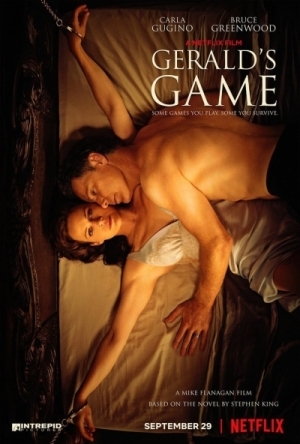
The horror film market is huge. Hundreds, if not thousands, of horror films are made every year, with only few standing out of the blood-drenched crowd. Netflix, with a penchant for outstanding horrors and thrillers, decided to hop on the horror flick train, bringing about an adaptation of Stephen King’s terrifying novel ‘Gerald’s Game’.
The film follows Jessie (Carla Gugino) and her husband, Gerald (Bruce Greenwood), as they head to a remote lake house in order to spice up their marriage. One thing leads to another, and then Gerald has a heart attack and dies, leaving Jessie handcuffed to the bed with the keys out of reach. She must then fight to survive, whilst having a few disturbing flashbacks and encounters along the way.
This movie is really disturbing. Like, really, really disturbing. It’s not particularly scary, there’s the odd jump-scare or three, but its the imagery and the situation that really get your heart going.
Carla Gugino as the shackled wife is a stand-out in this film. She basically carries it, only with a few interruptions from inside her head, and this makes for very entertaining viewing. She’s amusing, in a way that you didn’t think anyone could be whilst fighting dehydration, a hungry dog at the end of her bed and death himself. In all honesty, it’s not a very fun game.
Her husband, however, is brilliant at being horrible. Greenwood really amps up the bad husband vibes in the 20 minutes he is alive, which then are exacerbated in Jessie’s head after he has died. He’s manipulative, seedy and slimy: something that Jessie realises at the end of the film.
It could be argued that this film isn’t really a horror film in the typical sense. It’s more a horror film about what has happened to Jessie, the main character, and how she comes to terms with her past and survives. She calls on past experiences to escape her confines on the bed, and her horrible history.
That’s not to say that it doesn’t have stereotypical horror movie attributes. The Moonlight Man is their contribution to the supernatural – or more the ‘is he actually there or am I insane?’ kind of gimmick that sometimes comes with this genre. The Moonlight Man is a shadowy figure, lurking in the shadows with his box of trinkets and bones. He’s absolutely terrifying.
He’s also real. In the film and book, he’s a necrophiliac who’s waiting for Jessie to die so he can add her wedding ring and one of her bones to his box. The Moonlight Man is the kind of horror movie villain that you have nightmares about. Which is why he is one of the highlights of Gerald’s Game.
The film isn’t exactly the most complex plot in the world. It plays a bit too much on the stereotypes in some cases and the ending, in true horror film fashion, is too happy, is too well put together after such a traumatic experience. It all ends a bit too neatly after such a messy first three-quarters.
Even though this isn’t the best horror film ever, it certainly is not the worst. It has it’s flaws, but the acting and the scriptwriting make up for the few it has. In an era of horror trying too hard, this film is simple and refreshing, bringing a new feeling to the horror industry as a whole.
So, the moral of the story is: don’t handcuff yourself to the bed because your husband will die on top of you and then a stray dog will eat him and a necrophiliac will come into your house at night. Quite an easy thing to remember, right?
https://moviemetropolis.net/2017/12/06/geralds-game-review-not-a-very-fun-game/
The film follows Jessie (Carla Gugino) and her husband, Gerald (Bruce Greenwood), as they head to a remote lake house in order to spice up their marriage. One thing leads to another, and then Gerald has a heart attack and dies, leaving Jessie handcuffed to the bed with the keys out of reach. She must then fight to survive, whilst having a few disturbing flashbacks and encounters along the way.
This movie is really disturbing. Like, really, really disturbing. It’s not particularly scary, there’s the odd jump-scare or three, but its the imagery and the situation that really get your heart going.
Carla Gugino as the shackled wife is a stand-out in this film. She basically carries it, only with a few interruptions from inside her head, and this makes for very entertaining viewing. She’s amusing, in a way that you didn’t think anyone could be whilst fighting dehydration, a hungry dog at the end of her bed and death himself. In all honesty, it’s not a very fun game.
Her husband, however, is brilliant at being horrible. Greenwood really amps up the bad husband vibes in the 20 minutes he is alive, which then are exacerbated in Jessie’s head after he has died. He’s manipulative, seedy and slimy: something that Jessie realises at the end of the film.
It could be argued that this film isn’t really a horror film in the typical sense. It’s more a horror film about what has happened to Jessie, the main character, and how she comes to terms with her past and survives. She calls on past experiences to escape her confines on the bed, and her horrible history.
That’s not to say that it doesn’t have stereotypical horror movie attributes. The Moonlight Man is their contribution to the supernatural – or more the ‘is he actually there or am I insane?’ kind of gimmick that sometimes comes with this genre. The Moonlight Man is a shadowy figure, lurking in the shadows with his box of trinkets and bones. He’s absolutely terrifying.
He’s also real. In the film and book, he’s a necrophiliac who’s waiting for Jessie to die so he can add her wedding ring and one of her bones to his box. The Moonlight Man is the kind of horror movie villain that you have nightmares about. Which is why he is one of the highlights of Gerald’s Game.
The film isn’t exactly the most complex plot in the world. It plays a bit too much on the stereotypes in some cases and the ending, in true horror film fashion, is too happy, is too well put together after such a traumatic experience. It all ends a bit too neatly after such a messy first three-quarters.
Even though this isn’t the best horror film ever, it certainly is not the worst. It has it’s flaws, but the acting and the scriptwriting make up for the few it has. In an era of horror trying too hard, this film is simple and refreshing, bringing a new feeling to the horror industry as a whole.
So, the moral of the story is: don’t handcuff yourself to the bed because your husband will die on top of you and then a stray dog will eat him and a necrophiliac will come into your house at night. Quite an easy thing to remember, right?
https://moviemetropolis.net/2017/12/06/geralds-game-review-not-a-very-fun-game/
Gareth Michael Lewis (6 KP) rated Star Trek: Discovery in TV
Feb 26, 2018
Not the Star Trek we've come to know...
Contains spoilers, click to show
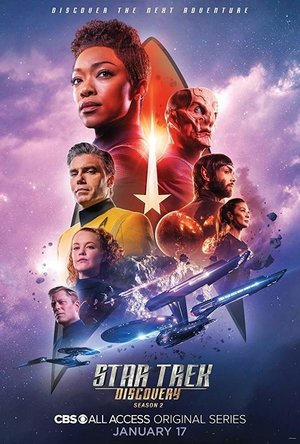
I did not have high hopes for this new series. I read every snippet of news about reshoots, cast changes, problems, etc. and I really could not see this new series living up to the ideals of all the Treks gone by. That said, I sat and watched it each week on Netflix and tried, really tried, to keep an open mind.
To begin, this series IS Star Trek. It has the ships. It has the Federation. It has the USS Enterprise (mentioned and seen). So why all the fuss?
Well, firstly, we have the Klingons. They look nothing like their predecessors in any other show. Alright, in The Original Series (TOS) they looked like fake-tanned, mustachioed humans and then they had forehead ridges in The Motion Picture and Next Generation (TNG) and we got over that quickly enough (they even explained why the ridgless Klingons existed in Star Trek Enterprise). Why the hostility towards the new Klingons in STD? Is it because they took an iconic villian and remade them for a more modern audience? Changing the appearance of ships, costumes and make-up along the way? Apparently so. But what series hasn't updated their villains as technology allows them to? Doctor Who's TARDIS has changed appearance more than once as have the Daleks. Didn't Battlestar Galactica face similar issues with the rebooted series? Of course. But we Trekkies can be an unforgiving bunch. Move past the updates to ships, uniforms and even aliens and judge the show on its own merits.
That leads us to the next bit.
Network executives seem to think that a more modern audience needs something edgier to keep them interested. So STD contains bloody violence, torture, f-words, naked Klingon sex (I did not need to see Klingon, armour-plated boobs) and is clearly made for an "adult" audience. My introduction to Star Trek was TNG, and I went back to TOS because I loved it. Then onto DS9 and Voyager. Even Enterprise, which played with established canon like a child in a sandpit, felt like something I'd let my kids watch. STD is like Game of Thrones in space, just with less incest. My kids will not be allowed to see this until they are much, much older.
The show itself is very pretty to look at, acted capably by almost everyone who has screentime and has characters I grew to genuinely like, but the writing was lazy. We were promised a Federation/Klingon war then somehow missed the whole thing by the final episode. The final episode itself seemed like an exercise in "how to end a season quickly and in the least satisfying way possible".
I wanted to give this series a higher score, I really did. I moved it from 7 to 6 and back to 7 again and again until I stuck with 6 because, although it has moments of brilliance, these moments are telegraphed so far in advance of happening you just can't bring yourself to be surprised by any of it. Almost every plot twist is so obvious that the writers seem to be waiting for a pat on the back at how cleverly they revealed the twist to you rather than trying to genuinely amaze you. It had such potential, it really did. The opening credits are beautiful, the music perfect. The ships are great (I play Star Trek Online so updated ships don't faze me that much). The crew are awesome, with dynamics that shift wonderfully and made me want to see more. But... alas.
If you want to watch a Star Trek series that pushes sci-fi, political and societal boundaries then go back and watch TOS, TNG, DS9 or even Voyager. If you want to watch a "Star Trek" series that does all of that for a modern audience... watch The Orville.
To begin, this series IS Star Trek. It has the ships. It has the Federation. It has the USS Enterprise (mentioned and seen). So why all the fuss?
Well, firstly, we have the Klingons. They look nothing like their predecessors in any other show. Alright, in The Original Series (TOS) they looked like fake-tanned, mustachioed humans and then they had forehead ridges in The Motion Picture and Next Generation (TNG) and we got over that quickly enough (they even explained why the ridgless Klingons existed in Star Trek Enterprise). Why the hostility towards the new Klingons in STD? Is it because they took an iconic villian and remade them for a more modern audience? Changing the appearance of ships, costumes and make-up along the way? Apparently so. But what series hasn't updated their villains as technology allows them to? Doctor Who's TARDIS has changed appearance more than once as have the Daleks. Didn't Battlestar Galactica face similar issues with the rebooted series? Of course. But we Trekkies can be an unforgiving bunch. Move past the updates to ships, uniforms and even aliens and judge the show on its own merits.
That leads us to the next bit.
Network executives seem to think that a more modern audience needs something edgier to keep them interested. So STD contains bloody violence, torture, f-words, naked Klingon sex (I did not need to see Klingon, armour-plated boobs) and is clearly made for an "adult" audience. My introduction to Star Trek was TNG, and I went back to TOS because I loved it. Then onto DS9 and Voyager. Even Enterprise, which played with established canon like a child in a sandpit, felt like something I'd let my kids watch. STD is like Game of Thrones in space, just with less incest. My kids will not be allowed to see this until they are much, much older.
The show itself is very pretty to look at, acted capably by almost everyone who has screentime and has characters I grew to genuinely like, but the writing was lazy. We were promised a Federation/Klingon war then somehow missed the whole thing by the final episode. The final episode itself seemed like an exercise in "how to end a season quickly and in the least satisfying way possible".
I wanted to give this series a higher score, I really did. I moved it from 7 to 6 and back to 7 again and again until I stuck with 6 because, although it has moments of brilliance, these moments are telegraphed so far in advance of happening you just can't bring yourself to be surprised by any of it. Almost every plot twist is so obvious that the writers seem to be waiting for a pat on the back at how cleverly they revealed the twist to you rather than trying to genuinely amaze you. It had such potential, it really did. The opening credits are beautiful, the music perfect. The ships are great (I play Star Trek Online so updated ships don't faze me that much). The crew are awesome, with dynamics that shift wonderfully and made me want to see more. But... alas.
If you want to watch a Star Trek series that pushes sci-fi, political and societal boundaries then go back and watch TOS, TNG, DS9 or even Voyager. If you want to watch a "Star Trek" series that does all of that for a modern audience... watch The Orville.

Hazel (1853 KP) rated Thirteen Reasons Why in Books
Dec 7, 2018

<i>This eBook was provided by the publisher via NetGalley in exchange for an honest review </i>
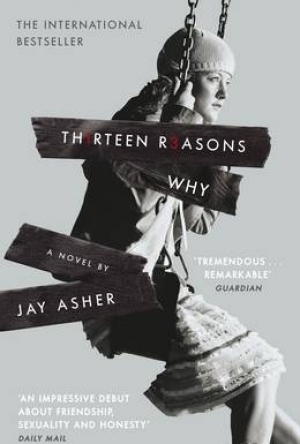
Recently filmed as a thirteen-part Netflix drama executively produced by Selena Gomez, <i>Thirteen Reasons Why</i> was the first novel by the award-winning author, Jay Asher. It is the type of book readers will either love or hate, but it should definitely come with a warning. This story is NOT an accurate representation of depression and suicide.
Yes, suicide. A teenaged girl has committed suicide, shocking everyone who knew her. No one could understand why, but thirteen people are going to find out. Clay Jensen is the ninth person to receive a box of thirteen audiotapes from Hannah Baker. However, Hannah died two weeks ago. As she premeditated taking her life, Hannah recorded thirteen stories involving people from her school that caused her to snowball into deep depression and despair. Desperate to find out why his name features in Hannah’s story, Clay begins listening to the tapes in order, putting together the events that led to Hannah’s death.
What follows is a heart-breaking story showing the impact individuals have on other people’s lives, often without realising it. In some cases, the characters only played a minor role in Hannah’s life, whereas others caused significant damage. The saddest thing is, Clay could have helped Hannah, but she had pushed him away.
At times, Hannah seemed like the horrible person, calling all these people out on petty little things, but these things, along with the more horrible ones, all built up to create a life that did not feel worth living. It is eye opening how much a small action, comment or rumour can so drastically alter someone’s future.
Bearing in mind that depression affects everyone differently and has numerous causes, some readers may feel disgusted at Hannah’s extreme action, but this is the fault of the author. Jay Asher fails to completely describe the emotional torment that Hannah felt, and only someone who may have been through a similar situation, or worse, will fully be able to understand the impact everything has had on her mental health.
As Hannah beleaguers her listeners, the thirteen people start to feel like the victims rather than the “attackers”, which is most probably not what the author was intending. Now, these people will have to live their lives believing they caused a girl to commit suicide when really they were only 1/13th of the reason. Although, before criticising this novel, keep in mind it is a work of fiction.
What is most painful about <i>Thirteen Reasons Why</i>, is not Hannah’s plight, but the reaction Clay has to hearing Hannah’s story. Unlike the other people Hannah accuses, Clay is not one of her antagonists; all Hannah wants to do is to say sorry.
It is up to the reader to judge whether <i>Thirteen Reasons Why</i> is worthy of praise or not. Those without an understanding of depression may dislike it on account of misunderstanding Hannah’s reasons, whereas others may feel insulted that she killed herself over things that could have been eased had she told someone. Personally, I understand where Hannah is coming from, and although I would not go to the extremes Hannah did, I do not think she was selfish or stupid or any other insult that may befall her.
The reason I give this book a good rating lies in the quality of writing. Asher seamlessly alternates between two narratives – Hannah’s story and Clay’s reaction and reflection. Although the author may not have clearly expressed Hannah’s emotions, he successful emphasises the grief and despair Clay feels listening to the cassettes. My main concern is that <i>Thirteen Reasons Why</i> will only be short lived. Audiotapes were already obsolete when the book was published, but soon will there be any new readers who know what a tape is?
Recently filmed as a thirteen-part Netflix drama executively produced by Selena Gomez, <i>Thirteen Reasons Why</i> was the first novel by the award-winning author, Jay Asher. It is the type of book readers will either love or hate, but it should definitely come with a warning. This story is NOT an accurate representation of depression and suicide.
Yes, suicide. A teenaged girl has committed suicide, shocking everyone who knew her. No one could understand why, but thirteen people are going to find out. Clay Jensen is the ninth person to receive a box of thirteen audiotapes from Hannah Baker. However, Hannah died two weeks ago. As she premeditated taking her life, Hannah recorded thirteen stories involving people from her school that caused her to snowball into deep depression and despair. Desperate to find out why his name features in Hannah’s story, Clay begins listening to the tapes in order, putting together the events that led to Hannah’s death.
What follows is a heart-breaking story showing the impact individuals have on other people’s lives, often without realising it. In some cases, the characters only played a minor role in Hannah’s life, whereas others caused significant damage. The saddest thing is, Clay could have helped Hannah, but she had pushed him away.
At times, Hannah seemed like the horrible person, calling all these people out on petty little things, but these things, along with the more horrible ones, all built up to create a life that did not feel worth living. It is eye opening how much a small action, comment or rumour can so drastically alter someone’s future.
Bearing in mind that depression affects everyone differently and has numerous causes, some readers may feel disgusted at Hannah’s extreme action, but this is the fault of the author. Jay Asher fails to completely describe the emotional torment that Hannah felt, and only someone who may have been through a similar situation, or worse, will fully be able to understand the impact everything has had on her mental health.
As Hannah beleaguers her listeners, the thirteen people start to feel like the victims rather than the “attackers”, which is most probably not what the author was intending. Now, these people will have to live their lives believing they caused a girl to commit suicide when really they were only 1/13th of the reason. Although, before criticising this novel, keep in mind it is a work of fiction.
What is most painful about <i>Thirteen Reasons Why</i>, is not Hannah’s plight, but the reaction Clay has to hearing Hannah’s story. Unlike the other people Hannah accuses, Clay is not one of her antagonists; all Hannah wants to do is to say sorry.
It is up to the reader to judge whether <i>Thirteen Reasons Why</i> is worthy of praise or not. Those without an understanding of depression may dislike it on account of misunderstanding Hannah’s reasons, whereas others may feel insulted that she killed herself over things that could have been eased had she told someone. Personally, I understand where Hannah is coming from, and although I would not go to the extremes Hannah did, I do not think she was selfish or stupid or any other insult that may befall her.
The reason I give this book a good rating lies in the quality of writing. Asher seamlessly alternates between two narratives – Hannah’s story and Clay’s reaction and reflection. Although the author may not have clearly expressed Hannah’s emotions, he successful emphasises the grief and despair Clay feels listening to the cassettes. My main concern is that <i>Thirteen Reasons Why</i> will only be short lived. Audiotapes were already obsolete when the book was published, but soon will there be any new readers who know what a tape is?

Emma @ The Movies (1786 KP) rated Little Women (2019) in Movies
Dec 27, 2019
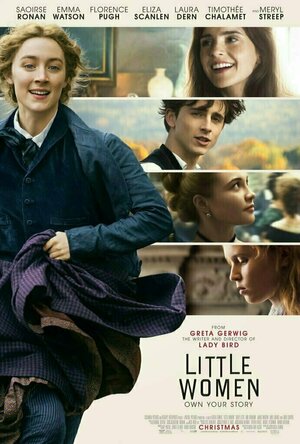

The top billing cast on IMDb read like my top list of reasons not to see a film. Saoirse Ronan, Emma Watson, Florence Pugh and Timothée Chalamet... all are raved about by various people but all have their own quirks that I can't stand to watch on screen. Chalamet did redeem himself with The King earlier this year for Netflix but none of the others have done anything recently to sway me.
Of course here's where I have to eat my words... Saoirse Ronan as Jo gave a very solid performance in Little Women and I enjoyed her throughout the whole thing. Her scenes with Laurie (Chalamet) we particularly entertaining, if a little rollercoastery, but overall she had the right balance of forthright and funny that really helped the story progress.
We all know my feelings about Emma Watson (#notmyDisneyPrincess) and the trailer wasn't helping her case, her accent seemed to be on the dubious side in the few moments we saw. Thankfully in the full film it rounded out quite well. I still can't say I'm a fan though, while moments of her performance amused me when they should and help some power in them I couldn't help but think she still hasn't found a genre of film that suits her.
Florence Pugh's overly dramatic and divaish Amy was by far my favourite of all the sisters. While bratty and a little spoilt every piece fit together perfectly and Pugh managed to add just the right amount of childish behaviour when it was needed.
Marmee was a wonderful character to watch and Laura Dern was an excellent choice. I feel like she's having a mainstream resurgence recently and it's well deserved.
The only other cast member I want to mention is Meryl Streep, we can't ignore her in a cast list! I love Meryl (who doesn't!?) and the light humour in Aunt March's sternness is delightful, but I don't think I like seeing her play old characters. I know she's 70 but she isn't 70 in my head and that's the way she must stay.
The palette of this whole film feels very much like a vintage filter, the colours and hues all sit well with the historical setting and in the March house give a wonderful sense of homeliness. Locations, sets and costumes all back this up and it comes together for an excellent visual retelling of the classic novel.
Emotion throughout the film was always very well matched to the scenes and when that thing happens that we won't talk about... because spoilers... I found myself wanting to do a Joey and put the film in the freezer while I cried my eyes out, the scene was set up incredibly well and the symmetry was beautiful as well as heartbreaking.
With all this great stuff going on in Little Women it bugs me that I had something to quibble about. A few times during the film we get a character doing a voiceover that then transitions to them speaking at the camera... eh, no. It was so out of place with the rest of the perfectly balanced film that I looked on with a furrowed brow and wrote a grumbly comment in my notes.
Given that last issue I'm forced to make a deduction. It was difficult trying to work out what to score this, there were so many wonderful pieces and I will be seeing it again soon, but, period dramas don't tend to make it into my home rewatch list so it should have got a 4... but it really deserved the extra half.
Originally posted on: https://emmaatthemovies.blogspot.com/2019/12/little-women-movie-review.html
Of course here's where I have to eat my words... Saoirse Ronan as Jo gave a very solid performance in Little Women and I enjoyed her throughout the whole thing. Her scenes with Laurie (Chalamet) we particularly entertaining, if a little rollercoastery, but overall she had the right balance of forthright and funny that really helped the story progress.
We all know my feelings about Emma Watson (#notmyDisneyPrincess) and the trailer wasn't helping her case, her accent seemed to be on the dubious side in the few moments we saw. Thankfully in the full film it rounded out quite well. I still can't say I'm a fan though, while moments of her performance amused me when they should and help some power in them I couldn't help but think she still hasn't found a genre of film that suits her.
Florence Pugh's overly dramatic and divaish Amy was by far my favourite of all the sisters. While bratty and a little spoilt every piece fit together perfectly and Pugh managed to add just the right amount of childish behaviour when it was needed.
Marmee was a wonderful character to watch and Laura Dern was an excellent choice. I feel like she's having a mainstream resurgence recently and it's well deserved.
The only other cast member I want to mention is Meryl Streep, we can't ignore her in a cast list! I love Meryl (who doesn't!?) and the light humour in Aunt March's sternness is delightful, but I don't think I like seeing her play old characters. I know she's 70 but she isn't 70 in my head and that's the way she must stay.
The palette of this whole film feels very much like a vintage filter, the colours and hues all sit well with the historical setting and in the March house give a wonderful sense of homeliness. Locations, sets and costumes all back this up and it comes together for an excellent visual retelling of the classic novel.
Emotion throughout the film was always very well matched to the scenes and when that thing happens that we won't talk about... because spoilers... I found myself wanting to do a Joey and put the film in the freezer while I cried my eyes out, the scene was set up incredibly well and the symmetry was beautiful as well as heartbreaking.
With all this great stuff going on in Little Women it bugs me that I had something to quibble about. A few times during the film we get a character doing a voiceover that then transitions to them speaking at the camera... eh, no. It was so out of place with the rest of the perfectly balanced film that I looked on with a furrowed brow and wrote a grumbly comment in my notes.
Given that last issue I'm forced to make a deduction. It was difficult trying to work out what to score this, there were so many wonderful pieces and I will be seeing it again soon, but, period dramas don't tend to make it into my home rewatch list so it should have got a 4... but it really deserved the extra half.
Originally posted on: https://emmaatthemovies.blogspot.com/2019/12/little-women-movie-review.html

Bob Mann (459 KP) rated The Two Popes (2019) in Movies
Jan 26, 2020 (Updated Jan 26, 2020)
Fantastic performances from two old acting pros.
Being inaugurated as a new pope in the last century must have been a source of enormous pride. But there must also have been a nagging thought... at some point you are going to be paraded, stiff as a board, around your work courtyard before being taken back inside to your place of work and buried there!
All that changed in 2013 when Pope Benedict XVI resigned, the first pope to voluntarily do so since Pope Celestine V in 1294. (Pope Gregory XII also resigned in 1415, but he was effectively forced to).
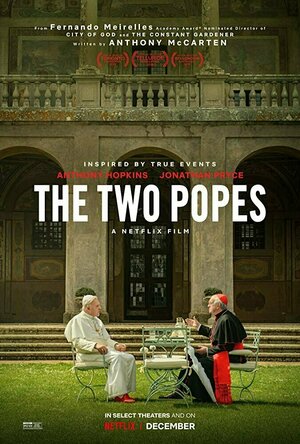
This movie tells the story of that curious situation, when Cardinal Jorge Bergoglio (played by Jonathan Pryce) ended up as Pope Francis while Benedict (Anthony Hopkins) was still alive. The official reason for the pope's resignation appears to have been his advanced age. But the film paints a rather different picture.
The movie starts back in 2005 as we enter the papal conclave. Benedict (Cardinal Ratzinger, as was) is the highly-political German cardinal who desperately wants the papacy; Bergoglio is the highly respected Argentinian cardinal who doesn't seek the office but might have it thrust upon him. (Clearly, when the white smoke clears, history has dictated the outcome).
But flash forward to 2013 and Bergoglio will get another bite of the cherry. Is he worthy of the role? Through flashbacks we return to Perón's unsettling rule over Argentina and the events that made the man.
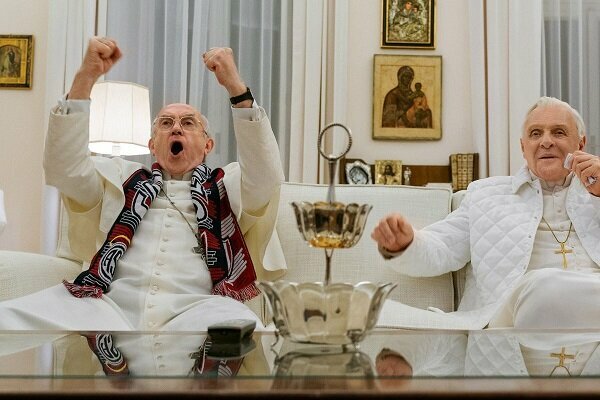
The two stars are simply outstanding together, and it's no surprise at all that both have been nominated in the Oscar acting categories. They are almost joint leads. But - perhaps to give the film its best awards-season shot - Pryce is down for Best Actor and Hopkins is down for Best Supporting Actor.
Anthony Hopkins in particular for me shone with the brilliant quietness and subtle facial movements that are the mark of a truly confident actor. Less is more.
I was enjoying this movie enormously up until we flashed back to the Argentinian sub-plot. Set in the time of Perón's "Dirty War" when a huge number of people - estimates range from 9,000 to 30,000 - simply went "missing". There's nothing wrong with this sequence of the film. For example, a reunion of Bergoglio with a persecuted priest, Father Jalics (Lisandro Fiks) - is brilliantly and movingly done. It's just that for me it seemed so disjointed. It was jarring to switch from this Evita-era drama to the gentle drama of the papal plot.
If the movie had been 30 minutes shorter and focused on the mental struggles of Benedict I would have preferred it. Curiously - we don't really get to fully understand his divergence from the faith. Bergoglio gets no end of back-story. But Ratzinger's is probably just as interesting, but not explored.
This is still a really fine movie and will appeal to older folks who like a story rich with character acting and not heavy on the action or special effects. The director is Fernando Meirelles (who interestingly directed the Rio Olympics opening ceremony!) and it's written by Anthony McCarten, the man behind the screenplays for "The Theory of Everything", "Darkest Hour" and "Bohemian Rhapsody".
You may still be able to find this in selected cinemas (e.g. Curzon) but it is also streaming on Netflix, which is where I had to watch it.
(For the full graphical review, please check out One Mann's Movies at https://bob-the-movie-man.com/2020/01/26/one-manns-movies-film-review-the-two-popes-2019/ ).
All that changed in 2013 when Pope Benedict XVI resigned, the first pope to voluntarily do so since Pope Celestine V in 1294. (Pope Gregory XII also resigned in 1415, but he was effectively forced to).
This movie tells the story of that curious situation, when Cardinal Jorge Bergoglio (played by Jonathan Pryce) ended up as Pope Francis while Benedict (Anthony Hopkins) was still alive. The official reason for the pope's resignation appears to have been his advanced age. But the film paints a rather different picture.
The movie starts back in 2005 as we enter the papal conclave. Benedict (Cardinal Ratzinger, as was) is the highly-political German cardinal who desperately wants the papacy; Bergoglio is the highly respected Argentinian cardinal who doesn't seek the office but might have it thrust upon him. (Clearly, when the white smoke clears, history has dictated the outcome).
But flash forward to 2013 and Bergoglio will get another bite of the cherry. Is he worthy of the role? Through flashbacks we return to Perón's unsettling rule over Argentina and the events that made the man.
The two stars are simply outstanding together, and it's no surprise at all that both have been nominated in the Oscar acting categories. They are almost joint leads. But - perhaps to give the film its best awards-season shot - Pryce is down for Best Actor and Hopkins is down for Best Supporting Actor.
Anthony Hopkins in particular for me shone with the brilliant quietness and subtle facial movements that are the mark of a truly confident actor. Less is more.
I was enjoying this movie enormously up until we flashed back to the Argentinian sub-plot. Set in the time of Perón's "Dirty War" when a huge number of people - estimates range from 9,000 to 30,000 - simply went "missing". There's nothing wrong with this sequence of the film. For example, a reunion of Bergoglio with a persecuted priest, Father Jalics (Lisandro Fiks) - is brilliantly and movingly done. It's just that for me it seemed so disjointed. It was jarring to switch from this Evita-era drama to the gentle drama of the papal plot.
If the movie had been 30 minutes shorter and focused on the mental struggles of Benedict I would have preferred it. Curiously - we don't really get to fully understand his divergence from the faith. Bergoglio gets no end of back-story. But Ratzinger's is probably just as interesting, but not explored.
This is still a really fine movie and will appeal to older folks who like a story rich with character acting and not heavy on the action or special effects. The director is Fernando Meirelles (who interestingly directed the Rio Olympics opening ceremony!) and it's written by Anthony McCarten, the man behind the screenplays for "The Theory of Everything", "Darkest Hour" and "Bohemian Rhapsody".
You may still be able to find this in selected cinemas (e.g. Curzon) but it is also streaming on Netflix, which is where I had to watch it.
(For the full graphical review, please check out One Mann's Movies at https://bob-the-movie-man.com/2020/01/26/one-manns-movies-film-review-the-two-popes-2019/ ).
Kirk Bage (1775 KP) rated Beasts of No Nation (2015) in Movies
Mar 3, 2020 (Updated Jul 9, 2020)
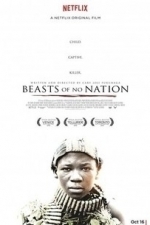
As I may have mentioned, a lot of my film viewing over the last wee while has been part of a project that hopes to be called 21st Century Cinema: 200 Essential films of the new millennium – which utilises the Decinemal system you will see at the bottom of each of my reviews. It aims to judge each film objectively with a score out of 10 over 10 categories, to give an overall rating out of 100.
Cary Joyi Fukunaga’s personal opus Beasts of no Nation, made for Netflix but good enough for a cinema release, falls into the category of films that have garnered enough critical acclaim to demand consideration for the top 200. It is the kind of film that you would always recommend, but may choose to overlook in search of a more basically entertaining watch.
Fukunaga has a fine pedigree already in his career, with credits on True Detective and the under-rated Sin Nombre from 2009. He has also been tasked with directing duties on the delayed Bond No Time To Die, which we hope to see before the new year now. He is a hands on, no messing about kind of guy, seemingly, taking on writing and cinematography duties also for this sad tale of child exploitation in an unnamed African war.
At times, it borders on documentary style, with an eye for strong visual images and extended silences, favoured over extraneous exposition and needless dialogue. A technique that makes the subject matter all the more uncomfortable to watch. Idris Elba adds big name weight in a fine supporting role, but the lion’s share of acting responsibility falls to young Abraham Attah, who is nothing short of astonishing in the most harrowing moments of this stark and sincere story.
I have to confess, this was another pre-lockdown watch for me, and as much as I can recall the feel and impact of it as a whole, I would struggle to talk about it in any detail after one viewing three months ago. And that is partly the reason it won’t quite make the lower benchmark of a strong 73 Decinemal score; for all its power it just isn’t quite memorable enough on every level, in the way something like City Of God, or even Beasts of the Southern Wild most definitely are.
Perhaps those are unfair comparisons, but it strives for the impact of the former without the flair, and has an independant feel without the charm of the latter. Not that flair or charm are priorities here. It simply wants to show you an issue you may not have been overly aware of, and demands that you empathise both with the complexity of the problem and with the tragic journey of Agu – a child robbed of all innocence by a terrible world.
The photography sits with the strong performances as a notable highlight; giving contrast to the devastation, depredation and desperation under the skin, and showing an angry beauty that dances beside it, showing brief moments of hope when we need them most, and therefore avoiding the trap of being too brutal to enjoy on any level. Which is a mistake similar films can fall prey too.
Violence and war are not light subjects. When the focus is also the lost soul of a child, the tightrope of melodrama and sentimentality is very fine. All involved here walk that line expertly, never once resorting to having to buy your care with familiar Hollywood tricks. In fact it couldn’t be further from Hollywood if it tried. And the drama is all the better for that.
A solid, fine movie, that is narrowly short of being truly great. But you should most definitely see it at some point if you haven’t already.
Cary Joyi Fukunaga’s personal opus Beasts of no Nation, made for Netflix but good enough for a cinema release, falls into the category of films that have garnered enough critical acclaim to demand consideration for the top 200. It is the kind of film that you would always recommend, but may choose to overlook in search of a more basically entertaining watch.
Fukunaga has a fine pedigree already in his career, with credits on True Detective and the under-rated Sin Nombre from 2009. He has also been tasked with directing duties on the delayed Bond No Time To Die, which we hope to see before the new year now. He is a hands on, no messing about kind of guy, seemingly, taking on writing and cinematography duties also for this sad tale of child exploitation in an unnamed African war.
At times, it borders on documentary style, with an eye for strong visual images and extended silences, favoured over extraneous exposition and needless dialogue. A technique that makes the subject matter all the more uncomfortable to watch. Idris Elba adds big name weight in a fine supporting role, but the lion’s share of acting responsibility falls to young Abraham Attah, who is nothing short of astonishing in the most harrowing moments of this stark and sincere story.
I have to confess, this was another pre-lockdown watch for me, and as much as I can recall the feel and impact of it as a whole, I would struggle to talk about it in any detail after one viewing three months ago. And that is partly the reason it won’t quite make the lower benchmark of a strong 73 Decinemal score; for all its power it just isn’t quite memorable enough on every level, in the way something like City Of God, or even Beasts of the Southern Wild most definitely are.
Perhaps those are unfair comparisons, but it strives for the impact of the former without the flair, and has an independant feel without the charm of the latter. Not that flair or charm are priorities here. It simply wants to show you an issue you may not have been overly aware of, and demands that you empathise both with the complexity of the problem and with the tragic journey of Agu – a child robbed of all innocence by a terrible world.
The photography sits with the strong performances as a notable highlight; giving contrast to the devastation, depredation and desperation under the skin, and showing an angry beauty that dances beside it, showing brief moments of hope when we need them most, and therefore avoiding the trap of being too brutal to enjoy on any level. Which is a mistake similar films can fall prey too.
Violence and war are not light subjects. When the focus is also the lost soul of a child, the tightrope of melodrama and sentimentality is very fine. All involved here walk that line expertly, never once resorting to having to buy your care with familiar Hollywood tricks. In fact it couldn’t be further from Hollywood if it tried. And the drama is all the better for that.
A solid, fine movie, that is narrowly short of being truly great. But you should most definitely see it at some point if you haven’t already.
Kirk Bage (1775 KP) rated Black Mirror - Season 2 in TV
Mar 3, 2020
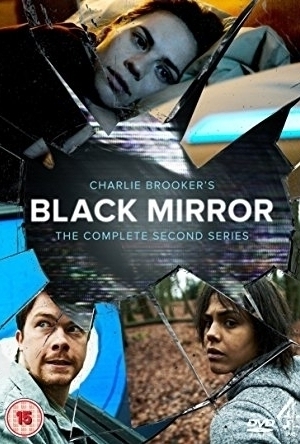
Be Right Back - 8
Hayley Atwell, best known as Captain America’s squeeze in the MCU, Carries the emotional weight of this episode in beguiling style. Not for the last time Black Mirror enters the territory of death, grief, loneliness and questions of a tech-aided afterlife. If it were possible to bring a loved one back in physical form, even though we knew it wasn’t really them, would we be tempted to do it? Entirely believable as a concept, considering the amount of data we are storing about ourselves on social media and in other digital ways. Although any kind of clone as good as Domhnall Gleason is a bit far fetched for now. What works here is realising that no matter how good a facsimile is, it is the myriad of tiny details that make a person that we miss the most, even the imperfections. Genuinely moving in its best moments, and a strong start to season 2 in 2013.
White Bear - 7.5
White Bear, the first of the “blind” episodes, where we as viewer are thrown into a situation with no explanation or context, was the first Black Mirror episode I ever watched. I remember being blown away by the dark concept, compelling nature of the minimal narrative, the cunning twist, and the boldness of the statement seemingly being made. So many themes are going on at the same time here: true crime as voyeuristic entertainment; the moral idea of an eye for an eye, brainwashing, and whether torture under any circumstance can be justified, for starters. Looking back, it isn’t the most rounded tale in the canon, or the best acted, but it is certainly very memorable. It also saw the birth of the White Bear symbol, which pops up in other episodes regularly, if paying attention. What is its meaning? The jury is still out!
The Waldo Moment - 6
The political apathy of a nation, and hatred of the personality flaws of our politicians could lead to a figurehead without real policies being elected and revered – it isn’t a very strange idea in 2020 at all. Many younger voters have been incited to demand change, without any idea of what that change should entail. So, in concept, this episode is right on the money. Trouble is it isn’t well written enough to sustain the drama or intrigue in the way the best of the canon do. The shock value is low, and therefore the reaction is “meh, fair enough”. For me, the first real blip in quality control for the series.
White Christmas - 8.5
This was the transition episode that saw Black Mirror make the big money move from Channel 4 to Netflix. Although now bundled into series two, it was a 21 month wait after The Waldo Moment before over 2 million of us settled down to this Christmas gift in 2014. It comes over as an anthology within an anthology, with John Hamm and Rafe Spall telling tales in front of the fire whilst on a “job” together in the cold wilderness of an unknown location. It is laden with ideas of technology back-firing, and is very satisfying in how quickly it moves through the plot points. The chemistry of the two lead men is great; the arrogance of one and the nervousness of the other allowing for some beautiful twists and turns. Essentially, the whole thing is either a re-working of ideas already used, or a precursor to future ideas that will be more fleshed out. Not that it really matters. This is the highest rated individual episode on IMDb, and the reason for that has to be its accessibility. The balance between being creeped out and entertained is just about perfect.
Hayley Atwell, best known as Captain America’s squeeze in the MCU, Carries the emotional weight of this episode in beguiling style. Not for the last time Black Mirror enters the territory of death, grief, loneliness and questions of a tech-aided afterlife. If it were possible to bring a loved one back in physical form, even though we knew it wasn’t really them, would we be tempted to do it? Entirely believable as a concept, considering the amount of data we are storing about ourselves on social media and in other digital ways. Although any kind of clone as good as Domhnall Gleason is a bit far fetched for now. What works here is realising that no matter how good a facsimile is, it is the myriad of tiny details that make a person that we miss the most, even the imperfections. Genuinely moving in its best moments, and a strong start to season 2 in 2013.
White Bear - 7.5
White Bear, the first of the “blind” episodes, where we as viewer are thrown into a situation with no explanation or context, was the first Black Mirror episode I ever watched. I remember being blown away by the dark concept, compelling nature of the minimal narrative, the cunning twist, and the boldness of the statement seemingly being made. So many themes are going on at the same time here: true crime as voyeuristic entertainment; the moral idea of an eye for an eye, brainwashing, and whether torture under any circumstance can be justified, for starters. Looking back, it isn’t the most rounded tale in the canon, or the best acted, but it is certainly very memorable. It also saw the birth of the White Bear symbol, which pops up in other episodes regularly, if paying attention. What is its meaning? The jury is still out!
The Waldo Moment - 6
The political apathy of a nation, and hatred of the personality flaws of our politicians could lead to a figurehead without real policies being elected and revered – it isn’t a very strange idea in 2020 at all. Many younger voters have been incited to demand change, without any idea of what that change should entail. So, in concept, this episode is right on the money. Trouble is it isn’t well written enough to sustain the drama or intrigue in the way the best of the canon do. The shock value is low, and therefore the reaction is “meh, fair enough”. For me, the first real blip in quality control for the series.
White Christmas - 8.5
This was the transition episode that saw Black Mirror make the big money move from Channel 4 to Netflix. Although now bundled into series two, it was a 21 month wait after The Waldo Moment before over 2 million of us settled down to this Christmas gift in 2014. It comes over as an anthology within an anthology, with John Hamm and Rafe Spall telling tales in front of the fire whilst on a “job” together in the cold wilderness of an unknown location. It is laden with ideas of technology back-firing, and is very satisfying in how quickly it moves through the plot points. The chemistry of the two lead men is great; the arrogance of one and the nervousness of the other allowing for some beautiful twists and turns. Essentially, the whole thing is either a re-working of ideas already used, or a precursor to future ideas that will be more fleshed out. Not that it really matters. This is the highest rated individual episode on IMDb, and the reason for that has to be its accessibility. The balance between being creeped out and entertained is just about perfect.
FarFaria Stories To Read Along
Education and Book
App
- “Brain Expander” –Parenting Magazine - “Netflix for Children's Books!” –USA Today -...

WeDo: Your second brain.
Productivity, Education and Stickers
App
See why WeDo has been praised by Forbes, Huffington Post, The Verge, Tech Crunch, and more! BEST...

Charlie Cobra Reviews (1840 KP) rated The Seven Deadly Sins in TV
Jul 6, 2020
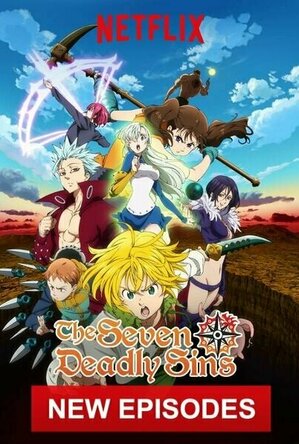
No Sins Deadlier - 8/10
The Seven Deadly Sins anime was created by A-1 Pictures and directed by Tensai Okamura. It was written by Shotaro Suga with Keigo Sasaki providing character designs and music by Hiroyuki Sawano. (Season1) The second season which is actually 4 television specials or episodes featured a story by Nakaba Suzuki. It was produced by A-1 Pictures and directed by Tomokazu Tokoro, Season 2 was also written by Yuniko Ayana and Yuichiro Kido, with character designs by Keigo Sasaki and music by Hiroyuki Sawano and Takafumi Wada. (Season2) Season 3 was an actual 24 episode season again with some changes to the creative team as well. Takeshi Furuta and Takao Yoshioka replaced Tensai Okamura and Shotaro Suga as director and series composer while most first season staff members to reprise their roles.
Once an active group of knights in the region of Britannia, "The Seven Deadly Sins" disbanded after supposedly plotting to overthrow the Liones Kingdom. Their defeat was believed to have been at the hands of the Holy Knights of Liones however persistent rumors continued that they were alive. Ten years later, the third princess, Elizabeth, begins her journey to find the "Seven Deadly Sins". She must get their help to save the Kingdom of Liones from the corrupt Holy Knights and those who plan to take over the kingdom.
This is a really great anime series. I can't believe it took me so long to get around to finishing it. They really left us hanging, waiting for season 2, and when Netflix released those 4 episodes as a whole season I was really confused. I was told by other fans of the series not to even watch them but to also not worry. A real season 2, or in this case season 3 was in the works and on the way. And not only were they right but a full length anime film released not long after. Anyways, sorry for getting off topic. The first thing I have to say when talking about this series is that there is a lot of "fan service". If you are not familiar with the term, in general fan service refers to scenes designed to excite or entice the viewer, usually of a racy or sexual nature. If that bothers you, this series is not for you. But if you can get past that there is a fantastical land of magic and knights with an epic tale of adventure waiting. At first I didn't like the character designs because to me the faces were very different from what I was use to at the time but then they grew on me and didn't seem to bother me as much. There are a lot of different looking characters, which I really enjoy seeing in anime, which was a plus to me. They also had a very interesting group dynamic since they were all based off of the seven deadly sins. There was good chemistry between the characters and a lot of camaraderie. I really enjoyed the enemies that they encountered in antagonist as well. Overall I give this series a 8/10.
If you liked this anime, after watching the entire series then watch the movie The Seven Deadly Sins Movie: Prisoners of the Sky.
Once an active group of knights in the region of Britannia, "The Seven Deadly Sins" disbanded after supposedly plotting to overthrow the Liones Kingdom. Their defeat was believed to have been at the hands of the Holy Knights of Liones however persistent rumors continued that they were alive. Ten years later, the third princess, Elizabeth, begins her journey to find the "Seven Deadly Sins". She must get their help to save the Kingdom of Liones from the corrupt Holy Knights and those who plan to take over the kingdom.
This is a really great anime series. I can't believe it took me so long to get around to finishing it. They really left us hanging, waiting for season 2, and when Netflix released those 4 episodes as a whole season I was really confused. I was told by other fans of the series not to even watch them but to also not worry. A real season 2, or in this case season 3 was in the works and on the way. And not only were they right but a full length anime film released not long after. Anyways, sorry for getting off topic. The first thing I have to say when talking about this series is that there is a lot of "fan service". If you are not familiar with the term, in general fan service refers to scenes designed to excite or entice the viewer, usually of a racy or sexual nature. If that bothers you, this series is not for you. But if you can get past that there is a fantastical land of magic and knights with an epic tale of adventure waiting. At first I didn't like the character designs because to me the faces were very different from what I was use to at the time but then they grew on me and didn't seem to bother me as much. There are a lot of different looking characters, which I really enjoy seeing in anime, which was a plus to me. They also had a very interesting group dynamic since they were all based off of the seven deadly sins. There was good chemistry between the characters and a lot of camaraderie. I really enjoyed the enemies that they encountered in antagonist as well. Overall I give this series a 8/10.
If you liked this anime, after watching the entire series then watch the movie The Seven Deadly Sins Movie: Prisoners of the Sky.