Search
Search results
Purple Phoenix Games (2266 KP) rated The Quest Kids in Tabletop Games
Mar 26, 2021
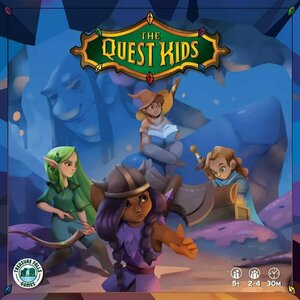
Have you heard of The Quest Kids? It’s a YouTube channel featuring six young adventurers as they use powerful “Tolk Gems” to help complete quests and protect the city of Treasure Falls. These kids are always striving for good and understanding, and are not afraid to do what is right in all scenarios. These Quest Kids are ideal role models for young children, and when I heard of board games based on the IP I knew my kids and I would love the games. Was my Faith Tolk Gem pointing me in the right direction, or has it gone dark for me? SPOILER: This game is great!
The Quest Kids is a dungeon crawler style board game for players as young as five years of age. Yes, FIVE! In it, players are acting as one of these Quest Kids, attempting to explore the cave of Tolk the Wise. The Quest Kids will find abilities to enhance their own, treasures to collect, and silly bad guys to scare away within, and the player with the most stars (VP) at the end will win the game!
DISCLAIMER: We were provided a copy of this game for the purposes of this review. This is a retail copy of the game, so what you see in these photos is exactly what would be received in your box. I do not intend to cover every single rule included in the rulebook, but will describe the overall game flow and major rule set so that our readers may get a sense of how the game plays. For more in depth rules, you may purchase a copy from the publisher online or from your FLGS. -T
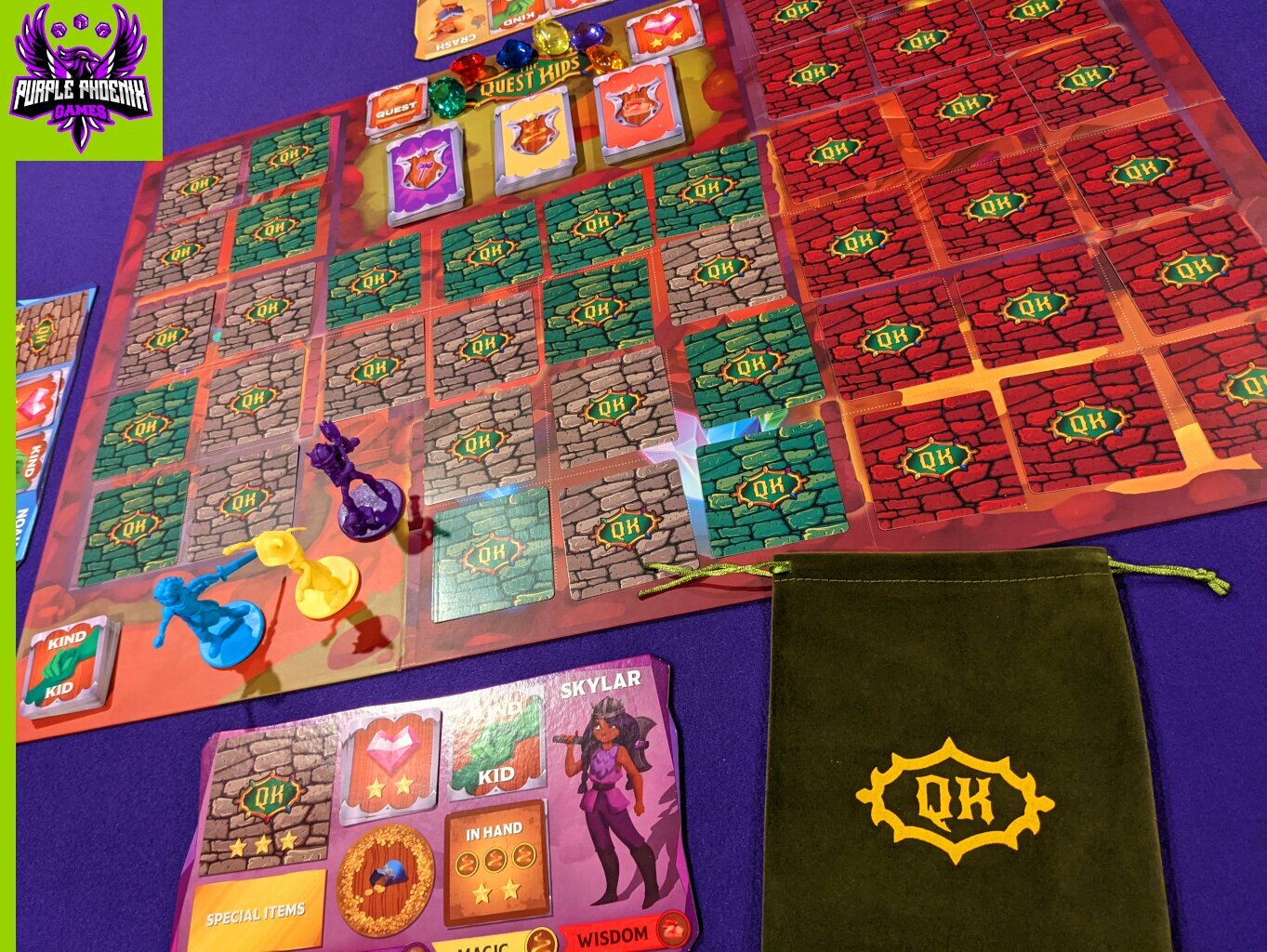
To setup, place the large game board on the table and populate it with the green, gray, and red Dungeon Tiles according to the rules. Also prepare the card decks and place them appropriately in their spaces on the board. The Treasure Tokens are placed in the Treasure Bag. Each player will receive one Quest Kid Player Mat and matching figurine. In addition each player will receive three starting Health Cards, one Quest Card, and one appropriate starting Ability Card. The game may now begin from the entrance to the cave!
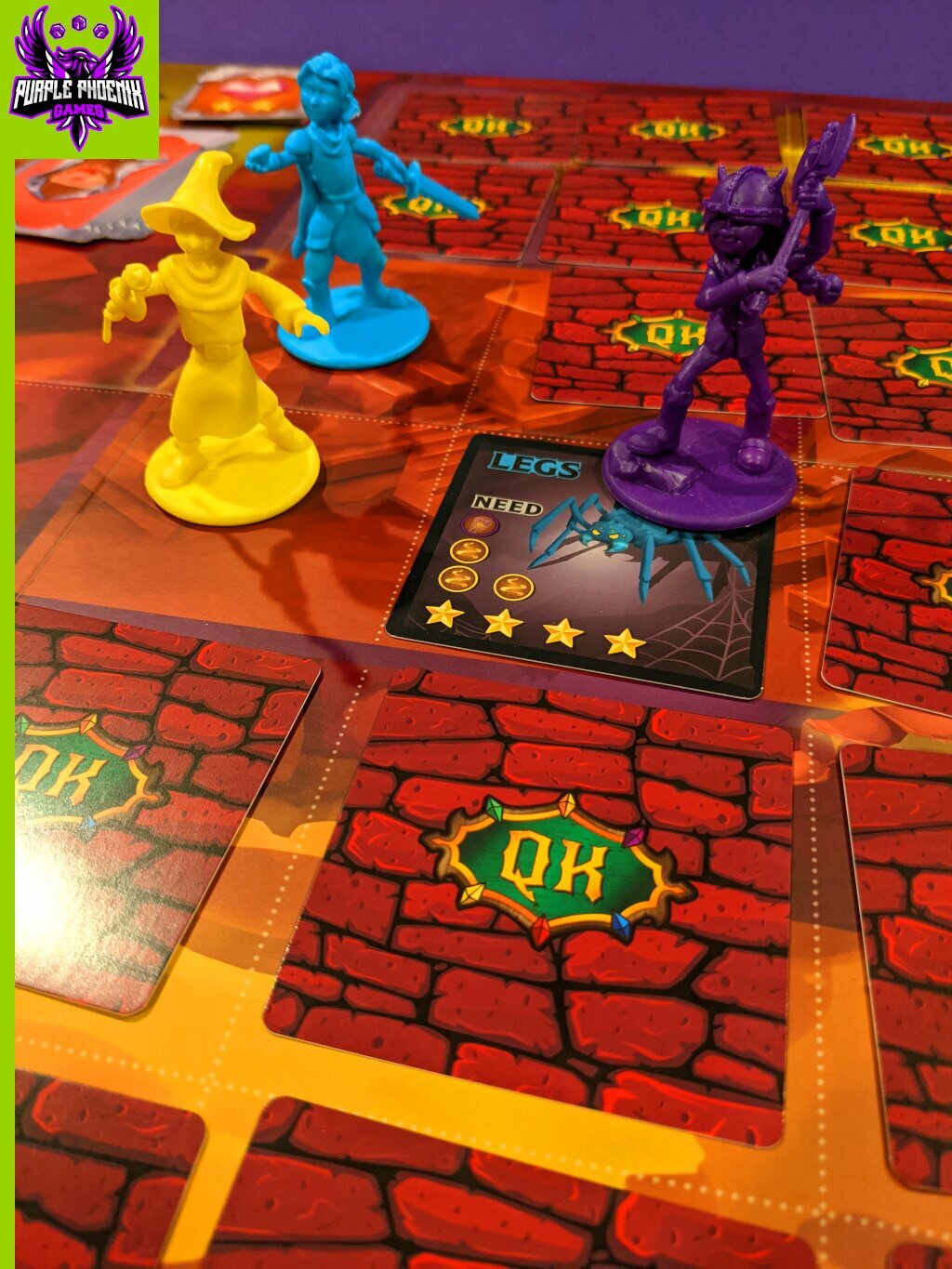
On a turn players will be able to have free movement around the board exploring tiles and resolving them in turns. Green tiles are always good for the players, Gray tiles may have some bad guys but are predominantly good, and Red tiles are littered with those silly bad guys that will need to be scared away. A player will travel to a board location and encounter a Dungeon Tile by flipping it over and collecting the resources shown or attempting to scare away the bad guys. Bad guys can be scared by discarding the printed Ability Cards on their tile. Once discarded, the player collects the tile to their Player Mat for stars at game end.
Sometimes players will encounter a bad guy they do not possess enough Ability Cards to scare away. In these scenarios the player may ask the other players for help. Nonactive players may then offer Ability Cards from their stash in order to help achieve the goal. For every Ability Card donated to the cause the donating Quest Kid will receive one Kind Kid Card. Kind Kid Cards are always great and can be resolved at ANY time during the game. Should a player encounter a bad guy they cannot scare away and other Quest Kids cannot help with Ability Cards, the active player will suffer a loss of one of their Health Cards (worth two stars).
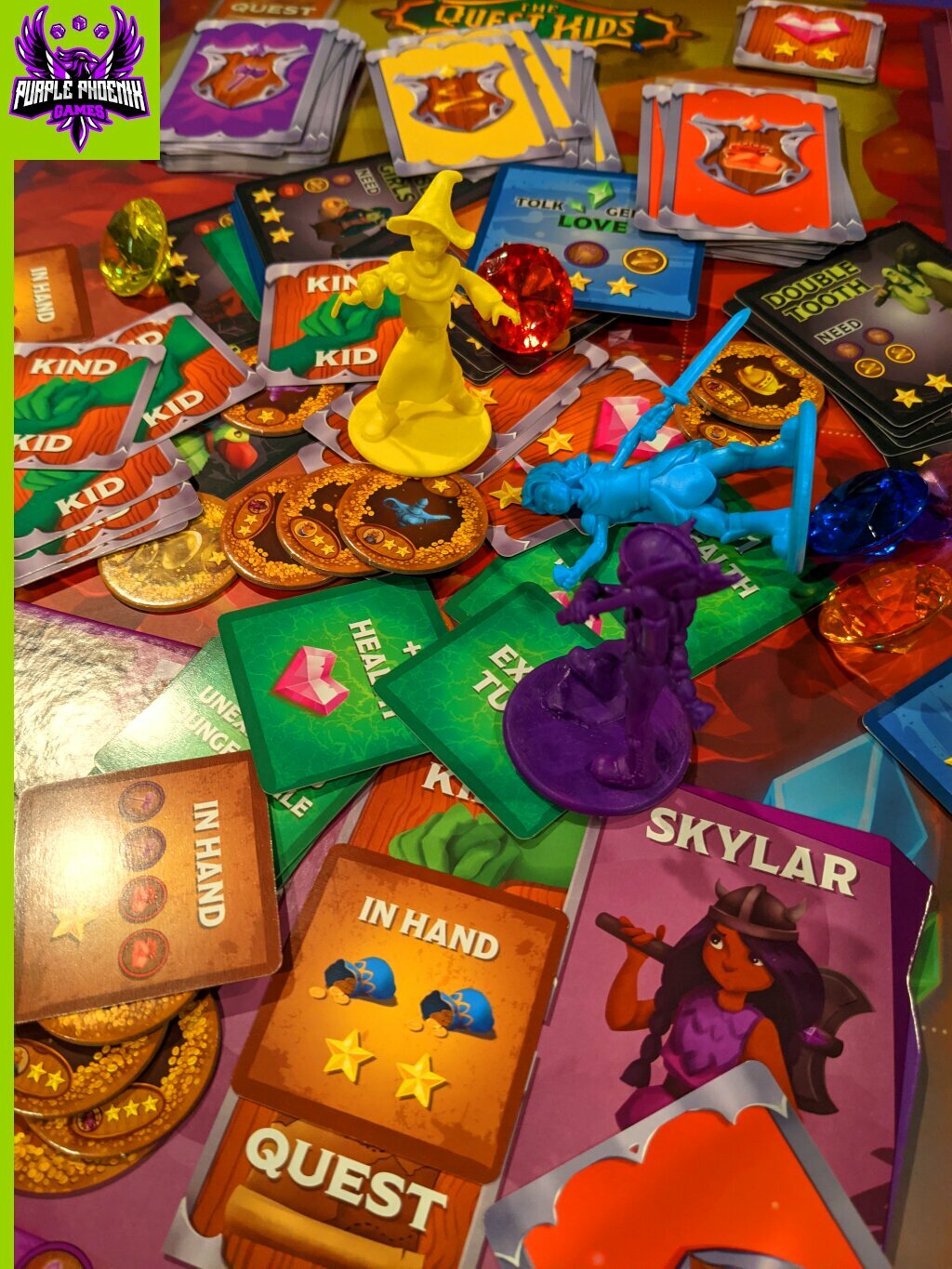
Some tiles or Quest cards will instruct the player to draw one or more treasures from the Treasure Bag. Most treasures are good and provide stars, but some are blobs that eat stars. Each Treasure Token also has two values. The top value is for the normal amount of stars. However, the bottom value is worth more stars if the controlling player matches the Quest Kid printed on the token. Some treasure may be worth just one star unless the Quest Kid is a match, in which case it is then worth three stars, for example.
Turns continue in this fashion until all Dungeon Tiles have been resolved or a stalemate reached. At this point all players count up their stars they have collected from various sources and the player with the most stars is the winner!
Components. This is a kids’ game, can we all agree? THIS kids’ game, however, boasts some of the most interesting and wonderful components I have seen. The board is huge and depicts a magical cave. Super cool. The tiles are easy to read and understand, as with all the iconography. The Quest Kids themselves all have the same abilities (unless the expansion is added – and the review for that is coming soon), so that smaller children are not burdened with having to remember their special abilities. There are these plastic Tolk Gems that can be collected during the game and children absolutely flip for these things. And did you see those colorful and very big minis? I mean, come on! It’s a kids’ game! They LOVE minis! The game also comes with cardboard standees in case your children cannot handle the minis carefully enough.
Here is the deal. I absolutely adore these Quest Kids games. They are absolutely the perfect difficulty for young gamers who are ready to step up from the Candy Lands and Chutes & Ladders. Now, the box suggests 5+ but my 4-year-old did just fine with it, so take that with a grain of salt. Having had him already familiarize himself with The Quest Kids characters in The Quest Kids: Matching Adventure, this was an easier process getting this game to the table for us.
The game gives an exciting dungeon crawl experience for younger children, and it’s honestly something I never really knew I needed in my life until I now have it. It is so simple to teach and play and definitely encourages helping other players, if even just because you receive those Kind Kid cards in return. Anything to create that helpful player atmosphere to prepare them for heavier cooperative games is much appreciated.
Please do not misunderstand me. The Quest Kids is targeting younger players, but I do believe that any aged gamer could appreciate and have a good time with this. It certainly will not fill the void of other dungeon crawlers, but if you need a fix and would like to spend 20-45 minutes playing something to scratch that itch, then pull out your copy of The Quest Kids. It is super-light, colorful, and is a perfect stepping stone to bigger cooperative games. Purple Phoenix Games (with special guest Finley) gives this one a Kind 11/12. Please visit the publisher’s website to pick up your copy, and have a great time introducing your children (or partners, in-laws, grannies, pets, whomever) to cooperative dungeon crawls that will have you leaving the table in a much better mood than when you sat down.
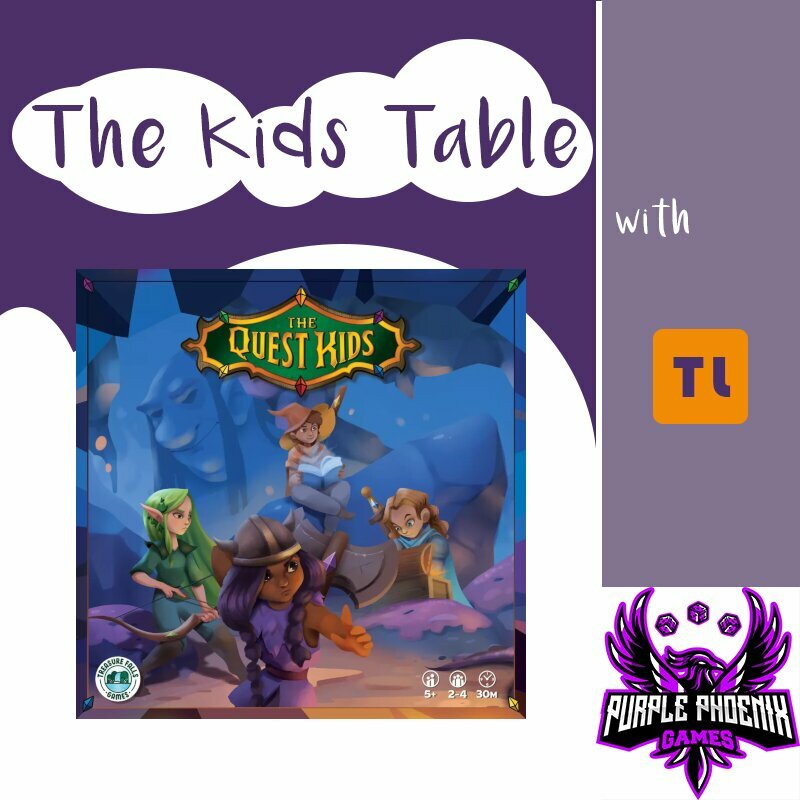
The Quest Kids is a dungeon crawler style board game for players as young as five years of age. Yes, FIVE! In it, players are acting as one of these Quest Kids, attempting to explore the cave of Tolk the Wise. The Quest Kids will find abilities to enhance their own, treasures to collect, and silly bad guys to scare away within, and the player with the most stars (VP) at the end will win the game!
DISCLAIMER: We were provided a copy of this game for the purposes of this review. This is a retail copy of the game, so what you see in these photos is exactly what would be received in your box. I do not intend to cover every single rule included in the rulebook, but will describe the overall game flow and major rule set so that our readers may get a sense of how the game plays. For more in depth rules, you may purchase a copy from the publisher online or from your FLGS. -T
To setup, place the large game board on the table and populate it with the green, gray, and red Dungeon Tiles according to the rules. Also prepare the card decks and place them appropriately in their spaces on the board. The Treasure Tokens are placed in the Treasure Bag. Each player will receive one Quest Kid Player Mat and matching figurine. In addition each player will receive three starting Health Cards, one Quest Card, and one appropriate starting Ability Card. The game may now begin from the entrance to the cave!
On a turn players will be able to have free movement around the board exploring tiles and resolving them in turns. Green tiles are always good for the players, Gray tiles may have some bad guys but are predominantly good, and Red tiles are littered with those silly bad guys that will need to be scared away. A player will travel to a board location and encounter a Dungeon Tile by flipping it over and collecting the resources shown or attempting to scare away the bad guys. Bad guys can be scared by discarding the printed Ability Cards on their tile. Once discarded, the player collects the tile to their Player Mat for stars at game end.
Sometimes players will encounter a bad guy they do not possess enough Ability Cards to scare away. In these scenarios the player may ask the other players for help. Nonactive players may then offer Ability Cards from their stash in order to help achieve the goal. For every Ability Card donated to the cause the donating Quest Kid will receive one Kind Kid Card. Kind Kid Cards are always great and can be resolved at ANY time during the game. Should a player encounter a bad guy they cannot scare away and other Quest Kids cannot help with Ability Cards, the active player will suffer a loss of one of their Health Cards (worth two stars).
Some tiles or Quest cards will instruct the player to draw one or more treasures from the Treasure Bag. Most treasures are good and provide stars, but some are blobs that eat stars. Each Treasure Token also has two values. The top value is for the normal amount of stars. However, the bottom value is worth more stars if the controlling player matches the Quest Kid printed on the token. Some treasure may be worth just one star unless the Quest Kid is a match, in which case it is then worth three stars, for example.
Turns continue in this fashion until all Dungeon Tiles have been resolved or a stalemate reached. At this point all players count up their stars they have collected from various sources and the player with the most stars is the winner!
Components. This is a kids’ game, can we all agree? THIS kids’ game, however, boasts some of the most interesting and wonderful components I have seen. The board is huge and depicts a magical cave. Super cool. The tiles are easy to read and understand, as with all the iconography. The Quest Kids themselves all have the same abilities (unless the expansion is added – and the review for that is coming soon), so that smaller children are not burdened with having to remember their special abilities. There are these plastic Tolk Gems that can be collected during the game and children absolutely flip for these things. And did you see those colorful and very big minis? I mean, come on! It’s a kids’ game! They LOVE minis! The game also comes with cardboard standees in case your children cannot handle the minis carefully enough.
Here is the deal. I absolutely adore these Quest Kids games. They are absolutely the perfect difficulty for young gamers who are ready to step up from the Candy Lands and Chutes & Ladders. Now, the box suggests 5+ but my 4-year-old did just fine with it, so take that with a grain of salt. Having had him already familiarize himself with The Quest Kids characters in The Quest Kids: Matching Adventure, this was an easier process getting this game to the table for us.
The game gives an exciting dungeon crawl experience for younger children, and it’s honestly something I never really knew I needed in my life until I now have it. It is so simple to teach and play and definitely encourages helping other players, if even just because you receive those Kind Kid cards in return. Anything to create that helpful player atmosphere to prepare them for heavier cooperative games is much appreciated.
Please do not misunderstand me. The Quest Kids is targeting younger players, but I do believe that any aged gamer could appreciate and have a good time with this. It certainly will not fill the void of other dungeon crawlers, but if you need a fix and would like to spend 20-45 minutes playing something to scratch that itch, then pull out your copy of The Quest Kids. It is super-light, colorful, and is a perfect stepping stone to bigger cooperative games. Purple Phoenix Games (with special guest Finley) gives this one a Kind 11/12. Please visit the publisher’s website to pick up your copy, and have a great time introducing your children (or partners, in-laws, grannies, pets, whomever) to cooperative dungeon crawls that will have you leaving the table in a much better mood than when you sat down.
Hazel (1853 KP) rated Clover Moon in Books
May 24, 2017
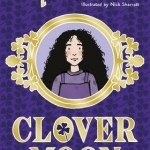
A Victorian Story
This eBook was provided by the publisher via NetGalley in exchange for an honest review
Although now in her seventies, the Nation’s favourite children’s author, Dame Jacqueline Wilson, is continuing to write after surpassing one hundred novels. Many children (mostly girls) grow up reading her stories, myself being amongst that number. Even my sister, who hated reading, purchased a number of her books. It has been well over a decade since I last read a Jacqueline Wilson, however after seeing her latest novel was available for review, I thought I would give it a go.
Clover Moon is set in poverty-stricken Victorian London, where eleven-year-old Clover, the eldest of six siblings, lives with her father and stepmother. Like many stepmother’s in children’s literature, Clover’s treats her like a slave – a position she is destined to stay in unless she gets a job in a factory. With no school to attend, Clover becomes a second mother to her younger brother’s and sisters, yet nothing can prepare her for the devastating impact a wave of Scarlet Fever brings. With only an old doll maker who cares about her, Clover is desperate to get out of her situation; so after a chance meeting with an artist who tells her about a home for destitute girls, Clover decides to seek out the help and life she deserves.
Although only eleven, Clover has the responsibilities of someone of a more mature age. It is hard to imagine sending a child out to work, or trusting them to look after a newborn baby. Children reading this book will learn the difference between their lives and the life of a child in the 1800s.
As always, Jacqueline Wilson gives her main character a happy ending – although in this instance it still remains a bit uncertain. Despite the horrible circumstances, Wilson manages to pump her story full of enthusiastic optimism, thus portraying Clover as a strong, determined heroine.
Most of Jacqueline Wilson’s earlier books were set in the present day; there were still unhappy situations, but the settings were based on ideas the reader would be familiar with. In the case of Clover Moon, unless children have been educated about the poor in Victorian England, it is unlikely that they will be able to fully comprehend Clover’s predicament. As a result, the book is more suitable for young teenagers than the usual target audience of eight to twelve year olds.
Comparing my memories of Jacqueline Wilson books I read as a child with her latest publication, Clover Moon felt like something different; a new direction. As I have not read any of her work between the early 2000s and now, I am not sure when this change occurred, but it feels as though Wilson is delving deeper into her main character’s thoughts and feelings, and creating a more insightful storyline. On the other hand, I may simply be more intuitive as an adult than I was a child.
Although Clover Moon did not turn out to be the style of writing I was expecting I thoroughly enjoyed it. In fact, this difference made it possible to distance myself from the author’s renown, and treat it as an individual story. Clover is an admirable character who, through her narration, provides both an entertaining story and brief historical education. Fans of Jacqueline Wilson will not be disappointed with this latest publication; and if you are a new reader, Clover Moon is a great place to start.
Although now in her seventies, the Nation’s favourite children’s author, Dame Jacqueline Wilson, is continuing to write after surpassing one hundred novels. Many children (mostly girls) grow up reading her stories, myself being amongst that number. Even my sister, who hated reading, purchased a number of her books. It has been well over a decade since I last read a Jacqueline Wilson, however after seeing her latest novel was available for review, I thought I would give it a go.
Clover Moon is set in poverty-stricken Victorian London, where eleven-year-old Clover, the eldest of six siblings, lives with her father and stepmother. Like many stepmother’s in children’s literature, Clover’s treats her like a slave – a position she is destined to stay in unless she gets a job in a factory. With no school to attend, Clover becomes a second mother to her younger brother’s and sisters, yet nothing can prepare her for the devastating impact a wave of Scarlet Fever brings. With only an old doll maker who cares about her, Clover is desperate to get out of her situation; so after a chance meeting with an artist who tells her about a home for destitute girls, Clover decides to seek out the help and life she deserves.
Although only eleven, Clover has the responsibilities of someone of a more mature age. It is hard to imagine sending a child out to work, or trusting them to look after a newborn baby. Children reading this book will learn the difference between their lives and the life of a child in the 1800s.
As always, Jacqueline Wilson gives her main character a happy ending – although in this instance it still remains a bit uncertain. Despite the horrible circumstances, Wilson manages to pump her story full of enthusiastic optimism, thus portraying Clover as a strong, determined heroine.
Most of Jacqueline Wilson’s earlier books were set in the present day; there were still unhappy situations, but the settings were based on ideas the reader would be familiar with. In the case of Clover Moon, unless children have been educated about the poor in Victorian England, it is unlikely that they will be able to fully comprehend Clover’s predicament. As a result, the book is more suitable for young teenagers than the usual target audience of eight to twelve year olds.
Comparing my memories of Jacqueline Wilson books I read as a child with her latest publication, Clover Moon felt like something different; a new direction. As I have not read any of her work between the early 2000s and now, I am not sure when this change occurred, but it feels as though Wilson is delving deeper into her main character’s thoughts and feelings, and creating a more insightful storyline. On the other hand, I may simply be more intuitive as an adult than I was a child.
Although Clover Moon did not turn out to be the style of writing I was expecting I thoroughly enjoyed it. In fact, this difference made it possible to distance myself from the author’s renown, and treat it as an individual story. Clover is an admirable character who, through her narration, provides both an entertaining story and brief historical education. Fans of Jacqueline Wilson will not be disappointed with this latest publication; and if you are a new reader, Clover Moon is a great place to start.
Hazel (1853 KP) rated Clover Moon in Books
Dec 7, 2018
<i>This eBook was provided by the publisher via NetGalley in exchange for an honest review </i>
Although now in her seventies, the Nation’s favourite children’s author, Dame Jacqueline Wilson, is continuing to write after surpassing one hundred novels. Many children (mostly girls) grow up reading her stories, myself being amongst that number. Even my sister, who hated reading, purchased a number of her books. It has been well over a decade since I last read a Jacqueline Wilson, however after seeing her latest novel was available for review, I thought I would give it a go.
<i>Clover Moon</i> is set in poverty-stricken Victorian London, where eleven-year-old Clover, the eldest of six siblings, lives with her father and stepmother. Like many stepmother’s in children’s literature, Clover’s treats her like a slave – a position she is destined to stay in unless she gets a job in a factory. With no school to attend, Clover becomes a second mother to her younger brother’s and sisters, yet nothing can prepare her for the devastating impact a wave of Scarlet Fever brings. With only an old doll maker who cares about her, Clover is desperate to get out of her situation; so after a chance meeting with an artist who tells her about a home for destitute girls, Clover decides to seek out the help and life she deserves.
Although only eleven, Clover has the responsibilities of someone of a more mature age. It is hard to imagine sending a child out to work, or trusting them to look after a newborn baby. Children reading this book will learn the difference between their lives and the life of a child in the 1800s.
As always, Jacqueline Wilson gives her main character a happy ending – although in this instance it still remains a bit uncertain. Despite the horrible circumstances, Wilson manages to pump her story full of enthusiastic optimism, thus portraying Clover as a strong, determined heroine.
Most of Jacqueline Wilson’s earlier books were set in the present day; there were still unhappy situations, but the settings were based on ideas the reader would be familiar with. In the case of <i>Clover Moon</i>, unless children have been educated about the poor in Victorian England, it is unlikely that they will be able to fully comprehend Clover’s predicament. As a result, the book is more suitable for young teenagers than the usual target audience of eight to twelve year olds.
Comparing my memories of Jacqueline Wilson books I read as a child with her latest publication, <i>Clover Moon</i> felt like something different; a new direction. As I have not read any of her work between the early 2000s and now, I am not sure when this change occurred, but it feels as though Wilson is delving deeper into her main character’s thoughts and feelings, and creating a more insightful storyline. On the other hand, I may simply be more intuitive as an adult than I was a child.
Although <i>Clover Moon</i> did not turn out to be the style of writing I was expecting I thoroughly enjoyed it. In fact, this difference made it possible to distance myself from the author’s renown, and treat it as an individual story. Clover is an admirable character who, through her narration, provides both an entertaining story and brief historical education. Fans of Jacqueline Wilson will not be disappointed with this latest publication; and if you are a new reader, <i>Clover Moon</i> is a great place to start.
Although now in her seventies, the Nation’s favourite children’s author, Dame Jacqueline Wilson, is continuing to write after surpassing one hundred novels. Many children (mostly girls) grow up reading her stories, myself being amongst that number. Even my sister, who hated reading, purchased a number of her books. It has been well over a decade since I last read a Jacqueline Wilson, however after seeing her latest novel was available for review, I thought I would give it a go.
<i>Clover Moon</i> is set in poverty-stricken Victorian London, where eleven-year-old Clover, the eldest of six siblings, lives with her father and stepmother. Like many stepmother’s in children’s literature, Clover’s treats her like a slave – a position she is destined to stay in unless she gets a job in a factory. With no school to attend, Clover becomes a second mother to her younger brother’s and sisters, yet nothing can prepare her for the devastating impact a wave of Scarlet Fever brings. With only an old doll maker who cares about her, Clover is desperate to get out of her situation; so after a chance meeting with an artist who tells her about a home for destitute girls, Clover decides to seek out the help and life she deserves.
Although only eleven, Clover has the responsibilities of someone of a more mature age. It is hard to imagine sending a child out to work, or trusting them to look after a newborn baby. Children reading this book will learn the difference between their lives and the life of a child in the 1800s.
As always, Jacqueline Wilson gives her main character a happy ending – although in this instance it still remains a bit uncertain. Despite the horrible circumstances, Wilson manages to pump her story full of enthusiastic optimism, thus portraying Clover as a strong, determined heroine.
Most of Jacqueline Wilson’s earlier books were set in the present day; there were still unhappy situations, but the settings were based on ideas the reader would be familiar with. In the case of <i>Clover Moon</i>, unless children have been educated about the poor in Victorian England, it is unlikely that they will be able to fully comprehend Clover’s predicament. As a result, the book is more suitable for young teenagers than the usual target audience of eight to twelve year olds.
Comparing my memories of Jacqueline Wilson books I read as a child with her latest publication, <i>Clover Moon</i> felt like something different; a new direction. As I have not read any of her work between the early 2000s and now, I am not sure when this change occurred, but it feels as though Wilson is delving deeper into her main character’s thoughts and feelings, and creating a more insightful storyline. On the other hand, I may simply be more intuitive as an adult than I was a child.
Although <i>Clover Moon</i> did not turn out to be the style of writing I was expecting I thoroughly enjoyed it. In fact, this difference made it possible to distance myself from the author’s renown, and treat it as an individual story. Clover is an admirable character who, through her narration, provides both an entertaining story and brief historical education. Fans of Jacqueline Wilson will not be disappointed with this latest publication; and if you are a new reader, <i>Clover Moon</i> is a great place to start.
Booksy: Learn to Read Platform for K-2
Education and Book
App
Featured in the New York Times article "Learning to read with tablets"! Booksy is a...

MultiFlow: Times Tables Reimagined - Practice Multiplication
Education and Games
App
Practice times tables, now with a new, completed redesigned and improved user interface. TUAW App...

BookInspector (124 KP) rated The Push in Books
Jul 1, 2021
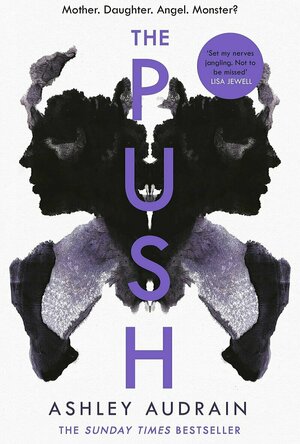
The protagonist in this book is a nameless woman, a daughter, a wife, a mother, and this story is told from her perspective, kind of. The woman is telling us her life story: how she met her husband, about her pregnancy and her troubles with her daughter Violet, and other events that traumatise her for life. The characters in this book are quite disturbed, intense and very complex. For some strange reason, I could really relate to the protagonist. I understood her and her thoughts resonated with mine sometimes.
At the beginning of the book, I was not very impressed, I had no idea what it was about. But the more I got into it, the more absorbed I became. The narrative has several different lines and is telling the story of women from three generations. The protagonist is sharing the deepest and scariest thoughts of her life, and it got very intense for me sometimes. I really enjoyed the suspense, turns and twists. The topics discussed in this book are marriage, pregnancies, lack of motherhood instinct, mother-daughter relationship, children behavioural issues, grief, depression, trauma and many more.
The book is set somewhere American sounding (might be Canada), the atmosphere of this book is pretty dark and shrouded with mystery. I really liked the writing style of this novel, it is very honest, detailed and the mystery was kept perfectly. The chapters are pretty short, so this book was a true page-turner for me. I really loved the ending, because I was pretty confused with some stuff happening in the book, but the ending kind of clarified it for me. I have to throw in a warning, that this book has triggers when it comes to pregnancies, cheating, death of children, grief, psychotic behaviour.
So, to conclude, this book is a very intense life story, filled with very well crafted characters, that are intriguing, absorbing and the plot that is layered, complex and brutally honest.

At the beginning of the book, I was not very impressed, I had no idea what it was about. But the more I got into it, the more absorbed I became. The narrative has several different lines and is telling the story of women from three generations. The protagonist is sharing the deepest and scariest thoughts of her life, and it got very intense for me sometimes. I really enjoyed the suspense, turns and twists. The topics discussed in this book are marriage, pregnancies, lack of motherhood instinct, mother-daughter relationship, children behavioural issues, grief, depression, trauma and many more.
The book is set somewhere American sounding (might be Canada), the atmosphere of this book is pretty dark and shrouded with mystery. I really liked the writing style of this novel, it is very honest, detailed and the mystery was kept perfectly. The chapters are pretty short, so this book was a true page-turner for me. I really loved the ending, because I was pretty confused with some stuff happening in the book, but the ending kind of clarified it for me. I have to throw in a warning, that this book has triggers when it comes to pregnancies, cheating, death of children, grief, psychotic behaviour.
So, to conclude, this book is a very intense life story, filled with very well crafted characters, that are intriguing, absorbing and the plot that is layered, complex and brutally honest.
BookwormMama14 (18 KP) rated Secrets of a Charmed Life in Books
Jan 2, 2019

As the Luftwaffe rains down terror on London, two sisters are separated and their lives changed forever.
**I have done my best to not share any spoilers. I have not shared more than you will find on the back of the cover.**
Isabel MacFarland has finally agreed to share her story and secrets that she has hidden for years. Isabel chose to pass her history to Kendra, an American student attending Oxford. Her story follows the lives of Emmy and Julia Downtree during World War II. With the war becoming more and more of a threat, the sisters are evacuated to the country along with the rest of London's children. Emmy's dreams of becoming a designer cloud her vision though. Julia, who is much younger than Emmy, needs her protection. At what cost will Emmy see her dreams become a reality?
I was extremely pleased with the incredible story Susan Meissner tells. I feel like I need a week to digest and process Secrets of a Charmed Life. I went through almost an entire bag of Starburts in one sitting when the book was getting really intense! This book was not published by a Christian publishing house, but the story is clean, which I was very thankful for. There are too many books out there (even "Christian" books) that share too much detail that I don't want to read. This story is a huge journey of forgiveness of one's self. There are decisions that we make each and every day and we must live with the consequences. How we choose to move on will shape who we are and who we become. I highly recommend this book. I encourage you to get lost in the pages and discover that no matter the circumstances, forgiveness is not out of reach.
**I have done my best to not share any spoilers. I have not shared more than you will find on the back of the cover.**
Isabel MacFarland has finally agreed to share her story and secrets that she has hidden for years. Isabel chose to pass her history to Kendra, an American student attending Oxford. Her story follows the lives of Emmy and Julia Downtree during World War II. With the war becoming more and more of a threat, the sisters are evacuated to the country along with the rest of London's children. Emmy's dreams of becoming a designer cloud her vision though. Julia, who is much younger than Emmy, needs her protection. At what cost will Emmy see her dreams become a reality?
I was extremely pleased with the incredible story Susan Meissner tells. I feel like I need a week to digest and process Secrets of a Charmed Life. I went through almost an entire bag of Starburts in one sitting when the book was getting really intense! This book was not published by a Christian publishing house, but the story is clean, which I was very thankful for. There are too many books out there (even "Christian" books) that share too much detail that I don't want to read. This story is a huge journey of forgiveness of one's self. There are decisions that we make each and every day and we must live with the consequences. How we choose to move on will shape who we are and who we become. I highly recommend this book. I encourage you to get lost in the pages and discover that no matter the circumstances, forgiveness is not out of reach.
Heather Cranmer (2721 KP) rated Fallout (Crank, #3) in Books
Jun 6, 2018
(This review can also be found on my blog at <a href="http://www.themisadventuresofatwentysomething.blogspot.com">The (Mis)Adventures of a Twenty Something Year Old Girl</a>).
Fallout by Ellen Hopkins is the final book in the Crank trilogy. I so wanted and expected this book to be just as great as the first two. However, this wasn't the case. It was alright, but no where near as good as Crank and Glass. Perhaps it was just because I wanted more Kristina, and she wasn't mentioned too much in this book.
Fallout follows the lives of three of Kristina's children. Hunter is the oldest at 19. He is extremely angry at his mother and can't understand why his mother abandoned him. Next is Autumn who lives with her aunt and grandfather. When the stability of her home life falls out beneath her, Autumn turns to drinking and becomes a bit of a wild child. Summer doesn't even know she has any biological siblings. She's been living in and out of foster homes her whole life for the most part. When she meets the boy who seems to love her, things start to go wrong. However, each one of them wants Kristina to acknowledge them.
The title of this book makes sense as all of Kristina's children have fallen out with her. I think it does a great job of giving you a hint about what this book will be about.
The cover of this book doesn't really do it for me. I like how the author stuck with the whole druggy looking title. However, I just didn't care for the ugly yellow background and how plain the cover looked. Perhaps that's just a personal thing as all the covers have been plain looking, but as this was told from the point of view from Kristina's children, I thought this cover would just have a different look.
The world building in Fallout is alright, but it's easy to forget which world you're in. Maybe that's just my bad memory, but I always had to remind myself which setting belonged to what character.
The pacing in this book is slower than the first two books, and is just a bit slow overall. It took me a longer time than usual to read this book because most of the time, I just had trouble getting into it. I just found myself not caring really when it came to everything in Fallout.
There's not much dialogue going on between the characters as with the first two books in the series. I thought the internal dialogue which each character was really good, and I felt like the dialogue between each individual character was appropriate for each of their age. There are a few swear words in this book so be warned if that's not your cup of tea.
I found myself not caring about the characters most of the time. I don't know if this was because I wanted more Kristina or because they weren't as well developed as Kristina. I got Autumn and Summer confused a lot of the time whilst reading since they almost seem to have the same personality. The only way I was able to tell them apart (besides it having their name printed at the top of the page when it was time for their point of view) was because of the setting, and even then it was sometimes difficult. With that said, I started off enjoying reading about Hunter as he seemed to just be a more well defined, more interesting character. About halfway through the book, I even stopped caring about him because he just became a little bit boring.
I enjoyed that Fallout was written in verse like the first two books in the series. Hopkins does a fantastic job putting words in verse and putting it into a story. I just wish this book could've been as good as the first two. Instead Fallout falls a little bit flat with the characters and the plot both leaving me feeling uncaring. Don't get me wrong, it's still an okay book, but I just think that this book didn't need to be written as not much is going on.
I'd recommend this book to those aged 15+ who are interested in learning about Kristina's children since you won't be hearing much about Kristina in this book.
Fallout by Ellen Hopkins is the final book in the Crank trilogy. I so wanted and expected this book to be just as great as the first two. However, this wasn't the case. It was alright, but no where near as good as Crank and Glass. Perhaps it was just because I wanted more Kristina, and she wasn't mentioned too much in this book.
Fallout follows the lives of three of Kristina's children. Hunter is the oldest at 19. He is extremely angry at his mother and can't understand why his mother abandoned him. Next is Autumn who lives with her aunt and grandfather. When the stability of her home life falls out beneath her, Autumn turns to drinking and becomes a bit of a wild child. Summer doesn't even know she has any biological siblings. She's been living in and out of foster homes her whole life for the most part. When she meets the boy who seems to love her, things start to go wrong. However, each one of them wants Kristina to acknowledge them.
The title of this book makes sense as all of Kristina's children have fallen out with her. I think it does a great job of giving you a hint about what this book will be about.
The cover of this book doesn't really do it for me. I like how the author stuck with the whole druggy looking title. However, I just didn't care for the ugly yellow background and how plain the cover looked. Perhaps that's just a personal thing as all the covers have been plain looking, but as this was told from the point of view from Kristina's children, I thought this cover would just have a different look.
The world building in Fallout is alright, but it's easy to forget which world you're in. Maybe that's just my bad memory, but I always had to remind myself which setting belonged to what character.
The pacing in this book is slower than the first two books, and is just a bit slow overall. It took me a longer time than usual to read this book because most of the time, I just had trouble getting into it. I just found myself not caring really when it came to everything in Fallout.
There's not much dialogue going on between the characters as with the first two books in the series. I thought the internal dialogue which each character was really good, and I felt like the dialogue between each individual character was appropriate for each of their age. There are a few swear words in this book so be warned if that's not your cup of tea.
I found myself not caring about the characters most of the time. I don't know if this was because I wanted more Kristina or because they weren't as well developed as Kristina. I got Autumn and Summer confused a lot of the time whilst reading since they almost seem to have the same personality. The only way I was able to tell them apart (besides it having their name printed at the top of the page when it was time for their point of view) was because of the setting, and even then it was sometimes difficult. With that said, I started off enjoying reading about Hunter as he seemed to just be a more well defined, more interesting character. About halfway through the book, I even stopped caring about him because he just became a little bit boring.
I enjoyed that Fallout was written in verse like the first two books in the series. Hopkins does a fantastic job putting words in verse and putting it into a story. I just wish this book could've been as good as the first two. Instead Fallout falls a little bit flat with the characters and the plot both leaving me feeling uncaring. Don't get me wrong, it's still an okay book, but I just think that this book didn't need to be written as not much is going on.
I'd recommend this book to those aged 15+ who are interested in learning about Kristina's children since you won't be hearing much about Kristina in this book.
Whatchareadin (174 KP) rated Emma in the Night in Books
Apr 9, 2019
Cass and Emma are sisters. And like most sisters, some days they are best friends and some days they just aren't. But one thing that keeps them tethered to each other is their shared love/hate relationship with their mother. She is a narcissist and only praise of the utmost will allow her to bring her children any joy. Then the girls disappear and three years later Cass shows up at her mother's doorstep, demanding that they find Emma. Cass describes the place they had been living for the past three years and hopes that the FBI and investigators are able to find this mysterious island and Emma.
Thank you to NetGalley and St. Martin's Press for the opportunity to read and review this book.
This book started off a little slow for me. Hearing the background information about what happened before the disappearance, intertwined with what was going on now to describe the place the girls were being held, took up the first half of the book. Told from the perspective of Cass, the youngest daughter and Dr. Winter the FBI Psychiatrist who did the initial investigation. After that, the reading went by much faster when the twists and turns started to take place.
Cass and Emma have a mother who constantly needs to be told how beautiful she is and how good of a mother she is. The only problem is that she's not. But hearing these things make her feel good about herself and keep her children on her good side. When things don't go the way she wants, she punishes the girls in unspeakable manners. Buying one a gift the other wanted, favoring one child and ignoring the other. This is a family that has a lot of issues going on inside of their home. They way things are handled are completely out of spite for another member of the family. Although this book had a slow start, it really had a great ending. So stick with it if you have to and it will be well worth it.
Wendy Walker also wrote, All is Not Forgotten which was also a great book released last year. I look forward to what else Ms. Walker has in store.
Thank you to NetGalley and St. Martin's Press for the opportunity to read and review this book.
This book started off a little slow for me. Hearing the background information about what happened before the disappearance, intertwined with what was going on now to describe the place the girls were being held, took up the first half of the book. Told from the perspective of Cass, the youngest daughter and Dr. Winter the FBI Psychiatrist who did the initial investigation. After that, the reading went by much faster when the twists and turns started to take place.
Cass and Emma have a mother who constantly needs to be told how beautiful she is and how good of a mother she is. The only problem is that she's not. But hearing these things make her feel good about herself and keep her children on her good side. When things don't go the way she wants, she punishes the girls in unspeakable manners. Buying one a gift the other wanted, favoring one child and ignoring the other. This is a family that has a lot of issues going on inside of their home. They way things are handled are completely out of spite for another member of the family. Although this book had a slow start, it really had a great ending. So stick with it if you have to and it will be well worth it.
Wendy Walker also wrote, All is Not Forgotten which was also a great book released last year. I look forward to what else Ms. Walker has in store.