
Search
Search results
Purple Phoenix Games (2266 KP) rated Macaron in Tabletop Games
Oct 20, 2020


The only game I have ever been able to play with my extended family on a regular basis, and provided us an excuse to get together every Sunday, is Euchre. My family loves Euchre. It took me a long time to finally learn it, and I did so on a tour bus traveling from Paris to Barcelona. I played so much Euchre on that tour. I still play Euchre somewhat regularly with my wife and in-laws. What does this all have to do with a delicious-looking game about difficult to nail baked goods? Well, I described Macaron to my wife as, “A more intense Euchre with a baking theme, where the bowers may actually kill someone.”
Macaron is a baked goods-themed trick-taking card game for one to five players. In it players are bakers in medieval France trying to become the favored royal baker to the king and his family. The player who can earn the most VP by delivering the tastiest macarons to the royal family will be victorious and will then bake the other players a box of macarons to take home (I added that last part, but Ta-Te Wu should consider adding it to the rules).
DISCLAIMER: We were provided a prototype copy of this game for the purposes of this review. These are preview copy components, and I know for sure the final components will be slightly different from these shown. Also, it is not my intention to detail every rule in the game, as there are just too many. You are invited to download the rulebook, back the game through the Kickstarter campaign, or through any retailers stocking it after fulfillment. -T
For this preview I am tackling the solo rule-set provided and my AI opponent is named Emma (per the rules). Multiplayer games will be played somewhat similarly, but against normal-intelligenced real people. Duh.
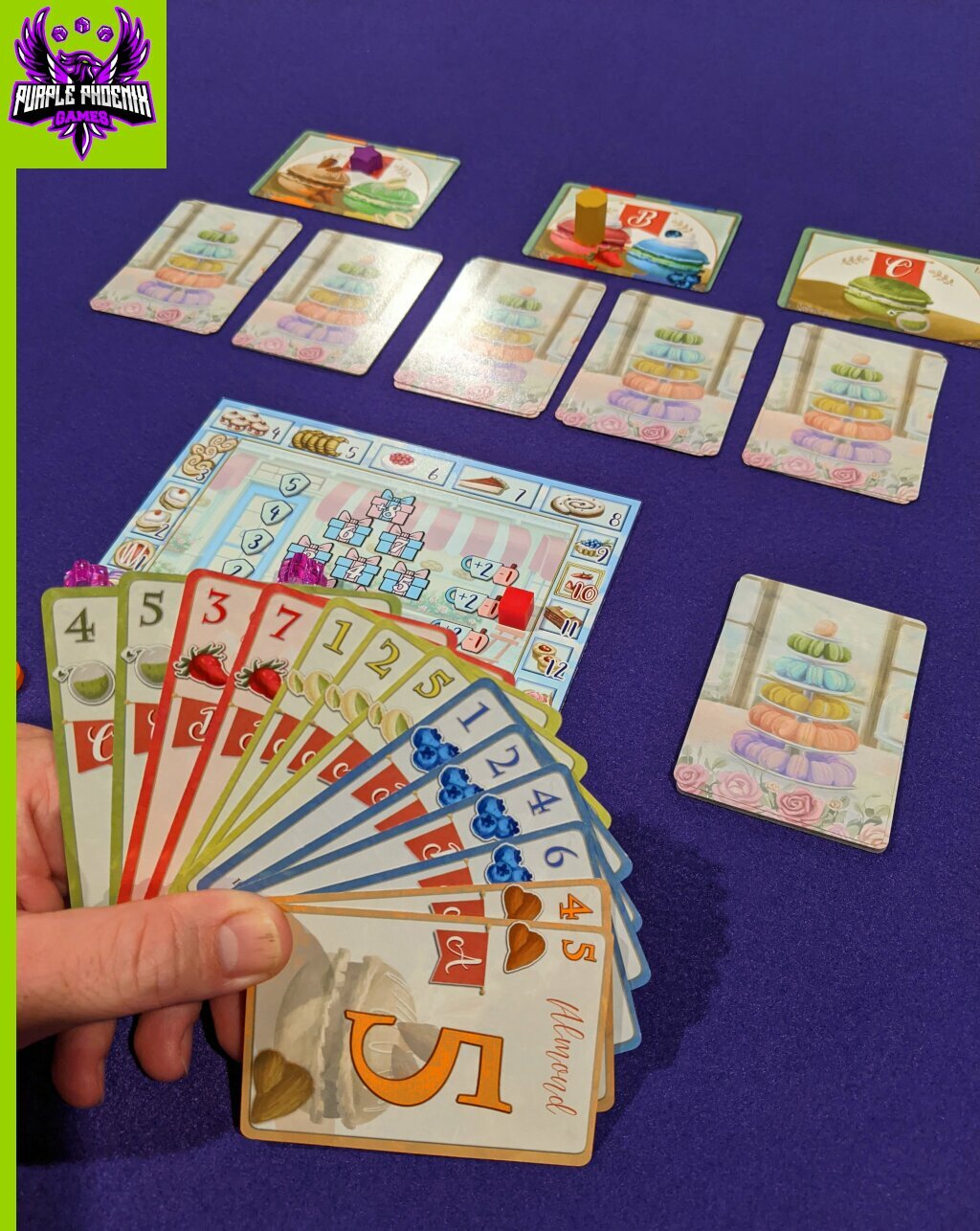
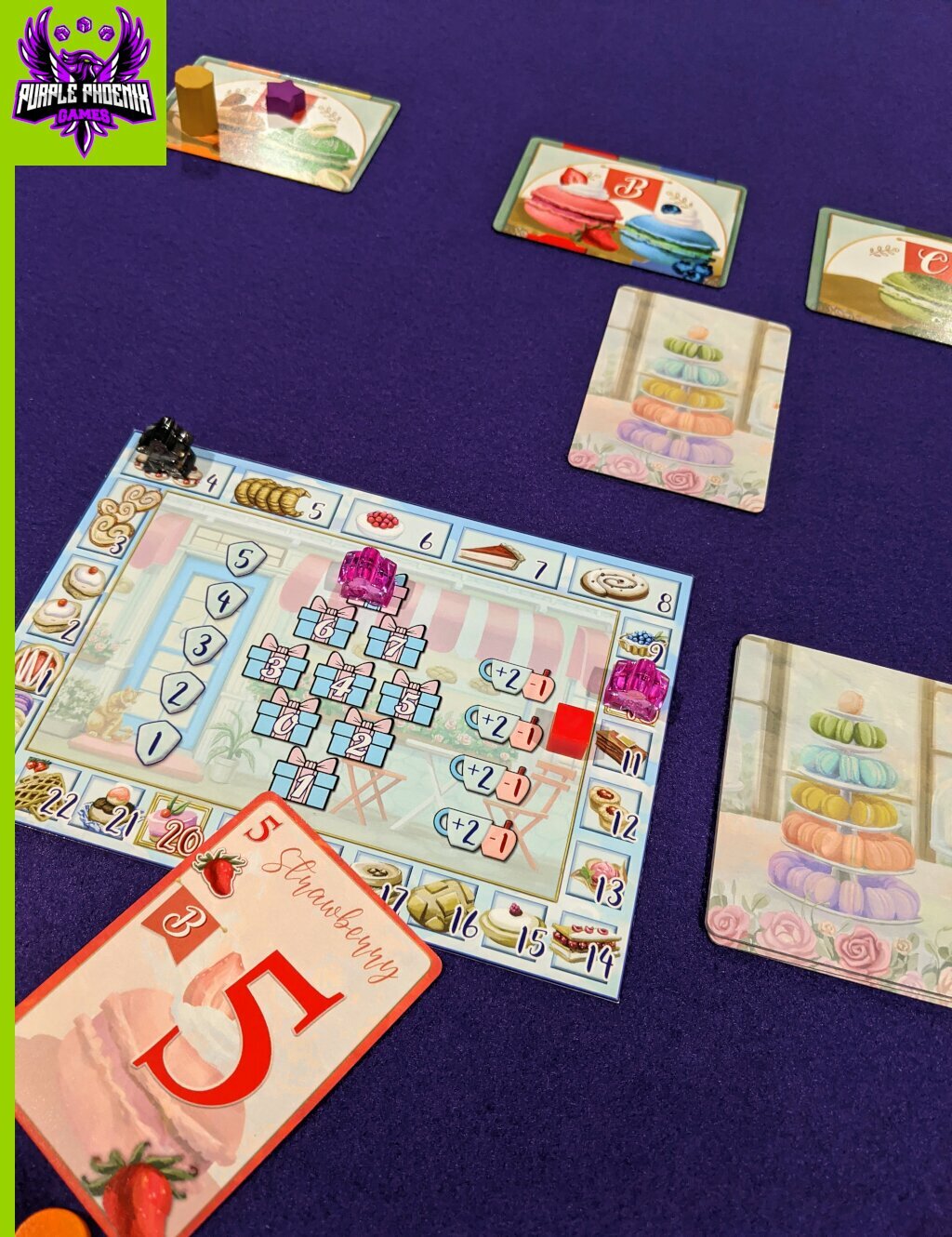
To setup a solo game, place the Score board in the middle of the table on whichever side is decided – one side allows up to 20 points, and the other up to 30. Place the first three Group boards (A with Almond and Pistachio, B with Strawberry and Blueberry, and C with just one Green Tea macaron upon it) somewhere near the Score board to denote the flavors being played. Remove all cards from the deck picturing Earl Grey and Chocolate flavored macarons. Shuffle the remaining macaron cards and deal the solo player 13 of them. Deal Emma one random card from the deck under each flavor on the Group board as shown below. These random cards will take on the flavor of whichever stack to which it now belongs. Continue dealing Emma eight cards to her stacks, but match them to their flavors – the 4 of Pistachio under Pistachio, etc. Emma should now have 13 cards in total, but each flavor stack should be shuffled and arranged as shown below. Choose a color for the player and for Emma, place one of each meeple on the Score board to track final scores, and the other meeples on the Gift Box tracker in the middle. Analyze each of Emma’s stacks to determine which Group contains the most cards. These flavors will be given the Royal token (I used the purple star) and are considered the trump suits this round. Flip over the top card of the deck that remains, and place the Allergen token (I used the tall goldenrod piece) upon the matching flavor. The game may now begin!
The solo player is always the starting player, so they will open the first trick by playing a card from hand. As in most card games, whichever flavor (suit) is led will need to be followed by Emma, if possible. The rulebook gives the player a nice turn-flow summary for Emma based on which player leads and which type of card is played.
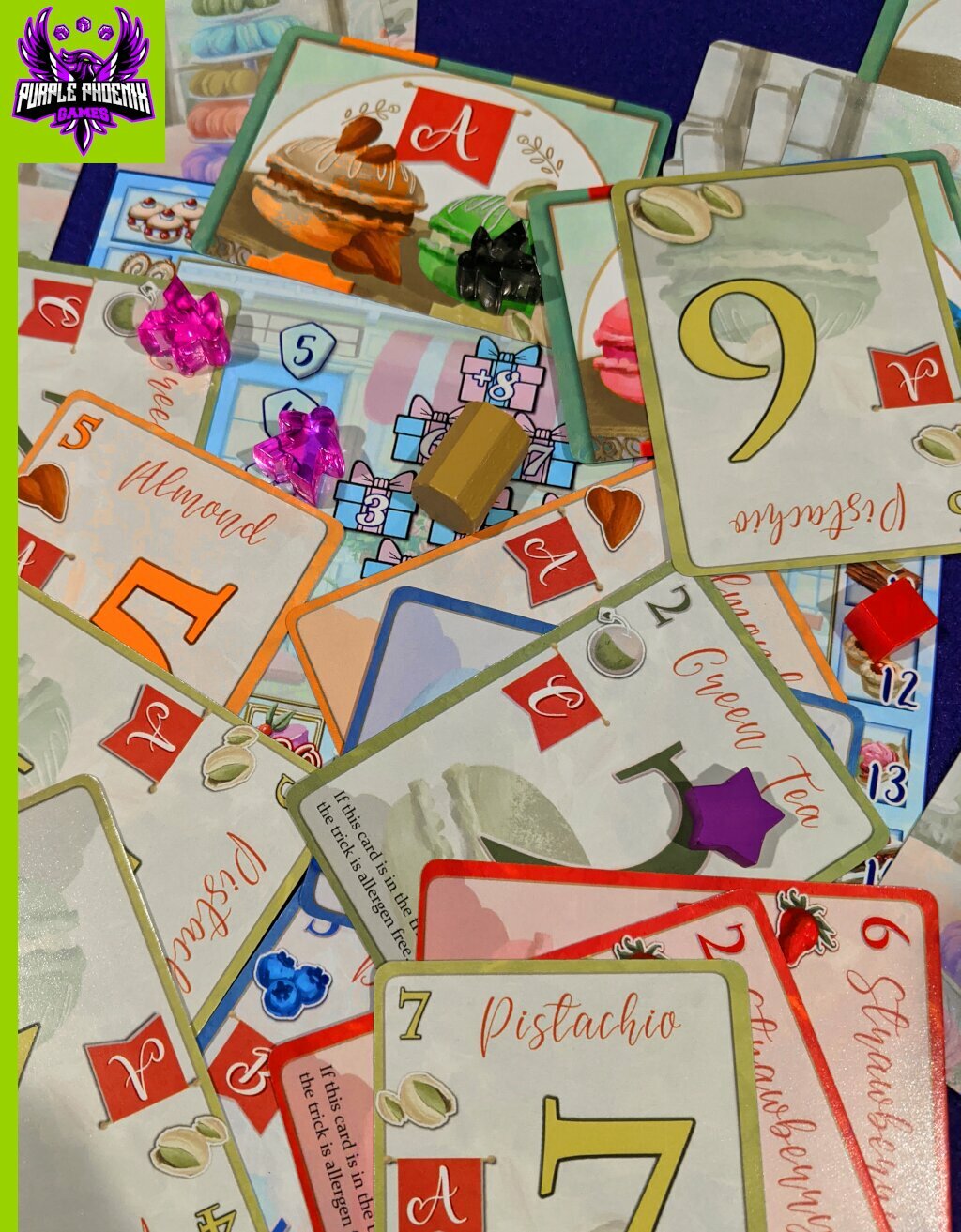
As in Euchre, suit must be followed. If a player is unable to follow, they may play a Royal (trump) card to win the trick or any other non-Royal card. The Royal flavors are both flavors that belong to the same Group, or Green Tea, as it is its own Group. For each trick won, the player will advance their meeple on the Gift Box track to denote number of tricks won. Some card rules adjust the scoring. For example, should a value 1 card win the trick the winning player will increase their number of Gift Boxes three spaces instead of one. Should a trick include an Allergen flavor the winning player will still lead the next trick but will not advance their Gift Box meeple, as Allergens make the royal family sick. However, should a trick contain a value 2 card in it, the 2 cancels the Allergen and the winner may advance their Gift Box meeple as normal.
The round ends when a player, or Emma, has finished their hand of 13 cards played or reaches eight or more Gift Boxes (won tricks). Setup for a new round as the game was initially setup with dealing cards to each player and determining Royal and Allergen flavors. Play continues in this fashion until the player or Emma has reached the pre-determined score of 10, 20, or 30. The winner must now get to baking (again, I added that, but it REALLLLLY needs to happen, I think)!
Components. Again, this is a prototype copy of the game (though still pretty good) and the final components will certainly be different than the ones shown here. That said, the art style is simply wonderful and incredibly enjoyable. Yes, the Score board is a little busy, but it’s functional and fun. The art on the cards is very good, colorblind-friendly with icons in addition to colors, and the art doesn’t get in the way of playing tricks at all. All the other components used in the game will probably be different upon a successful Kickstarter campaign, and though I haven’t seen the proposed components, I am sure they will match the theme and be great to handle.
So as a lover of Euchre, am I also a lover of Macaron? ABSOLUTELY! It takes everything I enjoy about Euchre and somehow simplifies AND complexifies it. Teaching Euchre to new players can be a chore when they don’t latch onto the fact that the highest cards in the game are the Jacks of the same color of trump, but one is higher than the other. It can be awkward at first. Here, there are one or two flavors that are trump suits. It makes sense to be able to visualize a bit easier, and to be able to relate to flavors. In fact, my 4-year-old son wanted to “play” it earlier this morning, so I took out the Allergen mechanic and just did straight suit-following with trumps and he understood it. So, I guess by house-ruling a little you can also play this with children who are learning games for the first time, learning their numbers, or learning trick-taking games. That’s a fun hidden side quest!
Now, I can see how people will totally dig Macaron as a multiplayer game, but I am previewing this as a solo game. Is it just as good? Yep! I like being able to play the game whenever I want, and using another mechanic I didn’t describe earlier – Betting. Having to bet upon how many Gift Boxes you will score for the round adds another layer of analyzation I particularly enjoy. If you guess correctly you score an additional two Gift Boxes. If you’re wrong Emma scores two Boxes. Couple this with Emma’s unpredictable card play and you have an interesting AI player that you may never be able to “figure out” and beat methodically. I like that randomness from Emma. She has made a few games close, but ultimately has lost every game against me.
Macaron is a cute little Euchre-style card game that can be played well solo and multiplayer, and features wonderful style. I love the theme, and I seem to be attracted to food games; I love Bohnanza, Morels, Happy Salmon (my favorite fish to eat), Sushi Go!, Coconuts, and The Three Little Pigs (ok that one was mean, but hey, I love pork)! If you also enjoy food-related games, or trick-taking games, or just fun little card games you can play solo or with other people, please consider backing Macaron via their Kickstarter campaign launching soon. Tell them Purple Phoenix Games sent you and I will share my Gift Box of Macarons with you**. You will have to let me know your food allergies prior, though.
** I don’t actually have a Gift Box of Macarons. That was a lie, and I apologize for that.
Macaron is a baked goods-themed trick-taking card game for one to five players. In it players are bakers in medieval France trying to become the favored royal baker to the king and his family. The player who can earn the most VP by delivering the tastiest macarons to the royal family will be victorious and will then bake the other players a box of macarons to take home (I added that last part, but Ta-Te Wu should consider adding it to the rules).
DISCLAIMER: We were provided a prototype copy of this game for the purposes of this review. These are preview copy components, and I know for sure the final components will be slightly different from these shown. Also, it is not my intention to detail every rule in the game, as there are just too many. You are invited to download the rulebook, back the game through the Kickstarter campaign, or through any retailers stocking it after fulfillment. -T
For this preview I am tackling the solo rule-set provided and my AI opponent is named Emma (per the rules). Multiplayer games will be played somewhat similarly, but against normal-intelligenced real people. Duh.
To setup a solo game, place the Score board in the middle of the table on whichever side is decided – one side allows up to 20 points, and the other up to 30. Place the first three Group boards (A with Almond and Pistachio, B with Strawberry and Blueberry, and C with just one Green Tea macaron upon it) somewhere near the Score board to denote the flavors being played. Remove all cards from the deck picturing Earl Grey and Chocolate flavored macarons. Shuffle the remaining macaron cards and deal the solo player 13 of them. Deal Emma one random card from the deck under each flavor on the Group board as shown below. These random cards will take on the flavor of whichever stack to which it now belongs. Continue dealing Emma eight cards to her stacks, but match them to their flavors – the 4 of Pistachio under Pistachio, etc. Emma should now have 13 cards in total, but each flavor stack should be shuffled and arranged as shown below. Choose a color for the player and for Emma, place one of each meeple on the Score board to track final scores, and the other meeples on the Gift Box tracker in the middle. Analyze each of Emma’s stacks to determine which Group contains the most cards. These flavors will be given the Royal token (I used the purple star) and are considered the trump suits this round. Flip over the top card of the deck that remains, and place the Allergen token (I used the tall goldenrod piece) upon the matching flavor. The game may now begin!
The solo player is always the starting player, so they will open the first trick by playing a card from hand. As in most card games, whichever flavor (suit) is led will need to be followed by Emma, if possible. The rulebook gives the player a nice turn-flow summary for Emma based on which player leads and which type of card is played.
As in Euchre, suit must be followed. If a player is unable to follow, they may play a Royal (trump) card to win the trick or any other non-Royal card. The Royal flavors are both flavors that belong to the same Group, or Green Tea, as it is its own Group. For each trick won, the player will advance their meeple on the Gift Box track to denote number of tricks won. Some card rules adjust the scoring. For example, should a value 1 card win the trick the winning player will increase their number of Gift Boxes three spaces instead of one. Should a trick include an Allergen flavor the winning player will still lead the next trick but will not advance their Gift Box meeple, as Allergens make the royal family sick. However, should a trick contain a value 2 card in it, the 2 cancels the Allergen and the winner may advance their Gift Box meeple as normal.
The round ends when a player, or Emma, has finished their hand of 13 cards played or reaches eight or more Gift Boxes (won tricks). Setup for a new round as the game was initially setup with dealing cards to each player and determining Royal and Allergen flavors. Play continues in this fashion until the player or Emma has reached the pre-determined score of 10, 20, or 30. The winner must now get to baking (again, I added that, but it REALLLLLY needs to happen, I think)!
Components. Again, this is a prototype copy of the game (though still pretty good) and the final components will certainly be different than the ones shown here. That said, the art style is simply wonderful and incredibly enjoyable. Yes, the Score board is a little busy, but it’s functional and fun. The art on the cards is very good, colorblind-friendly with icons in addition to colors, and the art doesn’t get in the way of playing tricks at all. All the other components used in the game will probably be different upon a successful Kickstarter campaign, and though I haven’t seen the proposed components, I am sure they will match the theme and be great to handle.
So as a lover of Euchre, am I also a lover of Macaron? ABSOLUTELY! It takes everything I enjoy about Euchre and somehow simplifies AND complexifies it. Teaching Euchre to new players can be a chore when they don’t latch onto the fact that the highest cards in the game are the Jacks of the same color of trump, but one is higher than the other. It can be awkward at first. Here, there are one or two flavors that are trump suits. It makes sense to be able to visualize a bit easier, and to be able to relate to flavors. In fact, my 4-year-old son wanted to “play” it earlier this morning, so I took out the Allergen mechanic and just did straight suit-following with trumps and he understood it. So, I guess by house-ruling a little you can also play this with children who are learning games for the first time, learning their numbers, or learning trick-taking games. That’s a fun hidden side quest!
Now, I can see how people will totally dig Macaron as a multiplayer game, but I am previewing this as a solo game. Is it just as good? Yep! I like being able to play the game whenever I want, and using another mechanic I didn’t describe earlier – Betting. Having to bet upon how many Gift Boxes you will score for the round adds another layer of analyzation I particularly enjoy. If you guess correctly you score an additional two Gift Boxes. If you’re wrong Emma scores two Boxes. Couple this with Emma’s unpredictable card play and you have an interesting AI player that you may never be able to “figure out” and beat methodically. I like that randomness from Emma. She has made a few games close, but ultimately has lost every game against me.
Macaron is a cute little Euchre-style card game that can be played well solo and multiplayer, and features wonderful style. I love the theme, and I seem to be attracted to food games; I love Bohnanza, Morels, Happy Salmon (my favorite fish to eat), Sushi Go!, Coconuts, and The Three Little Pigs (ok that one was mean, but hey, I love pork)! If you also enjoy food-related games, or trick-taking games, or just fun little card games you can play solo or with other people, please consider backing Macaron via their Kickstarter campaign launching soon. Tell them Purple Phoenix Games sent you and I will share my Gift Box of Macarons with you**. You will have to let me know your food allergies prior, though.
** I don’t actually have a Gift Box of Macarons. That was a lie, and I apologize for that.


The Bandersnatch (199 KP) rated Memoirs of a Geisha in Books
Nov 7, 2019
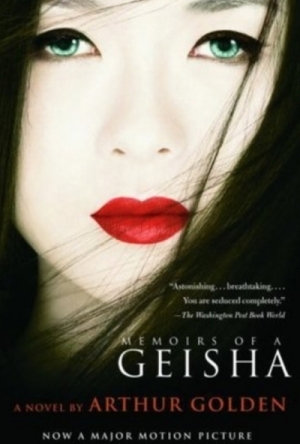

Memoirs of a Geisha is a historical fiction book published on September 27th 1997. Told in the first person Viewpoint of Geisha Sayuri (Original name Chiyo), It follows her journey from her childhood in a fishing village on the coast of Japan, forcibly taken to a Hanamachi in Gion Kyoto and raised to become a Geisha before experiencing the horrors of WW2 and being a Geisha during the hard work of rebuilding after a harrowing defeat.
My opinion of the book is one of both curiosity and interest. Japan is one of those countries where its history and culture is both unusual and mysterious. The book gives a brief glimpse into the hidden world of the Geisha which are a prominent spot in Japanese culture but are relatively unknown world wide. I believe that the story of Sayuri is one of personal travel and evolution. Since we see Sayuri';s experience as a child before becoming a Geisha, experiencing the horror of war and eventually finding love with the Chairman.
Arthur Golden was born on December 6th 1956 in Chattanooga, Tennessee. When he was eight years old his parents divorced with his father dying five years later. He spent most of his childhood living in lookout mountain, Georgia before graduating from the Baylor school in Chattanooga in 1974. After earning a degree in Fine art (Specifically Japanese art), an M. A. in Japanese history, Golden spent a summer at the Peking University in Beijing and spent some time working in Tokyo. When he returned to the states he earned an M. A. in English at Boston University. Golden married Trudi Legge and they went on to have two children Hays and Tess.
After getting the initial idea for Memoirs of a Geisha Golden spent six years over the story rewriting it at least three times, changing the view point until settling on the viewpoint of Sayuri. Golden had spent time interviewing several Geisha including Mineko Iwasaki (who ended up suing Golden when the Japanese version of the book came out for breach of contract.....the case was settled out of court in 2003) all of whom provided information about the world of the Geisha. After its release Memoirs of a Geisha spent two years on the New York Times bestseller list, its sold more than four million copies in English alone and has been translated into thirty-two languages around the world. In 2005 the book was made into a movie garnering three academy awards.
My opinion of Arthur Golden is very small and somewhat limited.......I believe he is a fantastic writer and very knowledgeable about Japanese history and art....Much more so than I am but hearing he faced being sued because of citing who his sources were when he was contracted not to has put something of a dampener on his character in my eyes.
Memoirs of a Geisha was released as a Movie on December 9th 2005 under director Rob Marshall and Produced by Steven Spielberg's production Company Amblin Entertainment and Spyglass Entertainment. With its production from pre- to post-production taking place mainly in California US, with a few spots filmed in Kyoto Japan. The movie received mixed reviews in the western world and received somewhat negative reviews in Japan due to its mixed casting of Chinese and Japanese actors and actresses and its relationship to history. Despite the chaos they won three Academy Awards (Best Art Direction, Best Cinematography and Best Costume Design), a Golden Globe (Best Original Score), A national Board of review (Best Supporting Actress), a satellite award (Outstanding screenplay) and three BAFTA's (Cinematography, Costume design and the Anthony Asquith award for Achievement in film music).
Whilst I quite like the movie I definitely feel that if more effort was put into tying more of both Japanese and Geisha history was some how tied into the movie. As well as using more Japanese Actors and actresses in the roles......despite that I believe the actors and actresses did a very good job in brining the script to life and keep a layer of mystery and fluidity to their roles.
And there you have it a book for all the ages, its definitely under the banner of AWESOME!!!.
My opinion of the book is one of both curiosity and interest. Japan is one of those countries where its history and culture is both unusual and mysterious. The book gives a brief glimpse into the hidden world of the Geisha which are a prominent spot in Japanese culture but are relatively unknown world wide. I believe that the story of Sayuri is one of personal travel and evolution. Since we see Sayuri';s experience as a child before becoming a Geisha, experiencing the horror of war and eventually finding love with the Chairman.
Arthur Golden was born on December 6th 1956 in Chattanooga, Tennessee. When he was eight years old his parents divorced with his father dying five years later. He spent most of his childhood living in lookout mountain, Georgia before graduating from the Baylor school in Chattanooga in 1974. After earning a degree in Fine art (Specifically Japanese art), an M. A. in Japanese history, Golden spent a summer at the Peking University in Beijing and spent some time working in Tokyo. When he returned to the states he earned an M. A. in English at Boston University. Golden married Trudi Legge and they went on to have two children Hays and Tess.
After getting the initial idea for Memoirs of a Geisha Golden spent six years over the story rewriting it at least three times, changing the view point until settling on the viewpoint of Sayuri. Golden had spent time interviewing several Geisha including Mineko Iwasaki (who ended up suing Golden when the Japanese version of the book came out for breach of contract.....the case was settled out of court in 2003) all of whom provided information about the world of the Geisha. After its release Memoirs of a Geisha spent two years on the New York Times bestseller list, its sold more than four million copies in English alone and has been translated into thirty-two languages around the world. In 2005 the book was made into a movie garnering three academy awards.
My opinion of Arthur Golden is very small and somewhat limited.......I believe he is a fantastic writer and very knowledgeable about Japanese history and art....Much more so than I am but hearing he faced being sued because of citing who his sources were when he was contracted not to has put something of a dampener on his character in my eyes.
Memoirs of a Geisha was released as a Movie on December 9th 2005 under director Rob Marshall and Produced by Steven Spielberg's production Company Amblin Entertainment and Spyglass Entertainment. With its production from pre- to post-production taking place mainly in California US, with a few spots filmed in Kyoto Japan. The movie received mixed reviews in the western world and received somewhat negative reviews in Japan due to its mixed casting of Chinese and Japanese actors and actresses and its relationship to history. Despite the chaos they won three Academy Awards (Best Art Direction, Best Cinematography and Best Costume Design), a Golden Globe (Best Original Score), A national Board of review (Best Supporting Actress), a satellite award (Outstanding screenplay) and three BAFTA's (Cinematography, Costume design and the Anthony Asquith award for Achievement in film music).
Whilst I quite like the movie I definitely feel that if more effort was put into tying more of both Japanese and Geisha history was some how tied into the movie. As well as using more Japanese Actors and actresses in the roles......despite that I believe the actors and actresses did a very good job in brining the script to life and keep a layer of mystery and fluidity to their roles.
And there you have it a book for all the ages, its definitely under the banner of AWESOME!!!.

Gareth von Kallenbach (980 KP) rated the PlayStation 4 version of Crash Bandicoot N. Sane Trilogy in Video Games
Jun 19, 2019

When news first arrived that the crash empire would be releasing a new game. The whole world went nuts. It was a childhood favourite for so many households across the world. It was rolled out onto the PS4 platform on the 30th of June 2017. It smashed pre sale records, with tons of people choosing to put a deposit down in order of not missing the game. It consists of three of the crash games; Crash Bandicoot, Cortex Strikes Back, and Warped. The three most iconic of the crash series. All three had a major face lift, which was going to be obvious due to sheer jump in technology and graphics we’ve had. Yet nothing about the actual game has really changed. The levels, characters, and sounds have all stayed the same. Here’s a review of what the game was like to play.
Game Play
The first thing that a lot of people pointed out is, the game is hard to play. Well, harder than when most of us were kids and attempting it. But this shouldn’t be classed as a negative. It added excitement to the game, and if anything, made game play last longer. The graphics were incredible. Everything was so sharp and defined, it really made the characters and scenery pop to life. It also sort of made the game easier to play. Although the levels were hard, moving through them was easy. There were no annoying glitches, the characters were extra responsive to movements, and it really just had a smoother feeling compared to its very older brother. This game was review on a standard PS4, the graphics would have been 10x better on a custom gaming pc, it would have been interesting to compare the difference.
The attention to detail that Vicarious Visions (the developer) has gone to is outstanding. One huge improvement is the enemies. In the first lot of the three games, the enemies were always so hard to kill. It is very noticeable that in the new series, enemies move more fluidly, and are easier to kill or dodge. There’s no lag what so ever during the game which is perfect. The sounds are also crisper, with additional noises such as feet crunching on the floor, or the wind blowing have been added. It doesn’t affect gameplay, but it’s a nice additional touch. The best of the three games is definitely Cortex Strikes Back, it’s much more fun, crash is able to move around better, and it’s just generally more engaging.
Characters
All of the original characters still appear in the new games. There’s Aku Aku, the mask that appears making the funny noise. Crush, Crunch, Coco, Doctor Neo Cortex to name but a few. As with the scenery of the game, they’ve all had a little face lift too. It’s so much easier to see the features of the character’s. They look so crisp and clear in the HD platform. They all play exactly the same role as they did in the beginning, and seeing them all together in a high definition view really offers something nostalgic. Crash still remains the main character throughout the game.
Price
The price of the game when first released was around $35-$55 depending on which store you got it from. It has now rapidly reduced to around $20-$30. There’s also cool collectable extras to take a look at. You can get model figures of most of the main crash characters from the internet. If you can collect all of them, they might be worth something a little more in the future!
Negatives
There’s only two negatives of this game. One being the fact it is only available on the PS4 platform. Many xbox lovers weren’t too happy about this, but at the same time, crash has always been on playstation. It wouldn’t be right to release it on all platforms. If they had done however, there profit could have been exponential compared to what it was. Although this didn’t have PS4 lover’s complaining. The second issue is just how damn hard the levels were. Yes it’s good to have a little bit of a challenge, but not three whole games worth of rock solid challenges. It did anger a lot of people, especially parents. The game was simply just too hard to play for some children. I think if they had the chance to do it again, they should have options that let you choose game play difficulty. That way it’ll be suitable for all ages. But even so, the game did need to be toned down a bit.
http://sknr.net/2017/10/11/crash-bandicoot-n-sane-trilogy-review/
Game Play
The first thing that a lot of people pointed out is, the game is hard to play. Well, harder than when most of us were kids and attempting it. But this shouldn’t be classed as a negative. It added excitement to the game, and if anything, made game play last longer. The graphics were incredible. Everything was so sharp and defined, it really made the characters and scenery pop to life. It also sort of made the game easier to play. Although the levels were hard, moving through them was easy. There were no annoying glitches, the characters were extra responsive to movements, and it really just had a smoother feeling compared to its very older brother. This game was review on a standard PS4, the graphics would have been 10x better on a custom gaming pc, it would have been interesting to compare the difference.
The attention to detail that Vicarious Visions (the developer) has gone to is outstanding. One huge improvement is the enemies. In the first lot of the three games, the enemies were always so hard to kill. It is very noticeable that in the new series, enemies move more fluidly, and are easier to kill or dodge. There’s no lag what so ever during the game which is perfect. The sounds are also crisper, with additional noises such as feet crunching on the floor, or the wind blowing have been added. It doesn’t affect gameplay, but it’s a nice additional touch. The best of the three games is definitely Cortex Strikes Back, it’s much more fun, crash is able to move around better, and it’s just generally more engaging.
Characters
All of the original characters still appear in the new games. There’s Aku Aku, the mask that appears making the funny noise. Crush, Crunch, Coco, Doctor Neo Cortex to name but a few. As with the scenery of the game, they’ve all had a little face lift too. It’s so much easier to see the features of the character’s. They look so crisp and clear in the HD platform. They all play exactly the same role as they did in the beginning, and seeing them all together in a high definition view really offers something nostalgic. Crash still remains the main character throughout the game.
Price
The price of the game when first released was around $35-$55 depending on which store you got it from. It has now rapidly reduced to around $20-$30. There’s also cool collectable extras to take a look at. You can get model figures of most of the main crash characters from the internet. If you can collect all of them, they might be worth something a little more in the future!
Negatives
There’s only two negatives of this game. One being the fact it is only available on the PS4 platform. Many xbox lovers weren’t too happy about this, but at the same time, crash has always been on playstation. It wouldn’t be right to release it on all platforms. If they had done however, there profit could have been exponential compared to what it was. Although this didn’t have PS4 lover’s complaining. The second issue is just how damn hard the levels were. Yes it’s good to have a little bit of a challenge, but not three whole games worth of rock solid challenges. It did anger a lot of people, especially parents. The game was simply just too hard to play for some children. I think if they had the chance to do it again, they should have options that let you choose game play difficulty. That way it’ll be suitable for all ages. But even so, the game did need to be toned down a bit.
http://sknr.net/2017/10/11/crash-bandicoot-n-sane-trilogy-review/

Bob Mann (459 KP) rated Shazam! (2019) in Movies
Sep 28, 2021
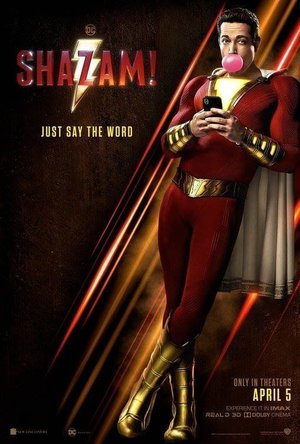
Zoltar Rides Again!
All work and no play makes Bob the Movie Man a dull reviewer. Due to work commitments, this is the first film I’ve been able to see at the cinema for over a month. There’s a whole slew of films I wanted to see that have already come and gone. Big sigh. So I might be about the last of the crowd to review this, but I’m glad I caught it before it shuffled off its silver screen coil.
Every review I’ve seen of this starts off with the hackneyed comment that “At last, DC have produced a fun film” – so I won’t (even though it’s true!).
The Plot
“Shazam!” harks back, strongly, to the vehicle that helped launch Tom Hanks‘ illustrious career – Penny Marshall’s “Big” from 1988. In that film the young teen Josh (David Moscow) visits a deserted fairground where “Zoltar” mystically (and without explanation) morphs Josh into his adult self (Hanks). Much fun is had with Hanks showing his best friend Billy the joys (and sometimes otherwise) of booze, girls and other adult pastimes. In similar vein, in “Shazam!” we see the parent-less Billy Batson (Asher Angel) hijacked on a Philadelphia subway train and transformed into a DC superhero as a last-gasp effort of the ancient-wizard (Djimon Hounsou) to find someone ‘good’ to pass his magic onto. “Grab onto my staff with both hands” (Ugh) and say my name – “Juman….”…. no, sorry, wrong film…. “Shazam!”. And as in “Big”, Billy has to explore his new superhero powers with the only person vaguely close to him; his new foster-brother Freddie (Jack Dylan Grazer from “It”).
Billy is not the first to have met the wizard – not by a long shot. There has been a long line of potential candidates examined and rejected on this road, one of which, back in 1974, was the unhappy youngster Thaddeus Sivana (Ethan Pugiotto, but now grown up as Mark Cross), who has a seething chip on his shoulder as big as the Liberty Bell. Gaining evil super-powers of his own, the race is on to see if Dr Sivana can track down the fledgling Billy before he can learn to master his superhero skills and so take him down.
Wizards with red capes?
With the loose exception of possibly Scarlet Witch, I don’t think it’s actually ever been explored before that “superheroes” are actually “magicians” with different coloured capes… it’s a novel take. Before the Marvel/DC wheels eventually come off – which before another twenty years are up they surely must? – will we see a “Harry Potter vs Superman” crossover? “YOUR MOTHER’S NAME WAS LILY AND MINE WAS MARTHA…. L AND M ARE NEXT TO EACH OTHER IN THE DICTIONARY!!!!” The mind boggles.
What does make “Shazam!” interesting is that the story is consciously set in a DC world where Superman, Batman, Wonder Woman, Aquaman and the rest all live and breathe. Freddie has a Bat-a-rang (“only a replica”) and a carefully shrink-wrapped squashed bullet that had impacted on Superman’s body. So when Billy – in superhero form – makes his appearances on the streets of Philly, this makes “Shazam” an “oh look, there’s another one” curiosity rather than an out-and-out marvel.
(Source: Warner Brothers). Lightning from the fingers! Proving very useful for Shazam’s own….
Much fun is obviously had with “Shazam” testing out his powers. Freddie’s Youtube videos gather thousands of hits baas Billy tries to fly; tries to burn; tries to use his “laser sight”; etc.
What works well.
It’s a fun flick that delivers the Marvel laughs of “Ragnarok” and “Ant Man” without ever really getting to the gravitas of either. The screenplay writer (Henry Gayden) is clearly a lover of cinema, as there are numerous references to other movies scattered throughout the film: the victory run of “Rocky” (obviously); the cracking windshield of “The Lost World”; the scary-gross-out body disintegrations of “Indiana Jones”; the portal entry doors of “Monsters, Inc”. Even making an appearance briefly, as a respectful nod presumably to the story’s plagiarism, is the toy-store floor piano of “Big”. There are probably a load of other movie Easter Eggs that I missed.
Playing Billy, the relatively unknown Zachary Levi also charms in a similarly goofball way as Hanks did all those years ago. (Actually, he’s more reminiscent of the wide-eyed delight of Brendan Fraser’s “George of the Jungle” rather than Hanks). In turns, his character is genuinely delighted then shocked at his successes and failures (“Leaping buildings with a single bound” – LOL!). Also holding up their own admirably are the young leads Asher Angel and Jack Dylan Grazer.
Mark Cross, although having flaunted with being the good guy in the “Kingsman” films, is now firmly back in baddie territory as the “supervillain”: and very good he is at it too; I thought he was the best thing in the whole film.
Finally, the movie’s got a satisfying story arc, with Billy undergoing an emotional journey that emphasises the importance of family. But it’s not done in a slushy manipulative way.
What works less well.
As many of you know, I have a few rules-of-thumb for movies, one of which is that a comedy had better by bloody good if it’s going to have a run-time of much more than 90 minutes. At 132 minutes, “Shazam!” overstayed its welcome for me by a good 20 or 30 minutes. Director David F. Sandberg could have made a much tighter and better film if he had wielded the editing knife a bit more freely. I typically enjoy getting backstory to characters, and in many ways this film delivers where many don’t. The pre-credit scenes with Thaddeus nicely paint the character for his (hideous) actions that follow. However, Billy is over-burdened with backstory, and it takes wayyyyyyy too long for the “Shazam!” to happen and the fun to begin. We also lapse into an overlong superhero finale. I didn’t actually see the twist in the plot coming, which was good, but once there then the denouement could and should have been much swifter.
The film also has its scary moments and deserves its 12A certificate. As a film rather painted as kid-friendly from the trailer and the poster, there is probably the potential to traumatise young children here, particularly in a terrifying scene in a board room (with a view). As well as the physical scares there is also a dark streak running under the story that reminded me of both the original “Jumanji” and “Ghostbusters”. Parents beware.
Monkeys?
Following on from the Marvel expectations, there are a couple of “monkeys” (see Glossary) in the title roll: one mid-titles, featuring Dr Sivana and implying an undoubted sequel, and one right at the end pointing fun at the otherwise ignored “Aquaman”.
Final thoughts.
It’s clearly been a long overdue hit for DC, and on the whole I enjoyed it. If the film had been a bit tighter, this would have had the potential to be a classic.
Every review I’ve seen of this starts off with the hackneyed comment that “At last, DC have produced a fun film” – so I won’t (even though it’s true!).
The Plot
“Shazam!” harks back, strongly, to the vehicle that helped launch Tom Hanks‘ illustrious career – Penny Marshall’s “Big” from 1988. In that film the young teen Josh (David Moscow) visits a deserted fairground where “Zoltar” mystically (and without explanation) morphs Josh into his adult self (Hanks). Much fun is had with Hanks showing his best friend Billy the joys (and sometimes otherwise) of booze, girls and other adult pastimes. In similar vein, in “Shazam!” we see the parent-less Billy Batson (Asher Angel) hijacked on a Philadelphia subway train and transformed into a DC superhero as a last-gasp effort of the ancient-wizard (Djimon Hounsou) to find someone ‘good’ to pass his magic onto. “Grab onto my staff with both hands” (Ugh) and say my name – “Juman….”…. no, sorry, wrong film…. “Shazam!”. And as in “Big”, Billy has to explore his new superhero powers with the only person vaguely close to him; his new foster-brother Freddie (Jack Dylan Grazer from “It”).
Billy is not the first to have met the wizard – not by a long shot. There has been a long line of potential candidates examined and rejected on this road, one of which, back in 1974, was the unhappy youngster Thaddeus Sivana (Ethan Pugiotto, but now grown up as Mark Cross), who has a seething chip on his shoulder as big as the Liberty Bell. Gaining evil super-powers of his own, the race is on to see if Dr Sivana can track down the fledgling Billy before he can learn to master his superhero skills and so take him down.
Wizards with red capes?
With the loose exception of possibly Scarlet Witch, I don’t think it’s actually ever been explored before that “superheroes” are actually “magicians” with different coloured capes… it’s a novel take. Before the Marvel/DC wheels eventually come off – which before another twenty years are up they surely must? – will we see a “Harry Potter vs Superman” crossover? “YOUR MOTHER’S NAME WAS LILY AND MINE WAS MARTHA…. L AND M ARE NEXT TO EACH OTHER IN THE DICTIONARY!!!!” The mind boggles.
What does make “Shazam!” interesting is that the story is consciously set in a DC world where Superman, Batman, Wonder Woman, Aquaman and the rest all live and breathe. Freddie has a Bat-a-rang (“only a replica”) and a carefully shrink-wrapped squashed bullet that had impacted on Superman’s body. So when Billy – in superhero form – makes his appearances on the streets of Philly, this makes “Shazam” an “oh look, there’s another one” curiosity rather than an out-and-out marvel.
(Source: Warner Brothers). Lightning from the fingers! Proving very useful for Shazam’s own….
Much fun is obviously had with “Shazam” testing out his powers. Freddie’s Youtube videos gather thousands of hits baas Billy tries to fly; tries to burn; tries to use his “laser sight”; etc.
What works well.
It’s a fun flick that delivers the Marvel laughs of “Ragnarok” and “Ant Man” without ever really getting to the gravitas of either. The screenplay writer (Henry Gayden) is clearly a lover of cinema, as there are numerous references to other movies scattered throughout the film: the victory run of “Rocky” (obviously); the cracking windshield of “The Lost World”; the scary-gross-out body disintegrations of “Indiana Jones”; the portal entry doors of “Monsters, Inc”. Even making an appearance briefly, as a respectful nod presumably to the story’s plagiarism, is the toy-store floor piano of “Big”. There are probably a load of other movie Easter Eggs that I missed.
Playing Billy, the relatively unknown Zachary Levi also charms in a similarly goofball way as Hanks did all those years ago. (Actually, he’s more reminiscent of the wide-eyed delight of Brendan Fraser’s “George of the Jungle” rather than Hanks). In turns, his character is genuinely delighted then shocked at his successes and failures (“Leaping buildings with a single bound” – LOL!). Also holding up their own admirably are the young leads Asher Angel and Jack Dylan Grazer.
Mark Cross, although having flaunted with being the good guy in the “Kingsman” films, is now firmly back in baddie territory as the “supervillain”: and very good he is at it too; I thought he was the best thing in the whole film.
Finally, the movie’s got a satisfying story arc, with Billy undergoing an emotional journey that emphasises the importance of family. But it’s not done in a slushy manipulative way.
What works less well.
As many of you know, I have a few rules-of-thumb for movies, one of which is that a comedy had better by bloody good if it’s going to have a run-time of much more than 90 minutes. At 132 minutes, “Shazam!” overstayed its welcome for me by a good 20 or 30 minutes. Director David F. Sandberg could have made a much tighter and better film if he had wielded the editing knife a bit more freely. I typically enjoy getting backstory to characters, and in many ways this film delivers where many don’t. The pre-credit scenes with Thaddeus nicely paint the character for his (hideous) actions that follow. However, Billy is over-burdened with backstory, and it takes wayyyyyyy too long for the “Shazam!” to happen and the fun to begin. We also lapse into an overlong superhero finale. I didn’t actually see the twist in the plot coming, which was good, but once there then the denouement could and should have been much swifter.
The film also has its scary moments and deserves its 12A certificate. As a film rather painted as kid-friendly from the trailer and the poster, there is probably the potential to traumatise young children here, particularly in a terrifying scene in a board room (with a view). As well as the physical scares there is also a dark streak running under the story that reminded me of both the original “Jumanji” and “Ghostbusters”. Parents beware.
Monkeys?
Following on from the Marvel expectations, there are a couple of “monkeys” (see Glossary) in the title roll: one mid-titles, featuring Dr Sivana and implying an undoubted sequel, and one right at the end pointing fun at the otherwise ignored “Aquaman”.
Final thoughts.
It’s clearly been a long overdue hit for DC, and on the whole I enjoyed it. If the film had been a bit tighter, this would have had the potential to be a classic.

Solar Walk 2 Ads+: Universe 3D
Reference and Education
App
Solar Walk 2 is a digital guide to our solar system and a new highly attractive way to explore the...

Bong Mines Entertainment (15 KP) rated KOD by J. Cole in Music
Jun 7, 2019
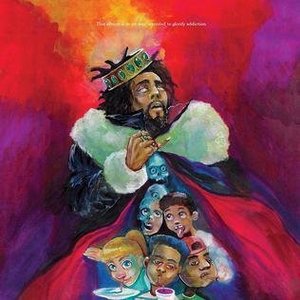

J. Cole is a popular hip-hop lyricist out of Fayetteville, North Carolina. Not too long ago, he released his long-anticipated, self-produced, fifth studio album, entitled, “KOD”.
J. Cole – “KOD Trailer”
Cole revealed via Twitter that “KOD” stands for Kids on Drugs, King Overdosed, and Kill Our Demons. The rest of the album he leaves to our interpretation. Well, let’s begin.
INTRO
The album begins with caution. Jazz bellows underneath a female voice reciting uplifting words. Her message suggests listeners should make the right decisions (choose wisely) because the past (sand in an hourglass) can provide shelter for their demons.
Also, a way to a painless existence is provided. Those in pain must choose wisely, or make healthier decisions, to avoid being tormented by their past.
KOD
The title track showcases Cole’s Kids on Drugs braggadocios side. In verse one, he utilizes his carnal mind to reply to media/fans asking him a bunch of ‘how’ questions. But instead of being humble, Cole replies to his critics in an arrogant way.
The second verse disconnects from the first and goes into a random storytelling mode with intersecting ideas that jump from one subject to another.
The outro is noteworthy. It forms a bridge between Intro and KOD songs. Also, it ends on a thought-provoking note.
If love is indeed the strongest drug like Cole stated, then why isn’t it being chased after like the drugs listed above? Why aren’t more people getting high off love? The question then becomes…is love even a drug?
That depends on who you ask. But what we all will agree on, love is an invisible element that contributes to people being addicted to drugs? It’s a fact, a strong love for something breeds addiction, dependency, et cetera.
PHOTOGRAPH
Cole uses a 2018 rhyme pattern to address a woman he follows privately on social media. He’s addicted or loves to stalk the woman online, and it’s starting to mess with his health.
Cole always excels when he tells stories about him and a woman. Women are his go-to subject to rap about and he does a pretty good job on this song.
THE CUT OFF (FEAT. KILL EDWARD)
Cole isn’t too fond of doing features on his albums. But this time, he enlists his alter ego, kiLL edward, to help him say that Heaven is a mental mind state.
edward raps that he’s stuck in his fallen ways and that’s why he keeps falling down. That’s why he drinks alcohol and uses drugs to help him cope. But keep in mind that edward is actually Cole.
Cole raps about disloyal friends that owe him an apology and what he’s gonna do to them when they meet. But all the while, edward is in Cole’s mind telling him that drinking alcohol and using drugs will help numb his pain.
ATM
ATM is an energetically poppin’ single with replay value. It begins with the album’s theme—choose wisely.
Cole praises money like it’s biblical and even states that it solved every problem he had. But after counting up all the money, he concludes that you can’t take it with you when you die.
The Scott Lazer & Cole-directed video shows the King of Drugs chauffeuring a bunch of children riding on a drug float. The storyline is dope, reminiscent of a classic video from hip-hop’s golden era.
Also, Cole literally gives his arm and leg to purchase a vehicle. That transaction signifies what people are doing nowadays to accumulate material wealth. But keep in mind, chasing money will lead to your death or downfall. Message received.
MOTIV8
Motiv8 is a good track that features a sample from Junior M.A.F.I.A.’s “Get Money” single.
Cole encourages listeners to get high and get money, even though he just said that chasing money is detrimental to their health.
Verse 2 features one of Cole’s best lyrics and flow.
KEVIN’S HEART
Cole’s continues his lyrical crusade and touches on his favorite subject.
He raps about being in a committed relationship but admits to being an addict that’s addicted to cheating. He tries to fight the temptation and remain faithful but acknowledges that he’s fake for thinking that way.
BRACKETS
The song begins with a Richard Pryor comedy skit.
Cole speaks about being a millionaire and then he receives a phone call from Uncle Sam.
Verse 2 highlights Cole’s disgust with paying higher taxes now that he’s a millionaire.
ONCE AN ADDICT – INTERLUDE
Cole shines brightly on this song, which is reminiscent of Nas’ “Project Windows” single.
He addresses his mother’s battle with alcoholism. The reason why she drank—because Cole’s step-father had a baby with another woman. So, to cope with the pain, Cole’s mother started abusing alcohol.
With no one to turn to, she used to call to talk to Cole. But he didn’t like talking to her while she was drunk.
At the end of the song, Cole regrets being that way to his mother when she needed him the most.
FRIENDS (FEAT. KILL EDWARDS)
Cole finds solace in his alter ego and cops another bag of weed to smoke. Somehow, he needs it to cope and gets aggravated when he doesn’t smoke.
He takes this time to address his friends who aren’t motivated to succeed. He tells them several things they can blame their lack of motivation on. And ends it by saying that the blame game is also an addiction that people use to not get better.
Also, he raps about depression and drug addiction.
WINDOW PAIN – OUTRO
The song begins with a girl telling Cole about the time her cousin got shot. Cole is sad, listening to the girl with tears in his eyes.
Then Cole praises the Most High. He speaks about things he wanna do like killing the man that made his mother cry and seeing his granny on the other side.
The girl ends the song with a powerful message.
1985 – INTRO TO “THE FALL OFF”
Cole ends his KOD album in battle rap mode. He addresses Lil Pump for dissing him on Pump’s “F*ck J Cole” song.
Cole’s flow is melodic and his lyrics cut deep. He foretells Pump’s future and predicts the rapper will be on Love & Hip-Hop in five years. Also, Cole wished him good luck in his career.
CONCLUSION
J. Cole gets a big thumbs up for producing a solid album with no features. Also, his evergreen message of choosing wisely has to be applauded, especially nowadays when living recklessly is being rewarded.
Listeners have different options to cope with their pain. Using drugs and drinking alcohol are just two ways of doing so. But if you choose wisely, and pick a healthier way to ease your pain, your life will change for the better.
https://www.bongminesentertainment.com/j-cole-kod/
J. Cole – “KOD Trailer”
Cole revealed via Twitter that “KOD” stands for Kids on Drugs, King Overdosed, and Kill Our Demons. The rest of the album he leaves to our interpretation. Well, let’s begin.
INTRO
The album begins with caution. Jazz bellows underneath a female voice reciting uplifting words. Her message suggests listeners should make the right decisions (choose wisely) because the past (sand in an hourglass) can provide shelter for their demons.
Also, a way to a painless existence is provided. Those in pain must choose wisely, or make healthier decisions, to avoid being tormented by their past.
KOD
The title track showcases Cole’s Kids on Drugs braggadocios side. In verse one, he utilizes his carnal mind to reply to media/fans asking him a bunch of ‘how’ questions. But instead of being humble, Cole replies to his critics in an arrogant way.
The second verse disconnects from the first and goes into a random storytelling mode with intersecting ideas that jump from one subject to another.
The outro is noteworthy. It forms a bridge between Intro and KOD songs. Also, it ends on a thought-provoking note.
If love is indeed the strongest drug like Cole stated, then why isn’t it being chased after like the drugs listed above? Why aren’t more people getting high off love? The question then becomes…is love even a drug?
That depends on who you ask. But what we all will agree on, love is an invisible element that contributes to people being addicted to drugs? It’s a fact, a strong love for something breeds addiction, dependency, et cetera.
PHOTOGRAPH
Cole uses a 2018 rhyme pattern to address a woman he follows privately on social media. He’s addicted or loves to stalk the woman online, and it’s starting to mess with his health.
Cole always excels when he tells stories about him and a woman. Women are his go-to subject to rap about and he does a pretty good job on this song.
THE CUT OFF (FEAT. KILL EDWARD)
Cole isn’t too fond of doing features on his albums. But this time, he enlists his alter ego, kiLL edward, to help him say that Heaven is a mental mind state.
edward raps that he’s stuck in his fallen ways and that’s why he keeps falling down. That’s why he drinks alcohol and uses drugs to help him cope. But keep in mind that edward is actually Cole.
Cole raps about disloyal friends that owe him an apology and what he’s gonna do to them when they meet. But all the while, edward is in Cole’s mind telling him that drinking alcohol and using drugs will help numb his pain.
ATM
ATM is an energetically poppin’ single with replay value. It begins with the album’s theme—choose wisely.
Cole praises money like it’s biblical and even states that it solved every problem he had. But after counting up all the money, he concludes that you can’t take it with you when you die.
The Scott Lazer & Cole-directed video shows the King of Drugs chauffeuring a bunch of children riding on a drug float. The storyline is dope, reminiscent of a classic video from hip-hop’s golden era.
Also, Cole literally gives his arm and leg to purchase a vehicle. That transaction signifies what people are doing nowadays to accumulate material wealth. But keep in mind, chasing money will lead to your death or downfall. Message received.
MOTIV8
Motiv8 is a good track that features a sample from Junior M.A.F.I.A.’s “Get Money” single.
Cole encourages listeners to get high and get money, even though he just said that chasing money is detrimental to their health.
Verse 2 features one of Cole’s best lyrics and flow.
KEVIN’S HEART
Cole’s continues his lyrical crusade and touches on his favorite subject.
He raps about being in a committed relationship but admits to being an addict that’s addicted to cheating. He tries to fight the temptation and remain faithful but acknowledges that he’s fake for thinking that way.
BRACKETS
The song begins with a Richard Pryor comedy skit.
Cole speaks about being a millionaire and then he receives a phone call from Uncle Sam.
Verse 2 highlights Cole’s disgust with paying higher taxes now that he’s a millionaire.
ONCE AN ADDICT – INTERLUDE
Cole shines brightly on this song, which is reminiscent of Nas’ “Project Windows” single.
He addresses his mother’s battle with alcoholism. The reason why she drank—because Cole’s step-father had a baby with another woman. So, to cope with the pain, Cole’s mother started abusing alcohol.
With no one to turn to, she used to call to talk to Cole. But he didn’t like talking to her while she was drunk.
At the end of the song, Cole regrets being that way to his mother when she needed him the most.
FRIENDS (FEAT. KILL EDWARDS)
Cole finds solace in his alter ego and cops another bag of weed to smoke. Somehow, he needs it to cope and gets aggravated when he doesn’t smoke.
He takes this time to address his friends who aren’t motivated to succeed. He tells them several things they can blame their lack of motivation on. And ends it by saying that the blame game is also an addiction that people use to not get better.
Also, he raps about depression and drug addiction.
WINDOW PAIN – OUTRO
The song begins with a girl telling Cole about the time her cousin got shot. Cole is sad, listening to the girl with tears in his eyes.
Then Cole praises the Most High. He speaks about things he wanna do like killing the man that made his mother cry and seeing his granny on the other side.
The girl ends the song with a powerful message.
1985 – INTRO TO “THE FALL OFF”
Cole ends his KOD album in battle rap mode. He addresses Lil Pump for dissing him on Pump’s “F*ck J Cole” song.
Cole’s flow is melodic and his lyrics cut deep. He foretells Pump’s future and predicts the rapper will be on Love & Hip-Hop in five years. Also, Cole wished him good luck in his career.
CONCLUSION
J. Cole gets a big thumbs up for producing a solid album with no features. Also, his evergreen message of choosing wisely has to be applauded, especially nowadays when living recklessly is being rewarded.
Listeners have different options to cope with their pain. Using drugs and drinking alcohol are just two ways of doing so. But if you choose wisely, and pick a healthier way to ease your pain, your life will change for the better.
https://www.bongminesentertainment.com/j-cole-kod/
Bob Mann (459 KP) rated Instant Family (2019) in Movies
Sep 28, 2021

Enjoyable and harmless comedy laced with a degree of sentimentality.
The Plot
Pete (Mark Wahlberg) and Ellie (Rose Byrne) are focused and business-oriented home designers. They’ve talked about having kids “sometime in the future” but the years – as years are want to do – are motoring away from them. Pete is concerned that if they have their own kids now then he will end up being an “old dad” (cue very funny, black-comedy, flashback). This leads them into contact with the State’s fostering service – led by Karen (Octavia Spencer) and Sharon (Tig Notaro) – and they progress into foster training. This introduces into their ‘perfect adult lives’ 15-year old Lizzy (Isabela Moner) and her younger siblings Juan (Gustavo Quiroz) and Lita (Julianna Gamiz). As these guys come from a troubled background Pete and Ellie find they have their work cut out. Who will crack first?
The turns
You’ve got to admire Mark Wahlberg as an actor. In the same vein as Steve Carell, he seems to be able to flex from dramatic (in his case, tough-guy action roles) to comedy without a blink. He’s nowhere near the calibre of actor as Carell, but he brings to all his roles a sense of menace – derived no doubt from his torrid criminal background in younger days. (His wiki page makes your eyes water: there’s a great biopic screenplay waiting to be written there! ) It must have made the kid actor who plays Charlie (Carson Holmes) actually soil himself at a key point in the film!
Wahlberg and the excellent Rose Byrne make a believable driven-couple, and Byrne has such a range of expressive faces that she can’t help but make you laugh.
Of the child actors, Nickelodeon star Isabella Moner shines with genuine brilliance, both in terms of her acting as the fiercely loyal Lizzy but also in terms of her musical ability (she sings the impressive end-title song). With Hollywood in ‘post-La-La-Showman: Here we go again’ mode, this is a talented young lady I predict might be in big demand over the next few years.
Top of my list of the most stupid “where the hell have I seen her before bang-my-head-against-the-cinema-wall” moments is the actress playing Ellie’s mother Jan. She is OF COURSE Julie Hagerty, air-hostess supreme from “Airplane!”.
Also good value, and topping my list of “I know her from lots of films but don’t know her name” is Margo Martindale* as Pete’s exuberant and easily bought mother Sandy. (*Must write this out 100 times before her picture appears in the Picturehouse Harbour Lights film quiz!).
A well-crafty script with some wayward characters
The script by director Sean (“Daddy’s Home”) Anders and John Morris zips along at a fine pace, albeit in a wholly predictable direction. It helps that I struggle the think of many films about the adoption process itself. Sure there have been lots of movies about children that have been adopted – Manchester By The Sea and Lion being two recent examples – but the only film I can immediately think of (and not in a good way) with foster care at its heart was the Katherine Heigl comedy from a few years ago “Life as we know it”. So this is good movie territory to mine.
There are some fine running jokes, notably young Juan’s penchant for constantly getting injured. However, the script also lapses as did Anders’ “Daddy’s Home 2” from last year – into moments of slushy sentimentality. (My dear departed Dad always used to affect an exaggerated snore at such points, and I could hear him in my head at regular intervals during the film!). I would have preferred a harder and blacker edge to the comedy: something that last year’s excellent “Game Night” pulled off so well.
There are also a couple of characters in the film that were poorly scripted and which just didn’t work. While Octavia Spencer was fine (channelling an almost identical version of her wisecracking and sardonic character from “The Shape of Water“), I just had no idea what her colleague Sharon (Tig Notaro) was supposed to be. The tone was all over the place. Similarly, who should pop up on a balcony in an unexpected cameo but the great Joan Cusack. And very funny she is too for the 10 second interruption. But the writers having got her there just couldn’t leave alone and we get a plain embarrassing extended interruption that strikes a duff note in the flow of the film.
Summary
The film is amusing and harmless without taxing many brain cells. Most notably unlike many so-called American ‘comedies’ it did actually make me laugh at multiple points. I should also point out that my wife absolutely loved it, rating it a strong 4* going on 5*.
But the really cute thing is that…
…the film is “inspired by a true family”: namely Anders’ own. He and his wife fostered three kids out of the US foster service, so the script is undoubtedly loosely based on their own experiences, which give it an extra impact for some of Peter and Ellie’s lines. In an essay for TIME (source: bustle.com) Anders wrote:
My wife Beth and I had been talking for years about whether we should have kids,” he wrote. “For the longest time we just felt like we couldn’t afford it. Then I sold a couple of scripts and was feeling like I might have a career, but we were in our 40s and worried we had left it too long. We knew kids would make our life bigger, so one day I joked, ‘Why don’t we just adopt a five-year-old and it will be like we got started five years ago?'”
It gives you a completely different perspective on the film knowing this. My wife after the film was saying “I’m not sure how accurately it portrays the fostering process”. But it clearly does.
Pete (Mark Wahlberg) and Ellie (Rose Byrne) are focused and business-oriented home designers. They’ve talked about having kids “sometime in the future” but the years – as years are want to do – are motoring away from them. Pete is concerned that if they have their own kids now then he will end up being an “old dad” (cue very funny, black-comedy, flashback). This leads them into contact with the State’s fostering service – led by Karen (Octavia Spencer) and Sharon (Tig Notaro) – and they progress into foster training. This introduces into their ‘perfect adult lives’ 15-year old Lizzy (Isabela Moner) and her younger siblings Juan (Gustavo Quiroz) and Lita (Julianna Gamiz). As these guys come from a troubled background Pete and Ellie find they have their work cut out. Who will crack first?
The turns
You’ve got to admire Mark Wahlberg as an actor. In the same vein as Steve Carell, he seems to be able to flex from dramatic (in his case, tough-guy action roles) to comedy without a blink. He’s nowhere near the calibre of actor as Carell, but he brings to all his roles a sense of menace – derived no doubt from his torrid criminal background in younger days. (His wiki page makes your eyes water: there’s a great biopic screenplay waiting to be written there! ) It must have made the kid actor who plays Charlie (Carson Holmes) actually soil himself at a key point in the film!
Wahlberg and the excellent Rose Byrne make a believable driven-couple, and Byrne has such a range of expressive faces that she can’t help but make you laugh.
Of the child actors, Nickelodeon star Isabella Moner shines with genuine brilliance, both in terms of her acting as the fiercely loyal Lizzy but also in terms of her musical ability (she sings the impressive end-title song). With Hollywood in ‘post-La-La-Showman: Here we go again’ mode, this is a talented young lady I predict might be in big demand over the next few years.
Top of my list of the most stupid “where the hell have I seen her before bang-my-head-against-the-cinema-wall” moments is the actress playing Ellie’s mother Jan. She is OF COURSE Julie Hagerty, air-hostess supreme from “Airplane!”.
Also good value, and topping my list of “I know her from lots of films but don’t know her name” is Margo Martindale* as Pete’s exuberant and easily bought mother Sandy. (*Must write this out 100 times before her picture appears in the Picturehouse Harbour Lights film quiz!).
A well-crafty script with some wayward characters
The script by director Sean (“Daddy’s Home”) Anders and John Morris zips along at a fine pace, albeit in a wholly predictable direction. It helps that I struggle the think of many films about the adoption process itself. Sure there have been lots of movies about children that have been adopted – Manchester By The Sea and Lion being two recent examples – but the only film I can immediately think of (and not in a good way) with foster care at its heart was the Katherine Heigl comedy from a few years ago “Life as we know it”. So this is good movie territory to mine.
There are some fine running jokes, notably young Juan’s penchant for constantly getting injured. However, the script also lapses as did Anders’ “Daddy’s Home 2” from last year – into moments of slushy sentimentality. (My dear departed Dad always used to affect an exaggerated snore at such points, and I could hear him in my head at regular intervals during the film!). I would have preferred a harder and blacker edge to the comedy: something that last year’s excellent “Game Night” pulled off so well.
There are also a couple of characters in the film that were poorly scripted and which just didn’t work. While Octavia Spencer was fine (channelling an almost identical version of her wisecracking and sardonic character from “The Shape of Water“), I just had no idea what her colleague Sharon (Tig Notaro) was supposed to be. The tone was all over the place. Similarly, who should pop up on a balcony in an unexpected cameo but the great Joan Cusack. And very funny she is too for the 10 second interruption. But the writers having got her there just couldn’t leave alone and we get a plain embarrassing extended interruption that strikes a duff note in the flow of the film.
Summary
The film is amusing and harmless without taxing many brain cells. Most notably unlike many so-called American ‘comedies’ it did actually make me laugh at multiple points. I should also point out that my wife absolutely loved it, rating it a strong 4* going on 5*.
But the really cute thing is that…
…the film is “inspired by a true family”: namely Anders’ own. He and his wife fostered three kids out of the US foster service, so the script is undoubtedly loosely based on their own experiences, which give it an extra impact for some of Peter and Ellie’s lines. In an essay for TIME (source: bustle.com) Anders wrote:
My wife Beth and I had been talking for years about whether we should have kids,” he wrote. “For the longest time we just felt like we couldn’t afford it. Then I sold a couple of scripts and was feeling like I might have a career, but we were in our 40s and worried we had left it too long. We knew kids would make our life bigger, so one day I joked, ‘Why don’t we just adopt a five-year-old and it will be like we got started five years ago?'”
It gives you a completely different perspective on the film knowing this. My wife after the film was saying “I’m not sure how accurately it portrays the fostering process”. But it clearly does.

Hadley (567 KP) rated The Walking Dead Rise of the Governor (Book #1) in Books
May 27, 2019
Characters (1 more)
Story telling
Too many author afterthoughts (1 more)
Overusage of scientific words for the brain
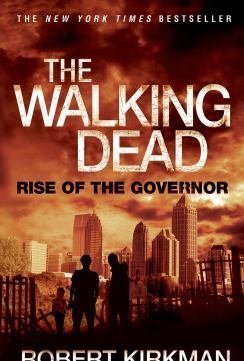
I love the Walking Dead. And,personally, I love any book that has a great apocalyptic world in it, and even more so if it has some pretty good characters in it, too.
Cue Brian and Philip Blake: in The Walking Dead's 'The Rise of the Governor,' we meet two brothers who barely have anything in common; Brian is a laid back, music-loving hippie, while Philip is a hard-headed, tough guy. In the story, we follow both brothers along with two of Philip's best buddies and his daughter, Penny. The focus is on the brothers almost the entire time, and quickly, the reader finds out that, surprisingly, Brian is the oldest of the pair, but yet, Philip is the one making all of the decisions. As we continue on, the dynamic between the brothers becomes clear - we start to understand that Brian has always been the cautious one of the family, while Philip quickly learned to be a fearless leader from an early age, making this odd dynamic seem right.
Most importantly, what the two have in common is their love for Penny. If you have ever watched the TV show, The Walking Dead, then you will recognize the little girl and the tragic fate that became her. But, we never knew the backstory of how Penny was turned into a zombie, which is one of the few reasons this book series was made. Penny spends much of the time as a background character, but her part plays a very important role on the development of the man we know becomes 'the Governor.' She reacts as most children would be expected to if the world were ever to suffer from a zombie apocalypse- she withdraws, barely speaking and hardly eats. When one of Philip's longtime friends gets bit by a zombie, Penny reacts with a cool casualness that seems troubling from early on. On another note, if it wasn't for her uncle, Brian, Penny would have probably died much earlier in the book, but because of his father-like protectiveness of her, she is kept alive until the end of the book. But when it does happen, I don't think I could blame Philip for keeping his daughter as a zombie-type of pet.
During the book, 'Rise of the Governor,' the group with the Blake brothers travel to Atlanta, Georgia in hopes of finding a refugee camp to hunker down at, but instead, they find that Atlanta has practically been turned over to the walkers. It's here that they fortunately meet a trio that is held up in an apartment building- this trio is the Chalmers family, which consists of David and his two grown daughters, April and Tara. The transition between the group fighting their way through the hordes in Atlanta to meeting the Chalmers family is done perfectly to the point that is it very believable that this could actually happen in real life.
One of the few problems I did have with this book were the authors' afterthoughts: too many times throughout the book, characters would suddenly show up with a new weapon or item that the authors would literally backtrack to explain how they found it, when it could have been easily shown while the character was in the area of where it was found.
Much of the story, appropriately, shows our main group of characters killing zombies with an array of weapons and such, but Kirkman - or co-writer, Bonansinga- seem to like to show off their knowledge of the brain a little too much:
"The business end of Philip's pickaxe lands squarely in the monster's head, cracking the coconutlike shell of the old man's skull, piercing the dense, fibrous membrane of the dura mater and sinking into the gelatinous parietal lobe. " The use of scientific terms just seems like an egotistical move, one that could have been avoided if they weren't used throughout the book.
In the middle of the book, there is an odd thing that happens which the reader may connect to the story or may not, when David Chalmers is meeting his end (Chalmers was suffering from advanced lung cancer before the group meets him), gives almost a prophetic speech on his death bed. We can either take this as he was speaking about who Philip was going to become or he was talking about the apocalypse as a whole, but the reader is never really told and the dying words are never discussed among any of the characters:
" 'The devil has plans for us.'... The voice that comes out of David Chalmers is low and gravelly, an engine dieseling: 'The day of reckoning is drawing near... the Deceiver walks among us.' "
Eventually, the group is forcefully thrown out of the Chalmers' apartment building due to a horrible mistake between Philip and April. To not give too much away, here is the part where Tara tells them to go away: " He whirls around and comes face-to-face with Tara Chalmers, who holds the Ruger pistol, the muzzle raised and aimed directly at Philip. "
The story continues on with the Blake brothers, Penny and Philip's friend, Nick, as they try to find shelter once again in the dead congested Atlanta. Early on, we learn that Philip has a bad temper, and as the book continues, his temper becomes more volatile and more important to the characters and the reader. Philip's personality changes are understandable in the story, but Kirkman/Bonansinga suddenly make Brian unafraid of his brother at a point where Philip's anger is almost at its worse; this isn't believable to the readers, especially because a few pages later, Brian changes back to being scared to even speak to his brother.
Overall, the story isn't about the zombies or Penny's tragic death, but rather about Brian and Philip; how the family dynamic plays out when everything is at it's worst. Also, when you read the story, there is a point where it seems that Brian is more of a father to Penny than Philip ever was, showing also the Uncle and Niece dynamics- something that will make complete sense near the end of the book. Whether you like The Walking Dead or not, the book is well done, but I believe it would only appeal to those who like survival type stories.
Cue Brian and Philip Blake: in The Walking Dead's 'The Rise of the Governor,' we meet two brothers who barely have anything in common; Brian is a laid back, music-loving hippie, while Philip is a hard-headed, tough guy. In the story, we follow both brothers along with two of Philip's best buddies and his daughter, Penny. The focus is on the brothers almost the entire time, and quickly, the reader finds out that, surprisingly, Brian is the oldest of the pair, but yet, Philip is the one making all of the decisions. As we continue on, the dynamic between the brothers becomes clear - we start to understand that Brian has always been the cautious one of the family, while Philip quickly learned to be a fearless leader from an early age, making this odd dynamic seem right.
Most importantly, what the two have in common is their love for Penny. If you have ever watched the TV show, The Walking Dead, then you will recognize the little girl and the tragic fate that became her. But, we never knew the backstory of how Penny was turned into a zombie, which is one of the few reasons this book series was made. Penny spends much of the time as a background character, but her part plays a very important role on the development of the man we know becomes 'the Governor.' She reacts as most children would be expected to if the world were ever to suffer from a zombie apocalypse- she withdraws, barely speaking and hardly eats. When one of Philip's longtime friends gets bit by a zombie, Penny reacts with a cool casualness that seems troubling from early on. On another note, if it wasn't for her uncle, Brian, Penny would have probably died much earlier in the book, but because of his father-like protectiveness of her, she is kept alive until the end of the book. But when it does happen, I don't think I could blame Philip for keeping his daughter as a zombie-type of pet.
During the book, 'Rise of the Governor,' the group with the Blake brothers travel to Atlanta, Georgia in hopes of finding a refugee camp to hunker down at, but instead, they find that Atlanta has practically been turned over to the walkers. It's here that they fortunately meet a trio that is held up in an apartment building- this trio is the Chalmers family, which consists of David and his two grown daughters, April and Tara. The transition between the group fighting their way through the hordes in Atlanta to meeting the Chalmers family is done perfectly to the point that is it very believable that this could actually happen in real life.
One of the few problems I did have with this book were the authors' afterthoughts: too many times throughout the book, characters would suddenly show up with a new weapon or item that the authors would literally backtrack to explain how they found it, when it could have been easily shown while the character was in the area of where it was found.
Much of the story, appropriately, shows our main group of characters killing zombies with an array of weapons and such, but Kirkman - or co-writer, Bonansinga- seem to like to show off their knowledge of the brain a little too much:
"The business end of Philip's pickaxe lands squarely in the monster's head, cracking the coconutlike shell of the old man's skull, piercing the dense, fibrous membrane of the dura mater and sinking into the gelatinous parietal lobe. " The use of scientific terms just seems like an egotistical move, one that could have been avoided if they weren't used throughout the book.
In the middle of the book, there is an odd thing that happens which the reader may connect to the story or may not, when David Chalmers is meeting his end (Chalmers was suffering from advanced lung cancer before the group meets him), gives almost a prophetic speech on his death bed. We can either take this as he was speaking about who Philip was going to become or he was talking about the apocalypse as a whole, but the reader is never really told and the dying words are never discussed among any of the characters:
" 'The devil has plans for us.'... The voice that comes out of David Chalmers is low and gravelly, an engine dieseling: 'The day of reckoning is drawing near... the Deceiver walks among us.' "
Eventually, the group is forcefully thrown out of the Chalmers' apartment building due to a horrible mistake between Philip and April. To not give too much away, here is the part where Tara tells them to go away: " He whirls around and comes face-to-face with Tara Chalmers, who holds the Ruger pistol, the muzzle raised and aimed directly at Philip. "
The story continues on with the Blake brothers, Penny and Philip's friend, Nick, as they try to find shelter once again in the dead congested Atlanta. Early on, we learn that Philip has a bad temper, and as the book continues, his temper becomes more volatile and more important to the characters and the reader. Philip's personality changes are understandable in the story, but Kirkman/Bonansinga suddenly make Brian unafraid of his brother at a point where Philip's anger is almost at its worse; this isn't believable to the readers, especially because a few pages later, Brian changes back to being scared to even speak to his brother.
Overall, the story isn't about the zombies or Penny's tragic death, but rather about Brian and Philip; how the family dynamic plays out when everything is at it's worst. Also, when you read the story, there is a point where it seems that Brian is more of a father to Penny than Philip ever was, showing also the Uncle and Niece dynamics- something that will make complete sense near the end of the book. Whether you like The Walking Dead or not, the book is well done, but I believe it would only appeal to those who like survival type stories.

Mark Jaye (65 KP) rated The Conjuring (2013) in Movies
May 13, 2019
The Conjuring Review
Contains spoilers, click to show
Originally wrote in 2013:
As an avid fan of horror I look for a few little things which if aren't apparent within the first minute decide on whether I'm going to bother with the rest of the film. Usually the company releasing the movie is a good starting point, reputable/recognised director or producer, recognisable actor/s, good production values - that sort of thing. I've seen some hum-dingers over the years - those films where Johnny Nobody has gathered several of his buddies together with a cheap camcorder or two and filmed some alleged zombie epic in the woods at the back of their school.
**The Conjuring is not one of those**
I like to think I have a strong disposition when it comes to scares - usually it takes a lot to make me squint. Examples that come to mind are 'Sinister', 'The Grudge', the end of 'The Ring' (you know, the scary dark haired girl climbing out of the TV!). The Conjuring is one of those - I watched this in the middle of the morning and found it pretty scary in places.
James Wan certainly knows how to make a movie of this type and is great at evoking atmosphere and notching up the scares as the film develops. In a nutshell, this is the alleged real life story of the Perron family who in 1971 moved into a new farmhouse. It isn't long before the usual shenanigans begin - pictures pulled off walls, doors knocking in the dead of night, the children befriending mysterious 'imaginary' kids (who we all know watching are going to show up at some point). The film sticks to the tried and tested story - gradual possession of one of the adults (Lily Taylor), gradually increasing appearances by ghostly figures, calling in the ghostbusters, gathering the proof, then the exorcism. It may be join the dots territory but it works.
Patrick Wilson shines and seems to be making his mark in films of this nature (Insidious and Insidious Chapter 2) - he portrays real life paranormal investigator Ed Warren who with his wife Lorraine (played just as well by Vera Farmiga) become immersed in the life of the Perron's making themselves targets of the supernatural force at work in the process.
The demonic spirit at work is that of a witch who was married to the guy who built the house back in the 1800's who cursed the land before committing suicide after murdering their child whilst a few days old. There is one particularly pant browning scene where the witch makes her first appearance atop a bedroom wardrobe....and I'll leave it there!
Quality. Best horror I've seen since Sinister.
As an avid fan of horror I look for a few little things which if aren't apparent within the first minute decide on whether I'm going to bother with the rest of the film. Usually the company releasing the movie is a good starting point, reputable/recognised director or producer, recognisable actor/s, good production values - that sort of thing. I've seen some hum-dingers over the years - those films where Johnny Nobody has gathered several of his buddies together with a cheap camcorder or two and filmed some alleged zombie epic in the woods at the back of their school.
**The Conjuring is not one of those**
I like to think I have a strong disposition when it comes to scares - usually it takes a lot to make me squint. Examples that come to mind are 'Sinister', 'The Grudge', the end of 'The Ring' (you know, the scary dark haired girl climbing out of the TV!). The Conjuring is one of those - I watched this in the middle of the morning and found it pretty scary in places.
James Wan certainly knows how to make a movie of this type and is great at evoking atmosphere and notching up the scares as the film develops. In a nutshell, this is the alleged real life story of the Perron family who in 1971 moved into a new farmhouse. It isn't long before the usual shenanigans begin - pictures pulled off walls, doors knocking in the dead of night, the children befriending mysterious 'imaginary' kids (who we all know watching are going to show up at some point). The film sticks to the tried and tested story - gradual possession of one of the adults (Lily Taylor), gradually increasing appearances by ghostly figures, calling in the ghostbusters, gathering the proof, then the exorcism. It may be join the dots territory but it works.
Patrick Wilson shines and seems to be making his mark in films of this nature (Insidious and Insidious Chapter 2) - he portrays real life paranormal investigator Ed Warren who with his wife Lorraine (played just as well by Vera Farmiga) become immersed in the life of the Perron's making themselves targets of the supernatural force at work in the process.
The demonic spirit at work is that of a witch who was married to the guy who built the house back in the 1800's who cursed the land before committing suicide after murdering their child whilst a few days old. There is one particularly pant browning scene where the witch makes her first appearance atop a bedroom wardrobe....and I'll leave it there!
Quality. Best horror I've seen since Sinister.
Duchess of Malfi, the White Devil, the Broken Heart and 'Tis Pity She's a Whore
John Ford, John Webster and Jane Kingsley-Smith
6.5 Rate It
Book
These four plays, written during the reigns of James I and Charles I, took revenge tragedy in dark...