Search

Purple Phoenix Games (2266 KP) rated Way Too Many Cats! in Tabletop Games
Jan 24, 2022

Before we had children and pets my wife and I would love to visit the humane societies back home on a Saturday morning. Sometimes looking for ourselves, sometimes just to see the lovelies being kept, and maybe once or twice volunteering to walk the animals. One place I never really enjoyed visiting was the cat room. I am a dog person. Actually, the older I get, the more I am becoming strictly an aquatic animal lover. Give me a 55 gallon saltwater tank and I’ll be happy raising my Firefish Gobies and Coral Beauty Angelfish. However, when I was asked to preview Way Too Many Cats, I just couldn’t say no. One of my favorite publishers calls for help, I will do my best. Just know I wish it were fish themed instead of cats. Cats…
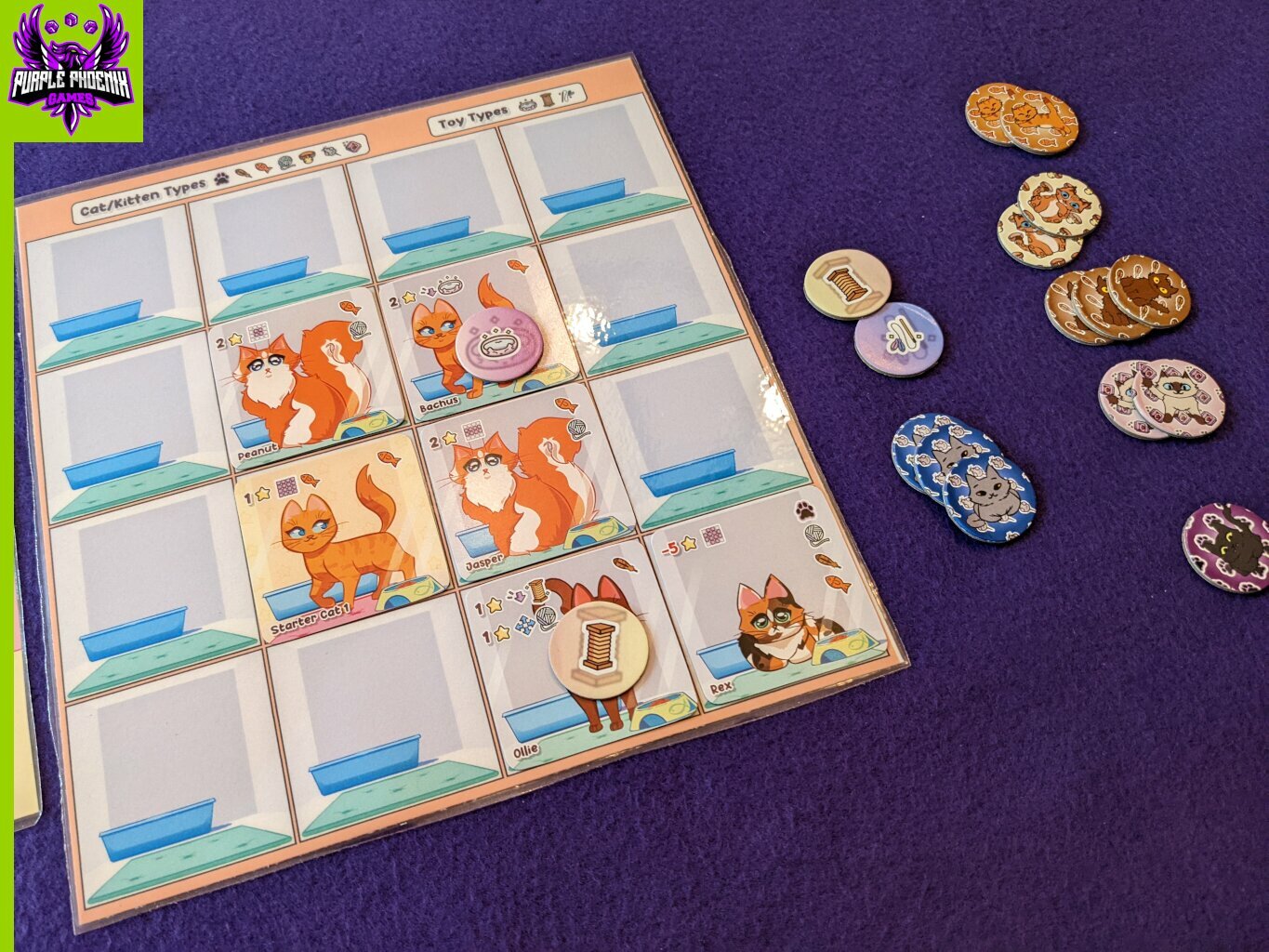
Way Too Many Cats is a cat and kitten drafting and spatial puzzle game for one to six players. In it, players work at feline adoption centers with the goal of having all stock adopted. To do this, players will be placing specific cats adjacent to other favorable cats for points, giving kittens a habitat of their own, and even supplying the cats with toys. The player who completes these tasks most effectively by the end of the game will score the most points and win!
DISCLAIMER: We were provided a prototype copy of this game for the purposes of this review. These are preview copy components, and I do not know for sure if the final components will be any different from these shown. Also, it is not my intention to detail every rule in the game, as there are just too many. You are invited to download the rulebook, back the game through the Kickstarter campaign, or through any retailers stocking it after fulfillment. -T
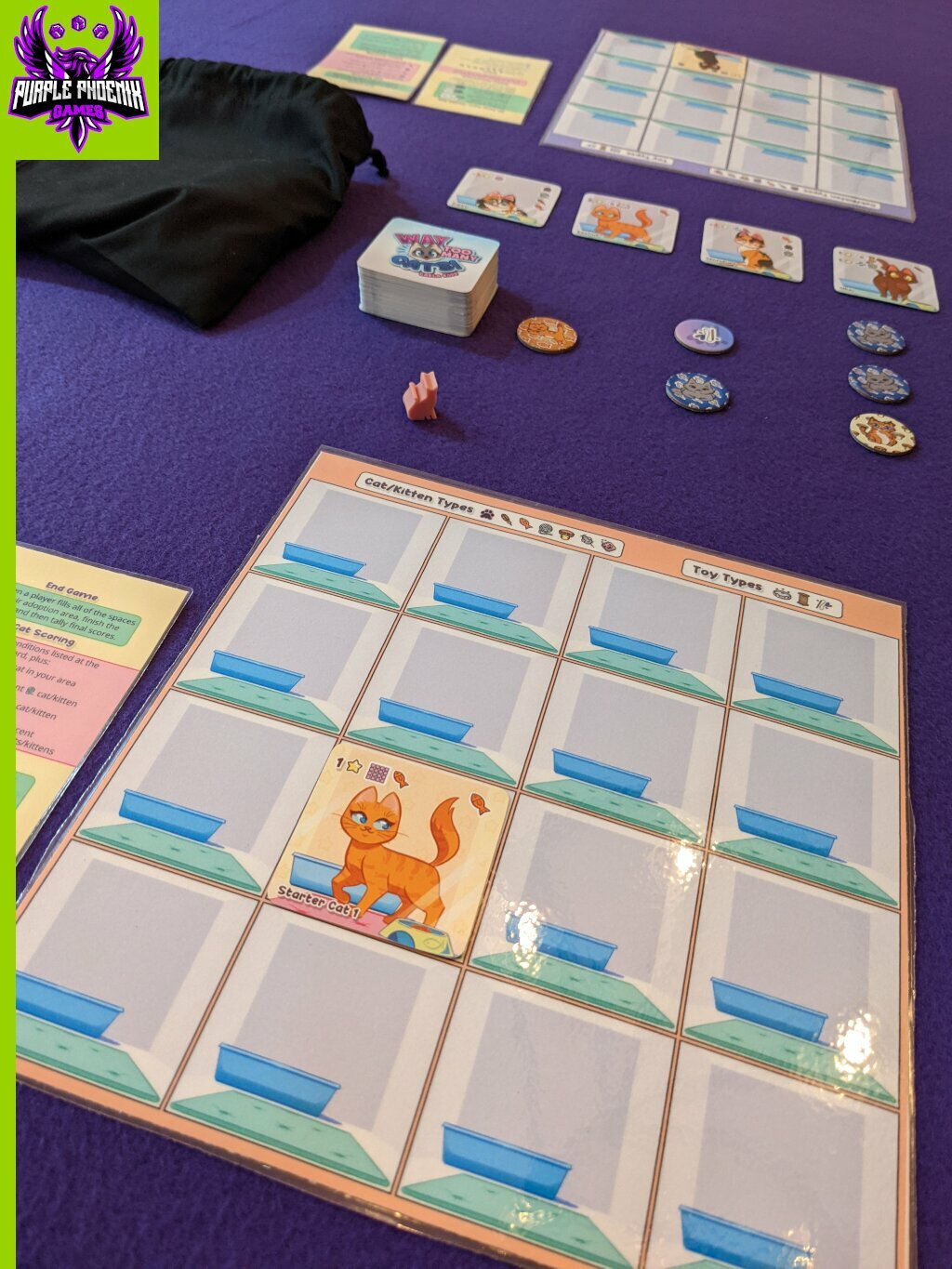
To setup, each player receives an adoption center board, starter cat tile, and a reference card. The kitten and toy tokens are placed into the provided bag to be shuffled and drawn later. The stack of adoptable cats is shuffled, and four drawn and revealed to create Cat Alley (from which players will be drafting). Nearby, three stacks of kitten/toy tokens are made with one stack containing one token, the next stack containing two, and the final stack containing three tokens. The starting player marker is given to the player who most recently pet a cat (aka probably attacked by a cat) and the game may begin!
A game of Way Too Many Cats lasts many rounds, and ends once all players have had the same amount of turns and one player having completely filled their adoption center. On a turn, the active player will take one mandatory action, and then will choose to take another two actions. The mandatory action that all players take each turn is to Choose a Token Set and Cat Card(s) and Place Them. A bit wordy, but this is a prototype, so I will let it slide. In any case, the player will choose to (1) take the smallest group of tokens and two Cat tiles of their choice, (2) take the mid-sized group of tokens and one Cat tile of their choice, or (3) take the largest group of tokens and the right-most Cat tile from Cat Alley (the offer row). Once the choice has been made and all components taken, the player then refreshes Cat Alley by sliding all tiles to the right and refilling to four tiles. Also, the player pulls three tokens from the bag and adds one to each group of tokens on the table. Note, as the player has just chosen a group of tokens, one of the groups will be empty until they place a token there – thus creating the smallest group and embiggening (I’m on a Marvel kick right now) the other two groups.
As an optional second action, the player may choose to give any cat in their adoption center a toy from their personal supply. Cat tiles show icons for toys that the cat will appreciate, though not every cat is into toys. Note, the toy tokens may be given to the cats on any turn, and even at the end of the game just before scoring.
Finally, at the end of the turn, the player may Create a Kitten Habitat by discarding three toy tokens to the bag. The player then designates a space on their adoption center to be the kitty haven and it can house any number of kittens.
Once a player fills their last adoption center slot, the end game is triggered. Players will finish out the round so that all have an equal amount of turns. Then, points are tallied and scored following an involved scoring process. Points in this game are scored in numerous ways. Firstly, the starter cats are scored, and then each type of cat is scored. For example, the paw icon on cat tiles earn 1 VP for each adjacent cat of a different color. Each ball of yarn icon on cat tiles scores 2 VP. The goldfish cracker icon scores 2 VP for each adjacent cat or kitten sporting a ball of yarn icon. Finally, the feather icon scores 3/7/12/18 VP for each group of adjacent feather cats of train size 2/3/4/5 cats. So placement is very important in this game. Not enough scoring?
Players will score more points for kittens and for specific icons on cat tiles. 15 VP is awarded to a player who holds a complete set of the seven different types of kitten tokens, while another 8 VP is earned for holding a set of four matching kitten types. The player receives a -2VP penalty for each kitten token not associated with either type of set nor in a habitat on the board. Additionally, for each cat tile on the board, special scoring will be earned for supplying the tile with the requested toy, or placing it in the preferred space in the center, or even for other adjacency considerations.
Players will be scoring hundreds of points, and hopefully having their felines adopted by unsuspecting travelers and goo-goo eyed children. The player with the most VP at the end of the game is the winner!
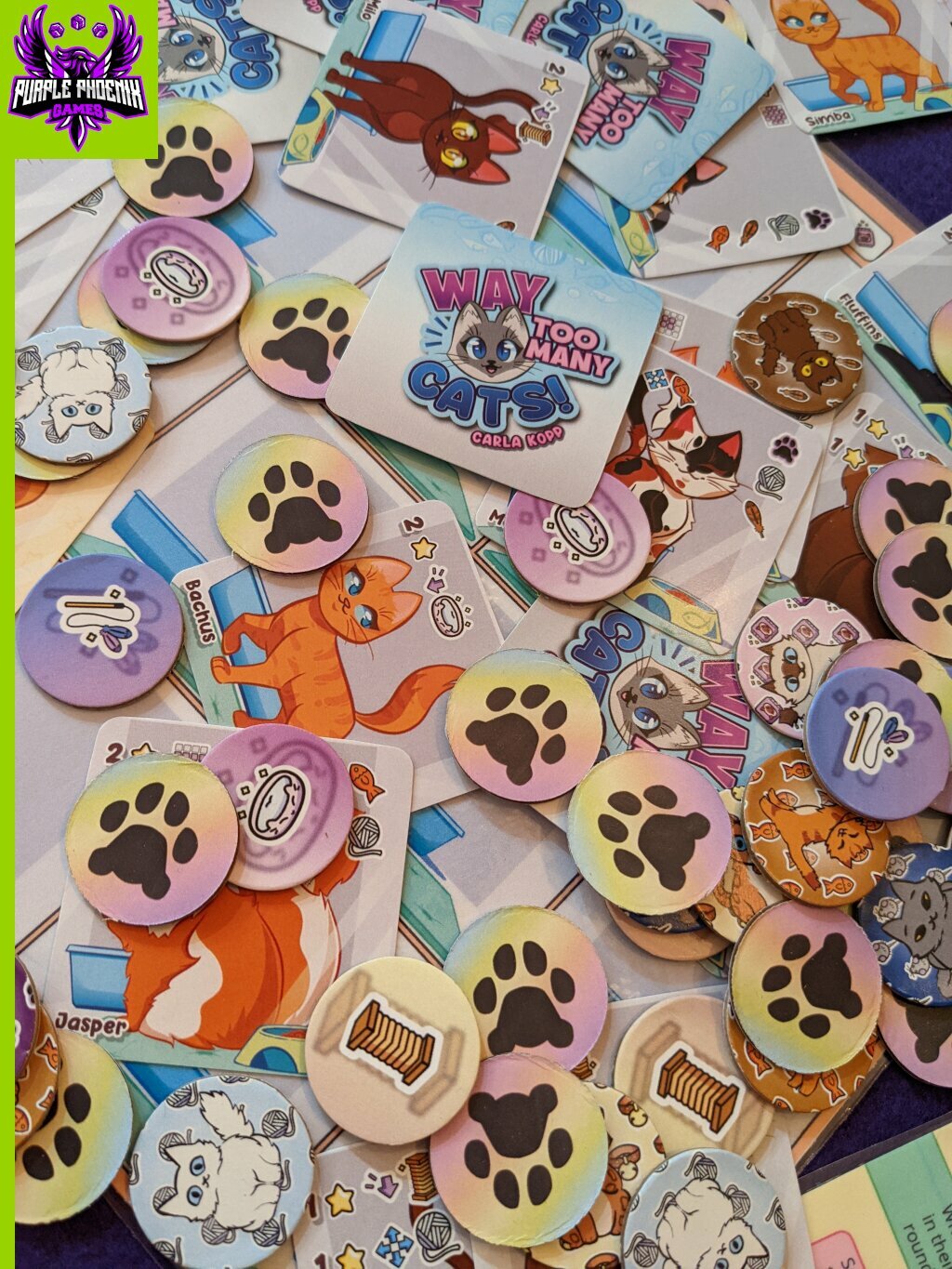
Components. Again, this is a prototype copy of the game, so I know that these are not final components at all. Having had many opportunities to preview for Weird Giraffe Games now, I am confident that the final game will be sparkling with upgrades and cool features. To reiterate, my interest in the theme is on the lower side, as I am not a cat person, but I can definitely understand the theme and it works well with this type of game. I guarantee that you will be able to spot Way Too Many Cats in stores right away because that box art is super colorful and busy. I do enjoy the cartoony art style, and it fits the theme really well. The final version of the game will undoubtedly affect this paragraph in the future, but for now this is well on the way to being a very solid title with regards to components, artwork, and theme.
But do I like it? Surprisingly, yes I do. Quite a bit. Theme goes a really long way with me, but I have been known to enjoy other games with themes that don’t necessarily resonate with me, so perhaps “surprising” isn’t the best term here. I really enjoy the spatial puzzle aspect of the game. I highlighted puzzle because that’s exactly what is going on here. When I am playing, I have to debate whether to take all those kitten tokens to complete my sets and be stuck with the right-most card, or perhaps taking the smallest group is more beneficial so that I can draft the two best cards for what I am building on my board. Is it really worth it to me to grab Taco just because I am starting to realize I have a food themed cat dispensary? Why does this cat need a scratching post token when it’s clearly been de-clawed?? These are serious questions, folks!
I kid, but only because this is a very light game, and one that I think works well in many situations. Have newer to intermediate level players coming over tonight? Grab Way Too Many Cats! Having an animal-themed game night? Pull this one out! Sticking with a mechanic-specific lineup? You got it. Now, I haven’t seen the Kickstarter page yet, nor have I asked Carla (the designer) what the plans are for it, but I know this one is close to many peoples’ hearts, so I imagine it will get all the love that’s possible in making this a wonder in a box. The mechanics are there. The theme is… great for some. Way Too Many Cats is a thinker in a catsuit disguise, but it is not too heavy to turn off casual or intermediate gamers. I can certainly add my stamp of approval and recommend checking out Way Too Many Cats. Look for it to hit Kickstarter in February and click here to be notified on launch. You will probably want to get in on this project early if any of this sounds appealing to you.
PS – How many catfolk did I offend in this preview? How many aquarists have I now befriended? What up, my peeps!
Way Too Many Cats is a cat and kitten drafting and spatial puzzle game for one to six players. In it, players work at feline adoption centers with the goal of having all stock adopted. To do this, players will be placing specific cats adjacent to other favorable cats for points, giving kittens a habitat of their own, and even supplying the cats with toys. The player who completes these tasks most effectively by the end of the game will score the most points and win!
DISCLAIMER: We were provided a prototype copy of this game for the purposes of this review. These are preview copy components, and I do not know for sure if the final components will be any different from these shown. Also, it is not my intention to detail every rule in the game, as there are just too many. You are invited to download the rulebook, back the game through the Kickstarter campaign, or through any retailers stocking it after fulfillment. -T
To setup, each player receives an adoption center board, starter cat tile, and a reference card. The kitten and toy tokens are placed into the provided bag to be shuffled and drawn later. The stack of adoptable cats is shuffled, and four drawn and revealed to create Cat Alley (from which players will be drafting). Nearby, three stacks of kitten/toy tokens are made with one stack containing one token, the next stack containing two, and the final stack containing three tokens. The starting player marker is given to the player who most recently pet a cat (aka probably attacked by a cat) and the game may begin!
A game of Way Too Many Cats lasts many rounds, and ends once all players have had the same amount of turns and one player having completely filled their adoption center. On a turn, the active player will take one mandatory action, and then will choose to take another two actions. The mandatory action that all players take each turn is to Choose a Token Set and Cat Card(s) and Place Them. A bit wordy, but this is a prototype, so I will let it slide. In any case, the player will choose to (1) take the smallest group of tokens and two Cat tiles of their choice, (2) take the mid-sized group of tokens and one Cat tile of their choice, or (3) take the largest group of tokens and the right-most Cat tile from Cat Alley (the offer row). Once the choice has been made and all components taken, the player then refreshes Cat Alley by sliding all tiles to the right and refilling to four tiles. Also, the player pulls three tokens from the bag and adds one to each group of tokens on the table. Note, as the player has just chosen a group of tokens, one of the groups will be empty until they place a token there – thus creating the smallest group and embiggening (I’m on a Marvel kick right now) the other two groups.
As an optional second action, the player may choose to give any cat in their adoption center a toy from their personal supply. Cat tiles show icons for toys that the cat will appreciate, though not every cat is into toys. Note, the toy tokens may be given to the cats on any turn, and even at the end of the game just before scoring.
Finally, at the end of the turn, the player may Create a Kitten Habitat by discarding three toy tokens to the bag. The player then designates a space on their adoption center to be the kitty haven and it can house any number of kittens.
Once a player fills their last adoption center slot, the end game is triggered. Players will finish out the round so that all have an equal amount of turns. Then, points are tallied and scored following an involved scoring process. Points in this game are scored in numerous ways. Firstly, the starter cats are scored, and then each type of cat is scored. For example, the paw icon on cat tiles earn 1 VP for each adjacent cat of a different color. Each ball of yarn icon on cat tiles scores 2 VP. The goldfish cracker icon scores 2 VP for each adjacent cat or kitten sporting a ball of yarn icon. Finally, the feather icon scores 3/7/12/18 VP for each group of adjacent feather cats of train size 2/3/4/5 cats. So placement is very important in this game. Not enough scoring?
Players will score more points for kittens and for specific icons on cat tiles. 15 VP is awarded to a player who holds a complete set of the seven different types of kitten tokens, while another 8 VP is earned for holding a set of four matching kitten types. The player receives a -2VP penalty for each kitten token not associated with either type of set nor in a habitat on the board. Additionally, for each cat tile on the board, special scoring will be earned for supplying the tile with the requested toy, or placing it in the preferred space in the center, or even for other adjacency considerations.
Players will be scoring hundreds of points, and hopefully having their felines adopted by unsuspecting travelers and goo-goo eyed children. The player with the most VP at the end of the game is the winner!
Components. Again, this is a prototype copy of the game, so I know that these are not final components at all. Having had many opportunities to preview for Weird Giraffe Games now, I am confident that the final game will be sparkling with upgrades and cool features. To reiterate, my interest in the theme is on the lower side, as I am not a cat person, but I can definitely understand the theme and it works well with this type of game. I guarantee that you will be able to spot Way Too Many Cats in stores right away because that box art is super colorful and busy. I do enjoy the cartoony art style, and it fits the theme really well. The final version of the game will undoubtedly affect this paragraph in the future, but for now this is well on the way to being a very solid title with regards to components, artwork, and theme.
But do I like it? Surprisingly, yes I do. Quite a bit. Theme goes a really long way with me, but I have been known to enjoy other games with themes that don’t necessarily resonate with me, so perhaps “surprising” isn’t the best term here. I really enjoy the spatial puzzle aspect of the game. I highlighted puzzle because that’s exactly what is going on here. When I am playing, I have to debate whether to take all those kitten tokens to complete my sets and be stuck with the right-most card, or perhaps taking the smallest group is more beneficial so that I can draft the two best cards for what I am building on my board. Is it really worth it to me to grab Taco just because I am starting to realize I have a food themed cat dispensary? Why does this cat need a scratching post token when it’s clearly been de-clawed?? These are serious questions, folks!
I kid, but only because this is a very light game, and one that I think works well in many situations. Have newer to intermediate level players coming over tonight? Grab Way Too Many Cats! Having an animal-themed game night? Pull this one out! Sticking with a mechanic-specific lineup? You got it. Now, I haven’t seen the Kickstarter page yet, nor have I asked Carla (the designer) what the plans are for it, but I know this one is close to many peoples’ hearts, so I imagine it will get all the love that’s possible in making this a wonder in a box. The mechanics are there. The theme is… great for some. Way Too Many Cats is a thinker in a catsuit disguise, but it is not too heavy to turn off casual or intermediate gamers. I can certainly add my stamp of approval and recommend checking out Way Too Many Cats. Look for it to hit Kickstarter in February and click here to be notified on launch. You will probably want to get in on this project early if any of this sounds appealing to you.
PS – How many catfolk did I offend in this preview? How many aquarists have I now befriended? What up, my peeps!
Purple Phoenix Games (2266 KP) rated Big Easy Busking in Tabletop Games
Sep 15, 2020
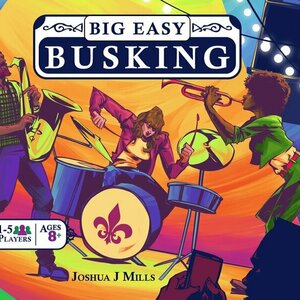


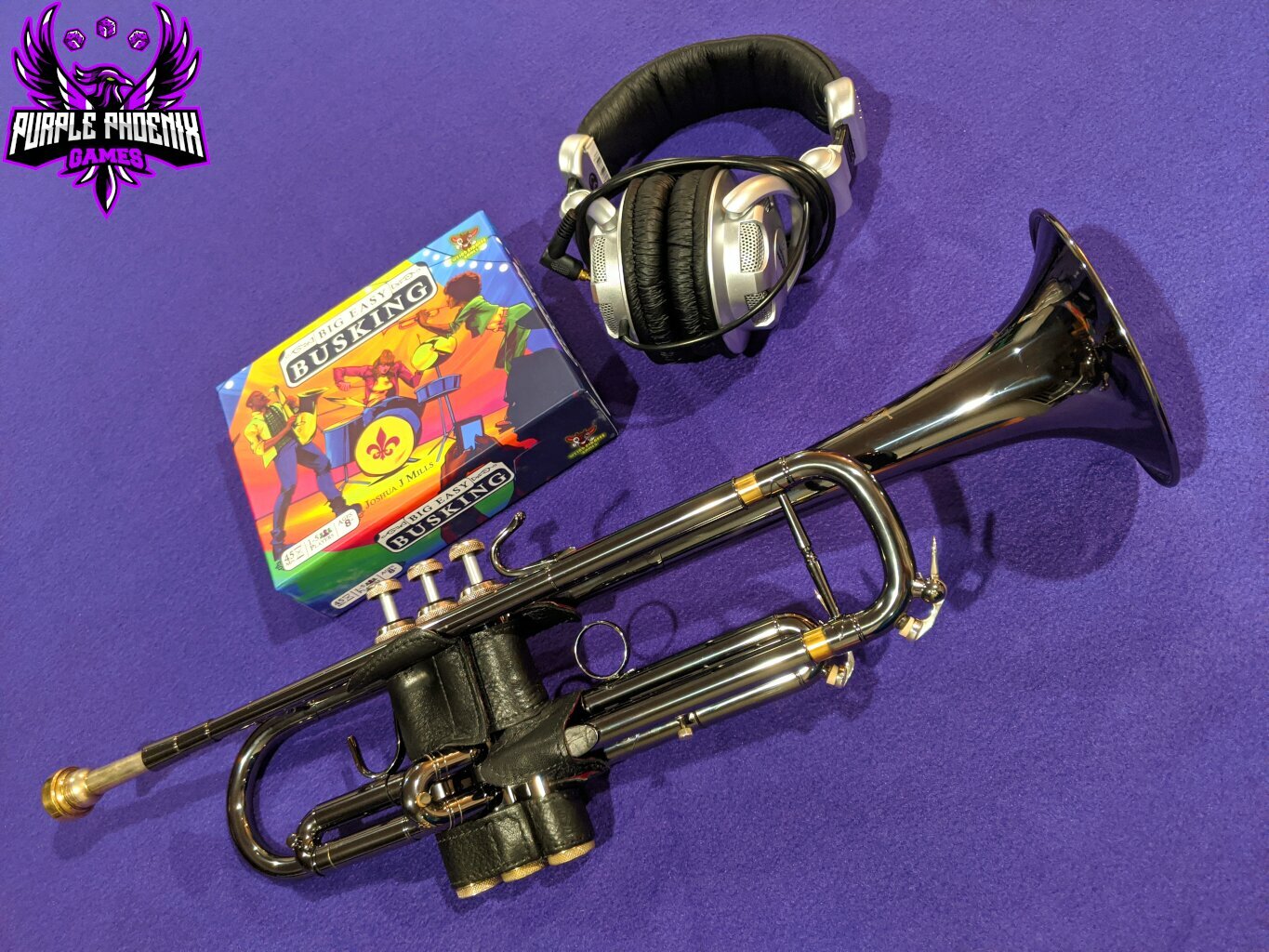
Ahh New Orleans. If there ever was a city I NEED to revisit, it’s New Orleans. I love nearly everything about it. The history, the art and music, the architecture, and strolling down Frenchman Street at night listening to the hottest music I’ve ever heard live. But what is it like to BE a musician in NOLA? Or even a group’s manager? Well, I’ve never played in New Orleans (I am a professional trumpet player – don’t belive me? Check out the last photo in this review to see my axe and the box as proof), but I can imagine how it would go. Does Big Easy Busking capture the feeling? Let’s find out together.
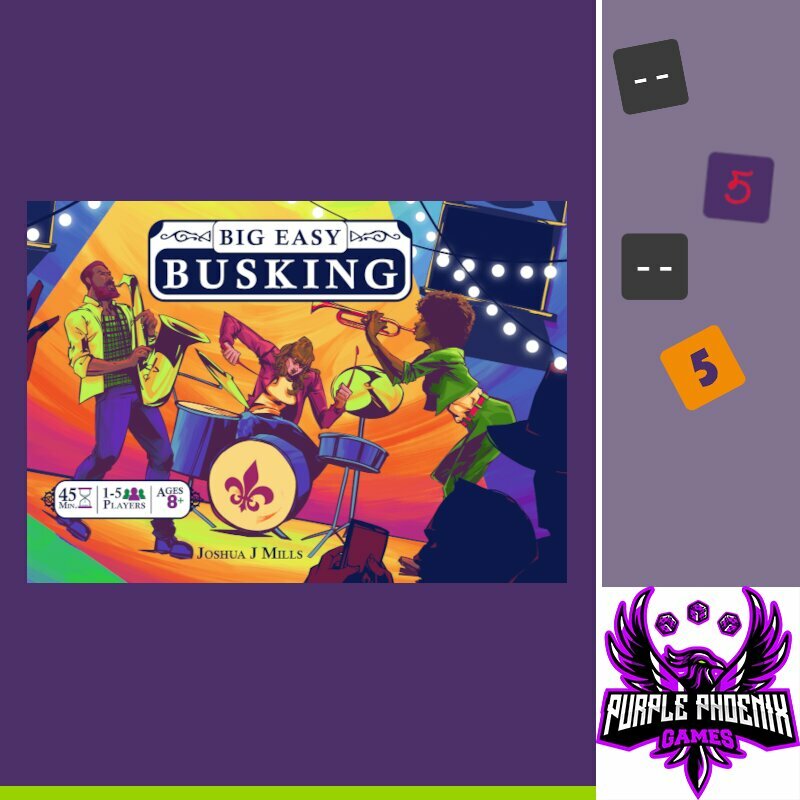
Big Easy Busking is a card-based area control game with a sweet sweet music theme. Players will be taking turns learning charts, playing charts, and transferring energy from the musicians to the crowd and back. The winner of Big Easy Busking is the player who can score the biggest haul in tips for the weekend to become the hottest band in town.
DISCLAIMER: We were provided a copy of this game for the purposes of this review. This is a retail copy of the game, so what you see in these photos is exactly what would be received in your box. I do not intend to cover every single rule included in the rulebook, but will describe the overall game flow and major rule set so that our readers may get a sense of how the game plays. For more in depth rules, you may purchase a copy online or from your FLGS. -T
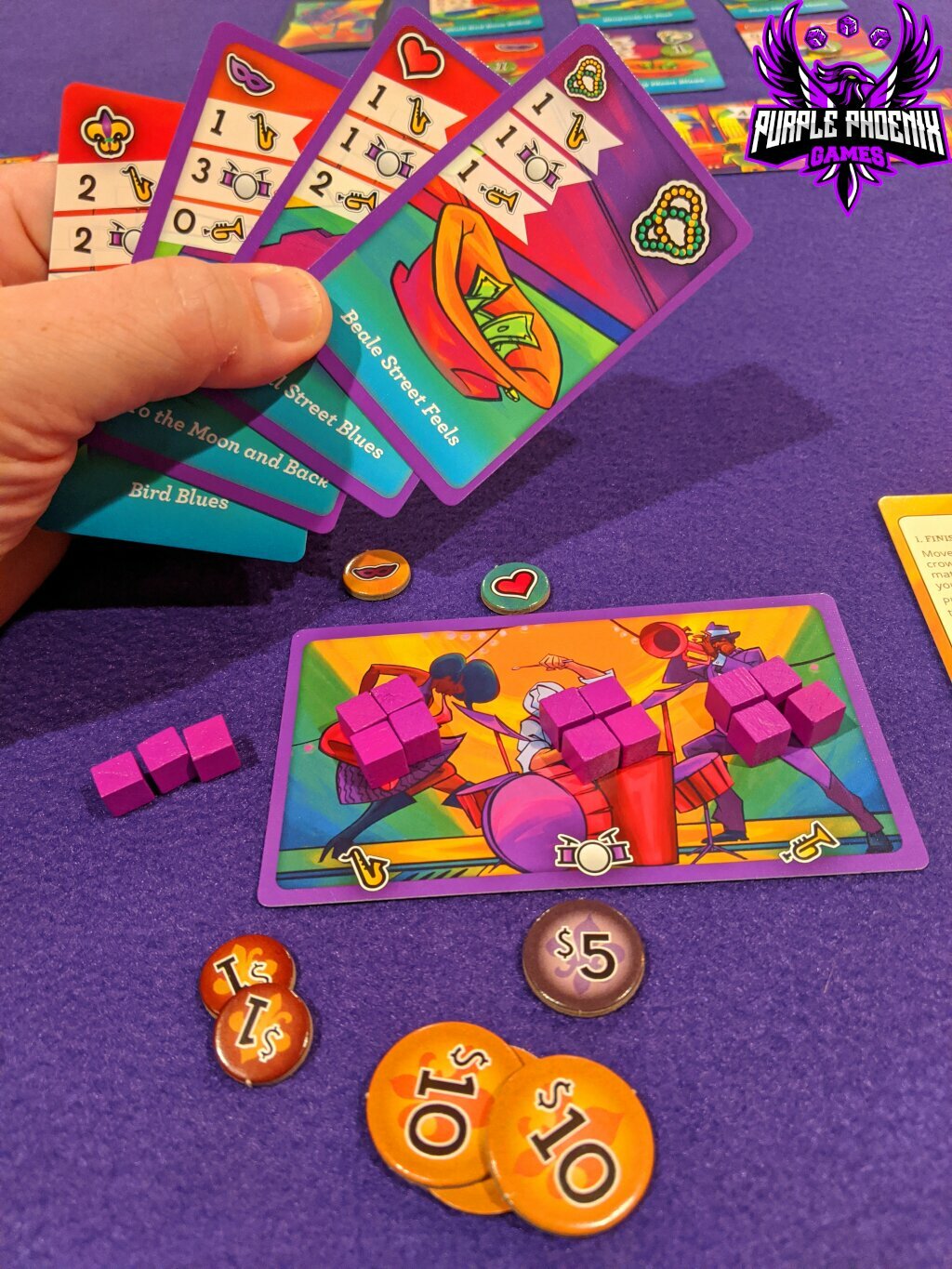
To setup, two “streets” in New Orleans will need to be populated with song cards, both standards and learnable tunes. Crowd cards will be placed under the streets to depict certain crowds and what the moods of those crowds are. Each player will receive some starting bread (money for those not in the biz), energy for their 3-piece band of sax, trumpet, and drums, a starting set list of three tunes, and a reference card that has nothing to do with the metaphor. Decide who can play the highest note (if you are all trumpet players) and the gig may begin!
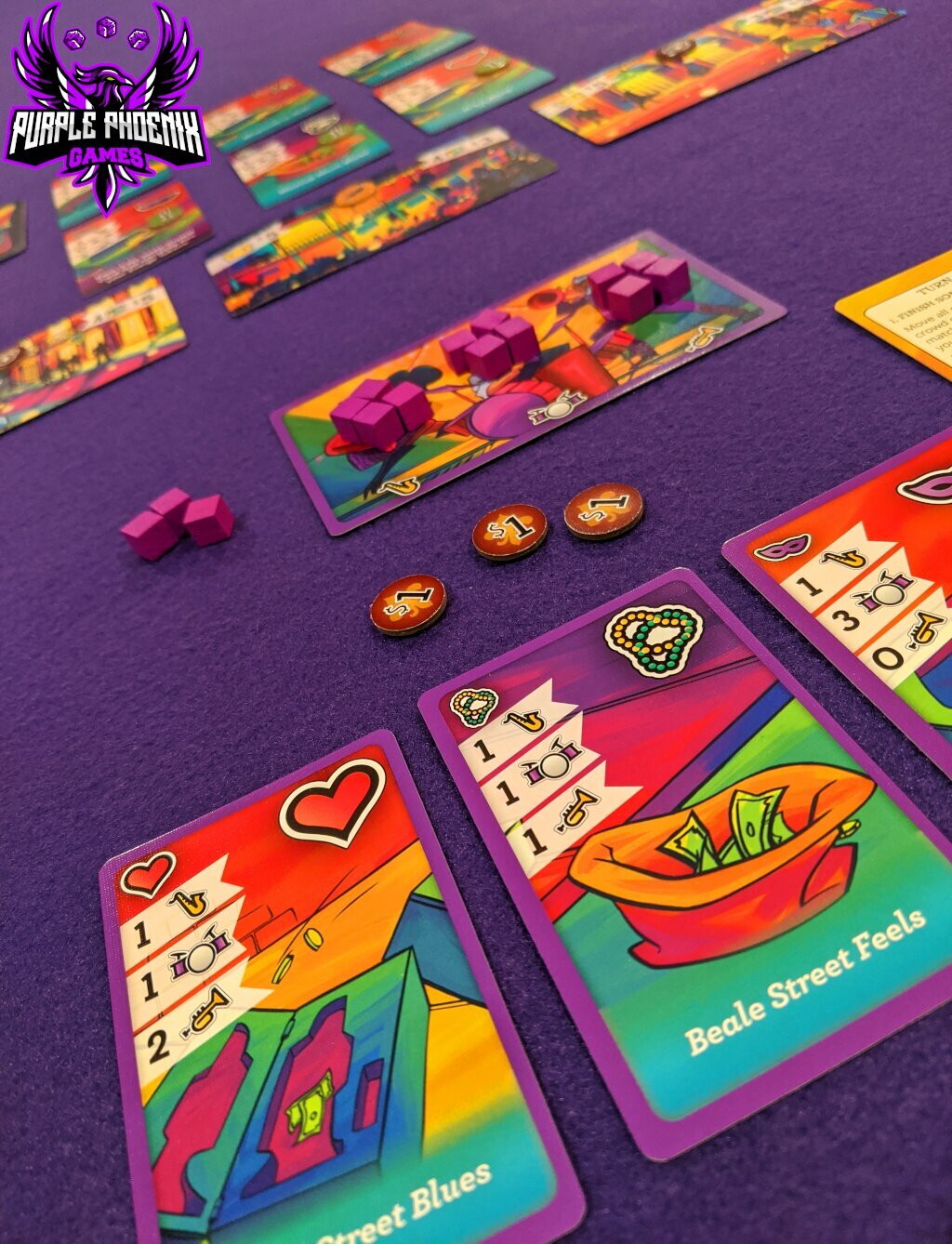
A turn is broken down into a few different parts. The first thing to be done on a turn is to finish playing the song that had been started in the previous round. Obviously you need to START playing a song to be able to finish, so the primary phase of the turn would be to either learn a song from the song offer or start playing a song from those dealt during setup. To play a song, players will choose a song card, place it under a crowd card (hopefully matching their mood: masks, hearts, beads, fleur-de-lis), gather the required energy from the musicians appropriately, and add those energy cubes to the song card.
After a song is started or learned, the player’s turn is over. On the next turn the player will finish playing the song by moving the spent energy to the crowd in full and taking $1 or moving some of the energy to the crowd and some back to their band members to be used on future songs.
The middle step in a turn (yes, I know I am explaining it out of order, but you do have to start playing a song before you can finish it) is to optionally tip your band members by trading in money for energy at a 1:1 ratio.
Once all players have used up their energy cubes or simply wish to, they will announce that they are “taking a break.” In other words, they pass for the remainder of the round. As the last player takes their break the end of round activities begin. Printed on each crowd card are two important icons: payout amounts for majority of energy and payout amounts for energy reaching the threshold. Resolving each crowd card will determine the players that hold majority or shared majority in each crowd location. For the majority holders payouts will reflect what is printed on the upper left of the crowd card. The upper right of the crowd card displays the number of energy needed upon it to meet the threshold in order to be paid the amount shown. When all crowd cards have been scored players will setup for the next night (round) per the rules. Play continues in this way over three rounds with the winner being the player at the end of the game with the most money.
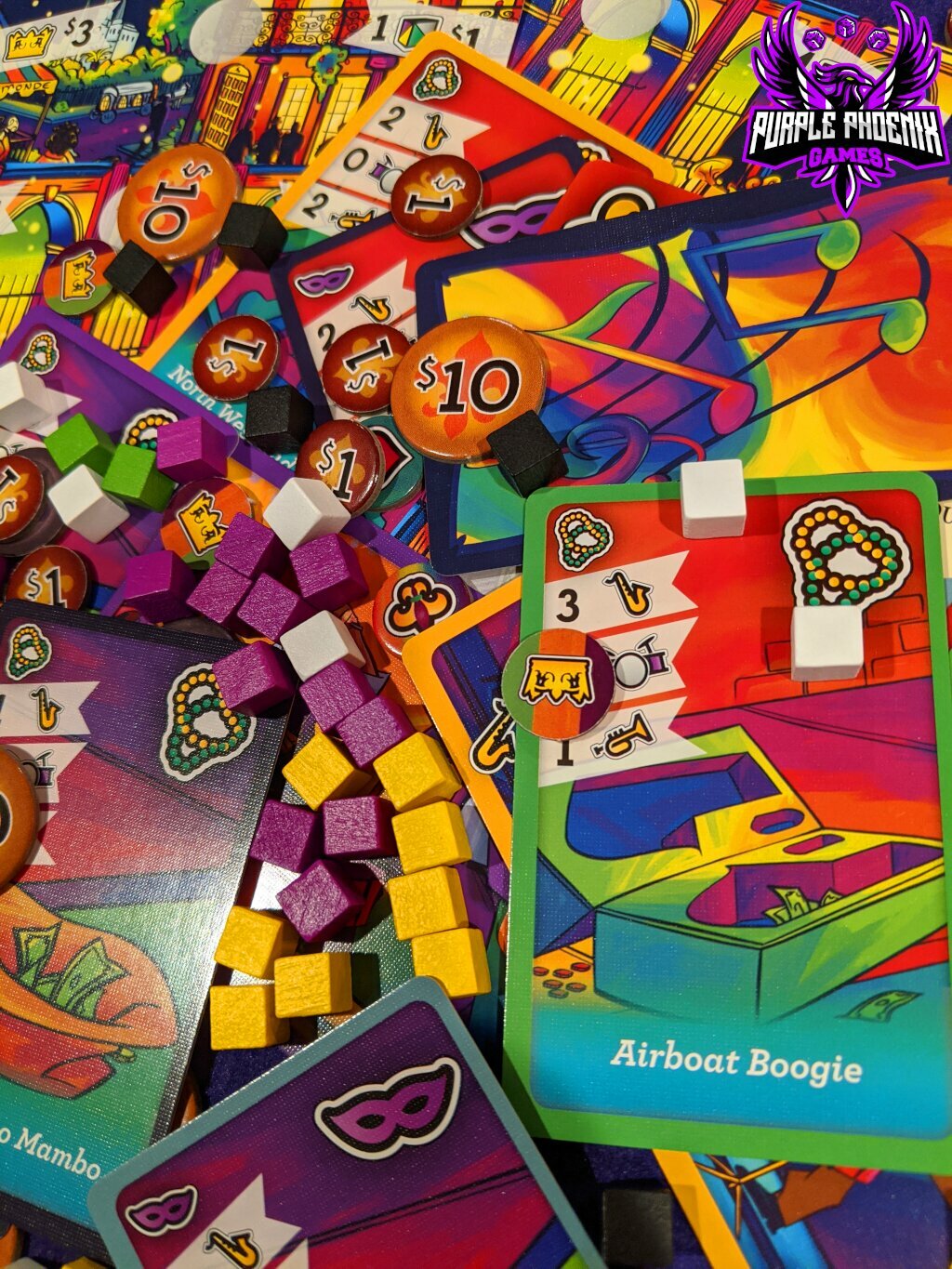
Components. This is a smaller box (not exactly the same size, but think Tiny Epic), but it is packed with some really amazing bits. First off, as you can tell from the photos the art and color palette used here is simply phenomenal. I absolutely love the color scheme and the art certainly reminds me of some paintings we purchased from an artist on Jackson Square last time we were able to visit. The cards are nice, but I think I will want to sleeve them eventually as I had them in my hands the whole game. The cardboard money and mood tokens are fine, and the wooden cubes reflect the colorful nature of this little gem. All in all, exactly what I would expect from components in a Weird Giraffe Games production. Stellar (see what I did there, Carla?).
I have not really enjoyed a ton of area control games in my gaming history. So this came as a little bit of a shock as I truly loved playing this game. Even the solo rules are engaging and DIFFICULT to win. I came close though – within $1. The game is super quick as you are trying to please the crowds and their distinct moods with your best charts, but having to be mindful of not overextending your musicians lest they be too exhausted to give you the gas when you need it. THAT part resonates with me personally. Being a musician myself, I can tell you that crowds that are into a tune or a band and give them all the energy they have will be rewarded with even more from the band. I definitely give it more when the crowd digs what we’re laying down.
In any case, this is a game review, not a nostalgic trip down my musical memory lane. But then again, a little card game just brought me back wonderful memories of my band, and of visiting New Orleans, and of the joy of live music. Does Big Easy Busking completely mimic what it’s like to be a musician? Well, no, I can’t imagine how any game truly could, but it certainly shows the cyclical nature of energy being exchanged between musicians and appreciative crowds. Oh, the names of the tunes are also pretty funny on some. This all said, I super love this game and will be kicking out something in my collection to make room for it. If you are needing a smaller card game that you can bring out with musicians or non-musicians that appreciate the theme but also want to start introducing area control in a more accessible form, please do check out Big Easy Busking. Purple Phoenix Games gives it a good-for-the-soul 10 / 12. Maybe once I get into video I will do a Dan King (Game Boy Geek) serenade for Big Easy Busking as it travels into my collection.
Big Easy Busking is a card-based area control game with a sweet sweet music theme. Players will be taking turns learning charts, playing charts, and transferring energy from the musicians to the crowd and back. The winner of Big Easy Busking is the player who can score the biggest haul in tips for the weekend to become the hottest band in town.
DISCLAIMER: We were provided a copy of this game for the purposes of this review. This is a retail copy of the game, so what you see in these photos is exactly what would be received in your box. I do not intend to cover every single rule included in the rulebook, but will describe the overall game flow and major rule set so that our readers may get a sense of how the game plays. For more in depth rules, you may purchase a copy online or from your FLGS. -T
To setup, two “streets” in New Orleans will need to be populated with song cards, both standards and learnable tunes. Crowd cards will be placed under the streets to depict certain crowds and what the moods of those crowds are. Each player will receive some starting bread (money for those not in the biz), energy for their 3-piece band of sax, trumpet, and drums, a starting set list of three tunes, and a reference card that has nothing to do with the metaphor. Decide who can play the highest note (if you are all trumpet players) and the gig may begin!
A turn is broken down into a few different parts. The first thing to be done on a turn is to finish playing the song that had been started in the previous round. Obviously you need to START playing a song to be able to finish, so the primary phase of the turn would be to either learn a song from the song offer or start playing a song from those dealt during setup. To play a song, players will choose a song card, place it under a crowd card (hopefully matching their mood: masks, hearts, beads, fleur-de-lis), gather the required energy from the musicians appropriately, and add those energy cubes to the song card.
After a song is started or learned, the player’s turn is over. On the next turn the player will finish playing the song by moving the spent energy to the crowd in full and taking $1 or moving some of the energy to the crowd and some back to their band members to be used on future songs.
The middle step in a turn (yes, I know I am explaining it out of order, but you do have to start playing a song before you can finish it) is to optionally tip your band members by trading in money for energy at a 1:1 ratio.
Once all players have used up their energy cubes or simply wish to, they will announce that they are “taking a break.” In other words, they pass for the remainder of the round. As the last player takes their break the end of round activities begin. Printed on each crowd card are two important icons: payout amounts for majority of energy and payout amounts for energy reaching the threshold. Resolving each crowd card will determine the players that hold majority or shared majority in each crowd location. For the majority holders payouts will reflect what is printed on the upper left of the crowd card. The upper right of the crowd card displays the number of energy needed upon it to meet the threshold in order to be paid the amount shown. When all crowd cards have been scored players will setup for the next night (round) per the rules. Play continues in this way over three rounds with the winner being the player at the end of the game with the most money.
Components. This is a smaller box (not exactly the same size, but think Tiny Epic), but it is packed with some really amazing bits. First off, as you can tell from the photos the art and color palette used here is simply phenomenal. I absolutely love the color scheme and the art certainly reminds me of some paintings we purchased from an artist on Jackson Square last time we were able to visit. The cards are nice, but I think I will want to sleeve them eventually as I had them in my hands the whole game. The cardboard money and mood tokens are fine, and the wooden cubes reflect the colorful nature of this little gem. All in all, exactly what I would expect from components in a Weird Giraffe Games production. Stellar (see what I did there, Carla?).
I have not really enjoyed a ton of area control games in my gaming history. So this came as a little bit of a shock as I truly loved playing this game. Even the solo rules are engaging and DIFFICULT to win. I came close though – within $1. The game is super quick as you are trying to please the crowds and their distinct moods with your best charts, but having to be mindful of not overextending your musicians lest they be too exhausted to give you the gas when you need it. THAT part resonates with me personally. Being a musician myself, I can tell you that crowds that are into a tune or a band and give them all the energy they have will be rewarded with even more from the band. I definitely give it more when the crowd digs what we’re laying down.
In any case, this is a game review, not a nostalgic trip down my musical memory lane. But then again, a little card game just brought me back wonderful memories of my band, and of visiting New Orleans, and of the joy of live music. Does Big Easy Busking completely mimic what it’s like to be a musician? Well, no, I can’t imagine how any game truly could, but it certainly shows the cyclical nature of energy being exchanged between musicians and appreciative crowds. Oh, the names of the tunes are also pretty funny on some. This all said, I super love this game and will be kicking out something in my collection to make room for it. If you are needing a smaller card game that you can bring out with musicians or non-musicians that appreciate the theme but also want to start introducing area control in a more accessible form, please do check out Big Easy Busking. Purple Phoenix Games gives it a good-for-the-soul 10 / 12. Maybe once I get into video I will do a Dan King (Game Boy Geek) serenade for Big Easy Busking as it travels into my collection.