
Search
Purple Phoenix Games (2266 KP) rated Whirling Witchcraft in Tabletop Games
Nov 9, 2021

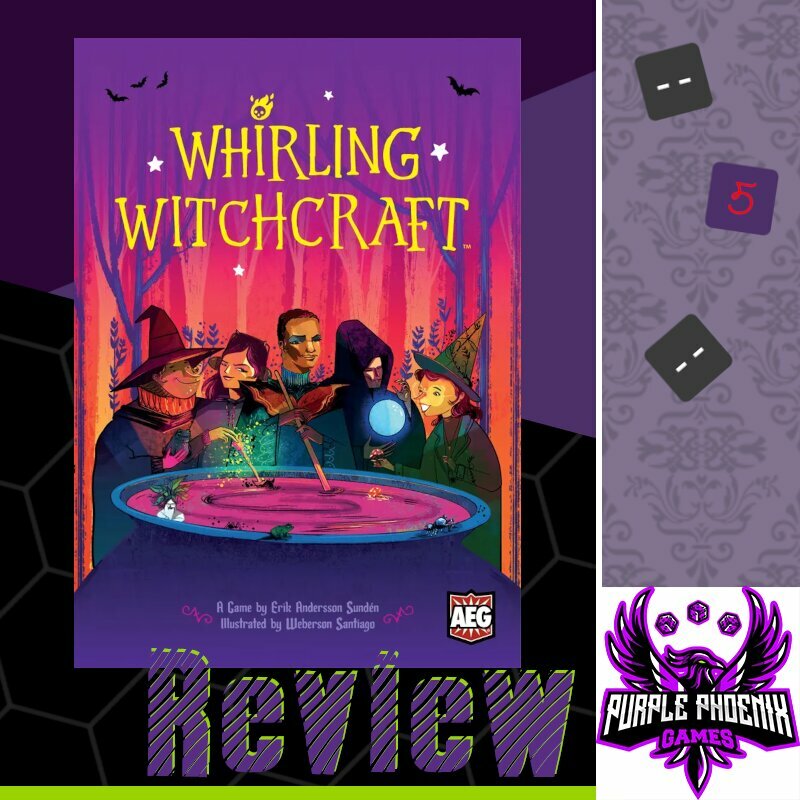
What is the thing that first draws you into a game? Is it talk of the gameplay and mechanics? Maybe you’ve had a good experience with the designer? Or perhaps the artwork is what catches your eye? For me, I’ve gotta say it’s not only the artwork, but the components as well. Obviously, we’re no strangers to board games, so scrolling through our feeds we see countless pictures of cards, boards, meeples, etc. It’s when a game has an interesting new component that it really pops out to me. Enter Whirling Witchcraft and its 3D cardboard cauldrons! It certainly got my attention, but does the game itself deserve a place on my shelves? Spoiler – it does, but keep reading to find out why!
Whirling Witchcraft is a game of simultaneous action selection and variable powers in which players take on the roles of witches creating various ingredients to be used in future potions. The neighboring witches are always on the lookout for new recipes, so of course you’ll share those secrets and even some ingredients with them!…….BUT these ingredients can be volatile, and having too many on your workbench could cause an explosion! Which witch is sly enough to not only manage their ingredients wisely, but also overflow opponents with extra ingredients?
Disclaimer: We were provided with a copy of this game for the purposes of this review. This is a finalized retail copy of the game, and what is described and pictured below is what you will get when you purchase this game. -L
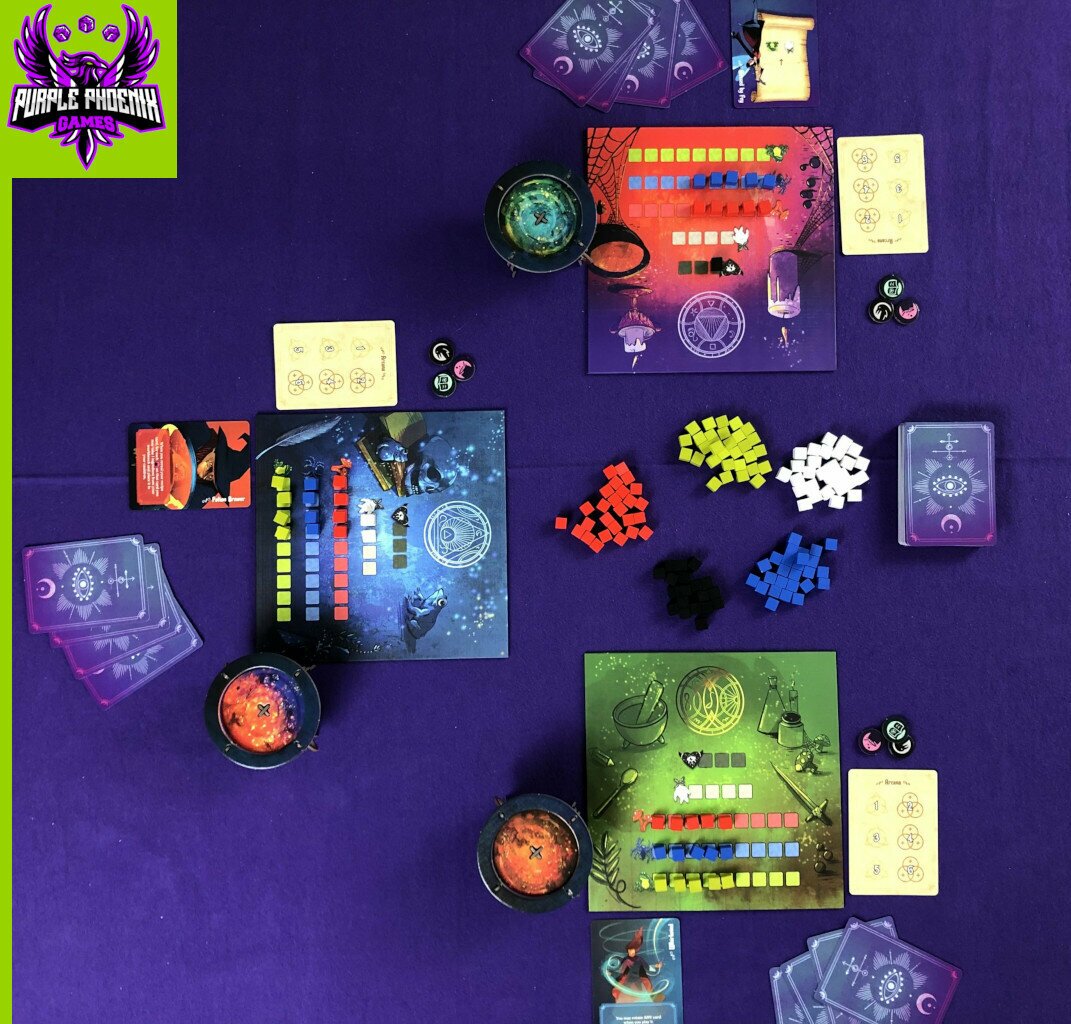
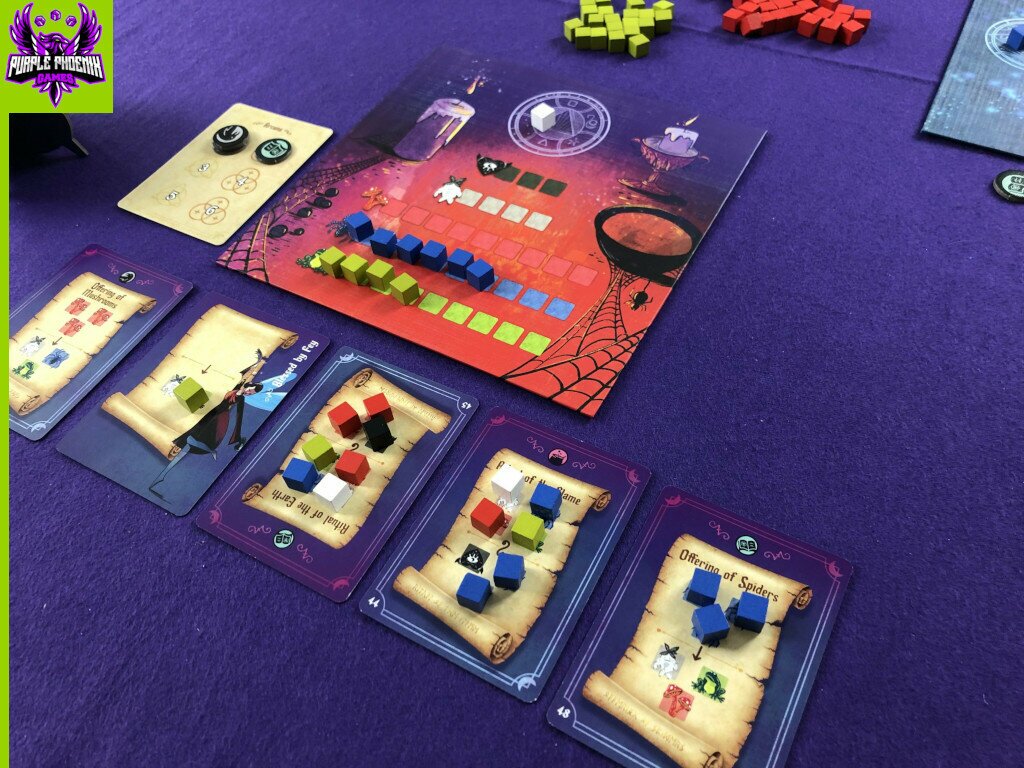
To setup for a game, each player receives a player board, cauldron, and Arcana tracker with corresponding tokens. Players are randomly dealt 2 Personality Cards, and choose one to use for the game. Personality Cards offer unique powers or recipes for use during the game. All recipe cards are shuffled, and 4 cards are dealt to each player. Players receive a number of starting ingredients (cubes) to their workbench (player board), as stated on their Personality card, and the remaining ingredients go into a general supply. Choose a starting player and the game is ready to begin! Pictured below is the setup for a 3-player game.
This game is played over a series of rounds, and the turns in each round are performed simultaneously. Each round is broken down into two phases: the Study Phase and the Brewing Phase. The first step of the Study Phase is to Play recipes. Players look at the 4 recipe cards in hand and select one to play this round. Cards are placed face-down below the player boards. The next step, Reveal recipes, is pretty straightforward – all players reveal their chosen recipe and add it to their other recipes already in play. The final step of this phase is to resolve Arcana. Certain recipe cards have Arcana icons on the top that are collected when the recipe is played. Arcana comes in three different types (Book, Potion, and Raven), and is tracked on your Arcana tracker. When you have reached a certain amount of Arcana, you have the opportunity to trigger a special effect for the current round. For example, triggering the Raven Arcana allows you to immediately remove up to 2 ingredients from your workbench. Arcana can play into your strategy, so keep an eye on which recipes offer certain types of Arcana! Players check to see if any Arcana has been triggered, and perform the effects if they so choose, and the round then continues to the next phase.
The second phase of the round, the Brewing Phase, is broken down into 4 steps: Produce ingredients, Pass cauldrons, Check for winners, and Pass recipe cards. The Produce ingredients step is performed by all players simultaneously. Players will choose which recipe cards they have in play to be used this round. To use a recipe, you place ingredients (cubes) from your workbench on the ‘input’ spaces of the recipe card – all input spaces on a recipe card must be filled for the recipe to be completed. When you complete a recipe, take the corresponding ingredients shown on the ‘output’ spaces of that recipe card from the general supply. Players can decide how many/few of their recipe cards to be used each round (one, a few, or all of them), and each recipe card can only be used once per round. When all players are finished using their recipe cards, the ingredients are distributed. Ingredients from the ‘input’ spaces of a recipe go back to the general supply, and ingredients left on the ‘output’ spaces go into your cauldron.
This leads us to the next step – Pass cauldrons. All players will pass their cauldron (and the ingredients on it) to the player on their right. The ingredients from your new cauldron are now added to your workbench. Each type of ingredient has a finite number of spaces on your workbench, though. If these new ingredients cause you to completely fill up a row, any excess ingredients of that type are given back to the player who passed you the cauldron. Any ingredients you get back from an opponent go at the top of your player board, into your Witch’s Circle. When all players have resolved their new ingredients, the next step is to check for winners. If any player has 5 or more ingredients in their Witch’s Circle, they are declared the winner and the game ends! If nobody has at least 5 ingredients in their Witch’s Circle, players will pass their hand of remaining recipe cards to the player on their left, draw back up to 4 cards, and a new round begins. The game continues in this fashion until a player has at least 5 ingredients in their Witch’s Circle by the end of the round.
As you can tell from my intro, as well as the rating graphic, I really love this game. I came into it expecting something light, cutesy, and fun, and what I got was so much more than that. Yes, the components (more on that later) and artwork are colorful and eye-catching, but the gameplay is what really surprised me. For a game that literally only has 2 mechanics listed on BGG (simultaneous action selection and variable player powers), the amount of strategy in this game blew me away. Is it the most strategic game I’ve ever played? No. But it was one that kept me engaged and thinking the whole time. There are 3 major elements that you have to consider: recipes, ingredients, and your opponents. For recipe cards, you have to strategize which recipe to add to your tableau, as well as which recipes to use each round. You are allowed to use as many recipes in a round as you wish, so which ones are the best use of your resources? The next element: ingredients. Aside from strategizing about your recipe cards, you have to figure out how to best manage your ingredients. Which recipes offer the output you want? Which ones eat up large numbers of ingredients? These are all things you have to be considering during the Brewing Phase. And finally, you have to keep an eye on your opponents. You ultimately win by causing your neighbor to have an ‘overflow’ of ingredients – so which recipes can produce ingredients that they don’t need more of? Everyone can see each others’ player boards, which gives you a little insight into perhaps which recipe cards you want to activate this round. Add the fact that pretty much all of this is happening simultaneously?! That just is another layer to the strategy you need for this game! Even just describing this gameplay and strategic implications has me psyched to play again! There is much more to Whirling Witchcraft than meets the eye, and that makes it an awesome game to me.
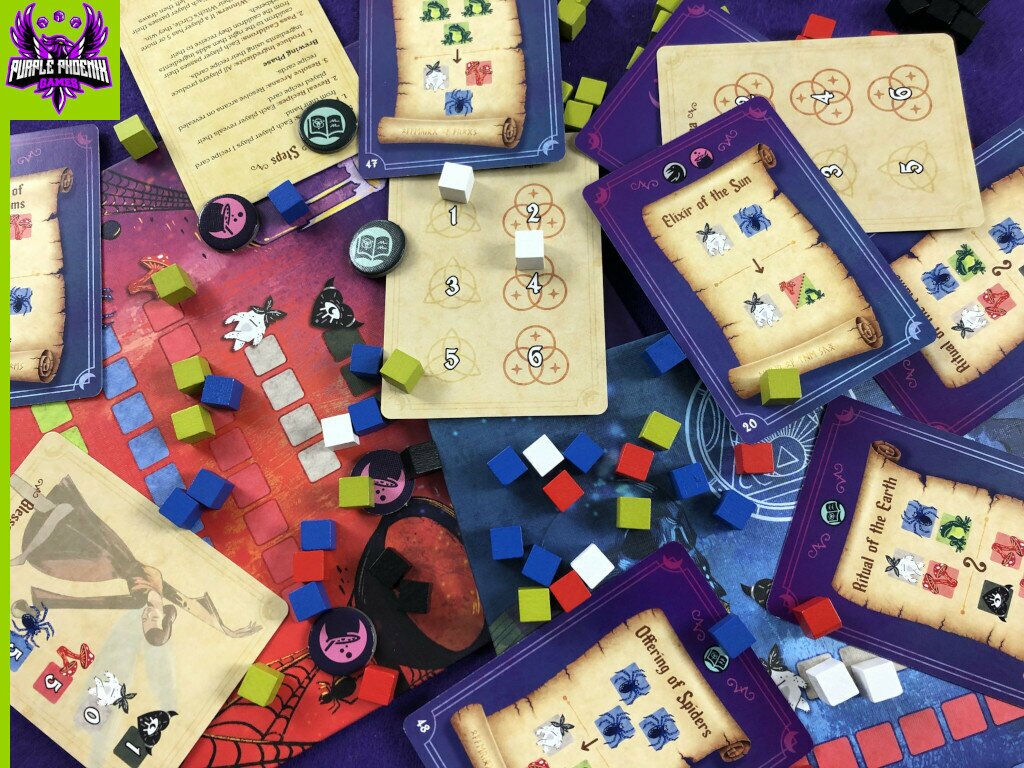
Ok, so the part we’ve all be waiting for – components! The player boards, cards, and Arcana tokens are all great quality, and vibrant in color. The artwork itself is a unique style that really catches the eye and fits the theme extremely well. The iconography/color-coded ingredients are clear to differentiate, and help streamline the gameplay. The ingredient cubes are your standard wooden cubes, and they are nice and sturdy for their small size. The 3D cauldrons are sooooo cool! Are they necessary to the gameplay? Wellllll not entirely – you could easily just use a simple cardboard circle on which to place ingredients. BUT they make the game feel more immersive, exciting, and fun to play! AEG could have as easily not gone with the 3D idea, but the inclusion of this unique component helps elevate the engagement and gameplay to me. Having physical 3D cauldrons adds so much to the overall table presence of this game, and it makes it feel like you’re playing a deluxe/upgraded game. Add in the fact that the box is made to house the assembled cauldrons, so you don’t have to be continually assembling/disassembling them every time you play. Great forethought and execution! So all in all, excellent production quality overall!
If you’re in the market for a game with ‘simple’ mechanics but elevated strategy, I highly recommend Whirling Witchcraft. This game truly is a gem, and it plays relatively quickly for a ‘heavier’ game. I’ll be the first to admit that I was drawn to this game by the components, but the stellar gameplay is what makes me keep playing it. Purple Phoenix Games gives this one a whirling 5 / 6. Check it out, you won’t be disappointed!
Whirling Witchcraft is a game of simultaneous action selection and variable powers in which players take on the roles of witches creating various ingredients to be used in future potions. The neighboring witches are always on the lookout for new recipes, so of course you’ll share those secrets and even some ingredients with them!…….BUT these ingredients can be volatile, and having too many on your workbench could cause an explosion! Which witch is sly enough to not only manage their ingredients wisely, but also overflow opponents with extra ingredients?
Disclaimer: We were provided with a copy of this game for the purposes of this review. This is a finalized retail copy of the game, and what is described and pictured below is what you will get when you purchase this game. -L
To setup for a game, each player receives a player board, cauldron, and Arcana tracker with corresponding tokens. Players are randomly dealt 2 Personality Cards, and choose one to use for the game. Personality Cards offer unique powers or recipes for use during the game. All recipe cards are shuffled, and 4 cards are dealt to each player. Players receive a number of starting ingredients (cubes) to their workbench (player board), as stated on their Personality card, and the remaining ingredients go into a general supply. Choose a starting player and the game is ready to begin! Pictured below is the setup for a 3-player game.
This game is played over a series of rounds, and the turns in each round are performed simultaneously. Each round is broken down into two phases: the Study Phase and the Brewing Phase. The first step of the Study Phase is to Play recipes. Players look at the 4 recipe cards in hand and select one to play this round. Cards are placed face-down below the player boards. The next step, Reveal recipes, is pretty straightforward – all players reveal their chosen recipe and add it to their other recipes already in play. The final step of this phase is to resolve Arcana. Certain recipe cards have Arcana icons on the top that are collected when the recipe is played. Arcana comes in three different types (Book, Potion, and Raven), and is tracked on your Arcana tracker. When you have reached a certain amount of Arcana, you have the opportunity to trigger a special effect for the current round. For example, triggering the Raven Arcana allows you to immediately remove up to 2 ingredients from your workbench. Arcana can play into your strategy, so keep an eye on which recipes offer certain types of Arcana! Players check to see if any Arcana has been triggered, and perform the effects if they so choose, and the round then continues to the next phase.
The second phase of the round, the Brewing Phase, is broken down into 4 steps: Produce ingredients, Pass cauldrons, Check for winners, and Pass recipe cards. The Produce ingredients step is performed by all players simultaneously. Players will choose which recipe cards they have in play to be used this round. To use a recipe, you place ingredients (cubes) from your workbench on the ‘input’ spaces of the recipe card – all input spaces on a recipe card must be filled for the recipe to be completed. When you complete a recipe, take the corresponding ingredients shown on the ‘output’ spaces of that recipe card from the general supply. Players can decide how many/few of their recipe cards to be used each round (one, a few, or all of them), and each recipe card can only be used once per round. When all players are finished using their recipe cards, the ingredients are distributed. Ingredients from the ‘input’ spaces of a recipe go back to the general supply, and ingredients left on the ‘output’ spaces go into your cauldron.
This leads us to the next step – Pass cauldrons. All players will pass their cauldron (and the ingredients on it) to the player on their right. The ingredients from your new cauldron are now added to your workbench. Each type of ingredient has a finite number of spaces on your workbench, though. If these new ingredients cause you to completely fill up a row, any excess ingredients of that type are given back to the player who passed you the cauldron. Any ingredients you get back from an opponent go at the top of your player board, into your Witch’s Circle. When all players have resolved their new ingredients, the next step is to check for winners. If any player has 5 or more ingredients in their Witch’s Circle, they are declared the winner and the game ends! If nobody has at least 5 ingredients in their Witch’s Circle, players will pass their hand of remaining recipe cards to the player on their left, draw back up to 4 cards, and a new round begins. The game continues in this fashion until a player has at least 5 ingredients in their Witch’s Circle by the end of the round.
As you can tell from my intro, as well as the rating graphic, I really love this game. I came into it expecting something light, cutesy, and fun, and what I got was so much more than that. Yes, the components (more on that later) and artwork are colorful and eye-catching, but the gameplay is what really surprised me. For a game that literally only has 2 mechanics listed on BGG (simultaneous action selection and variable player powers), the amount of strategy in this game blew me away. Is it the most strategic game I’ve ever played? No. But it was one that kept me engaged and thinking the whole time. There are 3 major elements that you have to consider: recipes, ingredients, and your opponents. For recipe cards, you have to strategize which recipe to add to your tableau, as well as which recipes to use each round. You are allowed to use as many recipes in a round as you wish, so which ones are the best use of your resources? The next element: ingredients. Aside from strategizing about your recipe cards, you have to figure out how to best manage your ingredients. Which recipes offer the output you want? Which ones eat up large numbers of ingredients? These are all things you have to be considering during the Brewing Phase. And finally, you have to keep an eye on your opponents. You ultimately win by causing your neighbor to have an ‘overflow’ of ingredients – so which recipes can produce ingredients that they don’t need more of? Everyone can see each others’ player boards, which gives you a little insight into perhaps which recipe cards you want to activate this round. Add the fact that pretty much all of this is happening simultaneously?! That just is another layer to the strategy you need for this game! Even just describing this gameplay and strategic implications has me psyched to play again! There is much more to Whirling Witchcraft than meets the eye, and that makes it an awesome game to me.
Ok, so the part we’ve all be waiting for – components! The player boards, cards, and Arcana tokens are all great quality, and vibrant in color. The artwork itself is a unique style that really catches the eye and fits the theme extremely well. The iconography/color-coded ingredients are clear to differentiate, and help streamline the gameplay. The ingredient cubes are your standard wooden cubes, and they are nice and sturdy for their small size. The 3D cauldrons are sooooo cool! Are they necessary to the gameplay? Wellllll not entirely – you could easily just use a simple cardboard circle on which to place ingredients. BUT they make the game feel more immersive, exciting, and fun to play! AEG could have as easily not gone with the 3D idea, but the inclusion of this unique component helps elevate the engagement and gameplay to me. Having physical 3D cauldrons adds so much to the overall table presence of this game, and it makes it feel like you’re playing a deluxe/upgraded game. Add in the fact that the box is made to house the assembled cauldrons, so you don’t have to be continually assembling/disassembling them every time you play. Great forethought and execution! So all in all, excellent production quality overall!
If you’re in the market for a game with ‘simple’ mechanics but elevated strategy, I highly recommend Whirling Witchcraft. This game truly is a gem, and it plays relatively quickly for a ‘heavier’ game. I’ll be the first to admit that I was drawn to this game by the components, but the stellar gameplay is what makes me keep playing it. Purple Phoenix Games gives this one a whirling 5 / 6. Check it out, you won’t be disappointed!

Haley Mathiot (9 KP) rated Crime and Punishment in Books
Apr 27, 2018


**spoilers**
Crime and Punishment by Fyodor Dostoevsky. read by Anthony Heald.
Genre: Fiction, classic
Rating: 5
Sin, Sentence, and Salvation
The allegory of Crime and Punishment
Crime and Punishment, one of the more famous works of Fyodor Dostoevsky, is considered “the first great novel of his mature period,” (Frank, 1995) and is one of his more famous books, rivaled only by The Brothers Karamazov. What makes Crime and Punishment such a classic? Perhaps because it is a picture of the only classic, and greatest story of all time. Crime and Punishment is an allegory of Salvation.
Self-justified
The main character, Rodion Romanovich Raskolnikov, was a poor student at a university, and was overcome with hate toward an old pawnbroker, and decided to rid the world of her for the greater good of everyone. He believed that she was a “louse,” and since everyone would be happier without her, his actions would be justified. He believed that he had broken the letter of the law only, but that it didn’t have any authority over him anyway because it was written by people just as low as himself. He didn’t believe in God, and in prison he was convinced that he didn’t deserve his treatment, and that it was something he simply needed to get over with. He had no higher authority, so he said “my conscience is at rest.” This is a picture of man before he is touched by the merciful salvation of Christ.
A Troubled Man
Although Raskolnikov justified his actions in killing the old woman, he still felt an overwhelming sense of guilt and fear over what he did. He worked very hard at keeping it a secret, and at first he thought he could live with the guilt that sat in back of his mind, but he was wrong. Raskolnikov had horrible dreams, was always sick, and one of the other characters noticed that he was constantly “set off by little things” for no apparent reason (though the reader knew that it was only because it reminded him of his crime). This represents a man who knows in his heart that he is a sinner, but who will not turn and repent from his sin.
Unending Love
Sonya Semyonovna Marmeladov was the daughter of a drunkard who “took the yellow card” and prostituted herself to support her family. Throughout the book, Sonya began to love Raskolnikov. Eventually, Raskolnikov told Sonya his secret. Sonya was horrified, but still loved him and forgave him after her initial shock wore off. As Raskolnikov was fighting inside with his conscience and his sins, he repeatedly snapped at her, refused her comfort, yelled at her, and so on. He was a bitter, angry, hateful man—and yet Sonya forgave him for everything he did to her, and everything he had done in his past. What redeeming quality Sonya saw in the wretch and why she forgave him, one cannot begin to comprehend; aside from the simple truth that Sonya was a loving, gentile, merciful girl. She saw that Raskolnikov needed someone to love him and she reached out to him, even when he repeatedly pushed her away. Sonya’s love for him is a picture of Christ’s unending and perfect love to His sinful people.
A Silent Witness
When Raskolnikov finally broke down and confessed his crime, Sonya moved to Siberia with him. Raskolnikov expected this, and knew that telling her not to come would be fruitless. She visited him often in prison and wrote to his family for him. But although Raskolnikov expected her to preach to him and push the Gospel in his face, she did not. Sonya followed the scripture’s instruction to Christian wives with non-Christian husbands in 1 Peter 3:1—“ Wives, in the same way be submissive to your husbands so that, if any of them do not believe the word, they may be won over without words by the behavior of their wives…” The verse tells women to be good examples of Christ to their non-Christian husbands rather than to preach to them and try to convert them, and that is exactly what Sonya did, even though she was not married to him. She did not try to convert him with words; rather she won him with her love. She did not push the Testament into Raskolnikov’s hands, he asked for it. When she did bring it, she did not pester him to read it. She had faith, and showed Raskolnikov the love of Christ through her actions. In the end, it paid off. Although Dostoevsky does not specifically say that Raskolnikov was converted, he does imply that he eventually became a Christian when he mused “Can not her own convictions now be mine?”
The truth will set you free
When Raskolnikov finally realized that he loved Sonya, he accepted that he was a criminal, and a murderer. When he finally accepted that he was a sinner, he repented and had a new life in him. He said he felt like “he had risen again” and that Sonya “lived only in his life.” By life, Dostoevsky refers to his mentality. Before, he had been a living dead man in prison. He was hated by his inmates, was almost killed by them in an outbreak, was unaffected by anything that happened to him or his family, and eventually became ill from it all. But after his resurrection, he repented from his sins, learned to move on with his life, and started to change. He began to converse with his inmates, and they no longer hated him. Sonya was alive in his “life” because of her love for him. When he was changed, she was so happy that she became sick with joy, to the point that she was ill in bed. Dostoevsky paints a picture of a redeemed man at the end of his novel—redeemed both by the law, and by God. This picture symbolizes the miracle of salvation through Christ.
An amazing Allegory
Dostoevsky was a wonderful writer because of his use of dialogue to tell the story, his descriptive scenes, his powerfully developed characters, and their inner dialogue. He often times told you that something was happening by only telling you what the character who was speaking at the time said in response to what was going on. For example, if Sonya was standing up, Dostoevsky would write “… ‘hey, what do you stand for?’ for Sonya had stood.”
He also painted such good descriptions of his characters, that by the middle of the book he didn’t have to say that Raskolnikov was musing in the corner of the room, glaring at anyone who was brave enough to look at him, while he stewed in grief under his old ratted cap, because you knew from how well he was described earlier and how well his character was developed from the dialogue, that he was doing exactly that.
His characters are so real, they almost frighten you because you see the things they do and feel and experience reflected in your own life. They are not perfect—in fact they are all incredibly flawed, but they are a joy to read.
His ending is superb, because he closes the story without actually telling you everything. He never says that Raskolnikov was converted, he never says when he got out of prison, and he never says that Sonya and he were married, but you know that it happened. The last scene of the story is so superb, it makes you want to read it again, just to experience the joy all over again.
But what really made Crime and Punishment the classic that it was is the picture of the best story in the world, the classic story of the world, showing through. The story of the Gospel, of Jesus Christ’s unending love and sin and salvation is clearly portrayed, and makes a joyous read.
Works cited:
Quotes are from Crime and Punishment by Fyodor Dostoevsky, 1886
Frank, Joseph (1995). Dostoevsky: The Miraculous Years, 1865–1871. Princeton University Press. ISBN 0-691-01587-2. (source found and taken from Wikipedia.com)
1 Peter 3:1 New International Version of The Holy Bible
Audio review: I had a hard time reading the book, simply because it was so huge that it was intimidating. I bought (ouch) the audio book of Crime and Punishment, recorded by Anthony Heald who did a fantastic job reading. His voices for the characters perfectly matched them, he felt for them, and he acted them. None of them were cheesy (yeah you all know how lame some male readers are at acting female voices). He read fast enough that the story didn't drag at all, but not so fast that you'd feel like you'd miss something if you didn't listen hard. I will definitely re-listen to the audio book.
Content: some gruesome descriptions of blood from the murder
Recommendation: Ages 14+
Crime and Punishment by Fyodor Dostoevsky. read by Anthony Heald.
Genre: Fiction, classic
Rating: 5
Sin, Sentence, and Salvation
The allegory of Crime and Punishment
Crime and Punishment, one of the more famous works of Fyodor Dostoevsky, is considered “the first great novel of his mature period,” (Frank, 1995) and is one of his more famous books, rivaled only by The Brothers Karamazov. What makes Crime and Punishment such a classic? Perhaps because it is a picture of the only classic, and greatest story of all time. Crime and Punishment is an allegory of Salvation.
Self-justified
The main character, Rodion Romanovich Raskolnikov, was a poor student at a university, and was overcome with hate toward an old pawnbroker, and decided to rid the world of her for the greater good of everyone. He believed that she was a “louse,” and since everyone would be happier without her, his actions would be justified. He believed that he had broken the letter of the law only, but that it didn’t have any authority over him anyway because it was written by people just as low as himself. He didn’t believe in God, and in prison he was convinced that he didn’t deserve his treatment, and that it was something he simply needed to get over with. He had no higher authority, so he said “my conscience is at rest.” This is a picture of man before he is touched by the merciful salvation of Christ.
A Troubled Man
Although Raskolnikov justified his actions in killing the old woman, he still felt an overwhelming sense of guilt and fear over what he did. He worked very hard at keeping it a secret, and at first he thought he could live with the guilt that sat in back of his mind, but he was wrong. Raskolnikov had horrible dreams, was always sick, and one of the other characters noticed that he was constantly “set off by little things” for no apparent reason (though the reader knew that it was only because it reminded him of his crime). This represents a man who knows in his heart that he is a sinner, but who will not turn and repent from his sin.
Unending Love
Sonya Semyonovna Marmeladov was the daughter of a drunkard who “took the yellow card” and prostituted herself to support her family. Throughout the book, Sonya began to love Raskolnikov. Eventually, Raskolnikov told Sonya his secret. Sonya was horrified, but still loved him and forgave him after her initial shock wore off. As Raskolnikov was fighting inside with his conscience and his sins, he repeatedly snapped at her, refused her comfort, yelled at her, and so on. He was a bitter, angry, hateful man—and yet Sonya forgave him for everything he did to her, and everything he had done in his past. What redeeming quality Sonya saw in the wretch and why she forgave him, one cannot begin to comprehend; aside from the simple truth that Sonya was a loving, gentile, merciful girl. She saw that Raskolnikov needed someone to love him and she reached out to him, even when he repeatedly pushed her away. Sonya’s love for him is a picture of Christ’s unending and perfect love to His sinful people.
A Silent Witness
When Raskolnikov finally broke down and confessed his crime, Sonya moved to Siberia with him. Raskolnikov expected this, and knew that telling her not to come would be fruitless. She visited him often in prison and wrote to his family for him. But although Raskolnikov expected her to preach to him and push the Gospel in his face, she did not. Sonya followed the scripture’s instruction to Christian wives with non-Christian husbands in 1 Peter 3:1—“ Wives, in the same way be submissive to your husbands so that, if any of them do not believe the word, they may be won over without words by the behavior of their wives…” The verse tells women to be good examples of Christ to their non-Christian husbands rather than to preach to them and try to convert them, and that is exactly what Sonya did, even though she was not married to him. She did not try to convert him with words; rather she won him with her love. She did not push the Testament into Raskolnikov’s hands, he asked for it. When she did bring it, she did not pester him to read it. She had faith, and showed Raskolnikov the love of Christ through her actions. In the end, it paid off. Although Dostoevsky does not specifically say that Raskolnikov was converted, he does imply that he eventually became a Christian when he mused “Can not her own convictions now be mine?”
The truth will set you free
When Raskolnikov finally realized that he loved Sonya, he accepted that he was a criminal, and a murderer. When he finally accepted that he was a sinner, he repented and had a new life in him. He said he felt like “he had risen again” and that Sonya “lived only in his life.” By life, Dostoevsky refers to his mentality. Before, he had been a living dead man in prison. He was hated by his inmates, was almost killed by them in an outbreak, was unaffected by anything that happened to him or his family, and eventually became ill from it all. But after his resurrection, he repented from his sins, learned to move on with his life, and started to change. He began to converse with his inmates, and they no longer hated him. Sonya was alive in his “life” because of her love for him. When he was changed, she was so happy that she became sick with joy, to the point that she was ill in bed. Dostoevsky paints a picture of a redeemed man at the end of his novel—redeemed both by the law, and by God. This picture symbolizes the miracle of salvation through Christ.
An amazing Allegory
Dostoevsky was a wonderful writer because of his use of dialogue to tell the story, his descriptive scenes, his powerfully developed characters, and their inner dialogue. He often times told you that something was happening by only telling you what the character who was speaking at the time said in response to what was going on. For example, if Sonya was standing up, Dostoevsky would write “… ‘hey, what do you stand for?’ for Sonya had stood.”
He also painted such good descriptions of his characters, that by the middle of the book he didn’t have to say that Raskolnikov was musing in the corner of the room, glaring at anyone who was brave enough to look at him, while he stewed in grief under his old ratted cap, because you knew from how well he was described earlier and how well his character was developed from the dialogue, that he was doing exactly that.
His characters are so real, they almost frighten you because you see the things they do and feel and experience reflected in your own life. They are not perfect—in fact they are all incredibly flawed, but they are a joy to read.
His ending is superb, because he closes the story without actually telling you everything. He never says that Raskolnikov was converted, he never says when he got out of prison, and he never says that Sonya and he were married, but you know that it happened. The last scene of the story is so superb, it makes you want to read it again, just to experience the joy all over again.
But what really made Crime and Punishment the classic that it was is the picture of the best story in the world, the classic story of the world, showing through. The story of the Gospel, of Jesus Christ’s unending love and sin and salvation is clearly portrayed, and makes a joyous read.
Works cited:
Quotes are from Crime and Punishment by Fyodor Dostoevsky, 1886
Frank, Joseph (1995). Dostoevsky: The Miraculous Years, 1865–1871. Princeton University Press. ISBN 0-691-01587-2. (source found and taken from Wikipedia.com)
1 Peter 3:1 New International Version of The Holy Bible
Audio review: I had a hard time reading the book, simply because it was so huge that it was intimidating. I bought (ouch) the audio book of Crime and Punishment, recorded by Anthony Heald who did a fantastic job reading. His voices for the characters perfectly matched them, he felt for them, and he acted them. None of them were cheesy (yeah you all know how lame some male readers are at acting female voices). He read fast enough that the story didn't drag at all, but not so fast that you'd feel like you'd miss something if you didn't listen hard. I will definitely re-listen to the audio book.
Content: some gruesome descriptions of blood from the murder
Recommendation: Ages 14+
5 Minute Movie Guy (379 KP) rated Transformers: Age of Extinction (2014) in Movies
Jun 29, 2019


There's a lot of good, fun, over-the-top, explosive action! (2 more)
Age of Extinction features an incredible showcase of special effects.
Great acting from Tucci and Grammar, and a solid new star for the franchise with Mark Wahlberg.
With a 2 hour and 45 minute run-time, the movie goes on far too long and loses steam before the finale. (1 more)
The plot is completely overloaded with enough content to easily cover two films.
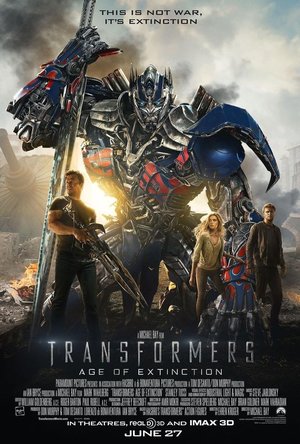
Transformers: Age of Extinction is a fun summer movie that sticks to Michael Bay's usual mode of operation, but it's jam-packed and overly ambitious, stretching the run time far longer than it ever should.
After the events of Transformers: Dark of the Moon, referred to in the film as The Battle of Chicago, the surviving Autobots are being hunted to extinction. The United States government is bent on exterminating all Transformers, good and bad, believing them to be an unwelcome global threat. All the while, the hypocritical government has simultaneously partnered with a wealthy inventor who is trying to create his own superior, man-made variations of Transformers. Furthermore, they’re working with the help of the Transformer bounty hunter Lockdown to search out and annihilate Optimus Prime, the famed leader of the Autobots. Prime has been forced into hiding and has sent out a distress call encouraging his comrades to follow suit. When amateur inventor Cade Yeager inadvertently stumbles upon a disguised Optimus Prime, he helps to repair the damaged Transformer who must reunite with his remaining allies to fight for their right to live.
Before I dive into this review, I think I should inform you that I have not seen any of the previous Transformers movies. I should also note that I’m something of a Transformers hater. Despite pressure from family and friends who have praised the movie series, I have deliberately avoided every single one of the films. I never liked the cartoon as a kid, and while Transformers’ amalgamation of cars and robots may be a dream combination for most guys, I have very little interest in either. However, as a critic, I cannot let my own biases get in the way of giving fair judgment. After having watched Transformers: Age of Extinction, I can thankfully report that the film actually wasn’t half bad. While it’s not going to make a Transformers fan out of me, it was an entertaining, albeit overly-long, movie-going experience.
Age of Extinction is an action-packed ride, filled with the kind of over-the-top entertainment you would expect from a Michael Bay film. While Bay has developed something of a bad rap, there’s no denying his knack for fun and ridiculous action sequences. He’s a man who spares no expense when it comes to explosions and special effects, and this is where Bay is at his best. Love him or hate him, it’s hard to argue with his results as he’s surely one of the most successful directors of all time. However, clocking in at two hours and forty-five minutes, the high-speed action of Age of Extinction is exhausting and becomes tiresome long before the finale. Even when Bay slows things down, he keeps the camera overly busy with particle effects and constant movement. While all of that looks great in IMAX 3D, it feels like an endless visual barrage that is frankly a lot to take in. How many lens flares must a man endure in one movie? I understand the desire to make every shot exciting and visually striking, but I think Bay is trying to tackle too much on camera.
Similarly, Age of Extinction is trying to squeeze too much into its plot, which could almost be broken up into two entirely separate movies. We have the hunt for Optimus Prime and the Transformers by Lockdown and the CIA; Cade Yeager’s discovery of Prime and their ensuing alliance; the love story between Cade’s daughter and her boyfriend; the emergence of the Dinobots; as well as the man-made construction of new Transformers. The result is a fast-paced action movie that is convoluted and far too long. That’s not to say that what is there is bad, though. Awful love story aside, all of the other components of the story are solid and even pretty interesting. Kelsey Grammer puts in a good performance as the head of the CIA who is responsible for the extermination of the Transformers. Similarly, Stanley Tucci is great as Joshua Joyce, the brilliant inventor who is recreating human-controlled Transformers for military use. Yet I can’t help but think that Joyce’s plot would have been perhaps been better to save for a sequel. Sure, it offers a nice parallel between the two inventors and it also creates an opportunity for them to introduce some all-new Transformers, but aren’t the Dinobots enough? There’s so much going on in the film that the eagerly-anticipated Dinobots aren’t given much screen time at all. There is just an unreasonable amount of narratives going on in this movie, to the point where it’s hard to follow, and even harder to stay interested in. Instead of sitting on the edge of your seat during the climactic showdown, you’re probably going to be looking at your watch and wondering how much longer this movie can possibly go on.
While I’m no expert on Transformers, I think the film does an admirable job in bringing the robotic characters to life. Their appearance and animation are both impressive, and they’re typically a pretty fun bunch. I have to admit, though, that I was a bit jarred by the angry and violent demeanor of Optimus Prime. I thought he was supposed to be the good guy everyone looked up to? In Age of Extinction, he clearly has some anger management issues. While he might be the most skilled warrior out there, he sure doesn’t seem like much of a role model. Peter Cullen, the original voice of Optimus Prime, has one again returned to voice the character. John Goodman gives a stand-out voice performance as Hound, in a role he seemed to have a lot of fun with, and Ken Watanabe voices the Samurai-like Transformer known as Drift. All in all, there are a lot of Transformers in the movie, but there is hardly ample time to get to know most of them. I imagine many of them have been introduced in previous films, but for a newcomer like myself, I had a hard time distinguishing between quite a few of them. Then there are the Dinobots, which look awesome, but we’re not given a chance to know much of anything about them. It’s a shame that they’re reduced to feeling like unnecessary bookends to an already overly-crammed movie.
On the human side of things, Mark Wahlberg is enjoyable as the struggling inventor who scavengers through whatever he can to try to create a breakthrough invention. He brings a charming and heroic presence to his role, making him a character we can identify with and root for as he tries to assist the highly-targeted Transformers. T.J. Miller’s Lucas makes for a mildly humorous companion to Cade, although much of the film’s attempts at comedy feel forced and aren’t very funny. Then there’s Nicola Peltz as the skimpily-dressed, rebellious but brainy and innocent, party girl daughter Tessa. She fits right into Bay’s stereotypical sexist female lead who serves as little more than a damsel in distress and eye candy. Still, I don’t know who is worse; Tessa, or her rally car racing boyfriend Shane, played by Jack Reynor. I felt just as frustrated by them as Wahlberg does playing Tessa’s disgruntled and disapproving father. These two lovebirds are an annoying and unwanted addition that only further drag out the plot. While it was at first vaguely amusing to watch Cade freak out as the over-protective father, that shtick ended up getting old real quick. While Wahlberg makes a good new face for the franchise, I hope to God that he comes alone for the next one.
Transformers: Age of Extinction is a fun summer movie. Director Michael Bay sticks to his usual mode of operation with ridiculous action sequences, top of the line special effects, and a whole lot of explosions. If you’re looking for a movie with more flash than substance, Age of Extinction should be right up your alley. It’s jam-packed and overly ambitious, stretching the run time far longer than it ever should, but if offers plenty of dumb, fun entertainment. Transformers fans should be pleased, although the series still has yet to make a fan out of me.
(This review was originally posted at 5mmg.com on 9.22.14.)
Before I dive into this review, I think I should inform you that I have not seen any of the previous Transformers movies. I should also note that I’m something of a Transformers hater. Despite pressure from family and friends who have praised the movie series, I have deliberately avoided every single one of the films. I never liked the cartoon as a kid, and while Transformers’ amalgamation of cars and robots may be a dream combination for most guys, I have very little interest in either. However, as a critic, I cannot let my own biases get in the way of giving fair judgment. After having watched Transformers: Age of Extinction, I can thankfully report that the film actually wasn’t half bad. While it’s not going to make a Transformers fan out of me, it was an entertaining, albeit overly-long, movie-going experience.
Age of Extinction is an action-packed ride, filled with the kind of over-the-top entertainment you would expect from a Michael Bay film. While Bay has developed something of a bad rap, there’s no denying his knack for fun and ridiculous action sequences. He’s a man who spares no expense when it comes to explosions and special effects, and this is where Bay is at his best. Love him or hate him, it’s hard to argue with his results as he’s surely one of the most successful directors of all time. However, clocking in at two hours and forty-five minutes, the high-speed action of Age of Extinction is exhausting and becomes tiresome long before the finale. Even when Bay slows things down, he keeps the camera overly busy with particle effects and constant movement. While all of that looks great in IMAX 3D, it feels like an endless visual barrage that is frankly a lot to take in. How many lens flares must a man endure in one movie? I understand the desire to make every shot exciting and visually striking, but I think Bay is trying to tackle too much on camera.
Similarly, Age of Extinction is trying to squeeze too much into its plot, which could almost be broken up into two entirely separate movies. We have the hunt for Optimus Prime and the Transformers by Lockdown and the CIA; Cade Yeager’s discovery of Prime and their ensuing alliance; the love story between Cade’s daughter and her boyfriend; the emergence of the Dinobots; as well as the man-made construction of new Transformers. The result is a fast-paced action movie that is convoluted and far too long. That’s not to say that what is there is bad, though. Awful love story aside, all of the other components of the story are solid and even pretty interesting. Kelsey Grammer puts in a good performance as the head of the CIA who is responsible for the extermination of the Transformers. Similarly, Stanley Tucci is great as Joshua Joyce, the brilliant inventor who is recreating human-controlled Transformers for military use. Yet I can’t help but think that Joyce’s plot would have been perhaps been better to save for a sequel. Sure, it offers a nice parallel between the two inventors and it also creates an opportunity for them to introduce some all-new Transformers, but aren’t the Dinobots enough? There’s so much going on in the film that the eagerly-anticipated Dinobots aren’t given much screen time at all. There is just an unreasonable amount of narratives going on in this movie, to the point where it’s hard to follow, and even harder to stay interested in. Instead of sitting on the edge of your seat during the climactic showdown, you’re probably going to be looking at your watch and wondering how much longer this movie can possibly go on.
While I’m no expert on Transformers, I think the film does an admirable job in bringing the robotic characters to life. Their appearance and animation are both impressive, and they’re typically a pretty fun bunch. I have to admit, though, that I was a bit jarred by the angry and violent demeanor of Optimus Prime. I thought he was supposed to be the good guy everyone looked up to? In Age of Extinction, he clearly has some anger management issues. While he might be the most skilled warrior out there, he sure doesn’t seem like much of a role model. Peter Cullen, the original voice of Optimus Prime, has one again returned to voice the character. John Goodman gives a stand-out voice performance as Hound, in a role he seemed to have a lot of fun with, and Ken Watanabe voices the Samurai-like Transformer known as Drift. All in all, there are a lot of Transformers in the movie, but there is hardly ample time to get to know most of them. I imagine many of them have been introduced in previous films, but for a newcomer like myself, I had a hard time distinguishing between quite a few of them. Then there are the Dinobots, which look awesome, but we’re not given a chance to know much of anything about them. It’s a shame that they’re reduced to feeling like unnecessary bookends to an already overly-crammed movie.
On the human side of things, Mark Wahlberg is enjoyable as the struggling inventor who scavengers through whatever he can to try to create a breakthrough invention. He brings a charming and heroic presence to his role, making him a character we can identify with and root for as he tries to assist the highly-targeted Transformers. T.J. Miller’s Lucas makes for a mildly humorous companion to Cade, although much of the film’s attempts at comedy feel forced and aren’t very funny. Then there’s Nicola Peltz as the skimpily-dressed, rebellious but brainy and innocent, party girl daughter Tessa. She fits right into Bay’s stereotypical sexist female lead who serves as little more than a damsel in distress and eye candy. Still, I don’t know who is worse; Tessa, or her rally car racing boyfriend Shane, played by Jack Reynor. I felt just as frustrated by them as Wahlberg does playing Tessa’s disgruntled and disapproving father. These two lovebirds are an annoying and unwanted addition that only further drag out the plot. While it was at first vaguely amusing to watch Cade freak out as the over-protective father, that shtick ended up getting old real quick. While Wahlberg makes a good new face for the franchise, I hope to God that he comes alone for the next one.
Transformers: Age of Extinction is a fun summer movie. Director Michael Bay sticks to his usual mode of operation with ridiculous action sequences, top of the line special effects, and a whole lot of explosions. If you’re looking for a movie with more flash than substance, Age of Extinction should be right up your alley. It’s jam-packed and overly ambitious, stretching the run time far longer than it ever should, but if offers plenty of dumb, fun entertainment. Transformers fans should be pleased, although the series still has yet to make a fan out of me.
(This review was originally posted at 5mmg.com on 9.22.14.)

Daniel Boyd (1066 KP) rated the PlayStation 4 version of Star Wars Jedi: Fallen Order in Video Games
Mar 1, 2020 (Updated Mar 1, 2020)

Wasted Potential
So I just finished Jedi: Fallen Order and it's left me feeling confused. Not because of some complex twist or story revelation, but because on paper I should have loved every minute of this game. You take the parkour movement and sense of adventure from a game like Uncharted and you give it to a Jedi, who we follow during some of the darkest days in the Star Wars lore and what do you get?
Apparently you get something that doesn't feel like Star Wars.
I have a fair number of problems with this game, so I'm going to go ahead and list them and explain why they bothered me so much during my experience playing through Fallen Order.
First of all, when this game dropped and did pretty well commercially and critically, EA were commended in the games media for having the guts to release a single-player, story based Star Wars game with no online play. When the reviews dropped just before the game's release, this news got me really hyped as I have never been much for online gaming and much prefer story based games over anything else. Now whilst EA did give us a single-player, offline Star Wars story, they did so in such a sloppy, janky, half-finished fashion.
I lost count of the amount of times that I had to restart my game because of loading errors or game breaking bugs. Almost every time I would enter a new area the characters would initially appear in a T-pose position and remain that way for a good few seconds until I approached them. Onscreen prompts would often fail to appear making the game's already confusing exploration methods even more unclear. I have not seen this much pop-in in a videogame since the first version of No Man's Sky. Almost every area was covered in murky textures upon initially entering them, with some entire structures and areas failing to render. During a few boss fights, the AI character would fail to attack me and just stand still and no matter how many blows I would land on them, their health bar would not budge until I fully reloaded the level. This sort of thing was present during every one of my play sessions and at a few points the game became almost unplayable due to it's glaring technical glitches. Also, I got this game as a Christmas gift, so it has been out for a decent amount of time. A game of this calibre, that has been out for months at this point, from a major studio like Respawn and a publisher like EA, not to mention being from a major franchise like Star Wars, - the fact that it is in the current broken state that it's in is frankly unacceptable.
The next issue I had was the story and characters in the game. The game's protagonist Cal, is an unsympathetic, whiny bitch of a character that got on my nerves every time he opened his mouth. The rest of the crew were also pretty bland, unendearing and lacking in much personality. I grew up loving the Star Wars universe, yet I found myself trying in vain to skip almost every cutscene and really not giving a crap what happens to any one of the characters. The villains were unengaging and the other side characters like Cal's master and the old dude that left holograms for Cal to find got increasingly annoying every time they appeared. The only character I found engaging throughout the whole game was Sister Merrin.
I always thought Jedi Knights were supposed to be extremely capable, powerful warriors, yet at no point in this game do you ever feel powerful in any significant way. The whole time, you feel on par with the non descript enemies that you are fighting. While I agree that the last major AAA single-player Star Wars game, The Force Unleashed was too easy, at least you felt powerful while playing as that character. The combat never feels as satisfying as it should due to the lack of dismemberment. The decision not to allow the player to chop off limbs makes it feels more like you are hitting enemy shaped piñatas with a big stick, rather than welding a laser sword of pure, raw energy. I also felt that there was a lack of variation in the combos and moves-set and found myself watching the same animations over and again no matter what combination of buttons I was mashing. Every fight in this game is hard and not in a fun,challenging way, but instead in a grinding, irritating way. The ridiculously long loading times also made dying even more frustrating. If you are going to design a game where the player is going to die frequently, you HAVE TO have a snappy respawn system in place à la Super Meat Boy or Hotline Miami. (Especially when your fucking studio is called RESPAWN, but I digress.) They were clearly going for a more defensive, methodical approach to the combat system, which is fine, but they should have given you a choice between that and a more aggressive, offensive skill tree, meaning that more play styles could be catered to. Another majorly annoying thing was the way that the game justified unlocking new skills for Cal, with him having out-of-the-blue flashbacks at seemingly random points in the story where he would suddenly remember that he could wall-run or double-jump. I hate when games do this, it feels extremely lazy and unjustified within the context of the story that is being presented. Another thing that bothered me gameplay-wise was the checkpoint system. The whole refilling your health = respawning the enemies thing felt really arcady and often broke immersion.
Something else that I hate in games is when the game tries to pretend that it is an open world game rather than a linear experience, which this game does. I don't understand why you would want to masquerade as an open world game when that mechanic has been so oversaturated for this entire generation. After you play through the game's intro and get access to the ship, you are given the impression that you can choose what order to visit each planet and progress though the game. However this is not the case. When I was first given the choice to pick a planet, I chose Dathomir as I am a big Darth Maul fan and thought it would be cool to explore his home turf. I got there and was making my way through the clear-as-mud holomap when I got to a section where I could not progress. There was a jump that I just could not make no matter how many times I tried. After eventually getting fed up I had to look up a walkthrough to find out how to progress whereupon I learned that you actually need to go to the other planet first and gain an ability to make this jump. Now even if I did design my game so poorly that I let the player go to the wrong planet on their first travel, I would have at least had the decency to put in a prompt at the un-passable jump to let the player know that they don't have the skills to progress here yet and to go to the other planet and return here later. It could have been a voiceover from a crew member or even an immersion-breaking piece of text, but something would have been nice to prevent me having to look up a walkthrough to learn this fact. Witnessing this ineptitude in game design from such a major studio was shocking. So yeah, from that point on, - lesson learned, - I just followed the checkpoints to decide what my next planet would be to travel to, but then why even give players the illusion of choice in this? Why not just usher the player automatically to the next planet they need to visit after they return to the ship?
My final and biggest issue with this game is despite it being a Star Wars game, it never really felt like Star Wars. I noticed this during the first third of the game in the some of the character designs. Some of the side characters looked more akin to something from Ratchet & Clank than from the Star Wars universe. Then as I was playing through Kashyyyk and fighting spiders and giant slugs, I'm thinking to myself, I don't ever remember Luke Skywalker doing this and that dude lived and trained in a swamp for like a year. Then the shark was well and truly jumped. Upon revisiting Dathomir and finally being able to make some progress, a character literally raises bodies from the ground for you to fight. That's right, they put zombies in a Star Wars game. I thought since Disney had taken control of Star Wars, that they were way stricter than Lucas ever was about what does and doesn't get into the Star Wars universe, so whoever greenlit this zombie shit over at Disney should really get the boot. I can't quite believe that I'm saying this, but if you want a more authentic and higher quality Star Wars videogame experience, go play Battlefront 2. Sure it may have had an extremely messy launch and been marred with controversy ever since, but at least it feels like Star Wars.
There were a sparse few things that I did enjoy. As I mentioned above, Merrin was a fairly engaging and well acted character. The Lightsaber customisation was also pretty neat. I also enjoyed the music and (SPOILERS,) the brief appearance that Darth Vader makes. However the music is only great because it's the Star Wars score and whilst Vader's appearance as an unstoppable force was cool here, I personally feel like it was done better in Rogue One.
So yeah, I kind of feel like I played a different game to everyone else. I really wanted to fall in love with this game and I kept waiting for it to win me over, but unfortunately it never did. I think that there is potential here for something better, mostly owed to the interesting time period the game is set in on the Star Wars timeline, so I really hope that they take the few good elements that were present in Fallen Order and improve upon everything else for the sequel.
Apparently you get something that doesn't feel like Star Wars.
I have a fair number of problems with this game, so I'm going to go ahead and list them and explain why they bothered me so much during my experience playing through Fallen Order.
First of all, when this game dropped and did pretty well commercially and critically, EA were commended in the games media for having the guts to release a single-player, story based Star Wars game with no online play. When the reviews dropped just before the game's release, this news got me really hyped as I have never been much for online gaming and much prefer story based games over anything else. Now whilst EA did give us a single-player, offline Star Wars story, they did so in such a sloppy, janky, half-finished fashion.
I lost count of the amount of times that I had to restart my game because of loading errors or game breaking bugs. Almost every time I would enter a new area the characters would initially appear in a T-pose position and remain that way for a good few seconds until I approached them. Onscreen prompts would often fail to appear making the game's already confusing exploration methods even more unclear. I have not seen this much pop-in in a videogame since the first version of No Man's Sky. Almost every area was covered in murky textures upon initially entering them, with some entire structures and areas failing to render. During a few boss fights, the AI character would fail to attack me and just stand still and no matter how many blows I would land on them, their health bar would not budge until I fully reloaded the level. This sort of thing was present during every one of my play sessions and at a few points the game became almost unplayable due to it's glaring technical glitches. Also, I got this game as a Christmas gift, so it has been out for a decent amount of time. A game of this calibre, that has been out for months at this point, from a major studio like Respawn and a publisher like EA, not to mention being from a major franchise like Star Wars, - the fact that it is in the current broken state that it's in is frankly unacceptable.
The next issue I had was the story and characters in the game. The game's protagonist Cal, is an unsympathetic, whiny bitch of a character that got on my nerves every time he opened his mouth. The rest of the crew were also pretty bland, unendearing and lacking in much personality. I grew up loving the Star Wars universe, yet I found myself trying in vain to skip almost every cutscene and really not giving a crap what happens to any one of the characters. The villains were unengaging and the other side characters like Cal's master and the old dude that left holograms for Cal to find got increasingly annoying every time they appeared. The only character I found engaging throughout the whole game was Sister Merrin.
I always thought Jedi Knights were supposed to be extremely capable, powerful warriors, yet at no point in this game do you ever feel powerful in any significant way. The whole time, you feel on par with the non descript enemies that you are fighting. While I agree that the last major AAA single-player Star Wars game, The Force Unleashed was too easy, at least you felt powerful while playing as that character. The combat never feels as satisfying as it should due to the lack of dismemberment. The decision not to allow the player to chop off limbs makes it feels more like you are hitting enemy shaped piñatas with a big stick, rather than welding a laser sword of pure, raw energy. I also felt that there was a lack of variation in the combos and moves-set and found myself watching the same animations over and again no matter what combination of buttons I was mashing. Every fight in this game is hard and not in a fun,challenging way, but instead in a grinding, irritating way. The ridiculously long loading times also made dying even more frustrating. If you are going to design a game where the player is going to die frequently, you HAVE TO have a snappy respawn system in place à la Super Meat Boy or Hotline Miami. (Especially when your fucking studio is called RESPAWN, but I digress.) They were clearly going for a more defensive, methodical approach to the combat system, which is fine, but they should have given you a choice between that and a more aggressive, offensive skill tree, meaning that more play styles could be catered to. Another majorly annoying thing was the way that the game justified unlocking new skills for Cal, with him having out-of-the-blue flashbacks at seemingly random points in the story where he would suddenly remember that he could wall-run or double-jump. I hate when games do this, it feels extremely lazy and unjustified within the context of the story that is being presented. Another thing that bothered me gameplay-wise was the checkpoint system. The whole refilling your health = respawning the enemies thing felt really arcady and often broke immersion.
Something else that I hate in games is when the game tries to pretend that it is an open world game rather than a linear experience, which this game does. I don't understand why you would want to masquerade as an open world game when that mechanic has been so oversaturated for this entire generation. After you play through the game's intro and get access to the ship, you are given the impression that you can choose what order to visit each planet and progress though the game. However this is not the case. When I was first given the choice to pick a planet, I chose Dathomir as I am a big Darth Maul fan and thought it would be cool to explore his home turf. I got there and was making my way through the clear-as-mud holomap when I got to a section where I could not progress. There was a jump that I just could not make no matter how many times I tried. After eventually getting fed up I had to look up a walkthrough to find out how to progress whereupon I learned that you actually need to go to the other planet first and gain an ability to make this jump. Now even if I did design my game so poorly that I let the player go to the wrong planet on their first travel, I would have at least had the decency to put in a prompt at the un-passable jump to let the player know that they don't have the skills to progress here yet and to go to the other planet and return here later. It could have been a voiceover from a crew member or even an immersion-breaking piece of text, but something would have been nice to prevent me having to look up a walkthrough to learn this fact. Witnessing this ineptitude in game design from such a major studio was shocking. So yeah, from that point on, - lesson learned, - I just followed the checkpoints to decide what my next planet would be to travel to, but then why even give players the illusion of choice in this? Why not just usher the player automatically to the next planet they need to visit after they return to the ship?
My final and biggest issue with this game is despite it being a Star Wars game, it never really felt like Star Wars. I noticed this during the first third of the game in the some of the character designs. Some of the side characters looked more akin to something from Ratchet & Clank than from the Star Wars universe. Then as I was playing through Kashyyyk and fighting spiders and giant slugs, I'm thinking to myself, I don't ever remember Luke Skywalker doing this and that dude lived and trained in a swamp for like a year. Then the shark was well and truly jumped. Upon revisiting Dathomir and finally being able to make some progress, a character literally raises bodies from the ground for you to fight. That's right, they put zombies in a Star Wars game. I thought since Disney had taken control of Star Wars, that they were way stricter than Lucas ever was about what does and doesn't get into the Star Wars universe, so whoever greenlit this zombie shit over at Disney should really get the boot. I can't quite believe that I'm saying this, but if you want a more authentic and higher quality Star Wars videogame experience, go play Battlefront 2. Sure it may have had an extremely messy launch and been marred with controversy ever since, but at least it feels like Star Wars.
There were a sparse few things that I did enjoy. As I mentioned above, Merrin was a fairly engaging and well acted character. The Lightsaber customisation was also pretty neat. I also enjoyed the music and (SPOILERS,) the brief appearance that Darth Vader makes. However the music is only great because it's the Star Wars score and whilst Vader's appearance as an unstoppable force was cool here, I personally feel like it was done better in Rogue One.
So yeah, I kind of feel like I played a different game to everyone else. I really wanted to fall in love with this game and I kept waiting for it to win me over, but unfortunately it never did. I think that there is potential here for something better, mostly owed to the interesting time period the game is set in on the Star Wars timeline, so I really hope that they take the few good elements that were present in Fallen Order and improve upon everything else for the sequel.
Kirk Bage (1775 KP) rated The Umbrella Academy in TV
Sep 19, 2020 (Updated Jan 22, 2021)

I came to this gloriously colourful, energetic and super smart comic book adaptation in August (when Netflix advertised season 2), at a time of lockdown where I really needed something cheerful and fun to keep me going. It worked so well I watched both full seasons twice over, back to back, and key episodes 3 times! A rare thing indeed for me and a TV show.
Since then the rigours of isolation have set me back with a really long backlog for The Wasteland – currently I have a list of over 40 cultural artifacts I want to talk about and share with you- but, I am very glad to be talking about this one today, as even though it wasn’t that long ago, it evokes such fond happy memories of becoming just a little bit obsessed by something. A phenomenon that only seems to happen when you go into something with low to medium expectations and come out feeling like you have found a diamond in the rough.
The concept of 7 children with mysterious powers being adopted and raised by a shady and strict, umbrella wielding, father has been around a few years in the form of several graphic novels, penned by My Chemical Romance frontman Gerard Way. You can feel the vibe of something slightly emo and arty coming through – just cool enough but also self conscious; melancholy and dark in places but also lots of sardonic fun. But, unlike the books, which often look stark and minimal, the world created by show runner and director Steve Blackman is vivid and full to the brim with things to overwhelm the senses.
For the last few years, and especially of late, the Superhero genre has been so oversaturated that it is almost impossible to come up with anything original, but The Umbrella Academy together with Amazon’s The Boys, definitely manage to do that. It has enough mystique to be intriguingly confusing for the first few episodes, as we piece together the Hargreaves’ past that has led to the current situation, and discover the dynamic tension that exists between the adopted siblings. Oh, and there is a talking chimpanzee butler / guardian called Pogo, that feels like CGI gimmickery for a while, before growing into something truly wonderful.
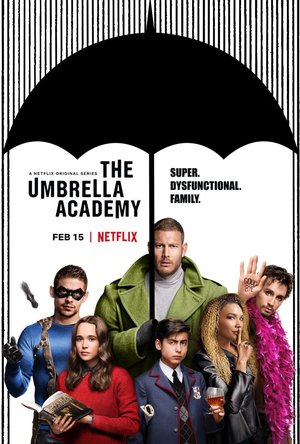
The first thing you notice about this set of misfits, as they reassemble for their father’s funeral after years of bitterness and estrangement, is that they are all a little bit broken and uncomfortable in their own skins – their powers as individuals are all a bit, well frankly underwhelming, and their personalities are not exactly attractive in every case. Season one is all about re-establishing connections and working through identity crises. In many ways it is a coming of age story, as circumstances lead to them needing to grow up fast and join together to achieve true power. It works both on the surface and as a deeper allegory.
As each main character is introduced you inevitably get drawn into ranking them from most to least favourite, and the trick of it is how much those feelings shift as the story progresses. Everyone loves Klaus, the twitchy junkie who can see dead people, his completely non heroic yet hilariously stoned outlook gives him many of the best lines and most fun scenes. I changed allegiance several times with the others, but Klaus, played by the charismatic Irish actor Robert Sheehan, always remained my favourite, because of his hippie rockstar vibe. Although it’s hard not to have a soft spot for Number 5, the time travelling schoolboy that has been missing for years and re-emerges as a middle aged man still trapped in the boys’ body. Aiden Gillen is superb in conveying that he is older whilst always looking like a teenager, and in many ways he is the true pivot and anchor of the story.
I suppose before the show aired it was Ellen Page that was the “star” draw amongst the young and mostly unknown cast of “heroes”. As Vanya, the only Hargreaves child never to demonstrate a power, and held aside by their controlling father, she is the outsider and most insecure of the bunch. You sense her storyline is going to be crucial to the whole shebang, and so it turns out, but her fame as an actress of note never overshadows the show as a whole – it feels instantly like a group effort, and in that sense a true family, the deeper you get into it.
I could go on explaining each character and the details of the intricate plot forever, but I would never do it justice. The only way to see what the fuss is about is to watch it. Anything else would just sound like mad confusion to the uninitiated. All I can say is that it does an incredible job of unfolding its charms and secrets piece by piece. So much so that by the climax of season two I am still not entirely sure we have all the information necessary to know what is going on in a complete sense; there are several questions and mysteries still to be unearthed, and I like that very much.
I have recommended this show to anyone I know who enjoys something entertaining that has substance yet doesn’t take itself too seriously – so that is everyone then! I think it’s allure is that very thing: it manages to hit a zeitgeist of perfect balance between a smart script and plotline with many cliffhangers, and enough disposable moments of fun, to be exactly what the modern Netflix viewer is looking for. Super easy to watch with one eye or with both, depending on what mood you are in.
There is also the style of the thing – a veritable candy box of colours and neat visual tricks, mixed in with some of the best musical montage sequences I have ever seen. I understand from several interviews that Steve Blackman specifically wrote certain scenes around the feel of a piece of music he wanted to include. That is a clever way of building a cult following: find songs that both tell a story and appeal to the cool kids, then use them as mini music video segments that punctuate the heavier elements of storytelling. It’s not a new trick, but the song choices here are so good that it has rarely been done this well before.
It all works especially well as we move into season two and an historical context that brings up a lot of pertinent issues for some of the siblings regarding race, sexuality and other freedoms of identity that can be taken for granted in the modern era. I don’t want to spoil too much of that here, but suffice to say as a hook to pin the themes on it is a genius touch that makes season two a huge leap forward on something that was already pretty decent in season one. All the characters become more rounded and relatable, even the so called bad guys – an increasingly eccentric bunch of creations that leave you in no doubt this is a comic book world not to be confused with reality.
At time of writing, a third season has still not being given the greenlight. Considering the massive cliffhanger we are left with at the end of season two, and how big the cult following seems to be by now, it would be an absolute crime not to allow it to continue. The only reason I can see it wouldn’t is that the stories of the source material are now exhausted, and anywhere they go from here will need to be truly original. However, there is so much scope to do almost anything from here that I don’t see it as any kind of issue.
If you haven’t seen it, I urge you whole-heartedly to give it a go. There really is something in there to please everyone, except perhaps the most serious minded of realists. Even then, they’d be hard pressed not to raise a smile or tap a toe at some of the best musical moments of emo hero mayhem.
Since then the rigours of isolation have set me back with a really long backlog for The Wasteland – currently I have a list of over 40 cultural artifacts I want to talk about and share with you- but, I am very glad to be talking about this one today, as even though it wasn’t that long ago, it evokes such fond happy memories of becoming just a little bit obsessed by something. A phenomenon that only seems to happen when you go into something with low to medium expectations and come out feeling like you have found a diamond in the rough.
The concept of 7 children with mysterious powers being adopted and raised by a shady and strict, umbrella wielding, father has been around a few years in the form of several graphic novels, penned by My Chemical Romance frontman Gerard Way. You can feel the vibe of something slightly emo and arty coming through – just cool enough but also self conscious; melancholy and dark in places but also lots of sardonic fun. But, unlike the books, which often look stark and minimal, the world created by show runner and director Steve Blackman is vivid and full to the brim with things to overwhelm the senses.
For the last few years, and especially of late, the Superhero genre has been so oversaturated that it is almost impossible to come up with anything original, but The Umbrella Academy together with Amazon’s The Boys, definitely manage to do that. It has enough mystique to be intriguingly confusing for the first few episodes, as we piece together the Hargreaves’ past that has led to the current situation, and discover the dynamic tension that exists between the adopted siblings. Oh, and there is a talking chimpanzee butler / guardian called Pogo, that feels like CGI gimmickery for a while, before growing into something truly wonderful.
The first thing you notice about this set of misfits, as they reassemble for their father’s funeral after years of bitterness and estrangement, is that they are all a little bit broken and uncomfortable in their own skins – their powers as individuals are all a bit, well frankly underwhelming, and their personalities are not exactly attractive in every case. Season one is all about re-establishing connections and working through identity crises. In many ways it is a coming of age story, as circumstances lead to them needing to grow up fast and join together to achieve true power. It works both on the surface and as a deeper allegory.
As each main character is introduced you inevitably get drawn into ranking them from most to least favourite, and the trick of it is how much those feelings shift as the story progresses. Everyone loves Klaus, the twitchy junkie who can see dead people, his completely non heroic yet hilariously stoned outlook gives him many of the best lines and most fun scenes. I changed allegiance several times with the others, but Klaus, played by the charismatic Irish actor Robert Sheehan, always remained my favourite, because of his hippie rockstar vibe. Although it’s hard not to have a soft spot for Number 5, the time travelling schoolboy that has been missing for years and re-emerges as a middle aged man still trapped in the boys’ body. Aiden Gillen is superb in conveying that he is older whilst always looking like a teenager, and in many ways he is the true pivot and anchor of the story.
I suppose before the show aired it was Ellen Page that was the “star” draw amongst the young and mostly unknown cast of “heroes”. As Vanya, the only Hargreaves child never to demonstrate a power, and held aside by their controlling father, she is the outsider and most insecure of the bunch. You sense her storyline is going to be crucial to the whole shebang, and so it turns out, but her fame as an actress of note never overshadows the show as a whole – it feels instantly like a group effort, and in that sense a true family, the deeper you get into it.
I could go on explaining each character and the details of the intricate plot forever, but I would never do it justice. The only way to see what the fuss is about is to watch it. Anything else would just sound like mad confusion to the uninitiated. All I can say is that it does an incredible job of unfolding its charms and secrets piece by piece. So much so that by the climax of season two I am still not entirely sure we have all the information necessary to know what is going on in a complete sense; there are several questions and mysteries still to be unearthed, and I like that very much.
I have recommended this show to anyone I know who enjoys something entertaining that has substance yet doesn’t take itself too seriously – so that is everyone then! I think it’s allure is that very thing: it manages to hit a zeitgeist of perfect balance between a smart script and plotline with many cliffhangers, and enough disposable moments of fun, to be exactly what the modern Netflix viewer is looking for. Super easy to watch with one eye or with both, depending on what mood you are in.
There is also the style of the thing – a veritable candy box of colours and neat visual tricks, mixed in with some of the best musical montage sequences I have ever seen. I understand from several interviews that Steve Blackman specifically wrote certain scenes around the feel of a piece of music he wanted to include. That is a clever way of building a cult following: find songs that both tell a story and appeal to the cool kids, then use them as mini music video segments that punctuate the heavier elements of storytelling. It’s not a new trick, but the song choices here are so good that it has rarely been done this well before.
It all works especially well as we move into season two and an historical context that brings up a lot of pertinent issues for some of the siblings regarding race, sexuality and other freedoms of identity that can be taken for granted in the modern era. I don’t want to spoil too much of that here, but suffice to say as a hook to pin the themes on it is a genius touch that makes season two a huge leap forward on something that was already pretty decent in season one. All the characters become more rounded and relatable, even the so called bad guys – an increasingly eccentric bunch of creations that leave you in no doubt this is a comic book world not to be confused with reality.
At time of writing, a third season has still not being given the greenlight. Considering the massive cliffhanger we are left with at the end of season two, and how big the cult following seems to be by now, it would be an absolute crime not to allow it to continue. The only reason I can see it wouldn’t is that the stories of the source material are now exhausted, and anywhere they go from here will need to be truly original. However, there is so much scope to do almost anything from here that I don’t see it as any kind of issue.
If you haven’t seen it, I urge you whole-heartedly to give it a go. There really is something in there to please everyone, except perhaps the most serious minded of realists. Even then, they’d be hard pressed not to raise a smile or tap a toe at some of the best musical moments of emo hero mayhem.