

Purple Phoenix Games (2266 KP) rated Ghoulash in Tabletop Games
Sep 3, 2019
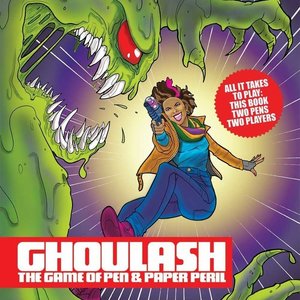

Wait, this is Ghoulash? Ok so ditch the food and add Ghoul meat, dashes of Ghoo, some falling debris, and holes. Also add an opponent to play against and you have a recipe for a really great game. Intrigued by my recipe? Read on. This is Ghoulash.
When you name a game (and game company) using a pun for a delicious meal you just KNOW everyone is going to be making these jokes. I am not below this. However, Ghoulash pits two players against each other in a race to defeat eight Ghouls first – or die trying. This is a pencil and paper game contained on one double-sided sheet of paper (with the rules printed on the other side). With such little in components, this game CAN’T be very good, right?
DISCLAIMER: We were provided with a link to print off the game, so technically it’s a PNP for us. We printed off several copies to play our review games. I do not intend to cover every single rule included in the rule book, but will describe the overall game flow and major rule set so that our readers may get a sense of how the game plays. For more in depth rules, you may purchase a copy from the publisher directly or from your FLGS. -T
To setup a game of Ghoulash: The Game of Pen and Paper Peril (which I will be calling simply Ghoulash for the remainder of this review) grab two copies of the game sheet and two writing utensils. Though the game’s title suggests using a pen, I recommend a pencil. From here, you will need to decide which map grid you want to use for your play map and which will be your DM map. For those who have not played table top RPG’s before, a DM is a Dungeon Master – the person who ultimately runs the game and is typically in charge of placing and playing the monsters, traps, and NPCs of a game. In this case, each player will be each other’s DM. You will see the number of items that must be placed on the map on the main page. You must place (anywhere you want on the map) eight Ghouls, five Holes, five Debris, and three First-Aid Kits. Seriously. Anywhere you want. These are the items and encounters your opponent will be interacting with as you play. You are now ready to begin!
On your turn you will be moving through the map attempting to encounter and kill Ghouls – blobby monsters that want to eat you. You do this by moving onto a square that your opponent has placed a Ghoul and fighting it. Fighting Ghouls is easy: your DM opponent will circle any number on the Ghoul you are fighting. You need to guess this number in order to exploit its weak spot and vanquish it. For every incorrect guess YOU will take a wound from it bashing you. Mark your wounds on the Wound Meters area below the Ghouls. If you happen to take 12 wounds before finding a First-Aid Kit, then you die and you lose the game. Finding a First-Aid Kit, however, will relieve you of all your wounds you have suffered. In this scenario, you will begin tracking your wounds anew on the next Wound Meter on the tracker.
Like I mentioned earlier, other traps will be awaiting you in your personal hell dungeon. When you fall into a Hole you will forfeit the rest of your turn and you will skip your next turn entirely. Should you move onto a square containing Debris, you will be hit for one wound from falling bits of the rickety dungeon. Or perhaps it’s guano. You never know.
The player to defeat all eight ghouls or remain living the longest will be the winner (unless you play hardcore rules and have to defeat all Ghouls to win)!
Usually at this point in my reviews I evaluate the game components. In this case I am going to evaluate how the game art and graphic design work with and for the game. As the entire game is played on one side of one sheet of paper and everything you really need is located on that page, this is really genius to me. Everything is right there, and it’s very clear what to place on the map, how many of each thing to place, and where you can track the Ghouls, wounds, and your Ghoul trophies. It’s really great! The only negative here is we wished the letters and numbers on the x and y axes were darker. It was a little difficult for some people to read the coordinates. This would be an easy fix for me, but it may not be within the designer’s vision for the layout. Many times we were describing our movement with Battleship coordinates: I am moving south to B-1 then east to P-1 then north to P-2, etc. I didn’t have much difficulty with this, but I did hear that others did.
I believe that the intent of the future of Ghoulash is to offer pre-printed charts for sale and possibly have different themed charts to play. The eagle-eyed among you may have noticed that we were playing The City map. I have not seen any other maps, so I cannot comment on them, but even if I only had The City to play forever, I think that I would be happy enough.
That said, I believe this is a really really great game. I enjoyed being able to place out my encounter elements, and being able to freely roam around the map until I ran into something – even if it was a hole in the middle of an intersection that I had to fall through several times (sneaky, sneaky, my brilliant little brother!). The guessing game of fighting Ghouls can be quick and fun, or it can give you five wounds in one encounter. Overall, I think that anyone can enjoy it, but I will give a caveat. Both players MUST be able to read the map and coordinates to follow along with where each player is moving or else you may have some bickering. Oh, just my family? Maybe.
Purple Phoenix Games gives this one a sticky-yet-pleasing 10 / 12. You really should give it a shot. It could work with couples, friends, co-workers, strangers, pets, anyone!
Purple Phoenix Games (2266 KP) rated Cartooner: The Fast & Furious Game of Drawing Comics in Tabletop Games
Jul 23, 2019
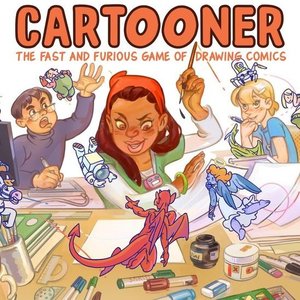
A typical game of Cartooner will last four rounds and each round will be the same length – five, six, or seven minutes each. During these rounds players will create comics using increasing numbers of panels each round. So Round 1 will be a 2-panel comic, Round 2 will have 4 panels, Round 3 will have 6 panels, and the final round will contain 8 panels to fill with glorious comic gold. This is the basic game flow. Where the actual “game” part comes in is through the use of the two decks of cards.
DISCLAIMER: I do not intend to cover every single rule included in the rule book, but will describe the overall game flow and major rule set so that our readers may get a sense of how the game plays. For more in depth rules, you may purchase a copy from the publisher directly or from your FLGS. -T
Three “Theme” cards are dealt at the beginning of the game to each player, which describe the player’s obsessions. Players score points at the end of each round for including their Themes in the comic. This may sound somewhat easy, but the game comes with about 28,000 Theme cards and the combinations can be pretty wonky. For example, for my first game I was dealt Fear of Growing Old, Infidelity, and Desire to Be Famous. My 10-year old niece was dealt Aliens, Flowers, and Animals. I mean, come on! AND her dad is an art teacher (who also played with us and totally killed the art). So I thought I was beaten before we even began. The three Theme cards kept everyone pretty busy in Round 1, but it was about to get harder.
Round 2 introduces a new element to the game that refreshes every round: “Trend” cards. Whomever scored lowest in the previous round will draw Trend cards (the number of which is determined by which round you are currently playing) and choose cards to enact for the upcoming round. Trends are basically bonus cards that you can attempt to incorporate into your comic for the round to score fabulous amounts of points. These are optional, of course, but really can boost those scores for the round, so are not to be ignored.
At the end of each round players will present and read their comics to the group to be scored. Points are awarded for including your Themes, completing objectives from the Trend cards, and also for filling in every panel on your page – which I thought would be a breeze, but apparently eight panels is way too hard for me because I neglected to draw something in the final two panels. Tally up your points from all the rounds and determine the greatest comic artist at the table (it was me)!
Components. This game is a large pad of paper, 28,000 cards, and cardboard VP tokens. You must supply your own writing utensil. As you can see below, I like to live on the edge and used ballpoint pen for my artwork. The tokens are fine and the cards are of good quality. What I really want to highlight is the pad of paper that is provided. Every game each player will need four sheets of paper from the pad, one for each round. These pages are wonderfully organized and include the game rules at the bottom of each page to remind you of what will score points. This helps you to prioritize your panels to include the most VP-worthy elements and to (hopefully) tell a good story as well.
All in all this is a frantic comic drawing game that will have you pulling out your hair trying to compose a somewhat cohesive short visual story including elements that may not, and probably WILL not, fit into that narrative. It is relatively quick, as long as the presentations and arbitrations are held in check for time. We do not have many drawing games in our collections, and I am overjoyed that we now have an enjoyable representative of the genre. Purple Phoenix Games eagerly awards this one a 10/12. Go check it out and test your own illustration skills.

Hazel (1853 KP) rated Picasso: The Colouring Book in Books
Jul 15, 2017
...
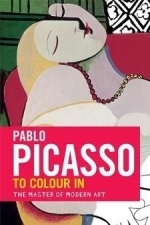
Pablo Picasso: To Colour In was published in April 2016 with the intention of using the popular fad to educate readers/colouring book enthusiasts about the techniques and secrets of the great master. Each work included in the book has a brief paragraph explaining what it is (in case you cannot tell) and a few details about Picasso’s intentions or the events happening in his life at the time.
...
Naturally, it would be impossible to produce a book of all Picasso’s recorded works, but the editors of this particular colouring book have carefully selected examples that span the majority of his life, thus encompassing the different styles he experimented with.
The author of the text – presumably Frédérique Cassegrain, who also wrote the biography and information for each included artwork – gives helpful advice about how to colour in the outlined versions of Picasso’s paintings. The paper is thick enough to be suitable for paints, particular Gouache, which is water soluble and easily blended. Alternatively, coloured pencils may be used, preferably of artistic quality, which may be more suitable for those less confident in art and design. Another option, although not mentioned by the author, are felt-tip pens. Usually, these should be avoided due to ink bleeding through the page, however, the paper is single sided, so there is no chance of damaging the following colouring page in the book.
Purchasing Pablo Picasso: To Colour In and completing the book, provides not only hours of fun and relaxation, but an opportunity to discover and understand the artist. Unlike at a gallery where the brain may switch off, being able to go away and return to the book gives us time to absorb the information and concentrate more clearly on the details of each painting.
Opposite each colouring page is a copy of the original in full colour, meaning that, if one desired, one could replicate Picasso’s work as closely as possible. By doing, rather than just looking, we begin to understand the colour choices, piece together the geometric shapes to form an image and begin to understand the thought processes of the artist.
Interestingly, there are two paintings that stand out amongst all the others. These were produced during and after the First World War, a time when Picasso returned to a more classical style of artwork. These are The Pipes of Pan (1923) and The Bathers (1918). Both show a completely different side to Picasso and would not immediately be recognised as his own work. Despite not being entirely life-like, there are no elements of Cubism or Surrealism and the colour palette is altogether natural. Picasso has focused on shading and tone to create a realistic appearance, a contrast to the flattened portraits he is known for.
...
Pablo Picasso: To Colour In will appeal to artists, art historians and other creatives with its contrast of light relief and in-depth knowledge. The book is available online at retailers such as Amazon and The Book Depository from approximately £6. If Picasso is not your thing, there are other artists available in the series of colouring books, including Klimt, Hokusai (Japanese Art), Monet, Van Gogh, Caillebotte and Manet (Impressionists), and Paul Klee. Whatever your preference, prepare to learn whilst you are relaxing and having fun.
Hazel (1853 KP) rated Picasso: The Colouring Book in Books
Dec 7, 2018
...
<i>Pablo Picasso: To Colour In</i> was published in April 2016 with the intention of using the popular fad to educate readers/colouring book enthusiasts about the techniques and secrets of the great master. Each work included in the book has a brief paragraph explaining what it is (in case you cannot tell) and a few details about Picasso’s intentions or the events happening in his life at the time.
...
Naturally, it would be impossible to produce a book of all Picasso’s recorded works, but the editors of this particular colouring book have carefully selected examples that span the majority of his life, thus encompassing the different styles he experimented with.
The author of the text – presumably Frédérique Cassegrain, who also wrote the biography and information for each included artwork – gives helpful advice about how to colour in the outlined versions of Picasso’s paintings. The paper is thick enough to be suitable for paints, particular Gouache, which is water soluble and easily blended. Alternatively, coloured pencils may be used, preferably of artistic quality, which may be more suitable for those less confident in art and design. Another option, although not mentioned by the author, are felt-tip pens. Usually, these should be avoided due to ink bleeding through the page, however, the paper is single sided, so there is no chance of damaging the following colouring page in the book.
Purchasing Pablo Picasso: To Colour In and completing the book, provides not only hours of fun and relaxation, but an opportunity to discover and understand the artist. Unlike at a gallery where the brain may switch off, being able to go away and return to the book gives us time to absorb the information and concentrate more clearly on the details of each painting.
Opposite each colouring page is a copy of the original in full colour, meaning that, if one desired, one could replicate Picasso’s work as closely as possible. By doing, rather than just looking, we begin to understand the colour choices, piece together the geometric shapes to form an image and begin to understand the thought processes of the artist.
Interestingly, there are two paintings that stand out amongst all the others. These were produced during and after the First World War, a time when Picasso returned to a more classical style of artwork. These are The Pipes of Pan (1923) and The Bathers (1918). Both show a completely different side to Picasso and would not immediately be recognised as his own work. Despite not being entirely life-like, there are no elements of Cubism or Surrealism and the colour palette is altogether natural. Picasso has focused on shading and tone to create a realistic appearance, a contrast to the flattened portraits he is known for.
...
Pablo Picasso: To Colour In will appeal to artists, art historians and other creatives with its contrast of light relief and in-depth knowledge. The book is available online at retailers such as Amazon and The Book Depository from approximately £6. If Picasso is not your thing, there are other artists available in the series of colouring books, including Klimt, Hokusai (Japanese Art), Monet, Van Gogh, Caillebotte and Manet (Impressionists), and Paul Klee. Whatever your preference, prepare to learn whilst you are relaxing and having fun.

Comix Zone Classic
Games, Entertainment and Stickers
App
Enter the Comix Zone, in SEGA's classic arcade-style beat 'em up, now available on mobile for the...
Drôles d'animaux de A à Z
Book and Education
App
Un abécédaire animalier haut en couleur, en musique et en truculence. Un livre familial et...

Captain Lazy Eye Full
Medical and Games
App
In cooperation with ophthalmologists with experience in successful amblyopic treatment, the first...

Irish Mirror iPad(Ireland)
News and Magazines & Newspapers
App
The iPad edition of the Irish Daily Mirror and Irish Sunday Mirror gives its readers greater levels...

Notes Writer+ Pro
Productivity and Business
App
NEW UPDATE! +100 NEW FEATURES! Type, handwrite, annotate, draw, highlight, scan & record notes and...

Notes Writer
Productivity and Education
App
NEW MAJOR UPDATE! +100 NEW FEATURES! Type, handwrite, annotate, draw, highlight, scan & record...