

Kristy H (1252 KP) rated Half Of What You Hear in Books
Mar 20, 2019
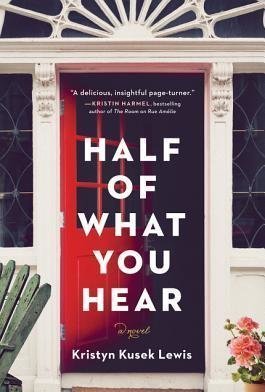

This was a really engaging, easy-to-read book that expertly captured the small town dynamic. Bess was a likeable character, struggling as an outsider in her husband's town. She's trying to put a mistake behind her at her former job, giving her even more trust issues. The novel is told mainly from Bess' point of view, but we also get snippets of town gossip, too. Ugh, having lived in such a town, I can tell you that Lewis really gets it right. I was wrapped up in the story from the beginning and felt awfully sorry for Bess--moving away from all she knew and having to deal with those hateful small town busybodies (sometimes there's nothing worse, really).
"It's like living in Stars Hollow, the charming small town on Gilmore Girls... Although honestly, so far, Greyhill feels a little more Desperate Housewives. The star character being me."
I was initially drawn to reading this book because the fake town of Greyhill, as written, is practically in my backyard. It frequently mentions my hometown of Madison (which, believe me, *never* shows up in books - it's not that big), as well as where I currently live. Even better, Lewis captures both quite well, as well as the moneyed, snobby atmosphere of Greyhill that will be intimately familiar to anyone who lives in Virginia. There's always something fun about reading about a place (or places) you know. My favorite sports team even gets a mention!
Bess is also a very realistic mother. The book does an excellent job of capturing how hard it is being a mom when your kid is going through a hard time, for example. Honestly, it does a good job of portraying parenthood in general--it's real and true throughout. I very much appreciated that. None of the sugarcoated parent/child relationships we get in some books.
This one was not completely what I expected. While it's character-driven and portrays Bess' struggle to fit in in Greyhill, it is almost a mystery at times. You can't really trust what you read and it's twisty, with some surprises thrown in. It makes for a fast, interesting read that delves into the history of Greyhill and Bess' family.
Overall, this was a really captivating book. I enjoyed the characters and the story--and the setting was a real bonus. This is the first book I've read by Krusek Lewis, but I definitely would like to read more.
I received a copy of this book from the publisher, Harper Collins, via LibraryThing in return for an unbiased review - thank you!

Sassy Brit (97 KP) rated Love, Secrets and Absolution in Books
Jun 6, 2019
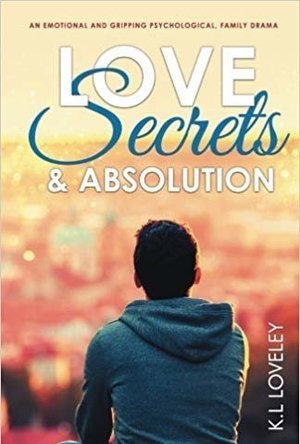
^^ Told from alternative viewpoints, Love, Secrets and Absolution is an emotional story revolving around the lives of a couple, Grace and Paul, who are trying to come to terms with the stresses and strains of bringing up an autistic child. But what makes this story different is how it’s set at a time which coincides with the Nottingham miners strikes of the 80s, where pit closures and pay restraints led to unofficial strikes, job losses and violence. Harsh times to say the least. This added a new dimension to the story, and of course, more pressure for Paul, and ultimately the whole family. They were terrible times in Britain, a lot of families suffered because of it.
^^ Right from the beginning we see young Alfie is different to other children. The author, K. L.oveley, helps show us this, by what I thought was a highly unusual technique- giving baby and toddler versions of Alfie his own voice.
^^ I must admit at first I was thinking, this doesn’t sound like a baby. After all, very young babies are not able to communicate in such a coherent manner. However, as I read further, I saw how Alfie’s voice as a child — seeing things differently from his POV — really helped to provide a deeper look into his inner thoughts and feelings. A fresh and unique approach, which revealed his own perspective of how he didn’t fit in with other kids, even if he was unable to understand the “why” himself. Very clever. It certainly made things clearer for me and highlighted aspects of autism I may have missed otherwise.
^^ Taking the time-period into consideration, I found the portrayal of the teachers and the way they behaved cruelly and professionally towards Alfie and Grace shocking, yet realistic. Back in those days many professionals were not trained to spot differences and learning difficulties in the way they are today. To outsiders who didn’t understand what Alfie was going though and thinking, he did just look like a trouble maker. Nowadays we know better and there is an ever-growing awareness and understanding of the many different spectrums of autism.
^^ Alfie’s father, Paul, may not have won the best dad of the year award, but I felt he was a realistic representation of a man living and working in a very masculine environment, where men were largely regarded as the breadwinners of the household and job scarcity was a huge issue. He didn’t know how to handle Alfie, and in a way you can’t blame him for that. Not everyone is capable of being a really good parent, especially when their own life has turned upside down in a blink of an eye.
^^ There’s also a really good story line around a girl called Magenta, which I felt helped strengthen both Alfie and Grace’s bond. A lovely touch. As was Grace’s newfound strength and courage, which really made this story become more than just gloom and doom. Her steadfast devotion to her son is both amazing and commendable, and I enjoyed seeing how she turned her life around.
Overall: This thought-provoking book is as much about relationships, as it is autism. We see the hopes and dreams of a young family shattered by a lack of communication, misunderstandings and even betrayal. Yet, despite all the struggles and heartache this family go through, we discover the true power of love; how it can heal, comfort and carry us forward through the toughest of times. A heart-warming, memorable and most satisfying read.
Hazel (1853 KP) rated The Inexplicable Logic of My Life in Books
Dec 7, 2018
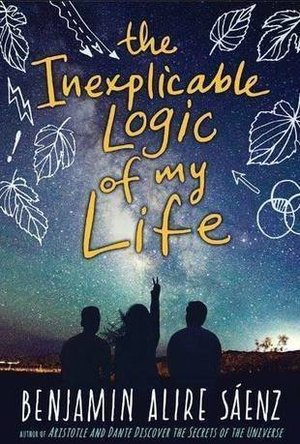

Over the past couple of years, social media, particularly Tumblr, has been raving over Benjamin Alire Sáenz’s multi-award winning novel, <i>Aristotle and Dante Discover the Secrets of the Universe</i>. As a result, I have wanted to read this book to see what the fuss is about. Unfortunately, libraries and bookstores in the UK do not appear to stock any of Sáenz’s novels.
When I saw an ARC of <i>The Inexplicable Logic of My Life</i> was available for request on NetGalley, I took the risk, having not read any of Sáenz’s work, and requested a copy. And I am truly glad I did. What, from the blurb and book cover, could result in a mundane Young Adult novel, turned out to be a thing of true beauty. The prose is almost poetic and full of emotion; it not only tells the story, it makes you feel it too.
The narrator, Salvador “Sal”, is beginning his final year at El Paso High School with his best friend Sam. Normally, the first day of school is something he looks forward to, however he feels differently this year. Something within Sal has changed, something indescribable but there all the same. Something that makes punching someone in the face an automatic reaction.
Sal’s dad is gay. Although not his real dad, Vicente adopted Sal into his extended Mexican American family after the death of his mother when he was three years old. He could not have asked for a better parent, but something is niggling in the back of his mind: who is his birth father?
Whilst Sal soliloquizes about his feelings, the reader is introduced to best friend Sam – a girl who, despite an erudite vocabulary, is not afraid to cuss and swear. Sam also understands what it is like to not truly know who you are, as does Fito, another friend, with terrible relations. Tragic events pull the three together, giving them a new chance at being part of a family despite not being blood related.
Sal, Sam and Fito try to help each other through their problems, ruminating together over their pasts and contemplating the unpredictable future. Despite each character suffering from grief, their friendship gives them a purpose and the encouragement to carry on.
<i>The Inexplicable Logic of My Life</i> covers so many themes it is impossible to categorize. Sam, Fito and Vicente are all encumbered with something that could ostracize them from society – their sexuality, race, drug addict parents – but they never let this get in their way. Sal, on the other hand, struggles somewhat, believing he no longer knows who he really is. He questions everything: how does he fit into the world around him? What right does he have to graduate and go to college?
With great efficacy, Sáenz explains through Sal’s voice, the importance of believing in yourself, letting yourself be loved, and accepting things for what they really are. All the main characters are trying so hard to belong; they do not realize that they always have belonged.
<i>The Inexplicable Logic of My Life</i> is a story of grief, death, family, friendship, fathers and words; a graceful, almost lyrical, narrative that gets to the heart of human existence and uplifts the spirit. The expressive language has a great emotional impact on the reader – have your tissues at the ready – and resonates within the soul. With quotable lines that you will wish you had written yourself, I guarantee you will love this book.
Hazel (1853 KP) rated Notes on Blindness: A Journey Through The Dark in Books
Dec 17, 2018

It is not often a blind man writes a book, and “write” is a word used due to the lack of a better. John M. Hull gradually lost his sight, registering as blind in 1980, a couple of days before the birth of his son. Although anticipating the event, John struggled to come to terms with his new circumstances and adjust to a new way of living. From 1983 through to 1985, John recorded his thoughts on tape, in diary form, as a way to ascertain and understand his predicament. Originally titled <I>Touching the Rock</I> (1990), John’s book has been republished as <I>Notes on Blindness</i> after the release of the film of the same name.
Initially, John made recordings every day, dictating the everyday occurrences he encountered. Amazingly, despite his disability, John was able to continue as a university lecturer and delve deeper into the world of theology. The way John thinks things through as he speaks reflects his academic abilities. Although he may have despaired at the thoughts of not being able to see his children, he had a fairly positive outlook on life.
John’s thought capacity and religious ideology are evident in his assemblage of diary entries. As a blind person, he learns to see the world in an alternative way, and often feels closer to God as a result. Through these new experiences, John begins to see the light despite the darkness.
The metaphorical descriptions of blindness help the reader to understand the horror and difficulties not being able to see visually provokes. This is heightened by John’s recordings of the bad dreams he often suffers, in which he is able to see. His fixations on these dreams are assumedly a fascination with visual imagery, which he does not have access to in his waking life.
It is hard not feel sorry for John as he reports the conversations he has with his young children. The effort to communicate and play with them is far greater than a seeing parent. Remarkably, as John begins to adjust to his new lifestyle, his children take the situation in their stride.
<i>Notes on Blindness</i> is also an educational narrative for those without sight problems. John explains the things other people, in attempts to be helpful, do that result in making things far more confusing for John as he tries to navigate his way from one place to another. Despite what most think, blind people are fairly good at walking routes they are familiar with, and, with the help of a stick, can safely travel through new areas. Once people start shouting instructions, it is difficult to pay attention to the location and listen to everyone else at the same time.
John’s voice is extremely articulate, and his thoughts profound, which may suggest heavy editing when compiling the recordings into written form. However, as he is an academician, his eloquence of speech does not feel forced or faked.
<i>Notes on Blindness</i> remains the same as the original publication but with the added inclusion of an introduction by Cathy Rentzenbrink, and an epilogue by his wife Marilyn, written in 2016, a year after his death. These, the latter in particular, provide an insight into how John’s blindness affected those around him and emphasises what a truly remarkable man he was.
Of the many memoirs available on bookshelves today,<i> Notes on Blindness</i> is a truly unique publication. It is not telling a story, or recounting a well-lived life, but gives great insight into the world of the blind. As John’s thoughts were not originally recorded with intention of being available to everyone, they are all the more personal and honest, provoking emotion and providing the reader with a new way of seeing. It is a book that will stay with you for a very long time.
hip hop hen: phonics 1 CVC
Education and Games
App
PHONICS APPS CREATED BY TEACHERS in the UK We are very excited to bring to you: “phonics 1 CVC”....

Bitsboard - Education, Games, and Flash Cards App
Education and Games
App
- Top 5 Education Game in the US App Store - Study almost anything for free across 25 addictive...

ConceptIQ : Human Geography
Education and Games
App
Would you like to have fun, while testing your knowledge of Human Geography. Would you like to...


Mini Monet - Creative Studio and Art Club for Kids
Education and Games
App
Award winning Coloring Book with over 120 Coloring Pages, 40 Stickers, 20 Stamps -- FREE. Featured...

Storypark for Families
Education and Lifestyle
App
Storypark for Families is designed for parents and their family. Home to your child’s most...