
Kirk Bage (1775 KP) rated Roma (2018) in Movies
Mar 2, 2020 (Updated Mar 3, 2020)
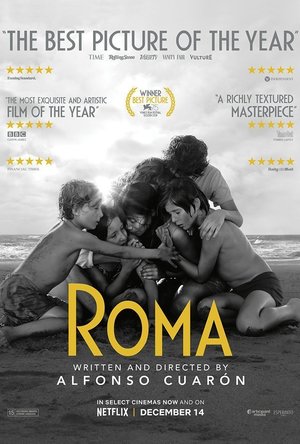


Not that it didn’t get attention at the time of its release, it did, receiving 10 Oscar nominations and winning 3, for best foreign language film, director and cinematography, but it certainly wasn’t seen by as many people as it should have been, despite its presence on Netflix from the start. Having digested it now, and spending some time reading about how and why it was made, I feel a slight mission to recommend it to as many people as I can.
Based on Alfonso Cuarón’s own childhood in Mexico City, and his memories of his family and especially their housemaid, Liboria (Libo) Rodriguez, to whom the film is dedicated, it is a masterpiece labour of love that few directors ever achieve or even attempt to make. After a strong career of exceptional films, including Y Tu Mamá También, Children of Men and Gravity, it was the box office and critical success of the latter that gave Cuarón carte blanche to go and make whatever project he chose. Where many might have been tempted by the big money of superhero or fantasy movies (for which he had some experience with Harry Potter and the Prisoner of Azkaban) he went back to his roots and shot a very personal non-English film, in black and white, where no music exists except that which occurs naturally, and on the surface not much happens.
At least it feels like not much is happening, such is the naturalistic, almost improvised (although it wasn’t) style and pace; shot with a lens capturing detail and nuance with some of the most beautiful photography I have ever had the privilege to see. Truly, an awful lot is happening, but you have to feel and experience it, not simply be told it by the narrative. It takes a while for our Hollywood conditioned brains to accept this at first, and many might come to it and give up half an hour in because of that challenge. I can promise, however, there is not a single thing boring about this film, unless humanity is boring.
Oscar nominated lead Yalitza Aparicio as the shy, loving maid, Cleo, was not an actor before this film. She auditioned and was hand picked by Cuarón from hundreds of young women, without knowing who he was or what the film was about. Apparently, the film was shot in sequence so as not to confuse her emotionally on her extraordinary journey. She is so unassuming and natural that part of you falls in love with her immediately. In time, we almost come to forget we are watching an act at all, and almost become her, such is the empathy she evokes.
Which isn’t an easy ride, as we watch her be gently and then cruelly ignored, mistreated and used; climaxing in one of the most astonishingly painful and jaw-dropping scenes imaginable, and then a scene of such powerful redemption and humanity it instantly breaks the heart and lifts the soul. All the while she never asks for attention or love, but is just herself: a young woman living a difficult but beautiful life in a country and time full of turmoil, prejudice and social change.
The recreation of Mexico in 1970 is so breathtaking, it is hard to imagine at times we are not watching a documentary from that era. But, it is the detail the lens chooses to capture that reminds you this is a visual poem and a love-letter to a time, a place and a family far away in history and the memory of one man (represented by ten year old Carlos Peralta as Paco). At times it evokes the work of the very greatest film artists of all time: Bergman, Fellini, Hitchcock etc. Not one image is wasted or insignificant, from the reflection of the sky in water, to the dog-shit constantly lining the driveway. Everything is chosen and meaningful in the full context of the work.
There is no awkward exposition, no dramatic moments milked for all they are worth, no sequences of heightened excitement that manipulate us; simply truthful moments that hang in the air for what they are, leaving us to decide how we relate to them without ever preaching or teaching us how. In that way, it is a work of such maturity that I doubt many living directors could emulate it at all. The closest comparison I can think of is the personal passion Spielberg put into Shindler’s List, but really it is a moot comparison, and in fact owes much more to films like Haneke’s The White Ribbon.
Can it be faulted? Well, yes, certainly. But, honestly, I don’t see the point in trying. It is as close to perfection a small story of this kind can be. Importantly, I think it is an open film, that allows us to take from it whatever we like, relating to our own experiences and cares. For me, it said that any pain and hardship can be overcome, as long as there is love and beauty walking by its side. A message of no small importance. If you haven’t seen it, I urge you to do so. If you have, then please keep spreading the word. I believe it to be a genuine classic that will endure the criticism of many decades to come. Without a doubt in my mind something very special indeed.


Darren (1599 KP) rated Ringu 2 (Ring 2) (2005) in Movies
Nov 7, 2019


Performances – Naomi Watts is still strong in the leading role, we need her to show extra motherly emotions in the film this time around. Simon Baker doesn’t get a chance to get going in this film, while David Dorfman does make a big improvement because of the extra additions to his character. The supporting cast are not the strongest either with most getting left to limited screen time.
Story – The story here continues to see Rachel haunted by Samara needing to continue to unlock the truth about Samara to save her own son from her curse. Now this is a confusing as for a story because everything felt pretty wrapped up at the end of the film, this did end up just putting a forced sequel out there which tries to build more on the Samara legacy. Where this falls short in the story as by giving us weak supporting characters, having the events literally start the day Rachel arrives in the new town and going against certain things that happen in the first film.
Horror/Mystery – The horror in the film does give us basic moments of scares, though dream sequences a hoping the same jumps can worked in the first film. the mystery continues to look at the mystery about Samara and why she has continued to haunt people.
Settings – The film was moved to a smaller location, while returning to certain other locations with them being an extra clue involved in the film.
Special Effects – The effects in the film have dated already, you can see certain green screens being used, which were meant for uneasy scenes.
Scene of the Movie – The bath surprise.
That Moment That Annoyed Me – The dated effects.
Final Thoughts – This is a weaker sequel that tries to build up on the original legacy, only to dive further into something we didn’t need to get more about what is happening.
Overall: Simple and weak sequel.

Sophia (Bookwyrming Thoughts) (530 KP) rated In The Shadow of Blackbirds in Books
Jan 23, 2020


In a city filled with the dead and dying,
while a nightmarish war rages halfway across the world,
the grieving look for answers in photographs and séances.
It's 1918. San Diego.
And a girl who doesn't believe in spirits
steps off the train and into a new life...
Apparently the one sentence synopsis provided by the publisher (yes, I read those) is a lot more helpful than this inside jacket cover synopsis, which gives a the book a mysterious aura that separates it from the other 2015-2016 Gateway Award Nominees.
The book, albeit a fantastically creepy concept, apparently goes from one end of the spectrum to the other end of the spectrum by the end of the book.
The so-called beginning of the spectrum I'm speaking of is the absolute, complete paranoia of the time period. Literally all of the characters depicted throughout the book was highly addicted to onions, spirit photography, or shunning the Germans. Of course, the more historical fiction and actual historical texts I read of World War I, I sometimes find it highly hilarious mainly due to the simple fact that Americans actually came from Europe and the majority of them have German blood (okay, a lot of ya'll have European blood). Funny how that actually works.
The only characters that I actually liked was Mary Shelley Black (thankfully the main character) and Stephen Embers (or rather, Live Stephen and not Dead Stephen, who actually spent a good few times squishing Mary Shelley). Both Mary Shelley and Stephen were more "adventurous" (logic and science) and tended to stray from the rest of the pack. On the unfortunate side... dear old Stephen Embers is apparently dead, which eventually results in the book being one of your typical ghost stories/shows where the dead have unfinished business.
However, in Stephen's case, all Mary Shelley seems to get from him is something about blackbirds - blackbirds attacking him.
The other end of the spectrum, as the book continues and Mary Shelley gets closer to finding out Stephen's "unfinished" business, is apparently the book going from the main character being the most logical and unparanoid one to being one of the paranoid ones. She goes from being one of the logical ones who reasons and questions everything to someone who "freaked" out over a cough or "drowning" herself in onions. Onions are apparently the garlic of the book while the vampire is the influenza.
Simply put, <i>In the Shadow of Blackbirds</i> started to become a little bit too "insane" for my taste and for me to handle at certain points until the very end. Cat Winters' debut novel was a chilling read that left me walking away feeling mainly satisfied with how Stephen and Mary Shelley eventually come to terms with their relationship.
<a href="https://bookwyrmingthoughts.com/review-in-the-shadow-of-blackbirds-by-cat-winters/"; target="_blank">This review was originally posted on Bookwyrming Thoughts</a>

BBC Focus Magazine
News and Magazines & Newspapers
App
*** Specialist Magazine of the Year winner at the Digital Magazine Awards 2016 *** BBC Focus...

Grand Tour of Italy
Lonely Planet, Cristian Bonetto, Duncan Garwood and Paula Hardy
Book
Discover the freedom of open roads with Lonely Planet Grand Tour of Italy Road Trips, your passport...

Lonely Planet Amalfi Coast Road Trips
Lonely Planet, Cristian Bonetto, Duncan Garwood and Paula Hardy
Book
Discover the freedom of open roads with Lonely Planet Amalfi Coast Road Trips, your passport to...

Lonely Planet Ireland's Best Trips
Lonely Planet, Catherine Le Nevez, Fionn Davenport and Belinda Dixon
Book
Lonely Planet: The world's leading travel guide publisher Discover the freedom of open roads while...

Lonely Planet Pacific Coast Highways Road Trips
Lonely Planet, Sara Benson, Andrew Bender and Alison Bing
Book
Lonely Planet: The world's leading travel guide publisher Whether exploring your own backyard or...

Lonely Planet Civil War Trail Road Trips
Lonely Planet, Amy C. Balfour, Michael Grosberg and Adam Karlin
Book
Lonely Planet: The world's leading travel guide publisher Whether exploring your own backyard or...

Matthew Krueger (10051 KP) rated Targets (1968) in Movies
Jun 18, 2020

The plot: After unhinged Vietnam vet Bobby Thompson (Tim O'Kelly) kills his wife and mother, he goes on a brutal shooting spree. Starting at an oil refinery, he evades the police and continues his murderous outing at a drive-in movie theater, where Byron Orlock (Boris Karloff), a retiring horror film icon, is making a promotional appearance. Before long, Orlock, a symbol of fantastical old-fashioned scares, faces off against Thompson, a remorseless psychopath rooted in a harsh modern reality.
Even Karloff's charcter is a retired horror film actor, so he can never get away from the horror genre/type-casting.
In the film's finale at a drive-in theater, Orlok – the old-fashioned, traditional screen monster who always obeyed the rules – confronts the new, realistic, nihilistic late-1960s "monster" in the shape of a clean-cut, unassuming multiple murderer.
Bogdanovich got the chance to make Targets because Boris Karloff owed studio head Roger Corman two days' work. Corman told Bogdanovich he could make any film he liked provided he used Karloff and stayed under budget. In addition, Bogdanovich had to use clips from Corman's Napoleonic-era thriller The Terror in the movie. The clips from The Terror feature Jack Nicholson and Boris Karloff. A brief clip of Howard Hawks' 1931 film The Criminal Code featuring Karloff was also used.
American International Pictures offered to release, but Bogdanovich wanted to try to see if the film could get a deal with a major studio. It was seen by Robert Evans of Paramount who bought it for $150,000, giving Corman an instant profit on the movie before it was even released.
Although the film was written and production photography completed in late 1967, it was released after the assassinations of Martin Luther King and Robert F. Kennedy in early 1968 and thus had some topical relevance to then-current events. Nevertheless, it was not very successful at the box office.
Quentin Tarantino later called it "the most political movie Corman ever made since The Intruder. And forty years later it’s still one of the strongest cries for gun control in American cinema. The film isn’t a thriller with a social commentary buried inside of it (the normal Corman model), it’s a social commentary with a thriller buried inside of it... It was one of the most powerful films of 1968 and one of the greatest directorial debuts of all time. And I believe the best film ever produced by Roger Corman.
Its a excellent mystery suspenseful thrilling starring Boris Karloff, last appearance in a marjor american film, before he passed away in 1968. A great film to end your career on.