Who's the Boss? - Season 8
TV Season
Tony Micelli, a retired baseball player, becomes the housekeeper of Angela Bower, an advertising...

Pummel Party
10.0 Rate It
Video Game
Pummel Party is a 4-8 player online and local-multiplayer party game. Pummel friends or AI using a...

7 Wonders: Armada
8.5 Rate It
Tabletop Game
This 7 Wonders expansion allows you to build fleets of ships to conquer the seas. New Armada and...


Homeworld Remastered Collection
8.0
Rate It
Video Game Watch
Experience the epic space strategy games that redefined the RTS genre. Control your fleet and build...

Tea for God
9.0 Rate It
Video Game
Tea For God is a VR roguelite shooter that uses impossible spaces (an euclidean orbifold or...

The Cemetery
6.0 Rate It
Book
At a Hallowe'en party with very exclusive guests, the disguised play a game of hide and seek in an...

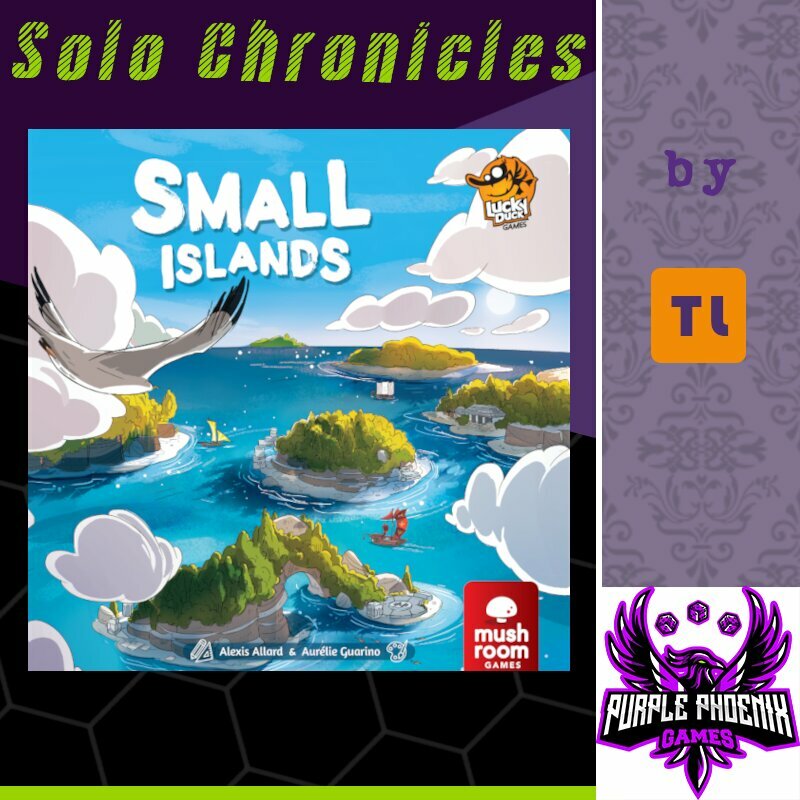
Purple Phoenix Games (2266 KP) rated Small Islands in Tabletop Games
Oct 13, 2021
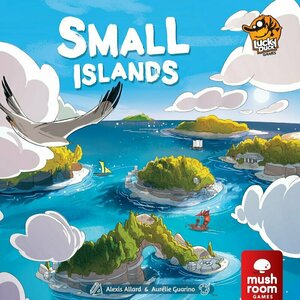
Small Islands is a tile placement exploration game for one to four players. In it, players are explorers tasked with discovering resource-rich new islands upon which their clans may either exploit or inhabit. However, it’s each clan for themselves, and the players all need those precious resources. In the solo game, the player’s AI opponent is Alexis Allard, designer of the game. He has goal cards to be used and finishing point totals that the solo player will be attempting to beat during the course of the game.
DISCLAIMER: We were provided a copy of this game for the purposes of this review. This is a retail copy of the game, so what you see in these photos is exactly what would be received in your box. I do not intend to cover every single rule included in the rulebook, but will describe the overall game flow and major rule set so that our readers may get a sense of how the game plays. For more in depth rules, you may purchase a copy online or from your FLGS. -T
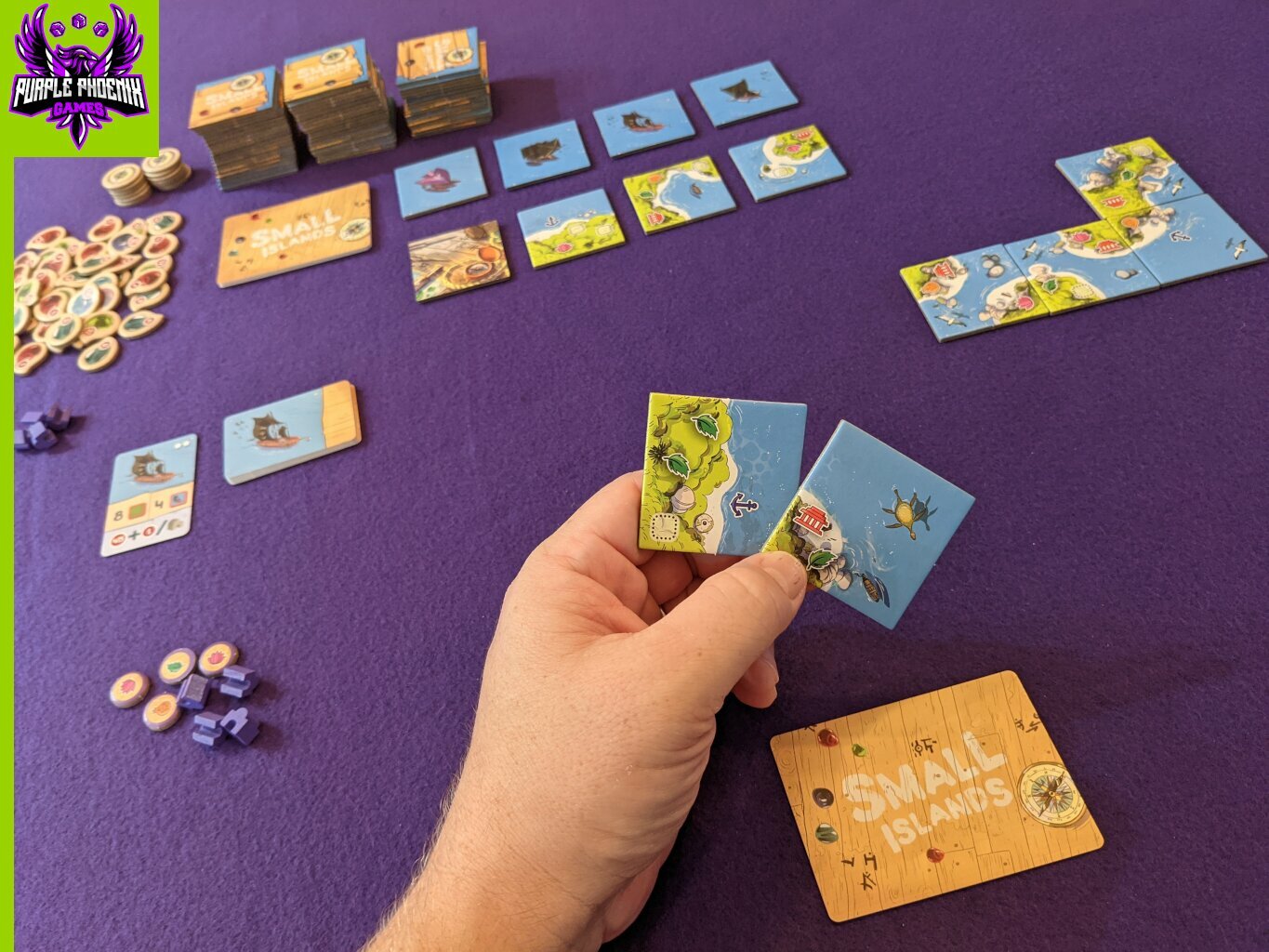
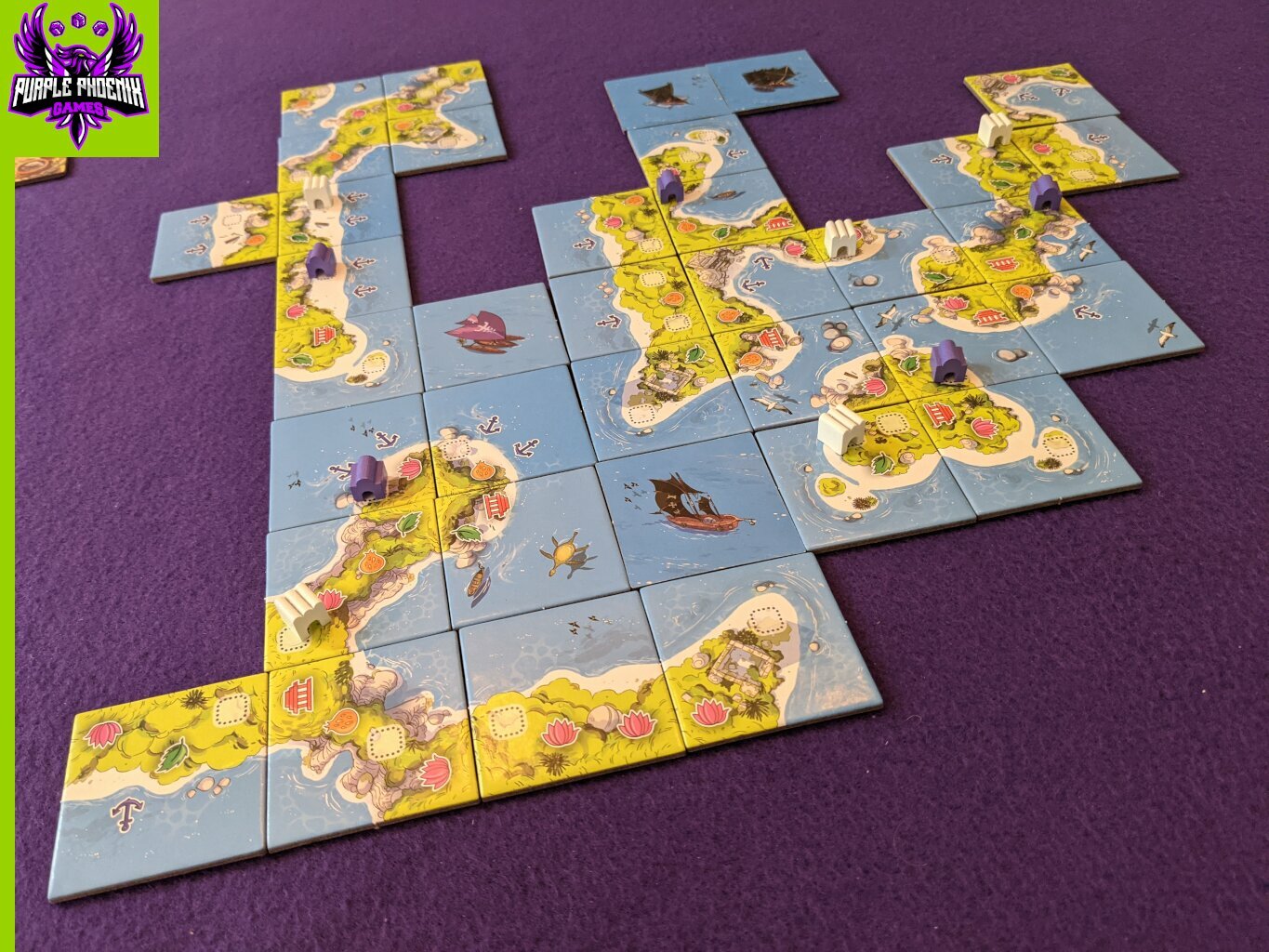
To setup, the player claims their player color and assigns Alexis with his color. They take all the components for each player and places them on the table. The starting tiles (that feature flying seagulls) are placed on the table in any orientation that is legal for play: islands need to connect, and seas need to flow from one tile to the next, as seen below. The Landscape tiles are to be shuffled and placed within reach. The four ship tiles are displayed, with all ships on their gray side, save for the solo player’s chosen color. The Navigation tile is placed below the ship tiles, and the beginning three Landscape tiles are placed in a row beside it. The small stack of Objective cards are shuffled and placed nearby, with the player drawing one to begin. They also draw two Landscape to start. For solo play, one Alexis difficulty card is chosen, and his deck of Explore and Land cards is built accordingly. The Prestige (VP) tokens are (apparently when I play) just thrown on the table and gathered in a loose pile. The game may now begin!
Small Islands is played over four rounds, with several turns being played per round. The solo player begins each round with their turn. A turn is divided into three phases: Preparation, Exploration, Reward. The Preparation phase has the player populating the Navigation Tile with six Landscape tiles face-down as a draw stack. The player then draws two Objective cards to add to their one they are currently holding. From these three cards the player will choose one to become their current objective for the round, one to be saved for a future round, and one to be discarded back to the stack. These Objective cards provide a strategy to guide the player through the current round, and also setup future rounds for scoring purposes. Upon them are icons that will award the player with points for scoring islands containing specific combinations of resources.
During the Exploration phase in the solo game, the player takes their turn first, and then Alexis will take his. A typical Exploration phase has a player deciding if they will Explore a tile or Land a ship. To Explore a tile, the player chooses one of the face-up Landscape tiles from the market/offer row and, along with their two held tiles, choose one to add to the play area. These tiles may be rotated in any fashion, as long as they can be legally placed: island edges are to be extended, sea spaces connected, et al. It is also at this time the player may place one of their Bonus Tokens upon any tile on the play area. These Bonus Tokens are resource icons that cover up existing icons on a tile, or directly over another Bonus Token. A player would do this in order to affect the balance of icons on a given island for scoring purposes.
Should the Navigation tile be empty of Landscape tiles and the player wish, they may instead Land a ship, thus ending the Exploration phase. The player chooses any of the ship tiles, and places it legally on the play area (in a sea space, as shown below). Once the player ends the phase, the game progresses to the Reward phase.
After the player takes their turn during the Exploration phase, Alexis takes his turn. This is done by drawing an Expedition card from his stack and following its instructions. The Expedition card will show whether Alexis would like to Explore or Land, which Landscape tile he would like to draw, and where he would like to place it – in relation to where the last player tile was placed.
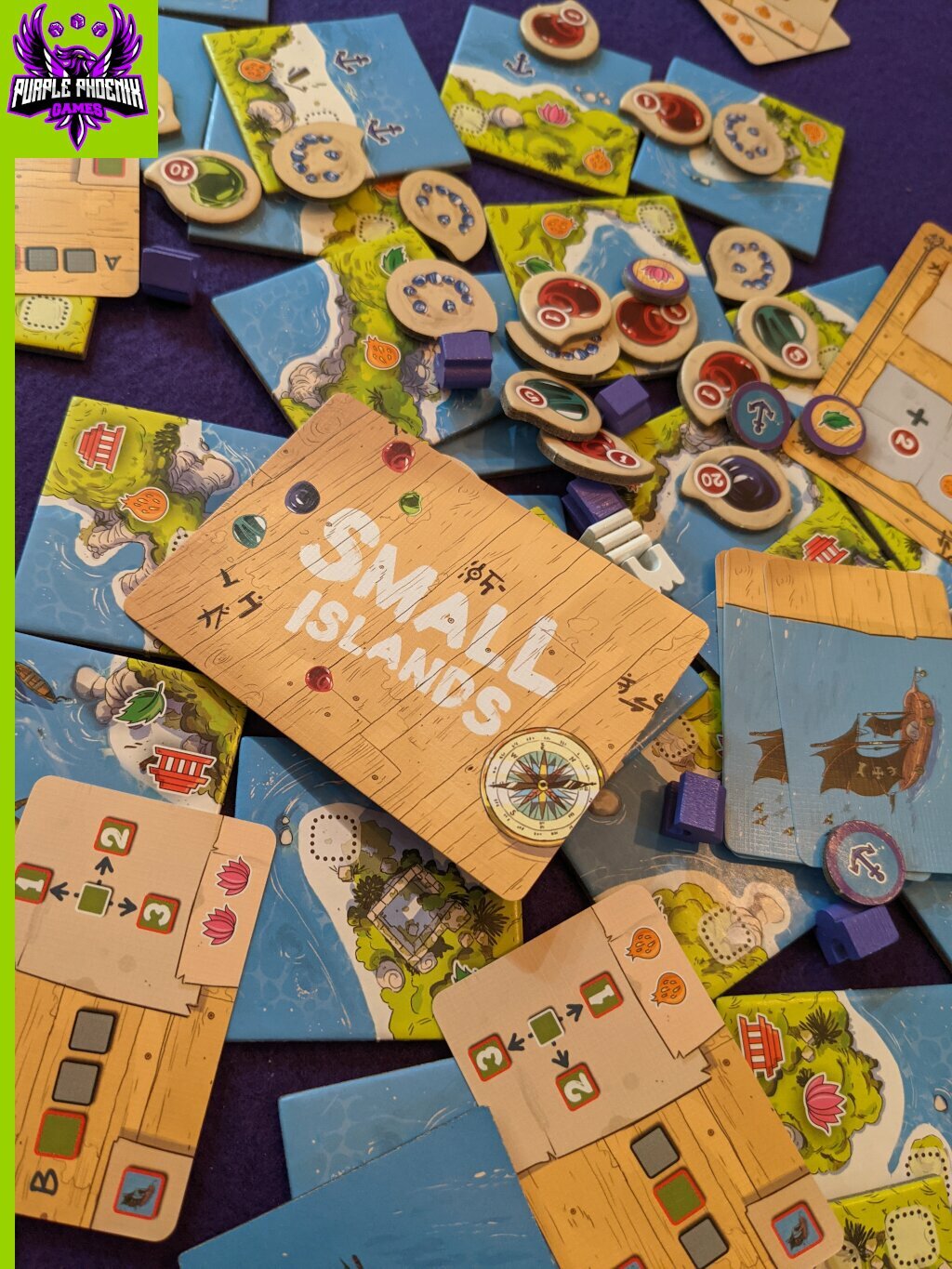
During the Reward phase, the player will place any of their clan houseeples they wish on any island upon which they have not placed a houseeple previously. Then, consulting their Objective card, score points for successfully satisfying the card’s requirements. For Alexis, the player will draw a new Expedition card from Alexis’s stack, note the icons present on the Mission area of the card, and place Alexis houseeples upon islands that satisfy its requirements.
The game continues in this fashion until the fourth round is complete. The player totals their Prestige points (VP) and if they score more than Alexis, they win! The player must then take a picture of their archipelago they built and send it to the designer directly and gloat to them about their massive victory. Or simply rest in the satisfaction of having played the game well. Whichever.
Components. This game has a lot of components, and they are mostly cardboard and houseeples. The cardstock and board are good quality, as I have come to expect from Lucky Duck Games, and the houseeples are all different shapes for each clan color. I find that a nice and unnecessary, but very cool, touch. The art in this one is simply amazing. I mean, look at these photos! Everything from the color scheme to the art style all mesh well and give a well-considered polish to a great theme.
Okay, I won’t even hide it – I LOOOOOOVE this game. I never really liked Carcassonne very much, but Small Islands gives a similar feel, but executes everything so much better. Even with the solo rules. There are so many options available at any one time, and having a random Alexis game each time you play is just so satisfying. I feel like I could keep this game forever and not play the same game twice. Ever. And I think that I would WANT to play this one forever. Yes, I think this is a solid fit for my collection indeed, and I can see it working for so many different gamer types.
Having Alexis constantly applying the pressure to maximize and strategize every turn is delicious, and having almost zero conflict with him as we both explore is welcome. You know when you start the game how many points Alexis will score at the end of the game, so having that knowledge really makes you consider all the options available. It just works on so many levels.
If you are looking for a light-hearted, but with some great decisions to be made, then I strongly urge you to check out Small Islands. I knew immediately that this was a game for me. It’s on the lighter side without being too simple, I get to build a thing and admire it at the end of the game, and I have an opponent who just wants to see me win because he designed the game! I’m in and out in less than an hour and feel content that I was able to have a great experience with a well-designed game. I cannot wait to introduce this to all my friends and family gamers so they can fall in love with it as well.