

Matthew Krueger (10051 KP) rated Condemned: Criminal Origins in Video Games
Oct 24, 2019

Condemned: Criminal Origins places an emphasis on melee combat and puzzle solving, including searching for fingerprints and gathering evidence. Lets talk more about the crime scene's, and gathing evidence.
Condemned directly involves the player in crime scene investigations, offering the ability to, at the press of a context-sensitive button, call upon a suite of forensic tools to find and record evidence. The player character is linked to an FBI lab via his mobile phone throughout the investigation, allowing (almost immediate) remote examination and analysis by his support worker, Rosa. Crime scene evidence can be used to solve puzzles, allowing the player to pass previously impassable barriers, and provide clues to the overall mysteries of the story.
Examples of evidence include fingerprints, footprints, fibers, fluids (such as blood or chemicals), particles, residues, markings/etchings, material, imprints, wounds, small objects, documents, and body parts.
The player character is gifted with the instinctual ability to detect when forensic evidence is nearby, allowing players to bring up the detection and collection tools when appropriate. However, the "instincts" of the character only vaguely highlight the area in which the evidence resides; it is up to the player to methodically sweep the scene and catalog any findings.
Lets talk about the plot: Condemned: Criminal Origins is set in the fictional American city of Metro. The player takes on the role of Ethan Thomas, a crime scene investigation agent with the FBI's Serial Crime Unit, as he traverses the seedier sides of the city. His journey takes him through a number of condemned buildings as he searches for the one who framed him for murder, the evasive Serial Killer X. Along the way, Ethan must use his investigative intuition and technology to examine evidence left behind by SKX, all the while fighting off the violently psychotic denizens of Metro City, who seem to be driven to such madness by a mysterious, yet seemingly extraneous force.
Their are two different ends: but really its the same ending.
If you do like psychological, crime solving horror games than you will like this one.

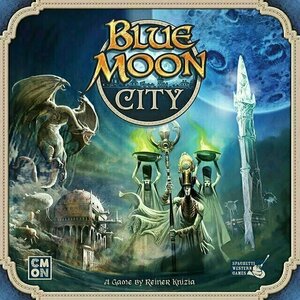
Blue Moon City
8.0 Rate It
Tabletop Game
Blue Moon City - the board game - picks up where the two-player game, (Blue Moon), ended: the...

Dune: A Game of Conquest and Diplomacy
Tabletop Game
Take part in one of the most famous science-fiction stories of all time. Dune: A Game of Conquest...

Purple Phoenix Games (2266 KP) rated Barnyard Roundup in Tabletop Games
Apr 12, 2021

Barnyard Roundup is a silly game of bluffing and hand management set on a farm. In it players are farmhands trying to help Farmer Brown sell the most animals at market. They do this by bluffing their hands in trade deals with other farmhands, thus making no friends in the process. The player with the most points at the end of the game, when all cards from the draw deck have been drawn, will be the winner!
DISCLAIMER: We were provided a copy of this game for the purposes of this review. This is a retail copy of the game, so what you see in these photos is exactly what would be received in your box. I do not intend to cover every single rule included in the rulebook, but will describe the overall game flow and major rule set so that our readers may get a sense of how the game plays. For more in depth rules, you may purchase a copy online or from your FLGS. -T
To setup place the five Animal Bonus cards in a line with the Set Bonus cards nearby. Shuffle the large deck of animal cards and deal out cards according to the rulebook per the number of players in the game. The Burglar and Excuse Me tokens are sorted and dealt out with the remainders face-down near the other cards. Remove eight cards from the draw deck and decide who will be the start player. The game may now begin!
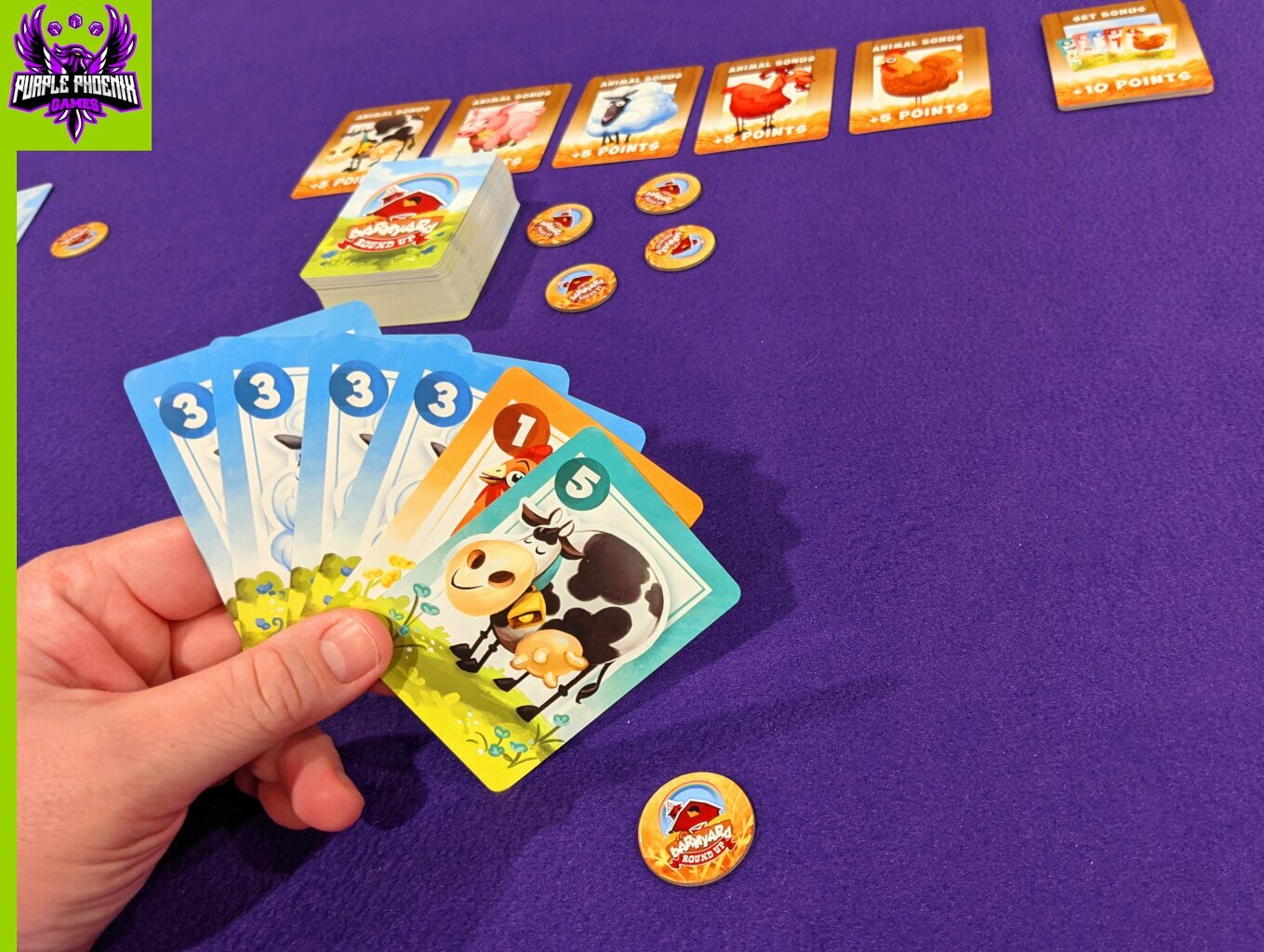
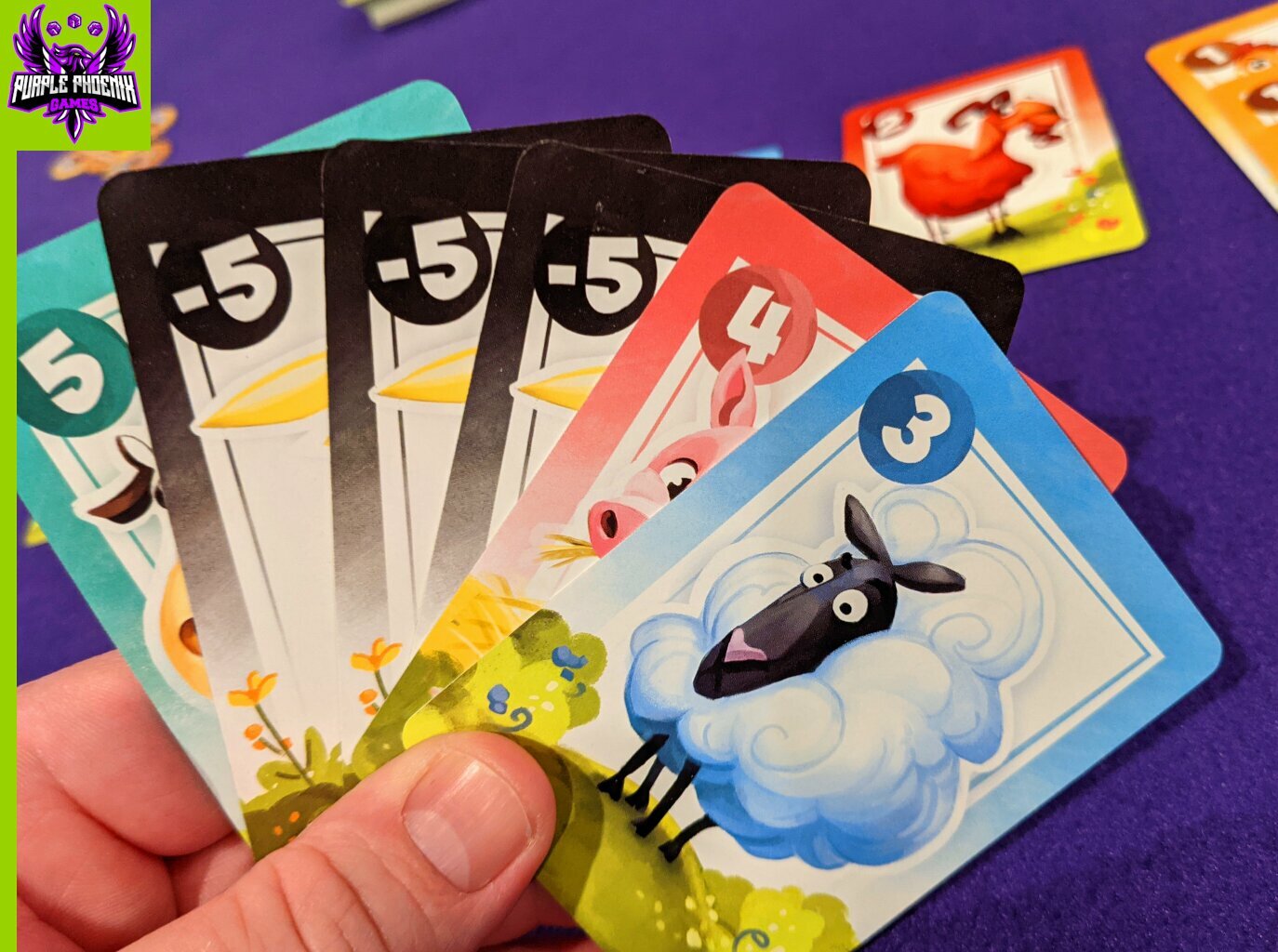
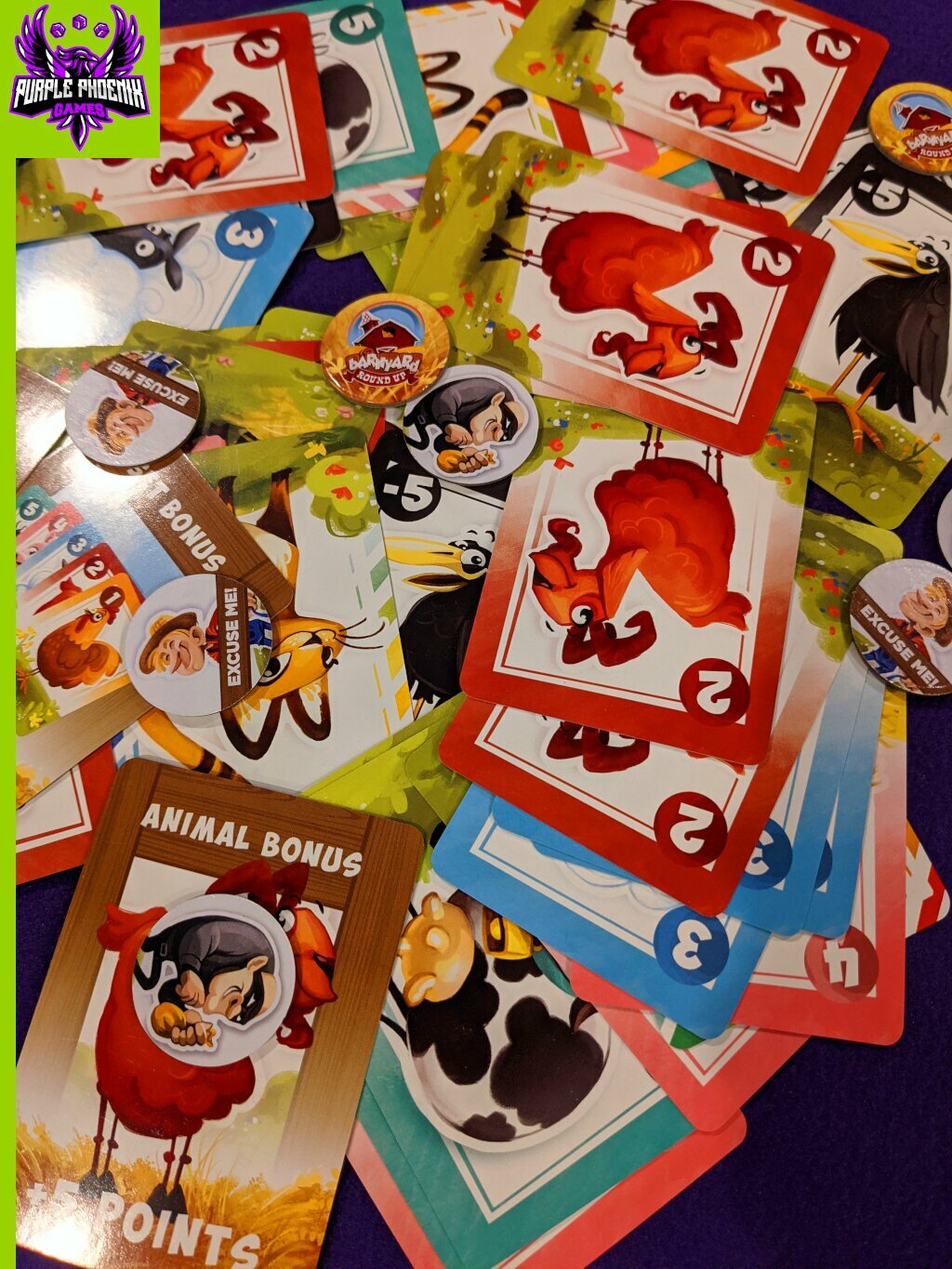
Barnyard Roundup turns are quite simple: take two or three actions and end the turn. The first action is mandatory and it is Passing Cards to another player. Choose anywhere from one to six cards, place them face-down on the table in front of the player with whom to be traded, and announce the number and type of cards to be traded. For example, a player may say, “This is four chickens.” The targeted player now must decide whether that group actually IS a group of four chickens or if they believe the trader (not traitor) is bluffing. If so the targeted player may say, “That is NOT four chickens.” Once the agree/disagree statement has been made the cards are flipped over to see which player will be adding the cards to their pens. If the targeted player guessed correctly then they will received all the animal cards that were passed to them. That is, unless the cards were actually CROWS. Crows are worth -5 VP at the end of the game (see the photo below) and will be taken into the pen of the defeated player in the trade. In addition to crows (bad) the game includes Copy Cats (good) which can be wild cards to be placed with other animals and they copy the animal in their group. When the trade is resolved the active player may choose to perform the next step, but it is not mandatory.
Players must note that any time a player gains crows that would extend their collection of crows to any multiple of 3 that player must then draw another Action Token (Burglar, Excuse Me, Scarecrow) from the supply. If a Scarecrow is drawn it is immediately revealed and three crows are discarded from that player’s collection. The Excuse Me token may be used during a trade, but before cards are revealed, by a player not involved in the trade. When they announce, “Excuse Me,” they immediately take the place of the targeted player and will decide whether the trade is correct as announced or is a bluff.
Should they wish, the active player may now Play a Burglar Token from their collection in order to target another player and ask for all of their animals of a specific type – “I wish to procure all of your cows” That player must then immediately hand over all their cows, or else may tell the active player to Go Fish. Okay, that last part isn’t in the rules, but I started doing it and it stuck for me.
The third and final step of a turn is simply to Draw Cards and End Your Turn. Draw cards back up to the hand limit of 5 or 6 and end the turn. Play then passes to the next player.
Play continues in this fashion until the last card has been drawn. The game ends immediately and players tally their points per the rulebook to arrive at an ultimate winner!
Components. This game is a bunch of cards and some tokens in a double-wide+ tuckbox. I love the art, and that makes sense as it is illustrated by Lina Cossette, half of Mr. Cuddington. If you don’t know about Mr. Cuddington, please check out their website. The cards are good quality, as are the tokens. But that box. Now, it LOOKS great, and is a fine size. But a tuckbox? I would have preferred a lidded box, or even one of those with the magnetic fold-out lids. But it’s a tuckbox and the opening flap dented upon its first opening. Oy. I could give a chef’s kiss to everything else though.
Now, there’s a reason why I rated this game a 4 and my wife a 6: she beats me every single time we play and I just cannot find the strategy to take her down. Am I just horrible at bluffing games? Does she just dominate me at ALL games? I’m not sure, but this one certainly highlights the fact that she’s just better than me. I can still hear her haunting and taunting me with, “OH MY GOSH I LOVE THIS GAME! I’M SOOOOO GOOD AT IT!” Meanwhile I am sitting pretty with a whole flock of crows laughing at me like I am the Scarecrow from Wizard of Oz. Perhaps I am truly brainless as well.
That said, the game is enjoyable. I do like to play bluffing games, but I’m the poor soul who would rather play straight than do ANY sort of bluffing at all. Except when I have lulled my prey into trusting my every declaration. Then pull out the big guns and laugh my way to the bank. Well, I tried that several times and no dice. But I do enjoy playing, and I do keep coming back for more torture. And if that isn’t a sign of a good game, then what is?
All in all the game is quick, light on rules, and features wonderful art style. This is the game I will probably use to introduce my children (or new gamers) to bluffing games as the theme is easily digestible and when you get stuck with the negative points you don’t feel super bad about it. It is easy to pronounce that Purple Phoenix Games gives this one a squawkin’-good 10 / 12. If you are looking for a light introductory game to teach bluffing or to hit that sweet-spot, then I recommend you check out Barnyard Roundup from Druid City Games. I ain’t a-bluffin’ ya.

Purple Phoenix Games (2266 KP) rated Vendarla in Tabletop Games
Oct 6, 2020

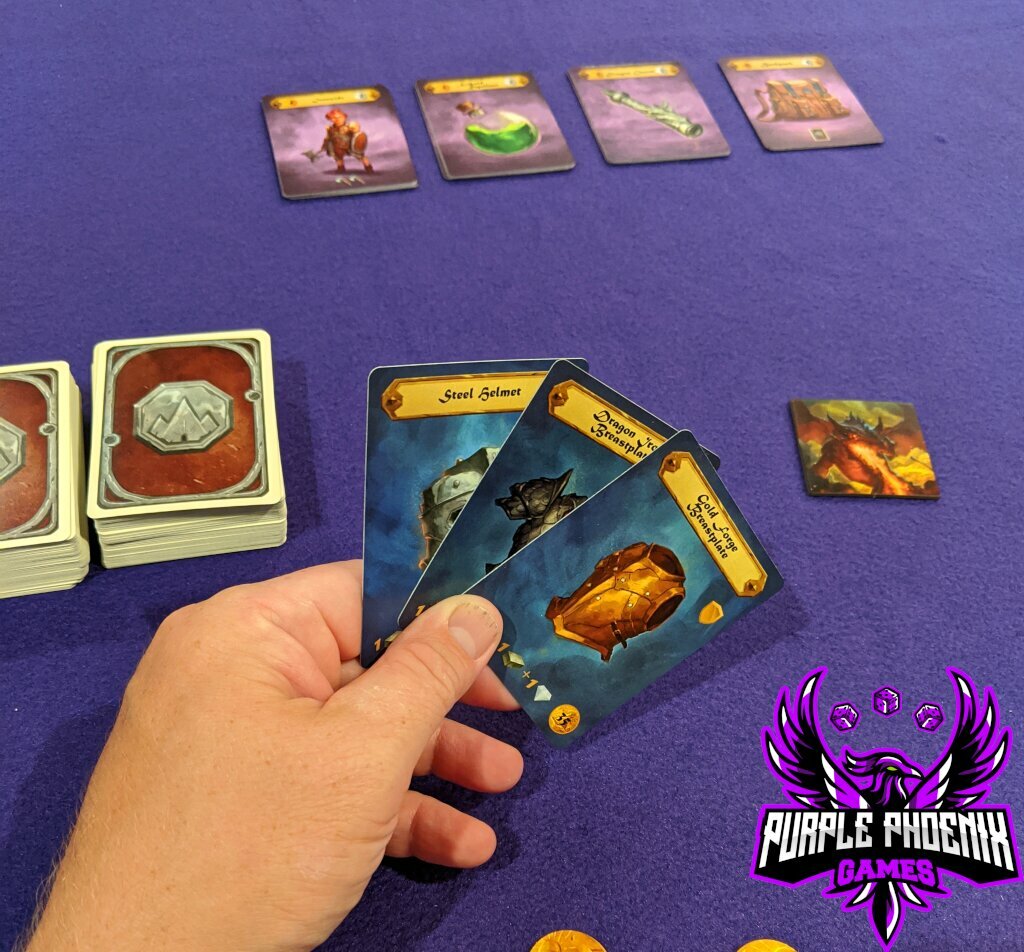
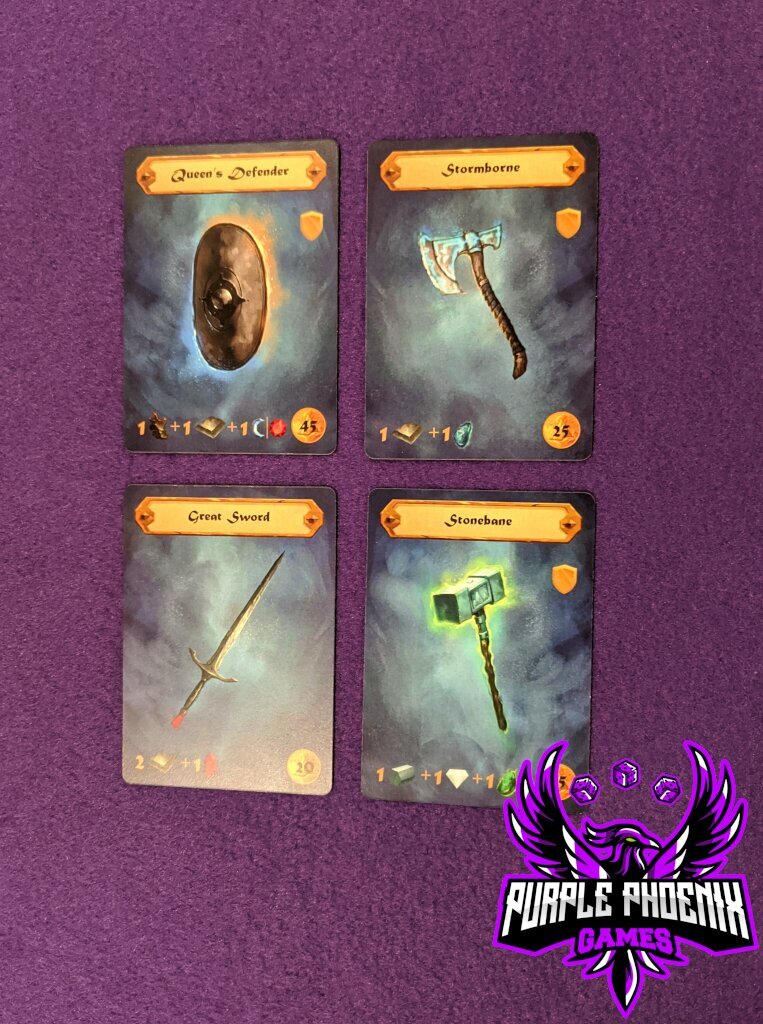
Vendarla is a press-your-luck, hand management, set collection card game where players are working against one another to collect the proper materials to craft three Queen’s Armory items while avoiding kobold warriors and thieves, as well as several dragons guarding the mountain.
DISCLAIMER: We were provided a prototype copy of this game for the purposes of this review. These are preview copy components, and the final components may be different from these shown. Also, it is not my intention to detail every rule in the game, as there are just too many. You are invited to back the game through the upcoming Kickstarter campaign, order from your FLGS, or purchase through any retailers stocking it after fulfillment. -T
To setup, follow the rulebook advice for your number of players, but generally Vendarla will be setup on the table in different areas: the Market, the Mountain, the Queen’s Armory, and the gold stash. Each player will receive five gold, and their choice of either two or three (depending on play count) Queen’s Armory items to begin working on during the game. Determine first player by giving the dragon token, shown below, to the player who most recently watched a dragon movie and the game is ready to begin!
On their turn a player will choose whether to visit the Market or the Mountain. When a player visits the Market, they may choose to purchase any previously sold materials, sell their own materials, purchase items for use in mountain runs, or exchange Queen’s Armory item cards.
Should the player instead wish to visit the Mountain, they will flip over a mountain card from the giant stack of mountain cards and decide how to continue. If a material card was flipped, the player may choose to take that card or continue flipping cards. This action can be replicated until up to 10 cards have been flipped. The active player will then need to choose a card (or two if they have a Backpack equipped) to place face-up in their play area. Each other player at the table, in player order, will then be allowed to take a material or gold card from the flipped offering by paying the active player one gold.
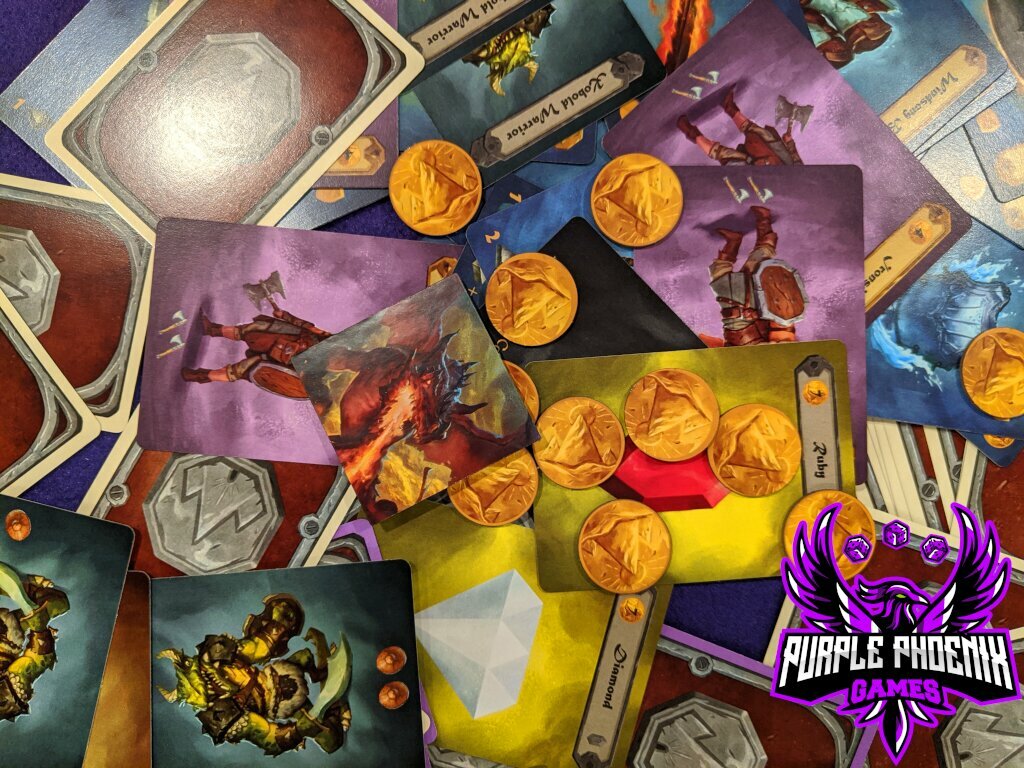
Should the active player flip over a second kobold warrior for the turn, they must stop flipping unless they had previously purchased from the market a kobold repellent or Ironsides (dwarven warrior) to combat it. If the kobold warrior, or the kobold thief for that matter, is overcome by ANY player then the active player may continue flipping cards from the mountain. Should the player flip a dragon card over, they may use a previously purchased Dragon Charm to charm the dragon back to sleep or taking the dragon card into their play area and suffering a negative 10 points at game end.
Play continues in this fashion of active player visiting the Market to take actions for themselves only, or visiting the Mountain to excavate materials to be used to craft their Queen’s Armory items and opponents also being able to follow the action using their flipped materials. Once a player has the proper materials to craft their Queen’s Armory items on their turn, they may, and the player who crafts their third item will trigger the end of the game. Players will finish the turn, count up their points and a winner will be declared!
Components. Again, this is a prototype copy of the game, so what we were provided may or may not be the same as the final version of the game. That said, this game is a ton of cards, and some gold coins. The card are fine quality, but I would probably want to sleeve them, as they are handled a bit and are a little thin. The gold coins are thick cardboard and look great. Speaking of looking great, the art in Vendarla is really really good. I love the art style used and the colors are vibrant and lovely. Though I had no problems with the iconography, my wife did a few times. Luckily, handy reference cards are included and that solved any questions we had with iconography. All in all the components are good, and the game looks great.
The “flip cards until you have to stop, choose to stop, or flip over something bad” is a mechanic that is used in many games, and in Vendarla I truly enjoy it because for every “bad” card another card may be able to neutralize it. And the best part about that is the neutralizing card can come from ANY player. Why would someone want to lull the dragon back to sleep on someone else’s turn? Well perhaps a material was flipped that they need to complete an item craft and they want to make sure they have a chance to get it for one measly coin. I love that. I also love games that include ways for other players to be involved in each turn taken. This isn’t a “multiplayer solitaire” game. Yeah you could go to the restroom during other players’ turns, but you may miss out on that elusive gem you need for your items.
I found that playing this I had to find a good balance between keeping my Market items stocked and going to the Mountain to grab materials. There may be several turns in a row, especially in the beginning of the game, where your turns are just flipping over a kobold warrior for which you are unprepared to handle and forfeiting your turn, but as the game progresses you will be hopefully be outfitting yourself appropriately.
While this game seems very involved and you may think there are many tiny rules when reading the rulebook, it plays really quickly. In my two-player games with my wife the games were 30 minutes or less, INCLUDING the teach the first time.
So even though I have a prototype copy of the game, I will certainly be holding onto this one and pulling it out quite a bit. When you can get a great play experience out of 30 minutes and feel like you did something interesting, I feel that’s a sign of a great game. If you are looking for a game that fills a hole in your collection (or even want to replace Port Royal, as I did), please check out the Kickstarter campaign for Vendarla launching October 27, 2020. If you like fantasy themed card games with press your luck and set collection, this one is for you!


Red Otter (340 KP) rated The Fox in the Forest in Tabletop Games
May 29, 2019




Sniper Ghost Warrior 3 - The Escape of Lydia
7.5 Rate It
Video Game
Take on the role of Lydia Jorjadze, an ex-Georgian Special Forces commando. Help her escape her...
action shooter

Weekly Poker Hand with Jonathan Little
Podcast
In this weekly podcast, World Poker Tour Player of the Year Jonathan Little will discuss and analyze...
Pool Billiards 8 Ball Snooker Master
Games and Education
7.0
Rate It
App
Great pool billiards game full of fun! You can play both 8 pool ball and snooker game! Key...