

The Sims 2: Nightlife
7.5 Rate It
Video Game
This expansion pack centers on the new downtown area, which has various activities, such as bowling,...


The Catcher Was a Spy (2018)
8.0 Rate It
Movie Watch
Major League baseball player Moe Berg lives a double life as a spy for the Office of Strategic...

A Duel Hand Disaster: Trackher
9.0 Rate It
Video Game
A Duel Hand Disaster: Trackher is the only split screen single player twin stick risk ‘em up in...

Rikki Hammond (33 KP) rated Carcassonne in Tabletop Games
May 23, 2019
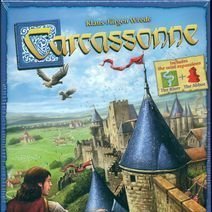
The rules of Carcassonne are very simple. Each player will pick a random tile from a stack, and starting with the first player (who always starts with the same beginning tile) will place their tile, so that it connects to one or more adjacent tiles. Each tile will have a road, city or church on it. Roads can only connect with roads, cities with cities, and churches around either of these.
Once a tile is placed, the player can then choose to place one of their meeples on it, either on a road, city, church, or surrounding field. Once that particular area is completed (a road connects to a town, city or church on either end or a city is completely walled around) then that meeple scores you points. 1 point for each section of road per tile, 2 points for each city piece per tile (double if that city tile has a shield on it) and you will score 9 points if you manage to completely surround a church with 8 other tiles. Once the meeple scores, the player removes it from the tile, and can be used again on another tile.
Play continues like this until the tile stack is depleted, then some endgame scoring occurs, where unfinished roads, churches and cities score 1 point per tile in the area. If farmers were used (laying a meeple face down on a field) then 3 points are scored per completed city in that field area. If ever two meeples share the same city, road or field through future tile placements, then each player will get the same points, and whoever has the most points at the end, is the winner.
Carcassone plays between 2 to 5 players, and having played with all player counts, I can say that it plays well, no matter how many players are there. The components are great. The tiles are colourful, and one the game is over, you can build some pretty impressive landscapes. Each player will have different coloured meeples, so it's easy to tell whose is whose, and the score tracker is a handy addition.
My only criticisms I can find is that, after playing a few games, you find that there's not much in the way of variety when it comes to placement of the tiles, and some more hardcore gamers could class this game as too simple. But these are very minor niggles.
Personally, I think Carcassonne is a fantastic first step for people who may not have played many board or tile games before, and if you do get tired if it, there are tonnes of expansions for it, which can add more variety to the game.
Rikki Hammond (33 KP) rated Drakon (fourth edition) in Tabletop Games
May 24, 2019
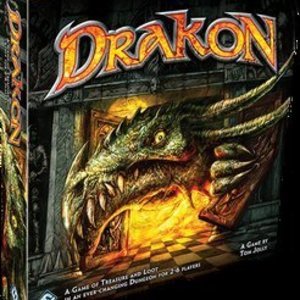

Each player will have 4 tiles in their hand, and on their turn, they can either place a tile (drawing a new one afterwards) or move their character into an adjacent chamber. Each tile has a door or an arrow on each side. You can place a tile door to door or arrow to door, but never arrow to arrow. Once a player moves through a door, you can't go back the eay you came (by the usual means anyway.) The goal of the game is to collect 10 coins through entering a chamber with gold in it, or by stealing them from another player. Each coin will have a value between 1 and 3, and the players keep them secret from the others.
A chamber might have an effect associated with it, which is activated when someone mives into it, such as allowing you to rotate a chamber, removing one from the game entirely, teleporting to another part of the dungeon, or even unleashing Drakon the dragon into the dungeon.
Once Drakon is in the dungeon, whoever next lands on her space can move her up to 3 spaces, ignoring doors and arrows along the way. If she ends on a space with a character, that player must put back a random coin into the stack and return to the entrance chamber.
Once someone collects 10 coins total, they win the game. If the tile stack runs out, the game automatically ends, and the player with the most coins at the end will be the winner.
For the base game, I would say that Drakon is TOO simple, and I highly recommend playing with the alternate methods, which gives each character it's own unique power to use once per game, and whoever collects 10 coins must then either make it back to the entrance chamber, make it to a teleport tile, or use an escape tile. This makes the game a lot more fun in my opinion, and also adds the element of the other players trying to stop you if they suspect you are trying to escape.
Drakon can be a mixed bag. Sometimes the games are really enjoyable, as the chambee effects can really play havoc with other players, esoecially if Drakon comes out. Other times, it can be rather boring, and sometimes a player can build an infinite loop of collecting coins, with no way of stopping them, which isn't really fun for anyone. I also feel that anything over 4 players makes the game a little too chaotic, and it can make the game overstay it's welcome. Generally though, Drakon is a quick, light filler game that can hold up well in anyones collection.

Jason James (3 KP) rated Founders of Gloomhaven in Tabletop Games
Apr 4, 2019

Overall this game is for people who enjoy other similar games like Catan or Ticket to Ride. Players must adjust to the fact that roads are public tiles that can connect any players resources to buildings. The game is high statistical and players must be able to make decisions that may result in other players gaining points. I would give the game an 8/10 as it brings a fresh feel to city-building board games! If you have any questions or have any comments on my review please feel free to message me.
Thanks!

ClosetSpace – Fashion Inspiration, Virtual Closet, & Outfit Planner - Free!
Shopping and Lifestyle
App
CRASH FIXED: The app crashing bug that some users reported has been fixed. It should work next time...

Strong in the Broken Places: A Memoir of Addiction and Redemption Through Wellness
Quentin Vennie and Jon Sternfeld
Book
Quentin Vennie shouldn't be alive--he has walked a path that many don't live long enough to write...

People, Places and Business Cultures: Essays in Honour of Francesca Carnevali
Andrew Popp, Peter Scott and Paolo Di Martino
Book
This collection brings together new research into nineteenth- and twentieth-century British and...