
Search
Search results

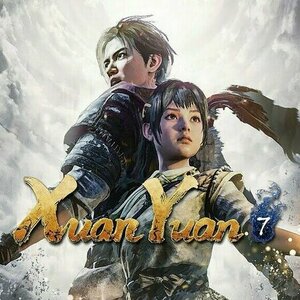
Charlie Cobra Reviews (1840 KP) rated the Xbox One version of Xuan Yuan Sword 7 in Video Games
Oct 4, 2021

Beautiful looking world and nice graphics (2 more)
Pretty enjoyable story and gameplay
Interesting mix of fantasy and history
Lacks the polish that could have made it great (2 more)
Too linear and doesn’t open up enough
Combat could have been further refined
Interesting and Ambitious but Ultimately Average
So to start this review I got to say that I'm pretty mixed on how I feel about this game. For one it definitely has a lot of potential and enough going for it that it could have been a really good. But on the other hand it had a lot of things that I feel could have been done better and falls far from being a great game to just around average for me. The story itself isn't terrible but it suffers from bad writing and performance of the voice actors. The world itself seems like it could have been a lot more interesting but it just wasn't engaging enough half the time.
It seemed like it was going to be an open world game but wound up being very linear in nature although it had aspects of an open world game like side quests, fast travel, and even treasure chests scattered throughout the game world as well. There's a climbing mechanic that seemed kind of pointless because it was pretty much just a cut scene of in game graphics of you climbing a little cliff or sometimes it would turn into an interactive part where you had to move the analog stick to move the character. Still it was better than these weird times that the game gave you control of the character for a scene in which your only movement was preset like a ride on a rail that couldn't veer off a road.
I liked that it was an action-RPG meaning instead of turn based combat like most RPG's it had an active combat system where you could move at your own leisure and consisted of hack and slash combat with some martial art skills, blocking, dodging, and some riposte (parrying). There are four basic martial art skills which can be learned as you progress through the game, Bull, Wolf, Bear, and Tiger. They become stronger and increase the length or hits of their combo the more you use them. A big draw back is that you could only equip or use two at one time although they can be changed at anytime through the talent menu. Then there are three special martial art skills which are Taowu, Tundou and ?
The combat was one of the things that had me really conflicted. A cool thing I liked about the combat was that there was a meter that would go up when you would attack an enemy and if it filled all the way you could perform an execution on them. Otherwise it was very unresponsive most of the time making dodging and parrying really hard and kind of useless. I found the blocking especially useless because of how much damage you still incurred. There is a skill tree for new martial arts and you can create and upgrade structures in Elysium that can enhance various things, such as weapon, armor, accessories and more. You can also use the fusion to capture the souls of enemies in combat and fuse them together in Elysium to equip them for bonus stats and effects.
Your able to carry items in your inventory which are mainly objects like items that don't do anything except advance the story or quest and some like healing weapons. There is an equipment screen for weapons and accessories but you only stay with one weapon the whole game. It does change and become stronger and its appearance changes too. You can even change outfits. I'm not sure if you get any in the game as the version I played came with a couple of additional weapons/costumes. You do wind up getting some party members which is customary of some RPG's and they help out by attacking enemies on their own. You can control them by activating some abilities or special attacks that have cooldown times for when you can use them again. There's a minigame called Zhuolu chess and it can be pretty fun and a nice change of pace but not what you were looking for when you bought the game.
You can save your game and recover health at random campfires throughout the game world as well as listen to some party dialogue when you choose to rest. The dialogue tends to repeat often and doesn't really advance the story much or fit where you are at in the story that often. These game mechanics are similar to Dark Souls as resting respawns enemies when you save at a bonfire and get healed too. As I mentioned earlier the game employs a fast travel system consisting of waypoints called guard stones that you can activate when found. There is an element of puzzle solving in the game but they don't seem to be that hard to figure out and some can even be skipped if you don't want to bother with it.
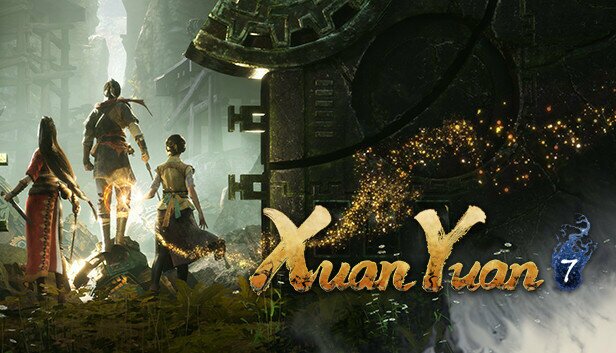
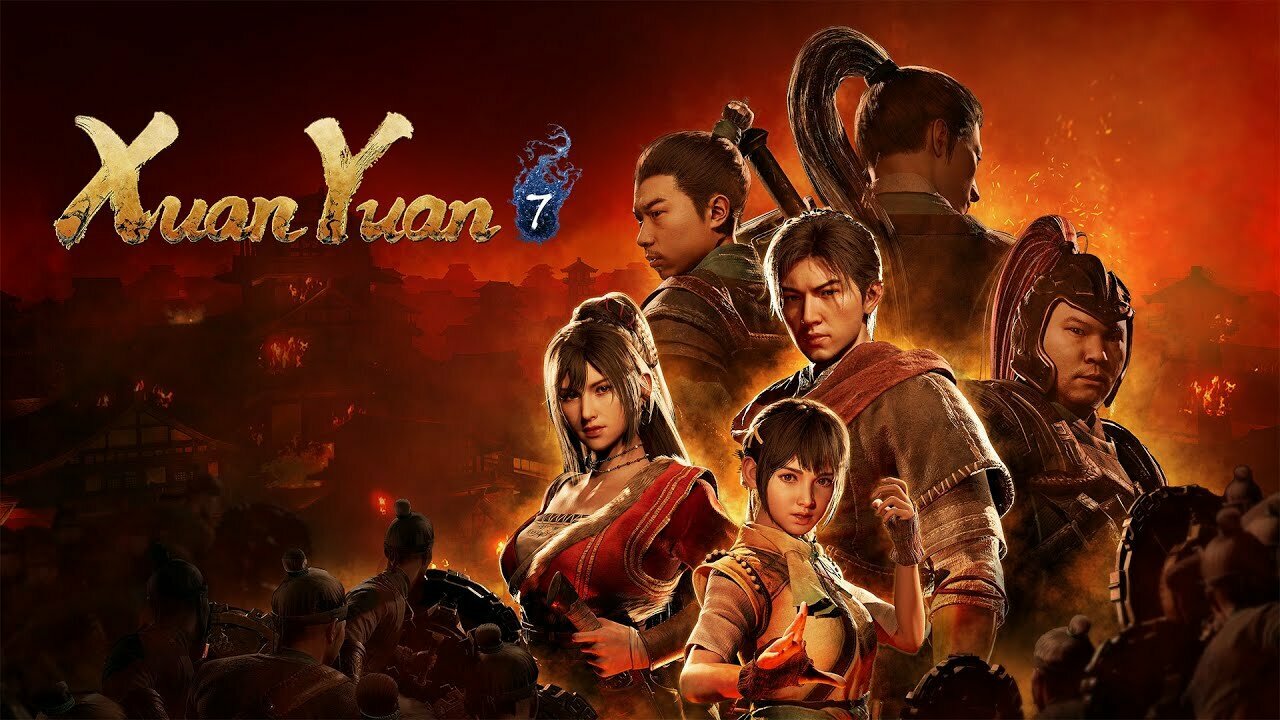
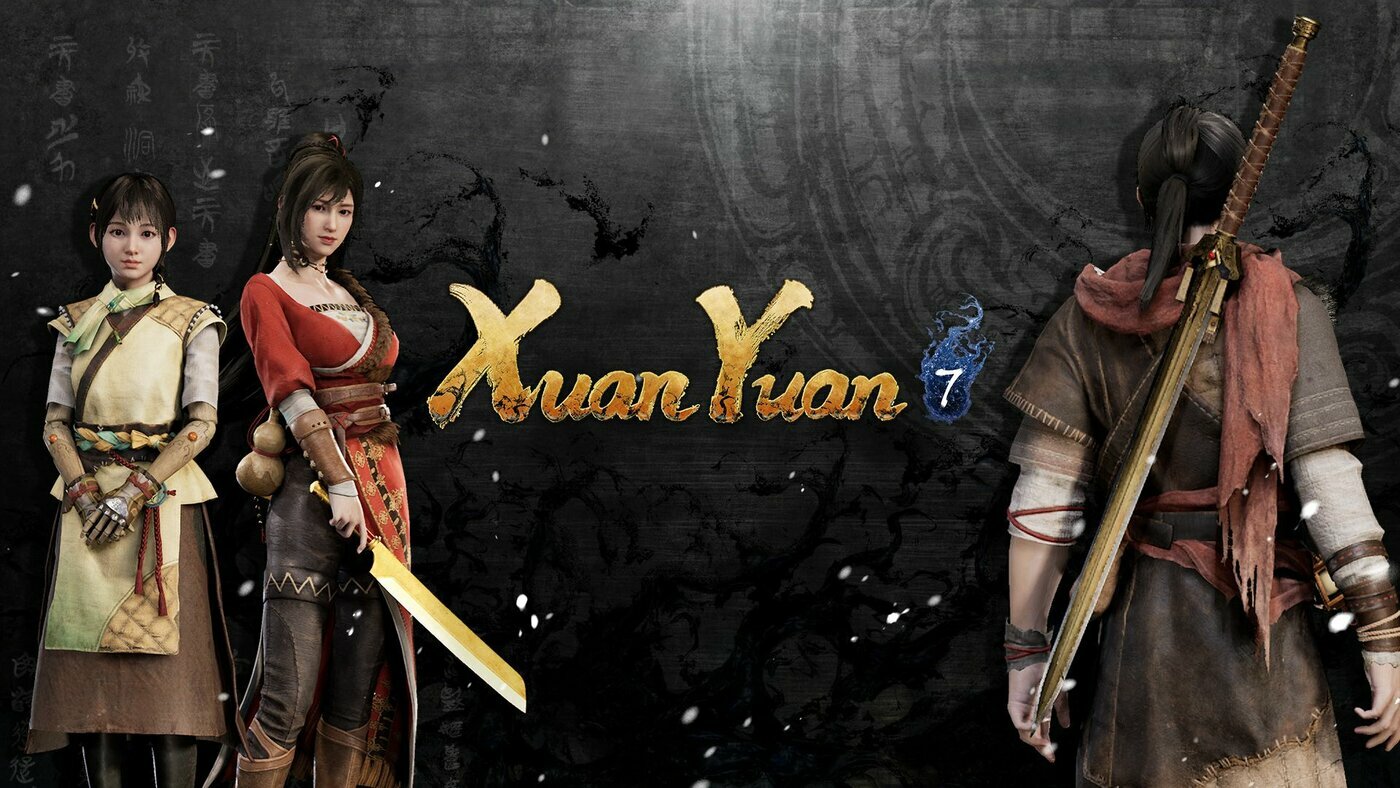
The graphics were pretty solid and the game surely looks good for the most part. The textures are sometimes rough in the environment and sometimes there's very noticeable instances of "pop-ins" but overall aesthetic and style is beautiful. You really never get to play games where you get to see ancient Chinese castles, cities, or kingdoms so that was nice. The leaves in the trees are even ruffled by the wind, which is a nice touch. The main characters like Zhao and his sister Xiang look great and so do most of the secondary characters like Chu-Hong and Mo Huang. It just makes it that more disappointing when you see sub-par detail in the NPC's and stiff cutscenes because you know they could have done better on those too. Maybe they didn't have enough time, man power or budget.
The music was probably one of the best additions to the game as a whole. Containing traditional Chinese sounds and instruments befitting the setting the music was great. There are some instances where there is no music and the void is filled with nothing but awkward silence or the sound of footsteps. Only the subpar voice acting fills the dead air and background music would have added more depth to certain parts and scenes of the game. There's no English dubbing for the voice acting in the game it's only in Mandarin/Chinese which isn't bad in itself except the performances are kind of hit and miss and not very balanced.
Verdict: [5/10]
The game seemed very rough around the edges, it lacked that "polished" feel that it would have gotten if it had been a "AAA" game instead of a "AA" game. It's linear aspects left little to no deviation for exploring the world other than the main quest making it feel like going through a tunnel from location to the next. The distances between the towns and villages also made the world feel really small which it probably was. The story and gameplay were enjoyable enough but writing and especially acting/voice acting in key cutscenes needed work. The combat was was so uninspired I felt like I was doing the same sword attacks the whole game and they never really changed. And last thing, even if it doesn't help or is in any way useful, I like to be able to make my character jump and this game didn't let you do that either. So in conclusion I have to give Xuan Yuan Sword 7 a 5/10. It's an average or ok game, which has it's moments but nothing to write home about. However if they make a Xuan Yuan Sword 8, I'd be looking forward to see what kind of improvements they would make in the next installment.

Purple Phoenix Games (2266 KP) rated Small Islands in Tabletop Games
Oct 13, 2021
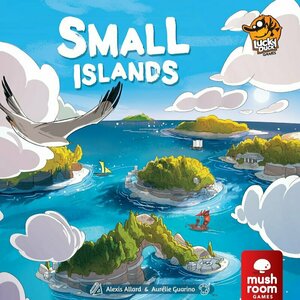

I have often wished to have been born in a different era of time. For me, I would have loved to have seen the birth of jazz in the US early 20th century. Or to witness the Renaissance first-hand. Another wish of mine was always to somehow discover something amazing. Like an island, or an unknown mountain range, or a new species of animal. That is so exciting to me, and I would have really loved to have just been around during these times. So along comes Small Islands, and my dreams have been woven into a board game about discovering new islands. That means the game is good, right?
Small Islands is a tile placement exploration game for one to four players. In it, players are explorers tasked with discovering resource-rich new islands upon which their clans may either exploit or inhabit. However, it’s each clan for themselves, and the players all need those precious resources. In the solo game, the player’s AI opponent is Alexis Allard, designer of the game. He has goal cards to be used and finishing point totals that the solo player will be attempting to beat during the course of the game.
DISCLAIMER: We were provided a copy of this game for the purposes of this review. This is a retail copy of the game, so what you see in these photos is exactly what would be received in your box. I do not intend to cover every single rule included in the rulebook, but will describe the overall game flow and major rule set so that our readers may get a sense of how the game plays. For more in depth rules, you may purchase a copy online or from your FLGS. -T
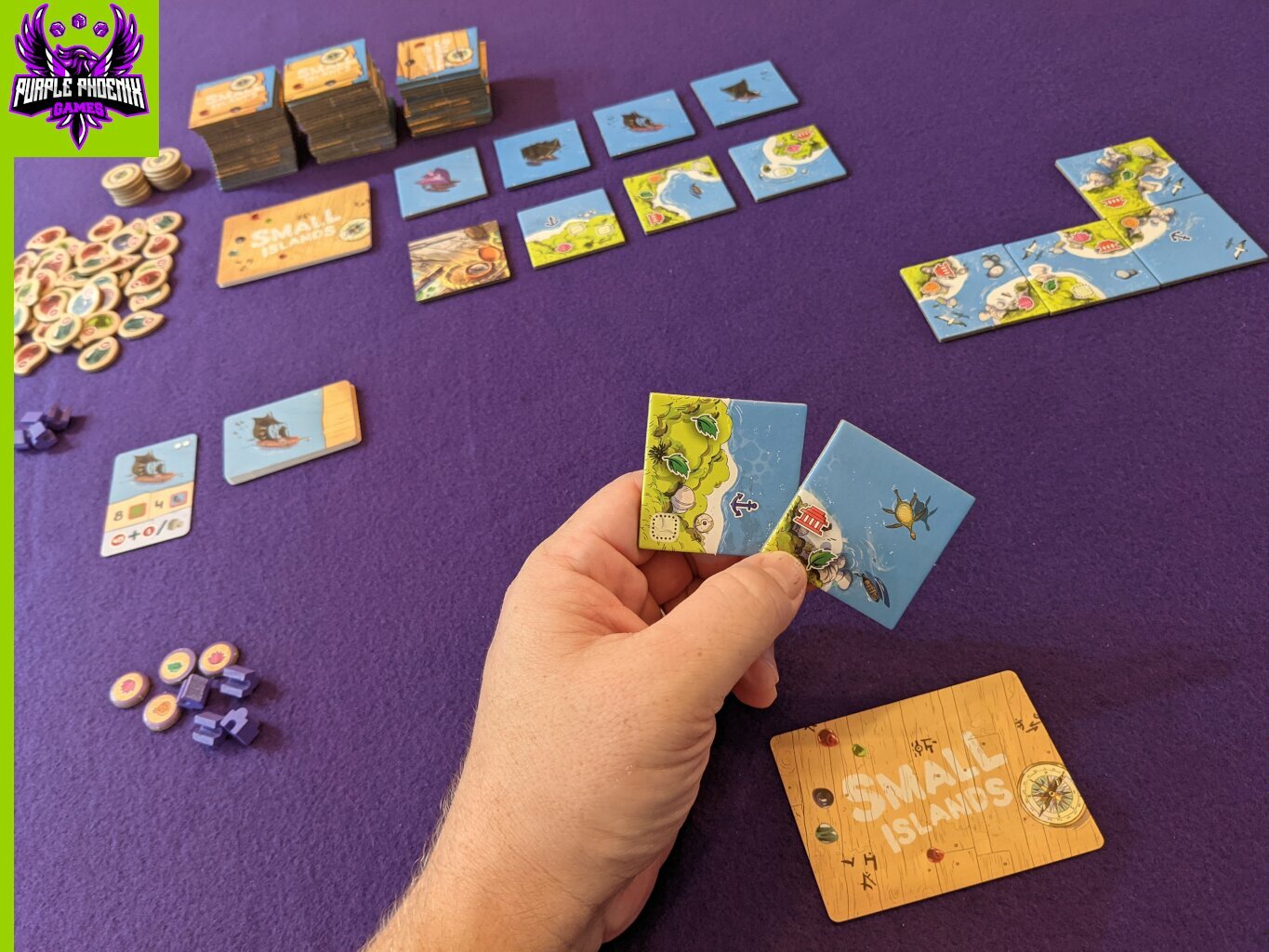
To setup, the player claims their player color and assigns Alexis with his color. They take all the components for each player and places them on the table. The starting tiles (that feature flying seagulls) are placed on the table in any orientation that is legal for play: islands need to connect, and seas need to flow from one tile to the next, as seen below. The Landscape tiles are to be shuffled and placed within reach. The four ship tiles are displayed, with all ships on their gray side, save for the solo player’s chosen color. The Navigation tile is placed below the ship tiles, and the beginning three Landscape tiles are placed in a row beside it. The small stack of Objective cards are shuffled and placed nearby, with the player drawing one to begin. They also draw two Landscape to start. For solo play, one Alexis difficulty card is chosen, and his deck of Explore and Land cards is built accordingly. The Prestige (VP) tokens are (apparently when I play) just thrown on the table and gathered in a loose pile. The game may now begin!
Small Islands is played over four rounds, with several turns being played per round. The solo player begins each round with their turn. A turn is divided into three phases: Preparation, Exploration, Reward. The Preparation phase has the player populating the Navigation Tile with six Landscape tiles face-down as a draw stack. The player then draws two Objective cards to add to their one they are currently holding. From these three cards the player will choose one to become their current objective for the round, one to be saved for a future round, and one to be discarded back to the stack. These Objective cards provide a strategy to guide the player through the current round, and also setup future rounds for scoring purposes. Upon them are icons that will award the player with points for scoring islands containing specific combinations of resources.
During the Exploration phase in the solo game, the player takes their turn first, and then Alexis will take his. A typical Exploration phase has a player deciding if they will Explore a tile or Land a ship. To Explore a tile, the player chooses one of the face-up Landscape tiles from the market/offer row and, along with their two held tiles, choose one to add to the play area. These tiles may be rotated in any fashion, as long as they can be legally placed: island edges are to be extended, sea spaces connected, et al. It is also at this time the player may place one of their Bonus Tokens upon any tile on the play area. These Bonus Tokens are resource icons that cover up existing icons on a tile, or directly over another Bonus Token. A player would do this in order to affect the balance of icons on a given island for scoring purposes.
Should the Navigation tile be empty of Landscape tiles and the player wish, they may instead Land a ship, thus ending the Exploration phase. The player chooses any of the ship tiles, and places it legally on the play area (in a sea space, as shown below). Once the player ends the phase, the game progresses to the Reward phase.
After the player takes their turn during the Exploration phase, Alexis takes his turn. This is done by drawing an Expedition card from his stack and following its instructions. The Expedition card will show whether Alexis would like to Explore or Land, which Landscape tile he would like to draw, and where he would like to place it – in relation to where the last player tile was placed.
During the Reward phase, the player will place any of their clan houseeples they wish on any island upon which they have not placed a houseeple previously. Then, consulting their Objective card, score points for successfully satisfying the card’s requirements. For Alexis, the player will draw a new Expedition card from Alexis’s stack, note the icons present on the Mission area of the card, and place Alexis houseeples upon islands that satisfy its requirements.
The game continues in this fashion until the fourth round is complete. The player totals their Prestige points (VP) and if they score more than Alexis, they win! The player must then take a picture of their archipelago they built and send it to the designer directly and gloat to them about their massive victory. Or simply rest in the satisfaction of having played the game well. Whichever.
Components. This game has a lot of components, and they are mostly cardboard and houseeples. The cardstock and board are good quality, as I have come to expect from Lucky Duck Games, and the houseeples are all different shapes for each clan color. I find that a nice and unnecessary, but very cool, touch. The art in this one is simply amazing. I mean, look at these photos! Everything from the color scheme to the art style all mesh well and give a well-considered polish to a great theme.
Okay, I won’t even hide it – I LOOOOOOVE this game. I never really liked Carcassonne very much, but Small Islands gives a similar feel, but executes everything so much better. Even with the solo rules. There are so many options available at any one time, and having a random Alexis game each time you play is just so satisfying. I feel like I could keep this game forever and not play the same game twice. Ever. And I think that I would WANT to play this one forever. Yes, I think this is a solid fit for my collection indeed, and I can see it working for so many different gamer types.
Having Alexis constantly applying the pressure to maximize and strategize every turn is delicious, and having almost zero conflict with him as we both explore is welcome. You know when you start the game how many points Alexis will score at the end of the game, so having that knowledge really makes you consider all the options available. It just works on so many levels.
If you are looking for a light-hearted, but with some great decisions to be made, then I strongly urge you to check out Small Islands. I knew immediately that this was a game for me. It’s on the lighter side without being too simple, I get to build a thing and admire it at the end of the game, and I have an opponent who just wants to see me win because he designed the game! I’m in and out in less than an hour and feel content that I was able to have a great experience with a well-designed game. I cannot wait to introduce this to all my friends and family gamers so they can fall in love with it as well.
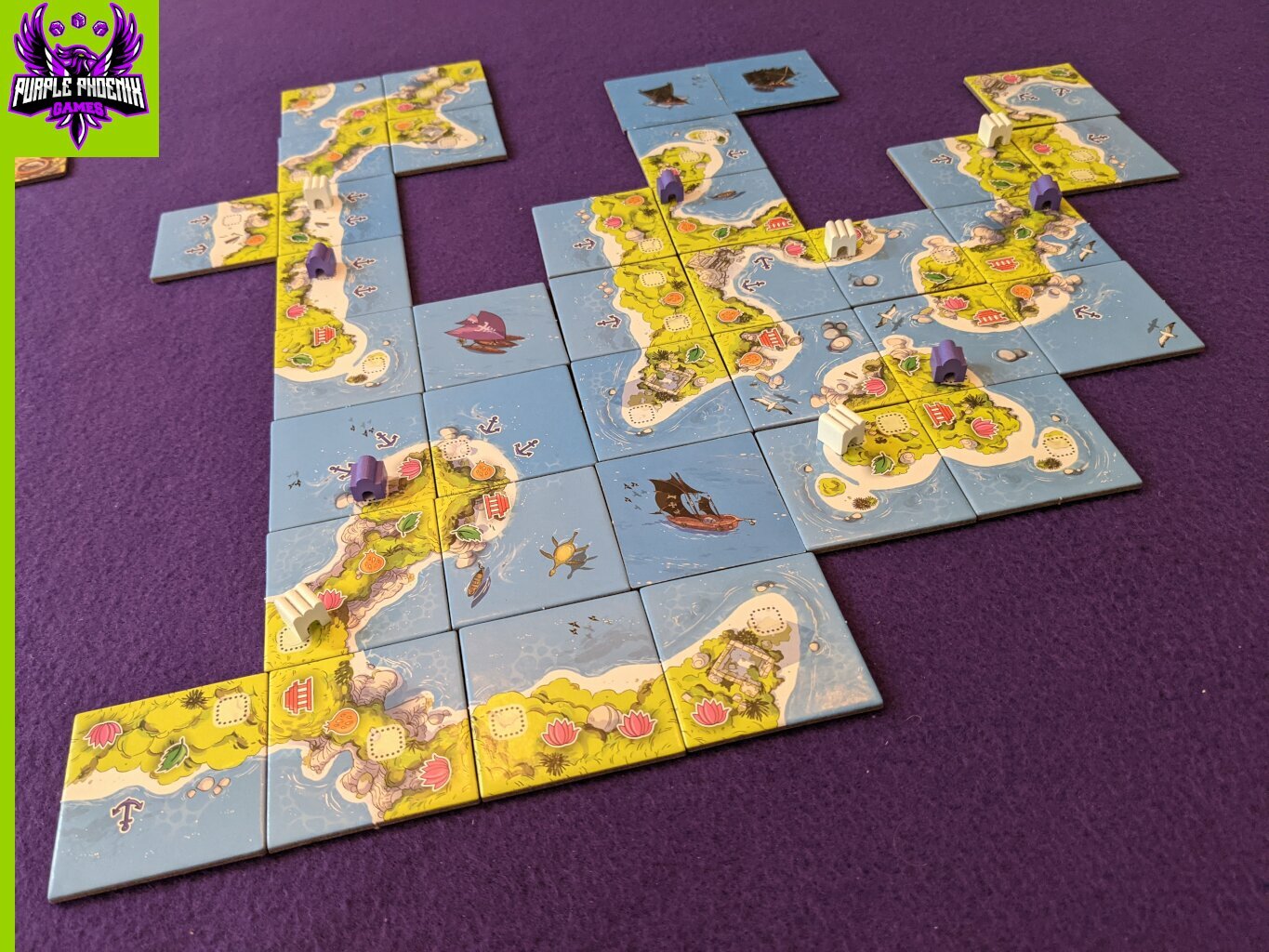
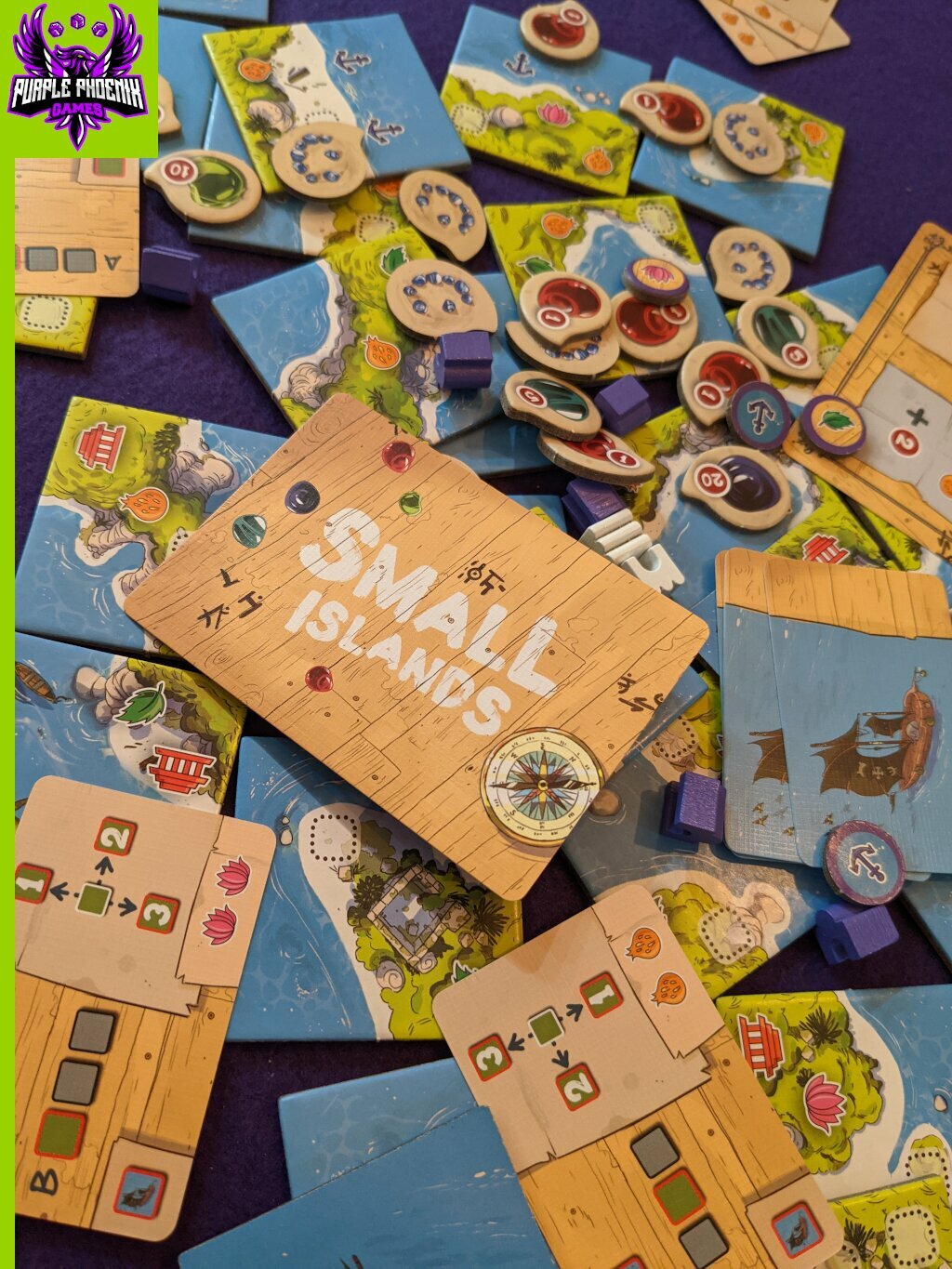

Heather Cranmer (2721 KP) rated The Exalted Gate in Books
Jun 7, 2018


(This review can be found on my blog <a href="http://themisadventuresofatwentysomething.blogspot.com/">The (Mis)Adventures of a Twenty-Something Year Old Girl</a>.
I absolutely love the cover of this book. It is gorgeous!! Anyway, this book has ten stories in it, so I will review and rate each one individually.
*
Boots
Judith (of an undisclosed age) is a girl that hates wearing shoes. However, she is in a play where she has to play a Polish tramp. She doesn't want to wear shoes, but the director says even tramps wear shoes. She finds some beat up looking boots in the prop room and puts them on. As soon as they are on her feet, it's like they have a mind of their own. They take Judith where they want to go. What ensues in an adventure that Judith won't soon forget.
I thought the story of Boots was a really cute and interesting read. I definitely think this will appeal to children of all ages. The only slight problem was with punctuation, but that's nothing that major. Judith is an interesting girl. I'd recommend this story.
I'd give Boots a 4.5 out of 5.
*
Five Gifts
Lonia is a thirteen year old girl whose parents are already nagging her to get married. (Yeah, it's a bit much, but it does say in the story that this was way back in the day). She'd rather spend her days in the children's glade talking to her elf friend, Pintak. One day, Pintak is kidnapped by a mean old wizard, and Lonia decides that she must go rescue him. She is given five gifts from different creatures of the forest to help her on her quest.
I was impressed with this story, and I found it quite interesting. There's also a lesson to be learned about experimenting on animals. Lonia was definitely a brave little girl and was willing to risk everything to save her friend. There are a few punctuation mistakes and a mispelt word, but other than that, this story was a good one.
I'd give Five Gifts a 5 out of 5.
*
Sintinko
Sintinko is a story set in Japan back when it was all emperors and generals. The emperor is jealous of Sintinko and wants to have him killed. It's only because of Ilyo, Sintinko's love interest, that the emperor spares his life. However, Sintinko is banished from Japan until he can find a maple tree that can sit in the hand of the emperor. Ilyo and Sintinko know that they will most likely never see each other. Unbeknownst to Sintinko and everyone else, Ilyo disguises herself as a geisha to help Sintinko on his journey. Love and loss are the themes of this story.
This was such a bittersweet love story. I felt sorry for both Sintinko and Ilyo. Sintinko thought he would never see his beloved again and swore off any type of relationship. Ilyo had her beloved right there in front of her, yet she couldn't do anything about it.
The names, being Japanese, were a bit hard to pronounce, but it's easy to get past that since the story is so strong. Speaking of names, this story even lets us know how the Bonsai tree got its name.
There's a few punctuation mistakes, but nothing that takes away from the story.
I think this story would be better suited for ages 11+. Personally, I found the story a bit slow, but not painfully slow.
I'd give Sintinko a 3.5 out of 5.
*
Tivurambhat
Tivurambhat is the story of a ghost by the same name of the title who helps people out in times of need in India. A mean man forces people to work for him by letting them borrow money, putting the interest up, and paying them such low wages they can never afford to pay him pack. One man decides to do something about it and goes to Tivurambhat for help.
I loved the message behind the story. Towards the ending, it even had me smiling. I couldn't pronounce the names since they were all Indian names, so I just shortened them so my American self could pronounce them. I loved the character of Tiv. He kind of reminded me of an American version of Casper for some reason. I really enjoyed the conversation between Pradesh and Tiv the most. This was such a happy story!
Again, there's some punctuation mistakes and a few grammar ones as well, but the story itself was excellent.
I'd give Tivurambhat a 5 out of 5.
*
St. Penalyn's Well
St Penalyn's Well tells the story of Rebecca (of an undisclosed age) who ventures into an overgrown garden with her dog. She stumbles across a well with an inscription. It is while reading this inscription that she becomes trapped in the well. Lucky for her, she meets an elf named Opickle who keeps her company and gives her the inspiration she needs to find her way out.
This was definitely an interesting story. I was hooked all the way through. It's a story about friendship amongst diversity and not giving up. I found Opickle to be just a tad bit of a snob but not enough to put me off the story.
A few punctuation mistakes throughout the story but not enough to be distracting.
St. Penalyn's Well gets a 5 out of 5 from me.
*
Quint and Trout's Mistake
Quint and Trout's Mistake is a story I didn't finish because of the name calling and making fun of someone who is overweight. It starts out innocently enough. A lake is being overrun by a white smelly substance. Two brothers, Quint and Trout, talk their friend Ned into investigating why this is happening. Ned swims down to the bottom of the lake and finds an overweight creature living in a cave who has been kicked out of his house. This is when the name calling starts, and I stopped reading.
I do not like stories aimed at children that condone name calling of any sort whether it be because of weight, disabilities, race, etc. Children do not need to read something like this and feel bad about themselves or view it as an excuse to tease others. I was very disappointed something like this was in a children's book.
Quint and Trout's Mistake gets a 0 out of 5 from me. What a vile story!
*
Densus
Densus is a boy who was born with blue fingernails and blue streaks in his hair. This is because he has a destiny to fulfill. When a crab named Arnold asks him if he'd go tell a giant that he has found a perfect wife for him, Densus agrees because it's his destiny even if there's a possibility the giant could kill him.
This is a story about destinies. It lets us know that we all have destinies if only we weren't too busy trying to find out what they are. This is a fun story which I think children would love! I loved Arnold the crab!! I think a majority of children would love him.
Again, there's a few punctuation and grammar mistakes but nothing major.
I'd give Densus a 5 out of 5.
*
Alice's Granddaughter
Alice's Granddaughter takes place years after Alice in Wonderland. Alice's granddaughter, Alicia, is recruited by a thief named Cheng to go down into a rabbit hole to get him a yellow dragon. Alicia discovers that things in Wonderland haven't changed much.
I thoroughly enjoyed this story! I'm a sucker for everything Alice in Wonderland-esque, and this was no exception! I loved how the author still managed to preserve the original Wonderland in his tale and how he even managed to keep the style of writing similar to that of Lewis Carroll. My favorite character was definitely the talking table. My only gripe is that I wish this story would've been longer!
As like with the previous story, there are some punctuation and grammar mistakes that can be overlooked.
Alice's Granddaughter gets a bit 5 out of 5.
*
The Dragon
The Dragon is a story about death. In this story, we follow a dragon in her very last moments as she dies of what I assume to be old age. We get to see her memories of when she was her prime and when she takes her last breath.
This is a sad story and probably one for the older children unless younger children can handle the topic of death. It's not written in a morbid way though. It's actually written quite beautifully especially when we get to see the memory of the dragon in her prime. I think this story can show that death is not always bad.
There are grammar and punctuation mistakes but nothing that deters from the story.
The Dragon gets a 3.75 out of 5.
*
The Wisdom of a Dog
The Wisdom of a Dog is about a man named Keith and his dog who go on an adventure and wind up in a crystal city. Keith must found out who is destroying the city and save it.
This story was a good read, and I think most children would enjoy it especially as it involves a talking dog. I enjoyed how the author even placed his own dialogue in the story. This is a good versus bad story that shows that bad people never win.
Again, there are grammar and punctuation mistakes, but it doesn't take away from the story.
The Wisdom of a Dog gets a 3.5 out of 5.
*
The Exalted Gate by Daniel Nanavati averages out to a 3.5 out of 5. I'd definitely recommend this book to old and young alike!
(I received a free physical copy of this title from the publisher in exchange for a fair and honest review).