
Search
Search results
Bubble Bust! - Pop Bubble Shooter
Games and Entertainment
App
Over 25 million people around the world are playing this original arcade bubble shooter! Thank...

Bob Mann (459 KP) rated Searching (2018) in Movies
Sep 28, 2021
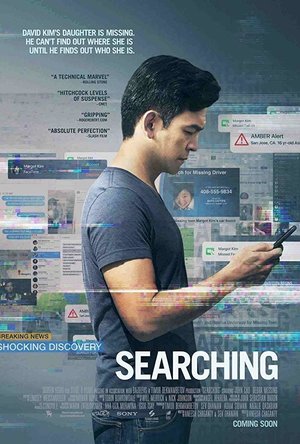


A phenomenally intriguing social media-focused movie.
There have been many movies that have featured computing and, more specifically, social media at their heart. Some these have used the device of the view “from the screen”: 2016’s entertaining “Nerve” had elements of this, with the majority of the rest of the film being ‘augmented reality’ over the video. But it was 2014’s teen-horror “Unfriended” that set a new bar being seen entirely through a computer screen. No surprise then that the producer of that one – Timur Bekmambetov – is also behind “Searching”. For – although taking a few liberties with news vidoes, that may or may not be showing on Youtube – the whole film is shot through computer screens.
“Oh no!” you sigh “another gimmicky B-movie”. Far from it. Not only is this a really helpful training film for Windows tips and tricks! It’s also a totally absorbing crime mystery anchored by a superb script that keeps the audience guessing to the end.
John Cho – most famous as Sulu in the Star Trek reboots – plays David Kim who is trying to control his 16 year-old daughter Margot (Michelle Ya, in her movie debut). Kim, working in some form of product development, is no technology luddite, and when Margot disappears he uses his nous about social media to try to piece together the fragments of the puzzle to assist police Detective Vick (Debra Messing, “Grace” in “Will and Grace”).
To say any more would ruin what is a masterly roller-coaster ride of twists and turns. The script by first-time director Aneesh Chaganty and Sev Ohanian doesn’t let its audience relax for a moment, spawning more movie cul-de-sacs and red herrings than a classic Agatha Christie.
In the acting stakes John Cho – who really doesn’t get given much to do in the Star Trek background – is here impressively believable as the parent, struggling with both bringing up a teen – enough to stress any mortal out – and an emotional past. Ms La is also equally engaging, given most of her scenes are via close-up web cam.
Criticisms? The film, at 102 minutes, might have usefully trimmed 10 minutes to be an even tighter 90 minute classic. I also thought it pulled its punches in the finale, where a director of the calibre of Hitchcock might have gone for a much darker angle without a qualm.
But I’m nit-picking. This is an excellent thriller that also effectively drills into grief and bereavement (a warning for anyone struggling with this – especially via the “Big C”… you might want to give this one a miss… #Up). It also ironically highlights that whilst broadcasting by people has never been more prevelant, communication between family members is sometimes totally lacking.
Clearly people agree with me that it is excellent: the preview cinema audience I saw this with was buzzing afterwards, and this won the “Audience Award” at Sundance.
“Searching” will be on general release in the UK and US from August 31st 2018. Highly recommended!
“Oh no!” you sigh “another gimmicky B-movie”. Far from it. Not only is this a really helpful training film for Windows tips and tricks! It’s also a totally absorbing crime mystery anchored by a superb script that keeps the audience guessing to the end.
John Cho – most famous as Sulu in the Star Trek reboots – plays David Kim who is trying to control his 16 year-old daughter Margot (Michelle Ya, in her movie debut). Kim, working in some form of product development, is no technology luddite, and when Margot disappears he uses his nous about social media to try to piece together the fragments of the puzzle to assist police Detective Vick (Debra Messing, “Grace” in “Will and Grace”).
To say any more would ruin what is a masterly roller-coaster ride of twists and turns. The script by first-time director Aneesh Chaganty and Sev Ohanian doesn’t let its audience relax for a moment, spawning more movie cul-de-sacs and red herrings than a classic Agatha Christie.
In the acting stakes John Cho – who really doesn’t get given much to do in the Star Trek background – is here impressively believable as the parent, struggling with both bringing up a teen – enough to stress any mortal out – and an emotional past. Ms La is also equally engaging, given most of her scenes are via close-up web cam.
Criticisms? The film, at 102 minutes, might have usefully trimmed 10 minutes to be an even tighter 90 minute classic. I also thought it pulled its punches in the finale, where a director of the calibre of Hitchcock might have gone for a much darker angle without a qualm.
But I’m nit-picking. This is an excellent thriller that also effectively drills into grief and bereavement (a warning for anyone struggling with this – especially via the “Big C”… you might want to give this one a miss… #Up). It also ironically highlights that whilst broadcasting by people has never been more prevelant, communication between family members is sometimes totally lacking.
Clearly people agree with me that it is excellent: the preview cinema audience I saw this with was buzzing afterwards, and this won the “Audience Award” at Sundance.
“Searching” will be on general release in the UK and US from August 31st 2018. Highly recommended!

Purple Phoenix Games (2266 KP) rated Way Too Many Cats! in Tabletop Games
Jan 24, 2022


Before we had children and pets my wife and I would love to visit the humane societies back home on a Saturday morning. Sometimes looking for ourselves, sometimes just to see the lovelies being kept, and maybe once or twice volunteering to walk the animals. One place I never really enjoyed visiting was the cat room. I am a dog person. Actually, the older I get, the more I am becoming strictly an aquatic animal lover. Give me a 55 gallon saltwater tank and I’ll be happy raising my Firefish Gobies and Coral Beauty Angelfish. However, when I was asked to preview Way Too Many Cats, I just couldn’t say no. One of my favorite publishers calls for help, I will do my best. Just know I wish it were fish themed instead of cats. Cats…
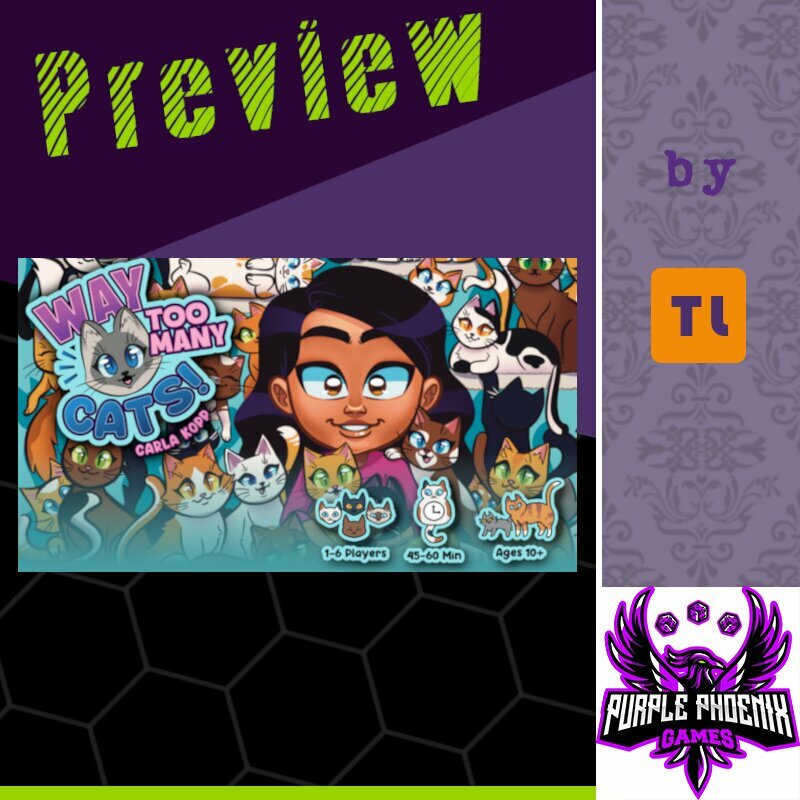
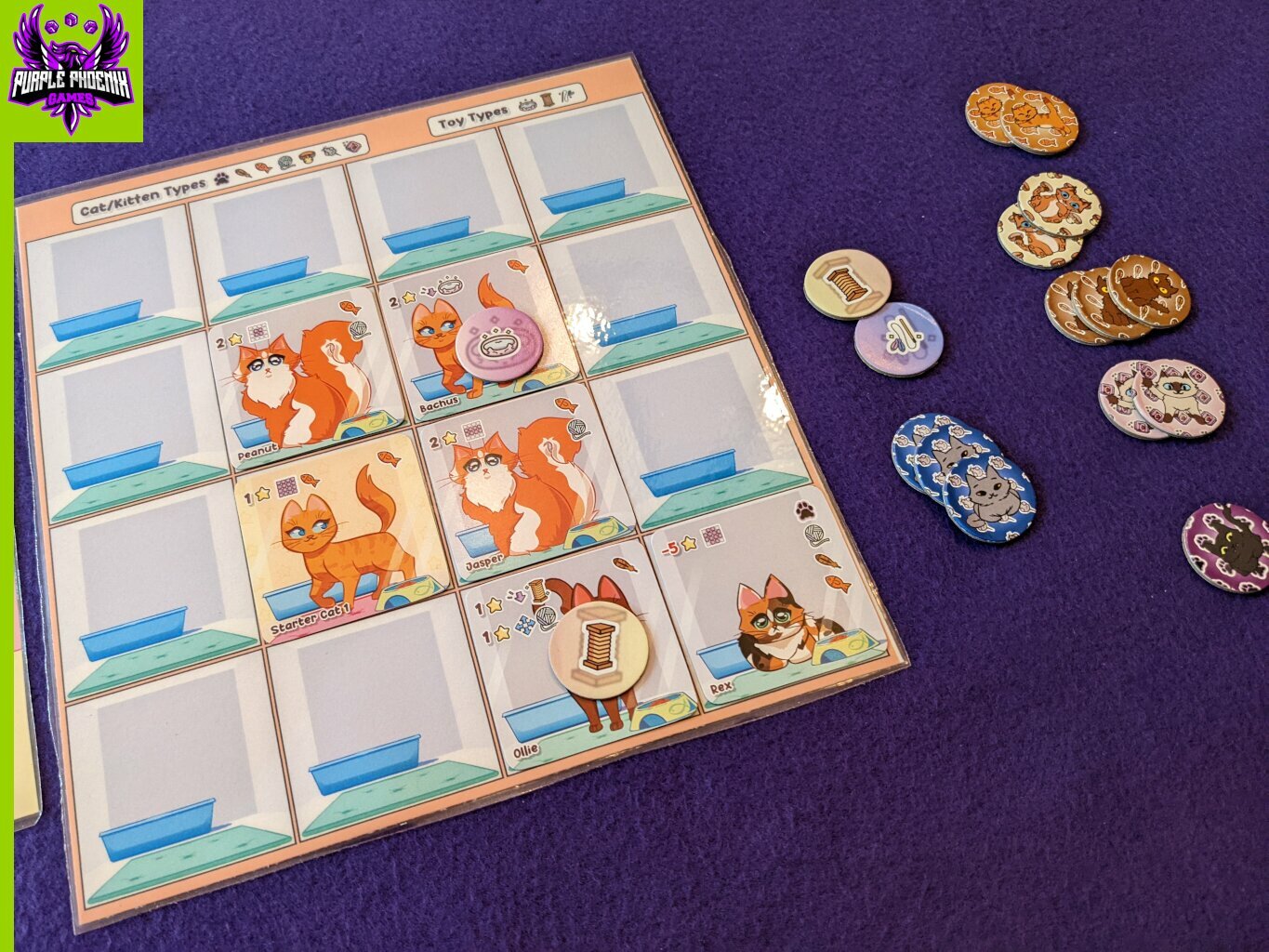
Way Too Many Cats is a cat and kitten drafting and spatial puzzle game for one to six players. In it, players work at feline adoption centers with the goal of having all stock adopted. To do this, players will be placing specific cats adjacent to other favorable cats for points, giving kittens a habitat of their own, and even supplying the cats with toys. The player who completes these tasks most effectively by the end of the game will score the most points and win!
DISCLAIMER: We were provided a prototype copy of this game for the purposes of this review. These are preview copy components, and I do not know for sure if the final components will be any different from these shown. Also, it is not my intention to detail every rule in the game, as there are just too many. You are invited to download the rulebook, back the game through the Kickstarter campaign, or through any retailers stocking it after fulfillment. -T
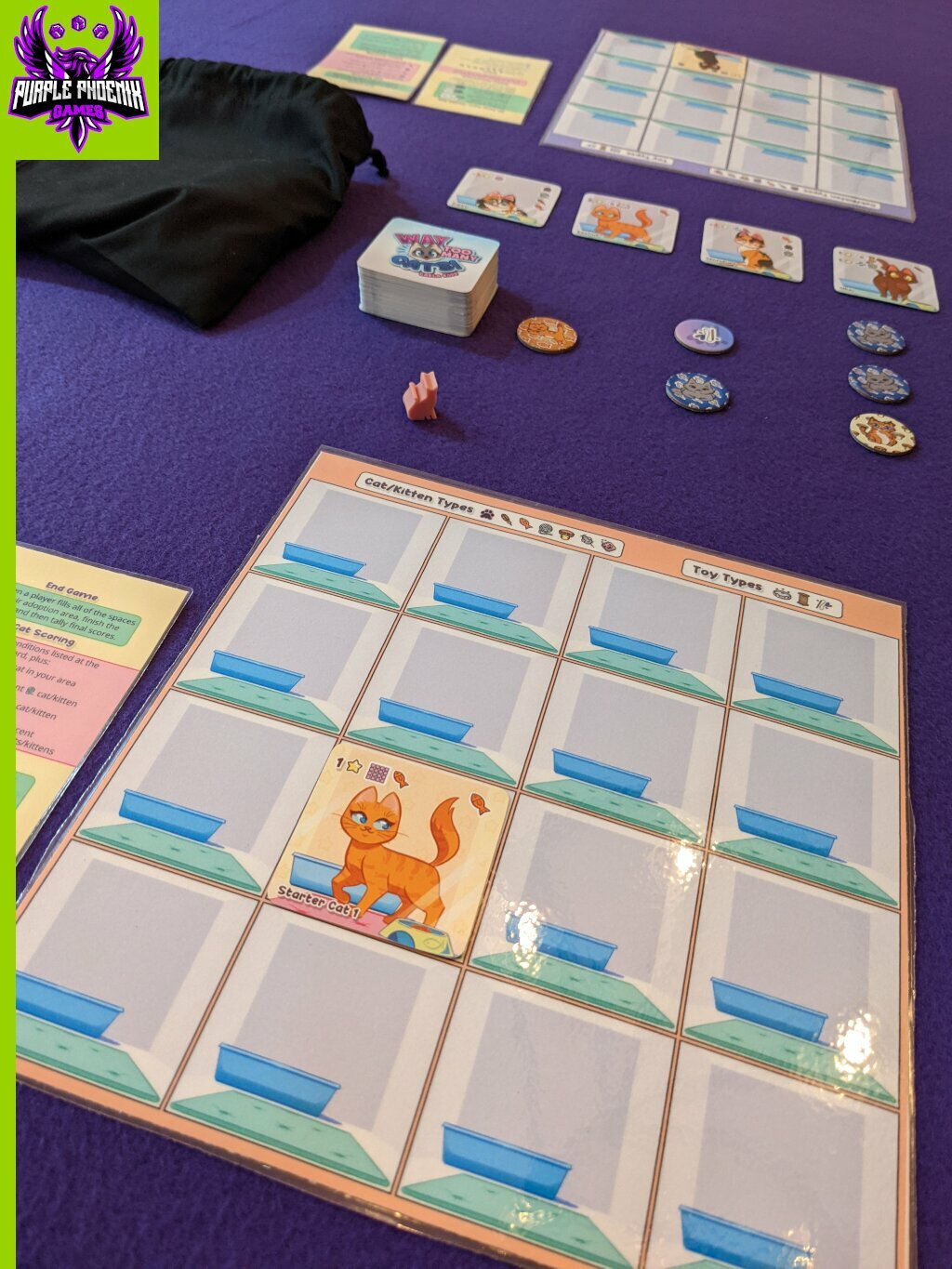
To setup, each player receives an adoption center board, starter cat tile, and a reference card. The kitten and toy tokens are placed into the provided bag to be shuffled and drawn later. The stack of adoptable cats is shuffled, and four drawn and revealed to create Cat Alley (from which players will be drafting). Nearby, three stacks of kitten/toy tokens are made with one stack containing one token, the next stack containing two, and the final stack containing three tokens. The starting player marker is given to the player who most recently pet a cat (aka probably attacked by a cat) and the game may begin!
A game of Way Too Many Cats lasts many rounds, and ends once all players have had the same amount of turns and one player having completely filled their adoption center. On a turn, the active player will take one mandatory action, and then will choose to take another two actions. The mandatory action that all players take each turn is to Choose a Token Set and Cat Card(s) and Place Them. A bit wordy, but this is a prototype, so I will let it slide. In any case, the player will choose to (1) take the smallest group of tokens and two Cat tiles of their choice, (2) take the mid-sized group of tokens and one Cat tile of their choice, or (3) take the largest group of tokens and the right-most Cat tile from Cat Alley (the offer row). Once the choice has been made and all components taken, the player then refreshes Cat Alley by sliding all tiles to the right and refilling to four tiles. Also, the player pulls three tokens from the bag and adds one to each group of tokens on the table. Note, as the player has just chosen a group of tokens, one of the groups will be empty until they place a token there – thus creating the smallest group and embiggening (I’m on a Marvel kick right now) the other two groups.
As an optional second action, the player may choose to give any cat in their adoption center a toy from their personal supply. Cat tiles show icons for toys that the cat will appreciate, though not every cat is into toys. Note, the toy tokens may be given to the cats on any turn, and even at the end of the game just before scoring.
Finally, at the end of the turn, the player may Create a Kitten Habitat by discarding three toy tokens to the bag. The player then designates a space on their adoption center to be the kitty haven and it can house any number of kittens.
Once a player fills their last adoption center slot, the end game is triggered. Players will finish out the round so that all have an equal amount of turns. Then, points are tallied and scored following an involved scoring process. Points in this game are scored in numerous ways. Firstly, the starter cats are scored, and then each type of cat is scored. For example, the paw icon on cat tiles earn 1 VP for each adjacent cat of a different color. Each ball of yarn icon on cat tiles scores 2 VP. The goldfish cracker icon scores 2 VP for each adjacent cat or kitten sporting a ball of yarn icon. Finally, the feather icon scores 3/7/12/18 VP for each group of adjacent feather cats of train size 2/3/4/5 cats. So placement is very important in this game. Not enough scoring?
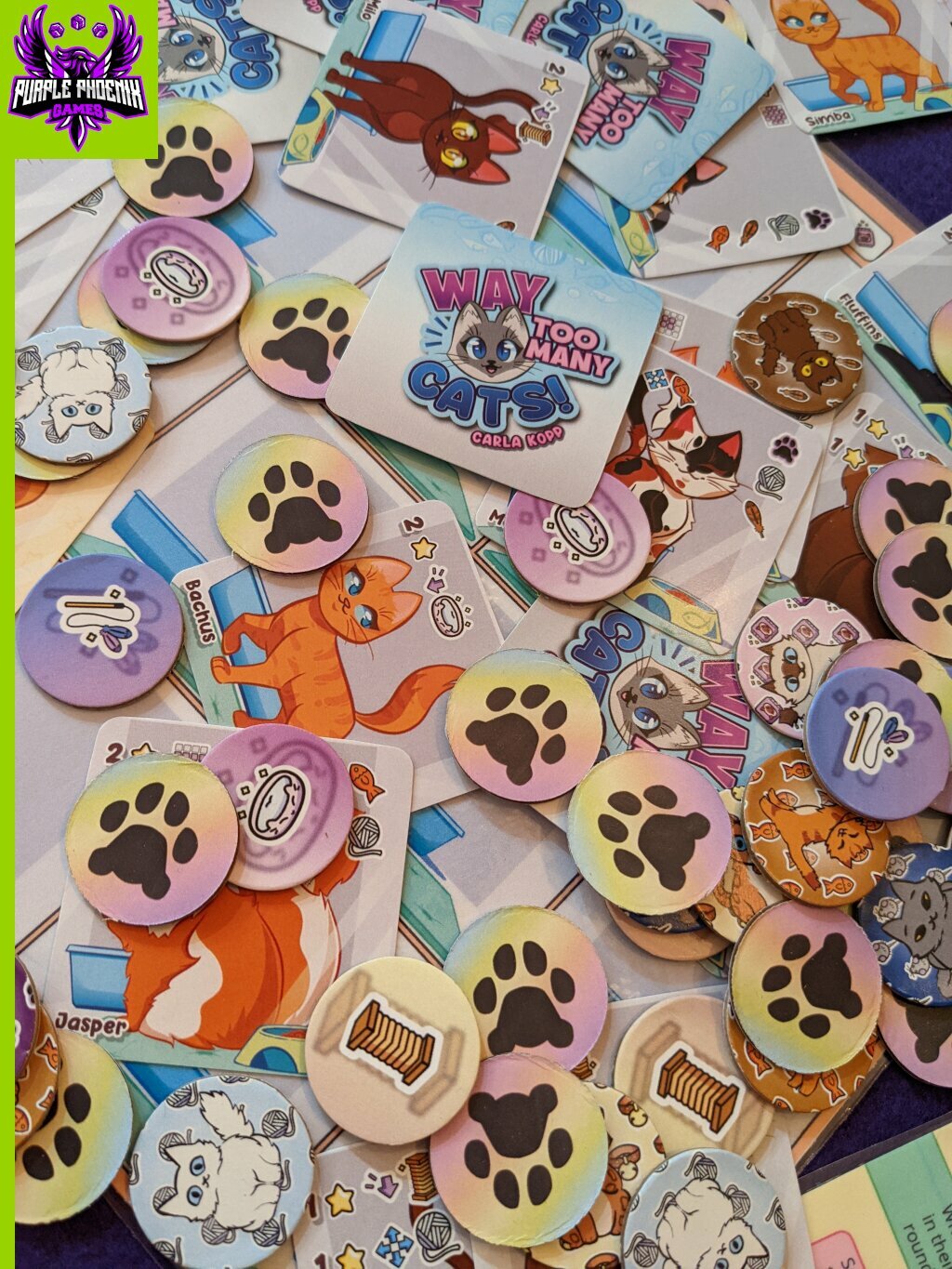
Players will score more points for kittens and for specific icons on cat tiles. 15 VP is awarded to a player who holds a complete set of the seven different types of kitten tokens, while another 8 VP is earned for holding a set of four matching kitten types. The player receives a -2VP penalty for each kitten token not associated with either type of set nor in a habitat on the board. Additionally, for each cat tile on the board, special scoring will be earned for supplying the tile with the requested toy, or placing it in the preferred space in the center, or even for other adjacency considerations.
Players will be scoring hundreds of points, and hopefully having their felines adopted by unsuspecting travelers and goo-goo eyed children. The player with the most VP at the end of the game is the winner!
Components. Again, this is a prototype copy of the game, so I know that these are not final components at all. Having had many opportunities to preview for Weird Giraffe Games now, I am confident that the final game will be sparkling with upgrades and cool features. To reiterate, my interest in the theme is on the lower side, as I am not a cat person, but I can definitely understand the theme and it works well with this type of game. I guarantee that you will be able to spot Way Too Many Cats in stores right away because that box art is super colorful and busy. I do enjoy the cartoony art style, and it fits the theme really well. The final version of the game will undoubtedly affect this paragraph in the future, but for now this is well on the way to being a very solid title with regards to components, artwork, and theme.
But do I like it? Surprisingly, yes I do. Quite a bit. Theme goes a really long way with me, but I have been known to enjoy other games with themes that don’t necessarily resonate with me, so perhaps “surprising” isn’t the best term here. I really enjoy the spatial puzzle aspect of the game. I highlighted puzzle because that’s exactly what is going on here. When I am playing, I have to debate whether to take all those kitten tokens to complete my sets and be stuck with the right-most card, or perhaps taking the smallest group is more beneficial so that I can draft the two best cards for what I am building on my board. Is it really worth it to me to grab Taco just because I am starting to realize I have a food themed cat dispensary? Why does this cat need a scratching post token when it’s clearly been de-clawed?? These are serious questions, folks!
I kid, but only because this is a very light game, and one that I think works well in many situations. Have newer to intermediate level players coming over tonight? Grab Way Too Many Cats! Having an animal-themed game night? Pull this one out! Sticking with a mechanic-specific lineup? You got it. Now, I haven’t seen the Kickstarter page yet, nor have I asked Carla (the designer) what the plans are for it, but I know this one is close to many peoples’ hearts, so I imagine it will get all the love that’s possible in making this a wonder in a box. The mechanics are there. The theme is… great for some. Way Too Many Cats is a thinker in a catsuit disguise, but it is not too heavy to turn off casual or intermediate gamers. I can certainly add my stamp of approval and recommend checking out Way Too Many Cats. Look for it to hit Kickstarter in February and click here to be notified on launch. You will probably want to get in on this project early if any of this sounds appealing to you.
PS – How many catfolk did I offend in this preview? How many aquarists have I now befriended? What up, my peeps!
Way Too Many Cats is a cat and kitten drafting and spatial puzzle game for one to six players. In it, players work at feline adoption centers with the goal of having all stock adopted. To do this, players will be placing specific cats adjacent to other favorable cats for points, giving kittens a habitat of their own, and even supplying the cats with toys. The player who completes these tasks most effectively by the end of the game will score the most points and win!
DISCLAIMER: We were provided a prototype copy of this game for the purposes of this review. These are preview copy components, and I do not know for sure if the final components will be any different from these shown. Also, it is not my intention to detail every rule in the game, as there are just too many. You are invited to download the rulebook, back the game through the Kickstarter campaign, or through any retailers stocking it after fulfillment. -T
To setup, each player receives an adoption center board, starter cat tile, and a reference card. The kitten and toy tokens are placed into the provided bag to be shuffled and drawn later. The stack of adoptable cats is shuffled, and four drawn and revealed to create Cat Alley (from which players will be drafting). Nearby, three stacks of kitten/toy tokens are made with one stack containing one token, the next stack containing two, and the final stack containing three tokens. The starting player marker is given to the player who most recently pet a cat (aka probably attacked by a cat) and the game may begin!
A game of Way Too Many Cats lasts many rounds, and ends once all players have had the same amount of turns and one player having completely filled their adoption center. On a turn, the active player will take one mandatory action, and then will choose to take another two actions. The mandatory action that all players take each turn is to Choose a Token Set and Cat Card(s) and Place Them. A bit wordy, but this is a prototype, so I will let it slide. In any case, the player will choose to (1) take the smallest group of tokens and two Cat tiles of their choice, (2) take the mid-sized group of tokens and one Cat tile of their choice, or (3) take the largest group of tokens and the right-most Cat tile from Cat Alley (the offer row). Once the choice has been made and all components taken, the player then refreshes Cat Alley by sliding all tiles to the right and refilling to four tiles. Also, the player pulls three tokens from the bag and adds one to each group of tokens on the table. Note, as the player has just chosen a group of tokens, one of the groups will be empty until they place a token there – thus creating the smallest group and embiggening (I’m on a Marvel kick right now) the other two groups.
As an optional second action, the player may choose to give any cat in their adoption center a toy from their personal supply. Cat tiles show icons for toys that the cat will appreciate, though not every cat is into toys. Note, the toy tokens may be given to the cats on any turn, and even at the end of the game just before scoring.
Finally, at the end of the turn, the player may Create a Kitten Habitat by discarding three toy tokens to the bag. The player then designates a space on their adoption center to be the kitty haven and it can house any number of kittens.
Once a player fills their last adoption center slot, the end game is triggered. Players will finish out the round so that all have an equal amount of turns. Then, points are tallied and scored following an involved scoring process. Points in this game are scored in numerous ways. Firstly, the starter cats are scored, and then each type of cat is scored. For example, the paw icon on cat tiles earn 1 VP for each adjacent cat of a different color. Each ball of yarn icon on cat tiles scores 2 VP. The goldfish cracker icon scores 2 VP for each adjacent cat or kitten sporting a ball of yarn icon. Finally, the feather icon scores 3/7/12/18 VP for each group of adjacent feather cats of train size 2/3/4/5 cats. So placement is very important in this game. Not enough scoring?
Players will score more points for kittens and for specific icons on cat tiles. 15 VP is awarded to a player who holds a complete set of the seven different types of kitten tokens, while another 8 VP is earned for holding a set of four matching kitten types. The player receives a -2VP penalty for each kitten token not associated with either type of set nor in a habitat on the board. Additionally, for each cat tile on the board, special scoring will be earned for supplying the tile with the requested toy, or placing it in the preferred space in the center, or even for other adjacency considerations.
Players will be scoring hundreds of points, and hopefully having their felines adopted by unsuspecting travelers and goo-goo eyed children. The player with the most VP at the end of the game is the winner!
Components. Again, this is a prototype copy of the game, so I know that these are not final components at all. Having had many opportunities to preview for Weird Giraffe Games now, I am confident that the final game will be sparkling with upgrades and cool features. To reiterate, my interest in the theme is on the lower side, as I am not a cat person, but I can definitely understand the theme and it works well with this type of game. I guarantee that you will be able to spot Way Too Many Cats in stores right away because that box art is super colorful and busy. I do enjoy the cartoony art style, and it fits the theme really well. The final version of the game will undoubtedly affect this paragraph in the future, but for now this is well on the way to being a very solid title with regards to components, artwork, and theme.
But do I like it? Surprisingly, yes I do. Quite a bit. Theme goes a really long way with me, but I have been known to enjoy other games with themes that don’t necessarily resonate with me, so perhaps “surprising” isn’t the best term here. I really enjoy the spatial puzzle aspect of the game. I highlighted puzzle because that’s exactly what is going on here. When I am playing, I have to debate whether to take all those kitten tokens to complete my sets and be stuck with the right-most card, or perhaps taking the smallest group is more beneficial so that I can draft the two best cards for what I am building on my board. Is it really worth it to me to grab Taco just because I am starting to realize I have a food themed cat dispensary? Why does this cat need a scratching post token when it’s clearly been de-clawed?? These are serious questions, folks!
I kid, but only because this is a very light game, and one that I think works well in many situations. Have newer to intermediate level players coming over tonight? Grab Way Too Many Cats! Having an animal-themed game night? Pull this one out! Sticking with a mechanic-specific lineup? You got it. Now, I haven’t seen the Kickstarter page yet, nor have I asked Carla (the designer) what the plans are for it, but I know this one is close to many peoples’ hearts, so I imagine it will get all the love that’s possible in making this a wonder in a box. The mechanics are there. The theme is… great for some. Way Too Many Cats is a thinker in a catsuit disguise, but it is not too heavy to turn off casual or intermediate gamers. I can certainly add my stamp of approval and recommend checking out Way Too Many Cats. Look for it to hit Kickstarter in February and click here to be notified on launch. You will probably want to get in on this project early if any of this sounds appealing to you.
PS – How many catfolk did I offend in this preview? How many aquarists have I now befriended? What up, my peeps!
Purple Phoenix Games (2266 KP) rated Gnomes & Wizards in Tabletop Games
Jan 21, 2020
I always thought that Gnomes could BE Wizards. This whole time I was led to believe that a Gnome could take on the class of Wizard and join these two houses splendidly. I did not, however, realize that Gnomes and Wizards were different species and vying for the same power crystals to fuel their magicks… until recently.
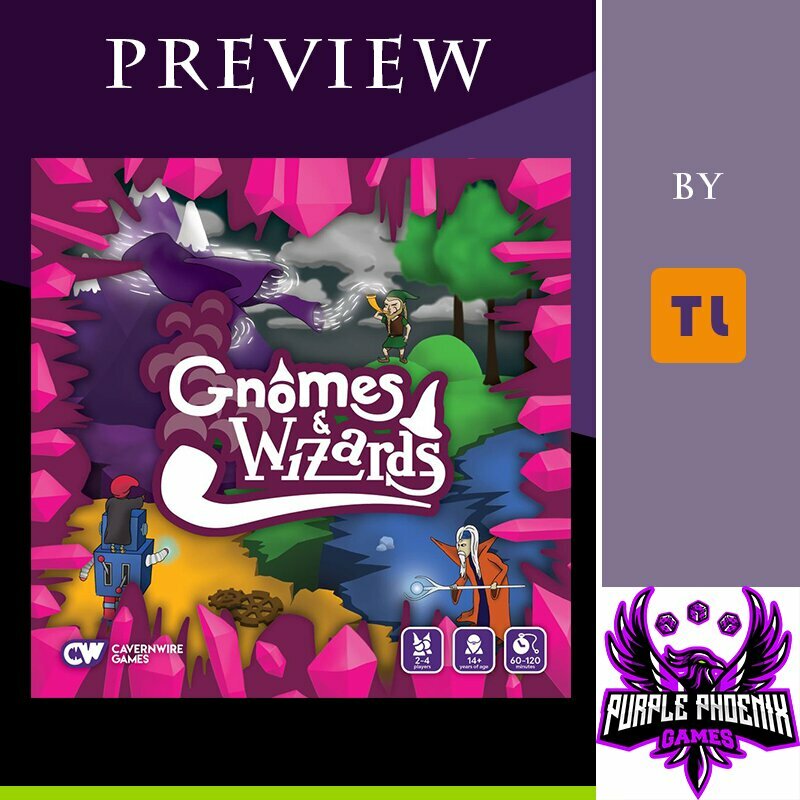
Gnomes & Wizards is an area control, map deformation, dice assignment battle game where the players are attempting to earn the most victory points (VP) at the end of the game. Players gain VP by defeating other players’ active characters (clan leaders and tribesmen henchpeople), and having the most hit points (HP) between all their active characters at game end. Sounds easy, right? Read on, my friend.
DISCLAIMER: We were provided a prototype copy of this game for the purposes of this review. These are preview copy components, and the final components will probably be different from these shown. Also, it is not my intention to detail every rule in the game, as there are just too many. You are invited to download the rulebook from the publisher’s website, purchase the game through the Kickstarter campaign, or through any retailers stocking it after fulfillment. -T
As I mentioned in my disclaimer, I will not be explaining every rule for this one as there are quite a few little nuances that make it tick. However, I will cover the basic gameplay, and I will be focusing on a 2-player game for this preview.
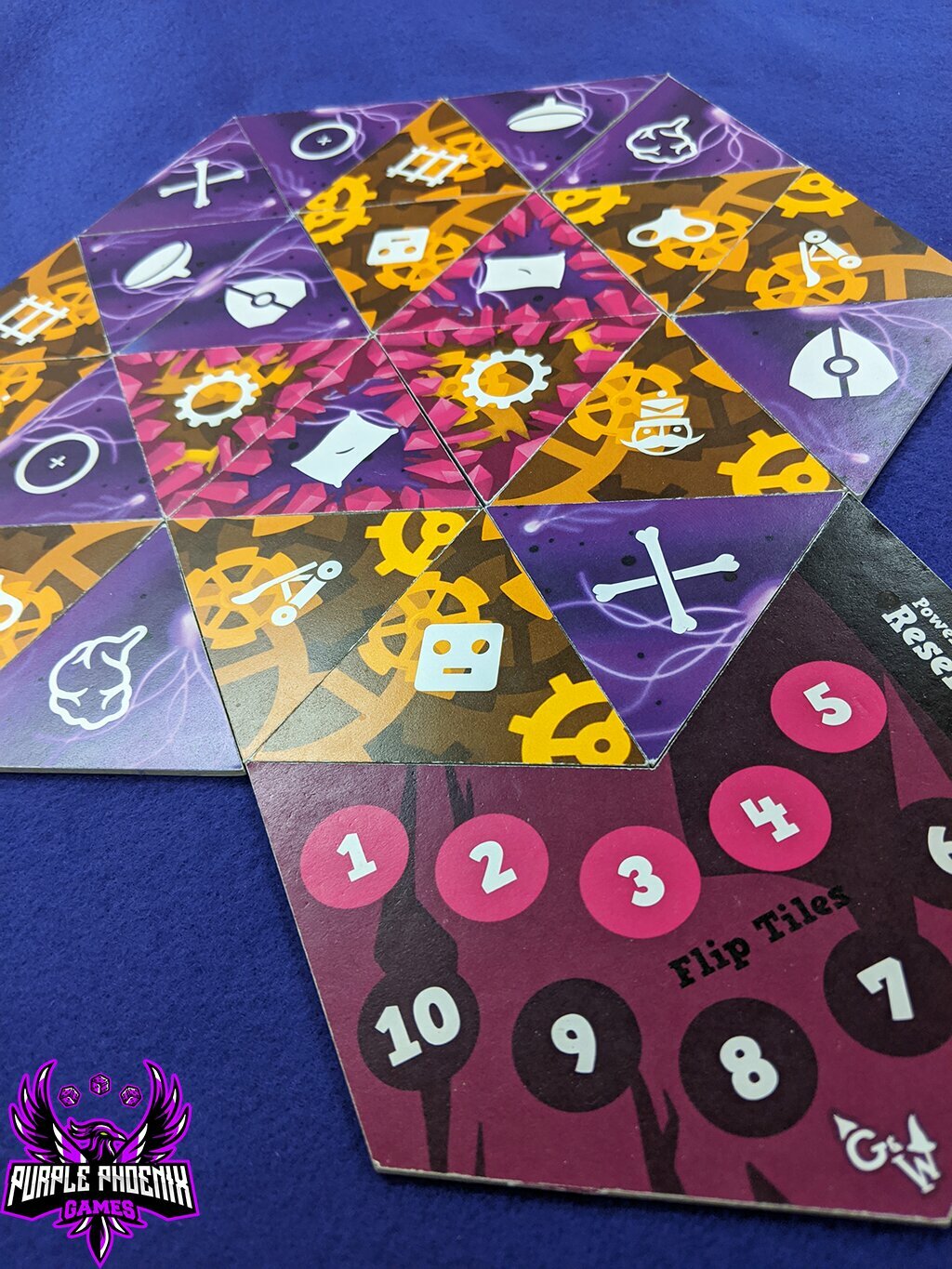
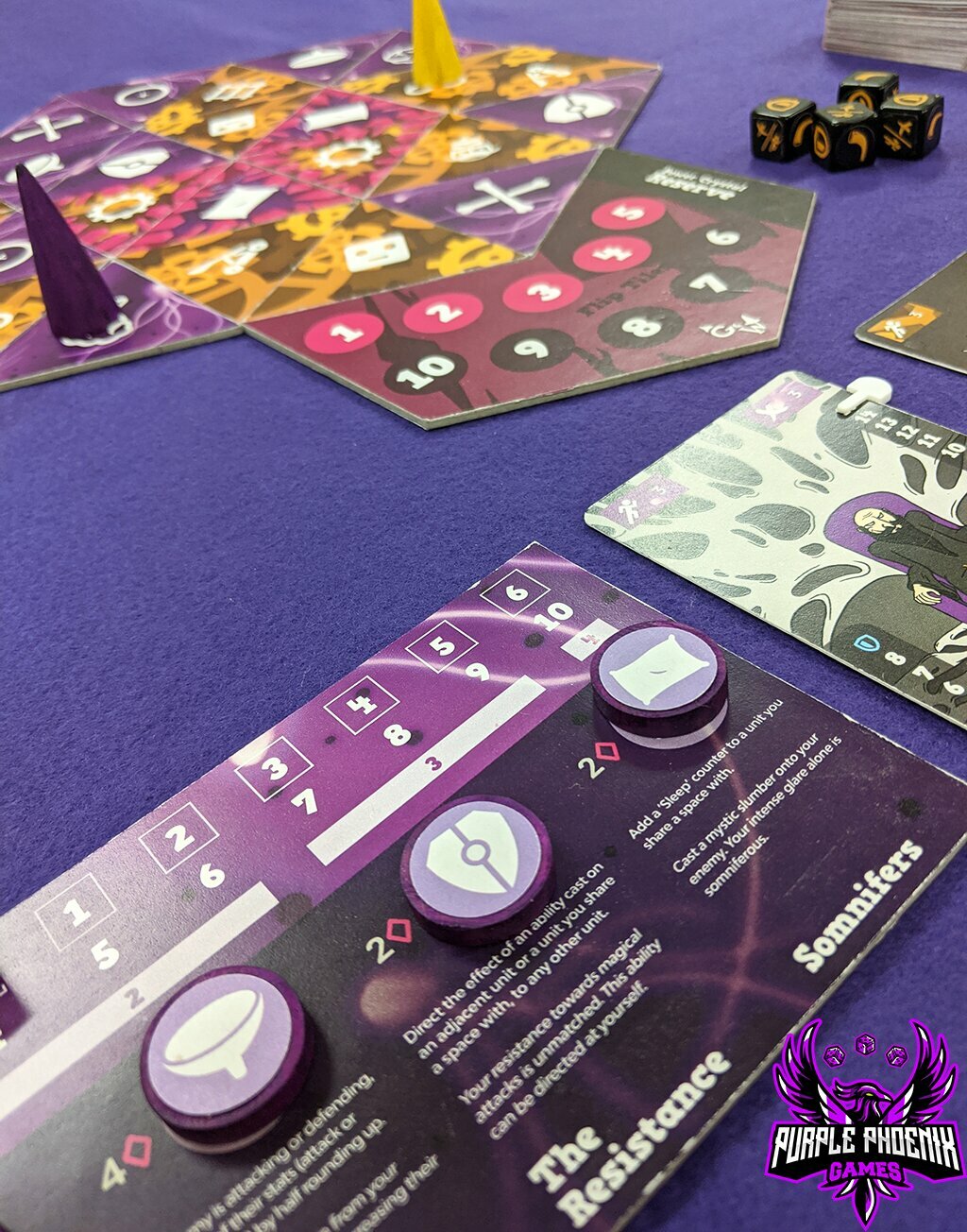
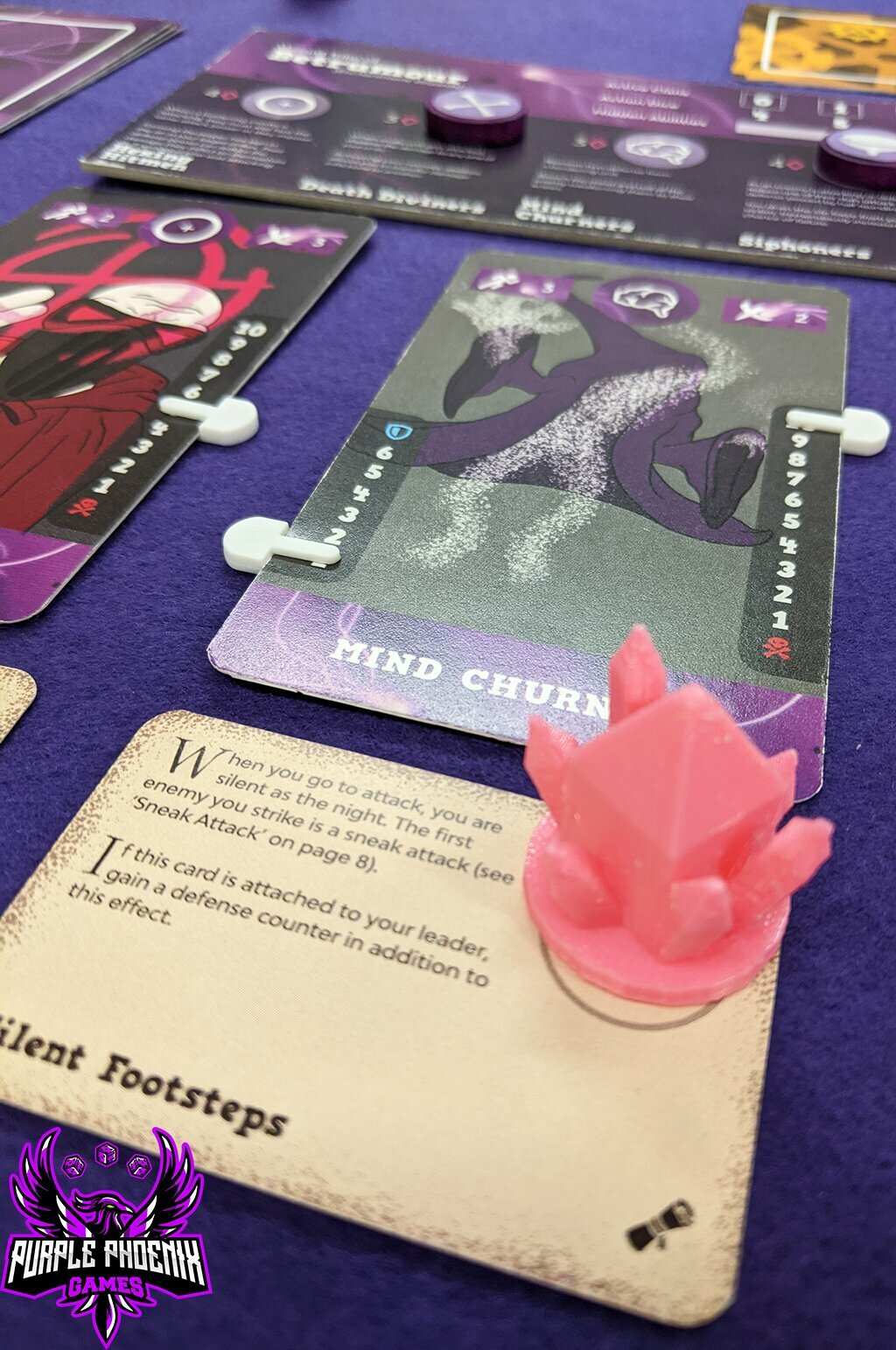
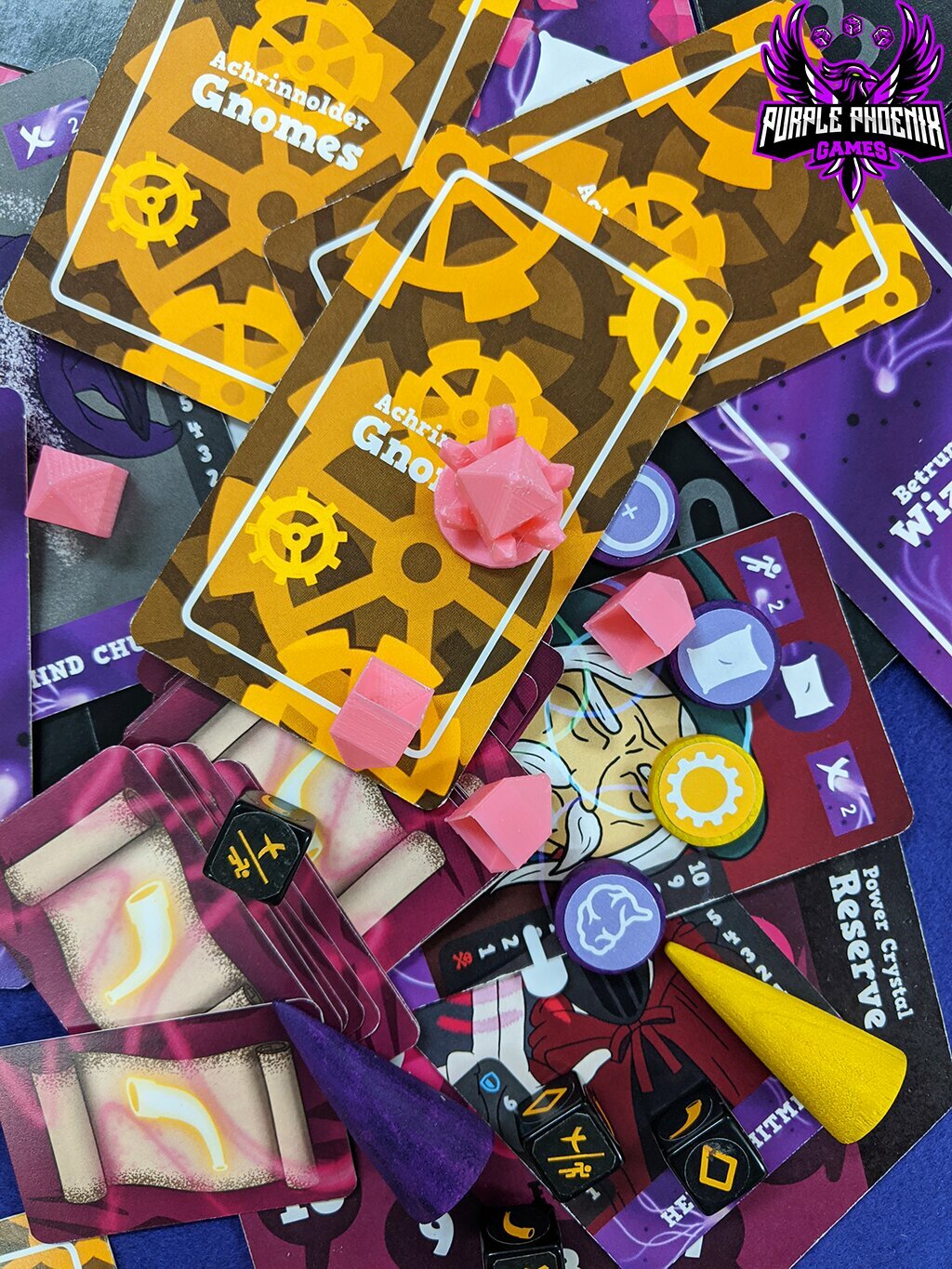
To setup the game, each player receives all the components in their chosen color for their clan. A clan consists of a leader (which is represented by the cone on the board) and six tribesmen (henchpeople represented by discs with their specific icon). The board is an elaborate puzzle of triangular pieces that fit together beautifully and create a very interesting map on the table. In the middle of this puzzle map will always be the mine tiles – tiles that have pink power crystals outlining the inner icons. Each leader will have clips placed on their cards to keep track of HP and Defense, and these cards also show baseline movement speed and attack power. Once all players have completed their setup and the black dice have been rolled to determine the starting player, the game is ready to begin and the crystals are primed to be exploited.
Gnomes & Wizards is a game of dice manipulation and allocation at its core. Leaders and tribesmen will always have base movement, attack, defense, and HP, but the dice rolls can alter these. Perhaps you are a super-aggressive player and are just out to destroy the other clan(s). I have played that way and it works very well. If so, then when rolling you will want to concentrate your efforts on the move/attack die face. These add to either your movement speed or to your attack power (not both). Other die faces include defense (which raise your defense clip), horns (which can buy you an ability card OR help to call a tribe – more on this later), or collect power crystals.
Power crystals are used to charge clan abilities (printed on the clan board) and card abilities (attached to clansmen). You can earn your power crystals via die rolls or by passing through the mine tiles in the center of the board map. These power crystals, and the abilities they fuel, are very powerful and can make or break encounters against other clans.
Horns are what need to be rolled to bring more tribesmen on the board. Initially, each clan will only have the leader cones available on the board to play with until more tribesmen can be called to the fray. Rolling three horns and having a leader cone or tribesman disc on tribe-specific icon tiles will allow that tribe to be called onto the board. Did you only roll one or two horns? That’s okay, because horns are also used to draw ability cards from the deck. Draw as many cards as you have rolled horns and choose one of those to keep and the others are discarded to the bottom of the deck. You may attach certain ability cards to your clansmen to be charged by power crystals and used later, or keep certain other cards hidden in your stash to be used any time – even on another player’s turn.
The winner of Gnomes & Wizards is the player who earns the most VP by knocking out opponent clansmen/leaders and earning 1VP per HP remaining on active clansmen cards. I purposely left out a couple twists for you here. Your gameplan needs to be carried out in just 10 rounds in a normal game. So you only have 10 turns to create your all-star clan, earn power crystals, and beat up your opponents. Not enough? Okay how about this – after Round 5 each player will flip over two map tiles at the beginning of their turns – thus eliminating possibilities of calling clansmen to war because their icon is now flipped and unavailable. Each turn is incredibly important to maximize as best as possible as you only get 10 of them, and the map will begin to crumble away.
Components. Again, we were provided a prototype version of the game, so I will not comment on component quality, even though it’s already pretty good. I can see what CavernWire is trying to do here and I am very excited by the plans. The layout on the cards is great. The dice will be cool when final. The amazing power crystals will be a little fragile, so do take care of them, but the design is awesome. The best part about the components on this one – the colors. This game is so wonderfully colorful, and extremely attractive on the table. When playing at work, my coworkers all walked by the table and wanted to know what I was up to. I play games at work a lot, but this one was so vibrant and interesting that they wanted to know more – and they are all mostly non-gamers.
I find Gnomes & Wizards to be a game that I wish I could spend lots of time exploring every strength and weakness of each clan. Trying new strategies, and watching them be dismantled by newcomers. I have not seen every ability card yet. I have not played with each clan yet. But I want to. It’s a deeply colorful game with engaging mechanics (and lots of them) that I feel offers something special to a game collection. So if you are interested in grabbing a copy for yourself, head over to CavernWire’s website and hop on the Kickstarter campaign. Or purchase a copy from your FLGS or favorite online retailer. We dig it.
Gnomes & Wizards is an area control, map deformation, dice assignment battle game where the players are attempting to earn the most victory points (VP) at the end of the game. Players gain VP by defeating other players’ active characters (clan leaders and tribesmen henchpeople), and having the most hit points (HP) between all their active characters at game end. Sounds easy, right? Read on, my friend.
DISCLAIMER: We were provided a prototype copy of this game for the purposes of this review. These are preview copy components, and the final components will probably be different from these shown. Also, it is not my intention to detail every rule in the game, as there are just too many. You are invited to download the rulebook from the publisher’s website, purchase the game through the Kickstarter campaign, or through any retailers stocking it after fulfillment. -T
As I mentioned in my disclaimer, I will not be explaining every rule for this one as there are quite a few little nuances that make it tick. However, I will cover the basic gameplay, and I will be focusing on a 2-player game for this preview.
To setup the game, each player receives all the components in their chosen color for their clan. A clan consists of a leader (which is represented by the cone on the board) and six tribesmen (henchpeople represented by discs with their specific icon). The board is an elaborate puzzle of triangular pieces that fit together beautifully and create a very interesting map on the table. In the middle of this puzzle map will always be the mine tiles – tiles that have pink power crystals outlining the inner icons. Each leader will have clips placed on their cards to keep track of HP and Defense, and these cards also show baseline movement speed and attack power. Once all players have completed their setup and the black dice have been rolled to determine the starting player, the game is ready to begin and the crystals are primed to be exploited.
Gnomes & Wizards is a game of dice manipulation and allocation at its core. Leaders and tribesmen will always have base movement, attack, defense, and HP, but the dice rolls can alter these. Perhaps you are a super-aggressive player and are just out to destroy the other clan(s). I have played that way and it works very well. If so, then when rolling you will want to concentrate your efforts on the move/attack die face. These add to either your movement speed or to your attack power (not both). Other die faces include defense (which raise your defense clip), horns (which can buy you an ability card OR help to call a tribe – more on this later), or collect power crystals.
Power crystals are used to charge clan abilities (printed on the clan board) and card abilities (attached to clansmen). You can earn your power crystals via die rolls or by passing through the mine tiles in the center of the board map. These power crystals, and the abilities they fuel, are very powerful and can make or break encounters against other clans.
Horns are what need to be rolled to bring more tribesmen on the board. Initially, each clan will only have the leader cones available on the board to play with until more tribesmen can be called to the fray. Rolling three horns and having a leader cone or tribesman disc on tribe-specific icon tiles will allow that tribe to be called onto the board. Did you only roll one or two horns? That’s okay, because horns are also used to draw ability cards from the deck. Draw as many cards as you have rolled horns and choose one of those to keep and the others are discarded to the bottom of the deck. You may attach certain ability cards to your clansmen to be charged by power crystals and used later, or keep certain other cards hidden in your stash to be used any time – even on another player’s turn.
The winner of Gnomes & Wizards is the player who earns the most VP by knocking out opponent clansmen/leaders and earning 1VP per HP remaining on active clansmen cards. I purposely left out a couple twists for you here. Your gameplan needs to be carried out in just 10 rounds in a normal game. So you only have 10 turns to create your all-star clan, earn power crystals, and beat up your opponents. Not enough? Okay how about this – after Round 5 each player will flip over two map tiles at the beginning of their turns – thus eliminating possibilities of calling clansmen to war because their icon is now flipped and unavailable. Each turn is incredibly important to maximize as best as possible as you only get 10 of them, and the map will begin to crumble away.
Components. Again, we were provided a prototype version of the game, so I will not comment on component quality, even though it’s already pretty good. I can see what CavernWire is trying to do here and I am very excited by the plans. The layout on the cards is great. The dice will be cool when final. The amazing power crystals will be a little fragile, so do take care of them, but the design is awesome. The best part about the components on this one – the colors. This game is so wonderfully colorful, and extremely attractive on the table. When playing at work, my coworkers all walked by the table and wanted to know what I was up to. I play games at work a lot, but this one was so vibrant and interesting that they wanted to know more – and they are all mostly non-gamers.
I find Gnomes & Wizards to be a game that I wish I could spend lots of time exploring every strength and weakness of each clan. Trying new strategies, and watching them be dismantled by newcomers. I have not seen every ability card yet. I have not played with each clan yet. But I want to. It’s a deeply colorful game with engaging mechanics (and lots of them) that I feel offers something special to a game collection. So if you are interested in grabbing a copy for yourself, head over to CavernWire’s website and hop on the Kickstarter campaign. Or purchase a copy from your FLGS or favorite online retailer. We dig it.
Purple Phoenix Games (2266 KP) rated Exit: The Game – The Polar Station in Tabletop Games
Mar 11, 2022
One thing that has grown in popularity over the recent years are Escape Rooms. You know, where you’re physically trapped inside a room and have to solve various puzzles, crack codes, and beat the clock in an effort to get out before it’s game over. It should come as no surprise that this premise has made its way into the world of board gaming. Yeah, you’re not physically trapped somewhere, but you still have tons of puzzles to sort out in the fastest time you can. So how does this EXIT game hold up when compared with a real-life escape room? Keep reading to find out!
Disclaimer: In order to avoid spoilers, I will not be going too in depth with this review, but rather provide a general overview of the type of gameplay involved. Also, this review covers one specific EXIT game, but the general mechanics and gameplay are the same across the entire EXIT family.
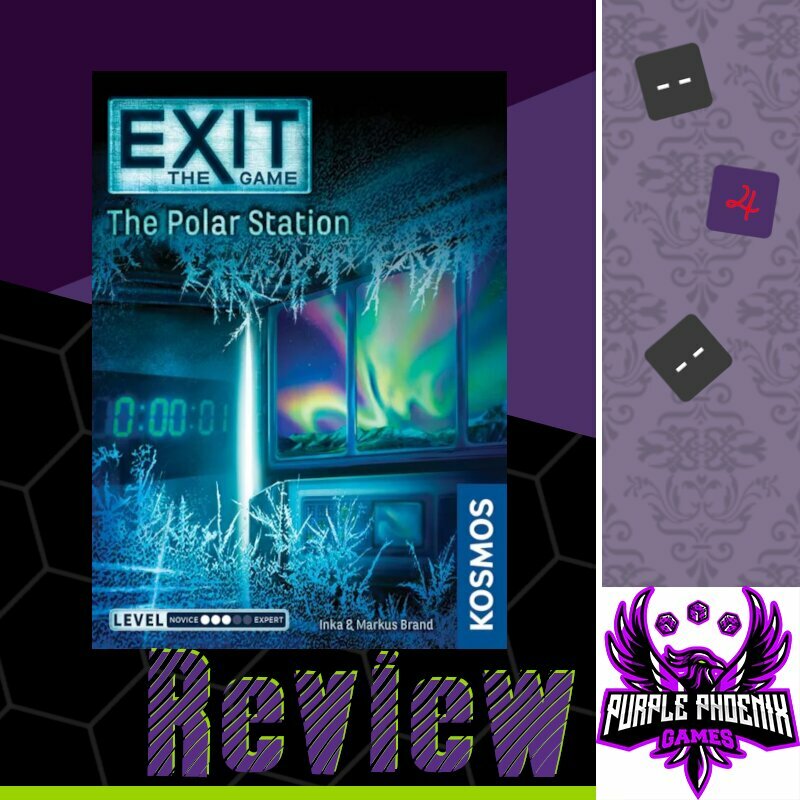
In EXIT: The Game – The Polar Station (simply referred to as just EXIT from hereon out), you are a member of a research team stationed in the Arctic. One morning, the evacuation alarm goes off unexpectedly, and everyone makes a break for the helicopters. Just one problem for your crew – your exit door is already locked and sealed! You make your way to another section of the lab to look for an alternate escape route. What you find is a room full of locked drawers/doors. You must quickly crack these codes, in hopes that the materials contained within will aid you in your attempts to escape before the final rescue helicopter takes off.
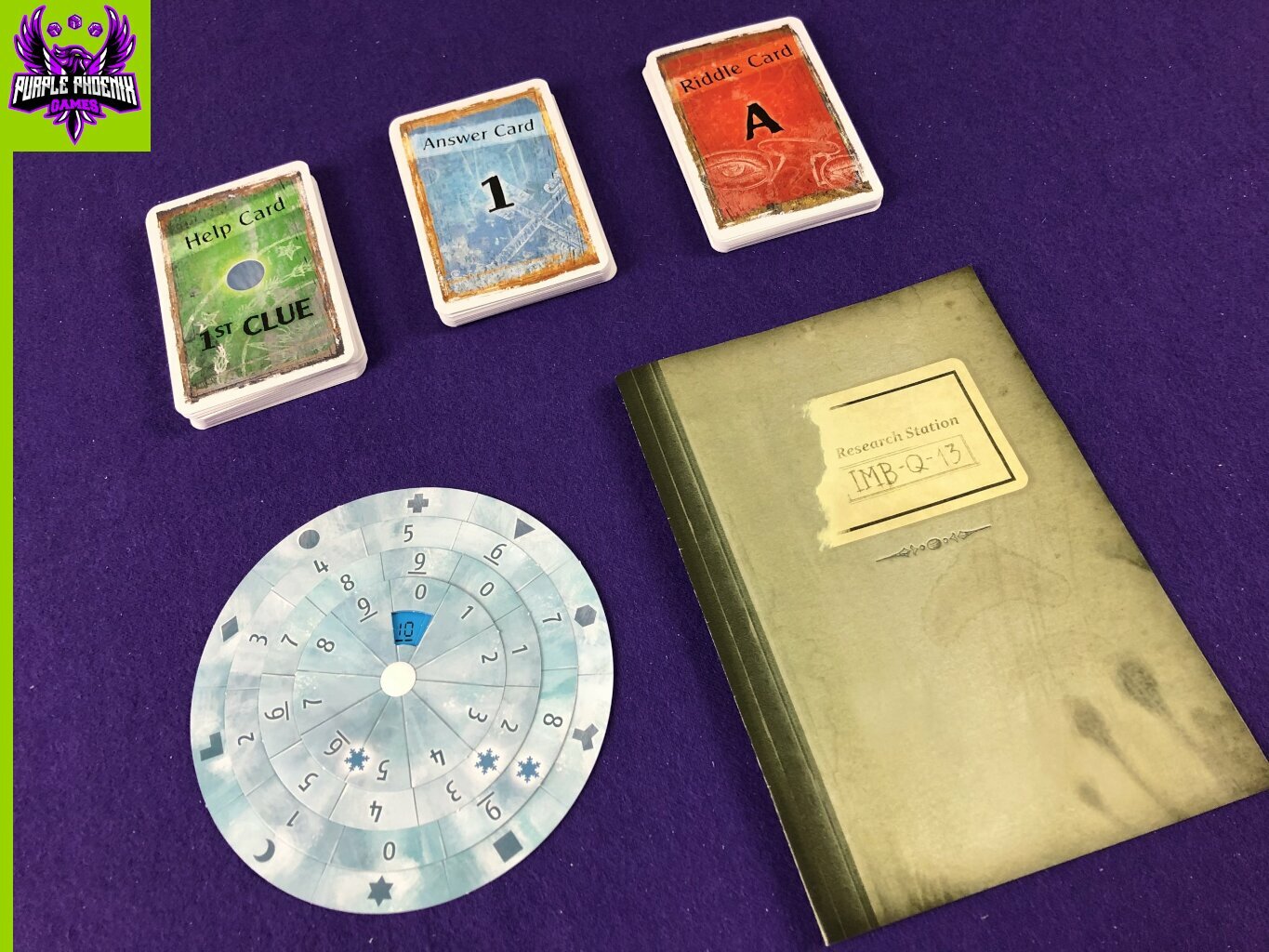
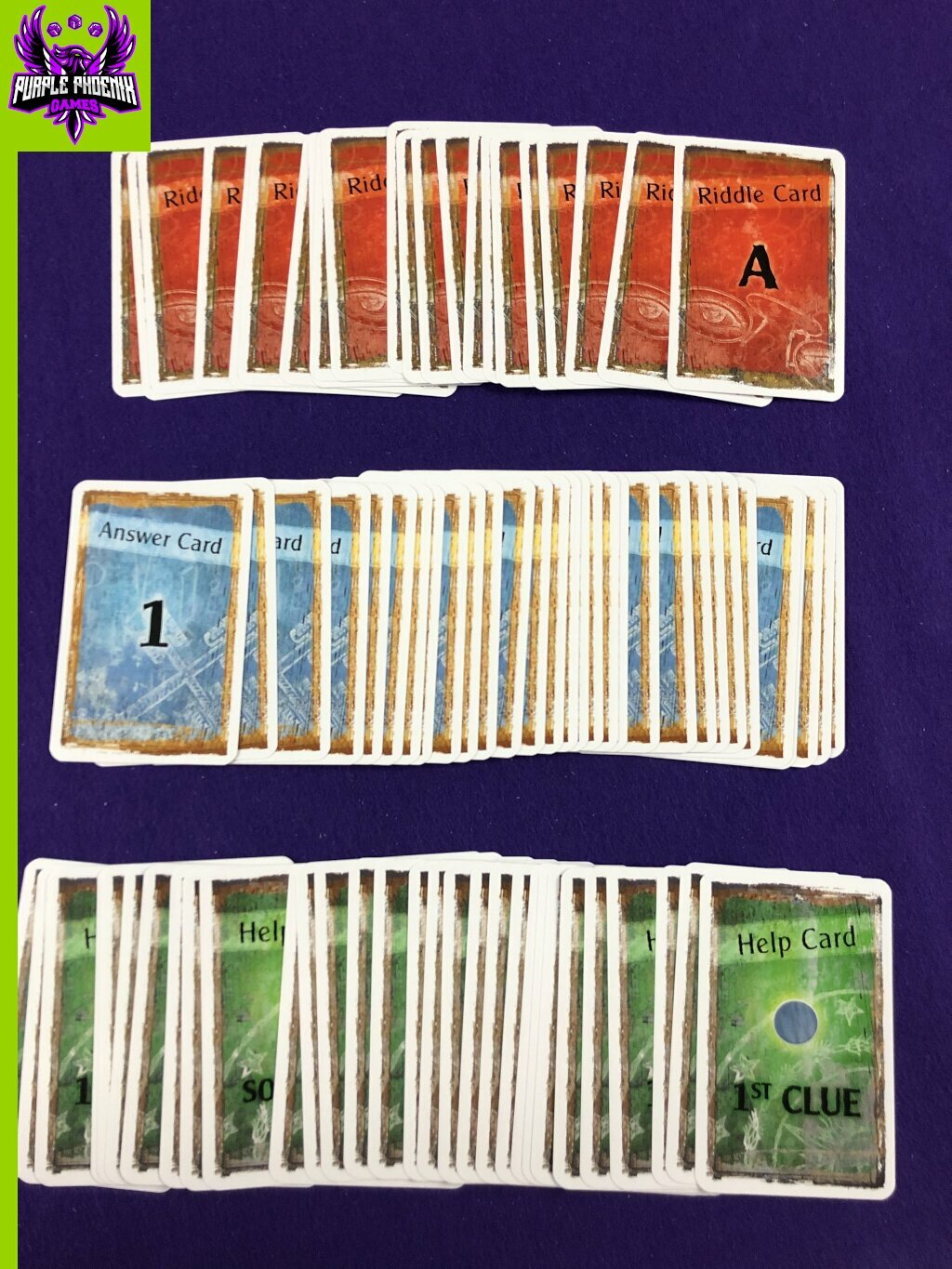
To setup for a game, sort the cards into their appropriate decks – Riddle cards, Answer cards, and Help cards. Place the Decoder disk and the Book in the center of the table. Leave the other items in the game box, to be introduced later in the gameplay. You will also most likely need a pen/pencil and paper to help you as you solve the riddles. And bam! You’re ready to start. You may then open the Book and begin the game. The game ends if or when players are able to successfully solve all of the riddles/puzzles and make their escape from the polar station.
Without spoilers, that’s basically as much detail as I can provide. Over the course of the gameplay, players will be using the pages of the Book to find clues, solve puzzles, or even identify secret symbols. Riddle cards will be drawn and used as ciphers, puzzles, or clues to help crack a code. When you think you have the correct 3-digit code for a specific Riddle Card, enter the code onto the Decoder disk. The disk will then provide the number of an Answer card, which you will draw and check to see if you were correct or incorrect. If your answer is incorrect, you simply keep trying to solve the Riddle card. If your answer is correct, you will then be instructed to draw other Riddle Cards, or the other items from the game box, and will continue with these new puzzles. If at any point in time you feel stuck, you may draw a Help card for the corresponding puzzle. The first and second Help cards will give you hints, and the final Help card will tell you the solution to the puzzle. Draw these sparingly if you can, as they affect your end-game score!
When all puzzles/riddles/codes have been completed and cracked, the game is over. Players will then check the rulebook to see how many Stars were earned, out of 10. The number of Help cards you use, as well as how much time you took to complete the game, will affect the overall score.
All in all, I think that EXIT is a unique game. The games of the series have varying difficulty levels, and this particular EXIT is rated a 3 out of 5. So this one isn’t the most difficult game in the bunch, but it wasn’t easy either! All of the puzzles require creative solutions, and the answers are rarely ever as straight-forward as they appear. Some puzzles are more logical than others, while some require you to physically manipulate components to be used in creative ways. I guess that’s as good a segue as any to get into components. This game consists of a deck of cards, a Decoder disk, a Book, and a couple of special ‘items.’ All decent quality overall. But here’s the thing – you will have to bend/cut/manipulate/destroy many of the components to help you in your mission to solve the riddles. So this game is literally a one-and-done. It cannot be played again.
Did I enjoy my play of this EXIT game? Yes. It was uniquely challenging, while forcing me to think creatively when addressing the different riddles. The method used to solve one riddle is not necessarily the same to solve the next, so you have be able to adjust on the fly. And often times you will have several riddles in play at once, so you have to decide which to address and when, when do you have the right information, which riddle it goes with, etc.
The biggest drawback for me is that it cannot be played again, The fact that you have to alter the components to a point of destroying the original card is something that was personally hard for me to get used to. I try to keep all my games so nice and pristine, that having to cut a card apart was tough! I got over it though. Having played a couple of the EXIT games, as well as a few of the Unlock! games, I would have to say I prefer the Unlock! system. The puzzles are just as challenging and creative, but you do not need to alter components to complete the game. That way, I can pass along an Unlock! game to a friend, as opposed to just tossing this EXIT game right in the recycling bin. I might pick up another EXIT game if I had a specific group/game night in mind, but in general I don’t think I’ll be grabbing any more of these, for the lack of replayability alone. The gameplay itself is pretty great, but the fact that I can’t play it again is a con I can’t ignore. Purple Phoenix Games gives this one a chilling 4 / 6.
Disclaimer: In order to avoid spoilers, I will not be going too in depth with this review, but rather provide a general overview of the type of gameplay involved. Also, this review covers one specific EXIT game, but the general mechanics and gameplay are the same across the entire EXIT family.
In EXIT: The Game – The Polar Station (simply referred to as just EXIT from hereon out), you are a member of a research team stationed in the Arctic. One morning, the evacuation alarm goes off unexpectedly, and everyone makes a break for the helicopters. Just one problem for your crew – your exit door is already locked and sealed! You make your way to another section of the lab to look for an alternate escape route. What you find is a room full of locked drawers/doors. You must quickly crack these codes, in hopes that the materials contained within will aid you in your attempts to escape before the final rescue helicopter takes off.
To setup for a game, sort the cards into their appropriate decks – Riddle cards, Answer cards, and Help cards. Place the Decoder disk and the Book in the center of the table. Leave the other items in the game box, to be introduced later in the gameplay. You will also most likely need a pen/pencil and paper to help you as you solve the riddles. And bam! You’re ready to start. You may then open the Book and begin the game. The game ends if or when players are able to successfully solve all of the riddles/puzzles and make their escape from the polar station.
Without spoilers, that’s basically as much detail as I can provide. Over the course of the gameplay, players will be using the pages of the Book to find clues, solve puzzles, or even identify secret symbols. Riddle cards will be drawn and used as ciphers, puzzles, or clues to help crack a code. When you think you have the correct 3-digit code for a specific Riddle Card, enter the code onto the Decoder disk. The disk will then provide the number of an Answer card, which you will draw and check to see if you were correct or incorrect. If your answer is incorrect, you simply keep trying to solve the Riddle card. If your answer is correct, you will then be instructed to draw other Riddle Cards, or the other items from the game box, and will continue with these new puzzles. If at any point in time you feel stuck, you may draw a Help card for the corresponding puzzle. The first and second Help cards will give you hints, and the final Help card will tell you the solution to the puzzle. Draw these sparingly if you can, as they affect your end-game score!
When all puzzles/riddles/codes have been completed and cracked, the game is over. Players will then check the rulebook to see how many Stars were earned, out of 10. The number of Help cards you use, as well as how much time you took to complete the game, will affect the overall score.
All in all, I think that EXIT is a unique game. The games of the series have varying difficulty levels, and this particular EXIT is rated a 3 out of 5. So this one isn’t the most difficult game in the bunch, but it wasn’t easy either! All of the puzzles require creative solutions, and the answers are rarely ever as straight-forward as they appear. Some puzzles are more logical than others, while some require you to physically manipulate components to be used in creative ways. I guess that’s as good a segue as any to get into components. This game consists of a deck of cards, a Decoder disk, a Book, and a couple of special ‘items.’ All decent quality overall. But here’s the thing – you will have to bend/cut/manipulate/destroy many of the components to help you in your mission to solve the riddles. So this game is literally a one-and-done. It cannot be played again.
Did I enjoy my play of this EXIT game? Yes. It was uniquely challenging, while forcing me to think creatively when addressing the different riddles. The method used to solve one riddle is not necessarily the same to solve the next, so you have be able to adjust on the fly. And often times you will have several riddles in play at once, so you have to decide which to address and when, when do you have the right information, which riddle it goes with, etc.
The biggest drawback for me is that it cannot be played again, The fact that you have to alter the components to a point of destroying the original card is something that was personally hard for me to get used to. I try to keep all my games so nice and pristine, that having to cut a card apart was tough! I got over it though. Having played a couple of the EXIT games, as well as a few of the Unlock! games, I would have to say I prefer the Unlock! system. The puzzles are just as challenging and creative, but you do not need to alter components to complete the game. That way, I can pass along an Unlock! game to a friend, as opposed to just tossing this EXIT game right in the recycling bin. I might pick up another EXIT game if I had a specific group/game night in mind, but in general I don’t think I’ll be grabbing any more of these, for the lack of replayability alone. The gameplay itself is pretty great, but the fact that I can’t play it again is a con I can’t ignore. Purple Phoenix Games gives this one a chilling 4 / 6.

Kristy H (1252 KP) rated The Dark Lake in Books
Dec 24, 2017 (Updated Dec 24, 2017)
intriguing (2 more)
compelling
surprising
Rosalind Ryan, a popular yet mysterious teacher, is found dead by the local lake. She's been murdered, her body left floating with red roses surrounding her. Detective Sergeant Gemma Woodstock and her partner, Felix, are called in to investigate Rosalind's case. Nothing about Rosalind adds up--everyone seemed to like her, but no one really knew her. She lived in a cheap apartment, but clearly had expensive taste in wine and makeup. She was the youngest of four, with three brothers, one of with whom she'd quarreled recently. Her father, George, is ill and runs a large business conglomerate in Australia, yet seemed to adore his inscrutable daughter. As for Gemma, she has memories of Rosalind from their time together in high school, when the beautiful Rose seemed enigmatic even then. Gemma and Felix have their hands full, focusing on Rosalind's co-workers, students, family, and more. Who is responsible for the death of this lovely teacher?
This is an intriguing and compelling two part mystery, with the present-day case focusing on Rosalind, combined with flashes to Gemma's past, focusing on her history with her former boyfriend Jacob, who died as a teen. The majority of our story is told from Gemma's present-day point of view, but we get a few key snippets from the townspeople and occasionally Gemma's point of view flashes to the past.
I really liked Gemma as a narrator. The intersection of the case with her past was extremely well-done. I read some reviews where the readers didn't care for Gemma, but that wasn't the case for me, though I could understand, as the story wore on, how they came to that point of view. She doesn't always make the right decisions, and I'm intrigued to see what she'll be like in the next novel (Goodreads tell me this is the first book in the series). But for me, I identified with her in many ways and, because she was so well-written, really enjoyed the story from her point of view, even if I didn't always agree with her actions. It was also great to get to see a character dealing with the challenges of being female and a mother in a small police force--in a small town no less--in what seemed to be, overall, a fairly realistic fashion.
The story itself is great. There are several twists that really got me, so major kudos to Bailey. I read a lot of thrillers, and it's not always easy to surprise me! For a huge portion of this book, I had *no idea* where this was going to go, or who killed Rosalind. Several times I found myself genuinely shocked by the happenings and was completely enthralled by the story and Bailey's characters. (I also can't believe this is a debut novel - wow.) She does an excellent job at creating tension in the story and the characters, slowing unfurling plot points and details as we go along. This novel is truly a puzzle, the pieces fitting into place as we go along, and putting them together is a joy. It is so well-done and Bailey's weaving together the past and the present is excellent. I wound up really liking Gemma, and her boss Jonesy, and I'm quite excited this is a series. I can't wait to see where Bailey takes us (and Gemma) next. 4.5 stars.
This is an intriguing and compelling two part mystery, with the present-day case focusing on Rosalind, combined with flashes to Gemma's past, focusing on her history with her former boyfriend Jacob, who died as a teen. The majority of our story is told from Gemma's present-day point of view, but we get a few key snippets from the townspeople and occasionally Gemma's point of view flashes to the past.
I really liked Gemma as a narrator. The intersection of the case with her past was extremely well-done. I read some reviews where the readers didn't care for Gemma, but that wasn't the case for me, though I could understand, as the story wore on, how they came to that point of view. She doesn't always make the right decisions, and I'm intrigued to see what she'll be like in the next novel (Goodreads tell me this is the first book in the series). But for me, I identified with her in many ways and, because she was so well-written, really enjoyed the story from her point of view, even if I didn't always agree with her actions. It was also great to get to see a character dealing with the challenges of being female and a mother in a small police force--in a small town no less--in what seemed to be, overall, a fairly realistic fashion.
The story itself is great. There are several twists that really got me, so major kudos to Bailey. I read a lot of thrillers, and it's not always easy to surprise me! For a huge portion of this book, I had *no idea* where this was going to go, or who killed Rosalind. Several times I found myself genuinely shocked by the happenings and was completely enthralled by the story and Bailey's characters. (I also can't believe this is a debut novel - wow.) She does an excellent job at creating tension in the story and the characters, slowing unfurling plot points and details as we go along. This novel is truly a puzzle, the pieces fitting into place as we go along, and putting them together is a joy. It is so well-done and Bailey's weaving together the past and the present is excellent. I wound up really liking Gemma, and her boss Jonesy, and I'm quite excited this is a series. I can't wait to see where Bailey takes us (and Gemma) next. 4.5 stars.
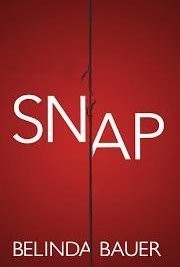
Fun, intriguing novel that keeps you guessing until the end
Jack is eleven when his pregnant mother goes for help after their car breaks down by the side of the road. She leaves him in charge of his two younger sisters. But she's gone too long and Jack and his siblings eventually go in search of her. But they do not find her: just a broken pay phone. Jack never sees his mother again, and it's eventually revealed she's been murdered. Three years later, Jack is doing the best to support his sisters, especially since his dad went out for milk and never came back. Meanwhile, another pregnant woman named Catherine While is startled when her house is broken into--while she's home--and the intruder leaves her a disturbing note. A strange set of occurrences leaves Catherine feeling unsettled and watched. And Jack is starting to wonder if he's getting closer to finding out who killed his mother.
This was a really bizarre book in many ways, but I totally enjoyed it. It's mainly told from the point of view of Jack, Catherine, and two policemen: Reynolds, a fastidious Detective Sergeant and Marvel, a disgruntled DCI. It often quickly changes viewpoints between these characters, but somehow, it all works. In fact, while the novel is compulsively readable in terms of finding out what happened to Jack's mother, it's also oddly funny at times: there's a dry wit running underneath the story.
Even more, the characters are really enjoyable. Catherine, eh, she wasn't my favorite (her decision-making leaves a lot to be desired), but Jack was great: I was rooting for him the entire time, even in cases where I probably shouldn't have been, based on some of his behavior. The poor kid has a lot to deal with, trying to care for his kid sisters. And Marvel and Reynolds: they can be annoying and even spiteful in their actions at times, but they are really fun to read about. The whole combination of this group somehow works, and it kept me flipping the pages, wondering what on earth had transpired and how, when, and why. The novel is creepy at times, funny at times, and sad and heartbreaking at times: impressive.
There are definitely a lot of characters in this book, and sometimes keeping track of them all was a bit of a challenge, but I was impressed at how Bauer connected them all eventually. And, seriously, you get attached to them, or annoyed with them as if they are real people--which I find doesn't always happen to me with a thriller. Some of what the police do seems a little much--part of why I say the book seems a little bizarre, as does some of the plot, but I found myself enjoying the book so much that none of it mattered. Bauer lets us put the pieces together simultaneously as her characters do, and the story in this one was just compelling, fun, and different.
Overall, this was a fun, intriguing novel that keeps you guessing until the end. The characters are interesting and draw you in immediately. There's humor and heartbreak, but also a great puzzle to solve as well.
I received a copy of this novel from the publisher and Netgalley in return for an unbiased review (thank you!).
This was a really bizarre book in many ways, but I totally enjoyed it. It's mainly told from the point of view of Jack, Catherine, and two policemen: Reynolds, a fastidious Detective Sergeant and Marvel, a disgruntled DCI. It often quickly changes viewpoints between these characters, but somehow, it all works. In fact, while the novel is compulsively readable in terms of finding out what happened to Jack's mother, it's also oddly funny at times: there's a dry wit running underneath the story.
Even more, the characters are really enjoyable. Catherine, eh, she wasn't my favorite (her decision-making leaves a lot to be desired), but Jack was great: I was rooting for him the entire time, even in cases where I probably shouldn't have been, based on some of his behavior. The poor kid has a lot to deal with, trying to care for his kid sisters. And Marvel and Reynolds: they can be annoying and even spiteful in their actions at times, but they are really fun to read about. The whole combination of this group somehow works, and it kept me flipping the pages, wondering what on earth had transpired and how, when, and why. The novel is creepy at times, funny at times, and sad and heartbreaking at times: impressive.
There are definitely a lot of characters in this book, and sometimes keeping track of them all was a bit of a challenge, but I was impressed at how Bauer connected them all eventually. And, seriously, you get attached to them, or annoyed with them as if they are real people--which I find doesn't always happen to me with a thriller. Some of what the police do seems a little much--part of why I say the book seems a little bizarre, as does some of the plot, but I found myself enjoying the book so much that none of it mattered. Bauer lets us put the pieces together simultaneously as her characters do, and the story in this one was just compelling, fun, and different.
Overall, this was a fun, intriguing novel that keeps you guessing until the end. The characters are interesting and draw you in immediately. There's humor and heartbreak, but also a great puzzle to solve as well.
I received a copy of this novel from the publisher and Netgalley in return for an unbiased review (thank you!).

Amanda (96 KP) rated The Woman in the Window in Books
Mar 11, 2019
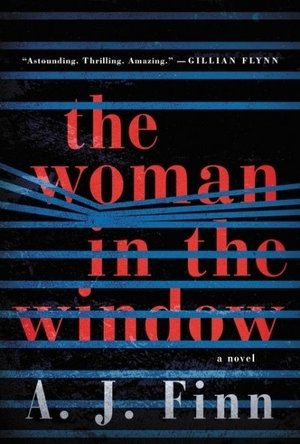
Anna has what's called Agoraphobia, meaning that she has anxiety leaving her house. Therefore, anything that needs to be done outside the house, she has done for her. Any medications she needs, groceries, etc., they are delivered to her house. She can't even bare to open a window because it would trigger her phobia. You learn there are different reasons for this kind of phobia.
Loss of a loved one.
Tragic accident.
Or...it could be something else entirely.
Ann also talks to other people with the same phobia and tries to also council them. You don't find out till much later as to why Anna who was a child psychologist now cannot bare to leave her home. She suffers from depression and is on multiple medications. She's separated from her husband, whom also has their daughter with him.
And she drinks...a lot.
One of the things I liked about Anna is her love for old movies. I loved how Finn incorporated some lines from different movies, including Alfred Hitchcock. Anna witnesses a murder in her neighbors house across the street. Try as she may, nobody takes her seriously and blame it on the medication she takes with alcohol.
“You can hear someone’s secrets and their fears and their wants, but remember that these exist alongside other people’s secrets and fears, people living in the same room.”
I kind of felt bad for her, but sometime during the story, I started to get frustrated with her as well. I really got a Girl on a Train feel. The main character always needs a drink or has to drink something in order to keep herself together, even though the alcohol doesn't help her situation at all.
On a different note, Girl on a Train was highly depressing.
The more the story progressed the more intrigued I got because there were quite a few twists that I honestly didn't see coming and I found myself yelling, 'WHAT?' Glad I was only listening to a book in the car and not in my house where someone could look at me funny. Not that people don't do that anyway, but such as life as a bookworm, I don't care.
“The definition of insanity, Fox, Wesley used to remind me, paraphrasing Einstein, is doing the same thing again and again and expecting different result.”
I've read a few psychological thrillers and while they were good, none kept me on my toes like this one. So many things happen with Anna and they come in bits and pieces but eventually make up a whole puzzle. You almost start to believe that perhaps Anna didn't see someone being murdered...maybe she did have an illusion.
Did it happen?
You have to read and find out.
I'd definitely give this 4 1/2 stars. Finn's writing in Anna's point of view is brilliant. You are inside her head and you are seeing everything through her eyes. She may start to ramble from time to time, but that just shows that she's still someone who is suffering. Other characters that play a major role in her life you don't know all that much...but you learn who they are in the end.
It's a long book, but every minute of it was well worth the listen. I will say that toward the beginning it was more like Girl on a Train, but it slowly morphs into Alfred Hitchcock's, Rear Window. I will say that I look forward to A.J. Finn's next novel.
Loss of a loved one.
Tragic accident.
Or...it could be something else entirely.
Ann also talks to other people with the same phobia and tries to also council them. You don't find out till much later as to why Anna who was a child psychologist now cannot bare to leave her home. She suffers from depression and is on multiple medications. She's separated from her husband, whom also has their daughter with him.
And she drinks...a lot.
One of the things I liked about Anna is her love for old movies. I loved how Finn incorporated some lines from different movies, including Alfred Hitchcock. Anna witnesses a murder in her neighbors house across the street. Try as she may, nobody takes her seriously and blame it on the medication she takes with alcohol.
“You can hear someone’s secrets and their fears and their wants, but remember that these exist alongside other people’s secrets and fears, people living in the same room.”
I kind of felt bad for her, but sometime during the story, I started to get frustrated with her as well. I really got a Girl on a Train feel. The main character always needs a drink or has to drink something in order to keep herself together, even though the alcohol doesn't help her situation at all.
On a different note, Girl on a Train was highly depressing.
The more the story progressed the more intrigued I got because there were quite a few twists that I honestly didn't see coming and I found myself yelling, 'WHAT?' Glad I was only listening to a book in the car and not in my house where someone could look at me funny. Not that people don't do that anyway, but such as life as a bookworm, I don't care.
“The definition of insanity, Fox, Wesley used to remind me, paraphrasing Einstein, is doing the same thing again and again and expecting different result.”
I've read a few psychological thrillers and while they were good, none kept me on my toes like this one. So many things happen with Anna and they come in bits and pieces but eventually make up a whole puzzle. You almost start to believe that perhaps Anna didn't see someone being murdered...maybe she did have an illusion.
Did it happen?
You have to read and find out.
I'd definitely give this 4 1/2 stars. Finn's writing in Anna's point of view is brilliant. You are inside her head and you are seeing everything through her eyes. She may start to ramble from time to time, but that just shows that she's still someone who is suffering. Other characters that play a major role in her life you don't know all that much...but you learn who they are in the end.
It's a long book, but every minute of it was well worth the listen. I will say that toward the beginning it was more like Girl on a Train, but it slowly morphs into Alfred Hitchcock's, Rear Window. I will say that I look forward to A.J. Finn's next novel.

Sassy Brit (97 KP) rated Forever Fudge in Books
Jun 5, 2019
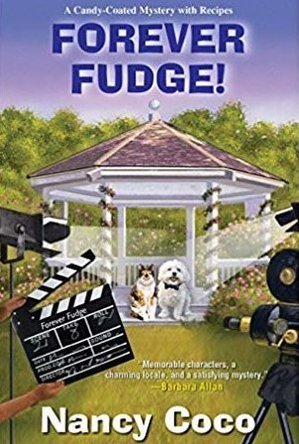
Forever Fudge by Nancy Coco is a sweet cozy mystery. Readers will salivate with the fudge recipes, be charmed on the Mackinac Island, and attempt to crack the murder mystery along with the main character Allie McMurphy.
Coco is a great pseudonym for the Fudge series. “I really enjoy writing these cozy mysteries with the humor and solving the puzzle. While writing my first series, I would put recipes on my blog. Then a friend of mine suggested I should write in this genre with a gluten free bakery. My last name was specifically chosen for this series. I love fudge, actually anything chocolate. The person in the apartment next to us said it always smells like chocolate in my house. Not only does it smell good but tastes good as well.”
Allie is an amateur sleuth. She and her dog Mal have an uncanny ability to find dead bodies. In the past, she has helped the police solve cases. As the owner of a delightful hotel and fudge shop on Mackinac Island, Allie’s excitement has grown after a television crew arrives on the island to film a television pilot for a mystery series. Throwing a wrench into the enthusiasm is the dead body found by Allie’s adorable Bichon-Poo puppy, Mal. Shot in the head, the body discovered has a letter with clues from chess moves. As the killings mount up, the murderer continues to taunt Allie, trying to get her to play his game.
The island plays a role in the story. “I have a huge family living in Michigan, which is where the island is located. If you ever saw the movie, “Somewhere in Time” starring Christopher Reeve, you can picture the setting. The island does not allow cars so people travel by foot, horse and carriage, or bicycle. It is a cool touristy place.”
There is also a love triangle. Allie is being wooed by two courters. She broke up with Trent Jessup because a long-distance relationship is not working, with him spending a lot of time in Chicago. The other beau is police chief Rex Manning who is being persistent in pursuing her, yet, willing to give her time and space.
“I thought it is interesting to compare ‘in love versus loving someone.’ I love my male friends but being ‘in love’ has excitement, a commitment, and intimacy. Allie is starting to build connections but some old timers see her as an outsider. One of those who accept her as part of the community is Rex who sees it as his responsibility to protect her and the community.”
Actual recipes are dispersed throughout the story. “I purposely did it this way to show what Allie is working on. I sprinkle it throughout to give the feel and flavor to what she is actually making. I try to relate it to the story when possible. I remember my first contract with Kensington Books required me to write ten recipes per book. Luckily, they downsized that amount. Since they had to be originals it was a relief.”
This story has an intriguing mystery, some romance, and humor. It is a fun who done it plot that has no shortage of suspects. Readers will be looking forward to the next installment, Fudge Bits, out next fall, a Halloween plot. It will highlight her cat instead of her dog that finds a Zombie body.
Coco is a great pseudonym for the Fudge series. “I really enjoy writing these cozy mysteries with the humor and solving the puzzle. While writing my first series, I would put recipes on my blog. Then a friend of mine suggested I should write in this genre with a gluten free bakery. My last name was specifically chosen for this series. I love fudge, actually anything chocolate. The person in the apartment next to us said it always smells like chocolate in my house. Not only does it smell good but tastes good as well.”
Allie is an amateur sleuth. She and her dog Mal have an uncanny ability to find dead bodies. In the past, she has helped the police solve cases. As the owner of a delightful hotel and fudge shop on Mackinac Island, Allie’s excitement has grown after a television crew arrives on the island to film a television pilot for a mystery series. Throwing a wrench into the enthusiasm is the dead body found by Allie’s adorable Bichon-Poo puppy, Mal. Shot in the head, the body discovered has a letter with clues from chess moves. As the killings mount up, the murderer continues to taunt Allie, trying to get her to play his game.
The island plays a role in the story. “I have a huge family living in Michigan, which is where the island is located. If you ever saw the movie, “Somewhere in Time” starring Christopher Reeve, you can picture the setting. The island does not allow cars so people travel by foot, horse and carriage, or bicycle. It is a cool touristy place.”
There is also a love triangle. Allie is being wooed by two courters. She broke up with Trent Jessup because a long-distance relationship is not working, with him spending a lot of time in Chicago. The other beau is police chief Rex Manning who is being persistent in pursuing her, yet, willing to give her time and space.
“I thought it is interesting to compare ‘in love versus loving someone.’ I love my male friends but being ‘in love’ has excitement, a commitment, and intimacy. Allie is starting to build connections but some old timers see her as an outsider. One of those who accept her as part of the community is Rex who sees it as his responsibility to protect her and the community.”
Actual recipes are dispersed throughout the story. “I purposely did it this way to show what Allie is working on. I sprinkle it throughout to give the feel and flavor to what she is actually making. I try to relate it to the story when possible. I remember my first contract with Kensington Books required me to write ten recipes per book. Luckily, they downsized that amount. Since they had to be originals it was a relief.”
This story has an intriguing mystery, some romance, and humor. It is a fun who done it plot that has no shortage of suspects. Readers will be looking forward to the next installment, Fudge Bits, out next fall, a Halloween plot. It will highlight her cat instead of her dog that finds a Zombie body.

Beckie Shelton (40 KP) rated If You Dare (The Lightkeepers, #2) in Books
Feb 8, 2018

🌟🌟🌟🌟 Fabulous Stars.
<a href="http://s1376.photobucket.com/user/rosella1974/media/one-way-or-an-author-review_zpsphyl14uy.png.html"; target="_blank"><img src="http://i1376.photobucket.com/albums/ah5/rosella1974/one-way-or-an-author-review_zpsphyl14uy.png~original"; border="0" alt=" photo one-way-or-an-author-review_zpsphyl14uy.png"/></a>
Reviewed By Beckie Bookworm
https://www.beckiebookworm.com
I didn't realise If You Dare (The Lightkeepers #2) By Erica Splinder was the second book in this series.
It probably would have been better to read book one first despite this "If You Dare" was very easy to interpret and told the back-story of this series splendidly.
Now You could technically read this as a standalone, but my recommendation would be start at the very beginning, it's a very good place to start usually ha ha.
<a href="http://s1376.photobucket.com/user/rosella1974/media/images%203_zps3qrbdz7u.jpg.html"; target="_blank"><img src="http://i1376.photobucket.com/albums/ah5/rosella1974/images%203_zps3qrbdz7u.jpg~original"; border="0" alt=" photo images 3_zps3qrbdz7u.jpg"/></a>
Now after playing some catch up I quickly fell into the story of dark and light bearers and the age old battle of good versus evil.
<a href="http://s1376.photobucket.com/user/rosella1974/media/Starved-Rock_zpse4w1zaf3.jpg.html"; target="_blank"><img src="http://i1376.photobucket.com/albums/ah5/rosella1974/Starved-Rock_zpse4w1zaf3.jpg~original"; border="0" alt=" photo Starved-Rock_zpse4w1zaf3.jpg"/></a>
Erica Spindler has really managed to create a vivid world that was so easy to get absorbed into, immersing myself fully into this other domain.
The book picks up where the previous one leaves us.
we have Our two detectives, Mikki, who has recovered from her injuries but is feeling that a lot is being kept from her, she feels on the outside partially, out in the cold, but not understanding exactly why.
Then there's her partner Zach who is half/ half lighter but is much more in the picture regarding information sharing and has been ordered to keep stum. keeping his partner in the dark is something he struggles with as well as certain feelings towards Mikki he so shouldn't be entertaining.
There's also Angel eighteen and struggling with her independence and Mikki's set boundaries, A Rebellious teenager in love for the first time with the mysterious Seth who comes with a very creepy but rich uncle.
This whole story is a puzzle with the pieces just waiting to be slotted together and everybody has a part to play in the bigger picture.
There are so many interesting and diverse secondary character's in this tale as well as the three main players Mikki, Zach and Angel. I love that we get to crawl inside this trios heads seeing different interpretations of events as they unfolded.
All the characters here were fleshed out well and the story just flowed for me effortlessly, keeping my attention throughout.
I found reading If You Dare an enjoyable experience and I would be happy to recommend it to others, my only advice would be Start at book one first before proceeding to the Finish line makes things a whole lot easier overall.
<a href="http://s1376.photobucket.com/user/rosella1974/media/start-and-finish_zpsnsodo1jc.jpg.html"; target="_blank"><img src="http://i1376.photobucket.com/albums/ah5/rosella1974/start-and-finish_zpsnsodo1jc.jpg~original"; border="0" alt=" photo start-and-finish_zpsnsodo1jc.jpg"/></a>
Thank you to the Publisher and NetGalley for providing me with an arc of If You Dare, this is my own honest and unbiased opinion.
Reviewed By Beckie Bookworm
https://www.beckiebookworm.com/
https://www.facebook.com/beckiebookworm/
<a href="http://s1376.photobucket.com/user/rosella1974/media/one-way-or-an-author-review_zpsphyl14uy.png.html"; target="_blank"><img src="http://i1376.photobucket.com/albums/ah5/rosella1974/one-way-or-an-author-review_zpsphyl14uy.png~original"; border="0" alt=" photo one-way-or-an-author-review_zpsphyl14uy.png"/></a>
Reviewed By Beckie Bookworm
https://www.beckiebookworm.com
I didn't realise If You Dare (The Lightkeepers #2) By Erica Splinder was the second book in this series.
It probably would have been better to read book one first despite this "If You Dare" was very easy to interpret and told the back-story of this series splendidly.
Now You could technically read this as a standalone, but my recommendation would be start at the very beginning, it's a very good place to start usually ha ha.
<a href="http://s1376.photobucket.com/user/rosella1974/media/images%203_zps3qrbdz7u.jpg.html"; target="_blank"><img src="http://i1376.photobucket.com/albums/ah5/rosella1974/images%203_zps3qrbdz7u.jpg~original"; border="0" alt=" photo images 3_zps3qrbdz7u.jpg"/></a>
Now after playing some catch up I quickly fell into the story of dark and light bearers and the age old battle of good versus evil.
<a href="http://s1376.photobucket.com/user/rosella1974/media/Starved-Rock_zpse4w1zaf3.jpg.html"; target="_blank"><img src="http://i1376.photobucket.com/albums/ah5/rosella1974/Starved-Rock_zpse4w1zaf3.jpg~original"; border="0" alt=" photo Starved-Rock_zpse4w1zaf3.jpg"/></a>
Erica Spindler has really managed to create a vivid world that was so easy to get absorbed into, immersing myself fully into this other domain.
The book picks up where the previous one leaves us.
we have Our two detectives, Mikki, who has recovered from her injuries but is feeling that a lot is being kept from her, she feels on the outside partially, out in the cold, but not understanding exactly why.
Then there's her partner Zach who is half/ half lighter but is much more in the picture regarding information sharing and has been ordered to keep stum. keeping his partner in the dark is something he struggles with as well as certain feelings towards Mikki he so shouldn't be entertaining.
There's also Angel eighteen and struggling with her independence and Mikki's set boundaries, A Rebellious teenager in love for the first time with the mysterious Seth who comes with a very creepy but rich uncle.
This whole story is a puzzle with the pieces just waiting to be slotted together and everybody has a part to play in the bigger picture.
There are so many interesting and diverse secondary character's in this tale as well as the three main players Mikki, Zach and Angel. I love that we get to crawl inside this trios heads seeing different interpretations of events as they unfolded.
All the characters here were fleshed out well and the story just flowed for me effortlessly, keeping my attention throughout.
I found reading If You Dare an enjoyable experience and I would be happy to recommend it to others, my only advice would be Start at book one first before proceeding to the Finish line makes things a whole lot easier overall.
<a href="http://s1376.photobucket.com/user/rosella1974/media/start-and-finish_zpsnsodo1jc.jpg.html"; target="_blank"><img src="http://i1376.photobucket.com/albums/ah5/rosella1974/start-and-finish_zpsnsodo1jc.jpg~original"; border="0" alt=" photo start-and-finish_zpsnsodo1jc.jpg"/></a>
Thank you to the Publisher and NetGalley for providing me with an arc of If You Dare, this is my own honest and unbiased opinion.
Reviewed By Beckie Bookworm
https://www.beckiebookworm.com/
https://www.facebook.com/beckiebookworm/