

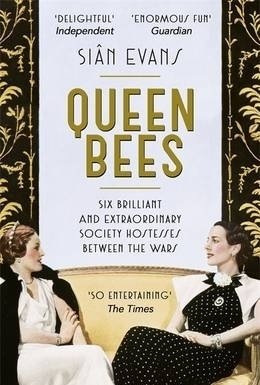

A spectacle of celebrity, talent and burning ambition, <i>Queen Bees</i> combines the biographical stories of six ambitious women who helped to shape the standards of British society between the two world wars. Londoner Siân Evans is a cultural historian who has previously worked with the <i>Victoria and Albert Museum, National Trust </i>and <i>Design Museum</i>, and takes great lengths to thoroughly research into her written subject in order to portray a highly accurate insight to the lives of historical figures. Due to the non-existent political status of women in the early 1900s, the women featured in this book are virtually unknown today, yet they had a great impact during the 20s and 30s and helped to shape the Britain of today.
Although not necessarily born into it, circumstances such as marriage meant these six women were regarded as upper class. In no particular order, the names impacting on the social revolution and thus featured in <i>Queen Bees</i> are as follows: Lady Nancy Astor, the first female MP; Lady Sybil Colefax, who became a friend of Edward VIII; Lady Emerald Cunard, also connected with the royal family; Mrs. Ronnie Greville, a rather formidable woman; Lady Edith Londonderry, the founder of the Women’s Legion; and Laura Corrigan, the youngest of the set. Evans talks the reader through these women’s careers as professional hostesses as they compete to throw the better party, entertaining famous writers and actors as well as members of royalty, both national and foreign.
What is perhaps the most interesting, and indeed the most worth learning, is the way a couple of these women altered the future of the British monarchy. Without their interference the future George VI would never have married Elizabeth Bowes-Lyon, and without their involvement in the relationship between Edward VIII and Wallis Simpson, George VI would never have come to the throne. This is such an important aspect of British history that has been widely left out and ignored. Without these hostesses influence we would all be experiencing a slightly different life.
In terms of the actual writing, Siân Evans manages fairly well to engage the reader as she relates the factual story in a more or less chronological way. A slight issue is the quick, often undetected, move from one woman to the next, resulting in a lot of confusion about who is who particularly at the beginning of the book. A lot of the narrative features other key figures from the same period and often moves away from the main characters, which, whilst interesting, is not what the reader necessarily expected from a book whose title <i>Queen Bees</i> suggested it was only going to be about the women’s lives.
Footnotes, quotes and extracts from letters and diaries help to make the book appear reliable, factual and believable. Some of the content, without back up, would have seemed rather fanciful or exaggerated. <i>Queen Bees</i> can be read as a source of entertainment or as a citation for historical research. What is found within these pages is a more unbiased account of the early twentieth century than would be found in numerous male dominated history textbooks.
Mature readers of all ages are likely to gain something from reading <i>Queen Bees</i> – pleasure, knowledge etc., however it is most likely to appeal to the contemporary feminist. With this in mind, be aware that the six hostesses were not feminists of their time; they were not involved in Suffragette movements and were fairly content to live off money earned by their husbands or fathers. Yet, on the other hand, they impacted on the future of Britain as much as the male politicians of the time. Highly political in content, <i>Queen Bees </i>is worth reading to discover our own history, but be prepared for initial confusion over who is who and rather lengthy paragraphs.

Beth Orton recommended Solid Air by John Martyn in Music (curated)


Diplomatic Intelligence on the Holy Roman Empire and Denmark During the Reigns of Elizabeth I and James VI: Three Treatises
Book
This collection brings to light three accounts on the Holy Roman Empire and Denmark during the...
Women Who Ruled: History's 50 Most Remarkable Women
Book
'Poisoners', 'whores', 'witches' and 'murderers' - or so their enemies claimed. From Queen Nefertiti...
Richard II
William Shakespeare, Keith Carabine and Cedric Watts
4.0 Rate It
Book
Richard II is one of Shakespeare's finest works: lucid, eloquent, and boldly structured. It can be...

Good Night Stories for Rebel Girls
Elena Favilli and Francesca Cavallo
9.0 Rate It
Book
Vibrantly illustrated and truly inspirational, Good Night Stories for Rebel Girls tells the stories...
The Queen’s Spy
Book
1584: Elizabeth I rules England. But a dangerous plot is brewing in court, and Mary Queen of Scots...
Historical Fiction Tudor

ClareR (6256 KP) rated The Queens Lady in Books
Dec 8, 2022
Joan no longer has a place at court, and her husband falls out of favour when his enemies gain considerable influence with the King.
It was really interesting to learn about the inner workings of the English court and the precarious line that courtiers had to tread. Joan also gave some insight into some significant historical events: the Field of the Cloth of Gold in France, Princess Margaret’s marriage to King James, the arrival of Catherine of Aragon, and accompanying Princess Mary to Paris when she marries King Louis.
I’m an absolute sucker for historical fiction, and I loved the details and the very human, realistic style this book was written in. And I really liked Joan.
The ravens are a constant - after all, Joan is the Lady of the Ravens. Bu they’re not as central to the storyline this time.
I don’t know whether this will just be a duology, or if there’s more to come, but I’ve thoroughly enjoyed this book.
Highly recommended.
The First Iron Lady: A Life of Caroline of Ansbach
Book
Often compared to Catherine the Great or Elizabeth I, Caroline of Ansbach is the great queen Britain...

Phil Leader (619 KP) rated The Tournament in Books
Nov 27, 2019
Reilly's books, under the usual all-out action sequences, always convey a good plot and storyline and have strong characterisation. Here those are to the fore. The main players are a young Princess Elizabeth; daughter of King Henry VIII and soon to be Elizabeth I and her teacher, Roger Ascham. Sultan Sulieman the Magnificent has invited all the best chess players across Europe to play to decide which nation can claim to have the ultimate chess champions. Elizabeth and Roger accompany England's entrant both to avoid the black death but also because Ascham wants to give Elizabeth a wide education just in case she becomes queen.
After a few adventures on the way the party arrives, along with the representatives of the other nations. Court intrigue and politics abound and everyone has their own agenda. When there is a high profile murder, Sulieman requests the aid of Ascham - known for his insight and ability to resolve problems using logic - to find the culprit before there is an international scandal. As the bodies pile up, Ascham and young Elizabeth face dangerous and unknown enemies and uncover plots and dark secrets.
The medieval detective story is not entirely new for Reilly. Previous he has written a couple of short stories that are available for download from his website - www.mattewreilly.com - with this theme. Dead Prince concerns the death of the Dauphin in France and is investigated by the king's architect. Roger Ascham and the King's Missing Girl is a story that precedes The Tournament by a few months and effectively introduces Ascham and his skills as he tracks down a serial kidnapper and murderer in Cambridge.
Reilly acknowledges at the end of the book that he was influenced by works such as The Name of the Rose and indeed this has much of the same flavour. The plot is complex and has the chess match running through it (and indeed sections of the book are named after chess pieces). Everything is very well handled by Reilly and everything unravels nicely in the finale of the book.
This has also been well researched. With many real historical figures included (not only Elizabeth, Ascham and Sulieman but a supporting cast that includes Ivan the Terrible and Michelangelo) and the feel of all the descriptions is very authentic.
One aspect that has to be mentioned is that, since Reilly wanted to explore something that may have influenced Elizabeth in her future life, there are a fair number of events of a sexual nature that occur. Some of these have a direct bearing on the plot, others are so that Elizabeth can form opinions on sex and marriage. Reilly has printed a warning at the start of the book that this is not for younger readers, and I can fully endorse that.
I can imagine that a number of Reilly fans will not enjoy this book - the pace is slow and methodical rather than headlong and there are very few 'action' sequences to speak of. However I would recommend this book to anybody who likes historical detective style stories.