Search
Search results

365Flicks (235 KP) rated V.S. (2019) in Movies
Nov 20, 2019


That is the synopsis for VS. on the IMDB. I am here to tell you that this movie is so so much more than this. This is one of the most powerful, thought provoking, superbly acted, respectfully told and emotionally driven movies I personally have had the pleasure of seeing in quite some time. I will get into the plot and subject matter now in a minute, but up front I would like to admit that this movie spoke to my heart and broke through a wall I didn’t think needed broken through. Yes a low budget independent movie from a debut director about the underground battle rap scene in Britain reduced this 34 year old man to being about 10 again (and not in a Jurassic park seeing dinosaurs on screen for the first time nostalgia kind of way).
Director:
Ed Lilly (debut feature film)
Cast:
Connor Swindells (The Vanishing, Netflixs Sex Education) Adam ‘Shotty Horroh’ Rooney
Fola Evans-Akingbola (Game of Thrones, Death in Paradise) Nicholas Pinnock (Fortitude, Marcella)
Ruth Sheen (Another Year, Vera Drake) Emily Taaffe (War & Peace)
First time Director Ed Lilly has put together an amazing group of young and fresh, up and coming stars and crafted a truly beautiful, gritty and raw tale of one mans use of the lyrical poetry that is Battle rap to simultaneously mask his pain and anger while working through his inner demons, only to discover a true family and camaraderie in the last place he expected. That’s just whats on the surface. Here is the trailer…
Adam has spent a life in the foster care system and it hasn’t been great to him, passed from home to home and never truly settling in wherever he is. His next stop is Southend and this could be the last chance saloon for Adam. Enter Makayla a young idealistic woman trying to make the best of it. Adam instantly takes a liking to Makayla as she introduces him to the underground Rap Battle scene. While Makayla sees this outlet as a way of making a better more tolerable life for herself and the colourful competitors, Adam sees a place he can truly let his hurt, pain and rage flow. While Adam proves to be a rising talent on the scene he is also dealing with the re-introduction to the woman who gave him away aged four… Both of Adams worlds are on a collision course and we are about to find out the type of man he wants to be.
Out Now
VOD 4th Feb. 2019
DVD 11th Feb. 2019
It is very easy to say that this is trying to be the Brit equivalent of 8-Mile (and people have been) but while I love that movie it can only wish to have the heart of Vs. I do love the rap battle sequences and having Shotty Horroh (legend on the UK Rap Battle scene, Youtube him for an education) in the movie really adds to the sense of them trying to portray this life properly. However this movie lives and breathes with the Outstandingly raw and real performances from the core cast.
Connor Swindells as Adam is unbelievable. A true revelation, A 10 out of 10 performance. Now I have to put it out there and be honest, I myself grew up in the system and while I didn’t exactly have the worst time of it I can absolutely relate to the portrayal put in by Connor. This is also a testament to the writing team of Director Ed Lilly and Daniel Hayes, they hit the nail on the head completely, The writing is so visceral that one scene in particular was a gut punch to this reviewer because I had legitimately lived the conversation and Connors performance in that scene is on another level (no spoilers but its the first real conversation he has with his mum). Swindells makes this movie an intense but rewarding journey to be part of.
Fola Evans-Akingbola is wonderful as Makayla and really holds the key to this movie. Most of the choices made by Adam revolve around her actions, while we are more focused on what is happening in his life Akingbola pushes her performance forward to show us she also is struggling through. Nicholas Pinnock, Ruth Sheen and Emily Taaffe round out the care system aspect of the movie as Adams care worker, foster carer and biological mum respectively. These sections of the movie are dealt with a great deal of attention and respect which was refreshing because here in the UK we tend to be very harsh on the system (especially in the media) but this movie shows both sides of the story. Then there is the scene I briefly spoke of earlier… Emily Taaffe, take a bow because damn you are incredible in this scene.
On the Rap Battle side of things we have massively talented Adam “Shotty Horroh” Rooney in his acting debut, I will admit when I first saw him I was dubious but he is essentially playing a version of himself and the moments that he gets to do something other than rap well he holds his own. The same can be said about MC Paige “Paigey Cakes” Meade as Miss Quotes to be fair though this isn’t her first time.
Okay then I guess its no surprise to anyone by now that I would hugely recommend this movie. I went in expecting to see 8-Mile or Bodied set in the UK but what followed was a story I just did not expect, performances that blew me away. Then again though I am a bit of sissy when movies hit me where I live. Is it perfect? Not at all what film is but hey its pretty damn close. See this movie soon as you can.
Director:
Ed Lilly (debut feature film)
Cast:
Connor Swindells (The Vanishing, Netflixs Sex Education) Adam ‘Shotty Horroh’ Rooney
Fola Evans-Akingbola (Game of Thrones, Death in Paradise) Nicholas Pinnock (Fortitude, Marcella)
Ruth Sheen (Another Year, Vera Drake) Emily Taaffe (War & Peace)
First time Director Ed Lilly has put together an amazing group of young and fresh, up and coming stars and crafted a truly beautiful, gritty and raw tale of one mans use of the lyrical poetry that is Battle rap to simultaneously mask his pain and anger while working through his inner demons, only to discover a true family and camaraderie in the last place he expected. That’s just whats on the surface. Here is the trailer…
Adam has spent a life in the foster care system and it hasn’t been great to him, passed from home to home and never truly settling in wherever he is. His next stop is Southend and this could be the last chance saloon for Adam. Enter Makayla a young idealistic woman trying to make the best of it. Adam instantly takes a liking to Makayla as she introduces him to the underground Rap Battle scene. While Makayla sees this outlet as a way of making a better more tolerable life for herself and the colourful competitors, Adam sees a place he can truly let his hurt, pain and rage flow. While Adam proves to be a rising talent on the scene he is also dealing with the re-introduction to the woman who gave him away aged four… Both of Adams worlds are on a collision course and we are about to find out the type of man he wants to be.
Out Now
VOD 4th Feb. 2019
DVD 11th Feb. 2019
It is very easy to say that this is trying to be the Brit equivalent of 8-Mile (and people have been) but while I love that movie it can only wish to have the heart of Vs. I do love the rap battle sequences and having Shotty Horroh (legend on the UK Rap Battle scene, Youtube him for an education) in the movie really adds to the sense of them trying to portray this life properly. However this movie lives and breathes with the Outstandingly raw and real performances from the core cast.
Connor Swindells as Adam is unbelievable. A true revelation, A 10 out of 10 performance. Now I have to put it out there and be honest, I myself grew up in the system and while I didn’t exactly have the worst time of it I can absolutely relate to the portrayal put in by Connor. This is also a testament to the writing team of Director Ed Lilly and Daniel Hayes, they hit the nail on the head completely, The writing is so visceral that one scene in particular was a gut punch to this reviewer because I had legitimately lived the conversation and Connors performance in that scene is on another level (no spoilers but its the first real conversation he has with his mum). Swindells makes this movie an intense but rewarding journey to be part of.
Fola Evans-Akingbola is wonderful as Makayla and really holds the key to this movie. Most of the choices made by Adam revolve around her actions, while we are more focused on what is happening in his life Akingbola pushes her performance forward to show us she also is struggling through. Nicholas Pinnock, Ruth Sheen and Emily Taaffe round out the care system aspect of the movie as Adams care worker, foster carer and biological mum respectively. These sections of the movie are dealt with a great deal of attention and respect which was refreshing because here in the UK we tend to be very harsh on the system (especially in the media) but this movie shows both sides of the story. Then there is the scene I briefly spoke of earlier… Emily Taaffe, take a bow because damn you are incredible in this scene.
On the Rap Battle side of things we have massively talented Adam “Shotty Horroh” Rooney in his acting debut, I will admit when I first saw him I was dubious but he is essentially playing a version of himself and the moments that he gets to do something other than rap well he holds his own. The same can be said about MC Paige “Paigey Cakes” Meade as Miss Quotes to be fair though this isn’t her first time.
Okay then I guess its no surprise to anyone by now that I would hugely recommend this movie. I went in expecting to see 8-Mile or Bodied set in the UK but what followed was a story I just did not expect, performances that blew me away. Then again though I am a bit of sissy when movies hit me where I live. Is it perfect? Not at all what film is but hey its pretty damn close. See this movie soon as you can.

Lee (2222 KP) rated Bombshell (2019) in Movies
Jan 8, 2020 (Updated Jan 8, 2020)



With media currently showing us scenes of disgraced Hollywood mogul Harvey Weinstein as he shuffles into court, expecting sympathy while his victims continue to try and rebuild their lives, along comes the timely release of Bombshell. Based on a high profile #MeToo scandal, Bombshell gives us a look deep inside the heart of Fox News, and tells the explosive story of the women who fought back against the powerful man who created it.
Megyn Kelly (Charlize Theron) begins by giving us a whistle-stop tour of the Fox News building - the floor layout, who is located where, how various news teams operate, who some of the news anchors are. We learn about the second floor, where the man at the centre of the scandal to come, Roger Ailes (John Lithgow), has his office and where Rupert Murdoch and his sons all fit in. It's a lot to take in right off the bat, so don't turn up late for the movie and make sure you're paying attention!
It's 2016, and the presidential campaign is in full swing. Megyn is preparing for the Republican debate hosted by Fox News, where she is planning to fire off a controversial question at Donald Trump regarding his treatment of women. There's a bit of an upset (literally) earlier in the day though, when Megyn develops a nasty stomach bug, presumably from someone tampering with the coffee bought for her on the way to work, and she very nearly doesn't make it to the debate, which we assume was the desired result. She manages to get out her question though, resulting in the kind of rage tweeting from Trump that we've now become so accustomed to, backlash from Trump supporters and paparazzi turning up at the holiday home where Megyn is taking a short break with her family.
Meanwhile, Gretchen Carlson (Nicole Kidman) is meeting with lawyers regarding the sexist comments that she regularly receives both on air from her male co-anchors, and off air from people like Roger Ailes. She also feels that her demotion to a less popular daytime show is the result of her reluctance to 'play ball' with Ailes. We see the uncomfortable story of Rudi Bakhitar, fired for politely declining the sexual advances of her employer, and the lawyers advise that Gretchen will need to gain further evidence from other women before they can file a harassment suit against Ailes.
The harassment and treatment of women and what they have to endure at Fox News, just to try and come close to the same level as their male counterparts, becomes increasingly apparent as the movie progresses. Short dresses, wide angle shots and transparent news desks in order to see their legs and hold viewer attention - it's the kind of thing you might only casually notice while watching a show, but eye opening and shocking when you see the orders being given in the control room to switch to a certain camera, and the women being told off screen how they should look and dress. Even though you know it's only a matter of time before Carlson gets the support she needs in order to get justice, there's obviously a lot of tension and drama that needs to play out before we get there.
In order to highlight and demonstrate the treatment off camera, particularly from Roger Ailes, we are introduced to up-and-coming journalist and new employee Kayla Pospisil (Margot Robbie), who is a fictional character. Kayla beings by working for Gretchen Carlson, but is keen to progress to bigger things and, despite warnings from Gretchen that she should stay close to her, takes a job on Fox's number one program, The O'Reilly Factor. Along the way, Kayla forms a relationship with her co-worker Jess Carr (Kate McKinnon) and manages to find her way into the office of Ailes, where we get to see him at work in a very creepy and uncomfortable scene. As news of Gretchen's lawsuit breaks, a slow trickle of former victims begins to come forward, while Megyn remains noticeably tight-lipped about an encounter she had with Ailes 10 years ago. It's clear that somebody like Megyn has enough power to make the lawsuit a lot more viable.
For me, Bombshell is all about the performances. Charlize Theron wears simple prosthetics, and underwent voice coaching in order to play the role of Megyn Kelly convincingly, and she is outstanding, as is Nicole Kidman. We get to live the trauma and the ups and downs of Margot Robbie's character along with her in the movie, earning her a supporting actress BAFTA nomination this week (against herself, for Once Upon A Time In Hollywood!). John Lithgow, who I found to be brilliant as Winston Churchill in The Crown, has once again bulked up in order to portray Roger Ailes, and succeeds in making him seem human, and at times humorous, while still portraying his darker, weaker and more creepier side.
Outside of the performances, I found Bombshell to be a fairly average movie. What happened in the space of just a few days in real life, seems to occur over weeks in the movie and I felt the trailer covered off the majority of the story in a pretty tight and more intense few minutes, with the movie just a more stretched out version of that. Still, Bombshell is definitely a good movie and, as I mentioned right at the start, more important and relevant now than ever before, so it deserves to be seen by all.
Megyn Kelly (Charlize Theron) begins by giving us a whistle-stop tour of the Fox News building - the floor layout, who is located where, how various news teams operate, who some of the news anchors are. We learn about the second floor, where the man at the centre of the scandal to come, Roger Ailes (John Lithgow), has his office and where Rupert Murdoch and his sons all fit in. It's a lot to take in right off the bat, so don't turn up late for the movie and make sure you're paying attention!
It's 2016, and the presidential campaign is in full swing. Megyn is preparing for the Republican debate hosted by Fox News, where she is planning to fire off a controversial question at Donald Trump regarding his treatment of women. There's a bit of an upset (literally) earlier in the day though, when Megyn develops a nasty stomach bug, presumably from someone tampering with the coffee bought for her on the way to work, and she very nearly doesn't make it to the debate, which we assume was the desired result. She manages to get out her question though, resulting in the kind of rage tweeting from Trump that we've now become so accustomed to, backlash from Trump supporters and paparazzi turning up at the holiday home where Megyn is taking a short break with her family.
Meanwhile, Gretchen Carlson (Nicole Kidman) is meeting with lawyers regarding the sexist comments that she regularly receives both on air from her male co-anchors, and off air from people like Roger Ailes. She also feels that her demotion to a less popular daytime show is the result of her reluctance to 'play ball' with Ailes. We see the uncomfortable story of Rudi Bakhitar, fired for politely declining the sexual advances of her employer, and the lawyers advise that Gretchen will need to gain further evidence from other women before they can file a harassment suit against Ailes.
The harassment and treatment of women and what they have to endure at Fox News, just to try and come close to the same level as their male counterparts, becomes increasingly apparent as the movie progresses. Short dresses, wide angle shots and transparent news desks in order to see their legs and hold viewer attention - it's the kind of thing you might only casually notice while watching a show, but eye opening and shocking when you see the orders being given in the control room to switch to a certain camera, and the women being told off screen how they should look and dress. Even though you know it's only a matter of time before Carlson gets the support she needs in order to get justice, there's obviously a lot of tension and drama that needs to play out before we get there.
In order to highlight and demonstrate the treatment off camera, particularly from Roger Ailes, we are introduced to up-and-coming journalist and new employee Kayla Pospisil (Margot Robbie), who is a fictional character. Kayla beings by working for Gretchen Carlson, but is keen to progress to bigger things and, despite warnings from Gretchen that she should stay close to her, takes a job on Fox's number one program, The O'Reilly Factor. Along the way, Kayla forms a relationship with her co-worker Jess Carr (Kate McKinnon) and manages to find her way into the office of Ailes, where we get to see him at work in a very creepy and uncomfortable scene. As news of Gretchen's lawsuit breaks, a slow trickle of former victims begins to come forward, while Megyn remains noticeably tight-lipped about an encounter she had with Ailes 10 years ago. It's clear that somebody like Megyn has enough power to make the lawsuit a lot more viable.
For me, Bombshell is all about the performances. Charlize Theron wears simple prosthetics, and underwent voice coaching in order to play the role of Megyn Kelly convincingly, and she is outstanding, as is Nicole Kidman. We get to live the trauma and the ups and downs of Margot Robbie's character along with her in the movie, earning her a supporting actress BAFTA nomination this week (against herself, for Once Upon A Time In Hollywood!). John Lithgow, who I found to be brilliant as Winston Churchill in The Crown, has once again bulked up in order to portray Roger Ailes, and succeeds in making him seem human, and at times humorous, while still portraying his darker, weaker and more creepier side.
Outside of the performances, I found Bombshell to be a fairly average movie. What happened in the space of just a few days in real life, seems to occur over weeks in the movie and I felt the trailer covered off the majority of the story in a pretty tight and more intense few minutes, with the movie just a more stretched out version of that. Still, Bombshell is definitely a good movie and, as I mentioned right at the start, more important and relevant now than ever before, so it deserves to be seen by all.

Purple Phoenix Games (2266 KP) rated Bandada in Tabletop Games
Jan 19, 2021

Though I may not look it, I am indeed half Mexican. That said, the word, “Bandada,” means, “Flock.” I don’t really get to flex my Spanish skills often, and it shows. I definitely looked up the word Bandada before reading the rules this time. In any case, as gamers we all belong to the same nerdy flock of people who just like to have a great time with friends, family, and some colorful cardboard and plastic. Birds and other flying creatures have been all the rage recently, but will I be adding this one to my flock of gems?
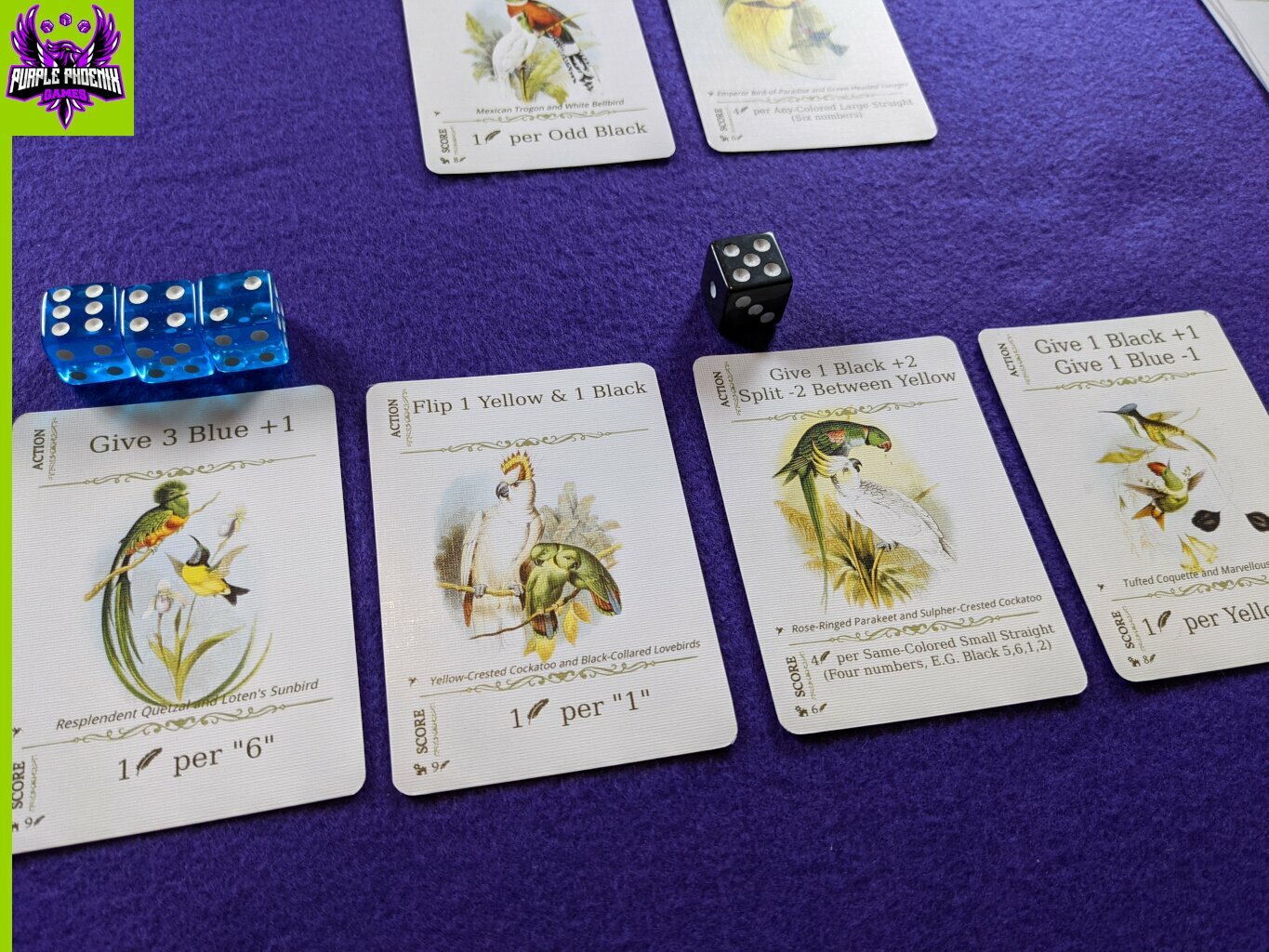
In Bandada players are attempting to catch and return birds that have escaped from the local zoo. These birds are attracted to different food morsels (namely black, blue, and yellow dice) and by manipulating the food source players may be able to catch all the right birdies and score tons of points.
DISCLAIMER: We were provided a prototype copy of this game for the purposes of this review. These are preview copy components, and I do not know for sure if the final components will be any different from these shown. Also, it is not my intention to detail every rule in the game, as there are just too many. You are invited to download the rulebook, back the game through the Kickstarter campaign, or through any retailers stocking it after fulfillment. -T
Disclaimer the second: I am previewing this using the Solo Adventure Variant, which uses many of the same rules as the main multiplayer rules with a few twists.
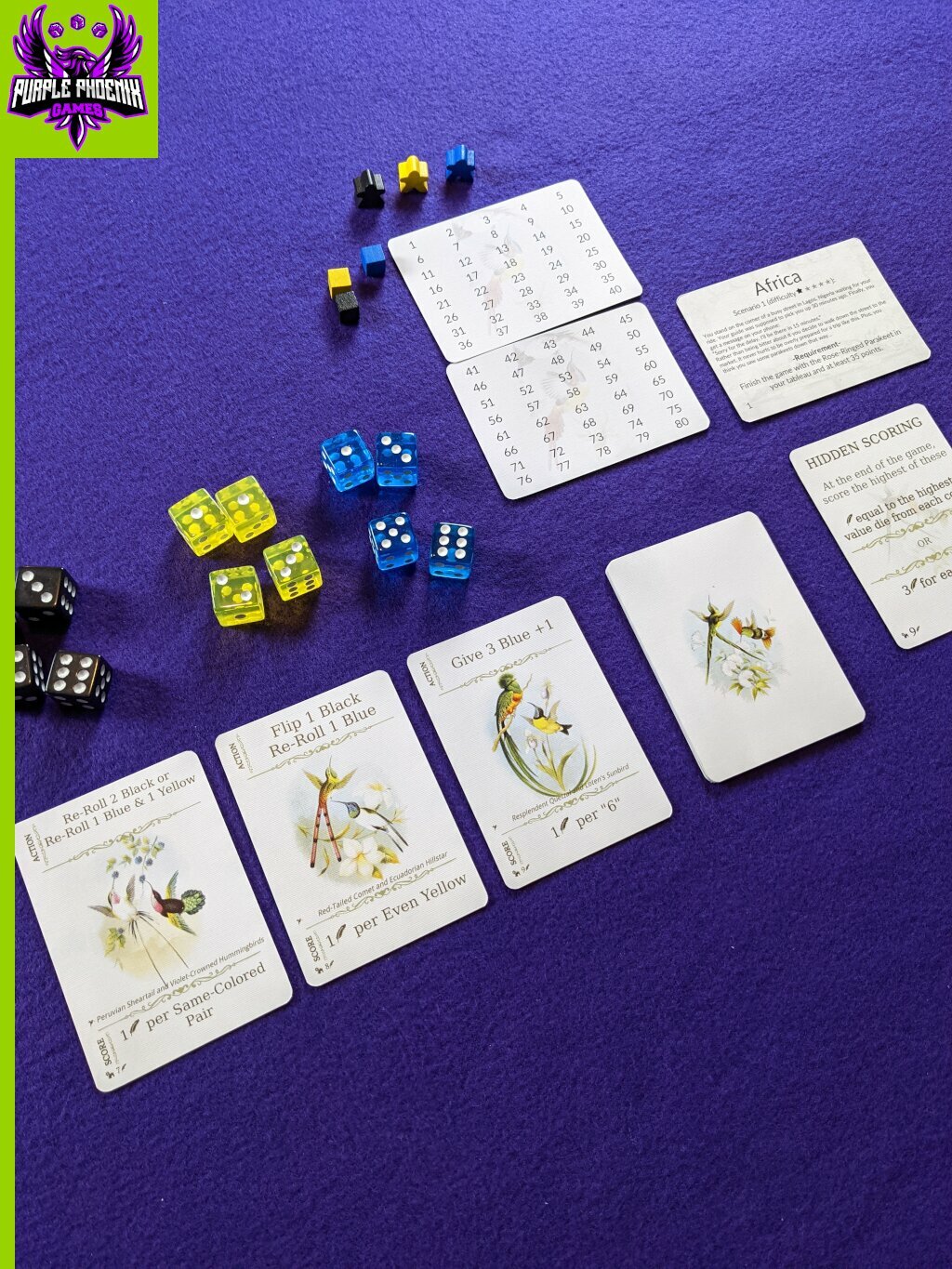
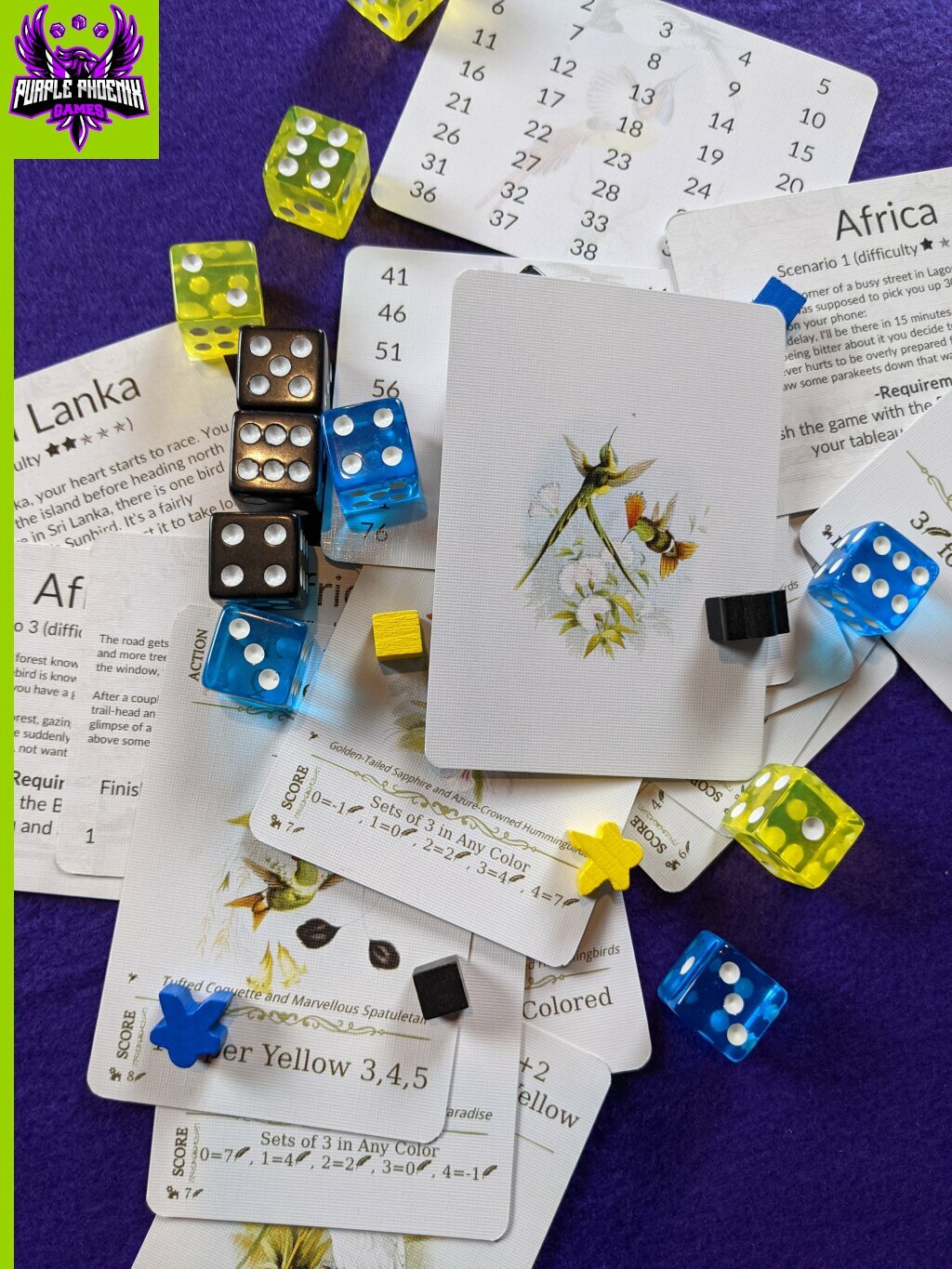
To setup the solo player will roll all 12 dice and sort them by color. Shuffle the bird cards and reveal three cards face-up in a market row. Grab a scoring cube for the score card, and choose which location card to play. Select (randomly or not) a bonus scoring card and the game may begin!
There are other optional variant rules that can be added to the adventure, but I will not be detailing those here.
Turns are divided into two phases: the Drafting phase and the Cleanup phase. During the Drafting phase the player will choose one of the face-up bird cards to be added to their personal bandada, perform the action described on the top of the card, and then add it to their bandada (personal tableau).
After drafting and bandada-ing the player will perform the Cleanup phase by scoring points based on the bird card abilities printed on the bottom, discarding the remaining face-up cards, and then adding three new birds cards to that market row. This phase differs from the multiplayer rules in that birds are scored once added to the bandada in multiplayer and then again during the Cleanup phase. In the solo mode they are scored only once at the end of the Cleanup phase.
The bird cards all have actions printed at the top that will manipulate the food dice in some way. Actions could simply give the birds a specific number of colored dice and adjust the value up or down. Some abilities will have the player flipping the dice to the opposite side, or adjusting multiple dice by splitting a positive or negative value. Of note in this game is that dice values wrap around the die. For example to increase the value of a 6 die it then wraps around to become a value 1. Manipulation of these food dice will make or break the game success, as I found in all my plays.
The game continues in this fashion until after the fourth full round. The player then totals their score on the score card, adds the points from the bonus card chosen at the beginning, and checks for the victory condition on the location card (the rules suggest starting in Africa). If the player has met the victory condition, the trip was a success! If, like me, the player fails to make 35 points in Africa every time, they must play again!
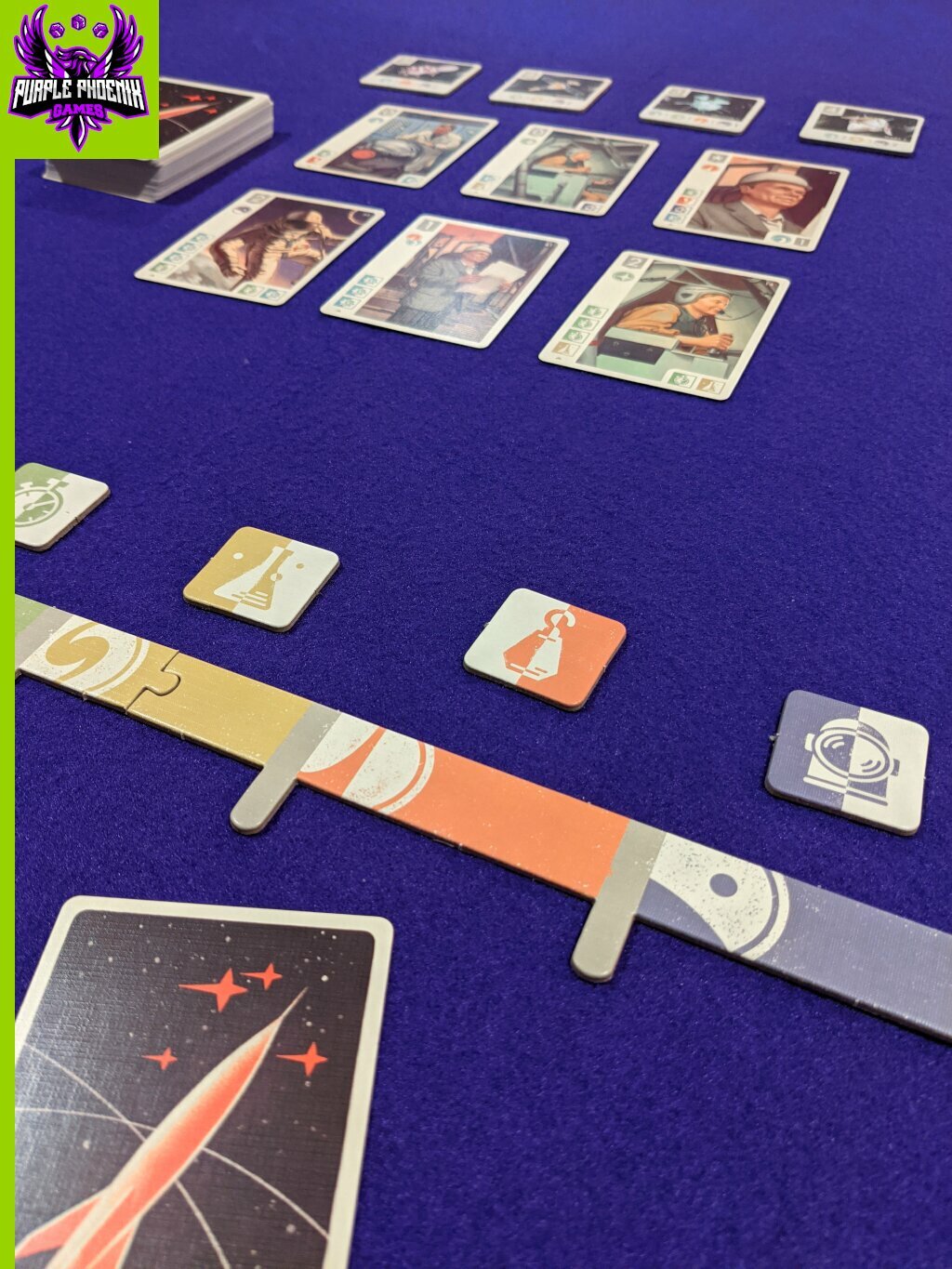
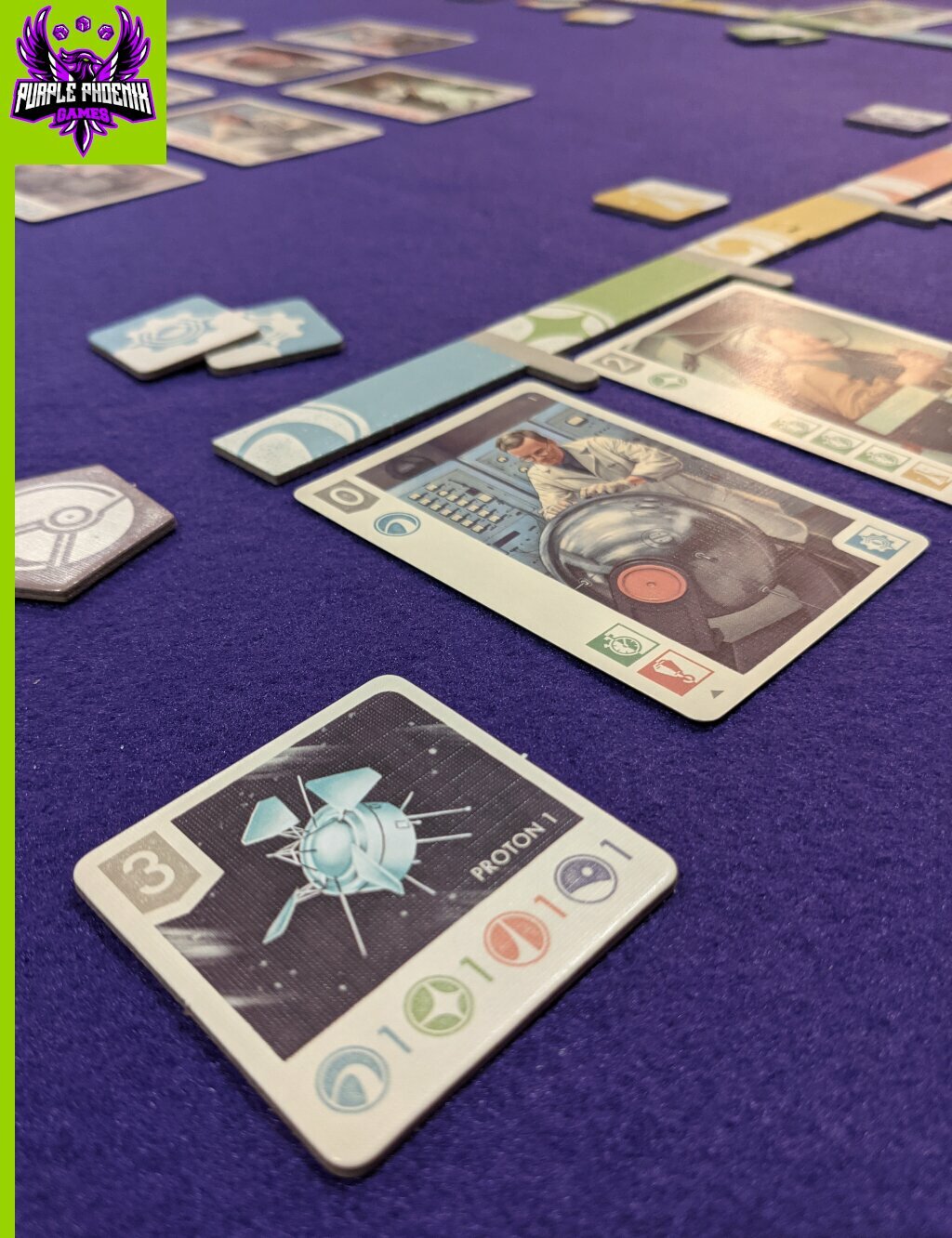
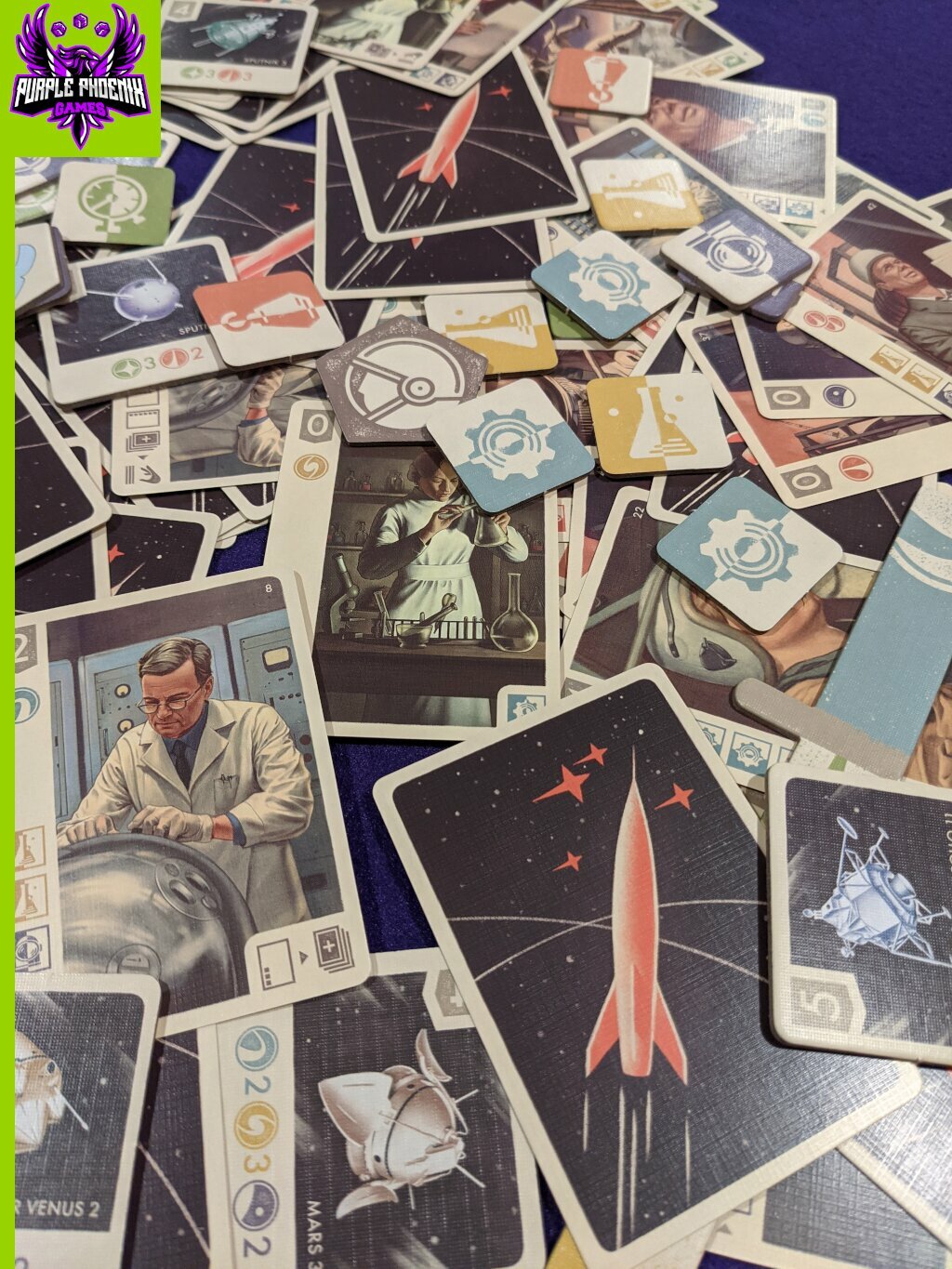
Components. Again, this is a prototype copy of the game, but I have to say that this is a beautiful minimalistic game. It consists of primarily dice and cards. The dice are translucent and good quality, though translucent yellow with white pips can be hard to read at times. The cards are good quality as well and feature breathtaking avian art. It really does look great on the table and doesn’t take up a ton of room, so I have very few negatives here.
Gameplay is super speedy and agonizing for a solo player. Maximizing points on every turn and having to consider specific win conditions makes for a crunchy little card game that takes about 10 minutes to play. It is definitely something I will be reaching for whenever I have a spare 15 minutes. With setup and teardown I am looking at a fulfilling, if not frustrating, card game experience that can be both anxiety-triggering and also quite calming. I was not sure what to expect when I opened the box, but boy am I glad I have this little gem.
If you are in the market for a great little solo game that can also play multiplayer, looks amazing, and is quick to complete, then look no further. If you are an avian aficionado and need your board and card game collection to reflect this, check out Bandada. I need you all to also promise to write me back once you figure out how to succeed in Africa, as I just plum can’t do it. But I am going to keep trying. As I always say, a game that makes you want to play it more is a mark of a great game, and I think a great game comes in this little box.
In Bandada players are attempting to catch and return birds that have escaped from the local zoo. These birds are attracted to different food morsels (namely black, blue, and yellow dice) and by manipulating the food source players may be able to catch all the right birdies and score tons of points.
DISCLAIMER: We were provided a prototype copy of this game for the purposes of this review. These are preview copy components, and I do not know for sure if the final components will be any different from these shown. Also, it is not my intention to detail every rule in the game, as there are just too many. You are invited to download the rulebook, back the game through the Kickstarter campaign, or through any retailers stocking it after fulfillment. -T
Disclaimer the second: I am previewing this using the Solo Adventure Variant, which uses many of the same rules as the main multiplayer rules with a few twists.
To setup the solo player will roll all 12 dice and sort them by color. Shuffle the bird cards and reveal three cards face-up in a market row. Grab a scoring cube for the score card, and choose which location card to play. Select (randomly or not) a bonus scoring card and the game may begin!
There are other optional variant rules that can be added to the adventure, but I will not be detailing those here.
Turns are divided into two phases: the Drafting phase and the Cleanup phase. During the Drafting phase the player will choose one of the face-up bird cards to be added to their personal bandada, perform the action described on the top of the card, and then add it to their bandada (personal tableau).
After drafting and bandada-ing the player will perform the Cleanup phase by scoring points based on the bird card abilities printed on the bottom, discarding the remaining face-up cards, and then adding three new birds cards to that market row. This phase differs from the multiplayer rules in that birds are scored once added to the bandada in multiplayer and then again during the Cleanup phase. In the solo mode they are scored only once at the end of the Cleanup phase.
The bird cards all have actions printed at the top that will manipulate the food dice in some way. Actions could simply give the birds a specific number of colored dice and adjust the value up or down. Some abilities will have the player flipping the dice to the opposite side, or adjusting multiple dice by splitting a positive or negative value. Of note in this game is that dice values wrap around the die. For example to increase the value of a 6 die it then wraps around to become a value 1. Manipulation of these food dice will make or break the game success, as I found in all my plays.
The game continues in this fashion until after the fourth full round. The player then totals their score on the score card, adds the points from the bonus card chosen at the beginning, and checks for the victory condition on the location card (the rules suggest starting in Africa). If the player has met the victory condition, the trip was a success! If, like me, the player fails to make 35 points in Africa every time, they must play again!
Components. Again, this is a prototype copy of the game, but I have to say that this is a beautiful minimalistic game. It consists of primarily dice and cards. The dice are translucent and good quality, though translucent yellow with white pips can be hard to read at times. The cards are good quality as well and feature breathtaking avian art. It really does look great on the table and doesn’t take up a ton of room, so I have very few negatives here.
Gameplay is super speedy and agonizing for a solo player. Maximizing points on every turn and having to consider specific win conditions makes for a crunchy little card game that takes about 10 minutes to play. It is definitely something I will be reaching for whenever I have a spare 15 minutes. With setup and teardown I am looking at a fulfilling, if not frustrating, card game experience that can be both anxiety-triggering and also quite calming. I was not sure what to expect when I opened the box, but boy am I glad I have this little gem.
If you are in the market for a great little solo game that can also play multiplayer, looks amazing, and is quick to complete, then look no further. If you are an avian aficionado and need your board and card game collection to reflect this, check out Bandada. I need you all to also promise to write me back once you figure out how to succeed in Africa, as I just plum can’t do it. But I am going to keep trying. As I always say, a game that makes you want to play it more is a mark of a great game, and I think a great game comes in this little box.


BankofMarquis (1832 KP) rated It: Chapter Two (2019) in Movies
Sep 7, 2019
Hader steals the film
The "secret sauce" of the first chapter of IT (based on the horror novel by Stephen King) was NOT the gore or scares that were thrown at the audience, it was the characters and the performances that made that first film work. The young members of the "Loser's Club" - and especially the young actors populating these characters - created people that you wanted to root and cheer for throughout their ordeal with Pennywise the Clown and the bullies of Derry.
So...it should have been a "no-brainer" for Director Andy Muschietti and the filmmakers to repeat that pattern - it worked very, very well. But, somewhere along the way they forgot what made the first film good and Muschietti and new screenwriter Gary Dauberman decided to focus on the horror, gore and frights and let their talented group of adult actors inhabit the characters with little (maybe no) help from the screenplay.
And...the result is a "fine" film that wraps up the first film just "fine", but ultimately falls short of that first film and definitely falls short of what "could have been".
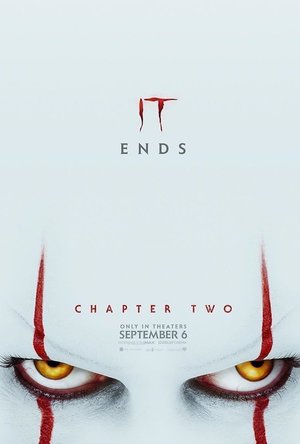
IT: CHAPTER TWO picks up 27 years later when Pennywise the Dancing Clown comes back (per his cycle) to terrorize the children of Derry once again. The Loser's Club from the first film band back together (per their pact at the end of the first film) to battle - and finally destroy - this dark threat.
The filmmakers pull a strong group of actors together to play the adult versions of the Loser's Club - headlined by Jessica Chastain (ZERO DARK THIRTY) as the adult Beverly Marsh and James McAvoy (Professor X in the recent run of X-MEN films) as the adult Bill Denborough. I find McAvoy to be (for the most part) a solid, if unspectacular, actor and he is true to from here. Solid, but unspectacular in a role that was written that way. Chastain, perhaps, is the biggest disappointment for me in this film as the young Beverly Marsh (as portrayed by Sophia Lillis) was the highlight of the first film but here this character is...bland and somewhat boring. I don't fault Chastain (an actress that I usually enjoy very, very much), I blame the screenplay which saddles these two characters with an underwritten "love triangle" with the adult Ben Hascombe (Jay Ryan - somewhat of a newcomer, who has smoldering good looks, but not much else going for him). It was rumored that Chris Pratt was circling this character (I would imagine he walked away when he saw the screenplay). That's too bad, for he might have brought some life to all 3 of these characters.
Faring better is the usually reliable Isiah Mustafa (TV's SHADOWHUNTERS) as the adult Mike Hanlon, the only one of the Loser's Club who stayed in Derry to keep a vigilant watch against Pennywise' return. He has a haunted air about him - certainly in keeping with the the past that only he remembers. And Andy Bean (SWAMP THING) has a nice couple of moments as the adult Stanley Uris.
The only truly interesting dynamic of the returning Loser's Club is the characters and love/hate relationship between the older Eddie Kaspbrak, the hypochondriac (played by James Ransome, TV's THE WIRE) and smart-mouth Richie Tolzier (inhabited by SNL vet Bill Hader). While Ransome's Eddie is quite a bit more interesting than he was as a youth (and that's no slight on Jack Dylan Grazer who played the younger Eddie, I just found Ransome's portrayal more nuanced and somewhat more interesting). But it is Hader who steals this film. His Richie is constantly using humor to cover his emotions building on the interesting characterization that Finn Wolfhard brought to the younger version and giving us more. Hader is a master comedian, so handles the comedy parts as deftly as you would think he would, but it is when the other emotions - fear, rage, love - come barreling out of him that Hader elevates this character (and the movie) to a higher level. I would be thrilled if Hader was nominated for an Oscar for this role - he is that good.
Also coming back are all of the "kids" from the first film to flesh out some scenes - and set up some other scenes/moments by the adults - they are a welcome addition and shine a spotlight at how weak - and underwritten - most of the adult characters are in this film.
Bill Skarsgard is seen quite a bit more as Pennywise - and that makes him less menacing and threatening (but still scary) and there are 2 fun cameos along the way by 2 prominent individuals, so that was fun.
There is a running gag throughout the film about author Bill Denborough (the surrogate for Stephen King) not being able to write a decent ending - a critique that King receives constantly - and they changed the ending of this film from the book. I am a big fan of the book, but would agree that the ending of the book was not that good, so was open to this trying a different way to end things...and...this new ending lands about as well as the original ending (oh well...).
But that's just a quibble, for by that time you've ridden with these characters for over 5 hours and while the first chapter is stronger than the first, the journey is good (enough) for an enjoyable (enough) time at the Cineplex.
Come for the Loser's Club and the scares - stay for Hader's Oscar worthy performance.
Letter Grade: B+
7 (out of 10) stars and you can take that to the Bank(ofMarquis)
So...it should have been a "no-brainer" for Director Andy Muschietti and the filmmakers to repeat that pattern - it worked very, very well. But, somewhere along the way they forgot what made the first film good and Muschietti and new screenwriter Gary Dauberman decided to focus on the horror, gore and frights and let their talented group of adult actors inhabit the characters with little (maybe no) help from the screenplay.
And...the result is a "fine" film that wraps up the first film just "fine", but ultimately falls short of that first film and definitely falls short of what "could have been".
IT: CHAPTER TWO picks up 27 years later when Pennywise the Dancing Clown comes back (per his cycle) to terrorize the children of Derry once again. The Loser's Club from the first film band back together (per their pact at the end of the first film) to battle - and finally destroy - this dark threat.
The filmmakers pull a strong group of actors together to play the adult versions of the Loser's Club - headlined by Jessica Chastain (ZERO DARK THIRTY) as the adult Beverly Marsh and James McAvoy (Professor X in the recent run of X-MEN films) as the adult Bill Denborough. I find McAvoy to be (for the most part) a solid, if unspectacular, actor and he is true to from here. Solid, but unspectacular in a role that was written that way. Chastain, perhaps, is the biggest disappointment for me in this film as the young Beverly Marsh (as portrayed by Sophia Lillis) was the highlight of the first film but here this character is...bland and somewhat boring. I don't fault Chastain (an actress that I usually enjoy very, very much), I blame the screenplay which saddles these two characters with an underwritten "love triangle" with the adult Ben Hascombe (Jay Ryan - somewhat of a newcomer, who has smoldering good looks, but not much else going for him). It was rumored that Chris Pratt was circling this character (I would imagine he walked away when he saw the screenplay). That's too bad, for he might have brought some life to all 3 of these characters.
Faring better is the usually reliable Isiah Mustafa (TV's SHADOWHUNTERS) as the adult Mike Hanlon, the only one of the Loser's Club who stayed in Derry to keep a vigilant watch against Pennywise' return. He has a haunted air about him - certainly in keeping with the the past that only he remembers. And Andy Bean (SWAMP THING) has a nice couple of moments as the adult Stanley Uris.
The only truly interesting dynamic of the returning Loser's Club is the characters and love/hate relationship between the older Eddie Kaspbrak, the hypochondriac (played by James Ransome, TV's THE WIRE) and smart-mouth Richie Tolzier (inhabited by SNL vet Bill Hader). While Ransome's Eddie is quite a bit more interesting than he was as a youth (and that's no slight on Jack Dylan Grazer who played the younger Eddie, I just found Ransome's portrayal more nuanced and somewhat more interesting). But it is Hader who steals this film. His Richie is constantly using humor to cover his emotions building on the interesting characterization that Finn Wolfhard brought to the younger version and giving us more. Hader is a master comedian, so handles the comedy parts as deftly as you would think he would, but it is when the other emotions - fear, rage, love - come barreling out of him that Hader elevates this character (and the movie) to a higher level. I would be thrilled if Hader was nominated for an Oscar for this role - he is that good.
Also coming back are all of the "kids" from the first film to flesh out some scenes - and set up some other scenes/moments by the adults - they are a welcome addition and shine a spotlight at how weak - and underwritten - most of the adult characters are in this film.
Bill Skarsgard is seen quite a bit more as Pennywise - and that makes him less menacing and threatening (but still scary) and there are 2 fun cameos along the way by 2 prominent individuals, so that was fun.
There is a running gag throughout the film about author Bill Denborough (the surrogate for Stephen King) not being able to write a decent ending - a critique that King receives constantly - and they changed the ending of this film from the book. I am a big fan of the book, but would agree that the ending of the book was not that good, so was open to this trying a different way to end things...and...this new ending lands about as well as the original ending (oh well...).
But that's just a quibble, for by that time you've ridden with these characters for over 5 hours and while the first chapter is stronger than the first, the journey is good (enough) for an enjoyable (enough) time at the Cineplex.
Come for the Loser's Club and the scares - stay for Hader's Oscar worthy performance.
Letter Grade: B+
7 (out of 10) stars and you can take that to the Bank(ofMarquis)
Rob P (30 KP) rated Avengers: Endgame (2019) in Movies
May 6, 2019
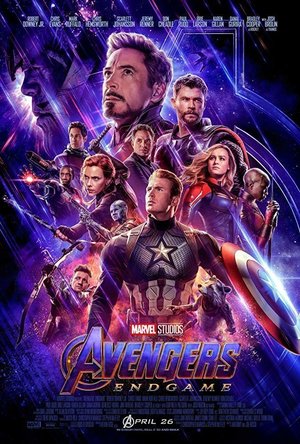

Sheer scope and spectacle (2 more)
satisfying conclusion to the Infinity/Avengers saga
Pretty much a 90 minute end battle scene
Unfair arc for some characters (1 more)
The end of an era! #cry
Love you 3000 - *Seriously - S P O I L E R S*
Contains spoilers, click to show
Well, what a long, strange, amazing trip it's been.
Assuming that everyone who sees this film is invested in the MCU, this doesn't disappoint. Although I'm a fan of the comics, you can't really compare the comic universe to the cinematic universe in terms of plot, it stands alone with its own intricacies, strengths and weaknesses.
I don't have a lot of negative things to say about this one, it's an involving, dramatic, action packed and beautiful piece of work from the Russo brothers, but I'll start with the one or two gripes I had.
From the start, they went with an odd route, one that I wasn't expecting . *SPOILERS* - Thanos as we know him, dies in the first 15 minutes of the film. Honestly was not expecting that. Robbed the satisfaction of build up for me, but ultimately the build up starts again, as the Avengers then go about stopping an alternate timeline Thanos from BEFORE the events of Guardians of the Galaxy by going to retrieve the infinity stones from different points in time (and the MCU movies), before Thanos finds them, so all is not lost on that front, there's still a Thanos to face.
One gripe was the arc of one particular character - our big green rage machine. After the events of infinity war, you'll remember, Hulk was left somewhat lacking, after getting his arse handed to him by Thanos and then refusing to come out for the rest of the film. I felt there was atonement due for him. Here we see Banner has now found catharsis with the Hulk, by staying in Hulk form with his own personality in the five years since the snap. That's all well and good, but after the death of a certain other member of the Avengers after retrieving the Soulstone, I thought - right. Now Hulk will smash. Now we have to see him go ham on someone. Nothing. Not even an action shot of Hulk fighting in the entire last battle scene, which only would have taken 20 seconds out of an entire 90 minute battle. I would have liked to have seen Hulk Vs Thanos, even if for a brief moment, whether Banner came out on top or not. Banner actually using his own anger, which by his own admission in Avengers Assemble, he has. All the time. It felt an unfair way to end one of the major characters stories, for seemingly what would have taken so little to make. it's not like they lacked the CGI budget, after all. Instead, Scarlet Witch gets a showdown with Thanos, and she's not even a particularly major player within the Avengers team, again don't get me wrong, after Vision she deserves a shot. But Hulk more so... It seemed silly to me.
The other negative for me, was Thor. Another slightly disappointing arc for the god of thunder. I felt he was robbed of all the awesomeness Taika rejuvenated him with from Ragnarok, which then continued into Infinity War. They turned him into God of amazing lightning and patron saint of badassery, with a new axe that just gives him a look as cool as they other side of the pillow. Now, the Russo's have had him drink himself to death, making him bloated and filled with sadness and regret. Don't get me wrong. Thor has more reason than most to be that way, he's lost everything over his story arc. I think that by letting him kill Thanos at the beginning, they robbed him of his real purpose, which is to be the strongest of the avengers (arguably) and just be the badass we all know he is. The one positive thing about this, is Thor's new aesthetic actually makes him look like a viking, which was amazing. Braided beard, heavy set, long hair. Great stuff, made him feel much more realistic in that sense, just again I think it was a bit of an unfair arc for him. Although, as he's now set to join GOTG, there's plenty of time to atone.
That's my two cents on the negs of this one. Now for positives:
My god, the scope and sheer spectacle of the MCU films rarely disappoint, this is no exception. just some absolutely jaw dropping sequences, especially when you have the big three (Stark, Cap and Thor) trying to stop Thanos before the major battle scene. It's stuff to make you weep tears of pure joy.
Following on from that, the moment where it's confirmed the snap has been reversed and the portals open up, the armies of Wakanda come out chanting along with just EVERYBODY, and that Avengers music starts up... goosebumps just thinking about it.
The involvement and rounding of previous MCU films in the first half of the movie is intense and satisfying, as the group split up into different places in time to retrieve the stones. Lots of nods to different franchises, nice bit of exposition, and certain parts in particular are just happy, like seeing Tony talking to his father back in the 70's without him realising who he is. Wonderful Stuff.
We all knew there would be deaths, I felt that these were handled gracefully and tactfully, giving the best service for the characters and fans. At the same time, they were not predictable, which i felt was definitely important.
As a last word, anyone who's ever watched a marvel film or had interest in the comics needs to see this. There is a list published of the films you need to see beforehand to fully appreciate the time travel segments, but it's not absolutely necessary. It just helps you appreciate the thought that has gone into rounding off the biggest cinematic series in history, all the in jokes and nuances that the Russo's included to really make this serviceable to the fans.
The end of an era, and as a crescendo to the the symphony started by the rest of MCU, it's just plain beautiful.
Love you 3000, folks.
- Rob
Assuming that everyone who sees this film is invested in the MCU, this doesn't disappoint. Although I'm a fan of the comics, you can't really compare the comic universe to the cinematic universe in terms of plot, it stands alone with its own intricacies, strengths and weaknesses.
I don't have a lot of negative things to say about this one, it's an involving, dramatic, action packed and beautiful piece of work from the Russo brothers, but I'll start with the one or two gripes I had.
From the start, they went with an odd route, one that I wasn't expecting . *SPOILERS* - Thanos as we know him, dies in the first 15 minutes of the film. Honestly was not expecting that. Robbed the satisfaction of build up for me, but ultimately the build up starts again, as the Avengers then go about stopping an alternate timeline Thanos from BEFORE the events of Guardians of the Galaxy by going to retrieve the infinity stones from different points in time (and the MCU movies), before Thanos finds them, so all is not lost on that front, there's still a Thanos to face.
One gripe was the arc of one particular character - our big green rage machine. After the events of infinity war, you'll remember, Hulk was left somewhat lacking, after getting his arse handed to him by Thanos and then refusing to come out for the rest of the film. I felt there was atonement due for him. Here we see Banner has now found catharsis with the Hulk, by staying in Hulk form with his own personality in the five years since the snap. That's all well and good, but after the death of a certain other member of the Avengers after retrieving the Soulstone, I thought - right. Now Hulk will smash. Now we have to see him go ham on someone. Nothing. Not even an action shot of Hulk fighting in the entire last battle scene, which only would have taken 20 seconds out of an entire 90 minute battle. I would have liked to have seen Hulk Vs Thanos, even if for a brief moment, whether Banner came out on top or not. Banner actually using his own anger, which by his own admission in Avengers Assemble, he has. All the time. It felt an unfair way to end one of the major characters stories, for seemingly what would have taken so little to make. it's not like they lacked the CGI budget, after all. Instead, Scarlet Witch gets a showdown with Thanos, and she's not even a particularly major player within the Avengers team, again don't get me wrong, after Vision she deserves a shot. But Hulk more so... It seemed silly to me.
The other negative for me, was Thor. Another slightly disappointing arc for the god of thunder. I felt he was robbed of all the awesomeness Taika rejuvenated him with from Ragnarok, which then continued into Infinity War. They turned him into God of amazing lightning and patron saint of badassery, with a new axe that just gives him a look as cool as they other side of the pillow. Now, the Russo's have had him drink himself to death, making him bloated and filled with sadness and regret. Don't get me wrong. Thor has more reason than most to be that way, he's lost everything over his story arc. I think that by letting him kill Thanos at the beginning, they robbed him of his real purpose, which is to be the strongest of the avengers (arguably) and just be the badass we all know he is. The one positive thing about this, is Thor's new aesthetic actually makes him look like a viking, which was amazing. Braided beard, heavy set, long hair. Great stuff, made him feel much more realistic in that sense, just again I think it was a bit of an unfair arc for him. Although, as he's now set to join GOTG, there's plenty of time to atone.
That's my two cents on the negs of this one. Now for positives:
My god, the scope and sheer spectacle of the MCU films rarely disappoint, this is no exception. just some absolutely jaw dropping sequences, especially when you have the big three (Stark, Cap and Thor) trying to stop Thanos before the major battle scene. It's stuff to make you weep tears of pure joy.
Following on from that, the moment where it's confirmed the snap has been reversed and the portals open up, the armies of Wakanda come out chanting along with just EVERYBODY, and that Avengers music starts up... goosebumps just thinking about it.
The involvement and rounding of previous MCU films in the first half of the movie is intense and satisfying, as the group split up into different places in time to retrieve the stones. Lots of nods to different franchises, nice bit of exposition, and certain parts in particular are just happy, like seeing Tony talking to his father back in the 70's without him realising who he is. Wonderful Stuff.
We all knew there would be deaths, I felt that these were handled gracefully and tactfully, giving the best service for the characters and fans. At the same time, they were not predictable, which i felt was definitely important.
As a last word, anyone who's ever watched a marvel film or had interest in the comics needs to see this. There is a list published of the films you need to see beforehand to fully appreciate the time travel segments, but it's not absolutely necessary. It just helps you appreciate the thought that has gone into rounding off the biggest cinematic series in history, all the in jokes and nuances that the Russo's included to really make this serviceable to the fans.
The end of an era, and as a crescendo to the the symphony started by the rest of MCU, it's just plain beautiful.
Love you 3000, folks.
- Rob

Gareth von Kallenbach (980 KP) rated X-Men: Dark Phoenix (2019) in Movies
Jul 2, 2019
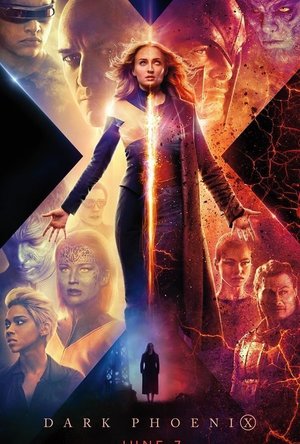

Ever since X-men First Class was released, Jean Gray one of the more pivotal characters in the X-Men universe has been surprisingly absent. Often portrayed at not only having psychic abilities that rivals Charles Xavier, but also attracted the admiration of both Cyclops and Wolverine. While she was a staple in the original film and subsequent sequels her first appearance in the newest series did not occur until X-Men Apocalypse. With the release of Dark Phoenix, we had hoped to finally get an opportunity to explore a bit of her background story and her transformation into Dark Phoenix.
Dark Phoenix begins on a small country road where a very young Jean Grey is arguing with her parents over what music to listen to. In traditional parent fashion, her mother reminds her that the driver is the one who chooses the music and when she is old enough to drive she can choose her own music. This small disagreement turns into a deadly confrontation, when the young Jean, unable to control her vast powers causes her mom to fall asleep at the wheel, resulting in a head on collision killing both her parents. The doctors are amazed that this young girl has survived without a single scratch and a young Charles Xavier arrives to take her to a place where she can be safe.
Fast Forward to the year 1992 where the space shuttle Endeavor, on a routine mission, encounters a cosmic entity that cripples it in space. The X-men, who are now looked at as heroes by most of the world are tasked to bring the astronauts safely home, it’s a dangerous mission, but one that Charles feels will further cement the hero status of his team and continue to grow trust between mutants and humans alike. The mission goes surprisingly without incident until Jean and Night Crawler attempt to rescue the final remaining astronaut from the doomed shuttle. Night Crawler quickly teleports the astronaut to safety, but Jean is caught by the full force of the cosmic entity, absorbing it completely and destroying the shuttle. The team scrambles to locate her, and with the help of Night Crawler are once again able to bring her back to the safety of the X-Jet. Relieved that she has somehow miraculously survived the encounter the team is unaware that Jean and themselves will never be the same again.
As we’ve come to expect from the previous X-men movies, a star-studded cast leads the way. Familiar cast members such as Jennifer Lawrence (Raven), Tye Sheridan (Cyclops) and James McAvoy (Charles Xavier) are joined once again by Sophie Turner as the iconic Jean Grey. Sophie does an incredible job at bringing out both the uncertainty in her character and the extreme anger and rage that flows through her. Unfortunately for such a major character the movie only briefly touches the surface of who Jean Grey really is. The movie, even from the start tends to focus on Jean as a dangerous and angry young lady, unable to control her emotions which will ultimately open the doorway to her alter ego Dark Phoenix. The movie unfortunately treats her as a one-off character and skips most of her back story choosing to focus only on her Dark Phoenix personality. This leaves the audience with no understanding of the person she was prior to the transformation, only seeing Jean as an uncontrollable child who has now become an uncontrollable adult with “off the chart” powers. While Charles and other members of the team try to assure those around them (and the audience seated in the theaters) that Jean is a good person, a person worth saving, there is very little in the movie that allows us to sympathize with her plight. It ultimately villainizes her and leaves much of the cast (and the audience) wondering whether destroying her is the right choice for all humankind.
Visually Dark Phoenix is a masterpiece, whether it’s the awe-inspiring deepness of space, or the incredible visual effects as the mutants square off against each other with their powers. Buildings topple, subway cars are pulled from underground and general mayhem takes the stage. This is certainly one of the more action-packed movies in the series and getting the opportunity to watch some of our favorite mutants square off against one another is enough to excite even the ones least interested in the franchise.
Dark Phoenix as one might expect is also one of the darkest of the x-men movies. Unlike its other Marvel film counterparts, there is no levity in the movie at all. There are scenes that are heartwarming, but the movie takes itself very seriously. Even in a similarly dark Marvel movie Endgame there were moments that would make you laugh regardless of how dire the situation was, Dark Phoenix is not like this at all. It carries a weight to it that ensures that not only the people on screen, but those in the audience understand how truly dire the situation is. It detracts a bit from the spirit of the source material it derives from and could potentially alienate its core audience. This is a very adult movie, that deals with some very adult themes and parents might want to think twice before taking their youngest to see this film. With the X-Men franchise finally joining the MCU, it’ll be interesting to see how movies down the road treat these characters.
Dark Phoenix represents the end of an X-Men era that has existed in both its original and First-Class installments for over twenty years. The acquisition of Fox by Disney now brings this venerable franchise to the MCU family along with its cast of seemingly endless characters. While the movie is certainly better than Apocalypse, it can’t quite reach the heights of either First-Class or Days of Futures Past. The Dark Phoenix storyline does a good job staying closer to its comic book roots than its previous outing but rushes the origin and character development of Jean far more than she deserves. It’s a fine ending to the series as a whole but can’t quite deliver in all the ways I hoped it would.
Dark Phoenix begins on a small country road where a very young Jean Grey is arguing with her parents over what music to listen to. In traditional parent fashion, her mother reminds her that the driver is the one who chooses the music and when she is old enough to drive she can choose her own music. This small disagreement turns into a deadly confrontation, when the young Jean, unable to control her vast powers causes her mom to fall asleep at the wheel, resulting in a head on collision killing both her parents. The doctors are amazed that this young girl has survived without a single scratch and a young Charles Xavier arrives to take her to a place where she can be safe.
Fast Forward to the year 1992 where the space shuttle Endeavor, on a routine mission, encounters a cosmic entity that cripples it in space. The X-men, who are now looked at as heroes by most of the world are tasked to bring the astronauts safely home, it’s a dangerous mission, but one that Charles feels will further cement the hero status of his team and continue to grow trust between mutants and humans alike. The mission goes surprisingly without incident until Jean and Night Crawler attempt to rescue the final remaining astronaut from the doomed shuttle. Night Crawler quickly teleports the astronaut to safety, but Jean is caught by the full force of the cosmic entity, absorbing it completely and destroying the shuttle. The team scrambles to locate her, and with the help of Night Crawler are once again able to bring her back to the safety of the X-Jet. Relieved that she has somehow miraculously survived the encounter the team is unaware that Jean and themselves will never be the same again.
As we’ve come to expect from the previous X-men movies, a star-studded cast leads the way. Familiar cast members such as Jennifer Lawrence (Raven), Tye Sheridan (Cyclops) and James McAvoy (Charles Xavier) are joined once again by Sophie Turner as the iconic Jean Grey. Sophie does an incredible job at bringing out both the uncertainty in her character and the extreme anger and rage that flows through her. Unfortunately for such a major character the movie only briefly touches the surface of who Jean Grey really is. The movie, even from the start tends to focus on Jean as a dangerous and angry young lady, unable to control her emotions which will ultimately open the doorway to her alter ego Dark Phoenix. The movie unfortunately treats her as a one-off character and skips most of her back story choosing to focus only on her Dark Phoenix personality. This leaves the audience with no understanding of the person she was prior to the transformation, only seeing Jean as an uncontrollable child who has now become an uncontrollable adult with “off the chart” powers. While Charles and other members of the team try to assure those around them (and the audience seated in the theaters) that Jean is a good person, a person worth saving, there is very little in the movie that allows us to sympathize with her plight. It ultimately villainizes her and leaves much of the cast (and the audience) wondering whether destroying her is the right choice for all humankind.
Visually Dark Phoenix is a masterpiece, whether it’s the awe-inspiring deepness of space, or the incredible visual effects as the mutants square off against each other with their powers. Buildings topple, subway cars are pulled from underground and general mayhem takes the stage. This is certainly one of the more action-packed movies in the series and getting the opportunity to watch some of our favorite mutants square off against one another is enough to excite even the ones least interested in the franchise.
Dark Phoenix as one might expect is also one of the darkest of the x-men movies. Unlike its other Marvel film counterparts, there is no levity in the movie at all. There are scenes that are heartwarming, but the movie takes itself very seriously. Even in a similarly dark Marvel movie Endgame there were moments that would make you laugh regardless of how dire the situation was, Dark Phoenix is not like this at all. It carries a weight to it that ensures that not only the people on screen, but those in the audience understand how truly dire the situation is. It detracts a bit from the spirit of the source material it derives from and could potentially alienate its core audience. This is a very adult movie, that deals with some very adult themes and parents might want to think twice before taking their youngest to see this film. With the X-Men franchise finally joining the MCU, it’ll be interesting to see how movies down the road treat these characters.
Dark Phoenix represents the end of an X-Men era that has existed in both its original and First-Class installments for over twenty years. The acquisition of Fox by Disney now brings this venerable franchise to the MCU family along with its cast of seemingly endless characters. While the movie is certainly better than Apocalypse, it can’t quite reach the heights of either First-Class or Days of Futures Past. The Dark Phoenix storyline does a good job staying closer to its comic book roots than its previous outing but rushes the origin and character development of Jean far more than she deserves. It’s a fine ending to the series as a whole but can’t quite deliver in all the ways I hoped it would.

Death By Rock and Roll by The Pretty Reckless
Album
Rock 'n' roll is a religion. It's a commitment to an ideal, a belief system. The lifestyle and...

BackToTheMovies (56 KP) rated Child's Play (2019) in Movies
Jun 21, 2019

After moving to a new city, young Andy Barclay receives a special present from his mother. A seemingly innocent Buddi doll that becomes his best friend. When the doll suddenly takes on a life of its own, Andy unites with other neighborhood children to stop the sinister toy from wreaking bloody havoc.
For months I’ve been hating on this reboot. Whilst I still don’t necessarily agree with the politics of how this film came to be. I left the theatre quite surprised at how much I enjoyed this movie. Child’s Play is reimagined for a modern generation. Whilst this film is an alternate timeline twist to the original it still manages to throw in that classic Chucky humor we all know and love. Here’s my Child’s Play 2019 review.
Lars Klevberg tells the story of Buddi, an artificial intelligence robot that can control your home appliances and become your best friend. He will play with you, interact with you like a real human being and you can do activities together. After a man is fired at the Buddi factory he reprograms one of the dolls to disobey its commands and the reign of Chucky begins when it falls into the hands of young Andy (Gabriel Bateman) given to him as a present by his mum Karen (Aubrey Plaza). What follows is a thoroughly enjoyable feature that flies by. Chucky’s murderous rage ramps up to artificial intelligence warfare with epic results.
Disregarding the original storyline of a serial killer whose soul inhabits a Good Guys doll the new Child’s Play tells a more chilling tale. The movie runs a very close to home social commentary about our reliance on technology and the implications that could follow. Buddi is your walking, talking Amazon Echo. Every home device is controlled at his fingertips from TV’s to telephones and even as far as automated cars. You can only imagine the terror that unfolds as Chucky learns to utilize his technological surroundings for evil.
Chucky starts off innocent enough. He’s programmed to be Andy’s best friend but what starts out as a unique interaction between boy and robot instantly changes when Chucky becomes sentient. Influenced by those around him and watching horror movies with Andy suddenly Buddi becomes more sinister in nature. Instead of a treasured companion, Chucky becomes possessive and will protect Andy by any means necessary. Quite the different approach from that of previous installments. Even when Chucky begins his reign of terror Andy is still loyal to him to some degree. Whilst he cannot understand why Chucky is doing the things he does there’s a loneliness about Andy’s character that almost seems to justify Chucky’s behavior. He doesn’t agree with it but at the same time, he has a friend, albeit a murderous little rampaging doll.
Child’s Play has some incredible humour mixed in throughout which allows the film to flow freely. Whilst Seed of Chucky and Bride of Chucky had free-speaking souls it’s harder to convey this type of humour within a robotic doll. Instead, the doll spills one-liners and is influenced by those around him leading to some comical results. Chucky’s infamous one-liners come to the fold and various facial expressions on the doll are hysterical.
The vocal work and comedic delivery from Mark Hamil is nothing short of wonderful. There is nothing this man cannot do. The force is strong with him even in a Chucky movie. Whilst more robotic in nature the way the lines are delivered with such dry-pan straight-faced edge is just brilliant. But once again we cannot compare this new Chucky to the sublime work of Brad Dourif. Brad is delivering dialogue as a human being whereas Mark is delivering lines as a robotic entity. They just cannot be compared and it would be a stupid comparison to make. All in all the voice work is great It’s just a shame I can’t take this ugly doll seriously for one second!
Whoever designed the Buddi doll in pre-production needs a serious talking to! I’m not quite sure what look they were going for with this but it certainly isn’t a good one. The film becomes even more of a comedy the more you look at it. The old dolls had that look of innocence in the originals, this one is just so damn weird. I can’t picture a production meeting where everyone in the room agreed that this is the final look of the doll without intense laughing involved. It’s like the production team are openly fucking with us. No one on this planet can take this doll seriously and for me, Child’s Play is way more of a comedy than it will ever be a horror movie.
For the most part, casting within Child’s Play is very strong. Gabriel Bateman (Andy) puts in a strong performance single-handedly carrying the film. Brian Tyree Henry (Mike) who plays a neighbor/detective is also a nice comedic relief within the feature. Ty Consiglio, Beatrice Kitsos and Carlease Burke also play strong supporting roles. Where casting failed for me however was Aubrey Plaza. I’ve seen Aubrey in comedies where her humor never really hits home in any roles she’s in.
Arrogant and annoying in many roles this cookie cutter casting has her playing the same role in every film she’s in. Playing Andy’s mum in this film doesn’t work for me whatsoever. There’s no conviction, no depth, no family dynamic feel of any sort. She almost plays an annoying older sister rather than a mother. Thankfully, she doesn’t play a key role as such to Andy’s arc and thus I can overlook her involvement as such. I think Aubrey should have played a sister role or similar, it would have played to her on-screen strengths.
When Chucky starts killing is when this movie comes into its own. It has nothing to compare it to previous Chucky films. Our new technologically manipulative little doll runs havoc on the millennial generation of mobile phone and gadget addicted humans. The death scenes are gory and for the most part, all have comedy elements to them. Whilst the kills are unimaginative it’s how Chucky delivers those kills that really add that star gore power to proceedings.
Endearing, gory and mostly hilarious. The contrast of tone in Child’s Play may even persuade the die-hard fans to enjoy this one. It shouldn’t really be compared to the originals in any way shape or form although it does have an 80’s flair to it. Child’s Play has taken a new direction but has stayed relevant to modern times and whilst it’s taking a different path than the upcoming TV series, it’s safe to say Chucky really is back!
Thanks for checking out my Child’s Play 2019 review. I hope you enjoy it as much as I did!
https://backtothemovies.com/childs-play-2019-review/
For months I’ve been hating on this reboot. Whilst I still don’t necessarily agree with the politics of how this film came to be. I left the theatre quite surprised at how much I enjoyed this movie. Child’s Play is reimagined for a modern generation. Whilst this film is an alternate timeline twist to the original it still manages to throw in that classic Chucky humor we all know and love. Here’s my Child’s Play 2019 review.
Lars Klevberg tells the story of Buddi, an artificial intelligence robot that can control your home appliances and become your best friend. He will play with you, interact with you like a real human being and you can do activities together. After a man is fired at the Buddi factory he reprograms one of the dolls to disobey its commands and the reign of Chucky begins when it falls into the hands of young Andy (Gabriel Bateman) given to him as a present by his mum Karen (Aubrey Plaza). What follows is a thoroughly enjoyable feature that flies by. Chucky’s murderous rage ramps up to artificial intelligence warfare with epic results.
Disregarding the original storyline of a serial killer whose soul inhabits a Good Guys doll the new Child’s Play tells a more chilling tale. The movie runs a very close to home social commentary about our reliance on technology and the implications that could follow. Buddi is your walking, talking Amazon Echo. Every home device is controlled at his fingertips from TV’s to telephones and even as far as automated cars. You can only imagine the terror that unfolds as Chucky learns to utilize his technological surroundings for evil.
Chucky starts off innocent enough. He’s programmed to be Andy’s best friend but what starts out as a unique interaction between boy and robot instantly changes when Chucky becomes sentient. Influenced by those around him and watching horror movies with Andy suddenly Buddi becomes more sinister in nature. Instead of a treasured companion, Chucky becomes possessive and will protect Andy by any means necessary. Quite the different approach from that of previous installments. Even when Chucky begins his reign of terror Andy is still loyal to him to some degree. Whilst he cannot understand why Chucky is doing the things he does there’s a loneliness about Andy’s character that almost seems to justify Chucky’s behavior. He doesn’t agree with it but at the same time, he has a friend, albeit a murderous little rampaging doll.
Child’s Play has some incredible humour mixed in throughout which allows the film to flow freely. Whilst Seed of Chucky and Bride of Chucky had free-speaking souls it’s harder to convey this type of humour within a robotic doll. Instead, the doll spills one-liners and is influenced by those around him leading to some comical results. Chucky’s infamous one-liners come to the fold and various facial expressions on the doll are hysterical.
The vocal work and comedic delivery from Mark Hamil is nothing short of wonderful. There is nothing this man cannot do. The force is strong with him even in a Chucky movie. Whilst more robotic in nature the way the lines are delivered with such dry-pan straight-faced edge is just brilliant. But once again we cannot compare this new Chucky to the sublime work of Brad Dourif. Brad is delivering dialogue as a human being whereas Mark is delivering lines as a robotic entity. They just cannot be compared and it would be a stupid comparison to make. All in all the voice work is great It’s just a shame I can’t take this ugly doll seriously for one second!
Whoever designed the Buddi doll in pre-production needs a serious talking to! I’m not quite sure what look they were going for with this but it certainly isn’t a good one. The film becomes even more of a comedy the more you look at it. The old dolls had that look of innocence in the originals, this one is just so damn weird. I can’t picture a production meeting where everyone in the room agreed that this is the final look of the doll without intense laughing involved. It’s like the production team are openly fucking with us. No one on this planet can take this doll seriously and for me, Child’s Play is way more of a comedy than it will ever be a horror movie.
For the most part, casting within Child’s Play is very strong. Gabriel Bateman (Andy) puts in a strong performance single-handedly carrying the film. Brian Tyree Henry (Mike) who plays a neighbor/detective is also a nice comedic relief within the feature. Ty Consiglio, Beatrice Kitsos and Carlease Burke also play strong supporting roles. Where casting failed for me however was Aubrey Plaza. I’ve seen Aubrey in comedies where her humor never really hits home in any roles she’s in.
Arrogant and annoying in many roles this cookie cutter casting has her playing the same role in every film she’s in. Playing Andy’s mum in this film doesn’t work for me whatsoever. There’s no conviction, no depth, no family dynamic feel of any sort. She almost plays an annoying older sister rather than a mother. Thankfully, she doesn’t play a key role as such to Andy’s arc and thus I can overlook her involvement as such. I think Aubrey should have played a sister role or similar, it would have played to her on-screen strengths.
When Chucky starts killing is when this movie comes into its own. It has nothing to compare it to previous Chucky films. Our new technologically manipulative little doll runs havoc on the millennial generation of mobile phone and gadget addicted humans. The death scenes are gory and for the most part, all have comedy elements to them. Whilst the kills are unimaginative it’s how Chucky delivers those kills that really add that star gore power to proceedings.
Endearing, gory and mostly hilarious. The contrast of tone in Child’s Play may even persuade the die-hard fans to enjoy this one. It shouldn’t really be compared to the originals in any way shape or form although it does have an 80’s flair to it. Child’s Play has taken a new direction but has stayed relevant to modern times and whilst it’s taking a different path than the upcoming TV series, it’s safe to say Chucky really is back!
Thanks for checking out my Child’s Play 2019 review. I hope you enjoy it as much as I did!
https://backtothemovies.com/childs-play-2019-review/

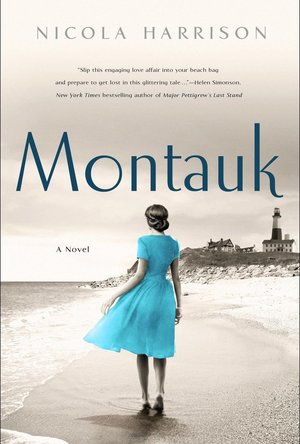

Breathtaking Historical Fiction; Must Read!
You can also find this review on my blog: bookingwayreads.wordpress.com
TRIGGER WARNINGS: rape, domestic violence, death, affairs, miscarriage
"You can only go so long pretending, acting as if you're someone you're not. Eventually you must return to who you are, who you were born to be. You can stray from it, try on other roles, other personalities, other beliefs, other lives, but eventually it will catch up with you and you have to return to the only person you can be."
Main Characters:
Beatrice Bordeaux - the main character, married to Harry Bordeaux. A bit of a feminist but it doesn't start showing until the middle to end of the novel. She's got a strong, compassionate, sweet personality. Her development was major and not at all what I was expecting.
Thomas - the lighthouse keeper. He's a simple man, compassionate and patient. Also unbelievably kind to all, no matter ethnicity, class, or gender.
Harry Bordeaux - cocky, self-conceded. Honestly, the most horrible person ever.
Dolly - hat maker who befriends Bea. She's sweet, independent, and an all around feminist.
Elizabeth - laundress for the Montauk Manor, befriends Bea. She's down-to-earth and a loving mother and wife.
"I felt rage and a hot determination side by side and that was something. That alone gave me hope. Something was better than numbness. Something was better than not caring, not dreaming, not daring."
Review:
**Possible spoilers ahead**
The story starts off in the year of 1938. The wealthy from New York City always head to the East Coast to an up and coming town called Montauk for the summer. Here, the wives stay in the luxurious Montauk Manor during the weekdays with their children and nannies, planning social events and relaxing, while the men head back to the city to work - only coming back to visit on the weekends.
Beatrice Bordeaux is one of the wives who ends up staying in Montauk for the summer. But she soon learns that her husband, Harry, would actually be leaving with the rest of the men during the week. Beatrice is taken aback, as the main reason why the couple took this vacation was to rekindle their cracking marriage. She was also hoping that the vacation would allow her and Harry to have alone time as she craved being a mother but has been eluded by pregnancy for the past five years.
Beatrice is forced to socialize with the other wives, even though she just wants to relax and read, so that Harry can gain a foothold for his investment interests. He thinks that if Beatrice can become buddy buddy with some of the more known in society women, that he can sizzle his way up to their husbands to get some funds to invest into Montauk. But, Beatrice quickly grows bored of the woman's talk of events that are more self-serving than they are generous. This is where Elizabeth, the Manor's laundress enters.
Elizabeth's down-to-earth nature gives Beatrice nostalgia of her life prior to meeting Harry. The two women befriend each other, even though it would be looked down upon if the other wives of the Manor found out. This doesn't stop Beatrice though.
As the novel progresses, Beatrice becomes disillusioned with her marriage and even finds out that Harry was not being the faithful husband he promised in his vows. The reader can see Harry's regression of interest towards Beatrice throughout the novel, and how he only seems to care about her when she is beside him at social gatherings. This causes Beatrice to start doing the things that she wants. Enter the handsome yet sensitive lighthouse keeper, Thomas.
Thomas is the complete opposite of Harry and as Beatrice's marriage drifts more and more apart, she takes her life into her own hands where she follows what her heart wants. But with the risk she's taking, major consequences that could take lives and ruin social standings follow. This is when Beatrice must decide whether to follow her heart or do what is right according to society.
Montauk is an interesting and beautifully written look back into history when women were expected to do what society told her to do. Questions were not asked, and one must be "happy" that she's being cared for by her husband, because "good wives" waited for orders from their husbands and always did what they wished. The author, Nicola Harrison, does an excellent job with captivating the history and superficial feel of society back in the late 30's. Even the descriptions of the lighthouse, manor, and fishing village created vivid images that circulated within my mind as I read.
Usually, when it comes to Historical Fiction novels, I've found that they can be very predictable. Montauk was not your average Historical Fiction novel, that's for sure. There were twists and turns that I was not expecting and the ending twist threw me for a major loop. The one problem that I do have with the overall story, was the last chapter and epilogue. It lacked the depth and detail that was interwoven throughout the rest of the story. But overall, I was fascinated and enthralled in the story of Montauk.
Character/ Story background and development -
It's there, one hundred percent there. The main character's and the side characters all have the development and background interwoven into the story, waiting to be dug out as you read. All of the development and background that took place within Montauk, actually made this novel great!
Plot -
At first, the plot and story was slow. It could have just been my skewed perspective of not liking Historical Fiction novels, but it eventually picked up; allowing the like/dislike scales to flip. I was really worried that I would DNF Montauk, but once the story started to get more in depth with the characters and background, I was taken on an emotional roller coaster of feels. And I will happily take that ride over and over again.
Spelling/ Grammatical errors -
I did not notice any spelling or grammatical errors that took away from the overall story. There were a slight few littered throughout, but they were so minor and hardly noticeable that it did no harm to count it against the author or publisher.
Enjoyment -
I can for sure say, that I 100% enjoyed every second I spent on Montauk. I don't typically like Historical Fiction novels, but Nicola Harrison does an amazing job not only making sure the information is correct, but the writing is well-thought out.
Overall -
This novel is a sucker punch to the emotions; it's honestly one of those novels that will be cherished forever because the story, the development, the plot, the background, the heartache and pain, it was all there. And it made this a breathtaking novel to read.
Do I recommend? -
159% yes! I highly recommend Montauk by Nicola Harrison.
"With the ocean surrounding me, I feel free and at peace with the world."
TRIGGER WARNINGS: rape, domestic violence, death, affairs, miscarriage
"You can only go so long pretending, acting as if you're someone you're not. Eventually you must return to who you are, who you were born to be. You can stray from it, try on other roles, other personalities, other beliefs, other lives, but eventually it will catch up with you and you have to return to the only person you can be."
Main Characters:
Beatrice Bordeaux - the main character, married to Harry Bordeaux. A bit of a feminist but it doesn't start showing until the middle to end of the novel. She's got a strong, compassionate, sweet personality. Her development was major and not at all what I was expecting.
Thomas - the lighthouse keeper. He's a simple man, compassionate and patient. Also unbelievably kind to all, no matter ethnicity, class, or gender.
Harry Bordeaux - cocky, self-conceded. Honestly, the most horrible person ever.
Dolly - hat maker who befriends Bea. She's sweet, independent, and an all around feminist.
Elizabeth - laundress for the Montauk Manor, befriends Bea. She's down-to-earth and a loving mother and wife.
"I felt rage and a hot determination side by side and that was something. That alone gave me hope. Something was better than numbness. Something was better than not caring, not dreaming, not daring."
Review:
**Possible spoilers ahead**
The story starts off in the year of 1938. The wealthy from New York City always head to the East Coast to an up and coming town called Montauk for the summer. Here, the wives stay in the luxurious Montauk Manor during the weekdays with their children and nannies, planning social events and relaxing, while the men head back to the city to work - only coming back to visit on the weekends.
Beatrice Bordeaux is one of the wives who ends up staying in Montauk for the summer. But she soon learns that her husband, Harry, would actually be leaving with the rest of the men during the week. Beatrice is taken aback, as the main reason why the couple took this vacation was to rekindle their cracking marriage. She was also hoping that the vacation would allow her and Harry to have alone time as she craved being a mother but has been eluded by pregnancy for the past five years.
Beatrice is forced to socialize with the other wives, even though she just wants to relax and read, so that Harry can gain a foothold for his investment interests. He thinks that if Beatrice can become buddy buddy with some of the more known in society women, that he can sizzle his way up to their husbands to get some funds to invest into Montauk. But, Beatrice quickly grows bored of the woman's talk of events that are more self-serving than they are generous. This is where Elizabeth, the Manor's laundress enters.
Elizabeth's down-to-earth nature gives Beatrice nostalgia of her life prior to meeting Harry. The two women befriend each other, even though it would be looked down upon if the other wives of the Manor found out. This doesn't stop Beatrice though.
As the novel progresses, Beatrice becomes disillusioned with her marriage and even finds out that Harry was not being the faithful husband he promised in his vows. The reader can see Harry's regression of interest towards Beatrice throughout the novel, and how he only seems to care about her when she is beside him at social gatherings. This causes Beatrice to start doing the things that she wants. Enter the handsome yet sensitive lighthouse keeper, Thomas.
Thomas is the complete opposite of Harry and as Beatrice's marriage drifts more and more apart, she takes her life into her own hands where she follows what her heart wants. But with the risk she's taking, major consequences that could take lives and ruin social standings follow. This is when Beatrice must decide whether to follow her heart or do what is right according to society.
Montauk is an interesting and beautifully written look back into history when women were expected to do what society told her to do. Questions were not asked, and one must be "happy" that she's being cared for by her husband, because "good wives" waited for orders from their husbands and always did what they wished. The author, Nicola Harrison, does an excellent job with captivating the history and superficial feel of society back in the late 30's. Even the descriptions of the lighthouse, manor, and fishing village created vivid images that circulated within my mind as I read.
Usually, when it comes to Historical Fiction novels, I've found that they can be very predictable. Montauk was not your average Historical Fiction novel, that's for sure. There were twists and turns that I was not expecting and the ending twist threw me for a major loop. The one problem that I do have with the overall story, was the last chapter and epilogue. It lacked the depth and detail that was interwoven throughout the rest of the story. But overall, I was fascinated and enthralled in the story of Montauk.
Character/ Story background and development -
It's there, one hundred percent there. The main character's and the side characters all have the development and background interwoven into the story, waiting to be dug out as you read. All of the development and background that took place within Montauk, actually made this novel great!
Plot -
At first, the plot and story was slow. It could have just been my skewed perspective of not liking Historical Fiction novels, but it eventually picked up; allowing the like/dislike scales to flip. I was really worried that I would DNF Montauk, but once the story started to get more in depth with the characters and background, I was taken on an emotional roller coaster of feels. And I will happily take that ride over and over again.
Spelling/ Grammatical errors -
I did not notice any spelling or grammatical errors that took away from the overall story. There were a slight few littered throughout, but they were so minor and hardly noticeable that it did no harm to count it against the author or publisher.
Enjoyment -
I can for sure say, that I 100% enjoyed every second I spent on Montauk. I don't typically like Historical Fiction novels, but Nicola Harrison does an amazing job not only making sure the information is correct, but the writing is well-thought out.
Overall -
This novel is a sucker punch to the emotions; it's honestly one of those novels that will be cherished forever because the story, the development, the plot, the background, the heartache and pain, it was all there. And it made this a breathtaking novel to read.
Do I recommend? -
159% yes! I highly recommend Montauk by Nicola Harrison.
"With the ocean surrounding me, I feel free and at peace with the world."
Purple Phoenix Games (2266 KP) rated Space Explorers in Tabletop Games
Jan 4, 2021

Space! It’s all the rage nowadays. Okay, it has been for many decades now, but I feel like recently we have, as a human race, decided to get back out there and start exploring again. While this game is not set in modern times, the excitement of exploration and the different facets of what actually goes into successful launches is certainly prevalent. Will our heroes overcome the G-Forces that press them into their seats and become one of the few to view Earth from afar, or will they fizzle out at launch and come back shamed?
Space Explorers is a card drafting, set collection game for two to four players. In it players will take on the mantles of unique Human Resources managers… in space! Well, not IN space, but FOR space. By recruiting the best and brightest engineers, testers, scientists, builders, and astronauts players will score points in addition to scoring points for completing projects.
DISCLAIMER: We were provided a copy of this game for the purposes of this review. This is a retail copy of the game, so what you see in these photos is exactly what would be received in your box. I do not intend to cover every single rule included in the rulebook, but will describe the overall game flow and major rule set so that our readers may get a sense of how the game plays. For more in depth rules, you may purchase a copy online or from your FLGS. -T
To setup, assemble Hub parts tableau organizer for each player. Shuffle the deck of Specialist cards (engineer, tester, et al) to be recruited and reveal six face up to symbolize the Center. Deal each player one of these Specialist cards to create their starting hand. Randomly choose two plus the number of players Project tiles and lay them on the table to be completed throughout the game. Each player will also receive a reference sheet (VERY handy) and one token of each Research type. Determine the starting player and the space race may now begin!
On a player’s turn they have two choices to make: take a Specialist card from the table into their hand, or recruit a Specialist from either their hand or from the table and place in their personal tableau. After this is completed the player may collect one Project tile if they now control the correct number of Specialists per Project tile.
To take a card into hand, a player simply selects one face-up Specialist card from those on the table and places it in hand. Simple.
To recruit a Specialist the player will need to spend Resources equal to the recruitment cost printed on the Specialist card. Resources may be spent in any combination from actual Resource tokens, Resources provided by recruited Specialists already in the player Hub (tableau), and discarding a Specialist card from hand to the table to give two Resources of any type.
As Specialists are recruited to the players’ Hubs they will then give a discount toward recruiting future Specialists of the same type along with other abilities. For each Specialist in the Hub the player will receive a discount of one Resource icon needed to spend to recruit a Specialist of the same type. For example, if a player already has recruited two Scientists, the next Scientist they recruit will be discounted by two Resources. These Resources are discounted from the bottom-up on the listed recruitment cost, and may even result in Specialists being recruited for free. Similarly, some Specialists have certain abilities printed on their card that allow such actions as recruiting cards for free, or providing Resource icons to be used to recruit, or even providing extra points at game end for a variety of reasons.
Play continues in this fashion of players taking Specialists in hand or recruiting them to their Hub to be used to complete Projects and earn points. The game ends once the last Project has been completed or any one player has recruited their 12th Specialist. Every player will have the same number of turns, after which the winner will be the player with the most points!
Components. I have a lot to say about the components here. I think that 25th Century Games has absolutely nailed every single component in this box. The Specialist cards are excellent quality: linen finished, great thickness, and they shuffle realllllly well. The Project tiles, Hub parts, and Resource tokens are thick board stock. The reference sheets are good and the rulebook is just perfect. One thing that may be slightly polarizing is the art style. Space Explorers uses imagery similar to what you would find on many things in the 1950s and 1960s in America. That said, I absolutely love the art style and it is reinforced on every component in this game. The icons are slick and stylish, the color scheme is muted without being drab, and everything you play with is meant to help immerse you into the time of the first astronauts. It’s simply amazingly well done.
The gameplay is also quite stellar (Laura will like that one). I know many compare it to Splendor, and that is certainly warranted, but I feel that Space Explorers pulls it off much more fluidly. Yes, Splendor has those weighty chips that everyone likes while Space Explorers has cardboard tokens. But other than that Space Explorers surpasses the other by leaps and bounds. The gameplay is much more intriguing, the theme is way cooler, and I am just overall much more attracted to it.
While gameplay overall is similar, there is quite a number of differences Space Explorers offers. Foremost, when Resource tokens are spent to recruit Specialists, instead of being sent to a communal bank they are passed along to the player on the left. That’s right, you literally give those Resources to your opponent that will be playing next. This small change really increases the need to be aware of what each player’s strategy may be in order to recruit who you need without also helping your rivals. Being able to utilize three different sources of currency in combination to recruit Specialists is also quite nice. Don’t have the right number of tokens? No problem! Check out what your Specialists are providing from their years of experience.
It is really no shock here that I am enamored with Space Explorers. I really didn’t know that I needed a Splendor killer in my collection, but now that I have this I will be holding it tightly and in high regard. Purple Phoenix Games gives this one an out-of-this-world 11 / 12. If you LIKE the aforementioned game that everyone seems to own but don’t LOVE it, then you need to check out Space Explorers. The theme is great, the components are superb, and the gameplay is light and fast. I love it dearly and hope you do too.
Space Explorers is a card drafting, set collection game for two to four players. In it players will take on the mantles of unique Human Resources managers… in space! Well, not IN space, but FOR space. By recruiting the best and brightest engineers, testers, scientists, builders, and astronauts players will score points in addition to scoring points for completing projects.
DISCLAIMER: We were provided a copy of this game for the purposes of this review. This is a retail copy of the game, so what you see in these photos is exactly what would be received in your box. I do not intend to cover every single rule included in the rulebook, but will describe the overall game flow and major rule set so that our readers may get a sense of how the game plays. For more in depth rules, you may purchase a copy online or from your FLGS. -T
To setup, assemble Hub parts tableau organizer for each player. Shuffle the deck of Specialist cards (engineer, tester, et al) to be recruited and reveal six face up to symbolize the Center. Deal each player one of these Specialist cards to create their starting hand. Randomly choose two plus the number of players Project tiles and lay them on the table to be completed throughout the game. Each player will also receive a reference sheet (VERY handy) and one token of each Research type. Determine the starting player and the space race may now begin!
On a player’s turn they have two choices to make: take a Specialist card from the table into their hand, or recruit a Specialist from either their hand or from the table and place in their personal tableau. After this is completed the player may collect one Project tile if they now control the correct number of Specialists per Project tile.
To take a card into hand, a player simply selects one face-up Specialist card from those on the table and places it in hand. Simple.
To recruit a Specialist the player will need to spend Resources equal to the recruitment cost printed on the Specialist card. Resources may be spent in any combination from actual Resource tokens, Resources provided by recruited Specialists already in the player Hub (tableau), and discarding a Specialist card from hand to the table to give two Resources of any type.
As Specialists are recruited to the players’ Hubs they will then give a discount toward recruiting future Specialists of the same type along with other abilities. For each Specialist in the Hub the player will receive a discount of one Resource icon needed to spend to recruit a Specialist of the same type. For example, if a player already has recruited two Scientists, the next Scientist they recruit will be discounted by two Resources. These Resources are discounted from the bottom-up on the listed recruitment cost, and may even result in Specialists being recruited for free. Similarly, some Specialists have certain abilities printed on their card that allow such actions as recruiting cards for free, or providing Resource icons to be used to recruit, or even providing extra points at game end for a variety of reasons.
Play continues in this fashion of players taking Specialists in hand or recruiting them to their Hub to be used to complete Projects and earn points. The game ends once the last Project has been completed or any one player has recruited their 12th Specialist. Every player will have the same number of turns, after which the winner will be the player with the most points!
Components. I have a lot to say about the components here. I think that 25th Century Games has absolutely nailed every single component in this box. The Specialist cards are excellent quality: linen finished, great thickness, and they shuffle realllllly well. The Project tiles, Hub parts, and Resource tokens are thick board stock. The reference sheets are good and the rulebook is just perfect. One thing that may be slightly polarizing is the art style. Space Explorers uses imagery similar to what you would find on many things in the 1950s and 1960s in America. That said, I absolutely love the art style and it is reinforced on every component in this game. The icons are slick and stylish, the color scheme is muted without being drab, and everything you play with is meant to help immerse you into the time of the first astronauts. It’s simply amazingly well done.
The gameplay is also quite stellar (Laura will like that one). I know many compare it to Splendor, and that is certainly warranted, but I feel that Space Explorers pulls it off much more fluidly. Yes, Splendor has those weighty chips that everyone likes while Space Explorers has cardboard tokens. But other than that Space Explorers surpasses the other by leaps and bounds. The gameplay is much more intriguing, the theme is way cooler, and I am just overall much more attracted to it.
While gameplay overall is similar, there is quite a number of differences Space Explorers offers. Foremost, when Resource tokens are spent to recruit Specialists, instead of being sent to a communal bank they are passed along to the player on the left. That’s right, you literally give those Resources to your opponent that will be playing next. This small change really increases the need to be aware of what each player’s strategy may be in order to recruit who you need without also helping your rivals. Being able to utilize three different sources of currency in combination to recruit Specialists is also quite nice. Don’t have the right number of tokens? No problem! Check out what your Specialists are providing from their years of experience.
It is really no shock here that I am enamored with Space Explorers. I really didn’t know that I needed a Splendor killer in my collection, but now that I have this I will be holding it tightly and in high regard. Purple Phoenix Games gives this one an out-of-this-world 11 / 12. If you LIKE the aforementioned game that everyone seems to own but don’t LOVE it, then you need to check out Space Explorers. The theme is great, the components are superb, and the gameplay is light and fast. I love it dearly and hope you do too.