
Search
Search results

Cody Cook (8 KP) rated Writings Of Thomas Paine Volume 4 (1794 1796); The Age Of Reason in Books
Jun 29, 2018


Thomas Paine was a political theorist who was perhaps best known for his support for the American Revolution in his pamphlet Common Sense. In what might be his second best known work, The Age of Reason, Paine argued in favor of deism and against the Christian religion and its conception of God. By deism it is meant the belief in a creator God who does not violate the laws of nature by communicating through revelation or miracles The book was very successful and widely read partly due to the fact that it was written in a style which appealed to a popular audience and often implemented a sarcastic, derisive tone to make its points.
The book seems to have had three major objectives: the support of deism, the ridicule of what Paine found loathsome in Christian theology, and the demonstration of how poor an example the Bible is as a reflection of God.
In a sense, Paine's arguments against Christian theology and scripture were meant to prop up his deistic philosophy. Paine hoped that in demonizing Christianity while giving evidences for God, he would somehow have made the case for deism. But this is not so. If Christianity is false, but God exists nonetheless, we are not left only with deism. There are an infinite number of possibilities for us to examine regarding the nature of God, and far too many left over once we have eliminated the obviously false ones. In favor of deism Paine has only one argument—his dislike of supernatural revelation, which is to say that deism appeals to his culturally derived preferences. In any case, Paine's thinking on the matter seemed to be thus: if supernatural revelation could be shown to be inadequate and the development of complex theology shown to be an error, one could still salvage a belief in God as Creator, but not as an interloper in human affairs who required mediators.
That being said, in his support of deism, Paine makes some arguments to demonstrate the reasonableness in belief in, if not the logical necessity of the existence of, God which could be equally used by Christians.
For instance, just as the apostle Paul argued in his epistle to the Romans that, "what can be known about God is plain to [even pagans], because God has shown it to them. For his invisible attributes, namely, his eternal power and divine nature, have been clearly perceived, ever since the creation of the world, in the things that have been made" (Romans 1:19-20, ESV), so also Paine can say that, "the Creation speaketh an universal language [which points to the existence of God], independently of human speech or human language, multiplied and various as they be."
The key point on which Paine differs from Paul on this issue is in his optimism about man's ability to reason to God without His assisting from the outside. Whereas Paul sees the plainness of God from natural revelation as an argument against the inherent goodness of a species which can read the record of nature and nevertheless rejects its Source's obvious existence, Paine thinks that nature and reason can and do lead us directly to the knowledge of God's existence apart from any gracious overtures or direct revelation.
On the witness of nature, Paine claims, and is quite correct, that, "THE WORD OF GOD IS THE CREATION WE BEHOLD: And it is in this word, which no human invention can counterfeit or alter, that God speaketh universally to man." What is not plainly clear, however, is that man is free enough from the noetic effects of sin to reach such an obvious conclusion on his own. Indeed, the attempts of mankind to create a religion which represents the truth have invariably landed them at paganism. By paganism I mean a system of belief based, as Yehezkel Kaufmann and John N. Oswalt have shown, on continuity.iv In polytheism, even the supernatural is not really supernatural, but is perhaps in some way above humans while not being altogether distinct from us. What happens to the gods is merely what happens to human beings and the natural world writ large, which is why the gods are, like us, victims of fate, and why pagan fertility rituals have attempted to influence nature by influencing the gods which represent it in accordance with the deeper magic of the eternal universe we all inhabit.
When mankind has looked at nature without the benefit of supernatural revelation, he has not been consciously aware of a Being outside of nature which is necessarily responsible for it. His reasoning to metaphysics is based entirely on his own naturalistic categories derived from his own experience. According to Moses, it took God revealing Himself to the Hebrews for anyone to understand what Paine thinks anyone can plainly see.
The goal of deism is to hold onto what the western mind, which values extreme independence of thought, views as attractive in theism while casting aside what it finds distasteful. But as C.S. Lewis remarked, Aslan is not a tame lion. If a sovereign God exists, He cannot be limited by your desires of what you'd like Him to be. For this reason, the deism of men like Paine served as a cultural stepping stone toward the atheism of later intellectuals.
For Paine, as for other deists and atheists like him, it is not that Christianity has been subjected to reason and found wanting, but that it has been subjected to his own private and culturally-determined tastes and preferences and has failed to satisfy. This is the flipside of the anti-religious claim that those who believe in a given religion only do so because of their cultural conditioning: the anti-religionist is also conditioned in a similar way. Of course, how one comes to believe a certain thing has no bearing on whether that thing is true in itself, and this is true whether Christianity, atheism, or any other view is correct. But it must be stated that the deist or atheist is not immune from the epistemic difficulties which he so condescendingly heaps on theists.
One of the befuddling ironies of Paine's work is that around the time he was writing about the revealed religions as, “no other than human inventions set up to terrify and enslave mankind, and monopolize power and profit," the French were turning churches into “temples of reason” and murdering thousands at the guillotine (an instrument of execution now most strongly identified with France's godless reign of terror). Paine, who nearly lost his own life during the French Revolution, saw the danger of this atheism and hoped to stay its progress, despite the risk to his own life in attempting to do so.
What is odd is that Paine managed to blame this violent atheism upon the Christian faith! Obfuscated Paine:
"The Idea, always dangerous to Society as it is derogatory to the Almighty, — that priests could forgive sins, — though it seemed to exist no longer, had blunted the feelings of humanity, and callously prepared men for the commission of all crimes. The intolerant spirit of church persecution had transferred itself into politics; the tribunals, stiled Revolutionary, supplied the place of an Inquisition; and the Guillotine of the Stake. I saw many of my most intimate friends destroyed; others daily carried to prison; and I had reason to believe, and had also intimations given me, that the same danger was approaching myself."
That Robespierre's deism finally managed to supplant the revolutionary state's atheism and that peace, love, and understanding did not then spread throughout the land undermines Paine's claims. Paine felt that the revolution in politics, especially as represented in America, would necessarily lead to a revolution in religion, and that this religious revolution would result in wide acceptance of deism. The common link between these two revolutions was the idea that the individual man was sovereign and could determine for himself what was right and wrong based on his autonomous reason. What Paine was too myopic to see was that in France's violence and atheism was found the logical consequence of his individualistic philosophy. In summary, it is not Christianity which is dangerous, but the spirit of autonomy which leads inevitably into authoritarianism by way of human desire.
As should be clear by now, Paine failed to understand that human beings have a strong tendency to set impartial reason aside and to simply evaluate reality based on their desires and psychological states. This is no more obvious than in his own ideas as expressed in The Age of Reason. Like Paine's tendency to designate every book in the Old Testament which he likes as having been written originally by a gentile and translated into Hebrew, so many of his criticisms of Christian theology are far more a reflection upon himself than of revealed Christianity. One has only to look at Paine's description of Jesus Christ as a “virtuous reformer and revolutionist” to marvel that Paine was so poor at introspection so as to not understand that he was describing himself.
There is much more that could be said about this work, but in the interest of being somewhat concise, I'll end my comments here. If you found this analysis to be useful, be sure to check out my profile and look for my work discussing Paine and other anti-Christian writers coming soon.

Hadley (567 KP) rated Those Bones Are Not My Child in Books
Nov 12, 2019


A different type of True Crime book (1 more)
Things you probably didn't know about the case
Writing transitions are confusing (1 more)
Smash poetry breaks up the flow
Toni Cade Bambara, a writer, documentary filmmaker and screenwriter, gives True Crime readers a unique viewpoint of the real Atlanta Child Murders. Bambara mostly writes from the eyes of Marzala, a mother of three whose oldest son goes missing during one of the worst murder sprees in Atlanta's history. Marzala and her family were not actual people during this time- - - all of them are based off of parents and siblings of the real victims. Not soon after Marzala does everything she can with the police to find her son, she joins a group of African-Americans that are outraged by the lack of progress to catch who is killing Atlanta's black children. This group forms what is called STOP (a citizen-run task force). For the majority of the book, Marzala with most of the black community in the area typed out letters to prominent government officials asking for help to stop the murders, also using Vietnam vets in the area to use their tracking skills to keep an eye on suspects, and investigating buildings that police refused to believe had anything to do with the childrens' disappearances and/or murders, which Bambara did an amazing job putting all the real facts together of the actual community members that were involved with this at the time. This story is upsetting, but enlightening on how politics may have caused so many children to be murdered. This is a story no reader will ever forget.
Bambara writes not in a normal narrative - - - just telling a story from specific viewpoints, but she often breaks off into smash poetry to depict a character's state-of-mind, which, sometimes can be off putting for the reader, breaking the flow of the story. Yet, the use of smash poetry combined with the era and the heart breaking subject at hand, separates Those Bones Are Not My Child from every True Crime book I have ever read. But a note for fans of True Crime, this story is from the view point of the victims' families and the search they went through to try and catch the murderer(s), unlike most TC books, which follow the police through the investigation leading to, usually, the capture of the perpetrator. From living in Atlanta during the time of the murders, Bambara was able to reconstruct the life of a black family in 1980's Georgia, while focusing on the effect these terrible crimes had on the surrounding community. Bambara did an amazing job on what most writers cannot.
The amount of characters, specifically the fictional ones, are very well created. She describes just enough to give readers the ability to tell them apart, showing every now and then from their own viewpoints. Out of all the characters, I came to really like Zala's two other children: Kenti and Kofi. One particular scene shows the strain of Sonny's disappearance on their family: " Zala parked the comb again and sat back. 'Listen, you two.' Kofi dropped down onto his knees. 'The police and the newspapers don't know what the hell is going on, so they feel stupid, because they're supposed to know, they're trained to know, they're paid to know. It's their job. Understand? But it's hard for grown-ups to admit they're stupid, especially if they're professionals like police and reporters. So they blame the children. Or they ignore them and fill up the papers with the hostages in Iran. Understand? And now... Jesus... they've got people calling those kids juvenile delinquents.'
'Don't cry.' Kenti tried to lean into her lap and got pushed away.
'They don't know a damn thing and they act like they don't want to know. So they blame the kids 'cause they can't speak up for themselves. They say the kids had no business being outdoors, getting themselves in trouble.'
'You let us go outdoors.'
'Of course I do, baby. We go lots of places, 'cause a lot of people fought hard for our right to go any damn where we please. But when the children go out like they've a right to and some maniac grabs them, then it's the children's fault or the parents who should've been watching every minute, like we don't have to work like dogs just to put food on the table.'
Kofi walked on his knees towards the bed, but he didn't lean on her like he wanted 'cause she might push him away. So he just put his hand on the mattress next to hers."
During the Atlanta Child Murders, victims were random, except for that they were children from the same neighborhood, and they were African-American. At first, police didn't believe a serial murderer was going around abducting children, but rather that 'poor, broken' families were killing their own. In the Prologue, Bambara shows that the victims' families and private detectives came up with more ideas of the motive than the police did:
" White cops taking license in Black neighborhoods.
The Klan and other Nazi thugs on the rampage.
Diabolical scientists experimenting on Third World people.
Demonic cults engaging in human sacrifices.
A 'Nam vet unable to make the transition.
UFO aliens conducting exploratory surgery.
Whites avenging Dewey Baugus, a white youth beaten to death in spring '79, allegedly by Black youths.
Parents of a raped child running amok with 'justice.'
Porno filmmakers doing snuff flicks for entertainment.
A band of child molesters covering their tracks.
New drug forces killing the young (unwitting?) couriers of the old in a bid for turf.
Unreconstructed peckerwoods trying to topple the Black administration.
Plantation kidnappers of slave labor issuing the pink slip.
White mercenaries using Black targets to train death squadrons for overseas jobs and for domestic wars to come. "
All of these theories are explored with evidence in Those Bones Are Not My Child. One scene in Part III, Zala's cop friend, B.J. shows up to her house to tell her to stop bringing attention to the investigation, " 'That Eubanks woman - - - your husband's friend? - - - she said you were bringing in the TV networks to blow the case open. I thought we had an agreement to keep each other informed. This morning I find out through the grapevine that you parents got a medium stashed in a hotel here in town, some woman who's been making headlines up north with cases that supposedly have the authorities stumped. If you knew how much work has been done on this case - - - no, listen, don't interrupt me. Then I find out - - - and not from you - - - that some of you parents are planning to tour the country cracking on the investigation. That's not too smart. And you should have told me.' " These two may have been fictional characters, but in Bambara's Acknowledgments, she states that all scenarios were true, and that she made B.J. to tell about the actual police officers who were involved with the investigation.
The tension between the police and the public is felt throughout the entire story. Despite all of the work the citizen task force put in, police arrested a man named Wayne Williams for the murder of two adult victims (who, due to their mental age, which was stated to be that of children, were placed on the victims' list of the Atlanta Child Murders): " Wayne Williams, charged with the murder of twenty-seven-year-old Nathaniel Cater and implicated in the murder of the other adults and children on the official list..." Zala, having worked for almost a year at the STOP offices, she, along with most of the community, doubt that Williams was a lone killer or even the killer at all. Williams never stood trial for the childrens' murders, but the police informed the public that he did it, case closed - - - although, after Williams' arrest, children were still being abducted and their bodies were still being found. Even after Williams' trial and the guilty verdict for two adult victims, some people stuck around to continue to investigate and claim Williams a 'scapegoat' of politics: " There were still pockets of interest and people who wouldn't let the case go. James Baldwin had been coming to town off and on; a book was rumored. Sondra O'Neale, the Emory University professor, hadn't abandoned her research, either. From time to time, TV and movie types were in the city poking around for an angle. Camille Bell was moving to Tallahassee to write up the case from the point of view of the STOP committee. The vets had taken over The Call now that Speaker was working full-time with the Central American Committee. The Revolutionary Communist Party kept running pieces on the case in the Revolutionary Worker. Whenever Abby Mann sent down a point man for his proposed TV docudrama, the Atlanta officials and civil rights leaders would go off the deep end. " At the end of it all, the questions still remain: did Williams kill all of those children by himself? Was he part of a pornographic cult that killed the children? Or is Williams completely innocent, and the murderer(s) are still out there? In Those Bones Are Not My Child, I guarantee you will be left questioning if the police were right.
All in all, the writing transitions can become confusing sometimes, especially the interludes of smash poetry, but I highly recommend this book to people who like the True Crime genre, especially of any interest in this specific case.

The Chairport (1 KP) rated Mission: Impossible - Fallout (2018) in Movies
Aug 4, 2018

Real action (3 more)
Real stunts
Fantastically scored
Beautiful locations and cinematography
Pay the admission, accept this mission!
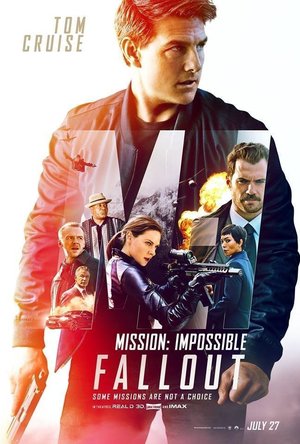
(Review from www.thechairport.com)When the Mission Impossible film franchise started it had a slightly rocky start. After a great first film, the second film fell short of the mark. Watching those first two films now you can see how different they are to the Mission we know now. Ever since the second Mission film, ever since JJ Abrams and the Bad Robot team took over, the Mission franchise has been ageing like a fine wine. Actually, it’s been ageing like Tom Cruise. Fallout, the sixth film in the Mission franchise is the best yet and easily one of the best action films of all time and it’s all thanks to its real action.
Mission Impossible: Fallout follows Ethan Hunt as he and his crew lose some plutonium they are trying to recover. The bad guys trying to use the plutonium are The Apostles, a spin-off group from Rogue Nation’s Syndicate. This time the IMF team are joined by a ruthless CIA agent, Walker played by Henry Cavill, who is there to ensure that the team retrieve the plutonium. The bad guys this time around, The Apostles, follow Solomon Lane’s thinking that to get peace the world must first experience a great suffering. With that line ringing throughout the IMF’s ears, the team is off on a race against time to stop The Apostles.
Fallout is filled with action and as far as action movies come, this film really takes the cake. Tom Cruise is just the man that everyone wants to be, as in he really seems like he can do anything. In the current state of cinema any other filmmaking team would’ve made this film with CGI effects all over yet Cruise and Fallout’s director, Christopher McQuarrie, have decided to do everything for real and it’s that element alone that makes the film.
There are moments in Fallout where you just sit there astonished by what you’re seeing happen in front of you. You feel shivers and the need to applause at the opening ten minutes of the film, your eye’s dash across the screen as you’re watching Cruise’s Ethan Hunt race through oncoming traffic in Paris and you’ll find yourself simply flabbergasted as you watch Cruise do anything at all in the helicopter sequence that you’ve definitely already heard about.
Mission Impossible: Fallout isn’t just simply an insane action blockbuster, it is more than that. Every actor on the screen knows that what they’re in is going to be something revolutionary for cinema and every actor really pulls their weight. Simon Pegg’s comedy is on point, Alec Baldwin’s acting as someone in charge is as good as ever, Henry Cavill being absolutely brutal is scary and cool at the same time. Fallout also has a good amount of female characters in it with Rebecca Ferguson and Michelle Monaghan bringing a lot of well-needed emotion and Vanessa Kirby’s Black Widow bringing a funny yet creepy vibe to the whole occasion.
The story is fairly simple as McQuarrie doesn’t want to isolate the audience, you can definitely see it if you haven’t seen other Mission Films. It’s McQuarrie and his team’s filmmaking that really make the film what it is. The cameraman who does the HALO jump with Tom Cruise deserves many awards and I would be surprised if the film, and its team, didn’t win any awards for filmmaking. If you’ve got free time too then look up how the film was made because it is quite interesting. I mean it’s rare that an action blockbuster would even be nominated but as of right now Fallout is my favourite film of the year, both for how good it is and then researching how it was made. People just don’t put in as much effort as the Mission team have done in films anymore.
Mission Impossible: Fallout is a must-see film. It’s a long film but never really feels like it. It’s a constant chase that will keep you on the edge of your seat and it has twists and turns that you won’t see coming. I was recently reading about how Christopher Nolan wanted The Dark Knight to bring back film instead of everyone filming digitally. Fallout sings a similar message and but its message is for real-life stunts. Mquarrie has evolved in a similar manner to how Nolan evolved between Batman Begins and The Dark Knight. Fallout gave me similar vibes of excitement and intensity and Fallout will leave its mark on you, I’m not sure how I’ll feel watching CGI action from now on. All I know is that making everything real instead of fake isn’t impossible but to repeat the magic that Fallout has, well that’s only something the Mission team can do. Mission accomplished Cruise, mission accomplished.
Score: 5/5

Hazel (1853 KP) rated Small Great Things in Books
May 24, 2017
Small is an Understatement
Jodi Picoult has been my favourite author since I first came across her novels in 2008. With twenty-three novels under her belt, she continues to delight readers with her page-turning stories. Most of Picoult’s books contain a moral issue, often, but not always, in the form of medical ethics, as well as a hefty court case. Although following along similar lines, Small Great Things is a radical, revolutionary book, which, with great courage, Picoult has written with the intent to expose the reader to truths that most of us, as a society, are intentionally oblivious to.
The gist of the storyline is that a baby dies whilst under the care of a nurse, prompting the grieving parents to take her to court with the accusation of murder. Although that sounds like an interesting story, it barely begins to describe what the book is about. The character on trial, Ruth, is an African American labour and delivery nurse – something that in this day and age need not by an issue. On the other hand, the parents of the baby are White Supremacists: seriously racist with the belief that white people are the master race. The father, Turk, refuses to let his wife and child be treated by Ruth, however circumstances result in her being the only nurse available to watch Davis, when, unfortunately, he so happens to go into cardiac arrest. Although the reader knows that Ruth is not at fault, Turk insists she murdered his child – but is he accusing her of medical negligence, or punishing her for being black?
Three characters, all with different views and experience when it comes to racism, alternately narrate Small Great Things. Ruth and Turk represent the extremes at either side of the scale. Ruth experiences first hand the negative impact of prejudice in the American system and society, not only through this court case, but in everyday life as well. She also reveals the difficulties growing up in a predominately white environment, never feeling like she fitted in with her peers. Alternatively, Turk spent his teenage years attending KKK rallies, participating in a white power movement, and beating up anyone who was different: black, foreign, gay, Jewish and so forth.
The third character represents the majority of white people living in America. Kennedy is a public defender and the lawyer assigned to Ruth’s case. Like most of the population, she believes that she is not racist, and persuades Ruth to leave the colour of her skin out of the argument. However, as she gets to know her client, she begins to realize that it is nigh on impossible to ignore racial prejudice.
Picoult shocks the reader on two accounts: one, the way that people of colour have been, and still are, treated; and two, the revelation that an invisible empire of White Supremacists are living amongst us. Yet there is a third way in which Picoult provokes outrage – she indirectly accuses the reader of being racist, too.
There is always something to learn in a Jodi Picoult novel, for instance medical terminology, or the way in which a court trial is conducted. Small Great Things provides a lot more eye opening information than any of her previous books, unveiling facts about such a controversial subject.
Through Kennedy, the reader’s eyes are opened to the racial discrimination that we all turn a blind eye to. Ignored are the difficulties African Americans suffer when going shopping, applying for jobs, attending school, walking down the street, sitting on a bus, and so forth. Picoult asks me as a reader to think about how my life has been affected by racial discrimination: being served politely in shops because I am white, not having my ethnicity questioned when applying for college etc. Living in Britain I have not experienced openly hateful comments or behaviours towards people with a different skin tone – I used to believe this was primarily an American problem. Yet, Small Great Things has really made me think about the hierarchy of power within society, particularly in regards to the ethnicity of those at the top, compared with those at the bottom.
Jodi Picoult sat on the idea of writing a book about racism for well over a decade, yet it is particularly apt that it is published now, with the current predicaments America is facing. Although we have come a long way in attempts to achieve equality for all – compare the trial in To Kill A Mockingbird to Picoult’s version – recent events have revealed that we are no where near.
Small Great Things will shock everyone who reads it regardless of their ethnicity and so forth. Many may find it uncomfortable to read, become upset or outraged, and even feel like they are being directly targeted. If this is the case, then good – it should do that. Everyone needs to read this book. On the one hand it is a brilliant, well told story with a beautiful, almost poetic narrative, and on the other, it causes us to face up to the issues we are forever making light of or overlooking entirely. We have grown up believing that racism is a form of hatred when, actually, it is about power. However Small Great Things makes you feel, it is definitely worth reading, especially for the satisfying ending – one that you do not see coming.
Hazel (1853 KP) rated Small Great Things in Books
Dec 7, 2018
Jodi Picoult has been my favourite author since I first came across her novels in 2008. With twenty-three novels under her belt, she continues to delight readers with her page-turning stories. Most of Picoult’s books contain a moral issue, often, but not always, in the form of medical ethics, as well as a hefty court case. Although following along similar lines, <i>Small Great Thing</i>s is a radical, revolutionary book, which, with great courage, Picoult has written with the intent to expose the reader to truths that most of us, as a society, are <s>intentionally</s> oblivious to.
The gist of the storyline is that a baby dies whilst under the care of a nurse, prompting the grieving parents to take her to court with the accusation of murder. Although that sounds like an interesting story, it barely begins to describe what the book is about. The character on trial, Ruth, is an African American labour and delivery nurse – something that in this day and age need not by an issue. On the other hand, the parents of the baby are White Supremacists: seriously racist with the belief that white people are the master race. The father, Turk, refuses to let his wife and child be treated by Ruth, however circumstances result in her being the only nurse available to watch Davis, when, unfortunately, he so happens to go into cardiac arrest. Although the reader knows that Ruth is not at fault, Turk insists she murdered his child – but is he accusing her of medical negligence, or punishing her for being black?
Three characters, all with different views and experience when it comes to racism, alternately narrate<i> Small Great Things</i>. Ruth and Turk represent the extremes at either side of the scale. Ruth experiences first hand the negative impact of prejudice in the American system and society, not only through this court case, but in everyday life as well. She also reveals the difficulties growing up in a predominately white environment, never feeling like she fitted in with her peers. Alternatively, Turk spent his teenage years attending KKK rallies, participating in a white power movement, and beating up anyone who was different: black, foreign, gay, Jewish and so forth.
The third character represents the majority of white people living in America. Kennedy is a public defender and the lawyer assigned to Ruth’s case. Like most of the population, she believes that she is not racist, and persuades Ruth to leave the colour of her skin out of the argument. However, as she gets to know her client, she begins to realize that it is nigh on impossible to ignore racial prejudice.
Picoult shocks the reader on two accounts: one, the way that people of colour have been, and still are, treated; and two, the revelation that an invisible empire of White Supremacists are living amongst us. Yet there is a third way in which Picoult provokes outrage – she indirectly accuses the reader of being racist, too.
There is always something to learn in a Jodi Picoult novel, for instance medical terminology, or the way in which a court trial is conducted. <i>Small Great Things</i> provides a lot more eye opening information than any of her previous books, unveiling facts about such a controversial subject.
Through Kennedy, the reader’s eyes are opened to the racial discrimination that we all turn a blind eye to. Ignored are the difficulties African Americans suffer when going shopping, applying for jobs, attending school, walking down the street, sitting on a bus, and so forth. Picoult asks me as a reader to think about how my life has been affected by racial discrimination: being served politely in shops because I am white, not having my ethnicity questioned when applying for college etc. Living in Britain I have not experienced openly hateful comments or behaviours towards people with a different skin tone – I used to believe this was primarily an American problem. Yet, <i>Small Great Things</i> has really made me think about the hierarchy of power within society, particularly in regards to the ethnicity of those at the top, compared with those at the bottom.
Jodi Picoult sat on the idea of writing a book about racism for well over a decade, yet it is particularly apt that it is published now, with the current predicaments America is facing. Although we have come a long way in attempts to achieve equality for all – compare the trial in <i>To Kill A Mockingbird</i> to Picoult’s version – recent events have revealed that we are no where near.
<i>Small Great Things</i> will shock everyone who reads it regardless of their ethnicity and so forth. Many may find it uncomfortable to read, become upset or outraged, and even feel like they are being directly targeted. If this is the case, then good – it should do that. Everyone needs to read this book. On the one hand it is a brilliant, well told story with a beautiful, almost poetic narrative, and on the other, it causes us to face up to the issues we are forever making light of or overlooking entirely. We have grown up believing that racism is a form of hatred when, actually, it is about power. However <i>Small Great Things </i>makes you feel, it is definitely worth reading, especially for the satisfying ending – one that you do not see coming.

Service-Oriented Architecture: Concepts, Technology, and Design
Book
"Service Oriented Architecture is a hot, but often misunderstood topic in IT today. Thomas...

Bob Mann (459 KP) rated Downsizing (2017) in Movies
Sep 29, 2021

Tiny People, Big Mess.
From the trailer this film looked quirky, funny and interesting and has been on my “looking forward to” list for many months. Oh dear, what a let down.
Matt Damon (“The Martian“, “The Great Wall“, “Jason Bourne“) and Kristen Wiig (“mother!“, “Ghostbusters“) play Paul and Audrey Safranek. Paul is a laid-back and hardworking occupational therapist; Audrey has materialistic ambitions over and above their available finances. The two decide to “downsize” making use of a revolutionary Norwegian invention that reduces humans, and most other lifeforms, to a fraction of their normal size. This offers huge wealth to the normal American, since the cost of living in downsized form within the mini-estate called LeisureLand is tiny in comparison to “big folks”. But all does not go well in the transition (unlike the trailer, no spoilers here) and Paul needs to find a new purpose in life as bigger problems loom.
It’s clearly written to be a social satire, and there are some clever angles to be explored here: everyone publicly positions their downsizing based on ‘environmental issues’ and ‘saving the planet’, but most everyone’s real reason is the lifestyle benefits. Also lightly touched on, but never deeply explored, are the impacts that the downsizing initiative is having on the broader American economy and property markets, with the ‘big people’ questioning why small people should have the same rights and votes as them.
But the film never really gets into the meat of any of this. Worse than that, the movie never settles on what it is trying to be. I think we can write off “Sci-Fi” pretty early on. But is it a drama? A comedy? A love story? A socialist rant? An environmental cri de coeur? The film jumbles all these aspects together and treats each so halfheartedly that none of them get properly addressed.
Not only are the audience confused: none of the actors seem to be too sure why they’re there either. Damon – never Mr Personality – should have been able to develop some chemistry with the feisty and dynamic Ms Wiig, but even these early scenes plod along with you thinking “what a dull film”. Things perk up slightly at the LeisureLand sales fair, where Neil Patrick Harris (“Gone Girl“) and a naked Laura Dern (“Star Wars: The Last Jedi“) glibly try to sell a luxury doll’s house to the assembled crowd. American consumerism in miniature.
But post-downsizing the film crashes back to ‘Dullesville Arizona’ again, but with added depression, requiring Christophe Waltz (“Django Unchanined”, “Spectre“), as a dodgy Serbian entrepreneur Dusan Mirkovic, to over-act manically to try to add any sort of energy into the film (which he is only mildly successful at doing). There’s a rather bizarre supporting role from Udo Kier – looking for all the world like Terence Stamp – as Mirkovic’s ship-owning pal, and an almost cameo performance from Jason Sudeikis (“Colossal“).
Enter stage-left Thai-born Hong Chau as Ngoc Lan Tran, a Vietnamese cleaner. There’s a clever angle here: where “average American Joes” like Safranek can live like kings, but the poor still have to scrape by, living in ‘skyscraper Portacabins’, as the menial classes: there’s no escaping class structures, even when 5 inches tall. Chau sums up the uneven nature of the film, as she mostly plays her lines for laughs but then (in a spectacularly good bit of acting in the midst of, I have to say, some pretty poor hamming) bursts into uncontrollable tears.
Just when you think things are going to limp to a unmemorable close, the film ups and leaves LeisureLand to add a completely bizarre final act. (It’s pretty unusual in the UK for people to walk out of a cinema mid-film, but a couple did so at this point). This segment bears no relationship to the downsizing theme whatsoever, since all the players at this point could be full-sized. Aside from an amusing “50 shades of f**k” speech from Ngoc Lan Tran and a “massive explosion”, this story goes nowhere, says nothing (at least not to me) and merely irritates. Throw in a completely anti-climatic non-ending and I genuinely shared a “WTF look” with the stranger sat next to me!
This is all very strange, since this comes from Alexander Payne, who also directed and co-wrote “The Descendants”, one of the most impressive films of the decade. Jim Taylor co-writes (as he has co-written numerous other films with Payne).
I note that in this morning’s London Times that their film critic, Kevin Maher – someone who’s views I am generally pretty well aligned with – gave it 4 *’s out of 5. I can only assume that he either saw a completely different cut of the film, or he is a lot cleverer than I am and understood amazing sub-texts that completely passed me by! Maybe… but I have a sneaking suspicion that the general viewing public will more share my opinion on this than his.
I was tempted to give this just one star as it was such a disappointment to me, but the underlying concept is a good one: it is just one that has, in my humble opinion, been implemented in a bizarrely slipshod manner.
Definitely not recommended. Go and see “Coco” instead!

Movie Metropolis (309 KP) rated Life Of Pi (2012) in Movies
Jun 10, 2019 (Updated Jun 10, 2019)


Ang Lee has directed some very artistic and emotionally charged films in his career and his new movie, Life of Pi is certainly no exception. But can his take on Yann Martel’s 2001 novel of the same name live up to his usual high standards?
In short, the answer is a resounding yes. From the stunning special effects and beautiful acting to the heart-warming story, it captivates from beginning to end like no other film released this year.
The film begins with a pet hate of mine, the credits. I always think a movie that starts with its credits is usually a huge let-down but something was different here, as soon as the brilliantly filmed names flash across the screen, I knew this film was going to be spectacular, just how spectacular however, I was not prepared for.
The story is, essentially what the title says it is, the life of a boy called Pi and his extraordinary journey from childhood, through adolescence and finally into adulthood. It seems quite simple and perhaps nothing too innovative or different, but the way Lee has captured the magic of the novel really does shine through on screen.
In the present day, Rafe Spall plays a budding writer searching for inspiration for his next big book. He comes across Irrfan Khan who plays the adult Pi and has an unbelievable story to tell. So, as he begins to narrate this incredible journey, the viewer is transported to when Pi was a boy.
It’s true that the film takes a while to get going and the scenes in Pi’s native India are perhaps the most testing of the entire film. The momentum is built up slowly as the boy travels through school life whilst his family run a small zoo in their hometown. Alas, the perfection of his childhood is ruined when his entire family decide to relocate to Canada due to an economic crisis. They are packed onto a tanker with the zoo animals on-board and begin the journey to their new life.
Whilst on the last leg of their journey, their ship is ravaged by a severe storm and Pi’s family is lost, along with most of the zoo animals and, in a scene that even betters the emotionally charged sinking in Titanic and the CGI packed sinking in Poseidon, their tanker is lost to the ocean.
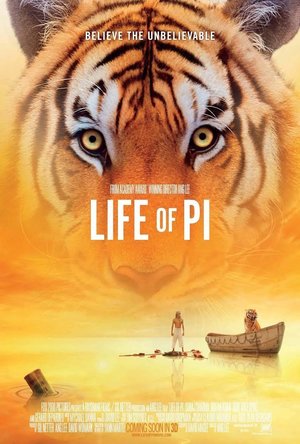
Thankfully he survives, along with an injured zebra, a naughty hyena and a motherly orangutan in a small life-boat. It’s safe to say that the zebra and ape don’t last too long on-board a ship with a hyena and they are picked off as lunch. However, also sailing with them is Richard Parker, a Bengal tiger and he forms the basis of the film, along with Pi. At first, after Richard Parker makes light work of the hyena, the relationship between Pi and his new shipmate is somewhat strained, a constant battle between who is going to eat who and the only sensible option is for Pi to live on separate raft tied to the life-boat.
However, a few days pass and finally they can share a boat, albeit after a couple of amusing scenes involving urine and some flying fish.
Richard Parker is a beautiful animal to say the least, a mixture of live action tigers, CGI animation and animatronics really brings him to life, which is good considering he is the only other character in the film. This is where Ang Lee’s brilliance as a director shines, bringing warmth and heart to a character that is not only not real, but an animal, without the ability to talk and share feelings. Credit must also be given to newcomer Suraj Sharma who plays Pi Patel absolutely brilliantly. I simply could not believe this was his first big acting role; his performance is nothing short of stunning.
Then there are the special effects and 3D. Everything is a wonder to behold and the 3D is a help in enjoying the film, rather than a hindrance which it continues to be in other movies. There are two scenes in particular which really stand out, including a lot of jellyfish and a few thousand meerkats. I won’t say anything else, as they need to be seen to be believed.
Moreover, in the depths of this film lies a huge emotional core, the story of a boy and his ‘pet’ and the perils they face, the togetherness they bring to one another is touching to say the least and let’s just say there were more than a few sniffles coming from the rows behind me in the cinema. However, it is more than just a story of companionship; there is a deep religious message about believing in god even if he seems to not be there 100% of the time. Whether or not you choose to read into this is your decision, but it’s there throughout.
Life of Pi is something really special, a magical journey that needs to be seen to be believed. Very rarely, a film comes along that touches your heart, your soul and your head and this is one of those films. Everything from the performances of all the actors, the beautiful recreation of Richard Parker and stunning special effects make this film as revolutionary as Avatar was in 2009. It is not only the best film of 2012; it is one of the best films ever made. Please, I urge all of you who read this, go see it, and witness history in the making.
https://moviemetropolis.net/2012/12/22/life-of-pi-review-2012/

Gareth von Kallenbach (980 KP) rated Les Misérables (2012) in Movies
Aug 7, 2019
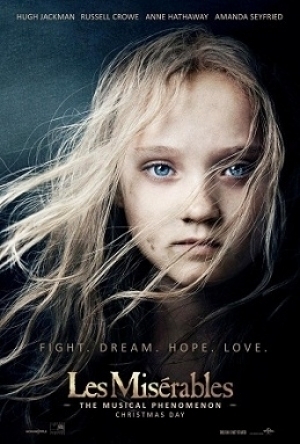
Words cannot express how amazing this movie is. For those of you who have shouldered through the modern-day musical revival; suffering through the questionable singing talents of many stars as “Phantom of the Opera,” “Chicago,” “Moulin Rouge,” “Sweeny Todd,” and that abysmal rendition of “Nine” – I can assure you, that “Les Mis” will change that perception. For once, the casting crew took the time to select a cast capable of the repertoire’s vocal demands (and Les Mis is very vocally demanding – as most operatic pieces are). It’s apparent that each singer was heavily vocally coached and trained, some faring more so than others. While this is no replacement for raw talent, I can assure you that the cast was downright fantastic.
For years I studied and sang opera. I know music and I’ve sung my fair share of Les Mis pieces in my past. I adore Victor Hugo and “Les Misérables” is by far one of my favorite literary works. When I began to watch this movie, I was keyed up to be critical on the vocal spectrum, the literary aspect, and the representation of one of my favorite Broadway/London pieces. To be frank, I wasn’t disappointed at all.
For those unfamiliar with Hugo’s work or what to expect with Les Mis, let me give you a brief synopsis on its plot and the history of the French revolution in which this takes place. France has just endured her infamous Revolution (the one with the guillotine, Marie-Antoinette, and the Sans Culottes movement) and her people are still suffering. There is no money for food, the country is in the midst of a depression, and the Napoleonic regime is yet to come to fruition. Thus, you find Fantine (Hathaway), a poor but determined (and beautiful) woman trying desperately to make enough money to support her daughter, Cosette, who resides with friends in another city. The book reveals that Madame Thénardier (Bonham-Carter) and her husband, Thénardier (Baron-Cohen) were supposed to be taking the money that Fantine had given to them to provide for her daughter, Cosette. Instead, however, Cosette is forced to live in absolute poverty while Thénardier’s daughter, Eponine, lives the life of opulence. Meanwhile, Jean Valjean (Jackman), an ex-convict, is trying desperately to find legitimate work after his stint in prison for stealing a loaf of bread to provide for his starving family. The infamous policeman, Javert (Crowe), feels Valjean will re-offend and makes it his mission to pursue Valjean until the end.
Finding the world a terrible place as an ex-convict, Valjean seeks to steal from a church her silver, believing he has no other way to survive. It is the love of a good priest, however, who gives Valjean the silver he seeks under the pledge he will become a servant of God and provide for others the same good he has provided for him. Thus, years later, we find Valjean a reformed man (who has skipped on his parole and assumed a new name), running a factory in which Fantine works. And so, when Fantine is fired from her job and takes to a life of prostitution in order to provide for her daughter, it is Valjean who feels the burden of her demise and takes it upon himself to save Cosette and raise her as his own.
Of course, this entire time, Javert is pursuing Valjean and a new revolution is starting to take place amongst Paris’ people. Years later we find Cosette grown to womanhood (now played by Seyfried), and falling in love with one of the revolution’s key players, a youth by the name of Marius (Redmayne). The Thénardiers are back again and we find their once-grand lifestyle has resorted to a life of gutter-crime and Éponine (now played by Barks), is desperately in love with Marius as well (although her love is unrequited). For those unfamiliar with how the story plays out, I will leave it at that.
I will caution those who have never seen this play to prepare for a long show. It is very dramatic and very intense, but visually breath-taking and emotionally moving in so many ways. Vocally, there are times when the legato is lacking and some transitions seemed forced (Crowe struggled many times with allowing his natural vibrato to come through instead of pushing a sustained note; Seyfried’s vibrato is very trill-like and sometimes distracts from the pure quality of her spinto-soprano range). However, I must say that I was blown away by Hathway’s performance (she brought me to tears with “I Dreamed a Dream” due to her emotional rendition) and her ability to truly escape into her character. Similarly, Tviet (he played Enjolras) was stunning with his vocal command and Redmayne was equally as impressive. Jackman will amaze you with his rich tenor and, surprisingly, I found Crowe to have a fantastic baritone when he didn’t force his work. Baron-Cohen and Bonham-Carter provided a much needed comical respite throughout the film (and both sing beautifully as well, although this movie didn’t focus on their vocal command as much). Barks did a lovely job for most of her work; although I found her rendition of “On My Own” a bit forced (she is a true mezzo but seemed to push her high notes, although this may have been where her voice shifted into her head voice which is no fault of her own).
Overall, if you are an avid musical lover and have been waiting for a proper rendition of this production, this movie will astound you. Visually, the movie is breath-taking and the acting is absolutely fantastic. I’m still haunted by the revolutionary song, to be honest. If you’ve been waiting for a musical worthy of the big screen, this one is it. Look for it to sweep the Oscars this year.
This movie deserves an A all around.

RəX Regent (349 KP) rated The Dark Knight Rises (2012) in Movies
Feb 19, 2019
Contains spoilers, click to show
After four years, since The Dark Knight ended, leaving us wanting more and seven years since Christopher Nolan reinvented the comic book adaptation with Batman Begins, The final chapter of The Dark Knight Trilogy has arrived.
With this much hype, would it possible live up to potentially bloated expectations? The first reviews hit last monday, with 4 to 5 stars being the consensus. Well, it did! The Dark Knight returns one last time, after eight years have passed since the events of The Dark Knight and Batman had retreated into the rebuilt Wayne Manor as Commissioner Gordon (Gary Oldman), maintaining the lie that Harvey Dent was Gotham’s The White Knight, and not the maniacal Two-Face, had managed to clean up Gotham City.
Batman was no longer needed but in the meantime, Bane has arrived in the city with grand plans for its destruction. I won’t go much further into the plot that this, though I will probably write a more spoiler heavy review for the Blu-ray later in the year. But for now, I will try to maintain the film’s integrity.
When we first meet Bruce Wayne after almost a decade of seclusion, he is a broken man, both physically and mentally following the murder of his childhood sweetheart, Rachel Dawes in the previous film and the toll of nightly combat. So the first port of call is to bring Batman back to the streets of Gotham. The sense of excitement is palpable and very much a part of what makes Nolan’s films tick.
He draws his audience into the narrative as if we are part of the events and the universe as it unfolds, leaving us not just wanting Batman to return for the sake of the action but for Gotham’s sake as well. Bane, played so excellently by Tom Hardy, was a little difficult to understand from behind his mask, but still conveyed an enormous amount of presence and power, as he lays siege to the city but not as Terrorist per say, but as a freedom fighter or revolutionary, with many visual references to the French Revolution to keep us going.
Anne Hathaway’s Catwoman, though not named as anyone other than Selina Kyle, was a credit to her character as well as the actress. Dark, sultry, seductive and agile, her feline credibly was intact, whilst still being a very human character. Her duplicity was bread from desperation rather than evil and her motives convincingly drive her in both good and more dubious endeavours.
*** MAJOR SPOILER***
The less said about Talia Al Ghul the better, but the for those aware of her role, it was well-played, though her final scene was the hammiest in the film, possibly the entire trilogy.
Then there’s the supporting cast, such as Mathew Modene, who does a great job as Dept. Commissioner Foley and Cillian Murphy’s back again, as the subtly unrecognisable Scarecrow, who besides some frayed shoulder’s on his jacket, could have been anyone,and that’s the beauty of Nolan’s Batman universe. It’s fluid and you can’t count on anything on anyone for too long.
But this franchise would be nothing without Hans Zimmer percussive score, pounding as much as it was gentle, it works well among with Nolan’s direction to craft the near perfect conclusion to the Trilogy. Both riff on earlier films and supe it up accordingly whilst maintaining the film’s integrity.
In the end, my expectations were met and exceeded. Nolan has crowned his trilogy with a film which is of the same calabar as the two which preceded it, filling in many of the blanks, choosing the right characters to take on and doing so a variety of ways, touching this time on the flamboyant Bain, though scrapping the “Venom” plot from the comics, creating an intriguing Catwoman and building another major character in the form of R. John Blake (Joseph Gordon-Lovett).
The ending of the film is just perfect, not only for this but for the entire Trilogy. With nods to Inception though I believe that it is just a nod and not as similar as some would protest, but this is epic in the way that The Dark Knight never tried to be and Batman Begins didn’t need to be. The threat is apocalyptic, in keeping with the genre, but believable in keeping with Nolan.
The same can be said for the action, though I must admit, the sentimentalist in me wanted to see the Batmoble/Tumber back, though it was there in triplicate, as Bane steels three prototype Tumbers from Wayne Enterprises, for his private army, but the Bat (Batwing) was stunning, and the Batpod made a reappearance. The Final showdown will leave you breathless, the perfect blend of direction, Zimmer’s score and some of the most intense and meaningful action you’ll see on the big screen.
The only real faults with The Dark Knight Rises stem from its scale and change in direction. It’s more about Batman’s evolution from crime fighter to savour. Less intense on a personal level, but much grander in its ideals and horror as Gotham is destroyed on scale never seen in a film of this type. But it’s not as far-fetched as one may think, as it grounds itself with historical references, such as the French Revolution, which was hardly far-fetched, though it was hard-hitting and is well translated here.
Bruce Wayne completes his journey from the boy who witnessed his parents murder, to a young man who could not grow beyond it, to a man who lost himself in a journey to understand the criminal mind. Finally returning as Batman, who defied his mentor to protect his beloved city, to a master detective. But here, he returns to his roots.
The billionaire who never cared about his wealth as much as he cared for the people of Gotham, he ends up exactly where he needed to be. Decide for yourself, whether it’s a happy ending, sad or satisfying, but either way, it was not only the best way to advance the saga, but the best way to end the series as a whole. Thanks to Nolan and his crew, we now have the most definitively brilliant Batman series EVER committed to celluloid, (or digital), and no matter what is to follow, whether it is to be the Justice League mash-up or another reboot, I suspect that it will be a long, long time before anyone can beat these.