Search

Search only in certain items:

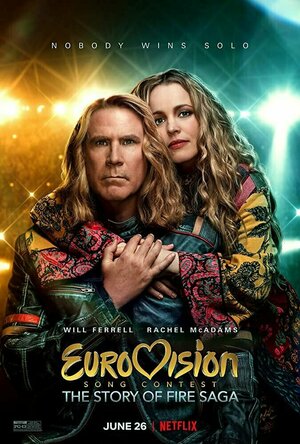
Eurovision Song Contest: The Story of Fire Saga (2020)
2020 | Comedy, Music, Romance
Rachel McAdams and Dan Stevens steal most of the scenes (1 more)
A real feelgood movie that spoofs the unspoofable pretty well
My lovely farce
Will Ferrell's output over the last few years has been decidedly patchy. I have to go back to "Get Hard" to find one of his movies that really got to my funny bone. But this latest Netflix offering hits the spot for me.

We start with the song recently voted the number one Eurovision song of all time by UK viewers: "Waterloo" by Abba. Young Lars Erickssong (LOL) (Alfie Melia) is transfixed watching the 1974 Eurovision winner with his recently bereaved father and local Lothario Erick (Pierce Brosnan). (Mental note to women: never marry Brosnan on screen... he gets through wives faster than you can murder "S.O.S."). Also present are his friends and young Sigrit ("probably not by sister") Ericksdottir (Sophia-Grace Donnelly). Lars vows to one day stand on that stage and make his father and his remote Icelandic fishing village proud.

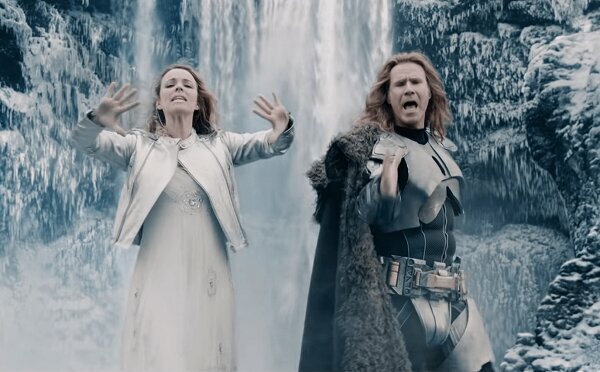
Now all grown up, Lars (now Will Ferrell) and Sigrit (now Rachel McAdams) are still pursuing their dream of representing Iceland in the upcoming Eurovision Song Contest. They are, of course, dreadful - - so they should fit right in! But their way is blocked by the immensely talented Katiana (Demi Lovato) and all seems hopeless. Will Sigrit's faith in the power of the Elves see them through?

There's an obvious problem here. The Eurovision Song Contest is in itself so bat-s**t bonkers that it is almost impossible to spoof. (If anyone is not on this wavelength, checkout the genuine Russian entry in this year's (cancelled) contest on Youtube). But the team here (writers Will Ferrell and Andrew Steele and director David "The Judge" Dobkin) do a really great job. I'd love to know what a US audience - who I guess will mostly be unfamiliar with Eurovision - make of this. Since Australia are now honorary Europeans in the contest.... wouldn't it be great if there was a Mexican mariachi band attending and a country and western act from the States? (Brits would love the US to be involved.... as spoofed in the film, there's only one country European's hate more than the UK.... be nice to have someone else to join us in the "nul points" club!)

Wherever you may be on the "Ferrell-funny-or-not-ometer", there's one thing I hope we can all agree on here, and that is that Rachel McAdams continues to shine as a comic lead. She was fantastic in "Game Night" - one of my favourite comedies of recent years - and here she is both gorgeous and hilarious. She knocks it out of the park playing the elf-loving Icelandic pixie with the golden voice. (McAdams "sings" but is significantly "helped" in the mix by Swedish pop star Molly Sandén (aka My Marianne)).

Here she even gets to almost reprise her wonderful "YEESSSSS! Oh no, he died!" line from "Game Night".

Almost matching her in the scene-stealing stakes though is Downton's Dan Stevens as Lemtov: a Russian 'Tom Jones'-like contestant singing "Lion of Love" ("Let's get together; I'm a lion lover; And I hunt for love!"). He's DEFINITELY not gay ("There are no gays in Russia") but are his multi-millions enough to turn Sigrit's head?

For those who love their annual Eurovision parties, there are also an impressive array of nice cameos that will delight.

But where the film-makers really score (no pun intended) is making the music so fitting. Some of the tracks make you think "Yeah, if this was the real content, this might have got my vote". Director Dobkin is quoted as saying "It's okay if it's funny, but it has to be really good music. It has to still be great and just kitschy enough to be Eurovision, because that's part of what's fun about Eurovision" (Source: Vulture). Very true. This success is down to the involvement of pop writer/producer Savan Kotecha on the project: the man behind hits by Katy Petty, Ariana Grande and Ellie Goulding.

A comedy needs to make me laugh, and this one really did - numerous times. It's not just the dialogue. Some of the cut-away scenes are priceless and perfectly executed: jumping whales; a collapsing glacier; a small slamming door!

Sure, it borrows from a number of other sources in its plot: most notably THAT episode of "Father Ted" and the rap-battle scenes from "Pitch Perfect". And sure, some of the outRAGEOUS Icelandic accents sometimes swerve into an alarming mix of Indian, Welsh and Caribbean dialects! But above all, this is movie with real heart. The plot is pretty well signposted, but the finale still packs a (surprisingly) hefty emotional punch, and it leaves you with a really nice afterglow.

As we struggle out of Covid lockdown, it may not be a vaccine, but it is a pretty good medicine for the side-effects. Did I love this? Jaja Ding Dong!

(For the full graphical review, please check out One Mann's Movies here - https://bob-the-movie-man.com/2020/06/27/one-manns-movies-film-review-eurovision-song-contest-the-story-of-fire-saga-2020/ ).
  
The Boondock Saints (1999)
1999 | Action, Comedy, Drama
9
8.6 (9 Ratings)
Movie Rating
The action, the Irish guys (0 more)
B is for Bad A**
Contains spoilers, click to show
This entertaining action film opens with aerial views of Boston and narration of the Lord's Prayer on St. Patty's Day. Soon, we are introduced to two Irish brothers, Connor and Murphy MacManus. The terrible twosome work in a meat-packing plant: in their spare time, they slaughter evildoers. What could be better? With their black shirts, black blazers, and blue jeans, the brothers seem like Mormon missionaries gone horribly wrong.

Connor and Murphy (played by Sean Patrick Flanery and Norman Reedus), fall into the
profession of murdering bad guys quite by accident. Initially, the fact that they killed a Russian crime lord, and his associate, after a bar fight seems a coincidental act of self-defense. They are hailed, at first, as heroes. They somehow continue to avoid prosecution, though from the beginning they are being pursued by FBI agent Paul Smecker. They start targeting the crime lords on purpose, and they eventually end up being hunted by a more ominous figure, the legendary hitman Il Duce.

Willem Dafoe gets an A for awesome in my book for his performance as FBI agent Paul Smecker. Smecker is a homosexual, and he is not apologetic about it. In fact, he draws attention to his orientation in many scenes. Particularly memorable is the moment where he corrects an officer’s use of the word “symbology” by hissing a pronounced s: “ssssymbolism.” Later in the film, Dafoe even gets the opportunity to use his feminine wiles by dressing in drag, a visual experience which I promise is as disconcerting as it sounds.

The presentation of Smecker’s crime scene explanations was particularly impressive. The crime scene was shown first, and the events that created it unfolded in retrospect as Smecker described the scene. Enhanced by the intensity of the score, Dafoe offered a memorable narration of an epic shootout, during which he resembles an insane conductor.

The writing in this film was great, with witty one-liners throughout to break the tension. There were several moments in the film where one wonders if the brothers’ success is due to dumb luck or divinity. The MacManus twins certainly seem to believe that their cause is a righteous one.

I must also acknowledge the score, by Jeff Danna, which beautifully compliments the opening sequence and the rest of the film. The score even includes a variation of a hymn, infused with a beat you can dance to.

I love a good revenge film, and this is one for the ages. To sum up my complex feelings about the vigilante-style justice in this film, I must end with a quote by Connor MacManus: "I'm strangely comfortable with it."
  
Suite Francaise
Suite Francaise
Irene Nemirovsky | 2007 | History & Politics
10
10.0 (1 Ratings)
Book Rating
Suite Francaise by the talented Irene Nemirovsky is divided into two "books," so to speak. The first part, Storm in June, begins with the French fleeing parts of Paris and surrounding areas to avoid the German occupation. The story focuses on two families and one couple primarily: the Michauds, the Pericands, and Gabriel Corte with his mistress, Florence. Throughout the book the characters' stories are intertwined with one another beautifully in vignette style chapters. The first book covers June 1940 through the end of November in 1940. The main story in Storm encompasses the fear and desperation that so many French people experienced at the beginning of the war-fear they would never return home, fear they would be killed in an air raid, fear they would just not survive. In Dolce, the second part, covers how the French are handling things back at home after the Germans have begun occupying various cities and have begun living with the French in their homes. This part in the story covers Easter Sunday 1941 through the end of July 1941, so a much shorter time frame than Storm. This section focuses on a different set of characters, involving the Angelliers, the Sabaries, and the Montmorts. The main come away from this is, how do you put up with someone who may have killed your loved one in the war?

Overall, this book was incredible. I don't typically go for this type of book (war-themed), but I was intrigued and I'm so glad I gave it a chance. Irene Nemirovsky was a French-Russian who was writing these books while all of this was happening around her in France. While the characters in the stories are fictional, the emotions they feel and the thoughts they have are very real and very comparable to what others were feeling during this time. In the beginning, yoiu will find your heart racing as everyone flees their possessions, their livelihoods, their families, just to escape the Germans and the certain death they bring. Your breath will catch at the description of the sirens and the air raids, and you will be angry at these Germans for what they have done. However, in the second part, you will find yourself sympathizing with the Germans, even after the brutalities explained in the first part. You will find yourself thinking about the French and how torn they were seeing how kind and generous the Germans were, how the children loved them so, not understanding what horrors they had committed against others. Irene paints such a beautifully descriptive landscape that you will feel like you are experiencing all these accounts first hand. I would recommend this book to anyone who has an interest in war-era books, and even those who have never read it before.
  
The Guest Room
The Guest Room
Chris Bohjalian | 2016 | Fiction & Poetry
8
8.7 (3 Ratings)
Book Rating
Richard Chapman reluctantly agrees to host his younger brother's bachelor party--at his own home. He suspects his brother, Philip, and Philip's good friend Spencer may be hiring some "entertainment" for the party, but isn't expecting the two women and Russian bodyguards who show up for the evening. Nor is Richard expecting what follows -- an evening of drinking, partying, sex, and suddenly - murder, when the women kill their bodyguards and disappear. Suddenly, Richard finds himself trying to explain what happened to his wife, their young daughter, his employer, and the world at large. Further he finds himself haunted by memories of his interactions with one of the girls, Alexandra.

This was an interesting book with a somewhat fascinating premise. It brings up a lot of questions about morality. What role does our society play when it comes to bachelors parties -- and what is the expectation of those attending? And the spouses and fiancees on the other side? What do we tell ourselves about the origin of the "talent" that appears at such functions? Bohjalian attempts to explore these questions through Richard's story - which unfolds from Richard's perspective, that of his wife, Kristin, and one of the hired girls, Alexandra. It becomes almost a bit of a thriller - as we piece together bits before the party, the aftermath, and also learn what led up to the girls' fateful decision.

A bit of the book lags in the beginning, but it picks up quickly and becomes quite compelling. One would think Richard would be the main character, but for me, the story revolved around Alexandra. Her tale is the most thought-provoking and insightful. At points, the novel is simply heart-breaking. Richard's sections are often irritating and frustrating, as you can only have so much sympathy for the man at points. Kristin is a good go-between - the innocent bystander blindsided by what occurred in her home when she was not there.

Overall, the book weaves the story nicely around its characters. Little details give a nuanced perspective that authors less experienced than Bohjalian may lack (he's also one of the few authors that has me hitting the dictionary from time to time to look up words). There was a time when I really felt my rating for this could range from 2 - 4 stars. It received a bump for the ending, which just felt fitting, and for Alexandra, who was a lovely protagonist and written in such a quiet way that doesn't come along very often. In the end, this felt more than a "life in suburbia gone terribly wrong" story - it was cold and heartless, yet heart-breaking and compassionate. A worthwhile read, for sure.

(Note: I received an ARC from Netgalley in return for an unbiased review.)
  
How Hard Can It Be?
How Hard Can It Be?
Allison Pearson | 2018 | Fiction & Poetry
8
7.0 (3 Ratings)
Book Rating
It's all fun and games until someone posts a belfie.

Kate Reddy is back. And her daughters backSIDE is causing some trouble. We jump right into our favorite bad-a$$, anxiety-ridden, take-charge heroine Kate's life as she is approaching 50 and it seems the hilarity and struggles of parenting, working, wife-ing, friendship and everything else in Kate's life is just as amusing as ever.

Kate's daughter Emily has taken a pic of her butt and the crazy life of Kate's we all know and love, just cannot seem to get any more complicated - until it does. She's been out of the workforce, and looking to get back in, She's not having much of any sort of pleasant relations with husband Richard (yes, surprisingly, still married). She's having a mini mid-life crisis trying to accept she's almost 50, her parents are aging, and her kids are now teenagers and the struggles to communicate with these digital-age micro-adults is almost as difficult as communicating with Russian Investors.

As Kate tries to make her way back into the world of investing she once was so good at, she has some pretty cringeworthy experiences, and struggles to find a way in that world as an "aging" woman. We find several comparisons to the past, when just being a mother was the wall between her and success. She finds herself lying to herself and others, trying her best to tiptoe through a marriage in crisis and lack of communication with her children, and praying the looming milestone birthday isn't going to be the demise of any semblance of the woman that she knows she is, and desperately wants to find again. Oh, and did I mention Jack is BACK?!

The book is classic Allison Pearson: witty, entertaining and full of laughs. I didn't realize how much I missed Kate (I totally still picture SJP in every situation...) and I settled into a familiar routine of rooting for her to find her stride and finally be happy with who she is, who she's becoming, and where she might be headed next.

The story is nostalgic of I Don't Know How She Does It, but reads well as a standalone with snippets of backstory that are well-placed and don't interfere. Avoiding any spoilers, I'll just say that I'm pretty sure readers and fans of Kate Reddy will be pleased at how it all turns out. How Hard Can It Be? was refreshing but familiar and it felt like an old friend was back in my life.

Thanks to NetGalley and St. Martin's Press for the Advanced Copy and opportunity to review this book.