Search
Search results

Gareth von Kallenbach (980 KP) rated the PC version of Call of Duty WWII in Video Games
Jun 19, 2019


The long running and very popular Call of Duty series has gone back to where it all began for the latest entry into the series. Call of Duty: WW2 returns the series to where the early games in the series were set and looks to restore its legacy as the best-selling series on the planet in doing so.
Last year’s Call of Duty: Infinite Warfare did not sell as well as other in the series had in recent years, and many fans were upset or divided over a futuristic setting that involved spaceships, energy weapons, and futuristic locations and technology.
It should be noted that the series has three developers working on games so developer Sledgehammer likely started work on the game before Call of Duty: Black Ops 3, and Call of Duty: Infinite Warfare shipped so the return to WW2 was something long in the planning.
The game opens with D-Day and players play as a young Private who is thrown headfirst into the conflict and learns the horrors of war as well as duty, honor, and sacrifice through his missions and interactions with members of his platoon.
Over the course of the missions, players will battle in highly-detailed maps and locales ranging from forests, bunkers, beaches, and bombed out cities as the Allies advance deeper and deeper into enemy held locales. The various locales for the game are so highly-detailed that they seem right out of a movie and would be a dream come true for location scouts looking for filming locations.
As anyone who has played a call of Duty game knows, they will be faced with waves of enemies to fight off as well as the usual stealth and vehicle missions. This time out there are a couple of driving missions as well as a clever one in a tank and one airborne fighter escort.
The attention to detail is very good as enemy Panzer tanks can take any fire from your tank head on, but have weaker armor in the bank which leads players to have to flank the enemy to survive.
Another new wrinkle is the health system which does not regenerate in the story mode and instead requires players to take cover and use a first aid kit in order to heal. The multiplayer portion does use a regenerative system so players can avoid any major disruptions in battle.
I really liked Josh Duhamel as the rough Sargent with a backstory. He was a very interesting character that kept me guessing as to his motivations and next moves as the story advanced.
Players could also call in ammo, mortar strikes, and health by requesting them from select members of their platoon. This could be tricky as when pinned down, having to move to another character to get needed items added to the challenge.
The weaponry was appropriate for the time and I had to adjust to slower load times, accuracy issues, and such with older tech, but it did give me a much greater level of immersion.
While I did enjoy the solo campaign, it did at times seem very familiar and as if I had seen and played some of it all before. I guess that is the trick with a series that has run as long as Call of Duty has as certain aspects of the gameplay are expected and while locations, weapons, locations, and characters may change, some things are going to be constant throughout the series.
The multiplayer aspects of the game really shine as not only are there numerous multiplayer modes, players can now pick a class such as Airborne, Recon, etc. which each have their own weapons and abilities and allow players to pick a division that best matches their abilities and gameplay style.
This comes in very handy in the new War mode where teams much battle one another to accomplish various objectives. Such as escorting tanks, protecting or stealing gas, and taking or defending key locales. My only issue is that this mode and many maps are camp fests where people with scoped rifles can easily hide in the back part of a map and pick off players as they spawn or enter the map. It seems far more pronounced in this game and leads to some frustrations. There is also the matter of iffy hit detection where players take half a clip from a machine gun point blank and yet can absorb them and one shit kill a player all while you unload on them.
There is also a very good Zombie mode where players take on wave after wave of undead soldiers as they attempt to get power restored and activate technology. The speed of the game is intense, the enemies numerous, and the ability to arm, armor up, and accessories your character is key as is having a good team around you.
As one person said that is Call of Duty and you know what you are in for if you have played any of the prior games. As such Call of Duty: World War 2 is not a radical new direction for the series, but rather a return to what made the series and is like slipping into a comfy pair of slippers after a long day., Familiar and comfortable and is in my opinion what the series needed.
http://sknr.net/2017/11/06/call-duty-ww2/
Last year’s Call of Duty: Infinite Warfare did not sell as well as other in the series had in recent years, and many fans were upset or divided over a futuristic setting that involved spaceships, energy weapons, and futuristic locations and technology.
It should be noted that the series has three developers working on games so developer Sledgehammer likely started work on the game before Call of Duty: Black Ops 3, and Call of Duty: Infinite Warfare shipped so the return to WW2 was something long in the planning.
The game opens with D-Day and players play as a young Private who is thrown headfirst into the conflict and learns the horrors of war as well as duty, honor, and sacrifice through his missions and interactions with members of his platoon.
Over the course of the missions, players will battle in highly-detailed maps and locales ranging from forests, bunkers, beaches, and bombed out cities as the Allies advance deeper and deeper into enemy held locales. The various locales for the game are so highly-detailed that they seem right out of a movie and would be a dream come true for location scouts looking for filming locations.
As anyone who has played a call of Duty game knows, they will be faced with waves of enemies to fight off as well as the usual stealth and vehicle missions. This time out there are a couple of driving missions as well as a clever one in a tank and one airborne fighter escort.
The attention to detail is very good as enemy Panzer tanks can take any fire from your tank head on, but have weaker armor in the bank which leads players to have to flank the enemy to survive.
Another new wrinkle is the health system which does not regenerate in the story mode and instead requires players to take cover and use a first aid kit in order to heal. The multiplayer portion does use a regenerative system so players can avoid any major disruptions in battle.
I really liked Josh Duhamel as the rough Sargent with a backstory. He was a very interesting character that kept me guessing as to his motivations and next moves as the story advanced.
Players could also call in ammo, mortar strikes, and health by requesting them from select members of their platoon. This could be tricky as when pinned down, having to move to another character to get needed items added to the challenge.
The weaponry was appropriate for the time and I had to adjust to slower load times, accuracy issues, and such with older tech, but it did give me a much greater level of immersion.
While I did enjoy the solo campaign, it did at times seem very familiar and as if I had seen and played some of it all before. I guess that is the trick with a series that has run as long as Call of Duty has as certain aspects of the gameplay are expected and while locations, weapons, locations, and characters may change, some things are going to be constant throughout the series.
The multiplayer aspects of the game really shine as not only are there numerous multiplayer modes, players can now pick a class such as Airborne, Recon, etc. which each have their own weapons and abilities and allow players to pick a division that best matches their abilities and gameplay style.
This comes in very handy in the new War mode where teams much battle one another to accomplish various objectives. Such as escorting tanks, protecting or stealing gas, and taking or defending key locales. My only issue is that this mode and many maps are camp fests where people with scoped rifles can easily hide in the back part of a map and pick off players as they spawn or enter the map. It seems far more pronounced in this game and leads to some frustrations. There is also the matter of iffy hit detection where players take half a clip from a machine gun point blank and yet can absorb them and one shit kill a player all while you unload on them.
There is also a very good Zombie mode where players take on wave after wave of undead soldiers as they attempt to get power restored and activate technology. The speed of the game is intense, the enemies numerous, and the ability to arm, armor up, and accessories your character is key as is having a good team around you.
As one person said that is Call of Duty and you know what you are in for if you have played any of the prior games. As such Call of Duty: World War 2 is not a radical new direction for the series, but rather a return to what made the series and is like slipping into a comfy pair of slippers after a long day., Familiar and comfortable and is in my opinion what the series needed.
http://sknr.net/2017/11/06/call-duty-ww2/
Gareth von Kallenbach (980 KP) rated Pacific Rim (2013) in Movies
Jun 19, 2019

Director Guillermo Del Toro has introduced an interesting new twist to the “giant monster run amok” genre with his latest film “Pacific Rim”. The movie details how extraterrestrial life has appeared upon the earth via a rift in the ocean floor. These gigantic alien life are known as Kaijus after the Japanese word for gigantic creature and have unleashed utter devastation upon the coastal cities of the world. Since the first attack took six days to repel, the leaders of the world devised a new plan of defense which involves the building of gigantic mechanized robots or Jaegers, after the German word for hunter. It is learned that the initial results were very promising however as time went along, the alien threat continued to evolve and adapt and were soon becoming a challenge for the mech defenses.
Enter into the mix Raleigh Becket (Charlie Hunnam), a young Jaeger pilot who, with his brother, pilots the Gypsy Danger mech. It is learned that two pilots are needed to control the mechs as the neural demands were too much for one individual alone. Through a process known as “drifting” the pilots are linked to one another’s minds which allows them each to control one half of the machine in combat situations. Needless to say it is vital that the two pilots are compatible as the connection allows them to see into each other’s minds and memories so therefore having somebody of a compatible nature is key to success.
Six years into the war tragedy strikes leaving Raleigh dissolution and alone. In the ensuing seven years he is working on a last gasp project to build gigantic walls around coastal cities in an effort to stop the alien menace and protect cities. Things have not been going well and due to increasing losses the command has canceled the Jaeger program and ordered the few remaining next to Hong Kong to provide a measure of defense will wall is completed.
This does not sit well with Defense Marshall Pentecost (Idris Elba), who believes that the mechs offer humanity’s best defense against the enemy and as such he seeks down Raleigh and return Sam reluctantly to the program. It is learned that there are only four mechs left and a desperate plan to deliver a nuclear payload through the rift directly to the enemy is put in place. Of course complications arise specifically in the form that Raleigh needs to find a new copilot and by far and away the best candidate for him Rinko (Mako Mori) is being blocked from taking part in the mission by the Defense Marshall. This combined with tension between their rival pilot and Raleigh certainly has him rethinking his place in the mission.
As if this was not complicated enough, base scientist Newton (Charlie Day), is convinced that there is a much bigger threat coming and that their current course of action is not going to be enough to save the day.What follows is an FX heavy spectacle of action as humanity makes a last-ditch stand against the alien apocalypse in spectacular style.
The movie, while entertaining, does strain credibility to a serious extreme even by adventure film standards. We’re supposed to believe that enormous amounts of money have been spent to develop and maintain the defense program when the weaponry aboard the mechs as well as conventional weaponry such as Tomahawk missiles and such could be mounted aboard ships and coastal batteries and deployed with similar success at a significantly reduced cost. We are told that the initial attack took six days to repel using jets and tanks but from my point of view heavy assault gunships, rail guns, cruise missiles, as well as the plasma weaponry shown in the film would certainly do the job from any floating or fixed coastal location.
Even though the 3-D in the movie was converted it was done very well and there were some very good moments of immersion especially during the very well done combat sequences. My biggest issue was that the middle of the film tended to drag as we had a lot of interpersonal dramas play out but they lacked attention and character development that they needed to be fully effective. Despite the extremely solid cast, many of the characters were very thinly developed as the emphasis on the movie was clearly on putting giant robots against giant creatures and unleashing as much carnage and mayhem as possible.
In this regard the film worked however the times in between do not work so well and there is a surprising lack of chemistry amongst many of the leads which undermines the sense of urgency, desperation, and sacrifice which is key to the story.
Charlie Day provides some good comic relief in his role and Hunnam and Elba do a good job with the limited characters that they are given.
While it is not a bad film by any stretch the imagination, it could have been so much more because as it stands now it is basically in the vein of the Toho Godzilla movies just with a bigger budget and better effects.
http://sknr.net/2013/07/11/pacific-rim/
Enter into the mix Raleigh Becket (Charlie Hunnam), a young Jaeger pilot who, with his brother, pilots the Gypsy Danger mech. It is learned that two pilots are needed to control the mechs as the neural demands were too much for one individual alone. Through a process known as “drifting” the pilots are linked to one another’s minds which allows them each to control one half of the machine in combat situations. Needless to say it is vital that the two pilots are compatible as the connection allows them to see into each other’s minds and memories so therefore having somebody of a compatible nature is key to success.
Six years into the war tragedy strikes leaving Raleigh dissolution and alone. In the ensuing seven years he is working on a last gasp project to build gigantic walls around coastal cities in an effort to stop the alien menace and protect cities. Things have not been going well and due to increasing losses the command has canceled the Jaeger program and ordered the few remaining next to Hong Kong to provide a measure of defense will wall is completed.
This does not sit well with Defense Marshall Pentecost (Idris Elba), who believes that the mechs offer humanity’s best defense against the enemy and as such he seeks down Raleigh and return Sam reluctantly to the program. It is learned that there are only four mechs left and a desperate plan to deliver a nuclear payload through the rift directly to the enemy is put in place. Of course complications arise specifically in the form that Raleigh needs to find a new copilot and by far and away the best candidate for him Rinko (Mako Mori) is being blocked from taking part in the mission by the Defense Marshall. This combined with tension between their rival pilot and Raleigh certainly has him rethinking his place in the mission.
As if this was not complicated enough, base scientist Newton (Charlie Day), is convinced that there is a much bigger threat coming and that their current course of action is not going to be enough to save the day.What follows is an FX heavy spectacle of action as humanity makes a last-ditch stand against the alien apocalypse in spectacular style.
The movie, while entertaining, does strain credibility to a serious extreme even by adventure film standards. We’re supposed to believe that enormous amounts of money have been spent to develop and maintain the defense program when the weaponry aboard the mechs as well as conventional weaponry such as Tomahawk missiles and such could be mounted aboard ships and coastal batteries and deployed with similar success at a significantly reduced cost. We are told that the initial attack took six days to repel using jets and tanks but from my point of view heavy assault gunships, rail guns, cruise missiles, as well as the plasma weaponry shown in the film would certainly do the job from any floating or fixed coastal location.
Even though the 3-D in the movie was converted it was done very well and there were some very good moments of immersion especially during the very well done combat sequences. My biggest issue was that the middle of the film tended to drag as we had a lot of interpersonal dramas play out but they lacked attention and character development that they needed to be fully effective. Despite the extremely solid cast, many of the characters were very thinly developed as the emphasis on the movie was clearly on putting giant robots against giant creatures and unleashing as much carnage and mayhem as possible.
In this regard the film worked however the times in between do not work so well and there is a surprising lack of chemistry amongst many of the leads which undermines the sense of urgency, desperation, and sacrifice which is key to the story.
Charlie Day provides some good comic relief in his role and Hunnam and Elba do a good job with the limited characters that they are given.
While it is not a bad film by any stretch the imagination, it could have been so much more because as it stands now it is basically in the vein of the Toho Godzilla movies just with a bigger budget and better effects.
http://sknr.net/2013/07/11/pacific-rim/
Gareth von Kallenbach (980 KP) rated V for Vendetta (2005) in Movies
Aug 14, 2019

On a dark and silent night, a young woman named Evey (Natalie Portman), treads carefully through the streets of London unaware of the direction her life is about to take. As an attractive young lady, sneaking out of her home after curfew is filled with peril, especially when she is confronted by a gang of local thugs who happen to work for the government. Despite her protests, the men set up Evey only to be confronted by a masked figure.
The masked figure quickly dispatches the assailants and offers to escort Evey to safety. Despite being scared, Evey does accompany the figure to a rooftop where she is treated to a spectacular explosion set to music.
Thus begins V for Vendetta a film that mixes “The Phantom of the Opera” “Beauty and the Beast” and ?” to create a gothic love story and biting social commentary about the dangers of governmental control and censorship in a society gone awry.
In London of the near future, it is learned that a series of terrorist attacks have left thousands dead which resulted in stricter governmental controls and intrusions into privacy and lifestyles. Those who did not conform nor meet expectations often vanished never to be heard from again. Such was the case of Evey’s parents who decided to protest governmental policies and soon found themselves beaten and whisked away in the night.
Behind all of the oppression is a man named Adam Sutler (John Hurt), a monomaniacal leader who rules with an iron fist and an extreme agenda that he has manipulated to make himself and unopposed ruler of the nation.
While most of the population lives in fear of Sutler and his men, there is one who does not, a mysterious masked figure named V (Hugo Weaving), who dons a Guy Fawkes mask in tribute to the man who centuries ago attempted to destroy Parliament. When V is able to temporarily gain control of the television network for the government, he is able to broadcast his message to the people that the time has come to take back their lives and society and stop living in fear. Towards this end, V pledges to the masses that he will destroy Parliament in 1 year and that the people should gather to watch the destruction unfold.
This bold proclamation causes Sutler to stop at nothing to capture V and he tasks his Chief Inspector Finch (Stephen Rea), to locate V. Since Evey worked at the television station and was observed helping V on a security monitor, Finch decides to locate Evey and force her to reveal the locale of the mysterious vigilante.
This task proves difficult as V has taken Evey into his protection and forces her to live in his luxurious yet secluded home in order to avoid the police forces.
It is during this time that Evey learns that V is a study in contrast. On one hand he is a very sophisticated person with a taste for the arts, culture, and a desire to see people free to live their lives as they desire.
During this time V also kills top members of the political party and with the discovery of each new victim, he becomes an even bigger target of a very irate Sutler.
All of which culminates in a race against the clock for V to complete his plan and exact his revenge for past wrongdoings done to him which propels the film to its climatic finale.
While the film is an interesting and at times enjoyable film it is hampered in some ways by a marketing program where early trailers showed the film to be an action filled romp. The truth is there is about 15-20 minutes of action in the films nearly 2hr and 10 minute run time which allows the majority of the film to be spent on the interaction between V and Evey.
While this is interesting and does bring in elements of “Phantom” and “Beauty” as I mentioned earlier, it is at the sacrifice of what I think are important factors. For example we learn a bit about why V is on his vendetta but serious questions from that are not answered. We do not learn the full what, where and why, on his situation. I am trying hard to avoid spoilers here so suffice it to say there are some very important questions about what was done to him, how he survived and so on that need to be answered but are not.
The action sequences though few and far between are well staged and Weaving and Portman have a great chemistry with one another and do make interesting and compelling characters.
The main strength of the film is the message that people need to be aware of what is going on around them and not be so willing to accept everything they are told at face value. There is a real sense of counter-culture with the film as the prevalent theme of question and if needed defy authority permeates the film.
The script written by the Wachowski brothers of The Matrix trilogy fame has chosen to tone down the gimmicky of bullet time effects and instead focus on a character driven drama with a message and it is one that resounds loudly and clearly.
The masked figure quickly dispatches the assailants and offers to escort Evey to safety. Despite being scared, Evey does accompany the figure to a rooftop where she is treated to a spectacular explosion set to music.
Thus begins V for Vendetta a film that mixes “The Phantom of the Opera” “Beauty and the Beast” and ?” to create a gothic love story and biting social commentary about the dangers of governmental control and censorship in a society gone awry.
In London of the near future, it is learned that a series of terrorist attacks have left thousands dead which resulted in stricter governmental controls and intrusions into privacy and lifestyles. Those who did not conform nor meet expectations often vanished never to be heard from again. Such was the case of Evey’s parents who decided to protest governmental policies and soon found themselves beaten and whisked away in the night.
Behind all of the oppression is a man named Adam Sutler (John Hurt), a monomaniacal leader who rules with an iron fist and an extreme agenda that he has manipulated to make himself and unopposed ruler of the nation.
While most of the population lives in fear of Sutler and his men, there is one who does not, a mysterious masked figure named V (Hugo Weaving), who dons a Guy Fawkes mask in tribute to the man who centuries ago attempted to destroy Parliament. When V is able to temporarily gain control of the television network for the government, he is able to broadcast his message to the people that the time has come to take back their lives and society and stop living in fear. Towards this end, V pledges to the masses that he will destroy Parliament in 1 year and that the people should gather to watch the destruction unfold.
This bold proclamation causes Sutler to stop at nothing to capture V and he tasks his Chief Inspector Finch (Stephen Rea), to locate V. Since Evey worked at the television station and was observed helping V on a security monitor, Finch decides to locate Evey and force her to reveal the locale of the mysterious vigilante.
This task proves difficult as V has taken Evey into his protection and forces her to live in his luxurious yet secluded home in order to avoid the police forces.
It is during this time that Evey learns that V is a study in contrast. On one hand he is a very sophisticated person with a taste for the arts, culture, and a desire to see people free to live their lives as they desire.
During this time V also kills top members of the political party and with the discovery of each new victim, he becomes an even bigger target of a very irate Sutler.
All of which culminates in a race against the clock for V to complete his plan and exact his revenge for past wrongdoings done to him which propels the film to its climatic finale.
While the film is an interesting and at times enjoyable film it is hampered in some ways by a marketing program where early trailers showed the film to be an action filled romp. The truth is there is about 15-20 minutes of action in the films nearly 2hr and 10 minute run time which allows the majority of the film to be spent on the interaction between V and Evey.
While this is interesting and does bring in elements of “Phantom” and “Beauty” as I mentioned earlier, it is at the sacrifice of what I think are important factors. For example we learn a bit about why V is on his vendetta but serious questions from that are not answered. We do not learn the full what, where and why, on his situation. I am trying hard to avoid spoilers here so suffice it to say there are some very important questions about what was done to him, how he survived and so on that need to be answered but are not.
The action sequences though few and far between are well staged and Weaving and Portman have a great chemistry with one another and do make interesting and compelling characters.
The main strength of the film is the message that people need to be aware of what is going on around them and not be so willing to accept everything they are told at face value. There is a real sense of counter-culture with the film as the prevalent theme of question and if needed defy authority permeates the film.
The script written by the Wachowski brothers of The Matrix trilogy fame has chosen to tone down the gimmicky of bullet time effects and instead focus on a character driven drama with a message and it is one that resounds loudly and clearly.

Sophia (Bookwyrming Thoughts) (530 KP) rated Coral & Bone in Books
Jan 23, 2020


Coral & Bone was a waste of my time. An absolute waste, because I could have spent 2 days reading other books that are so much more amazing (and obviously, worth my attention).
When reading the synopsis and first starting out the book, I thought Coral & Bone would be promising Sirens! Mermaids are the bad guys! How cool is that!
Problem? Early on in the book, I could already tell like I can with most books this would not go very well. The writing feels a bit choppy.
<blockquote>She was going through bookstore withdrawals and losing her sanity at the same time. She would have to try and persuade her mom to take her to Portland soon. If she could just nestle between the aisles of books, get lost for few hours, she might be able to harness some of these crazy new feelings she had been experiencing.</blockquote>
Think of a river, or any type of water source. If the water is choppy, it doesn't really bear a good sign. But if the water flows, it's pretty calm. It's precisely how I felt with Duane's writing. It just didn't seem to go really well and I felt as though I were reading a sample from a grammar book. "Sophia did this. Sophia did that. Sophia flipped. Sophia pouted. Sophia expressed her dislike."
<img src="http://4.bp.blogspot.com/-O2UQC1S43r4/VCDMO-p0xiI/AAAAAAAAD3I/_ZPjiz-LnPs/s1600/Throw%2BOut%2Ba%2BWindow.gif"; border="0">
BORING. Thing is, I'm not exactly one to give up on a book when it's just 4%. In fact, I personally thought I was a bit drained out... especially from Puritan readings (it's quite the brain exercise if you ask me). Except... it gets worse.
It's CONFUSING. If there's one thing I really dislike, it's people not giving me clarification. Please. If a math teacher doesn't teach you clearly how to do a problem, how do you pass a math class with a passable grade? But goody gumdrops, does Duane confuse me.
<blockquote>She discovered, through meditation, that she was able to speak to her mom. Are you still there? Mom?</blockquote>
If her mom's throat got slit and she's dead, how is Tage able to speak to her mom, even if it's through meditation? Is her mom a ghost? Is Tage just thinking about what her mother would say if she were still alive?
<blockquote>"They took the bait."</blockquote>
What bait? You would think that as Tage and Daspar are working together toward a common goal, Daspar would reveal what the bait would be. He doesn't. What the heck?
<blockquote>"After he consumed Puras soul he was different."</blockquote>
Eh? Whoa whoa whoa. When did we enter sucking your soul out zone? How does one do that exactly, and why did Daspar do it? Protection? Did Pura sacrifice herself?
<blockquote>Remember I told you the Elosians didnt like sirens?</blockquote>
Wait a minute. Wait a minute. If Etlis is for shifters and humans stay on Earth, yet Elosians don't like Sirens, where do Sirens live? Are they immigrants? Migrants? The world building has a good start, but it's too confusing to be a fully developed world.
<blockquote>"When Natalie died
Went missing, Pepper chimed in.
Died, Catch said.
Halen looked to Dax. Is she dead or alive?
We dont know for sure. We havent found her body, but that doesnt mean the hunters didnt destroy it.</blockquote>
Goodness, even the characters are confused. "Where's Natalie? Where's Natalie? Where's Natalie?" "Oh, let's just throw Halen in and see how she does and go from there because we're not sure if Natalie's alive or not!" What happens if Natalie really is alive? Ping, pong, let's have a sister fight!
<img src="http://3.bp.blogspot.com/-rFkaK8GKFOE/VCDMTJnhFsI/AAAAAAAAD3Q/1Xq3NVQhCXM/s1600/i%2Bcan't.gif"; border="0" height="179" width="320">
And speaking of Halen, our main character, I have quite the complaint about her as a character.
For fun, I pretty much thought her name was Haden. Funny, because I actually read The Shadow Prince and what do you know? Haden's the main character (well, one of them).
It's probably even a coincidence they have similar personalities and are all mopey. "I can't do this! I give up! Blah blah blah!" It's all acceptable for the first book... usually. It becomes quite the problem if the character cries wolf quite loudly. Ahem... their bark is apparently bigger than their bite.
But here's one positive aspect: Halen isn't a quitter. Despite the fact she's completely frustrated all the time, she continues.
Unfortunately, it was pretty much the only thing about Coral & Bone I liked. When that happens, especially at around 60%, it pretty much means all hope is lost and I should move on.
With all that said, you don't really want to waste your time with Coral & Bone unless you're looking for a book that confuses you. Perhaps with major tweaks, Duane's latest work would certainly be one you wouldn't want to simply pass by. But no, that's not the case.
-----------------
Review copy provided by the author originally for the blog tour
Original Rating: 1.5 out of 5
Original review posted at <a href="http://bookwyrming-thoughts.blogspot.com/2014/10/dnf-review-coral-and-bone-by-tiffany-duane.html">Bookwyrming Thoughts</a>
When reading the synopsis and first starting out the book, I thought Coral & Bone would be promising Sirens! Mermaids are the bad guys! How cool is that!
Problem? Early on in the book, I could already tell like I can with most books this would not go very well. The writing feels a bit choppy.
<blockquote>She was going through bookstore withdrawals and losing her sanity at the same time. She would have to try and persuade her mom to take her to Portland soon. If she could just nestle between the aisles of books, get lost for few hours, she might be able to harness some of these crazy new feelings she had been experiencing.</blockquote>
Think of a river, or any type of water source. If the water is choppy, it doesn't really bear a good sign. But if the water flows, it's pretty calm. It's precisely how I felt with Duane's writing. It just didn't seem to go really well and I felt as though I were reading a sample from a grammar book. "Sophia did this. Sophia did that. Sophia flipped. Sophia pouted. Sophia expressed her dislike."
<img src="http://4.bp.blogspot.com/-O2UQC1S43r4/VCDMO-p0xiI/AAAAAAAAD3I/_ZPjiz-LnPs/s1600/Throw%2BOut%2Ba%2BWindow.gif"; border="0">
BORING. Thing is, I'm not exactly one to give up on a book when it's just 4%. In fact, I personally thought I was a bit drained out... especially from Puritan readings (it's quite the brain exercise if you ask me). Except... it gets worse.
It's CONFUSING. If there's one thing I really dislike, it's people not giving me clarification. Please. If a math teacher doesn't teach you clearly how to do a problem, how do you pass a math class with a passable grade? But goody gumdrops, does Duane confuse me.
<blockquote>She discovered, through meditation, that she was able to speak to her mom. Are you still there? Mom?</blockquote>
If her mom's throat got slit and she's dead, how is Tage able to speak to her mom, even if it's through meditation? Is her mom a ghost? Is Tage just thinking about what her mother would say if she were still alive?
<blockquote>"They took the bait."</blockquote>
What bait? You would think that as Tage and Daspar are working together toward a common goal, Daspar would reveal what the bait would be. He doesn't. What the heck?
<blockquote>"After he consumed Puras soul he was different."</blockquote>
Eh? Whoa whoa whoa. When did we enter sucking your soul out zone? How does one do that exactly, and why did Daspar do it? Protection? Did Pura sacrifice herself?
<blockquote>Remember I told you the Elosians didnt like sirens?</blockquote>
Wait a minute. Wait a minute. If Etlis is for shifters and humans stay on Earth, yet Elosians don't like Sirens, where do Sirens live? Are they immigrants? Migrants? The world building has a good start, but it's too confusing to be a fully developed world.
<blockquote>"When Natalie died
Went missing, Pepper chimed in.
Died, Catch said.
Halen looked to Dax. Is she dead or alive?
We dont know for sure. We havent found her body, but that doesnt mean the hunters didnt destroy it.</blockquote>
Goodness, even the characters are confused. "Where's Natalie? Where's Natalie? Where's Natalie?" "Oh, let's just throw Halen in and see how she does and go from there because we're not sure if Natalie's alive or not!" What happens if Natalie really is alive? Ping, pong, let's have a sister fight!
<img src="http://3.bp.blogspot.com/-rFkaK8GKFOE/VCDMTJnhFsI/AAAAAAAAD3Q/1Xq3NVQhCXM/s1600/i%2Bcan't.gif"; border="0" height="179" width="320">
And speaking of Halen, our main character, I have quite the complaint about her as a character.
For fun, I pretty much thought her name was Haden. Funny, because I actually read The Shadow Prince and what do you know? Haden's the main character (well, one of them).
It's probably even a coincidence they have similar personalities and are all mopey. "I can't do this! I give up! Blah blah blah!" It's all acceptable for the first book... usually. It becomes quite the problem if the character cries wolf quite loudly. Ahem... their bark is apparently bigger than their bite.
But here's one positive aspect: Halen isn't a quitter. Despite the fact she's completely frustrated all the time, she continues.
Unfortunately, it was pretty much the only thing about Coral & Bone I liked. When that happens, especially at around 60%, it pretty much means all hope is lost and I should move on.
With all that said, you don't really want to waste your time with Coral & Bone unless you're looking for a book that confuses you. Perhaps with major tweaks, Duane's latest work would certainly be one you wouldn't want to simply pass by. But no, that's not the case.
-----------------
Review copy provided by the author originally for the blog tour
Original Rating: 1.5 out of 5
Original review posted at <a href="http://bookwyrming-thoughts.blogspot.com/2014/10/dnf-review-coral-and-bone-by-tiffany-duane.html">Bookwyrming Thoughts</a>

Purple Phoenix Games (2266 KP) rated Mountain Goats in Tabletop Games
Mar 14, 2021

Fun fact about me: I thoroughly enjoy watching nature documentaries. I just think they’re so fascinating and I love getting to see all different kinds of animals from across the world. Some of my favorites have definitely been mountain goats. You know, those goats that somehow end up way up high on mountainsides that are basically sheer cliffs? How do they get up there? How do they not fall?? Maybe it’s just me, but those goats are extra intriguing to me. Along comes a game called Mountain Goats, so obviously, I had to try it.
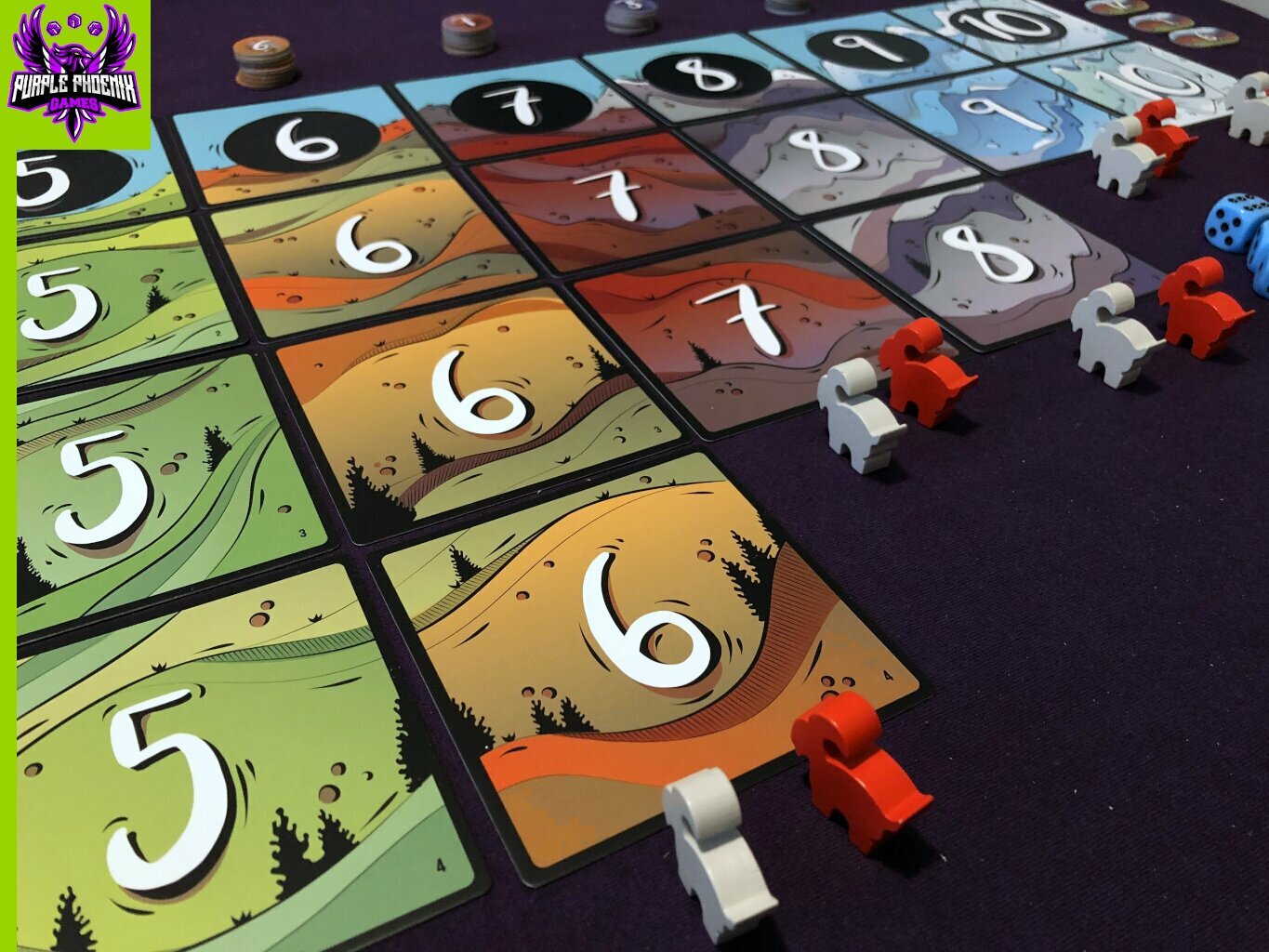
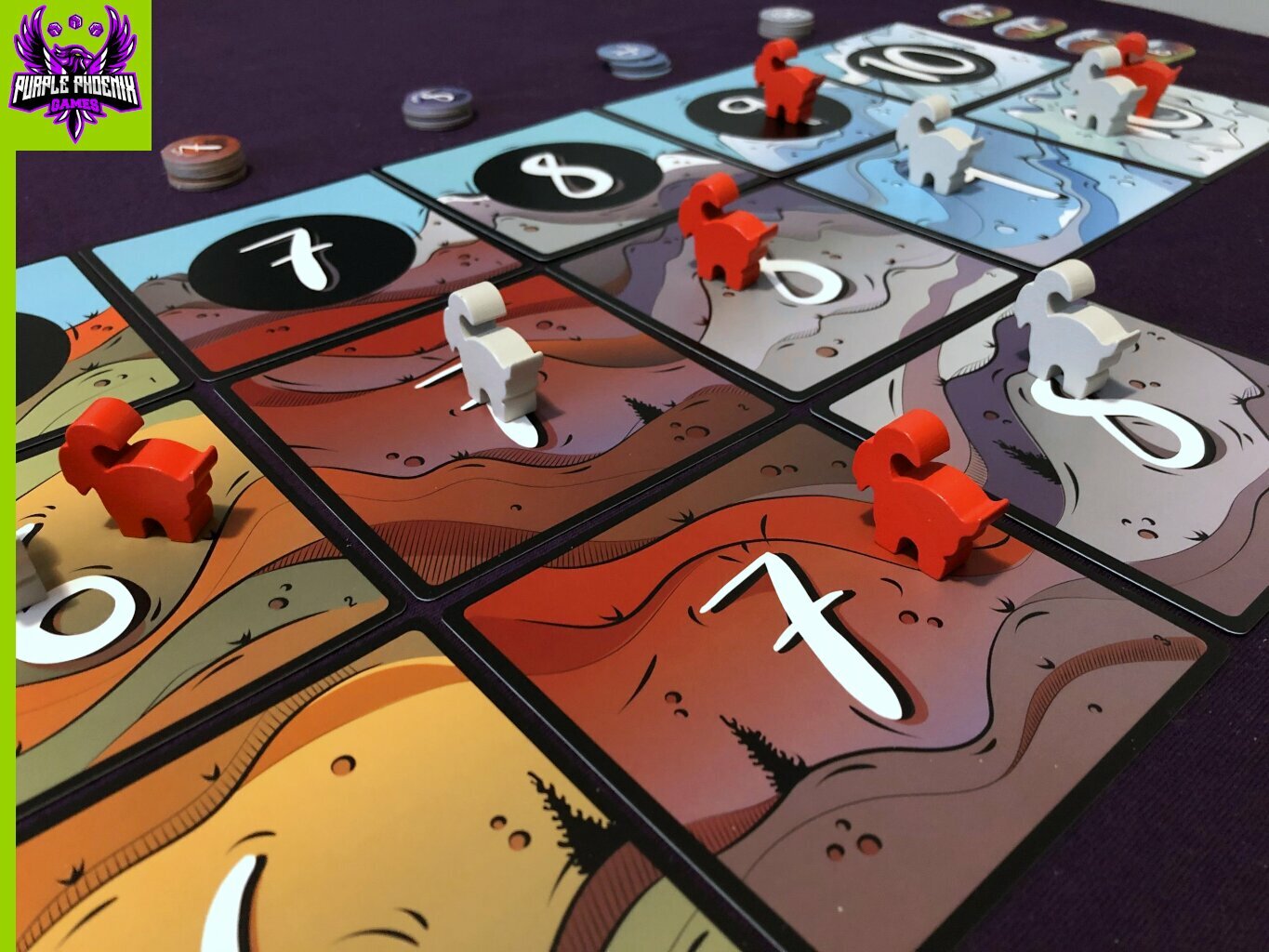
Mountain Goats is a game in which players are racing to the top of 6 different mountains with their goats, in a bid to be the ‘king of the hill,’ if you will. To setup the game, lay out the Mountain cards into a grid, as described in the rules. Place the point tokens at the top of their corresponding Mountain cards, set the Bonus point tokens to the side, and all players place one Goat meeple at the bottom of each set of Mountain cards. The game is now ready to start.
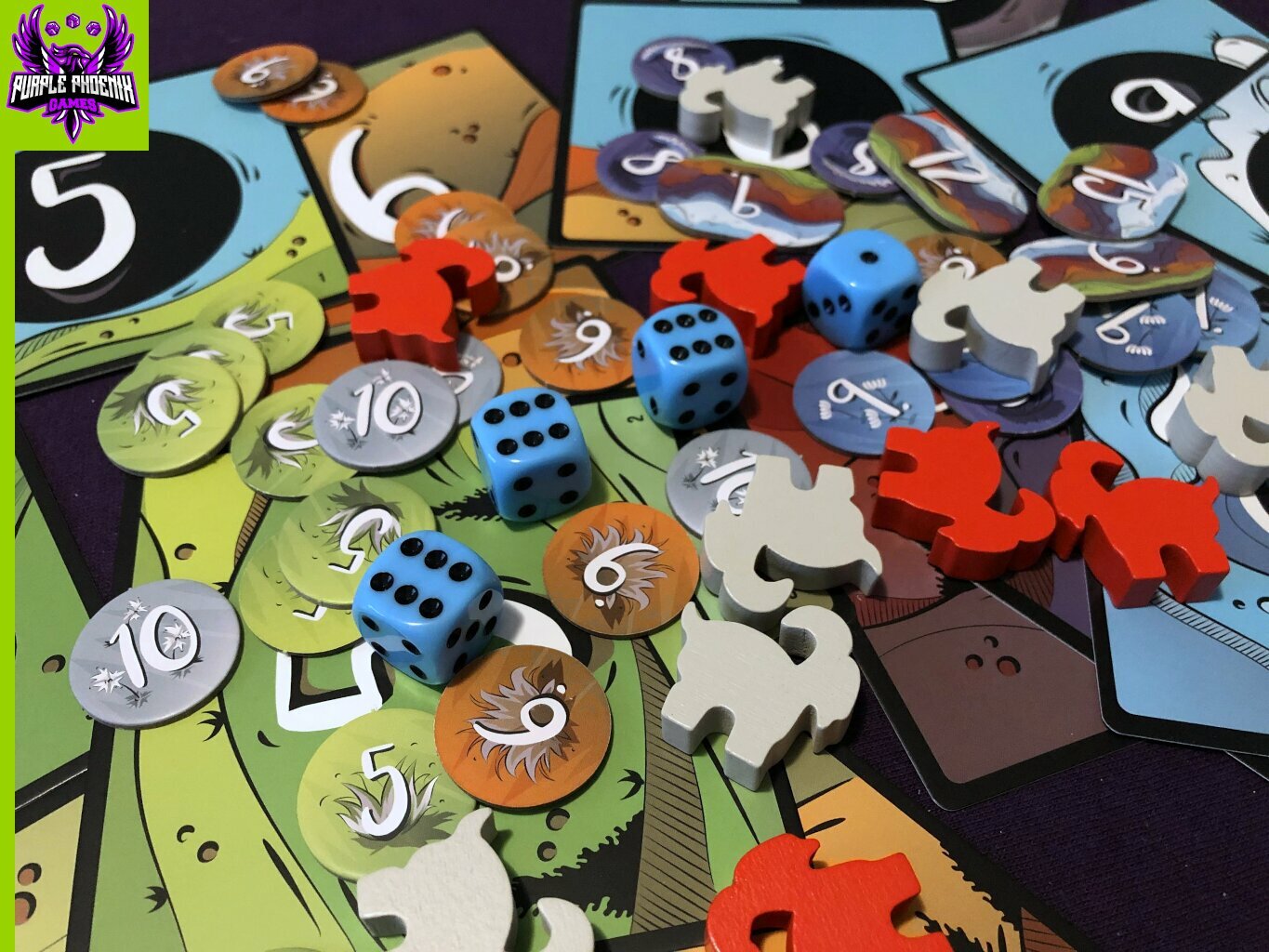
On your turn, you will roll the 4 dice of the game. Using those results, you will create groups of dice, in which the dice total dictates which of your Goats is moved. Once you have created your groups, you will move your Goat up one space on the corresponding Mountain. (For example, if one of my dice groups is a 3 and a 2, then I will move my Goat on Mountain 5 up one space). After moving all of your affected Goats, pass the dice to the next player. Simple, right? Yep! Now here’s where it gets interesting. If you get a Goat to the top of a Mountain, you will collect a Point token from the corresponding pile. If an opponent is already at the top of a Mountain and you are able to move there, then you kick your opponent back to the bottom of that mountain, and claim the top spot for yourself, collecting a Point token as normal! AND if you create a dice set for a Mountain on which you are already at the top, you get to collect an additional Point token and keep your Goat at the top. How long can you hang onto that top spot? I guess you’ll find out. If/when you collect at least 1 Point token from each of the 6 Mountains, you get to claim the highest-value Bonus point token still available.
Play continues in this manner until either all of the Bonus point tokens have been claimed, or when 3 Mountains have no more Point tokens remaining. Players count up all of their collected points, and the player with the highest score is the winner.
The thing I like about Mountain Goats the most is that it is so fast and easy to play/teach. The concept is easy to grasp, the mechanics are simple, and the gameplay is engaging. So right off the bat, this is a solid game for me. The next thing I like is that even though it is such a small, light game, you’ve still got to have a strategy to succeed. With the Mountains numbered 5-10, you really have to think about how you want to group your dice. If your total falls below 5 or over 10, it won’t move any Goats! So if you’ve got a 6, 6, 5, and 2, how can you best maximize your movement? Are you willing to sacrifice a die because it doesn’t necessarily work with your strategy this turn? Or do you want to move as many Goats as possible every turn? It’s really up to you, and that strategic flexibility heightens the gameplay for me.
The other thing I really like about Mountain Goats is the amount of player interaction, in a sort of take-that way. When you reach the top of a Mountain, if an opponent is already there, they get kicked back to the bottom! So not only do they have to start the climb over again, but they can’t just sit pretty collecting Point tokens when possible. For me, the slight take-that element in this game is more friendly than cutthroat, and that really makes the overall gameplay experience more positive. Starting over from the bottom is, at most, only 4 cards from the top, so getting kicked down isn’t totally detrimental to the game atmosphere.
Components. They’re great! The cards are nice and sturdy, the artwork colorful and numbering clear. The Point tokens are nice thick cardboard, the dice are big and clear, and the Goat meeples are chunky and fun to manipulate. I have yet to see a game from BoardGameTables.com that has poor production quality, and Mountain Goats is no exception.
All in all, I think this is a great and fun little game. The concept is cute, the gameplay itself is fun and engaging, and the small footprint and short playtime make it an enjoyable little game. And since the gist of the game is just counting/numbers, it can be played with relatively young gamers, which makes it a good family-friendly filler game. Purple Phoenix Games gives Mountain Goats an ascending 9 / 12. Give it a shot and see if you’ve got what it takes to come out on top!
Mountain Goats is a game in which players are racing to the top of 6 different mountains with their goats, in a bid to be the ‘king of the hill,’ if you will. To setup the game, lay out the Mountain cards into a grid, as described in the rules. Place the point tokens at the top of their corresponding Mountain cards, set the Bonus point tokens to the side, and all players place one Goat meeple at the bottom of each set of Mountain cards. The game is now ready to start.
On your turn, you will roll the 4 dice of the game. Using those results, you will create groups of dice, in which the dice total dictates which of your Goats is moved. Once you have created your groups, you will move your Goat up one space on the corresponding Mountain. (For example, if one of my dice groups is a 3 and a 2, then I will move my Goat on Mountain 5 up one space). After moving all of your affected Goats, pass the dice to the next player. Simple, right? Yep! Now here’s where it gets interesting. If you get a Goat to the top of a Mountain, you will collect a Point token from the corresponding pile. If an opponent is already at the top of a Mountain and you are able to move there, then you kick your opponent back to the bottom of that mountain, and claim the top spot for yourself, collecting a Point token as normal! AND if you create a dice set for a Mountain on which you are already at the top, you get to collect an additional Point token and keep your Goat at the top. How long can you hang onto that top spot? I guess you’ll find out. If/when you collect at least 1 Point token from each of the 6 Mountains, you get to claim the highest-value Bonus point token still available.
Play continues in this manner until either all of the Bonus point tokens have been claimed, or when 3 Mountains have no more Point tokens remaining. Players count up all of their collected points, and the player with the highest score is the winner.
The thing I like about Mountain Goats the most is that it is so fast and easy to play/teach. The concept is easy to grasp, the mechanics are simple, and the gameplay is engaging. So right off the bat, this is a solid game for me. The next thing I like is that even though it is such a small, light game, you’ve still got to have a strategy to succeed. With the Mountains numbered 5-10, you really have to think about how you want to group your dice. If your total falls below 5 or over 10, it won’t move any Goats! So if you’ve got a 6, 6, 5, and 2, how can you best maximize your movement? Are you willing to sacrifice a die because it doesn’t necessarily work with your strategy this turn? Or do you want to move as many Goats as possible every turn? It’s really up to you, and that strategic flexibility heightens the gameplay for me.
The other thing I really like about Mountain Goats is the amount of player interaction, in a sort of take-that way. When you reach the top of a Mountain, if an opponent is already there, they get kicked back to the bottom! So not only do they have to start the climb over again, but they can’t just sit pretty collecting Point tokens when possible. For me, the slight take-that element in this game is more friendly than cutthroat, and that really makes the overall gameplay experience more positive. Starting over from the bottom is, at most, only 4 cards from the top, so getting kicked down isn’t totally detrimental to the game atmosphere.
Components. They’re great! The cards are nice and sturdy, the artwork colorful and numbering clear. The Point tokens are nice thick cardboard, the dice are big and clear, and the Goat meeples are chunky and fun to manipulate. I have yet to see a game from BoardGameTables.com that has poor production quality, and Mountain Goats is no exception.
All in all, I think this is a great and fun little game. The concept is cute, the gameplay itself is fun and engaging, and the small footprint and short playtime make it an enjoyable little game. And since the gist of the game is just counting/numbers, it can be played with relatively young gamers, which makes it a good family-friendly filler game. Purple Phoenix Games gives Mountain Goats an ascending 9 / 12. Give it a shot and see if you’ve got what it takes to come out on top!

Heather Cranmer (2721 KP) rated Storms of Malhado in Books
May 18, 2020

I admit that when I read the book synopsis for Storms of Malhado by Maria Elena Sandovici and saw there were ghosts involved, I knew I had to read this book! While it turned out not to be so much of a ghost story but something much much more, it was still a great read!
I felt that the plot for Storms of Malhado was fairly original. The reader is taken through three different points in time starting in 1900 with Suzanne's story, followed by 1961 with Betty's story, and then to 2008 with Katie's story. We learn of how each woman is with a man that is slippery and unobtainable yet each woman yearns to make the relationship work. Each story leads up to a horrible hurricane from each year. What will each woman sacrifice for love, and will it lead up to their demise? Storms of Malhado is full of life lessons, the strongest being that those who don't learn from the past are doomed to repeat it. There is so much symbolism throughout this novel which I didn't catch some of it until I finished reading and reflected back on what I had just read. Sandovici does a fantastic job at painting a beautiful picture of what life was like for each woman. It's easy to get lost in the narrative and forget you're only reading about the characters instead of living their life! The only thing about the plot that lets it down a little is the ending. It just felt a bit messy and confusing. I can't go into great detail because of spoilers. The ending, while I believe in what happened, just seemed a little far fetched and a little too neat if that makes sense. Three people experiencing the same thing at the same time and calling each other by different names, well, it just seemed kind of out there. I wish I could go into more detail, but I really don't want to give too much away. However, all loose ends are tied up by the end of book, and it becomes obvious how all three narratives within Storms of Malhado are related.
The majority of the characters in Storms of Malhado were well fleshed out and very realistic feeling. I enjoyed reading about Suzanne, Josephine, and Desmond. Suzanne was an interesting character to read about, but there were times she made me angry especially towards her ending. I could actually feel how much she loved and longed after Desmond. I just felt that she could be a little selfish at times. However, I feel that we've all been a little selfish when it comes to love. I could really feel how much Josephine loved Suzanne and wanted the best for her. Josephine was such a great character! Betty, Edna, and Cornelius also had an interesting story line. I felt like I connected with Betty the most. I could feel her frustration with Carl seeping through the pages as well as how much she wanted Cornelius no matter how frustrating he was. I loved Edna the most though, and it made me wish I had an Edna in my life to care for me and be there for me. Betty seemed to not have her head in the clouds as much as Suzanne did which was nice. The narrative I felt that was a little underdeveloped was that of Katie, her boyfriend George, and her mother. We don't get to read much about them until the very end. I would have liked more insight into George and Katie's relationship before the storm hits. The reader gets all this backstory into Suzanne's and Desmond's relationship as well as Betty's and Cornelius' relationship, yet there isn't much back story for Katie and George. All of a sudden towards the ending, we are told that Katie and George have a rocky relationship. I wanted to know why it was so rocky instead of just little bits and pieces. Katie's and George's relationship just felt like it was missing so much. The relationship between Katie and her mother also felt lacking. If her relationship was a strong with her mother as the relationship between Suzanne and Josephine as well as the relationship between Betty and Edna, it did not come across that way in the book. Katie's relationships just felt rushed.
Trigger warnings for Storms of Malhado include infidelity, adultery, alcohol use, death, drug use, some light profanity, and sexual situations (although not graphic).
All in all, Storms of Malhado is a highly interesting read that will leave you hooked on each and every word. It grabs you by the hand and doesn't let go until the end. With fantastic writing, a highly interesting plot, and entertaining characters, Storms of Malhado is a must read. I would definitely recommend Storms of Malhado by Maria Elena Sandovici to those aged 16+ who are after a book that will leave them thinking about it long after they are done reading it.
--
(A special thank you to Lone Star Literary Life and Maria Elena Sandovici for providing me with a paperback of Storms of Malhado in exchange for an honest and unbiased review.)
I felt that the plot for Storms of Malhado was fairly original. The reader is taken through three different points in time starting in 1900 with Suzanne's story, followed by 1961 with Betty's story, and then to 2008 with Katie's story. We learn of how each woman is with a man that is slippery and unobtainable yet each woman yearns to make the relationship work. Each story leads up to a horrible hurricane from each year. What will each woman sacrifice for love, and will it lead up to their demise? Storms of Malhado is full of life lessons, the strongest being that those who don't learn from the past are doomed to repeat it. There is so much symbolism throughout this novel which I didn't catch some of it until I finished reading and reflected back on what I had just read. Sandovici does a fantastic job at painting a beautiful picture of what life was like for each woman. It's easy to get lost in the narrative and forget you're only reading about the characters instead of living their life! The only thing about the plot that lets it down a little is the ending. It just felt a bit messy and confusing. I can't go into great detail because of spoilers. The ending, while I believe in what happened, just seemed a little far fetched and a little too neat if that makes sense. Three people experiencing the same thing at the same time and calling each other by different names, well, it just seemed kind of out there. I wish I could go into more detail, but I really don't want to give too much away. However, all loose ends are tied up by the end of book, and it becomes obvious how all three narratives within Storms of Malhado are related.
The majority of the characters in Storms of Malhado were well fleshed out and very realistic feeling. I enjoyed reading about Suzanne, Josephine, and Desmond. Suzanne was an interesting character to read about, but there were times she made me angry especially towards her ending. I could actually feel how much she loved and longed after Desmond. I just felt that she could be a little selfish at times. However, I feel that we've all been a little selfish when it comes to love. I could really feel how much Josephine loved Suzanne and wanted the best for her. Josephine was such a great character! Betty, Edna, and Cornelius also had an interesting story line. I felt like I connected with Betty the most. I could feel her frustration with Carl seeping through the pages as well as how much she wanted Cornelius no matter how frustrating he was. I loved Edna the most though, and it made me wish I had an Edna in my life to care for me and be there for me. Betty seemed to not have her head in the clouds as much as Suzanne did which was nice. The narrative I felt that was a little underdeveloped was that of Katie, her boyfriend George, and her mother. We don't get to read much about them until the very end. I would have liked more insight into George and Katie's relationship before the storm hits. The reader gets all this backstory into Suzanne's and Desmond's relationship as well as Betty's and Cornelius' relationship, yet there isn't much back story for Katie and George. All of a sudden towards the ending, we are told that Katie and George have a rocky relationship. I wanted to know why it was so rocky instead of just little bits and pieces. Katie's and George's relationship just felt like it was missing so much. The relationship between Katie and her mother also felt lacking. If her relationship was a strong with her mother as the relationship between Suzanne and Josephine as well as the relationship between Betty and Edna, it did not come across that way in the book. Katie's relationships just felt rushed.
Trigger warnings for Storms of Malhado include infidelity, adultery, alcohol use, death, drug use, some light profanity, and sexual situations (although not graphic).
All in all, Storms of Malhado is a highly interesting read that will leave you hooked on each and every word. It grabs you by the hand and doesn't let go until the end. With fantastic writing, a highly interesting plot, and entertaining characters, Storms of Malhado is a must read. I would definitely recommend Storms of Malhado by Maria Elena Sandovici to those aged 16+ who are after a book that will leave them thinking about it long after they are done reading it.
--
(A special thank you to Lone Star Literary Life and Maria Elena Sandovici for providing me with a paperback of Storms of Malhado in exchange for an honest and unbiased review.)

FearlessLover (27 KP) rated Dunkirk (2017) in Movies
Jul 31, 2017

Stunning cinea
It' s 1940, 400,000 allied troops are cornered and cut off on the beaches of Dunkirk; with the enemy closing in, and no cover or defence, they await annihilation or a miracle. We experience the moment as the characters do, without unnecessary exposition or dialogue! This proves quite the departure for Nolan; there is a lot here that owes more to silent cinema than anything else, but his images often say all that needs to be said.
An opening frame invites us to join a group of soldiers. Next, the loudest onslaught of gunfire kicks the film into another gear. We are given as much pause for thought as the soldiers we follow. We run with Tommy, played here by a Fionn Whitehead, and like him, we are aware of comrades falling dead next to us, but it is all panic and no time; we will lament their loss later. Set to the ticking of a watch, we feel Tommy's heart pounding with ours, and we know the tone for this audacious movie has been set.
We see the event from different perspectives and from within different time frames. Right now, not many directors can build momentum like Nolan. The jumping to and from different characters' point of view, the corkscrewing impression of the editing, events echoed and mirrored by Hans Zimmer's Shepherd's Tones and persistent, all enveloping score, acting at times more like sound design than music; it all results in a constant rise in tension, to the point of almost being exhaustive.
This said, the editing also serves another purpose. The "Miracle of Dunkirk" is a grand story, with every soldier, every pilot, and every civilian having their own point of view. Nolan wants us to build up an overall picture of the event purely through subjective experience, so of course we spend a tiring week with the terrified boys. Of course we spend a desperate day with a fisherman as he and his familial crew sail their way into action. Lastly, given the fuel constraints of the RAF, whose decisions had to be immediate and impulsive, always a choice between defending the beach or getting home, why would we spend any more that an edge-of-your-seat, quickly-cut hour in the cockpit of a Spitfire, as they do their duty and enter into dogfights to keep the German aircraft at bay? Each timeline is contracted or dilated to give everybody equal measure and importance, whilst staying true to and very much in their situation. Yes, this means we're kept on our toes; we have moments of confusion as timelines cross over and we see the same thing happening from another point of view, but as we head into the finale, as well as the aforementioned tension and release (which is just exciting cinema), we also get to see how, despite very different perspectives, everyone was working together, and how sacrifice and struggle for duty were par for the course for all involved, whether other people knew it or not. It is important that we the audience recognise this bigger picture, and as everything clicks together in an emotive final convergence of efforts, we not only see the justification for the techniques adopted, but struggle to imagine the story told another way. That is, at least, without going down a standard route, with objective storytelling employed.
A proper review not being complete without comment on the elephant in the room, it must be said that Harry Styles does not stand out like the proverbial sore thumb at all. Frankly, he carries his scenes with aplomb, and surely, following the Heath Ledger lesson, and now this, it is time we learned that, maybe, Christopher Nolan just knows what he's doing better that we do? As to the other big names, there are moments from that remain with me so long after having seen it: Kenneth Brannagh and Mark Rylance can say so much with so little, their faces and gestures doing the heavy lifting to deliver a lot of the human emotion, and it would appear Tom Hardy has Oscar-worthy eyes! You need see nothing more through the course of his drama to have a complete sense of the type of man his Farrier is. We talk about great acting and achieving realism through imagination, but with the knowledge that Nolan actually took everyone to Dunkirk, sank real ships, sailed real ships, flew real Spitfires overhead, employed real explosions on the beach, and even rejected green screen and CGI in favour of cardboard cut-outs, it seems imagination wasn't too necessary for these already consummate actors.
Nolan's principle fan base will be well prepared for what they get; but with his insistence on holding back from the audience any perspective not afforded his characters, ala 'Memento', some knowledge of the "Miracle Of Dunkirk" might put the more casual viewer in better stead. Regardless of which camp you fall into, or indeed of whether or not the movie does it for you, certain things are for sure: With no melodrama or cheese, and no superfluous fluff or emotional subterfuge, 'Dunkirk' is a purely experiential movie, a technical marvel of a war film unlike any other I can name. It also stands as a beacon in Nolan's career, characterised by his desire to cultivate an audience willing to keep up with him. And perhaps most importantly, this is a key moment in world history that is often overlooked; a disaster averted which, had it not been, would have seen the history books written very differently. That this event has been marshalled by a confident and sincere director, who has surely by now cemented his name alongside those of his own heroes, is reason enough to see 'Dunkirk'.
An opening frame invites us to join a group of soldiers. Next, the loudest onslaught of gunfire kicks the film into another gear. We are given as much pause for thought as the soldiers we follow. We run with Tommy, played here by a Fionn Whitehead, and like him, we are aware of comrades falling dead next to us, but it is all panic and no time; we will lament their loss later. Set to the ticking of a watch, we feel Tommy's heart pounding with ours, and we know the tone for this audacious movie has been set.
We see the event from different perspectives and from within different time frames. Right now, not many directors can build momentum like Nolan. The jumping to and from different characters' point of view, the corkscrewing impression of the editing, events echoed and mirrored by Hans Zimmer's Shepherd's Tones and persistent, all enveloping score, acting at times more like sound design than music; it all results in a constant rise in tension, to the point of almost being exhaustive.
This said, the editing also serves another purpose. The "Miracle of Dunkirk" is a grand story, with every soldier, every pilot, and every civilian having their own point of view. Nolan wants us to build up an overall picture of the event purely through subjective experience, so of course we spend a tiring week with the terrified boys. Of course we spend a desperate day with a fisherman as he and his familial crew sail their way into action. Lastly, given the fuel constraints of the RAF, whose decisions had to be immediate and impulsive, always a choice between defending the beach or getting home, why would we spend any more that an edge-of-your-seat, quickly-cut hour in the cockpit of a Spitfire, as they do their duty and enter into dogfights to keep the German aircraft at bay? Each timeline is contracted or dilated to give everybody equal measure and importance, whilst staying true to and very much in their situation. Yes, this means we're kept on our toes; we have moments of confusion as timelines cross over and we see the same thing happening from another point of view, but as we head into the finale, as well as the aforementioned tension and release (which is just exciting cinema), we also get to see how, despite very different perspectives, everyone was working together, and how sacrifice and struggle for duty were par for the course for all involved, whether other people knew it or not. It is important that we the audience recognise this bigger picture, and as everything clicks together in an emotive final convergence of efforts, we not only see the justification for the techniques adopted, but struggle to imagine the story told another way. That is, at least, without going down a standard route, with objective storytelling employed.
A proper review not being complete without comment on the elephant in the room, it must be said that Harry Styles does not stand out like the proverbial sore thumb at all. Frankly, he carries his scenes with aplomb, and surely, following the Heath Ledger lesson, and now this, it is time we learned that, maybe, Christopher Nolan just knows what he's doing better that we do? As to the other big names, there are moments from that remain with me so long after having seen it: Kenneth Brannagh and Mark Rylance can say so much with so little, their faces and gestures doing the heavy lifting to deliver a lot of the human emotion, and it would appear Tom Hardy has Oscar-worthy eyes! You need see nothing more through the course of his drama to have a complete sense of the type of man his Farrier is. We talk about great acting and achieving realism through imagination, but with the knowledge that Nolan actually took everyone to Dunkirk, sank real ships, sailed real ships, flew real Spitfires overhead, employed real explosions on the beach, and even rejected green screen and CGI in favour of cardboard cut-outs, it seems imagination wasn't too necessary for these already consummate actors.
Nolan's principle fan base will be well prepared for what they get; but with his insistence on holding back from the audience any perspective not afforded his characters, ala 'Memento', some knowledge of the "Miracle Of Dunkirk" might put the more casual viewer in better stead. Regardless of which camp you fall into, or indeed of whether or not the movie does it for you, certain things are for sure: With no melodrama or cheese, and no superfluous fluff or emotional subterfuge, 'Dunkirk' is a purely experiential movie, a technical marvel of a war film unlike any other I can name. It also stands as a beacon in Nolan's career, characterised by his desire to cultivate an audience willing to keep up with him. And perhaps most importantly, this is a key moment in world history that is often overlooked; a disaster averted which, had it not been, would have seen the history books written very differently. That this event has been marshalled by a confident and sincere director, who has surely by now cemented his name alongside those of his own heroes, is reason enough to see 'Dunkirk'.
Gareth von Kallenbach (980 KP) rated The Dark Knight (2008) in Movies
Aug 14, 2019

Riding a wave a fan expectations and anticipation as well as surrounding by the tragic death of Heath Ledger, the latest installment in Writer/Director Christopher Nolan’s Batman Series, “The Dark Knight”, has arrived. Christian Bale once again stars in the dual role of troubled billionaire playboy Bruce Wayne and the masked avenger Batman, as he attempts to bring order to Gotham City.
The film picks up shortly after the events of “Batman Begins” and finds Bruce and his trusty sidekick Alfred (Michael Caine), splitting their time between a lofty penthouse and a secret lair while Wayne Manor is being rebuilt. The streets of Gotham have become safer as thanks to Batman many of the bad elements of the city have either been arrested or driven off.
Batman has a new ally in his fight, as new District Attorney Harvey Dent, (Aaron Eckhart), is waging a personal war on crime, and has vowed to stop at nothing to bring the remaining crime bosses and their associates to justice. Bruce is unsure what to make of Dent, and is further troubled by the growing relationship between Dent and his longtime flame Rachel Dawes (Maggie Gyllenhaal).
Unknown to Batman and Dent, the biggest threat ever to face Gotham City is about to move into the limelight, as a mysterious figure known as The Joker (Heath Ledger), has risen from the ranks of violent bank robber to psychopathic mastermind, attempting to get the remaining crime lords to join him in an scheme to kill Batman and prominent heads of the city to bring utter chaos.
As the Joker’s wave of violence, death, and destruction unfolds, Batman is drawn deeper into turmoil, as he is conflicted by his desire to abandon his Batman alter-ego and leave cleaning up the city to Dent and his trusted ally James Gordon (Gary Oldman). Bruce knows that he cannot be with Rachel as long as Batman is a part of his life, and he wishes he can abandon the fight to live a more normal existence.
As the crime wave escalates and the body count starts to mount, Bruce is driven to the edge as he matches wits with his toughest foe yet, a man who seems capable of matching his every move, and seems to be always one step ahead.
What follows is a truly gripping and enjoyably dark tale of murder, deception, action, and intrigue in what is not only the best Batman film ever but simply the best superhero film ever. This is strong praise considering the solid screen versions of “Spider-Man”, “Iron-Man” and the previous “Batman Beyond”, but Nolan has crafted a true cinematic masterpiece.
The key to the film is not only the solid cast but a serious and intelligent script that allows the actors to truly shine. This is not a thinly veiled comic story where plot and character are secondary to visuals and actions; instead it is a brilliant physiological study of madness, human nature, unchecked ambition, and morality, wrapped in a truly epic story.
Nolan deftly juggles the characters and action and never allows one to overshadow the other. He does not lose sight of the fact that despite the amazing and intense actions and visuals, this is a character driven story.
Many times during the press showing of the film I marveled at the high quality of the story and solid acting in the film. The impressive cast is anchored by a truly incredible performance by Ledger as he portrays the Joker as a deeply disturbed individual who mixes genius with absolute ruthless cunning. The mannerisms of the character are such that Ledger simply becomes the demented killer and at no time appears to be an actor portraying a character, but rather the personification of the character brought to reality.
His scenes with Bale are truly memorable and underscore the vast history between the two characters that has been established over the decades, and emphasizes the fact that, in some ways, Batman and the Joker are similar beings, both troubled souls who deal with their pain in different ways.
Bale is very good at portraying the torment his character lives with day in and day out, as well as the dark and seething rage that threatens to overtake him and his constant struggle to keep it under the control. Lesser actors would be lost against the amazing performance of Ledger, but Bale more than holds his own, and provides gripping cinema at its best during his scenes with Ledger and the talented cast.
Morgan Freeman and Michael Caine bring solid support to the film as their characters provide wisdom, morality, and direction for characters that walk the thin line between good and evil. The only real disappointment in the film for me was that Maggie Gyllenhaal is not given enough to do. She ably takes over the role originated by Katie Holmes, but she is not given any chance to stand out and her moments with Bale do not allow her to further her relationship with Bruce Wayne.
Eckhart gives a solid performance as Harvey Dent and his alter ego Two Face, taking great advantage of the time he was allowed to develop Dent. My only wish would have been for Two Face to have more time to develop as his arrival seems more of an add-on than a point of plot emphasis.
That being said, the film is a true masterpiece that proves you do not have to sacrifice character development and story to deliver a solid action film. The story sets up very well for future installments and I am sure I am not alone in wanting another outing for Nolan and Bale.
The film picks up shortly after the events of “Batman Begins” and finds Bruce and his trusty sidekick Alfred (Michael Caine), splitting their time between a lofty penthouse and a secret lair while Wayne Manor is being rebuilt. The streets of Gotham have become safer as thanks to Batman many of the bad elements of the city have either been arrested or driven off.
Batman has a new ally in his fight, as new District Attorney Harvey Dent, (Aaron Eckhart), is waging a personal war on crime, and has vowed to stop at nothing to bring the remaining crime bosses and their associates to justice. Bruce is unsure what to make of Dent, and is further troubled by the growing relationship between Dent and his longtime flame Rachel Dawes (Maggie Gyllenhaal).
Unknown to Batman and Dent, the biggest threat ever to face Gotham City is about to move into the limelight, as a mysterious figure known as The Joker (Heath Ledger), has risen from the ranks of violent bank robber to psychopathic mastermind, attempting to get the remaining crime lords to join him in an scheme to kill Batman and prominent heads of the city to bring utter chaos.
As the Joker’s wave of violence, death, and destruction unfolds, Batman is drawn deeper into turmoil, as he is conflicted by his desire to abandon his Batman alter-ego and leave cleaning up the city to Dent and his trusted ally James Gordon (Gary Oldman). Bruce knows that he cannot be with Rachel as long as Batman is a part of his life, and he wishes he can abandon the fight to live a more normal existence.
As the crime wave escalates and the body count starts to mount, Bruce is driven to the edge as he matches wits with his toughest foe yet, a man who seems capable of matching his every move, and seems to be always one step ahead.
What follows is a truly gripping and enjoyably dark tale of murder, deception, action, and intrigue in what is not only the best Batman film ever but simply the best superhero film ever. This is strong praise considering the solid screen versions of “Spider-Man”, “Iron-Man” and the previous “Batman Beyond”, but Nolan has crafted a true cinematic masterpiece.
The key to the film is not only the solid cast but a serious and intelligent script that allows the actors to truly shine. This is not a thinly veiled comic story where plot and character are secondary to visuals and actions; instead it is a brilliant physiological study of madness, human nature, unchecked ambition, and morality, wrapped in a truly epic story.
Nolan deftly juggles the characters and action and never allows one to overshadow the other. He does not lose sight of the fact that despite the amazing and intense actions and visuals, this is a character driven story.
Many times during the press showing of the film I marveled at the high quality of the story and solid acting in the film. The impressive cast is anchored by a truly incredible performance by Ledger as he portrays the Joker as a deeply disturbed individual who mixes genius with absolute ruthless cunning. The mannerisms of the character are such that Ledger simply becomes the demented killer and at no time appears to be an actor portraying a character, but rather the personification of the character brought to reality.
His scenes with Bale are truly memorable and underscore the vast history between the two characters that has been established over the decades, and emphasizes the fact that, in some ways, Batman and the Joker are similar beings, both troubled souls who deal with their pain in different ways.
Bale is very good at portraying the torment his character lives with day in and day out, as well as the dark and seething rage that threatens to overtake him and his constant struggle to keep it under the control. Lesser actors would be lost against the amazing performance of Ledger, but Bale more than holds his own, and provides gripping cinema at its best during his scenes with Ledger and the talented cast.
Morgan Freeman and Michael Caine bring solid support to the film as their characters provide wisdom, morality, and direction for characters that walk the thin line between good and evil. The only real disappointment in the film for me was that Maggie Gyllenhaal is not given enough to do. She ably takes over the role originated by Katie Holmes, but she is not given any chance to stand out and her moments with Bale do not allow her to further her relationship with Bruce Wayne.
Eckhart gives a solid performance as Harvey Dent and his alter ego Two Face, taking great advantage of the time he was allowed to develop Dent. My only wish would have been for Two Face to have more time to develop as his arrival seems more of an add-on than a point of plot emphasis.
That being said, the film is a true masterpiece that proves you do not have to sacrifice character development and story to deliver a solid action film. The story sets up very well for future installments and I am sure I am not alone in wanting another outing for Nolan and Bale.
Purple Phoenix Games (2266 KP) rated Goblin Teeth in Tabletop Games
Nov 5, 2019
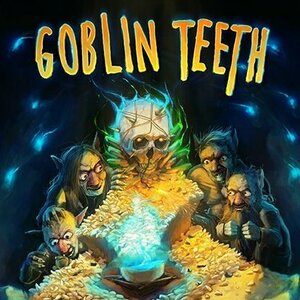
You know a game is going to be great when you actually enjoy reading the rules. Please take a moment to consider what I just wrote. I *enjoyed* reading the rules to a game. To this game. Why? Well, the intro to the rules that introduces the setting of the game, is written in the voice of a goblin. For those of you who may uninitiated into fantasy lore, goblins are small, gross humanoids that are greedy and not at all known for their academic prowess. Ok, so the rules started out pretty entertaining. Did this set us up for an entertaining game or a boring slug… er, slog? I have high expectations from Jellybean Games now, so will this be a winner as well?
Goblin Teeth is a fantasy take-that, auction, set collection, dice and card game. Each player is a goblin attempting to impress the goblin boss enough to become the right hand gobbie by offering a collection of items that the boss enjoys.
DISCLAIMER: We were provided a prototype copy of this game for the purposes of this review. As this is a preview copy of the game, I do not know if the final rules or components will be similar or different to what we were provided. -T
To setup, create the offering mat by randomly drawing a red and blue offering card to be placed in their respective locations. Shuffle the Cheat cards and Item cards into separate decks. Each goblin player chooses a set of three matching dice they will use throughout the game. Give each goblin one Cheat card to begin their collection. From the Item cards, place as many Items face-up as the number of players and one more face-down at the end of the row near where the sacrifice altar will be placed. You now have your offer row for the first round and are ready to play.
Before the round begins, all players will roll all three of their dice simultaneously. These dice represent your bid amounts for the Item cards on display (including the face-down Item). Whomever is in possession of the first-player marker will take their turn first. This goblin may choose to play any number of Cheat cards in their hand, and then must place a die on an Item card or into the altar. These Item cards feature items to be collected and used to satisfy an Offering card – like skulls, goblin teeth, glow worms, and others. By placing a die on an Item card, a goblin is casting their bid. By placing a die into the sacrificing altar, the goblin is instead giving up a bid die in exchange for drawing a Cheat card (which can be very powerful). Once the die is placed, the next goblin in clockwise order can take their turn following the same order of operations. The goblin who wins the face-down Item card becomes the new first player and receives the first player token. A new round can now begin by laying out new Items and rolling all dice simultaneously.
The game continues in this fashion until one sneaky goblin has all the Items they need to satisfy one of the Offering cards (or the pre-printed space on the Offering mat). There are dice placement rules and Cheats-a-plenty that I did not describe at all, but per the disclaimer, you can back the game or purchase from your favorite board game retailer (naturally, your FLGS). All goblins then tear each other to shreds over jealousy and greed. Ok, I added that last bit myself, but it should go into the rules. Just sayin’.
Components. Again, this is a prototype version of the game and some components may (and probably will) change over the course of a successful Kickstarter campaign. That said, I will comment on what I can here. The physical components themselves are fine for a prototype game. The cards are big tarot cards that are fun to handle. I hope they keep that size. The first player token in this is a green translucent plastic meeple that I’m sure they will be upgrading during the campaign. Similarly, the dice will more than likely see an upgrade (I am totally projecting here, I have no information on any future plans for components). What needs very little upgrading is the art on the cards. The card backs for the Cheat and Item cards feature an excellent logo (I hope) for the game, and the art on the Item cards are clear and really really good. I hope the art style doesn’t change as the art is amazing here. The Cheat cards look good, are clear, and although they feature several different fonts, I was not at all ever turned off by the presentation.
So here are my thoughts. Goblin Teeth is an excellent game of outbidding your opponents, double-think, and Cheating your way to victory! I absolutely adore this game. Without those Cheat cards it would still be decent, but those Cheats are what make this game special. Being able to play as many Cheat cards as you want on your turn, with some of them being good and some bad, but being able to place them on yourself or your opponents is just gold. I cannot wait to see this game go to Kickstarter and just kill it. Seriously, it’s an amusing, frustrating, beautiful game that I cannot wait to own in its full glory. If you enjoy experiences that pit you against your opponents and you find yourself giggling at thwarting their plans, this is the game for you.
Goblin Teeth is a fantasy take-that, auction, set collection, dice and card game. Each player is a goblin attempting to impress the goblin boss enough to become the right hand gobbie by offering a collection of items that the boss enjoys.
DISCLAIMER: We were provided a prototype copy of this game for the purposes of this review. As this is a preview copy of the game, I do not know if the final rules or components will be similar or different to what we were provided. -T
To setup, create the offering mat by randomly drawing a red and blue offering card to be placed in their respective locations. Shuffle the Cheat cards and Item cards into separate decks. Each goblin player chooses a set of three matching dice they will use throughout the game. Give each goblin one Cheat card to begin their collection. From the Item cards, place as many Items face-up as the number of players and one more face-down at the end of the row near where the sacrifice altar will be placed. You now have your offer row for the first round and are ready to play.
Before the round begins, all players will roll all three of their dice simultaneously. These dice represent your bid amounts for the Item cards on display (including the face-down Item). Whomever is in possession of the first-player marker will take their turn first. This goblin may choose to play any number of Cheat cards in their hand, and then must place a die on an Item card or into the altar. These Item cards feature items to be collected and used to satisfy an Offering card – like skulls, goblin teeth, glow worms, and others. By placing a die on an Item card, a goblin is casting their bid. By placing a die into the sacrificing altar, the goblin is instead giving up a bid die in exchange for drawing a Cheat card (which can be very powerful). Once the die is placed, the next goblin in clockwise order can take their turn following the same order of operations. The goblin who wins the face-down Item card becomes the new first player and receives the first player token. A new round can now begin by laying out new Items and rolling all dice simultaneously.
The game continues in this fashion until one sneaky goblin has all the Items they need to satisfy one of the Offering cards (or the pre-printed space on the Offering mat). There are dice placement rules and Cheats-a-plenty that I did not describe at all, but per the disclaimer, you can back the game or purchase from your favorite board game retailer (naturally, your FLGS). All goblins then tear each other to shreds over jealousy and greed. Ok, I added that last bit myself, but it should go into the rules. Just sayin’.
Components. Again, this is a prototype version of the game and some components may (and probably will) change over the course of a successful Kickstarter campaign. That said, I will comment on what I can here. The physical components themselves are fine for a prototype game. The cards are big tarot cards that are fun to handle. I hope they keep that size. The first player token in this is a green translucent plastic meeple that I’m sure they will be upgrading during the campaign. Similarly, the dice will more than likely see an upgrade (I am totally projecting here, I have no information on any future plans for components). What needs very little upgrading is the art on the cards. The card backs for the Cheat and Item cards feature an excellent logo (I hope) for the game, and the art on the Item cards are clear and really really good. I hope the art style doesn’t change as the art is amazing here. The Cheat cards look good, are clear, and although they feature several different fonts, I was not at all ever turned off by the presentation.
So here are my thoughts. Goblin Teeth is an excellent game of outbidding your opponents, double-think, and Cheating your way to victory! I absolutely adore this game. Without those Cheat cards it would still be decent, but those Cheats are what make this game special. Being able to play as many Cheat cards as you want on your turn, with some of them being good and some bad, but being able to place them on yourself or your opponents is just gold. I cannot wait to see this game go to Kickstarter and just kill it. Seriously, it’s an amusing, frustrating, beautiful game that I cannot wait to own in its full glory. If you enjoy experiences that pit you against your opponents and you find yourself giggling at thwarting their plans, this is the game for you.
Purple Phoenix Games (2266 KP) rated Abyss in Tabletop Games
Aug 5, 2021
I am not a great swimmer. For several years of my life I would avoid water at all costs. I have since grown to love it, but would still freak out a bit if a crab came towards me. I’m kind of a baby like that. I do so love underwater scenes and the wildlife, so I was bound to enjoy Abyss. Throw in some of the most amazing artwork in all of gaming and you have a hit, right?
Abyss is a push your luck, set collection, hand management, fantasy card drafting game for two to four players. In it players are attempting to gain the most Influence Points to rule the underwater kingdom by recruiting allies and Lords, and controlling locations. The game ends once a player recruits their seventh Lord or if the Lords cards run out before the Court can be refilled.
To setup, lay out the board, shuffle the Exploration cards (starfish backs) and place in the upper left corner. Shuffle the Lord cards (trident backs) and place the deck in the lower left corner. Reveal Lords to each of the spaces drawn to the right of the deck. This is the Court. Shuffle the Monster tokens and place in a messy pile near the board. Next to these place all the Key tokens. Display the Threat Tracker board with the Threat token on the first space. Shuffle the Location tiles into a stack and reveal the first one. Give each player a pearl in a shell cup and the game is ready to begin!
On a player’s turn they will follow the basic structure of Plotting at Court (by spending pearls to reveal more Lords), Taking One Action (by Exploring the Depths, Requesting Support from the Council, or Recruiting a Lord), and Controlling a Location.
Plotting at Court is simply paying pearls to reveal more Lords at Court.
The action choices begin with Exploring the Depths. This is the push your luck portion of the game where players will reveal cards from the top of the Exploration deck one by one, offer the card to their opponents for purchase (payable to the active player in pearls), and then deciding to continue or take into hand. These cards include members of five allied races of underwater species numbered in strength from one to five and monsters. Fighting monsters is an auto-win and the spoils are what is reflected on the Threat Tracker. If players decide to pass, they will move the Threat token down by one level and improve the treasure won when destroying a monster. Any allies that are undrafted will be sorted by family and placed on the appropriate space on the board.
To Request Support from the Council players will take the entire stack from one family on the board. Again, these are made up of the cards that were undrafted from previous Exploring the Depths actions.
Finally, Recruiting a Lord players will be spending their Exploration cards to combine strength values and family types to appease the Lords they wish to recruit. Players will analyze the strength needed on the bottom left of the Lord card along with the number and color of bubbles above the strength number to determine from which families cards will need to be paid. Lords will have special powers that can be used throughout the game until you use them to Control Locations.
Lords and monster tokens afford players keys, and once players accumulate three keys they MUST Control a Location. To Control a Location players will draft a face-up Location tile or draw one to four tiles and draft one of them. Also, players will sacrifice their Lords (and their special powers) to, well, lord over Locations as super powerful property managers. This is done by covering up the special Lord powers with the Location tiles.
Play continues in this fashion of quick turns until a player recruits their seventh Lord or if the Lords cards run out before the Court can be refilled during a Plot at Court action.
Components. As I mentioned in my open, Abyss boasts some of the most magnificent art ever to grace a board game. The aesthetic coupled with the theme makes for a gorgeous game on the table. The cardboard is all good quality and thick, the cards are good quality as well. The black plastic shells and pearls they hold are so nice to play with and I find myself rolling those pearls as fast as I can within the shells and inevitably spilling them everywhere.
The game play is also quite solid. I like drafting games quite a bit and this delivers a lot of drafting in different locations. You draft Exploration cards and Location tiles to beef up your mini empire. Using the Lords as special power cards but having to cover them up to help control a Location is a clever mechanic and helps with any sort of runaway leader issue. I did not touch on a couple rules because they can be a little confusing to new players (ie the affiliation of allies), but even new gamers can appreciate what Abyss does and how beautifully it accomplishes its task.
I cannot overstate how gorgeous this game is and how much I enjoy being able to pull it off the shelf and set it up to people who have never seen it. I mean, even just the box cover, which is a giant face and no text, is very impressive and helps set the tone for the dark but interesting experiences held within. Purple Phoenix Games gives Abyss a boding 14 / 18. Pick it up, post a picture of which box cover you received, and tag us in the post so we can compare.
Abyss is a push your luck, set collection, hand management, fantasy card drafting game for two to four players. In it players are attempting to gain the most Influence Points to rule the underwater kingdom by recruiting allies and Lords, and controlling locations. The game ends once a player recruits their seventh Lord or if the Lords cards run out before the Court can be refilled.
To setup, lay out the board, shuffle the Exploration cards (starfish backs) and place in the upper left corner. Shuffle the Lord cards (trident backs) and place the deck in the lower left corner. Reveal Lords to each of the spaces drawn to the right of the deck. This is the Court. Shuffle the Monster tokens and place in a messy pile near the board. Next to these place all the Key tokens. Display the Threat Tracker board with the Threat token on the first space. Shuffle the Location tiles into a stack and reveal the first one. Give each player a pearl in a shell cup and the game is ready to begin!
On a player’s turn they will follow the basic structure of Plotting at Court (by spending pearls to reveal more Lords), Taking One Action (by Exploring the Depths, Requesting Support from the Council, or Recruiting a Lord), and Controlling a Location.
Plotting at Court is simply paying pearls to reveal more Lords at Court.
The action choices begin with Exploring the Depths. This is the push your luck portion of the game where players will reveal cards from the top of the Exploration deck one by one, offer the card to their opponents for purchase (payable to the active player in pearls), and then deciding to continue or take into hand. These cards include members of five allied races of underwater species numbered in strength from one to five and monsters. Fighting monsters is an auto-win and the spoils are what is reflected on the Threat Tracker. If players decide to pass, they will move the Threat token down by one level and improve the treasure won when destroying a monster. Any allies that are undrafted will be sorted by family and placed on the appropriate space on the board.
To Request Support from the Council players will take the entire stack from one family on the board. Again, these are made up of the cards that were undrafted from previous Exploring the Depths actions.
Finally, Recruiting a Lord players will be spending their Exploration cards to combine strength values and family types to appease the Lords they wish to recruit. Players will analyze the strength needed on the bottom left of the Lord card along with the number and color of bubbles above the strength number to determine from which families cards will need to be paid. Lords will have special powers that can be used throughout the game until you use them to Control Locations.
Lords and monster tokens afford players keys, and once players accumulate three keys they MUST Control a Location. To Control a Location players will draft a face-up Location tile or draw one to four tiles and draft one of them. Also, players will sacrifice their Lords (and their special powers) to, well, lord over Locations as super powerful property managers. This is done by covering up the special Lord powers with the Location tiles.
Play continues in this fashion of quick turns until a player recruits their seventh Lord or if the Lords cards run out before the Court can be refilled during a Plot at Court action.
Components. As I mentioned in my open, Abyss boasts some of the most magnificent art ever to grace a board game. The aesthetic coupled with the theme makes for a gorgeous game on the table. The cardboard is all good quality and thick, the cards are good quality as well. The black plastic shells and pearls they hold are so nice to play with and I find myself rolling those pearls as fast as I can within the shells and inevitably spilling them everywhere.
The game play is also quite solid. I like drafting games quite a bit and this delivers a lot of drafting in different locations. You draft Exploration cards and Location tiles to beef up your mini empire. Using the Lords as special power cards but having to cover them up to help control a Location is a clever mechanic and helps with any sort of runaway leader issue. I did not touch on a couple rules because they can be a little confusing to new players (ie the affiliation of allies), but even new gamers can appreciate what Abyss does and how beautifully it accomplishes its task.
I cannot overstate how gorgeous this game is and how much I enjoy being able to pull it off the shelf and set it up to people who have never seen it. I mean, even just the box cover, which is a giant face and no text, is very impressive and helps set the tone for the dark but interesting experiences held within. Purple Phoenix Games gives Abyss a boding 14 / 18. Pick it up, post a picture of which box cover you received, and tag us in the post so we can compare.