
Search

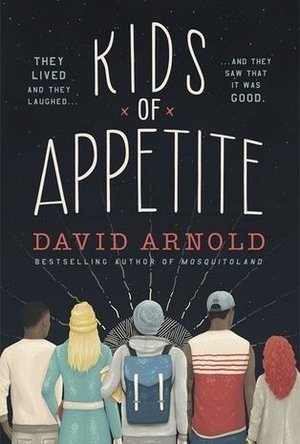
Hazel (1853 KP) rated Kids of Appetite in Books
Dec 14, 2018

<i>This ARC was provided by the publisher via NetGalley in exchange for an honest review
They lived and they laughed and they saw that it was good.</i>
<i>Mosquitoland </i>was the best book I read last year (2015) and I was excited to discover what David Arnold would write next. I approached<i> Kids of Appetite</i> with mild trepidation; what if it did not live up to my expectations? Need not have worried – it was brilliant. Dubbed a “tragicomedy” <i>Kids of Appetite</i> is a combination of realistic, heartbreaking experiences with intellectual humour.
The book opens mid interview at a local police station where two teenagers, Vic and Mad, are being questioned about a murder their friend has supposedly committed. From there, the story backtracks a week and proceeds to bring the reader up to date. It all begins with Vic running away from home, distancing himself from his mother and her new partner. By chance, a coincidence – a bump, Vic would say – he is found by Mad who introduces him to a small group of homeless friends. Vic may not have packed in preparation for life on the streets – or in a greenhouse as it turns out – however he did grab the urn containing his late father’s ashes before racing out of the house. Along with the urn is a letter containing cryptic clues that lead to various locations that Vic’s father wished for his ashes to be scattered. He, along with his new found friends; make it a mission to put his father to rest.
It is not possible to label the general theme of the book. <i>Kids of Appetite</i> is a story full of stories. Each character has their own past, something that led them to the situation they find themselves in now. The group consists of five members – once Vic has been accepted. Baz, at age twenty-seven, is clearly the leader: responsible, caring, and fatherly – until accused of murder. Seven years younger is Zuz, Baz’s mute brother, and finally Coco, an eleven year old with the mouth of a foul old lady. It is Coco, amongst all her swearing and hilarious misuse of words, that coins the name <i>Kids of Appetite, KOA</i> for short, a play on words: they are not solely in want of food, they hunger for life.
Initially it would appear that the main focus will be on Vic: his father’s death, his mother’s new partner, Moebius (facial paralysis) – a syndrome that results in a lot of bullying and discrimination – and, of course, his flight from home. However the remaining members of <i>KOA </i>equally contribute to the overall narrative. Mad, like Vic, knows what it is like to lose a father. Unfortunately she also knows what it is like to lose a mother. Her life since the fateful car crash that left her and orphan has been full of abuse and uncertainty. Baz and Zuz, on the other hand, have escaped a traumatizing childhood in the midst of the Congo Civil War.
Similarly with <i>Mosquitoland</i>, Arnold’s second book is full of intellectual knowledge and humour complete with references to highbrow material. Vic is obsessed with an operatic song and deeply interested in abstract art, particularly Matisse. He pulls the artist’s work apart in search of meaning and relatable truths of life. Like Vic, Mad has a particular song she draws comfort from. The lyrics help her make sense of the world around her, and produce her own manifesto – Madifesto, rather. She is particularly fascinated by S E Hinton’s <i>The Outsiders</i> – a book I have not read, but am obviously going to now. With in-depth theories purloined from her favourite novel, she encourages and advises those around her.
The murder investigation is evidently another key point of the book. I do not want to say too much on the matter as it would not be fair to give the ending away. Be reassured that<i> Kids of Appetite</i> is not a thriller, crime or horror novel; it is the events and dialogue leading up to the conclusion that make up the greatest parts of the story.
It is essentially the characters that make <i>Kids of Appetite</i> such a fantastic work of fiction. Their background stories are all based on real life experiences of many people throughout the world, but it is their opinion of life, their terminology, and their reckless enthusiasm that really impacts the reader. <i>Kids of Appetite</i> is a book to be read over and over again. So many phrases can be lifted and quoted to explain our own lives and feelings. In fact, the entire novel is one big quote to sum up life itself. Although there are so many themes, stories and ideas, there is one clear message. Let go. Let go of the past. Let go of the things that hold you back. For Vic and Mad it is the death of their parents; for Coco it is abandonment; and Baz and Zuz learn to let go of their violent childhood.
David Arnold is an extremely talented author, seamlessly flowing from one notion to another, whilst sweeping the reader into a sea of pure emotion. He may over use the word “ergo” and have an unconventional penchant for ellipses, but that only adds to the uniqueness of the writing. There may be an excessive amount of expletives, however that is overshadowed by the pure genius of the story itself. <i>Kids of Appetite</i> is a book I want to recommend to all. The blurb likens it to authors Rainbow Rowell and Jennifer Niven – I would like to throw John Green into the mix – and should appeal to many Young Adult readers. I could write forever about this book, but I would rather you go and read it yourself. And whilst you read, remember:
<i>They lived and they laughed and they saw that it was good. </i>
They lived and they laughed and they saw that it was good.</i>
<i>Mosquitoland </i>was the best book I read last year (2015) and I was excited to discover what David Arnold would write next. I approached<i> Kids of Appetite</i> with mild trepidation; what if it did not live up to my expectations? Need not have worried – it was brilliant. Dubbed a “tragicomedy” <i>Kids of Appetite</i> is a combination of realistic, heartbreaking experiences with intellectual humour.
The book opens mid interview at a local police station where two teenagers, Vic and Mad, are being questioned about a murder their friend has supposedly committed. From there, the story backtracks a week and proceeds to bring the reader up to date. It all begins with Vic running away from home, distancing himself from his mother and her new partner. By chance, a coincidence – a bump, Vic would say – he is found by Mad who introduces him to a small group of homeless friends. Vic may not have packed in preparation for life on the streets – or in a greenhouse as it turns out – however he did grab the urn containing his late father’s ashes before racing out of the house. Along with the urn is a letter containing cryptic clues that lead to various locations that Vic’s father wished for his ashes to be scattered. He, along with his new found friends; make it a mission to put his father to rest.
It is not possible to label the general theme of the book. <i>Kids of Appetite</i> is a story full of stories. Each character has their own past, something that led them to the situation they find themselves in now. The group consists of five members – once Vic has been accepted. Baz, at age twenty-seven, is clearly the leader: responsible, caring, and fatherly – until accused of murder. Seven years younger is Zuz, Baz’s mute brother, and finally Coco, an eleven year old with the mouth of a foul old lady. It is Coco, amongst all her swearing and hilarious misuse of words, that coins the name <i>Kids of Appetite, KOA</i> for short, a play on words: they are not solely in want of food, they hunger for life.
Initially it would appear that the main focus will be on Vic: his father’s death, his mother’s new partner, Moebius (facial paralysis) – a syndrome that results in a lot of bullying and discrimination – and, of course, his flight from home. However the remaining members of <i>KOA </i>equally contribute to the overall narrative. Mad, like Vic, knows what it is like to lose a father. Unfortunately she also knows what it is like to lose a mother. Her life since the fateful car crash that left her and orphan has been full of abuse and uncertainty. Baz and Zuz, on the other hand, have escaped a traumatizing childhood in the midst of the Congo Civil War.
Similarly with <i>Mosquitoland</i>, Arnold’s second book is full of intellectual knowledge and humour complete with references to highbrow material. Vic is obsessed with an operatic song and deeply interested in abstract art, particularly Matisse. He pulls the artist’s work apart in search of meaning and relatable truths of life. Like Vic, Mad has a particular song she draws comfort from. The lyrics help her make sense of the world around her, and produce her own manifesto – Madifesto, rather. She is particularly fascinated by S E Hinton’s <i>The Outsiders</i> – a book I have not read, but am obviously going to now. With in-depth theories purloined from her favourite novel, she encourages and advises those around her.
The murder investigation is evidently another key point of the book. I do not want to say too much on the matter as it would not be fair to give the ending away. Be reassured that<i> Kids of Appetite</i> is not a thriller, crime or horror novel; it is the events and dialogue leading up to the conclusion that make up the greatest parts of the story.
It is essentially the characters that make <i>Kids of Appetite</i> such a fantastic work of fiction. Their background stories are all based on real life experiences of many people throughout the world, but it is their opinion of life, their terminology, and their reckless enthusiasm that really impacts the reader. <i>Kids of Appetite</i> is a book to be read over and over again. So many phrases can be lifted and quoted to explain our own lives and feelings. In fact, the entire novel is one big quote to sum up life itself. Although there are so many themes, stories and ideas, there is one clear message. Let go. Let go of the past. Let go of the things that hold you back. For Vic and Mad it is the death of their parents; for Coco it is abandonment; and Baz and Zuz learn to let go of their violent childhood.
David Arnold is an extremely talented author, seamlessly flowing from one notion to another, whilst sweeping the reader into a sea of pure emotion. He may over use the word “ergo” and have an unconventional penchant for ellipses, but that only adds to the uniqueness of the writing. There may be an excessive amount of expletives, however that is overshadowed by the pure genius of the story itself. <i>Kids of Appetite</i> is a book I want to recommend to all. The blurb likens it to authors Rainbow Rowell and Jennifer Niven – I would like to throw John Green into the mix – and should appeal to many Young Adult readers. I could write forever about this book, but I would rather you go and read it yourself. And whilst you read, remember:
<i>They lived and they laughed and they saw that it was good. </i>

Ivana A. | Diary of Difference (1171 KP) rated The Language Of Thorns in Books
Feb 3, 2020

<a href="https://diaryofdifference.com/">Blog</a>; | <a href="https://www.facebook.com/diaryofdifference/">Facebook</a>; | <a href="https://twitter.com/DiaryDifference">Twitter</a>; | <a href="https://www.instagram.com/diaryofdifference/">Instagram</a>; | <a href="https://www.pinterest.co.uk/diaryofdifference/pins/">Pinterest</a>;
<img src="https://gipostcards.files.wordpress.com/2019/01/new-blog-banner-17.png"/>;
<b>3.8 ★, to be exact. </b>
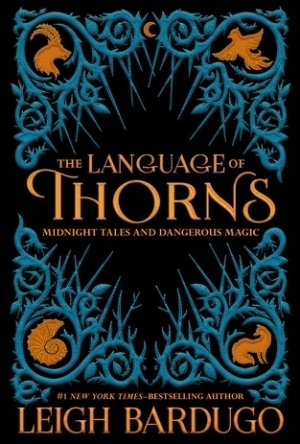
Sometimes, we enter a library, not really knowing what we are looking for. One day, I entered the library, only to return a few books. Instead, I returned with two more. The first one didn’t impress me, but the second one was this book – The Language of Thorns by Leigh Bardugo. I only picked it up, because I liked the cover. And I know, we shouldn’t judge a book by its cover, but I guess the magic worked on me this time around.
This book featured six stories, all six magical and beautiful in their own way. Some attracted me more, some a bit less, but I, overall, feel delighted to have read this book. I haven’t read Leigh’s previous books, so I didn’t know about this world before, but these are apparently the same woods featured in those books as well.
I will give a brief opinion on all stories, and the main rating will be the average from them all. Let’s go.
<b><i>1. Ayama and the Thorn Wood – ★★★★★</i></b>
<b>‘’Interesting things only happen to pretty girls.’’</b>
A beautiful tale that will show you how beauty comes from within. The King and Queen have two sons – one is a beautiful man, the future king, and the other one is a monster. They are scared and ashamed of the monster-boy, and let him live his life in the labyrinth they made for him. In the village, in a poor family, there are two daughters, one as beautiful as the sun, and the other one ugly. When the monster escapes the labyrinth and starts ruining fields and make disasters, everyone is scared to go and talk to him and beg for forgiveness, so the ugly lady is sent to her woods – quite certain she will never return…
<b>‘’This little prince was shaped a bit like a boy but more like a wolf, his body covered in slick black fur from crown to clawed foot. His eyes were red as blood, and the nubs of two budding horns protruded from his head.’’</b>
<b><i>2. The Too-Clever Fox – ★★★★★</i></b>
<b>‘’Freedom is a burden, but you will learn to bear it.’’</b>
I loved this story the most, out of all six of them. It reminded me of home, and of how we tell stories back there. The whole ‘’Once Upon a Time’’ is real, and I enjoyed every moment of it. The winter theme, the hunting, the girl and the fox. This is a story that will teach you to not be assured you can outsmart everyone. Foxes in stories have always been presented as the smart ones, outsmarting every animal in the woods. This reminds me of Aesop’s Tales, which I really loved as a little girl. But sometimes, you will get outsmarted, and it might cost you your life. The twist was definitely unexpected, but indeed satisfying.
<b><i>3. The Witch of Duva – ★★★</i></b>
A story where girls disappear, and one girl decides to go into the woods and try to figure out why. This story upset me, and I didn’t like it. But deep inside, it’s a good one. Very creepy though, and very horror-y, but worth reading. Turn the lights off, get under a blanket, turn your torch on, and only then you will be ready to know the deep secrets this story tells you.
<b><i>4. Little Knife – ★★★★</i></b>
The shortest story in the book, but by all means not the least intriguing. A story that features a woman that is too beautiful, that men lose their mind as soon as they see her. To get the chance to marry her, men will have to go through a various of tasks. The twist at the end is incredible, and I really liked it. It starts off as a usual story, but it goes wild.
<b><i>5. The Soldier Prince – ★★</i></b>
This was a story I enjoyed the least. It all screamed ‘’The Nutcracker’’ to me, and I couldn’t see it as original. It was a re-make, and it was very different that the story we know, but it just didn’t work for me. This is a story about a man who makes toys and gives them life. And when one toy sort of ‘’wakes up’’, interesting things start to happen. Quite a creepy story. I usually like those, but this one was not my cup of tea.
<b><i>6. When Water Sand Fire – ★★★★</i></b>
<b>‘’ We were not made to please princes.’’</b>
This one is the longest story in the book. It features a world of creatures living underwater, and Ulla, who can sing and create magic, but who, as the people believe, is not a true born, but a mix between the underwater world and the humans. She is asked to help the prince become a king, but when the magic price is too high to paid, it doesn’t seem like she has a choice. I truly enjoyed this story, as it’s a beautiful mix of emotions while you read it. It was a bit disappointing that it seems as a remake of the creation of the character of Ursula from The Little Mermaid, at least to me.
Have you read this book, or any of Leigh Bardugo’s books? Let me know in the comments, I love to chat with you!
<a href="https://diaryofdifference.com/">Blog</a>; | <a href="https://www.facebook.com/diaryofdifference/">Facebook</a>; | <a href="https://twitter.com/DiaryDifference">Twitter</a>; | <a href="https://www.instagram.com/diaryofdifference/">Instagram</a>; | <a href="https://www.pinterest.co.uk/diaryofdifference/pins/">Pinterest</a>;
<img src="https://gipostcards.files.wordpress.com/2019/01/new-blog-banner-17.png"/>;
<b>3.8 ★, to be exact. </b>
Sometimes, we enter a library, not really knowing what we are looking for. One day, I entered the library, only to return a few books. Instead, I returned with two more. The first one didn’t impress me, but the second one was this book – The Language of Thorns by Leigh Bardugo. I only picked it up, because I liked the cover. And I know, we shouldn’t judge a book by its cover, but I guess the magic worked on me this time around.
This book featured six stories, all six magical and beautiful in their own way. Some attracted me more, some a bit less, but I, overall, feel delighted to have read this book. I haven’t read Leigh’s previous books, so I didn’t know about this world before, but these are apparently the same woods featured in those books as well.
I will give a brief opinion on all stories, and the main rating will be the average from them all. Let’s go.
<b><i>1. Ayama and the Thorn Wood – ★★★★★</i></b>
<b>‘’Interesting things only happen to pretty girls.’’</b>
A beautiful tale that will show you how beauty comes from within. The King and Queen have two sons – one is a beautiful man, the future king, and the other one is a monster. They are scared and ashamed of the monster-boy, and let him live his life in the labyrinth they made for him. In the village, in a poor family, there are two daughters, one as beautiful as the sun, and the other one ugly. When the monster escapes the labyrinth and starts ruining fields and make disasters, everyone is scared to go and talk to him and beg for forgiveness, so the ugly lady is sent to her woods – quite certain she will never return…
<b>‘’This little prince was shaped a bit like a boy but more like a wolf, his body covered in slick black fur from crown to clawed foot. His eyes were red as blood, and the nubs of two budding horns protruded from his head.’’</b>
<b><i>2. The Too-Clever Fox – ★★★★★</i></b>
<b>‘’Freedom is a burden, but you will learn to bear it.’’</b>
I loved this story the most, out of all six of them. It reminded me of home, and of how we tell stories back there. The whole ‘’Once Upon a Time’’ is real, and I enjoyed every moment of it. The winter theme, the hunting, the girl and the fox. This is a story that will teach you to not be assured you can outsmart everyone. Foxes in stories have always been presented as the smart ones, outsmarting every animal in the woods. This reminds me of Aesop’s Tales, which I really loved as a little girl. But sometimes, you will get outsmarted, and it might cost you your life. The twist was definitely unexpected, but indeed satisfying.
<b><i>3. The Witch of Duva – ★★★</i></b>
A story where girls disappear, and one girl decides to go into the woods and try to figure out why. This story upset me, and I didn’t like it. But deep inside, it’s a good one. Very creepy though, and very horror-y, but worth reading. Turn the lights off, get under a blanket, turn your torch on, and only then you will be ready to know the deep secrets this story tells you.
<b><i>4. Little Knife – ★★★★</i></b>
The shortest story in the book, but by all means not the least intriguing. A story that features a woman that is too beautiful, that men lose their mind as soon as they see her. To get the chance to marry her, men will have to go through a various of tasks. The twist at the end is incredible, and I really liked it. It starts off as a usual story, but it goes wild.
<b><i>5. The Soldier Prince – ★★</i></b>
This was a story I enjoyed the least. It all screamed ‘’The Nutcracker’’ to me, and I couldn’t see it as original. It was a re-make, and it was very different that the story we know, but it just didn’t work for me. This is a story about a man who makes toys and gives them life. And when one toy sort of ‘’wakes up’’, interesting things start to happen. Quite a creepy story. I usually like those, but this one was not my cup of tea.
<b><i>6. When Water Sand Fire – ★★★★</i></b>
<b>‘’ We were not made to please princes.’’</b>
This one is the longest story in the book. It features a world of creatures living underwater, and Ulla, who can sing and create magic, but who, as the people believe, is not a true born, but a mix between the underwater world and the humans. She is asked to help the prince become a king, but when the magic price is too high to paid, it doesn’t seem like she has a choice. I truly enjoyed this story, as it’s a beautiful mix of emotions while you read it. It was a bit disappointing that it seems as a remake of the creation of the character of Ursula from The Little Mermaid, at least to me.
Have you read this book, or any of Leigh Bardugo’s books? Let me know in the comments, I love to chat with you!
<a href="https://diaryofdifference.com/">Blog</a>; | <a href="https://www.facebook.com/diaryofdifference/">Facebook</a>; | <a href="https://twitter.com/DiaryDifference">Twitter</a>; | <a href="https://www.instagram.com/diaryofdifference/">Instagram</a>; | <a href="https://www.pinterest.co.uk/diaryofdifference/pins/">Pinterest</a>;

Purple Phoenix Games (2266 KP) rated Crazier Eights: Pantheon in Tabletop Games
Aug 25, 2020
DISCLAIMER: We have previously previewed Crazier Eights: Olympus, and this preview has much of the same verbiage as the two games share most things. Near the end of the preview are my thoughts about the differences in Pantheon vs Olympus. We will also be previewing Crazier Eights: Camelot, and that will also detail the differences between the other sets we have tried.
War. Old Maid. Go Fish. Crazy Eights. These are classic card games we probably all grew up playing. There have been many re-themes and new difficulty layers spread upon them to make them even more interesting. While UNO certainly has cornered the market on the Crazy Eights base, we have a new contender: Crazier Eights. Recoculous has published several versions of this card game with different themes: Camelot, Avalon, One Thousand & One Nights, Olympus, and Shahrzad. Today we are taking a preview of Crazier Eights: Pantheon.
You HAVE played Crazy Eights right? The card game where you attempt to be the first to exhaust your hand of cards, but you can only play down if you can match the suit or number on top of the discard pile? And if you can’t, you throw down an 8 as a wild and call the color to be played next? Well there you have the easy rules. Crazier Eights: Pantheon (which I will from here call C8P) holds basically the same rule-set with a few new mechanics and a theme. The win condition is still the same: be the first to exhaust your hand of cards, but to win you will need to play your hand strategically against your opponents.
DISCLAIMER: We were provided a copy of this game for the purposes of this review. This is a retail copy of the game, so what you see in these photos is exactly what would be received in your box. I do not intend to cover every single rule included in the rulebook, but will describe the overall game flow and major rule set so that our readers may get a sense of how the game plays. For more in depth rules, you may purchase a copy online or from your FLGS. -T
To setup, shuffle the large deck of cards and place the deck in the middle of the table. Flip the top card to begin the discard pile and dictate the first card play. Deal each player seven cards and you are ready to begin!
The turn structure is familiar: check for any “start of turn” effects and apply them, draw a card, play and/or discard a card, then resolve any “end of turn” effects. The deck is comprised of Events and Assets in different colors (suits) and numbers like in a typical deck of playing cards. After checking and resolving start of turn effects on Asset cards in your personal tableau, you must draw a card from the deck. This is where C8P strays from OG Crazy Eights a bit. You may play a card from your hand (Assets and Events) and discard a card to the discard pile (matching the suit/number/or an Eight), or simply play a card from your hand without discarding. Cards played from your hand can be Event cards that are played, resolved, and then discarded to the bottom of the discard pile, or an Asset card that is played to your tableau that cause chain reactions or other abilities on future turns. Next, resolve any end of turn effects from Assets in your tableau before the next player begins their turn.
Play continues in this fashion until one player has rid themselves of their hand and is crowned the Master of the Pantheon! Or at least, the winner of the game.
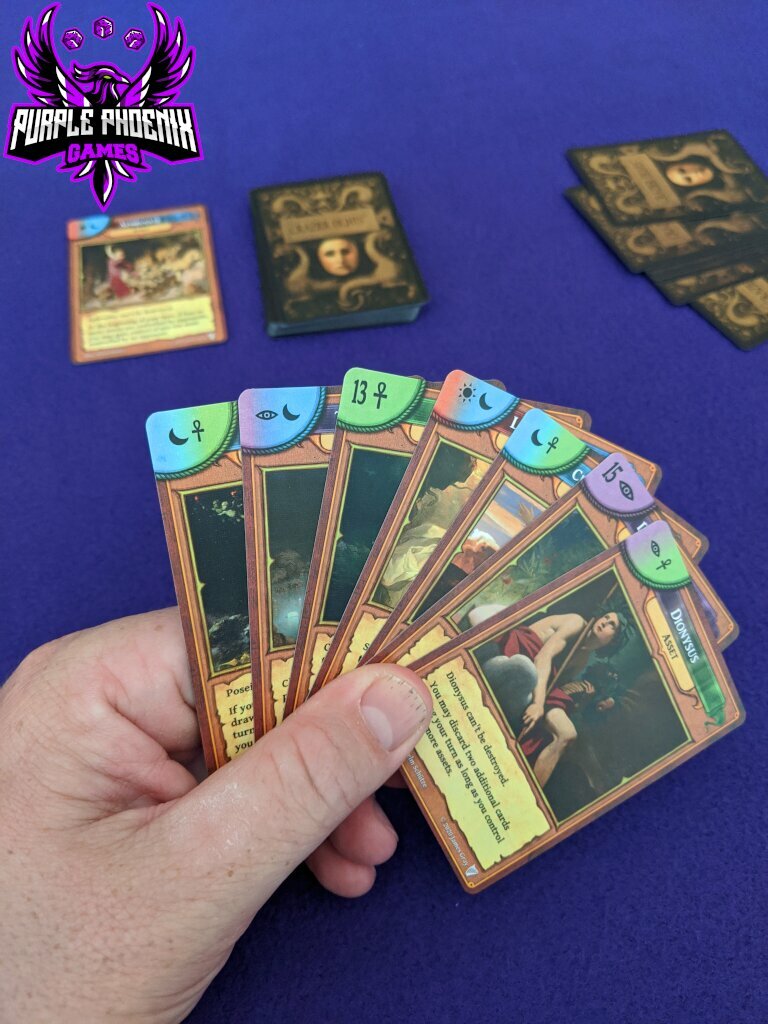
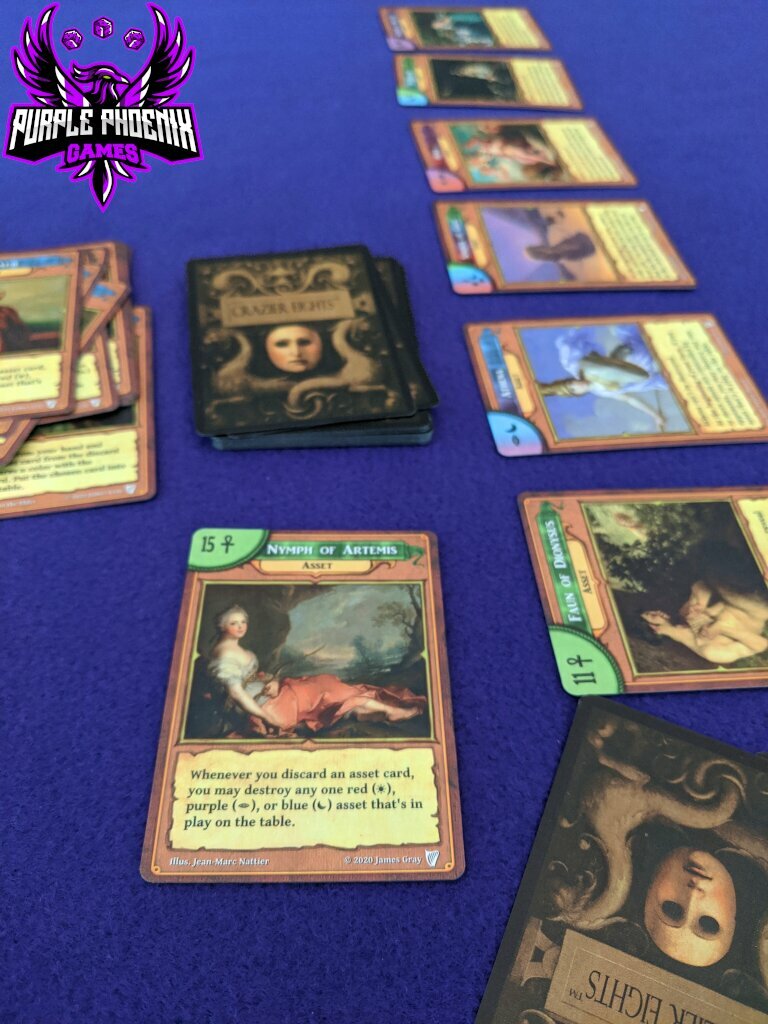
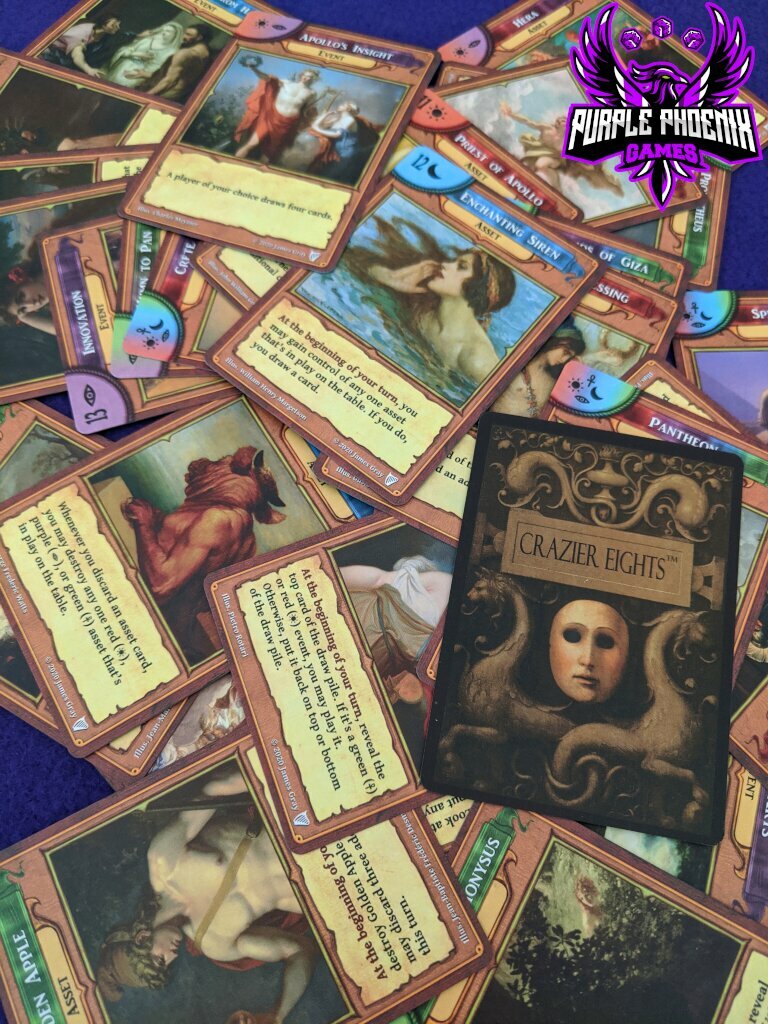
Components. This game is a box full of cards. The cards are good. The layout makes sense, and the art on the faces of the cards remind me of very classic art depicting ancient Grecian scenes. I am no art historian, so I do not know if they are existing art pieces or new ones crafted for this game, but either way, they are a joy to behold… if you can spend the time appreciating the art instead of tracking what cards you need to play and what effects you can chain together (that was me). Extra points to the Recoculous team for associating symbols with the different suit colors for our colorblind friends. This is something that unfortunately goes unaddressed far too often.
This implementation is the second Crazier Eights we have had the chance to try, and I can say that we really enjoyed our plays of it (we played Olympus first and will be playing Camelot soon). The game comes with many interesting and varied effects to craft an ingenious strategy, and the art is stellar. Beware of playing with AP-prone gamers, as there is a lot going on and it is more than just a skinned Crazy Eights.
The Pantheon set, specifically, seems to contain more cards that allow players to steal Assets from other players, and also cards that allow players to discard more than one card each turn. These are very interesting adjustments to our first experience of Crazier Eights, and from what we were told, Pantheon can be played as a standalone OR as an expansion to throw into any other set. There are less cards in Pantheon than in Olympus or Camelot (and the other base sets I assume), but the gameplay is the same, and is super quick.
Now having played this family of games several times, I can say that it is my favorite Crazy Eights derivative and certainly worthy of a look. If your game collection is sorely lacking in ancient Greek-themed card games, or if you want a hybrid game of old school rules with interesting twists, then do consider purchasing this or one of its predecessors.
PS – Don’t worry if, while you are playing, you have all your Assets stolen or destroyed. I have won the game with zero Assets in front of me while opponents have had eight, ironically. Assets are great, but you still need to shed your hand.
War. Old Maid. Go Fish. Crazy Eights. These are classic card games we probably all grew up playing. There have been many re-themes and new difficulty layers spread upon them to make them even more interesting. While UNO certainly has cornered the market on the Crazy Eights base, we have a new contender: Crazier Eights. Recoculous has published several versions of this card game with different themes: Camelot, Avalon, One Thousand & One Nights, Olympus, and Shahrzad. Today we are taking a preview of Crazier Eights: Pantheon.
You HAVE played Crazy Eights right? The card game where you attempt to be the first to exhaust your hand of cards, but you can only play down if you can match the suit or number on top of the discard pile? And if you can’t, you throw down an 8 as a wild and call the color to be played next? Well there you have the easy rules. Crazier Eights: Pantheon (which I will from here call C8P) holds basically the same rule-set with a few new mechanics and a theme. The win condition is still the same: be the first to exhaust your hand of cards, but to win you will need to play your hand strategically against your opponents.
DISCLAIMER: We were provided a copy of this game for the purposes of this review. This is a retail copy of the game, so what you see in these photos is exactly what would be received in your box. I do not intend to cover every single rule included in the rulebook, but will describe the overall game flow and major rule set so that our readers may get a sense of how the game plays. For more in depth rules, you may purchase a copy online or from your FLGS. -T
To setup, shuffle the large deck of cards and place the deck in the middle of the table. Flip the top card to begin the discard pile and dictate the first card play. Deal each player seven cards and you are ready to begin!
The turn structure is familiar: check for any “start of turn” effects and apply them, draw a card, play and/or discard a card, then resolve any “end of turn” effects. The deck is comprised of Events and Assets in different colors (suits) and numbers like in a typical deck of playing cards. After checking and resolving start of turn effects on Asset cards in your personal tableau, you must draw a card from the deck. This is where C8P strays from OG Crazy Eights a bit. You may play a card from your hand (Assets and Events) and discard a card to the discard pile (matching the suit/number/or an Eight), or simply play a card from your hand without discarding. Cards played from your hand can be Event cards that are played, resolved, and then discarded to the bottom of the discard pile, or an Asset card that is played to your tableau that cause chain reactions or other abilities on future turns. Next, resolve any end of turn effects from Assets in your tableau before the next player begins their turn.
Play continues in this fashion until one player has rid themselves of their hand and is crowned the Master of the Pantheon! Or at least, the winner of the game.
Components. This game is a box full of cards. The cards are good. The layout makes sense, and the art on the faces of the cards remind me of very classic art depicting ancient Grecian scenes. I am no art historian, so I do not know if they are existing art pieces or new ones crafted for this game, but either way, they are a joy to behold… if you can spend the time appreciating the art instead of tracking what cards you need to play and what effects you can chain together (that was me). Extra points to the Recoculous team for associating symbols with the different suit colors for our colorblind friends. This is something that unfortunately goes unaddressed far too often.
This implementation is the second Crazier Eights we have had the chance to try, and I can say that we really enjoyed our plays of it (we played Olympus first and will be playing Camelot soon). The game comes with many interesting and varied effects to craft an ingenious strategy, and the art is stellar. Beware of playing with AP-prone gamers, as there is a lot going on and it is more than just a skinned Crazy Eights.
The Pantheon set, specifically, seems to contain more cards that allow players to steal Assets from other players, and also cards that allow players to discard more than one card each turn. These are very interesting adjustments to our first experience of Crazier Eights, and from what we were told, Pantheon can be played as a standalone OR as an expansion to throw into any other set. There are less cards in Pantheon than in Olympus or Camelot (and the other base sets I assume), but the gameplay is the same, and is super quick.
Now having played this family of games several times, I can say that it is my favorite Crazy Eights derivative and certainly worthy of a look. If your game collection is sorely lacking in ancient Greek-themed card games, or if you want a hybrid game of old school rules with interesting twists, then do consider purchasing this or one of its predecessors.
PS – Don’t worry if, while you are playing, you have all your Assets stolen or destroyed. I have won the game with zero Assets in front of me while opponents have had eight, ironically. Assets are great, but you still need to shed your hand.

Bob Mann (459 KP) rated The Girl in the Spider's Web (2018) in Movies
Sep 28, 2021


Would the last straight woman in Stockholm turn off the lights?
You’ve gotta love a Scandi-thriller. Well, that was until last year’s hopeless Michael Fassbender vehicle “The Snowman” which devalued the currency better than Brexit has done to the pound! The mother of them all though was the original “Girl with the Dragon Tattoo” trilogy (in Swedish) in 2009. Although subject to a wholly unnecessary English remake two year’s later by David Fincher (with Mara Rooney and Daniel Craig) it was Noomi Rapace who struck the perfect note as the original anarchic and damaged Lisbeth Salander: a punk wielding a baseball bat like an alien-thing possessed (pun well and truly intended!).
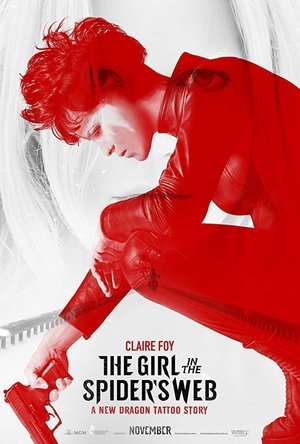
Now though we have “A New Dragon Tattoo Story” (as the film’s subtitle clumsily declares) based on the book by David Lagercrantz, who took over the literary franchise after the untimely death of Stieg Larsson. Picking up the reins as Salander is that most British of actresses Claire Foy…. which seems an odd choice, but one which – after you get past the rather odd accent – she just about pulls off.
The Plot
Lizbeth Salendar (Claire Foy) has an interesting hobby. She is a vigilante, like a lesbian Batman, stalking the streets of Stockholm putting wrongs right where abusive boyfriends/husbands are concerned.
She is also a hacking machine for rent. And Frans Balder (Stephen Merchant) has a problem. He has invented a software program that allows its user to control every nuclear warhead in the world from a single laptop (cue every other Bond/24/Austin Powers script ever written). But he has had second thoughts and wants it back from its resting place on the server of the NSA’s chief hacker, Ed Needham (Lakeith Stanfield). Balder recruits Salander to recover it, but when things go pear-shaped Salander finds herself on the wrong side of both the law and the encircling terrorist “spiders”.
The Review
Scandi-dramas work best when they exploit the snow; maintain a sexual tension; and go dark, gritty and violent. On the plus side, “The Girl in the Spider’s Web” ticks most of those boxes adequately. Foy’s Salandar is smart, sassy and sexy, outwitting the best of the best, and only once finding her intellectual match. (If you’re a lesbian, Stockholm is most definitely the place to be: there only seemed to be one hetero-female there, and she was an adulteress).
But Salander also has a Bond-like invincibility that unfortunately tests your incredulity at multiple points. Contributing to the excitement is the stunt team, who keep themselves busy with some great car and bike chases.
So, the movie has its moments and is great to look at. But the film ends up a sandwich or two short of a smorgasbord, thanks largely to some totally bonkers plot points and more than a few ridiculous coincidences. There are without doubt an array of well-constructed set pieces here, but they fail to fully connect with any great conviction. An example of a scene that infuriates is a dramatic bathroom fight in a red-lit gloom with identical protagonists that is cut together so furiously you would need a Blu-ray slo-mo to work out what the hell is going on… and then I fear you might fail.
So it’s an A- for the Production Design (Eve Stewart, “The Danish Girl“) and the Cinematography (Pedro Luque, “Don’t Breathe“), but a C- for the director Fede Alvarez (also “Don’t Breathe“).
Avoid the Trailer
I will save my biggest source of wrath though for that major bug-bear of mine: trailers that spoil the plot.
I’ve asked before, but for a film like this, WHO EXACTLY PUTS TOGETHER THE TRAILER? I’d like to think it’s some mindless committee of marketing execs somewhere. Because I HONESTLY CAN’T BELIEVE it would be the director! (If I’m wrong though, I would point my finger at Mr Alvarez and chant “shame, shame, shame”!)
For the trailer that I saw playing in UK cinemas does it’s level best to not only drop in the key spoilers of the plot (including the climactic scene), but also spoils just about every action money-shot in the movie. It’s all so pointless. If you’ve by any chance managed to get to this point without seeing the trailer, then SAVE YOURSELVES and AVOID IT!
(The one attached below by the way is slightly – slightly! – better, including some over-dubbing of a line that I don’t think was in the film. Perhaps they realised their huge mistake and reissued it?)
The Turns
As I mentioned earlier, Claire Foy again extends her range by playing Salander really well. She is the reason to go and see the film.
The Daniel Craig part of Blomkvist is played here by Sverrir Gudnason, who was in “The Circle” (which I saw) and was Borg in “Borg McEnroe” (which I didn’t). Blomkvist really is a lazy ****, since he works for the publication “Millenium” but writes absolutely nothing for years. It must be only because the boss (Vicky Krieps) fancies him that he keeps his job. Gudnason is good enough, but has very little to do in the movie: its the Salander/Foy show. Slightly, but only slightly, more involved is Lakeith Standfield as the US intelligence man.
Given little to do in the plot. Sverrir Gudnason as the incredibly unproductive ‘journalist’ Mikael Blomkvist. (Source: Sony Pictures Entertainment)
Stephen Merchant is an odd casting choice for Balder. Not withstanding that he was brilliant when almost unrecognisable in “Logan“, here he looks far too much like his “Ricky Gervais sidekick” persona to be taken seriously: and it’s not even remotely a comedy (there is only one humorous moment in the film, a nice “clicker” gag in a car park).
Final Thoughts
I had high hopes for this film from the trailer, but I was left disappointed. It’s not classic Scandi-noir like the original “Tattoo”; and it’s not going for the black comedy angle of “Headhunters” (which I saw again last week and loved… again!). It falls into a rather “meh” category. It’s not a bad evening’s watch, but perhaps worth leaving for a DVD/cable showing.
Now though we have “A New Dragon Tattoo Story” (as the film’s subtitle clumsily declares) based on the book by David Lagercrantz, who took over the literary franchise after the untimely death of Stieg Larsson. Picking up the reins as Salander is that most British of actresses Claire Foy…. which seems an odd choice, but one which – after you get past the rather odd accent – she just about pulls off.
The Plot
Lizbeth Salendar (Claire Foy) has an interesting hobby. She is a vigilante, like a lesbian Batman, stalking the streets of Stockholm putting wrongs right where abusive boyfriends/husbands are concerned.
She is also a hacking machine for rent. And Frans Balder (Stephen Merchant) has a problem. He has invented a software program that allows its user to control every nuclear warhead in the world from a single laptop (cue every other Bond/24/Austin Powers script ever written). But he has had second thoughts and wants it back from its resting place on the server of the NSA’s chief hacker, Ed Needham (Lakeith Stanfield). Balder recruits Salander to recover it, but when things go pear-shaped Salander finds herself on the wrong side of both the law and the encircling terrorist “spiders”.
The Review
Scandi-dramas work best when they exploit the snow; maintain a sexual tension; and go dark, gritty and violent. On the plus side, “The Girl in the Spider’s Web” ticks most of those boxes adequately. Foy’s Salandar is smart, sassy and sexy, outwitting the best of the best, and only once finding her intellectual match. (If you’re a lesbian, Stockholm is most definitely the place to be: there only seemed to be one hetero-female there, and she was an adulteress).
But Salander also has a Bond-like invincibility that unfortunately tests your incredulity at multiple points. Contributing to the excitement is the stunt team, who keep themselves busy with some great car and bike chases.
So, the movie has its moments and is great to look at. But the film ends up a sandwich or two short of a smorgasbord, thanks largely to some totally bonkers plot points and more than a few ridiculous coincidences. There are without doubt an array of well-constructed set pieces here, but they fail to fully connect with any great conviction. An example of a scene that infuriates is a dramatic bathroom fight in a red-lit gloom with identical protagonists that is cut together so furiously you would need a Blu-ray slo-mo to work out what the hell is going on… and then I fear you might fail.
So it’s an A- for the Production Design (Eve Stewart, “The Danish Girl“) and the Cinematography (Pedro Luque, “Don’t Breathe“), but a C- for the director Fede Alvarez (also “Don’t Breathe“).
Avoid the Trailer
I will save my biggest source of wrath though for that major bug-bear of mine: trailers that spoil the plot.
I’ve asked before, but for a film like this, WHO EXACTLY PUTS TOGETHER THE TRAILER? I’d like to think it’s some mindless committee of marketing execs somewhere. Because I HONESTLY CAN’T BELIEVE it would be the director! (If I’m wrong though, I would point my finger at Mr Alvarez and chant “shame, shame, shame”!)
For the trailer that I saw playing in UK cinemas does it’s level best to not only drop in the key spoilers of the plot (including the climactic scene), but also spoils just about every action money-shot in the movie. It’s all so pointless. If you’ve by any chance managed to get to this point without seeing the trailer, then SAVE YOURSELVES and AVOID IT!
(The one attached below by the way is slightly – slightly! – better, including some over-dubbing of a line that I don’t think was in the film. Perhaps they realised their huge mistake and reissued it?)
The Turns
As I mentioned earlier, Claire Foy again extends her range by playing Salander really well. She is the reason to go and see the film.
The Daniel Craig part of Blomkvist is played here by Sverrir Gudnason, who was in “The Circle” (which I saw) and was Borg in “Borg McEnroe” (which I didn’t). Blomkvist really is a lazy ****, since he works for the publication “Millenium” but writes absolutely nothing for years. It must be only because the boss (Vicky Krieps) fancies him that he keeps his job. Gudnason is good enough, but has very little to do in the movie: its the Salander/Foy show. Slightly, but only slightly, more involved is Lakeith Standfield as the US intelligence man.
Given little to do in the plot. Sverrir Gudnason as the incredibly unproductive ‘journalist’ Mikael Blomkvist. (Source: Sony Pictures Entertainment)
Stephen Merchant is an odd casting choice for Balder. Not withstanding that he was brilliant when almost unrecognisable in “Logan“, here he looks far too much like his “Ricky Gervais sidekick” persona to be taken seriously: and it’s not even remotely a comedy (there is only one humorous moment in the film, a nice “clicker” gag in a car park).
Final Thoughts
I had high hopes for this film from the trailer, but I was left disappointed. It’s not classic Scandi-noir like the original “Tattoo”; and it’s not going for the black comedy angle of “Headhunters” (which I saw again last week and loved… again!). It falls into a rather “meh” category. It’s not a bad evening’s watch, but perhaps worth leaving for a DVD/cable showing.

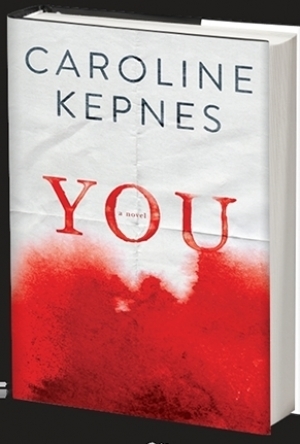

I first learned about you, Joe, when I sat one Sunday morning on Netflix and I could not keep my eyes off of the promo for this show about you fixating on a blonde woman. Naturally, I was intrigued and I had to learn about you, Joe, and how exactly you could see stalking as a way of getting close to someone and love them. I do wish you hadn't been a manager at a bookstore, Joe. I'm a booknerd, it was difficult to not like you, most of the time.
I watched your story and then I listened to your story. Joe, there are quite a few differences between the BookJoe and the NetflixJoe. Either way, Joe, I judge you harshly at each passing moment when you follow this girl, Guinevere Beck (can we just laugh at the irony that her name is Guinevere? If you haven't read King Author, you should) or stalk her using her old phone that she believed lost.
Just a little nit pick on my part, Netflix, Android and Apple DO NOT use the same cloud! They are ENTIRELY different companies with entirely different hardware. There was no way, NetflixJoe, that you could have seen the woman's emails or texts from an Android phone when she got a new phone that is an Apple. Rant over, now back to you, Joe.
BookJoe is more wordy and more story telling. Perhaps your warped mind may have believed Guinevere (Beck in both stories) might have flirted with you. This begs the question, what made her stand out from any other WOMAN who doesn't wear a bra (and don't state that you can't tell because you point that out about Beck every chance you got)? It couldn't have been the books she purchased as how you mentally made fun of the fact that she bought a certain book because the author was a relative of a celebrity.
I'll give you credit, NetflixJoe, while NetflixBeck was still a bit off with her procrastination and her obsessiveness with a crack head and drinking, she still grew some character and made for someone with potential. BookBeck, on the other hand, BookJoe, you really could have picked a much better person to stalk.
BookBeck is highly ditzy, a pushover, loves to drink (a lot!), and prefers casual encounters (which you found that out by going through her email) with other men, except you! She claims she wants to write, yet spends little if any time doing it, and while you do somewhat encourage her, it doesn't work. She just wants to say she wants to write, but not do it. And when she does write, and BookJoe you have stated this a little annoyance before, it's pure pornography.
BookJoe, I often pitied you because you are highly intelligent yet so stupid. BookBeck was all wrong for you and you spent all this time trying to make her right and doing it all the wrong way. Oh, Joe, you just couldn't take it. And you couldn't see it. So stupid, Joe.
Okay, as fun as that was, here's the remainder of the review without me talking to Joe. The show on Netflix was so hard to turn off because it was that intense. No, I DO NOT ship Beck and Joe. HE IS STILL A STALKER!! The show really showed that even the people who seem all nice and laid back CAN BE THE PERSON THAT IS DANGEROUS! The book does the same thing as well.
In the book, it's all told in Joe's point of view, and he could very well be not a very reliable narrator. All of it is told from what he sees and sometimes what he wishes he could see. At least on Netflix, though Joe narrates mostly, you're able to see the evidence instead of going off by his word. He also gives off of how delusional he really is when it comes to Beck. He makes himself BELIEVE that Beck is just suffering from daddy issues with all these men and he can help her and make her only want him.
The story itself was really well put together. The book will definitely not give you the shipping feels like Netflix seems to do for some people. Most of the time, I do just say out loud how stupid Joe really is and how he maybe he should move on. I wasn't lying when I said BookBeck was all those things. She really was. I actually did not like her character at all. To me, there wasn't much growth except for small things here and there, but for the most part, she just remained this person who had daddy issues and tried to do everything she could to NOT write. I'll give her credit for finding out about Joe and trying to figure out how to get away, but that's about it.
The show is a great watch cause the story is pretty good. If you want to see everything and not go by Joe, watch the show first. If you are curious as to how BookJoe started and became NetflixJoe, read this book first. Do you think he's a reliable narrator?
I have to point out the similarities with these characters that of King Arthur, however. I mentioned that earlier because Beck's first name is Guinevere. Think about it (if you've read King Arthur when you were in school).
Joe is Arthur - he manages a bookstore and reads. He fixates himself on a woman who apparently is so enchanting that he must have her no matter what.
Benji in retrospect is Merlin - He may be hooked on drugs and a total douche, but he WARNS Joe about Beck and that she is indeed crazy and not faithful. Joe does NOT listen.
Dr. Nicky is Lancelot - he is a therapist to both Joe and Beck (separately and without the other knowing) and he tries to guide Joe through his therapy, but in the end, he falls for Beck and they have an affair.
Beck IS GUINEVERE - Not at all the person she appears to be for Joe and winds up being entirely unfaithful and suffers for it.
**I haven't figured out Peach, but she's just crazy**
It is a two part series - I need a break from Joe before I think about reading the second book.
I watched your story and then I listened to your story. Joe, there are quite a few differences between the BookJoe and the NetflixJoe. Either way, Joe, I judge you harshly at each passing moment when you follow this girl, Guinevere Beck (can we just laugh at the irony that her name is Guinevere? If you haven't read King Author, you should) or stalk her using her old phone that she believed lost.
Just a little nit pick on my part, Netflix, Android and Apple DO NOT use the same cloud! They are ENTIRELY different companies with entirely different hardware. There was no way, NetflixJoe, that you could have seen the woman's emails or texts from an Android phone when she got a new phone that is an Apple. Rant over, now back to you, Joe.
BookJoe is more wordy and more story telling. Perhaps your warped mind may have believed Guinevere (Beck in both stories) might have flirted with you. This begs the question, what made her stand out from any other WOMAN who doesn't wear a bra (and don't state that you can't tell because you point that out about Beck every chance you got)? It couldn't have been the books she purchased as how you mentally made fun of the fact that she bought a certain book because the author was a relative of a celebrity.
I'll give you credit, NetflixJoe, while NetflixBeck was still a bit off with her procrastination and her obsessiveness with a crack head and drinking, she still grew some character and made for someone with potential. BookBeck, on the other hand, BookJoe, you really could have picked a much better person to stalk.
BookBeck is highly ditzy, a pushover, loves to drink (a lot!), and prefers casual encounters (which you found that out by going through her email) with other men, except you! She claims she wants to write, yet spends little if any time doing it, and while you do somewhat encourage her, it doesn't work. She just wants to say she wants to write, but not do it. And when she does write, and BookJoe you have stated this a little annoyance before, it's pure pornography.
BookJoe, I often pitied you because you are highly intelligent yet so stupid. BookBeck was all wrong for you and you spent all this time trying to make her right and doing it all the wrong way. Oh, Joe, you just couldn't take it. And you couldn't see it. So stupid, Joe.
Okay, as fun as that was, here's the remainder of the review without me talking to Joe. The show on Netflix was so hard to turn off because it was that intense. No, I DO NOT ship Beck and Joe. HE IS STILL A STALKER!! The show really showed that even the people who seem all nice and laid back CAN BE THE PERSON THAT IS DANGEROUS! The book does the same thing as well.
In the book, it's all told in Joe's point of view, and he could very well be not a very reliable narrator. All of it is told from what he sees and sometimes what he wishes he could see. At least on Netflix, though Joe narrates mostly, you're able to see the evidence instead of going off by his word. He also gives off of how delusional he really is when it comes to Beck. He makes himself BELIEVE that Beck is just suffering from daddy issues with all these men and he can help her and make her only want him.
The story itself was really well put together. The book will definitely not give you the shipping feels like Netflix seems to do for some people. Most of the time, I do just say out loud how stupid Joe really is and how he maybe he should move on. I wasn't lying when I said BookBeck was all those things. She really was. I actually did not like her character at all. To me, there wasn't much growth except for small things here and there, but for the most part, she just remained this person who had daddy issues and tried to do everything she could to NOT write. I'll give her credit for finding out about Joe and trying to figure out how to get away, but that's about it.
The show is a great watch cause the story is pretty good. If you want to see everything and not go by Joe, watch the show first. If you are curious as to how BookJoe started and became NetflixJoe, read this book first. Do you think he's a reliable narrator?
I have to point out the similarities with these characters that of King Arthur, however. I mentioned that earlier because Beck's first name is Guinevere. Think about it (if you've read King Arthur when you were in school).
Joe is Arthur - he manages a bookstore and reads. He fixates himself on a woman who apparently is so enchanting that he must have her no matter what.
Benji in retrospect is Merlin - He may be hooked on drugs and a total douche, but he WARNS Joe about Beck and that she is indeed crazy and not faithful. Joe does NOT listen.
Dr. Nicky is Lancelot - he is a therapist to both Joe and Beck (separately and without the other knowing) and he tries to guide Joe through his therapy, but in the end, he falls for Beck and they have an affair.
Beck IS GUINEVERE - Not at all the person she appears to be for Joe and winds up being entirely unfaithful and suffers for it.
**I haven't figured out Peach, but she's just crazy**
It is a two part series - I need a break from Joe before I think about reading the second book.
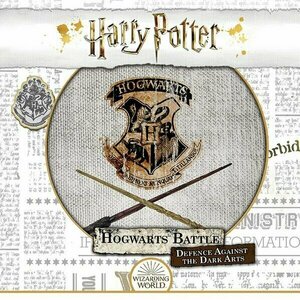

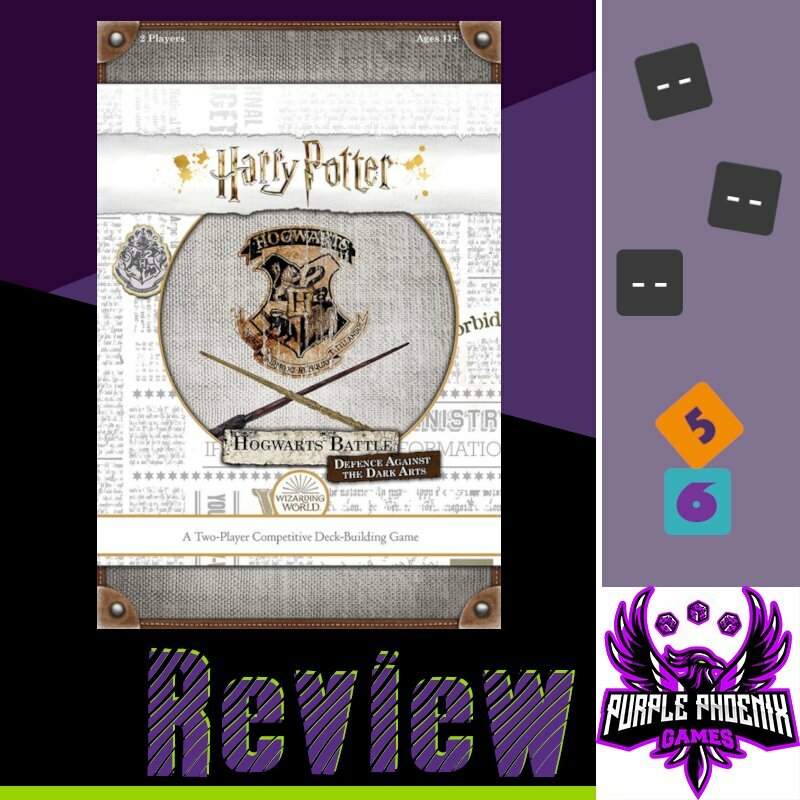
“OMG when is Purple Phoenix Games gonna review another Harry Potter game??” We listened. So here is the next installment of our unofficial Harry Potter games series. In Harry Potter: Hogwarts Battle – Defence Against the Dark Arts (which I will gladly reduce to Defence throughout the review, even though my American English Spidey-Senses are all over that spelling), players will be playing through a duel in the classroom using spells, allies, and items to push back and stun their opponent. Have you got the wand strength to stand up to your rival?
Like I just mentioned, Defence pits two players against each other in a sparring scenario. Players will be drafting cards that represent Spells to sling, Allies to aid, and Items to help knock opponents off their balance. The winner of Defence is the wizard who can stun their opponent three times. Only then will they be able to stand a chance against their dark foes.
DISCLAIMER: We were provided a copy of this game for the purposes of this review. This is a retail copy of the game, so what you see in these photos is exactly what would be received in your box. I do not intend to cover every single rule included in the rulebook, but will describe the overall game flow and major rule set so that our readers may get a sense of how the game plays. For more in depth rules, you may purchase a copy online or from your FLGS. -T
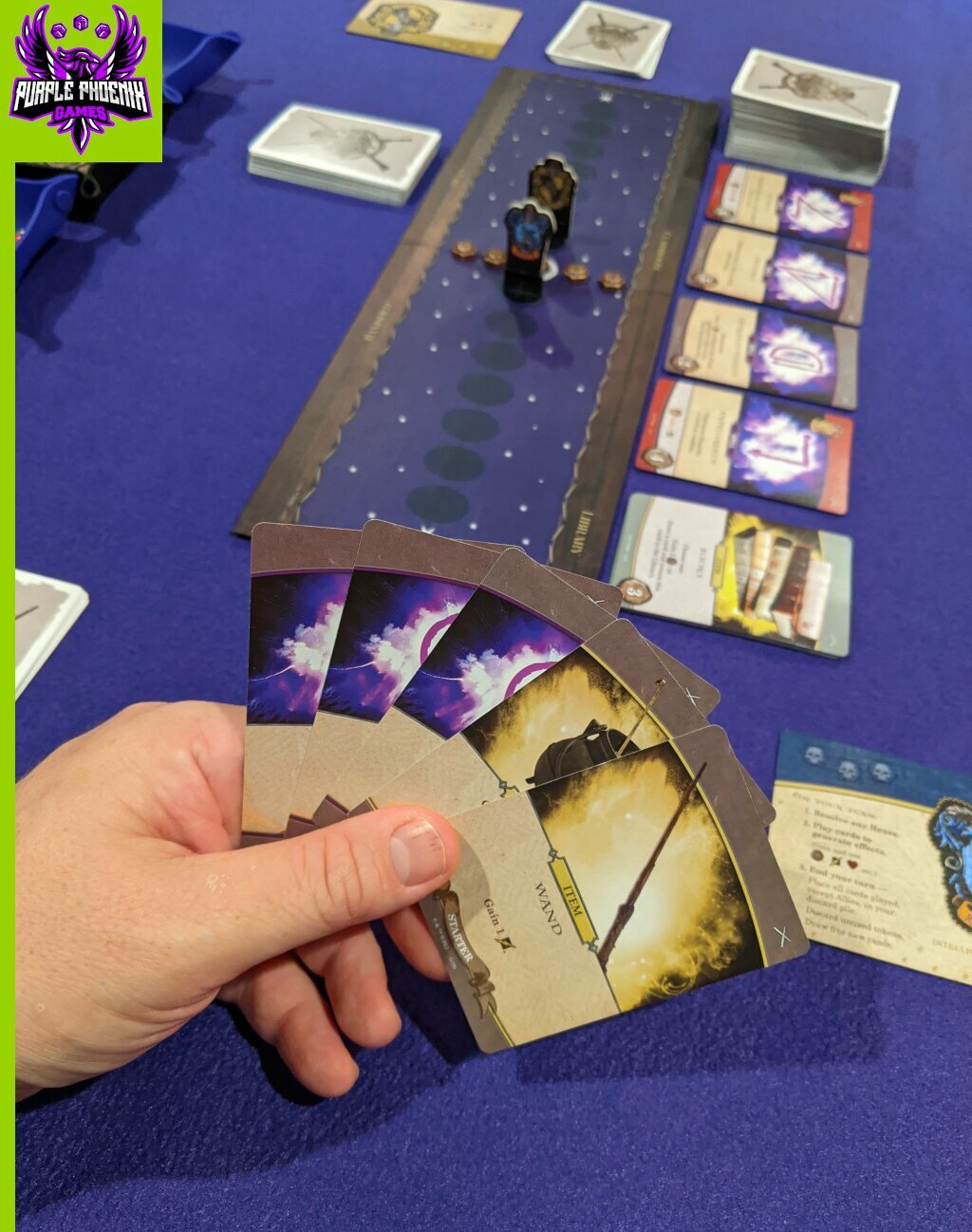
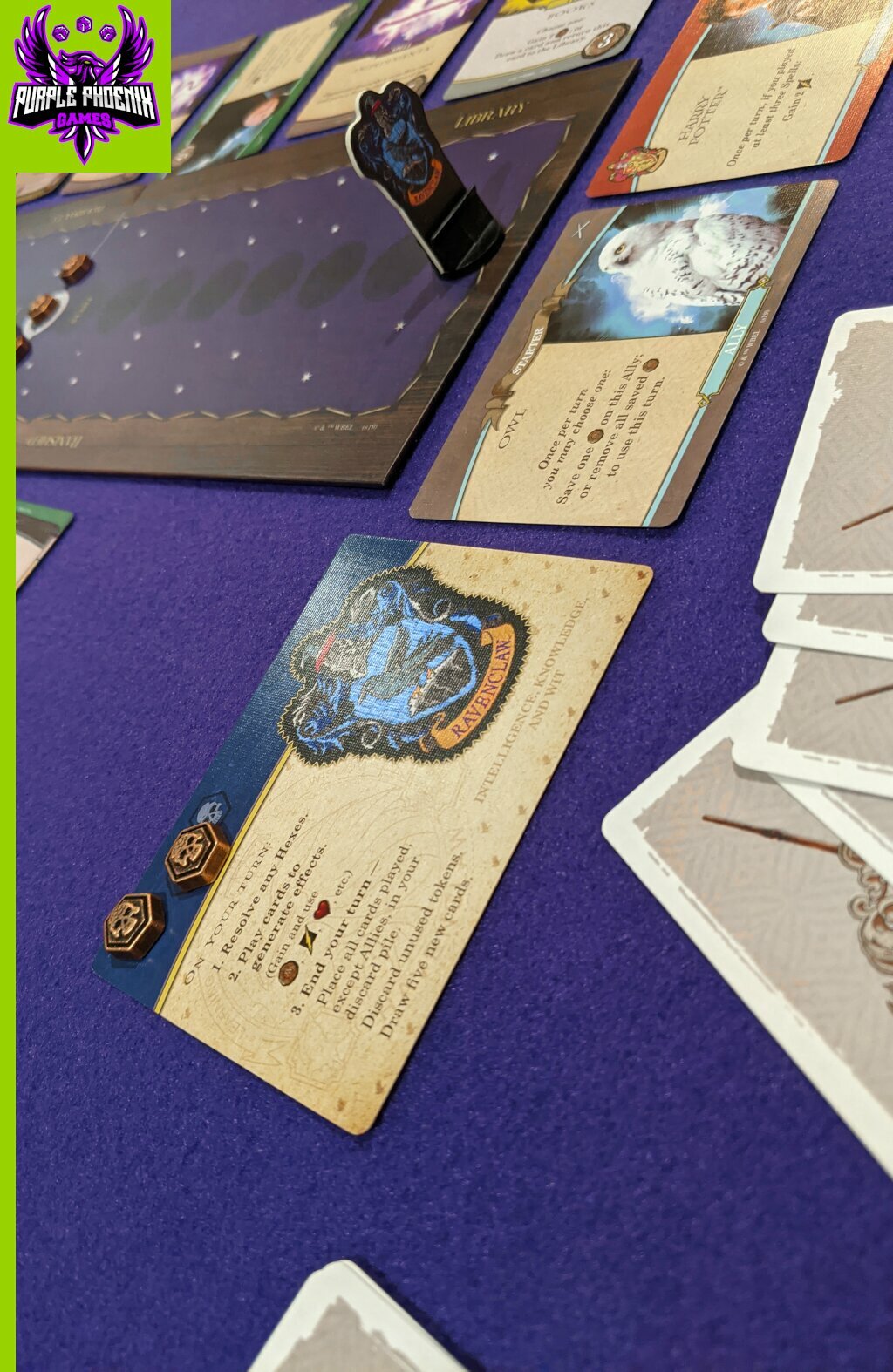
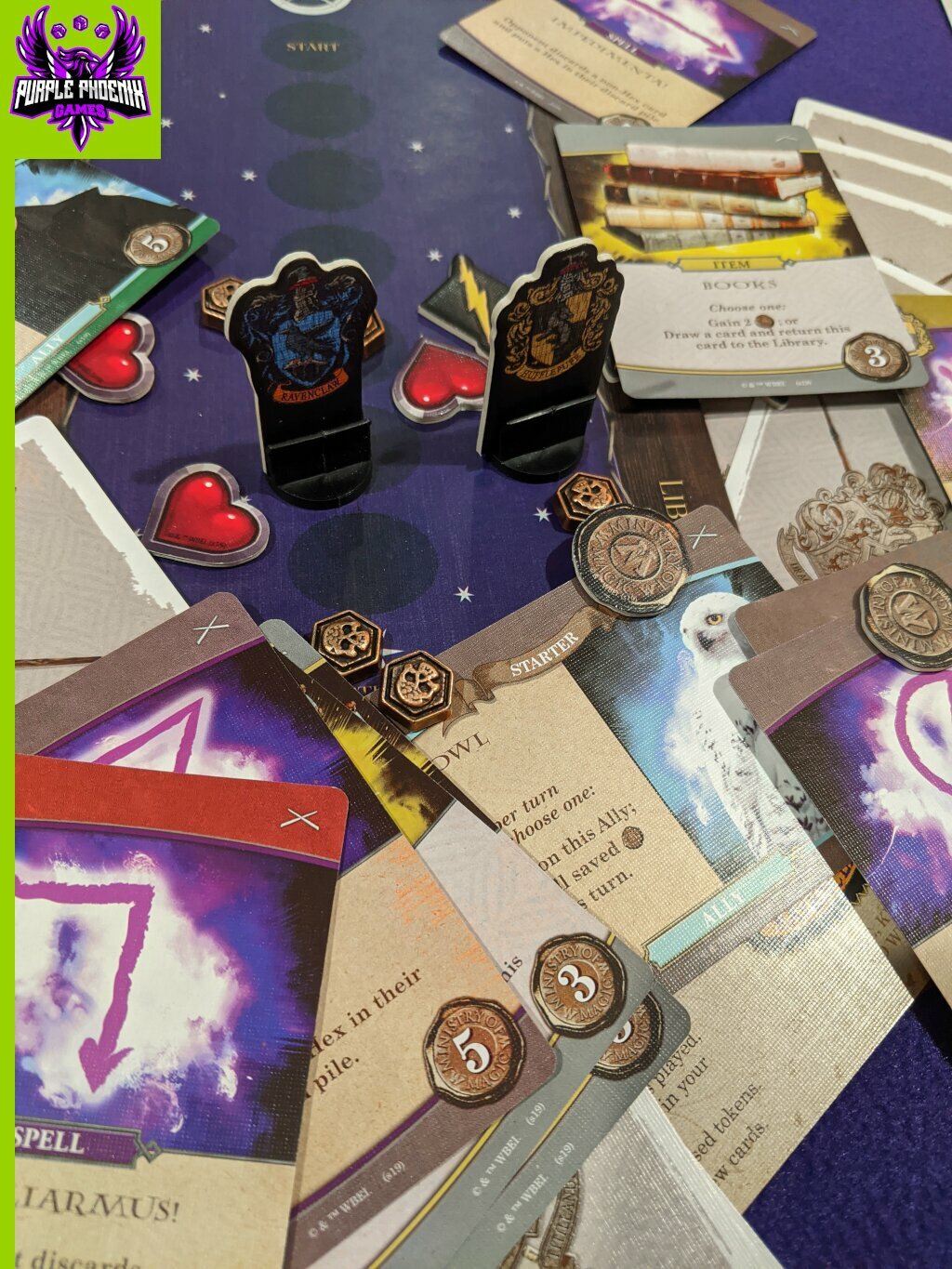
To setup a game, follow the rulebook instructions to lay out the main duel board and its shuffled decks that will surround it. These include the Hogwarts deck (from which players will be purchasing cards to add to their discard piles), the Library deck (which includes only Books cards that add influence or the ability to draw the top card of the player deck), Hexes (which are placed directly in the opponent’s discard pile and must be dealt with first when in hand), and Banished cards. Each player will choose a House card and a matching mover token to be placed on the board. Likewise, each player will have a starting hand of seven Alohomora! cards, one Wand, one Cauldron, and one starter Ally: Owl, Toad, or Cat. Each player will shuffle their starting deck, drawing five for their starting hand. Determine the starting player and the duel may begin!
On a player’s turn they will first deal with any Hex cards they have acquired, following the instructions written on the card. Once cleared, the active player will play cards from their hand in any order they wish to gain Influence to purchase cards from the Classroom (market), Attack points to push back their opponent towards the Stun space, or Health points to move their own mover token one space closer to the Starting space on the board.
Cards that are purchased from the Classroom can be Items, Spells, or even Allies. Items and Spells typically provide Influence, Health, or Attack, and some will have House bonuses in addition to normal effects. In order to take advantage of the House bonus, a player will either need to be from the affiliated House, or have an active Ally belonging to the affiliated House. This is a new mechanic in this game and adds another layer of strategy to a player’s purchasing.
As wizards duel back and forth slinging Spells, recruiting and activating Allies, and using Items to push back their opponent, one wizard will be stunned. When this happens the players will reset their play areas by combining all of their cards they have in their possession. Shuffle the lot of them, draw another hand of five cards and reset their mover token back to the Starting space. The next round is ready to begin and the wizard who stuns their opponent thrice will be crowned champion! Or get an A for the day… or whatever the Common Core equivalent is nowadays.
Components. I have many great things to say about the components in this box and a couple little gripes. Gripelets, really. First gripe: the box comes with a cardstock sleeve. It is very cool and looks great, but it’s unnecessary and I find it keeps snagging on other boxes and such. Not a big deal, as I can always get rid of it, but that’s an opinion. Second, the board is very dark. It features a very dark purple (yay purple!) with black spaces upon which players move their tokens. The colors are very close under certain lighting and I wish there was even just a faint outline of the spaces in a white or gray. Lastly, and probably just me and the way I play, the Attack and Health trackers are almost completely unnecessary. I know you are supposed to take a token every time you “Gain” a Health or Attack point, but I always just keep track in my head thus negating the need for the tokens.
But onto the great. Literally everything else is great. I have always enjoyed the components in the original game, and as this one contains many of the same, I also enjoy these. The art style is interesting and pretty cool, and I really don’t mind screencaps as much as many others do. So for me, overall, I really enjoy the components here.
All in all I truly love this game. I am almost always in the mood to play Harry Potter: Hogwarts Battle, but it is cooperative and my wife doesn’t really enjoy the OG HP game. This one, however, she does enjoy because she can just flex on me and stun me into oblivion with her superior deckbuilding abilities. This one is quicker to setup and play, and holds a much smaller footprint. The mechanics are familiar without being totally duplicating, and I just love deckbuilders in general. So this one was bound to be a big hit with me from the start.
If you are looking for a great Harry Potter-themed deckbuilding game and are not completely sold on the bigger cooperative game, take a look at this much smaller two-player competitive title. Do try to take some of the cards with a grain of salt, as I am sure it is difficult to imagine having both Hermione and Draco as allies simultaneously, but it can happen in the game. Purple Phoenix Games gives this one a very enthusiastic 11 / 12. Just a word of caution, try not to Flipendo your table when you lose. It won’t end well.
Like I just mentioned, Defence pits two players against each other in a sparring scenario. Players will be drafting cards that represent Spells to sling, Allies to aid, and Items to help knock opponents off their balance. The winner of Defence is the wizard who can stun their opponent three times. Only then will they be able to stand a chance against their dark foes.
DISCLAIMER: We were provided a copy of this game for the purposes of this review. This is a retail copy of the game, so what you see in these photos is exactly what would be received in your box. I do not intend to cover every single rule included in the rulebook, but will describe the overall game flow and major rule set so that our readers may get a sense of how the game plays. For more in depth rules, you may purchase a copy online or from your FLGS. -T
To setup a game, follow the rulebook instructions to lay out the main duel board and its shuffled decks that will surround it. These include the Hogwarts deck (from which players will be purchasing cards to add to their discard piles), the Library deck (which includes only Books cards that add influence or the ability to draw the top card of the player deck), Hexes (which are placed directly in the opponent’s discard pile and must be dealt with first when in hand), and Banished cards. Each player will choose a House card and a matching mover token to be placed on the board. Likewise, each player will have a starting hand of seven Alohomora! cards, one Wand, one Cauldron, and one starter Ally: Owl, Toad, or Cat. Each player will shuffle their starting deck, drawing five for their starting hand. Determine the starting player and the duel may begin!
On a player’s turn they will first deal with any Hex cards they have acquired, following the instructions written on the card. Once cleared, the active player will play cards from their hand in any order they wish to gain Influence to purchase cards from the Classroom (market), Attack points to push back their opponent towards the Stun space, or Health points to move their own mover token one space closer to the Starting space on the board.
Cards that are purchased from the Classroom can be Items, Spells, or even Allies. Items and Spells typically provide Influence, Health, or Attack, and some will have House bonuses in addition to normal effects. In order to take advantage of the House bonus, a player will either need to be from the affiliated House, or have an active Ally belonging to the affiliated House. This is a new mechanic in this game and adds another layer of strategy to a player’s purchasing.
As wizards duel back and forth slinging Spells, recruiting and activating Allies, and using Items to push back their opponent, one wizard will be stunned. When this happens the players will reset their play areas by combining all of their cards they have in their possession. Shuffle the lot of them, draw another hand of five cards and reset their mover token back to the Starting space. The next round is ready to begin and the wizard who stuns their opponent thrice will be crowned champion! Or get an A for the day… or whatever the Common Core equivalent is nowadays.
Components. I have many great things to say about the components in this box and a couple little gripes. Gripelets, really. First gripe: the box comes with a cardstock sleeve. It is very cool and looks great, but it’s unnecessary and I find it keeps snagging on other boxes and such. Not a big deal, as I can always get rid of it, but that’s an opinion. Second, the board is very dark. It features a very dark purple (yay purple!) with black spaces upon which players move their tokens. The colors are very close under certain lighting and I wish there was even just a faint outline of the spaces in a white or gray. Lastly, and probably just me and the way I play, the Attack and Health trackers are almost completely unnecessary. I know you are supposed to take a token every time you “Gain” a Health or Attack point, but I always just keep track in my head thus negating the need for the tokens.
But onto the great. Literally everything else is great. I have always enjoyed the components in the original game, and as this one contains many of the same, I also enjoy these. The art style is interesting and pretty cool, and I really don’t mind screencaps as much as many others do. So for me, overall, I really enjoy the components here.
All in all I truly love this game. I am almost always in the mood to play Harry Potter: Hogwarts Battle, but it is cooperative and my wife doesn’t really enjoy the OG HP game. This one, however, she does enjoy because she can just flex on me and stun me into oblivion with her superior deckbuilding abilities. This one is quicker to setup and play, and holds a much smaller footprint. The mechanics are familiar without being totally duplicating, and I just love deckbuilders in general. So this one was bound to be a big hit with me from the start.
If you are looking for a great Harry Potter-themed deckbuilding game and are not completely sold on the bigger cooperative game, take a look at this much smaller two-player competitive title. Do try to take some of the cards with a grain of salt, as I am sure it is difficult to imagine having both Hermione and Draco as allies simultaneously, but it can happen in the game. Purple Phoenix Games gives this one a very enthusiastic 11 / 12. Just a word of caution, try not to Flipendo your table when you lose. It won’t end well.
Kirk Bage (1775 KP) rated The Expanse in TV
Sep 4, 2020 (Updated Feb 11, 2021)
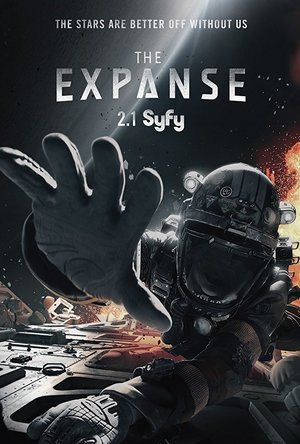
In this particular future, where there exists a cold war tension between the splintered factions of humanity across the solar system, all is not well. Earthers, Dusters (Martians) and Skinnies (Belters) compete for resources and political strength in an ever shifting landscape of trust and betrayal. It is a sci-fi geek’s paradise, full of believable tech, an extensive character list and jargon coming out of the wazoo! It’s all very complicated… and season five just finished airing on Amazon Prime on Wednesday 3rd Feb, so I thought it a good time to talk about it in detail.
Based on the novel series by James S. A. Corey (actually the assumed name of collaborators Ty Franck and Daniel Abraham), which began in 2011 and has produced one book a year since, the TV version has been on the go since 2015, first at SyFy and then at Amazon after being cancelled unfairly, and to mass uproar from the fans, after Season three. It isn’t something you watch casually – either you are into it and make a point of obsessing about it, or you watch a few, feel completely lost and admit it isn’t for you; although you suspect it is good and you just didn’t make the effort to engage enough. Sci-fi this earnest can be like that: a little unforgiving to tourists and passers-by.
Personally, I went through 2 phases with it. The first was watching it late at night with autoplay on, falling in and out of sleep depending on how exciting what was happening was, missing a lot of the detail and feeling largely lost in space. The second was coming back to Season 4 recently (about 3 weeks ago), after taking in a full recap of the story, and becoming a true fan that couldn’t get enough of the complex web of storylines, motives and personalities. Catching up enough to have to wait a week between episodes for the last 4 weeks, which has been tremendously rewarding.
Not that I had a major problem with it from the start. I thought it had a great look and a great mood about it, but lacked some star quality in the cast and was fairly opaque storywise. It always had potential. It was a question of whether you could be bothered to invest in that, knowing that it may go nowhere or even get cancelled very quickly – the TV universe is not known for being kind to sci-fi, as die-hard fans of Firefly still weep about regularly, and quite correctly.
In season one you watch it for the only person onboard that you have heard of, namely Thomas Jane (from The Mist and The Punisher) as det. Joe Miller, a cynical sleuth complete with a great anachronistic hat, who gets wrapped up in a mystery so mysterious it is often hard to work out what he is doing at all, and why… he literally comes and goes, for reasons that become apparent in later seasons. A frustrating and yet fascinating entity that must have been a real test to get right.
The show’s main cast also take a lot of time to warm up, to the point where you wonder who they are and whether they will be in it for long? Steven Strait, Dominique Tipper, Wes Chatham and Cas Anvar, as the ragtag collective of a small ship (they eventually name The Rocinante) that finds itself at the centre of a huge political shitstorm as the last bastion of impartial hope and moral reasoning, exude such little charisma at first it all seems doomed to fail. But, something magical begins to happen, by virtue of being in their presence a lot – you start to care. And the more you care the more the subsequent events have the power to stun you sideways!
More than anything else I can think of in recent years, this is a show that rewards patient investment. You will have definite moments of wanting to quit or take a long break, but the more faith you show in it, the more it will reward you in the long run. For me it was the climax of season 3 when I realised I was 100% into it, and that everything that had happened to that point was now starting to make sense in a larger context. Basically, what you think this is and what you assume it is about early doors, is not where it ends up. It goes somewhere way better!
Perhaps because it has the support of the book series as inspiration, the writing and story arc feels stronger and stronger in time. There are to date 9 books, so there is still scope to let this run for a good few years. And it does start to feel like there is a point where it will all completely tie together. Anyway, I am rambling as much as an average episode seems to do here. The point is, there is something right on the tightrope edge of classic or near miss going on with this. The cast have all really grown into their skins and personalities, and there are some moments in seasons 4 & 5 that left me jaw dropped at their dramatic weight!
Look, this isn’t going to be for everyone. It is very easy to say “I don’t get it” and move on with this show, but I am a sci-fi veteran , if not full geek, and I now absolutely love it. Cult status then is what we are talking about here. There will be a good wait for season six now, but the cliffhanger is mouth-watering, so I am in! It’s far from impossible they will ruin the vibe at some point and it will all fall flat… or, it could become the stuff of legend. I’ll be there to find out either way. No chance I am doing 5 seasons of something to drop out at that point.
Take away the space and the spaceships and this is a story about division and rights, and the hard work it takes to meet a diplomatic solution to the many differences and grievances that exist between different tribes and factions. What will some do to gain power? What will others do to ensure freedom and justice? How easy is it to waste life in the name of a cause? Oh, yeah and there’s also the little detail of an ancient alien civilisation that have been leaving tech and artifacts all over the solar system for us to fight over and try to control. As I say, the main story element of it all still feels like a partial mystery, and I love that!
Based on the novel series by James S. A. Corey (actually the assumed name of collaborators Ty Franck and Daniel Abraham), which began in 2011 and has produced one book a year since, the TV version has been on the go since 2015, first at SyFy and then at Amazon after being cancelled unfairly, and to mass uproar from the fans, after Season three. It isn’t something you watch casually – either you are into it and make a point of obsessing about it, or you watch a few, feel completely lost and admit it isn’t for you; although you suspect it is good and you just didn’t make the effort to engage enough. Sci-fi this earnest can be like that: a little unforgiving to tourists and passers-by.
Personally, I went through 2 phases with it. The first was watching it late at night with autoplay on, falling in and out of sleep depending on how exciting what was happening was, missing a lot of the detail and feeling largely lost in space. The second was coming back to Season 4 recently (about 3 weeks ago), after taking in a full recap of the story, and becoming a true fan that couldn’t get enough of the complex web of storylines, motives and personalities. Catching up enough to have to wait a week between episodes for the last 4 weeks, which has been tremendously rewarding.
Not that I had a major problem with it from the start. I thought it had a great look and a great mood about it, but lacked some star quality in the cast and was fairly opaque storywise. It always had potential. It was a question of whether you could be bothered to invest in that, knowing that it may go nowhere or even get cancelled very quickly – the TV universe is not known for being kind to sci-fi, as die-hard fans of Firefly still weep about regularly, and quite correctly.
In season one you watch it for the only person onboard that you have heard of, namely Thomas Jane (from The Mist and The Punisher) as det. Joe Miller, a cynical sleuth complete with a great anachronistic hat, who gets wrapped up in a mystery so mysterious it is often hard to work out what he is doing at all, and why… he literally comes and goes, for reasons that become apparent in later seasons. A frustrating and yet fascinating entity that must have been a real test to get right.
The show’s main cast also take a lot of time to warm up, to the point where you wonder who they are and whether they will be in it for long? Steven Strait, Dominique Tipper, Wes Chatham and Cas Anvar, as the ragtag collective of a small ship (they eventually name The Rocinante) that finds itself at the centre of a huge political shitstorm as the last bastion of impartial hope and moral reasoning, exude such little charisma at first it all seems doomed to fail. But, something magical begins to happen, by virtue of being in their presence a lot – you start to care. And the more you care the more the subsequent events have the power to stun you sideways!
More than anything else I can think of in recent years, this is a show that rewards patient investment. You will have definite moments of wanting to quit or take a long break, but the more faith you show in it, the more it will reward you in the long run. For me it was the climax of season 3 when I realised I was 100% into it, and that everything that had happened to that point was now starting to make sense in a larger context. Basically, what you think this is and what you assume it is about early doors, is not where it ends up. It goes somewhere way better!
Perhaps because it has the support of the book series as inspiration, the writing and story arc feels stronger and stronger in time. There are to date 9 books, so there is still scope to let this run for a good few years. And it does start to feel like there is a point where it will all completely tie together. Anyway, I am rambling as much as an average episode seems to do here. The point is, there is something right on the tightrope edge of classic or near miss going on with this. The cast have all really grown into their skins and personalities, and there are some moments in seasons 4 & 5 that left me jaw dropped at their dramatic weight!
Look, this isn’t going to be for everyone. It is very easy to say “I don’t get it” and move on with this show, but I am a sci-fi veteran , if not full geek, and I now absolutely love it. Cult status then is what we are talking about here. There will be a good wait for season six now, but the cliffhanger is mouth-watering, so I am in! It’s far from impossible they will ruin the vibe at some point and it will all fall flat… or, it could become the stuff of legend. I’ll be there to find out either way. No chance I am doing 5 seasons of something to drop out at that point.
Take away the space and the spaceships and this is a story about division and rights, and the hard work it takes to meet a diplomatic solution to the many differences and grievances that exist between different tribes and factions. What will some do to gain power? What will others do to ensure freedom and justice? How easy is it to waste life in the name of a cause? Oh, yeah and there’s also the little detail of an ancient alien civilisation that have been leaving tech and artifacts all over the solar system for us to fight over and try to control. As I say, the main story element of it all still feels like a partial mystery, and I love that!

Bong Mines Entertainment (15 KP) rated The Life of Pablo by Kanye West in Music
Jun 7, 2019
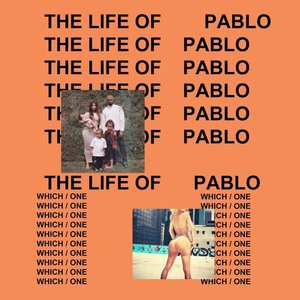
Kanye West is an iconic rapper from Chicago, Illinois. Not too long ago, he released his seventh studio album, entitled, “The Life of Pablo“.
ULTRA LIGHT BEAMS
The opening track functions as a Sunday-morning church revival, where Kanye is the ordained minister. He’s standing in the pulpit, preaching a time-sensitive sermon to his loyal congregation.
His message: God over Satan, keep the faith, pray for Paris, pray for parents, and we’re living God’s dream.
West sets the tone and declares where he stands on religious and socially-driven issues.
A Gospel choir emerges. The Dream and Kelly Price reinforce West’s message by singing verses of encouragement, leading to a heartfelt testimonial by Chance The Rapper.
While the collection plates are being filled with hopes of a better tomorrow, Kirk Franklin concludes the service by praying for everyone. He uplifts those who feel they are not good enough or have said, “I’m sorry,” too many times.
Father Stretch My Hands (Pt. 1)
A spiritual figure, Pastor T.L. Barrett, ushers in the second track with praises to The Most High. Future appears for a brief moment and Kid Cudi delivers a stunning chorus.
A liberated West returns to the pulpit and gives a brief, but somewhat explicit testimony of his past and present relationships to Amber Rose and Kim Kardashian.
Father Stretch My Hands (Pt. 2)
West continues his testimony and raps about his personal experiences. He speaks on the importance of returning his wife’s phone calls and not wanting to make the same mistakes his father made. Also, he mentions the passing of the mother in Hollywood, being broke, and the reason why he broke his jaw.
West’s words hit home, making room for another liberated soul to tell his story of triumph.
Desiigner, a newly-signed artist of G.O.O.D. Music, emerges from the underbelly of the ghetto. He raps about getting money illegally, drugs, and violence-familiarized by urban-street hustlers.
Though his grim subject matter contradicts the song’s hopeful message of liberation, it somehow adds mysticism or substance to Kanye’s brutally-honest testimony.
Desiigner, blessed with a futuristic flow, highlights a few things that West’s congregation needs to examine in order to be totally liberated.
FAMOUS
Whenever an important event occurs in an urban community, an after party is sure to follow. And a host of celebrities are always on standby to attend it. The Life of Pablo is no exception.
The fourth song features Rihanna and legendary-producer Swizz Beatz. Also, it contains timeless vocals from Sister Nancy and Nina Simone.
West, no longer in church clothes, stands out lyrically with witty, braggadocios lyrics.
Whether that statement is factual or not, it’s doesn’t really matter because West believes it is.
FEEDBACK
The fifth song serves as a transformational period, where West shows signs of the old Kanye.
West doesn’t need a psychiatrist to diagnose his problems. He does that himself by wearing them on his sleeves.
LOW LIGHTS
On the sixth track, West wrote via Twitter, “I put Low Lights on my album just thinking about all the moms driving their kids to school, then going to work.”
Listeners can now relate to the everyday struggle that mothers endure.
The song features an acapella sample from “So Alive” by Kings of Tomorrow.
The woman gives a grateful-testimony of God’s graciousness over a laid-back, simple piano groove. Her honesty is felt. Also, she sounds liberated because her Creator has accepted her for who she is.
HIGH LIGHTS
From lows to high, the seventh track is in direct correlation to “Low Lights”.
West and Young Thug put on their festive robes because it’s time to celebrate life. El Debarge and The Dream chime in, and West addresses a lingering issue.
But this is only the beginning. West finishes strong with more thought-provoking lyrics.
FREESTYLE 4
The eighth track features Desiigner. Again, when he and West are together, all hell breaks loose.
The once festive scene transforms into a grimy underworld filled with a prostitute that West is explicitly lusting after. The temptation makes it difficult for him to stand on his opening statement of Jesus over Satan. But the power of darkness is more powerful than West thinks. So, he subconsciously indulges in sexual misconduct.
I LOVE KANYE
On the ninth track, West realizes that he’s at war with himself. The old Kanye, known for chopping up soul records is fighting against the new Kanye that everyone hates. But Kanye wants to go back to being sweet again if that’s even possible. His multiple egos are fighting for control over the ‘real’ Kanye.
WAVE
West doesn’t stare in the mirror for too long. On the tenth track, redemption happens. Chris Brown, disguised as an angel, comes to West’s aid by providing much-needed light.
Miraculously, the sun emerges from the shade, a bird flies out its cage, and a nostalgic feeling is felt.
West realizes that nothing is impossible because waves don’t die and feelings don’t really go away.
FML (FOR MY LADY)
On the eleventh track, West realizes what’s really important to him and that’s his wife. Someone he won’t jeopardize for no other woman. Also, his children are all layers of his soul.
The Weeknd appears in the form of West’s conscience.
West remains focused and listeners can feel the positive aura of God surrounding him. He is determined to remain faithful to only Kim, no other woman.
REAL FRIENDS
West continues his introspective outlook and raps about trust issues that everyone can relate to. His honest, down-to-earth lyrics, mixed in with Ty Dolla $ign’s vocals, paints a vivid picture. Also, it forms a collectible souvenir that hangs nicely in listeners’ collective memories.
WOLVES
The thirteenth track provides a cooling effect with wild emotions and bizarre-sounds.
The setting, maybe an extraterritorial realm in West’s subconscious mind. Perhaps, it’s the Milky Way Galaxy or a dream-state of Saturn.
A time for relaxation, preparing listeners for a surprise guest.
SILVER SURFER INTERMISSION
The fourteenth track features a phone conversation between incarcerated Max B and French Montana. Also, Max voices his gratitude to West for showing him love.
30 HOURS
On the fifteenth track, West takes a trip down memory lane and raps about an ex-girlfriend that he used to drive 30-hours to see. He used to drive from Chicago to St. Louis, St. Louis to Chicago. He recalls the good times they shared. But unfortunately, her infidelity was the reason why they broke up.
NO PARTIES IN L.A.
The sixteenth track will go down in history as a legendary bar-fest between two elite emcees. Kendrick Lamar and West rap with dope punchlines and clever metaphors over a Madlib-produced track. Once again, West is flowing like the old Kanye that people love.
FACTS
The seventeenth track is a standout anthem where West brags that Yeezy just jumped over Jumpman. He’s in boss-mode, talking that big-money talk.
FADE
The final track features Post Malone and Ty Dollar $ign. The song has a reoccurring sample from Rare Earth, “Your love is fading/I feel it fade.”
The Eli Linnetz-directed video shows Teyana Taylor explicitly dancing.
CONCLUSION
Kanye West’s “The Life of Pablo” is a memorable hip-hop album with solid content and heavy replay value.
https://www.bongminesentertainment.com/kanye-west-life-pablo/
ULTRA LIGHT BEAMS
The opening track functions as a Sunday-morning church revival, where Kanye is the ordained minister. He’s standing in the pulpit, preaching a time-sensitive sermon to his loyal congregation.
His message: God over Satan, keep the faith, pray for Paris, pray for parents, and we’re living God’s dream.
West sets the tone and declares where he stands on religious and socially-driven issues.
A Gospel choir emerges. The Dream and Kelly Price reinforce West’s message by singing verses of encouragement, leading to a heartfelt testimonial by Chance The Rapper.
While the collection plates are being filled with hopes of a better tomorrow, Kirk Franklin concludes the service by praying for everyone. He uplifts those who feel they are not good enough or have said, “I’m sorry,” too many times.
Father Stretch My Hands (Pt. 1)
A spiritual figure, Pastor T.L. Barrett, ushers in the second track with praises to The Most High. Future appears for a brief moment and Kid Cudi delivers a stunning chorus.
A liberated West returns to the pulpit and gives a brief, but somewhat explicit testimony of his past and present relationships to Amber Rose and Kim Kardashian.
Father Stretch My Hands (Pt. 2)
West continues his testimony and raps about his personal experiences. He speaks on the importance of returning his wife’s phone calls and not wanting to make the same mistakes his father made. Also, he mentions the passing of the mother in Hollywood, being broke, and the reason why he broke his jaw.
West’s words hit home, making room for another liberated soul to tell his story of triumph.
Desiigner, a newly-signed artist of G.O.O.D. Music, emerges from the underbelly of the ghetto. He raps about getting money illegally, drugs, and violence-familiarized by urban-street hustlers.
Though his grim subject matter contradicts the song’s hopeful message of liberation, it somehow adds mysticism or substance to Kanye’s brutally-honest testimony.
Desiigner, blessed with a futuristic flow, highlights a few things that West’s congregation needs to examine in order to be totally liberated.
FAMOUS
Whenever an important event occurs in an urban community, an after party is sure to follow. And a host of celebrities are always on standby to attend it. The Life of Pablo is no exception.
The fourth song features Rihanna and legendary-producer Swizz Beatz. Also, it contains timeless vocals from Sister Nancy and Nina Simone.
West, no longer in church clothes, stands out lyrically with witty, braggadocios lyrics.
Whether that statement is factual or not, it’s doesn’t really matter because West believes it is.
FEEDBACK
The fifth song serves as a transformational period, where West shows signs of the old Kanye.
West doesn’t need a psychiatrist to diagnose his problems. He does that himself by wearing them on his sleeves.
LOW LIGHTS
On the sixth track, West wrote via Twitter, “I put Low Lights on my album just thinking about all the moms driving their kids to school, then going to work.”
Listeners can now relate to the everyday struggle that mothers endure.
The song features an acapella sample from “So Alive” by Kings of Tomorrow.
The woman gives a grateful-testimony of God’s graciousness over a laid-back, simple piano groove. Her honesty is felt. Also, she sounds liberated because her Creator has accepted her for who she is.
HIGH LIGHTS
From lows to high, the seventh track is in direct correlation to “Low Lights”.
West and Young Thug put on their festive robes because it’s time to celebrate life. El Debarge and The Dream chime in, and West addresses a lingering issue.
But this is only the beginning. West finishes strong with more thought-provoking lyrics.
FREESTYLE 4
The eighth track features Desiigner. Again, when he and West are together, all hell breaks loose.
The once festive scene transforms into a grimy underworld filled with a prostitute that West is explicitly lusting after. The temptation makes it difficult for him to stand on his opening statement of Jesus over Satan. But the power of darkness is more powerful than West thinks. So, he subconsciously indulges in sexual misconduct.
I LOVE KANYE
On the ninth track, West realizes that he’s at war with himself. The old Kanye, known for chopping up soul records is fighting against the new Kanye that everyone hates. But Kanye wants to go back to being sweet again if that’s even possible. His multiple egos are fighting for control over the ‘real’ Kanye.
WAVE
West doesn’t stare in the mirror for too long. On the tenth track, redemption happens. Chris Brown, disguised as an angel, comes to West’s aid by providing much-needed light.
Miraculously, the sun emerges from the shade, a bird flies out its cage, and a nostalgic feeling is felt.
West realizes that nothing is impossible because waves don’t die and feelings don’t really go away.
FML (FOR MY LADY)
On the eleventh track, West realizes what’s really important to him and that’s his wife. Someone he won’t jeopardize for no other woman. Also, his children are all layers of his soul.
The Weeknd appears in the form of West’s conscience.
West remains focused and listeners can feel the positive aura of God surrounding him. He is determined to remain faithful to only Kim, no other woman.
REAL FRIENDS
West continues his introspective outlook and raps about trust issues that everyone can relate to. His honest, down-to-earth lyrics, mixed in with Ty Dolla $ign’s vocals, paints a vivid picture. Also, it forms a collectible souvenir that hangs nicely in listeners’ collective memories.
WOLVES
The thirteenth track provides a cooling effect with wild emotions and bizarre-sounds.
The setting, maybe an extraterritorial realm in West’s subconscious mind. Perhaps, it’s the Milky Way Galaxy or a dream-state of Saturn.
A time for relaxation, preparing listeners for a surprise guest.
SILVER SURFER INTERMISSION
The fourteenth track features a phone conversation between incarcerated Max B and French Montana. Also, Max voices his gratitude to West for showing him love.
30 HOURS
On the fifteenth track, West takes a trip down memory lane and raps about an ex-girlfriend that he used to drive 30-hours to see. He used to drive from Chicago to St. Louis, St. Louis to Chicago. He recalls the good times they shared. But unfortunately, her infidelity was the reason why they broke up.
NO PARTIES IN L.A.
The sixteenth track will go down in history as a legendary bar-fest between two elite emcees. Kendrick Lamar and West rap with dope punchlines and clever metaphors over a Madlib-produced track. Once again, West is flowing like the old Kanye that people love.
FACTS
The seventeenth track is a standout anthem where West brags that Yeezy just jumped over Jumpman. He’s in boss-mode, talking that big-money talk.
FADE
The final track features Post Malone and Ty Dollar $ign. The song has a reoccurring sample from Rare Earth, “Your love is fading/I feel it fade.”
The Eli Linnetz-directed video shows Teyana Taylor explicitly dancing.
CONCLUSION
Kanye West’s “The Life of Pablo” is a memorable hip-hop album with solid content and heavy replay value.
https://www.bongminesentertainment.com/kanye-west-life-pablo/

Gareth von Kallenbach (980 KP) rated King Kong (2005) in Movies
Aug 14, 2019
Following up the box office and Oscar success of the Lord of the Rings Trilogy is an undertaking that is sure to have its dangers. Expectations of the fans notwithstanding, the ability to recapture the magic of the trilogy could be akin to capturing lightning in a bottle. When it was announced that Peter Jackson would follow his Oscar success by doing yet another adaptation of King Kong, there were plenty of questions amidst the excitement.
When an earlier remake was a critical and commercial bomb, “Would Jackson be able to do justice to one of the all time classics?” was one of the biggest questions. When it was announced that comedian Jack Black would be in the film, people began to wonder what Jackson had brewing. Black, as well as Academy Award winner Adrian Brody were seen as offbeat choices. As the release date for the film neared, so did speculation over the look of the film, the running time, and its decision to follow the screenplay of the original rather than adapt to a modern setting.
The film follows a filmmaker named Carl Denham (Jack Black), who in an act of desperation flees New York for a mysterious and uncharted island in an attempt to finish his latest movie before the studio can shut him down. Amidst the backdrop of the Great Depression, it is clear that Denham knows that failure now could be the end of his livelihood and his long term future. As he embarks on his fly by night production, Denham encounters Ann Darrow (Naomi Watts), a recently unemployed Vaudeville performer who is enticed into the film in the hopes of meeting its writer Jack Driscoll (Adrian Brody). It seems that Ann has long coveted a part in Driscoll’s plays and hopes that by meeting him, she will obtain her long sought after audition.
With the cops and studio hot on their heels, the cast and crew board a tramp steamer named “The Venture” as they set off for the mysterious island that is known only to Denham via a mysterious map he obtained through methods unknown.
As the voyage unwinds, not only does Denham get the chance to film segments of the film, but Ann and a stranded Jack find themselves becoming an item. Jack is inspired by Ann, and he works like a man inspired turning out page after page of material for various projects which he hopes Ann will star.
Eventually the ship finds its way to the mysterious Skull Island surrounded in fog, and the crew venture ashore to take in the bizarre and exotic land that has previously been unexplored. Upon finding a fortified wall and settlement the crew has a run in with some dangerous natives which in turn leads to Ann being kidnapped and offered up sacrificial style to a gigantic creature the Islanders refer to as Kong. Undaunted, Jack and the crew set off to rescue Ann while Denham shoots footage along the way, as the island offers visuals the likes of which have never been seen by mankind.
Along the way, the crew encounters deadly creatures and obstacles at every turn, as does Ann who plays a dangerous game of cat and mouse with Kong as she comes to grips with her situation. Kong is taken with the lovely Ann and protects her against numerous dangers including a pack of Tyrannosauruses in one of the film’s best action sequences.
Of course few will be surprised at the final act of the film so I will leave it to say that the fish out of water nature of the previous versions remains intact as Kong finds himself dealing with an urban jungle which leads to a spectacular finale atop the Empire State Building.
In many ways Jackson’s film is three separate films. The first hour of the film is an interesting and, at times witty, character piece where the lead characters assemble. The look of the city is amazing, making it very clear that enormous amounts of effort went into crafting the look of Depression Era New York, and to remind the audience that Prohibition was also in effect. The interplay between the characters is decent.Black does standout work as the slick Denham, as does Watts as the wholesome and lovable Ann.
The second hour of the film is the special effects showcase where the mysteries of Skull Island and Kong are shown complete with all manner of CGI creatures and action sequences. While most of them are well staged, I could not help but note that on more than one occasion the CGI backdrops did not match up well with their live action counterparts. There is one scene of a stampede where it looked like the actors had been drawn in and that they were running in place as they clearly did not mesh with the spectacle behind them.
Throughout the film this occurrence happened more and more which really had me wondering if the effects house was overtaxed. A film with a budget reportedly over 100 million should not have these technical issues. Thankfully Kong himself is a wonder, with everything from his expressive eyes and facial features, captured in a remarkable way. It is just a shame that the other effects did not get the same treatment as the films namesake, as he truly is a site to behold. Andy Serkis who did the character mannerisms for the animators program did a phenomenal job. The movements of Kong progress with a strength and agility that bellies a simian rather than a skilled performer.
I do not want it to sound as if I did not enjoy the film, as much of the film worked very well, technical issues aside. What my biggest issue with the film was that at over 3 Hours, it was far too long for the material to support. We get numerous scenes of Ann and Kong flirting, bonding, fighting, running, and more. What is cute the first couple of times becomes dull the more it is repeated. It is obvious that they have a bond; we do not need to see it over and over ad nauseum to get the message. Also, the character development and interplay between the characters that was so effective in the first part of the film all but vanishes amidst the effects.
The finale of the film is a rousing success as the daring visuals and camera angles are very inventive and thrilling. This segment with its fury of motion and sound will have viewers on the edge of their seat as it certainly delivers the goods. The biggest issue again is having to sit through three hours to get to it. Anyone who has seen either version of Kong knows exactly where the film is heading, and after two hours of screen time I found myself wishing they would just hurry up and get to it.
Jackson has crafted a very entertaining and lavish film that packs its share of thrills. What the film needed is someone to reign in Jackson and his boundless enthusiasm for the project to remind him that sometimes less is more. Jackson has said that he had over 4 hours worth of material filmed but trimmed it down to its current running time. When the film is almost twice the running time of the original, I found myself thinking that minus 45 minutes the same story could have been told.
Despite the flaws and the hype, King Kong is a solid film that for me was more satisfying in many ways than any of the “Rings” films. While not quite a masterpiece, this Kong is worthy of the name and pedigree of the timeless original that inspired it.
When an earlier remake was a critical and commercial bomb, “Would Jackson be able to do justice to one of the all time classics?” was one of the biggest questions. When it was announced that comedian Jack Black would be in the film, people began to wonder what Jackson had brewing. Black, as well as Academy Award winner Adrian Brody were seen as offbeat choices. As the release date for the film neared, so did speculation over the look of the film, the running time, and its decision to follow the screenplay of the original rather than adapt to a modern setting.
The film follows a filmmaker named Carl Denham (Jack Black), who in an act of desperation flees New York for a mysterious and uncharted island in an attempt to finish his latest movie before the studio can shut him down. Amidst the backdrop of the Great Depression, it is clear that Denham knows that failure now could be the end of his livelihood and his long term future. As he embarks on his fly by night production, Denham encounters Ann Darrow (Naomi Watts), a recently unemployed Vaudeville performer who is enticed into the film in the hopes of meeting its writer Jack Driscoll (Adrian Brody). It seems that Ann has long coveted a part in Driscoll’s plays and hopes that by meeting him, she will obtain her long sought after audition.
With the cops and studio hot on their heels, the cast and crew board a tramp steamer named “The Venture” as they set off for the mysterious island that is known only to Denham via a mysterious map he obtained through methods unknown.
As the voyage unwinds, not only does Denham get the chance to film segments of the film, but Ann and a stranded Jack find themselves becoming an item. Jack is inspired by Ann, and he works like a man inspired turning out page after page of material for various projects which he hopes Ann will star.
Eventually the ship finds its way to the mysterious Skull Island surrounded in fog, and the crew venture ashore to take in the bizarre and exotic land that has previously been unexplored. Upon finding a fortified wall and settlement the crew has a run in with some dangerous natives which in turn leads to Ann being kidnapped and offered up sacrificial style to a gigantic creature the Islanders refer to as Kong. Undaunted, Jack and the crew set off to rescue Ann while Denham shoots footage along the way, as the island offers visuals the likes of which have never been seen by mankind.
Along the way, the crew encounters deadly creatures and obstacles at every turn, as does Ann who plays a dangerous game of cat and mouse with Kong as she comes to grips with her situation. Kong is taken with the lovely Ann and protects her against numerous dangers including a pack of Tyrannosauruses in one of the film’s best action sequences.
Of course few will be surprised at the final act of the film so I will leave it to say that the fish out of water nature of the previous versions remains intact as Kong finds himself dealing with an urban jungle which leads to a spectacular finale atop the Empire State Building.
In many ways Jackson’s film is three separate films. The first hour of the film is an interesting and, at times witty, character piece where the lead characters assemble. The look of the city is amazing, making it very clear that enormous amounts of effort went into crafting the look of Depression Era New York, and to remind the audience that Prohibition was also in effect. The interplay between the characters is decent.Black does standout work as the slick Denham, as does Watts as the wholesome and lovable Ann.
The second hour of the film is the special effects showcase where the mysteries of Skull Island and Kong are shown complete with all manner of CGI creatures and action sequences. While most of them are well staged, I could not help but note that on more than one occasion the CGI backdrops did not match up well with their live action counterparts. There is one scene of a stampede where it looked like the actors had been drawn in and that they were running in place as they clearly did not mesh with the spectacle behind them.
Throughout the film this occurrence happened more and more which really had me wondering if the effects house was overtaxed. A film with a budget reportedly over 100 million should not have these technical issues. Thankfully Kong himself is a wonder, with everything from his expressive eyes and facial features, captured in a remarkable way. It is just a shame that the other effects did not get the same treatment as the films namesake, as he truly is a site to behold. Andy Serkis who did the character mannerisms for the animators program did a phenomenal job. The movements of Kong progress with a strength and agility that bellies a simian rather than a skilled performer.
I do not want it to sound as if I did not enjoy the film, as much of the film worked very well, technical issues aside. What my biggest issue with the film was that at over 3 Hours, it was far too long for the material to support. We get numerous scenes of Ann and Kong flirting, bonding, fighting, running, and more. What is cute the first couple of times becomes dull the more it is repeated. It is obvious that they have a bond; we do not need to see it over and over ad nauseum to get the message. Also, the character development and interplay between the characters that was so effective in the first part of the film all but vanishes amidst the effects.
The finale of the film is a rousing success as the daring visuals and camera angles are very inventive and thrilling. This segment with its fury of motion and sound will have viewers on the edge of their seat as it certainly delivers the goods. The biggest issue again is having to sit through three hours to get to it. Anyone who has seen either version of Kong knows exactly where the film is heading, and after two hours of screen time I found myself wishing they would just hurry up and get to it.
Jackson has crafted a very entertaining and lavish film that packs its share of thrills. What the film needed is someone to reign in Jackson and his boundless enthusiasm for the project to remind him that sometimes less is more. Jackson has said that he had over 4 hours worth of material filmed but trimmed it down to its current running time. When the film is almost twice the running time of the original, I found myself thinking that minus 45 minutes the same story could have been told.
Despite the flaws and the hype, King Kong is a solid film that for me was more satisfying in many ways than any of the “Rings” films. While not quite a masterpiece, this Kong is worthy of the name and pedigree of the timeless original that inspired it.
Gareth von Kallenbach (980 KP) rated Warhammer: Chaosbane in Video Games
Jul 8, 2019
There have been a lot of Warhammer games released over the past year or so. Everything from managing spaceships, to Real-Time Strategy, to Tactical Combat based games have been represented between the Warhammer and the Warhammer 40,000 universe. EKO Software and Bigben decided to add the action-RPG to the mix with their fun to play Diablo clone Warhammer: Chaosbane.
Much like the games that it takes inspiration from, you have the opportunity to pick one of four characters to battle the Lords of Chaos and bring order to the land. Your standard archetype characters are all here in standard Warhammer Fantasy. The Dwarven “Slayer” class, for those who like a barbarian class to rage havoc upon his foes, The High-Elf Mage who utilizes his magic to bring down the forces of chaos, the ho-hum Imperial Soldier who can take and deal out a huge amount of damage, and the Wood Elf who uses her bow and dagger to deal damage at a frighteningly fast pace.
Each of the characters have their own unique secondary ability that allows them to gain a strategic advantage on their foes. The Slayer can vault himself into enemies (much like the Barbarian class in Diablo), The Mage can control magical projectiles towards his targets, the Imperial soldier can shield bash targets and the Wood Elf can tumble in and out of danger. I played through the vast majority of the game as the Wood Elf and learning to use her tumble ability and stay mobile is some of the best ways to beat the bosses that you will come across.
One area where Warhammer: Chaosbane improves on the standard Diablo formula is how it handles health and energy/mana. Various items you equip can provide health regeneration on their own or you also possess the ability to use a “health Potion” that refills slowly each time you use it. Thankfully this means you don’t have individual health potions cluttering up your inventory. Mana/Energy is used for special attacks and actions…each time you use a skill some of your Mana/Energy is used. There are a few ways you can recoup your energy. The first is to use your general attacks on creatures, as you successfully hit each one your energy fills a little until it tops the meter off. The other way is to reach out to your familiar who follows you around the screen. My familiar was a butterfly that I could run over to when I’d run low on energy and it would fill my meter about half way. When you utilize your familiar in this way they must also recharge, so use them wisely.
One of the more unique items that you acquire as you slice your way through the hordes of demons and undead are Blood Orbs. Blood Orbs appear on the battlefield seemingly at random (although the more enemies you cut down the more likely they are to appear). As you acquire these orbs it fills a Blood lust meter and when full imbues your character with incredible power and near invincibility until the meter runs out. The Orbs don’t stay on the battlefield forever however, and they slowly lose power the longer you wait to gather them, so it encourages you to step out of the battle (or in my case roll out of the battle) to gather them as quickly as you can. As you progress your character you’ll be given the chance to upgrade these as well which essentially allows you to fill multiple meters and grants you this special power for longer lengths of time.
Skills are broken down into various types which allow you to outfit your character to best suit your play style. There are literally dozens of both active and passive skills to choose from, and each of these skills can be upgraded as well for improved effects or damage. As the Wood Elf Elessa, I was able to summon dryads to my side to help me deal with the hordes of enemies. In edition there are also God Skills that you acquire as you level up and complete missions. These special skills unlock more powerful abilities but also unlock traits as you apply the points. Traits such as health regeneration or critical hit chances are only some of the ones that you can unlock along the God Skill tree that give you a sense that your character is becoming more unstoppable with every skill acquired.
Unfortunately, the inconsistent voice acting is what relegates Chaosbane to being good instead of great. I made the mistake of choosing the character with the worst voice acting in the bunch and if I had played through with another character I may not have noticed how truly terrible it was. Elessa delivers her lines in an almost wooden (pun intended) manner, almost as if reading directly from a script. This gets even more noticeable when on occasion her voice changes to that of a man. The developers and testers did a good job of catching most of them, but there were at least five or six dialog trees where Elessa’s voice changed completely. I have two theories on this, my first theory (although I hadn’t confirmed this) is that the character was originally meant to be portrayed as a man and was changed to add a bit more diversity to the line-up. Not that there is anything wrong with having the main characters all be male, but it certainly could have limited the appeal of the audience. My second theory is that some of the dialog was simply place holders while they were sourcing out the right voice actors and simply missed replacing the audio bytes.
Either way, Elessa isn’t the only place where the voice acting takes a turn for the worst, other characters suffer from this fate as well. While the Warhammer games have always used bravado to deliver their dialog, it is simply too over the top in most cases. The first boss I encountered sounded like Cobra Commander who had just walked off the set of the latest GI Joe Cartoon to lead the forces of Chaos…Yo Joe! The fact that the game is voice acted entirely is something that I do applaud the developers for insisting on, it’s just disappointing that you find yourself reading through the dialog as quickly as possible and skipping the voices whenever you can.
Even with its flaws Warhammer: Chaosbane is a fun Diablo clone and an absolute blast to play. The story is forgettable, the voices laughable, but the combat scratches the same itch that any other action roleplaying game provides. There’s plenty of loot to acquire, that ranges from common to rare, and your ability to “bless” items to make them more powerful is an added bonus. There are a whopping ten levels of difficulty, each level provides for a more difficult adventure with the promise of even better loot. With both couch co-op and online multiplayer, it even harkened me back to the days of playing the original Gauntlet in the arcades. If you like the Warhammer universe and are looking for a game you can pick up and play with relative ease, then Warhammer: Chaosbane is just the game you are looking for.
What I liked: Fun combat, Amazing selection of skills, Plays equally well with keyboard/mouse or controller
What I liked less: Terrible voice acting, Repetitive loot drops, Forgettable story
Much like the games that it takes inspiration from, you have the opportunity to pick one of four characters to battle the Lords of Chaos and bring order to the land. Your standard archetype characters are all here in standard Warhammer Fantasy. The Dwarven “Slayer” class, for those who like a barbarian class to rage havoc upon his foes, The High-Elf Mage who utilizes his magic to bring down the forces of chaos, the ho-hum Imperial Soldier who can take and deal out a huge amount of damage, and the Wood Elf who uses her bow and dagger to deal damage at a frighteningly fast pace.
Each of the characters have their own unique secondary ability that allows them to gain a strategic advantage on their foes. The Slayer can vault himself into enemies (much like the Barbarian class in Diablo), The Mage can control magical projectiles towards his targets, the Imperial soldier can shield bash targets and the Wood Elf can tumble in and out of danger. I played through the vast majority of the game as the Wood Elf and learning to use her tumble ability and stay mobile is some of the best ways to beat the bosses that you will come across.
One area where Warhammer: Chaosbane improves on the standard Diablo formula is how it handles health and energy/mana. Various items you equip can provide health regeneration on their own or you also possess the ability to use a “health Potion” that refills slowly each time you use it. Thankfully this means you don’t have individual health potions cluttering up your inventory. Mana/Energy is used for special attacks and actions…each time you use a skill some of your Mana/Energy is used. There are a few ways you can recoup your energy. The first is to use your general attacks on creatures, as you successfully hit each one your energy fills a little until it tops the meter off. The other way is to reach out to your familiar who follows you around the screen. My familiar was a butterfly that I could run over to when I’d run low on energy and it would fill my meter about half way. When you utilize your familiar in this way they must also recharge, so use them wisely.
One of the more unique items that you acquire as you slice your way through the hordes of demons and undead are Blood Orbs. Blood Orbs appear on the battlefield seemingly at random (although the more enemies you cut down the more likely they are to appear). As you acquire these orbs it fills a Blood lust meter and when full imbues your character with incredible power and near invincibility until the meter runs out. The Orbs don’t stay on the battlefield forever however, and they slowly lose power the longer you wait to gather them, so it encourages you to step out of the battle (or in my case roll out of the battle) to gather them as quickly as you can. As you progress your character you’ll be given the chance to upgrade these as well which essentially allows you to fill multiple meters and grants you this special power for longer lengths of time.
Skills are broken down into various types which allow you to outfit your character to best suit your play style. There are literally dozens of both active and passive skills to choose from, and each of these skills can be upgraded as well for improved effects or damage. As the Wood Elf Elessa, I was able to summon dryads to my side to help me deal with the hordes of enemies. In edition there are also God Skills that you acquire as you level up and complete missions. These special skills unlock more powerful abilities but also unlock traits as you apply the points. Traits such as health regeneration or critical hit chances are only some of the ones that you can unlock along the God Skill tree that give you a sense that your character is becoming more unstoppable with every skill acquired.
Unfortunately, the inconsistent voice acting is what relegates Chaosbane to being good instead of great. I made the mistake of choosing the character with the worst voice acting in the bunch and if I had played through with another character I may not have noticed how truly terrible it was. Elessa delivers her lines in an almost wooden (pun intended) manner, almost as if reading directly from a script. This gets even more noticeable when on occasion her voice changes to that of a man. The developers and testers did a good job of catching most of them, but there were at least five or six dialog trees where Elessa’s voice changed completely. I have two theories on this, my first theory (although I hadn’t confirmed this) is that the character was originally meant to be portrayed as a man and was changed to add a bit more diversity to the line-up. Not that there is anything wrong with having the main characters all be male, but it certainly could have limited the appeal of the audience. My second theory is that some of the dialog was simply place holders while they were sourcing out the right voice actors and simply missed replacing the audio bytes.
Either way, Elessa isn’t the only place where the voice acting takes a turn for the worst, other characters suffer from this fate as well. While the Warhammer games have always used bravado to deliver their dialog, it is simply too over the top in most cases. The first boss I encountered sounded like Cobra Commander who had just walked off the set of the latest GI Joe Cartoon to lead the forces of Chaos…Yo Joe! The fact that the game is voice acted entirely is something that I do applaud the developers for insisting on, it’s just disappointing that you find yourself reading through the dialog as quickly as possible and skipping the voices whenever you can.
Even with its flaws Warhammer: Chaosbane is a fun Diablo clone and an absolute blast to play. The story is forgettable, the voices laughable, but the combat scratches the same itch that any other action roleplaying game provides. There’s plenty of loot to acquire, that ranges from common to rare, and your ability to “bless” items to make them more powerful is an added bonus. There are a whopping ten levels of difficulty, each level provides for a more difficult adventure with the promise of even better loot. With both couch co-op and online multiplayer, it even harkened me back to the days of playing the original Gauntlet in the arcades. If you like the Warhammer universe and are looking for a game you can pick up and play with relative ease, then Warhammer: Chaosbane is just the game you are looking for.
What I liked: Fun combat, Amazing selection of skills, Plays equally well with keyboard/mouse or controller
What I liked less: Terrible voice acting, Repetitive loot drops, Forgettable story