Search
Search results
Purple Phoenix Games (2266 KP) rated Boy Band Builder: The Card Game in Tabletop Games
Dec 21, 2021

When researching and requesting games to review and preview, I sometimes need to clarify my stance on certain things. Perhaps my thoughts on climate change, or my interest in European door decorations, or, in this case, my preferences on the era of boy bands past which we recently (and thankfully) have evolved. I was assured that my distaste for the music genre would not negatively influence my enjoyment of this game. After my plays, I must agree.
Boy Band Builder (BBB from here out) is a card drafting and band-building game for two to four players. In it, players are band managers tasked with creating the next big group of talented and attractive boys, with the winner of the game being they who earn the most money from assembling the best band and playing the most lucrative gigs.
DISCLAIMER: We were provided a copy of this game for the purposes of this review. This is a retail copy of the game, so what you see in these photos is exactly what would be received in your box. I do not intend to cover every single rule included in the rulebook, but will describe the overall game flow and major rule set so that our readers may get a sense of how the game plays. For more in depth rules, you may purchase a copy online or from your FLGS. -T
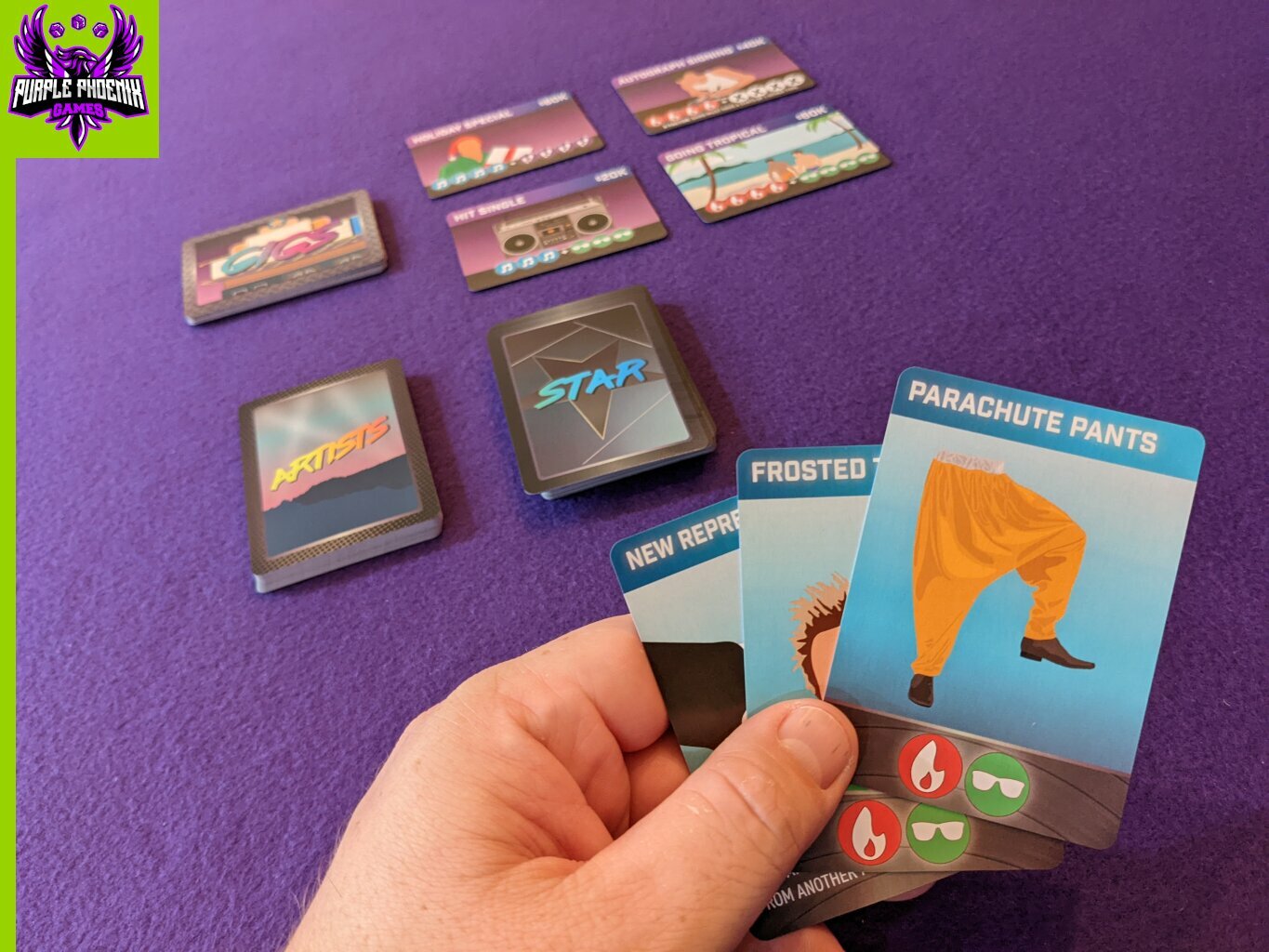
To setup, separate the cards by type and shuffle each stack independently. The Gigs deck is placed on the table with four Gigs displayed from the top of the deck. The Artists and Star decks are placed on the table and each player is dealt three Star cards to start the game. It is now setup and managers are ready to build bands… of boys!
BBB is played over a series of rounds, where each player will take two actions each turn. These actions are Audition, Draw Star Cards, Play a Star Card, and Do a Gig. When a manager Auditions boys for the band, they draw the top three Artist cards, choose one to add to their band, and then discard the rest to the bottom of the deck. The cost to add the boy to the band is shown in the upper right hand corner and represents the number of Star cards to be discarded from hand. Artists are added to band (tableau) and ready to begin rehearsing. At least, I hope they are rehearsing.
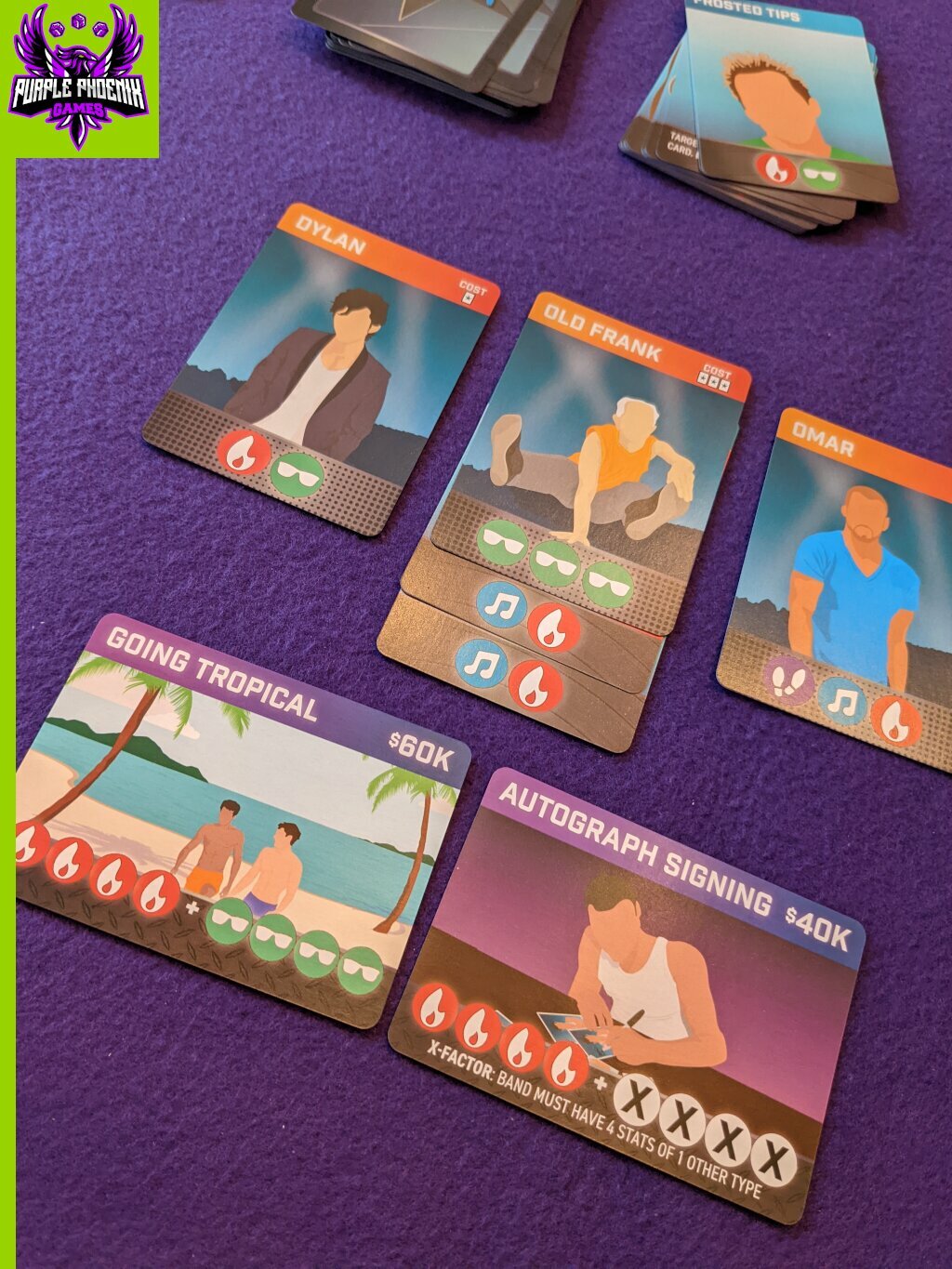
Additionally, the active manager may Draw Star Cards to increase their hand. Simply draw two Star cards from the top of the deck. Alternatively, the manager may choose to Play a Star Card for its stats by slipping the card under a boy to increase his level of Pipes, Moves, Heat, or Cool stats (check out the photo below where I went hard on buffing Old Frank).
Finally, if the boy band members currently possess the appropriate amount of stats, the manager may choose to Do a Gig. They choose one of the face-up Gigs cards, take it to their score pile (assuming they possess the correct type and number of stats), and then do a little dance to celebrate a completed Gig. To signify the end of their turn, the active manager draws a Star card and passes to the next player. The game ends once the appropriate number of Gigs have been completed by a manager, as detailed in the rules per number of players. The manager with the highest total of money earned from Gigs cards is the winner, and receives all the Grammy nominations afforded to them.
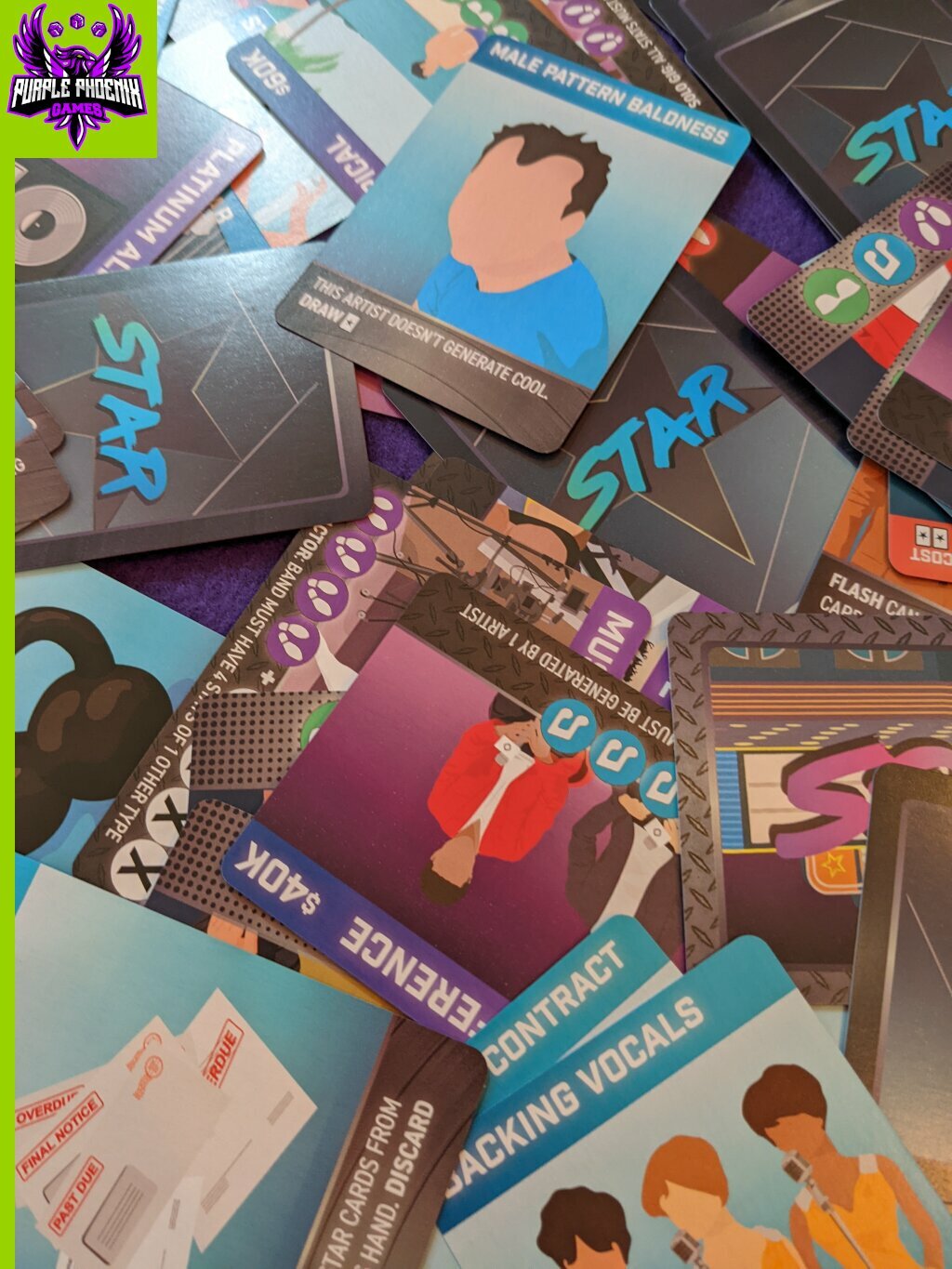
Components. This is a bunch of cards in a tuckbox. The cards are all fine, but the true hero here is the artwork. I cannot express how much I appreciate the decision to keep the art style modern, and the faces blank. I believe it is mostly due to the fact that all of us who were not in boy bands were all a bit jealous of those who were, but I will publicly state that my official opinion is because these boys don’t really need faces. Body language speaks volumes, and the art style reflects that extremely well. Mad props from me on the artwork.
The gameplay here is very intuitive, even though I had a couple questions that were not made clear in the rulebook. You need Star cards in order to buff Boys so they can do Gigs, and making sure that your band has all the right stats to complete the more profitable Gigs. I believe the game lasts an appropriate amount of time; it does NOT overstay its welcome, which is a huge thing for a filler game such as this. I do wish there were more off-the-wall characters like Old Frank and Lil’Hop, and I also wish the Star cards’ backgrounds were a little more interesting to look at, but the game ultimately looks good and plays well too. There are a few extra surprises to be found in the game that I will let our readers discover, including some Take That card that can hinder opponents.
Boy Band Builder can be super quick and competitive, or can be more leisurely and relaxed. This is a great thing for a cute little card game, and though the theme is something with which I am not at all enamored, a love for boy bands is not required to enjoy Boy Band Builder. I can see myself breaking this out with the right people, but I don’t necessarily foresee having this on stand-by for every game night. If you are in the market for a uniquely-themed card game you can chair dance while playing, then check out Boy Band Builder. It can be found on the Amazon store by clicking this link. Enjoy!
Boy Band Builder (BBB from here out) is a card drafting and band-building game for two to four players. In it, players are band managers tasked with creating the next big group of talented and attractive boys, with the winner of the game being they who earn the most money from assembling the best band and playing the most lucrative gigs.
DISCLAIMER: We were provided a copy of this game for the purposes of this review. This is a retail copy of the game, so what you see in these photos is exactly what would be received in your box. I do not intend to cover every single rule included in the rulebook, but will describe the overall game flow and major rule set so that our readers may get a sense of how the game plays. For more in depth rules, you may purchase a copy online or from your FLGS. -T
To setup, separate the cards by type and shuffle each stack independently. The Gigs deck is placed on the table with four Gigs displayed from the top of the deck. The Artists and Star decks are placed on the table and each player is dealt three Star cards to start the game. It is now setup and managers are ready to build bands… of boys!
BBB is played over a series of rounds, where each player will take two actions each turn. These actions are Audition, Draw Star Cards, Play a Star Card, and Do a Gig. When a manager Auditions boys for the band, they draw the top three Artist cards, choose one to add to their band, and then discard the rest to the bottom of the deck. The cost to add the boy to the band is shown in the upper right hand corner and represents the number of Star cards to be discarded from hand. Artists are added to band (tableau) and ready to begin rehearsing. At least, I hope they are rehearsing.
Additionally, the active manager may Draw Star Cards to increase their hand. Simply draw two Star cards from the top of the deck. Alternatively, the manager may choose to Play a Star Card for its stats by slipping the card under a boy to increase his level of Pipes, Moves, Heat, or Cool stats (check out the photo below where I went hard on buffing Old Frank).
Finally, if the boy band members currently possess the appropriate amount of stats, the manager may choose to Do a Gig. They choose one of the face-up Gigs cards, take it to their score pile (assuming they possess the correct type and number of stats), and then do a little dance to celebrate a completed Gig. To signify the end of their turn, the active manager draws a Star card and passes to the next player. The game ends once the appropriate number of Gigs have been completed by a manager, as detailed in the rules per number of players. The manager with the highest total of money earned from Gigs cards is the winner, and receives all the Grammy nominations afforded to them.
Components. This is a bunch of cards in a tuckbox. The cards are all fine, but the true hero here is the artwork. I cannot express how much I appreciate the decision to keep the art style modern, and the faces blank. I believe it is mostly due to the fact that all of us who were not in boy bands were all a bit jealous of those who were, but I will publicly state that my official opinion is because these boys don’t really need faces. Body language speaks volumes, and the art style reflects that extremely well. Mad props from me on the artwork.
The gameplay here is very intuitive, even though I had a couple questions that were not made clear in the rulebook. You need Star cards in order to buff Boys so they can do Gigs, and making sure that your band has all the right stats to complete the more profitable Gigs. I believe the game lasts an appropriate amount of time; it does NOT overstay its welcome, which is a huge thing for a filler game such as this. I do wish there were more off-the-wall characters like Old Frank and Lil’Hop, and I also wish the Star cards’ backgrounds were a little more interesting to look at, but the game ultimately looks good and plays well too. There are a few extra surprises to be found in the game that I will let our readers discover, including some Take That card that can hinder opponents.
Boy Band Builder can be super quick and competitive, or can be more leisurely and relaxed. This is a great thing for a cute little card game, and though the theme is something with which I am not at all enamored, a love for boy bands is not required to enjoy Boy Band Builder. I can see myself breaking this out with the right people, but I don’t necessarily foresee having this on stand-by for every game night. If you are in the market for a uniquely-themed card game you can chair dance while playing, then check out Boy Band Builder. It can be found on the Amazon store by clicking this link. Enjoy!


Kyera (8 KP) rated Empire of Storms in Books
Feb 1, 2018
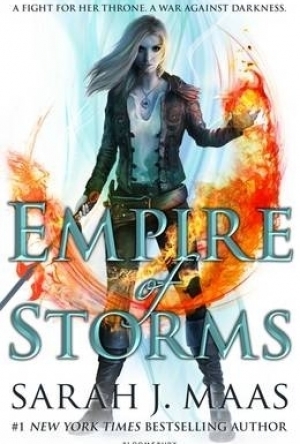


Re-Read Update:
This book destroyed me. I cheered when my baby, Abraxos, appeared (legitimately out loud cheered) and wanted to cry at those fateful words. If you've read this book, you know which ones I'm referring to and if not, I can't say because there would be spoilers. Despite the issues and shift in the characterization of some of our leads, this book takes you on an incredible emotional journey with highs that make you cheer (see above) and lows that bring you to tears (almost).
Despite the length of the book, I didn't feel as though the story lagged or the pacing was poor. Any free minute I had, I immediately turned to the book to continue where I left off. Even knowing what was going to happen, it managed to enthrall me.
One of the problems that I have with this book is its portrayal of relationships. There are aspects of it that are so swoon-worthy and make your heart hurt, but there are some that are not healthy. It's nice to see diverse portrayals of love and relationships, but my concern is that a young adult reader might see the territorial Fae nonsense in the book and not realize that it's an extreme. It might seem normalized. As I am not a teenager, I am aware of the intricacies and can roll my eyes at the "nonsense" without putting any weight on the idea. That may not be the same for teen readers.
There are aspects of the character development that seems off and others that, although regrettable, are completely valid. For example, Dorian has gone through an incredible amount of turmoil and emotional upheaval in the last two books. It's understandable that his personality would not quite be the same carefree, flirty scholar that we met in the first book who wished to stand up to his father but could never garner the courage to do so.
In a similar vein, we watch other characters develop into multi-faceted people and understand them more. Manon and Lysandra have become much more interesting characters as they were expanded upon, and at least for me have become some of my favourites. Despite the huge cast of fairly main characters, each is still given the time to shine and grow.
Finally, the world building continues in this book to an immense degree. A combination of the book's size and the various viewpoints has allowed Sarah J Maas to expand the world we have come to know. Erilea has been developed and we are able to see more pieces of Nehemia's homeland, Aelin's kingdom, and so much in between.
I still love this series and highly recommend it to young adult/teen readers who enjoy fantasy books.
Original Review:
These novels are so addicting, emotional and indescribable - but I'm going to try to do them justice. If you've not yet read up to Empire of Storms, please avoid this review as it has spoilers. I try to leave out the major plot points and just focus on the characters/world, but it's not free from them. Please read on only if you've read the series.
Our main cast of beloved and some tolerated, main/supporting characters grows throughout the series. Although we lose Nehemia, which I am still so sad about - we are introduced to the Fae. Their inclusion in the series brings the genre into high fantasy and makes it even more enjoyable. Prior to this series, I hadn't read many novels in which the supernatural creatures were the Fae but now I am obsessed. The world of the Fae isn't experienced or explained much, but I would love to see more of it. Their powers or abilities are so intriguing and well written. Just enough information is given that you can understand what is going on, then beautifully populate the world and battles in your mind.
Sarah J Maas makes you fall in love with each of the characters, whether you liked them when they were first introduced or not. One of the first perspective shifts we experience is when we are introduced to the bloodthirsty Manon Blackbeak. At first, you wish her scenes weren't there as they take away from time with our main characters but by the fifth novel she's one of the characters you're rooting for. Although she's a witch and over one hundred years old, she is given the ability to develop and change over the course of the novels. It takes time because she's learning that things she believed her entire life aren't true and don't need to affect how she views life.
Even characters that we were originally introduced to, like Lysandre are able to evolve and change over the course of the books. She and Celaena start off butting heads and competing, but that doesn't last. They join together and made a formidable pair (especially once magic is restored to the land). Lysandre grows into one of my favourite characters and her wholehearted commitment to the cause is inspiring.
Seeking more information about the Wyrdkeys, Celaena seeks knowledge from the Fae Queen Maeve. Unwilling to give her information away for nothing, Queen Maeve makes a deal that Celaena must train with and impress one of her trusted warriors, Rowan. Prince Rowan is able to manipulate ice and wind, whilst also transforming into a hawk. Her inner circle are sworn to her with a blood oath and a group of Fae warriors that include Rowan, Lorcan, Gavriel, Vaughen, Fenrys and Connall. Later on, this group is affectionately titled Rowan's cadre and some join our heroes on their journey.
Unsurprisingly, we discover that Celaena is actually the Princess (or Queen) of Terrasen and that revelation brings with it some people from her past. Her cousin, Aedion was forced for years to do the bidding of the King of Adarlan whilst secretly helping his people. He is a general and his legion of warriors called the Bane are loyal to him rather than the King. We also meet another person from Terrasen, the daughter of the woman who sacrificed herself to allow Aelin to escape as a child - Elide. She was mistreated by her Uncle for years, until Manon Blackbeak helped her escape. After only a few days, she crosses paths with Lorcan who is a member of Rowan's cadre and they begin to journey together.
Lorcan is not well liked by Rowan or Aelin when we first come across him in Rifthold. He is still bound to Queen Maeve and is seeking to find and destroy the Wyrdkeys. Throughout his journey across Erilea, he discovers that he has a soft spot for Elide and protects her. Some of the other cadre are viewed in a more favourable light by Aelin and her friends, as they attempt to delay their orders from Maeve to help on the quest.
Sarah J Maas writes the best pairings that fill your heart with so much feeling then she rips it out and stomps all over it. Rowan loves Aelin with his whole heart, every part, the good, the bad, the broken and beaten, the assassin, the Queen, the Fae and no one else has ever done that for her. Their love is true and enduring. Heartwrenching and pure. Even though they didn't start off on the best footing, after training her for a time and even breaking his blood oath to Maeve - Rowan is completely enamored. Plus, they're mates so there's nothing more important and bonding. Each relationship is authentic and pulls at your heartstrings.
Throughout the novels, you are able to experience more of the lands with Erilea from the dark, twisted towers of Morath to the Queen's home of Terrasen. They are welcome additions to our mental maps of the land and wonderfully illustrated through words.
This is one of my favourite series by far and is highly recommended to all - also specifically to young adult readers who enjoy well writen novels with developed characters, immersive world-building and fantasy.
This book destroyed me. I cheered when my baby, Abraxos, appeared (legitimately out loud cheered) and wanted to cry at those fateful words. If you've read this book, you know which ones I'm referring to and if not, I can't say because there would be spoilers. Despite the issues and shift in the characterization of some of our leads, this book takes you on an incredible emotional journey with highs that make you cheer (see above) and lows that bring you to tears (almost).
Despite the length of the book, I didn't feel as though the story lagged or the pacing was poor. Any free minute I had, I immediately turned to the book to continue where I left off. Even knowing what was going to happen, it managed to enthrall me.
One of the problems that I have with this book is its portrayal of relationships. There are aspects of it that are so swoon-worthy and make your heart hurt, but there are some that are not healthy. It's nice to see diverse portrayals of love and relationships, but my concern is that a young adult reader might see the territorial Fae nonsense in the book and not realize that it's an extreme. It might seem normalized. As I am not a teenager, I am aware of the intricacies and can roll my eyes at the "nonsense" without putting any weight on the idea. That may not be the same for teen readers.
There are aspects of the character development that seems off and others that, although regrettable, are completely valid. For example, Dorian has gone through an incredible amount of turmoil and emotional upheaval in the last two books. It's understandable that his personality would not quite be the same carefree, flirty scholar that we met in the first book who wished to stand up to his father but could never garner the courage to do so.
In a similar vein, we watch other characters develop into multi-faceted people and understand them more. Manon and Lysandra have become much more interesting characters as they were expanded upon, and at least for me have become some of my favourites. Despite the huge cast of fairly main characters, each is still given the time to shine and grow.
Finally, the world building continues in this book to an immense degree. A combination of the book's size and the various viewpoints has allowed Sarah J Maas to expand the world we have come to know. Erilea has been developed and we are able to see more pieces of Nehemia's homeland, Aelin's kingdom, and so much in between.
I still love this series and highly recommend it to young adult/teen readers who enjoy fantasy books.
Original Review:
These novels are so addicting, emotional and indescribable - but I'm going to try to do them justice. If you've not yet read up to Empire of Storms, please avoid this review as it has spoilers. I try to leave out the major plot points and just focus on the characters/world, but it's not free from them. Please read on only if you've read the series.
Our main cast of beloved and some tolerated, main/supporting characters grows throughout the series. Although we lose Nehemia, which I am still so sad about - we are introduced to the Fae. Their inclusion in the series brings the genre into high fantasy and makes it even more enjoyable. Prior to this series, I hadn't read many novels in which the supernatural creatures were the Fae but now I am obsessed. The world of the Fae isn't experienced or explained much, but I would love to see more of it. Their powers or abilities are so intriguing and well written. Just enough information is given that you can understand what is going on, then beautifully populate the world and battles in your mind.
Sarah J Maas makes you fall in love with each of the characters, whether you liked them when they were first introduced or not. One of the first perspective shifts we experience is when we are introduced to the bloodthirsty Manon Blackbeak. At first, you wish her scenes weren't there as they take away from time with our main characters but by the fifth novel she's one of the characters you're rooting for. Although she's a witch and over one hundred years old, she is given the ability to develop and change over the course of the novels. It takes time because she's learning that things she believed her entire life aren't true and don't need to affect how she views life.
Even characters that we were originally introduced to, like Lysandre are able to evolve and change over the course of the books. She and Celaena start off butting heads and competing, but that doesn't last. They join together and made a formidable pair (especially once magic is restored to the land). Lysandre grows into one of my favourite characters and her wholehearted commitment to the cause is inspiring.
Seeking more information about the Wyrdkeys, Celaena seeks knowledge from the Fae Queen Maeve. Unwilling to give her information away for nothing, Queen Maeve makes a deal that Celaena must train with and impress one of her trusted warriors, Rowan. Prince Rowan is able to manipulate ice and wind, whilst also transforming into a hawk. Her inner circle are sworn to her with a blood oath and a group of Fae warriors that include Rowan, Lorcan, Gavriel, Vaughen, Fenrys and Connall. Later on, this group is affectionately titled Rowan's cadre and some join our heroes on their journey.
Unsurprisingly, we discover that Celaena is actually the Princess (or Queen) of Terrasen and that revelation brings with it some people from her past. Her cousin, Aedion was forced for years to do the bidding of the King of Adarlan whilst secretly helping his people. He is a general and his legion of warriors called the Bane are loyal to him rather than the King. We also meet another person from Terrasen, the daughter of the woman who sacrificed herself to allow Aelin to escape as a child - Elide. She was mistreated by her Uncle for years, until Manon Blackbeak helped her escape. After only a few days, she crosses paths with Lorcan who is a member of Rowan's cadre and they begin to journey together.
Lorcan is not well liked by Rowan or Aelin when we first come across him in Rifthold. He is still bound to Queen Maeve and is seeking to find and destroy the Wyrdkeys. Throughout his journey across Erilea, he discovers that he has a soft spot for Elide and protects her. Some of the other cadre are viewed in a more favourable light by Aelin and her friends, as they attempt to delay their orders from Maeve to help on the quest.
Sarah J Maas writes the best pairings that fill your heart with so much feeling then she rips it out and stomps all over it. Rowan loves Aelin with his whole heart, every part, the good, the bad, the broken and beaten, the assassin, the Queen, the Fae and no one else has ever done that for her. Their love is true and enduring. Heartwrenching and pure. Even though they didn't start off on the best footing, after training her for a time and even breaking his blood oath to Maeve - Rowan is completely enamored. Plus, they're mates so there's nothing more important and bonding. Each relationship is authentic and pulls at your heartstrings.
Throughout the novels, you are able to experience more of the lands with Erilea from the dark, twisted towers of Morath to the Queen's home of Terrasen. They are welcome additions to our mental maps of the land and wonderfully illustrated through words.
This is one of my favourite series by far and is highly recommended to all - also specifically to young adult readers who enjoy well writen novels with developed characters, immersive world-building and fantasy.
Purple Phoenix Games (2266 KP) rated Scooby-Doo: Escape from the Haunted Mansion in Tabletop Games
Dec 1, 2020
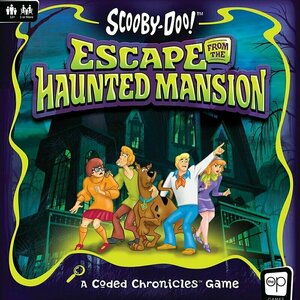

YES! A Scooby-Doo game! AND it’s an escape room style game? I am so fired up to play this! This was my line of thinking as I received this game in the mail. Scooby-Doo is one of my favorite cartoon shows from my youth, and name a better episode than the Harlem Globetrotters episode. I’ll wait. So with a winning design team of Jay Cormier and Sen-Foong Lim (of the excellent Belfort game) this should be a giant hit, right?
Like I mentioned, Scooby-Doo: Escape from the Haunted Mansion is an escape room style board game with the tag of, “A Coded Chronicles Game.” This is a series of similar style games coming to us from the publisher using different IPs. This review will be lots different than our others because I do not wish to provide any spoilers, so I am eliminating my typical “messy components” shot at the end. I have also smudged the entire second photo so as not to give away anything. On to the review.
DISCLAIMER: We were provided a copy of this game for the purposes of this review. This is a retail copy of the game, so what you see in these photos is exactly what would be received in your box. I do not intend to cover every single rule included in the rulebook, but will describe the overall game flow and major rule set so that our readers may get a sense of how the game plays. For more in depth rules, you may purchase a copy online or from your FLGS. -T
To setup, read the rulebook, and turn to the proper paragraph number in the starting booklet. Each Mystery, Inc. character (“the gang”) has their own booklet with paragraphs and instructions inside. If you have ever played a game like Tales of the Arabian Nights you will know the style. The entry in the booklet will instruct players how to setup the first map tile and set the stage for the plot of the game.
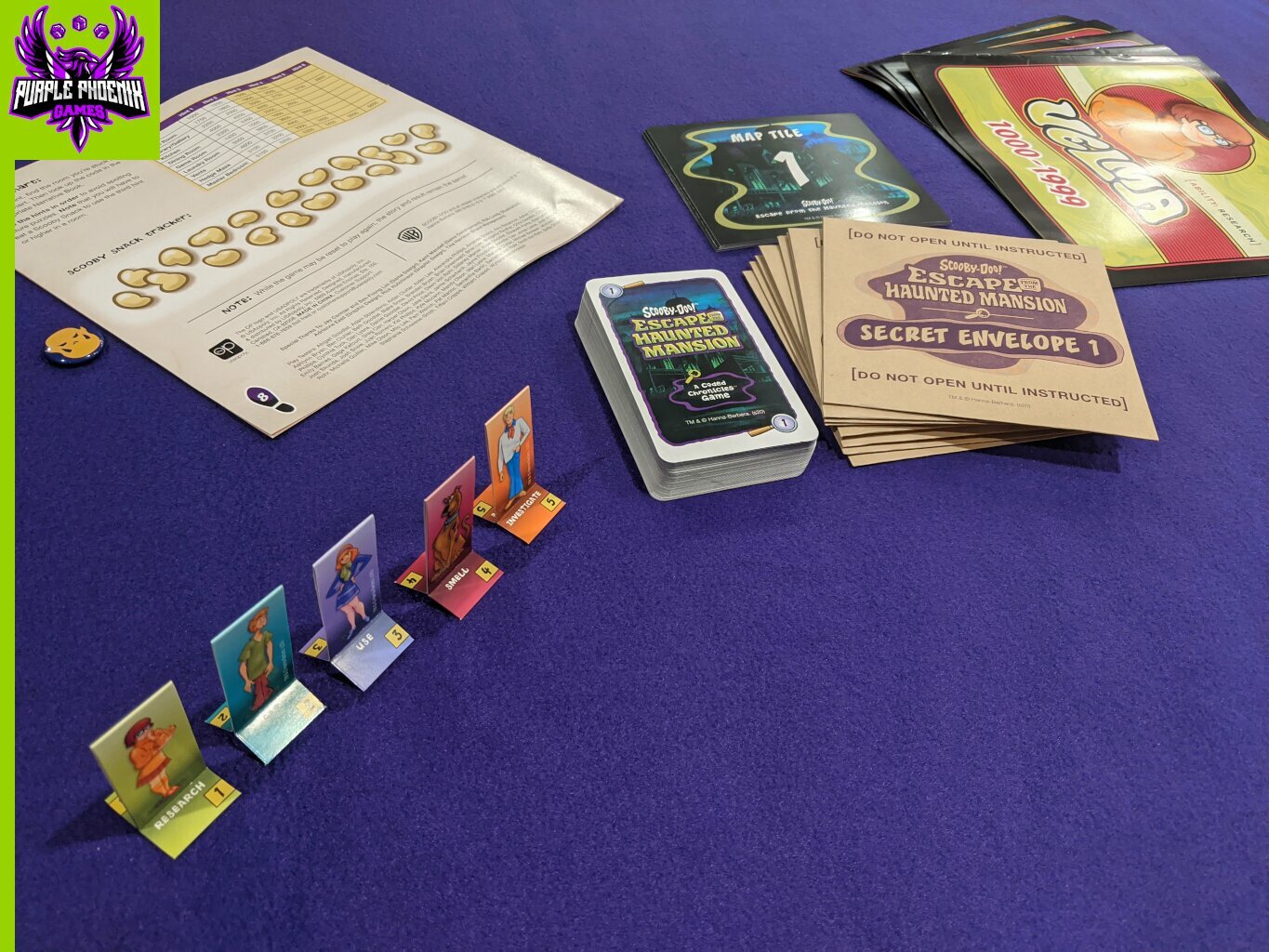
This game features gameplay with no “turns,” so any person may choose to control a character from the gang and have them take some action. The possible actions that can be taken by the gang are: Velma may Research something, Shaggy can Eat stuff, Daphne Uses things, Scoob Smells, and Fred Investigates. Each character is assigned a single-digit number to be combined with items on the map tiles to arrive at a four-digit paragraph number. Find the number in the respective booklet and read aloud to the rest of the players. If successful, more map tiles may be added, or other things (being vague on purpose).
Should the entry not exist or instruct you to otherwise, players will need to “eat a Scooby Snack” by crossing off or reducing the total number of Snacks each time. We used another publisher’s pin to move along the track at the end of the rulebook because I didn’t feel like finding a coin.
As players progress through the game they will be presented with several challenges to figure out together. Half way through the game is a break time between Chapters 1 & 2. We were able to play this game over two nights utilizing the break.
At the end of Chapter 2 the game ends. If the players can successfully solve the case, they win! Alternately, if playing with academics, the rulebook provides a scale of VPs corresponding to the number of Scooby Snacks remaining. Whichever end-game method is chosen, the game is over and can be passed along to another household or gamer friend. That’s right, this is a one-shot escape room game. Only cheaters would go through it a second time…
Components. I cannot speak about many of the components, but I will evaluate what you see in the above photo. The rulebook and subsequent character booklets are all fine, but are curved as a result of how they sit in the box. The box itself is a strange design that you do not see with many board games. It’s not at all bad, just different. The cards are good, the map tiles are thin cardstock, and I can’t really discuss the Secret Envelopes. My biggest gripe about the game is the character standees. They are a long strip of thin stock that is folded in half, then the ends flared to make an inverted T shape. I mean, it’s fine, but this game could have done with a plastic stand for a sturdier standee to fit inside, or even basic miniatures. These standees that are included fall over all the time and when touched, even a little, flop on the table like a “professional” soccer player.
The gameplay, however, is very cool and I enjoyed my playthrough quite a bit. I very much enjoy one-shot games and despise when they ask you to destroy different components. No thanks, says me. Luckily, Scooby-Doo is able to be reset and given or sold to another person. I like that.
I also really enjoyed exploring the Haunted Mansion and trying to outwit the different challenges the game presented. This is not a particularly super difficult game to master, but will certainly give players a couple of fun hours of play with a group of animated childhood friends. For the nostalgia alone I would suggest this one, but there is also a pretty darn good game here. I have zero experience with the other Coded Chronicles Game from The Op (using The Shining), so I don’t know if I would enjoy it or not, but I loved Scooby-Doo and I adored my time with him. Purple Phoenix Games gives this one a meddling 12 / 18. If you are looking for a game you can circulate through your gamer friend network and enjoy the theme, then check out Scooby-Doo: Escape from the Haunted Mansion. It is cute, fun, and gives the ol’ noggin a workout. Also, privately message or email me and let me know if you figured out the correct ending. I did not.
Like I mentioned, Scooby-Doo: Escape from the Haunted Mansion is an escape room style board game with the tag of, “A Coded Chronicles Game.” This is a series of similar style games coming to us from the publisher using different IPs. This review will be lots different than our others because I do not wish to provide any spoilers, so I am eliminating my typical “messy components” shot at the end. I have also smudged the entire second photo so as not to give away anything. On to the review.
DISCLAIMER: We were provided a copy of this game for the purposes of this review. This is a retail copy of the game, so what you see in these photos is exactly what would be received in your box. I do not intend to cover every single rule included in the rulebook, but will describe the overall game flow and major rule set so that our readers may get a sense of how the game plays. For more in depth rules, you may purchase a copy online or from your FLGS. -T
To setup, read the rulebook, and turn to the proper paragraph number in the starting booklet. Each Mystery, Inc. character (“the gang”) has their own booklet with paragraphs and instructions inside. If you have ever played a game like Tales of the Arabian Nights you will know the style. The entry in the booklet will instruct players how to setup the first map tile and set the stage for the plot of the game.
This game features gameplay with no “turns,” so any person may choose to control a character from the gang and have them take some action. The possible actions that can be taken by the gang are: Velma may Research something, Shaggy can Eat stuff, Daphne Uses things, Scoob Smells, and Fred Investigates. Each character is assigned a single-digit number to be combined with items on the map tiles to arrive at a four-digit paragraph number. Find the number in the respective booklet and read aloud to the rest of the players. If successful, more map tiles may be added, or other things (being vague on purpose).
Should the entry not exist or instruct you to otherwise, players will need to “eat a Scooby Snack” by crossing off or reducing the total number of Snacks each time. We used another publisher’s pin to move along the track at the end of the rulebook because I didn’t feel like finding a coin.
As players progress through the game they will be presented with several challenges to figure out together. Half way through the game is a break time between Chapters 1 & 2. We were able to play this game over two nights utilizing the break.
At the end of Chapter 2 the game ends. If the players can successfully solve the case, they win! Alternately, if playing with academics, the rulebook provides a scale of VPs corresponding to the number of Scooby Snacks remaining. Whichever end-game method is chosen, the game is over and can be passed along to another household or gamer friend. That’s right, this is a one-shot escape room game. Only cheaters would go through it a second time…
Components. I cannot speak about many of the components, but I will evaluate what you see in the above photo. The rulebook and subsequent character booklets are all fine, but are curved as a result of how they sit in the box. The box itself is a strange design that you do not see with many board games. It’s not at all bad, just different. The cards are good, the map tiles are thin cardstock, and I can’t really discuss the Secret Envelopes. My biggest gripe about the game is the character standees. They are a long strip of thin stock that is folded in half, then the ends flared to make an inverted T shape. I mean, it’s fine, but this game could have done with a plastic stand for a sturdier standee to fit inside, or even basic miniatures. These standees that are included fall over all the time and when touched, even a little, flop on the table like a “professional” soccer player.
The gameplay, however, is very cool and I enjoyed my playthrough quite a bit. I very much enjoy one-shot games and despise when they ask you to destroy different components. No thanks, says me. Luckily, Scooby-Doo is able to be reset and given or sold to another person. I like that.
I also really enjoyed exploring the Haunted Mansion and trying to outwit the different challenges the game presented. This is not a particularly super difficult game to master, but will certainly give players a couple of fun hours of play with a group of animated childhood friends. For the nostalgia alone I would suggest this one, but there is also a pretty darn good game here. I have zero experience with the other Coded Chronicles Game from The Op (using The Shining), so I don’t know if I would enjoy it or not, but I loved Scooby-Doo and I adored my time with him. Purple Phoenix Games gives this one a meddling 12 / 18. If you are looking for a game you can circulate through your gamer friend network and enjoy the theme, then check out Scooby-Doo: Escape from the Haunted Mansion. It is cute, fun, and gives the ol’ noggin a workout. Also, privately message or email me and let me know if you figured out the correct ending. I did not.


Daniel Boyd (1066 KP) rated X-Men: Apocalypse (2016) in Movies
Jul 19, 2017 (Updated Apr 16, 2021)

80's setting (2 more)
Quicksilver
Oscar Isaacs
Mutants Have Mankind Divided
This movie has had the most mixed reaction that I have seen since Batman V Superman, however I do objectively believe that X Men is a better movie and to be honest I don’t understand the mixed response Apocalypse has gotten. The year is 1983, 10 years after the last x men movie, Days Of Future Past (as in the kind of 10 years where no one ages a day,) and we know that it is 1983 because some of the young mutants go and see Return Of The Jedi in the cinema. The hairstyles and fashion statements are suitably 80’s, which is an appropriate motif to choose as it adds a more comic book feel to the movie and forces it to stick to a brighter colour pallet than some of the previous X men outings. Another positive is the return of Quicksilver, who has another awesome slow motion scene, which possibly isn’t as well choreographed as the one in DOFP, but is definitely grander in scale. While the design of Apocalypse in this movie has been heavily criticised, I didn’t feel that it took me out of the movie and I felt that Oscar Isaacs’ portrayal of the ancient mutant is another great turn by the actor and proves yet again how diverse and chameleon like he really is. The one downside of his character is that he has been significantly nerfed in terms of his powers here. He does feel powerful, but never overwhelmingly so and when the final confrontation does take place, it feels like he is holding back. This could be explained in a contrived manner by saying that he doesn’t want to kill mutants, because they are all his children, but if the success of his plan depends on it then he shouldn’t even hesitate, he should just wipe all the X Men out in an instant like we know he can.
The tone is another issue I have with the movie, it is fairly inconsistent throughout and never reaches the level of threat that it is aiming for. However, this is through no fault of the cast or the performances. MacAvoy and Fassbender stand out here as you would expect, their relationship also remains one of the most interesting parts of the plot. Isaacs’ performance is also suitably threatening and sinister, the only thing lacking in his character other than the odd design choice, is how short he is next to the other mutants. He doesn’t have to be huge like in the comics and cartoons, but making him a little bit more physically imposing with clever camera tricks would have went a long way in adding to the character. Jennifer Lawrence is fine here as usual and young Cyclops and Jean Grey are perfectly serviceable, although Sophie Turner’s American accent does come and go in certain scenes. Even Peters is typically brilliant as Quicksilver and the actress who plays Storm here is also pretty convincing, as is the young English actor who plays Angel. Nightcrawler is a welcome addition to the roster as I feel that he has been criminally underused since the second X Men movie and his power set is definitely one of the most interesting in all of the X Men movies, also the actor playing him here does a good job throughout the film. However the same can’t be said for Olivia Munn who plays Psylocke in this movie, I have disliked this actress in every role I have seen her in to date and the same goes for this one, she brings nothing to the movie and she constantly has a resting bitch face that suggests she doesn’t want to be there.
Like Civil War, X Men wasn’t anything like the comic it was based on and we didn’t get what we expected, but what we did end up getting was fresh and entertaining in it’s own right, so it’s okay that the film plots aren’t 100% faithful to the source material and that is something that Singer has been preaching since he made the first X Men movie back in 2001, which incidentally wasn’t based on any comic book and was a totally original plot. Also I love how because of the alternate timeline they are now free to do whatever they want in terms of the timing of certain events. For example, (and this is a slight spoiler, but the movie has been out for a while now so deal with it,) the Phoenix Force makes an appearance in this movie, which typically isn’t something that Jean Grey acquires until later in her life. Also the fact that we saw Wolverine escaping from Weapon X again, (again spoilers but this was in the trailers anyway so again, deal with it,) was awesome and this time we saw him being broken out by the young X Men and this time he had the comic book accurate electric headgear on while he escaped and I also loved how we saw him interact with young Jean Grey and regain some of his memories. This could also could be a change in the timeline caused by the butterfly effect as a result of the events of Days Of Future Past. This would also explain why the Magneto/Quicksilver, father/son relationship has never been discussed before, because if Apocalypse never awakened in the original X Men trilogy, then Quicksilver would have never went to the X Men mansion and therefore wouldn’t have come into contact with his dad during the final battle scene. Also Mystique looks like she is now a member and potential leader of the X Men team, rather than an enemy of the team like she was in the original movies when she was played by Rebecca Romjin. The other big change in the timeline is the death of Magneto’s family and even the fact that he had a wife and another child besides Quicksilver and Scarlett Witch.
Overall I really enjoyed this movie, however I can also see why some people would take a disliking to it, as it does require a good amount of previous knowledge of the universe, but as an X Men fan, I loved it. Also another criticism I have read is that people aren’t happy with the length of the film, stating that it is too long and it drags in, but I actually thought the pacing was spot on. Anyway as an X Men fan, I loved my time would this movie and I look forward to seeing it again and I’d recommend it to anyone who is a mutant superhero fan.
The tone is another issue I have with the movie, it is fairly inconsistent throughout and never reaches the level of threat that it is aiming for. However, this is through no fault of the cast or the performances. MacAvoy and Fassbender stand out here as you would expect, their relationship also remains one of the most interesting parts of the plot. Isaacs’ performance is also suitably threatening and sinister, the only thing lacking in his character other than the odd design choice, is how short he is next to the other mutants. He doesn’t have to be huge like in the comics and cartoons, but making him a little bit more physically imposing with clever camera tricks would have went a long way in adding to the character. Jennifer Lawrence is fine here as usual and young Cyclops and Jean Grey are perfectly serviceable, although Sophie Turner’s American accent does come and go in certain scenes. Even Peters is typically brilliant as Quicksilver and the actress who plays Storm here is also pretty convincing, as is the young English actor who plays Angel. Nightcrawler is a welcome addition to the roster as I feel that he has been criminally underused since the second X Men movie and his power set is definitely one of the most interesting in all of the X Men movies, also the actor playing him here does a good job throughout the film. However the same can’t be said for Olivia Munn who plays Psylocke in this movie, I have disliked this actress in every role I have seen her in to date and the same goes for this one, she brings nothing to the movie and she constantly has a resting bitch face that suggests she doesn’t want to be there.
Like Civil War, X Men wasn’t anything like the comic it was based on and we didn’t get what we expected, but what we did end up getting was fresh and entertaining in it’s own right, so it’s okay that the film plots aren’t 100% faithful to the source material and that is something that Singer has been preaching since he made the first X Men movie back in 2001, which incidentally wasn’t based on any comic book and was a totally original plot. Also I love how because of the alternate timeline they are now free to do whatever they want in terms of the timing of certain events. For example, (and this is a slight spoiler, but the movie has been out for a while now so deal with it,) the Phoenix Force makes an appearance in this movie, which typically isn’t something that Jean Grey acquires until later in her life. Also the fact that we saw Wolverine escaping from Weapon X again, (again spoilers but this was in the trailers anyway so again, deal with it,) was awesome and this time we saw him being broken out by the young X Men and this time he had the comic book accurate electric headgear on while he escaped and I also loved how we saw him interact with young Jean Grey and regain some of his memories. This could also could be a change in the timeline caused by the butterfly effect as a result of the events of Days Of Future Past. This would also explain why the Magneto/Quicksilver, father/son relationship has never been discussed before, because if Apocalypse never awakened in the original X Men trilogy, then Quicksilver would have never went to the X Men mansion and therefore wouldn’t have come into contact with his dad during the final battle scene. Also Mystique looks like she is now a member and potential leader of the X Men team, rather than an enemy of the team like she was in the original movies when she was played by Rebecca Romjin. The other big change in the timeline is the death of Magneto’s family and even the fact that he had a wife and another child besides Quicksilver and Scarlett Witch.
Overall I really enjoyed this movie, however I can also see why some people would take a disliking to it, as it does require a good amount of previous knowledge of the universe, but as an X Men fan, I loved it. Also another criticism I have read is that people aren’t happy with the length of the film, stating that it is too long and it drags in, but I actually thought the pacing was spot on. Anyway as an X Men fan, I loved my time would this movie and I look forward to seeing it again and I’d recommend it to anyone who is a mutant superhero fan.
Mandy and G.D. Burkhead (26 KP) rated Kushiel's Dart (Phèdre's Trilogy, #1) in Books
May 20, 2018
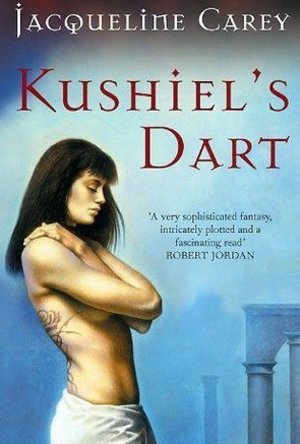

Shelf Life – Kushiel’s Legacy, the Naamah Trilogy, and How Jacqueline Carey Ruined My Ability to Be Impartial About Them
Contains spoilers, click to show
I can honestly say that the nine books that comprise these three trilogies are among the best fantasy available today as well as nine of my all-time favorite books I’ve ever read.
The Spoiler-Free Overview
If you want the shorter, less spoilery answer for what I think of these books: holy crap, yes, they’re as good as everyone says they are. Jacqueline Carey has a way of making me just…feel stuff like no other author can. Plenty of books have caught and held my interest enough that I didn’t want to put them down, but few have made the act of putting them down anyway so torturous. More than once, I hit a point in these stories where I had to drop whatever else I was gonna do that day (that I could realistically drop) just because I had to keep reading to make sure the characters were going to be okay.
This is character-driven fiction at its finest, with people in the pages who come alive and subtly win your heart. More than once, I’ve found reading about their ordeals to be worrying, a little bit painful, and a little bit infuriating (all in a good way, though), and I had to stop and remind myself that these weren’t real people that I was so concerned over and angry for. So if you ever wanted to be really, really invested in the story you’re reading and the people in it, Terre d’Ange is the place to go. All of the eroticism that everyone talks about is just a really nice bonus.
If you want an even shorter answer: do you watch Game of Thrones? Have you read George R.R. Martin’s A Song of Ice and Fire books? Have you at least heard of the fan hype around these stories? The Kushiel and Naamah books are like that, except sexier and with deeper court intrigue. And a lot less incest.
If you want the long answer…
A Dizzying Amount of Adventure Mileage
One thing that has to be said for Kushiel’s Legacy and the Naamah trilogy is that you definitely get your money’s worth of story out of each book. There’s a pattern that I’ve noticed with each of them, which is that you’ll follow the heroine/hero through a massive tribulation, see them endure their hardships and take their small victories where they can, then finally watch matters come to a crux, a climax, and a satisfying resolution…only to realize that you’re only a third of the way through the full page count.
Where most books are content to have one major conflict, Carey packs hers with about three each. The best part is that they’re not laid out in rigid sequence like a series of video game side quests – fight this problem, win, check it off the list, leave it behind and find a new one to fill the word count. No, each new adventure in the same book arises completely organically from the story overall. It makes you realize just how huge a scope these characters’ destinies really are, and just how incredibly wearying it can be and how much seemingly inhuman endurance it takes to be one of the gods’ chosen.
For instance, the first book to kick everything off, Kushiel’s Dart, begins slowly and simply enough. Phedre is an unwanted child who is basically sold into indentured servitude, then trained to be a spy and courtesan while we’re introduced to Terre d’Ange through her eyes over the next couple hundred pages, learning more about the politics and the players in time to watch the drama around them steadily unfold and escalate.
And then her wise mentor gets killed (as wise mentors tend to do), she and her bodyguard companion are betrayed, and the both of them get sold into full-on slavery to the vikings of Skaldia. Plenty of conflict and hardship and planning later, they make their escape and flee into harsh, snowy mountain terrain, falling in love for good measure while they fend off the deadly cold and the pursuit from their enemies. Finally, they make it back to their homeland and clear their names.
This is where most books would be content to stop and maybe leave further contentions for a sequel. Kushiel’s Dart would have been well within its rights to do so as well, and I wouldn’t have complained if it did. But no, it reminds readers, we’re not done yet. There’s a war coming, remember? We talked about this. Catch your breath for a moment, but then we gotta go rally our armies.
So Phedre and Joscelin set off to the wild and secluded island nation of Alba on the other side of an enchanted strait, a body of water where a vengeful, divine power known as the Master of the Straits lives and for some reason prevents almost all contact between the two nations. Arriving safely enough, they find that Alba is also war-torn at the moment, and the armies they had hoped to rally are busy defending their land from another foe. More plotting and intrigue ensues, alliances and promises are made, and with our heroes’ help, the two sides clash in a decisive battle that gains the side we’re rooting for victory as well as gives them their rightful sovereignty back. Now Phedre has the army she needs. After a sudden and unexpected stop at the Master of the Straits’ island, where they learn the secret of his power and guarantee indefinite safe passage between the nations in return for Phedre losing her closest friend, our heroes finally make it back to their homeland again with their army in tow.
Finally! After all of that struggle, we get a happy ending after all. But wait, not yet you don’t, the chunk of pages left at the end remind you. All you did was get your forces together. Good for you. Now you still gotta go actually fight the war with the Skaldi invaders to determine the fate of your entire nation.
So they do. And only after an awesome last-stand battle (the excitement and careful strategy of which will take you completely by surprise if you first entered this book expecting little more than kinky sex scenes) is the story allowed to wrap up in earnest, our heroes finally earning their long-deserved rest. The dangerous and cunning warlord is defeated, the invading army has been pushed back, the new Queen has ascended the throne, Terre d’Ange has been saved, and Phedre and Joscelin are free to finally be together – with the only little niggle being that the real mastermind behind all of their problems is still loose and taunting them. But we can get to that in the next book. Or five.
The Spoiler-Free Overview
If you want the shorter, less spoilery answer for what I think of these books: holy crap, yes, they’re as good as everyone says they are. Jacqueline Carey has a way of making me just…feel stuff like no other author can. Plenty of books have caught and held my interest enough that I didn’t want to put them down, but few have made the act of putting them down anyway so torturous. More than once, I hit a point in these stories where I had to drop whatever else I was gonna do that day (that I could realistically drop) just because I had to keep reading to make sure the characters were going to be okay.
This is character-driven fiction at its finest, with people in the pages who come alive and subtly win your heart. More than once, I’ve found reading about their ordeals to be worrying, a little bit painful, and a little bit infuriating (all in a good way, though), and I had to stop and remind myself that these weren’t real people that I was so concerned over and angry for. So if you ever wanted to be really, really invested in the story you’re reading and the people in it, Terre d’Ange is the place to go. All of the eroticism that everyone talks about is just a really nice bonus.
If you want an even shorter answer: do you watch Game of Thrones? Have you read George R.R. Martin’s A Song of Ice and Fire books? Have you at least heard of the fan hype around these stories? The Kushiel and Naamah books are like that, except sexier and with deeper court intrigue. And a lot less incest.
If you want the long answer…
A Dizzying Amount of Adventure Mileage
One thing that has to be said for Kushiel’s Legacy and the Naamah trilogy is that you definitely get your money’s worth of story out of each book. There’s a pattern that I’ve noticed with each of them, which is that you’ll follow the heroine/hero through a massive tribulation, see them endure their hardships and take their small victories where they can, then finally watch matters come to a crux, a climax, and a satisfying resolution…only to realize that you’re only a third of the way through the full page count.
Where most books are content to have one major conflict, Carey packs hers with about three each. The best part is that they’re not laid out in rigid sequence like a series of video game side quests – fight this problem, win, check it off the list, leave it behind and find a new one to fill the word count. No, each new adventure in the same book arises completely organically from the story overall. It makes you realize just how huge a scope these characters’ destinies really are, and just how incredibly wearying it can be and how much seemingly inhuman endurance it takes to be one of the gods’ chosen.
For instance, the first book to kick everything off, Kushiel’s Dart, begins slowly and simply enough. Phedre is an unwanted child who is basically sold into indentured servitude, then trained to be a spy and courtesan while we’re introduced to Terre d’Ange through her eyes over the next couple hundred pages, learning more about the politics and the players in time to watch the drama around them steadily unfold and escalate.
And then her wise mentor gets killed (as wise mentors tend to do), she and her bodyguard companion are betrayed, and the both of them get sold into full-on slavery to the vikings of Skaldia. Plenty of conflict and hardship and planning later, they make their escape and flee into harsh, snowy mountain terrain, falling in love for good measure while they fend off the deadly cold and the pursuit from their enemies. Finally, they make it back to their homeland and clear their names.
This is where most books would be content to stop and maybe leave further contentions for a sequel. Kushiel’s Dart would have been well within its rights to do so as well, and I wouldn’t have complained if it did. But no, it reminds readers, we’re not done yet. There’s a war coming, remember? We talked about this. Catch your breath for a moment, but then we gotta go rally our armies.
So Phedre and Joscelin set off to the wild and secluded island nation of Alba on the other side of an enchanted strait, a body of water where a vengeful, divine power known as the Master of the Straits lives and for some reason prevents almost all contact between the two nations. Arriving safely enough, they find that Alba is also war-torn at the moment, and the armies they had hoped to rally are busy defending their land from another foe. More plotting and intrigue ensues, alliances and promises are made, and with our heroes’ help, the two sides clash in a decisive battle that gains the side we’re rooting for victory as well as gives them their rightful sovereignty back. Now Phedre has the army she needs. After a sudden and unexpected stop at the Master of the Straits’ island, where they learn the secret of his power and guarantee indefinite safe passage between the nations in return for Phedre losing her closest friend, our heroes finally make it back to their homeland again with their army in tow.
Finally! After all of that struggle, we get a happy ending after all. But wait, not yet you don’t, the chunk of pages left at the end remind you. All you did was get your forces together. Good for you. Now you still gotta go actually fight the war with the Skaldi invaders to determine the fate of your entire nation.
So they do. And only after an awesome last-stand battle (the excitement and careful strategy of which will take you completely by surprise if you first entered this book expecting little more than kinky sex scenes) is the story allowed to wrap up in earnest, our heroes finally earning their long-deserved rest. The dangerous and cunning warlord is defeated, the invading army has been pushed back, the new Queen has ascended the throne, Terre d’Ange has been saved, and Phedre and Joscelin are free to finally be together – with the only little niggle being that the real mastermind behind all of their problems is still loose and taunting them. But we can get to that in the next book. Or five.

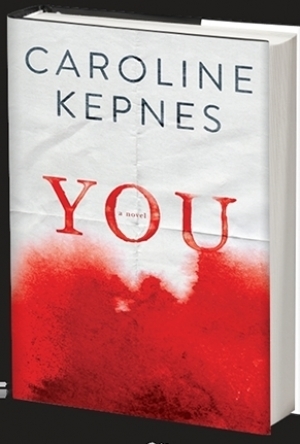
I first learned about you, Joe, when I sat one Sunday morning on Netflix and I could not keep my eyes off of the promo for this show about you fixating on a blonde woman. Naturally, I was intrigued and I had to learn about you, Joe, and how exactly you could see stalking as a way of getting close to someone and love them. I do wish you hadn't been a manager at a bookstore, Joe. I'm a booknerd, it was difficult to not like you, most of the time.
I watched your story and then I listened to your story. Joe, there are quite a few differences between the BookJoe and the NetflixJoe. Either way, Joe, I judge you harshly at each passing moment when you follow this girl, Guinevere Beck (can we just laugh at the irony that her name is Guinevere? If you haven't read King Author, you should) or stalk her using her old phone that she believed lost.
Just a little nit pick on my part, Netflix, Android and Apple DO NOT use the same cloud! They are ENTIRELY different companies with entirely different hardware. There was no way, NetflixJoe, that you could have seen the woman's emails or texts from an Android phone when she got a new phone that is an Apple. Rant over, now back to you, Joe.
BookJoe is more wordy and more story telling. Perhaps your warped mind may have believed Guinevere (Beck in both stories) might have flirted with you. This begs the question, what made her stand out from any other WOMAN who doesn't wear a bra (and don't state that you can't tell because you point that out about Beck every chance you got)? It couldn't have been the books she purchased as how you mentally made fun of the fact that she bought a certain book because the author was a relative of a celebrity.
I'll give you credit, NetflixJoe, while NetflixBeck was still a bit off with her procrastination and her obsessiveness with a crack head and drinking, she still grew some character and made for someone with potential. BookBeck, on the other hand, BookJoe, you really could have picked a much better person to stalk.
BookBeck is highly ditzy, a pushover, loves to drink (a lot!), and prefers casual encounters (which you found that out by going through her email) with other men, except you! She claims she wants to write, yet spends little if any time doing it, and while you do somewhat encourage her, it doesn't work. She just wants to say she wants to write, but not do it. And when she does write, and BookJoe you have stated this a little annoyance before, it's pure pornography.
BookJoe, I often pitied you because you are highly intelligent yet so stupid. BookBeck was all wrong for you and you spent all this time trying to make her right and doing it all the wrong way. Oh, Joe, you just couldn't take it. And you couldn't see it. So stupid, Joe.
Okay, as fun as that was, here's the remainder of the review without me talking to Joe. The show on Netflix was so hard to turn off because it was that intense. No, I DO NOT ship Beck and Joe. HE IS STILL A STALKER!! The show really showed that even the people who seem all nice and laid back CAN BE THE PERSON THAT IS DANGEROUS! The book does the same thing as well.
In the book, it's all told in Joe's point of view, and he could very well be not a very reliable narrator. All of it is told from what he sees and sometimes what he wishes he could see. At least on Netflix, though Joe narrates mostly, you're able to see the evidence instead of going off by his word. He also gives off of how delusional he really is when it comes to Beck. He makes himself BELIEVE that Beck is just suffering from daddy issues with all these men and he can help her and make her only want him.
The story itself was really well put together. The book will definitely not give you the shipping feels like Netflix seems to do for some people. Most of the time, I do just say out loud how stupid Joe really is and how he maybe he should move on. I wasn't lying when I said BookBeck was all those things. She really was. I actually did not like her character at all. To me, there wasn't much growth except for small things here and there, but for the most part, she just remained this person who had daddy issues and tried to do everything she could to NOT write. I'll give her credit for finding out about Joe and trying to figure out how to get away, but that's about it.
The show is a great watch cause the story is pretty good. If you want to see everything and not go by Joe, watch the show first. If you are curious as to how BookJoe started and became NetflixJoe, read this book first. Do you think he's a reliable narrator?
I have to point out the similarities with these characters that of King Arthur, however. I mentioned that earlier because Beck's first name is Guinevere. Think about it (if you've read King Arthur when you were in school).
Joe is Arthur - he manages a bookstore and reads. He fixates himself on a woman who apparently is so enchanting that he must have her no matter what.
Benji in retrospect is Merlin - He may be hooked on drugs and a total douche, but he WARNS Joe about Beck and that she is indeed crazy and not faithful. Joe does NOT listen.
Dr. Nicky is Lancelot - he is a therapist to both Joe and Beck (separately and without the other knowing) and he tries to guide Joe through his therapy, but in the end, he falls for Beck and they have an affair.
Beck IS GUINEVERE - Not at all the person she appears to be for Joe and winds up being entirely unfaithful and suffers for it.
**I haven't figured out Peach, but she's just crazy**
It is a two part series - I need a break from Joe before I think about reading the second book.
I watched your story and then I listened to your story. Joe, there are quite a few differences between the BookJoe and the NetflixJoe. Either way, Joe, I judge you harshly at each passing moment when you follow this girl, Guinevere Beck (can we just laugh at the irony that her name is Guinevere? If you haven't read King Author, you should) or stalk her using her old phone that she believed lost.
Just a little nit pick on my part, Netflix, Android and Apple DO NOT use the same cloud! They are ENTIRELY different companies with entirely different hardware. There was no way, NetflixJoe, that you could have seen the woman's emails or texts from an Android phone when she got a new phone that is an Apple. Rant over, now back to you, Joe.
BookJoe is more wordy and more story telling. Perhaps your warped mind may have believed Guinevere (Beck in both stories) might have flirted with you. This begs the question, what made her stand out from any other WOMAN who doesn't wear a bra (and don't state that you can't tell because you point that out about Beck every chance you got)? It couldn't have been the books she purchased as how you mentally made fun of the fact that she bought a certain book because the author was a relative of a celebrity.
I'll give you credit, NetflixJoe, while NetflixBeck was still a bit off with her procrastination and her obsessiveness with a crack head and drinking, she still grew some character and made for someone with potential. BookBeck, on the other hand, BookJoe, you really could have picked a much better person to stalk.
BookBeck is highly ditzy, a pushover, loves to drink (a lot!), and prefers casual encounters (which you found that out by going through her email) with other men, except you! She claims she wants to write, yet spends little if any time doing it, and while you do somewhat encourage her, it doesn't work. She just wants to say she wants to write, but not do it. And when she does write, and BookJoe you have stated this a little annoyance before, it's pure pornography.
BookJoe, I often pitied you because you are highly intelligent yet so stupid. BookBeck was all wrong for you and you spent all this time trying to make her right and doing it all the wrong way. Oh, Joe, you just couldn't take it. And you couldn't see it. So stupid, Joe.
Okay, as fun as that was, here's the remainder of the review without me talking to Joe. The show on Netflix was so hard to turn off because it was that intense. No, I DO NOT ship Beck and Joe. HE IS STILL A STALKER!! The show really showed that even the people who seem all nice and laid back CAN BE THE PERSON THAT IS DANGEROUS! The book does the same thing as well.
In the book, it's all told in Joe's point of view, and he could very well be not a very reliable narrator. All of it is told from what he sees and sometimes what he wishes he could see. At least on Netflix, though Joe narrates mostly, you're able to see the evidence instead of going off by his word. He also gives off of how delusional he really is when it comes to Beck. He makes himself BELIEVE that Beck is just suffering from daddy issues with all these men and he can help her and make her only want him.
The story itself was really well put together. The book will definitely not give you the shipping feels like Netflix seems to do for some people. Most of the time, I do just say out loud how stupid Joe really is and how he maybe he should move on. I wasn't lying when I said BookBeck was all those things. She really was. I actually did not like her character at all. To me, there wasn't much growth except for small things here and there, but for the most part, she just remained this person who had daddy issues and tried to do everything she could to NOT write. I'll give her credit for finding out about Joe and trying to figure out how to get away, but that's about it.
The show is a great watch cause the story is pretty good. If you want to see everything and not go by Joe, watch the show first. If you are curious as to how BookJoe started and became NetflixJoe, read this book first. Do you think he's a reliable narrator?
I have to point out the similarities with these characters that of King Arthur, however. I mentioned that earlier because Beck's first name is Guinevere. Think about it (if you've read King Arthur when you were in school).
Joe is Arthur - he manages a bookstore and reads. He fixates himself on a woman who apparently is so enchanting that he must have her no matter what.
Benji in retrospect is Merlin - He may be hooked on drugs and a total douche, but he WARNS Joe about Beck and that she is indeed crazy and not faithful. Joe does NOT listen.
Dr. Nicky is Lancelot - he is a therapist to both Joe and Beck (separately and without the other knowing) and he tries to guide Joe through his therapy, but in the end, he falls for Beck and they have an affair.
Beck IS GUINEVERE - Not at all the person she appears to be for Joe and winds up being entirely unfaithful and suffers for it.
**I haven't figured out Peach, but she's just crazy**
It is a two part series - I need a break from Joe before I think about reading the second book.

Mothergamer (1652 KP) rated the PlayStation 3 version of Nier in Video Games
Apr 3, 2019
To say that Nier is dark filled with loss of hope undertones is like saying fire is hot. However, when my friend Gary was showing me the game, I had to admit that the game play looked interesting and I was intrigued. When I found out that it was a thinly veiled sequel to one of the endings in Drakengard, I definitely wanted to play it and test it out. Gary being the awesome friend that he is, loaned me his copy of Nier so I could try it out. It does take me some time to go through a game sometimes due to my hectic schedule, so I apologize to my friends who have been asking if I'm ever going to put into words my thoughts on this particular RPG.
Nier starts off strongly with a great opening scene and brilliant musical score, featuring a shell of a city and harsh winter weather in the middle of summer. After the initial introductory scene you learn that the glories of humanity have disappeared and the few humans that remain struggle to survive in a medieval existence with the threat of shades and a disease known as Black Scrawl and Nier's daughter has it. Nier (the hero), has sworn that he will do anything at all costs to search for a cure.
The graphics are beautifully done right down to the cinematic cut scenes. There is a clear objective to the game and there are plenty of side quests even farming to flesh everything out. The battle system is user friendly and the items and spells menu are quite easy to navigate.You play as Nier and you find yourself caring about this character as the story progresses. There are other interesting characters along the way on this adventure such as Grimoire Weiss, an ancient talking book. That's just for starters. You meet the rest of the companions at different intervals and because of how well written their back stories are, you find yourself caring about them as well.
Now, I know what you're thinking. What's the deal with that first sentence in this little review? Well, let's get down to it shall we? Overall, the game is good with user friendly controls and a solid battle system. The soundtrack is beautiful and they chose wisely with this musical score. However, there are flaws here and there with Nier. So I'll list the pros and cons.
Pros:
The graphics, scenery, and cut scenes are amazing. They stand out and you remember every one.
The musical score is fantastic and well thought out throughout the game.
The character development and writing for the support characters is genius. When you can have your audience genuinely care about the characters in the story, that's pretty great writing.
Their battle system isn't too difficult and the menus are easy to navigate.
While you could hurry to the end of the game, there are many side quests and even a fishing mini-game as well as the option to do some of your own farming to give you a break from slashing all the baddies.
Impressive boss battles capture your interest especially when they throw spell casting cut scenes into the mix.
The story is original and keeps you guessing. You never know what to expect and just when you think you know something, they surprise you with a different event altogether.
Cons:
There are times in Nier, where the pacing could be a lot better. At some points in the story, it drags a little bit and you find yourself wishing they would get on with it so you can move along to the next area already.
It can be a real downer. There are times where everyone is happy and celebrating a victory, only to have something absolutely horrible happen. Half the time it seems like more tragedies happen than good times. Hey, I'm not asking that we all hug a Care Bear and have a lovely tea party, but they really cashed in on that whole emo kid phase.
All the doubling back. You will find yourself revisiting a dungeon or town six times or more for certain quests or plot lines in the story. After a bit of that, it gets a little old and you find yourself sighing with frustration. A lot.
The fetch quests. This ties into the doubling back. There are quite a few fetch quests, where you have to get a certain number of items for various npcs and return to get a reward. They tend to blur together after a while because they are so similar. You'll find yourself just giving up on that whole thing because it's tedious and boring.
BAD CAMERA ANGLES. With all the technology we have in this day and age, it still kills me when a game has not one, but several bad camera angles that happen consistently throughout the game play. There were angles where you couldn't turn the camera enough to get a jump properly, or it would spin wildly turning a corner and you'd find yourself wanting to upchuck your dinner when the wave of vertigo hit you.
A final boss battle with eight boss fights with multiple endings. This one comes last because it is the one that pissed me off the most. Not only do you have eight boss battles to fight, but there is no save point in between them. So if you lose, you get to go through all of that all over again. Top that off with four different endings that you can not get until you play through the whole game again and you'll find yourself wishing you could find the developer who thought this was a good idea and punch him square in the throat. SPOILER ALERT: You have to do the endings in a certain order, because one of the endings actually erases all your saved game data. No you did not misread that. That's actually true.
Now with all of that said, while I don't hate Nier, I don't really love it either. There is good and bad with it, but because of the pros I listed, the game manages to be enjoyable to play. It's definitely not like anything I've ever played before and the supporting cast works well with the main character story wise. It did its job of keeping me entertained and managed to tell an interesting story while doing so. So while it's not a spectacular take my breath away kind of game, it's still a decent game that you could enjoy playing through at least once.
Nier starts off strongly with a great opening scene and brilliant musical score, featuring a shell of a city and harsh winter weather in the middle of summer. After the initial introductory scene you learn that the glories of humanity have disappeared and the few humans that remain struggle to survive in a medieval existence with the threat of shades and a disease known as Black Scrawl and Nier's daughter has it. Nier (the hero), has sworn that he will do anything at all costs to search for a cure.
The graphics are beautifully done right down to the cinematic cut scenes. There is a clear objective to the game and there are plenty of side quests even farming to flesh everything out. The battle system is user friendly and the items and spells menu are quite easy to navigate.You play as Nier and you find yourself caring about this character as the story progresses. There are other interesting characters along the way on this adventure such as Grimoire Weiss, an ancient talking book. That's just for starters. You meet the rest of the companions at different intervals and because of how well written their back stories are, you find yourself caring about them as well.
Now, I know what you're thinking. What's the deal with that first sentence in this little review? Well, let's get down to it shall we? Overall, the game is good with user friendly controls and a solid battle system. The soundtrack is beautiful and they chose wisely with this musical score. However, there are flaws here and there with Nier. So I'll list the pros and cons.
Pros:
The graphics, scenery, and cut scenes are amazing. They stand out and you remember every one.
The musical score is fantastic and well thought out throughout the game.
The character development and writing for the support characters is genius. When you can have your audience genuinely care about the characters in the story, that's pretty great writing.
Their battle system isn't too difficult and the menus are easy to navigate.
While you could hurry to the end of the game, there are many side quests and even a fishing mini-game as well as the option to do some of your own farming to give you a break from slashing all the baddies.
Impressive boss battles capture your interest especially when they throw spell casting cut scenes into the mix.
The story is original and keeps you guessing. You never know what to expect and just when you think you know something, they surprise you with a different event altogether.
Cons:
There are times in Nier, where the pacing could be a lot better. At some points in the story, it drags a little bit and you find yourself wishing they would get on with it so you can move along to the next area already.
It can be a real downer. There are times where everyone is happy and celebrating a victory, only to have something absolutely horrible happen. Half the time it seems like more tragedies happen than good times. Hey, I'm not asking that we all hug a Care Bear and have a lovely tea party, but they really cashed in on that whole emo kid phase.
All the doubling back. You will find yourself revisiting a dungeon or town six times or more for certain quests or plot lines in the story. After a bit of that, it gets a little old and you find yourself sighing with frustration. A lot.
The fetch quests. This ties into the doubling back. There are quite a few fetch quests, where you have to get a certain number of items for various npcs and return to get a reward. They tend to blur together after a while because they are so similar. You'll find yourself just giving up on that whole thing because it's tedious and boring.
BAD CAMERA ANGLES. With all the technology we have in this day and age, it still kills me when a game has not one, but several bad camera angles that happen consistently throughout the game play. There were angles where you couldn't turn the camera enough to get a jump properly, or it would spin wildly turning a corner and you'd find yourself wanting to upchuck your dinner when the wave of vertigo hit you.
A final boss battle with eight boss fights with multiple endings. This one comes last because it is the one that pissed me off the most. Not only do you have eight boss battles to fight, but there is no save point in between them. So if you lose, you get to go through all of that all over again. Top that off with four different endings that you can not get until you play through the whole game again and you'll find yourself wishing you could find the developer who thought this was a good idea and punch him square in the throat. SPOILER ALERT: You have to do the endings in a certain order, because one of the endings actually erases all your saved game data. No you did not misread that. That's actually true.
Now with all of that said, while I don't hate Nier, I don't really love it either. There is good and bad with it, but because of the pros I listed, the game manages to be enjoyable to play. It's definitely not like anything I've ever played before and the supporting cast works well with the main character story wise. It did its job of keeping me entertained and managed to tell an interesting story while doing so. So while it's not a spectacular take my breath away kind of game, it's still a decent game that you could enjoy playing through at least once.

Movie Metropolis (309 KP) rated It: Chapter Two (2019) in Movies
Sep 13, 2019
Part of this post is sponsored by 4DX Cinemas. With poignancy and heart on its side, 2017’s IT managed to avoid its occasional flaws to become an unnerving addition to the horror genre. While the film could never be classed as outright terrifying, the character of Pennywise, portrayed exceptionally by Bill Skarsgard, is an unsettling antagonist and one of the best in film.
Two years later, the town of Derry is back on the big screen in Andy Muschietti’s epic conclusion. But at nearly 3 hours long, is IT: Chapter Two just a bloated mess, or does it float to new heights?
Defeated by members of the Losers’ Club, the evil clown Pennywise returns 27 years later to terrorise the town of Derry, Maine, once again. Now adults, the childhood friends have long since gone their separate ways. But when people start disappearing, Mike Hanlon (Isaiah Mustafa) calls the others home for one final stand. Damaged by scars from the past, the united Losers must conquer their deepest fears to destroy the shape-shifting Pennywise – who is now more powerful than ever.
The film follows many of the same tropes as its predecessor, with beautiful cinematography and excellent performances masking some shoddy CGI and an over-reliance on jump scares, and while it does lack the simplicity and tightly-wound script of its predecessor, IT: Chapter Two is even more unsettling.
For director Andy Muschietti, it’s clear that the training wheels are off. After being guided through the process by Warner Bros. first time around, the success of IT (it grossed over $700million worldwide) now means he’s been free to splash his creative vision all over the screen – and it shows. A deeply disconcerting opening involving two of Derry’s LGBT community and some town bigots lets the audience know early on that this is going to be even darker and much more graphic than its predecessor.
From a casting point of view, they couldn’t have done better. Each adult version of the Loser’s Club nicely embodies their child counterpart, even if we spend more time with some than others. James McAvoy is as reliable as ever and Jessica Chastain plays Beverly nicely but it’s in Bill Hader and James Ransome that we find the perfect embodiments of their juvenile characters.
Hader and Ransome share the same chemistry that made Eddie and Richie so watchable in the first instalment and there is even some well-judged poignancy to go with their playful teasing. The Chinese restaurant scene, a fan favourite from the book and the TV mini-series, is present and correct and remains a highlight over the course of the running time.
IT: Chapter Two is a confident finale to one of 2017’s best films; filled with exceptional performances
Praise must be given to the scriptwriters here as ensembles of this size can all too often get lost with little character development. Thankfully, each cast member feels fully fleshed out, meaning we care for them a lot more than your typical horror-movie character.
However, this is Bill Skarsgard’s film and Pennywise is as menacing as ever. Skarsgard turns up the ante here with his physical performance being absolutely incredible. This portrayal is Heath Ledger Joker levels of good. It would be a shame if he wasn’t recognised officially for the exceptional work he has done to bring this wretched character to life.
While much of the film sees the Loser’s Club separate from each other as they try to locate tokens from their pasts, this allows the production team to create some truly staggering set pieces – although it’s unfortunate that many of them have been spoilt in the trailers. The much-marketed house of mirrors scene is brief but leaves a lasting impression and there’s a sequence early on involving a small girl that was really troubling.
Unfortunately, it’s not all good news. While the pacing for such a long film is spot on, the appearances of our titular character are not. Despite being billed as appearing more often, the movie’s gargantuan length means that Pennywise doesn’t feel like he’s on screen for any longer than in the first instalment. With such a great character and performance, it would have been nice to see him a little more.
And while you’ll have noticed me using adjectives like ‘unsettling’ and ‘unnerving’, the film isn’t truly scary unless Pennywise in clown form is on the screen. That’s mainly down to some of the CGI used to create the monsters. As in its predecessor, IT: Chapter Two’s monsters feel too glossy, lacking in any true sense of realism.
Nevertheless, IT: Chapter Two is a confident finale to one of 2017’s best films; filled with exceptional performances and the wit and humour that made its predecessor such a hit. While not reaching quite the same dizzy heights as that film and relying even more on jump scares, as a pair, it’s hard to think of a horror series that has made its mark in the last decade quite as much as IT.
⭐⭐⭐⭐ IT: Chapter Two in 4DX
I was unsure how a horror film would translate to 4DX but the good news is that the experience became even more immersive, with sight, smell and feel all being utilised to great effect.
Soaring over Derry, the advanced seating that 4DX provides means that you feel like you’re flying over the town too. Of course, while this is a pleasant experience when the film is playing nicely, as soon as the horror hits, 4DX jolts you back to reality with some well-timed movement, strobe lighting and weather effects.
A nice touch in this film was the use of smell, something not utilised in Hobbs & Shaw. Every time Pennywise was about to appear on screen, a sweet aroma would fill the cinema, lulling you into a false sense of security. It was a nice effect that added to the drama of the film beautifully.
Naturally, being a horror film, rain was utilised a lot and having the spray nozzle behind your seat was great. Although you are able to turn it off if you so wish, having the weather effects left on meant that you became immersed in what was happening on screen.
This was my first experience of 4D cinema utilised in a horror film and the overall impact was one that added to the terror rather than detracted from it. I would highly recommend viewing IT: Chapter Two in 4DX, and you can book tickets at 19 Cineworld locations across the UK.
Two years later, the town of Derry is back on the big screen in Andy Muschietti’s epic conclusion. But at nearly 3 hours long, is IT: Chapter Two just a bloated mess, or does it float to new heights?
Defeated by members of the Losers’ Club, the evil clown Pennywise returns 27 years later to terrorise the town of Derry, Maine, once again. Now adults, the childhood friends have long since gone their separate ways. But when people start disappearing, Mike Hanlon (Isaiah Mustafa) calls the others home for one final stand. Damaged by scars from the past, the united Losers must conquer their deepest fears to destroy the shape-shifting Pennywise – who is now more powerful than ever.
The film follows many of the same tropes as its predecessor, with beautiful cinematography and excellent performances masking some shoddy CGI and an over-reliance on jump scares, and while it does lack the simplicity and tightly-wound script of its predecessor, IT: Chapter Two is even more unsettling.
For director Andy Muschietti, it’s clear that the training wheels are off. After being guided through the process by Warner Bros. first time around, the success of IT (it grossed over $700million worldwide) now means he’s been free to splash his creative vision all over the screen – and it shows. A deeply disconcerting opening involving two of Derry’s LGBT community and some town bigots lets the audience know early on that this is going to be even darker and much more graphic than its predecessor.
From a casting point of view, they couldn’t have done better. Each adult version of the Loser’s Club nicely embodies their child counterpart, even if we spend more time with some than others. James McAvoy is as reliable as ever and Jessica Chastain plays Beverly nicely but it’s in Bill Hader and James Ransome that we find the perfect embodiments of their juvenile characters.
Hader and Ransome share the same chemistry that made Eddie and Richie so watchable in the first instalment and there is even some well-judged poignancy to go with their playful teasing. The Chinese restaurant scene, a fan favourite from the book and the TV mini-series, is present and correct and remains a highlight over the course of the running time.
IT: Chapter Two is a confident finale to one of 2017’s best films; filled with exceptional performances
Praise must be given to the scriptwriters here as ensembles of this size can all too often get lost with little character development. Thankfully, each cast member feels fully fleshed out, meaning we care for them a lot more than your typical horror-movie character.
However, this is Bill Skarsgard’s film and Pennywise is as menacing as ever. Skarsgard turns up the ante here with his physical performance being absolutely incredible. This portrayal is Heath Ledger Joker levels of good. It would be a shame if he wasn’t recognised officially for the exceptional work he has done to bring this wretched character to life.
While much of the film sees the Loser’s Club separate from each other as they try to locate tokens from their pasts, this allows the production team to create some truly staggering set pieces – although it’s unfortunate that many of them have been spoilt in the trailers. The much-marketed house of mirrors scene is brief but leaves a lasting impression and there’s a sequence early on involving a small girl that was really troubling.
Unfortunately, it’s not all good news. While the pacing for such a long film is spot on, the appearances of our titular character are not. Despite being billed as appearing more often, the movie’s gargantuan length means that Pennywise doesn’t feel like he’s on screen for any longer than in the first instalment. With such a great character and performance, it would have been nice to see him a little more.
And while you’ll have noticed me using adjectives like ‘unsettling’ and ‘unnerving’, the film isn’t truly scary unless Pennywise in clown form is on the screen. That’s mainly down to some of the CGI used to create the monsters. As in its predecessor, IT: Chapter Two’s monsters feel too glossy, lacking in any true sense of realism.
Nevertheless, IT: Chapter Two is a confident finale to one of 2017’s best films; filled with exceptional performances and the wit and humour that made its predecessor such a hit. While not reaching quite the same dizzy heights as that film and relying even more on jump scares, as a pair, it’s hard to think of a horror series that has made its mark in the last decade quite as much as IT.
⭐⭐⭐⭐ IT: Chapter Two in 4DX
I was unsure how a horror film would translate to 4DX but the good news is that the experience became even more immersive, with sight, smell and feel all being utilised to great effect.
Soaring over Derry, the advanced seating that 4DX provides means that you feel like you’re flying over the town too. Of course, while this is a pleasant experience when the film is playing nicely, as soon as the horror hits, 4DX jolts you back to reality with some well-timed movement, strobe lighting and weather effects.
A nice touch in this film was the use of smell, something not utilised in Hobbs & Shaw. Every time Pennywise was about to appear on screen, a sweet aroma would fill the cinema, lulling you into a false sense of security. It was a nice effect that added to the drama of the film beautifully.
Naturally, being a horror film, rain was utilised a lot and having the spray nozzle behind your seat was great. Although you are able to turn it off if you so wish, having the weather effects left on meant that you became immersed in what was happening on screen.
This was my first experience of 4D cinema utilised in a horror film and the overall impact was one that added to the terror rather than detracted from it. I would highly recommend viewing IT: Chapter Two in 4DX, and you can book tickets at 19 Cineworld locations across the UK.

Donner Party tale (1 more)
Lots of mystery
Inconsistencies (1 more)
Changes characters referred name too much
Authors Preston and Child did such a great job on 'Old Bones' that once you start reading, you won't be able to put it down.
'Old Bones' follows two women, Nora Kelly and Corrie Swanson, with a small segment following a man named Clive Benton, all of who end up being intertwined within this one novel. The entire story revolves around the dark history of the cannibalistic Donner Party, while bringing in fictitious elements to give the readers a well-rounded adventure.
The story gets rolling after Benton visits Kelly with a historical diary that belonged to a member of the Donner Party- - - Kelly is a well-known archaeologist, while Benton is an accredited historian - - - Benton tells Kelly that the journal revealed a lost camp which had never been discovered by anyone, and that this camp could be one of the biggest archaeological finds of the century. While Kelly has to convince the director of the Archaeology Institute to fund the expedition, Benton springs on her and the director that there is a possibility of twenty million dollars worth of gold coins that belonged to a member of the Donner Party could still be located at this lost camp, and, of course, the director quickly agrees to fund the expedition.
Before this, I have never read a book by Preston and Child, but after reading 'Old Bones,' I am anxious to read their other works. The writing is fluid, and keeps the pace going quite well, and the transition between the two main characters is done flawlessly without any confusion as to whose view point you are viewing. The fictitious take on the historical Donner Party is done masterfully enough that even I had to go back to actual historic documents to see what was true and what was not. In one book, readers get dark history, paranormal elements, archaeology, thriller moments, mystery and suspense.
Although the story is a well-written one, there is one scene that could have had great potential, but nothing ever came of it: "Taking a few more steps, she passed through a particularly dense stand of trees and suddenly emerged into a roughly circular clearing. Odd: there was no reason for a break like this in such thick forest. She shone her light around, but there was nothing: just a soft bed of green moss, undisturbed by tracks, and a few scattered boulders." The way this scene is written leaves readers to believe that this may be important later on, but the area is unfortunately never mentioned again.
The story brings FBI agent Swanson into the lives of Benton and Kelly after a string of grave robberies and one presumed murder takes place; the former and latter have one thing in common: they are descendants of a member belonging to the Donner Party.
" 'So where do we fit into this?' asked Nora.
'The commonality I referred to. All four individuals were descended from a single person: a man named Parkin.'
Nora saw Clive start in surprise. 'Albert Parkin?' he asked. 'Of the Donner Party?'
'Exactly. And I've been led to understand he's one of the individuals in the camp you're excavating.' " Agent Swanson isn't exactly welcomed with open arms at the expedition.
The amount of archaeological understanding that was put into this novel is astounding. Preston and Child relay a lot of terms and devices used in the career field such as when Benton uses a bamboo pick to loosen the surface of a quad area and a whisk to gently work dirt away from findings. But this story isn't all archaeological terms, there's also a lot of great development among the characters.
These characters are written differently just enough that the reader should be able to tell them apart easily. Kelly is a leading archaeologist, who has led many different expeditions, but she is also still dealing with the grief of losing her husband years before. Benton is a historian that is a descendant of a member belonging to the Donner Party,and Swanson is a junior FBI agent that is eager to work on her first active case. Even minor characters are distinct among themselves.
Yet, the story is not flawless, there are quite a few inconsistencies, but the major problem I have found with the novel is the changing of characters' names in which they are addressed by. One scene, Nora would be referred to as Kelly - her last name - then more than usually the next paragraph, she would be called Nora. This happens with the main characters too often than it should, that it can confuse the reader and upset the flow of the story itself.
And unfortunately, the paranormal and horror elements are few and far between. We get an amazing retelling of the Donner Party tragedy not once, but throughout the story, reliving the cannibalism that took place, as well as the fictional element of gold leading to murder:
" 'Then you'll recall that when Wolfinger's wagon became stuck while crossing the Great Salt Lake Desert, two men - - - Reinhardt and Spitzer- - - volunteered to go back and help dig it out. Those two men returned, claiming Indians had killed Wolfinger.'
' Yes, yes, ' Dr. Fugit said, concealing a growing impatience.
'Well, that was a lie. Even at the time the members of the party were suspicious that something untoward had happened to Wolfinger. Reinhardt and Spitzer were viewed with a great deal if suspicion, and the two men afterwards kept to themselves and were somewhat ostracized by the rest. When Reinhardt was dying of starvation in the Lost Camp, he made a deathbed confession: Wolfinger had not been killed by Indians. Reinhardt and Spitzer had gone back, murdered Wolfinger, and taken his gold.' He paused. ' This information has been known to historians for over a century, but nobody, incredibly enough, thought to ask the next question: what happened to the gold? ' "
I highly recommend this book to fans of Thomas Harris; the writing is very similar and the character Swanson reminds me a lot of Harris' character Clarice Starling (refer to 'Silence of the Lambs' and 'Hannibal'). I also recommend this book to anyone who enjoys history, especially that of dark history, such as the Donner Party tale.
'Old Bones' follows two women, Nora Kelly and Corrie Swanson, with a small segment following a man named Clive Benton, all of who end up being intertwined within this one novel. The entire story revolves around the dark history of the cannibalistic Donner Party, while bringing in fictitious elements to give the readers a well-rounded adventure.
The story gets rolling after Benton visits Kelly with a historical diary that belonged to a member of the Donner Party- - - Kelly is a well-known archaeologist, while Benton is an accredited historian - - - Benton tells Kelly that the journal revealed a lost camp which had never been discovered by anyone, and that this camp could be one of the biggest archaeological finds of the century. While Kelly has to convince the director of the Archaeology Institute to fund the expedition, Benton springs on her and the director that there is a possibility of twenty million dollars worth of gold coins that belonged to a member of the Donner Party could still be located at this lost camp, and, of course, the director quickly agrees to fund the expedition.
Before this, I have never read a book by Preston and Child, but after reading 'Old Bones,' I am anxious to read their other works. The writing is fluid, and keeps the pace going quite well, and the transition between the two main characters is done flawlessly without any confusion as to whose view point you are viewing. The fictitious take on the historical Donner Party is done masterfully enough that even I had to go back to actual historic documents to see what was true and what was not. In one book, readers get dark history, paranormal elements, archaeology, thriller moments, mystery and suspense.
Although the story is a well-written one, there is one scene that could have had great potential, but nothing ever came of it: "Taking a few more steps, she passed through a particularly dense stand of trees and suddenly emerged into a roughly circular clearing. Odd: there was no reason for a break like this in such thick forest. She shone her light around, but there was nothing: just a soft bed of green moss, undisturbed by tracks, and a few scattered boulders." The way this scene is written leaves readers to believe that this may be important later on, but the area is unfortunately never mentioned again.
The story brings FBI agent Swanson into the lives of Benton and Kelly after a string of grave robberies and one presumed murder takes place; the former and latter have one thing in common: they are descendants of a member belonging to the Donner Party.
" 'So where do we fit into this?' asked Nora.
'The commonality I referred to. All four individuals were descended from a single person: a man named Parkin.'
Nora saw Clive start in surprise. 'Albert Parkin?' he asked. 'Of the Donner Party?'
'Exactly. And I've been led to understand he's one of the individuals in the camp you're excavating.' " Agent Swanson isn't exactly welcomed with open arms at the expedition.
The amount of archaeological understanding that was put into this novel is astounding. Preston and Child relay a lot of terms and devices used in the career field such as when Benton uses a bamboo pick to loosen the surface of a quad area and a whisk to gently work dirt away from findings. But this story isn't all archaeological terms, there's also a lot of great development among the characters.
These characters are written differently just enough that the reader should be able to tell them apart easily. Kelly is a leading archaeologist, who has led many different expeditions, but she is also still dealing with the grief of losing her husband years before. Benton is a historian that is a descendant of a member belonging to the Donner Party,and Swanson is a junior FBI agent that is eager to work on her first active case. Even minor characters are distinct among themselves.
Yet, the story is not flawless, there are quite a few inconsistencies, but the major problem I have found with the novel is the changing of characters' names in which they are addressed by. One scene, Nora would be referred to as Kelly - her last name - then more than usually the next paragraph, she would be called Nora. This happens with the main characters too often than it should, that it can confuse the reader and upset the flow of the story itself.
And unfortunately, the paranormal and horror elements are few and far between. We get an amazing retelling of the Donner Party tragedy not once, but throughout the story, reliving the cannibalism that took place, as well as the fictional element of gold leading to murder:
" 'Then you'll recall that when Wolfinger's wagon became stuck while crossing the Great Salt Lake Desert, two men - - - Reinhardt and Spitzer- - - volunteered to go back and help dig it out. Those two men returned, claiming Indians had killed Wolfinger.'
' Yes, yes, ' Dr. Fugit said, concealing a growing impatience.
'Well, that was a lie. Even at the time the members of the party were suspicious that something untoward had happened to Wolfinger. Reinhardt and Spitzer were viewed with a great deal if suspicion, and the two men afterwards kept to themselves and were somewhat ostracized by the rest. When Reinhardt was dying of starvation in the Lost Camp, he made a deathbed confession: Wolfinger had not been killed by Indians. Reinhardt and Spitzer had gone back, murdered Wolfinger, and taken his gold.' He paused. ' This information has been known to historians for over a century, but nobody, incredibly enough, thought to ask the next question: what happened to the gold? ' "
I highly recommend this book to fans of Thomas Harris; the writing is very similar and the character Swanson reminds me a lot of Harris' character Clarice Starling (refer to 'Silence of the Lambs' and 'Hannibal'). I also recommend this book to anyone who enjoys history, especially that of dark history, such as the Donner Party tale.
Purple Phoenix Games (2266 KP) rated Bunny Party at Maple Valley in Tabletop Games
Oct 11, 2021
What kinds of pets did you have growing up? My family was allowed one dog throughout my formative years, and I even tried to keep a turtle once in college. I have not ever had rabbits, but my brother did – Brewster. He was a cool bunny. Kinda freaked out sometimes and made a huge mess, but overall a nice little fella. I am trying to imagine an entire village of Brewsters planning a party and inviting all their friends. I can’t really do it, but now I don’t have to – there’s a game I can play.
Bunny Party at Maple Valley (which I shall refer to as simply Bunny Party from here) is a sweet and cute little card game for three or four players. In it players are the titular bunnies decorating for and competing to win the chance to host the Night Sky Party at their place. However, in this game more often than not the victory is shared between they who amass the requisite five decorations and their neighbor who also co-hosts the event! The bunnies gotta get crackin’ so let’s get going!
PS – I will be reviewing the 3-player version of the game, which has ever-so-slightly different rules.
DISCLAIMER: We were provided a copy of this game for the purposes of this review. This is a retail copy of the game, so what you see in these photos is exactly what would be received in your box. I do not intend to cover every single rule included in the rulebook, but will describe the overall game flow and major rule set so that our readers may get a sense of how the game plays. For more in depth rules, you may purchase a copy online or from your FLGS. -T
To setup, character cards are shuffled and two dealt to each player. They choose one to be their avatar and discard the other back to the box. The large deck of cards with the house on the back is shuffled and placed on the table within reach. The villager cards are shuffled and one is drawn and placed outside the play area – it will not be used this round. The other five villagers are arranged as a market of friends. Each player draws three cards on the first round, and the game is ready to begin!
Bunny Party is played over a series of rounds until one player satisfies the win condition. Each round consists of eight phases: Turn Start, Tidy a Card, Villagers Visit, Play Cards, Trade, Play Cards (again), Party Start?, and Villagers Go Home. Turn Start typically involves players setting the table for the round. First, the villager cards are re-shuffled, one set aside to be ignored this round (they are staying home), and the remainders displayed. Then each player draws two cards from the deck and collects one Trade Token.
Next, all players will choose one of their cards they drew during the Tidy a Card step to be placed in a temporary discard pile face-down. Alternatively, a player may forego the Tidy in order to place a card in front of another player by spending one Trade Token. Once all players have tidied a card or placed one in front of another player, the Tidy pile is shuffled, then flipped as a stack to the top of the discard pile, face-up.
The villagers are now becoming impatient, so players will allow them audience during this Villagers Visit phase. Each player chooses a villager from those available to host during their party preparation. These villagers offer special abilities each round and can be very valuable at certain times during the game.
While the villagers are visiting, players may next Play Cards from their hand. These cards are typically of three types: Item, Event, or Decoration. Item cards are placed in the player’s tableau and offer one-time or lingering effects. Event cards are typically one-and-done cards to be completed and then discarded. Decorations are what players are really after, as they are what determine win conditions. With five star or moon cards the player can start the party and end the game. At the bottom of the decoration cards is printed an arrow. This arrow points to the neighbor that will co-host and also win the game. In a three-player game Decoration cards are displayed upside down, so that is why the photo below looks a little strange.
When players have all played their hand of cards, the Trade phase may begin. Players may offer Item cards to other players and a trade may be struck by each player discarding a Trade Token from their stash. This may result in a player receiving a new card to be played. When this happens, the next phase is immediately played (after all trades have been completed). Any player who now holds an unplayed card may Play Cards (again) as before.
If a player (or players) have now collected five or more star or moon Decoration cards, they may claim victory during this Party Start? phase. Again, the Decoration cards have arrows printed to determine the co-host/co-victor in the game, and the winners may then invite the rest of the burrow to their den for the Night Sky Party! However, if no victor emerges during the Party Start? phase, then all the Villagers Go Home, and a new round begins with the Turn Start phase.
Play continues in this fashion until winners have been crowned host and co-host of the Night Sky Party in Maple Valley!
Components. This one is a bunch of cards a few cardboard chits. The cards are all fine quality, as are the chits. What is really great about these components is the art on them. I cannot think of many cuter themes than uber-nice bunnies throwing a party and sharing their victory with a neighbor. So obviously the art has to match the theme, tone, and style of the game. I believe Bunny Party knocks it out of the park here. The art is so playful and cute, and I absolutely have to give a huge shout out to Evan’s Games for the very apparent inclusivity and representation. I see you and I applaud you!
Gameplay for me is where I take just a little issue. Everything works, and once you understand the phases it does flow better, but, I can see myself really only playing this with children or in a gateway/breaking in new gamers situation. It is very light, but there are eight phases to a round! So while each phase is easy to understand and execute, each round takes a little longer because there are a few too many steps. Once my kids really know how to read well they will be playing this with me and I know right now that we will have a great time with it. I really do appreciate the special efforts that were made with regards to representation (yes, even with anthropomorphic cartoon animals) and with the design being more focused on sharing victory and being nice to neighbors. My children will certain have good habits reinforced while playing this, and that is what makes this game important.
Again, this is not the game for hardcore gamers, nor those who are interested in bigger and more complex medium-weight games. This is a quick filler at best during a game night when newer gamers are gathered. That being said, I still find a great deal of value in this one, and will be keeping it for a long time. Purple Phoenix Games gives this one a 4 / 6 on stand-by. I do want to try this with different types of people (once we are able again) to see if my predictions are correct. I have only been able to play it with adult family, and none of them are medium to heavy weight game enthusiasts. If you are needing a nice game that can be played among other games for a themed game night (like Bunny Party + Bob Ross: Art of Chill + Hues and Cues + Escape: The Curse of the Temple) then this certainly fits that niche.
So my official stance, for now, is that Bunny Party has a great theme, excellent art, a wonderful message of harmony, but is both too light and too complex for what it is. I realize that sounds ridiculous. Please try it and let me know your thoughts. For now, I am keeping this close and I will be trying it with various groups with whom I game.
Bunny Party at Maple Valley (which I shall refer to as simply Bunny Party from here) is a sweet and cute little card game for three or four players. In it players are the titular bunnies decorating for and competing to win the chance to host the Night Sky Party at their place. However, in this game more often than not the victory is shared between they who amass the requisite five decorations and their neighbor who also co-hosts the event! The bunnies gotta get crackin’ so let’s get going!
PS – I will be reviewing the 3-player version of the game, which has ever-so-slightly different rules.
DISCLAIMER: We were provided a copy of this game for the purposes of this review. This is a retail copy of the game, so what you see in these photos is exactly what would be received in your box. I do not intend to cover every single rule included in the rulebook, but will describe the overall game flow and major rule set so that our readers may get a sense of how the game plays. For more in depth rules, you may purchase a copy online or from your FLGS. -T
To setup, character cards are shuffled and two dealt to each player. They choose one to be their avatar and discard the other back to the box. The large deck of cards with the house on the back is shuffled and placed on the table within reach. The villager cards are shuffled and one is drawn and placed outside the play area – it will not be used this round. The other five villagers are arranged as a market of friends. Each player draws three cards on the first round, and the game is ready to begin!
Bunny Party is played over a series of rounds until one player satisfies the win condition. Each round consists of eight phases: Turn Start, Tidy a Card, Villagers Visit, Play Cards, Trade, Play Cards (again), Party Start?, and Villagers Go Home. Turn Start typically involves players setting the table for the round. First, the villager cards are re-shuffled, one set aside to be ignored this round (they are staying home), and the remainders displayed. Then each player draws two cards from the deck and collects one Trade Token.
Next, all players will choose one of their cards they drew during the Tidy a Card step to be placed in a temporary discard pile face-down. Alternatively, a player may forego the Tidy in order to place a card in front of another player by spending one Trade Token. Once all players have tidied a card or placed one in front of another player, the Tidy pile is shuffled, then flipped as a stack to the top of the discard pile, face-up.
The villagers are now becoming impatient, so players will allow them audience during this Villagers Visit phase. Each player chooses a villager from those available to host during their party preparation. These villagers offer special abilities each round and can be very valuable at certain times during the game.
While the villagers are visiting, players may next Play Cards from their hand. These cards are typically of three types: Item, Event, or Decoration. Item cards are placed in the player’s tableau and offer one-time or lingering effects. Event cards are typically one-and-done cards to be completed and then discarded. Decorations are what players are really after, as they are what determine win conditions. With five star or moon cards the player can start the party and end the game. At the bottom of the decoration cards is printed an arrow. This arrow points to the neighbor that will co-host and also win the game. In a three-player game Decoration cards are displayed upside down, so that is why the photo below looks a little strange.
When players have all played their hand of cards, the Trade phase may begin. Players may offer Item cards to other players and a trade may be struck by each player discarding a Trade Token from their stash. This may result in a player receiving a new card to be played. When this happens, the next phase is immediately played (after all trades have been completed). Any player who now holds an unplayed card may Play Cards (again) as before.
If a player (or players) have now collected five or more star or moon Decoration cards, they may claim victory during this Party Start? phase. Again, the Decoration cards have arrows printed to determine the co-host/co-victor in the game, and the winners may then invite the rest of the burrow to their den for the Night Sky Party! However, if no victor emerges during the Party Start? phase, then all the Villagers Go Home, and a new round begins with the Turn Start phase.
Play continues in this fashion until winners have been crowned host and co-host of the Night Sky Party in Maple Valley!
Components. This one is a bunch of cards a few cardboard chits. The cards are all fine quality, as are the chits. What is really great about these components is the art on them. I cannot think of many cuter themes than uber-nice bunnies throwing a party and sharing their victory with a neighbor. So obviously the art has to match the theme, tone, and style of the game. I believe Bunny Party knocks it out of the park here. The art is so playful and cute, and I absolutely have to give a huge shout out to Evan’s Games for the very apparent inclusivity and representation. I see you and I applaud you!
Gameplay for me is where I take just a little issue. Everything works, and once you understand the phases it does flow better, but, I can see myself really only playing this with children or in a gateway/breaking in new gamers situation. It is very light, but there are eight phases to a round! So while each phase is easy to understand and execute, each round takes a little longer because there are a few too many steps. Once my kids really know how to read well they will be playing this with me and I know right now that we will have a great time with it. I really do appreciate the special efforts that were made with regards to representation (yes, even with anthropomorphic cartoon animals) and with the design being more focused on sharing victory and being nice to neighbors. My children will certain have good habits reinforced while playing this, and that is what makes this game important.
Again, this is not the game for hardcore gamers, nor those who are interested in bigger and more complex medium-weight games. This is a quick filler at best during a game night when newer gamers are gathered. That being said, I still find a great deal of value in this one, and will be keeping it for a long time. Purple Phoenix Games gives this one a 4 / 6 on stand-by. I do want to try this with different types of people (once we are able again) to see if my predictions are correct. I have only been able to play it with adult family, and none of them are medium to heavy weight game enthusiasts. If you are needing a nice game that can be played among other games for a themed game night (like Bunny Party + Bob Ross: Art of Chill + Hues and Cues + Escape: The Curse of the Temple) then this certainly fits that niche.
So my official stance, for now, is that Bunny Party has a great theme, excellent art, a wonderful message of harmony, but is both too light and too complex for what it is. I realize that sounds ridiculous. Please try it and let me know your thoughts. For now, I am keeping this close and I will be trying it with various groups with whom I game.