
Search
Search results

Boat Beacon
Navigation and Sports
App
Boat Beacon is an AIS receiver for your iPhone and iPad. It is the only AIS ship tracking app to...

Midge (525 KP) rated Salvation in Death (In Death, #27) in Books
Dec 17, 2018


Lovely portrayal of the relationship between the two lead characters (1 more)
Some hilarious moments
Gripping And Very Interesting!
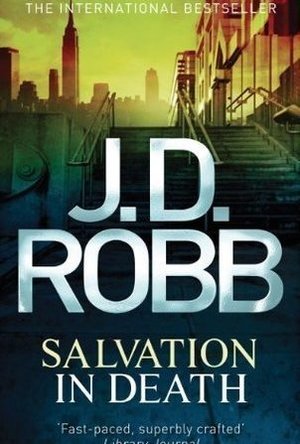
Immediately after drinking the wine during a Catholic funeral mass, Father Miguel Flores is dead on the altar. Detective Lieutenant Eve Dallas confirms that the consecrated wine contained potassium cyanide. Though the East Harlem neighbourhood is a long way from the stone mansion she shares with her billionaire husband Roarke, she knows she's looking for a murderer.
The autopsy reveals faint scars of knife wounds, a removed tattoo and evidence of plastic surgery, suggesting “Father Flores” may not be the man his parishioners thought. Now, as Eve pieces together clues that suggest identity theft, gang connections, and a deeply personal act of revenge, she hopes to track down whoever committed this unholy act. Then a second murder takes place, in front of an even larger crowd of worshippers. Are the homicides linked?
Salvation in Death is the 27th book of the "In Death" series, with Eve and Roarke as the lead characters.
Salvation in Death begins with the poisoning of a Catholic priest during mass. The priest, a passionate, dedicated and energetic member of the community, seems to have no enemies. He cared especially about young people, was not depressed, stressed or troubled and every member of the church looked up to him. But when his autopsy reveals some old scars and a covered tattoo, Eve realises that the priest must have some dark secrets in his past. When the tattoo points to a ruthless badass gang, Eve is not convinced that the priest is the person he purports to be. When another religious leader is also killed, Eve and her team have to investigate whether there is a serial killer on the loose or if the cases are coincidental in their timing.
This is the first book I have read from the "In Death" series by J. D. Robb, the pseudonym of Nora Roberts. I loved the portrayal of the relationship between the two lead characters, Eve and Roarke, particularly,
"Everything and all things. That was Eve for him. Nothing he'd ever dreamed of, even in secret in the dirty alleys of Dublin, approached the reality of her. Nothing he possessed could ever be as precious. The taste of her in the cool night, in the pale light, stirred a craving he understood would never be fully sated."
There is an impressive number of characters in this crime novel which I have to say made it a little difficult to follow at times. Others that I found an affinity with were Peabody and her significant other and work colleague, McNab.
"They were a good ten feet from the Homicide bullpen when Peabody's nose went up like a hound on the hunt. "I smell doughnuts." When Peabody increased her pace, Eve started to roll her eyes, but then she smelled them, too."
I also liked the following quote including McNab:-
"We got a snag. One of the sons-in-law's a lawyer." "Shit." "Ain't that always the way?" ......."So. He's making lawyer noises. It's after two A.M., and people have been held here for over four hours, yaddah-blah-blah." "Did you get anything from the interviews?" "Nothing that buzzed and popped......"
Eve is really out of her comfort zone investigating murders that have taken place in Catholic churches. She obviously has a past that she has to come to terms with which she seems to make some progress in Salvation in Death. Roarke and she have a great deal of chemistry between them and are very hot together and Roarke has some hilarious moments that make him adorable. He is there for her when certain aspects of the case trouble her and she is needing clarity, but she is by his side when he is struggling with some bad memories of his own. They make a brilliant team and I can't wait to read more of them.
I really surprised myself in that I chose to read this crime novel at all as I don't generally go for books relating to Catholicism. However, I thought it was very nicely written and I found it thoroughly enjoyable. The ending was a surprise to me, and I loved the way the book was concluded. Reading Salvation in Death has inspired me to read other "In Deaths" and also other Nora Roberts novels.
Overall, Salvation in Death is a gripping and very interesting read.
The autopsy reveals faint scars of knife wounds, a removed tattoo and evidence of plastic surgery, suggesting “Father Flores” may not be the man his parishioners thought. Now, as Eve pieces together clues that suggest identity theft, gang connections, and a deeply personal act of revenge, she hopes to track down whoever committed this unholy act. Then a second murder takes place, in front of an even larger crowd of worshippers. Are the homicides linked?
Salvation in Death is the 27th book of the "In Death" series, with Eve and Roarke as the lead characters.
Salvation in Death begins with the poisoning of a Catholic priest during mass. The priest, a passionate, dedicated and energetic member of the community, seems to have no enemies. He cared especially about young people, was not depressed, stressed or troubled and every member of the church looked up to him. But when his autopsy reveals some old scars and a covered tattoo, Eve realises that the priest must have some dark secrets in his past. When the tattoo points to a ruthless badass gang, Eve is not convinced that the priest is the person he purports to be. When another religious leader is also killed, Eve and her team have to investigate whether there is a serial killer on the loose or if the cases are coincidental in their timing.
This is the first book I have read from the "In Death" series by J. D. Robb, the pseudonym of Nora Roberts. I loved the portrayal of the relationship between the two lead characters, Eve and Roarke, particularly,
"Everything and all things. That was Eve for him. Nothing he'd ever dreamed of, even in secret in the dirty alleys of Dublin, approached the reality of her. Nothing he possessed could ever be as precious. The taste of her in the cool night, in the pale light, stirred a craving he understood would never be fully sated."
There is an impressive number of characters in this crime novel which I have to say made it a little difficult to follow at times. Others that I found an affinity with were Peabody and her significant other and work colleague, McNab.
"They were a good ten feet from the Homicide bullpen when Peabody's nose went up like a hound on the hunt. "I smell doughnuts." When Peabody increased her pace, Eve started to roll her eyes, but then she smelled them, too."
I also liked the following quote including McNab:-
"We got a snag. One of the sons-in-law's a lawyer." "Shit." "Ain't that always the way?" ......."So. He's making lawyer noises. It's after two A.M., and people have been held here for over four hours, yaddah-blah-blah." "Did you get anything from the interviews?" "Nothing that buzzed and popped......"
Eve is really out of her comfort zone investigating murders that have taken place in Catholic churches. She obviously has a past that she has to come to terms with which she seems to make some progress in Salvation in Death. Roarke and she have a great deal of chemistry between them and are very hot together and Roarke has some hilarious moments that make him adorable. He is there for her when certain aspects of the case trouble her and she is needing clarity, but she is by his side when he is struggling with some bad memories of his own. They make a brilliant team and I can't wait to read more of them.
I really surprised myself in that I chose to read this crime novel at all as I don't generally go for books relating to Catholicism. However, I thought it was very nicely written and I found it thoroughly enjoyable. The ending was a surprise to me, and I loved the way the book was concluded. Reading Salvation in Death has inspired me to read other "In Deaths" and also other Nora Roberts novels.
Overall, Salvation in Death is a gripping and very interesting read.

Gareth von Kallenbach (980 KP) rated Fast Five (2011) in Movies
Aug 7, 2019
The 2011 summer movie season kicks off in high gear with the release of Fast Five the latest installment in the phenomenally popular Fast and Furious series. The movie picks up exactly where the previous film ended with Brian O’ Conner (Paul Walker), orchestrating a daring escape for Dominic Toretto (Vin Diesel).
The film quickly moves forward in time where Brian and Dominic’s sister Mia (Jordana Brewster), overall fugitives from the law, have taken refuge in Rio. Unsure of exactly where Dominic is, an old family friend offers Brian and Mia roles in a job which will surely score them some very easy and much-needed money. Although reluctant, Brian agrees to the job which involves the theft of three high-value cars from a train. Things go horribly wrong when they’re doublecrossed, the aftermath of which leads to the death of three federal agents. Only Dominic’s arrival, quick thinking, and a daring escape allows Brian and Mia to survive.
Although it is not their fault, the deaths of the agents is blamed solely on the trio, and an elite fugitive hunter named Hobbs (Dwayne Johnson) arrives with his team with the sole mission of stopping Brian, Mia and Dominic, no matter the cost.
As if this wasn’t enough trouble for the fugities, it is learned that they have also fallen on the radar of the local drug kingpin named Reyes (Joaquim de Almeida), who will stop at nothing to retrieve an item now in the trio’s possession. Caught in the crossfire between Hobbs and Reyes, Dominic plots an epic caper that will allow them not only the money to flee Hobbs and disappear into a life of luxury, but allow them to settle the score with Reyes.
What follows is a nonstop action thrill ride that sprinkles in a nice mix of comedy and romance to keep things interesting. The film downplays the racing aspect of the series and instead saves the spectacular driving for key action sequences. While street racing scenes are alluded to they are not shown as director Justin Chin focuses squarely on his cast and allows them ample time to develop their characters. In doing so it strengthens the bond between them and allows the climactic sequence to have an even greater impact than your standard over-the-top summer film action scenes.
.
There are some really funny moments in the film as Dominic assembles his team to pull off the ultimate job. The new characters work very well with the established cast from the previous films and introduce characters which I hope will be a part of any future films in the series. Johnson was a very pleasant surprise, as his character could easily have been one-dimensional. He was given a few wrinkles which allowed him to walk the fine line between good guy and bad guy, which is an essential quality to many of the film’s characters. Johnson’s action sequences were solid and highly effective and once again underscores that he needs to be focusing more on action films and less on the family-friendly genre that
has dominated the bulk of his recent work.
Walker and Diesel complement each other perfectly and appear to be having a great time working with one another again. They have a very easy-going and natural chemistry with one another that works even when they’re not behind the wheel of a car or caught up in a frantic action scene.
While the plot of the film is fairly straightforward it provides ample framework for the characters to grow and propel the story forward. While the audience is asked to take some great leaps in logic it doesn’t derail from the finished product. The stuntwork in the film was absolutely amazing and the spectacular finale of the movie alone must be seen to be believed.
Many times during my press screening the audience was completely silent for a brief second following an action sequence before erupting into thunderous applause and cheers after they’ve fully processed what just unfolded on the screen. Larger-than-life characters combined with larger-than-life action, plus some very sexy cars and very sexy people make an extremely winning formula. If the rumors are true, Chin may be handed the reins to the Terminator franchise as well as the next film in the Fast and Furious series, then audiences are in for one hell of a ride.
I think my wife summed it up best when she said that movie was “Ridiculous…ridiculously good.” Reality is thrown out the window for pure adrenaline and testosterone fueled action.
The film quickly moves forward in time where Brian and Dominic’s sister Mia (Jordana Brewster), overall fugitives from the law, have taken refuge in Rio. Unsure of exactly where Dominic is, an old family friend offers Brian and Mia roles in a job which will surely score them some very easy and much-needed money. Although reluctant, Brian agrees to the job which involves the theft of three high-value cars from a train. Things go horribly wrong when they’re doublecrossed, the aftermath of which leads to the death of three federal agents. Only Dominic’s arrival, quick thinking, and a daring escape allows Brian and Mia to survive.
Although it is not their fault, the deaths of the agents is blamed solely on the trio, and an elite fugitive hunter named Hobbs (Dwayne Johnson) arrives with his team with the sole mission of stopping Brian, Mia and Dominic, no matter the cost.
As if this wasn’t enough trouble for the fugities, it is learned that they have also fallen on the radar of the local drug kingpin named Reyes (Joaquim de Almeida), who will stop at nothing to retrieve an item now in the trio’s possession. Caught in the crossfire between Hobbs and Reyes, Dominic plots an epic caper that will allow them not only the money to flee Hobbs and disappear into a life of luxury, but allow them to settle the score with Reyes.
What follows is a nonstop action thrill ride that sprinkles in a nice mix of comedy and romance to keep things interesting. The film downplays the racing aspect of the series and instead saves the spectacular driving for key action sequences. While street racing scenes are alluded to they are not shown as director Justin Chin focuses squarely on his cast and allows them ample time to develop their characters. In doing so it strengthens the bond between them and allows the climactic sequence to have an even greater impact than your standard over-the-top summer film action scenes.
.
There are some really funny moments in the film as Dominic assembles his team to pull off the ultimate job. The new characters work very well with the established cast from the previous films and introduce characters which I hope will be a part of any future films in the series. Johnson was a very pleasant surprise, as his character could easily have been one-dimensional. He was given a few wrinkles which allowed him to walk the fine line between good guy and bad guy, which is an essential quality to many of the film’s characters. Johnson’s action sequences were solid and highly effective and once again underscores that he needs to be focusing more on action films and less on the family-friendly genre that
has dominated the bulk of his recent work.
Walker and Diesel complement each other perfectly and appear to be having a great time working with one another again. They have a very easy-going and natural chemistry with one another that works even when they’re not behind the wheel of a car or caught up in a frantic action scene.
While the plot of the film is fairly straightforward it provides ample framework for the characters to grow and propel the story forward. While the audience is asked to take some great leaps in logic it doesn’t derail from the finished product. The stuntwork in the film was absolutely amazing and the spectacular finale of the movie alone must be seen to be believed.
Many times during my press screening the audience was completely silent for a brief second following an action sequence before erupting into thunderous applause and cheers after they’ve fully processed what just unfolded on the screen. Larger-than-life characters combined with larger-than-life action, plus some very sexy cars and very sexy people make an extremely winning formula. If the rumors are true, Chin may be handed the reins to the Terminator franchise as well as the next film in the Fast and Furious series, then audiences are in for one hell of a ride.
I think my wife summed it up best when she said that movie was “Ridiculous…ridiculously good.” Reality is thrown out the window for pure adrenaline and testosterone fueled action.

BankofMarquis (1832 KP) rated Da 5 Bloods (2020) in Movies
Jun 19, 2020
Delroy Lindo shines in a mostly good film
Over the years, I have become a fan of Spike Lee. I think he has a singular vision as a filmmaker with his films putting a spotlight on the black experience and the prejudices and injustices that prevail.
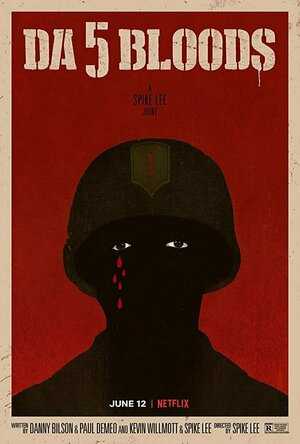
DA 5 BLOODS - Lee's Vietnam War movie - is no exception.
Set in present(ish) day and in the memories of the main characters from their time "in country", DA 5 BLOODS tells the tale of 4 Vietnam Veterans who return to find the body of their squadron leader - and the gold that they buried under his body.
Part Vietnam war flick, part gold heist (and the cost of this theft on the hearts and minds of the participants) and part reflection on the treatment of the black soldiers, Lee reaches high to combine 3 separate - and complex - films into one (any one of which could have been a film of their own) and it is here that this films succeeds - and fails. For this film is at moments riveting, at moments unflinching and hard to watch, at moments confusing and at moments...surprisingly... dull. Spike had a lot of movie to tell and he took 2 and a 1/2 hours to tell it. He would have been better suited to cut some of this down to a more palatable 2-ish hour length. The film bogs down on itself at times.
But when it crackles - it crackles. Especially when the 4 veteran soldiers interact with each other. Led by the great Delroy Lindo (TV's THE GOOD FIGHT). I hope that this film gets a theatrical release sometime (to make it eligible for the Oscars) for Lindo's portrayal of MAGA Hat wearing, PTSD suffering Paul is powerful and captivating. I was riveted by his performance and I was willing to follow him to the ends of the Earth. Also standing out is Clarke Peters as Otis - the heart and soul of this group and Norm Lewis, the pigeon-toed Eddie who has a secret that he is hiding. Both of these characters shine at moments - but are not in the spotlight nearly often enough. The same can be said for Isaih Whitlock Jr as Melvin, a character that is undeserved until the end and by then I felt myself wanting more of him. (Side Note: Lee named these characters after members of THE TEMPTATIONS).
Lee makes an interesting choice in the flashback scenes of the war. Instead of casting younger actors or spending the $$ on "de-aging" the actors (Lee would say that the de-aging was "cost prohibitive"), Lee chooses to have these old guys just play their younger versions of themselves just as they are now, claiming that these are not flashbacks, but "memories" of these soldiers - and I gotta admit that this tactic works very, very well - especially when these 4 older gentlemen are in the Vietnam War scenes with their Platoon Leader played, charismatically, by the much younger Chadwick Boseman. His character is killed in action and since these scenes are memories, it works well that he is younger (he never got a chance to grow old) while all the others are older. Boseman has a an attraction to him that helps the audience buy into the fact that all these years later these 4 men still hold him front and center in their memories. Unfortunately, the combat scenes looks to me like they were done on a shoe-string budget, so Lee has to use "tricks" to pull these scenes off and these tricks bring these scenes down a peg.
As I've stated, this film is really 3 films in one and the effects of the gold on the men is the most interesting part of this film for me, it touches on the desires of the human soul and brings some of the strongest acting and emotions.
This being a Spike Lee joint, this film is peppered with scenes from the black experience - from Martin Luther KIng to Malcom X to "Hanoi Hannah" telling the black troops that their country is abandoning them. These are important events in the lives and psyche of these men (and African Americans) and Mr. Lee is uniquely positioned to bring the attention of the public to these events, and he does it well.
DA 5 BLOODS in now streaming on Netflix.
Letter Grade: A-
8 stars (out of 10) and you can take that to the Bank(ofMarquis)
DA 5 BLOODS - Lee's Vietnam War movie - is no exception.
Set in present(ish) day and in the memories of the main characters from their time "in country", DA 5 BLOODS tells the tale of 4 Vietnam Veterans who return to find the body of their squadron leader - and the gold that they buried under his body.
Part Vietnam war flick, part gold heist (and the cost of this theft on the hearts and minds of the participants) and part reflection on the treatment of the black soldiers, Lee reaches high to combine 3 separate - and complex - films into one (any one of which could have been a film of their own) and it is here that this films succeeds - and fails. For this film is at moments riveting, at moments unflinching and hard to watch, at moments confusing and at moments...surprisingly... dull. Spike had a lot of movie to tell and he took 2 and a 1/2 hours to tell it. He would have been better suited to cut some of this down to a more palatable 2-ish hour length. The film bogs down on itself at times.
But when it crackles - it crackles. Especially when the 4 veteran soldiers interact with each other. Led by the great Delroy Lindo (TV's THE GOOD FIGHT). I hope that this film gets a theatrical release sometime (to make it eligible for the Oscars) for Lindo's portrayal of MAGA Hat wearing, PTSD suffering Paul is powerful and captivating. I was riveted by his performance and I was willing to follow him to the ends of the Earth. Also standing out is Clarke Peters as Otis - the heart and soul of this group and Norm Lewis, the pigeon-toed Eddie who has a secret that he is hiding. Both of these characters shine at moments - but are not in the spotlight nearly often enough. The same can be said for Isaih Whitlock Jr as Melvin, a character that is undeserved until the end and by then I felt myself wanting more of him. (Side Note: Lee named these characters after members of THE TEMPTATIONS).
Lee makes an interesting choice in the flashback scenes of the war. Instead of casting younger actors or spending the $$ on "de-aging" the actors (Lee would say that the de-aging was "cost prohibitive"), Lee chooses to have these old guys just play their younger versions of themselves just as they are now, claiming that these are not flashbacks, but "memories" of these soldiers - and I gotta admit that this tactic works very, very well - especially when these 4 older gentlemen are in the Vietnam War scenes with their Platoon Leader played, charismatically, by the much younger Chadwick Boseman. His character is killed in action and since these scenes are memories, it works well that he is younger (he never got a chance to grow old) while all the others are older. Boseman has a an attraction to him that helps the audience buy into the fact that all these years later these 4 men still hold him front and center in their memories. Unfortunately, the combat scenes looks to me like they were done on a shoe-string budget, so Lee has to use "tricks" to pull these scenes off and these tricks bring these scenes down a peg.
As I've stated, this film is really 3 films in one and the effects of the gold on the men is the most interesting part of this film for me, it touches on the desires of the human soul and brings some of the strongest acting and emotions.
This being a Spike Lee joint, this film is peppered with scenes from the black experience - from Martin Luther KIng to Malcom X to "Hanoi Hannah" telling the black troops that their country is abandoning them. These are important events in the lives and psyche of these men (and African Americans) and Mr. Lee is uniquely positioned to bring the attention of the public to these events, and he does it well.
DA 5 BLOODS in now streaming on Netflix.
Letter Grade: A-
8 stars (out of 10) and you can take that to the Bank(ofMarquis)
Kirk Bage (1775 KP) rated Black Mirror - Season 3 in TV
Mar 3, 2020
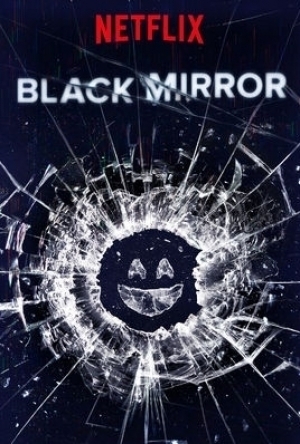
Nosedive - 8
We had to wait almost another 2 years for the Netflix investment to show a product, and in time for Halloween 2016 we got the super-glossy re-boot of Nosedive, with a big name up front and lots of anticipation. The tone was instantly more playful; less British, more inclusive to a world audience. It tackled with a wry humour the universal phenomenon of popularity and everything being rated, most notably, people themselves. In a future world of sunshine and pastel shades it has become the norm to rate every interaction, from buying coffee to buying a house, in the hope of becoming one of the beautiful people rated above a 4.5. It cleverly questions the motivations for that desire, and the pitfalls of false behaviour and the manipulation from an elite standpoint. It isn’t necessary to imagine this future, as we are virtually there already, and all this episode does is heighten the idea to hyperbolic proportions. Rated down by many viewers because it is “annoying”, but that is entirely the point: the whole thing makes you want to scream!
Playtest - 6.5
Also available for Halloween (as was the whole season, in standard Netflix style) came a chance to explore what really scares us! And… they blew it. Sure, the idea that gaming and VR becomes so photo realistic it seems entirely real isn’t far away. But, making it personal to a very annoying character dissolves all tension quite early on. Some mild jump scares aside, this has to go down as a missed opportunity. Notable only for the re-occurance of the White Bear symbol.
Shut Up and Dance - 7
This is the one most likely to make you think, hmm, that is too far! An uncomfortable episode, not only because of the subject matter and ultimate revelation, but because of the intense nastiness that pervades it. No doubt that tension is intentional, and therefore effective to a degree, but for me it crosses the line of entertainment and becomes simply nasty. Being unafraid to tackle controversial subjects is to be applauded, but the execution has to be note perfect, or the risk is the backlash this episode received. A cautionary tale about surveillance, data theft, blackmail and our personal online responsibility. Not a bad piece, just a slight misjudgment on tone and delivery.
San Junipero - 9.5
Just when critics were sharpening their pens that Netflix had ruined the potential of Black Mirror in its first phase, comes an almost perfect piece of TV that is literally heavenly! Everything about San Junipero is a work of art! Another “blind” episode that takes a while to unravel; the pacing and realisation of which is so beautifully judged that, from a writing point of view, this has to be seen as the pinnacle of the show to date. Mackenzie Davis is extraordinary as the vulnerable, shy and naive Yorkie, looking for a connection in an 80s nightclub, filled with nostalgia and cultural memes galore. The music alone is not only sing aloud perfect, but chosen for storytelling reasons so clever it raises goosebumps! The relationship between Yorkie and Kelly, an equally great Gugu Mbatha-Raw, is filled with chemistry and nuance, drawing us in to a place so deep that when the penny drops on what is really going on it draws a gasp and then possibly tears – I know it did for me! The mechanics of the technology that would make this story possible does raise a lot of questions, but in the end it is better to accept it as an allegory for love, life and our ideas of “eternity”. Don’t look too deeply at the how, but marvel at the why, and this could be the best hour of TV you will ever see! So rewatchable, rich and rewarding; the only reason not to make this a feature length big budget film is that how could it possibly be improved?
Men Against Fire - 7
Revisiting yet again the technology of a brain implant that affects our vision of the world, literally and figuratively, this episode explores indoctrination and brainwashing, with the underlying themes of racism and basic human compassion. It is a fine analogy of how the media and governments would have us think of immigrants and the “dangers” of anything “not us”. A tad obvious, and doesn’t really go anywhere new once the twist is revealed. Visually quite stunning, but not as strong as other episodes that cover similar ground.
Hated in the Nation - 8.5
With a running time of 89 minutes, this is essentially what happens when Black Mirror pushes an idea to feature length. Allowing more time for character development does make a difference, and the tension build in this fine concept for a thriller also benefits from a few extra minutes. The ever reliable Kelly MacDonald is the cornerstone of a strong cast, on the hunt for the mind behind a series of killings by killer bee drones, targeted at a democratically elected “most hated” person every day, based on a public vote. An exploration of media vilification and how easy it can be to manipulate our idea of someone’s identity and judge their actions and even personalities based on one wrong thing they may have said or done. The episode is a who-dunnit? A why-doit? And, framed, with the backdrop of the inquest surrounding events, both a good cop movie and a courtroom drama. Charlie Brooker has hinted that some of these characters may return at some point. I’m all for it.
We had to wait almost another 2 years for the Netflix investment to show a product, and in time for Halloween 2016 we got the super-glossy re-boot of Nosedive, with a big name up front and lots of anticipation. The tone was instantly more playful; less British, more inclusive to a world audience. It tackled with a wry humour the universal phenomenon of popularity and everything being rated, most notably, people themselves. In a future world of sunshine and pastel shades it has become the norm to rate every interaction, from buying coffee to buying a house, in the hope of becoming one of the beautiful people rated above a 4.5. It cleverly questions the motivations for that desire, and the pitfalls of false behaviour and the manipulation from an elite standpoint. It isn’t necessary to imagine this future, as we are virtually there already, and all this episode does is heighten the idea to hyperbolic proportions. Rated down by many viewers because it is “annoying”, but that is entirely the point: the whole thing makes you want to scream!
Playtest - 6.5
Also available for Halloween (as was the whole season, in standard Netflix style) came a chance to explore what really scares us! And… they blew it. Sure, the idea that gaming and VR becomes so photo realistic it seems entirely real isn’t far away. But, making it personal to a very annoying character dissolves all tension quite early on. Some mild jump scares aside, this has to go down as a missed opportunity. Notable only for the re-occurance of the White Bear symbol.
Shut Up and Dance - 7
This is the one most likely to make you think, hmm, that is too far! An uncomfortable episode, not only because of the subject matter and ultimate revelation, but because of the intense nastiness that pervades it. No doubt that tension is intentional, and therefore effective to a degree, but for me it crosses the line of entertainment and becomes simply nasty. Being unafraid to tackle controversial subjects is to be applauded, but the execution has to be note perfect, or the risk is the backlash this episode received. A cautionary tale about surveillance, data theft, blackmail and our personal online responsibility. Not a bad piece, just a slight misjudgment on tone and delivery.
San Junipero - 9.5
Just when critics were sharpening their pens that Netflix had ruined the potential of Black Mirror in its first phase, comes an almost perfect piece of TV that is literally heavenly! Everything about San Junipero is a work of art! Another “blind” episode that takes a while to unravel; the pacing and realisation of which is so beautifully judged that, from a writing point of view, this has to be seen as the pinnacle of the show to date. Mackenzie Davis is extraordinary as the vulnerable, shy and naive Yorkie, looking for a connection in an 80s nightclub, filled with nostalgia and cultural memes galore. The music alone is not only sing aloud perfect, but chosen for storytelling reasons so clever it raises goosebumps! The relationship between Yorkie and Kelly, an equally great Gugu Mbatha-Raw, is filled with chemistry and nuance, drawing us in to a place so deep that when the penny drops on what is really going on it draws a gasp and then possibly tears – I know it did for me! The mechanics of the technology that would make this story possible does raise a lot of questions, but in the end it is better to accept it as an allegory for love, life and our ideas of “eternity”. Don’t look too deeply at the how, but marvel at the why, and this could be the best hour of TV you will ever see! So rewatchable, rich and rewarding; the only reason not to make this a feature length big budget film is that how could it possibly be improved?
Men Against Fire - 7
Revisiting yet again the technology of a brain implant that affects our vision of the world, literally and figuratively, this episode explores indoctrination and brainwashing, with the underlying themes of racism and basic human compassion. It is a fine analogy of how the media and governments would have us think of immigrants and the “dangers” of anything “not us”. A tad obvious, and doesn’t really go anywhere new once the twist is revealed. Visually quite stunning, but not as strong as other episodes that cover similar ground.
Hated in the Nation - 8.5
With a running time of 89 minutes, this is essentially what happens when Black Mirror pushes an idea to feature length. Allowing more time for character development does make a difference, and the tension build in this fine concept for a thriller also benefits from a few extra minutes. The ever reliable Kelly MacDonald is the cornerstone of a strong cast, on the hunt for the mind behind a series of killings by killer bee drones, targeted at a democratically elected “most hated” person every day, based on a public vote. An exploration of media vilification and how easy it can be to manipulate our idea of someone’s identity and judge their actions and even personalities based on one wrong thing they may have said or done. The episode is a who-dunnit? A why-doit? And, framed, with the backdrop of the inquest surrounding events, both a good cop movie and a courtroom drama. Charlie Brooker has hinted that some of these characters may return at some point. I’m all for it.
Kirk Bage (1775 KP) rated Black Mirror - Season 4 in TV
Mar 3, 2020
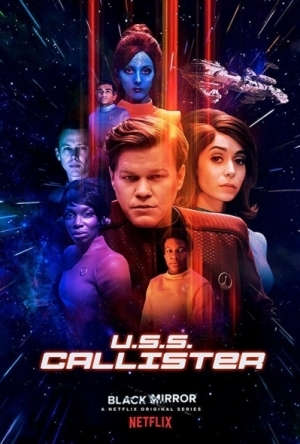
USS Callister - 7.5
A fascinatingly geeky episode, all else aside. Not only are there references to almost every significant sci-fi meme (in the true sociological sense of the word) you can think of, but there are also many links to past and even future Black Mirror episodes. It really is a spot the clever touch piece of the ensemble. Deceptively colourful and lively, this is a dark idea – taking identity theft to the next level and using stolen DNA to replicate and then trap a person in a virtual world where you are god. Jesse Plemons takes on two personas and has never been seen to such effect as in this rare lead role for him. Nominated for 8 Emmys and winning 4, the start to season four in late 2017 was a strong one, and a real indicator that the Universe of Black Mirror is all intrinsically linked. As I say, geek heaven! Points for spotting Kirsten Dunst in an unspoken cameo…
Arkangel - 6
Notable for the first big guest director credit of one Jodie Foster. This one moves from creepy idea to hard to swallow nonsense very quickly. Returning to the idea of brain implants and using the eyes of a person as a recorder than can be manipulated, the idea of aparent using such tech to protect a child is fine on the surface. But when you go deeper, it is impossible to imagine a parent stupid enough not to see the drawbacks and dangers of it, and fantastical to imagine the child not questioning it as they get older. Apart from a memorable moment of violence that works well in the context of the story, this episode largely doesn’t really work.
Crocodile - 7
An almost unrecognisable Andrea Riseborough is the best thing about this bleak thriller type episode, often compared to Scandi-dramas like The Bridge. It starts with a haunting accidental death and cover up scenario, progressing to a breakdown manifested in two very different ways. Once again, the tech on display is a machine not unlike the Voight-Kampf of Blade Runner, which can translate memory into images. The intrigue and tension are great, and when things really kick off, we find ourselves yelling “just stop” at our screens! Trouble is, the final twist undermines it all, by crossing the line of irony and into comedy. Memorable, but not in the top ten for me.
Hang the DJ - 8.5
Now, this one I really like! The unlikely chemistry of Joe Cole and Georgina Campbell, as two guinea pigs using an intense dating app in some vague dystopia, hits the right tone from the start and keeps you gripped. The basic idea being that the app tells you how long a couple can be together, before parting, whether they want to or not. The promise of the system being that in the end there is a 99.8% chance of finding your “perfect” partner. The empathy for the leads is huge by the time it comes to the inevitable conclusion that they must rebel to escape their fate and be together. What happens next: the simplicity, yet detail of the twist is absolute genius! Leaving you with a wry smile and a very strong lasting impression. Artistically, not he strongest; in terms of pure writing, one of the very best.
Metalhead - 7
Perhaps unfairly, this episode, shot in gorgeous black and white, is the lowest rated of all Black Mirror episodes on IMDb. David Slade, the man responsible for films such as Hard Candy and 30 Days of Night directs, and it is apparent this is going to be a minimal mood piece, with standard psychological horror elements. The most obvious comparison is The Terminator, but there is more going on than that. What I like about it is the ambiguity. How we got to this place and where “home” is and who is left there, are all left to our imagination, as we watch Maxine Peake struggle to survive against a machine that will not stop. I think many reject it out of hand because it is too vague and has little in the way of a clever twist. But, as a character study it works fine. Shorter than most, at 41 minutes, perhaps even that is a push, given the simple idea, which does have short film vibes pouring out of it. I can’t say I don’t like it though…
Black Museum - 8
A fitting end to season four was the trick of paying homage to old anthology horror movies of the 70s, where artifacts that link to dark stories are collected in one place and re-told by a perhaps sinister narrator. There are plenty of clever nods to recognisable props and images from earlier episodes, as well as new stuff that may have future significance, that,even more than USS Callister, this episode is basically one big Easter egg. Letitia Wright, best known from her role in Black Panther, to date, shows star quality in a tricky part that basically requires her to listen and wait patiently until the satisfying pay-off. The three linking tales of a doctor who becomes addicted to pain via an empathy implant; a dead mother whose soul is trapped in a childs toy forever; and a murderer condemned to relive his execution over and over for the gratification of paying customers – are all captivating within themselves, and fit into the macabre tongue in cheek vibe well. Thankfully, the climax does make it all gel and make sense, and we leave the season on a high, reflecting our own sense of “justice”.
A fascinatingly geeky episode, all else aside. Not only are there references to almost every significant sci-fi meme (in the true sociological sense of the word) you can think of, but there are also many links to past and even future Black Mirror episodes. It really is a spot the clever touch piece of the ensemble. Deceptively colourful and lively, this is a dark idea – taking identity theft to the next level and using stolen DNA to replicate and then trap a person in a virtual world where you are god. Jesse Plemons takes on two personas and has never been seen to such effect as in this rare lead role for him. Nominated for 8 Emmys and winning 4, the start to season four in late 2017 was a strong one, and a real indicator that the Universe of Black Mirror is all intrinsically linked. As I say, geek heaven! Points for spotting Kirsten Dunst in an unspoken cameo…
Arkangel - 6
Notable for the first big guest director credit of one Jodie Foster. This one moves from creepy idea to hard to swallow nonsense very quickly. Returning to the idea of brain implants and using the eyes of a person as a recorder than can be manipulated, the idea of aparent using such tech to protect a child is fine on the surface. But when you go deeper, it is impossible to imagine a parent stupid enough not to see the drawbacks and dangers of it, and fantastical to imagine the child not questioning it as they get older. Apart from a memorable moment of violence that works well in the context of the story, this episode largely doesn’t really work.
Crocodile - 7
An almost unrecognisable Andrea Riseborough is the best thing about this bleak thriller type episode, often compared to Scandi-dramas like The Bridge. It starts with a haunting accidental death and cover up scenario, progressing to a breakdown manifested in two very different ways. Once again, the tech on display is a machine not unlike the Voight-Kampf of Blade Runner, which can translate memory into images. The intrigue and tension are great, and when things really kick off, we find ourselves yelling “just stop” at our screens! Trouble is, the final twist undermines it all, by crossing the line of irony and into comedy. Memorable, but not in the top ten for me.
Hang the DJ - 8.5
Now, this one I really like! The unlikely chemistry of Joe Cole and Georgina Campbell, as two guinea pigs using an intense dating app in some vague dystopia, hits the right tone from the start and keeps you gripped. The basic idea being that the app tells you how long a couple can be together, before parting, whether they want to or not. The promise of the system being that in the end there is a 99.8% chance of finding your “perfect” partner. The empathy for the leads is huge by the time it comes to the inevitable conclusion that they must rebel to escape their fate and be together. What happens next: the simplicity, yet detail of the twist is absolute genius! Leaving you with a wry smile and a very strong lasting impression. Artistically, not he strongest; in terms of pure writing, one of the very best.
Metalhead - 7
Perhaps unfairly, this episode, shot in gorgeous black and white, is the lowest rated of all Black Mirror episodes on IMDb. David Slade, the man responsible for films such as Hard Candy and 30 Days of Night directs, and it is apparent this is going to be a minimal mood piece, with standard psychological horror elements. The most obvious comparison is The Terminator, but there is more going on than that. What I like about it is the ambiguity. How we got to this place and where “home” is and who is left there, are all left to our imagination, as we watch Maxine Peake struggle to survive against a machine that will not stop. I think many reject it out of hand because it is too vague and has little in the way of a clever twist. But, as a character study it works fine. Shorter than most, at 41 minutes, perhaps even that is a push, given the simple idea, which does have short film vibes pouring out of it. I can’t say I don’t like it though…
Black Museum - 8
A fitting end to season four was the trick of paying homage to old anthology horror movies of the 70s, where artifacts that link to dark stories are collected in one place and re-told by a perhaps sinister narrator. There are plenty of clever nods to recognisable props and images from earlier episodes, as well as new stuff that may have future significance, that,even more than USS Callister, this episode is basically one big Easter egg. Letitia Wright, best known from her role in Black Panther, to date, shows star quality in a tricky part that basically requires her to listen and wait patiently until the satisfying pay-off. The three linking tales of a doctor who becomes addicted to pain via an empathy implant; a dead mother whose soul is trapped in a childs toy forever; and a murderer condemned to relive his execution over and over for the gratification of paying customers – are all captivating within themselves, and fit into the macabre tongue in cheek vibe well. Thankfully, the climax does make it all gel and make sense, and we leave the season on a high, reflecting our own sense of “justice”.

Purple Phoenix Games (2266 KP) rated Aristotle's Elements and Space in Tabletop Games
Nov 5, 2020


The Cosmos! So many of us dream of flying up into space to enjoy the views and hopes of a better life on another planet. Some would like to study space more closely to unravel its mysteries. Still others would think it’s just kinda cool to be weightless and IN SPACE! I’m a mixture of all these, so when I heard a call for reviewers for a game whose title includes a major philosopher, elements of all matter, AND SPACE I just had to know more and play it. Would Aristotle take pride in this card game’s premise or has it shot for the moon and is now drifting among the space junk?
Aristotle’s Elements and Space is a party style card game for three to five players. Players will be attempting to play elements to triumph over their opponents by using tried and true rock-paper-scissors style play.
DISCLAIMER: We were provided a prototype copy of this game for the purposes of this review. These are preview copy components, and I do not know for sure if the final components will be any different from these shown. Also, it is not my intention to detail every rule in the game, as there are just too many. You are invited to download the rulebook, back the game through the Kickstarter campaign, or through any retailers stocking it after fulfillment. -T
To setup stock the token bag (not pictured) with tokens according to the rulebook suggestions for number of players. Each player will blindly choose three tokens from the bag to place in front of themselves within reach of all players. Shuffle the element cards and deal each player seven. Determine the first Aristotle player and place the Aristotle card facing that player. Shuffle and deal out three Element of Surprise cards face-down within reach of all players. The game may now begin!
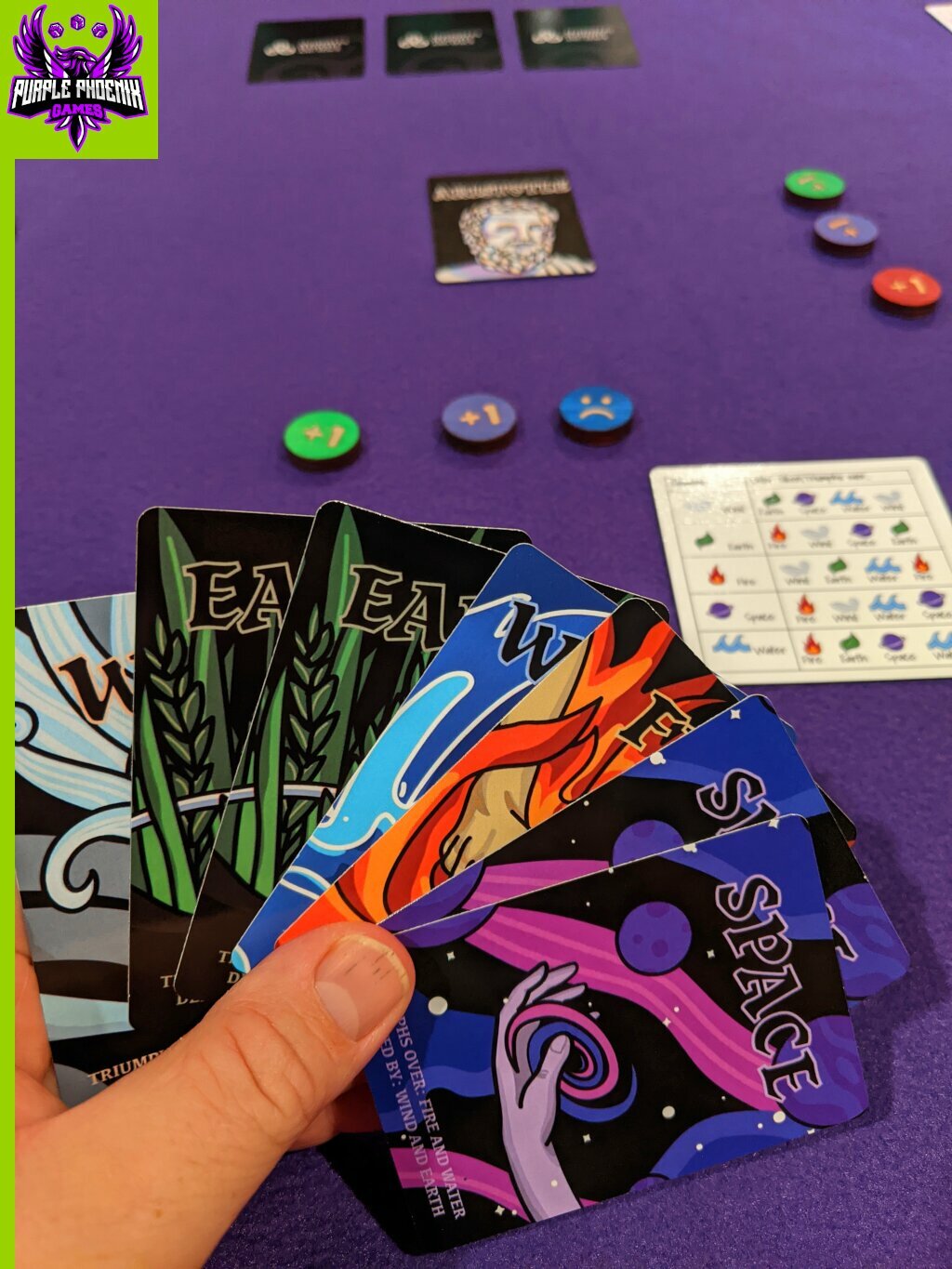
Each game lasts seven rounds. At the start of each round players will secretly choose a card from hand to play to the table face down. Once all players are ready all players must simultaneously say out loud, “Aristotle,” while flipping over their cards. When all cards are revealed the Aristotle player will compare cards with the player on their left. Whichever element card played triumphs over the other will win that battle and continue onward clockwise to battle the other players. This continues until one player has triumphed all the cards and taken the trick. The Aristotle card is then given to the next player in clockwise seating to begin a new round. This is how a basic game is played.
More advanced games will include Power Up Tokens and the Element of Surprise Cards. In order to use a Power Up Token a player would first need to have successfully stolen another player’s token during a round of play. To successfully steal a token the player will physically take a token from another player without being touched by that player. Should the defending player touch or slap the offensive player’s hand during the theft, the heist is unsuccessful. Once stolen a token may be used on a subsequent round.
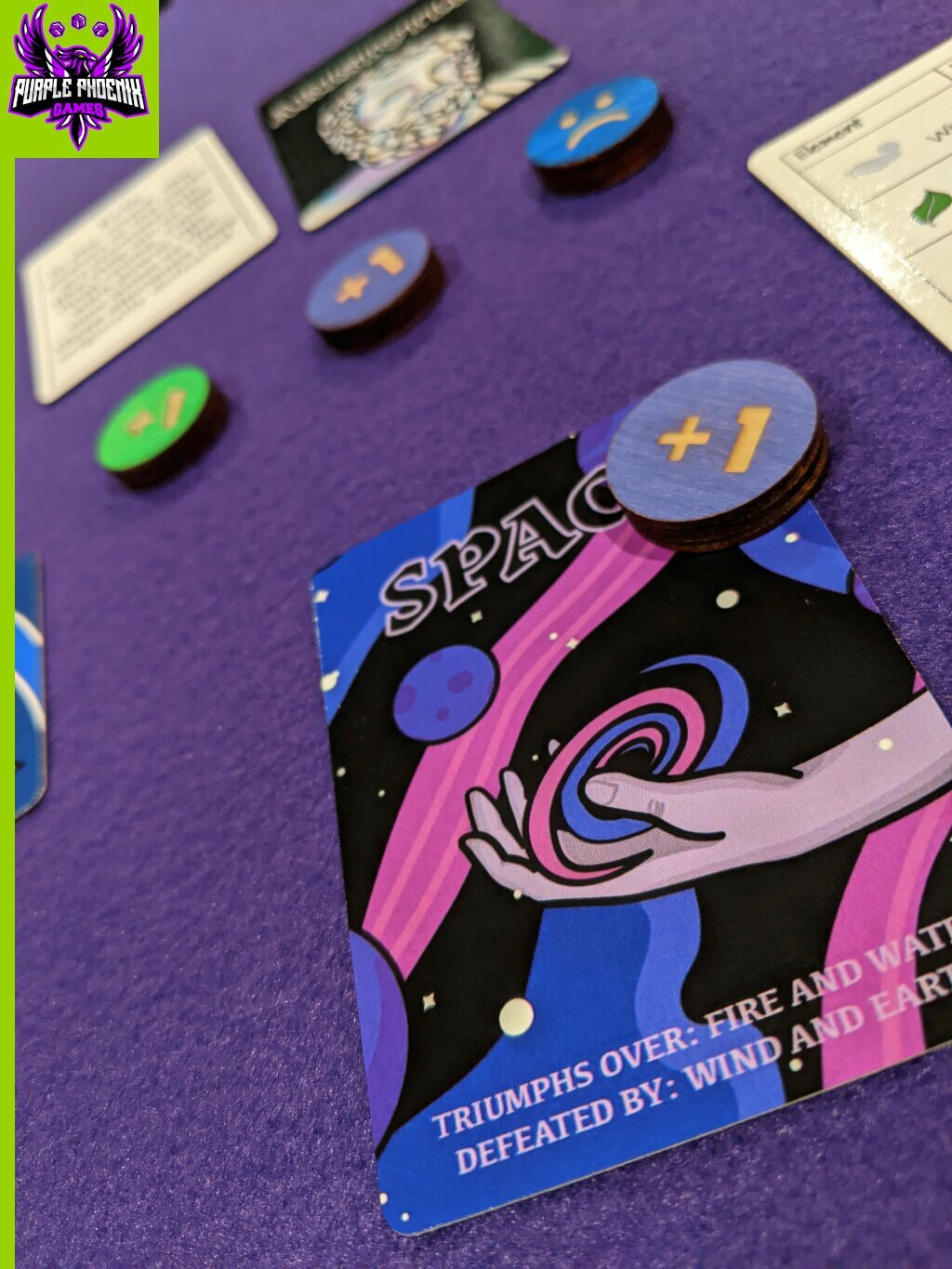
The Power Up Tokens increase the number of elements that may be triumphed using a particular element. For instance, Fire typically triumphs over Earth and Wind, but with the Power Up Token also applied the Fire triumphs over Earth, Wind, AND Water. A most welcome twist! Also, during a round in which a player is acting as Aristotle they may, once cards are revealed, call, “Element of Surprise!,” and choose a face-down card to read aloud to the group. These cards add a goofy rule that must be thenceforth followed, gives prompts for the players to discuss, or has players searching the room/house/wherever for items to bring back to the table first.
Play continues in this fashion until the last round, where triumph rules are reversed. When all cards have been played the winner is the player who won the most tricks.
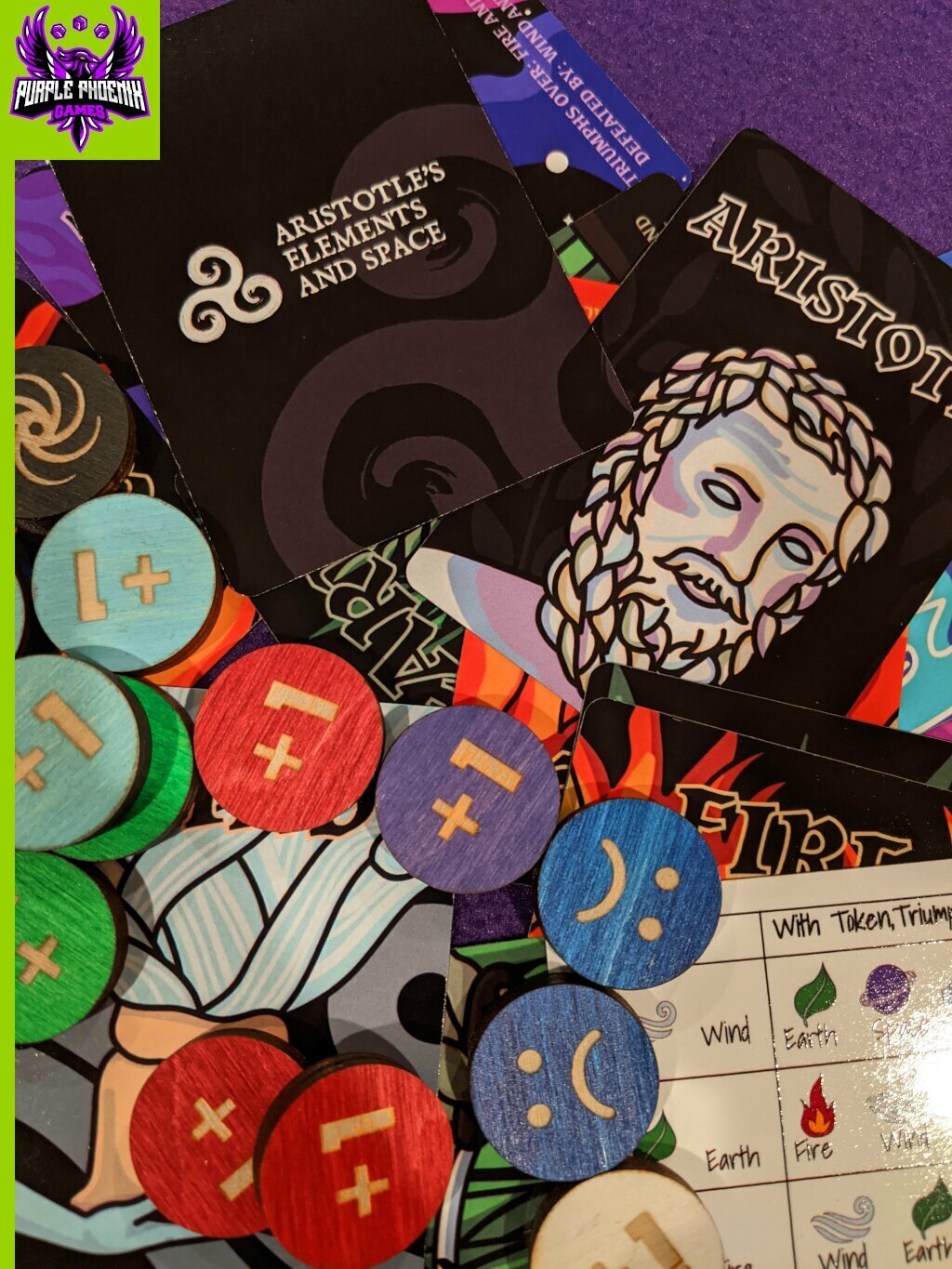
Components. Again, this is a prototype version of the game. That said, what we received was a bunch of cards and the Power Up Tokens. The tokens are fine – laser cut plywood discs painted on both sides to match the elements they modify. The cards are glossy and feature unique art. The art is, well, just okay for me. It’s not terribly exciting, but it is very colorful and not bad, necessarily. I feel like the art could be improved some, but art is always a personal preference.
The gameplay itself is certainly a hodge-podge of mechanics from other games that, for the most part, are well-used for a very light trick-taking card game. I enjoy playing it using the Power Up Tokens, but for me and my group, we passed on the Element of Surprise cards. They add a different twist to the game that isn’t necessarily Quelf-ish, but also doesn’t add much to the game. They merely add a distraction from the game. I can see many people totally diggin’ those cards, and I probably would use them if converting a game-noob, but for more serious gamers, just leave them out.
If you are looking for a very light and different trick-taking card game, check out Aristotle’s Elements and Space. I am not entirely sure if any components will be updated before going to retail, but even if not, they are pretty decent. The gameplay is quick and easy to teach; I think I will try it with my 4-year-old as well. This is a decent gateway filler that could fit very well in many collections. Give it a look!
Aristotle’s Elements and Space is a party style card game for three to five players. Players will be attempting to play elements to triumph over their opponents by using tried and true rock-paper-scissors style play.
DISCLAIMER: We were provided a prototype copy of this game for the purposes of this review. These are preview copy components, and I do not know for sure if the final components will be any different from these shown. Also, it is not my intention to detail every rule in the game, as there are just too many. You are invited to download the rulebook, back the game through the Kickstarter campaign, or through any retailers stocking it after fulfillment. -T
To setup stock the token bag (not pictured) with tokens according to the rulebook suggestions for number of players. Each player will blindly choose three tokens from the bag to place in front of themselves within reach of all players. Shuffle the element cards and deal each player seven. Determine the first Aristotle player and place the Aristotle card facing that player. Shuffle and deal out three Element of Surprise cards face-down within reach of all players. The game may now begin!
Each game lasts seven rounds. At the start of each round players will secretly choose a card from hand to play to the table face down. Once all players are ready all players must simultaneously say out loud, “Aristotle,” while flipping over their cards. When all cards are revealed the Aristotle player will compare cards with the player on their left. Whichever element card played triumphs over the other will win that battle and continue onward clockwise to battle the other players. This continues until one player has triumphed all the cards and taken the trick. The Aristotle card is then given to the next player in clockwise seating to begin a new round. This is how a basic game is played.
More advanced games will include Power Up Tokens and the Element of Surprise Cards. In order to use a Power Up Token a player would first need to have successfully stolen another player’s token during a round of play. To successfully steal a token the player will physically take a token from another player without being touched by that player. Should the defending player touch or slap the offensive player’s hand during the theft, the heist is unsuccessful. Once stolen a token may be used on a subsequent round.
The Power Up Tokens increase the number of elements that may be triumphed using a particular element. For instance, Fire typically triumphs over Earth and Wind, but with the Power Up Token also applied the Fire triumphs over Earth, Wind, AND Water. A most welcome twist! Also, during a round in which a player is acting as Aristotle they may, once cards are revealed, call, “Element of Surprise!,” and choose a face-down card to read aloud to the group. These cards add a goofy rule that must be thenceforth followed, gives prompts for the players to discuss, or has players searching the room/house/wherever for items to bring back to the table first.
Play continues in this fashion until the last round, where triumph rules are reversed. When all cards have been played the winner is the player who won the most tricks.
Components. Again, this is a prototype version of the game. That said, what we received was a bunch of cards and the Power Up Tokens. The tokens are fine – laser cut plywood discs painted on both sides to match the elements they modify. The cards are glossy and feature unique art. The art is, well, just okay for me. It’s not terribly exciting, but it is very colorful and not bad, necessarily. I feel like the art could be improved some, but art is always a personal preference.
The gameplay itself is certainly a hodge-podge of mechanics from other games that, for the most part, are well-used for a very light trick-taking card game. I enjoy playing it using the Power Up Tokens, but for me and my group, we passed on the Element of Surprise cards. They add a different twist to the game that isn’t necessarily Quelf-ish, but also doesn’t add much to the game. They merely add a distraction from the game. I can see many people totally diggin’ those cards, and I probably would use them if converting a game-noob, but for more serious gamers, just leave them out.
If you are looking for a very light and different trick-taking card game, check out Aristotle’s Elements and Space. I am not entirely sure if any components will be updated before going to retail, but even if not, they are pretty decent. The gameplay is quick and easy to teach; I think I will try it with my 4-year-old as well. This is a decent gateway filler that could fit very well in many collections. Give it a look!


Chris Sawin (602 KP) rated Free Guy (2021) in Movies
Dec 14, 2021 (Updated Dec 14, 2021)

Taika Waititi. (2 more)
The cameos.
Impressive special effects.
Not as funny as it could have been. (2 more)
Love being the "hokey" solution.
Mouser.
Artificial Excellence
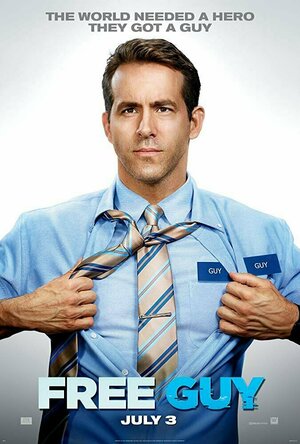
Filmed in 2019 and finally seeing release after five separate delays from its original July 2020 premiere date, Free Guy is a sci-fi action comedy directed by Shawn Levy (Real Steal, the Night at the Museum trilogy) and written by Matt Lieberman (Scoob!) and Zak Penn (Ready Player One), which follows the life of Guy (Ryan Reynolds), an NPC that and lives and works as a bank teller in Free City.
Completely content with every day being exactly the same as the day before, Guy’s life is changed forever following a chance encounter with a ‘Sunglasses Person’ (the film’s term for player characters) named Molotov Girl (Jodie Comer).
An homage to Grand Theft Auto’s Vice City, with some elements from Fortnite sprinkled in for good measure, Free City is located within a video game of the same name, and boasts a population of various NPCs (non-player characters) as they go through their daily routines completely unaware that they’re stuck within the confines of a video game.
These NPCs cater to the whim of the Sunglasses People, who are seen as unapproachable heroes, but in actuality are just players from the real world who want to loot, steal, and cause chaos in order to achieve virtual richness in free city.
Ryan Reynolds’ real-life demeanor and sense of humor are so similar to his portrayal of Deadpool that almost anything Reynolds has done since 2016 has undoubtedly reminded you of The Merc With A Mouth.
To that end, in Free Guy, Reynolds’ narration of his own story, combined with the film’s explosive action, will definitely have filmgoers reminiscing about Marvel’s pair of R-rated X-men spin-offs – an inevitable circumstance of being a successful actor and allowing oneself to be typecast into roles similar to their most popular one.
While there are some laugh out loud moments in Free Guy, the “Oh, he found the button,” scene being the most notable, the film simply isn’t as funny as you think it’s going to be.
There’s no arguing that Free Guy is amusing to a certain extent, but its repeated gags and attempts at humor, more often than not, fall flat. Taika Waititi’s Antwan character, the man calling the shots when it comes to Free City’s game development, is a highlight of the film.
However, the promotional clip of Waititi’s outtakes released to hype the film, whose content supposedly made it into the film (spoiler alert: they didn’t), is better than any of Antwan’s actual lines of dialogue in the theatrical cut.
The cameos in Free Guy are some of the best surprises to stumble onto while seeing the film. They won’t be spoiled here, though some of them have been spoiled on the internet already, but there are a couple of really fun ones that are so much more entertaining if you go in not expecting them.
In fact, one of the lengthier such cameos, which extends across multiple scenes and features in several minutes of screen time, is a major source for hilarity in Free Guy.
The premise of Free Guy a A background character in a video game becomes sentient – is its most promising aspect. Guy, motivated by a desire to get more out of life than the daily routine he’s accustomed to, essentially betters himself simply because he wants to. In a way, it’s an I, Robot kind of concept burrito’d within a world that would fit within the walls of Ready Player One.
Surprisingly, given its filming before the outbreak of the pandemic, the film is also extremely relatable to how our reality is still under the thumb of an unpredictable coronavirus. Guy being trapped within the walls of Free City and wanting more out of life is an awfully similar sentiment to wanting everything back to normal after being stuck in months-long lockdowns.
Yet, Free Guy’s solid special effects, absurd humor, and surprisingly effective cameos are nearly derailed by how much time it devotes to the its love story.
Guy’s big awakening all comes down to finding the girl of his dreams, which then branches off into a different sort of relationship in the real world that was right under two character’s noses from the start. It feels like it was meant to be this sort of revelation in the film, but comes off as this, “Duh,” moment anyone besides the writers could have predicted.
Speaking of the film’s writing, the character of Mouser (Utkarsh Ambudkar) is so poorly written that it’s unbearable and exhausting.
A developer working alongside Antwan and Keys (Joe Kerry), Mouser comes off a rival to the later, acting like he can do Keys’ job better than Keys can and constantly breaking his balls from the moment he is introduced. Throughout the film, Mouser wants to do nothing more than whatever Antwan says, even if it’s morally reprehensible.
But, predictably, in the film’s final moments, Mouser is suddenly Keys’ best friend, wanting to do what’s right all for the sake of a happy ending.
Ultimately, while Free Guy has an amazing concept, it’s trapped within a massively underwhelming execution.
Admittedly, the film looks like it was an absolute blast to make, but also incredibly expensive. This tall budget, combined with public hesitancy to return to theaters and the Delta variant of COVID seemingly on the verge of backtracking all the progress we’ve made since the vaccine became readily available to the public, it makes you wonder if Free Guy has any sort of chance of making a respectable amount of money at the box office or even just breaking even.
Note: This was originally written when the film opened in theaters. Free Guy would go on to make $331.5 million on a $100-$125 million budget. A sequel is currently in the works.
Completely content with every day being exactly the same as the day before, Guy’s life is changed forever following a chance encounter with a ‘Sunglasses Person’ (the film’s term for player characters) named Molotov Girl (Jodie Comer).
An homage to Grand Theft Auto’s Vice City, with some elements from Fortnite sprinkled in for good measure, Free City is located within a video game of the same name, and boasts a population of various NPCs (non-player characters) as they go through their daily routines completely unaware that they’re stuck within the confines of a video game.
These NPCs cater to the whim of the Sunglasses People, who are seen as unapproachable heroes, but in actuality are just players from the real world who want to loot, steal, and cause chaos in order to achieve virtual richness in free city.
Ryan Reynolds’ real-life demeanor and sense of humor are so similar to his portrayal of Deadpool that almost anything Reynolds has done since 2016 has undoubtedly reminded you of The Merc With A Mouth.
To that end, in Free Guy, Reynolds’ narration of his own story, combined with the film’s explosive action, will definitely have filmgoers reminiscing about Marvel’s pair of R-rated X-men spin-offs – an inevitable circumstance of being a successful actor and allowing oneself to be typecast into roles similar to their most popular one.
While there are some laugh out loud moments in Free Guy, the “Oh, he found the button,” scene being the most notable, the film simply isn’t as funny as you think it’s going to be.
There’s no arguing that Free Guy is amusing to a certain extent, but its repeated gags and attempts at humor, more often than not, fall flat. Taika Waititi’s Antwan character, the man calling the shots when it comes to Free City’s game development, is a highlight of the film.
However, the promotional clip of Waititi’s outtakes released to hype the film, whose content supposedly made it into the film (spoiler alert: they didn’t), is better than any of Antwan’s actual lines of dialogue in the theatrical cut.
The cameos in Free Guy are some of the best surprises to stumble onto while seeing the film. They won’t be spoiled here, though some of them have been spoiled on the internet already, but there are a couple of really fun ones that are so much more entertaining if you go in not expecting them.
In fact, one of the lengthier such cameos, which extends across multiple scenes and features in several minutes of screen time, is a major source for hilarity in Free Guy.
The premise of Free Guy a A background character in a video game becomes sentient – is its most promising aspect. Guy, motivated by a desire to get more out of life than the daily routine he’s accustomed to, essentially betters himself simply because he wants to. In a way, it’s an I, Robot kind of concept burrito’d within a world that would fit within the walls of Ready Player One.
Surprisingly, given its filming before the outbreak of the pandemic, the film is also extremely relatable to how our reality is still under the thumb of an unpredictable coronavirus. Guy being trapped within the walls of Free City and wanting more out of life is an awfully similar sentiment to wanting everything back to normal after being stuck in months-long lockdowns.
Yet, Free Guy’s solid special effects, absurd humor, and surprisingly effective cameos are nearly derailed by how much time it devotes to the its love story.
Guy’s big awakening all comes down to finding the girl of his dreams, which then branches off into a different sort of relationship in the real world that was right under two character’s noses from the start. It feels like it was meant to be this sort of revelation in the film, but comes off as this, “Duh,” moment anyone besides the writers could have predicted.
Speaking of the film’s writing, the character of Mouser (Utkarsh Ambudkar) is so poorly written that it’s unbearable and exhausting.
A developer working alongside Antwan and Keys (Joe Kerry), Mouser comes off a rival to the later, acting like he can do Keys’ job better than Keys can and constantly breaking his balls from the moment he is introduced. Throughout the film, Mouser wants to do nothing more than whatever Antwan says, even if it’s morally reprehensible.
But, predictably, in the film’s final moments, Mouser is suddenly Keys’ best friend, wanting to do what’s right all for the sake of a happy ending.
Ultimately, while Free Guy has an amazing concept, it’s trapped within a massively underwhelming execution.
Admittedly, the film looks like it was an absolute blast to make, but also incredibly expensive. This tall budget, combined with public hesitancy to return to theaters and the Delta variant of COVID seemingly on the verge of backtracking all the progress we’ve made since the vaccine became readily available to the public, it makes you wonder if Free Guy has any sort of chance of making a respectable amount of money at the box office or even just breaking even.
Note: This was originally written when the film opened in theaters. Free Guy would go on to make $331.5 million on a $100-$125 million budget. A sequel is currently in the works.

Hadley (567 KP) rated The Amazing Crime and Trial of Leopold and Loeb in Books
Apr 13, 2019
"The crime itself was indefensible. The brilliant, spoiled and bored sons of two of Chicago's wealthiest families planned to commit the perfect crime both for the thrill of and to prove their perverse misunderstanding of Friedrich Nietzsche's philosophy of the 'superman,' who was above all law so long as he made no mistake. Their plan, worked out over several months, was to kidnap and immediately kill one of their younger neighbors and hide his body. They would then demand and collect a ransom. The body would never be discovered, the crime would never be solved and only they would know that they had prevailed over ordinary human beings and their simple-minded legal system. But far from being the 'perfect crime,' the murder of 14-year-old Bobby Franks turned out to be amateurishly botched. Before any ransom could be paid, the boy's body was discovered in a culvert near where Nathan Leopold often went bird-watching. A pair of telltale glasses were found adjacent to the body. They were easily traced to Leopold who first came up with a paper-thin alibi and soon thereafter confessed to the crime. His fellow murderer likewise confessed. Each of the 'superboys' placed blame for the actual killing on the other." - Alan M. Dershowitz
If you mentioned the names Leopold and Loeb today, many people wouldn't know who you were talking about, but if you had mentioned them just thirty years ago, many people would recall the 'murder of the century.'
If you are a fan of the True Crime genre, you'll come across the case of two wealthy Chicago boys who thought they could get away with murder. (The trial is probably the most talked about trial to-date because this is the first time that psychology was brought before a court room.)
For a good part of the late 1920's, Leopold and Loeb were household names for good reason: they came from millionaire families, they were college graduates before they were 18-years-old, and their trial was the first time in history that the world saw psychology put in front of a judge. The trial was even more unforgettable due to a closing speech given by famous defense attorney, Clarence Darrow, which is reprinted in its entirety,spanning a hefty 93 pages.
Nathan Leopold, Jr. and Richard Loeb were two people who should have never met, according to the courtroom. The two met at about the age of fifteen, soon after they began to embark on criminal acts together, ranging from theft to arson. It's stated in 'the Amazing Crime and Trial of Leopold and Loeb' that Loeb had created a fantasy world where he was a crime ringleader that was too smart for the police to catch. Readers get to judge for themselves whether or not they believe Loeb was the cause of their crimes, or if Leopold was the one really in charge.
After robbing Loeb's fraternity house together, Leopold and Loeb came up with a plan to kidnap a wealthy child that they could then ransom. "They began to devise elaborate plans for this kidnapping, and soon the planning became the all-important thing. They gave up the idea of kidnapping this particular person [a young man named William], and settled on the idea of kidnapping anyone who would fit in their kidnapping plans." Throughout the book, we find out that the boys were pretty desperate for a kidnapping victim, that they even thought about kidnapping one of their close friends:
"The plan of kidnaping Dick Rubel was given up because Dick Rubel's father was so tight we might not get any money from him."
Leopold and Loeb discussed everything from how they would receive the ransom, what weapons they would use, how they would get the victim inside a rented vehicle, and what they would do with the body afterwards. "In March, 1924, the patient [Loeb] conceived the idea of securing the money by having it thrown off a moving train. This idea was discussed in great detail, and gradually developed into a carefully systematized plan. As time wore on the plan became greatly modified from the original one. They discussed at considerable length the choice of a suitable subject for kidnapping. The patient's companion [Leopold] suggested that they kidnap a young girl instead of a boy, but the patient [Loeb] objected to this. His companion [Leopold] also suggested that they kidnap the patient's [Loeb] younger brother, but the patient apparently did not seriously consider doing this. They then considered half a dozen boys, any one of whom would do, for the following reasons: that they were physically small enough to be easily handled and their parents were extremely wealthy and would have no difficulty or disinclination to pay ransom money."
During the trial, Leopold and Loeb's psychological evaluations became the forefront of their guilty plea, stating that they were not responsible for their actions due to their upbringing and environment. "I submit the facts do not rest on the evidence of these boys alone. It is proven by the writings; it is proven by every act. It is proven by their companions, and there can by no question about it." Clarence Darrow explains in his famous closing statement. "We brought into this courtroom a number of their boy friends, whom they had known day by day, who had associated with them in the club house, were their constant companions, and they tell the same stories. They tell the story that neither of these two boys was responsible for his conduct."
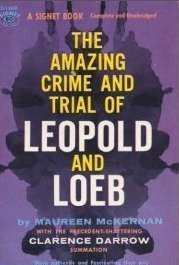
'The Amazing Crime and Trial of Leopold and Loeb' contains the portions of the psychiatric evaluations that were submitted in court,but the testimony of character witnesses is omitted. For a factual telling of a real life trial, this book is okay. If the reader pays attention, they may notice that some of the book contradicts itself, such as one page states that the car robe used to wrap up Franks' body was found buried near Lake Michigan,but then pages later, the book states it had been burned at Loeb's home.
The psychiatric reports are very repetitive,just using different words to describe the same things. Yet, these reports are the backbone of the trial and well worth a read. The evaluations and Darrow's extensive speech were what saved Leopold and Loeb from a death sentence.
There are very few books written about the 'murder of the century,' and even less about the 'lawyer of the century.' Leopold and Loeb, as well as Darrow, have faded into the obscurity of the True Crime genre, but because the boys' mental state was brought into question, we now accept forensic science/psychology in the court room today. I feel that only people who are truly interested in True Crime, or even have a fascination for the court room are the only ones who will enjoy 'The Amazing Crime and Trial of Leopold and Loeb.'
If you mentioned the names Leopold and Loeb today, many people wouldn't know who you were talking about, but if you had mentioned them just thirty years ago, many people would recall the 'murder of the century.'
If you are a fan of the True Crime genre, you'll come across the case of two wealthy Chicago boys who thought they could get away with murder. (The trial is probably the most talked about trial to-date because this is the first time that psychology was brought before a court room.)
For a good part of the late 1920's, Leopold and Loeb were household names for good reason: they came from millionaire families, they were college graduates before they were 18-years-old, and their trial was the first time in history that the world saw psychology put in front of a judge. The trial was even more unforgettable due to a closing speech given by famous defense attorney, Clarence Darrow, which is reprinted in its entirety,spanning a hefty 93 pages.
Nathan Leopold, Jr. and Richard Loeb were two people who should have never met, according to the courtroom. The two met at about the age of fifteen, soon after they began to embark on criminal acts together, ranging from theft to arson. It's stated in 'the Amazing Crime and Trial of Leopold and Loeb' that Loeb had created a fantasy world where he was a crime ringleader that was too smart for the police to catch. Readers get to judge for themselves whether or not they believe Loeb was the cause of their crimes, or if Leopold was the one really in charge.
After robbing Loeb's fraternity house together, Leopold and Loeb came up with a plan to kidnap a wealthy child that they could then ransom. "They began to devise elaborate plans for this kidnapping, and soon the planning became the all-important thing. They gave up the idea of kidnapping this particular person [a young man named William], and settled on the idea of kidnapping anyone who would fit in their kidnapping plans." Throughout the book, we find out that the boys were pretty desperate for a kidnapping victim, that they even thought about kidnapping one of their close friends:
"The plan of kidnaping Dick Rubel was given up because Dick Rubel's father was so tight we might not get any money from him."
Leopold and Loeb discussed everything from how they would receive the ransom, what weapons they would use, how they would get the victim inside a rented vehicle, and what they would do with the body afterwards. "In March, 1924, the patient [Loeb] conceived the idea of securing the money by having it thrown off a moving train. This idea was discussed in great detail, and gradually developed into a carefully systematized plan. As time wore on the plan became greatly modified from the original one. They discussed at considerable length the choice of a suitable subject for kidnapping. The patient's companion [Leopold] suggested that they kidnap a young girl instead of a boy, but the patient [Loeb] objected to this. His companion [Leopold] also suggested that they kidnap the patient's [Loeb] younger brother, but the patient apparently did not seriously consider doing this. They then considered half a dozen boys, any one of whom would do, for the following reasons: that they were physically small enough to be easily handled and their parents were extremely wealthy and would have no difficulty or disinclination to pay ransom money."
During the trial, Leopold and Loeb's psychological evaluations became the forefront of their guilty plea, stating that they were not responsible for their actions due to their upbringing and environment. "I submit the facts do not rest on the evidence of these boys alone. It is proven by the writings; it is proven by every act. It is proven by their companions, and there can by no question about it." Clarence Darrow explains in his famous closing statement. "We brought into this courtroom a number of their boy friends, whom they had known day by day, who had associated with them in the club house, were their constant companions, and they tell the same stories. They tell the story that neither of these two boys was responsible for his conduct."
'The Amazing Crime and Trial of Leopold and Loeb' contains the portions of the psychiatric evaluations that were submitted in court,but the testimony of character witnesses is omitted. For a factual telling of a real life trial, this book is okay. If the reader pays attention, they may notice that some of the book contradicts itself, such as one page states that the car robe used to wrap up Franks' body was found buried near Lake Michigan,but then pages later, the book states it had been burned at Loeb's home.
The psychiatric reports are very repetitive,just using different words to describe the same things. Yet, these reports are the backbone of the trial and well worth a read. The evaluations and Darrow's extensive speech were what saved Leopold and Loeb from a death sentence.
There are very few books written about the 'murder of the century,' and even less about the 'lawyer of the century.' Leopold and Loeb, as well as Darrow, have faded into the obscurity of the True Crime genre, but because the boys' mental state was brought into question, we now accept forensic science/psychology in the court room today. I feel that only people who are truly interested in True Crime, or even have a fascination for the court room are the only ones who will enjoy 'The Amazing Crime and Trial of Leopold and Loeb.'