

ThinkMaverick - Entrepreneur and Startup Notes
Business and Magazines & Newspapers
App
Are you looking to make a difference in your niche, industry or marketplace? Striving to start a...

ProSieben – Live TV, Mediathek
Entertainment and Lifestyle
App
KOSTENLOS FERNSEHEN mit der ProSieben TV App. Für Deine Shows, Stars, Blockbuster und Lifestyle...

Harrison’s Principles of Internal Medicine
Education and Medical
App Watch
The landmark guide to internal medicine—updated and streamlined for today’s students and...
education medicine

13:20:Sync
Navigation and Reference
App
This app puts the Mayan Dreamspell Calendar in your pocket! "13:20:Sync makes it so much easier to...

Gareth von Kallenbach (980 KP) rated Warhammer: Chaosbane in Video Games
Jul 8, 2019

Much like the games that it takes inspiration from, you have the opportunity to pick one of four characters to battle the Lords of Chaos and bring order to the land. Your standard archetype characters are all here in standard Warhammer Fantasy. The Dwarven “Slayer” class, for those who like a barbarian class to rage havoc upon his foes, The High-Elf Mage who utilizes his magic to bring down the forces of chaos, the ho-hum Imperial Soldier who can take and deal out a huge amount of damage, and the Wood Elf who uses her bow and dagger to deal damage at a frighteningly fast pace.
Each of the characters have their own unique secondary ability that allows them to gain a strategic advantage on their foes. The Slayer can vault himself into enemies (much like the Barbarian class in Diablo), The Mage can control magical projectiles towards his targets, the Imperial soldier can shield bash targets and the Wood Elf can tumble in and out of danger. I played through the vast majority of the game as the Wood Elf and learning to use her tumble ability and stay mobile is some of the best ways to beat the bosses that you will come across.
One area where Warhammer: Chaosbane improves on the standard Diablo formula is how it handles health and energy/mana. Various items you equip can provide health regeneration on their own or you also possess the ability to use a “health Potion” that refills slowly each time you use it. Thankfully this means you don’t have individual health potions cluttering up your inventory. Mana/Energy is used for special attacks and actions…each time you use a skill some of your Mana/Energy is used. There are a few ways you can recoup your energy. The first is to use your general attacks on creatures, as you successfully hit each one your energy fills a little until it tops the meter off. The other way is to reach out to your familiar who follows you around the screen. My familiar was a butterfly that I could run over to when I’d run low on energy and it would fill my meter about half way. When you utilize your familiar in this way they must also recharge, so use them wisely.
One of the more unique items that you acquire as you slice your way through the hordes of demons and undead are Blood Orbs. Blood Orbs appear on the battlefield seemingly at random (although the more enemies you cut down the more likely they are to appear). As you acquire these orbs it fills a Blood lust meter and when full imbues your character with incredible power and near invincibility until the meter runs out. The Orbs don’t stay on the battlefield forever however, and they slowly lose power the longer you wait to gather them, so it encourages you to step out of the battle (or in my case roll out of the battle) to gather them as quickly as you can. As you progress your character you’ll be given the chance to upgrade these as well which essentially allows you to fill multiple meters and grants you this special power for longer lengths of time.
Skills are broken down into various types which allow you to outfit your character to best suit your play style. There are literally dozens of both active and passive skills to choose from, and each of these skills can be upgraded as well for improved effects or damage. As the Wood Elf Elessa, I was able to summon dryads to my side to help me deal with the hordes of enemies. In edition there are also God Skills that you acquire as you level up and complete missions. These special skills unlock more powerful abilities but also unlock traits as you apply the points. Traits such as health regeneration or critical hit chances are only some of the ones that you can unlock along the God Skill tree that give you a sense that your character is becoming more unstoppable with every skill acquired.
Unfortunately, the inconsistent voice acting is what relegates Chaosbane to being good instead of great. I made the mistake of choosing the character with the worst voice acting in the bunch and if I had played through with another character I may not have noticed how truly terrible it was. Elessa delivers her lines in an almost wooden (pun intended) manner, almost as if reading directly from a script. This gets even more noticeable when on occasion her voice changes to that of a man. The developers and testers did a good job of catching most of them, but there were at least five or six dialog trees where Elessa’s voice changed completely. I have two theories on this, my first theory (although I hadn’t confirmed this) is that the character was originally meant to be portrayed as a man and was changed to add a bit more diversity to the line-up. Not that there is anything wrong with having the main characters all be male, but it certainly could have limited the appeal of the audience. My second theory is that some of the dialog was simply place holders while they were sourcing out the right voice actors and simply missed replacing the audio bytes.
Either way, Elessa isn’t the only place where the voice acting takes a turn for the worst, other characters suffer from this fate as well. While the Warhammer games have always used bravado to deliver their dialog, it is simply too over the top in most cases. The first boss I encountered sounded like Cobra Commander who had just walked off the set of the latest GI Joe Cartoon to lead the forces of Chaos…Yo Joe! The fact that the game is voice acted entirely is something that I do applaud the developers for insisting on, it’s just disappointing that you find yourself reading through the dialog as quickly as possible and skipping the voices whenever you can.
Even with its flaws Warhammer: Chaosbane is a fun Diablo clone and an absolute blast to play. The story is forgettable, the voices laughable, but the combat scratches the same itch that any other action roleplaying game provides. There’s plenty of loot to acquire, that ranges from common to rare, and your ability to “bless” items to make them more powerful is an added bonus. There are a whopping ten levels of difficulty, each level provides for a more difficult adventure with the promise of even better loot. With both couch co-op and online multiplayer, it even harkened me back to the days of playing the original Gauntlet in the arcades. If you like the Warhammer universe and are looking for a game you can pick up and play with relative ease, then Warhammer: Chaosbane is just the game you are looking for.
What I liked: Fun combat, Amazing selection of skills, Plays equally well with keyboard/mouse or controller
What I liked less: Terrible voice acting, Repetitive loot drops, Forgettable story
Sophia (Bookwyrming Thoughts) (530 KP) rated Broken Dolls (Broken Dolls, #1) in Books
Jan 23, 2020
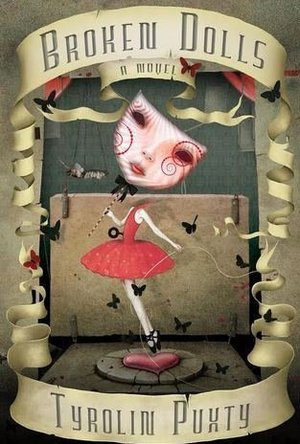
<strong><em>Broken Dolls</em> is like a creepy version of <em>Toy Story</em></strong> (I suppose <em>Toy Story</em> could be creepy...) with live, animated dolls created from humans. They're supposed to be unemotional and feel nothing – not pain, not happiness, not loneliness...
For three decades, Ella lived her life as a doll, assisting the Professor in his creations. In those years, she's forgotten about her humanity and seems perfectly happy as a dancing doll until the Professor unveils his latest creation: a goth doll named Lisa.
Here are my thoughts on the Professor: I deem him an ingenious mad scientist. He is absolutely <em>insane</em>, feels guilty about the past, and wants to change the world. I honestly don't know what to say about the guy aside from the fact I actually feel just a tad bit bad for him in the long run.
But as odd as it might be, I enjoyed the aspect of humans being turned into dolls and living a supposedly ideal life with no emotions or feelings and a life controlled by the Professor. I didn't expect Ella to have much of a voice or a personality aside from what she knew during her time as a doll (also more robotic sounding), and it is definitely the case in the early parts of <em>Broken Dolls</em> when Puxty sets up Ella's world in a Toy Story-esque fashion.
Ella's world revolves around the Professor making her a comfy room (lots of pink) in a chest in the attic of his home (that sentence sounds weird). To pass the time away, Ella spends her days locked up in the attic practicing ballet and recording adventures from her imagination into a recorder. The attic comes out a little bland – nothing remotely interesting and Ella's day-to-day actions would have sounded repetitively boring if Puxty didn't bring Lisa and Gabby into the story.
When Ella meets Lisa, however, she doesn't like Lisa; Lisa makes multiple attempts to destroy Ella because of the theory she has about Ella and all the other dolls. Around the same time, Ella meets the Professor's granddaughter, Gabby, a girl who has a virus that will eventually lead her to an inevitable fate. Like many kids, Gabby is adventurous, and she adores and protects Ella from the moment they meet. Unfortunately for Gabby, the Professor also has plans to turn Gabby into a doll-like Ella and prevent her from dying.
In the time Ella meets Lisa and Gabby, she starts to develop feelings and emotions and becomes more curious about her time before she turned into a doll. With the help of Lisa and another doll, she also strives to dig out all of the Professor's secrets to his experiments before Gabby becomes an Ella-sized playmate. But not only does Ella uncovers the Professor's secrets, she uncovers hers as well and Puxty gives us a glimpse into Ella's human life before becoming a doll.
I personally think Ella is better off as a doll compared to being a human. With the brief glimpse of Ella's human life, she starts out extremely happy and becomes really pessimistic later on – I don't know how I would be able to handle human Ella. Since <em>Broken Dolls</em> has a sequel coming out sometime in 2016, I'm really curious how Ella will cope with her doll life as everyone around her knows who she really is and continues on with their lives.
<a href="https://bookwyrmingthoughts.com/arc-review-broken-dolls-by-tyrolin-puxty/"; target="_blank">This review was originally posted on Bookwyrming Thoughts</a>

Bob Mann (459 KP) rated The Two Popes (2019) in Movies
Jan 26, 2020 (Updated Jan 26, 2020)
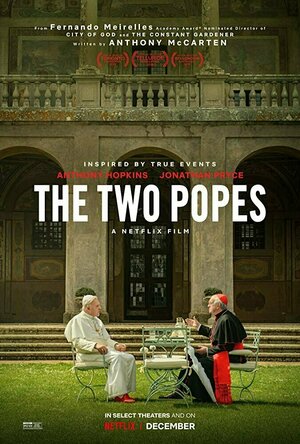
All that changed in 2013 when Pope Benedict XVI resigned, the first pope to voluntarily do so since Pope Celestine V in 1294. (Pope Gregory XII also resigned in 1415, but he was effectively forced to).
This movie tells the story of that curious situation, when Cardinal Jorge Bergoglio (played by Jonathan Pryce) ended up as Pope Francis while Benedict (Anthony Hopkins) was still alive. The official reason for the pope's resignation appears to have been his advanced age. But the film paints a rather different picture.
The movie starts back in 2005 as we enter the papal conclave. Benedict (Cardinal Ratzinger, as was) is the highly-political German cardinal who desperately wants the papacy; Bergoglio is the highly respected Argentinian cardinal who doesn't seek the office but might have it thrust upon him. (Clearly, when the white smoke clears, history has dictated the outcome).
But flash forward to 2013 and Bergoglio will get another bite of the cherry. Is he worthy of the role? Through flashbacks we return to Perón's unsettling rule over Argentina and the events that made the man.
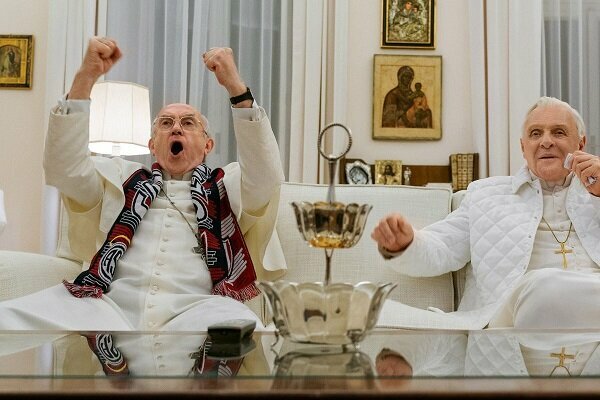
The two stars are simply outstanding together, and it's no surprise at all that both have been nominated in the Oscar acting categories. They are almost joint leads. But - perhaps to give the film its best awards-season shot - Pryce is down for Best Actor and Hopkins is down for Best Supporting Actor.
Anthony Hopkins in particular for me shone with the brilliant quietness and subtle facial movements that are the mark of a truly confident actor. Less is more.
I was enjoying this movie enormously up until we flashed back to the Argentinian sub-plot. Set in the time of Perón's "Dirty War" when a huge number of people - estimates range from 9,000 to 30,000 - simply went "missing". There's nothing wrong with this sequence of the film. For example, a reunion of Bergoglio with a persecuted priest, Father Jalics (Lisandro Fiks) - is brilliantly and movingly done. It's just that for me it seemed so disjointed. It was jarring to switch from this Evita-era drama to the gentle drama of the papal plot.
If the movie had been 30 minutes shorter and focused on the mental struggles of Benedict I would have preferred it. Curiously - we don't really get to fully understand his divergence from the faith. Bergoglio gets no end of back-story. But Ratzinger's is probably just as interesting, but not explored.
This is still a really fine movie and will appeal to older folks who like a story rich with character acting and not heavy on the action or special effects. The director is Fernando Meirelles (who interestingly directed the Rio Olympics opening ceremony!) and it's written by Anthony McCarten, the man behind the screenplays for "The Theory of Everything", "Darkest Hour" and "Bohemian Rhapsody".
You may still be able to find this in selected cinemas (e.g. Curzon) but it is also streaming on Netflix, which is where I had to watch it.
(For the full graphical review, please check out One Mann's Movies at https://bob-the-movie-man.com/2020/01/26/one-manns-movies-film-review-the-two-popes-2019/ ).

Neil Goddard (3 KP) rated Godzilla: King of the Monsters (2019) in Movies
Feb 27, 2020
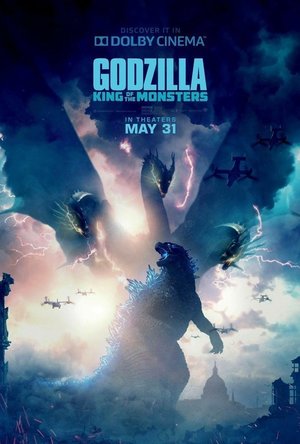


Now, imagine you’re watching a film. I don’t know, maybe a bit creature epic, larger than life with whole cities being destroyed. The creature’s look amazing and the carnage they are wreaking is fabulous; buildings, helicopters, cars, all flying around the screen with a swish of a mighty reptilian tale. Now imagine that the actors, real people, not CGI, are, at best, bland and in some instances just outright terrible.
Annoying isn’t it?
It would lead one to believe that the film makers didn’t really put any stock in the human interactions, rather just gave a huge wad of cash to an SFX company and said, “Fill your boots, the more the merrier, make everything f---ing enormous!”
Godzilla (2014) was the second time Hollywood has attempted to make a film featuring Japan’s kaiju supremo and it was the first successful attempt from Hollywood, given that the 1998 Roland Emmerich attempt was basically Lost World: Jurassic Park (1997) but with added daddy issues (Roland Emmerich’s trademark).
Gareth Edwards 2014 first entry in the MonsterVerse was a huge success, financially and artistically. We saw a Godzilla that was of a scale we’d always wanted, towering over buildings, a reptilian God and we’re just the ants trying to not get squished.
Godzilla: King of Monsters attempts to up the ante by throwing a dozen or so monsters at the story. “Godzilla fought two MUTO’s did he, well… hold my beer!” Yeah, we’ll hold your beer while you get Millie Bobby Brown to stand there teary eyed for most of the film (a waste), Vera Farmiga to go from bereaved workaholic, to eco-terrorist to pointless self-sacrifice (unfathomable), and for Kyle Chandler to… well, Christ knows what Kyle Chandler was doing, apart from spitting terrible dialogue badly and then standing/sitting/walking looking angry but unconvincingly. Bradley Whitford provided some nice comic relief, he does droll sarcasm immensely well, Charles Dance is underused (and then forgotten about) and Zhang Ziyi tries to out-Kyle-Chandler Kyle Chandler in the bland, borderline useless stakes.
Worse than any failing on the human emotion side of the story are the huge liberties they take with global travel, like, one of side of the world to the other in a very short space of time. I mean Godzilla can do it because of some tunnels under the sea that he uses, possible the ones used in the science-denying sci-fi car crash abomination The Core (2003), but for the humans to just pop to Venezuela or the Antarctic is unforgivable.
This kind of leaps of reality always leads me to lose interest in the events in a film and start thinking around the script. In a film where everything everyone says is of dire emergency or import and then we see them in another part of the world some time later, what have they been talking about for all that time. Have they been napping? If so, it’s hasn’t eased any of the pointless angry posturing. Have they been chatting about boring everyday stuff? There is no hint of a relationship between any of these people who are spending potentially their last moments on earth together with alarming regularity. The world is possible about to get destroyed and you are in direct harm’s way! Shut up and nut up.
Gareth von Kallenbach (980 KP) rated Abraham Lincoln: Vampire Hunter (2012) in Movies
Aug 7, 2019

movies and this was no exception. And, to my honest surprise, it wasn’t as awful as I had wholly envisioned in my head.
The movie starts with a young Abraham Lincoln (Benjamin Walker) defending his slave friend, Will Johnson (Anthony Mackie), from abuse at the hands of a slave trader. A scuffle ensues and Abraham’s father is ultimately met face-to-face with “Adam” (Rufus Sewell), a well-known and well-feared trader in the lands. The two exchange heated words with Adam threatening to extract his revenge by some unknown means. What seems later that evening, Abraham’s mother is attacked by Adam as young Abraham watches from the shadows. Adam, as one can guess, is a vampire and leaves Abraham’s mother in such a state she cannot recover. Upon her death, Abraham vows revenge, devoting the next ten years of his life to killing Adam.
As the reader can surmise, Abraham is ill-equipped to face Adam and when the day finally arrives, he finds himself wholly unprepared for the task. Cue the entrance of Henry Sturgess, Vampire Hunter. Saving Abraham from an early demise, Henry (Dominic Cooper) takes the young man under his wing and teaches him the way of vampire hunting. He teaches young Abe that the vampires control the whole of the south, using the slave trade as their means for fresh and easily accessible blood. Having never tolerated slavery of any kind, Abraham is infuriated by this and his desire to eradicate the vampire colony grows.
From there he is bequeathed his infamous axe, its edge lined in silver, and we watch as young Abe grows and matures as a skilled warrior before our eyes. When the time comes, Abraham is sent away on a mission to kill select vampires in a quiet town, vampires who pose as noted professionals and townspersons during the day. As a rule, Henry cautions Abraham not to make any friends or form any kind of attachments. Of course, it’s at this point he meets Mary Todd and that whole theory goes out the window. In addition to his vampire hunting, he also begins his career in politics and as a renowned orator. Given one’s knowledge of history, we can see where this all leads.
I won’t divulge the whole of the story here – I’m sure you can imagine where it goes and what comes of it. That said, aside from the over-the-top fighting scenes and certain drawn out moments (the horse stampede and train fight immediately come to mind), it wasn’t as awful as I had originally envisioned. The movie is entertaining and still
retains a fair amount of the B-movie cheesiness one hopes for in watching it. Obviously, the storyline is wracked with historical inaccuracies and unlikely moments (really, Abe Lincoln survives a horse being thrown at him?), but it’s a B-movie and I wasn’t expecting perfection.
If you’re looking for something that offers sheer entertainment and nothing further, this is a movie for you then. You won’t be blown away by the acting skills, the special effects are decent enough (don’t pay extra for 3-D though – it was awful), and while the movie feels slow and drags at parts, over-all it’s rather entertaining for what it is.