

Beatriz (17 KP) rated Lilo & Stitch (2002) in Movies
Feb 22, 2019



It was released in 2002 passed in Hawaii. It tells the story about a girl (Lilo) and her sister (Nani) that fight to stay together as Nani is trying to prove to the social worker Cobra Bubbles that she is fit to take care of her younger sister. In the meawhile Lilo is bullied and feels different so Nani takes her to a dog shelter to adopt a dog. There Lilo meets Stitch, a mutated alien (or more specifically, experiment 626) that is hiding, from the Galactic Police, on Earth, and ends up using Lilo as his shield. But with time Lilo and Stitch become Ohana ( "Ohana means family and family means no one gets left behind or forgotten)
Its a fun and emotional film that touched a lot of childrens and adults hearts (including mine)
Here are some interesting facts that i found about the film...
- The original story focused solely on an alien living in a forest, trying to overcome his isolation and find out where he came from.
Lilo didn’t become a part of the film until much later during story development.
- Stitch was not originally supposed to talk, but when the filmmakers realized the story hinged on him being able to express himself at the film’s end,
they began developing his voice. Director Chris Sanders provided Stitch’s voice during test animation, and eventually everyone got so used to it that they
decided to keep it.
- After an early test screening showed that audiences thought Nani was Lilo’s mother, filmmakers reworked some key scenes to make their sisterly relationship clear.
- Lilo & Stitch was the first Disney animated film since Dumbo to use watercolor painted backgrounds.
- While on a tour of Kaua?i, filmmakers noticed that their Hawaiian tour guide seemed to know someone everywhere they went. They were so struck by the guide’s
explanation of the term “‘ohana” as it relates to an extended family, that they made it the central theme of the film.
- In the climax of the movie, Jumba can be seen flying around in a huge red spaceship that looks very similar to an airplane. This is because in the originaL
edit of the film, it WAS an airplane! In the original edit, the writers and animators had Jumba hijacking a Boeing 747 from the Lihue airport and crashing it
into buildings throughout Honolulu.
Unfortunately, the movie came out right after 9/11/2001. The animators felt this was much too close to the attacks that happened on September 11th, so they
remodeled Jumba’s spaceship to look a bit different than a Boeing 747, and also changed the buildings to mountains.
- All of the landscapes in the movie are recognizable locations in Hawaii
- Not only was the setting and plot of the movie unique, Lilo & Stitch was also very unique in the way that Disney promoted the movie. Disney released a set
of trailers in which they inserted the character of Stitch into some of their more “classic” films.
Some examples of the movies they inserted Stitch into, are as follows: The Little Mermaid; Stitch surfs on a wave that crashes down onto Ariel. Beauty and the
Beast; Stitch can be seen loosening the chandelier during the ballroom dance scene and it almost lands on Beast and Belle. Aladdin; he steals Jasmine away
during their magic carpet ride. The Lion King; Stitch is on Pride Rock instead of Simba.
- Did you know that the character of Stitch was actually created way back in 1985? Stitch was created by one of the directors of the film named Chris Sanders
for a children’s book he was writing. The children’s book was never published, and Stitch was made into a movie 17 years later.
Chris Sanders was not only one of the directors of Lilo & Stitch, but he was also a co-screenwriter, a co-character designer, and also provided the voice acting
for Stitch.
- During the animation stage of Lilo & Stitch, the animators made a conscious effort to design the "alien" aspects of the film a certain way.
Since the movie was going to take place on the island of Hawaii, they decided to design all of the alien aspects of the movie to resemble marine animals.
This makes sense, since Hawaii is famous for its diverse marine plant and animal life that resides on the island.

Visual Attention Therapy Lite - Cognitive Training
Medical and Education
App
Visual Attention Therapy helps brain injury and stroke survivors, as well as struggling students, to...

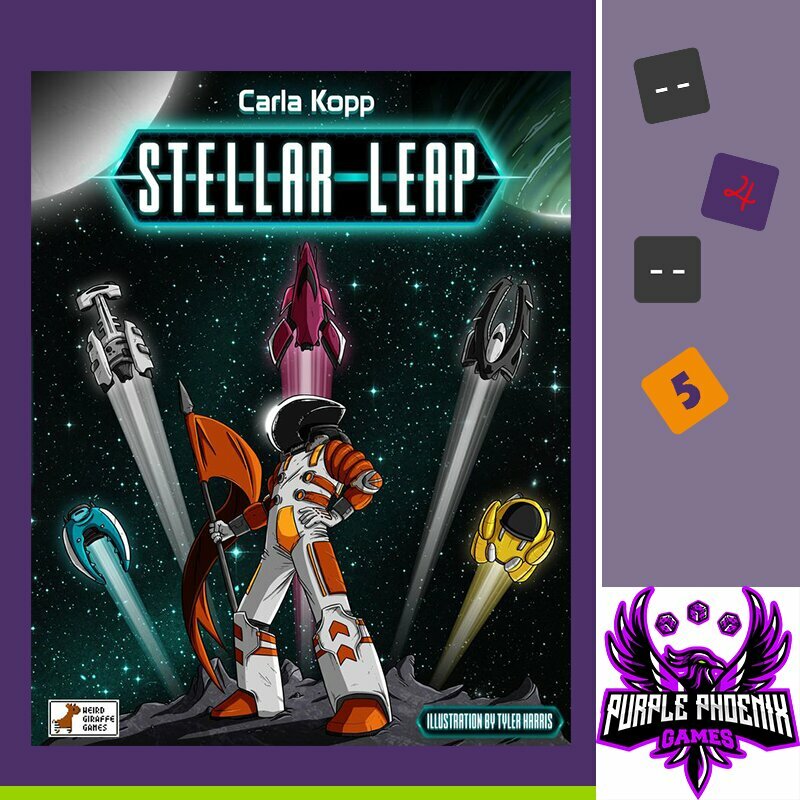
Purple Phoenix Games (2266 KP) rated Stellar Leap in Tabletop Games
Apr 23, 2020


DISCLAIMER: We were provided a copy of this game for the purposes of this review. This is a retail copy of the game, so what you see in these photos is exactly what would be received in your box. We do not intend to cover every single rule included in the rulebook, but will describe the overall game flow and major rule set so that our readers may get a sense of how the game plays. For more in depth rules, you may purchase a copy online or from your FLGS. -T
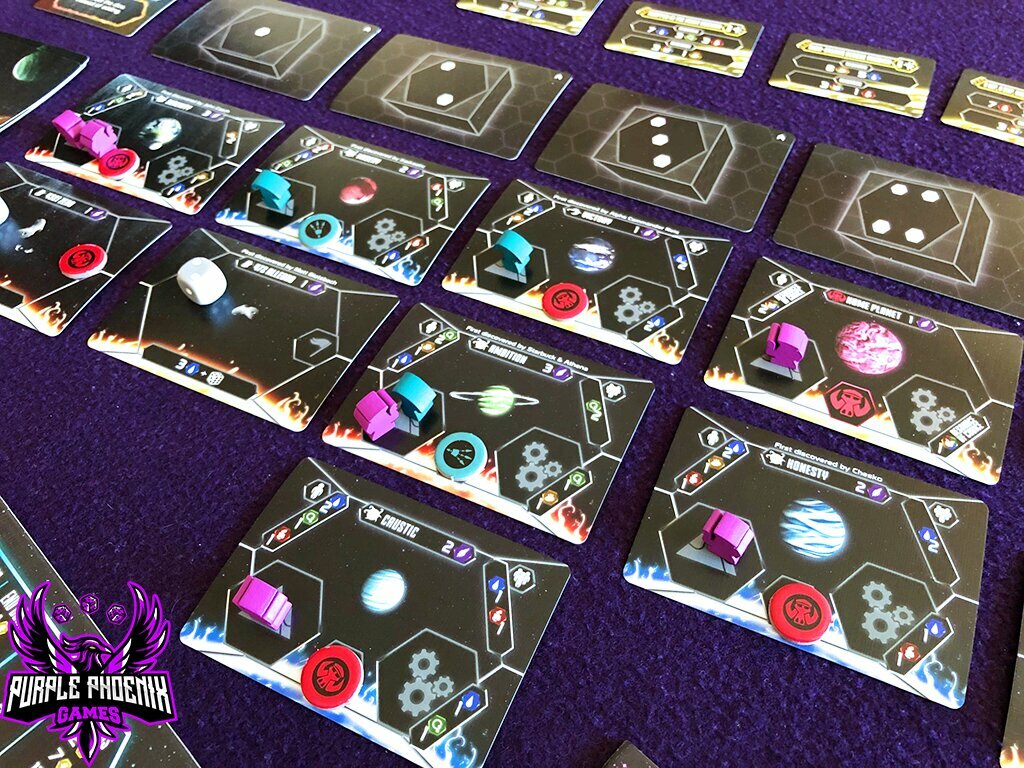
Stellar Leap is, at its core, a worker placement game with elements of dice rolling, variable powers, and a modular ‘board’ sprinkled in. To setup, each player receives an individual player board and components, while the Galaxy is set up for use by all players. Players then add their home planet, as well as 1 population marker, to the Galaxy, and the game is ready to begin! Stellar Leap is played over a series of rounds in which players take turns performing any or all actions available to them.
To begin a turn, players first recover any Population markers that may have been exhausted on their last turn (more on that in a bit). Next, the player rolls the two dice, manipulating them with Special Dice Powers if desired, and resources are collected. The Galaxy is set up in columns, each column numbered 1-6, to which these dice rolls will correspond. If you have a Population marker on a planet in one of the columns that corresponds to your die roll (you have a Population in column 4 and you rolled a 4), you collect the resources provided by that planet. It is important to note that any player can receive resources from a die roll, even if it is not their turn!
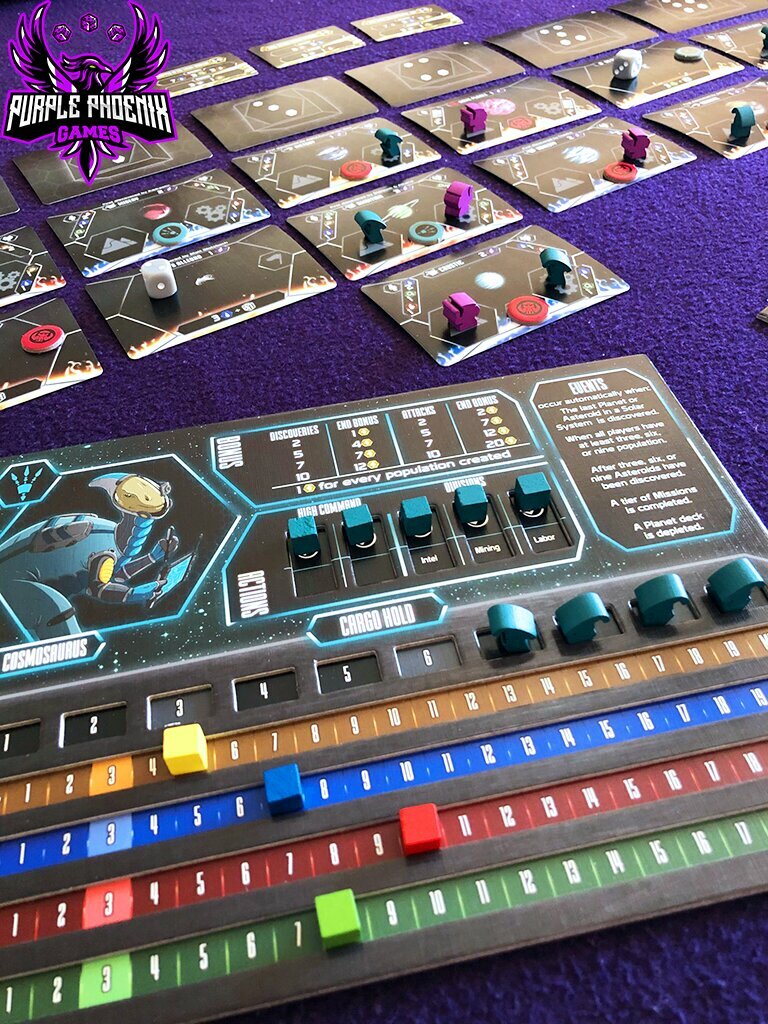
The next phase of play involves three elements: Movement, High Command Actions, and Division Actions. There is no limit to the amount of Movement you can take on your turn, as long as you have resources available to perform that action. You may take two High Command Actions: Populate (add a new Population marker to a planet), Tax (collect any two resources), Discover (add planets/asteroids to the Galaxy), or Attack (fight an opponent located on the same planet as yourself). The same High Command Action could be performed twice on your turn, but you can only perform two per turn. The Division Actions can each be taken once per turn. Those actions are: Intelligence (complete a Mission), Mining (mine an asteroid for resources), or Labor (exhaust one of your populations on a planet to receive additional resources). Movement, High Command Actions, and Division Actions can be taken in any order on your turn – turns are not ‘set’ in a specific order and actions can be taken at your discretion. You also are not required to take every available action on your turn if you do not want to – your turns could be as long or as brief as you want them to be, depending on which actions you want to take.
At certain points throughout play, Events will be triggered. When an Event is triggered, draw the top Event card and resolve its effect. Some are resolved immediately, and some remain in play for the rest of the game. The game ends once six Events have been triggered. Players then tally up their Prestige points (earned by completing Missions, discovering planets, winning combats, and fulfilling their secret objectives), and the player with the highest Prestige is declared the winner!
So as you can see, there is quite a bit going on in Stellar Leap. Admittedly, it seemed pretty daunting to me as I first read through the rules. But in all actuality, the game flows pretty efficiently and calmly. How? Player Reference cards! I absolutely looooove a game that includes good references cards for player turns because it makes it so much easier to check instead of digging through the entire rulebook for an answer. The Player Reference cards included in this game are well-written, clear, and concise, and that truly helps the game flow smoothly even though there are many elements to every turn. Another thing that I love about Stellar Leap is that you have so many strategic options. Everyone has their own secret objectives for end-game scoring to complete, but you also have to decide which Missions you’d like to accomplish to earn points as well. And do you want to risk many combats, or would you rather live harmoniously with your opponents? When adding planets/asteroids to the Galaxy, you also have to strategize where you should put them – do you want them close to you for easy access? Or do you want to keep them as far away from opponents as necessary? The modular board makes this a different game every time you play, so you can’t just pick a blanket strategy for every play.
The only thing that gives me pause with this game are the rules regarding Movement. You pay certain resources to move, but it depends on the ‘threat level’ of the destination as well as its location in your Solar System or a neighboring Solar System. It just was a little tricky to keep track of how many of each resource I had to pay to move, when moving more than just one planet away. That aspect takes a little bit more concentration, but other than that, the game gave me no issues.
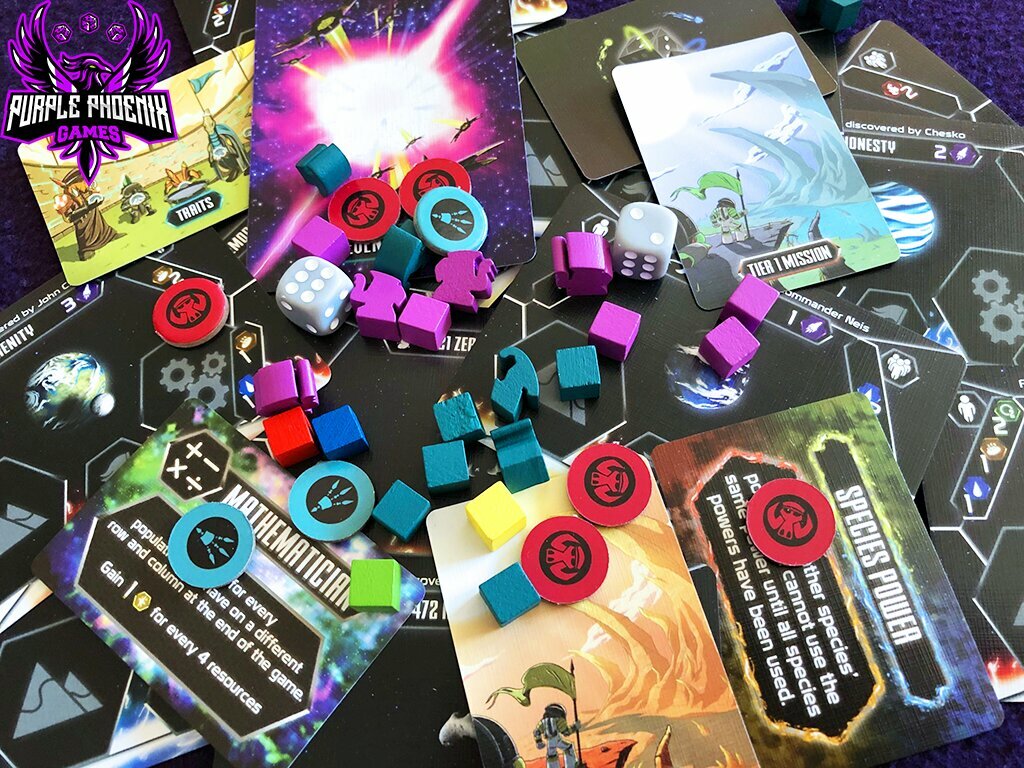
Speaking of no issues, let’s touch on components. The player boards are dual-layered and they are awesome. The text is clear, the organization is logical, and they are just of a great quality. The cards are nice and sturdy, the ‘meeples’ are cute and chunky, and the cardboard chits are good too. The space theme is definitely translated well in this game, and that adds to the immersion.
Overall, I would say Stellar Leap is stellar. (Ha, see what I did there?) The gameplay is engaging and the strategy is adaptable. Some of the rules seem a little tedious in some aspects, but for the most part, they are logical and easy to remember. Weird Giraffe Games is a publisher that has made a blip on our radar, and we are excited to see what other games they will put out in the future – we’ve been impressed so far! Purple Phoenix Games gives Stellar Leap an other-worldly 9 / 12.

Economics
Daron Acemoglu, David Laibson and John List
Book
For courses in Principles of Economics Acemoglu, Laibson, List: An evidence-based approach to...

Land Rover Series I, II & IIA: The Essential Buyer's Guide
Book
The Series Land Rover was conceived as a utility vehicle for farmers; one that could be repaired and...

Mod Servers for Minecraft PE
Reference
App
Want the best modded multiplayer servers at your fingertips? Look no further! With this app, get a...

Chris Sawin (602 KP) rated Antikörper (Antibodies) (2007) in Movies
Jun 18, 2019

Gabriel already admitted to being in the area around the time of Lucia’s death, but her murder doesn’t entirely fit his M.O. But Michael plays right into Gabriel’s hands and becomes the pawn in his sick, psychological game as he’s able to get into Michael’s head from the moment they meet and remains there until the credits roll. The question isn’t, “Will Michael be able to find what he’s looking for?” but is instead, “Will Michael be able to survive the cerebral hedge maze Gabriel has thrown him into?”
Written and directed by Christian Alvart (Case 39, Pandorum), Antibodies is a German crime drama thriller that is worth seeing for André Hennicke’s performance alone. His portrayal of Gabriel is psychotic, disturbing, and extraordinarily mesmerizing as he steals nearly every scene he’s in. Hennicke embodies Gabriel and brings the character to life in all of his monstrously disquieting glory. There’s a brief sequence where Gabriel is drawing in his cell and he slowly starts pulling out his hair. There’s no dialogue, but Hennicke is able to pull it off with such terrifying elegance that it is incredible to witness.
Wotan Wilke Möhring is also quite impressive as Michael Martens. Michael struggles with the mental obstacles Gabriel throws at him throughout the film. Möhring is fantastically efficient at portraying a man who devoted his life to being an abiding citizen that is also committed to his religion. He cares deeply about his family and is now slowly losing his grip on his so-called perfect life. The interrogation scenes between Michael and Gabriel seem to simultaneously be homage to The Silence of the Lambs while also offering something different with its complete mastery of tension and Gabriel’s ulterior motives ring loudly upon the audience yet fall on deaf ears to a gullible Michael.
The religious parallels are incredibly interesting and deserve recognition, as well. The film has a tendency to not only reveal these parallels, but dives into them in a way that is easy to understand for the audience; the similarities between Michael and the archangel Gabriel are uncanny. The ending involving the test Gabriel gives Michael is all a part of a twisted game Gabriel plays and the web he’s spun has managed to get Michael tangled up in it. The film makes you think you know where it’s headed before it takes an unexpected detour and ends up going in the opposite direction.
Perhaps the most unusual aspect of the film is the involvement of Norman Reedus. The Wikipedia entry for Antibodies is still so bare, but apparently Reedus did his part in the film for free. Before The Walking Dead came along, Reedus was known best for his roles in The Boondock Saints, 8MM, Blade II, and the John Carpenter directed Masters of Horror episode, “Cigarette Burns.” Reedus has always taken part in projects that are unusual, but typically turn out to be fairly awesome. It was a great change of pace to see him show up and speak a few lines of German without a crossbow or a motorcycle.
Antibodies isn’t without its flaws as its script is often juvenile with the way it references sex and pleasuring yourself way more often than it should. The German thriller is still able to capitalize on a wonderfully tense and magnificently unsettling atmosphere with two incredibly strong leads that make the whole journey worthwhile. The story is riveting despite a few hiccups, the cast is top notch, the cinematography is excellent, and its unpredictable outcome is brilliant.
Antibodies is currently streaming on Amazon Video and Vudu for $2.99. The 2-disc special edition DVD is available for $24.98 on Amazon while the standard DVD is between $19.99 and $43.41. The film is available on DVD for various prices on eBay with the best offers being a pre-owned version of the single disc edition for $5.39 (10% off its normal $5.99 price) and the two-disc edition for $18.24; both have free shipping.






Mastering Backbone.js
Book
Design and build scalable web applications using Backbone.js About This Book * Level up your...

Hardest Game Ever 2
Games and Entertainment
App
Ranked #1 (Overall) in US, UK, Canada, Germany, Australia, ... for HARDEST GAME EVER 1, HARDEST GAME...