Search

Chris Sawin (602 KP) rated Ready Player One (2018) in Movies
Jun 18, 2019 (Updated Jun 18, 2019)


Steven Spielberg's (Mostly) Triumphant Return to Sci-Fi
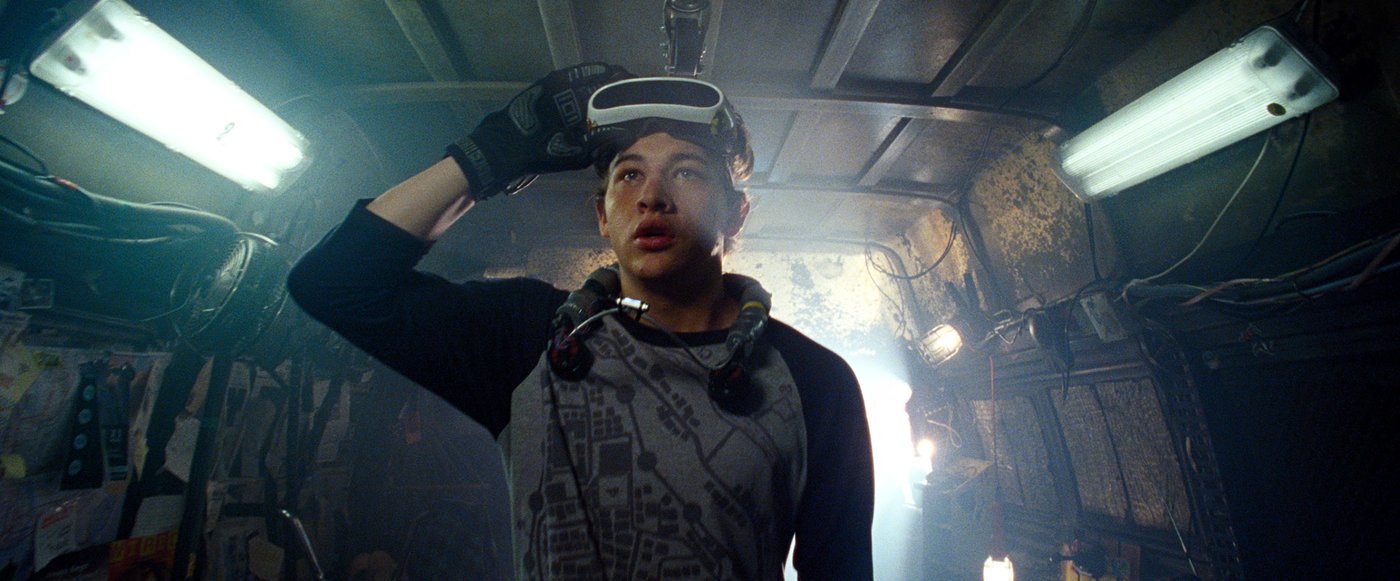
If we’re being honest here, writer to reader, I never got around to reading Ernest Cline’s Ready Player One novel despite the fact that it’s sitting on a bookshelf less than ten feet from me as I type this. It turned out not to matter that much since Steven Spielberg took liberties with the source material. In the film, a virtual video game reality known as the OASIS is where everyone spends their time in the year 2045. Our main character Wade Watts (Tye Sheridan) lives in, “The Stacks,” which is basically just a bunch of mobile homes stacked on top of each other. The coin collected in the OASIS as well as purchases within the game have evolved into an individual's life savings in the real world. Everyone wants to escape their crappy life and the OASIS is now all that matters.
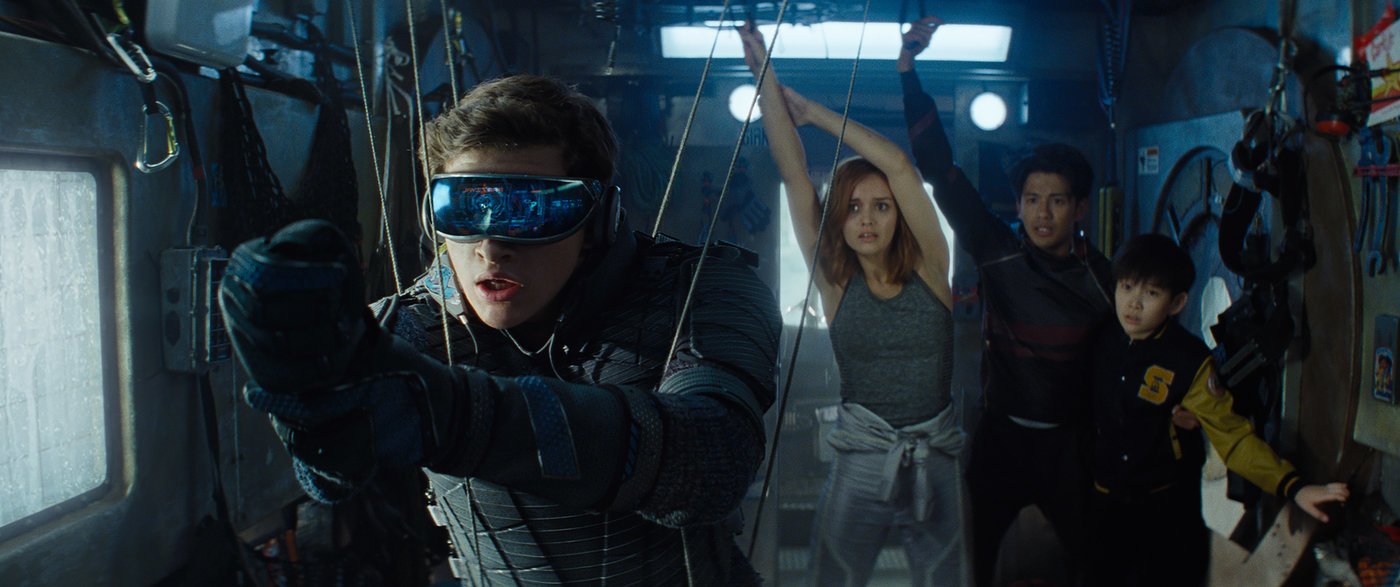
James Halliday (Mark Rylance), creator of the OASIS, dies suddenly but he leaves behind a treasure hunt for three keys hidden within the depths of the OASIS with the main prize being an Easter egg that would allow the winner to have complete control over the entirety of the OASIS. Wade (as his avatar Parzival) intends to win Halliday’s challenge to get out of The Stacks and adopts the title of Gunter (egg hunter) along with his friends Aech (Lena Waithe), Art3mis (Olivia Cooke), and brothers Daito (Win Morisaki) and Sho (Philip Zhao) who become known together as the, “HIgh Five,” but a video game conglomerate known as Innovative Online Industries or IOI spends all of their time and money attempting to find the secrets Halliday has hidden. IOI consists of an army known as the Sixers, which are players who owe large debts to the OASIS. CEO of IOI Nolan Sorrento (Ben Mendelsohn) intends to take the free-to-use OASIS and transform it into a monetized monopoly.
The storyline of Spielberg’s Ready Player One reminds me of the 19th episode of season two of Regular Show entitled, “High Score.” In that episode, Mordecai and Rigby attempt to beat the world record on a video game with record holder Garrett Bobby Ferguson (GBF or Giant Bearded Face). Ready Player One kind of expands on that concept and throws in a ton of nostalgic movie references while being set in the future. The weird thing is that those recycled moments that call back to the movies of yesteryear are the highlights of Ready Player One while the rest of the film suffers from Spielberg’s usual shortcomings.
I haven’t enjoyed a Steven Spielberg film since 2011’s The Adventures of Tintin. That combined with the trailer coming off as less than impressive and poster art from the marketing campaign (the main poster illustrated by Drew Struzan is amazing) that seemed to rely on generic face swapping via Photoshop on well-known movie posters had me really underwhelmed for the film overall. The film itself also suffers from corny dialogue, tender and romantic moments feeling force fed and overwhelming, and head-scratching sequences that leave you wondering why they needed to be included in the first place (the whole dance club/second challenge scene, for starters).
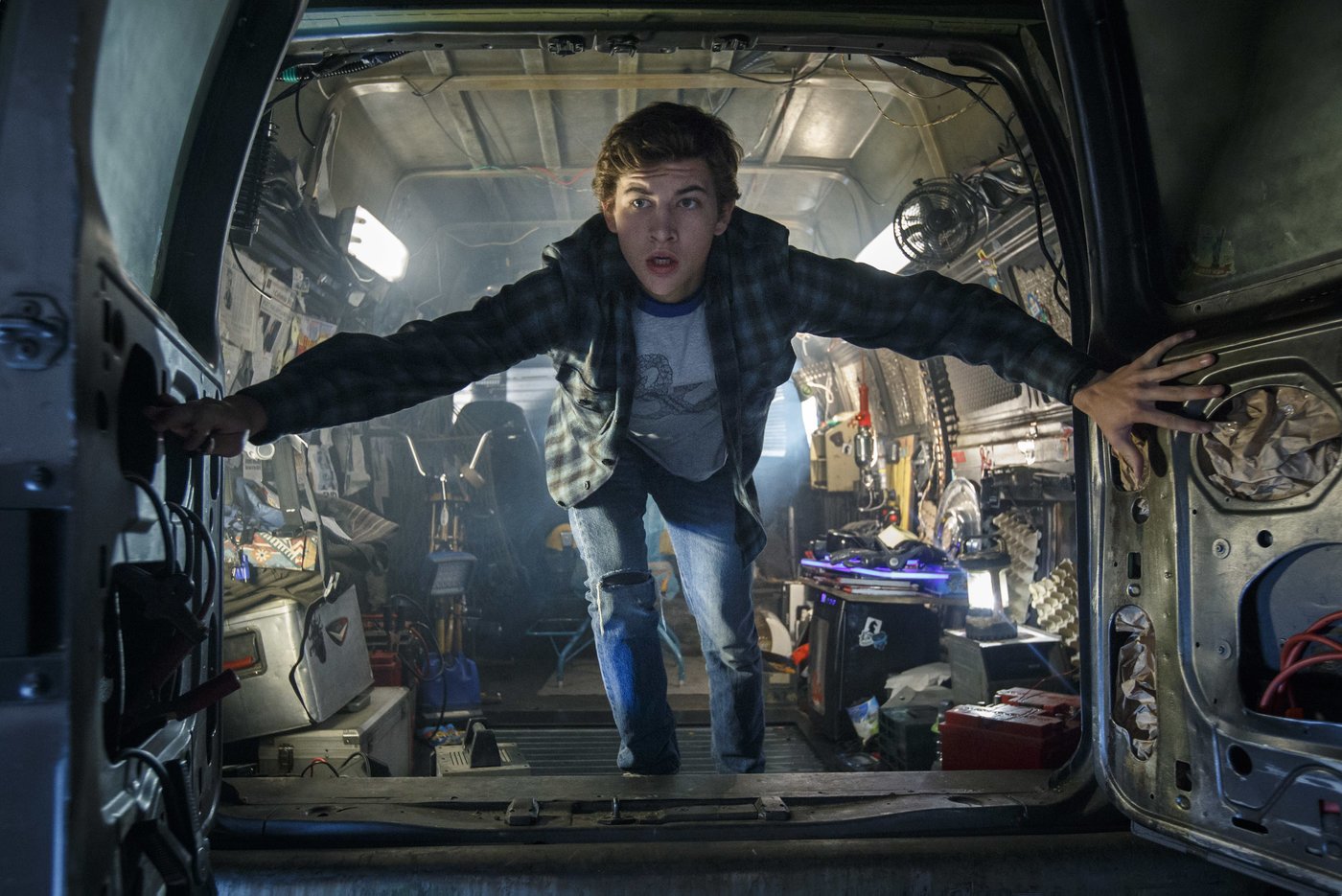
However, what the science fiction adventure gets right is the reason why you go to the movies. Spielberg along with cinematographer and frequent collaborator Janusz Kaminski know how to smoothly and effectively capture dynamic shots with a camera. When we first see Wade in The Stacks, he slides down a series of ropes and poles passing by and through various homes and junkyard cars that no longer run all while showcasing how plugged into a false reality civilization has become. The first race sequence of the film is also extraordinary with its fast pace and hectic action that is fairly easy to digest due to the sleek camera work. There’s a fairly lengthy segment devoted to a beloved horror film that is legitimately fantastic since it is not only a throwback to that original film, but it’s also injected with new thrilling terrors that you won’t see coming. Most battle sequences in the film with large ensembles are impressive for all of the obvious reasons; solid special effects, mass number of characters on the screen, a delicious dose of destruction, and most of all a countless series of references to movies, video games, and cartoons that you probably love. Witnessing what characters will pop up, when, and how they’ll be utilized is half of what makes Ready Player One so fun; it’s like a big budget version of South Park’s Imaginationland.
You either love or hate what Steven Spielberg has accomplished as a filmmaker, but it’s difficult not to admit that Ready Player One is a hell of a lot of fun even if you have some issues with the film. Spielberg has this cliche quality to him that is completely overbearing at times and he isn’t able to escape that aspect of his filmmaking with Ready Player One, but there’s enough of an entertaining and nostalgic value combined with not knowing who’s going to pop up next and some incredible cinematography highlighted by fluid yet flashy special effects resulting in a film that will be exciting and fun for anyone who was ever or still is a rabid gamer or movie lover. Spielberg has crafted a surefire crowd-pleaser that is basically a two and a half hour sentimental plunge directly into your childhood.
James Halliday (Mark Rylance), creator of the OASIS, dies suddenly but he leaves behind a treasure hunt for three keys hidden within the depths of the OASIS with the main prize being an Easter egg that would allow the winner to have complete control over the entirety of the OASIS. Wade (as his avatar Parzival) intends to win Halliday’s challenge to get out of The Stacks and adopts the title of Gunter (egg hunter) along with his friends Aech (Lena Waithe), Art3mis (Olivia Cooke), and brothers Daito (Win Morisaki) and Sho (Philip Zhao) who become known together as the, “HIgh Five,” but a video game conglomerate known as Innovative Online Industries or IOI spends all of their time and money attempting to find the secrets Halliday has hidden. IOI consists of an army known as the Sixers, which are players who owe large debts to the OASIS. CEO of IOI Nolan Sorrento (Ben Mendelsohn) intends to take the free-to-use OASIS and transform it into a monetized monopoly.
The storyline of Spielberg’s Ready Player One reminds me of the 19th episode of season two of Regular Show entitled, “High Score.” In that episode, Mordecai and Rigby attempt to beat the world record on a video game with record holder Garrett Bobby Ferguson (GBF or Giant Bearded Face). Ready Player One kind of expands on that concept and throws in a ton of nostalgic movie references while being set in the future. The weird thing is that those recycled moments that call back to the movies of yesteryear are the highlights of Ready Player One while the rest of the film suffers from Spielberg’s usual shortcomings.
I haven’t enjoyed a Steven Spielberg film since 2011’s The Adventures of Tintin. That combined with the trailer coming off as less than impressive and poster art from the marketing campaign (the main poster illustrated by Drew Struzan is amazing) that seemed to rely on generic face swapping via Photoshop on well-known movie posters had me really underwhelmed for the film overall. The film itself also suffers from corny dialogue, tender and romantic moments feeling force fed and overwhelming, and head-scratching sequences that leave you wondering why they needed to be included in the first place (the whole dance club/second challenge scene, for starters).
However, what the science fiction adventure gets right is the reason why you go to the movies. Spielberg along with cinematographer and frequent collaborator Janusz Kaminski know how to smoothly and effectively capture dynamic shots with a camera. When we first see Wade in The Stacks, he slides down a series of ropes and poles passing by and through various homes and junkyard cars that no longer run all while showcasing how plugged into a false reality civilization has become. The first race sequence of the film is also extraordinary with its fast pace and hectic action that is fairly easy to digest due to the sleek camera work. There’s a fairly lengthy segment devoted to a beloved horror film that is legitimately fantastic since it is not only a throwback to that original film, but it’s also injected with new thrilling terrors that you won’t see coming. Most battle sequences in the film with large ensembles are impressive for all of the obvious reasons; solid special effects, mass number of characters on the screen, a delicious dose of destruction, and most of all a countless series of references to movies, video games, and cartoons that you probably love. Witnessing what characters will pop up, when, and how they’ll be utilized is half of what makes Ready Player One so fun; it’s like a big budget version of South Park’s Imaginationland.
You either love or hate what Steven Spielberg has accomplished as a filmmaker, but it’s difficult not to admit that Ready Player One is a hell of a lot of fun even if you have some issues with the film. Spielberg has this cliche quality to him that is completely overbearing at times and he isn’t able to escape that aspect of his filmmaking with Ready Player One, but there’s enough of an entertaining and nostalgic value combined with not knowing who’s going to pop up next and some incredible cinematography highlighted by fluid yet flashy special effects resulting in a film that will be exciting and fun for anyone who was ever or still is a rabid gamer or movie lover. Spielberg has crafted a surefire crowd-pleaser that is basically a two and a half hour sentimental plunge directly into your childhood.


Purple Phoenix Games (2266 KP) rated Deep Blue in Tabletop Games
Mar 17, 2022
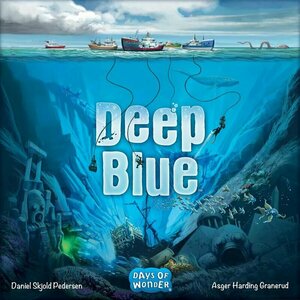

A couple of months ago, Travis was in town, so he and I went over to Josh’s place to get a day of gaming in. It was an awesome time to play together, and to get to experience some new games for each of us. While we were there, we got to talking about some of the games in Josh’s collection, and he pulled out Deep Blue. He’d had it for a while, but had since gotten another game that he felt did the same things but better. So he asked if either of us wanted to take it off his hands. I said sure, as I’d never played the game before. Now that it’s a part of my collection, is it going to stay there? Or will my feelings mirror Josh’s with regards to the gameplay?
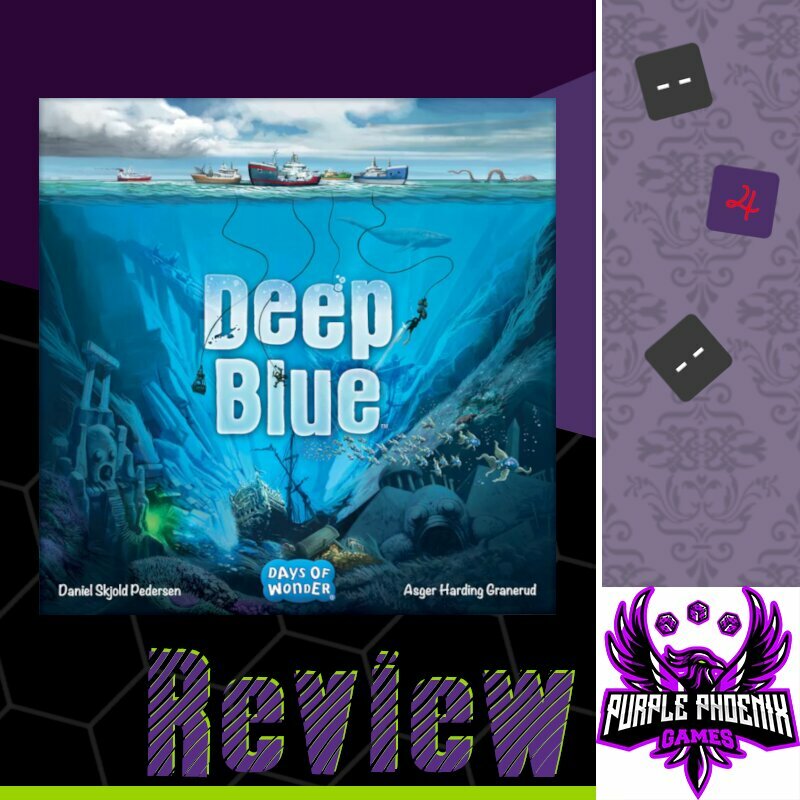
Deep Blue is a nautical game for 2-5 players of deck building, hand management, and a bit of push your luck. In it, players take on the roles ship Captains who are racing to collect treasures from undersea wrecks. Players will be hiring Crew members, sailing across the sea, and sending divers down to wrecks to salvage any valuables. The race is on, though, because you are not the only Captain on this treasure hunt… Throughout the game, players will stumble across 4 Wrecks that make up a Sunken City. Once all 4 areas of the Sunken City have been discovered and searched, the game ends. The player who earns the most VP from their collected treasures by the end of the game is declared the winner!
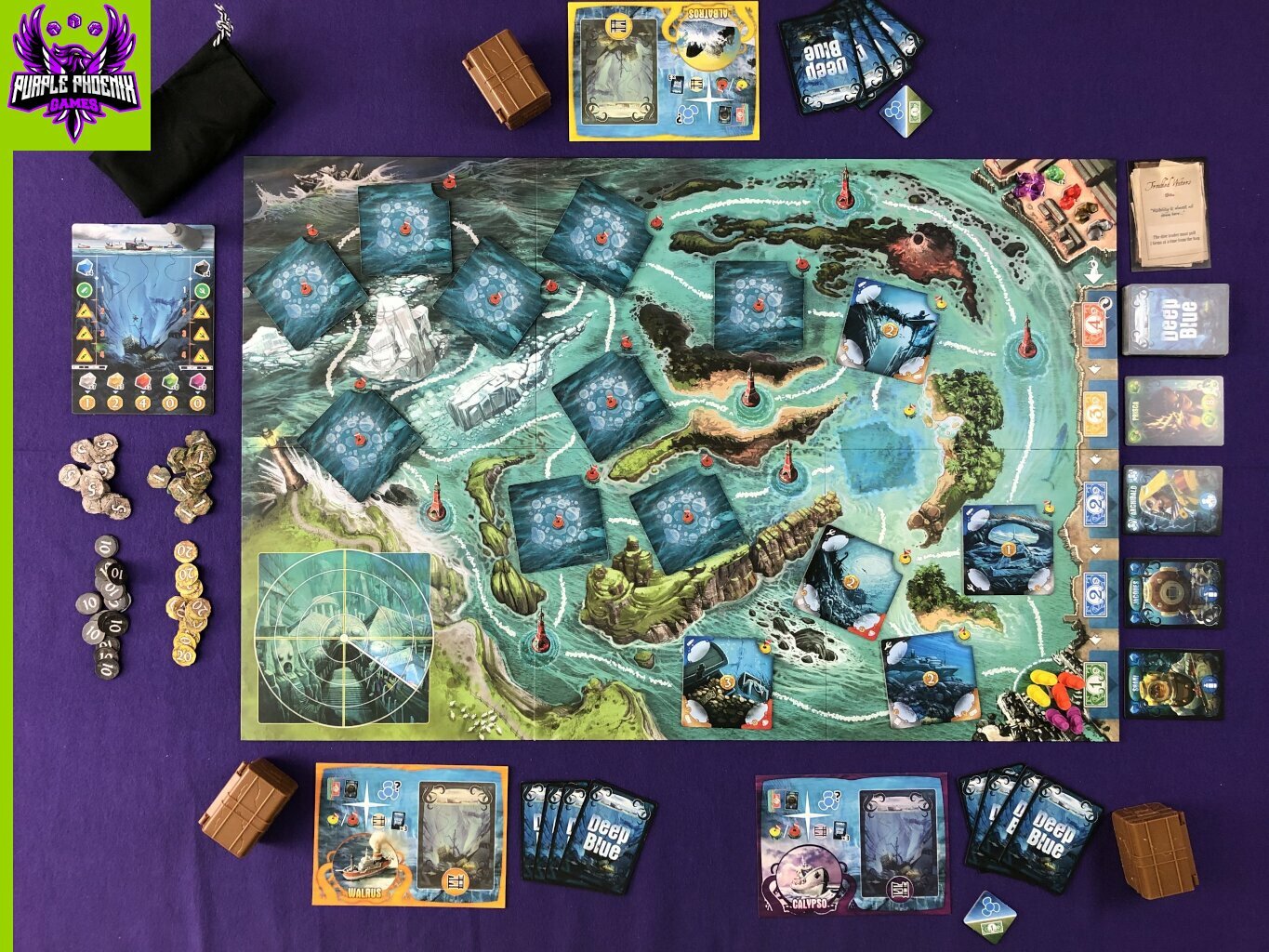
To setup for a game, follow the instructions in the rulebook – there are simply too many to detail here. The basic gist of setup is to create a market of Crew cards, shuffle and randomly distribute Wreck tiles across the board, and create a Gem pool. Each player will receive a player mat and starting cards in their chosen color, as well as 2 ships to be placed on the starting space of the board. Players will also get a treasure chest, in which they will keep their VP throughout the game. Set the Dive Site board, Gem bag, and VP tokens off to the side. Select a starting player, deal out starting tokens accordingly, and the game is ready to begin! Pictured below is the setup for a 3-player game.
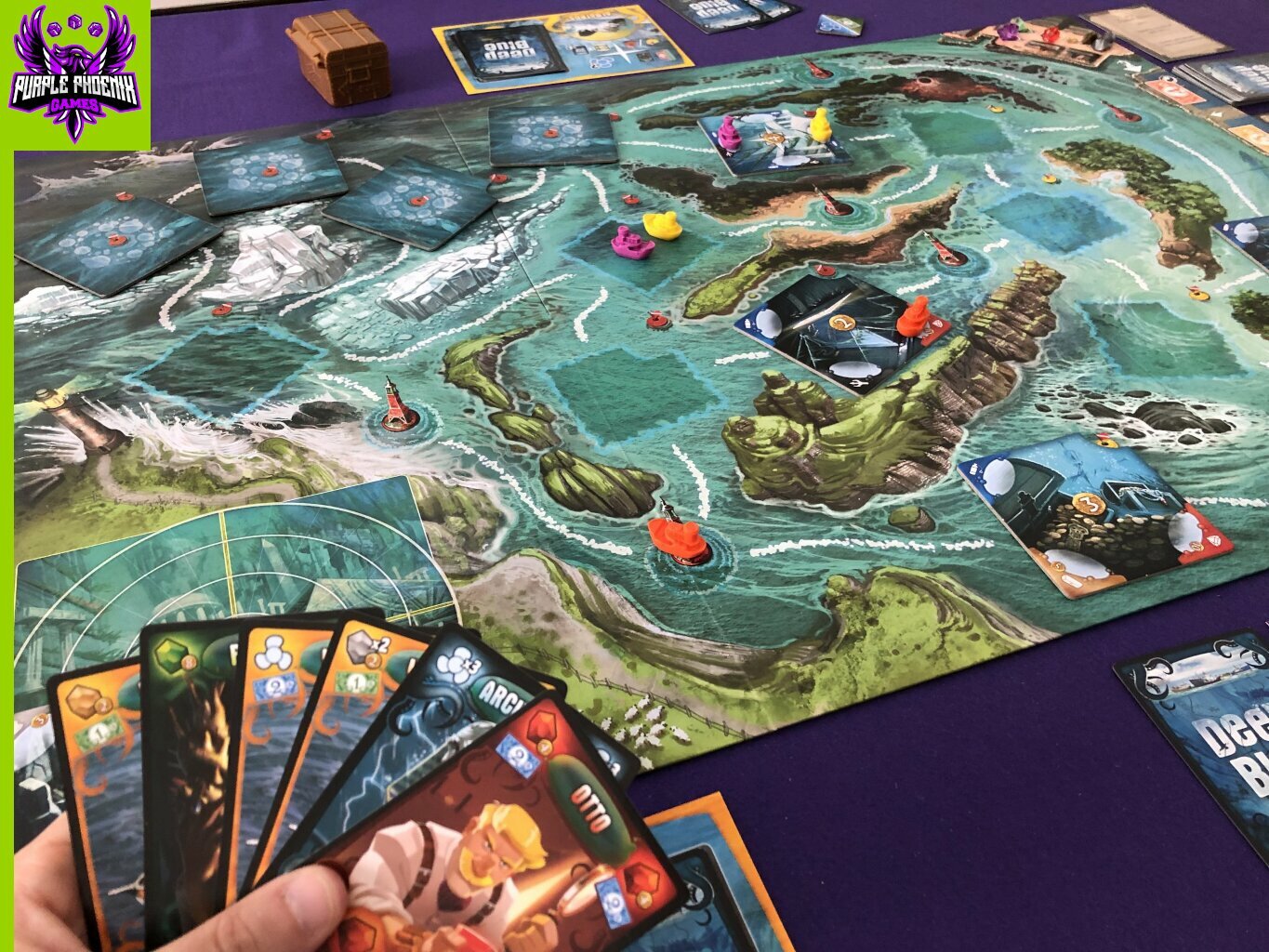
On your turn, you will take one of four possible actions: Recruit a Crew Member, Sail, Rest, or Dive. Throughout the game you will be building your personal deck by Recruiting Crew Members. These new Crew offer unique abilities and scoring powers to be used during Dives. In order to recruit a Crew Member, you must pay the corresponding cost listed by its location in the market. To do so, you will play cards from your hand with $ symbols that equal the required cost. Once you play a card from your hand, it goes facedown onto the Rest area of your player mat. Take the Crew Member you just hired directly into your hand, and move the Market cards down to fill in the empty space, drawing a new card for the final slot. If you choose to Sail, you will play a number of cards from your hand with the Propeller icon. The number of icons dictates how many spaces you may sail. You can use all of your movement on one of your ships, or you can break movement across both ships. If you end a move on a face-up Wreck tile, you will ‘anchor’ your boat to one of the open scouting spots. These scouting spots offer special scoring benefits during the Dive on this tile. If you end movement on a face-down Wreck tile, first you will flip it face-up, and then anchor your boat. When landing on a buoy or an empty dive site, nothing happens.
On any turn, you may instead choose to Rest. To perform this action, you will shuffle all cards that reside on the Rest area of your player mat, and then draw only the 3 topmost cards into your hand. This is the action that allows you to refresh your hand, as you play more cards and your hand starts to dwindle. The final action choice is to Dive. This action is the crux of the game. When you have a boat on a Wreck tile, you may choose to start a Dive. The first step is to declare your Dive – decide which Wreck to Dive if your boats are on different Wreck tiles. Before the Dive begins, any opponents who have boats on adjacent Wreck tiles may move their boats to your Wreck in hopes of also profiting from the Dive. When all eligible boats have been moved to the Wreck, you will then officially begin the Dive. Take the Gem bag and Dive Site board. You will then draw Gems out of the bag, one-by-one, resolving them as necessary. Red, Gold, Silver, Green, and Purple gems are treasures, and can earn you VP. Blue and Black gems are Hazards that must be defended against in order to continue the Dive.
After a Gem is drawn and placed on the Dive Site board, players may choose to play a Crew Member to increase their VP earned. For example, one card allows you to earn 8 VP for a Green gem, instead of 0. To defend against hazards, players may play Crew from their hands who have the ability to negate the hazard, or may use the special ability of their scouting spot on the Wreck tile. If you are unable to defend against a hazard, you are forced to resurface and leave the Dive. The Dive continues in this fashion, until either the active player decides to end the Dive, or when they no longer have the ability to defend against hazards. Any players who still have boats at the Dive Site will collect VP from Crew cards they played, as well as a base amount of VP for the different Gems that were drawn. Once a Dive has been performed at a Wreck, that tile is removed from the game, leaving an empty dive site behind. If players have performed a Dive at one of the 4 Sunken City tiles, it is removed from the board, but placed on its corresponding space in the corner of the board. After all 4 Sunken City tiles have been moved to the corner of the board, the game immediately ends. Players will count up all the VP collected throughout the game, and the player with the highest score is declared the winner!
So how do I feel about Deep Blue overall? I would have to say that it’s fine. Just fine. There are some elements that I really enjoy, but others that kind of frustrate me. What I enjoy – the bits of strategy involved, and the awesome components. What I don’t enjoy – the pacing of the game and the imbalance of actions. To touch on the pros first, this game does require some strategy. You have to decide where to Sail, which Crew to recruit, which Crew to play and when to play them, etc. VP are earned by participating in Dives, so you want to make sure you can be at as many Dives as possible. That means keeping ships close to opponents to profit from any dives they may choose to initiate. Another interesting strategic element is the Rest action. You shuffle your discard pile, but then only draw the 3 topmost cards into your hand. You might not always draw what you were wanting, but you are always allowed to take a Rest action, regardless of how many cards are in your discard. There is no hand limit in this game, so do you rest every other turn to ensure you have almost all cards in your hand? Or do you dwindle your hand down in order to perform other actions instead? It’s all about your strategy, and you never quite know what your opponents are trying to do.
Now for the cons. The pacing of the gameplay feels really slow to me. You are only allowed to perform 1 action per turn, so it seems like the game takes a while to really get going. At first, everyone is going to be wanting to Sail, as all players start in the same starting area of the board. You want to get your ships out there ASAP. But then you run out of cards, so you have to take a turn to Rest and get those cards back. You’re taking a bunch of little turns to accomplish any one bigger thing, and that bogs down the gameplay for me. If you were able to perform 2 actions per turn, that would probably alleviate some of this frustration, as it would allow you to progress more quickly than by taking only a single action. Another aspect I mentioned is the imbalance of actions. The Recruit, Sail, and Rest actions all feel to me like they are on the same level, but the Dive action is different. Which in and of itself isn’t necessarily a bad thing. But the process of the Dive action is vastly different than any of the other actions, to the point that it kind of feels like a different game to me. For half of the game, you’re playing this game of strategy, deck building, and optimizing placement across the board. But for the other half, it turns into a push-your-luck frenzy that seems disjointed from the rest of the game to me. No matter how strategic and careful you are with your actions, it ultimately comes down to the luck of the draw.
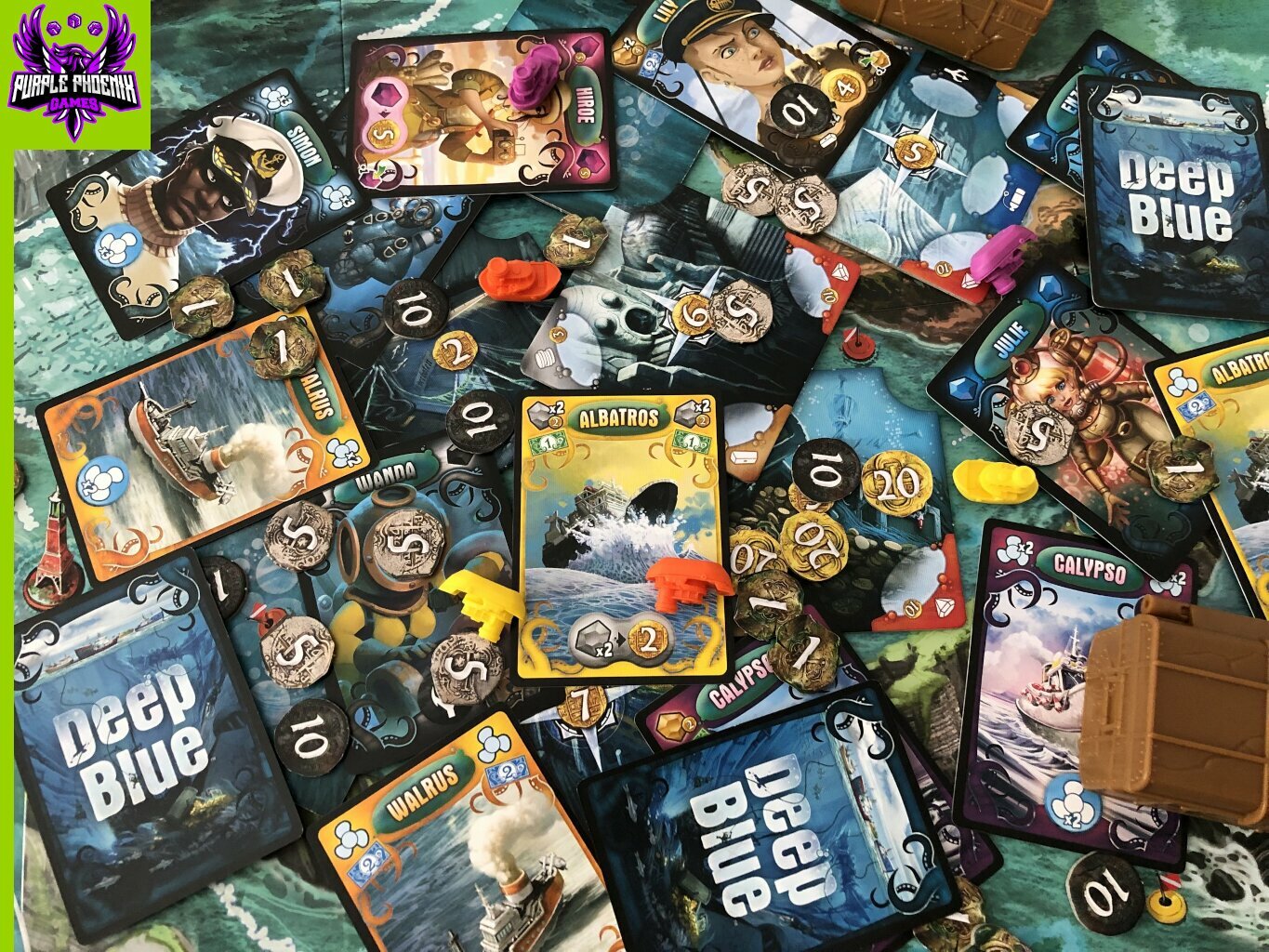
To touch on components for a minute – the production quality of this game is awesome. The board, Dive Site board, and VP tokens are nice chunky cardboard. The cards are colorful, have cool artwork, and are sturdy. And the treasure chests are awesome little plastic chests that definitely are holding up well. The Wreck tiles are big and thick, the Gems are cute, and the ships are fun to play with. So overall, this game is made very well.
You can probably tell by now that I have mixed feelings about Deep Blue. There are aspects that I like, but other aspects that negate some of those positive attributes. I was psyched for a cool nautical deck builder where I could really flex my strategy, but got more push-your-luck than I was anticipating. Deep Blue will probably stick around in my collection for the time being. But, like Josh, I will probably find something that gives me the same vibes but done better. It’s a game that I’ll pull out from time to time, but definitely not one that’s going to break into my Top 10. With that said, Purple Phoenix Games gives it a sunken 4 / 6.
Deep Blue is a nautical game for 2-5 players of deck building, hand management, and a bit of push your luck. In it, players take on the roles ship Captains who are racing to collect treasures from undersea wrecks. Players will be hiring Crew members, sailing across the sea, and sending divers down to wrecks to salvage any valuables. The race is on, though, because you are not the only Captain on this treasure hunt… Throughout the game, players will stumble across 4 Wrecks that make up a Sunken City. Once all 4 areas of the Sunken City have been discovered and searched, the game ends. The player who earns the most VP from their collected treasures by the end of the game is declared the winner!
To setup for a game, follow the instructions in the rulebook – there are simply too many to detail here. The basic gist of setup is to create a market of Crew cards, shuffle and randomly distribute Wreck tiles across the board, and create a Gem pool. Each player will receive a player mat and starting cards in their chosen color, as well as 2 ships to be placed on the starting space of the board. Players will also get a treasure chest, in which they will keep their VP throughout the game. Set the Dive Site board, Gem bag, and VP tokens off to the side. Select a starting player, deal out starting tokens accordingly, and the game is ready to begin! Pictured below is the setup for a 3-player game.
On your turn, you will take one of four possible actions: Recruit a Crew Member, Sail, Rest, or Dive. Throughout the game you will be building your personal deck by Recruiting Crew Members. These new Crew offer unique abilities and scoring powers to be used during Dives. In order to recruit a Crew Member, you must pay the corresponding cost listed by its location in the market. To do so, you will play cards from your hand with $ symbols that equal the required cost. Once you play a card from your hand, it goes facedown onto the Rest area of your player mat. Take the Crew Member you just hired directly into your hand, and move the Market cards down to fill in the empty space, drawing a new card for the final slot. If you choose to Sail, you will play a number of cards from your hand with the Propeller icon. The number of icons dictates how many spaces you may sail. You can use all of your movement on one of your ships, or you can break movement across both ships. If you end a move on a face-up Wreck tile, you will ‘anchor’ your boat to one of the open scouting spots. These scouting spots offer special scoring benefits during the Dive on this tile. If you end movement on a face-down Wreck tile, first you will flip it face-up, and then anchor your boat. When landing on a buoy or an empty dive site, nothing happens.
On any turn, you may instead choose to Rest. To perform this action, you will shuffle all cards that reside on the Rest area of your player mat, and then draw only the 3 topmost cards into your hand. This is the action that allows you to refresh your hand, as you play more cards and your hand starts to dwindle. The final action choice is to Dive. This action is the crux of the game. When you have a boat on a Wreck tile, you may choose to start a Dive. The first step is to declare your Dive – decide which Wreck to Dive if your boats are on different Wreck tiles. Before the Dive begins, any opponents who have boats on adjacent Wreck tiles may move their boats to your Wreck in hopes of also profiting from the Dive. When all eligible boats have been moved to the Wreck, you will then officially begin the Dive. Take the Gem bag and Dive Site board. You will then draw Gems out of the bag, one-by-one, resolving them as necessary. Red, Gold, Silver, Green, and Purple gems are treasures, and can earn you VP. Blue and Black gems are Hazards that must be defended against in order to continue the Dive.
After a Gem is drawn and placed on the Dive Site board, players may choose to play a Crew Member to increase their VP earned. For example, one card allows you to earn 8 VP for a Green gem, instead of 0. To defend against hazards, players may play Crew from their hands who have the ability to negate the hazard, or may use the special ability of their scouting spot on the Wreck tile. If you are unable to defend against a hazard, you are forced to resurface and leave the Dive. The Dive continues in this fashion, until either the active player decides to end the Dive, or when they no longer have the ability to defend against hazards. Any players who still have boats at the Dive Site will collect VP from Crew cards they played, as well as a base amount of VP for the different Gems that were drawn. Once a Dive has been performed at a Wreck, that tile is removed from the game, leaving an empty dive site behind. If players have performed a Dive at one of the 4 Sunken City tiles, it is removed from the board, but placed on its corresponding space in the corner of the board. After all 4 Sunken City tiles have been moved to the corner of the board, the game immediately ends. Players will count up all the VP collected throughout the game, and the player with the highest score is declared the winner!
So how do I feel about Deep Blue overall? I would have to say that it’s fine. Just fine. There are some elements that I really enjoy, but others that kind of frustrate me. What I enjoy – the bits of strategy involved, and the awesome components. What I don’t enjoy – the pacing of the game and the imbalance of actions. To touch on the pros first, this game does require some strategy. You have to decide where to Sail, which Crew to recruit, which Crew to play and when to play them, etc. VP are earned by participating in Dives, so you want to make sure you can be at as many Dives as possible. That means keeping ships close to opponents to profit from any dives they may choose to initiate. Another interesting strategic element is the Rest action. You shuffle your discard pile, but then only draw the 3 topmost cards into your hand. You might not always draw what you were wanting, but you are always allowed to take a Rest action, regardless of how many cards are in your discard. There is no hand limit in this game, so do you rest every other turn to ensure you have almost all cards in your hand? Or do you dwindle your hand down in order to perform other actions instead? It’s all about your strategy, and you never quite know what your opponents are trying to do.
Now for the cons. The pacing of the gameplay feels really slow to me. You are only allowed to perform 1 action per turn, so it seems like the game takes a while to really get going. At first, everyone is going to be wanting to Sail, as all players start in the same starting area of the board. You want to get your ships out there ASAP. But then you run out of cards, so you have to take a turn to Rest and get those cards back. You’re taking a bunch of little turns to accomplish any one bigger thing, and that bogs down the gameplay for me. If you were able to perform 2 actions per turn, that would probably alleviate some of this frustration, as it would allow you to progress more quickly than by taking only a single action. Another aspect I mentioned is the imbalance of actions. The Recruit, Sail, and Rest actions all feel to me like they are on the same level, but the Dive action is different. Which in and of itself isn’t necessarily a bad thing. But the process of the Dive action is vastly different than any of the other actions, to the point that it kind of feels like a different game to me. For half of the game, you’re playing this game of strategy, deck building, and optimizing placement across the board. But for the other half, it turns into a push-your-luck frenzy that seems disjointed from the rest of the game to me. No matter how strategic and careful you are with your actions, it ultimately comes down to the luck of the draw.
To touch on components for a minute – the production quality of this game is awesome. The board, Dive Site board, and VP tokens are nice chunky cardboard. The cards are colorful, have cool artwork, and are sturdy. And the treasure chests are awesome little plastic chests that definitely are holding up well. The Wreck tiles are big and thick, the Gems are cute, and the ships are fun to play with. So overall, this game is made very well.
You can probably tell by now that I have mixed feelings about Deep Blue. There are aspects that I like, but other aspects that negate some of those positive attributes. I was psyched for a cool nautical deck builder where I could really flex my strategy, but got more push-your-luck than I was anticipating. Deep Blue will probably stick around in my collection for the time being. But, like Josh, I will probably find something that gives me the same vibes but done better. It’s a game that I’ll pull out from time to time, but definitely not one that’s going to break into my Top 10. With that said, Purple Phoenix Games gives it a sunken 4 / 6.
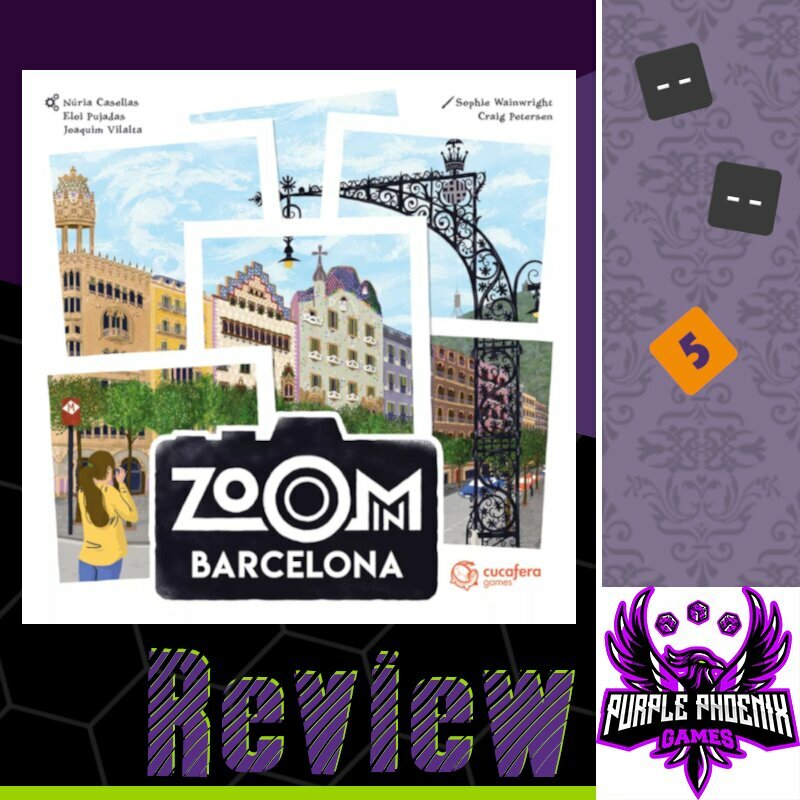
Purple Phoenix Games (2266 KP) rated Zoom in Barcelona in Tabletop Games
Jan 5, 2022

Barcelona! One of my favorite cities I have ever visited. I have sweet memories and also sour memories of this wonderful place. I have walked the streets, tipped the street performers, performed at the Universitat de Barcelona, but I also have mistakenly happened upon a brothel at night and had my debit card stolen by the hotel maintenance staff while visiting. So there’s a wide range of experiences I’ve had in Spain. That said, as this game is set in Barcelona, I knew I just had to get it to the table ASAP, and I found a gem for my collection.
In Zoom in Barcelona, players are photographers competing in a local photography contest. Judges will dictate the preferred sites, and the contest will have an over-arching theme, while players also race to take shots at the most opportune moment with the sunlight over the city. There are multiple ways to score points, and collecting a diverse portfolio of shots from the day will win a prize for the best photographer!
DISCLAIMER: We were provided a copy of this game for the purposes of this review. This is a retail copy of the game, so what you see in these photos is exactly what would be received in your box. I do not intend to cover every single rule included in the rulebook, but will describe the overall game flow and major rule set so that our readers may get a sense of how the game plays. For more in depth rules, you may purchase a copy online or from your FLGS. -T
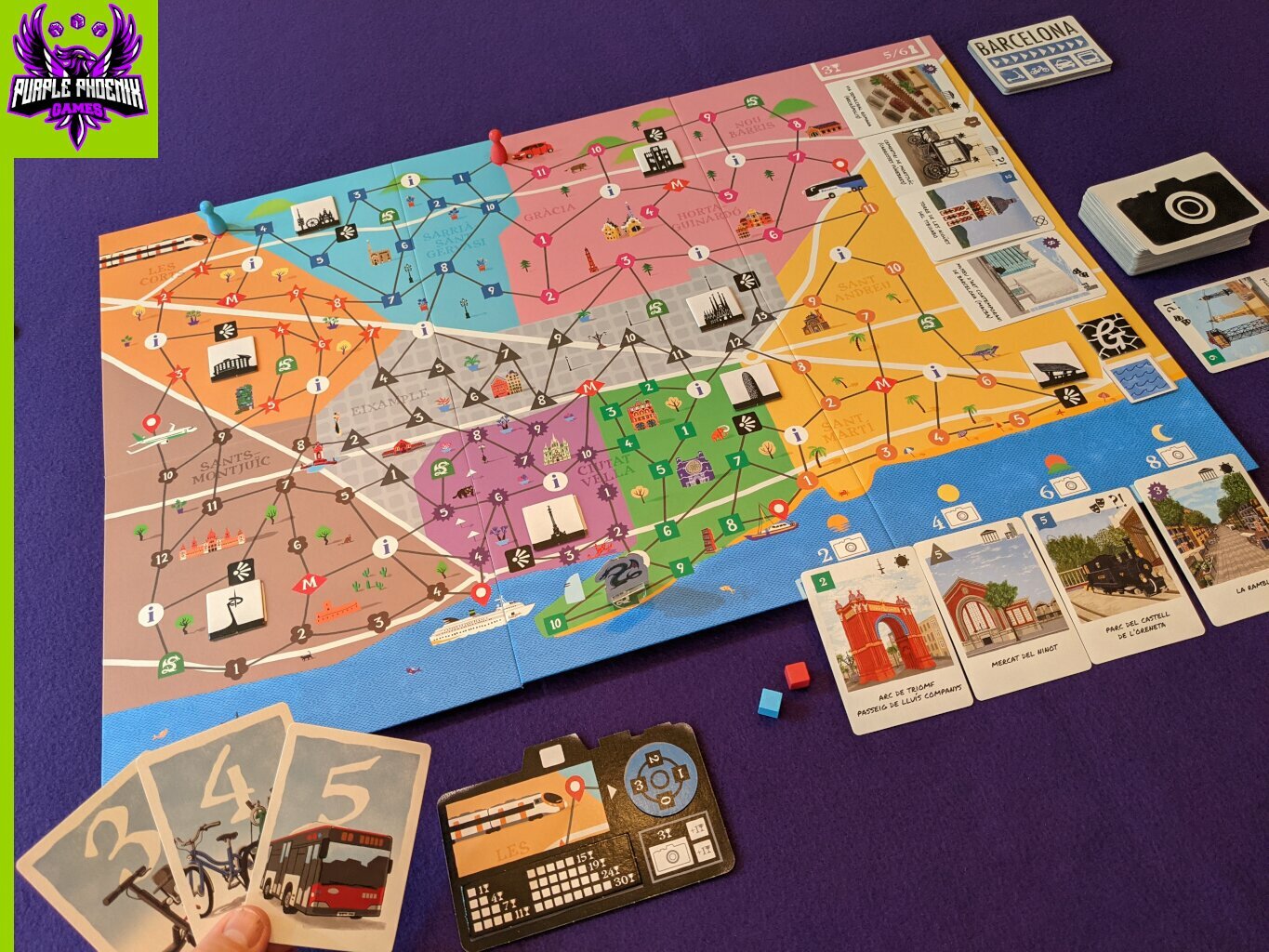
To setup, follow the instructions in the rulebook; there are just too many to list here. However, the starting state of the board should look something similar to the photo below. The major components are the board, the Landmark photo cards, the Transport cards, Natural Light track, Themes tokens, and of course: the Dragon token.
NOTE: This review includes all rules found in the rulebook. For lighter games, players may omit certain rule options.
Turns are very simple in Zoom in Barcelona and consist of two phases – Move and Perform One Action. Players may move up to two connected spaces by walking, or more spaces by playing and discarding one of their Transport cards (shown above in hand). Players will be moving around the board like crazy attempting to arrive at certain locations so that they may take one action from the following: take one photo, visit an Information Point, or take the Metro.
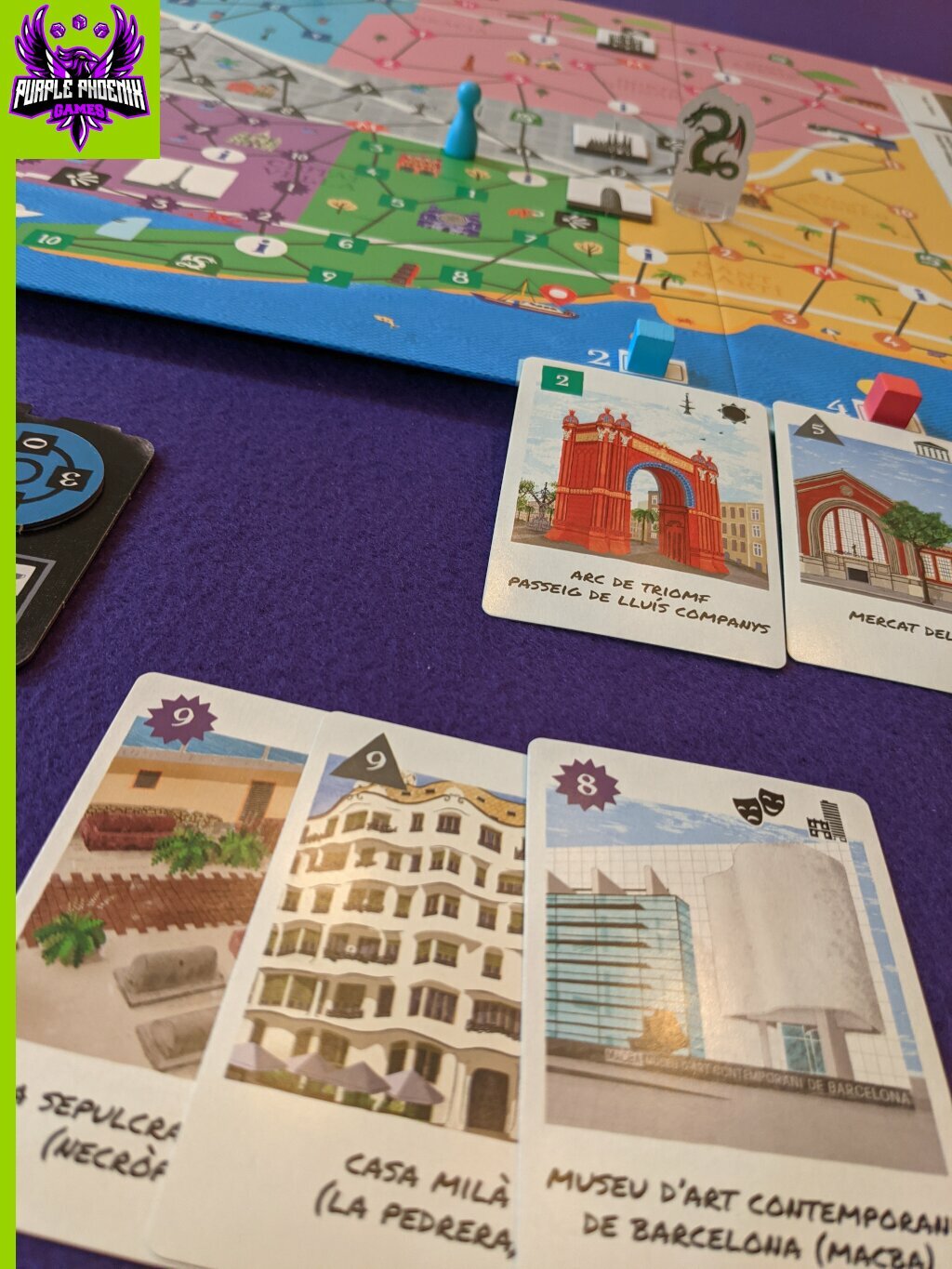
Should the active player choose to take one photo, they must be currently at a location that matches one of the Landmark cards currently residing in the Judges’ Picks area (northeast corner of the board). To take a photo here, the player simply collects the card from the board and replaces it with another from the deck. Collecting Judges’ Picks cards is nice, but if players neglect to advance themselves along the Natural Light Track (southeast corner of the board), these cards will not score. Players will need to take photos at the leftmost location to be able to score two Landmark cards, with each subsequent Natural Light card allowing an additional two cards to be scored, up to a maximum of eight total cards scored. Players may also take photos of portions of the Barcelona Skyline by arriving at the corresponding Skyline Viewpoint spots on the board and collecting the token present (in a two player game, there is only one token at each spot, so the race is on!). These Skyline tokens can be combined at the end of the game for bonus points if combined in a specific order per the individual City Skyline Tokens dealt at the beginning of the game. Finally, players may take a photo of the Dragon in its current Lair by arriving on the Dragon’s location and choosing this action. By taking its photo, the Dragon allows players to freely take one of the Judges’ Picks Landmark cards from those on display, collect any Skyline building token from the board, advance the player’s token on the Natural Light Tracker, OR refresh all the Landmark cards on the Judges’ Pick area. In all of my plays, I abuse the Dragon to advance my token on the Natural Light Track primarily.
The player may instead visit an Information Point on the board in order to draw more or completely refresh their hand of Transport cards. Perhaps the player has a value 3 card, discards it, and draws three more cards offering higher value transports.
Finally, a player may instead choose to Take the Metro by visiting a red M spot and virtually teleporting to any other red M Metro spot on the board. This makes for quick travel across the city.
Play continues in this fashion until one player collects their eighth Landmark photo. The game then immediately ends and scores are counted per the rulebook. The photographer with the highest score wins the competition!
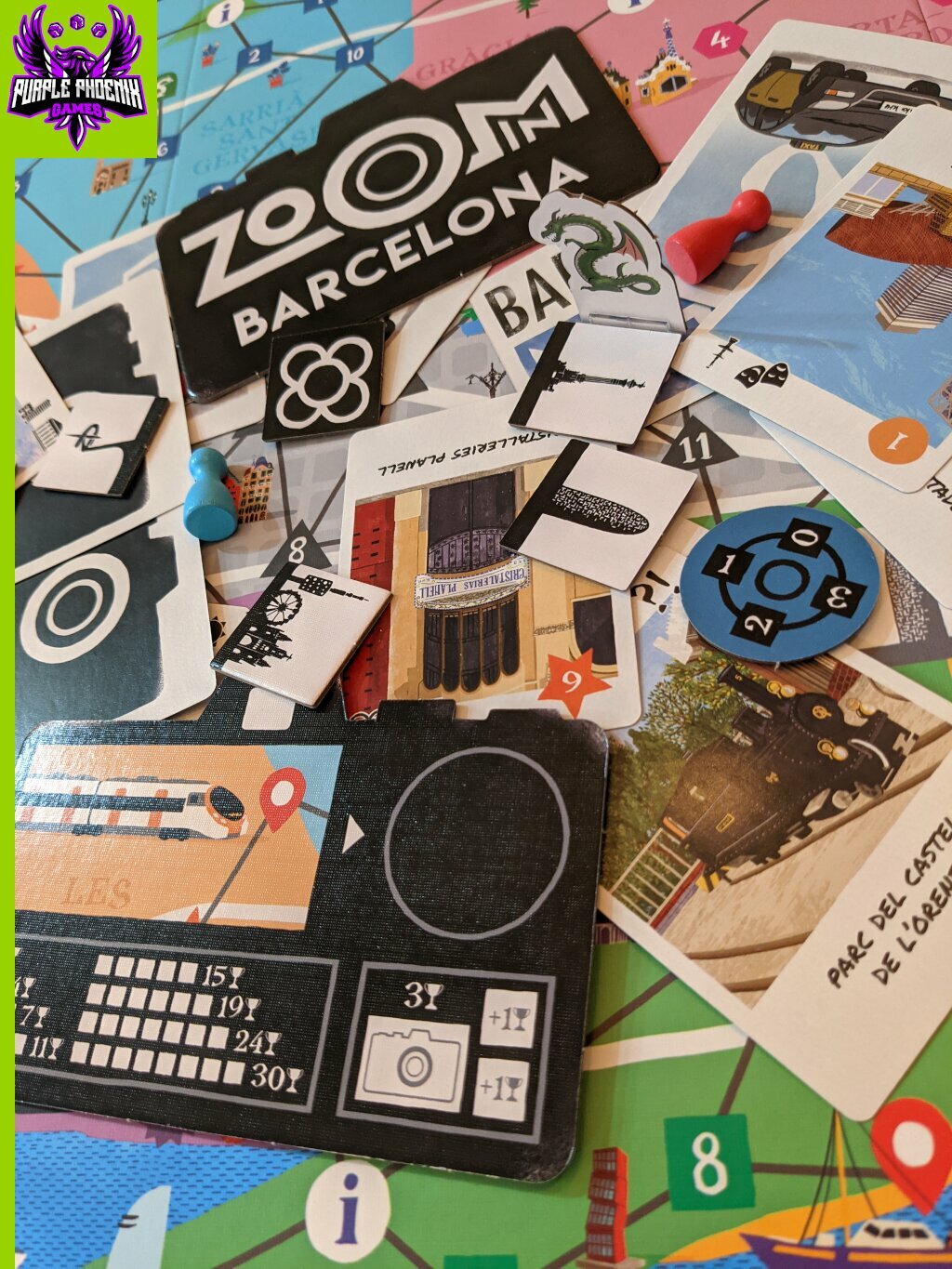
Components. This game has a lot of different types of components; the box is stuffed! All of the cards are nice, the cardboard components are great, and the wooden tokens are just okay. I would prefer more custom wooden components, as the game ships with just entry level pawn tokens and matching colored cubes. Something a bit more jazzed up would be appreciated here. Otherwise, the art is wonderful, the board is beautiful, and everything just looks really interesting when all setup. Per usual, Blue Orange has given us a beautiful game. (*Just bling out the wooden bits in your copy – I plan to with mine)
So wow, there are so many choices to be made in this game. Firstly, it’s a mad dash to collect that eighth Landmark card, but you just can’t ignore the Natural Light Track (if you play with it), because having eight cards but only able to score two or four is just like shooting yourself in the foot for no good reason. Zooming around town (I know, I had to) is so satisfying, like a board game treasure hunt, and snapping all these photos of memorable places just hits the spot for me. Yes, I am probably biased because of the setting and my fondness for it, but even if this were set in another location where I had no experience, I would still very much enjoy it.
I’ll tell you one thing. I feel bad every time I play this because I feel like a lazy one-trick pony chasing around the Dragon to exploit its power, and MAYBE grabbing a shot along the way. The Dragon is very powerful and allows players to do really helpful things throughout.
Yes, there are some minor rules I left out, but I think you all get the idea behind this game. I am absolutely in love with this one, and I am so glad it was suggested to me to try, and even more lucky that Blue Orange sent me a copy to review! Officially, Purple Phoenix Games gives this one a 5 / 6 for its beauty, fun mechanics, and incredible array of choices to be made along the way. I can see this one inching its way toward my Top 10 Games of All Time, but I suppose time will tell. If you are a fan of ours, and your tastes typically line up with mine, then please do yourself a solid and grab a copy of this one right away. It may be daunting to learn at first, but once it all clicks, I can guarantee you will see the cohesiveness and beauty of Zoom in Barcelona.
Oh, and if anyone finds my debit card, please return it. I “lost” it there in the Summer of 2000. Thanks.
In Zoom in Barcelona, players are photographers competing in a local photography contest. Judges will dictate the preferred sites, and the contest will have an over-arching theme, while players also race to take shots at the most opportune moment with the sunlight over the city. There are multiple ways to score points, and collecting a diverse portfolio of shots from the day will win a prize for the best photographer!
DISCLAIMER: We were provided a copy of this game for the purposes of this review. This is a retail copy of the game, so what you see in these photos is exactly what would be received in your box. I do not intend to cover every single rule included in the rulebook, but will describe the overall game flow and major rule set so that our readers may get a sense of how the game plays. For more in depth rules, you may purchase a copy online or from your FLGS. -T
To setup, follow the instructions in the rulebook; there are just too many to list here. However, the starting state of the board should look something similar to the photo below. The major components are the board, the Landmark photo cards, the Transport cards, Natural Light track, Themes tokens, and of course: the Dragon token.
NOTE: This review includes all rules found in the rulebook. For lighter games, players may omit certain rule options.
Turns are very simple in Zoom in Barcelona and consist of two phases – Move and Perform One Action. Players may move up to two connected spaces by walking, or more spaces by playing and discarding one of their Transport cards (shown above in hand). Players will be moving around the board like crazy attempting to arrive at certain locations so that they may take one action from the following: take one photo, visit an Information Point, or take the Metro.
Should the active player choose to take one photo, they must be currently at a location that matches one of the Landmark cards currently residing in the Judges’ Picks area (northeast corner of the board). To take a photo here, the player simply collects the card from the board and replaces it with another from the deck. Collecting Judges’ Picks cards is nice, but if players neglect to advance themselves along the Natural Light Track (southeast corner of the board), these cards will not score. Players will need to take photos at the leftmost location to be able to score two Landmark cards, with each subsequent Natural Light card allowing an additional two cards to be scored, up to a maximum of eight total cards scored. Players may also take photos of portions of the Barcelona Skyline by arriving at the corresponding Skyline Viewpoint spots on the board and collecting the token present (in a two player game, there is only one token at each spot, so the race is on!). These Skyline tokens can be combined at the end of the game for bonus points if combined in a specific order per the individual City Skyline Tokens dealt at the beginning of the game. Finally, players may take a photo of the Dragon in its current Lair by arriving on the Dragon’s location and choosing this action. By taking its photo, the Dragon allows players to freely take one of the Judges’ Picks Landmark cards from those on display, collect any Skyline building token from the board, advance the player’s token on the Natural Light Tracker, OR refresh all the Landmark cards on the Judges’ Pick area. In all of my plays, I abuse the Dragon to advance my token on the Natural Light Track primarily.
The player may instead visit an Information Point on the board in order to draw more or completely refresh their hand of Transport cards. Perhaps the player has a value 3 card, discards it, and draws three more cards offering higher value transports.
Finally, a player may instead choose to Take the Metro by visiting a red M spot and virtually teleporting to any other red M Metro spot on the board. This makes for quick travel across the city.
Play continues in this fashion until one player collects their eighth Landmark photo. The game then immediately ends and scores are counted per the rulebook. The photographer with the highest score wins the competition!
Components. This game has a lot of different types of components; the box is stuffed! All of the cards are nice, the cardboard components are great, and the wooden tokens are just okay. I would prefer more custom wooden components, as the game ships with just entry level pawn tokens and matching colored cubes. Something a bit more jazzed up would be appreciated here. Otherwise, the art is wonderful, the board is beautiful, and everything just looks really interesting when all setup. Per usual, Blue Orange has given us a beautiful game. (*Just bling out the wooden bits in your copy – I plan to with mine)
So wow, there are so many choices to be made in this game. Firstly, it’s a mad dash to collect that eighth Landmark card, but you just can’t ignore the Natural Light Track (if you play with it), because having eight cards but only able to score two or four is just like shooting yourself in the foot for no good reason. Zooming around town (I know, I had to) is so satisfying, like a board game treasure hunt, and snapping all these photos of memorable places just hits the spot for me. Yes, I am probably biased because of the setting and my fondness for it, but even if this were set in another location where I had no experience, I would still very much enjoy it.
I’ll tell you one thing. I feel bad every time I play this because I feel like a lazy one-trick pony chasing around the Dragon to exploit its power, and MAYBE grabbing a shot along the way. The Dragon is very powerful and allows players to do really helpful things throughout.
Yes, there are some minor rules I left out, but I think you all get the idea behind this game. I am absolutely in love with this one, and I am so glad it was suggested to me to try, and even more lucky that Blue Orange sent me a copy to review! Officially, Purple Phoenix Games gives this one a 5 / 6 for its beauty, fun mechanics, and incredible array of choices to be made along the way. I can see this one inching its way toward my Top 10 Games of All Time, but I suppose time will tell. If you are a fan of ours, and your tastes typically line up with mine, then please do yourself a solid and grab a copy of this one right away. It may be daunting to learn at first, but once it all clicks, I can guarantee you will see the cohesiveness and beauty of Zoom in Barcelona.
Oh, and if anyone finds my debit card, please return it. I “lost” it there in the Summer of 2000. Thanks.