

toPhonetics English Phonetic Transcription
Education and Reference
App
Got an English text and want to see how to pronounce it? This app will turn your English text into...

Spelling 1-2
Education and Games
App
Rescue fish, win prizes, and become a super speller! A G-R-E-A-T app to help good spellers become...

iHunter Saskatchewan
Sports and Utilities
App
Regulations updated annually once released by the province. iHunter Saskatchewan gives hunters and...

KICK: Football Card Trader
Sports and Games
App
Topps® KICK® 2018: Football Card Trader is the official digital card trading app of the Premier...

Legendary: A Marvel Deck Building Game
8.9 Rate It
Tabletop Game
Legendary: A Marvel Deck Building Game is set in the Marvel Comics universe. To set up the game,...

Purple Phoenix Games (2266 KP) rated MechaTop in Tabletop Games
Jul 2, 2020


Disclaimer: We were provided with a PnP version of this game for the purposes of this preview. Please excuse my lack of a color printer, and rest assured that the cards are colorful and eye-catching. The rulebook we have is not the finalized version, but rather an up-to-date draft detailing the overall rules and gameplay. Some changes will probably take place during the Kickstarter campaign, so the finalized game system might have some differences to this preview. For more details, check out the publisher’s website! -L
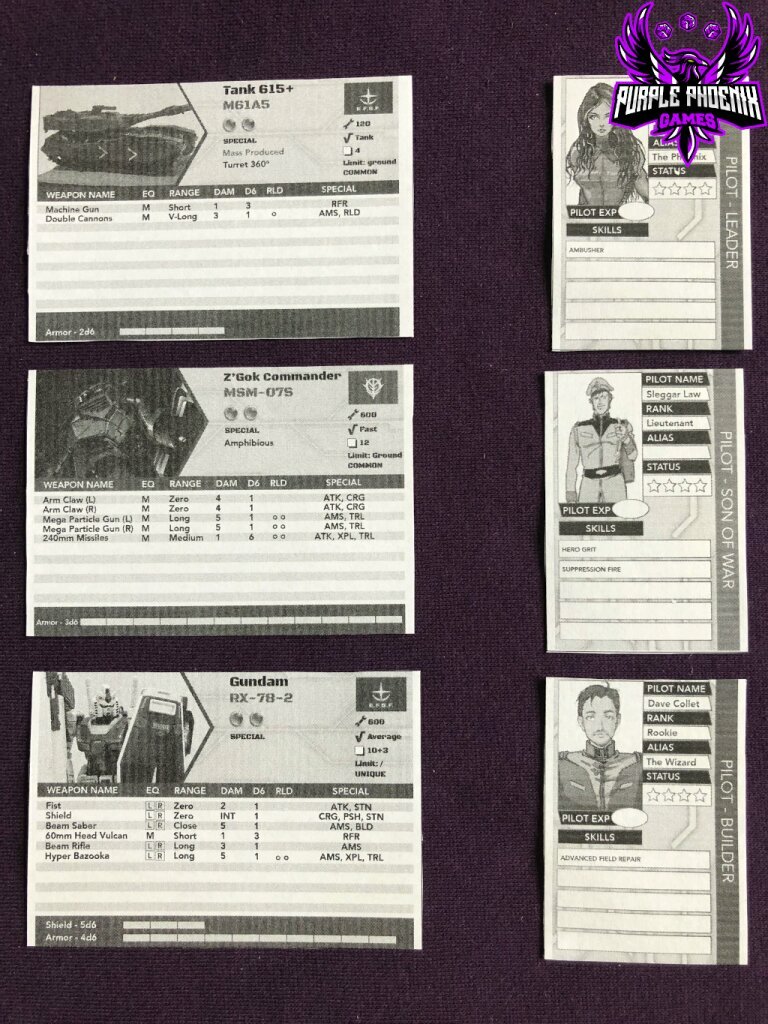
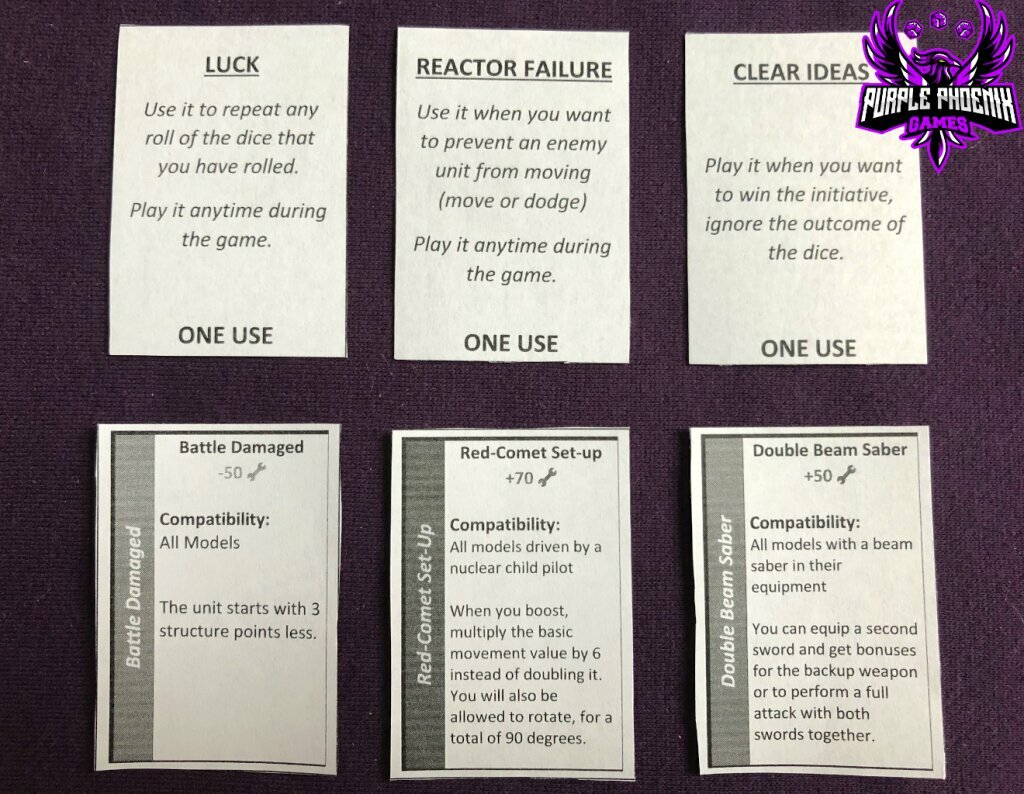
MechaTop is a tabletop wargame system in which players pilot large Mecha suits and battle their opponents. To begin a game, you must first decide which game mode you want to play. After selecting the game mode, players create their Mecha teams for battle. Each game mode has an associated cost score limit – the highest maximum cost you can spend on your team. For example, a Mecha suit might cost 300, and the cost score limit for the chosen mode is 600, leaving you with 300 to spend on upgrade cards for your suit. Once all players have chosen and upgraded their Mecha suits, those corresponding cards are placing in their play area. Everyone then selects a Pilot card to be assigned to their Mecha suit, and receives a set of Button tokens and a secret Twist card (kept secret until played at any time during the game). Decide which weapons to equip on your suit for the start of the game, roll a d6, and take turns placing your Mecha in the playing field in ascending numerical order of the die rolls. You are officially ready to start the game now!
Each round begins with the Instinct Phase, where players decide which 2 Button tokens they want to play this round. The Button actions are: Attack, Movement/Rotation, Change Weapon/Reload, and possibly Telekinesis. After the Buttons have been selected, they are placed face-down on the playing field next to their corresponding Mecha suit. Next is the Initiative Phase, in which all players roll a d6 and the player who rolled the highest gets to act first in the round. On your turn, you may choose to activate 1 Button token, activate both Button tokens, or declare No Action and pass your turn. Choosing to activate only 1 Button allows you to perform a simple action, but activating both at the same time in certain combinations allows you to perform a more powerful type of the corresponding action. Choosing to do No Action allows you to keep both Button tokens facedown. The benefit to leaving either 1 or both Button tokens facedown is that you can then use them as reactions during an opponent’s turn. Let’s say an opponent tries to Attack you – if you have your Movement Button still at your disposal, you can use it to attempt to dodge the hit and negate that damage. If you don’t use a Button in that situation, or don’t have one left face-down, all the damage goes straight through on your suit, thus bringing you closer to losing the game. Be warned – some actions are automatic, but some are resolved by dice rolls, so you better hope luck is on your side! After all players have had a turn in Initiative Order, a new round begins with another Instinct Phase. Play continues in this manner until the win condition of the selected game mode has been met, and the winner is deemed victorious!
First and foremost, I think one of the coolest things about the MechaTop system is that it can be played using ANY mecha models, action figures, or standees that you choose. In my childhood, Transformers made up a decent amount of our household, so it’s neat that I am able to bring those back out again after all these years. The nostalgia is great in that sense, and it makes the game more enjoyable. Also along those lines, the game will come with blank Mecha and Pilot cards for you to create your own – the rulebook has a section dedicated to stat card creation. It’s a neat element that lets you add a personal twist to your game, and lets you sit in the pilot’s seat (see what I did there?) to make the game truly your own! In the team creation step, players also have the opportunity to buy Upgrades for their suits, and that gives you additional control over your game. You can create so many different combinations of Upgrades that keep each game unique and entertaining.
The overall game flow is pretty nice. The rounds are logical, and the Button tokens add a unique element of strategy that takes this game to the next level for me. Do you forego doing a special action this turn and save a Button token in case an opponent tries to attack you? Or are you willing to risk damage to your Mecha suit in order to execute the exact plan that you want? The Button tokens take MechaTop beyond a simple attack-and-defend wargame and incorporates strategy to help balance out the randomness of Initiative rolls. The Twist cards are a nice touch as well, because if played at the right time, they could literally turn the battle around for you! No matter how good your strategy is, however, all offensive/defensive actions are dictated by dice rolls. So there’s a bit of a luck element embedded in this game as well. You have to be able to adapt your strategy on the fly depending on how your die results are turning out!
There is a bit of a learning curve to this game that can make it seem daunting at first. Different actions require a different number of dice to roll, and knowing what results counts as a success or failure is not always easy to remember. Incorporating a Player Reference Sheet would eliminate some of the confusion, but it does get easier to remember the more you play the game. Probably the biggest drawback of the system for me is that there is no set game board or movement system. The rulebook details movement speeds and weapon ranges based on different scales of models you might use, but that honestly just went right over my head. Providing a set of bases for models, as well as a hex-grid board would take out that guess-work for players and make it easier to visualize movement and range. And that would help keep the game flowing smoothly because players would not have to spend time measuring distances across the play area.
Let’s talk components. As I mentioned earlier, we only have a PnP copy of MechaTop, so admittedly our components are not the best. That being said, the finalized game should be coming with nice colorful cards, sturdy cardboard tokens, and good quality dice. Don’t let my drab version keep you from checking out the game on BGG or its own website!
All in all, MechaTop is a wargame system that I can see myself playing again. The gameplay itself is straight-forward and simple to grasp, but the strategic elements incorporated with Button tokens, Twist cards, and Upgrades ensure that you will never play the same game twice. If you’re looking to get into wargame systems, or are just looking for a unique wargame setting, definitely check out the MechaTop Kickstarter when it goes live later this month!


Purple Phoenix Games (2266 KP) rated Cult of the Deep in Tabletop Games
Feb 24, 2021
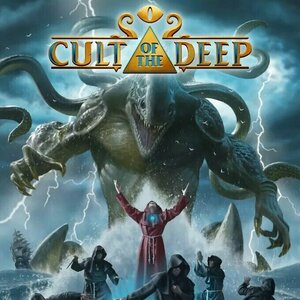
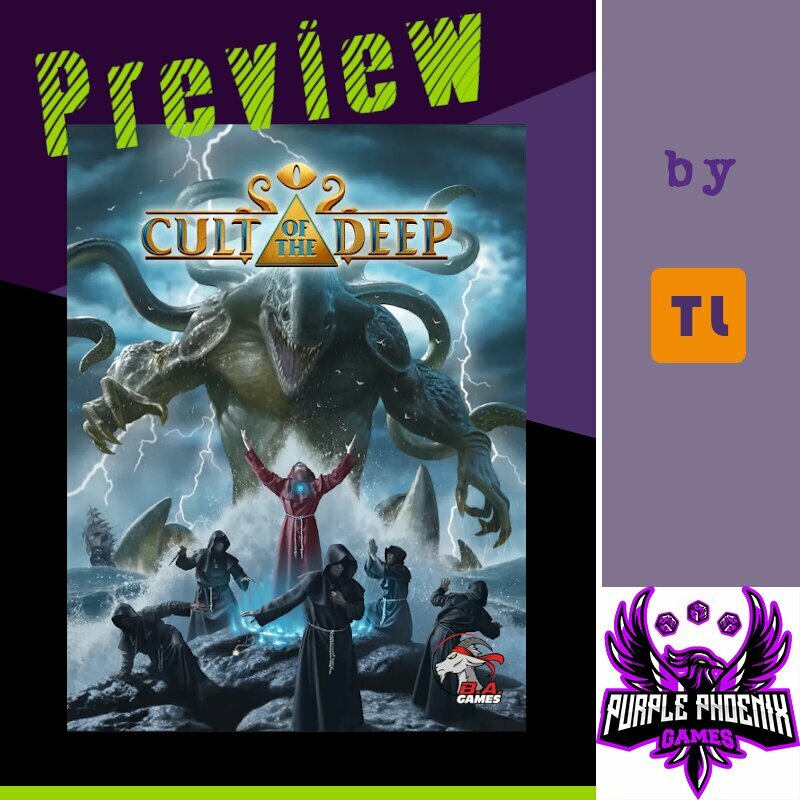
Cult of the Deep is a dice-driven, fantasy horror, hidden role game with similarities to some classic games. In it players will be donning the personas (personae?) of cultists with different roles and agendas. Players will be forming alliances with other cultists of unknown roles and possibly having their character perish and return to play as a Wraith with a totally new agenda. Each cultist’s role will have their own victory conditions to fulfill and the game ends once a player (or players) have fulfilling their victory conditions.
DISCLAIMER: We were provided a prototype copy of this game for the purposes of this review. These are preview copy components, and I do not know for sure if the final components will be any different from these shown. Also, it is not my intention to detail every rule in the game, as there are just too many. You are invited to download the rulebook, back the game through the Kickstarter campaign, or through any retailers stocking it after fulfillment. -T
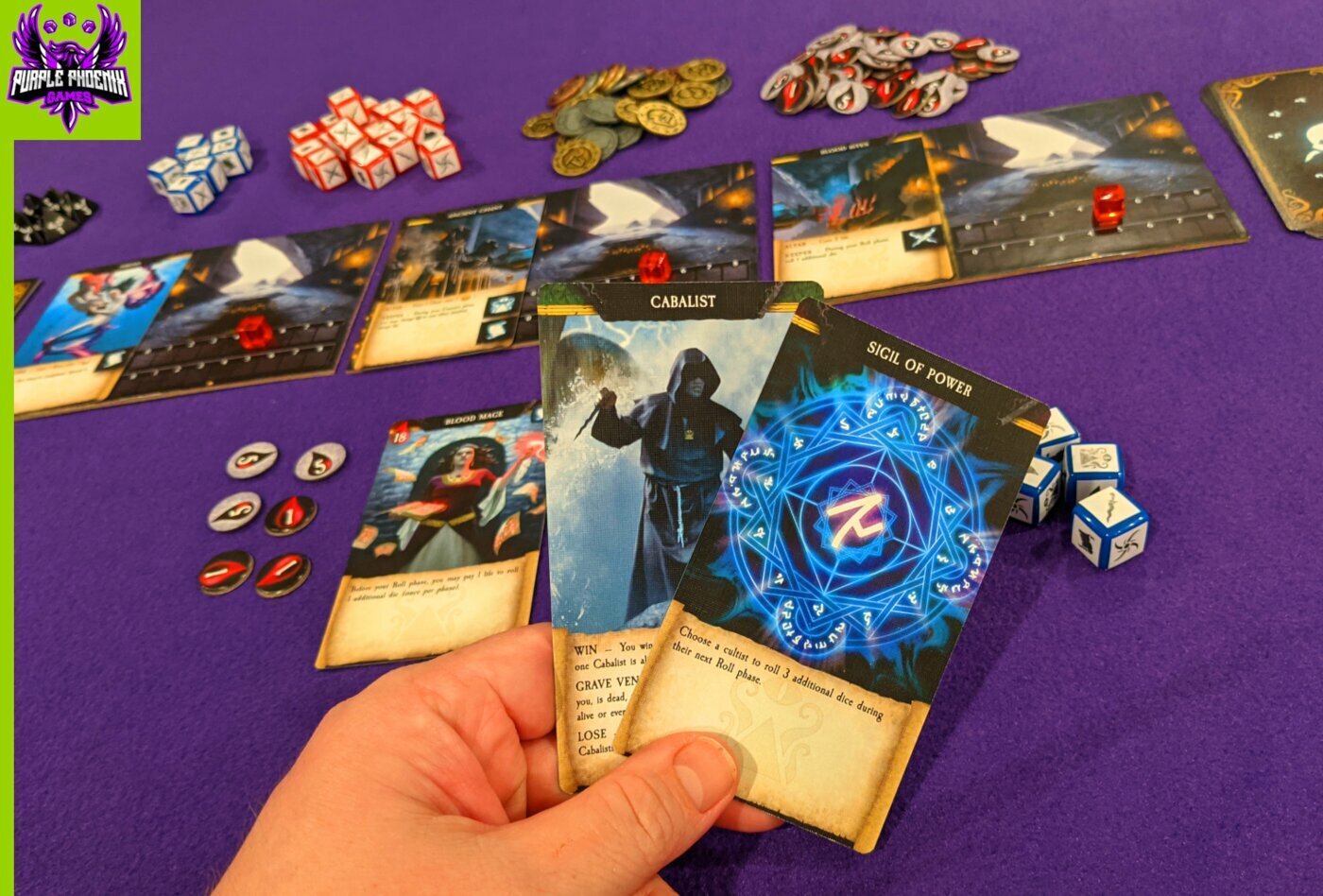
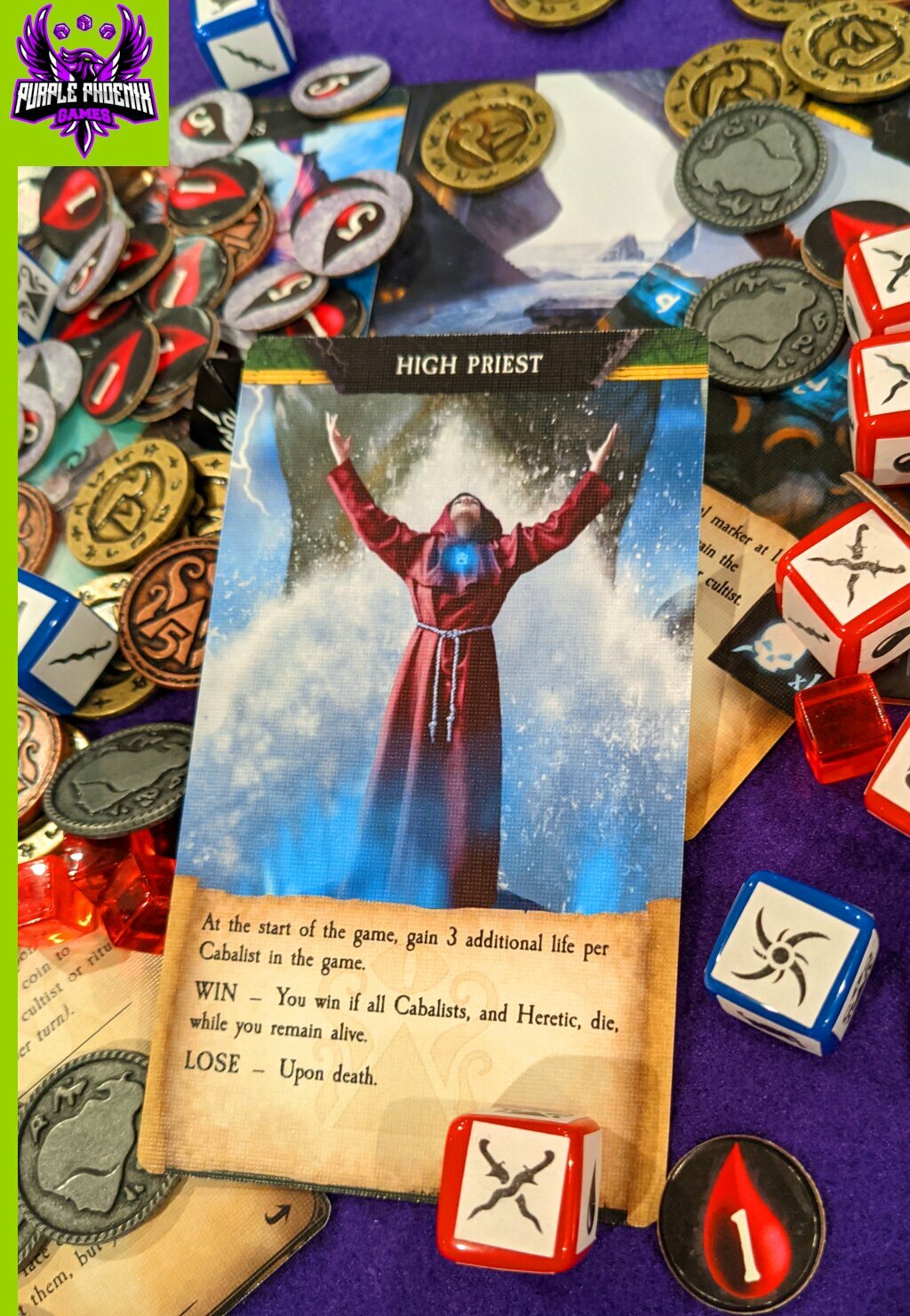
Setup involves placing out the Altar Boards and Ritual Cards upon them. Players will also receive one Role, Character, Sigil, and Reference Card to use during play. Players will reveal their Character Cards and collect enough Life Tokens to equal what is shown upon these cards. Each set of dice and the coins are to be set on the table within reach. The player who received the High Priest Role Card reveals it, takes extra Life Counters, and becomes the first player. They take five Cultist Dice and the game may begin!
Each turn is divided into four phases: Roll, Commit, Response, Resolve. During the Roll phase the active player will roll five dice, and any dice may be re-rolled another two times. Once all re-rolls are complete or the player decides to stop, they will take each die and Commit them to other players, altars, or themselves. For example, if the player rolls two blood drop icons they may wish to heal themselves by two, so they can commit these dice to themselves. Should this player also have rolled any dagger icons they may commit these dice to other players in order to attack them for one life per icon. If any player has a special ability that can be enacted during the Response phase, they must now use it. One such ability may be turning a one-dagger icon into a two-dagger icon, or other abilities. Once all players have had a chance to activate any abilities during this phase, the dice must now be Resolved in any order of the active player’s choosing. So now the player can regain life counters (or even surpass their starting life total), attack other players’ life points, or activate any Altar abilities if dice were placed on Ritual Cards on altars.
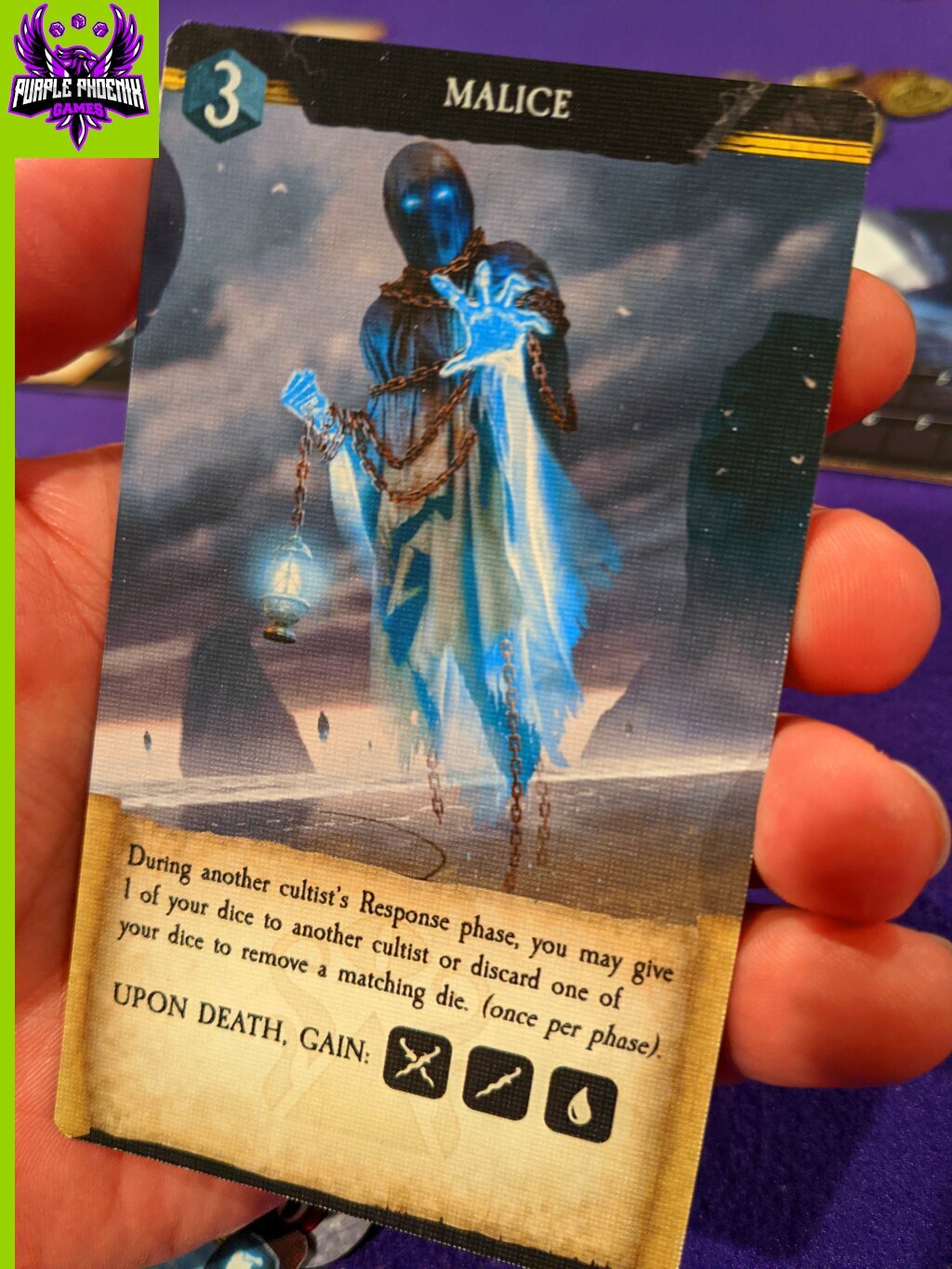
The Resolve phase is where the action happens, and can lead to some serious actions. Players can be killed, Rituals can be activated, and players can be healed. If a Ritual is completed (no more activation slots remaining) during this phase, the active player becomes the Keeper of the Ritual and collects its card from the altar to be used for an immediate effect, or an ongoing effect for the rest of the game. Should a player be slain, they may return to the game as a Wraith, and thus draws a Wraith card (shown below) to now represent their altered state. Wraiths play the game differently, as they will not be able to commit any dice during their turn, but rather have their dice to be used during other cultists’ Response phases.
Play continues in this fashion of taking turns around the table until victory conditions have been met for a player or group of players. The game may be over, but the lasting effects of the results will remain in each player’s heart for some time.
Components. Again, this is a prototype copy of the game, so not all components are as they will be in the finished version. That said, we received an excellent prototype copy of the game. The cards are great, the cardboard components are equally great, and I know we were provided with examples of the Kickstarter exclusive add-on metal coins, but I certainly would spring for them. These coins are the real deal and just feel amazing to handle. I know the dice will be different upon a successful campaign, as stickered dice simply will not hold up to many plays (and I see on the KS page that the d4s will have numbers ON TOP, which is where they should be). So once all is said and done, I believe this will be a beautiful, if not dark, game with excellent components and art style.
I mentioned in my open that this game reminds me of bits of other classic games. Perhaps you were able to discern these in my description, but here are my thoughts. I enjoy dice-based hidden-role games like BANG! The Dice Game. Cult of the Deep feels similar in that players may suss out roles of other players simply by attacking them until roles are revealed or cultists slain. This is not the ideal strategy, as I have been repeatedly told by my wife, but it certain is effective. What is improved here is that players come back as Wraiths and really are not ever out of the game. This is very good, as I usually am the player who is ganged up on and first to exit any game of this type.
Secondly, rolling dice and then committing them to certain areas of the game feels extremely reminiscent of the classic Biblios. Biblios uses cards and each turn the different areas MUST be committed to, but here again Cult of the Deep improves on this mechanic by allowing the player to choose every location to which they wish to commit their dice. Maybe every turn a player will commit daggers to one player (more than likely the High Priest), or certain dice faces to heal another player, but it is not necessary, and always being aware of what faces the Rituals need to progress will also dissuade players from ganging on one player each turn.
I didn’t mention it in my description, but each player is also given a Sigil card that can be used once per game, and they are especially powerful. Having so many choices available during a turn, or even during other players’ turns makes this game unique and incredibly enjoyable.
If you are looking for a game that has that Cthulhu-esque theme, hints of other classic game mechanics, and a deluxe look, then Cult of the Deep is certainly highly recommended. It is a notch more difficult than BANG! The Dice Game, and utilizes Biblios’s resource allocation mechanic better, thus creating a great blend of each. I do think you should check out the Kickstarter campaign ending Wednesday, March 3, 2021 to back it and add it to your collection. Obviously, this isn’t for everyone, but if you have read this far, I will assume at least a small measure of interest. I believe it will be a great game to have available for the right group of people who can handle the theme and don’t mind dying and becoming a character in Lord of the Rings.

Purple Phoenix Games (2266 KP) rated Castle: The Detective Card Game in Tabletop Games
Jul 17, 2021

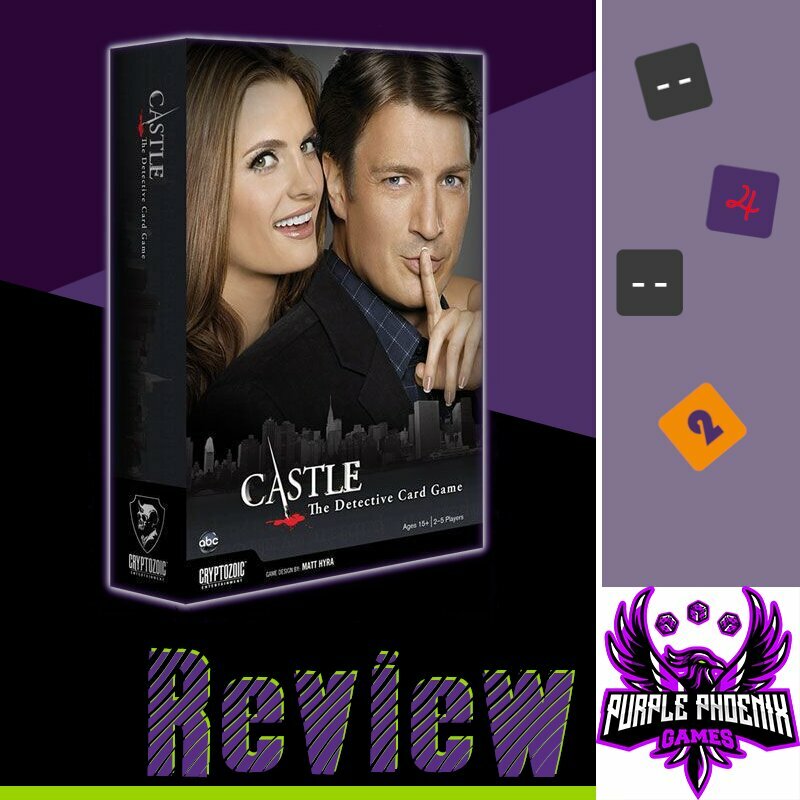
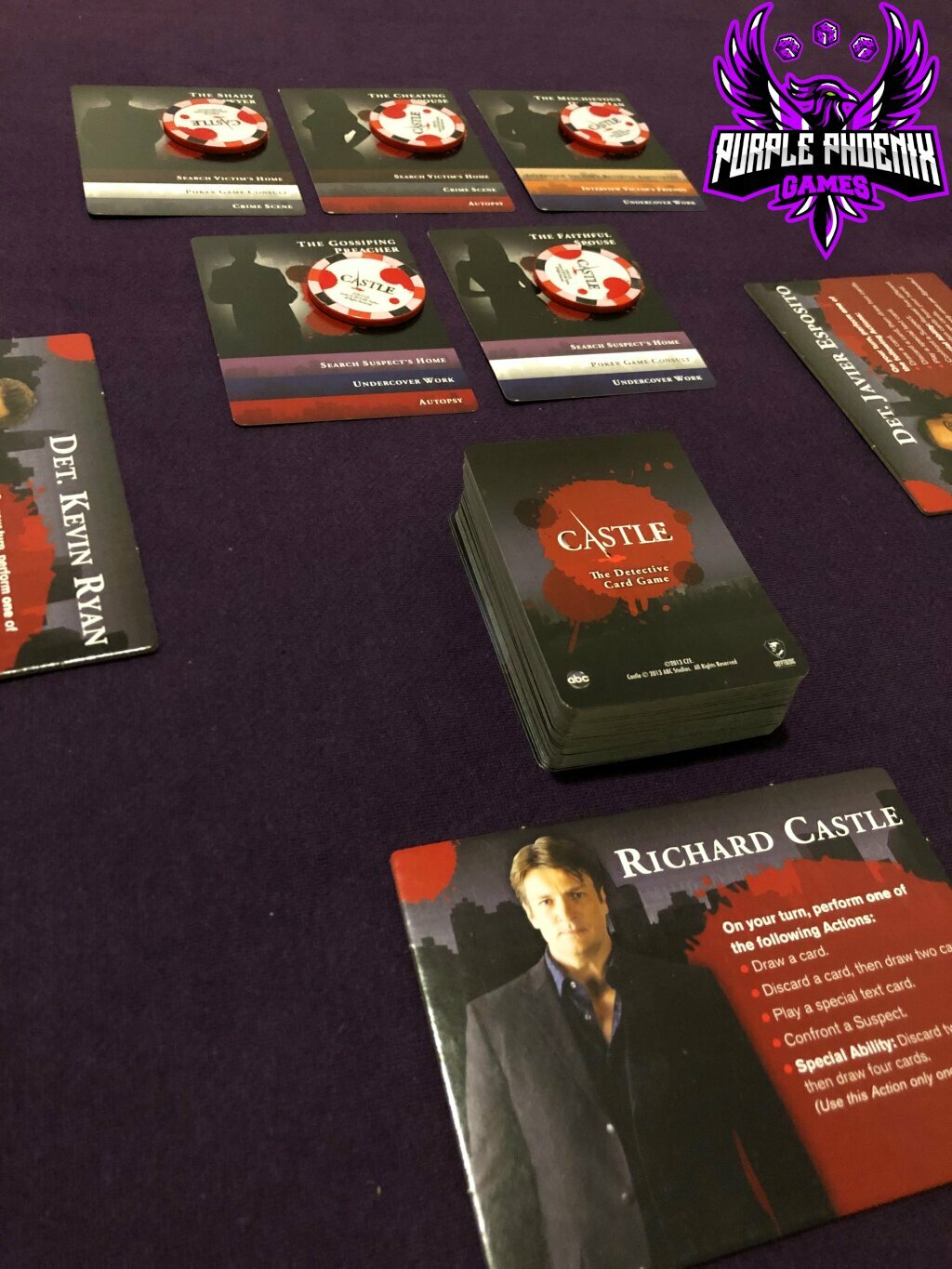
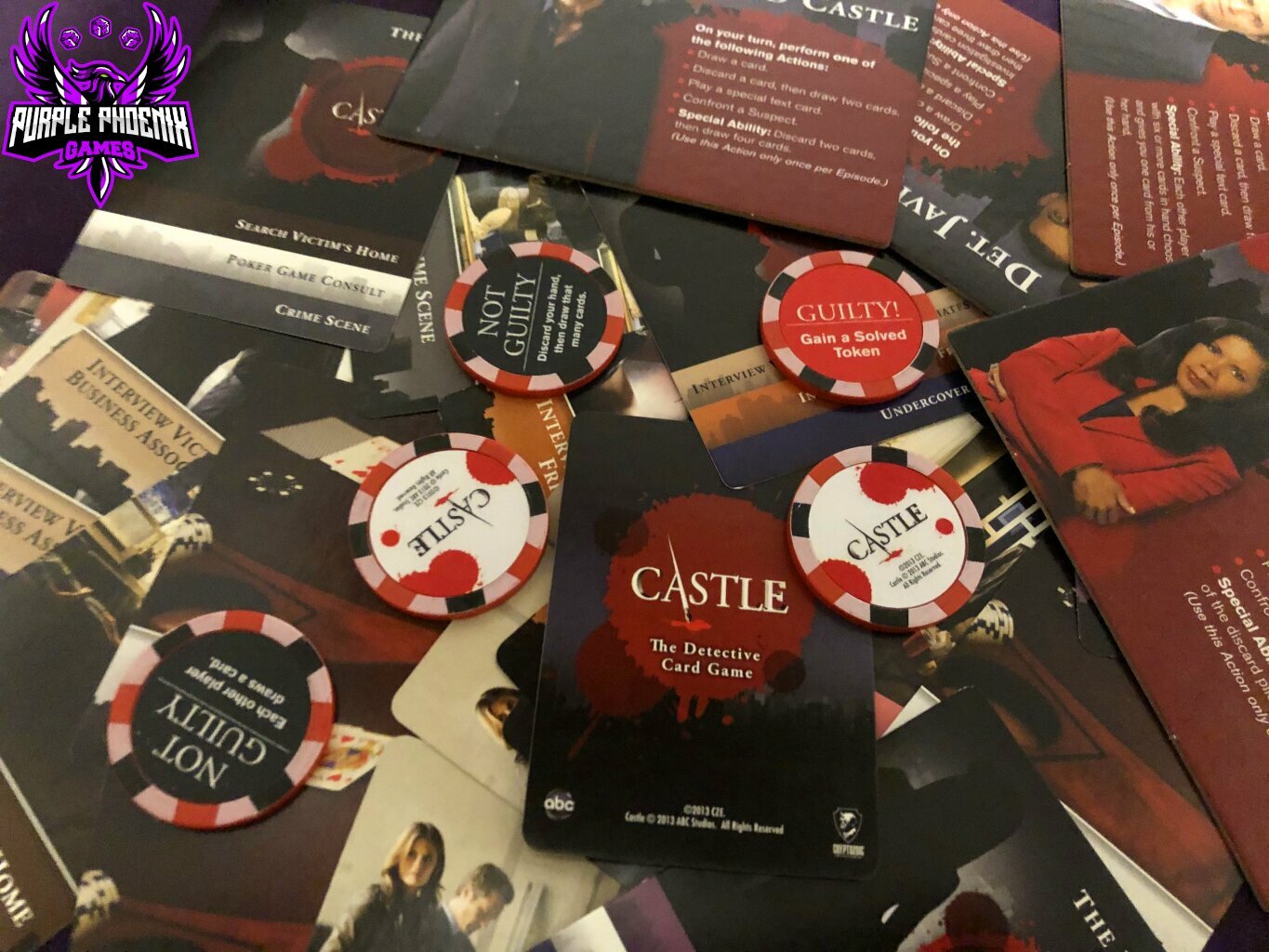
In Castle: The Detective Card Game (referred to as just Castle for the rest of this review) is a murder-mystery card game in which players assume the role of a character from the show, and work to gather evidence and conduct investigations in order to solve the murder at hand! To set up a game, give every player a Character card that represents one of the main characters from the show. Each Character card has a unique Special Ability to be used during play. Shuffle the Suspect cards, and randomly draw five to be placed face-up in the middle of the table. Select one Guilty token and four Not Guilty tokens – shuffle them together face-down and then place one token on each of the Suspect cards. Shuffle the deck of Investigation cards, deal 3 to each player, place the remaining cards into a Draw deck, and the game is ready to begin!
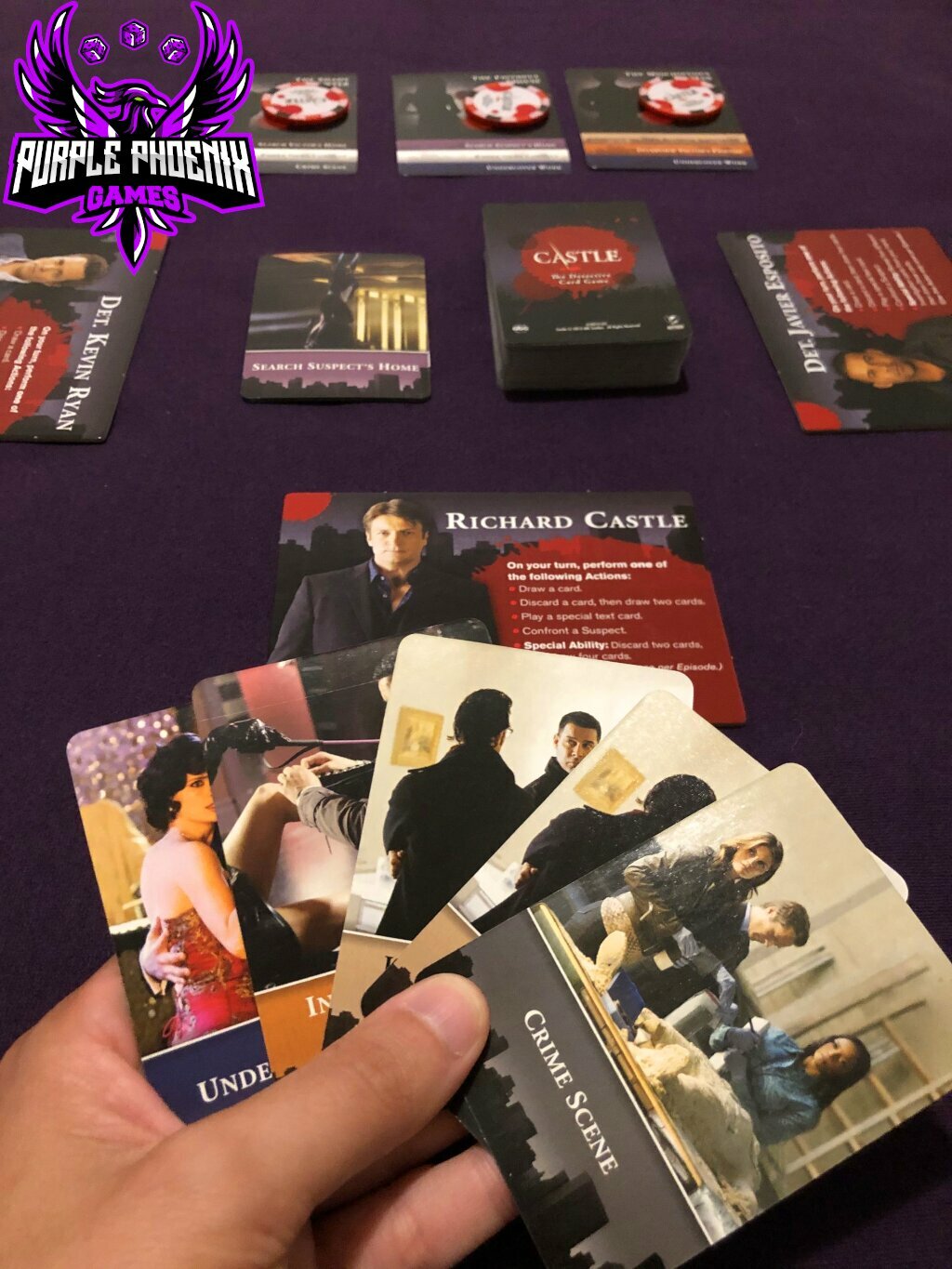
Moving in clockwise order, players will take turns performing one of the following actions: Draw a card, Discard one card to draw two cards, Play a Special Text card, Use your Special Ability, or Confront a Suspect. The first two actions regarding drawing cards are pretty self-explanatory. Throughout the game, you might draw into your hand an Investigation card with Special Text. You may play a Special Text card, and perform the specified action on your turn. Each Character has a Special Ability that can be used once per game, so plan wisely and use it appropriately! The last action, Confront a Suspect, is what the entire game is leading to. In order to Confront a Suspect, you must have the three Investigation cards listed on the bottom of the Suspect card in hand. When performing this action, you will reveal the three requisite Investigation cards, and then you flip the token on that Suspect card. If the token reads Guilty, then you have won the game! If the token reads Not Guilty, perform the action listed on the token, remove that Suspect and token from the game, discard your used Investigation cards, and play continue with a narrowed Suspect pool! The goal is to be the first player to find the Guilty party before the Draw deck runs out of cards.
Pretty straight-forward, right? I think so, and that’s one of the things I really like about this game. The gameplay is fast and simple, and makes for a quick little set collection game. Another neat element of this game is that although it is based around the Castle TV show, you do not need to have watched any of the show to play. Anyone can play and not feel like they are missing any vital information if they haven’t seen the show, and that makes it accessible to all players, not just fans of the show.
Even though I love the show, I have to admit that the gameplay, although fast and simple, is heavily dependent on the luck of the draw. Throughout the game, you are working to collect sets of the necessary Investigation cards for individual suspects, but the only way in which cards are distributed is through drawing them from the deck. There isn’t an offering that you ‘pay’ certain resources for coveted cards, there’s no real way to know in advance what card you are going to draw, etc. It really depends on how the deck was shuffled whether you will be successful or not. There are no real opportunities to strategize, and that keeps the overall gameplay kind of stagnant. Yes, there are Special Text cards and each Character has a unique ability, but deciding when to use them is kind of a shot in the dark due to the dependence on luck.
Let’s talk components for a minute. All of the Investigation and Character cards use photos or stills from the actual TV show. Again, you need not have watched it to play, but the use of the stills makes the game more immersive and nostalgic for those that have seen it. I love looking at the cards and trying to remember from which episode each still is, and if I remember who the killer was in that specific scenario. It’s just a fun little thing. The cards are all of good sturdy quality and will hold up decently in the long run. The Guilty/Not Guilty tokens in this game are some thick and heavy poker chips and they are AWESOME. They are so high quality, I just love to manipulate them, and they add some cool ‘bling’ to the game.
All in all, is Castle a great card game? No, not necessarily. It is a fun little murder mystery game, but not one that requires and real strategy or brain power to successfully play. Do I like it though? Absolutely, because it is based on my favorite show! If you’re looking for a nice filler game, or a game that doesn’t require too much focus, give Castle: The Detective Card Game a shot. That being said, I feel like only fans of the show will be trying this game, but I guess you can prove me wrong! Purple Phoenix Games give this a mischievous 6 / 12.
Purple Phoenix Games (2266 KP) rated Samurai Spirit in Tabletop Games
Jun 12, 2019

As a Samurai, you spend your life traveling across the land to help those in need. Most recently, you and a handful of other Samurai have been contracted by a small village to defend them against a clan of invading raiders. Only by working together, and by using your extensive training, will you succeed in keeping this village safe!
Samurai Spirit is a cooperative game of press-your-luck. Players take on the role of a Samurai, each with a unique power, and take turns drawing cards and fighting off the invaders or offering support to your fellow Samurai. Invaders can have recurring negative effects, so strategize wisely on how best to combat them and see how far you can push your luck each round. If you are able to survive through 3 rounds (waves) of invaders with at least one surviving farmstead and family, the Samurai are victorious and the village is saved! If any of the Samurai are killed, or the village has been completely destroyed by invaders, then the game is lost. As a solo game, Samurai Spirit plays essentially the same as in group play, with only 2 main differences – the solo player controls 2 Samurai instead of 1, and the support tokens from the unused Samurai are each available for use once during the game.
For such a neat theme, this game falls short for me. It seems simple enough, but there are areas of ambiguity in the rules that lead to some confusion. For starters, the text size is so small that I am not able to find any information at a quick glance! The text itself is not always clear either – like when, at the end of a round, the rules say to collect all cards used this round, does that include cards that have been discarded due to Samurai abilities? How about the cards of the Intruder stack that are presumably discarded after being revealed? The rulebook offers no clarification, and I honestly still don’t know the right answer.
The order/layout of the rules feels mismatched too – relevant information is not always grouped together, and I find myself flipping between several pages at a time trying to figure out one single thing. For example, in the ‘Fight’ action description, it says that if you reach your Kiai value exactly, you can activate your Kiai ability. You have to turn the page to a different section to see exactly what activating that ability means, and then you have to flip an additional 2 more pages to see what each individual Kiai ability is! Why not just put them all in one place? It would certainly be easier to understand if all relevant information was grouped together.
The prominent mechanic of Samurai Spirit is press-your-luck, and I would definitely say that this game is very luck-based. When setting up the game, the initial deck of cards is randomly selected and that can impact whether or not you are able to complete certain requirements each round – if there aren’t enough hat/farm/doll cards for each Samurai, you are guaranteed to incur a penalty at the end of every round. Actual gameplay is very luck-based too, and for me it feels like there are no good ways to strategize – your choices are all dependent on the luck of the draw. You can push your luck to draw more cards and use special abilities, but since you are suffering from recurring penalties each turn, it feels futile to keep going at a certain point.
For me, Samurai Spirit is repetitive and kind of boring – suffer penalty, draw card, and repeat until you eventually pass or the deck runs out. It’s like a too-complicated version of blackjack in which the deck is stacked against you. It’s such a bummer because the theme and artwork are neat, and the gameplay (in theory, at least) should be effective. But the actual execution is too reliant on luck to be successful.
I do quite a bit of solo gaming, but this game is never one that I willingly decide to play. I honestly only broke it out recently as a refresher for this review. Perhaps it is better at higher player counts, but since that is not where most of my gaming occurs, Samurai Spirit is a dud for me.
https://purplephoenixgames.wordpress.com/2019/02/06/solo-chronicles-samurai-spirit/