
Search
Search results

Purple Phoenix Games (2266 KP) rated Disney Villainous in Tabletop Games
Jan 6, 2020
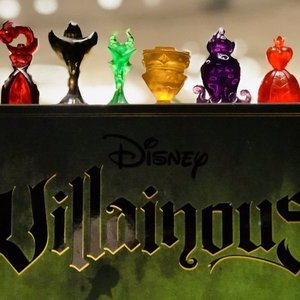

I am a sucker for a great theme. Or themes that turn the game around. Such is the case with Disney Villainous. Not often does a game allow you to play AS the bad guys against the good guys. That premise is interesting to me, and as I saw this release last year, I just knew I had to have it. Now that I have played it several times, with and without the first expansion, what do I have to say about it? Read on.
Disney Villainous (“Villainous” from here on) is a card game that pits players against each other in a race to complete individualized objectives to win the game. Players are in direct competition with each other and have devices to employ to spoil the plans of their competitors. Can Maleficent place out curses on all the lands in her realm before Hades can have three Titans storm on Mount Olympus? Can Prince John attain 20 power before either of them win the game? Such is Villainous.
DISCLAIMER: This game has a few standalone expansions now, with more on the way I’m sure. We are using components from the base game as well as the first expansion, “Wicked to the Core,” for this review. Should we decide to review the expansions as standalone games, we will link to the new material here. Furthermore, I do not intend to cover every single rule included in the rule book, but will describe the overall game flow and major rule set so that our readers may get a sense of how the game plays. For more in depth rules, you may purchase a copy from the publisher directly or from your FLGS. -T
To setup, each player will choose a big bad to play. Each character comes equipped with a colored pawn, a realm board with four locations, a deck of cards with matching pawn colored backs, a Fate deck with white back, and a playbook with tips on how to play that character. Also give every player a reference card that details the actions available. Shuffle each deck separately, give the starting player zero power from the cauldron, the second player one power, the third player two power, etc. Each player draws a hand of four colored back cards. Begin the game with the pawns on the leftmost location on the realm board and you are now ready to play.
Play works thusly: move your pawn to any unlocked location, complete any or all actions available at the location, draw your hand back up to four, next player. You MUST move on your turn, unless a card allows you to stay at your current location on your next turn. Once moved, the location will either show two or four options for actions. These could include play a card, activate a card, discard a card, gain power tokens, move an item or ally, move a Hero card, vanquish a Hero, or play cards from an opponent’s Fate deck. Some actions are self-explanatory (gain power tokens, et al), but some require further explanation.
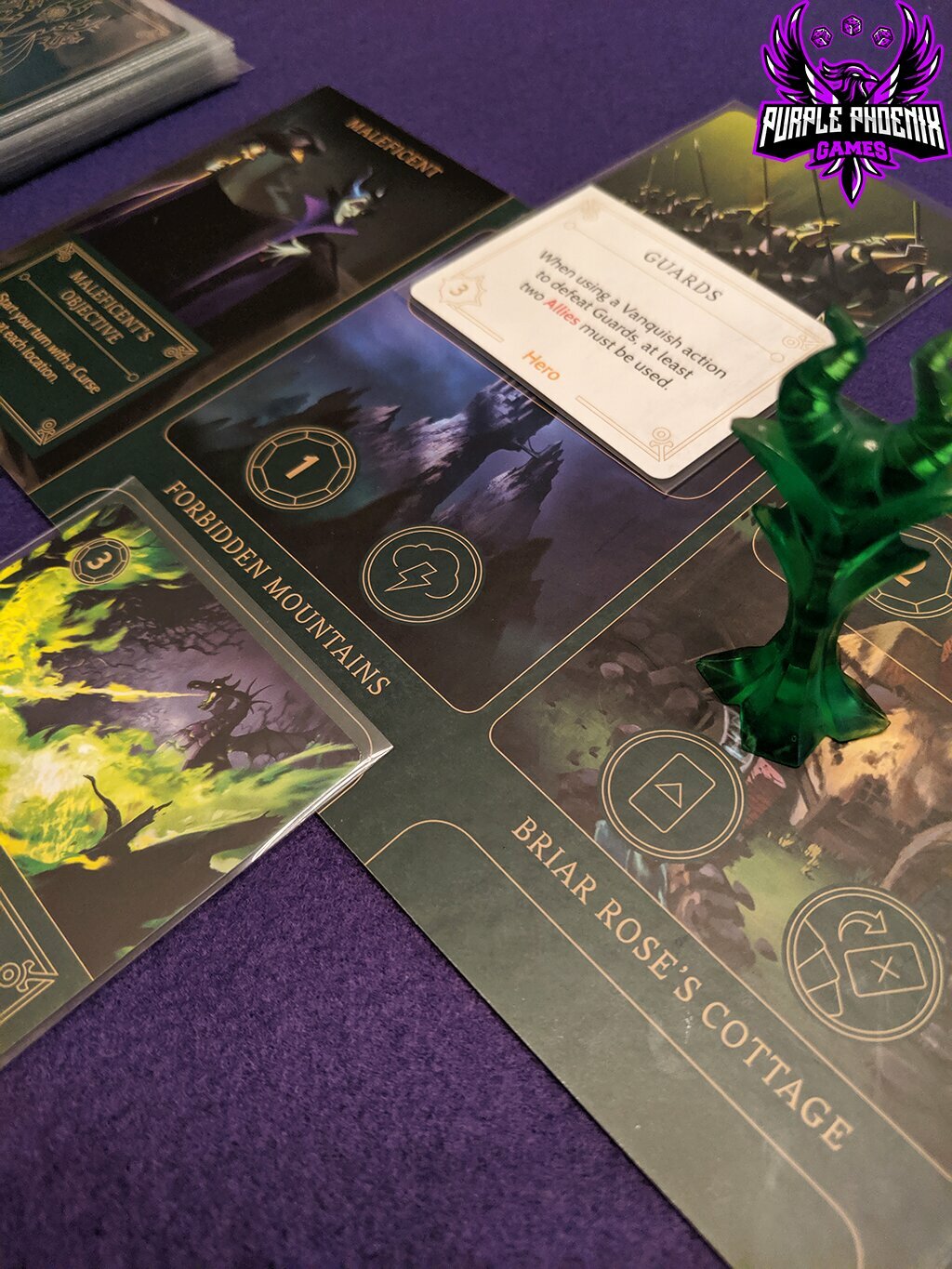
Some cards will have an activation symbol displayed on them. This means that a pawn has to have been moved to a location with an activate card symbol, and the player must pay to activate the card for its special abilities. Easy. Moving an item, ally, or Hero typically means physically moving the cards from one location to another adjacent location. This is important for some villains’ objectives: cards need to enter play in one location but travel to another as part of the win condition. When a villain moves to a location with the Fate symbol, they will choose an opponent, look at the top two cards of their Fate deck, and choose one card to play and one card to discard. These are especially devious and can greatly hinder the player’s progress. In addition, when a Fate card resides on a realm board it covers the top symbols of a location, thus nullifying the player’s ability to use these symbols on future turns. Using the vanquish symbol requires a Hero to have been played on your board, and having enough strength in allies and items to meet or overcome the Hero’s strength. Heroes and any allies/items used in the fight are then all discarded to the appropriate discard piles.
Play continues in this manner until one player has achieved their victory condition.
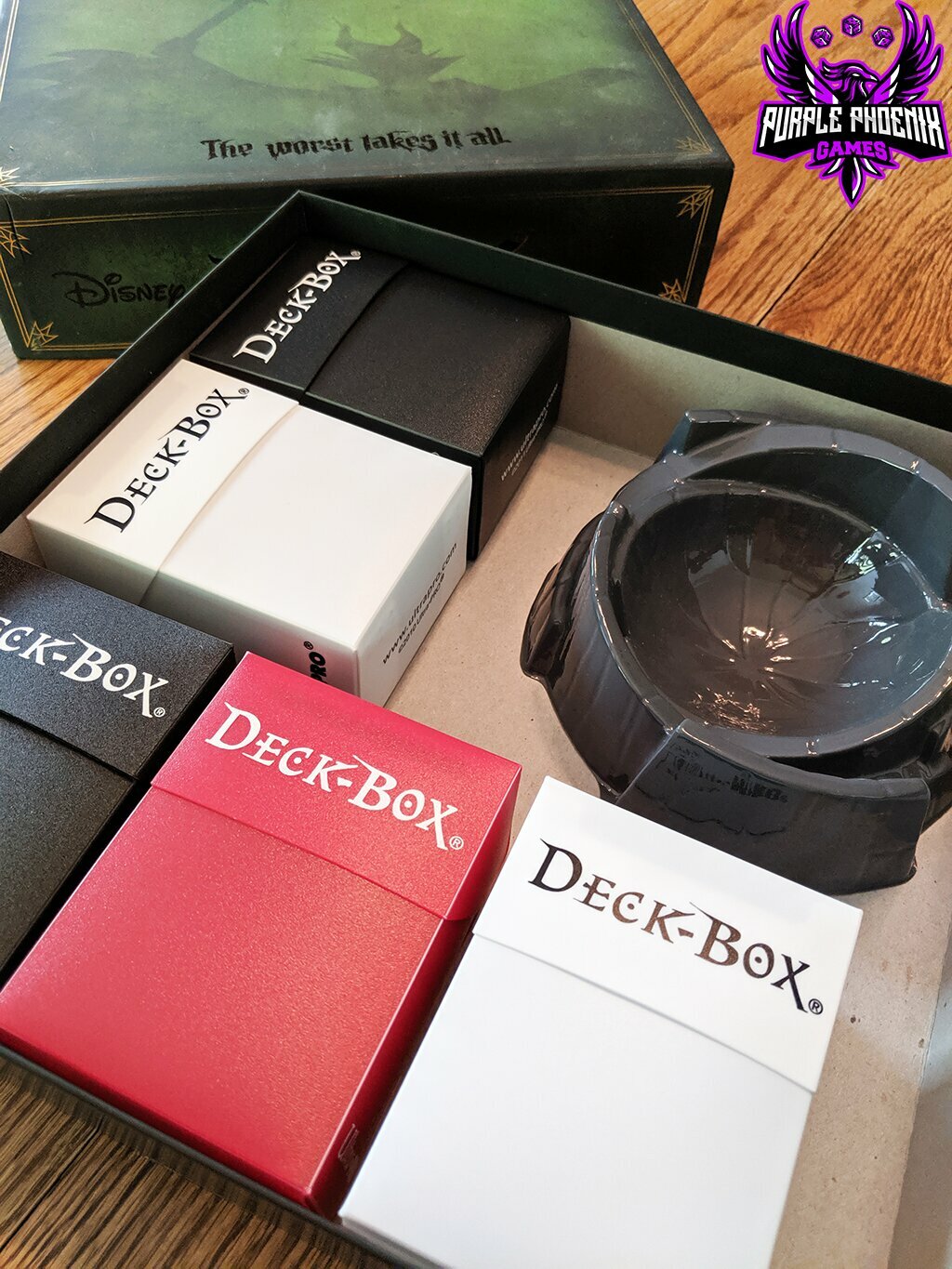
Components. I have good and bad news. Good news first. The components are absolutely fabulous! Those pawns. SOOOO good. Each is a somewhat abstracted figure of the villain, but with some concrete callbacks and recognizable features. They are just so dang fun to handle and play with. I think the cards are good quality, but I forgot what they feel like outside of the sleeves I put mine in. The board components are great, the cauldron is flimsy, unnecessary, and unwieldy when putting back in the box, especially if you have one or more expansions. I have not found a decent way to put everything back in one box, so I am resigned to having both boxes with me every time I want to play. That’s the bad. I also have put all my sleeved cards into plastic deck boxes in the main game box along with the cauldron. Everything else gets put in the expansion box. I hope a better storage solution is on the horizon along with future expansions…
So as you can see from our rating graphic on top that we are spread out on this one. I love it, but I don’t see it ever breaching my Top 10 list. It does have a tendency to overstay its welcome with all the Fate cards making it more and more difficult to win the game. Once a player seems to be near winning every other player gangs up, or seems to when I have played. I get that it may come off as a negative, and the play length as well, but it’s all part of villains out-villaining each other. While Josh rated it as a three and may not ever willingly ask to play it, I have it at a five because I think it’s a great game with a wonderful theme, amazing components, and tons of expandability. With that, we at Purple Phoenix Games give Disney Villainous a boding 16 / 24. If you are a big Disney fan, can live with the Take That, and want something that looks incredible on the table, pick it up.
Disney Villainous (“Villainous” from here on) is a card game that pits players against each other in a race to complete individualized objectives to win the game. Players are in direct competition with each other and have devices to employ to spoil the plans of their competitors. Can Maleficent place out curses on all the lands in her realm before Hades can have three Titans storm on Mount Olympus? Can Prince John attain 20 power before either of them win the game? Such is Villainous.
DISCLAIMER: This game has a few standalone expansions now, with more on the way I’m sure. We are using components from the base game as well as the first expansion, “Wicked to the Core,” for this review. Should we decide to review the expansions as standalone games, we will link to the new material here. Furthermore, I do not intend to cover every single rule included in the rule book, but will describe the overall game flow and major rule set so that our readers may get a sense of how the game plays. For more in depth rules, you may purchase a copy from the publisher directly or from your FLGS. -T
To setup, each player will choose a big bad to play. Each character comes equipped with a colored pawn, a realm board with four locations, a deck of cards with matching pawn colored backs, a Fate deck with white back, and a playbook with tips on how to play that character. Also give every player a reference card that details the actions available. Shuffle each deck separately, give the starting player zero power from the cauldron, the second player one power, the third player two power, etc. Each player draws a hand of four colored back cards. Begin the game with the pawns on the leftmost location on the realm board and you are now ready to play.
Play works thusly: move your pawn to any unlocked location, complete any or all actions available at the location, draw your hand back up to four, next player. You MUST move on your turn, unless a card allows you to stay at your current location on your next turn. Once moved, the location will either show two or four options for actions. These could include play a card, activate a card, discard a card, gain power tokens, move an item or ally, move a Hero card, vanquish a Hero, or play cards from an opponent’s Fate deck. Some actions are self-explanatory (gain power tokens, et al), but some require further explanation.
Some cards will have an activation symbol displayed on them. This means that a pawn has to have been moved to a location with an activate card symbol, and the player must pay to activate the card for its special abilities. Easy. Moving an item, ally, or Hero typically means physically moving the cards from one location to another adjacent location. This is important for some villains’ objectives: cards need to enter play in one location but travel to another as part of the win condition. When a villain moves to a location with the Fate symbol, they will choose an opponent, look at the top two cards of their Fate deck, and choose one card to play and one card to discard. These are especially devious and can greatly hinder the player’s progress. In addition, when a Fate card resides on a realm board it covers the top symbols of a location, thus nullifying the player’s ability to use these symbols on future turns. Using the vanquish symbol requires a Hero to have been played on your board, and having enough strength in allies and items to meet or overcome the Hero’s strength. Heroes and any allies/items used in the fight are then all discarded to the appropriate discard piles.
Play continues in this manner until one player has achieved their victory condition.
Components. I have good and bad news. Good news first. The components are absolutely fabulous! Those pawns. SOOOO good. Each is a somewhat abstracted figure of the villain, but with some concrete callbacks and recognizable features. They are just so dang fun to handle and play with. I think the cards are good quality, but I forgot what they feel like outside of the sleeves I put mine in. The board components are great, the cauldron is flimsy, unnecessary, and unwieldy when putting back in the box, especially if you have one or more expansions. I have not found a decent way to put everything back in one box, so I am resigned to having both boxes with me every time I want to play. That’s the bad. I also have put all my sleeved cards into plastic deck boxes in the main game box along with the cauldron. Everything else gets put in the expansion box. I hope a better storage solution is on the horizon along with future expansions…
So as you can see from our rating graphic on top that we are spread out on this one. I love it, but I don’t see it ever breaching my Top 10 list. It does have a tendency to overstay its welcome with all the Fate cards making it more and more difficult to win the game. Once a player seems to be near winning every other player gangs up, or seems to when I have played. I get that it may come off as a negative, and the play length as well, but it’s all part of villains out-villaining each other. While Josh rated it as a three and may not ever willingly ask to play it, I have it at a five because I think it’s a great game with a wonderful theme, amazing components, and tons of expandability. With that, we at Purple Phoenix Games give Disney Villainous a boding 16 / 24. If you are a big Disney fan, can live with the Take That, and want something that looks incredible on the table, pick it up.


Cynthia Armistead (17 KP) rated Enthralled: Paranormal Diversions in Books
Mar 1, 2018


Journeys, literal or otherwise, are the theme of this young adult anthology. Appropriately enough, it was conceived as the result of a book tour.
"Giovanni’s Farewell" by [a:Claudia Gray|1192311|Claudia Gray|http://photo.goodreads.com/authors/1234643683p2/1192311.jpg] is a sweet, coming-of-age story of sorts. The twist is that it features a brother and sister, twins, rather than just one person. They visit Rome with a school group while dealing with major changes in their lives. There was too much background crammed into a short story, but it was interesting.
[a:Carrie Ryan|1443712|Carrie Ryan|http://photo.goodreads.com/authors/1343410049p2/1443712.jpg]'s "Scenic Route" is a disturbing, post-apocalyptic story set in the world of [b:The Forest of Hands and Teeth|3432478|The Forest of Hands and Teeth (The Forest of Hands and Teeth, #1)|Carrie Ryan|http://photo.goodreads.com/books/1320633297s/3432478.jpg|3473471] about two young sisters trying to survive in an isolated cabin. The older sister keeps the younger one occupied with the planning of a road trip that will never happen, always hoping against hope that the girl won't realize what their reality is. How long can they stay isolated enough to survive? Bloody, frightening, and visceral.
"Red Run" by [a:Kami Garcia|2895706|Kami Garcia|http://photo.goodreads.com/authors/1289693388p2/2895706.jpg] is the story of a girl who has lost the only person she loves in the world, and the trip she takes to avenge his death. How do you hunt a ghost? Maybe it isn't fair, coming right after Ryan's story, but I didn't truly feel the main character's feelings.
[a:Jackson Pearce|2761947|Jackson Pearce|http://photo.goodreads.com/authors/1336840299p2/2761947.jpg]'s "Things About Love" is a sweet story involving a jinn researching love. I felt like I'd come into the middle of something, so I checked and found that she's written a novel, [b:As You Wish|6750586|As You Wish|Jackson Pearce|http://photo.goodreads.com/books/1319175193s/6750586.jpg|6217232], in the same setting. While this story technically stands on its own, it would probably be enriched by having read As You Wish.
"Niederwald" by [a:Rachel Vincent|415967|Rachel Vincent|http://photo.goodreads.com/authors/1262900481p2/415967.jpg] is the first story I've read in her Soul Screamers series. Sabine, a macha (nightmare), takes a road trip with a human acquaintance and detours to Niederwald, Texas, home to the harpies. No, there's no way that could go wrong. Of course you know from the moment they hit the parking lot that it will go wrong, but at least it's an interesting sort of wrong.
[a:Melissa Marr|175855|Melissa Marr|http://photo.goodreads.com/authors/1192302741p2/175855.jpg]'s "Merely Mortal" feels as though it's probably set in the same world as her Wicked Lovely series.
"Facing Facts" by [a:Kelley Armstrong|7581|Kelley Armstrong|http://photo.goodreads.com/authors/1199068298p2/7581.jpg] is set in her Darkest Powers universe. I read the first of those books, but obviously a lot has passed since then, and there were spoilers in this story. It really centers around Chloe and Tori, with a little Derek tossed in. Tori learns something she doesn't want to know and reacts badly, running off on her own, which is dangerous. Chloe goes after her and they get into trouble. That seemed rather predictable to me, but at least the type of trouble wasn't what I expected. Tori doesn't seem to have changed since the first book, but Chloe is coming into control of her abilities.
[a:Sarah Rees Brennan|836009|Sarah Rees Brennan|http://photo.goodreads.com/authors/1254149255p2/836009.jpg]'s "Let’s Get this Undead Show on the Road" is about a boy band that features a vampire, Christian. He's an unusual vampire, all alone without a nest or a sire. His journey seems to be about his identity as a vampire, although the band is on tour and has another sort of journey to make, as well.
"Bridge" by [a:Jeri Smith-Ready|56019|Jeri Smith-Ready|http://photo.goodreads.com/authors/1204922569p2/56019.jpg] is told from a ghost's point of view, 233 days after death. It's frustrating being a ghost, because most people can't see or hear you. There are things you have to accomplish before moving on, though, that require communication with the living. Finding a "bridge" and working things out takes a lot of effort. This was a touching story, bittersweet and well-told.
[a:Kimberly Derting|2755160|Kimberly Derting|http://photo.goodreads.com/authors/1229976464p2/2755160.jpg]'s "Skin Contact" nearly broke me. Rafe is looking for his girlfriend. He knows where he needs to go, and he's guided by dreams. This story nearly broke me. It's told sparingly, and something feels perfectly right about it, but it hurts. According to her author biography, Rafe was introduced in her novel Desires of the Dead.
"Leaving" by [a:Ally Condie|1304470|Ally Condie|http://photo.goodreads.com/authors/1325882614p2/1304470.jpg] is a very literary story, about a girl left behind after her mother dies and her father leaves. She spends the story preparing to go after her father. It's hard to describe much more than that, or to have much of an opinion. It was well-written and I think I'll probably remember it for a long time.
[a:Jessica Verday|1290625|Jessica Verday|http://photo.goodreads.com/authors/1243816082p2/1290625.jpg]'s "At The Late Night, Double Feature, Picture Show" is a darkly funny story about a girl from a family of monster hunters. She's usually the bait, but tonight she has decided to be the hunter — without backup. I'd like to read more from Verday.
"IV League" by [a:Margaret Stohl|2895707|Margaret Stohl|http://photo.goodreads.com/authors/1241421033p2/2895707.jpg] just didn't hit me right. It's the story of a bunch of southern vampires on a college tour, which could have been funny but wasn't written that way. The whole thing just didn't sit well with me, perhaps because the main character seemed too unrealistically out of touch for someone who obviously had access to television and the internet.
[a:Mary E. Pearson|123463|Mary E. Pearson|http://photo.goodreads.com/authors/1238978651p2/123463.jpg]'s "Gargouille" is the most touching love story in the collection. Just read it.
"The Third Kind" by [a:Jennifer Lynn Barnes|164187|Jennifer Lynn Barnes|http://photo.goodreads.com/authors/1243935916p2/164187.jpg] is, on the surface, about a road trip to San Antonio. The real journey is much deeper, one of coming to understanding one's calling.
[a:Rachel Caine|15292|Rachel Caine|http://photo.goodreads.com/authors/1272650500p2/15292.jpg]'s Morganville is the setting for her "Automatic." I think I've read a Morganville novella, but my memory of it is dim. The Morganville Blood Bank introduces an automated withdrawal machine, essentially a soda can dispenser. Michael Glass is ordered to try it first, as a demonstration for the older, more traditional vampires, with unexpected results. His journey is one of self-knowledge. I didn't really care much about him, his journey, his girlfriend, or anything else. The setting and characters do nothing for me, but your mileage may vary.
Altogether, the anthology was worth reading. There were some low spots, but that's true of any collection. To be fair, I'm sure someone who is more enthusiastic about young adult fiction would also be more enthusiastic about the works here.
"Giovanni’s Farewell" by [a:Claudia Gray|1192311|Claudia Gray|http://photo.goodreads.com/authors/1234643683p2/1192311.jpg] is a sweet, coming-of-age story of sorts. The twist is that it features a brother and sister, twins, rather than just one person. They visit Rome with a school group while dealing with major changes in their lives. There was too much background crammed into a short story, but it was interesting.
[a:Carrie Ryan|1443712|Carrie Ryan|http://photo.goodreads.com/authors/1343410049p2/1443712.jpg]'s "Scenic Route" is a disturbing, post-apocalyptic story set in the world of [b:The Forest of Hands and Teeth|3432478|The Forest of Hands and Teeth (The Forest of Hands and Teeth, #1)|Carrie Ryan|http://photo.goodreads.com/books/1320633297s/3432478.jpg|3473471] about two young sisters trying to survive in an isolated cabin. The older sister keeps the younger one occupied with the planning of a road trip that will never happen, always hoping against hope that the girl won't realize what their reality is. How long can they stay isolated enough to survive? Bloody, frightening, and visceral.
"Red Run" by [a:Kami Garcia|2895706|Kami Garcia|http://photo.goodreads.com/authors/1289693388p2/2895706.jpg] is the story of a girl who has lost the only person she loves in the world, and the trip she takes to avenge his death. How do you hunt a ghost? Maybe it isn't fair, coming right after Ryan's story, but I didn't truly feel the main character's feelings.
[a:Jackson Pearce|2761947|Jackson Pearce|http://photo.goodreads.com/authors/1336840299p2/2761947.jpg]'s "Things About Love" is a sweet story involving a jinn researching love. I felt like I'd come into the middle of something, so I checked and found that she's written a novel, [b:As You Wish|6750586|As You Wish|Jackson Pearce|http://photo.goodreads.com/books/1319175193s/6750586.jpg|6217232], in the same setting. While this story technically stands on its own, it would probably be enriched by having read As You Wish.
"Niederwald" by [a:Rachel Vincent|415967|Rachel Vincent|http://photo.goodreads.com/authors/1262900481p2/415967.jpg] is the first story I've read in her Soul Screamers series. Sabine, a macha (nightmare), takes a road trip with a human acquaintance and detours to Niederwald, Texas, home to the harpies. No, there's no way that could go wrong. Of course you know from the moment they hit the parking lot that it will go wrong, but at least it's an interesting sort of wrong.
[a:Melissa Marr|175855|Melissa Marr|http://photo.goodreads.com/authors/1192302741p2/175855.jpg]'s "Merely Mortal" feels as though it's probably set in the same world as her Wicked Lovely series.
"Facing Facts" by [a:Kelley Armstrong|7581|Kelley Armstrong|http://photo.goodreads.com/authors/1199068298p2/7581.jpg] is set in her Darkest Powers universe. I read the first of those books, but obviously a lot has passed since then, and there were spoilers in this story. It really centers around Chloe and Tori, with a little Derek tossed in. Tori learns something she doesn't want to know and reacts badly, running off on her own, which is dangerous. Chloe goes after her and they get into trouble. That seemed rather predictable to me, but at least the type of trouble wasn't what I expected. Tori doesn't seem to have changed since the first book, but Chloe is coming into control of her abilities.
[a:Sarah Rees Brennan|836009|Sarah Rees Brennan|http://photo.goodreads.com/authors/1254149255p2/836009.jpg]'s "Let’s Get this Undead Show on the Road" is about a boy band that features a vampire, Christian. He's an unusual vampire, all alone without a nest or a sire. His journey seems to be about his identity as a vampire, although the band is on tour and has another sort of journey to make, as well.
"Bridge" by [a:Jeri Smith-Ready|56019|Jeri Smith-Ready|http://photo.goodreads.com/authors/1204922569p2/56019.jpg] is told from a ghost's point of view, 233 days after death. It's frustrating being a ghost, because most people can't see or hear you. There are things you have to accomplish before moving on, though, that require communication with the living. Finding a "bridge" and working things out takes a lot of effort. This was a touching story, bittersweet and well-told.
[a:Kimberly Derting|2755160|Kimberly Derting|http://photo.goodreads.com/authors/1229976464p2/2755160.jpg]'s "Skin Contact" nearly broke me. Rafe is looking for his girlfriend. He knows where he needs to go, and he's guided by dreams. This story nearly broke me. It's told sparingly, and something feels perfectly right about it, but it hurts. According to her author biography, Rafe was introduced in her novel Desires of the Dead.
"Leaving" by [a:Ally Condie|1304470|Ally Condie|http://photo.goodreads.com/authors/1325882614p2/1304470.jpg] is a very literary story, about a girl left behind after her mother dies and her father leaves. She spends the story preparing to go after her father. It's hard to describe much more than that, or to have much of an opinion. It was well-written and I think I'll probably remember it for a long time.
[a:Jessica Verday|1290625|Jessica Verday|http://photo.goodreads.com/authors/1243816082p2/1290625.jpg]'s "At The Late Night, Double Feature, Picture Show" is a darkly funny story about a girl from a family of monster hunters. She's usually the bait, but tonight she has decided to be the hunter — without backup. I'd like to read more from Verday.
"IV League" by [a:Margaret Stohl|2895707|Margaret Stohl|http://photo.goodreads.com/authors/1241421033p2/2895707.jpg] just didn't hit me right. It's the story of a bunch of southern vampires on a college tour, which could have been funny but wasn't written that way. The whole thing just didn't sit well with me, perhaps because the main character seemed too unrealistically out of touch for someone who obviously had access to television and the internet.
[a:Mary E. Pearson|123463|Mary E. Pearson|http://photo.goodreads.com/authors/1238978651p2/123463.jpg]'s "Gargouille" is the most touching love story in the collection. Just read it.
"The Third Kind" by [a:Jennifer Lynn Barnes|164187|Jennifer Lynn Barnes|http://photo.goodreads.com/authors/1243935916p2/164187.jpg] is, on the surface, about a road trip to San Antonio. The real journey is much deeper, one of coming to understanding one's calling.
[a:Rachel Caine|15292|Rachel Caine|http://photo.goodreads.com/authors/1272650500p2/15292.jpg]'s Morganville is the setting for her "Automatic." I think I've read a Morganville novella, but my memory of it is dim. The Morganville Blood Bank introduces an automated withdrawal machine, essentially a soda can dispenser. Michael Glass is ordered to try it first, as a demonstration for the older, more traditional vampires, with unexpected results. His journey is one of self-knowledge. I didn't really care much about him, his journey, his girlfriend, or anything else. The setting and characters do nothing for me, but your mileage may vary.
Altogether, the anthology was worth reading. There were some low spots, but that's true of any collection. To be fair, I'm sure someone who is more enthusiastic about young adult fiction would also be more enthusiastic about the works here.

Gareth von Kallenbach (980 KP) rated Snow White and the Huntsman (2012) in Movies
Aug 7, 2019
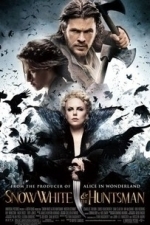
It is easy to be cynical or dismissive regarding the trend in Hollywood to take up beloved gems of the past – namely our childhoods – and adapt them to the big screen with all of the flare and clichés of a summer blockbuster. Yet, what happens when it actually ends up winning you over? There’s a moment in movies like “Snow White and the Huntsman” in which you realize you have let go of those prejudices and notions of incorruptible nostalgia and you’ve actually started to enjoy a new rendition of something old. It’s the directorial debut for the film’s helmer, Rupert Sanders; and to be honest he’s the star of the show. As shallow as it is to say, the visual effects and action overshadow most flaws with characters, acting, or uneven pacing. Not only because his directing ability is well done, but because any flaws with the movie are relatively minor.
The movie retells the familiar story of Snow White (Kristen Stewart), likely popularized by Disney’s adaptation for most of us. Yet, the film takes more influence from the original fairy tale with the additional focus on the Huntsman (Chris Hemsworth). Snow White grows up in a kingdom under the rule of her wicked step-mother, Queen Ravenna (Charlize Theron). The Queen is a narcissistic tyrant obsessed with preserving her physical beauty – at the behest of the entire land and its people. One day, the Queen’s mirror warns that Snow White is fairer than her which leads her to order Snow White’s death. Snow White escapes, and goes on an adventure to save herself and her kingdom with the help of the Huntsman, seven dwarves, and other fantastical allies.
The movie’s framework holds up fairly well. To be honest it was my biggest worry going into the movie – that its plot would break under bloating or simply feeling uninspired. Neither was the case, yet if it were to tip in one side or the other it definitely tips in the direction of a bloated plot. Some characters simply do not get the screentime they require, and with so many characters already it feels like some of them could have been taken out entirely without much effect. Trimming down of characters and irrelevant plot threads could have benefitted the movie greatly. It does, however, do a serviceable job establishing its own identity among fantasy epics. It’s refreshing to see a movie fully embrace two extremes – full-on hard fantasy and the more gritty, realistic and perhaps minimalist fantasy. It strikes a balance with both, so you will see great effects for trolls and fairies while still maintaining a gothic medieval feel. The plot moves forward at a mostly well-paced format, but unfortunately wavers here and there. Sometimes I wished the movie would linger on certain scenes longer – as it can help to have us dwell on great character moments or moments of visual beauty – an unfortunate side effect of a bloated script. While not a problem for the overall plot, the uneven pacing in some scenes can feel a bit rushed. Some questions in the plot went unanswered, but fortunately they aren’t important to the overall understanding of the story.
The only other major issue with the movie is acting. Kristen Stewart as Snow White was an odd choice. Not to say her performance is bad in this film, but it is awkward at points. In some moments she does very well but in others she seems uninspired. It is hard to see her as the titular character instead of just Kristen Stewart in those instances; and in those scenes it feels like she’s as much part of the audience as we are – just with more of a one-note “concerned” facial expression for every instance. While not a breaking element, it leaves more to be desired from her, especially in interactions with others. Chris Hemsworth was much more enjoyable as the Huntsman, and honestly I think his performance along with Theron’s far outbalance any flaws in Kristen Stewart’s acting. The chemistry between the two protagonists seems one sided, as Chris Hemsworth acts well on his side of the equation, but Stewart unfortunately does not reciprocate. Essentially this makes a potential major relationship fall flat. However, Theron completely inhibits the role as the evil Queen. While she may overact in some scenes, she does an excellent job playing a sinister, abusive, powerful and surprisingly tragic villain.
The highlight of the movie is definitely its visual design, cinematography, and action. The only downside in this area is that this movie will definitely remind you of other great movies from long ago. Obvious inspiration from “The Lord of the Rings” echoes while watching, as it even features the same faraway montage shots of the group traversing grand vistas. If you can get passed these obvious influences, it does establish a vibrant and inspired design. That is one of the greatest aspects of the movie – the fact that the director can do so much in a single scene to really draw you in. He does an excellent job using color and pattern contrasts to a striking and awesome effect. There are some great moments that have no action yet are just as enthralling to watch, something difficult to do with just visual style. A great use of color really brings out the themes of the movie – the grey monotones and gothic style bring out a sense of dread and annihilation throughout the Queen’s empire. She truly is a force of parasitism – entirely vampiric in the way she sucks the life out of the entire land around her. She is the embodiment of self-obsession with physical beauty – a force so vain and narcissistic that she acts as a black hole absorbing all beauty around her. Sanders plays this against the vibrant designs of the forest in which Snow White spends most of her time. Alive, colorful, and natural – she embodies natural beauty – and in doing so she seemingly commands nature itself.
Sanders’ directing ability really shines in scenes of action. Instead of lazy overuse of “shaky-cam” to get the effect, he balances it with just enough on-screen choreography so you get intensity without confusion. The movie is truly action packed with familiar medieval-esque battles throughout, but highlighted by truly amazing shots of action and use of fantastical effects. There were a couple instances of eye-rolling wonder at battlefield tactics, but that gets into too much of an area of nitpicking. The action really is one of the best aspects of the movie, and these scenes by themselves outweigh many already mentioned issues.
Overall, “Snow White and the Huntsman” has proven to be a great initial outing for director Rupert Sanders. There are some issues in the flick – namely some instances of uneven pacing and acting issues which leaves some potential to be desired. But even these seemingly huge issues are overshadowed by an excellent use of visual design, cinematography, and action. The plot may be merely serviceable overall, and the movie will remind you of great films long past; yet it still happens to triumph in its main goal – to retell the classic fairly tale of Snow White in the modern Blockbuster sense. In a summer packed with science fiction and superheroes, an entertaining fantasy movie fits in quite nicely.
The movie retells the familiar story of Snow White (Kristen Stewart), likely popularized by Disney’s adaptation for most of us. Yet, the film takes more influence from the original fairy tale with the additional focus on the Huntsman (Chris Hemsworth). Snow White grows up in a kingdom under the rule of her wicked step-mother, Queen Ravenna (Charlize Theron). The Queen is a narcissistic tyrant obsessed with preserving her physical beauty – at the behest of the entire land and its people. One day, the Queen’s mirror warns that Snow White is fairer than her which leads her to order Snow White’s death. Snow White escapes, and goes on an adventure to save herself and her kingdom with the help of the Huntsman, seven dwarves, and other fantastical allies.
The movie’s framework holds up fairly well. To be honest it was my biggest worry going into the movie – that its plot would break under bloating or simply feeling uninspired. Neither was the case, yet if it were to tip in one side or the other it definitely tips in the direction of a bloated plot. Some characters simply do not get the screentime they require, and with so many characters already it feels like some of them could have been taken out entirely without much effect. Trimming down of characters and irrelevant plot threads could have benefitted the movie greatly. It does, however, do a serviceable job establishing its own identity among fantasy epics. It’s refreshing to see a movie fully embrace two extremes – full-on hard fantasy and the more gritty, realistic and perhaps minimalist fantasy. It strikes a balance with both, so you will see great effects for trolls and fairies while still maintaining a gothic medieval feel. The plot moves forward at a mostly well-paced format, but unfortunately wavers here and there. Sometimes I wished the movie would linger on certain scenes longer – as it can help to have us dwell on great character moments or moments of visual beauty – an unfortunate side effect of a bloated script. While not a problem for the overall plot, the uneven pacing in some scenes can feel a bit rushed. Some questions in the plot went unanswered, but fortunately they aren’t important to the overall understanding of the story.
The only other major issue with the movie is acting. Kristen Stewart as Snow White was an odd choice. Not to say her performance is bad in this film, but it is awkward at points. In some moments she does very well but in others she seems uninspired. It is hard to see her as the titular character instead of just Kristen Stewart in those instances; and in those scenes it feels like she’s as much part of the audience as we are – just with more of a one-note “concerned” facial expression for every instance. While not a breaking element, it leaves more to be desired from her, especially in interactions with others. Chris Hemsworth was much more enjoyable as the Huntsman, and honestly I think his performance along with Theron’s far outbalance any flaws in Kristen Stewart’s acting. The chemistry between the two protagonists seems one sided, as Chris Hemsworth acts well on his side of the equation, but Stewart unfortunately does not reciprocate. Essentially this makes a potential major relationship fall flat. However, Theron completely inhibits the role as the evil Queen. While she may overact in some scenes, she does an excellent job playing a sinister, abusive, powerful and surprisingly tragic villain.
The highlight of the movie is definitely its visual design, cinematography, and action. The only downside in this area is that this movie will definitely remind you of other great movies from long ago. Obvious inspiration from “The Lord of the Rings” echoes while watching, as it even features the same faraway montage shots of the group traversing grand vistas. If you can get passed these obvious influences, it does establish a vibrant and inspired design. That is one of the greatest aspects of the movie – the fact that the director can do so much in a single scene to really draw you in. He does an excellent job using color and pattern contrasts to a striking and awesome effect. There are some great moments that have no action yet are just as enthralling to watch, something difficult to do with just visual style. A great use of color really brings out the themes of the movie – the grey monotones and gothic style bring out a sense of dread and annihilation throughout the Queen’s empire. She truly is a force of parasitism – entirely vampiric in the way she sucks the life out of the entire land around her. She is the embodiment of self-obsession with physical beauty – a force so vain and narcissistic that she acts as a black hole absorbing all beauty around her. Sanders plays this against the vibrant designs of the forest in which Snow White spends most of her time. Alive, colorful, and natural – she embodies natural beauty – and in doing so she seemingly commands nature itself.
Sanders’ directing ability really shines in scenes of action. Instead of lazy overuse of “shaky-cam” to get the effect, he balances it with just enough on-screen choreography so you get intensity without confusion. The movie is truly action packed with familiar medieval-esque battles throughout, but highlighted by truly amazing shots of action and use of fantastical effects. There were a couple instances of eye-rolling wonder at battlefield tactics, but that gets into too much of an area of nitpicking. The action really is one of the best aspects of the movie, and these scenes by themselves outweigh many already mentioned issues.
Overall, “Snow White and the Huntsman” has proven to be a great initial outing for director Rupert Sanders. There are some issues in the flick – namely some instances of uneven pacing and acting issues which leaves some potential to be desired. But even these seemingly huge issues are overshadowed by an excellent use of visual design, cinematography, and action. The plot may be merely serviceable overall, and the movie will remind you of great films long past; yet it still happens to triumph in its main goal – to retell the classic fairly tale of Snow White in the modern Blockbuster sense. In a summer packed with science fiction and superheroes, an entertaining fantasy movie fits in quite nicely.

Bob Mann (459 KP) rated If Beale Street Could Talk (2018) in Movies
Sep 28, 2021
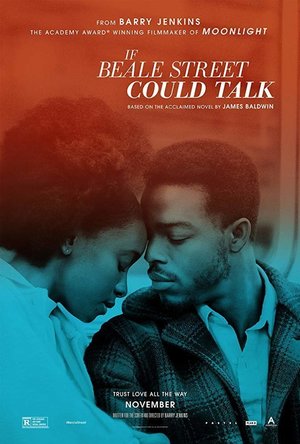
Love and Rage against the machine.
The baby asked,
‘Is there not one righteous among them?”
― James Baldwin, If Beale Street Could Talk
Beale Street refers to the jumpin’ heart of Memphis where Louis Armstrong was born. As explained in text from Baldwin’s source book (requiring a speed read!) it’s used as a metaphor for the birthplace of every black person in America. (“Every black person in America was born on Beale Street“). But the story is set in Harlem, New York, and with this intellectual stretch, before I even get past the title, I am immediately reaching for the “P-word”, of which more later.
The Plot
Tish (KiKi Layne) is 19 and in love with her lifelong friend ‘Fonny’ (Stephan James). So much in love in fact (and so careless) that Tish is now pregnant with his child. Tish must break this news to both families herself, since Fonny is inside awaiting trial for a vicious rape that he claims he didn’t commit. Tish and their joint families are trying to help, but can Fonny be released in time to see the birth of his child? Or are the institutions so set against him that release is impossible and death row might await?
Interwoven with Love and Anger
At its heart, this film portrays a truly beautiful love story. Tish and Fonny (both adorably played by the young leads) are friends becoming more than friends. We see their emerging love through flashback scenes. Some of these, particularly one on a metro train, are exquisitely done; long gazes into eyes, starting as one thing and ending as another.
In another scene, Fonny takes Tish’s virginity, and it’s done with style, taste and finesse. For younger teens this should be compulsory viewing as an antidote to all the horrible porn they are seeing on the internet: THIS is what sex, based on a foundation of true love, is all about. (The film is UK15 rated for “infrequent very strong language, strong sex” – I actually agree with the rating for the language (and actually I think an act of marital violence should also have also been referenced)…. but not for the sex, which should be 12A).
It’s a love story then? Well, yes, but offset against that, it’s a very angry film, seething with rage about how the police force and the justice system is set ‘against the black man’. Director Barry Jenkins (of – eventual – Oscar winner “Moonlight” fame) has a message to impart and he is intent on imparting it.
A great ensemble performance
The film didn’t get a SAG nomination for the ensemble cast, but it almost feels that they missed out here. As well as the two young leads being spectacular, the whole of the rest of the cast really gel well together, particularly the respective parents: Colman Domingo (“Selma“) as Tish’s father Joseph; Regina King as Tish’s mother Sharon; Michael Beach (“Patriots Day“) as Fonny’s father Frank and Aunjanue Ellis as his bible-bashing mother. A dramatic scene where they all collectively hear the news about the pregnancy is both comical and shocking in equal measure.
Poor sound mixing
If this film gets an Oscar nomination for sound, I’ll frankly be cross! There is significant use of sonorous, bass-heavy music and effects (including a lovely cello theme by Nicholas Britell) – all very effective; there is a lot of earnest and quietly spoken dialogue between the characters – also moody and effective. Unfortunately the two are mixed together in some scenes and frankly I couldn’t make out what was being said. Most frustrating.
In addition, there is voiceover narration from Tish (if you follow my blog regularly you KNOW what I think about that!). Actually, this isn’t as overly intrusive as in films like “The Hate U Give“, but it sounds like it was recorded in a dustbin! It’s a bit like that effect you get with headphones where the plug isn’t quite in the socket, and everything sounds way off and tinny. When combined with Layne’s accent the effect, again, made the dialogue difficult to comprehend.
The c-word and the n-word
There’s a degree of bad language in the film, albeit mild in comparison to “The Favourite“! Tish’s sister (Teyonah Parris) uses the c-word in one very funny dissing of Fonny’s ‘up-themselves’ sisters (Ebony Obsidian and Dominique Thorne). But the n-word is used repeatedly during the film, and that I can never get used to. I ‘get it’ (in the sense that I understand the perception) that this is a word that ‘only black people can use between themselves’. But this just feels elitist and wrong to me. At a time when Viggo Mortensen gets crucified for using it once (while being descriptive and in-context) during a press junket for “Green Book“, I just feel that if a word is taboo it should be taboo, period.
The p-word
My p-word here is “pretentious”. Barry Jenkins clearly feels he has something to prove after the success of “Moonlight“, and there are certainly moments of directorial brilliance in the film. As previously mentioned, the sex scene is one of the best I’ve seen in a long while. Also beautifully done are a birthing scene and two confrontational scenes in Puerto Rico. But there are also moments that seem to be staged, artificial and too ‘arty’ for their own good. Any hidden meaning behind them completely passed me by. (Examples are Sharon’s wig scene and a pan around Fonny’s wood sculpture). It all seems to be “trying too hard”.
Hate for the police is also writ large on the film, with every discriminatory police officer in the whole of the US embodied in the wicked sneering face of the police office Bell (Ed Skrein).
A platform that should be used for more than ranting
This is a film written and directed by an American black man (Jenkins) and largely fully cast with American black people. And I’m a white Englishman commenting on it. I’m clearly unqualified to pass judgement on how black America really feels about things! But comment I will from this fug of ignorance.
It feels to me that the “Black Lives Movement” has given, at long last, black film-makers like Jenkins a platform in cinema to present from. This is a great thing. But I’m sensing that at the moment the tone of the output from that platform (such as this film) seems to me heavily tinged with anger: a scream of frustration about the system and racial injustice over the years. It’s the film-makers right to make films about subjects dear to them. And I’m sure this summer we’ll sadly again see atrocities as previously seen in the likes of Ferguson and Dallas, fuelling the fire of hate. But I would personally really like to see someone like Jenkins use his undoubted talents to make a more uplifting film: a film reflecting the more positive strives that are happening in society, allowing for people of all races and all sexual orientations to make their way in business (not drug-running or crime!) and/or life in general. Those good news stories – the positive side of race relations – are out there and my view is that someone like Barry Jenkins should be telling them.
Final thoughts
I wasn’t as much of a fan of “Moonlight” as the Academy, and this film also left me conflicted. The film is well-made and the cast is very engaging. It also has a love story at its heart that is moody but well-done. Overall though the movie felt over-engineered and a little pretentious, and that knocked it down a few pegs for me.
‘Is there not one righteous among them?”
― James Baldwin, If Beale Street Could Talk
Beale Street refers to the jumpin’ heart of Memphis where Louis Armstrong was born. As explained in text from Baldwin’s source book (requiring a speed read!) it’s used as a metaphor for the birthplace of every black person in America. (“Every black person in America was born on Beale Street“). But the story is set in Harlem, New York, and with this intellectual stretch, before I even get past the title, I am immediately reaching for the “P-word”, of which more later.
The Plot
Tish (KiKi Layne) is 19 and in love with her lifelong friend ‘Fonny’ (Stephan James). So much in love in fact (and so careless) that Tish is now pregnant with his child. Tish must break this news to both families herself, since Fonny is inside awaiting trial for a vicious rape that he claims he didn’t commit. Tish and their joint families are trying to help, but can Fonny be released in time to see the birth of his child? Or are the institutions so set against him that release is impossible and death row might await?
Interwoven with Love and Anger
At its heart, this film portrays a truly beautiful love story. Tish and Fonny (both adorably played by the young leads) are friends becoming more than friends. We see their emerging love through flashback scenes. Some of these, particularly one on a metro train, are exquisitely done; long gazes into eyes, starting as one thing and ending as another.
In another scene, Fonny takes Tish’s virginity, and it’s done with style, taste and finesse. For younger teens this should be compulsory viewing as an antidote to all the horrible porn they are seeing on the internet: THIS is what sex, based on a foundation of true love, is all about. (The film is UK15 rated for “infrequent very strong language, strong sex” – I actually agree with the rating for the language (and actually I think an act of marital violence should also have also been referenced)…. but not for the sex, which should be 12A).
It’s a love story then? Well, yes, but offset against that, it’s a very angry film, seething with rage about how the police force and the justice system is set ‘against the black man’. Director Barry Jenkins (of – eventual – Oscar winner “Moonlight” fame) has a message to impart and he is intent on imparting it.
A great ensemble performance
The film didn’t get a SAG nomination for the ensemble cast, but it almost feels that they missed out here. As well as the two young leads being spectacular, the whole of the rest of the cast really gel well together, particularly the respective parents: Colman Domingo (“Selma“) as Tish’s father Joseph; Regina King as Tish’s mother Sharon; Michael Beach (“Patriots Day“) as Fonny’s father Frank and Aunjanue Ellis as his bible-bashing mother. A dramatic scene where they all collectively hear the news about the pregnancy is both comical and shocking in equal measure.
Poor sound mixing
If this film gets an Oscar nomination for sound, I’ll frankly be cross! There is significant use of sonorous, bass-heavy music and effects (including a lovely cello theme by Nicholas Britell) – all very effective; there is a lot of earnest and quietly spoken dialogue between the characters – also moody and effective. Unfortunately the two are mixed together in some scenes and frankly I couldn’t make out what was being said. Most frustrating.
In addition, there is voiceover narration from Tish (if you follow my blog regularly you KNOW what I think about that!). Actually, this isn’t as overly intrusive as in films like “The Hate U Give“, but it sounds like it was recorded in a dustbin! It’s a bit like that effect you get with headphones where the plug isn’t quite in the socket, and everything sounds way off and tinny. When combined with Layne’s accent the effect, again, made the dialogue difficult to comprehend.
The c-word and the n-word
There’s a degree of bad language in the film, albeit mild in comparison to “The Favourite“! Tish’s sister (Teyonah Parris) uses the c-word in one very funny dissing of Fonny’s ‘up-themselves’ sisters (Ebony Obsidian and Dominique Thorne). But the n-word is used repeatedly during the film, and that I can never get used to. I ‘get it’ (in the sense that I understand the perception) that this is a word that ‘only black people can use between themselves’. But this just feels elitist and wrong to me. At a time when Viggo Mortensen gets crucified for using it once (while being descriptive and in-context) during a press junket for “Green Book“, I just feel that if a word is taboo it should be taboo, period.
The p-word
My p-word here is “pretentious”. Barry Jenkins clearly feels he has something to prove after the success of “Moonlight“, and there are certainly moments of directorial brilliance in the film. As previously mentioned, the sex scene is one of the best I’ve seen in a long while. Also beautifully done are a birthing scene and two confrontational scenes in Puerto Rico. But there are also moments that seem to be staged, artificial and too ‘arty’ for their own good. Any hidden meaning behind them completely passed me by. (Examples are Sharon’s wig scene and a pan around Fonny’s wood sculpture). It all seems to be “trying too hard”.
Hate for the police is also writ large on the film, with every discriminatory police officer in the whole of the US embodied in the wicked sneering face of the police office Bell (Ed Skrein).
A platform that should be used for more than ranting
This is a film written and directed by an American black man (Jenkins) and largely fully cast with American black people. And I’m a white Englishman commenting on it. I’m clearly unqualified to pass judgement on how black America really feels about things! But comment I will from this fug of ignorance.
It feels to me that the “Black Lives Movement” has given, at long last, black film-makers like Jenkins a platform in cinema to present from. This is a great thing. But I’m sensing that at the moment the tone of the output from that platform (such as this film) seems to me heavily tinged with anger: a scream of frustration about the system and racial injustice over the years. It’s the film-makers right to make films about subjects dear to them. And I’m sure this summer we’ll sadly again see atrocities as previously seen in the likes of Ferguson and Dallas, fuelling the fire of hate. But I would personally really like to see someone like Jenkins use his undoubted talents to make a more uplifting film: a film reflecting the more positive strives that are happening in society, allowing for people of all races and all sexual orientations to make their way in business (not drug-running or crime!) and/or life in general. Those good news stories – the positive side of race relations – are out there and my view is that someone like Barry Jenkins should be telling them.
Final thoughts
I wasn’t as much of a fan of “Moonlight” as the Academy, and this film also left me conflicted. The film is well-made and the cast is very engaging. It also has a love story at its heart that is moody but well-done. Overall though the movie felt over-engineered and a little pretentious, and that knocked it down a few pegs for me.

Hadley (567 KP) rated The Devil in the White City: Murder, Magic, and Madness in Books
Jan 18, 2021
History (1 more)
Well-written
H.H. Holmes had many aliases and lives.
He's been a doctor and a licensed pharmacist, who then conned an old couple into selling their drug store to him where he preyed on young girls and ignorant customers that would buy whatever Holmes would tell them to buy, whether it were real or fake tonics.
He was a building owner who had a murder hotel secretly built with " a wooden chute that would descend from a secret location on the second floor all the way to the basement... ", "a room next to his office fitted with a large walk-in vault, with airtight seams and asbestos-coated iron walls. A gas jet embedded in one wall would be controlled from his closet...", "a large basement with hidden chambers and a sub-basement for the permanent storage of sensitive material. "
He owned and ran an alcohol-treatment company known as the Silver Ash Institute that claimed to have the cure for alcoholism.
He was a traveling business man, who had two wives and two children. He established the Campbell-Yates Manufacturing Company, which made nothing and sold nothing.
He was also labeled as America's first serial killer. His body count is unknown even today; his victims were frequently young women, which included stenographers and house wives. He was best known for convincing people who trusted him to sign him as the beneficiary of their life insurance policies, only to kill them and make it seem an accident so he could collect the money.
Holmes grew up in a small farming village in New Hampshire, where he briefly spoke about an early fear of a human skeleton that hung in a doctor's office: " 'I had daily to pass the office of one village doctor, the door of which was seldom if ever barred,' he wrote in a later memoir. 'Partly from its being associated in my mind as the source of all the nauseous mixtures that had been my childish terror (for this was before the day of children's medicines), and partly because of vague rumors I had heard regarding its contents, this place was one of peculiar abhorrence to me.' "... "Two children discovered Mudgett's [Holmes' real last name] fear and one day captured him and dragged him 'struggling and shrieking' into the doctor's office. 'Nor did they desist,' Mudgett wrote, 'until I had been brought face to face with one of its grinning skeletons, which, with arms outstretched, seemed ready in its turn to seize me. It was a wicked and dangerous thing to do to a child of tender years and health,' he wrote, ' but it proved an heroic method of treatment, destined ultimately to cure me of my fears, and to inculcate in me, first, a strong feeling of curiosity, and, later, a desire to learn, which resulted years afterwards in my adopting medicine as a profession.' "
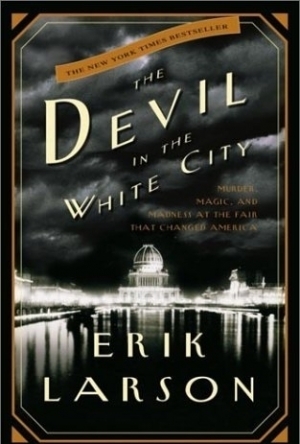
Erik Larson's fourth book, the Devil in the White City, is only partly about Holmes and his dark trail of murder and lies. The story told is mostly centered around the planning and building of the 1893 World's Fair. The prologue opens with one of the architects aboard a ship long after the fair has ended - - - 1912 to be exact- - - where he begins to write of the fair in his diary. The next chapter continues on with Chicago competing against other major cities to win the rights to host the World's Fair. Chicago was not the ideal place for the fair because it was known for it's crime and slaughter houses - - - this was exactly why the politicians wanted it so badly there, so it would help to lighten the image of Chicago for the rest of the world. Even the local Whitechapel Club that had sprouted up after the infamous murders by Jack the Ripper, were excited to win the rights to host the fair in their city, and celebrated in a macabre way:
"Upon learning that Chicago had won the fair, the men of the Whitechapel Club composed a telegram to Chauncey Depew, who more than any other man symbolized New York and its campaign to win the fair. Previously Depew had promised the members of the Whitechapel Club that if Chicago prevailed he would present himself at the club's next meeting, to be hacked apart by the Ripper himself - - - metaphorically, he presumed, although at the Whitechapel Club could one ever be certain? The club's coffin, for example, had once been used to transport the body of a member who had committed suicide. After claiming his body, the club hauled it to the Indiana Dunes on Lake Michigan, where members erected an immense pyre. They placed the body on top, then set it alight. Carrying torches and wearing black hooded robes, they circled the fire singing hymns to the dead between sips of whiskey. The club also had a custom of sending robed members to kidnap visiting celebrities and steal them away in a black coach with covered windows, all without saying a word.
The club's telegram reached Depew in Washington twenty minutes after the final ballot, just as Chicago's congressional delegation began celebrating at the Willard Hotel near the White House. The telegram asked, 'When may we see you at our dissecting table?' "
There are chapters in-between, technically reading like a side story, that tell us about Holmes and his misdeeds in Chicago, but there just wasn't enough about Holmes that I could consider this a True Crime book, nor an informative book about Holmes. Unfortunately, when the reader begins to really dwell into the story of Holmes, it's quickly ended by having two or more chapters about the building of the World's Fair. One interesting point about the story is that the reader does get to see how many inventions were brought to light because of the Fair, such as the invention of the Ferris Wheel. Larson's writing is very coherent and the descriptions are so well done that the reader is practically transported back to the late 1800s, yet, before I finished the book, I felt misled by the title... then coming across everything that happened to not only the Fair, but the people who were involved with it, it's hard not to wonder if the whole thing was cursed, thus the Devil being in the White City.
One of the side stories I did really enjoy was the slow unfolding of a man named Prendergast. A delusional young man who ran one of the groups of paperboys in Chicago, who was also obsessed with politics, became a determined supporter of Mayor Harrison; after Harrison was voted into office again, Prendergast believed it was because of him and the letters he sent out to numerous politicians and potential voters. Prendergast also believed he deserved a chair on the council for Harrison's re-election, for which he even showed up at City Hall to take over. This incident was the straw that broke the camel's back for Prendergast - - - he was humiliated when the people there laughed in his face. Prendergast then decided to take matters into his own hands, and bought a revolver. The day before the Fair would end, Prendergast showed up at Harrison's home and shot him. Harrison died minutes later. Prendergast turned himself in for the murder as soon as he left Harrison's residence. When asked why he had done it, Prendergast responded: " ' Because he betrayed my confidence. I supported him through his campaign and he promised to appoint me corporation counsel. He didn't live up to his word.' "
This book has been voted as a top True Crime must-read novel. I don't agree with this. As I said before: Holmes' chapters are few; eighty percent of this book is about the building of the World's Fair. As a True Crime junkie, I didn't enjoy this one, but also as a history junkie, I enjoyed learning about the Fair and everything that happened. I can't recommend this book to TC fans or horror fans. It's mostly history and architecture.
He's been a doctor and a licensed pharmacist, who then conned an old couple into selling their drug store to him where he preyed on young girls and ignorant customers that would buy whatever Holmes would tell them to buy, whether it were real or fake tonics.
He was a building owner who had a murder hotel secretly built with " a wooden chute that would descend from a secret location on the second floor all the way to the basement... ", "a room next to his office fitted with a large walk-in vault, with airtight seams and asbestos-coated iron walls. A gas jet embedded in one wall would be controlled from his closet...", "a large basement with hidden chambers and a sub-basement for the permanent storage of sensitive material. "
He owned and ran an alcohol-treatment company known as the Silver Ash Institute that claimed to have the cure for alcoholism.
He was a traveling business man, who had two wives and two children. He established the Campbell-Yates Manufacturing Company, which made nothing and sold nothing.
He was also labeled as America's first serial killer. His body count is unknown even today; his victims were frequently young women, which included stenographers and house wives. He was best known for convincing people who trusted him to sign him as the beneficiary of their life insurance policies, only to kill them and make it seem an accident so he could collect the money.
Holmes grew up in a small farming village in New Hampshire, where he briefly spoke about an early fear of a human skeleton that hung in a doctor's office: " 'I had daily to pass the office of one village doctor, the door of which was seldom if ever barred,' he wrote in a later memoir. 'Partly from its being associated in my mind as the source of all the nauseous mixtures that had been my childish terror (for this was before the day of children's medicines), and partly because of vague rumors I had heard regarding its contents, this place was one of peculiar abhorrence to me.' "... "Two children discovered Mudgett's [Holmes' real last name] fear and one day captured him and dragged him 'struggling and shrieking' into the doctor's office. 'Nor did they desist,' Mudgett wrote, 'until I had been brought face to face with one of its grinning skeletons, which, with arms outstretched, seemed ready in its turn to seize me. It was a wicked and dangerous thing to do to a child of tender years and health,' he wrote, ' but it proved an heroic method of treatment, destined ultimately to cure me of my fears, and to inculcate in me, first, a strong feeling of curiosity, and, later, a desire to learn, which resulted years afterwards in my adopting medicine as a profession.' "
Erik Larson's fourth book, the Devil in the White City, is only partly about Holmes and his dark trail of murder and lies. The story told is mostly centered around the planning and building of the 1893 World's Fair. The prologue opens with one of the architects aboard a ship long after the fair has ended - - - 1912 to be exact- - - where he begins to write of the fair in his diary. The next chapter continues on with Chicago competing against other major cities to win the rights to host the World's Fair. Chicago was not the ideal place for the fair because it was known for it's crime and slaughter houses - - - this was exactly why the politicians wanted it so badly there, so it would help to lighten the image of Chicago for the rest of the world. Even the local Whitechapel Club that had sprouted up after the infamous murders by Jack the Ripper, were excited to win the rights to host the fair in their city, and celebrated in a macabre way:
"Upon learning that Chicago had won the fair, the men of the Whitechapel Club composed a telegram to Chauncey Depew, who more than any other man symbolized New York and its campaign to win the fair. Previously Depew had promised the members of the Whitechapel Club that if Chicago prevailed he would present himself at the club's next meeting, to be hacked apart by the Ripper himself - - - metaphorically, he presumed, although at the Whitechapel Club could one ever be certain? The club's coffin, for example, had once been used to transport the body of a member who had committed suicide. After claiming his body, the club hauled it to the Indiana Dunes on Lake Michigan, where members erected an immense pyre. They placed the body on top, then set it alight. Carrying torches and wearing black hooded robes, they circled the fire singing hymns to the dead between sips of whiskey. The club also had a custom of sending robed members to kidnap visiting celebrities and steal them away in a black coach with covered windows, all without saying a word.
The club's telegram reached Depew in Washington twenty minutes after the final ballot, just as Chicago's congressional delegation began celebrating at the Willard Hotel near the White House. The telegram asked, 'When may we see you at our dissecting table?' "
There are chapters in-between, technically reading like a side story, that tell us about Holmes and his misdeeds in Chicago, but there just wasn't enough about Holmes that I could consider this a True Crime book, nor an informative book about Holmes. Unfortunately, when the reader begins to really dwell into the story of Holmes, it's quickly ended by having two or more chapters about the building of the World's Fair. One interesting point about the story is that the reader does get to see how many inventions were brought to light because of the Fair, such as the invention of the Ferris Wheel. Larson's writing is very coherent and the descriptions are so well done that the reader is practically transported back to the late 1800s, yet, before I finished the book, I felt misled by the title... then coming across everything that happened to not only the Fair, but the people who were involved with it, it's hard not to wonder if the whole thing was cursed, thus the Devil being in the White City.
One of the side stories I did really enjoy was the slow unfolding of a man named Prendergast. A delusional young man who ran one of the groups of paperboys in Chicago, who was also obsessed with politics, became a determined supporter of Mayor Harrison; after Harrison was voted into office again, Prendergast believed it was because of him and the letters he sent out to numerous politicians and potential voters. Prendergast also believed he deserved a chair on the council for Harrison's re-election, for which he even showed up at City Hall to take over. This incident was the straw that broke the camel's back for Prendergast - - - he was humiliated when the people there laughed in his face. Prendergast then decided to take matters into his own hands, and bought a revolver. The day before the Fair would end, Prendergast showed up at Harrison's home and shot him. Harrison died minutes later. Prendergast turned himself in for the murder as soon as he left Harrison's residence. When asked why he had done it, Prendergast responded: " ' Because he betrayed my confidence. I supported him through his campaign and he promised to appoint me corporation counsel. He didn't live up to his word.' "
This book has been voted as a top True Crime must-read novel. I don't agree with this. As I said before: Holmes' chapters are few; eighty percent of this book is about the building of the World's Fair. As a True Crime junkie, I didn't enjoy this one, but also as a history junkie, I enjoyed learning about the Fair and everything that happened. I can't recommend this book to TC fans or horror fans. It's mostly history and architecture.

Zuky the BookBum (15 KP) rated Nightmares: A New Decade of Modern Horror in Books
Mar 15, 2018
Also read my review here: http://bookbum.weebly.com/book-reviews/nightmares-a-new-decade-of-modern-horror-by-various-authors
NOW AVAILABLE IN THE UK!
I decided that instead of rating this book overall, it would be better to rate each individual story, so that’s what I’ve done. Obviously I had to rate the overall book so I actually calculated the average of all the ratings lol.
<b><u>Shallaballah</b></u> by Mark Samuels
<i>1 star</i>
Not a good start to the book for me. I was over the stitched up face appearance, creepy hospital, shady operations kind of horror story long ago, so this did pretty much nothing for me. Yes there were creepy elements to it but not enough. I also get what it was trying to do with the whole vanity, television thing, but it didn’t really work and so for me, added nothing to the overall plot.
<b><u>Sob in the Silence</b></u> by Gene Wolfe
<i>3 stars</i>
This was a pretty good creepy story, I much prefer stories that don't really have any paranormal elements to them and are more about the madness of the human brain. This short story had a bit of both to it so it was much preferable to the last! Didn't like the weird abrupt ending though, it felt like the story had been cut short.
<b><u>Our Turn Too Will One Day Come</b></u> by Brian Hodge
<i>4 stars</i>
This definitely had my skin crawling a bit. I love this kind of horror story that incorporates creatures and family secrets, kind of gave me The Village vibes… Is that the name of that film? Anyway, yes, great short!
<b><u>Dead Sea Fruit</b></u> by Kaaron Warren
<i>3 stars</i>
This short was pretty good, the Ash Mouth Man was pretty freaky but the writing was a bit all over the place and I felt too much was squeezed into such a small story. I'd love to read a full length story about this Ash Man, that would definitely be disturbing to read!
<b><u>Closet Dreams</b></u> by Lisa Tuttle
<i>4 stars</i>
Really well written and completely terrifying! I hate abduction stories so much because it could happen to anyone. It's not like the demonic ghost stories that you choose to believe or not believe, men who rape and steal little girls are <b>real.</b> The ending was… Predictable… Done before… Boring… But the rest of it was good enough to warrant it 4 stars!
<b><u>Spectral Evidence</b></u> by Gemma Files
<i>1 star</i>
?????????????????????????????????????????????????????????????????
I didn’t like the way this was set out, very frustrating to read on a Kindle! Also, I didn’t really get it, it was so all over the place I forgot what was happening previously.
<b><u>Hushabye</b></u> by Simon Bestwick
<i>2 stars.</i>
I wanted to like this one but there was too much missing from the story, maybe it was meant to be mysterious but in my eyes it just felt unfinished. Like what was the man sucking out of the children? And what really happened to Hardiman? Also I thought the narrator was a woman until we finally learnt his name was Paul, don’t know why, I just imagined him that way.
<b><u>Very Low-Flying Aircraft</b></u> by Nicholas Royle
<i>3 stars</i>
I’m not really a big fan of war based novels / stories so from the get go I knew I wasn’t going to get on that well with this story but it wasn’t so bad. I didn’t feel like this story explained itself enough or maybe it did and I just didn’t get it? Like why did it matter that Frankie looked like Victoria and why did Flynn go to the clinic? Also, I didn’t think it of a horror story really, though it was scary and horrible, it didn’t give me the heeby-jeebys like some of the others have done.
<b><u>The Goosle</b></u> by Margo Lanagan
<i>2 stars</i>
Seriously, seriously grotesque. If you have a weak stomach, <i>avoid this.</i> A very peculiar branch off the traditional Hansel and Gretel story we all know. This isn’t my kind of horror at all. I much prefer scary, mysterious human crime and occasionally a paranormal story. Torture porn is not at all my thing. This was very well written though, so props to Lanagan for that.
<b><u>The Clay Party</b></u> by Steve Duffy
<i>4 stars</i>
Again, not exactly what I’d classify as a horror story, but a great read nonetheless. Excellently written and enjoyable the whole way through, up until the end… the ending definitely wasn’t my kind of style so that was disappointing for me personally, but I’m sure others would love it!
<b><u>Strappado</b></u> by Laird Barron
<i>3 stars</i>
Definitely one of the strangest of the shorts in this novel. I thought it was excellently written but I didn’t quite get it? Maybe I was just having an off day when I read this but it didn’t really do anything for me.
<b><u>Lonegan’s Luck</b></u> by Stephen Graham Jones
<i>4 stars</i>
This is one of those stories I don’t know why I like. I never used to be into these kinds of rural town, religious apocalyptic kind of books, but ever since reading Mammoth, I’ve begun to enjoy reading them. Admittedly this had me a little confused to begin with, there were what felt like a lot of characters, but in the end none of the mattered anyway, they were just there to set the scene.
<b><u>Mr Pigsny</b></u> by Reggie Oliver
<i>3 stars</i>
I feel like I’ve read this book a million times. It’s one of those stories that's been redone time and time again with just slight changes here and there. It isn’t a bad plot per say, I certainly enjoyed it, it just had nothing unique about it.
<b><u>At Night, When the Demons Come by</b></u> by Ray Cluley
<i>4 stars</i>
One of the longer stories in this book but also one of the best. It had a pleasing twist to it and some interesting characters. I guess I quite like the whole apocalyptic feel when it comes to stories. I personally don’t feel this one was a horror story, more like a fantasy thriller.
<b><u>Was She Wicked? Was She Good?</b></u> by Mary Rickert
<i>4 stars</i>
This was a sad horror story, but in a way, it was also quite beautiful. I really liked the plot, it was something quite different to all the others in this collection and I thought the way it was written flowed well. Enjoyable short story!
<b><u>The Shallows</b></u> by John Langan
<i>2 stars</i>
I liked how this was written but I didn’t get it? I got bored halfway through it too, it was a half an hour read and I just couldn’t understand it so I skimmed the last 10 minutes or so. Yawn.
<b><u>Little Pig</b></u> by Anna Taborska
<i>3 stars</i>
Meh. This was well written and very different to the rest of the stories in this collection but was it a horror story? No. It was tragic, but not scary. Disappointing because whenever I see the word “pig” in relation to something “scary” I think of AHS.
<b><u>Omphalos</b></u> by Livia Llewellyn
<i>3 stars</i>
<b>TRIGGER WARNING: SEXUAL ABUSE</b>
This story was definitely very unique to the rest of the stories in this collection in the terms that this was a horror story that focused more on the real life horrors of families rather than made up monsters and ghouls. This story isn’t for the faint-hearted, it was horrific and gruesome and very upsetting. It wasn’t the best story in the collection when it came to plot or writing style, but it did bring out strong emotions in me, which other stories have been unable to do.
<b><u>How We Escaped Our Certain Fate</b></u> by Dan Chaon
<i>5 stars</i>
I liked how this was a different take on a classic zombie story - <b><i>”It wasn’t the end of the world… of course, a bite would infect you, but they weren’t terribly aggressive, in general.”</b></i> This was by far my favourite story in the entire book, it was so sad and emotional. It was beautiful.
<b><u>That Tiny Flutter of the Heart I Used to Call Love</b></u> by Robert Shearman
<i>4 stars</i>
Creepy, creepy, creepy. Dolls terrify me thanks to modern horror, although, really, I’ve always felt unsettled by them. Enjoyable story though. Poor Julian.
(This story almost had my name in it! “Suki” is close enough to Zuky.)
<b><u>Interstate Love Song (Murder Ballad No.8)</b></u> by Caitlin R. Kiernan
<i>3 stars</i>
Hmm, why did the shorts at the end of this book get all meaningful and loved up? I think that kinda ruined this for me. Granted it was disturbed and pretty grotesque at times but sadness of the ending ruined that creepy effect of the book and just left this kind of hanging in the space between horror and tragedy.
<b><u>Shay Corsham Worsted</b></u> by Garth Nix
<i>4 stars</i>
This was an interesting story and I liked our harsh but caring main character, Sir David. I wish this story was a little longer so we could find out more about Shay because I feel the missing backstory left this plot wide open. Enjoyable nonetheless.
<b><u>The Atlas of Hell</b></u> by Nathan Ballingrud
<i>3 stars</i>
I really enjoyed this to begin with though I thought it had a little David Wong influence, a writing style I’m not into. All was going well for this story until I got towards the end of it, where it completely lost me. Whether this is down to the annoying man sat on the train next to me, speaking into his phone at 32596 decibels, or just because the plot went AWOL, we’ll never know.
<b><u>Ambitious Boys Like You</b></u> by Richard Kadrey
<i>4 stars</i>
I like these kinds of creepy stories! They’re not particularly unique anymore, because they’ve been done so many different times in so many different, but similar ways, but they’re still fun to read. The old man was especially disturbing just because he was so witty and chilled out. I liked that this story had elements of humour to it, it made a nice change to the more recent emotion filled stories.
I’d like to thank Netgalley and Tachyon Publications for giving me the opportunity to read this in an exchange for an honest review.
NOW AVAILABLE IN THE UK!
I decided that instead of rating this book overall, it would be better to rate each individual story, so that’s what I’ve done. Obviously I had to rate the overall book so I actually calculated the average of all the ratings lol.
<b><u>Shallaballah</b></u> by Mark Samuels
<i>1 star</i>
Not a good start to the book for me. I was over the stitched up face appearance, creepy hospital, shady operations kind of horror story long ago, so this did pretty much nothing for me. Yes there were creepy elements to it but not enough. I also get what it was trying to do with the whole vanity, television thing, but it didn’t really work and so for me, added nothing to the overall plot.
<b><u>Sob in the Silence</b></u> by Gene Wolfe
<i>3 stars</i>
This was a pretty good creepy story, I much prefer stories that don't really have any paranormal elements to them and are more about the madness of the human brain. This short story had a bit of both to it so it was much preferable to the last! Didn't like the weird abrupt ending though, it felt like the story had been cut short.
<b><u>Our Turn Too Will One Day Come</b></u> by Brian Hodge
<i>4 stars</i>
This definitely had my skin crawling a bit. I love this kind of horror story that incorporates creatures and family secrets, kind of gave me The Village vibes… Is that the name of that film? Anyway, yes, great short!
<b><u>Dead Sea Fruit</b></u> by Kaaron Warren
<i>3 stars</i>
This short was pretty good, the Ash Mouth Man was pretty freaky but the writing was a bit all over the place and I felt too much was squeezed into such a small story. I'd love to read a full length story about this Ash Man, that would definitely be disturbing to read!
<b><u>Closet Dreams</b></u> by Lisa Tuttle
<i>4 stars</i>
Really well written and completely terrifying! I hate abduction stories so much because it could happen to anyone. It's not like the demonic ghost stories that you choose to believe or not believe, men who rape and steal little girls are <b>real.</b> The ending was… Predictable… Done before… Boring… But the rest of it was good enough to warrant it 4 stars!
<b><u>Spectral Evidence</b></u> by Gemma Files
<i>1 star</i>
?????????????????????????????????????????????????????????????????
I didn’t like the way this was set out, very frustrating to read on a Kindle! Also, I didn’t really get it, it was so all over the place I forgot what was happening previously.
<b><u>Hushabye</b></u> by Simon Bestwick
<i>2 stars.</i>
I wanted to like this one but there was too much missing from the story, maybe it was meant to be mysterious but in my eyes it just felt unfinished. Like what was the man sucking out of the children? And what really happened to Hardiman? Also I thought the narrator was a woman until we finally learnt his name was Paul, don’t know why, I just imagined him that way.
<b><u>Very Low-Flying Aircraft</b></u> by Nicholas Royle
<i>3 stars</i>
I’m not really a big fan of war based novels / stories so from the get go I knew I wasn’t going to get on that well with this story but it wasn’t so bad. I didn’t feel like this story explained itself enough or maybe it did and I just didn’t get it? Like why did it matter that Frankie looked like Victoria and why did Flynn go to the clinic? Also, I didn’t think it of a horror story really, though it was scary and horrible, it didn’t give me the heeby-jeebys like some of the others have done.
<b><u>The Goosle</b></u> by Margo Lanagan
<i>2 stars</i>
Seriously, seriously grotesque. If you have a weak stomach, <i>avoid this.</i> A very peculiar branch off the traditional Hansel and Gretel story we all know. This isn’t my kind of horror at all. I much prefer scary, mysterious human crime and occasionally a paranormal story. Torture porn is not at all my thing. This was very well written though, so props to Lanagan for that.
<b><u>The Clay Party</b></u> by Steve Duffy
<i>4 stars</i>
Again, not exactly what I’d classify as a horror story, but a great read nonetheless. Excellently written and enjoyable the whole way through, up until the end… the ending definitely wasn’t my kind of style so that was disappointing for me personally, but I’m sure others would love it!
<b><u>Strappado</b></u> by Laird Barron
<i>3 stars</i>
Definitely one of the strangest of the shorts in this novel. I thought it was excellently written but I didn’t quite get it? Maybe I was just having an off day when I read this but it didn’t really do anything for me.
<b><u>Lonegan’s Luck</b></u> by Stephen Graham Jones
<i>4 stars</i>
This is one of those stories I don’t know why I like. I never used to be into these kinds of rural town, religious apocalyptic kind of books, but ever since reading Mammoth, I’ve begun to enjoy reading them. Admittedly this had me a little confused to begin with, there were what felt like a lot of characters, but in the end none of the mattered anyway, they were just there to set the scene.
<b><u>Mr Pigsny</b></u> by Reggie Oliver
<i>3 stars</i>
I feel like I’ve read this book a million times. It’s one of those stories that's been redone time and time again with just slight changes here and there. It isn’t a bad plot per say, I certainly enjoyed it, it just had nothing unique about it.
<b><u>At Night, When the Demons Come by</b></u> by Ray Cluley
<i>4 stars</i>
One of the longer stories in this book but also one of the best. It had a pleasing twist to it and some interesting characters. I guess I quite like the whole apocalyptic feel when it comes to stories. I personally don’t feel this one was a horror story, more like a fantasy thriller.
<b><u>Was She Wicked? Was She Good?</b></u> by Mary Rickert
<i>4 stars</i>
This was a sad horror story, but in a way, it was also quite beautiful. I really liked the plot, it was something quite different to all the others in this collection and I thought the way it was written flowed well. Enjoyable short story!
<b><u>The Shallows</b></u> by John Langan
<i>2 stars</i>
I liked how this was written but I didn’t get it? I got bored halfway through it too, it was a half an hour read and I just couldn’t understand it so I skimmed the last 10 minutes or so. Yawn.
<b><u>Little Pig</b></u> by Anna Taborska
<i>3 stars</i>
Meh. This was well written and very different to the rest of the stories in this collection but was it a horror story? No. It was tragic, but not scary. Disappointing because whenever I see the word “pig” in relation to something “scary” I think of AHS.
<b><u>Omphalos</b></u> by Livia Llewellyn
<i>3 stars</i>
<b>TRIGGER WARNING: SEXUAL ABUSE</b>
This story was definitely very unique to the rest of the stories in this collection in the terms that this was a horror story that focused more on the real life horrors of families rather than made up monsters and ghouls. This story isn’t for the faint-hearted, it was horrific and gruesome and very upsetting. It wasn’t the best story in the collection when it came to plot or writing style, but it did bring out strong emotions in me, which other stories have been unable to do.
<b><u>How We Escaped Our Certain Fate</b></u> by Dan Chaon
<i>5 stars</i>
I liked how this was a different take on a classic zombie story - <b><i>”It wasn’t the end of the world… of course, a bite would infect you, but they weren’t terribly aggressive, in general.”</b></i> This was by far my favourite story in the entire book, it was so sad and emotional. It was beautiful.
<b><u>That Tiny Flutter of the Heart I Used to Call Love</b></u> by Robert Shearman
<i>4 stars</i>
Creepy, creepy, creepy. Dolls terrify me thanks to modern horror, although, really, I’ve always felt unsettled by them. Enjoyable story though. Poor Julian.
(This story almost had my name in it! “Suki” is close enough to Zuky.)
<b><u>Interstate Love Song (Murder Ballad No.8)</b></u> by Caitlin R. Kiernan
<i>3 stars</i>
Hmm, why did the shorts at the end of this book get all meaningful and loved up? I think that kinda ruined this for me. Granted it was disturbed and pretty grotesque at times but sadness of the ending ruined that creepy effect of the book and just left this kind of hanging in the space between horror and tragedy.
<b><u>Shay Corsham Worsted</b></u> by Garth Nix
<i>4 stars</i>
This was an interesting story and I liked our harsh but caring main character, Sir David. I wish this story was a little longer so we could find out more about Shay because I feel the missing backstory left this plot wide open. Enjoyable nonetheless.
<b><u>The Atlas of Hell</b></u> by Nathan Ballingrud
<i>3 stars</i>
I really enjoyed this to begin with though I thought it had a little David Wong influence, a writing style I’m not into. All was going well for this story until I got towards the end of it, where it completely lost me. Whether this is down to the annoying man sat on the train next to me, speaking into his phone at 32596 decibels, or just because the plot went AWOL, we’ll never know.
<b><u>Ambitious Boys Like You</b></u> by Richard Kadrey
<i>4 stars</i>
I like these kinds of creepy stories! They’re not particularly unique anymore, because they’ve been done so many different times in so many different, but similar ways, but they’re still fun to read. The old man was especially disturbing just because he was so witty and chilled out. I liked that this story had elements of humour to it, it made a nice change to the more recent emotion filled stories.
I’d like to thank Netgalley and Tachyon Publications for giving me the opportunity to read this in an exchange for an honest review.