Search

Purple Phoenix Games (2266 KP) rated Hues and Cues in Tabletop Games
Jul 7, 2020 (Updated Jul 7, 2020)
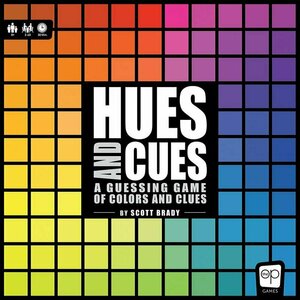


When chatting with the team at Purple Phoenix Games about Hues and Cues, what ended up happening was listing our favorite Hughs in order (obviously Hugh Jackman being the best Hugh). However, Hues and Cues has nothing to do with any of those Hughs, but rather color hues, or shades. Did this one make us blue like Eeyore? Are the other PPG team members green with envy that I possess this game now? Or has this one sparked a joyous shout to the orange-colored sky?
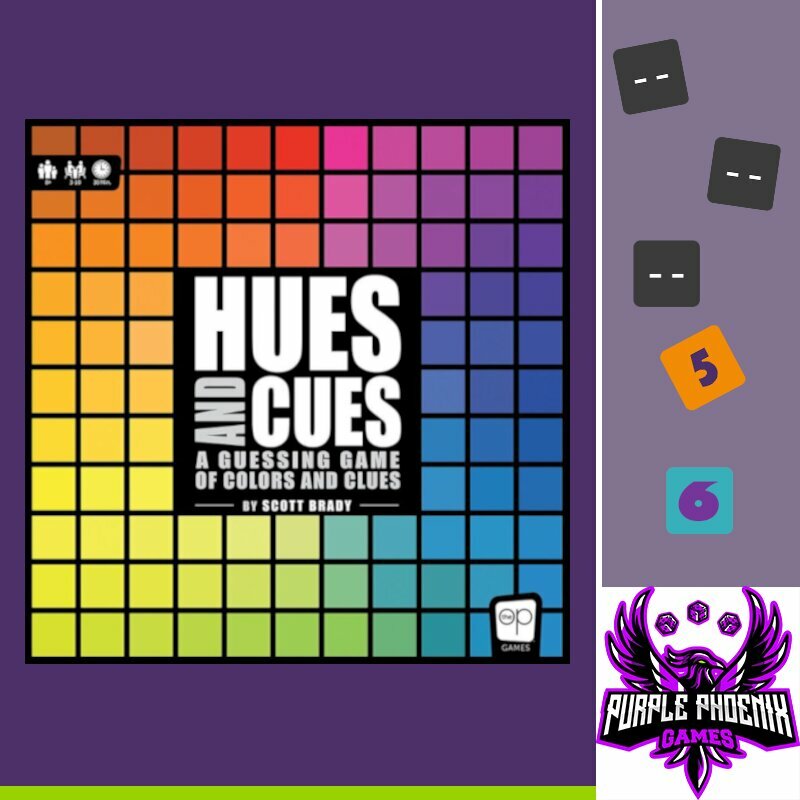
Hues and Cues is a party game of describing colors using one- and two-word cues (a la the hit game show Password from back in the day). As each player is attempting to guess the correct color, and populate the areas immediately adjacent to it, chances for big-time points are plentiful, but I’ll tell you what – coming up with cues proves to be a bit more challenging than one might assume.
DISCLAIMER: We were provided a retail copy of this game for the purposes of this review. Though I know the designer personally, I will be reviewing this game as an impartial judge. -T
To setup a game of Hues and Cues, shuffle the large deck of cue cards to be drawn from, lay out the giant board, set aside the scoring frame for now, and give each player the three cones of their selected color. Place one of these cones on the board to be used as a scoring token, and the game is ready to be played!
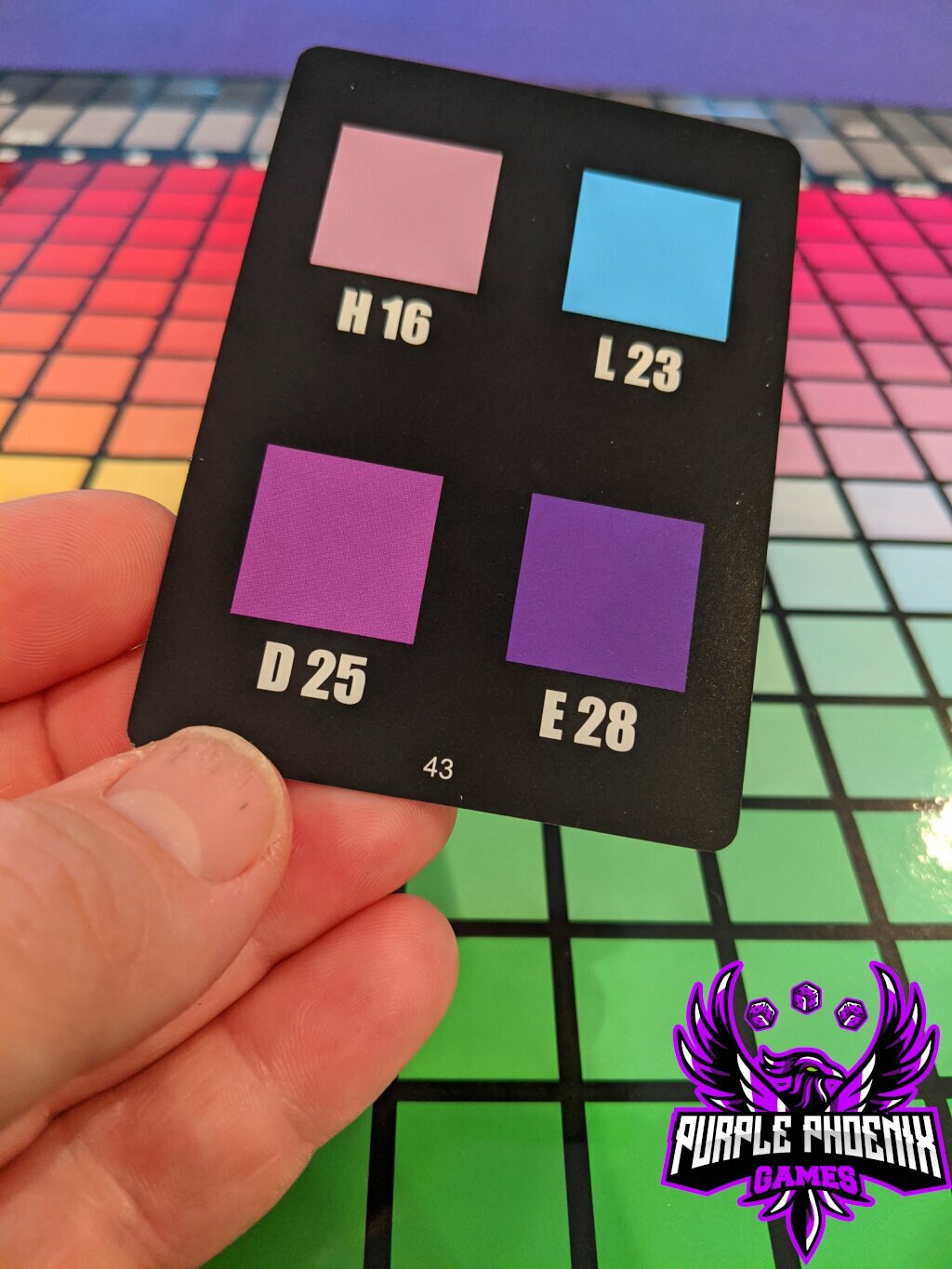
A game of Hues and Cues will be played over several rounds where each player will act as the cue giver for at least one round, depending on number of players (unless you play with my wife, in which case games can last many many more rounds than suggested). The cue giver will draw a card from the deck, choose a color hue from it, and think of a one-word cue to offer the group. Once the cue is given, in clockwise fashion, each other player will place one of their cones on a color box on the main board. Once complete, the cue giver will then offer a two-word cue to the group, if they so choose… Again the players will place their other cone in a box (either near their original choice or somewhere completely different). When all players have placed their second cone, the cue giver will place upon the board the scoring frame with the chosen hue’s coordinates directly in the center of the frame.
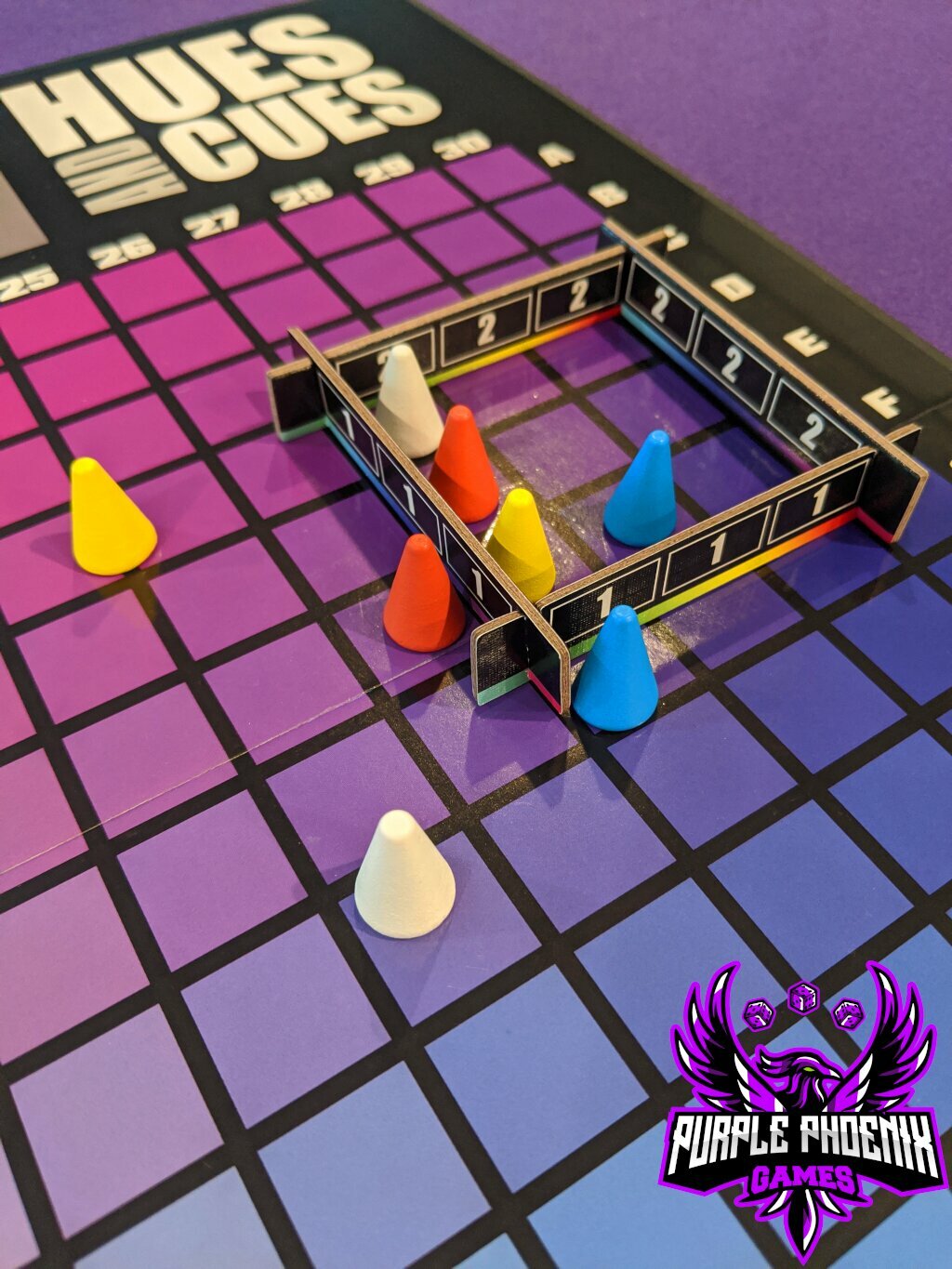
If a player has placed a cone directly on the correct coordinate box, they score 3 points. If a cone resides within the scoring frame (the other 8 boxes surrounding the correct box), they receive 2 points. For every cone just outside the scoring frame surrounding it, the player will receive 1 point. For each cone within the scoring frame the cue giver will score 1 point.
The game ends after each player has had one or two turns to be cue giver, depending on player count and house rules for game end rounds. The player with the most points will be deemed the winner and will have quality bragging rights for the night.
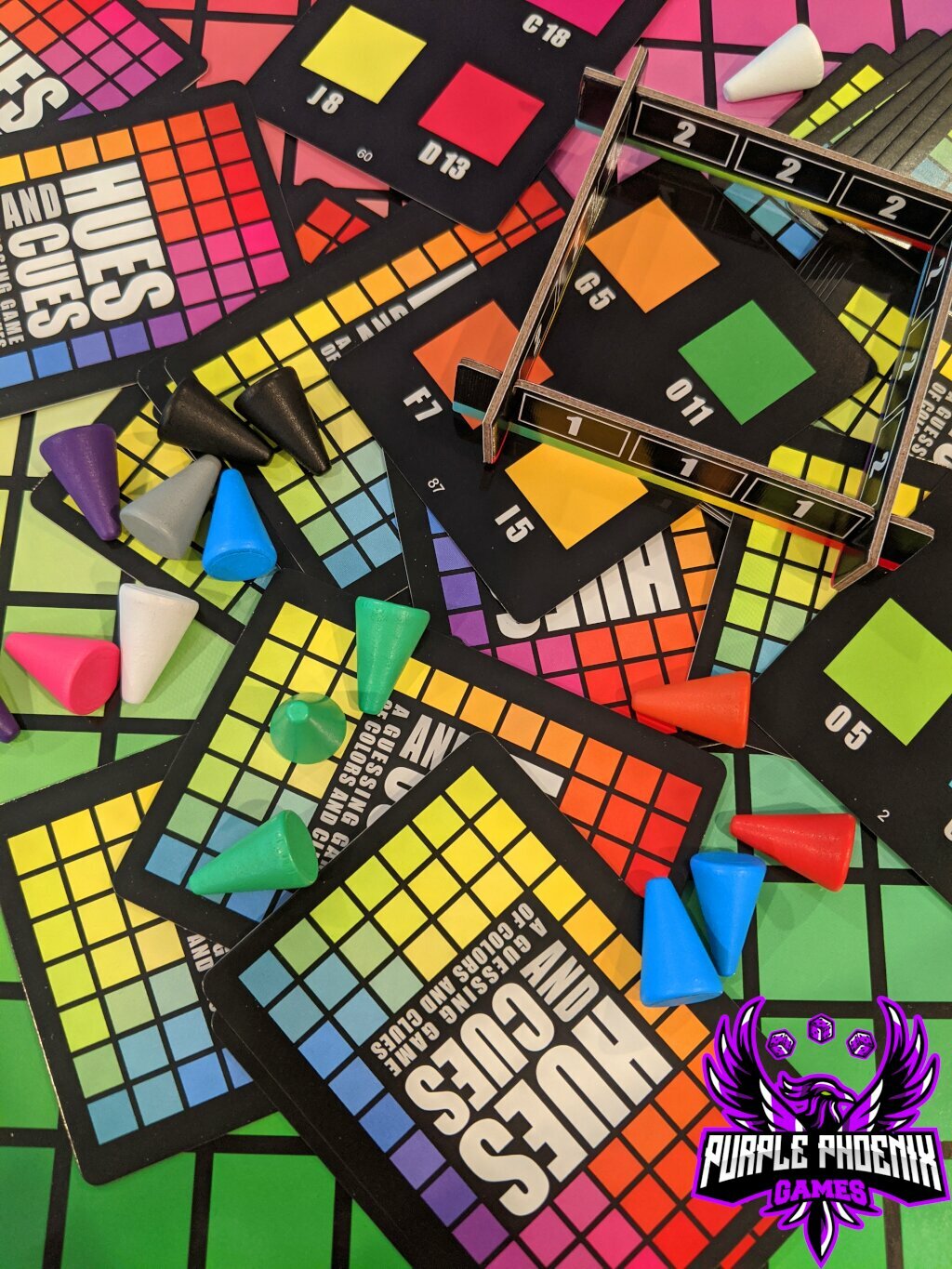
Components. Guys and gals, these components are great. The board is HUGE, but also necessary because there are tons of color hues printed on it. The cards are nice, and the game comes with a giant stack of them. The cones are colored cones. There’s orange and purple and some others colors I think too (I really only care about orange and purple usually). The scoring frame takes a bit to get used to, but is necessary to visualize which cones receive the correct amount of points. The Op comes through again with some choice components here.
So again, I personally know the designer and want to offer that disclaimer. That said, whether I know him or not, this is another great game. I reviewed Gekitai some months ago and was enamored with it as a wonderful abstract, and Hues and Cues gets me again. I love the components, the game play is simple and fast, and I haven’t really played a game too similar. I guess the closest games I can compare it to would be Concept and Codenames. You have to be very exact when giving cues to others (Concept) using one-word and two-word cues (Codenames). It seems super easy to be able to describe a color, but when you look at your chosen hue and can’t even think of a one-word cue and you’re just sitting there while the other players are anxiously awaiting your utterance, you can feel the confidence sweating out of your body.
For one example of actual gameplay, a cue was given, “Western.” My wife and I, alums of Western Illinois University, immediately started finding the correct purple hue because WIU’s colors are purple and gold. However, another player started searching the browns because they thought the cue was guiding the players to Western movies or the Wild West. So there may be conflicts, or different ideas and interpretations of the cues given that can make the whole group giggle incessantly, or times where the game is near the end and you know you need at least 3 points to be in the running and you reallllllly want to hit on the exact hue. So this one can make you feel like you are Bob Ross colormaster, or like you can’t even remember what red even is anymore.
That said, this is NOT a game for our colorblind friends, as it revolved heavily on being able to distinguish color differences, but for everyone else this is a hit. I love that I have to think of things and items and concepts in terms of color to describe instead of any other values, and that is very challenging for me. I love being able to look at the board and have 20 options when the cue given is, “Penny.” I love laughing at some of the amusing cues given or trying to figure out what the hey someone even means with their cues. It’s a wonderful stressful game (for me and the way my mind works) but it has gone over smashingly with everyone to whom I have introduced it. If you are looking for a uniquely-themed party (!) game that isn’t an Apples to Apples or Mafia clone, then you certainly owe it to yourself to check out Hues and Cues. Purple Phoenix Games gives this one a rainbowy 11 / 12. Hugh Jackman would certainly approve, and would probably like to come to your house to play your copy.
Hues and Cues is a party game of describing colors using one- and two-word cues (a la the hit game show Password from back in the day). As each player is attempting to guess the correct color, and populate the areas immediately adjacent to it, chances for big-time points are plentiful, but I’ll tell you what – coming up with cues proves to be a bit more challenging than one might assume.
DISCLAIMER: We were provided a retail copy of this game for the purposes of this review. Though I know the designer personally, I will be reviewing this game as an impartial judge. -T
To setup a game of Hues and Cues, shuffle the large deck of cue cards to be drawn from, lay out the giant board, set aside the scoring frame for now, and give each player the three cones of their selected color. Place one of these cones on the board to be used as a scoring token, and the game is ready to be played!
A game of Hues and Cues will be played over several rounds where each player will act as the cue giver for at least one round, depending on number of players (unless you play with my wife, in which case games can last many many more rounds than suggested). The cue giver will draw a card from the deck, choose a color hue from it, and think of a one-word cue to offer the group. Once the cue is given, in clockwise fashion, each other player will place one of their cones on a color box on the main board. Once complete, the cue giver will then offer a two-word cue to the group, if they so choose… Again the players will place their other cone in a box (either near their original choice or somewhere completely different). When all players have placed their second cone, the cue giver will place upon the board the scoring frame with the chosen hue’s coordinates directly in the center of the frame.
If a player has placed a cone directly on the correct coordinate box, they score 3 points. If a cone resides within the scoring frame (the other 8 boxes surrounding the correct box), they receive 2 points. For every cone just outside the scoring frame surrounding it, the player will receive 1 point. For each cone within the scoring frame the cue giver will score 1 point.
The game ends after each player has had one or two turns to be cue giver, depending on player count and house rules for game end rounds. The player with the most points will be deemed the winner and will have quality bragging rights for the night.
Components. Guys and gals, these components are great. The board is HUGE, but also necessary because there are tons of color hues printed on it. The cards are nice, and the game comes with a giant stack of them. The cones are colored cones. There’s orange and purple and some others colors I think too (I really only care about orange and purple usually). The scoring frame takes a bit to get used to, but is necessary to visualize which cones receive the correct amount of points. The Op comes through again with some choice components here.
So again, I personally know the designer and want to offer that disclaimer. That said, whether I know him or not, this is another great game. I reviewed Gekitai some months ago and was enamored with it as a wonderful abstract, and Hues and Cues gets me again. I love the components, the game play is simple and fast, and I haven’t really played a game too similar. I guess the closest games I can compare it to would be Concept and Codenames. You have to be very exact when giving cues to others (Concept) using one-word and two-word cues (Codenames). It seems super easy to be able to describe a color, but when you look at your chosen hue and can’t even think of a one-word cue and you’re just sitting there while the other players are anxiously awaiting your utterance, you can feel the confidence sweating out of your body.
For one example of actual gameplay, a cue was given, “Western.” My wife and I, alums of Western Illinois University, immediately started finding the correct purple hue because WIU’s colors are purple and gold. However, another player started searching the browns because they thought the cue was guiding the players to Western movies or the Wild West. So there may be conflicts, or different ideas and interpretations of the cues given that can make the whole group giggle incessantly, or times where the game is near the end and you know you need at least 3 points to be in the running and you reallllllly want to hit on the exact hue. So this one can make you feel like you are Bob Ross colormaster, or like you can’t even remember what red even is anymore.
That said, this is NOT a game for our colorblind friends, as it revolved heavily on being able to distinguish color differences, but for everyone else this is a hit. I love that I have to think of things and items and concepts in terms of color to describe instead of any other values, and that is very challenging for me. I love being able to look at the board and have 20 options when the cue given is, “Penny.” I love laughing at some of the amusing cues given or trying to figure out what the hey someone even means with their cues. It’s a wonderful stressful game (for me and the way my mind works) but it has gone over smashingly with everyone to whom I have introduced it. If you are looking for a uniquely-themed party (!) game that isn’t an Apples to Apples or Mafia clone, then you certainly owe it to yourself to check out Hues and Cues. Purple Phoenix Games gives this one a rainbowy 11 / 12. Hugh Jackman would certainly approve, and would probably like to come to your house to play your copy.
Purple Phoenix Games (2266 KP) rated Tiny Epic Western in Tabletop Games
Dec 30, 2021



It’s no secret that we at Purple Phoenix Games are fans of the Tiny Epic series. But one that had evaded our reviews until this point was Tiny Epic Western. Admittedly, this one has been sitting on my shelf of shame for quite some time, so I finally decided it was time to take it off the shelf and bring it to the table! After squaring up with TEW, how does it compare to the rest in the series? Is this the rootinest tootinest of the bunch, or should it be bucked off my shelf?
Disclaimer: I do not intend to rehash the entire rulebook in this review, as there are just too many details, but will instead provide a more general overview of the rules and gameplay. -L
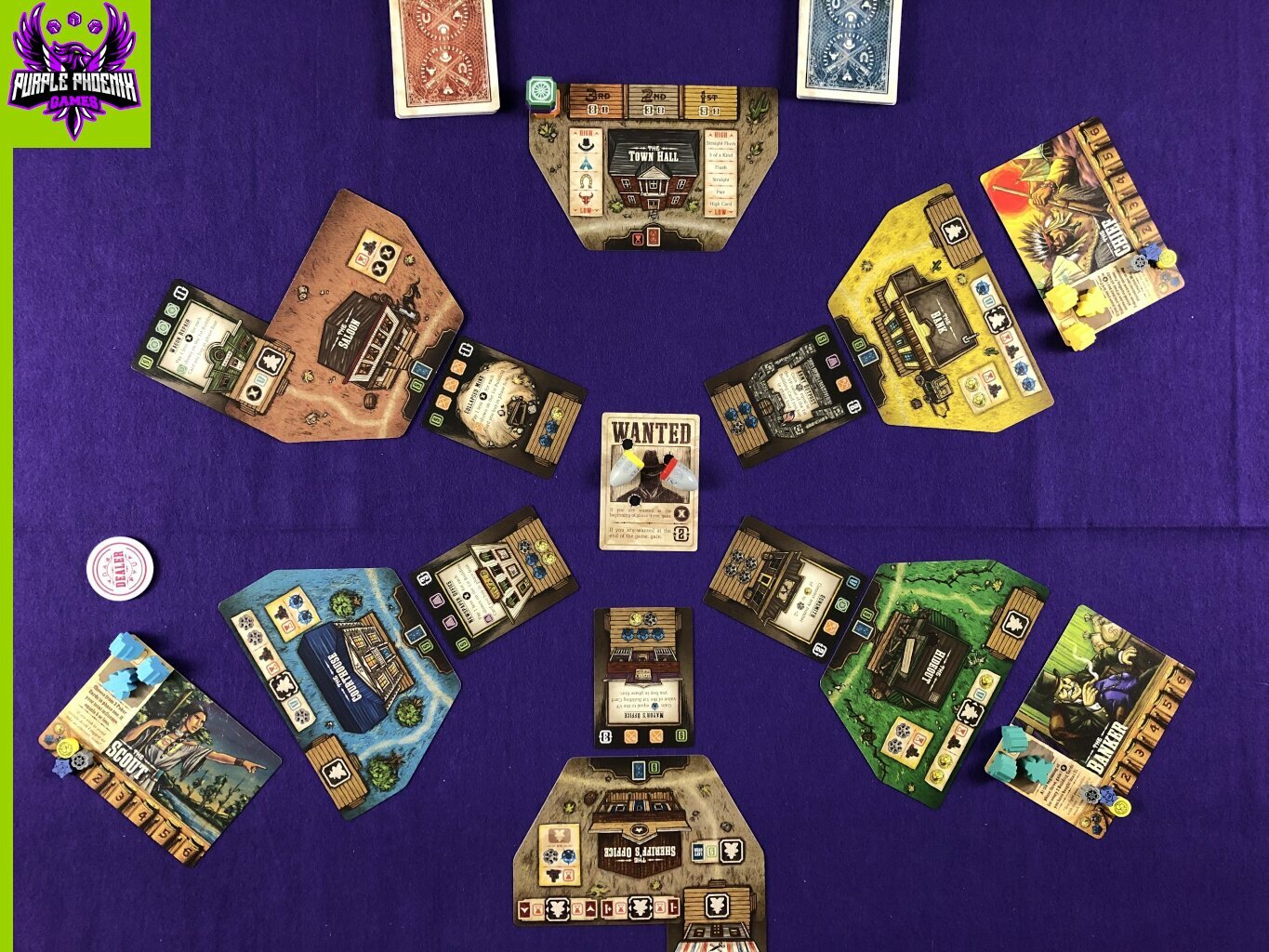
Tiny Epic Western is a game of worker placement and set collection in which players are trying to amass the most end-game victory points. Played over a series of rounds, players will be placing their Posse (Meeples), collecting Influence and taking actions, dueling opponents (if necessary), playing a bit of poker, and buying buildings in an effort to become the most powerful boss in this wild west town. To setup for a game, place the Location Mats as described in the rules, dealing a Building Card where appropriate. Each player receives a Boss card, 3 Posse tokens (Meeples), and one of each of the Influence trackers (Money, Law, and Force), placed on the 1 space of their card. Shuffle the decks of Building Cards and Poker Cards separately, choose a starting player (who receives the Dealer token), place the Wanted card/Gunslinger dice in the center of the play area, and the game is ready to begin! Pictured below is the starting setup for a 3-player game.
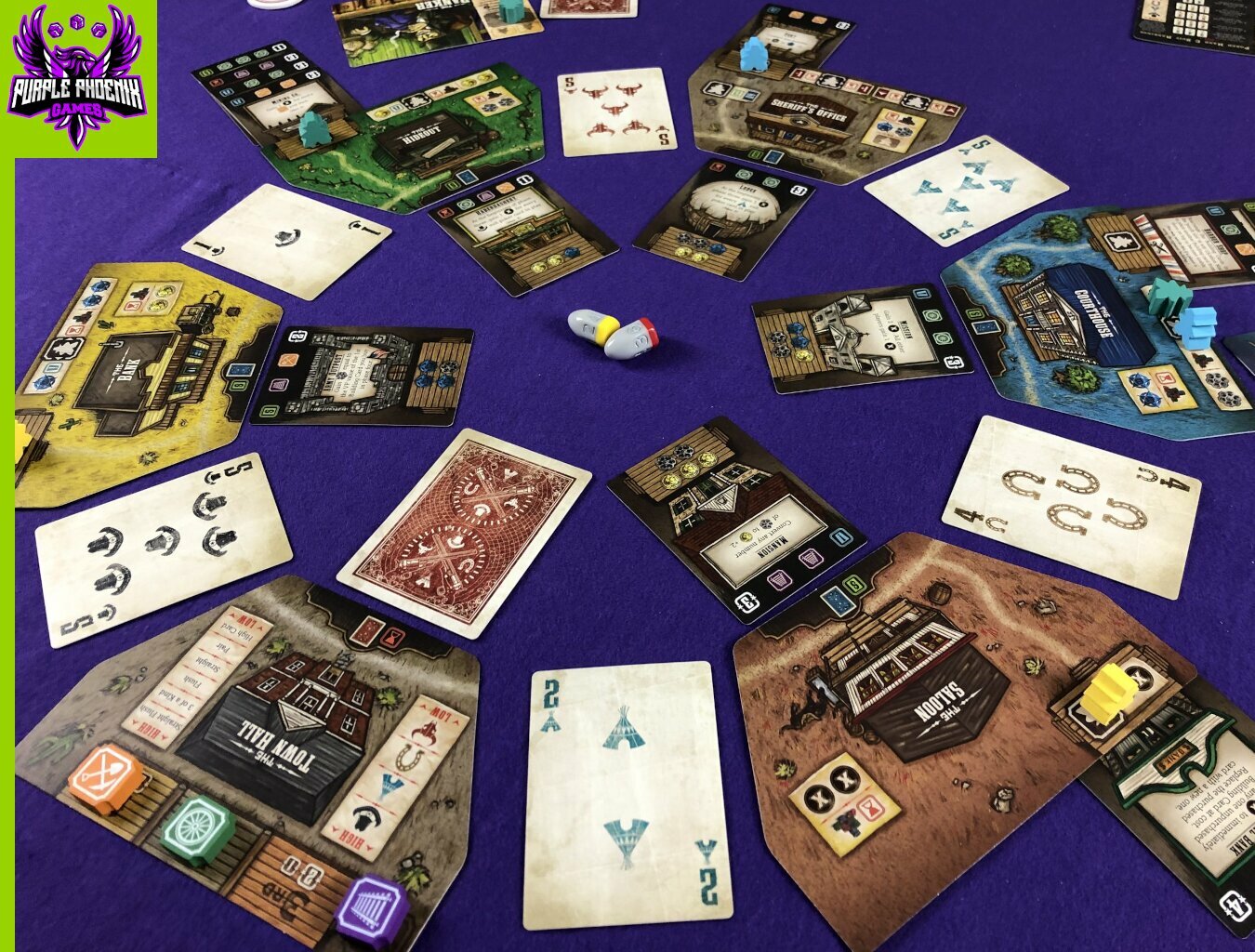
The game is played over 6 total rounds, each of which is broken into 4 phases: Shuffle and Deal, Posse Placement, Resolution, and Buy. To start a round, the Dealer shuffles the deck of Poker cards, and then deals 1 card face-up to the 6 empty spaces between the Location Mats. One Poker card is dealt face-down to the Rival Space (under the Town Hall Location Mat), and 2 Poker cards are dealt face-down to each player. Players look at both of their cards and pick 1 to keep, discarding the other. The round then moves to phase 2: Posse Placement. Starting with the Dealer, players will take turns placing Posse tokens onto the placement spots on any of the Location mats. All placement spots grant unique benefits (collecting different Influence or performing Building card actions) that are performed either immediately or during later phases of the round. What happens if an opponent took a placement spot that you wanted? Then it’s time for an old-fashioned duel! The dueling players each roll a Gunslinger die, modify it if they so choose, and determine a winner. Players continue taking turns placing Posse tokens until all available Posse tokens have been placed.
When all Posse tokens have been placed, the round moves to phase 3: Resolution. The first step of this phase is to reveal Poker cards – all players reveal their cards, and the card in the Rival Space is also revealed. Moving clockwise from the Town Hall, each Location will be resolved by ‘playing’ three-card poker. Each Location has 2 Poker cards directly adjacent to it (placed between the Locations in phase 1), and those 2 cards plus the one in your hand will form your Poker hand. Any players with Posse tokens on the Location will compare their Poker hands to determine a winner. If you win the hand, you collect the Winner’s Pot (extra benefits) and are able to collect any delayed benefits from placement spots in the Posse Placement phase. Losing the hand earns you nothing *womp womp*. If you are the only Posse on a Location (with no opponents) you will compare your hand to that of the Rival. The Rival’s hand uses the cards adjacent to the Town Hall, plus the revealed card in the Rival Space. If you have a better hand, you win the benefits on your Location. If the Rival wins, though, you do not collect these benefits. All Locations are resolved in this fashion before the last phase of the round, Buy, begins.
To start this phase, all players will compare their three-card Poker hands using the 2 Poker cards adjacent to the Town Hall. The player with the best hand will act first in this phase, followed by the next best hand, and so on. The first player may now choose to buy a Building card from any Location on which they have a Posse token. Pay the requisite amount of Influence to purchase a Building, and add it to the Porch Slot on your color-corresponding Location Mat. The power granted by this Building card is now available for use in future rounds. Once all players have had the option to purchase a Building, the player with the best hand will advance one of the Industry Tokens at Town Hall. The placements of Industry Tokens will affect end-game scoring, so keep that in mind as the game progresses. When all steps of the Buy phase are performed, the round now ends. Players collect all their Posse tokens back to their boss cards, all Poker cards are collected and re-shuffled, new Building cards are dealt to Locations from which they were purchased this round, and the Dealer token is passed to the next clockwise player. If a player did not buy a Building at all during the round, they have gained the Third Posse Benefit for the coming round – granting them an additional Posse token to place during phase 2. Otherwise, all players will only ever have 2 Posse tokens to place.
After a total of 6 complete rounds, the game ends and points are tallied. Victory Points are earned from Building cards bought throughout the game. Building cards have a specified VP amount, and also have a collection of Industry Icons on them. Using the final placement of the Industry Tokens on the board, players will earn points for Industry Icon sets they have collected. And finally, whomever holds the Wanted card (won the last duel) gains an additional 2 VP. Points are all counted, and the player with the highest score is the winner.
That all probably sounds pretty complicated. But I do have to say that verbally explaining/teaching the game (and being able to use components for examples) is waaaaay easier than doing so through a text review. So please do not let the seemingly complex gameplay turn you off from this game. Once you get a basic understanding of the phases of each round, the game moves along pretty seamlessly. Honestly, the biggest learning curve for me to conquer was playing three-card poker. As someone who has never played any form of poker before, this was probably what had me most hesitant about learning TEW. After having played it now, three-card poker really isn’t too complicated, and there are some nice player reference cards to help you figure it out.
Aside from the poker element, this game really comes down to worker placement and strategy. Each Location card only has a finite number of placement spots, and the resources required to buy Buildings are not exactly in abundance. This affects your strategy, as you must decide which resources to collect at what times, as well as deciding whether you need to duel someone for a coveted resource. Another element to your strategy? You may only buy Building cards from Locations on which you have a Posse token. Maybe none of those placement spots really appeal to you this round, but you reaaaaally want that specific Building card. Are you willing to ‘burn’ a Posse token for the chance to buy it? Or is there a different Location that offers a useful resources and a desirable Building card? Also, keep in mind how your poker hand will come into play. Since poker cards are dealt to each Location at the start of a round, you are able to see what your hand will be for each Location. Maybe you have a pretty strong hand at the Bank Location, but at the Courthouse the cards end up being a bust. Are you willing to risk a placement in hopes that you have the best hand of the bunch? Because remember – if you don’t have the best hand at a Location, you get no resources/rewards! There are so many elements to a successful strategy with this game, and it really keeps all players engaged at all times. Be warned though – the variety of strategic options could be difficult for some AP-prone players.
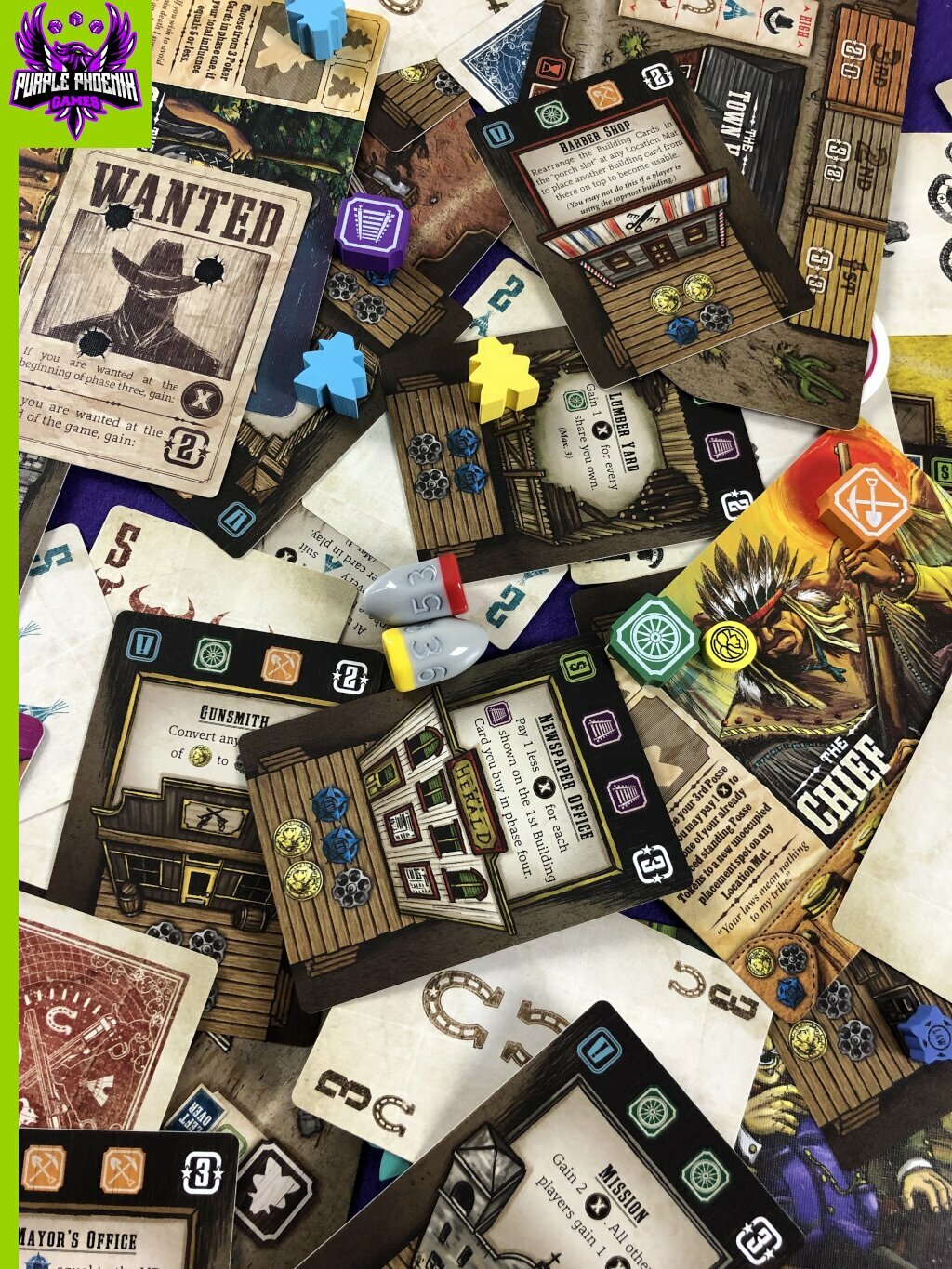
Let me touch on components for a minute. As with all Tiny Epic games, the production quality of TEW is pretty stellar. The cards are nice and sturdy, and the iconography is clear. The Posse tokens are cute Meeples with cowboy hats, and they are nice and chunky. The only thing I don’t really like about this game are the Gunslinger dice. In theory, they are super cool, but in actual execution, they leave much to be desired. The numbers aren’t really clearly define, so they’re a bit tricky to read. Aside from that, a pretty high quality game here.
So all in all, how does Tiny Epic Western stand up in the series? It is definitely one of the heavier games of the bunch, and there is so much more going on than initially meets the eye. It feels daunting for the first few plays, but once you get the phases under your belt, it really flows pretty well. I can’t say that it is my favorite Tiny Epic game, as I just personally feel like there are too many elements going on at the same time. You’re strategizing your worker placement, but also need to consider buying Buildings for VP and to collect sets of Industry Icons and for their specific abilities, as well as figuring out your poker hand for 5 different Locations, and dealing with duels. Some people might really be into that amount of strategic forethought, but it feels a bit cumbersome to me. That being said, Purple Phoenix Games gives this three-card poker game a 3/6. The gameplay is decent, just not really my kind of game.
Disclaimer: I do not intend to rehash the entire rulebook in this review, as there are just too many details, but will instead provide a more general overview of the rules and gameplay. -L
Tiny Epic Western is a game of worker placement and set collection in which players are trying to amass the most end-game victory points. Played over a series of rounds, players will be placing their Posse (Meeples), collecting Influence and taking actions, dueling opponents (if necessary), playing a bit of poker, and buying buildings in an effort to become the most powerful boss in this wild west town. To setup for a game, place the Location Mats as described in the rules, dealing a Building Card where appropriate. Each player receives a Boss card, 3 Posse tokens (Meeples), and one of each of the Influence trackers (Money, Law, and Force), placed on the 1 space of their card. Shuffle the decks of Building Cards and Poker Cards separately, choose a starting player (who receives the Dealer token), place the Wanted card/Gunslinger dice in the center of the play area, and the game is ready to begin! Pictured below is the starting setup for a 3-player game.
The game is played over 6 total rounds, each of which is broken into 4 phases: Shuffle and Deal, Posse Placement, Resolution, and Buy. To start a round, the Dealer shuffles the deck of Poker cards, and then deals 1 card face-up to the 6 empty spaces between the Location Mats. One Poker card is dealt face-down to the Rival Space (under the Town Hall Location Mat), and 2 Poker cards are dealt face-down to each player. Players look at both of their cards and pick 1 to keep, discarding the other. The round then moves to phase 2: Posse Placement. Starting with the Dealer, players will take turns placing Posse tokens onto the placement spots on any of the Location mats. All placement spots grant unique benefits (collecting different Influence or performing Building card actions) that are performed either immediately or during later phases of the round. What happens if an opponent took a placement spot that you wanted? Then it’s time for an old-fashioned duel! The dueling players each roll a Gunslinger die, modify it if they so choose, and determine a winner. Players continue taking turns placing Posse tokens until all available Posse tokens have been placed.
When all Posse tokens have been placed, the round moves to phase 3: Resolution. The first step of this phase is to reveal Poker cards – all players reveal their cards, and the card in the Rival Space is also revealed. Moving clockwise from the Town Hall, each Location will be resolved by ‘playing’ three-card poker. Each Location has 2 Poker cards directly adjacent to it (placed between the Locations in phase 1), and those 2 cards plus the one in your hand will form your Poker hand. Any players with Posse tokens on the Location will compare their Poker hands to determine a winner. If you win the hand, you collect the Winner’s Pot (extra benefits) and are able to collect any delayed benefits from placement spots in the Posse Placement phase. Losing the hand earns you nothing *womp womp*. If you are the only Posse on a Location (with no opponents) you will compare your hand to that of the Rival. The Rival’s hand uses the cards adjacent to the Town Hall, plus the revealed card in the Rival Space. If you have a better hand, you win the benefits on your Location. If the Rival wins, though, you do not collect these benefits. All Locations are resolved in this fashion before the last phase of the round, Buy, begins.
To start this phase, all players will compare their three-card Poker hands using the 2 Poker cards adjacent to the Town Hall. The player with the best hand will act first in this phase, followed by the next best hand, and so on. The first player may now choose to buy a Building card from any Location on which they have a Posse token. Pay the requisite amount of Influence to purchase a Building, and add it to the Porch Slot on your color-corresponding Location Mat. The power granted by this Building card is now available for use in future rounds. Once all players have had the option to purchase a Building, the player with the best hand will advance one of the Industry Tokens at Town Hall. The placements of Industry Tokens will affect end-game scoring, so keep that in mind as the game progresses. When all steps of the Buy phase are performed, the round now ends. Players collect all their Posse tokens back to their boss cards, all Poker cards are collected and re-shuffled, new Building cards are dealt to Locations from which they were purchased this round, and the Dealer token is passed to the next clockwise player. If a player did not buy a Building at all during the round, they have gained the Third Posse Benefit for the coming round – granting them an additional Posse token to place during phase 2. Otherwise, all players will only ever have 2 Posse tokens to place.
After a total of 6 complete rounds, the game ends and points are tallied. Victory Points are earned from Building cards bought throughout the game. Building cards have a specified VP amount, and also have a collection of Industry Icons on them. Using the final placement of the Industry Tokens on the board, players will earn points for Industry Icon sets they have collected. And finally, whomever holds the Wanted card (won the last duel) gains an additional 2 VP. Points are all counted, and the player with the highest score is the winner.
That all probably sounds pretty complicated. But I do have to say that verbally explaining/teaching the game (and being able to use components for examples) is waaaaay easier than doing so through a text review. So please do not let the seemingly complex gameplay turn you off from this game. Once you get a basic understanding of the phases of each round, the game moves along pretty seamlessly. Honestly, the biggest learning curve for me to conquer was playing three-card poker. As someone who has never played any form of poker before, this was probably what had me most hesitant about learning TEW. After having played it now, three-card poker really isn’t too complicated, and there are some nice player reference cards to help you figure it out.
Aside from the poker element, this game really comes down to worker placement and strategy. Each Location card only has a finite number of placement spots, and the resources required to buy Buildings are not exactly in abundance. This affects your strategy, as you must decide which resources to collect at what times, as well as deciding whether you need to duel someone for a coveted resource. Another element to your strategy? You may only buy Building cards from Locations on which you have a Posse token. Maybe none of those placement spots really appeal to you this round, but you reaaaaally want that specific Building card. Are you willing to ‘burn’ a Posse token for the chance to buy it? Or is there a different Location that offers a useful resources and a desirable Building card? Also, keep in mind how your poker hand will come into play. Since poker cards are dealt to each Location at the start of a round, you are able to see what your hand will be for each Location. Maybe you have a pretty strong hand at the Bank Location, but at the Courthouse the cards end up being a bust. Are you willing to risk a placement in hopes that you have the best hand of the bunch? Because remember – if you don’t have the best hand at a Location, you get no resources/rewards! There are so many elements to a successful strategy with this game, and it really keeps all players engaged at all times. Be warned though – the variety of strategic options could be difficult for some AP-prone players.
Let me touch on components for a minute. As with all Tiny Epic games, the production quality of TEW is pretty stellar. The cards are nice and sturdy, and the iconography is clear. The Posse tokens are cute Meeples with cowboy hats, and they are nice and chunky. The only thing I don’t really like about this game are the Gunslinger dice. In theory, they are super cool, but in actual execution, they leave much to be desired. The numbers aren’t really clearly define, so they’re a bit tricky to read. Aside from that, a pretty high quality game here.
So all in all, how does Tiny Epic Western stand up in the series? It is definitely one of the heavier games of the bunch, and there is so much more going on than initially meets the eye. It feels daunting for the first few plays, but once you get the phases under your belt, it really flows pretty well. I can’t say that it is my favorite Tiny Epic game, as I just personally feel like there are too many elements going on at the same time. You’re strategizing your worker placement, but also need to consider buying Buildings for VP and to collect sets of Industry Icons and for their specific abilities, as well as figuring out your poker hand for 5 different Locations, and dealing with duels. Some people might really be into that amount of strategic forethought, but it feels a bit cumbersome to me. That being said, Purple Phoenix Games gives this three-card poker game a 3/6. The gameplay is decent, just not really my kind of game.