Search
Search results

Jordan Binkerd (567 KP) rated Gideon's Angel in Books
Aug 15, 2019

Note: this review is transposted from my personal review blog, and so was originally written several years ago. I figured if I reposted it here, someone might actually read it….
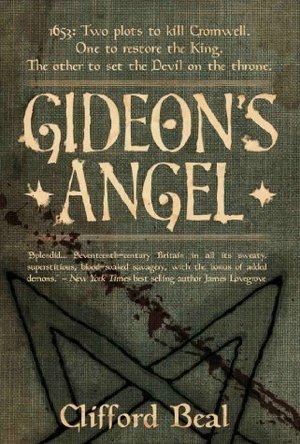
I received my copy of Gideon’s Angel through the Goodreads FirstReads program. This in no way influences my review, except to ensure that I was able to get ahold of this book and thus review it. I have to say, I really enjoyed this one. I want to describe it as “steampunk,” but my understanding is that steampunk is usually set in the 1800s (or at least that level of tech and society) whereas this work is firmly set in 1653. If there’s already a term for pseudo-historical fiction with a fantasy touch set in that timeframe, I apologize for not knowing what it is and using it accordingly.
Things are not going well for Richard Treadwell. The English Civil War is over, the King’s Cavaliers lost to the forces of Parliament and Oliver Cromwell, and Charles I has been executed. Treadwell has managed to escape the destruction of his cause, and has spent the past eight years in exile in France, performing a delicate balancing act between loyalty to his exiled king* and his employer, Cardinal Mazarin. When Mazarin informs him that someone is using the forces of Hell to tip the balance in their favor and asks him to spy on the exile court to find out if it is one of the king’s supporters, Treadwell decides that it’s time to get out of Paris. He accepts a mission for one of the king’s more militant supporters that will take him back to his beloved England–to lead a Royalist uprising, one last try to oust Cromwell and his Puritan cronies. Treadwell has other business to tend to as well, including a wife who by now probably considers herself a widow. Unfortunately for Treadwell’s simple worldview, it soon becomes clear that Cromwell’s power is the only thing preventing the more radical Puritan elements from running roughshod over the whole country. Worse still, a demon from the pits of Hell has appeared to a radical Puritan sect masquerading as an angel of light and ordering the death of Cromwell so that the Kingdom of God may be fulfilled. Now instead of assassinating Cromwell Treadwell will be forced to save him–if he can find a way to fight the forces of Hell, gain some allies in his quest, and avoid d’Artagnan, a young Musketeer dispatched by the Cardinal to bear him back to Paris….
I really enjoyed this book. It’s not exactly “high literature,” but I think I’ve very well established that I care far more about a work’s entertainment value than whatever it is critics look for. The world Beal creates here feels very real, slipping in background historical information without making you feel like you’ve been lectured. Some readers will probably wish for more background on the English Civil War, and that’s fine. If they care that much, there are numerous good books on the subject. If they don’t, there’s a Wikipedia article that should give you a good rundown on what happened. Beal manages to evoke seventeenth-century London in all its grimy glory, much as it would have actually been aside from the fact that all the magic we dismiss as superstition is actually going on behind the scenes. Moreover, this magic very much resembles what you would find depicted in the folklore of the era without obvious modern embellishment. I’m not really all that well versed in the history of the Freemasons, so I can’t accurately speak to how they were portrayed here except to say that I very much doubt their claim to date back to the builders of the pyramids. Then again, I doubt they have the tools to summon demons too, so maybe I shouldn’t be too critical. Secondary characters generally proved to be interestingly complex, especially Billy Chard, but I am seeing criticism of how the female characters in the book act. They aren’t weak characters by any means, but they are constrained by their roles in society. Treadwell’s wife has pragmatically joined her fate to that of the officer who took over Treadwell’s land when he was banished and is pregnant with his child. Is she weak for this? Or is she a strong female doing what she has to in order to protect what is left of her family? Treadwell’s Parisian mistress follows him to England rather than stay in Paris and face the scandal of their liasion alone. Weak, for needing Treadwell by her side? Or strong, for following him into whatever dangers he may be facing? Finally, Isabelle decides to follow her father and the rest of Treadwell’s band into battle against the forces of Darkness, deciding that it would be better to fall by his side than live on without him. Possibly a sign of weakness, but look at her situation realistically. She and her father were driven from Spain for their Jewish heritage, her mother dying along the way. Jews do not fare well in the Christian world of the seventeenth century, not even in England. The lot of a young woman alone in the world is already hard enough in this time without adding the burden of religious and ethnic persecution. She would have no respectable means of supporting herself, and could conceivably find herself forced into prostitution–on her own if she was lucky, as no more than a slave if she was not. Is preferring death in battle to such a fate a sign of weakness or of strength? She certainly has no trouble speaking her mind, and in fact berates Treadwell severely for endangering her father when they first meet. I suppose I can understand where some people would find these characters and their portrayal to be weak and sexist, but I respectfully disagree. I submit that instead they are strong characters reacting realistically to a world where women are not treated equally–in fact, I would have more of a problem with them if they demonstrated anachronistic modern sensibilities.** The ending was a little deus ex machina, but on the whole I didn’t mind. I would say that I want to read a sequel, but I don’t think the author could come up with anything to top this in terms of personal impact on the characters–Treadwell’s internal conflict between hating Cromwell and having to save him is very well done, and I fear Beal would prove unable to find something equally interesting as a follow up. We never really got to find out what happened to Treadwell back during the Thirty Years War that introduced him to the world of angels and demons, so I could see maybe writing that up….I’d buy it, anyway.
CONTENT: R-rated language, occasionally harsh but I would argue not gratuitous. Moderately explicit sexual content, as you would expect from a work in this vein.*** A fair amount of violence, from both man and demon. Not usually too gory in its description. There is also a good deal of occult content, as the villains are summoning a demon they believe to be an angel. This demon’s lesser minions dog Treadwell and his friends, and there are multiple encounters with them. One is implied to be a golem, others appear as strange amalgamations of beast(s) and man. For me, this is adequately balanced by the recognition that, as powerful as the forces of Darkness are, God is far more powerful than they. Bottom line: if you’re mature enough to handle the other content, I don’t believe the occult elements should prove to be an issue.
*Charles I was executed, while his son Charles II went into exile. Just in case you were concerned with the historical accuracy of the book. So far as I can tell, this is pretty accurate. You know, aside from the demons and fictional characters roaming London…..
**Please understand, I’m neither defending nor endorsing the inequality of the seventeenth century. Neither is Clifford Beal, for that matter. I’m simply pointing out that it was how it was, and this was the world the characters would have come from. I’m all for equality, but to whitewash history and pretend it was different from it was….that way lies dangerous waters.
***This evokes more than anything a supernatural-tinged Alexandre Dumas novel for me….and you know how bawdry his musketeers could be when they wanted to be.
Original post: https://jordanbinkerd.wordpress.com/2013/10/24/review-gideons-angel-by-clifford-beal/
I received my copy of Gideon’s Angel through the Goodreads FirstReads program. This in no way influences my review, except to ensure that I was able to get ahold of this book and thus review it. I have to say, I really enjoyed this one. I want to describe it as “steampunk,” but my understanding is that steampunk is usually set in the 1800s (or at least that level of tech and society) whereas this work is firmly set in 1653. If there’s already a term for pseudo-historical fiction with a fantasy touch set in that timeframe, I apologize for not knowing what it is and using it accordingly.
Things are not going well for Richard Treadwell. The English Civil War is over, the King’s Cavaliers lost to the forces of Parliament and Oliver Cromwell, and Charles I has been executed. Treadwell has managed to escape the destruction of his cause, and has spent the past eight years in exile in France, performing a delicate balancing act between loyalty to his exiled king* and his employer, Cardinal Mazarin. When Mazarin informs him that someone is using the forces of Hell to tip the balance in their favor and asks him to spy on the exile court to find out if it is one of the king’s supporters, Treadwell decides that it’s time to get out of Paris. He accepts a mission for one of the king’s more militant supporters that will take him back to his beloved England–to lead a Royalist uprising, one last try to oust Cromwell and his Puritan cronies. Treadwell has other business to tend to as well, including a wife who by now probably considers herself a widow. Unfortunately for Treadwell’s simple worldview, it soon becomes clear that Cromwell’s power is the only thing preventing the more radical Puritan elements from running roughshod over the whole country. Worse still, a demon from the pits of Hell has appeared to a radical Puritan sect masquerading as an angel of light and ordering the death of Cromwell so that the Kingdom of God may be fulfilled. Now instead of assassinating Cromwell Treadwell will be forced to save him–if he can find a way to fight the forces of Hell, gain some allies in his quest, and avoid d’Artagnan, a young Musketeer dispatched by the Cardinal to bear him back to Paris….
I really enjoyed this book. It’s not exactly “high literature,” but I think I’ve very well established that I care far more about a work’s entertainment value than whatever it is critics look for. The world Beal creates here feels very real, slipping in background historical information without making you feel like you’ve been lectured. Some readers will probably wish for more background on the English Civil War, and that’s fine. If they care that much, there are numerous good books on the subject. If they don’t, there’s a Wikipedia article that should give you a good rundown on what happened. Beal manages to evoke seventeenth-century London in all its grimy glory, much as it would have actually been aside from the fact that all the magic we dismiss as superstition is actually going on behind the scenes. Moreover, this magic very much resembles what you would find depicted in the folklore of the era without obvious modern embellishment. I’m not really all that well versed in the history of the Freemasons, so I can’t accurately speak to how they were portrayed here except to say that I very much doubt their claim to date back to the builders of the pyramids. Then again, I doubt they have the tools to summon demons too, so maybe I shouldn’t be too critical. Secondary characters generally proved to be interestingly complex, especially Billy Chard, but I am seeing criticism of how the female characters in the book act. They aren’t weak characters by any means, but they are constrained by their roles in society. Treadwell’s wife has pragmatically joined her fate to that of the officer who took over Treadwell’s land when he was banished and is pregnant with his child. Is she weak for this? Or is she a strong female doing what she has to in order to protect what is left of her family? Treadwell’s Parisian mistress follows him to England rather than stay in Paris and face the scandal of their liasion alone. Weak, for needing Treadwell by her side? Or strong, for following him into whatever dangers he may be facing? Finally, Isabelle decides to follow her father and the rest of Treadwell’s band into battle against the forces of Darkness, deciding that it would be better to fall by his side than live on without him. Possibly a sign of weakness, but look at her situation realistically. She and her father were driven from Spain for their Jewish heritage, her mother dying along the way. Jews do not fare well in the Christian world of the seventeenth century, not even in England. The lot of a young woman alone in the world is already hard enough in this time without adding the burden of religious and ethnic persecution. She would have no respectable means of supporting herself, and could conceivably find herself forced into prostitution–on her own if she was lucky, as no more than a slave if she was not. Is preferring death in battle to such a fate a sign of weakness or of strength? She certainly has no trouble speaking her mind, and in fact berates Treadwell severely for endangering her father when they first meet. I suppose I can understand where some people would find these characters and their portrayal to be weak and sexist, but I respectfully disagree. I submit that instead they are strong characters reacting realistically to a world where women are not treated equally–in fact, I would have more of a problem with them if they demonstrated anachronistic modern sensibilities.** The ending was a little deus ex machina, but on the whole I didn’t mind. I would say that I want to read a sequel, but I don’t think the author could come up with anything to top this in terms of personal impact on the characters–Treadwell’s internal conflict between hating Cromwell and having to save him is very well done, and I fear Beal would prove unable to find something equally interesting as a follow up. We never really got to find out what happened to Treadwell back during the Thirty Years War that introduced him to the world of angels and demons, so I could see maybe writing that up….I’d buy it, anyway.
CONTENT: R-rated language, occasionally harsh but I would argue not gratuitous. Moderately explicit sexual content, as you would expect from a work in this vein.*** A fair amount of violence, from both man and demon. Not usually too gory in its description. There is also a good deal of occult content, as the villains are summoning a demon they believe to be an angel. This demon’s lesser minions dog Treadwell and his friends, and there are multiple encounters with them. One is implied to be a golem, others appear as strange amalgamations of beast(s) and man. For me, this is adequately balanced by the recognition that, as powerful as the forces of Darkness are, God is far more powerful than they. Bottom line: if you’re mature enough to handle the other content, I don’t believe the occult elements should prove to be an issue.
*Charles I was executed, while his son Charles II went into exile. Just in case you were concerned with the historical accuracy of the book. So far as I can tell, this is pretty accurate. You know, aside from the demons and fictional characters roaming London…..
**Please understand, I’m neither defending nor endorsing the inequality of the seventeenth century. Neither is Clifford Beal, for that matter. I’m simply pointing out that it was how it was, and this was the world the characters would have come from. I’m all for equality, but to whitewash history and pretend it was different from it was….that way lies dangerous waters.
***This evokes more than anything a supernatural-tinged Alexandre Dumas novel for me….and you know how bawdry his musketeers could be when they wanted to be.
Original post: https://jordanbinkerd.wordpress.com/2013/10/24/review-gideons-angel-by-clifford-beal/

Purple Phoenix Games (2266 KP) rated Illumination in Tabletop Games
Oct 5, 2021
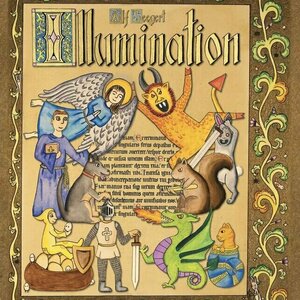

Ancient Medieval books. We all love ’em, right? Full of bright beautiful pictures of angels fighting demons, knights fighting dragons, dogs fighting squirrels(?), and monks fighting armed bunnies?? Hey, what’s going on here? Okay, I have played enough Alf Seegert games to know that everything comes with a hint of quirk, but now I need to pore through my non-existent collection of old tomes to find instances of monks warding off sword-brandishing rabbits. Ohhhhh, maybe this is about children’s books! Man, times were weird back in the day.
Illumination is a game about two monks who are tasked with illuminating the pages of manuscripts with drawings in the hopes of becoming the next head of the Scriptorium: The Scriptmaster, one might say. However, one of the monks gets a little itch and begins to draw irreverent subjects, like demons, dragons, and such. Which monk will earn the made-up-by-me title of Scriptmaster? Guess you will have to play to find out.
DISCLAIMER: We were provided a copy of this game for the purposes of this review. This is a retail copy of the game, so what you see in these photos is exactly what would be received in your box. I do not intend to cover every single rule included in the rulebook, but will describe the overall game flow and major rule set so that our readers may get a sense of how the game plays. For more in depth rules, you may purchase a copy online or from your FLGS. -T
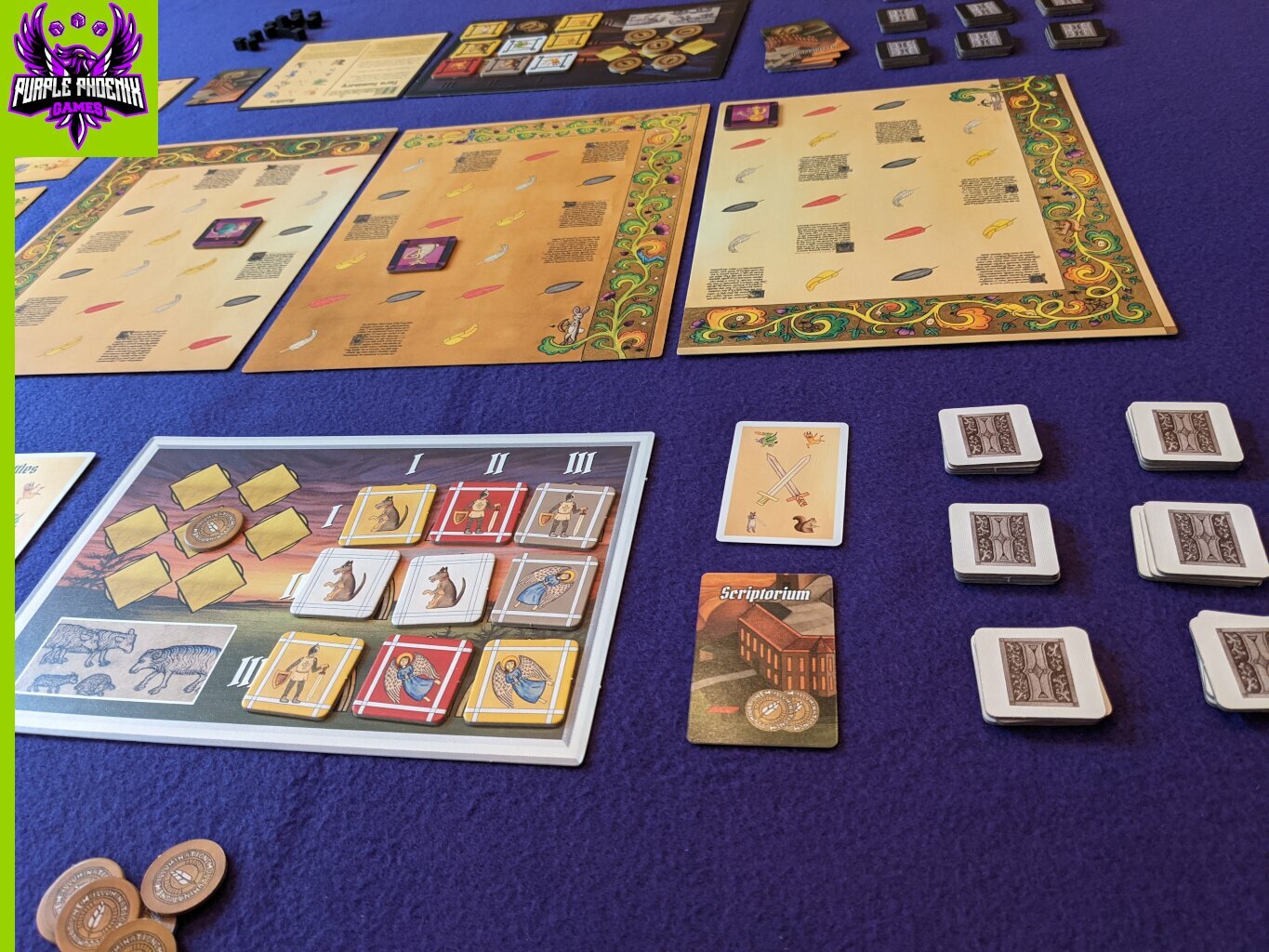
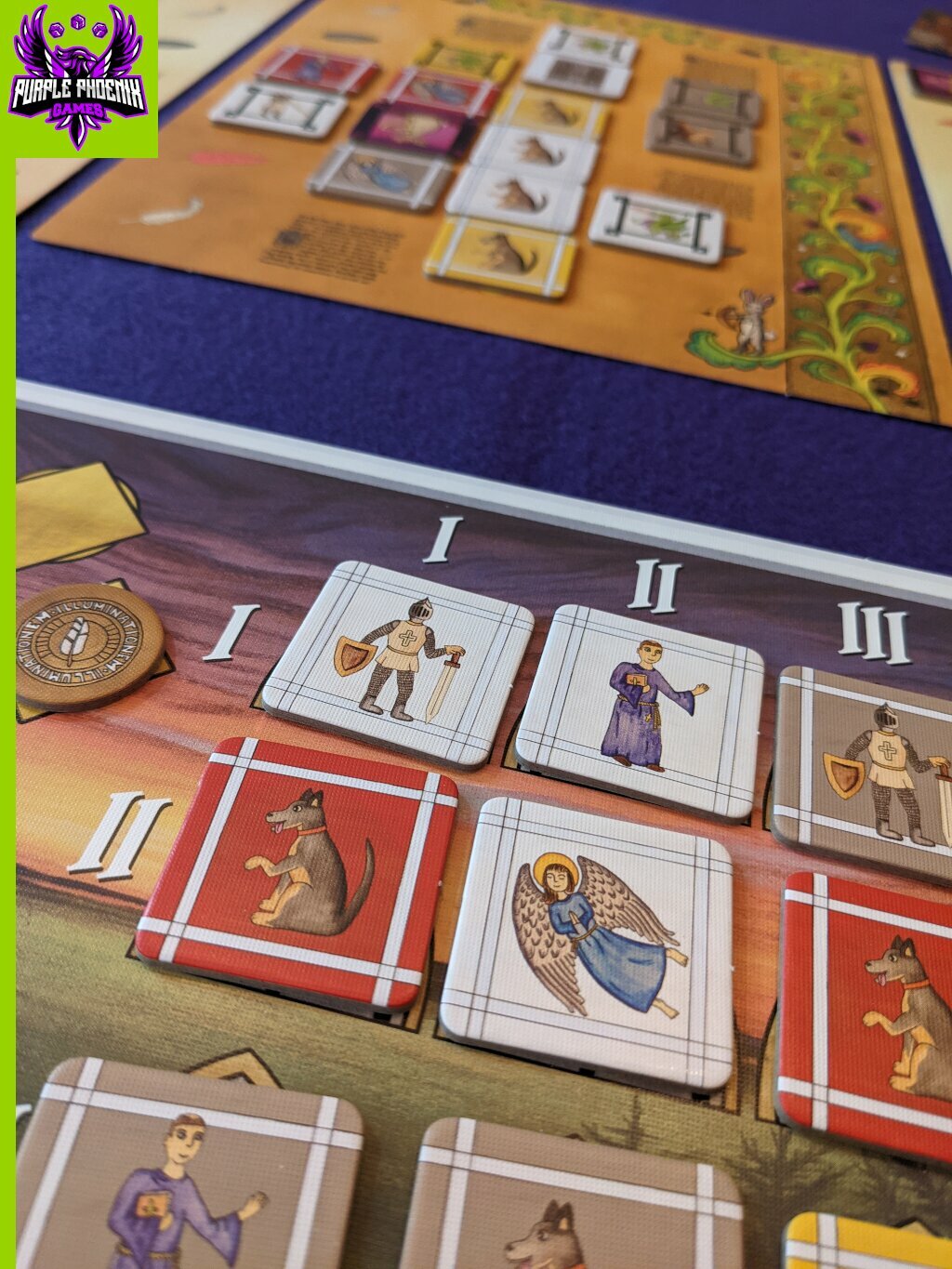
As with many games that are well endowed with components, setup can be a bit of a task. The game will be focused around a few main areas. First, the three manuscript pages are placed on the table in any orientation, with the purple wild Drollery tiles placed on one text box on each page. The Monastery mat is placed nearby as well, with the Abbot pawn randomly placed on a blank station. This pawn will be moved around the map during play to determine which rituals may be performed at any one time. Each player will have their own player mat, upon which will be placed their starting gold (1 for the Reverent player and 5 for the Irreverent player), as well as their starting nine Illumination tiles. The rules mention separating all the Illumination tiles into stacks of three, choosing three of these stacks to flip over and place on the play mat without altering the order. This is very important to keep the tiles in their randomized order. The remainder of the tiles are to be placed nearby in stacks of three. Each player is dealt one starting Scriptorium card and a random Crusade card that will offer bonuses at the end of the game. Once all setup, the game may begin with the Reverent player’s turn.
On a turn, the active player will choose from their mat one row or column of three tiles to be played. They take the three tiles and place them upon one of the three book pages on the table, in the margins. From there the player can choose any tile from the margin to place onto the page in any order they wish, upon any quill icon they choose (except for coin tiles – those simply grant two coins immediately). If the tile is placed on a quill of a matching color to that of the tile, the player will immediately collect one coin and place it on the player mat. If the tile is placed on a quill and orthogonally touches a tile of the matching color, the player then collects a Ritual token of the same color. These Ritual tokens are used in sets of three, four, or five in order to earn VP for end of game scoring. Each purple Drollery tile is wild for the purpose of placement and Ritual token collection. Each tile placed will collect its earnings immediately, and any coins earned may be spent immediately as well.
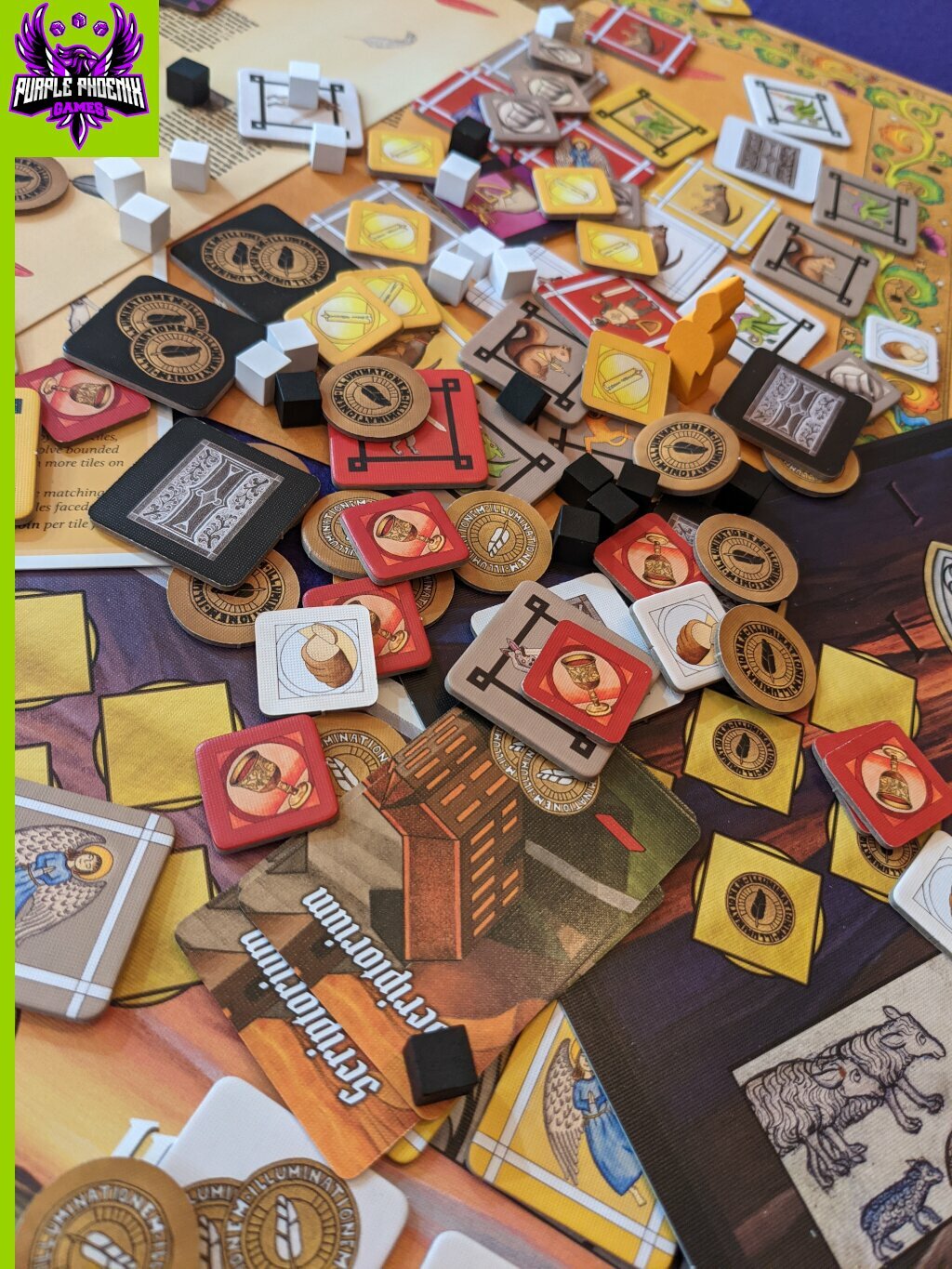
A player may use coins for several purposes throughout the game: move a tile from the margin of one book to the margin of a different book, move the Abbot one space along the track for Ritual purposes, or to draw a Scriptorium card. The other resources are Ritual tokens, and may be spent during the turn as well. In order to spend these, the Abbot must be on the matching location on the Monastery board, and the player may spend three, four, or five matching tokens to perform the Ritual. They discard the tokens, place one of their cubes upon the appropriate icon on the Monastery mat for VP at game end.
At any time during the turn Scriptorium cards may be played. These are very special cards that allow the player to complete certain actions that break the normal rules. This could be a free movement of the Abbot, or switching places of two tiles on the player mat, or even banishing one of the opponent’s tiles to another book entirely.
Why mention the battles in the intro if they are not part of the game? They are. Once opposing foes are placed orthogonally from each other, and all involved tiles are completely enclosed by other tiles or board obstacles, a Bounded Battle will begin. Battles are simple to resolve as it requires players to count the number of combatants on both sides and whichever side has more forces wins the battle. The winner places their cube on the appropriate battle card near the Monastery mat, and the loser gains coins equal to the number of their tiles lost to battle. Tiles that are lost are simply flipped to its opposite side.
Play continues in this fashion of players choosing and placing tiles, drawing and using Scriptorium cards, performing Rituals, and resolving Bounded Battles until both players pass their turn. The game is then over and VP counted in all their places around the play area. The player with the most points becomes the next Scriptmaster Flex and is able to enhance or defile as many manuscripts as they like!
Components. This game has a lot of components, but they are mostly cardboard tiles, cardstock cards and mats, and wooden cubes. The quality is all very fine, as to be expected with Eagle-Gryphon games. The art, for me, is the biggest drawback of the game. I UNDERSTAND why it looks the way it does – in trying to stick with a Medieval manuscript theme some decision were made on the style. It just doesn’t vibe with me. I took a look at the new edition of The Road to Canterbury, by the same designer and publisher, and loved the look of it. I REALIZE that the tiles are supposed to be not only reminiscent of the art style of that time period, but also imaginations of monks and their doodles, but it’s just not for me. I do like the looks of everything else except the art on the tiles, and when that’s the majority of the components I am looking at, I sigh a little. I am absolutely no artist, and I can acknowledge that the art presented is very good and in line with the theme. Oh well.
The game play is very solid, and I do like it quite a bit. Everything makes a lot of sense as to why you are doing the actions, and the most difficult thing to comprehend the first time through is the Bounded Battles. You see, battles don’t immediately happen when you pit one foe against another. In fact, all tiles engaged need to be surrounded by other tiles or battleground obstacles before battle can begin. This allows both sides to add more tiles to help sway the balance of power, and can get a little confusing for some players. Not ME, of course, but SOME players (ok it was totally me the first time through). I am thankful that resolving the battles are pretty simple, and winning battles gives the victor a cool five points.
Other aspects I really enjoy are the Scriptorium cards and the Rituals. Again, the Scriptorium cards can be drawn for two coins during the game and can provide excellent rule-breaking choices to the players. Any time a game has cards that bend the rules, I generally am a fan. The Rituals are merely tokens that are collected and then turned in for points. This doesn’t necessarily sound that interesting until I reveal that a player board only has space for seven items: Ritual tokens AND coins included. So a player may be stacking up coins, and not have space for Ritual tokens or vice versa. Hard choices need to be made sometimes, but to help with that Ritual tokens can also be used like a coin, but not the other way around. So there is no buying Ritual tokens. Having that restriction of seven items on hand is a really nice touch, and makes each turn important.
So all in all I enjoyed my plays of Illumination. I have yet to try the solo version that is included, but I will soon. I feel that of the two Medieval series games I have played I prefer The Road to Canterbury, but I do like the different feel of Illumination. Having a solo mode is also very attractive to me because my wife and I do not always have matching schedules where we can game together. I like Illumination for the actual gameplay, but the art is a turn-off for me. Purple Phoenix Games gives this one an irreverent 4 / 6. If you are looking for something a little different that features some interesting game play, tons of choices, yet is restrictive as well, take a look at Illumination. Try not to complete too many wine and candle rituals though. Those two things don’t mix very well in my experience.
Illumination is a game about two monks who are tasked with illuminating the pages of manuscripts with drawings in the hopes of becoming the next head of the Scriptorium: The Scriptmaster, one might say. However, one of the monks gets a little itch and begins to draw irreverent subjects, like demons, dragons, and such. Which monk will earn the made-up-by-me title of Scriptmaster? Guess you will have to play to find out.
DISCLAIMER: We were provided a copy of this game for the purposes of this review. This is a retail copy of the game, so what you see in these photos is exactly what would be received in your box. I do not intend to cover every single rule included in the rulebook, but will describe the overall game flow and major rule set so that our readers may get a sense of how the game plays. For more in depth rules, you may purchase a copy online or from your FLGS. -T
As with many games that are well endowed with components, setup can be a bit of a task. The game will be focused around a few main areas. First, the three manuscript pages are placed on the table in any orientation, with the purple wild Drollery tiles placed on one text box on each page. The Monastery mat is placed nearby as well, with the Abbot pawn randomly placed on a blank station. This pawn will be moved around the map during play to determine which rituals may be performed at any one time. Each player will have their own player mat, upon which will be placed their starting gold (1 for the Reverent player and 5 for the Irreverent player), as well as their starting nine Illumination tiles. The rules mention separating all the Illumination tiles into stacks of three, choosing three of these stacks to flip over and place on the play mat without altering the order. This is very important to keep the tiles in their randomized order. The remainder of the tiles are to be placed nearby in stacks of three. Each player is dealt one starting Scriptorium card and a random Crusade card that will offer bonuses at the end of the game. Once all setup, the game may begin with the Reverent player’s turn.
On a turn, the active player will choose from their mat one row or column of three tiles to be played. They take the three tiles and place them upon one of the three book pages on the table, in the margins. From there the player can choose any tile from the margin to place onto the page in any order they wish, upon any quill icon they choose (except for coin tiles – those simply grant two coins immediately). If the tile is placed on a quill of a matching color to that of the tile, the player will immediately collect one coin and place it on the player mat. If the tile is placed on a quill and orthogonally touches a tile of the matching color, the player then collects a Ritual token of the same color. These Ritual tokens are used in sets of three, four, or five in order to earn VP for end of game scoring. Each purple Drollery tile is wild for the purpose of placement and Ritual token collection. Each tile placed will collect its earnings immediately, and any coins earned may be spent immediately as well.
A player may use coins for several purposes throughout the game: move a tile from the margin of one book to the margin of a different book, move the Abbot one space along the track for Ritual purposes, or to draw a Scriptorium card. The other resources are Ritual tokens, and may be spent during the turn as well. In order to spend these, the Abbot must be on the matching location on the Monastery board, and the player may spend three, four, or five matching tokens to perform the Ritual. They discard the tokens, place one of their cubes upon the appropriate icon on the Monastery mat for VP at game end.
At any time during the turn Scriptorium cards may be played. These are very special cards that allow the player to complete certain actions that break the normal rules. This could be a free movement of the Abbot, or switching places of two tiles on the player mat, or even banishing one of the opponent’s tiles to another book entirely.
Why mention the battles in the intro if they are not part of the game? They are. Once opposing foes are placed orthogonally from each other, and all involved tiles are completely enclosed by other tiles or board obstacles, a Bounded Battle will begin. Battles are simple to resolve as it requires players to count the number of combatants on both sides and whichever side has more forces wins the battle. The winner places their cube on the appropriate battle card near the Monastery mat, and the loser gains coins equal to the number of their tiles lost to battle. Tiles that are lost are simply flipped to its opposite side.
Play continues in this fashion of players choosing and placing tiles, drawing and using Scriptorium cards, performing Rituals, and resolving Bounded Battles until both players pass their turn. The game is then over and VP counted in all their places around the play area. The player with the most points becomes the next Scriptmaster Flex and is able to enhance or defile as many manuscripts as they like!
Components. This game has a lot of components, but they are mostly cardboard tiles, cardstock cards and mats, and wooden cubes. The quality is all very fine, as to be expected with Eagle-Gryphon games. The art, for me, is the biggest drawback of the game. I UNDERSTAND why it looks the way it does – in trying to stick with a Medieval manuscript theme some decision were made on the style. It just doesn’t vibe with me. I took a look at the new edition of The Road to Canterbury, by the same designer and publisher, and loved the look of it. I REALIZE that the tiles are supposed to be not only reminiscent of the art style of that time period, but also imaginations of monks and their doodles, but it’s just not for me. I do like the looks of everything else except the art on the tiles, and when that’s the majority of the components I am looking at, I sigh a little. I am absolutely no artist, and I can acknowledge that the art presented is very good and in line with the theme. Oh well.
The game play is very solid, and I do like it quite a bit. Everything makes a lot of sense as to why you are doing the actions, and the most difficult thing to comprehend the first time through is the Bounded Battles. You see, battles don’t immediately happen when you pit one foe against another. In fact, all tiles engaged need to be surrounded by other tiles or battleground obstacles before battle can begin. This allows both sides to add more tiles to help sway the balance of power, and can get a little confusing for some players. Not ME, of course, but SOME players (ok it was totally me the first time through). I am thankful that resolving the battles are pretty simple, and winning battles gives the victor a cool five points.
Other aspects I really enjoy are the Scriptorium cards and the Rituals. Again, the Scriptorium cards can be drawn for two coins during the game and can provide excellent rule-breaking choices to the players. Any time a game has cards that bend the rules, I generally am a fan. The Rituals are merely tokens that are collected and then turned in for points. This doesn’t necessarily sound that interesting until I reveal that a player board only has space for seven items: Ritual tokens AND coins included. So a player may be stacking up coins, and not have space for Ritual tokens or vice versa. Hard choices need to be made sometimes, but to help with that Ritual tokens can also be used like a coin, but not the other way around. So there is no buying Ritual tokens. Having that restriction of seven items on hand is a really nice touch, and makes each turn important.
So all in all I enjoyed my plays of Illumination. I have yet to try the solo version that is included, but I will soon. I feel that of the two Medieval series games I have played I prefer The Road to Canterbury, but I do like the different feel of Illumination. Having a solo mode is also very attractive to me because my wife and I do not always have matching schedules where we can game together. I like Illumination for the actual gameplay, but the art is a turn-off for me. Purple Phoenix Games gives this one an irreverent 4 / 6. If you are looking for something a little different that features some interesting game play, tons of choices, yet is restrictive as well, take a look at Illumination. Try not to complete too many wine and candle rituals though. Those two things don’t mix very well in my experience.