

Soulfulness: The Marriage of Shamanic and Contemporary Psychology
Book
This book brings the wisdom of the ancient healing practice of shamanism together with the insights...

Purple Phoenix Games (2266 KP) rated Gekitai in Tabletop Games
Feb 20, 2020
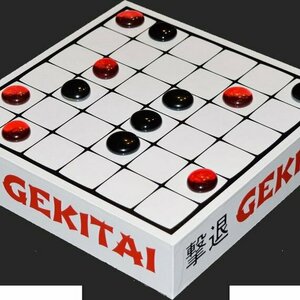

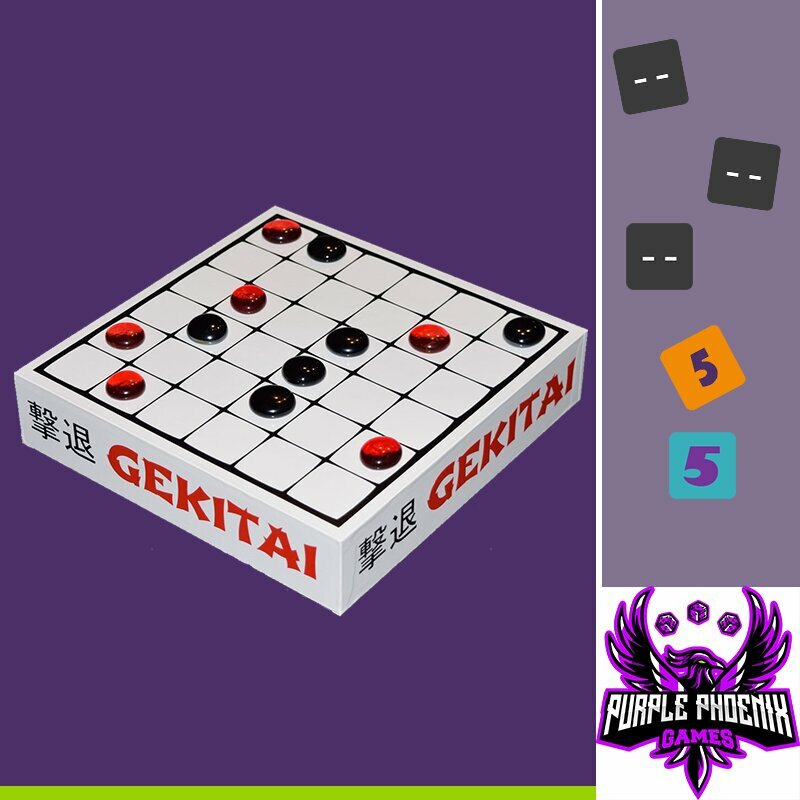
Gekitai is an abstract strategy game with very minimal rules. The phrase, “easy to learn, but hard to master” is very overdone, but it certainly applies here. For those that are wondering, the term, “Gekitai” is Japanese for “Repel.” You will see why this nomenclature is perfect for this game soon.
DISCLAIMER: We were provided a prototype copy of this game for the purposes of this review. Though I know the designer personally, I will be reviewing this game as an impartial judge. -T
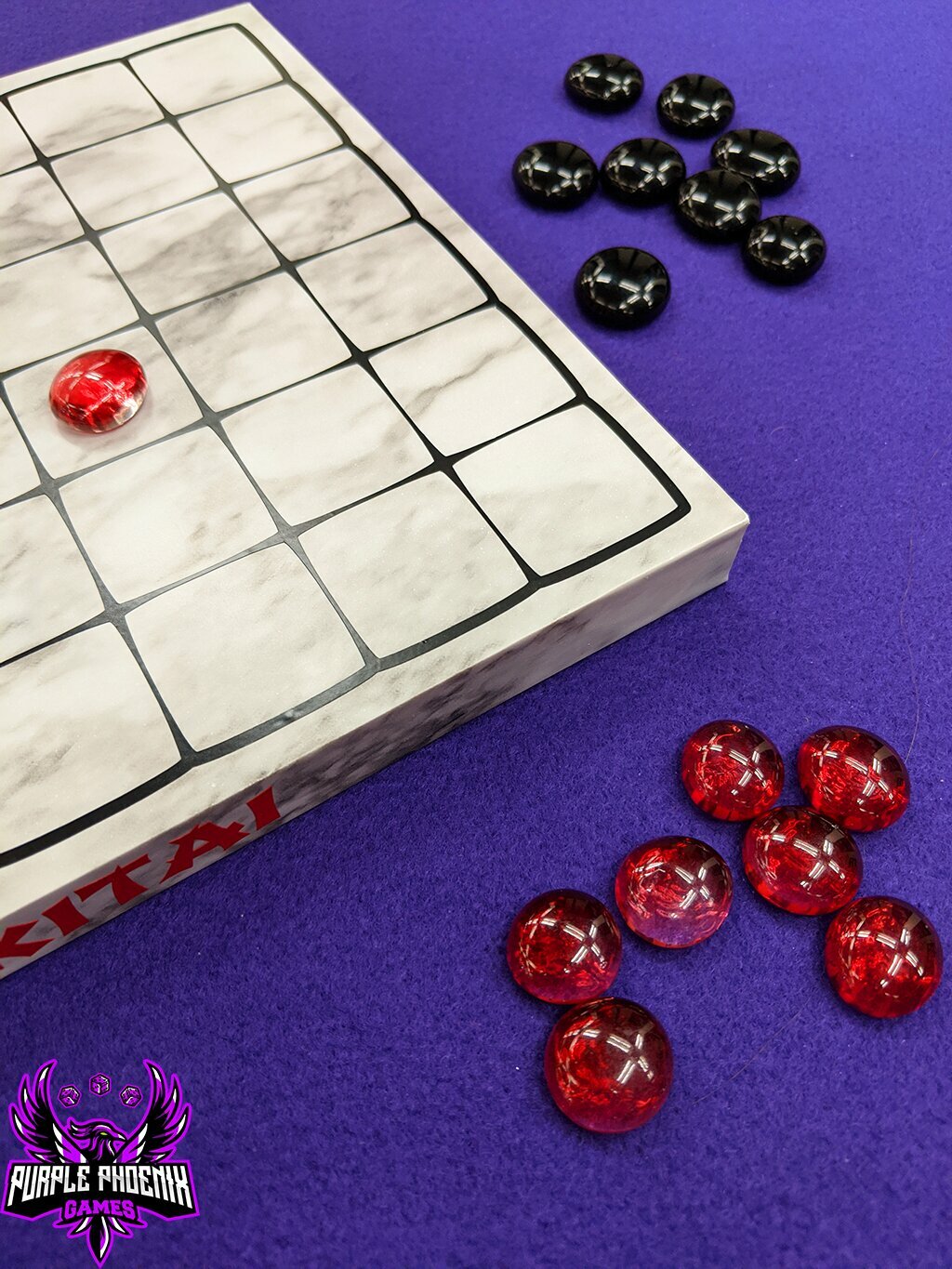
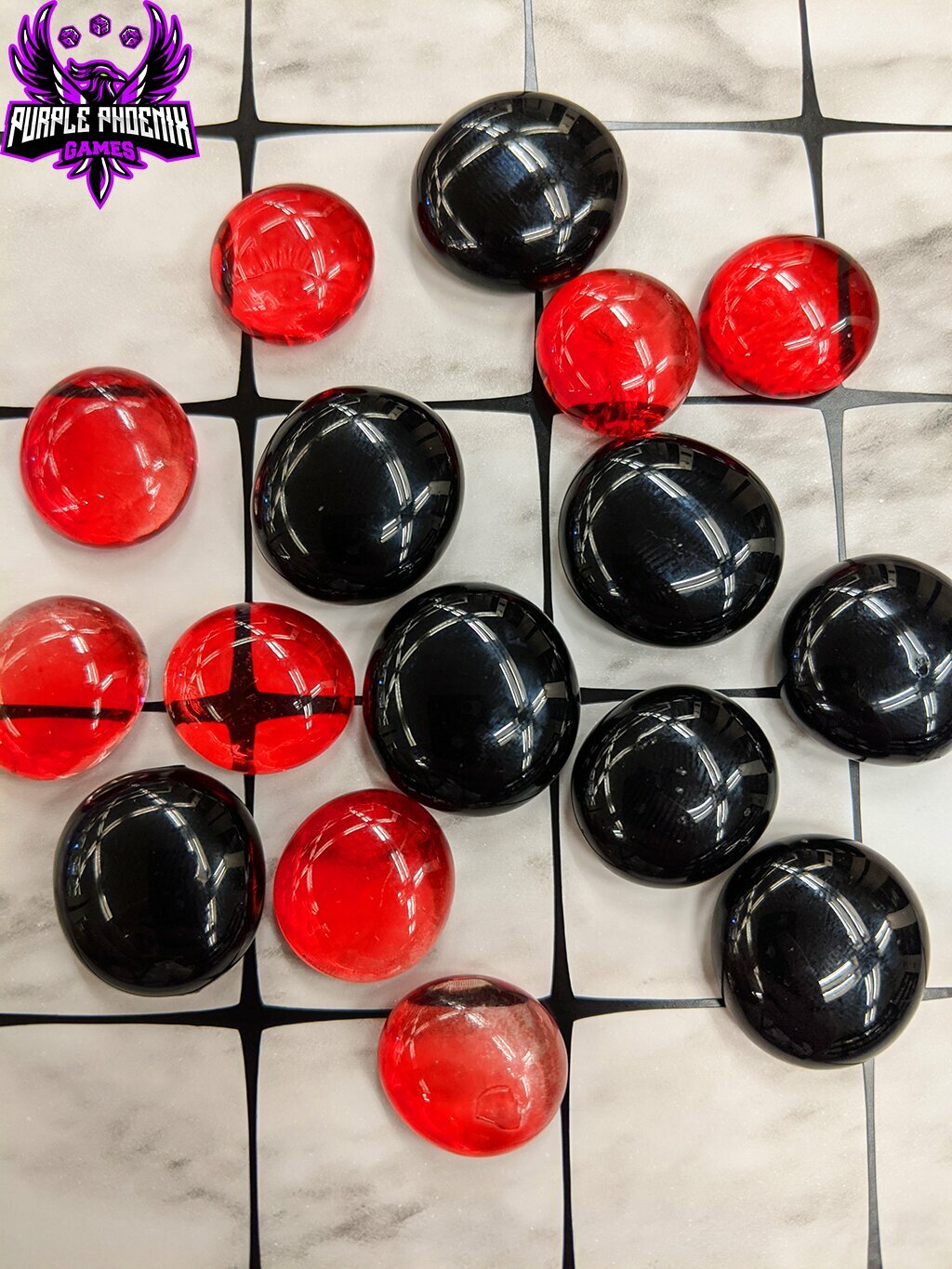
Normally I like to include setup instructions here in this paragraph for my reviews, so I shall do that now. To setup, place the board between the two players and give each player their eight matching pieces. In my game, they are red and black glass beads. For convenience I will refer to the red ones as apples and the black ones as 8-balls. That’s it. You’re setup to play.
The object of Gekitai is to fulfill one of two victory conditions: play until one player has three of their pieces in a row (diagonally OR orthogonally) or finish their turn with all eight of their pieces on the board. Easy, right? It most certainly is! Oh, you want the catch? Ok then, here’s the catch: while players can place any piece on any empty square, once placed the pieces will repel all other adjacent pieces away from itself. This includes their own pieces.
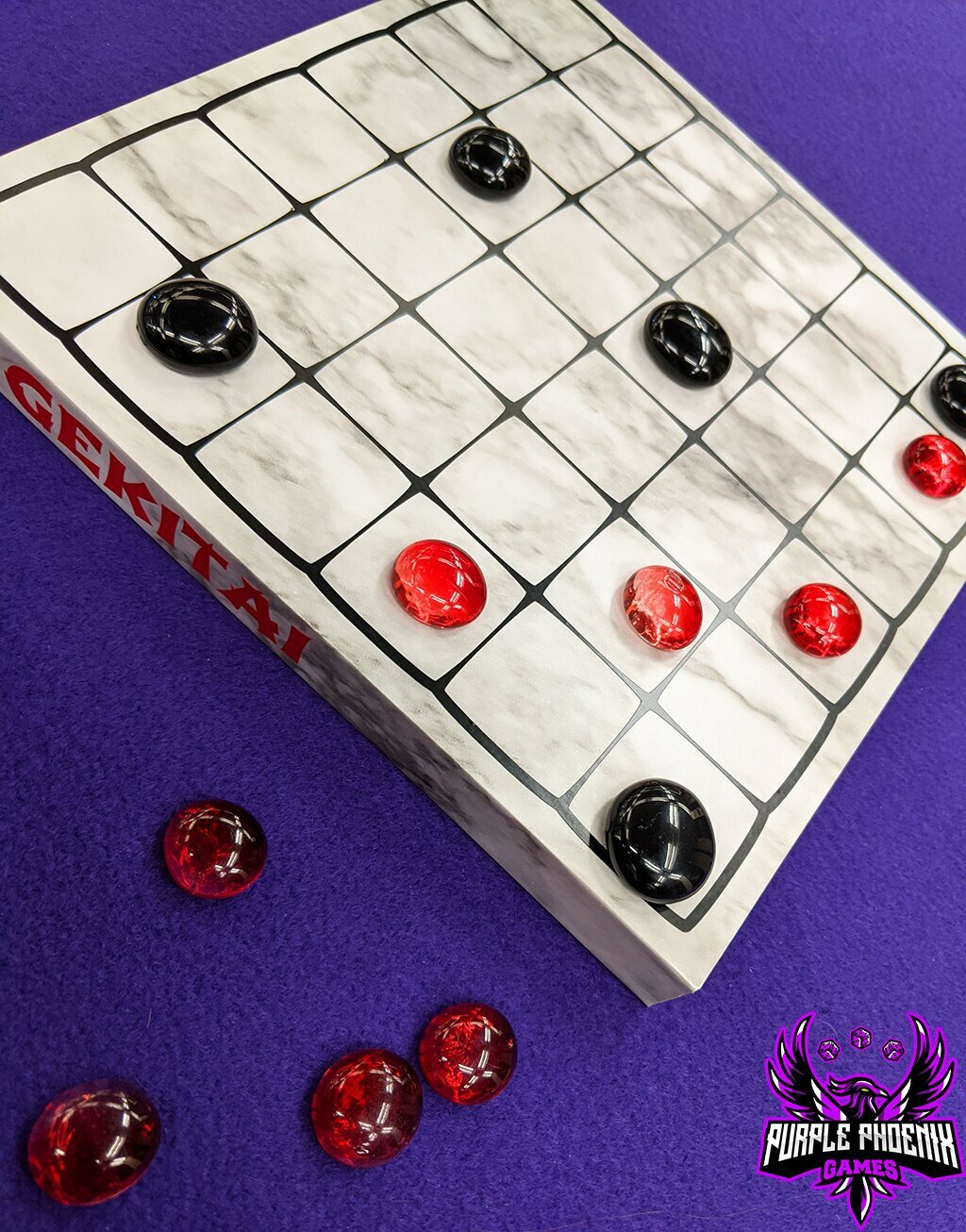
So let’s say you start the game and place your first 8-ball in a corner closest to you. Great opening noob. I mean move. You see, I would just place one of my apples adjacent to your 8-ball and repel it right off the board. That doesn’t mean that I have captured your 8-ball or anything like that. You would be able to use it again next turn if you like, but this is the danger of outside spaces. When repelled, a piece (your 8-ball) continues one space in the direction away from the most recently-placed piece (my apple). So diagonally if diagonal from the just-placed apple, or orthogonally otherwise. Again, this would affect all pieces that are adjacent, not just your opponent’s. Think of placing a piece as someone doing a cannonball in an infinity pool. Everyone already in the pool will get pushed away from the point of impact and may even fall out of the pool, but be able to hop back in soon.
One note about pushing other pieces. One piece can only push one other piece. Here’s what I mean. When my apple is placed near another 8-ball or apple, it repels it, right? Well, a piece may only be repelled if there is an empty space for it to go. If another apple is blocking the pathway of an affected apple or 8-ball, no movement happens. The pieces has been blocked. In this way strategy plays in integral part in Gekitai – you must always be thinking about 10 turns in the future. Play continues in this fashion until a player has achieved three-in-a-row or placed all of their pieces on the board.
Components. Again, we are playing with a PNP prototype game package. Granted, this PNP is assembled by the designer and looks WAAAY better than if I had tried to assemble it myself, so we do take that into consideration. Components aside (because unless you order a copy from the designer via Etsy in the future, you will probably download the files and play on a sheet of paper with coins or other stand-ins), this is a typical, classic abstract strategy-style game. The board can look any way you like in a 6×6 board and you can you use any bits for your game. Heck, you could even play with real apples and 8-balls. But what we were provided is excellent and looks great on the table.
But gameplay. Like I mentioned earlier, I know the designer and his family and they are wonderful people. Luckily that makes no difference here because the game itself is absolutely wonderful! My wife typically kicks my booty in all abstracts. Ok fine, usually in all games. BUT! After playing Gekitai lots with her, she has only beaten me once! When we do play it she asks for rematches several times over and I just love being able to have a go-to game for when we have a few minutes between running around with the kids. I love it. She loves it. We at Purple Phoenix Games, with an enthusiastic guest score from my wife, give Gekitai a cannonball-esque 11 / 12. We suggest you go to the BGG page where the PNP files can be printed. You will want this in your collection.
Purple Phoenix Games (2266 KP) rated Polemic in Tabletop Games
Nov 19, 2019

DISCLAIMER: We were provided a copy of this game and its NSFW expansion for the purposes of this review. These are final components, and the game is available from the publisher and other online retail stores. Also, I do not intend to explicitly cover every rule for the game, but to give an idea of game flow and play. -T
To setup a game of Polemic, each player will choose a color of cards and receive the small deck of the same color. Each player’s deck will include a Like, Dislike, and numbered cards 0-6. Shuffle the Topic cards (or Adult Topic cards – optional expansion) and place them face down in the middle of the playing surface – my band and I used a chair when we played. Choose who will be the first active player and you are ready to play!
The active player will draw a Topic card and read the provided topics silently. They will choose one topic to play, announce it to the group and lay the card in a discard pile. Now every player (active player included) will choose whether they Like or Dislike the topic. Simple as that. However, the players will also need to choose a card describing how many of the players will Like the topic. Herein lies the game.
You see, it’s not just deciding whether you Like the topic or not, but it’s also reading and knowing your fellow players to guess how many of them will also Like the topic. Example from photo below: I choose “dogs” as my topic. Obviously I Like dogs, so I will play my Like card and another numbered card as my guess to how many total players will Like dogs. It should be all of them, but I suppose there are those who are cat people as well. All players will reveal their Like/Dislike and numbered guess simultaneously and those that guessed the number of Likes correctly will each get one point. The game continues in this fashion until you run out of time to play or you have hit the agreed-upon point total for victory.
Components. To reiterate, we were provided a copy of this game along with the Adult Topics Pack. This game is a box with a bunch of cards. A ton of Topic cards are provided and enough personal decks for up to six players. The rules are also printed on a card. I LOVE this. The cards are good quality and I might even consider sleeving my personal decks as they are handled A LOT. I have no issues with the components at all.
Here’s the deal. We hear so many times that a game is a CAH-killer. And I, for one, hope that to be true every single time. While Polemic is not really akin to CAH, I can see how it would be classified similarly. However, Polemic is SUCH a great game of discovering what your playmates are into and what they think you enjoy as well. I would be remiss if I didn’t insist on also picking up the Adult Topics Packs, but be warned: once you go NSFW you may not want to play any other way. Unless you’re playing with your grandparents or in-laws or something. Then just be smart about what you choose to play with them. That said, Purple Phoenix Games (with help from 10 of Soul) give this one a resounding 11 / 12. Pick this up now before they are sold out.

Cook Yourself Happy: The Danish Way
Book
Cook Yourself Happy is a beautifully illustrated cookbook with over 100 delicious Danish recipes....
Catch the Jew!
Book
This book recounts the adventures of Tuvia Tenenbom, who wanders around Israel of our time calling...

Flick Golf!
Games and Sports
App
Play the most addictive golf game on the App Store! No. 1 Sports Game in over 100 Countries!...
Taking Root: The Nature Writing of William and Adam Summer of Pomaria
Book
William Summer founded the renowned Pomaria Nursery, which thrived from the 1840s to the 1870s in...

Cynthia Armistead (17 KP) rated American Gods in Books
Mar 1, 2018

I've certainly read some short stories, too. The most memorable, <a href="http://en.wikipedia.org/wiki/Snow,_Glass,_Apples">"Snow, Glass, Apples"</a> was reprinted in an anthology I read recently. I find it disturbing, so I won't re-read it. Well-written, of course—it wouldn't be so very memorably distressing if it weren't so masterfully done! (I found the <a href="http://www.holycow.com/dreaming/stories/snow-glass-apples">text online</a> if you care to read it, but please understand that the story deals with pedophilia, necrophilia, and incest here. It is the polar opposite of all things Disney.) Snow White was never one of of my favorite fairy tales, and Gaiman definitely pushed it much farther down the list.
In any case, I don't know what I was expecting from Gaiman, but <i>American Gods</i> wasn't it. I like stories with happy endings, and within the first few chapters I was fairly sure that there wouldn't be one. Is Gaiman fundamentally opposed to joy, or is it just happiness that he doesn't allow?
The novel is epic. It is masterful. All that stuff from the big critics is dead on. The book could be used as the backbone of a mythological scavenger hunt if a teacher were willing to run a very unstructured but engaging course that way. I certainly enjoyed that aspect of it, and it made me glad that I was reading it on my iTouch so that I could look up anything I liked online at any time, no matter where I happened to be (which was almost always at home or somewhere else that had wifi access, happily).
I seldom want to see illustrations in any book, but yes, I think I would like to see good pictures of some of the characters Gaiman described in this one. On the other hand, without artwork I spent time imagining what the characters looked like based on the descriptions. I don't normally stop to do that, as such matters as seldom relevant to a plot, but these beings caught my fancy. Not enough that I would sit through an entire graphic novel, I'm afraid, but if I saw one now I might flip through it to see how the artist's renderings compare with my versions.
I'm seldom able to identify an overall Theme to the books I read. Most of them, honestly, are fluff. I'm fine with that. I read them because they entertain me. <i>American Gods</i> is different. It is entertaining, but it isn't light or fluffy in the least. It definitely has an easily identifiably Theme and Tropes and all those elements that I recall from long-ago classes, the sorts of things that put me off from my original English major because I hated tearing other author's works apart instead of writing anything original. (Now, I begin to understand that we were being taught to recognize what makes for good writing so we might have some hope of possibly creating some of it one day.)
I somewhat timidly conclude that <i>American Gods</i> is the first piece of Literature I've read in a very long time, and well worth the time spent reading it. (I find it rather amusing that it would be British Literature, despite its title, due to the author's nationality.) I'm not going to state the theme, because that would be a spoiler, and I hate putting those in reviews—but it's something that I see as a Truth, and one that needs to be stated far more often, especiallly today. It's even more interesting that it took a Brit to say it.
The book is dark, although it does have some very bright spots in it. I will acknowledge that I was going through a particularly bad time with regards to my health when I was reading it, but I still think it might be best for some people to read this one when in a fairly positive state of mind.