

Unpossible
Games
App
Unpossible will test your skills, your reflexes, and even your memory. It will make you smile. It...

Jordan Binkerd (567 KP) rated American Vampire, Vol. 6 in Books
Jul 21, 2019 (Updated Jul 21, 2019)


So, it has come to this. The sixth and latest collection of American Vampire comics. Now it’s not just my library’s slow acquisition policies holding me back, but the fact that there haven’t been any more published yet! Apparently the creators put the book on hiatus for a while, but they’ve at least started publishing again. I just have to wait for it to hit the collections….This particular collection is a couple of one-shots they put out in the meantime to keep our appetites whetted–one from the main American Vampire team, one with them letting a whole bunch of other comics creators play in their sandbox. Obviously, this review could spoil events from the previous collections.
First off, we have THE LONG ROAD TO HELL. Snyder and Albuquerque set out the story for this one together, with Albuquerque taking over to script and draw the story. Billy Bob and Jo are the Bonnie and Clyde of petty thieves, picking pockets by night to add to their stash. They’re hoping to have enough soon to cover the cost of renting a chapel, but one fateful encounter with a vampire coven recruitment team and everything changes…not for the better, I’m afraid. Jasper Miller is a young orphan, favorite target of a group of bullies. It seems that young Jasper is a very insightful young man, and some of what he knows makes these bullies very nervous, and he decides that the open road would be safer for him than the old orphanage. Vampire hunter Travis Kidd we’ve already met back in Vol. IV, and it’s good to see that he survived the ambush he willingly dove into at the end of that book. Seems to have picked up a katana somewhere in the interim too, which is always cool. Fate has these four on a collision course, and blood will be spilled by the time they reach the end of the road….
Moving on to the American Vampire Anthology, we open with the frame story by Snyder and Albuquerque. THE MAN COMES AROUND is set in 1967 as Skinner Sweet hides out in the middle of nowhere, hoping to avoid the major events he can sense just over the horizon. Seems there’s always someone trying to kill him, though…. Jason Aaron and Declan Shalvey then enlighten us as to what really happened on Roanoke Island in THE LOST COLONY. Here’s a hint, vampires were involved. We then move on to BLEEDING KANSAS, where Albuquerque puts down his pencil and takes a shot at writing the story, leaving the art to Ivo Milazzo. Set against that tumultuous time and place, Albuquerque and Milazzo set down for us a tale of what I can only assume are Henry Jones’ grandparents. Next up, Jeff Lemire and Ray Fawkes serve up a tale of terror in the frozen north with CANADIAN VAMPIRE as ex-Mountie-turned-bounty-hunter Jack Warhammer is hired to find out what happened to a German fur trading expedition missing in the wild. Becky Cloonan handles both the writing and art for GREED, starring Skinner Sweet and featuring his first encounter with those crazy folks who hail from a place called “Hollywood….” Francesco Francavilla then pulls the same trick for THE PRODUCERS, detailing the birth of a star as he makes a shady deal in exchange for fame and fortune. Gail Simone and Tula Lotay treat us to Hattie Hargrove’s origin story in ESSENCE OF LIFE, showing us just what happened to her that made her willing to screw over her best friend in the world. Gabriel Ba and Fabio Moon share both the writing and artist credits for LAST NIGHT, as a lounge singer describes to a reporter the events leading up to the previous evening’s massacre at the club. Finally, Greg Rucka and JP Leon tell the tale of a dying drunk and the lowlifes who try and shanghai him in PORTLAND, 1940.
On the whole, I really enjoyed this as per the usual for this series. The writing was stellar, and the anthology format really served well for the world being depicted. As with any comics anthology, there’s a wide variety of artistic styles represented, and some of those styles I’m not really a fan of, but that’s largely a matter of taste. I could sit here and tell you that I really wasn’t a fan of Ivo Milazzo’s art on BLEEDING KANSAS (which is true), but the next guy might have loved it. I could laud Tula Lotay’s work on ESSENCE OF LIFE (also true), but the next guy may not have been a fan. That’s kind of how it works–peoples’ tastes are pretty subjective. I did enjoy getting into Hattie’s head a bit more than we were able to back when she was introduced, and Skinner Sweet’s adventures are always fun–I’ve mentioned before my weakness for antiheroes. As a historian, Roanoke’s lost colony is always a fascinating topic, and a number of the plot twists contained here were very satisfying if not always surprising. I really can’t wait for the next volume to come out so I can see the payoff to some of the plot threads being set up both here and in the teaser from the end of volume V….
CONTENT: R-rated language. Brutal, bloody vampire violence–these aren’t sparkly, angst-ridden pretty boys, these are monsters through and through. Some explicit and implicit sexual content, including what more or less constitutes a rape. No real occult content, as there isn’t a spiritual element to this version of vampirism.
Original review link: https://jordanbinkerd.wordpress.com/2014/08/15/review-american-vampire-volume-vi-by-scott-snyder-rafael-albuquerque/

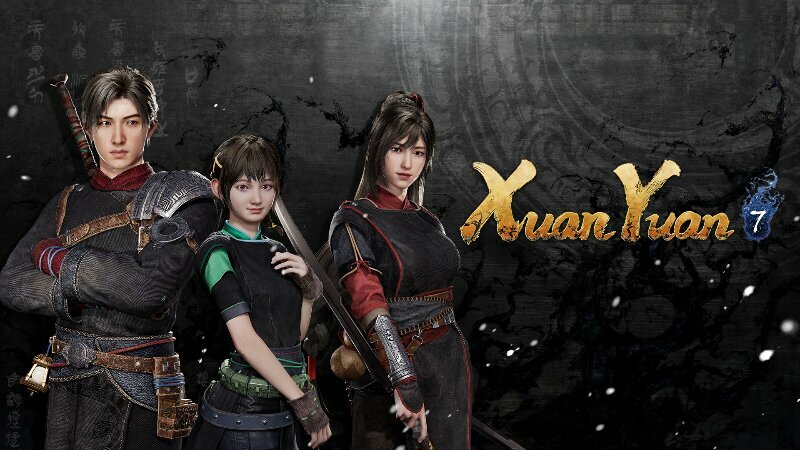
Charlie Cobra Reviews (1840 KP) rated the Xbox One version of Xuan Yuan Sword 7 in Video Games
Oct 4, 2021

It seemed like it was going to be an open world game but wound up being very linear in nature although it had aspects of an open world game like side quests, fast travel, and even treasure chests scattered throughout the game world as well. There's a climbing mechanic that seemed kind of pointless because it was pretty much just a cut scene of in game graphics of you climbing a little cliff or sometimes it would turn into an interactive part where you had to move the analog stick to move the character. Still it was better than these weird times that the game gave you control of the character for a scene in which your only movement was preset like a ride on a rail that couldn't veer off a road.
I liked that it was an action-RPG meaning instead of turn based combat like most RPG's it had an active combat system where you could move at your own leisure and consisted of hack and slash combat with some martial art skills, blocking, dodging, and some riposte (parrying). There are four basic martial art skills which can be learned as you progress through the game, Bull, Wolf, Bear, and Tiger. They become stronger and increase the length or hits of their combo the more you use them. A big draw back is that you could only equip or use two at one time although they can be changed at anytime through the talent menu. Then there are three special martial art skills which are Taowu, Tundou and ?
The combat was one of the things that had me really conflicted. A cool thing I liked about the combat was that there was a meter that would go up when you would attack an enemy and if it filled all the way you could perform an execution on them. Otherwise it was very unresponsive most of the time making dodging and parrying really hard and kind of useless. I found the blocking especially useless because of how much damage you still incurred. There is a skill tree for new martial arts and you can create and upgrade structures in Elysium that can enhance various things, such as weapon, armor, accessories and more. You can also use the fusion to capture the souls of enemies in combat and fuse them together in Elysium to equip them for bonus stats and effects.
Your able to carry items in your inventory which are mainly objects like items that don't do anything except advance the story or quest and some like healing weapons. There is an equipment screen for weapons and accessories but you only stay with one weapon the whole game. It does change and become stronger and its appearance changes too. You can even change outfits. I'm not sure if you get any in the game as the version I played came with a couple of additional weapons/costumes. You do wind up getting some party members which is customary of some RPG's and they help out by attacking enemies on their own. You can control them by activating some abilities or special attacks that have cooldown times for when you can use them again. There's a minigame called Zhuolu chess and it can be pretty fun and a nice change of pace but not what you were looking for when you bought the game.
You can save your game and recover health at random campfires throughout the game world as well as listen to some party dialogue when you choose to rest. The dialogue tends to repeat often and doesn't really advance the story much or fit where you are at in the story that often. These game mechanics are similar to Dark Souls as resting respawns enemies when you save at a bonfire and get healed too. As I mentioned earlier the game employs a fast travel system consisting of waypoints called guard stones that you can activate when found. There is an element of puzzle solving in the game but they don't seem to be that hard to figure out and some can even be skipped if you don't want to bother with it.
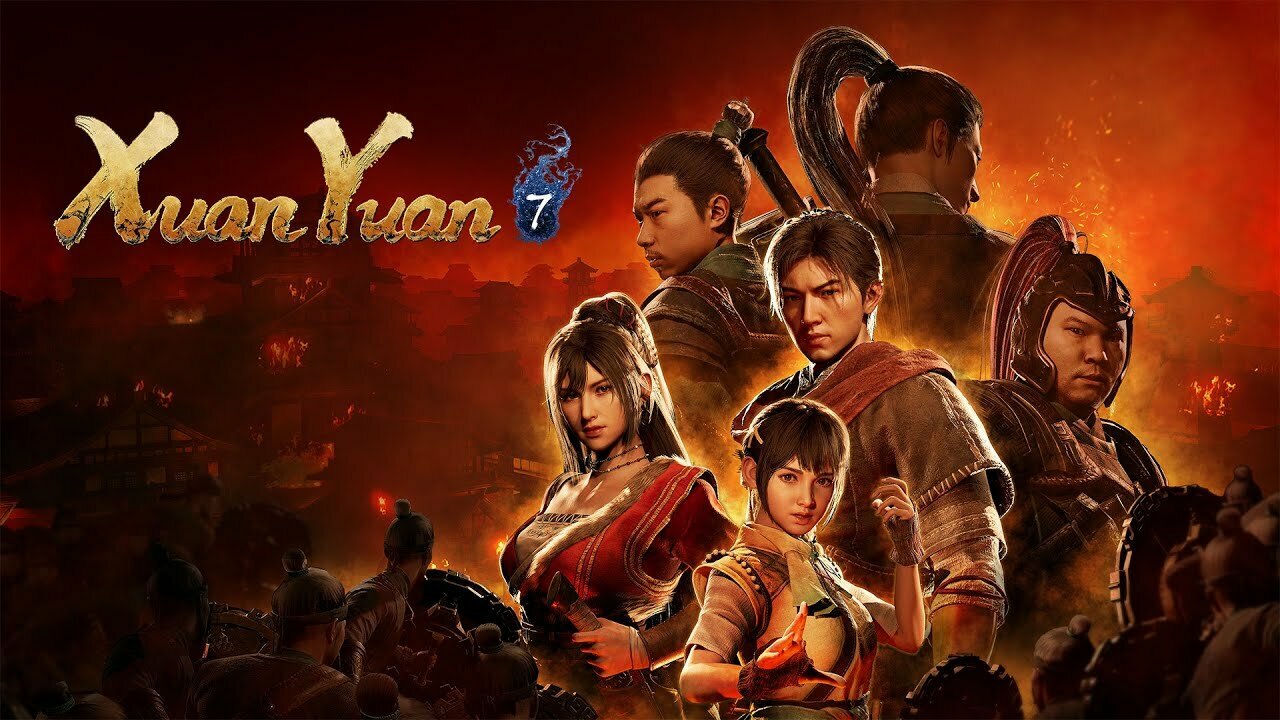
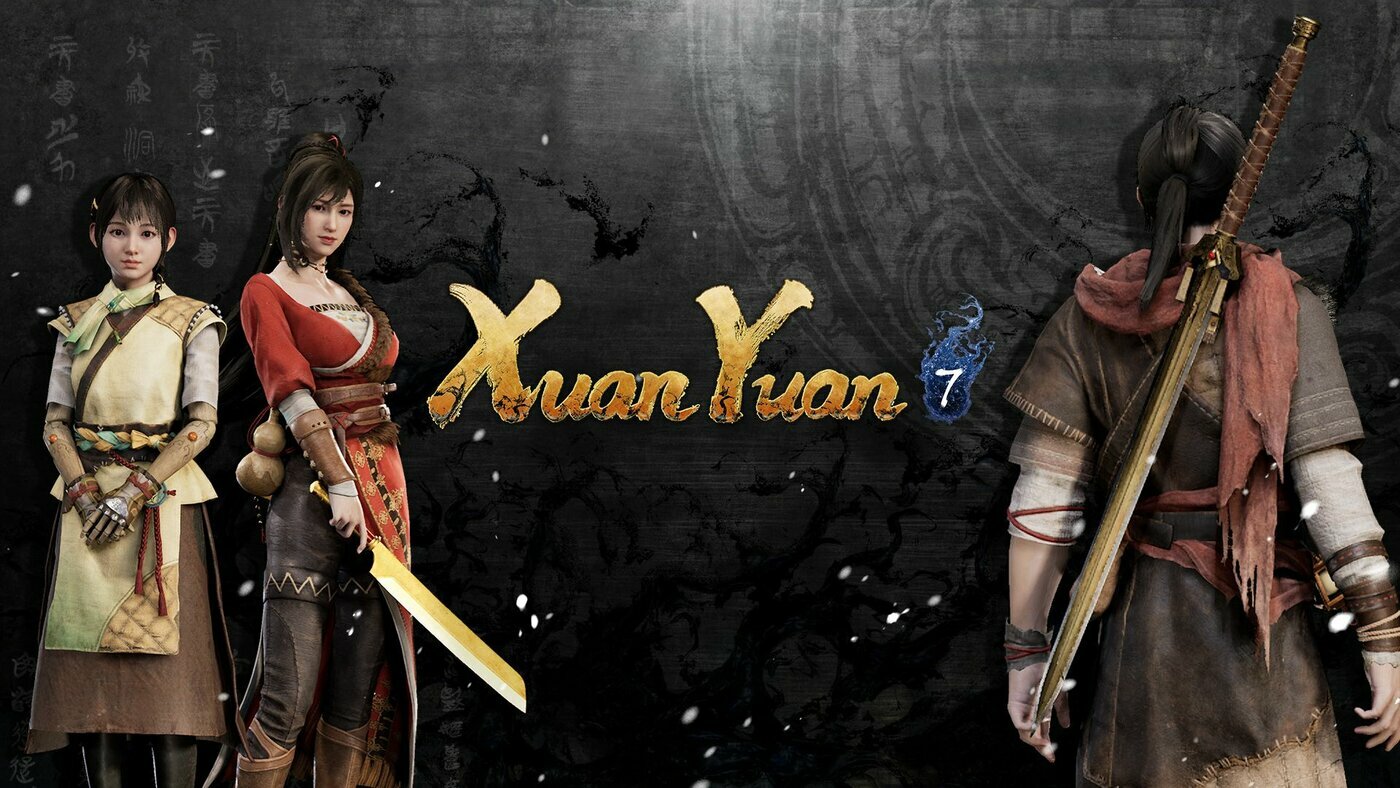
The graphics were pretty solid and the game surely looks good for the most part. The textures are sometimes rough in the environment and sometimes there's very noticeable instances of "pop-ins" but overall aesthetic and style is beautiful. You really never get to play games where you get to see ancient Chinese castles, cities, or kingdoms so that was nice. The leaves in the trees are even ruffled by the wind, which is a nice touch. The main characters like Zhao and his sister Xiang look great and so do most of the secondary characters like Chu-Hong and Mo Huang. It just makes it that more disappointing when you see sub-par detail in the NPC's and stiff cutscenes because you know they could have done better on those too. Maybe they didn't have enough time, man power or budget.
The music was probably one of the best additions to the game as a whole. Containing traditional Chinese sounds and instruments befitting the setting the music was great. There are some instances where there is no music and the void is filled with nothing but awkward silence or the sound of footsteps. Only the subpar voice acting fills the dead air and background music would have added more depth to certain parts and scenes of the game. There's no English dubbing for the voice acting in the game it's only in Mandarin/Chinese which isn't bad in itself except the performances are kind of hit and miss and not very balanced.
Verdict: [5/10]
The game seemed very rough around the edges, it lacked that "polished" feel that it would have gotten if it had been a "AAA" game instead of a "AA" game. It's linear aspects left little to no deviation for exploring the world other than the main quest making it feel like going through a tunnel from location to the next. The distances between the towns and villages also made the world feel really small which it probably was. The story and gameplay were enjoyable enough but writing and especially acting/voice acting in key cutscenes needed work. The combat was was so uninspired I felt like I was doing the same sword attacks the whole game and they never really changed. And last thing, even if it doesn't help or is in any way useful, I like to be able to make my character jump and this game didn't let you do that either. So in conclusion I have to give Xuan Yuan Sword 7 a 5/10. It's an average or ok game, which has it's moments but nothing to write home about. However if they make a Xuan Yuan Sword 8, I'd be looking forward to see what kind of improvements they would make in the next installment.

Purple Phoenix Games (2266 KP) rated Space Plague in Tabletop Games
Mar 9, 2021
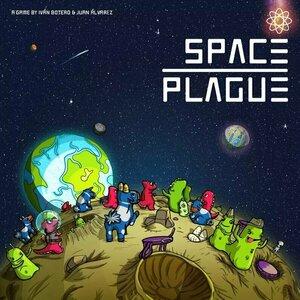

Space Plague is a new game from first time designers who hail from the country of Colombia. In it players assume the command of a race of aliens attempting to colonize a newfound planet before the other races assume majority. Each race is essentially the same, and have similar tactics, but may use these tactics differently from other races. The player who amasses the most plagues from their race by the time the game ends will be crowned champion, and settler of the new world.
DISCLAIMER: We were provided a prototype copy of this game for the purposes of this review. These are preview copy components, and I do not know for sure if the final components will be any different from these shown. Also, it is not my intention to detail every rule in the game, as there are just too many. You are invited to download the rulebook, back the game through the Kickstarter campaign, or through any retailers stocking it after fulfillment. -T
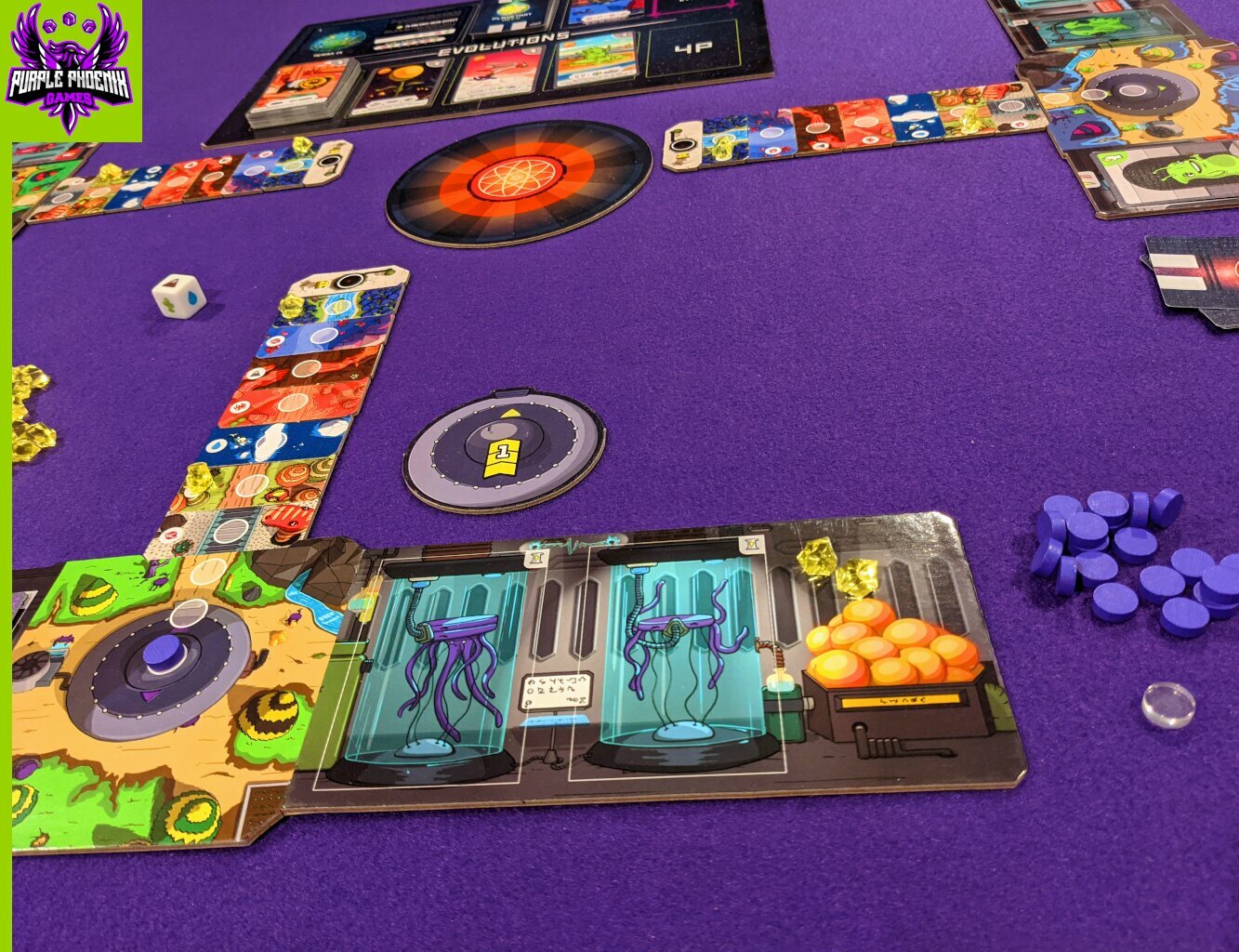
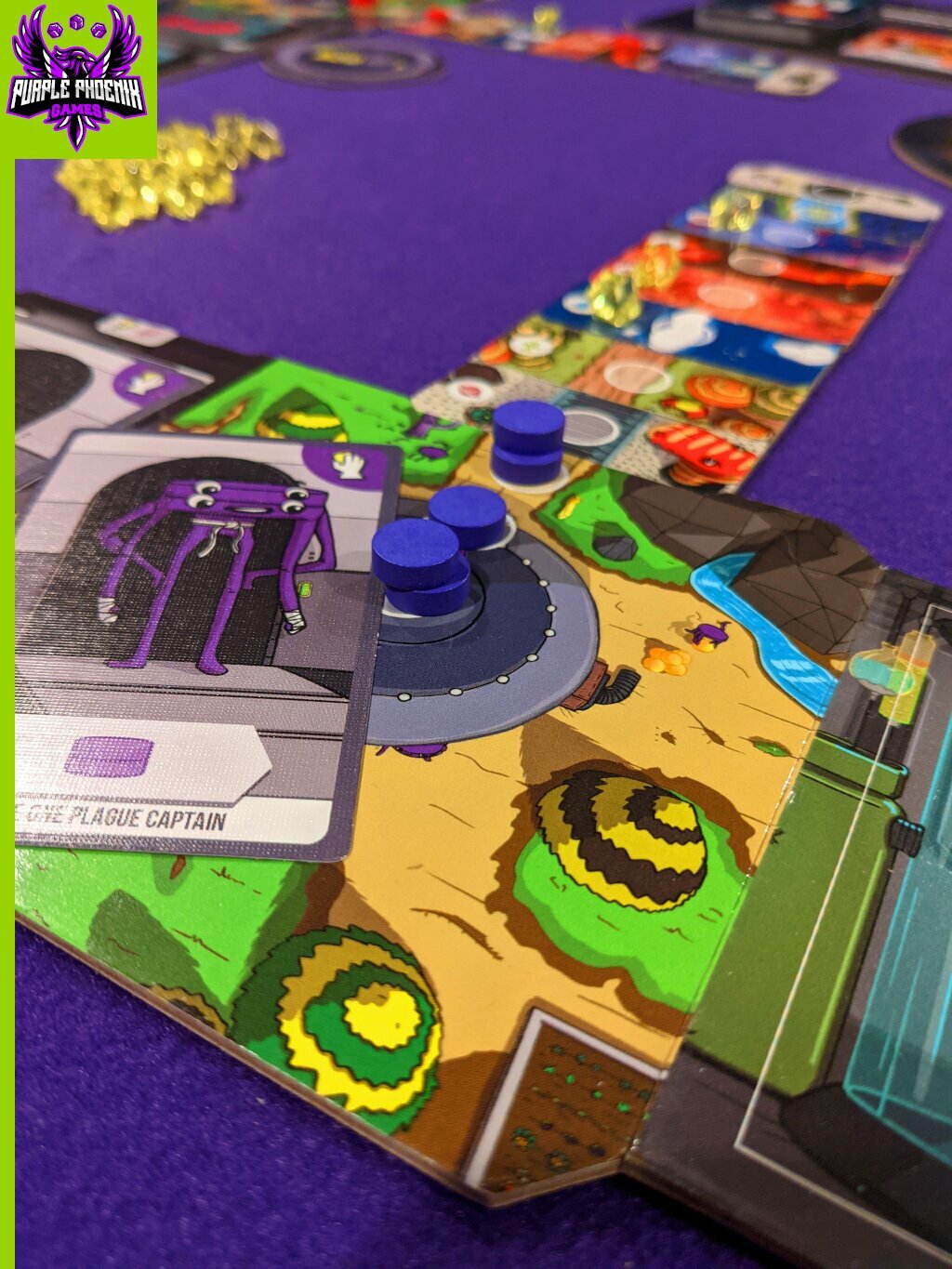
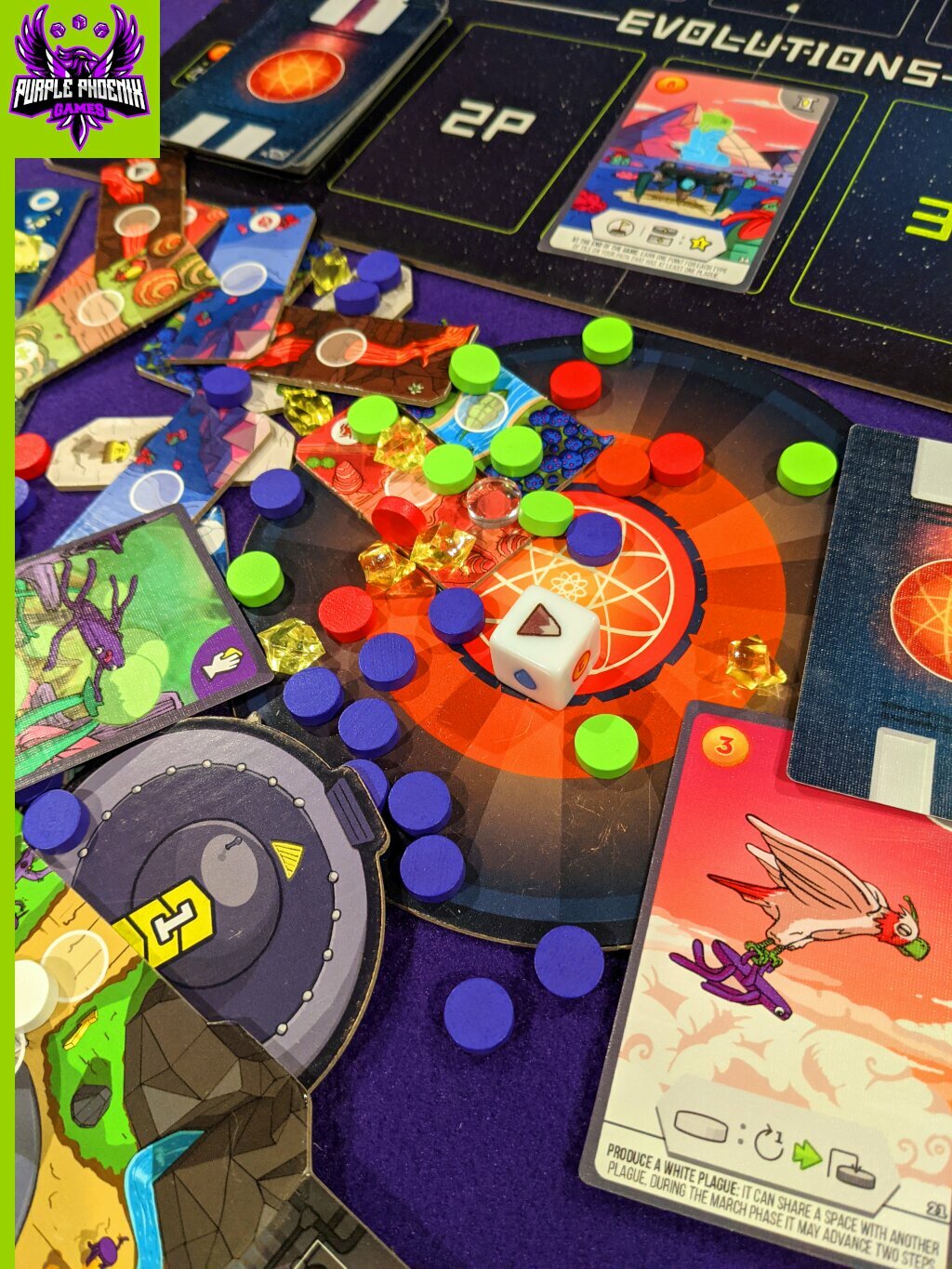
To setup, follow the instructions, as there are many steps for setup. Once complete, the game should look similar to the photo below. You will see in this photo the main board at the top, the circular world core board (in black and red), and individual board setups for three players. Of course, for this review I will be playing the purple faction: The Flat-Earthers (not that I agree with the actual group of Flat-Earthers). Each player receives the same components, just in their player color. This includes six action cards to serve as the opening hand.
Each round follows four phases: Planetary Deck, Play Action Cards, Planetary Event, and March. On the main board a Planetary Event Card is flipped at the start of each round. This will inform the players which terrain type will generate energy this turn, as well as give a glimpse into the future event that will occur once the card travels to the activation zone on the board. Once players have placed energy shards onto the requisite terrain tiles they must each choose one card to be played this turn from their hand. As each player has the same six beginning Action Cards turns may seem similar. These action cards include Producing Plague (placing a plague disc on the space furthest from the end of the terrain tile line, on top of the picture of the player’s spaceship), Producing a Captain (a stronger version of the normal plague disc), Fast Movement (allows plague discs to move twice toward the core or two discs to move one space each), Slow But Steady (allows one plague disc to move forward one space OR allows the player to place a shield disc on top of a plague to protect it from harm), and Evolving OR Getting Lucky (which allows the player to purchase an Evolution Card from the Market or to roll the energy die and place energy shards on the resulting terrain type). More action cards can be purchased at the Market and used on future turns in order to buff certain actions, abduct opponent plagues, or even create new types of plagues with special abilities.
Once all players have played and resolved their action card for the round the Planetary Event phase begins. If an event card has moved its way to the activation zone of the main board its event text is resolved now. These events signify death of plague discs if they reside on specific terrain types, allow for purchasing cards at the Market or else destroying the plague furthest toward the core, or other various and nefarious events.
When the event has been resolved the active player token is passed to the next player and the March phase ensues. Players will move each of their plague discs one space toward the core to make room for more incoming plagues and captains.
Once the final event card has made its way through each of the main board slots and past the activation zone the game will end. Players will count their plague discs that made it onto the core of the planet and the player with the most discs will win! The rules also include several tie-breakers, ending with a shared victory and a snarky, “tough toothpaste,” style of comment.
Components. Again, this is a prototype copy of the game, and components are not at all final. However, component quality aside, this game looks amazing on the table and hints at some really excellent plans for the final aesthetic. The character art and art on the cards is cartoony, but not in a bad way, and the other art in the graphic design is just stellar (checks around the room for the hook). The game feels “spacey” and “alieny” but also hip and lighthearted. I like it. I like it a lot. My hope for the final product is that the rulebook gets much more detailed, as I had to ask several questions to the designer that just were not clear or present in the rules. I am also hoping that the cards themselves will see quite a bit of beefiness added to them, as this prototype copy shipped with mega-thin cards that are delicate to handle. For a prototype, the components are good and show me what could be upon a successful Kickstarter campaign.
The gameplay is definitely something I want to discuss. I was blown away by how much fun I had playing this game! I cannot count how many times I vocalized how impressed I was with the design and how much fun I was having. I love the mechanic of giving all players the same components but allowing them to choose how to use them best for their strategies. Sometimes I felt that I need to flood my track with plagues and get them moving, while other times I wanted to just upgrade my race by using the evolution cards from the market. Those evolution cards are so interesting to use because they can change the course of the game, especially if specific cards come out near the beginning of the game.
Players can choose which world they wish to conquer at the start of each game (five were included with this copy), and each world possesses different strategies of play. That said, Space Plague definitely scores points for replayability from us.
While it was difficult to get into at first (remember all the rules questions I had), once I was able to truly learn the game it became so enjoyable, and everyone I have played with has thoroughly enjoyed it. If this is the style of game we can expect to come out of Colombia and Bamboo Studios in particular, I am very excited for the future and for the board game community as a whole. This one is a gem and I cannot recommend it highly enough. If you are looking for something a little kooky but with great art and super fun play, then it’s a no-brainer. Space Plague is a must-play at the very least.

Kids Yogaverse: I AM LOVE
Health & Fitness and Book
App
Kids Yogaverse: I AM LOVE is “Highly recommended” by the US Surgeon General as a healthy app...

Phoebe (13 KP) rated Hannibal - Season 1 in TV
Oct 8, 2018


It did not disappoint.
The relationships built within this season are well thought out and captivating, especially that of Will Graham and Hannibal Lecter. The way the two men circle each other, their relationship filled with manipulation and a subtle seduction, you learn the ways they need each other, and become dependant on each other as they delve further into each other's psyches.
Speaking of, the way in which Will is both portrayed by Hugh Dancy, and treated within the show in regards to his innate aptitude for understanding the macabre is fascinating. I found it opened a new door to how the mind can work, and the dark repercussions they can have. This is also well shown through Abigail, as we follow through the aftermath of a traumatic event at the hands of her father.
The overly stunning aesthetics of this show work not only to entice but also to act as a juxtaposition to the gore caused by Hannibal and the "monsters of the week" in every episode. It allows the viewer a glimpse into how Hannibal sees the world; as a work of art. Even down to his victims. The elegance that he constantly exudes, particularly in scenes in his kitchen, almost numbs the viewer to the horrific truth behind his character.
Overall, a beautiful show. One I would highly recommend, but maybe not to those with a particularly weak stomach.

Natari (73 KP) rated Hunt the Moon (Cassandra Palmer, #5) in Books
Jul 19, 2019

I really enjoyed Hunt the Moon. Karen Chance onces again nails the pace of action, romance and deepening our understanding of the loveable characters she has created. In Hunt the Moon we learn a lot about the big three, Cassie, Pritkin and Mircea which puts their behaviour and way of reacting to life in a whole new light. It's a work of art.
In Hunt the Moon, Cassie finds herself a brand new enemy, because rogue vampires, black wizards and gods were't enough. Now she gets to throw in the fae and demi-gods too. Who bring with them a whole new bag of tricks. And while you shouldn't laugh at someone who always seems to find herself and her bodyguards in the midst of explosions, but, well, it's damn funny when a stoned pythia is glaring at a possessed fridge. Karen is able to be serious and cover some unsettling topics like war, politics and childhood trauma (of all varieties) and balance it with pleasant prose and just straight-up fun. That's the best word for the Cassie Palmer series, it is fun to read.
Tower Dash
Games and Stickers
App
Play Tower Dash! The super addictive new game from the creators of Bird Climb and Spider Square. In...
The Sting Man: The True Story Behind the Film American Hustle
Book
The Sting Man: The True Story Behind the Film AMERICAN HUSTLE The inspiration behind the film...

Tomorrow is D-Day: The Remarkable War Story of Supermarine's First Draughtswoman
Book
At 10.15 a.m. on Saturday 3 June 1944, a shaft of sunlight fell across my board, sending a brilliant...