Search
Search results

Daniel Boyd (1066 KP) rated Rogue One: A Star Wars Story (2016) in Movies
Jul 19, 2017


Darth Vader (1 more)
Fits nicely with the rest of the series
What's Old Is New
So our yearly Star Wars movie has arrived and after a complicated production it has released to rave reviews, with some outlets going as far as to compare it in quality to Empire Strikes Back, (which is widely considered to be the superior Star Wars film,) and it has even garnered a fair amount of Oscar buzz. This, along with the fact it’s a Star Wars movie meant that my expectations for this were pretty high going in and after seeing the movie there are parts of the flick that I loved and parts that I didn’t. When I wrote my Force Awakens review last year, I wrote both a spoiler free and a spoiler filled version of the review, but this year I have less time on my hands, so from this point on this will be a spoiler filled review, but the movie has been out for almost a week at the time of writing this, so if you haven’t seen the movie yet and are reading my review, well that is your own fault.
This movie for the most part impressed me. I loved how well it tied into A New Hope and how it actually fixed that movie’s biggest plothole by explaining that the weak point in the Death Star was installed on purpose by Galen Erso while designing the battle station under the Empire’s thumb, so that the Rebels would have a chance to destroy it. I loved how the movie had the balls to kills off the entire crew of the Rogue One team at the end of the movie and that corridor scene at the end with Vader was possibly the best scene I’ve seen in the cinema this year, it’s definitely up there with the airport scene in Civil War. Those are the stand out positives of the movie for me, however there were also a few flaws throughout the film.
First of all, that Grand Mof Tarkin CGI recreation of Peter Cushing was awful, the whole thing looked like a character from the Star Wars animated series. When he is first introduced it is through a glass reflection on a window he is looking out of and in that part of the scene it was fairly convincing, however he then turns around and the camera moves to a medium close up shot and all of a sudden it feels like watching a video game cutscene. Guy Henry was the actor who did the motion capture for Tarkin and that actor actually looks relatively similar to Peter Cushing, so why they didn’t just apply some makeup to Guy Henry and dye his hair gray to resemble Cushing more and recast the Tarkin role is a mystery to me, it would have also been a lot cheaper than the method that they went with. Either that or he should have only been seen in the reflection of the glass, since that was the only time that the CGI effect actually looked convincing. However, I did think that the CGI recreation of 1970’s Carrie Fischer at the end of the movie was very convincing and if it wasn’t for the movement in her mouth, I wouldn’t have known that was a CGI character. Another flaw I had with the movie was the how rushed and choppy the first act was, the characters were all introduced quickly and vaguely, then it took them ages to actually form up as a team. I get that introducing a whole cast of brand new characters in a short space of time isn’t easy, but Tarantino pulls it off in Hateful 8 and Inglorious Bastards and it works a lot better than it works here.
In a lot of ways Rogue One is a contrast to Force Awakens. In Force Awakens, the plot was essentially the same as A New Hope and was a fairly by the book, traditional Star Wars story, but the characters were what made that movie, if Poe Dameron, Rey, Finn, Kylo Ren, Han and Chewie weren’t as well written, that movie would have been mediocre at best. In Rogue One, the characters are pretty shallow and underdeveloped and they are introduced quickly and by the end of the movie none of them have really had a proper character arc. However that is not what this movie is about, this film is about a team of people coming together in order to complete a task to set up the events of the original trilogy and in that sense this movie does what it sets out to do. An example of this is the robot character K2SO, who I thought was going to start off with no humanity, then over the course of the movie realize the value of human life and then sacrifice himself for the greater good at the movie’s climax, but it turns out that the only real reason that he is helping the Rebels, is because he has been programmed to do so. This I feel sums up the level of character development present in the movie and demonstrates that it is not necessary in the film as that isn’t the movie’s purpose. What Force Awakens lacked in an original plot, it made up for in character development and what Rogue One lacks in character development, it makes up for in plot and setup, so both movies have their strengths and their flaws. Bearing in mind that I have only seen Rogue One once so far, I currently prefer Force Awakens to Rogue One, but then I prefer Return of the Jedi to Empire, so maybe that’s just me.
The writing moves the story along at a brisk pace, but it is effective in that you are constantly kept aware of where we are and what is happening at least from the end of the first act onwards. The performances are also suitable to the characters in each role, but I wouldn’t say anyone was incredible, my personal favourite was Cassian, the Alliance’s trigger finger who had shades of Han Solo thrown in as well. While watching Diego Luna’s performance, I actually thought he would be a good pick to play Nathan Drake in the Uncharted movie. The lighting in the film is well used and the CGI is spectacular for the most part other than weird waxwork Peter Cushing. The space battles are breathtaking and the action on the ground is also exciting.
Now, let’s talk about the characters that weren’t part of the Rogue One team. Forest Whittaker and Mads Mikkelson are two of my favourite actors working in Hollywood today and they are both in this movie, but I feel that both could have been used more. When they are onscreen, they are brilliant, it’s just a pity they make up such a small part of the movie. Whittaker appears only to be killed off minutes later and Mikkelson is only in two major scenes outside of a brief hologram appearance and then also gets killed off unceremoniously. The reason that a lot of people will go and see this movie however, will be to see Darth Vader. He isn’t in the movie much, but when he is it is fantastic. All of this reminds me a lot of Edwards’ last movie Godzilla, where Bryan Cranston and the monster were clearly the best parts of that movie, but for some reason were hardly in the thing. It’s as if Edwards has this idea in his head that less is always more and if he doesn’t show what people want to see in the movie for more than a few minutes at a time, then he is being original and artistic. While I understand this way of thinking from an auteur perspective, it’s fucking Star Wars and Godzilla mate, just give the people what they want. It is far less of an issue here however, since the rest of the cast in Rogue One are far more compelling than the rest of the cast in Godzilla.
Anyway, back to Vader. We first see Vader when Krennic goes to see him in his Imperial Castle in Mustafar, the same location that he was relieved of his limbs and burnt alive in a pool of lava. The way he is introduced is awesome, when Krennic arrives one of Vader’s cloaked minions enters a large room containing an ominous bacta tank, which we see Vader floating in without his suit on. This is the most vulnerable we have ever seen Vader since we saw him getting his suit fitted for the first time in Revenge Of The Sith. The tank empties and we see Vader’s stumps where his arms and legs once were and we see the burnt skin that covers his torso. Then we cut to him in full costume, complete with the classic James Earl Jones voice and force choking Krennic. He then disappears again for most of the movie, until the second to last scene where he is at his most powerful and this could genuinely be my favourite Vader scene of all time, perhaps even beating the infamous, ‘I am your father,’ scene from Empire. Vader in this scene is pure raw anger and power and the way the scene is shot and lit is fucking perfect, the audio and the editing fantastic also. The scene opens with a dark corridor with Rebels scrambling to get the hard drive containing the Death Star plans to the other end of the corridor and onto the ship that Leia is on, so that she can go on to get the plans into R2 in order to kick off A New Hope’s events. At first you wonder why the Rebels are in such a panic then you hear the terrifying breathing from Vader’s suit, but he still isn’t shown. Then the first and only lightsaber in the movie is sparked and it illuminates Vader in all of his terrifying glory before he starts tearing through the Rebels like a monster in a horror movie. This minute long scene is one of the best I’ve seen this year and it alone made the ticket price worth it for me.
Overall, Rogue One was essentially what I thought it would be based on the trailers. I don’t personally understand the overblown critical fanfare that the movie is receiving, but I’m glad that Star Wars fans like it. There are many parts of the movie that could be considered polarizing, such as the lack of Vader scenes, the dodgy Tarkin CGI, the fact that the entire Rogue One squad is killed off at the end of the movie, the absence of an opening crawl and Forest Whittaker’s raspy voice, which admittedly takes a bit of getting used to. Some of these elements I loved and some I hated, but for the most part this is an enjoyable addition to the Star Wars saga, I love how well it ties into and sets up the events of the films following this one and it was an added bonus that they actually resolved some of the original trilogy’s flaws. As I said earlier, I still prefer The Force Awakens to this, but I can see how an argument could be made for this one being a better movie.
This movie for the most part impressed me. I loved how well it tied into A New Hope and how it actually fixed that movie’s biggest plothole by explaining that the weak point in the Death Star was installed on purpose by Galen Erso while designing the battle station under the Empire’s thumb, so that the Rebels would have a chance to destroy it. I loved how the movie had the balls to kills off the entire crew of the Rogue One team at the end of the movie and that corridor scene at the end with Vader was possibly the best scene I’ve seen in the cinema this year, it’s definitely up there with the airport scene in Civil War. Those are the stand out positives of the movie for me, however there were also a few flaws throughout the film.
First of all, that Grand Mof Tarkin CGI recreation of Peter Cushing was awful, the whole thing looked like a character from the Star Wars animated series. When he is first introduced it is through a glass reflection on a window he is looking out of and in that part of the scene it was fairly convincing, however he then turns around and the camera moves to a medium close up shot and all of a sudden it feels like watching a video game cutscene. Guy Henry was the actor who did the motion capture for Tarkin and that actor actually looks relatively similar to Peter Cushing, so why they didn’t just apply some makeup to Guy Henry and dye his hair gray to resemble Cushing more and recast the Tarkin role is a mystery to me, it would have also been a lot cheaper than the method that they went with. Either that or he should have only been seen in the reflection of the glass, since that was the only time that the CGI effect actually looked convincing. However, I did think that the CGI recreation of 1970’s Carrie Fischer at the end of the movie was very convincing and if it wasn’t for the movement in her mouth, I wouldn’t have known that was a CGI character. Another flaw I had with the movie was the how rushed and choppy the first act was, the characters were all introduced quickly and vaguely, then it took them ages to actually form up as a team. I get that introducing a whole cast of brand new characters in a short space of time isn’t easy, but Tarantino pulls it off in Hateful 8 and Inglorious Bastards and it works a lot better than it works here.
In a lot of ways Rogue One is a contrast to Force Awakens. In Force Awakens, the plot was essentially the same as A New Hope and was a fairly by the book, traditional Star Wars story, but the characters were what made that movie, if Poe Dameron, Rey, Finn, Kylo Ren, Han and Chewie weren’t as well written, that movie would have been mediocre at best. In Rogue One, the characters are pretty shallow and underdeveloped and they are introduced quickly and by the end of the movie none of them have really had a proper character arc. However that is not what this movie is about, this film is about a team of people coming together in order to complete a task to set up the events of the original trilogy and in that sense this movie does what it sets out to do. An example of this is the robot character K2SO, who I thought was going to start off with no humanity, then over the course of the movie realize the value of human life and then sacrifice himself for the greater good at the movie’s climax, but it turns out that the only real reason that he is helping the Rebels, is because he has been programmed to do so. This I feel sums up the level of character development present in the movie and demonstrates that it is not necessary in the film as that isn’t the movie’s purpose. What Force Awakens lacked in an original plot, it made up for in character development and what Rogue One lacks in character development, it makes up for in plot and setup, so both movies have their strengths and their flaws. Bearing in mind that I have only seen Rogue One once so far, I currently prefer Force Awakens to Rogue One, but then I prefer Return of the Jedi to Empire, so maybe that’s just me.
The writing moves the story along at a brisk pace, but it is effective in that you are constantly kept aware of where we are and what is happening at least from the end of the first act onwards. The performances are also suitable to the characters in each role, but I wouldn’t say anyone was incredible, my personal favourite was Cassian, the Alliance’s trigger finger who had shades of Han Solo thrown in as well. While watching Diego Luna’s performance, I actually thought he would be a good pick to play Nathan Drake in the Uncharted movie. The lighting in the film is well used and the CGI is spectacular for the most part other than weird waxwork Peter Cushing. The space battles are breathtaking and the action on the ground is also exciting.
Now, let’s talk about the characters that weren’t part of the Rogue One team. Forest Whittaker and Mads Mikkelson are two of my favourite actors working in Hollywood today and they are both in this movie, but I feel that both could have been used more. When they are onscreen, they are brilliant, it’s just a pity they make up such a small part of the movie. Whittaker appears only to be killed off minutes later and Mikkelson is only in two major scenes outside of a brief hologram appearance and then also gets killed off unceremoniously. The reason that a lot of people will go and see this movie however, will be to see Darth Vader. He isn’t in the movie much, but when he is it is fantastic. All of this reminds me a lot of Edwards’ last movie Godzilla, where Bryan Cranston and the monster were clearly the best parts of that movie, but for some reason were hardly in the thing. It’s as if Edwards has this idea in his head that less is always more and if he doesn’t show what people want to see in the movie for more than a few minutes at a time, then he is being original and artistic. While I understand this way of thinking from an auteur perspective, it’s fucking Star Wars and Godzilla mate, just give the people what they want. It is far less of an issue here however, since the rest of the cast in Rogue One are far more compelling than the rest of the cast in Godzilla.
Anyway, back to Vader. We first see Vader when Krennic goes to see him in his Imperial Castle in Mustafar, the same location that he was relieved of his limbs and burnt alive in a pool of lava. The way he is introduced is awesome, when Krennic arrives one of Vader’s cloaked minions enters a large room containing an ominous bacta tank, which we see Vader floating in without his suit on. This is the most vulnerable we have ever seen Vader since we saw him getting his suit fitted for the first time in Revenge Of The Sith. The tank empties and we see Vader’s stumps where his arms and legs once were and we see the burnt skin that covers his torso. Then we cut to him in full costume, complete with the classic James Earl Jones voice and force choking Krennic. He then disappears again for most of the movie, until the second to last scene where he is at his most powerful and this could genuinely be my favourite Vader scene of all time, perhaps even beating the infamous, ‘I am your father,’ scene from Empire. Vader in this scene is pure raw anger and power and the way the scene is shot and lit is fucking perfect, the audio and the editing fantastic also. The scene opens with a dark corridor with Rebels scrambling to get the hard drive containing the Death Star plans to the other end of the corridor and onto the ship that Leia is on, so that she can go on to get the plans into R2 in order to kick off A New Hope’s events. At first you wonder why the Rebels are in such a panic then you hear the terrifying breathing from Vader’s suit, but he still isn’t shown. Then the first and only lightsaber in the movie is sparked and it illuminates Vader in all of his terrifying glory before he starts tearing through the Rebels like a monster in a horror movie. This minute long scene is one of the best I’ve seen this year and it alone made the ticket price worth it for me.
Overall, Rogue One was essentially what I thought it would be based on the trailers. I don’t personally understand the overblown critical fanfare that the movie is receiving, but I’m glad that Star Wars fans like it. There are many parts of the movie that could be considered polarizing, such as the lack of Vader scenes, the dodgy Tarkin CGI, the fact that the entire Rogue One squad is killed off at the end of the movie, the absence of an opening crawl and Forest Whittaker’s raspy voice, which admittedly takes a bit of getting used to. Some of these elements I loved and some I hated, but for the most part this is an enjoyable addition to the Star Wars saga, I love how well it ties into and sets up the events of the films following this one and it was an added bonus that they actually resolved some of the original trilogy’s flaws. As I said earlier, I still prefer The Force Awakens to this, but I can see how an argument could be made for this one being a better movie.

Purple Phoenix Games (2266 KP) rated TEN in Tabletop Games
Nov 28, 2021

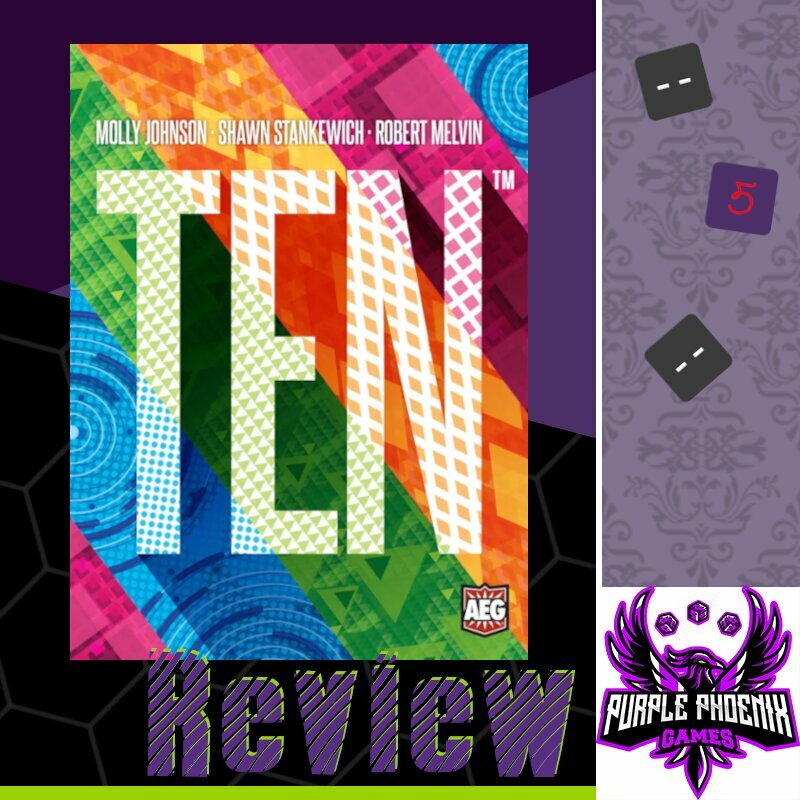
When it comes to game mechanics, set collection is my JAM. Auction/bidding and push your luck, not so much….. So when Alderac Entertainment Group brought TEN into my life, I was a bit wary at first. A game of collecting sequences/sets of numbers? Awesome!! Add in bidding for Wildcards or pushing your luck to not Bust each turn? A bit too risky, at least for my gaming tastes. After having had the opportunity to play TEN, were my initial feelings misplaced? Spoiler: Yes. For me, TEN was a prime example of “Don’t judge a game by its mechanics.” Keep reading to find out why.
Disclaimer: We were provided with a copy of TEN for the purposes of this review. This is a final production copy, so what you see pictured is what you would receive in a retail copy of the game. -L
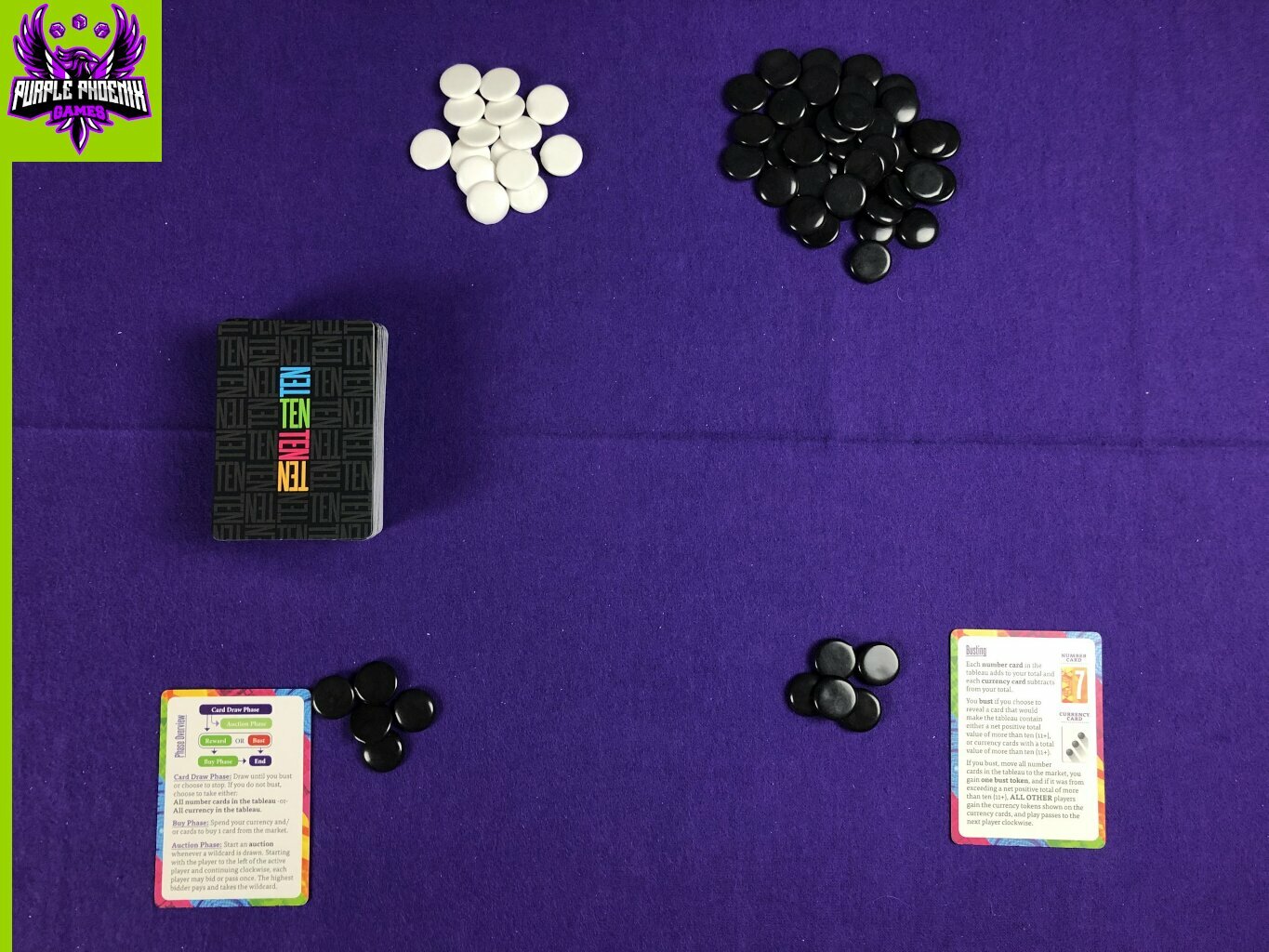
TEN is a push-your-luck game of set collection and auction/bidding in which players are trying to amass the most points by the end of the game. Points are earned by collecting sets of numeric sequences in the 4 colors of the game: Blue, Green, Pink, and Orange. Played over a series of turns, players will be drawing/collecting cards from the tableau, buying cards from the Market, or Busting if they push their luck a bit too far. To setup for a game, assemble the deck of cards as dictated by the player count and set it in the play area. Each player gets 5 Currency tokens with which to start the game, and are all dealt a random reference card. The player who was dealt the reference card with the Starting Player symbol will begin the game. Before getting into the actual gameplay, I want to mention the different card types, as to provide a better understanding when reading this review. In each of the 4 colors, there are card values numbered 1-9, with more copies of the lower numbers and fewer of the higher numbers. There are also Wildcards that can be used to represent any #/color, depending on the card. Some cards in the deck are Currency cards and show a value of 1-5 Currency. Should you choose to take these from the tableau, you collect that amount of Currency to be used for auctions or buying cards in later turns.
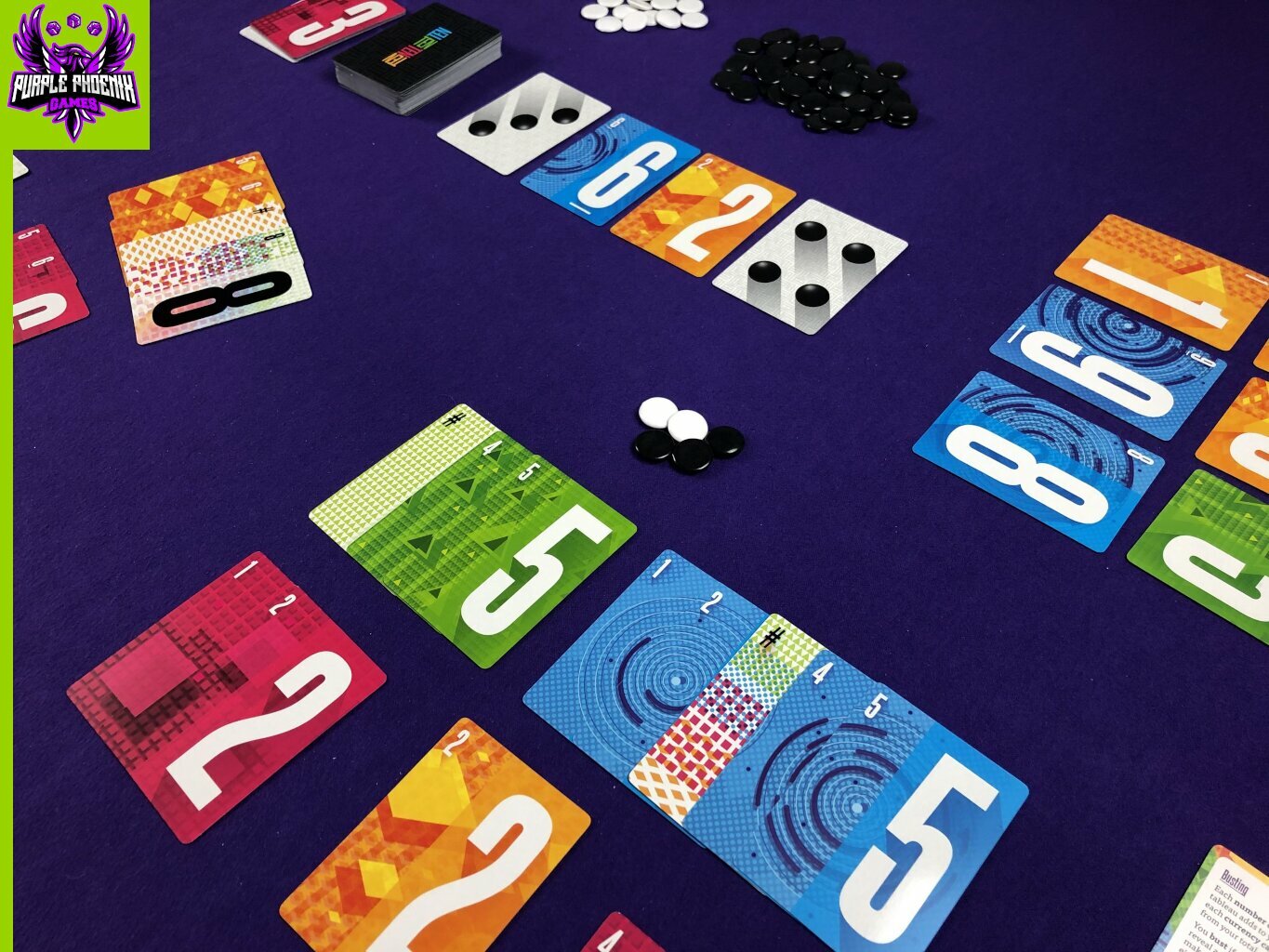
On your turn, you will perform a series of actions, the first of which is Draw a Card. You will draw a card from the top of the deck and place it in the tableau. If the card is a # card or a Currency card, you will then decide if you wish to continue drawing cards. If you do, draw the next card, and so on, until either you decide to stop or you Bust (more on this in a bit). As long as you do not Bust, you can decide when to stop drawing cards to the tableau. You may then take one of the following rewards: take all the # cards to your play area, or take Currency tokens (equal to the amount shown on the Currency cards in the tableau). When you take the # cards, they go into your play area and all other players will collect Currency tokens. You then have the opportunity to Buy a card from the Market (by paying the numeric value of the card) and add it to your play area. If you instead choose to collect Currency, you will take Currency equal to the total value of Currency in the tableau, and all other players receive nothing from your turn. All # cards are moved to the Market, and your turn ends. In the picture below, if I choose to take the # cards, I would take the Orange 2 and Blue 6 to my play area, and all other players would collect 7 Currency. Conversely, I could choose to take 7 Currency, and the # cards are added to the Market (on the right-hand side of the picture).
So how does Busting work? The tableau may never have a value of more than 10. Every # card you draw adds to your total value, and any Currency card drawn subtracts from the total. If you were to draw a # card that would give you a total value of more than 10, you Bust! OR if you ever have Currency cards that total more than 10, you Bust as well. So there’s a bit of math involved, with addition and subtraction, but you have to make sure you never get more than 10! For example, in the picture below, the net total value of the tableau is 1. (8 from # cards, -7 from Currency cards) If I were to draw a Currency card of 4-5, I would Bust, because that totals more than 10. In this pictured instance, any # card I draw would not make me Bust, as the highest total would only be a 10, given the current cards in play. If you ever push your luck too far and end up Busting, all # cards in the tableau are moved to the Market, and you gain a Bust token (worth 3 Currency). If you Busted with # cards, then all other players will collect Currency tokens, but if you Bust with Currency cards, nobody receives anything. After resolving a Bust, your turn ends and the game continues to the next player.
If, on your turn, you ever draw a Wildcard, your turn pauses and the Wildcard is auctioned. Each player will have one chance to either bid (increasing the bid from the previous) or pass. Whomever wins the auction must pay their bid, and they collect the Wildcard to their play area. Once the auction has been resolved, your turn continues as normal. It is possible to have multiple auctions on your turn – it all depends on the cards. The game continues in this fashion, players taking turns drawing cards, collecting cards/Currency, buying from the Market, bidding in auctions, etc., until the draw deck has been depleted. The active player finishes their turn as normal, but may not draw any more cards. Points are then tallied. All players will arrange their cards to create consecutive sequences of numbers in the 4 different colors. You receive 1 point per card in your longest sequence of each color. If you have a complete set of numbers 1-9 in a color, you get a bonus point. Players count up all their points, and the player with the highest value is the winner!
That kind of seems like a lot, but I promise it’s actually pretty intuitive when you get playing. Also, huge shoutout to AEG for providing such a well-done reference card – it includes a little flowchart to help you with how the turns flow. The gameplay itself is essentially pretty straightforward. You draw a card, and then react based on what it is. Bust? Collect a Bust token and your turn ends. No Bust? Decide if you want to keep drawing. Done pushing your luck? Collect either the # cards or Currency. Try to make sequential runs of numbers in the different colors – the more cards you get in sequence, the more points you’ll get at the end of the game. The thing that elevates TEN beyond a simple push-your-luck game to me is that it requires more strategy than just luck. You can see what cards are available in the Market – is there something you need to buy? You can see everyone else’s playing area – do they need any of the numbers you just revealed? You know how much Currency every player has – do you bid high on this Wildcard because your neighbor can’t outbid you? There is so much more than just luck in this game, and that is what takes it to the next level for me. I know that Travis has reviewed No, Thanks! in the past, and I would say that this gives me similar vibes, but way better in my opinion.
When it comes to playing games, I am generally not a huge risk-taker. I like making logical choices based on known information and end-game strategy. But something about this game just gets me. I think one element that makes me love this game is the different types of cards – # cards and Currency cards. When you’re pushing your luck and drawing cards, there’s an added element of excitement, because the two different types of cards affect the net total differently. It doesn’t all positively add to the net total, which makes me more likely to keep drawing in hopes that things will cancel out and I can maximize the turn. If everything all added together, and you just couldn’t get more than 10, I would probably only ever draw 2 cards per turn, max., just to make sure I didn’t Bust. But the fact that Currency cards subtract from the net total encourages players to keep pushing their luck, and either earning a big payoff or a big Bust. This game is exciting, engaging, and entertaining to play, and that makes it fun!
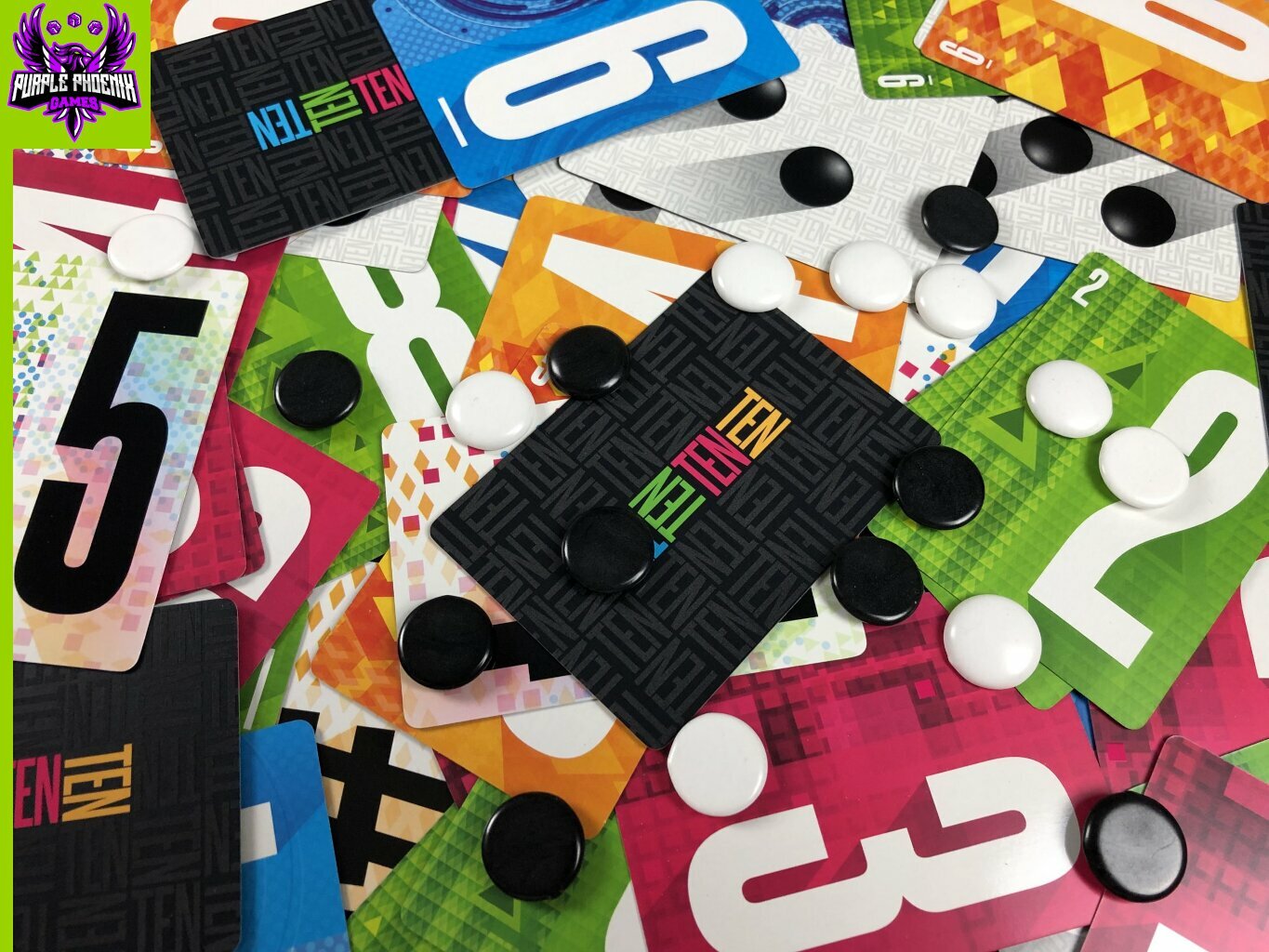
To touch on components, AEG always hits it out of the park – and TEN is no exception. The game is mostly just a bunch of cards, and some white/black Currency tokens. The tokens themselves are nice plastic, and are smooth and chunky in hand. The cards are thick and sturdy, and hold up to shuffling pretty well. The colors of the game are bright and vibrant, and they are very clear to differentiate between. It’s a nice pop of color on the table, and that adds to the overall enjoyment of the game. Each of the 4 colors, and the Wildcards for that matter, have a unique background design – which can help our colorblind friends who may not necessarily be able to differentiate between the colors. Just an added plus to help the gamers tell what cards belong to what colors! The game box is equally as colorful, and is eye-catching on the shelf. All in all, I’d say AEG gets a 10 for their production quality here. (Get it?)
I spoke earlier about judging a game by its mechanics, and how TEN really challenged me on that. I was expecting a game that I would like, but would be kind of just ok overall for me. What I got is a game that is highly strategic, yet also unpredictable at times. I am definitely a planner when it comes to strategy, but the unpredictability of this game is light, fun, and engaging for all players at all times. It just is fun to play. This is a game that I see staying in my collection for a long time, and hopefully getting to the table quite often when I need a quick filler that isn’t so light that it’s mindless, but not heavy enough that it’s a brain-burner. If you’re in the market for a fun little game that challenges all players, I would definitely recommend checking out TEN. Purple Phoenix Games rates our games on a scale of 1-6 (not 10 unfortunately in this case), and we give this one a solid 5 / 6.
Disclaimer: We were provided with a copy of TEN for the purposes of this review. This is a final production copy, so what you see pictured is what you would receive in a retail copy of the game. -L
TEN is a push-your-luck game of set collection and auction/bidding in which players are trying to amass the most points by the end of the game. Points are earned by collecting sets of numeric sequences in the 4 colors of the game: Blue, Green, Pink, and Orange. Played over a series of turns, players will be drawing/collecting cards from the tableau, buying cards from the Market, or Busting if they push their luck a bit too far. To setup for a game, assemble the deck of cards as dictated by the player count and set it in the play area. Each player gets 5 Currency tokens with which to start the game, and are all dealt a random reference card. The player who was dealt the reference card with the Starting Player symbol will begin the game. Before getting into the actual gameplay, I want to mention the different card types, as to provide a better understanding when reading this review. In each of the 4 colors, there are card values numbered 1-9, with more copies of the lower numbers and fewer of the higher numbers. There are also Wildcards that can be used to represent any #/color, depending on the card. Some cards in the deck are Currency cards and show a value of 1-5 Currency. Should you choose to take these from the tableau, you collect that amount of Currency to be used for auctions or buying cards in later turns.
On your turn, you will perform a series of actions, the first of which is Draw a Card. You will draw a card from the top of the deck and place it in the tableau. If the card is a # card or a Currency card, you will then decide if you wish to continue drawing cards. If you do, draw the next card, and so on, until either you decide to stop or you Bust (more on this in a bit). As long as you do not Bust, you can decide when to stop drawing cards to the tableau. You may then take one of the following rewards: take all the # cards to your play area, or take Currency tokens (equal to the amount shown on the Currency cards in the tableau). When you take the # cards, they go into your play area and all other players will collect Currency tokens. You then have the opportunity to Buy a card from the Market (by paying the numeric value of the card) and add it to your play area. If you instead choose to collect Currency, you will take Currency equal to the total value of Currency in the tableau, and all other players receive nothing from your turn. All # cards are moved to the Market, and your turn ends. In the picture below, if I choose to take the # cards, I would take the Orange 2 and Blue 6 to my play area, and all other players would collect 7 Currency. Conversely, I could choose to take 7 Currency, and the # cards are added to the Market (on the right-hand side of the picture).
So how does Busting work? The tableau may never have a value of more than 10. Every # card you draw adds to your total value, and any Currency card drawn subtracts from the total. If you were to draw a # card that would give you a total value of more than 10, you Bust! OR if you ever have Currency cards that total more than 10, you Bust as well. So there’s a bit of math involved, with addition and subtraction, but you have to make sure you never get more than 10! For example, in the picture below, the net total value of the tableau is 1. (8 from # cards, -7 from Currency cards) If I were to draw a Currency card of 4-5, I would Bust, because that totals more than 10. In this pictured instance, any # card I draw would not make me Bust, as the highest total would only be a 10, given the current cards in play. If you ever push your luck too far and end up Busting, all # cards in the tableau are moved to the Market, and you gain a Bust token (worth 3 Currency). If you Busted with # cards, then all other players will collect Currency tokens, but if you Bust with Currency cards, nobody receives anything. After resolving a Bust, your turn ends and the game continues to the next player.
If, on your turn, you ever draw a Wildcard, your turn pauses and the Wildcard is auctioned. Each player will have one chance to either bid (increasing the bid from the previous) or pass. Whomever wins the auction must pay their bid, and they collect the Wildcard to their play area. Once the auction has been resolved, your turn continues as normal. It is possible to have multiple auctions on your turn – it all depends on the cards. The game continues in this fashion, players taking turns drawing cards, collecting cards/Currency, buying from the Market, bidding in auctions, etc., until the draw deck has been depleted. The active player finishes their turn as normal, but may not draw any more cards. Points are then tallied. All players will arrange their cards to create consecutive sequences of numbers in the 4 different colors. You receive 1 point per card in your longest sequence of each color. If you have a complete set of numbers 1-9 in a color, you get a bonus point. Players count up all their points, and the player with the highest value is the winner!
That kind of seems like a lot, but I promise it’s actually pretty intuitive when you get playing. Also, huge shoutout to AEG for providing such a well-done reference card – it includes a little flowchart to help you with how the turns flow. The gameplay itself is essentially pretty straightforward. You draw a card, and then react based on what it is. Bust? Collect a Bust token and your turn ends. No Bust? Decide if you want to keep drawing. Done pushing your luck? Collect either the # cards or Currency. Try to make sequential runs of numbers in the different colors – the more cards you get in sequence, the more points you’ll get at the end of the game. The thing that elevates TEN beyond a simple push-your-luck game to me is that it requires more strategy than just luck. You can see what cards are available in the Market – is there something you need to buy? You can see everyone else’s playing area – do they need any of the numbers you just revealed? You know how much Currency every player has – do you bid high on this Wildcard because your neighbor can’t outbid you? There is so much more than just luck in this game, and that is what takes it to the next level for me. I know that Travis has reviewed No, Thanks! in the past, and I would say that this gives me similar vibes, but way better in my opinion.
When it comes to playing games, I am generally not a huge risk-taker. I like making logical choices based on known information and end-game strategy. But something about this game just gets me. I think one element that makes me love this game is the different types of cards – # cards and Currency cards. When you’re pushing your luck and drawing cards, there’s an added element of excitement, because the two different types of cards affect the net total differently. It doesn’t all positively add to the net total, which makes me more likely to keep drawing in hopes that things will cancel out and I can maximize the turn. If everything all added together, and you just couldn’t get more than 10, I would probably only ever draw 2 cards per turn, max., just to make sure I didn’t Bust. But the fact that Currency cards subtract from the net total encourages players to keep pushing their luck, and either earning a big payoff or a big Bust. This game is exciting, engaging, and entertaining to play, and that makes it fun!
To touch on components, AEG always hits it out of the park – and TEN is no exception. The game is mostly just a bunch of cards, and some white/black Currency tokens. The tokens themselves are nice plastic, and are smooth and chunky in hand. The cards are thick and sturdy, and hold up to shuffling pretty well. The colors of the game are bright and vibrant, and they are very clear to differentiate between. It’s a nice pop of color on the table, and that adds to the overall enjoyment of the game. Each of the 4 colors, and the Wildcards for that matter, have a unique background design – which can help our colorblind friends who may not necessarily be able to differentiate between the colors. Just an added plus to help the gamers tell what cards belong to what colors! The game box is equally as colorful, and is eye-catching on the shelf. All in all, I’d say AEG gets a 10 for their production quality here. (Get it?)
I spoke earlier about judging a game by its mechanics, and how TEN really challenged me on that. I was expecting a game that I would like, but would be kind of just ok overall for me. What I got is a game that is highly strategic, yet also unpredictable at times. I am definitely a planner when it comes to strategy, but the unpredictability of this game is light, fun, and engaging for all players at all times. It just is fun to play. This is a game that I see staying in my collection for a long time, and hopefully getting to the table quite often when I need a quick filler that isn’t so light that it’s mindless, but not heavy enough that it’s a brain-burner. If you’re in the market for a fun little game that challenges all players, I would definitely recommend checking out TEN. Purple Phoenix Games rates our games on a scale of 1-6 (not 10 unfortunately in this case), and we give this one a solid 5 / 6.