

Modern NMR Approaches to the Structure Elucidation of Natural Products: Volume 2: Data Acquisition and Applications to Compound Classes
Antony Williams, Gary Martin, David Rovnyak and Kirk Gustafson
Book
The Ghanian plant Cryptolepis sanguinolenta is the source of a series of fascinating indoloquinoline...

Suswatibasu (1703 KP) rated Tell Me How it Ends: An Essay in Forty Questions in Books
Jan 3, 2018
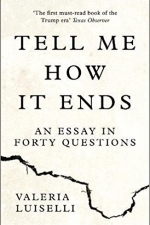


Based on her experiences working as an interpreter for dozens of Central American child migrants, she speaks to those who risked their lives crossing Mexico to escape their fraught existence back home. To stay in the US, each must be vetted by the Citizenship and Immigration Services, a vast, impersonal bureaucracy. It's her job to help these kids, but in order to do so, they must answer 40 questions that will determine their fate.
The truth about the crossing may be much more brutal in reality, with 80% of women and girls who cross from Mexico to the US being raped, hence some of the children appear evasive when answering questions. But this book is fueled, in no small part, by Luiselli's bottles up shame and rage. She's aghast at the gap between American ideals and the way they actually treat undocumented children, yet her writing is measured and fair-minded.
Luiselli takes us inside the grand dream of migration, offering the valuable reminder that exceedingly few immigrants abandon their past and brave death to come to America for dark or nasty reasons. Fantastic read.
Educational Leadership and Pierre Bourdieu
Book
Pierre Bourdieu was one of the most important thinkers of the twentieth century. He argued for, and...
Modeling, Simulation, and Control of a Medium Scale Power System: 2017
Book
This book highlights the most important aspects of mathematical modeling, computer simulation, and...
Strategy Genius: 40 Insights from the Science of Strategic Thinking
Book
The fast-track MBA in strategy Imagine having instant access to the world's smartest thinking on...
Reclaiming Pluralism in Economics
Jerry Courvisanos, James Doughney and Alex Millmow
Book
Until the end of the early 1970s, from a history of economic thought perspective, the mainstream in...

Climate Change and Agricultural Development: Improving Resilience Through Climate Smart Agriculture, Agroecology and Conservation
Book
Two of the greatest current challenges are climate change (and variability) and food security....

TacoDave (4137 KP) rated Lost and Found in Books
Oct 3, 2019
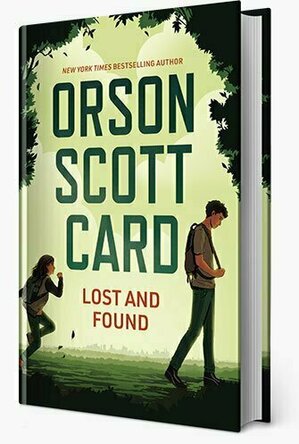


The main character, Ezekiel, can touch something that is lost and sense who and where the owner is. A lost toy on the ground might call out to him, asking to be returned to its five-year-old owner. Or a lost shoe might give him the impulse to track down a businessman. The power sounds useful, but since everyone assumes he is a thief (how else would he know where these items belong?), it is more of a burden than a blessing.
Everything changes when a police officer asks Ezekiel to help find a missing child. Could his "power" actually be useful? Or is it impossible to find a person who is "lost?" That's the main story of the book, and it is an intriguing concept, especially when Ezekiel meets other people with odd micropowers.
After saying all of that, how is the book? It's good! It isn't quite as engaging as some of Card's other books, but only because it is smaller in scale and scope. The Ender saga (which is up to approximately 12 books by now) feels important. The themes, moral dilemmas, and human interactions all have weight to them because of how epic the story is.
"Lost and Found" has a bit of adventure and danger, but it is much more grounded. It is focused on (almost) regular humans living their lives in contemporary times. So it is a touch lighter, a touch simpler than some of Card's other books.
Having said that, I thoroughly enjoyed the book from beginning to end and would love to find out more about micropowers and just how inane they might be. The world-building is good enough to make me crave more.
One last note: the micropowers discussed actually *do* relate to the Ender saga, because they seem to be based (intentionally or not) on philotic rays. The main character can "feel" a connection between lost items and their owners. Another character can "feel" where spiders are. And one can "feel" other peoples' navels. It instantly reminded me of the ansible, the hive queen, and philotic webs. So that's something.

Joe Goodhart (27 KP) rated Fables: Volume 1: Legends in Exile in Books
Nov 30, 2020
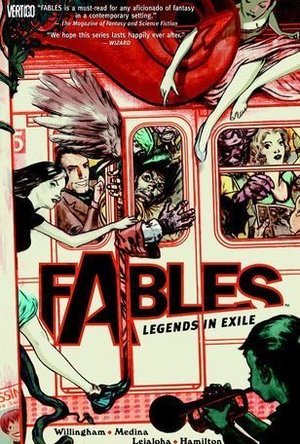
So, prior to writing this review, I wanted to peruse the reviews on here, to see what others said, reducing the risk of writing something already said. What I found were a number of 1-Star reviews, something I found to be quite surprising!
Not every comic (or book, for that matter) will necessarily start with an amazing first arc. It may be good, yes, but it could also be polished in spots. However, despite little things that could be better, the overall content should be seen as good enough to warrant reading the second story arc.
That is how I felt at the conclusion of this first volume, a mystery of sorts that also served to introduce us to a number of characters who go on to appear as series regulars. Sure, the dialogue was not perfect (really? Comparing it to Gaiman's SANDMAN? Like trying to compare RICK & MORTY to THE LAST UNICORN!), but I can safely say that the series matures, like a well-aged wine, and later issues are much, much better.
Long and short: it's an urban fantasy with the fables we grew up with. Go in without an judgments or comparisons, and you might be pleasantly surprised. Jus' sayin'..
Convergence: The Redesign of Design
Book
There is today a pronounced and accelerated convergence in architecture. This convergence is...