

Purple Phoenix Games (2266 KP) rated Voltage in Tabletop Games
Jan 8, 2022
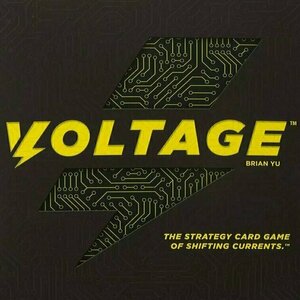

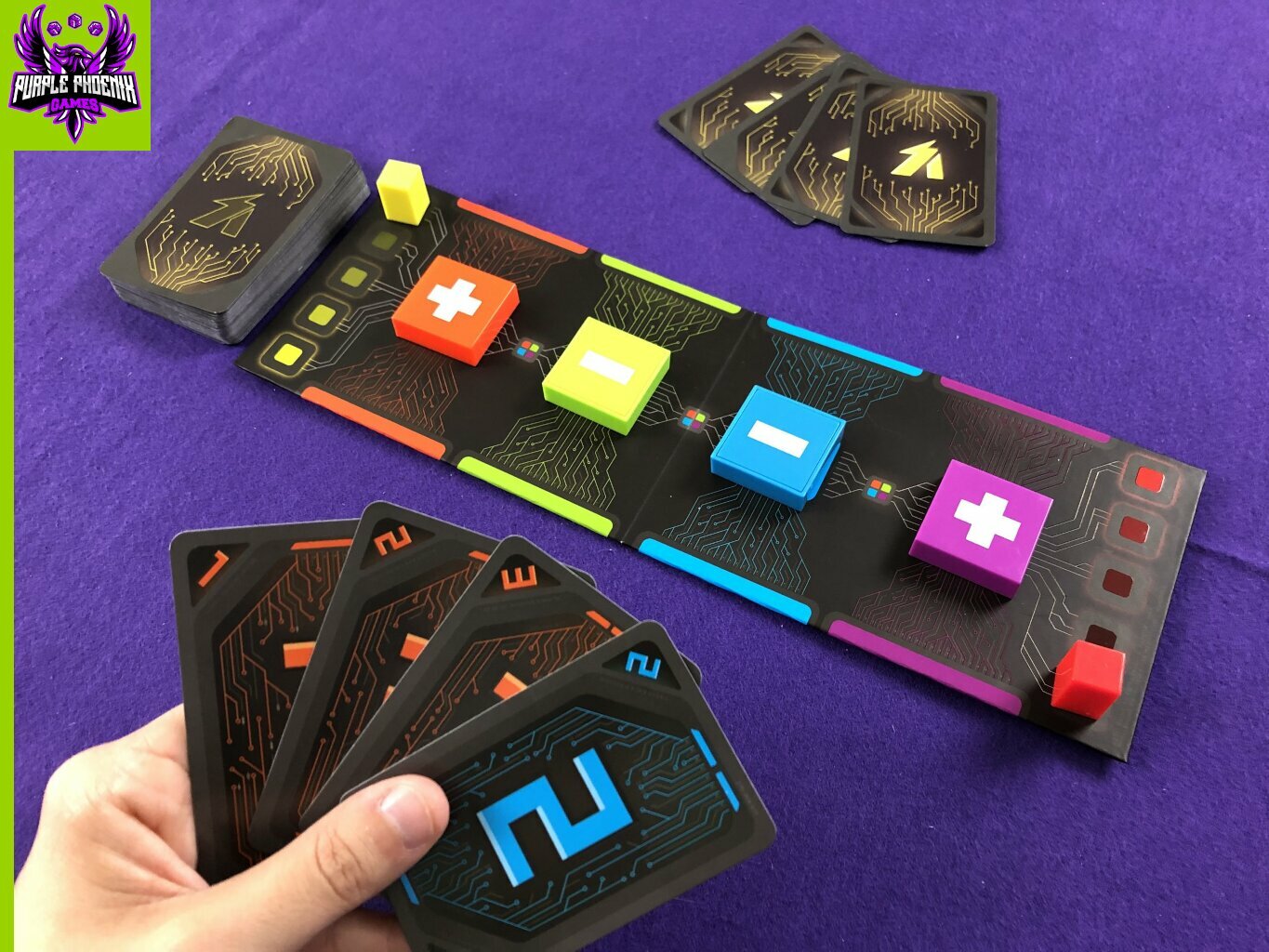
Voltage is a competitive game for 2 players in which players are trying to be the first to earn 4 total points. To setup for the game, place the board between the two players. Take the double-sized Terminal blocks and place them on their corresponding spaces of the board. The starting orientation for the Terminal blocks should read + – – + horizontally across the board. Shuffle the deck of cards and deal 4 to each player. Each player selects a Score Marker and places it on the first space of their score track. Choose a starting player, and the game is ready to begin! Pictured below is the starting setup for a game.
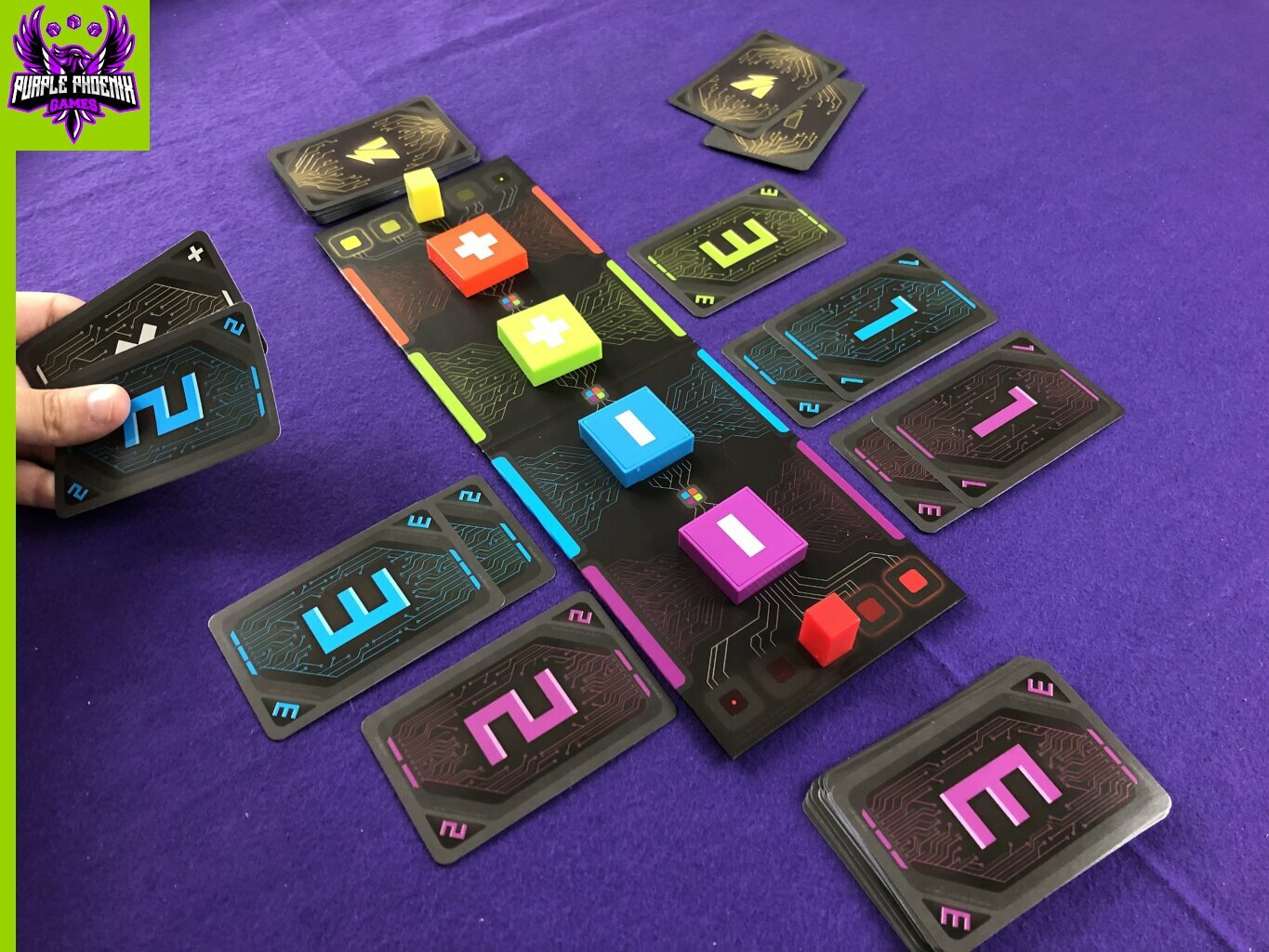
Over a series of turns, players will be playing cards to their corresponding colored Terminals in an attempt to win the set. If the Terminal is set to a + then the player with the highest value will win the set. Alternately, if the Terminal is set to a – then the player with the lowest value will win the set. Cards are played to Terminals until a Terminal has a set of 5 total cards. The Terminal is then scored, the cards used are discarded, and the winning player earns a point. The game continues in this fashion until one player has earned 4 total points.
On your turn, you must perform one of these three actions: Play a card & draw a card, Play 2 cards, or Draw 2 cards. Simple enough, but the strategy is what makes this game. When playing cards to the different Terminals, there are a few placement rules to keep in mind. Of course, you may only play cards to the Terminal of the matching color. You are allowed to play cards on your side of the Terminal, or on your opponent’s side. Now to get to the actions themselves. If you choose to play a card and draw a card, you must do so in that order. If you choose to play 2 cards, you must play both cards on different colors – you cannot play both to the same Terminal. The last action, draw 2 cards, is self-explanatory.
The cards of the game are numbered from 1-3, and are of the 4 Terminal colors. There are 3 types of special cards: Bypass, Blown Fuse, and Transformer. A Bypass card allows you to move a card from your opponent’s side to your side of the Terminal, and a Blown Fuse allows you to remove a card from your opponent’s side completely from play. Both of these types of cards count toward the 5-card maximum of the Terminals, so use them wisely. A Transformer is identified by the card back – if the V logo is colored Yellow. When you draw a Transformer, you must then flip one of the Terminal blocks to its opposite side. Since the draw deck is always visible, you can see when a Transformer card is next, so that could help inform your strategy for your turn. The game continues in this fashion of alternating player turns until one player has earned 4 total points. They are declared the winner!
I have to say that the gameplay of Voltage really surprised me. I went into my first play expecting a light little game, and what I got was so much more. There really is a pretty decent strategic element to this game that caught me a little off guard at first. The gameplay itself seems simple – draw cards, play cards, win sets to earn points. But how you accomplish that is more challenging that it seems. The ability to play cards to your side or your opponent’s allows you to try to tip the scales in your favor. You can’t simply focus on your side alone, you need to keep tabs across the entire board to inform your next move. And then if your opponent draws a Transformer, they could just as easily reverse the polarity of that Terminal and now you’re on the wrong end! When playing 2 cards, they must be played to different colored Terminals, so how can you place your cards so they are most beneficial to you? Do you risk placing the big numbers right away in hopes of winning a + Terminal, or do you play lower-numbered cards in case that Terminal gets flipped? All things to consider throughout the game. Along with the strategy, one thing that I love about Voltage is that there really is no runaway winner each time – the direction of a set can literally change with one card, and neither player can really feel secure during the game. You have to anticipate your opponent’s moves while trying to complete sets that are currently favorable to you. That all being said, I guess there is a bit of a ‘take that’ element in the gameplay that might seem a little aggressive to some players, but that’s kind of just the nature of this head-to-head gameplay.
To touch on components, this game is pretty basic. The cards are nice quality, and the artwork is electrical and thematic. The board itself is nice and thick, and the spaces are all clearly marked. The Terminal blocks are probably my favorite components of this game. They are nice chunky plastic blocks, and the colors are bright neon colors – some of my favorites! For a game with such few components, the quality of them is appreciated.
After playing Voltage with Travis at The Table, I actually came home and found a copy for myself – that’s how much I liked it! I don’t think it’s my all-time favorite 2-player game yet, but it’s certainly working its way up the list…. If you’re in the market for a fast, yet strategic, 2-player game, I would highly recommend giving Voltage a try. The simplicity of the gameplay coupled with the vast strategic options makes for an engaging and entertaining game. Purple Phoenix Games gives this one an electrifying 9 / 12.



Kid Chameleon Classic
Games and Stickers
App
Enter Kid Chameleon and experience SEGA's colossal platformer! Unleash your super powers in...

ECG EKG Mastery
Medical and Education
App
Finally learn to read that EKG! The most convenient and complete resource for interpreting EKGs --...

Girl's Life Craft: Shopping & Dancing
Games and Entertainment
App
Crafting game for girls! Girls craft, exploration, party, dating, shopping and spa salon in one...

RotoWire Basketball Draft 2017
Sports and Entertainment
App
Imagine getting a cheat sheet that adjusts to fit your league settings, allows you to mark off...

Phil Leader (619 KP) rated Pacific Vortex! (Dirk Pitt #1) in Books
Nov 21, 2019


Although released later in the series, Pacific Vortex! is very much a prequel to the main Dirk Pitt series and was the first of the Pitt novels Cussler wrote. As such it is a little different to the rest. Pitt comes across as more of a generic action hero type. The plot is far more straightforward with very little in the way of twists and suprise reveals that became the hallmark of the best of Cussler's novels. The standard hero trope is also enforced by the love interest and the megalomaniac villain in his lair.
However this is still a good read, with good ideas and it's interesting to see some of the building blocks that made up the Pitt franchise, particularly those that surfaced here but were then discarded for the later works. As a story it's not bad with enough going on the engage the reader's interest and obviously it lays the seeds of the later appearance of his children.
Not an essential read by any means, but one that will entertain

7 Wonders: Magical Mystery Tour
Games
App
In an all-new 7 Wonders, you’ll take a fantastic journey to some of the most enchanting sites of...

Play School Play Time
Education
App
ABC KIDS Play School Play Time encourages kids to play with time whilst celebrating Humpty's...

Miffy's World!
Games, Education and Stickers
App
New! Go to the living room to paint your own Miffy masterpiece! Discover what Miffy dreams about...

Green Growth and Travelism: Concept, Policy and Practice for Sustainable Tourism
Min Jiang, Terry DeLacy, Geoffrey Lipman and Shaun Vorster
Book
The green growth paradigm emerged from evolving global strategies that coherently promote a more...