
Search
Search results

Purple Phoenix Games (2266 KP) rated Cubitos in Tabletop Games
Mar 17, 2022
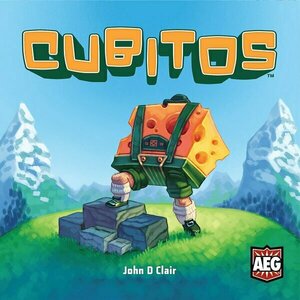

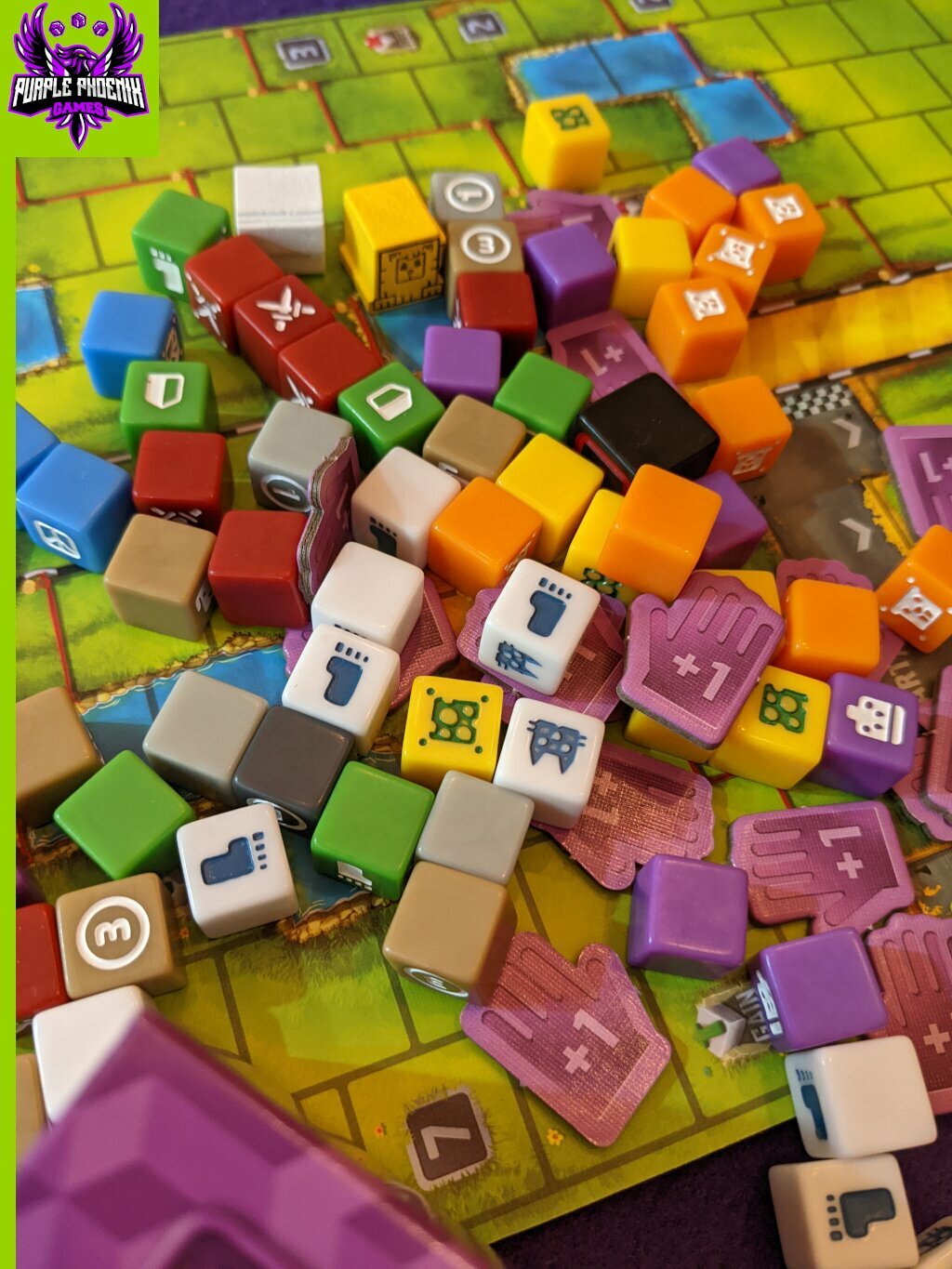
Let me tell you a story about how I came to own Cubitos. My FLGS, which since moving to Tennessee is an hour away in Knoxville (Sci-Fi City), had great stock of this game a couple months ago. I would step in, browse around, and pass on picking up a copy since they seemed to have so many. Forward in time to a month ago, when I was ready to grab my own copy, they are sold out. WHAT. Well, I had to order a copy online from somewhere I don’t normally shop because my favorite online sellers were also out of stock. Then Christmas came and my brother gifted me a copy of Cubitos. So then I had two. Long story now short – I have a copy and that’s all that matters because Cubitos is amazing.
Cubitos is a push-your-luck, dice building, racing game for two to four players. In it, players have runners that will be moving around a crazy race track, and another runner who keeps track of fans (the manager maybe?), and the first player’s runner to cross the finish line will be the winner! Now, managing movement and special abilities is where the game REALLY is, and it all boils down to which special dice are purchased and used, and whether Lady Luck will find favor or not. It’s a wild ride, so prepare your runner and let’s go!
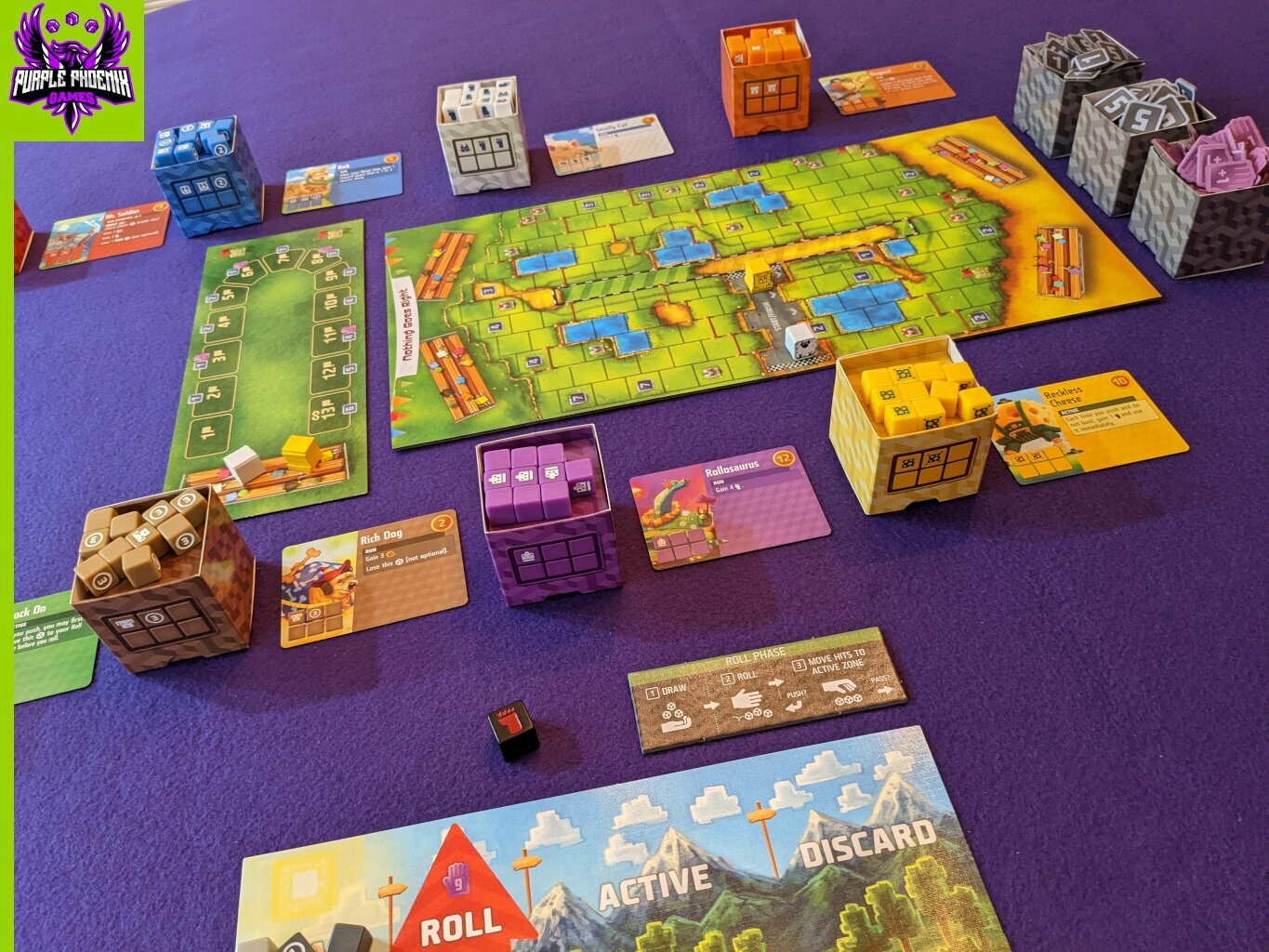
To setup, place out one of the double-sided Racetrack boards, along with the Fan Track board. Runners for each player are placed at the Starting Line on the Racetrack board, and the other on the bleachers of the Fan Track. Each player receives a color-coded Player Board and nine gray starting dice. They receive a Phase Token to keep track of each phase in a round, and the starting player receives the Start Player Die. Each dice box is placed around the boards with the dice on top. All corresponding cards for each die type is placed by the dice box, and the game may now begin!
DISCLAIMER: We have adopted an unofficial variant/house rule that differs from the rules because we find it works better for us. During the phases where all players may play simultaneously we instead just have each player take a turn individually. -T
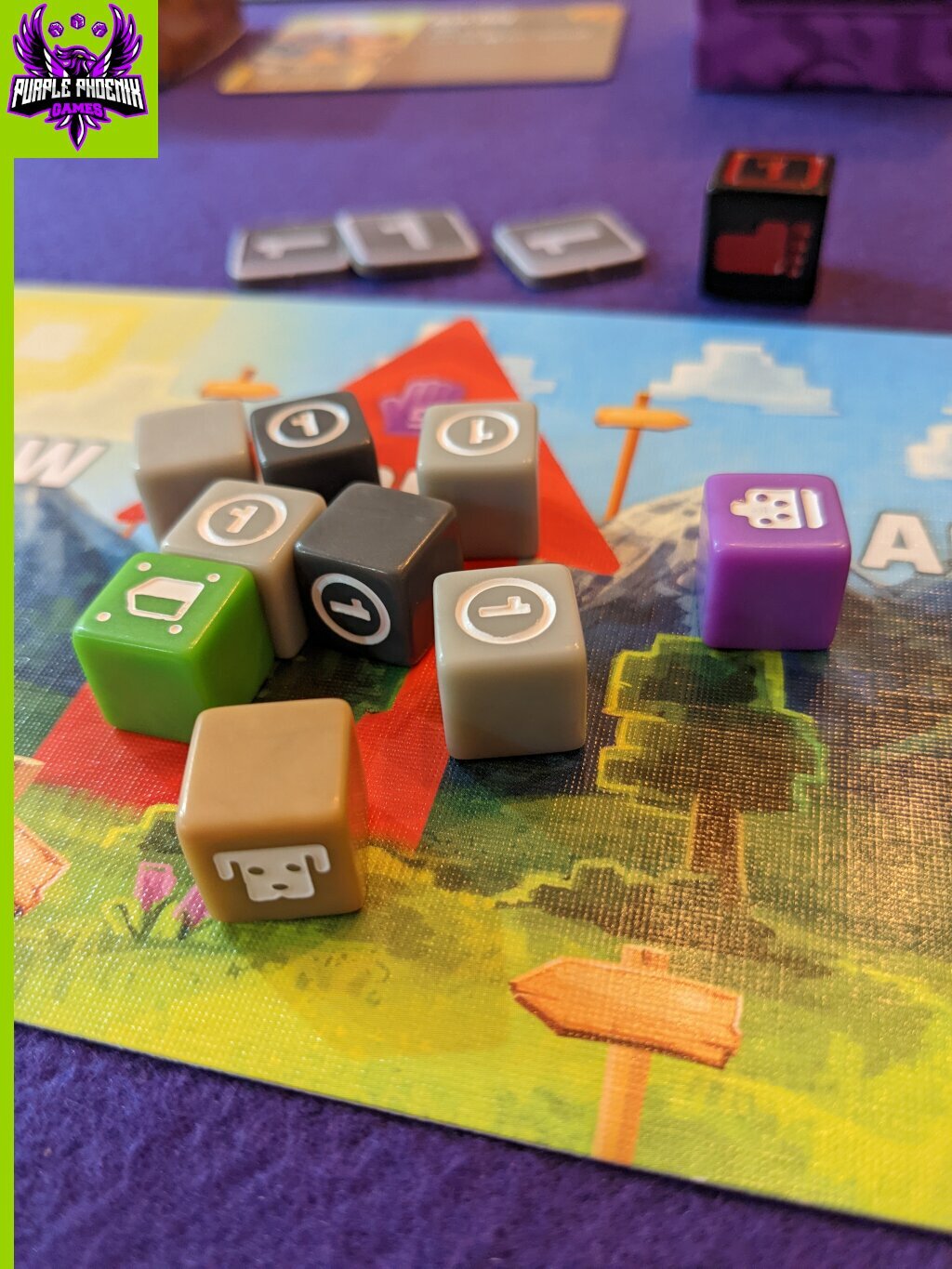
A turn in Cubitos is divided into two main phases with several sub-phases for each. During the main Roll Phase, players will first Draw dice from their personal Draw Zone (on the Player Board) and place them into the Roll Zone. Initially, players will have a hand size of nine, but that may be adjusted as the game progresses. Once the dice have been drawn the player then Rolls their dice. Every die face showing an icon is counted as a Hit, and every die showing a blank face is considered a Miss. All dice showing Hits are moved to the Active Zone of the board, and the player then decides if they wish to Push (their luck) and re-roll all the Misses in hopes of more Hits, or if they are done rolling. Once a player re-rolls their Misses, if the result is all Misses, the player Busts and must move ALL rolled dice to the Discard Zone on their board. However, players may continue to roll all Misses until they Bust or are content and stop.
The Run Phase then begins with players resolving their red die icons (crossed swords for attacks), and determining their other icons rolled for coins and movement. Feet icons (and certain dice special abilities) provide players with movement along the Racetrack board, and coins provide the player with purchasing power to buy new dice. Once a player’s Runner has landed on a reward spot on the board, the player receives the benefit and moves all dice used this turn to the Discard Zone on the Player board.
Every time a player Busts, or lands on a Fan icon on the Racetrack, the other matching Runner on the Fan Track board will move one spot along the track, and the player receives the benefits of the new space. These benefits are either an increase in hand limit of dice drawn, or more purchasing power in the form of credits. Reward spaces on the board could give players extra dice for free, allow players to remove dice from their collection, or even gain credits to be used at any time. The game continues in this fashion of each player taking their turns until one player crosses the finish line and wins!
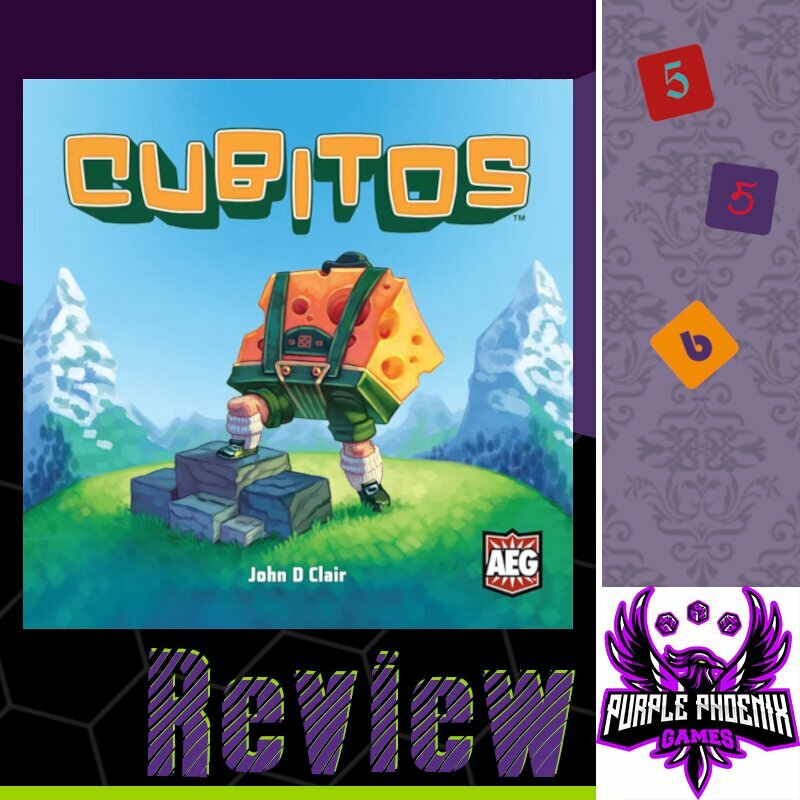
Components. This box is chock full of tasty components that we all just adore. The boards and cards are all good quality and feature some fantastic art, and the custom dice are just so fun to handle. A truly ingenious use of folding arts is used when setting up all the dice boxes. Not only are they used in-game to remind players what icons are on each die face, but they also hold the dice during play, and store the dice in the box. I mean, triple duty dice boxes are where it’s at! Everything is super colorful and just a joy to play with each time. My one quibble is the very offensive block of cheese on the box cover. I am a big Chicago Bears fan, and seeing something so proudly displayed that even remotely resembles an homage to the Packers is such a shame to me. I really hope that wasn’t intentional, but I am also joking. Mostly.
The absolute best part about this game is the selection of action cards associated with each special set of dice. For example, the purple dinosaur dice could be paired with seven different cards, each with different abilities when the icon is rolled. Each color has a seven card deck, from which a card could randomly be used each game. The rulebook also offers 10 suggested combinations of cards, and also invites players to choose their own combos. This reminds me of a similar mechanic I first saw with the Dice Masters system, where each die’s faces could mean something completely different depending on the card associated with it. I loved that mechanic back then, and I do now as well.
I cannot believe I passed on this game for as long as I did. I mean, I like AEG-published games. We have reviewed John D. Clair games positively: Mystic Vale, with Custom Heroes and Space Base coming soon. Was it a subconscious dislike for the dumb cheese man on the cover? I am not too sure, but I am clearly glad to have it now. The cool dice. The interesting theme. The multi-use dice/card components. The fact they included both orange and purple dice. Am I into racing games now? The reasons are plentiful, and I just cannot wait for my next play of Cubitos. Maybe I can get my wife into it and it can be a staple in our rotation.
There are several other little rules that I did not mention here, but all in all I have had a blast every time I play Cubitos. I was certainly correct in wanting to add it to my collection, and having Josh teach Laura and me originally just adds a unique personal touch to the game for me. Creating lasting memories is a big reason I am so into board games in the first place, and I think Cubitos will hold a special place in my heart simply because I was able to play it with my best friends. They agree with me that this is a special game, and Purple Phoenix Games gives this a nonsquare 16 / 18. If you see this at your LFGS I highly recommend you pick up a copy. Don’t wait, like I did, because when you do get around to it, they just may be out of stock. And a suggestion: because the cheeseperson is wearing lederhosen, just refer to them as a great German friend. AND THAT’S IT. Go Bears.
Cubitos is a push-your-luck, dice building, racing game for two to four players. In it, players have runners that will be moving around a crazy race track, and another runner who keeps track of fans (the manager maybe?), and the first player’s runner to cross the finish line will be the winner! Now, managing movement and special abilities is where the game REALLY is, and it all boils down to which special dice are purchased and used, and whether Lady Luck will find favor or not. It’s a wild ride, so prepare your runner and let’s go!
To setup, place out one of the double-sided Racetrack boards, along with the Fan Track board. Runners for each player are placed at the Starting Line on the Racetrack board, and the other on the bleachers of the Fan Track. Each player receives a color-coded Player Board and nine gray starting dice. They receive a Phase Token to keep track of each phase in a round, and the starting player receives the Start Player Die. Each dice box is placed around the boards with the dice on top. All corresponding cards for each die type is placed by the dice box, and the game may now begin!
DISCLAIMER: We have adopted an unofficial variant/house rule that differs from the rules because we find it works better for us. During the phases where all players may play simultaneously we instead just have each player take a turn individually. -T
A turn in Cubitos is divided into two main phases with several sub-phases for each. During the main Roll Phase, players will first Draw dice from their personal Draw Zone (on the Player Board) and place them into the Roll Zone. Initially, players will have a hand size of nine, but that may be adjusted as the game progresses. Once the dice have been drawn the player then Rolls their dice. Every die face showing an icon is counted as a Hit, and every die showing a blank face is considered a Miss. All dice showing Hits are moved to the Active Zone of the board, and the player then decides if they wish to Push (their luck) and re-roll all the Misses in hopes of more Hits, or if they are done rolling. Once a player re-rolls their Misses, if the result is all Misses, the player Busts and must move ALL rolled dice to the Discard Zone on their board. However, players may continue to roll all Misses until they Bust or are content and stop.
The Run Phase then begins with players resolving their red die icons (crossed swords for attacks), and determining their other icons rolled for coins and movement. Feet icons (and certain dice special abilities) provide players with movement along the Racetrack board, and coins provide the player with purchasing power to buy new dice. Once a player’s Runner has landed on a reward spot on the board, the player receives the benefit and moves all dice used this turn to the Discard Zone on the Player board.
Every time a player Busts, or lands on a Fan icon on the Racetrack, the other matching Runner on the Fan Track board will move one spot along the track, and the player receives the benefits of the new space. These benefits are either an increase in hand limit of dice drawn, or more purchasing power in the form of credits. Reward spaces on the board could give players extra dice for free, allow players to remove dice from their collection, or even gain credits to be used at any time. The game continues in this fashion of each player taking their turns until one player crosses the finish line and wins!
Components. This box is chock full of tasty components that we all just adore. The boards and cards are all good quality and feature some fantastic art, and the custom dice are just so fun to handle. A truly ingenious use of folding arts is used when setting up all the dice boxes. Not only are they used in-game to remind players what icons are on each die face, but they also hold the dice during play, and store the dice in the box. I mean, triple duty dice boxes are where it’s at! Everything is super colorful and just a joy to play with each time. My one quibble is the very offensive block of cheese on the box cover. I am a big Chicago Bears fan, and seeing something so proudly displayed that even remotely resembles an homage to the Packers is such a shame to me. I really hope that wasn’t intentional, but I am also joking. Mostly.
The absolute best part about this game is the selection of action cards associated with each special set of dice. For example, the purple dinosaur dice could be paired with seven different cards, each with different abilities when the icon is rolled. Each color has a seven card deck, from which a card could randomly be used each game. The rulebook also offers 10 suggested combinations of cards, and also invites players to choose their own combos. This reminds me of a similar mechanic I first saw with the Dice Masters system, where each die’s faces could mean something completely different depending on the card associated with it. I loved that mechanic back then, and I do now as well.
I cannot believe I passed on this game for as long as I did. I mean, I like AEG-published games. We have reviewed John D. Clair games positively: Mystic Vale, with Custom Heroes and Space Base coming soon. Was it a subconscious dislike for the dumb cheese man on the cover? I am not too sure, but I am clearly glad to have it now. The cool dice. The interesting theme. The multi-use dice/card components. The fact they included both orange and purple dice. Am I into racing games now? The reasons are plentiful, and I just cannot wait for my next play of Cubitos. Maybe I can get my wife into it and it can be a staple in our rotation.
There are several other little rules that I did not mention here, but all in all I have had a blast every time I play Cubitos. I was certainly correct in wanting to add it to my collection, and having Josh teach Laura and me originally just adds a unique personal touch to the game for me. Creating lasting memories is a big reason I am so into board games in the first place, and I think Cubitos will hold a special place in my heart simply because I was able to play it with my best friends. They agree with me that this is a special game, and Purple Phoenix Games gives this a nonsquare 16 / 18. If you see this at your LFGS I highly recommend you pick up a copy. Don’t wait, like I did, because when you do get around to it, they just may be out of stock. And a suggestion: because the cheeseperson is wearing lederhosen, just refer to them as a great German friend. AND THAT’S IT. Go Bears.
Purple Phoenix Games (2266 KP) rated Drop It in Tabletop Games
Oct 22, 2019
Oh Dexterity games – how I love thee. Strategy means nothing if you don’t have the physical coordination/reflexes to back it up! Gone are the days of being outsmarted by my opponents, because a little physical luck at juuuuust the right time can change the entire game.
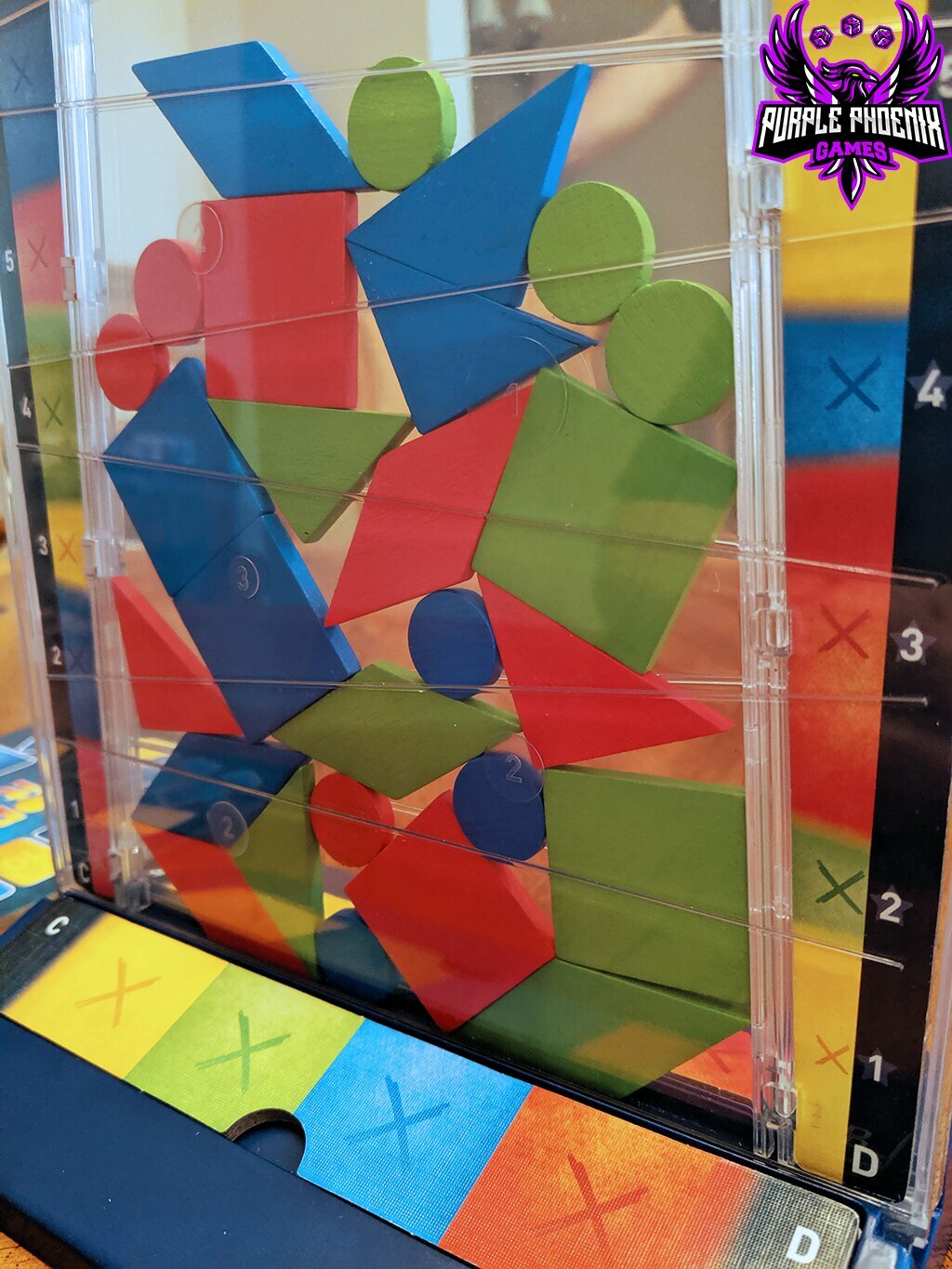
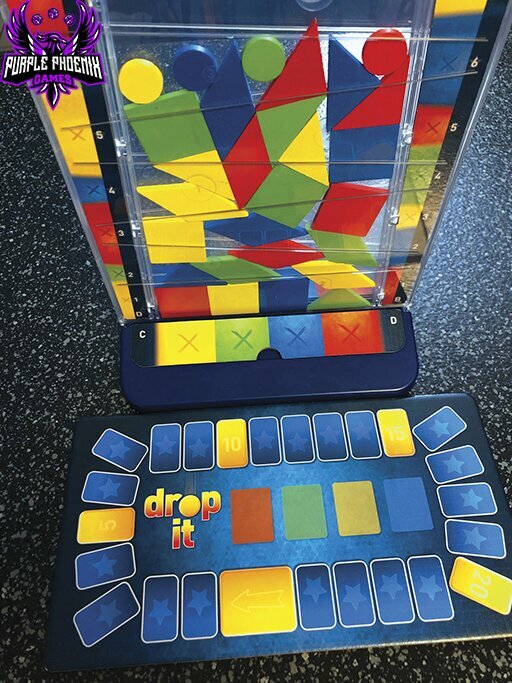
Did you ever play Connect 4? Who am I kidding, of course you probably did. Drop It is essentially an abstract version of Connect 4. In Drop It, players take turns dropping their pieces into the slot board in an effort to amass the most points. Each player has a set number of pieces in their specific color, and in various shapes. The rules of Drop It are simple – pick a piece and drop it (roll credits) into the board. You earn points for the highest level that your piece crosses into, as well as bonus points for touching various smaller areas across the board. Sounds easy enough, right? Well here’s the tricky part. If your piece touches another one of your pieces, even if by just a hair, it earns you no points. Similarly, if your piece touches another piece of the same shape (regardless of color), you earn no points as well. AND on top of that, certain areas along the bottom and sides of the board are colored and are not allowed to be touched by their corresponding colored pieces. If a piece touches one of those forbidden zones, then that player earns (you guessed it) no points. So all in all, not as simple a game as it looks, is it? The player at the end of the game with the most points is the winner!
Man, Drop It is a neat little game. When I first heard of it, I thought it would be the easiest game on the planet. But boy oh boy was I wrong. Although I’d say this game is primarily one of dexterity (and luck), there is definitely quite a bit of strategy involved. Because there are several placement restrictions, you have to be careful about which pieces you play at what times. The circles roll around on pretty much anything, so do you risk dropping one when it might just roll onto your square and negate those points? Can you drop your trapezoid at the right angle to have it span two other pieces and miss landing on yours in the middle? All while making sure it doesn’t hit the left side of the board here? It is way more strategic than meets the eye, and I love that. It keeps me engaged the entire game, and it elevates the game to a higher level than just simple dexterity.
Whatever strategy you choose must involve your opponents as well. Even though there is no real player interaction in Drop It, you’ve got to keep an eye on your opponents and which pieces they play at what times. If another player just dropped their square right in the middle of the board, you probably should not drop your square right now. Unless you don’t want points. Then by all means, drop your square right on top of that sucker. Are you able to keep a variety of shapes throughout the game, or will you get cornered for several turns because all you have left are your circles? You’re not only thinking of your strategy, but that of your opponents as well.
One other thing that I love about Drop It is that once a piece is scored, it is out of your mind. What I mean is that in some cases, dropping a piece causes those underneath to shift. You only score the piece that was just dropped – regardless of how it moved any pieces underneath. That definitely helps to keep the game moving because you are not having to constantly go back and re-score any shifted pieces. That would just be brutal.
Overall, I really like Drop It. It’s not one that I personally own, but it definitely is on my Wish List after having played it. It’s the perfect little filler game for in-between some meatier games. Although it requires strategy, the dexterity aspect of the game makes it more light-hearted, fun, and fast to play! Purple Phoenix Games is dropping a score of 14 / 18 for this little gem.
Did you ever play Connect 4? Who am I kidding, of course you probably did. Drop It is essentially an abstract version of Connect 4. In Drop It, players take turns dropping their pieces into the slot board in an effort to amass the most points. Each player has a set number of pieces in their specific color, and in various shapes. The rules of Drop It are simple – pick a piece and drop it (roll credits) into the board. You earn points for the highest level that your piece crosses into, as well as bonus points for touching various smaller areas across the board. Sounds easy enough, right? Well here’s the tricky part. If your piece touches another one of your pieces, even if by just a hair, it earns you no points. Similarly, if your piece touches another piece of the same shape (regardless of color), you earn no points as well. AND on top of that, certain areas along the bottom and sides of the board are colored and are not allowed to be touched by their corresponding colored pieces. If a piece touches one of those forbidden zones, then that player earns (you guessed it) no points. So all in all, not as simple a game as it looks, is it? The player at the end of the game with the most points is the winner!
Man, Drop It is a neat little game. When I first heard of it, I thought it would be the easiest game on the planet. But boy oh boy was I wrong. Although I’d say this game is primarily one of dexterity (and luck), there is definitely quite a bit of strategy involved. Because there are several placement restrictions, you have to be careful about which pieces you play at what times. The circles roll around on pretty much anything, so do you risk dropping one when it might just roll onto your square and negate those points? Can you drop your trapezoid at the right angle to have it span two other pieces and miss landing on yours in the middle? All while making sure it doesn’t hit the left side of the board here? It is way more strategic than meets the eye, and I love that. It keeps me engaged the entire game, and it elevates the game to a higher level than just simple dexterity.
Whatever strategy you choose must involve your opponents as well. Even though there is no real player interaction in Drop It, you’ve got to keep an eye on your opponents and which pieces they play at what times. If another player just dropped their square right in the middle of the board, you probably should not drop your square right now. Unless you don’t want points. Then by all means, drop your square right on top of that sucker. Are you able to keep a variety of shapes throughout the game, or will you get cornered for several turns because all you have left are your circles? You’re not only thinking of your strategy, but that of your opponents as well.
One other thing that I love about Drop It is that once a piece is scored, it is out of your mind. What I mean is that in some cases, dropping a piece causes those underneath to shift. You only score the piece that was just dropped – regardless of how it moved any pieces underneath. That definitely helps to keep the game moving because you are not having to constantly go back and re-score any shifted pieces. That would just be brutal.
Overall, I really like Drop It. It’s not one that I personally own, but it definitely is on my Wish List after having played it. It’s the perfect little filler game for in-between some meatier games. Although it requires strategy, the dexterity aspect of the game makes it more light-hearted, fun, and fast to play! Purple Phoenix Games is dropping a score of 14 / 18 for this little gem.

Carcassonne
Entertainment and Games
8.6 Rate It
App
a classic board game turned into an app. Tile laying game, where each turn you draw a tile and place...
BoardGameApp
Classic Ludo Offline & Online
Games
App
NEW: Multiplayer Online with Facebook Friends available now. Calling all the kings of Ludo game,...
Purple Phoenix Games (2266 KP) rated Kids Chronicles: Quest for the Moon Stones in Tabletop Games
Jan 13, 2022
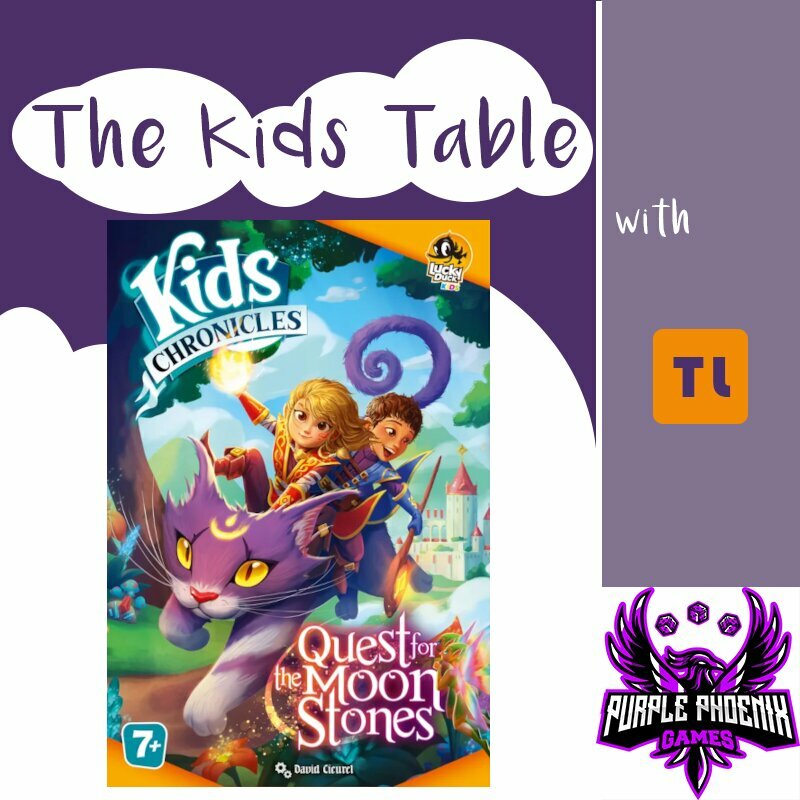
The Kids Table series from Purple Phoenix Games seeks to lightly explore games that are focused toward children and families. We will do our best to give some good insight, but not bog your down with the millions of rules…
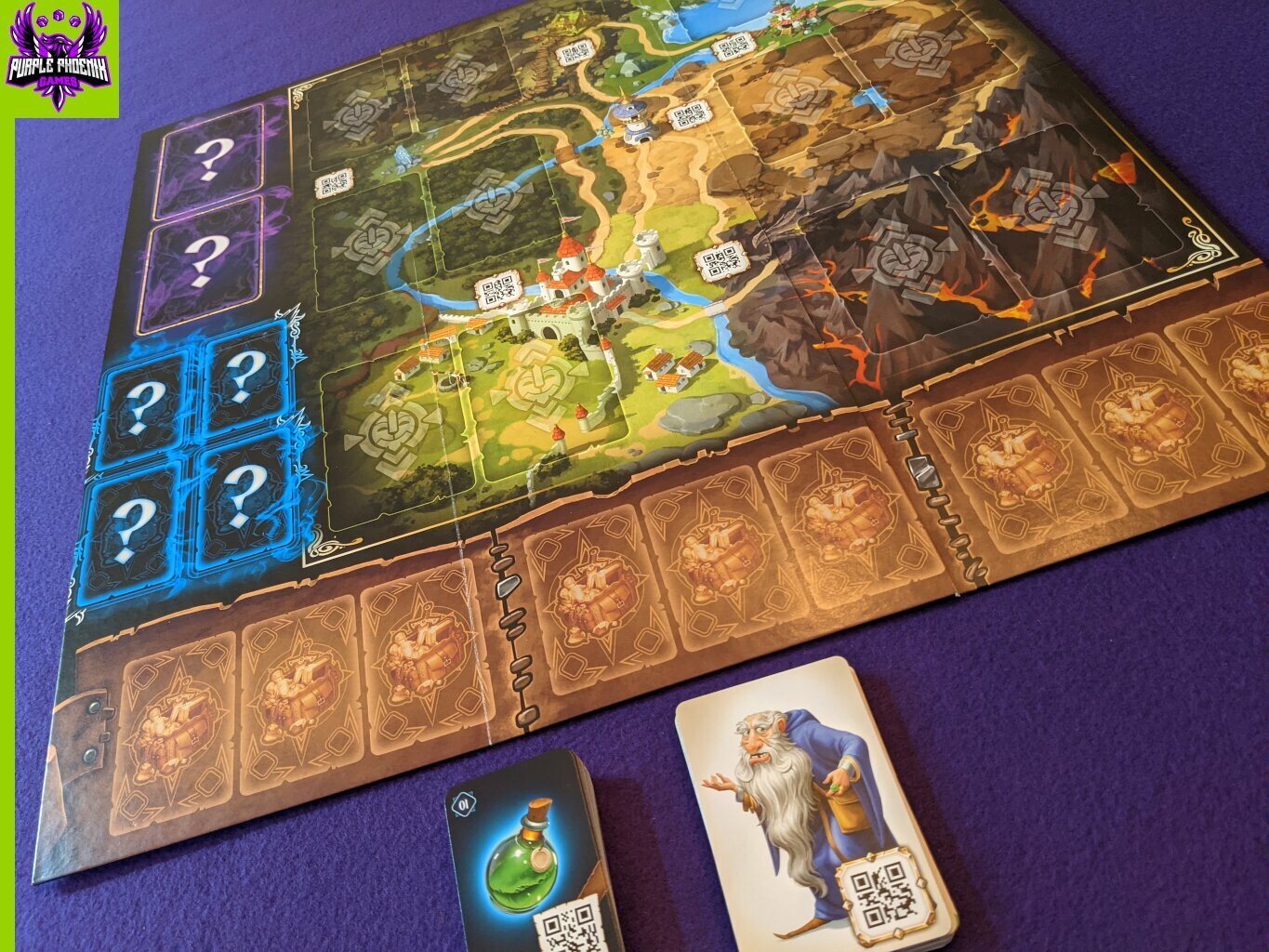
In Kids Chronicles: Quest of the Moon Stones (which I will just call “this game” from here on out if you please), players are new apprentices to Merlin, the old wizard keeping two neighboring kingdoms together and keeping them from warring with each other. In this game, players will be adventuring across the double-sided board solving riddles, completing quests, and meeting tons of great characters all with the assistance and guidance of a free app specifically designed for this game.
DISCLAIMER: We were provided a copy of this game for the purposes of this review. This is a retail copy of the game, so what you see in these photos is exactly what would be received in your box. I do not intend to cover every single rule included in the rulebook, but will describe the overall game flow and major rule set so that our readers may get a sense of how the game plays. For more in depth rules, you may purchase a copy online or from your FLGS. -T
Setup could not be easier for this game. First, download the Kids Chronicles app to your phone or tablet, lay out the board (initially on the side that looks like Summer), display the Character cards and Item cards face-up in their respective decks. You don’t even have to sort or shuffle them! And you’re done. The game is ready to be played! Open the app and let it guide you through each mission – but do start with the tutorial, especially if any player hasn’t played a hybrid board game like this before.
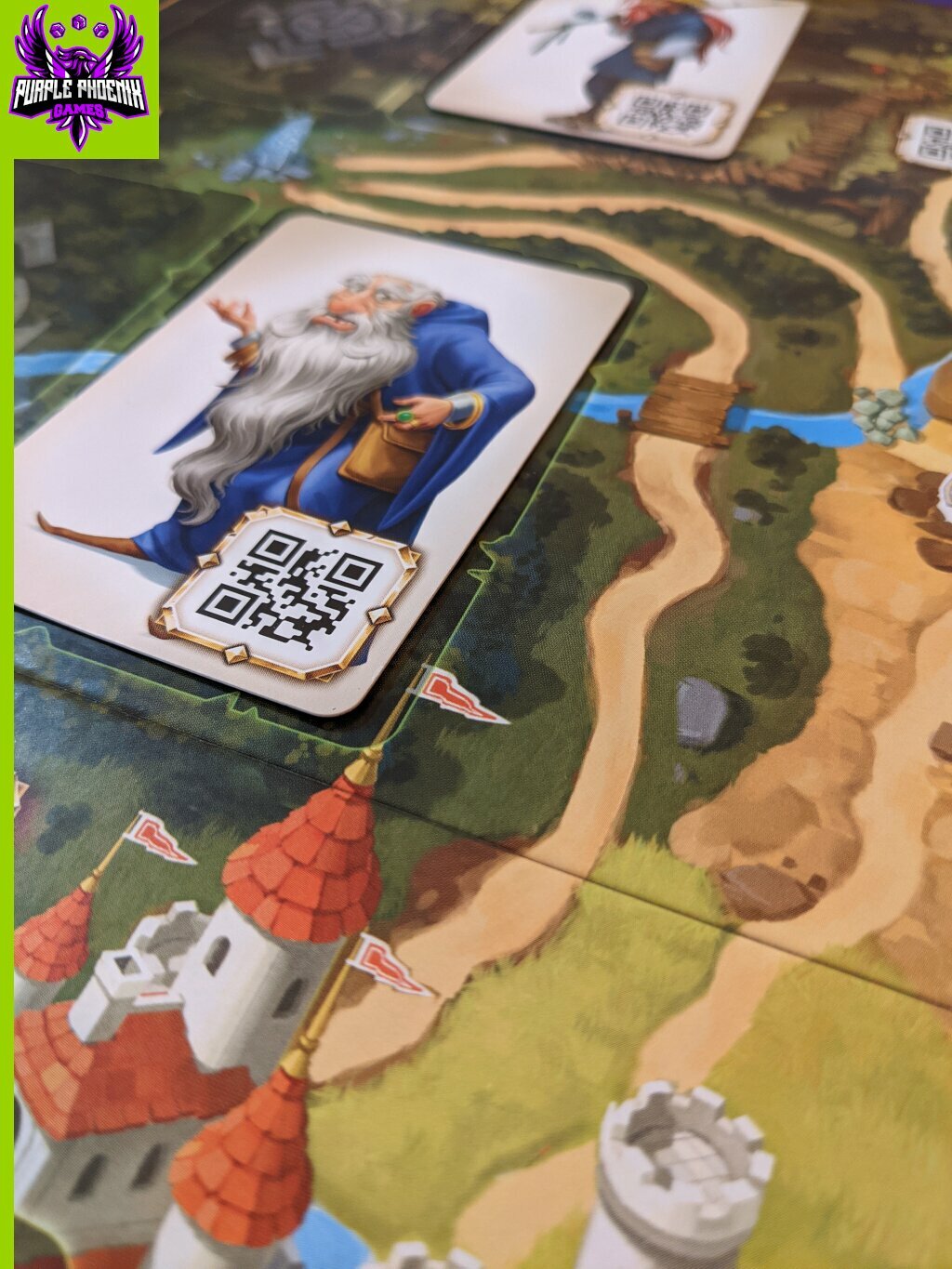
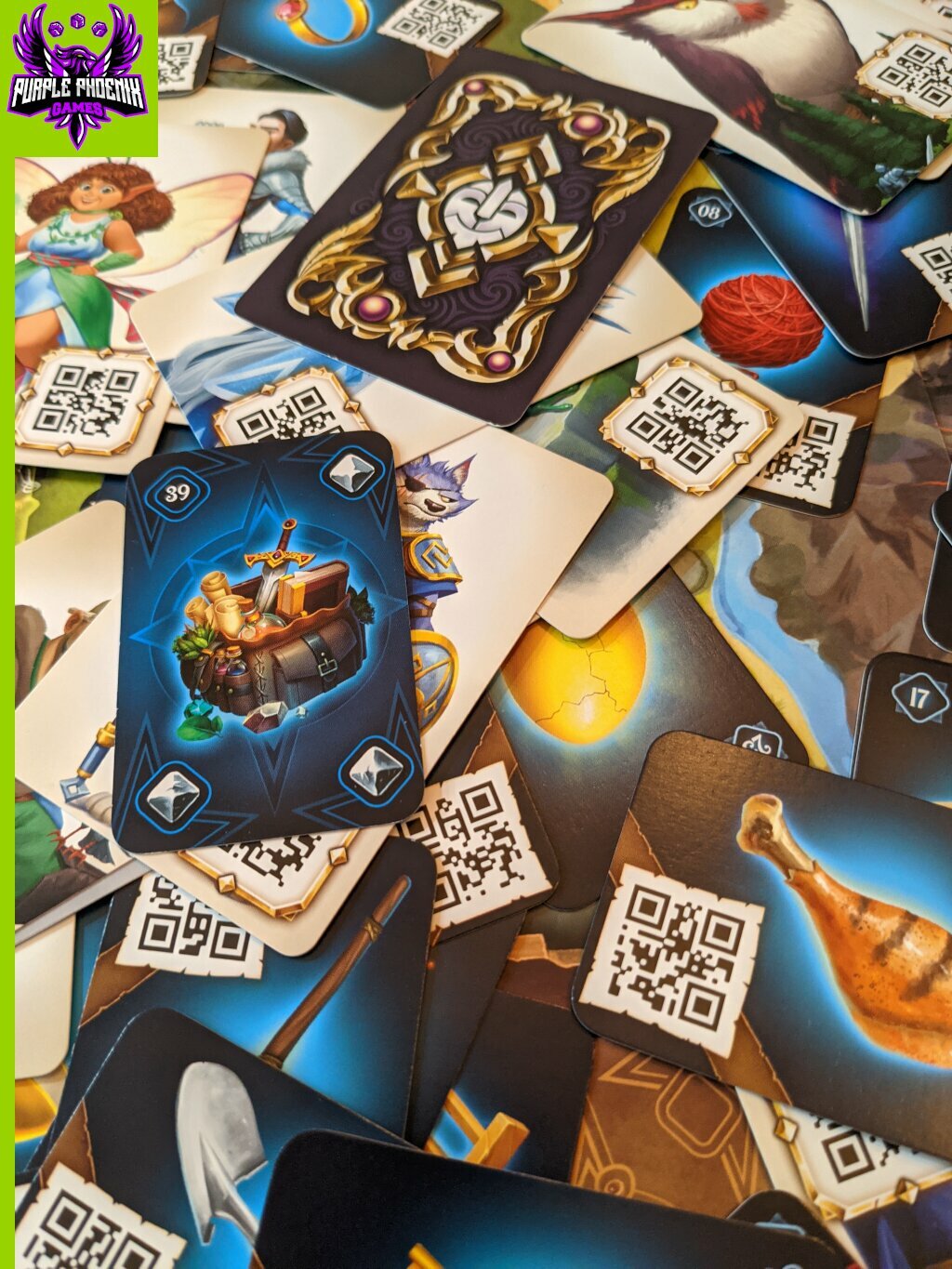
I do not want to give away too much information in this review, so I will keep this portion brief. Throughout the game players will be marching around to different parts of the board, speaking with characters, collecting items, and solving riddles by scanning the QR codes found on the cards and board locations. I really should stop here so as not to spoil any actual gameplay information.
I have reviewed many of these hybrid app-driven games from Lucky Duck Games (Chronicles of Crime, CoC: 1400, CoC: 1900, and CoC: 2400). None of them, however, are designed for children, nor recommended for children to even play. With those titles, very adult themes are played through, but this is not so here with this game. Kids Chronicles is VERY family friendly, and the app simply walks players through the entire setup and missions.
What I enjoy most about this game, especially after having played their bigger siblings, is that there is no time limit to have things completed. So players can travel across the land, scanning whatever they like, and not be penalized for it. You just can’t do that with the grown-up versions. Also, the art is excellent and colorful – perfect for a kids game. The stunning visual appeal, free-feeling adventuring, and introducing the hybridization of apps and board games to children all work together really well here.
Now, the box advises that this game is for ages 7+ but my little 5-year-old loves this one and asks to play it all the time. There is a lot of reading to be done from the app (it doesn’t read anything aloud), but that just adds to the fun for us, because I enjoy adding different voices to the characters. So in a way, this is very similar to reading a nighttime book, but just way more fun.
So, if you have little gamers at home that are ready for that next step, I recommend checking out Kids Chronicles. I am super happy that Lucky Duck Games is branching out into the children’s games market, and bringing that excellent scanning mechanic along for the ride. Once you get the hang of this style of game, I suggest you also then pick up a copy of one of the Chronicles of Crime games for your adult game nights. You can thank me later!
In Kids Chronicles: Quest of the Moon Stones (which I will just call “this game” from here on out if you please), players are new apprentices to Merlin, the old wizard keeping two neighboring kingdoms together and keeping them from warring with each other. In this game, players will be adventuring across the double-sided board solving riddles, completing quests, and meeting tons of great characters all with the assistance and guidance of a free app specifically designed for this game.
DISCLAIMER: We were provided a copy of this game for the purposes of this review. This is a retail copy of the game, so what you see in these photos is exactly what would be received in your box. I do not intend to cover every single rule included in the rulebook, but will describe the overall game flow and major rule set so that our readers may get a sense of how the game plays. For more in depth rules, you may purchase a copy online or from your FLGS. -T
Setup could not be easier for this game. First, download the Kids Chronicles app to your phone or tablet, lay out the board (initially on the side that looks like Summer), display the Character cards and Item cards face-up in their respective decks. You don’t even have to sort or shuffle them! And you’re done. The game is ready to be played! Open the app and let it guide you through each mission – but do start with the tutorial, especially if any player hasn’t played a hybrid board game like this before.
I do not want to give away too much information in this review, so I will keep this portion brief. Throughout the game players will be marching around to different parts of the board, speaking with characters, collecting items, and solving riddles by scanning the QR codes found on the cards and board locations. I really should stop here so as not to spoil any actual gameplay information.
I have reviewed many of these hybrid app-driven games from Lucky Duck Games (Chronicles of Crime, CoC: 1400, CoC: 1900, and CoC: 2400). None of them, however, are designed for children, nor recommended for children to even play. With those titles, very adult themes are played through, but this is not so here with this game. Kids Chronicles is VERY family friendly, and the app simply walks players through the entire setup and missions.
What I enjoy most about this game, especially after having played their bigger siblings, is that there is no time limit to have things completed. So players can travel across the land, scanning whatever they like, and not be penalized for it. You just can’t do that with the grown-up versions. Also, the art is excellent and colorful – perfect for a kids game. The stunning visual appeal, free-feeling adventuring, and introducing the hybridization of apps and board games to children all work together really well here.
Now, the box advises that this game is for ages 7+ but my little 5-year-old loves this one and asks to play it all the time. There is a lot of reading to be done from the app (it doesn’t read anything aloud), but that just adds to the fun for us, because I enjoy adding different voices to the characters. So in a way, this is very similar to reading a nighttime book, but just way more fun.
So, if you have little gamers at home that are ready for that next step, I recommend checking out Kids Chronicles. I am super happy that Lucky Duck Games is branching out into the children’s games market, and bringing that excellent scanning mechanic along for the ride. Once you get the hang of this style of game, I suggest you also then pick up a copy of one of the Chronicles of Crime games for your adult game nights. You can thank me later!
Purple Phoenix Games (2266 KP) rated Baby Dinosaur Rescue in Tabletop Games
Apr 21, 2021


The Kids Table series from Purple Phoenix Games seeks to lightly explore games that are focused toward children and families. We will do our best to give some good insight, but not bog you down with a million rules.
The island’s volcano is about to erupt! We HAVE to get these baby dinosaurs to safety FAST! Place the game board on the table with the lava tracker token on the highest lava spot. Depending on how challenging you want your game, place all your dinosaur tokens at the bottom of the board ready to move to safety. Shuffle the cards and deal each player three. You are ready to truck it to the safety of a neighboring island.
On your turn you will play a card from your hand and move any dinosaur to the next-closest open spot that matches the card you played. So if you play that Fish Bone card, move one dino to the first Fish Bone spot on the board you see. Draw another card and it’s the next player’s turn. Do they also have a Fish Bone? Great, play it now because the next-closest open Fish Bone spot is the one PAST where you last placed a dino moving them even further ahead!
Uh oh, have a Lava card in your hand? You HAVE to play that first. When a Lava card is played, no dinosaurs move, but the Lava token moves down one spot closer to obliterating the island!
Play continues in this fashion of playing cards and hopefully leap-frogging dinos to move further ahead on the path to safety. Players are playing cooperatively, so either everyone wins when all the dinos get to the other island, or everyone loses because the island has been burninated.
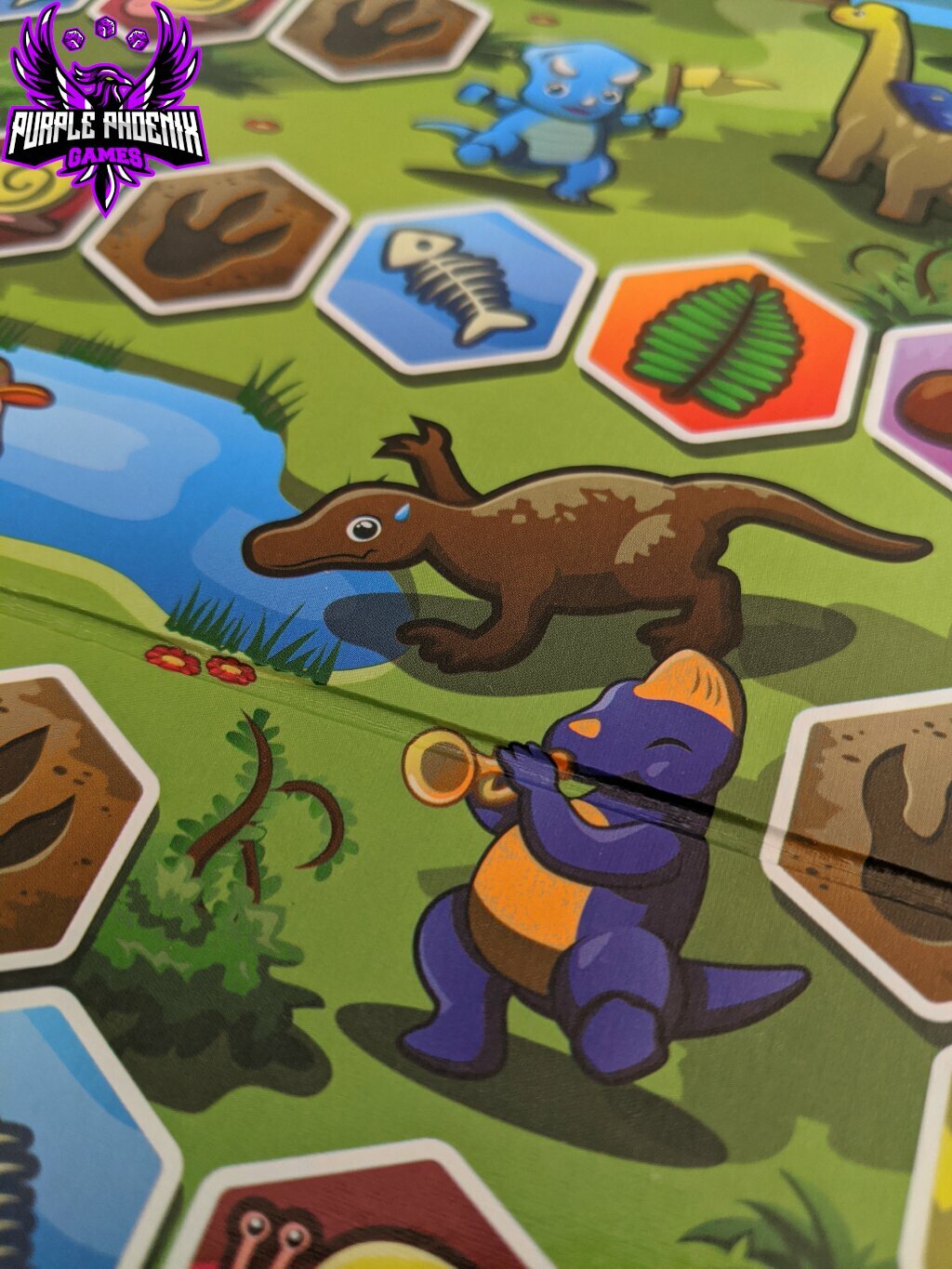
Components. Any game with a trumpet-playing character already has great components. But, the board and chips are good sturdy quality, and the cards are as well. If you find that you will be playing this one quite a bit I would suggest sleeving the cards as they are handled a lot during play.
We love this game and my son requests it more than any other game we own. It is simple, fun, and tense at times! What we love about this game as parents is that it teaches children about cooperative gaming. No dinosaurs are owned in the game – everyone is trying to save ALL the dinos, not just “THEIR” dino. It also teaches that sometimes you have Lava cards and are unable to help the team, and that’s okay because another player will pick up that slack and make the team better. Gotta love educational games with great themes! Pick it up online as I haven’t seen it in stores anywhere.
The island’s volcano is about to erupt! We HAVE to get these baby dinosaurs to safety FAST! Place the game board on the table with the lava tracker token on the highest lava spot. Depending on how challenging you want your game, place all your dinosaur tokens at the bottom of the board ready to move to safety. Shuffle the cards and deal each player three. You are ready to truck it to the safety of a neighboring island.
On your turn you will play a card from your hand and move any dinosaur to the next-closest open spot that matches the card you played. So if you play that Fish Bone card, move one dino to the first Fish Bone spot on the board you see. Draw another card and it’s the next player’s turn. Do they also have a Fish Bone? Great, play it now because the next-closest open Fish Bone spot is the one PAST where you last placed a dino moving them even further ahead!
Uh oh, have a Lava card in your hand? You HAVE to play that first. When a Lava card is played, no dinosaurs move, but the Lava token moves down one spot closer to obliterating the island!
Play continues in this fashion of playing cards and hopefully leap-frogging dinos to move further ahead on the path to safety. Players are playing cooperatively, so either everyone wins when all the dinos get to the other island, or everyone loses because the island has been burninated.
Components. Any game with a trumpet-playing character already has great components. But, the board and chips are good sturdy quality, and the cards are as well. If you find that you will be playing this one quite a bit I would suggest sleeving the cards as they are handled a lot during play.
We love this game and my son requests it more than any other game we own. It is simple, fun, and tense at times! What we love about this game as parents is that it teaches children about cooperative gaming. No dinosaurs are owned in the game – everyone is trying to save ALL the dinos, not just “THEIR” dino. It also teaches that sometimes you have Lava cards and are unable to help the team, and that’s okay because another player will pick up that slack and make the team better. Gotta love educational games with great themes! Pick it up online as I haven’t seen it in stores anywhere.




Boulder Trainer
Sports and Health & Fitness
App
Boulder Trainer is designed for those of you who like the idea of structured fingerboard training...

Rhubarbio (27 KP) rated Chronicles of Crime in Tabletop Games
May 25, 2019
Great use of QR codes (3 more)
Perfect integration of old and new - VR technology with a board game
Co-operative deductive game
Engaging stories!
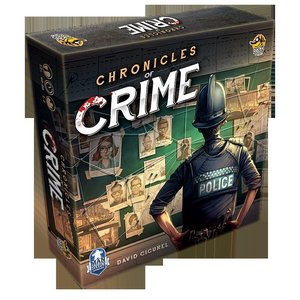
Chronicles of Crime by Lucky Duck Games is an amazing co-operative game that incorporates QR codes, to be scanned by a mobile phone, VR technology to see crime scenes in 3D, and a board with locations. Therefore this game not only marries technology with traditional gaming, but does this without being tacky or a gimmick! Originally this game was launched via Kickstarter, but I believe this will have hit general release with a few expansions already. The stories are engaging and the game very enjoyable. I must say, the crime scenes are quite sobering and grim, therefore not for children but an amazing experience for adults. The way the game is structured, Lucky Duck can continue to publish new cases, using the characters and locations on the boards you already have, resulting in a potential for continued play beyond the stories contained in the box. I thoroughly recommend this game at a player count of 2-3...more than this, I think it may become a little boring for additional players.

Rhys (240 KP) rated Firefly: The Game in Tabletop Games
Aug 21, 2018
Shiny.
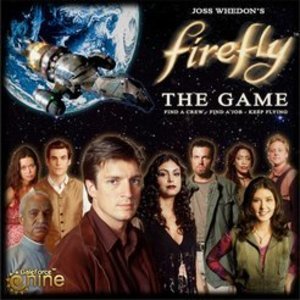
There is a LOT to this game. Like, a lot. Setting everything up requires roughly at least a four foot square space not including each player’s own Firefly board. Basically, it is BIG.
In the simplest game mode (‘First time in the captain’s chair.’) you need the board, which is huge, the plastic ships, around 3 decks of cards, money and crew (all provided). Admittedly, the instructions are not awfully clear and you may end up creating your own variations which work better than the ‘official’. A first game should be dedicated to learning the rules and how to play before any competition starts.
However, once you know what you’re doing you can have several hours of fun. You need to do jobs for money, spend it on upgrades and crew to complete goals, often go to a place and buy or sell something. Think Monopoly meets Risk. Upgrades to Firefly ships are fairly balanced, ones that allow stealthy movements reduce movement range, while increasing range may increase fuel consumption. Although, some are more imbalanced than others, but nothing is ‘game breaking’.
Overall a fun game that takes a little time to really get into.
(Oh, no real knowledge of the series or the expanded universe is required.)
In the simplest game mode (‘First time in the captain’s chair.’) you need the board, which is huge, the plastic ships, around 3 decks of cards, money and crew (all provided). Admittedly, the instructions are not awfully clear and you may end up creating your own variations which work better than the ‘official’. A first game should be dedicated to learning the rules and how to play before any competition starts.
However, once you know what you’re doing you can have several hours of fun. You need to do jobs for money, spend it on upgrades and crew to complete goals, often go to a place and buy or sell something. Think Monopoly meets Risk. Upgrades to Firefly ships are fairly balanced, ones that allow stealthy movements reduce movement range, while increasing range may increase fuel consumption. Although, some are more imbalanced than others, but nothing is ‘game breaking’.
Overall a fun game that takes a little time to really get into.
(Oh, no real knowledge of the series or the expanded universe is required.)

Christine A. (965 KP) rated The Swallows in Books
Jan 30, 2020 (Updated Jan 31, 2020)
I was provided with a complimentary copy of this book so I could give an honest review.
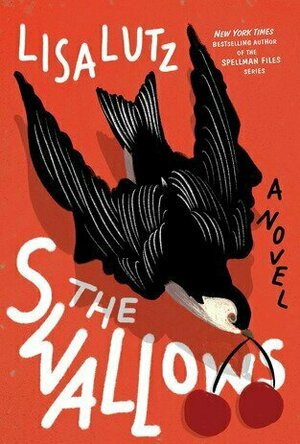
Lisa Lutz's latest, The Swallows, introduces Alex Witt, a teacher with a past. She is hired at Stonebridge Academy and asks her creative writing students to answer innocent questions so she can get to know them. "What do you love? What do you hate? What do you want?" The answers surprise Alex. They are not innocent and reveal much more about the students and the school's activities than she expects. The students reveal online bullying and a private message board. She encourages the female students to fight back and fight they do.
While I have not worked at a boarding school, I have worked at urban schools. The online bullying and message board are all too real. So is the school's attitude that "boys will be boys". Lutz uses her characters to show the dark side of technology and teenagers. This is not a young adult book. It is a book for adults which is set in a school.
The writing in The Swallows is witty while covering dark topics. Lutz's word choices and writing style keep the book from being too dark.
I added several of Lutz's books, including the Spellman Files series, to my "want to read" list.
This 200-word review was published on Philomathinphila.com on 1/30/20.
Lisa Lutz's latest, The Swallows, introduces Alex Witt, a teacher with a past. She is hired at Stonebridge Academy and asks her creative writing students to answer innocent questions so she can get to know them. "What do you love? What do you hate? What do you want?" The answers surprise Alex. They are not innocent and reveal much more about the students and the school's activities than she expects. The students reveal online bullying and a private message board. She encourages the female students to fight back and fight they do.
While I have not worked at a boarding school, I have worked at urban schools. The online bullying and message board are all too real. So is the school's attitude that "boys will be boys". Lutz uses her characters to show the dark side of technology and teenagers. This is not a young adult book. It is a book for adults which is set in a school.
The writing in The Swallows is witty while covering dark topics. Lutz's word choices and writing style keep the book from being too dark.
I added several of Lutz's books, including the Spellman Files series, to my "want to read" list.
This 200-word review was published on Philomathinphila.com on 1/30/20.