Healthy 365
Health & Fitness
App
Healthy 365 app is brought to you by the Health Promotion Board (HPB). This app enables you to track...

BAND - Organize your groups
Social Networking and Productivity
App
Organize your group on BAND! It’s the perfect group communication app with features like Community...
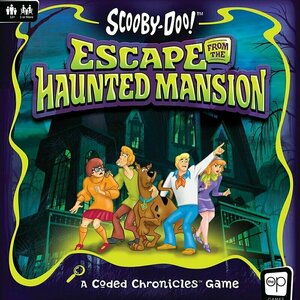
Scooby-Doo: Escape from the Haunted Mansion
7.8 Rate It
Tabletop Game
In Scooby-Doo: Escape from the Haunted Mansion, players take on the roles of the teen sleuths and...

Merchants & Marauders
8.0 Rate It
Tabletop Game
Merchants & Marauders lets you live the life of an influential merchant or a dreaded pirate in the...
BoardGames Pirategames

The Pillars of the Earth
5.0 Rate It
Tabletop Game
The Pillars of the Earth is based on the bestselling novel by Ken Follett and the 2006 game in the...
Boardgames WorkerPlacementGames BooksintoGames
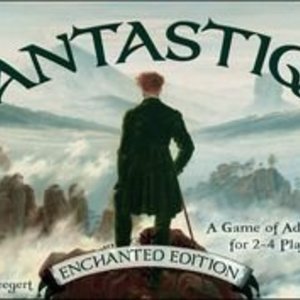
Fantastiqa
9.0 Rate It
Tabletop Game
Welcome to the wild, weird world of FANTASTIQA! Fantastiqa is a deck-building board game set in a...

Purple Phoenix Games (2266 KP) rated Trogdor!!: The Board Game in Tabletop Games
Aug 8, 2019
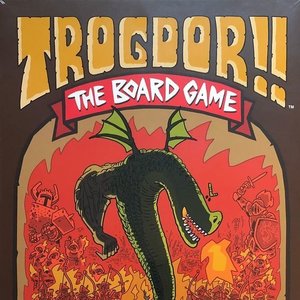
Trogdor!! The Board Game, which I’m just gonna start calling Trogdor!!, is a cooperative area burninating puzzle adventure game for only the coolest of the cool. The twist on this game, if you are unfamiliar with Trogdor or Homsar, is that the players are all essentially cultists who assist Trogdor to burninate the countryside, all the cottages, and chomp the peasants or send them to the Void.
DISCLAIMER: Though this was Kickstarted, I did not splurge on the deluxe version, so I have the meepled version and it does just fine. Furthermore, I do not intend to cover every single rule included in the rule book, but will describe the overall game flow and major rule set so that our readers may get a sense of how the game plays. For more in depth rules, you may purchase a copy from the publisher directly or from your FLGS. -T
To setup the game (and I found this part tedious) lay out the countryside tiles according to one of the suggested layouts in the back of the rule book or simply wherever you want in a 5×5 grid. This is your game board now. Also place out the thatched-roof cottages, peasants, knights, and archers. Trogdor starts the game in the middle tile, prepped for his burnination run. Each player also receives a Keeper of Trogdor persona card that provides special abilities, an item card that can be used during play, and an action card that determines how many action points a player may use as well as possibly special abilities to use for the turn. Troghammer starts the game on the Trog-meter, ready to come onto the board to wreak hammery havoc on our hero.
A turn consists of two phases. The first phase has the current player drawing an action card which intimates the number of action points (AP) the player can use for actions: Move Trogdor one space orthogonally, Chomp a peasant to increase health, Burninate a tile/cottage/peasant, Burrow into a tunnel and pop out the other side, or Hide in the mountains. Movement is easy: move Trogdor one space per AP you’d like to spend. Chomping requires Trogdor to be on the same tile as a peasant, but then you can chow down on them to increase our deity’s health bar. Burninating also requires Trogdor to be on the same tile as the tile/cottage/peasant you want to burninate. The Lake tile has special burninating rules, as do thatched-roof cottages. I will also allow you to learn about burninating peasants on your own, as it is pretty amazing. Burrowing requires Trogdor to be on a tunnel tile and spend an AP to teleport to the other tunnel (a la Small World). Trogdor may also simply Hide on a mountain tile to be protected from the attackers that act during the next phase. If players to not like either the action card they were dealt or the card they drew, they may simply discard a card to take their turn with 5 AP and no special abilities.
The next phase is where the board elements do their thang. The active player will draw and play a movement card. From instructions on this card the board may spawn more peasants, will move the peasants, will move the knights and also archers. Peasants do not fight Trogdor, but they can possibly repair burninated tiles. Knights WILL hurt Trogdor whenever they pass through or end their turn on the same tile as Trogdor. Knights will also automatically repair any burninated thatched-roof cottages they pass through. Troghammer is a special knight who only comes into play once Trogdor is hurt the first time. Archers will attack an entire column or row depending on which direction they were traveling when they ended their movement. If Trogdor still has peasants on the Trog-meter (representing health), then the next player takes their turn. If Trogdor has no more health and he is hit again, he enters a fiery RAGE! I will let you discover what happens during this event also.
The players win when all the tiles, cottages, and peasants have been burninated or eliminated from the board. They lose when Trogdor is defeated and they have not completed their victory conditions.
Components. It’s always so hard to really know exactly what you will be receiving when you Kickstart a game. Especially from a company not known for board games, and which has never produced a board game. So, I was anticipating something entirely different as I was opening my box. This is what I received: excellent tiles with UV spot on each side (super fancy!). I usually don’t care about UV spot anywhere on my game, but that seems to be en vogue now, so I’ll just try to enjoy it when I can. The other cardboard bits are great too. The cards are of great quality, but I went ahead and sleeved the action and movement cards since I knew they would be handled quite a bit. The Trogeeples (jeez) all are of great quality, and I really appreciate the additional Trogdor meeples included. I had a big chuckle about that. The artwork is comical (like in a comic) and I also appreciated all the Strong Bad enhancements as well. The only negative I have about the components of the game is the ridiculous thin box of air that was included as a buffer near the insert. I threw it out, put my sleeved action and movement cards in a plastic deck box in its place and now I’m much happier.
Overall, I had such a blast playing this game. Is it mostly due to nostalgia and reverie? Perhaps. But, Bryan was playing this with us and he didn’t know anything about Trogdor or Homestar Runner. He also really enjoyed the game, so I think the level of familiarity doesn’t matter. Obviously I did not explain EVERY rule to the game, but hopefully by my quick description my readers get a good idea of how the game plays. I can honestly say that I love love love this game and will treasure it always. If/when I see this at my FLGS I may just buy up all the copies to give as gifts. It’s really good. That’s why Purple Phoenix Games give this one an MSG’d 15 / 18. Oh, and you’re welcome for my holding back of all the quotes I COULD HAVE put in this review. I could have really earned my nerd card renewal.
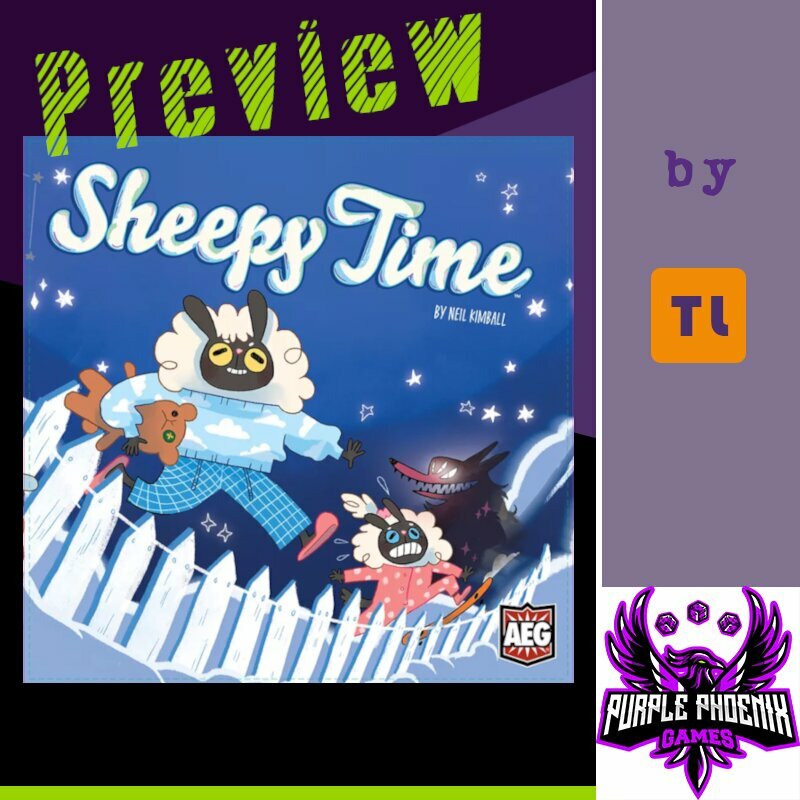
Purple Phoenix Games (2266 KP) rated Sheepy Time in Tabletop Games
May 27, 2021
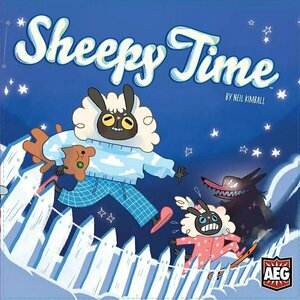
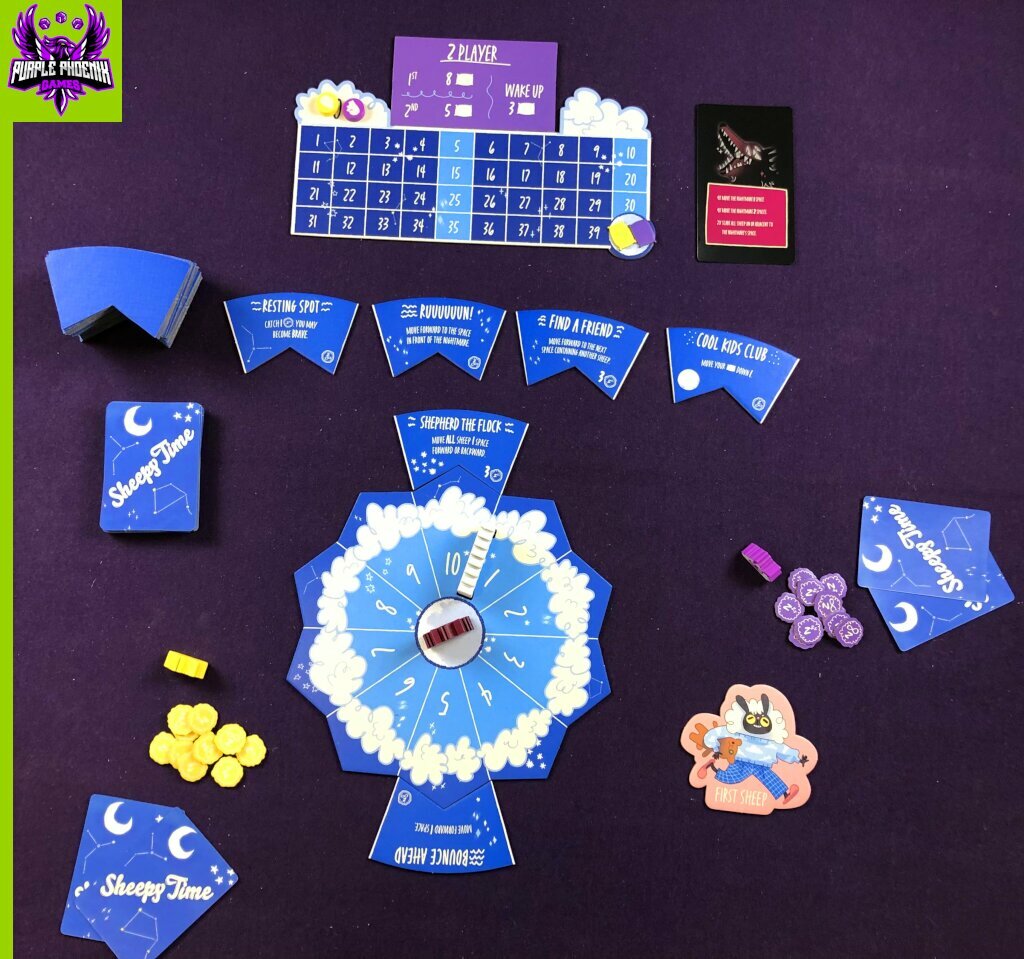
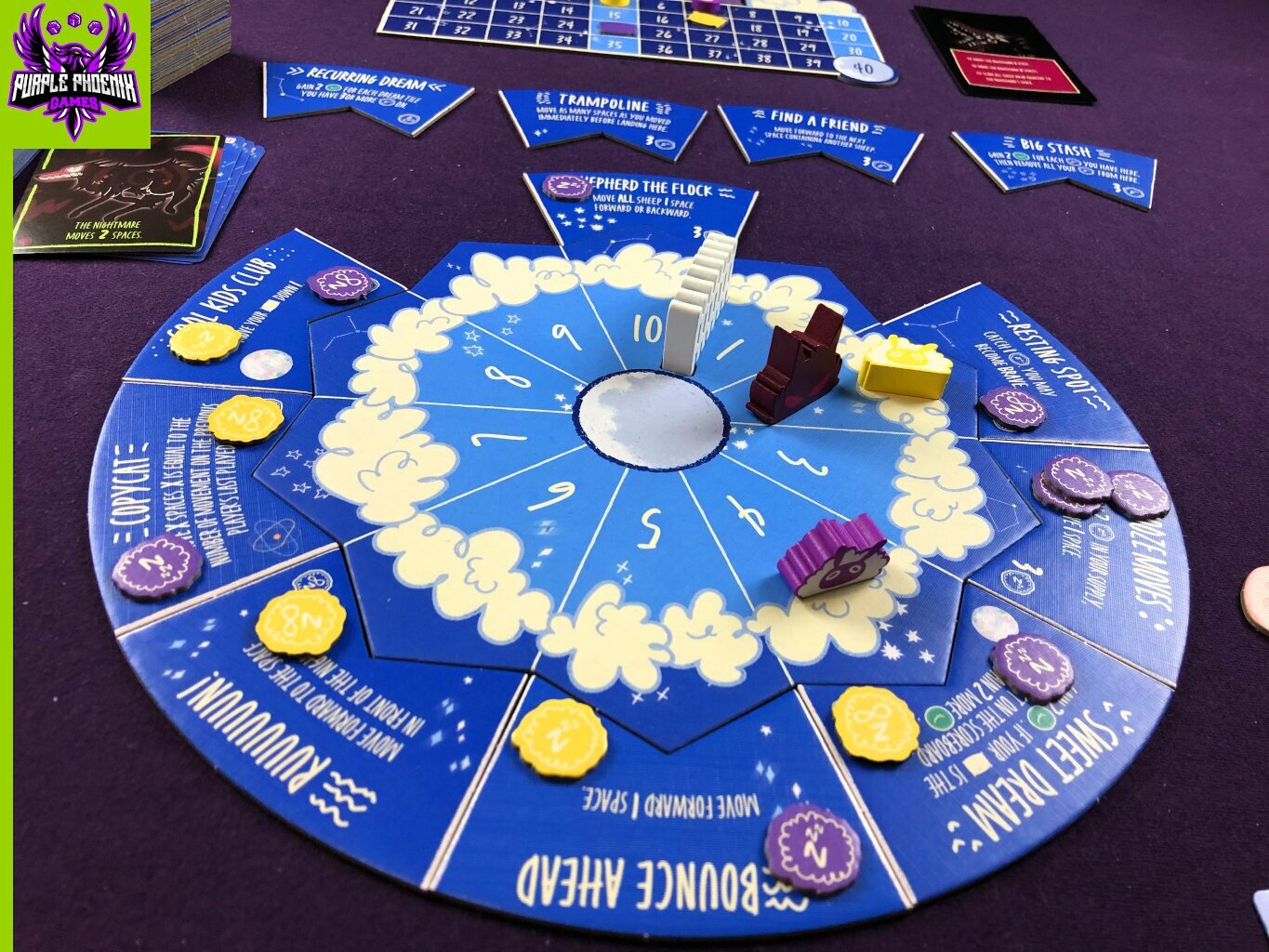
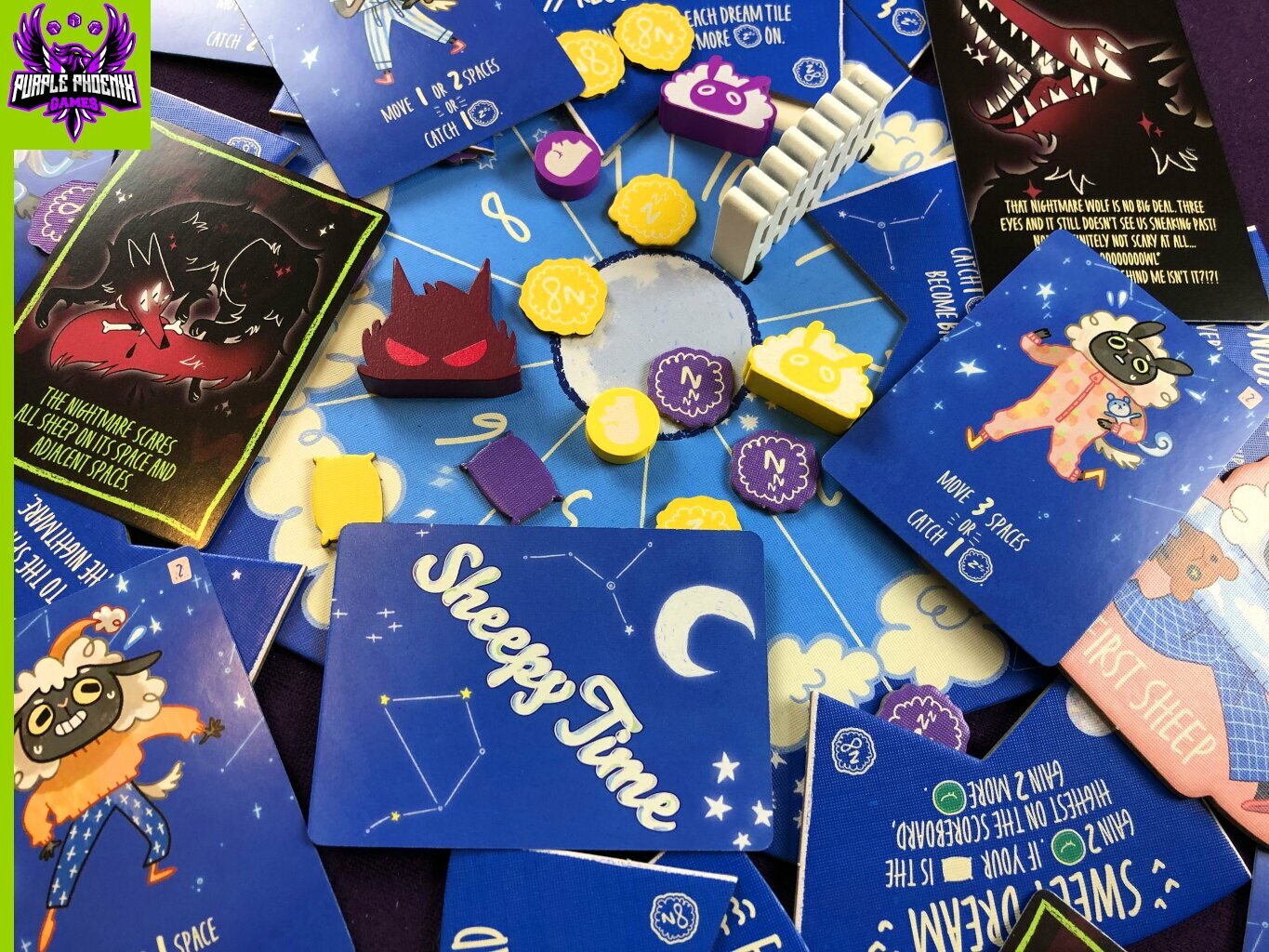
Disclaimer: We were provided with a copy of Sheepy Time for the purposes of this preview. What you see pictured below are the retail components. -L
Sheepy Time is a push-your-luck game in which players take on the roles of Dream Sheep, tasked with helping humans fall asleep. Played over a series of rounds, players will take turns racing their Sheep around the board, using special Dream powers, and avoiding the Nightmare that lurks around the board. The player that earns the most points (as described in the rules) will be declared the dreamiest sheep of all! To setup for a game, place the board within reach of all players and attach the Fence between spaces 10 and 1. Place the scoreboard and Pillow Reference tile nearby, and give all players a Sheep, Wink, Pillow, and Zzz tokens in their chosen color. Select one of the three provided Nightmares to use this game, shuffle their cards into the deck of Sheep cards, and place the Nightmare meeple in the center of the board. Shuffle the Dream tiles, drawing and placing one randomly on spaces 1 and 5 of the board, and reveal four more tiles to create a market. Place all Pillow tokens on the 40 Winks space of the scoreboard, choose a starting player, and the game is ready to begin!
Each round of Sheepy Time is broken into two phases: the Racing phase, and the Resting phase. To begin the Racing phase, all players will draw 2 cards into their hand. A turn consists of 4 steps: Play a card, Use Dream tiles, Resolve Fence crossing, and Draw cards. The first action you will take on your turn is to play a card from your hand. Most cards will have you move your Sheep around the board a set number of spaces, or will give you the option to ‘Catch some Zzz’s’ (place one of your Zzz tokens on a Dream tile in play). The next step, if applicable, is to use Dream tiles. Dream tiles provide special/extra abilities that can be beneficial to you. In order to use a Dream tile, however, you must have a Zzz token on it – remove your Zzz token from the tile to use its power. So you’ve got to decide when to move your Sheep, or when it’s necessary to Catch some Zzz’s! The third step is to resolve Fence crossing, if applicable. If a cards movement causes your Sheep to cross the Fence, you immediately gain 5 Winks (on the Scoreboard), and decide whether to keep playing this round or ‘Call it a Night.’ If you decide to keep playing, you move to step 4, and draw a new card into your hand. If you Call it a Night, you will discard your hand, and sit out for the remainder of this Racing phase.
If at any point in the Racing phase, you draw a Nightmare card, it must immediately be revealed and resolved. The Nightmare moves around the board, much like the Sheep, but it will Scare any Sheep that it passes! Being Scared once is ok, but if you were to be Scared AGAIN, you get Woken Up, lose all Winks for this round, and are out of the Racing phase. If the Nightmare completes a lap of the board and crosses the Fence before all players have Called it a Night, the remaining players get Woken Up. How risky are you willing to be once the Nightmare comes into play? That’s for you to decide. Once all players have either Called it a Night or been Woken Up, the Racing phase ends. Check the scoreboard for a winner – when a player earns enough Winks in the Racing phase to surpass their Pillow token. If nobody has met that requirement, players will lower their Pillow tokens by the amount specified on the Pillow Reference tile. The lower you can get your Pillow token, the fewer Winks you need to get to win in future rounds! When all Pillow tokens have been adjusted, the game moves to the Resting phase. In this phase, each player will have the choice to either add a new Dream tile to the board, or to Catch 2 Zzz’s. In turn order, players can select one of the Dream tiles from the market to place on an open space of the board, or place 2 Zzz tokens on Dream tiles in play. When everyone has performed their action, the round ends and a new Racing phase begins. Play continues in this manner until one player has been declared the winner!
I’m not typically a fan of push-your-luck games, but Sheepy Time really surprised me! Yes, that mechanic is definitely present in the gameplay, but there is also quite a bit of strategic variability that makes turns feel a little more controlled. The Dream tiles in play will always be different, providing unique abilities to help give you a strategic boost during play. And you always have 2 cards to decide between to play – you are not limited to only one course of action each turn. So yes, there is a riskiness involved with how many laps you think you can get, can you avoid the Nightmare, etc. But there is also a light element of strategy that makes the game more exciting for me. The gameplay itself is also very smooth and intuitive. The turn order makes sense and the flow of the game is pretty seamless. It is fast to teach and learn, and even though the box says 30-45 minutes, it feels fast to play.
Let me touch on components for a minute. As I said earlier, this is a retail copy of the game, and the production quality is great. The cardboard components are nice and thick, the wooden meeples are large and cute, and the overall art style reflects the theme and lightness of the game well. I want to mention that the insert is nice as well – I know it doesn’t effect the gameplay, but it makes set-up/tear-down quick and efficient. AEG definitely knocked it over the fence (get it?) with the production of this game!
So where does Sheepy Time fit into my collection? I think it’s a great game to use to introduce newer gamers to the hobby. The rules and gameplay are not overwhelming, but they offer more of a modern gaming feel than some of the older classics. I would even say that this game can be used with younger gamers as well – take out the Dream tile powers, and just race to see who can earn the most Winks before the Nightmare gets them, or something like that! It is really accessible for everyone, and that earns a big thumbs up from me. So if you’re not quite sure what to think of this game based on the theme/art style, I can assure you that the gameplay is quite excellent. When Sheepy Time hits retail, make sure you jump at the chance to play this game. Definitely don’t sleep on it.
Purple Phoenix Games (2266 KP) rated Kingdoms of the Deep in Tabletop Games
Dec 26, 2020
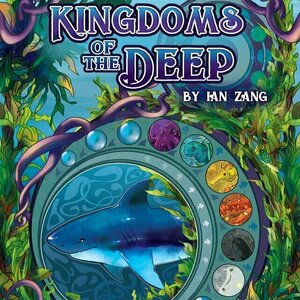
Kingdoms of the Deep is an abstracted area-control game set in the ocean for one to six players. In it players lead a faction of creatures intent on ruling the underwater kingdom. The player who scores the most VP at the end of the game is the winner, and as their king the player must rule with a strong pectoral fin. Okay, that last part isn’t in the rules, but it should be.
DISCLAIMER: We were provided a prototype copy of this game for the purposes of this preview. These are preview copy components, and the final components may be different from these shown. Also, it is not my intention to detail every rule in the game, but to give our readers an idea of how the game plays. You are invited to back the game on Kickstarter launching January 12, 2021, order from your FLGS, or purchase through any retailers stocking it after it is fulfilled. -T
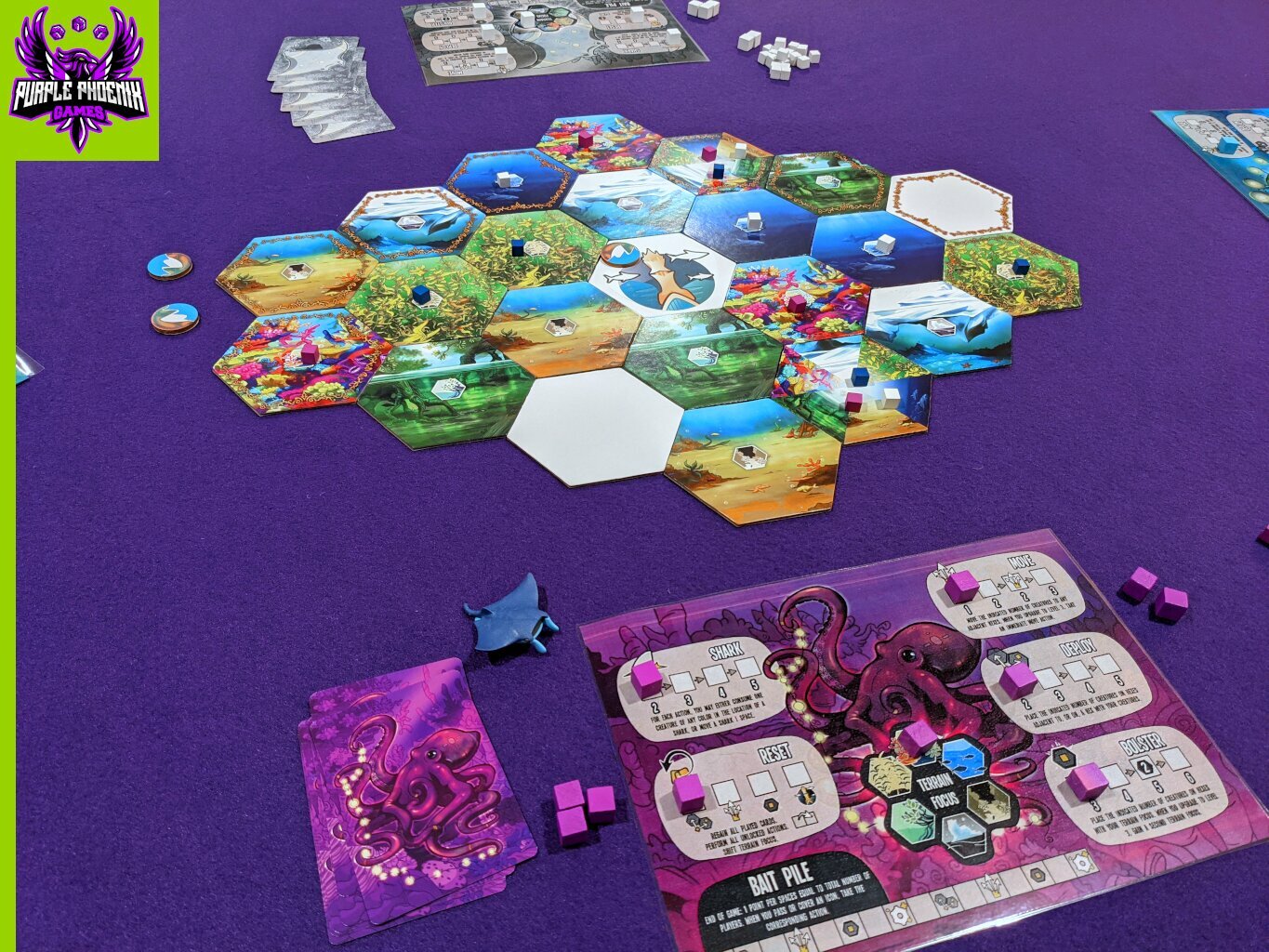
To setup players will choose a color and take all components of that color. Obviously, the best choice is purple. Next the central board will be built of large hex tiles surrounding an Atlantis tile. Upon Atlantis one Shark token will be placed. The Score Board is placed near the central hex board and upon it is placed the Round Marker, the End Game Scoring tile, and the three Goal cards. Players then populate the board with their Influence Cubes on their specific preferred terrain types. Upgrade Cubes (discs in the final version) are then placed on each player’s individual play mats on the furthest value to the left, save for the Reset upgrades: players will choose one to place a cube. Give the starting player the Start Player token (a manta ray in this prototype) and the game may begin!
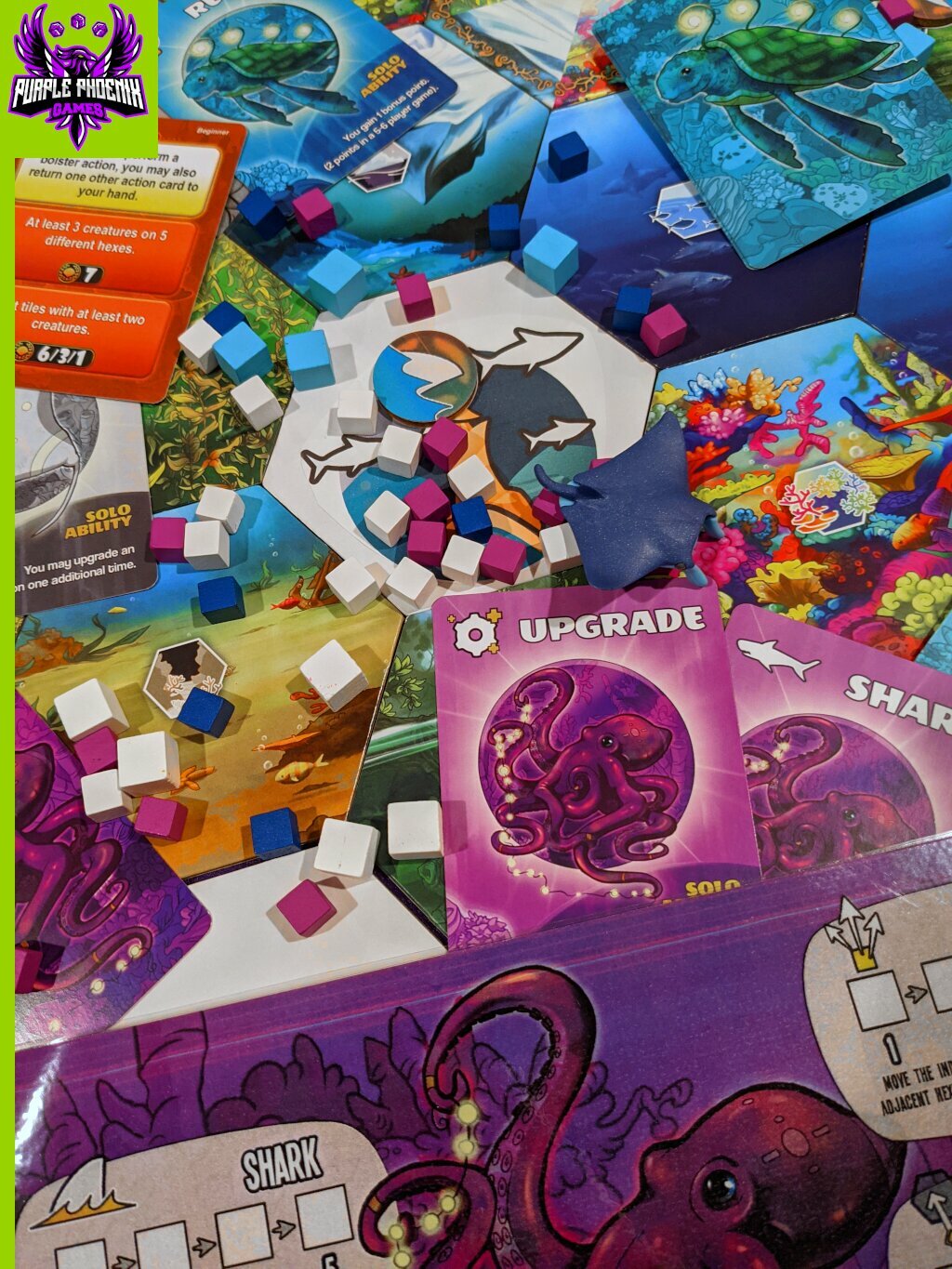
On a turn each player will choose a card from their hand of Action cards to be flipped simultaneously. The starting player will resolve their card first and play will continue around the table thenceforth. Each player will take their action and prepare for the next round. Should a player choose a card that no other player had chosen for the round they will also be able to activate the Solo Ability printed on the card. Typically these Solo Abilities are a furtherance of the action chosen. For example, should a player choose the Deploy Action card and be the only one to do so, they will be able to deploy one additional Influence Cube on the board than normal. The actions are Bolster, Deploy, Move, Upgrade, Shark, and Reset. Each action is limited to a number of cubes added, spaces moved, or upgrades allowed according to where the player board discs (large cubes in the prototype) lie on the player’s mat.
The Bolster action allows the player to add a number of Influence Cubes to the board on the player’s current preferred terrain type. To Deploy units is to add Influence Cubes to the board on hexes already containing their Influence or hexes directly adjacent to those already containing their Influence cubes. When a player chooses the Move action they are able to move creatures (Influence Cubes of any player and Shark tokens) a number of spaces that can be used for once creature or split between several. Players will certainly wish to Upgrade their actions throughout the game by increasing their player board discs’ spaces on their mat. For example, upgrading the Move action could allow the player to move creatures three spaces instead of two. The Shark action allows the player to move the Shark token(s) and chomp creatures on the same hex. Once a Shark feeds, the controlling player will increase their standing on their own Bait Pile track on their play mat. Certain increments on this track will provide the player with one instance of an action (Move, Deploy, etc), and the creature’s Influence Cube is returned to the matching player. Reset actions allow the player to recall their played Action cards to their hands, but also provide whichever action the player originally chose at setup. Should a player wish to Upgrade their Reset action more actions will become available to them each time they utilize the Reset action. Additionally, at the end of the player’s turn having used the Reset action card the Round Marker token is moved one space closer to the end of the game on its track. More on this later.
During play, some creatures may be moved onto the Atlantis tile in the middle of the board via the Deploy or Move actions. When this happens the player who moved the cube onto the Atlantis tile will score a point immediately, and the creature cube is placed in the Atlantis castle (cloth bag in the prototype, but a castle component in the final version). At the end of the game points are awarded to the player with the most creatures in Atlantis.
Every three movements of the Round Marker token signifies a scoring round takes place. Players will consult the current Goal card for any scoring round bonuses and points are earned. The Goal card is then discarded to reveal the next Goal card in sequence on which players can concentrate during the next rounds of play. Also during the first two of these scoring rounds another Shark token is added to the board on the Atlantis tile to be moved around seeking lunch. Once the Round Marker reaches the final scoring round the game ends and points are tallied to arrive at the winner.
Components. Again, this is a prototype version of the game, and while I know certain things will be different in the final version, I do not know what else may be upgraded as a result of any stretch goals reached. Therefore I do not want to comment on the quality of the components, but rather the art style and direction this game is heading toward actual production.
The art on this one is simply gorgeous. The style is the same as that of Animal Kingdoms, which is also a release from Galactic Raptor. All the art I have seen in this game is sublime and permeates the theme into every portion of the game. It is so beautifully colorful and the creatures are all unique and interesting that it may be difficult to concentrate on the actual game for some people, I imagine.
All that aside, I really do think this is a good game. It certainly gives me the Witch’s Brew/Broom Service vibe with benefits for the player who chooses something the others have not. Combine that feeling with that of the chaos of Survive!: Escape from Atlantis area control of constantly-shifting cube placement and I think Galactic Raptor has a hit here. Again, I am excited to see the final product with the more premium components and tweaked rules, but what I have here is still a good implementation of the mechanics with a hard-to-beat theme.
I do quite like the Shark ability to chomp not only everyone else’s creatures, but also your own to take those cubes back into your supply to be Bolstered or Deployed elsewhere. I also really like being able to Upgrade any action I wish to truly personalize my style and tactics during play. I like being able to Move other players’ creatures into Atlantis for that immediate point, but also to remove that cube from play altogether. It creates quite an interesting dynamic and strategy to facilitate other players’ majority status in Atlantis in order to gain quick points and board control right away. There are so many thing to like about this game, and I am so glad I was able to give it a chance on the table.
If you enjoy games similar to those I mentioned previously, then check out Kingdoms of the Deep. It is beautiful, offers quite a bit of strategy and tactics, and stands to become an excellent mid-weight simultaneous action, area control game WITH SHARKS. While I probably won’t be playing this one every game night, I can certainly see myself introducing it to many of my fellow gamers. I urge you to check out the Kickstarter campaign for Kingdoms of the Deep once it launches in January. Tell ’em Old Travis sent ya.


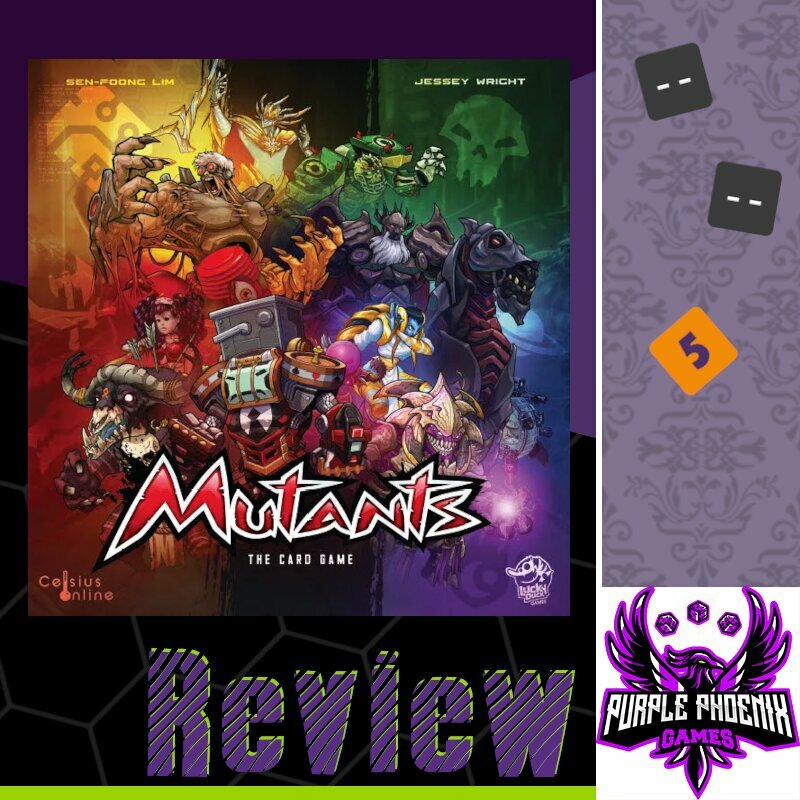
Purple Phoenix Games (2266 KP) rated Mutants in Tabletop Games
Mar 11, 2022
Mutants is a crazy-themed deck building, hand management, fighting, card game for one to four players. Usually in this instance I would put together a Solo Chronicles review, but I wanted to first get the multiplayer rules down and then delve into solo. In any case, this game pits players against each other in a royal rumble where controlling mutants to fight one another most effectively and efficiently will earn the player riches galore. Come check out the world of Mutants.
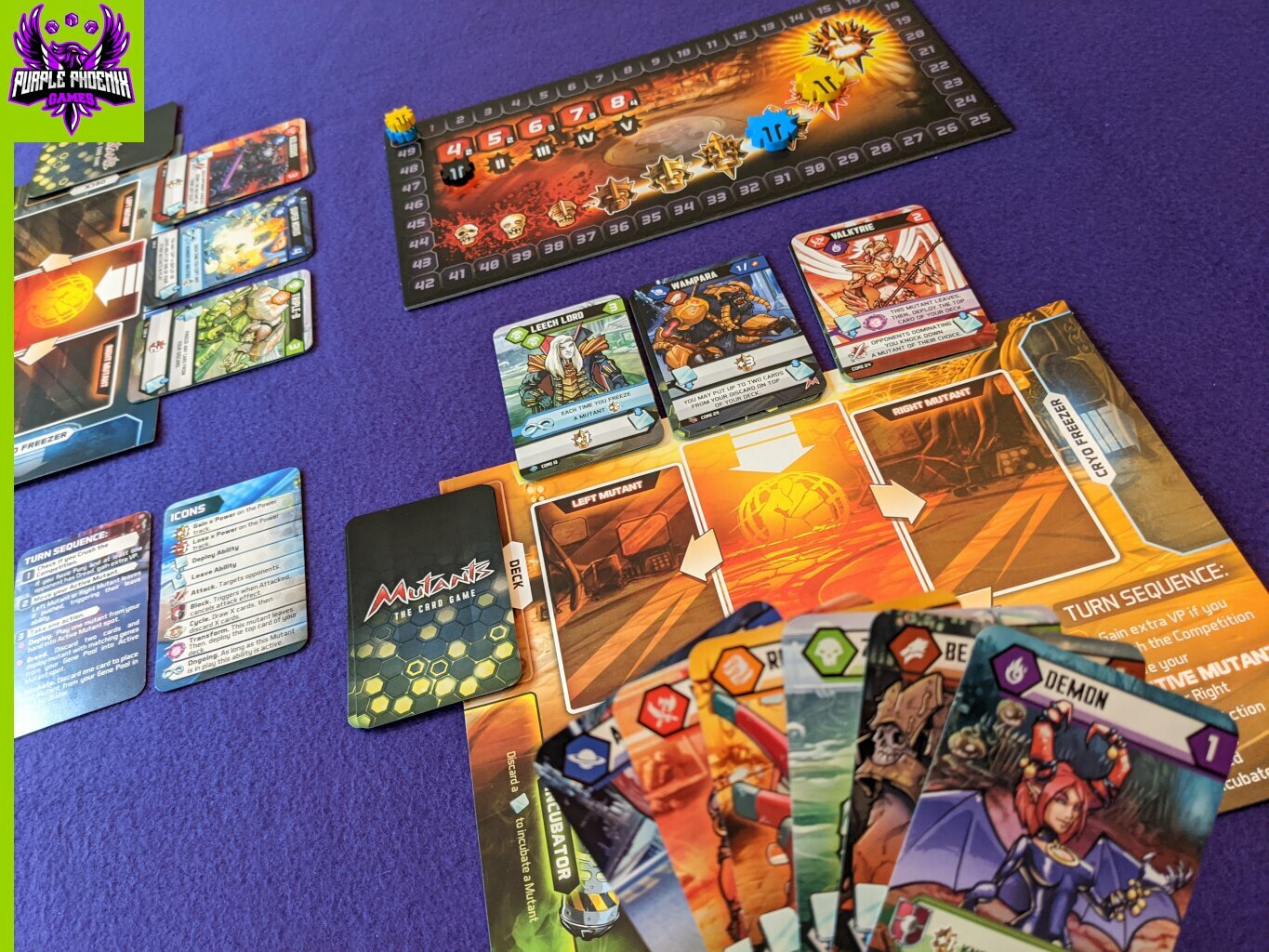
To setup, well, there are many steps. The biggest and perhaps most confusing step is creating the decks of mutants that will be used by players throughout the game. I will recommend you follow the rulebook for drafting your team, or simply use one of the provided pre-constructed team suggestions. Otherwise, place the main board on the table, along with the power and scoring tokens for each player. Players choose their player board according to color chosen, take their starting deck, and divide their Advanced Mutant deck into three piles, with the top card flipped face-up. Players draw a hand of six Basic Mutant cards (one of each type initially) and the battle may begin!
Mutants is played over five rounds, tracked on the main board. Each round encompasses three phases: Crush the Competition, Move Active Mutant, and Take Action. As the game progresses, the power tokens for players will be moving up and down the Power Track. If, at the start of the current player’s turn, an opponent’s power token is located in one of the last three Power Track spaces (named the Dread Zone), and the current player’s token is on the Fury Space (furthest along the Track), then the current player will score immediate bonus points by Crushing the Competition.
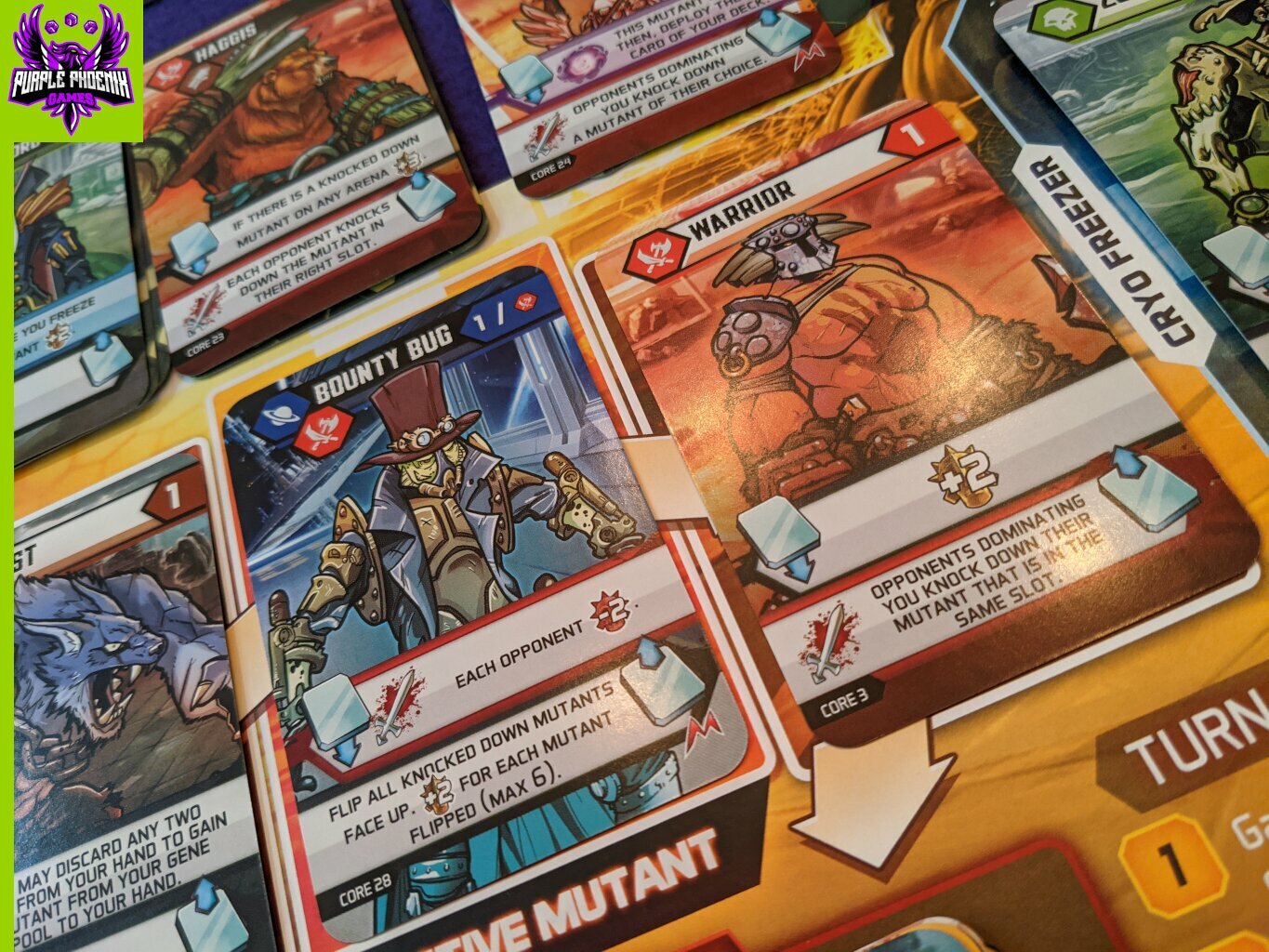
The first turn will not utilize the Move Active Mutant phase, but on subsequent phases, this will need to be resolved. A player’s board consists of three main slots: Left Mutant, Active Mutant, and Right Mutant. Mutants may only enter the Active Mutant slot in the middle, so if a Mutant is currently placed in that slot, it will need to be moved either to the Left or Right slot, at the player’s discretion. Should all slots be filled, one of the Mutants will need to be moved off the board to make room for the new one. Once this happens, the Mutant’s Leave Ability (at the bottom of the Mutant’s card) will activate. This could give the player more Power, some Attacking abilities, or other unique abilities. Once a card leaves their slot and applies their Leave Ability, it is placed in the Discard space at the bottom of the player board.
Now that the Active Mutant slot is available, the current player may choose from one of the Take Action choices: Deploy Mutant, Breed, or Incubate. To Deploy Mutant, simply play a card from hand to the Active Mutant slot, activating the Deploy Ability once placed. These Deploy Abilities could range from cycling (draw a card from the deck and discard a card from the hand), gaining Power, or even reactionary abilities. Breeding Mutants requires the player to discard two cards from hand whose type icons match those of one of the face-up Advanced Mutant cards atop the player board. Discarding these cards allows the Advanced Mutant to enter play on the Active Mutant slot. Finally, the player may instead choose to Incubate an Advanced Mutant from one on offer by discarding one card (and it does NOT need to match icons) and placing the chosen Advanced Mutant on the Incubator slot on the left side of the board. These incubated Advanced Mutants will be placed atop the draw deck at the end of the round, so it will be drawn during the next round.
If at any time a player needs to draw a card from their draw deck and there are no cards remaining, they will first choose a card from their Discards to Freeze, by placing it in the appropriate Cryo Freezer on the right side of the player board. Frozen cards will be scored at game end, and can really boost a final score.
At the end of the round players will perform a few more tasks and setup for the next round. First, the Power Tokens are scored according to which is in first place along the Track and so on, using the red and black VP numbers printed on the main board. The round marker is advanced one level, and each Mutant in Incubation is moved to the players’ draw decks. Players then draw a new hand of six cards, and Power Tokens are reset according to the previous round’s placement, in reverse order. The player whose Power Token is now furthest behind will be the starting player for the next round.
Play continues in this fashion of moving Mutants around, taking actions, and jockeying for supremacy along the Power Track until the end of the fifth round. At that time, the final VPs are awarded for the Power Track placement, and all cards in the Cryo Freezer are tallied. The player with the most VP at the end of the game is the winner of Mutants!
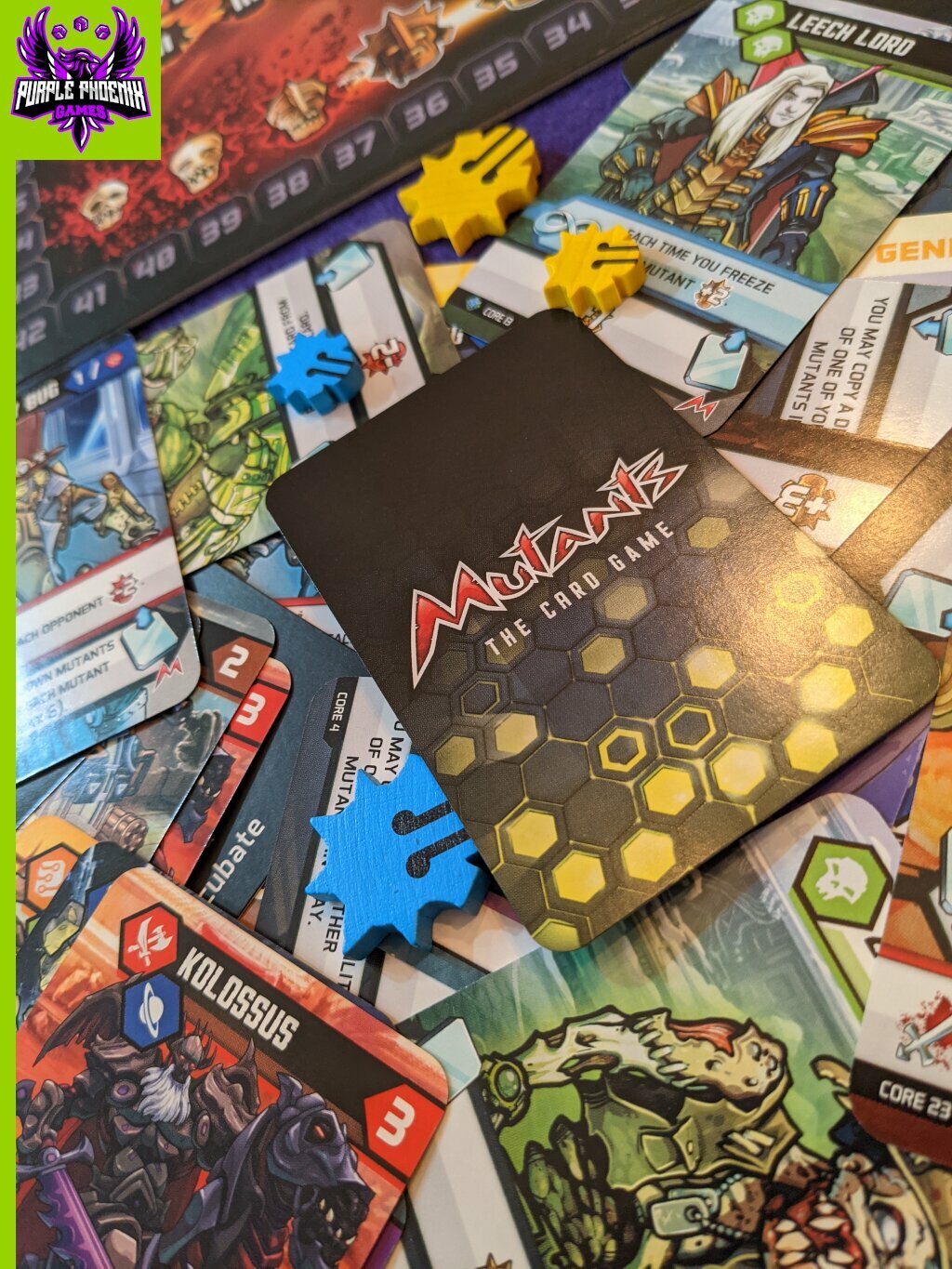
Components. Okay, I have some thoughts here, and more than just, “oh hey, they are nice.” The game comes with a bevvy of cards, some wooden tokens, and a couple “boards.” I used quotations because only the main board is an actual board. The player boards are slick cardstock and, while functional, feel a little cheap. The cards themselves are all super great and the artwork is appropriate and quite excellent. I have a couple issues with some other components, however. The Power and Score Tokens are the only wooden components in the box and I just do not understand them. They look like Sauron/Spartan helmets, or someone who is crying because they just shoved a fork into the power outlet. Now, there are four of each type in different colors, and though the colors aren’t the primary colors we have grown to accept for our player colors, they have swapped out the green for purple, and I think the game is colorful enough to include more exciting colors. So I’m not a fan of the Power and Score Tokens. Similarly, I don’t really understand the insert that comes with the game. I see that it is setup to hold TONS of cards, and maybe there were/are plans for many many expansions, but the base game can be housed in two of the 14 total card slots provided. Also, I have no idea what is going on in the middle of the insert, but I also don’t own any of the expansions yet, so hopefully those molded spots are actually meant to hold something. Everything else, though, is great!
For me, art and components are very high on my list of items that affect how much I enjoy a game. Now, I can live with the wonky Power and Score Tokens, and I suppose I don’t mind carrying around a giant box of cards, when the game could ALMOST fit inside a box the size of Bohnanza or Point Salad or the like. That said, I have definitely enjoyed my plays of Mutants. The rulebook is a little daunting at first, mostly because the theme is unique and the game style is similarly different to me. Once the game gets into the thick of it, though, strategy and tactics take over so strongly. Each card is carefully considered for its usability as either a card to be played or discarded for varying effects. I love that about this game.
This is certainly more than a “deck builder,” even though deck building and hand management are at the forefront of the mechanics here. You aren’t necessarily building your deck and cycling through it quickly enough for me to consider this a true deck builder alone, but using each card for different purposes certainly increases the replayability with Mutants. When is the best time to freeze a card versus keeping it in the deck for its abilities? Do I move off the Left Mutant or keep it around for another turn? Why did I pick these Advanced Mutants during the draft, when I have crappy supporting cards? Every play of Mutants has been a wonderful challenge of maximizing my deck and choosing just the right opponents to attack with my monstrous creations. Purple Phoenix Games gives this one a horrifically delightful 5 / 6. I hate having to bling out my games, but I think I will probably try to find replacements for the Power and Score Tokens (though maybe a little spray paint will help?), and look into grabbing one or all of the expansions so that I may be able to fill up that confusing insert. I look forward to my next games of this, and to getting the word out on this little gem I finally tried.