
Search
Search results

Purple Phoenix Games (2266 KP) rated Deep Blue in Tabletop Games
Mar 17, 2022
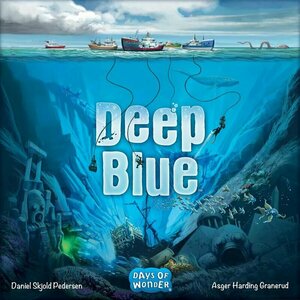

A couple of months ago, Travis was in town, so he and I went over to Josh’s place to get a day of gaming in. It was an awesome time to play together, and to get to experience some new games for each of us. While we were there, we got to talking about some of the games in Josh’s collection, and he pulled out Deep Blue. He’d had it for a while, but had since gotten another game that he felt did the same things but better. So he asked if either of us wanted to take it off his hands. I said sure, as I’d never played the game before. Now that it’s a part of my collection, is it going to stay there? Or will my feelings mirror Josh’s with regards to the gameplay?
Deep Blue is a nautical game for 2-5 players of deck building, hand management, and a bit of push your luck. In it, players take on the roles ship Captains who are racing to collect treasures from undersea wrecks. Players will be hiring Crew members, sailing across the sea, and sending divers down to wrecks to salvage any valuables. The race is on, though, because you are not the only Captain on this treasure hunt… Throughout the game, players will stumble across 4 Wrecks that make up a Sunken City. Once all 4 areas of the Sunken City have been discovered and searched, the game ends. The player who earns the most VP from their collected treasures by the end of the game is declared the winner!
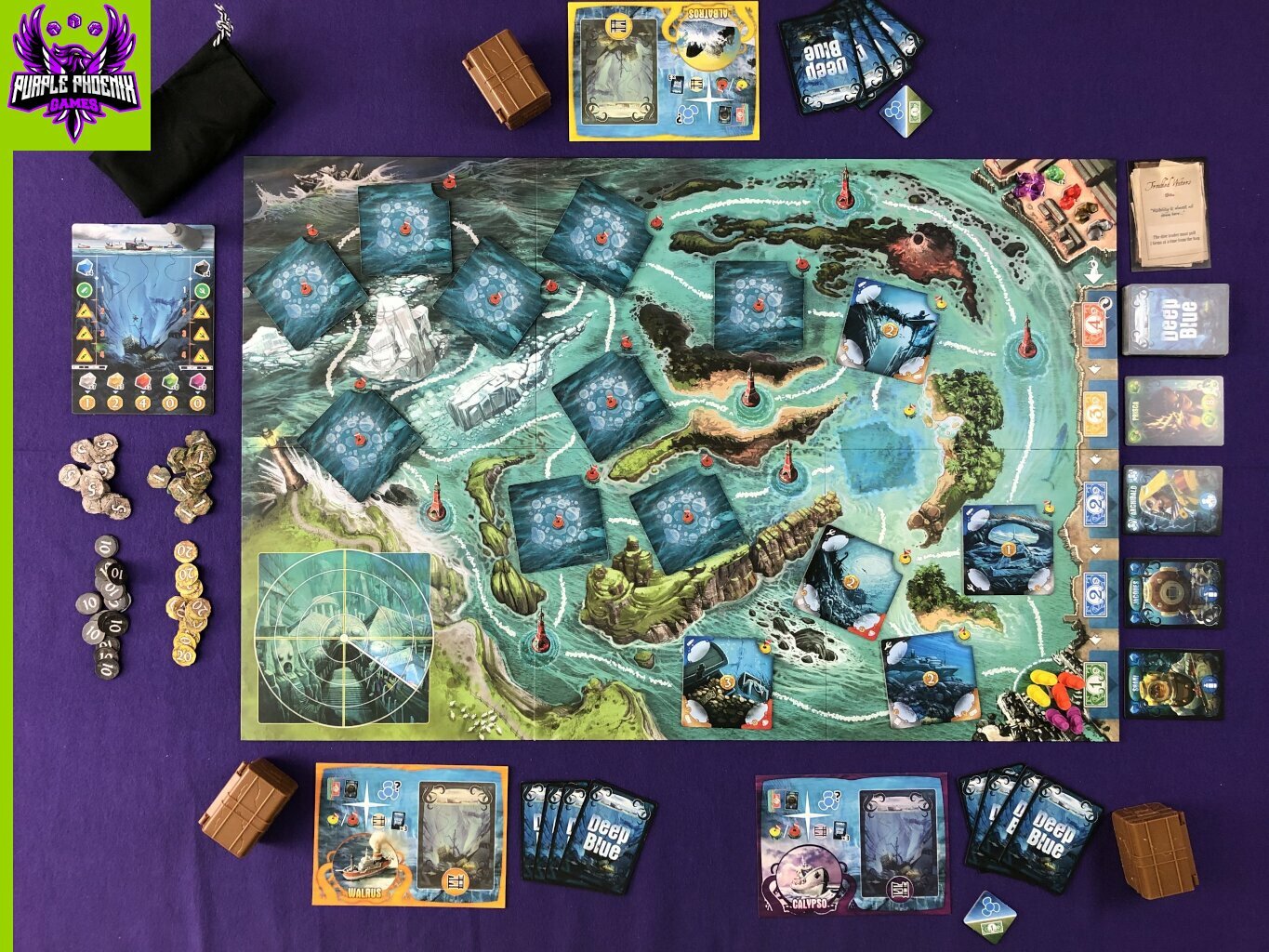
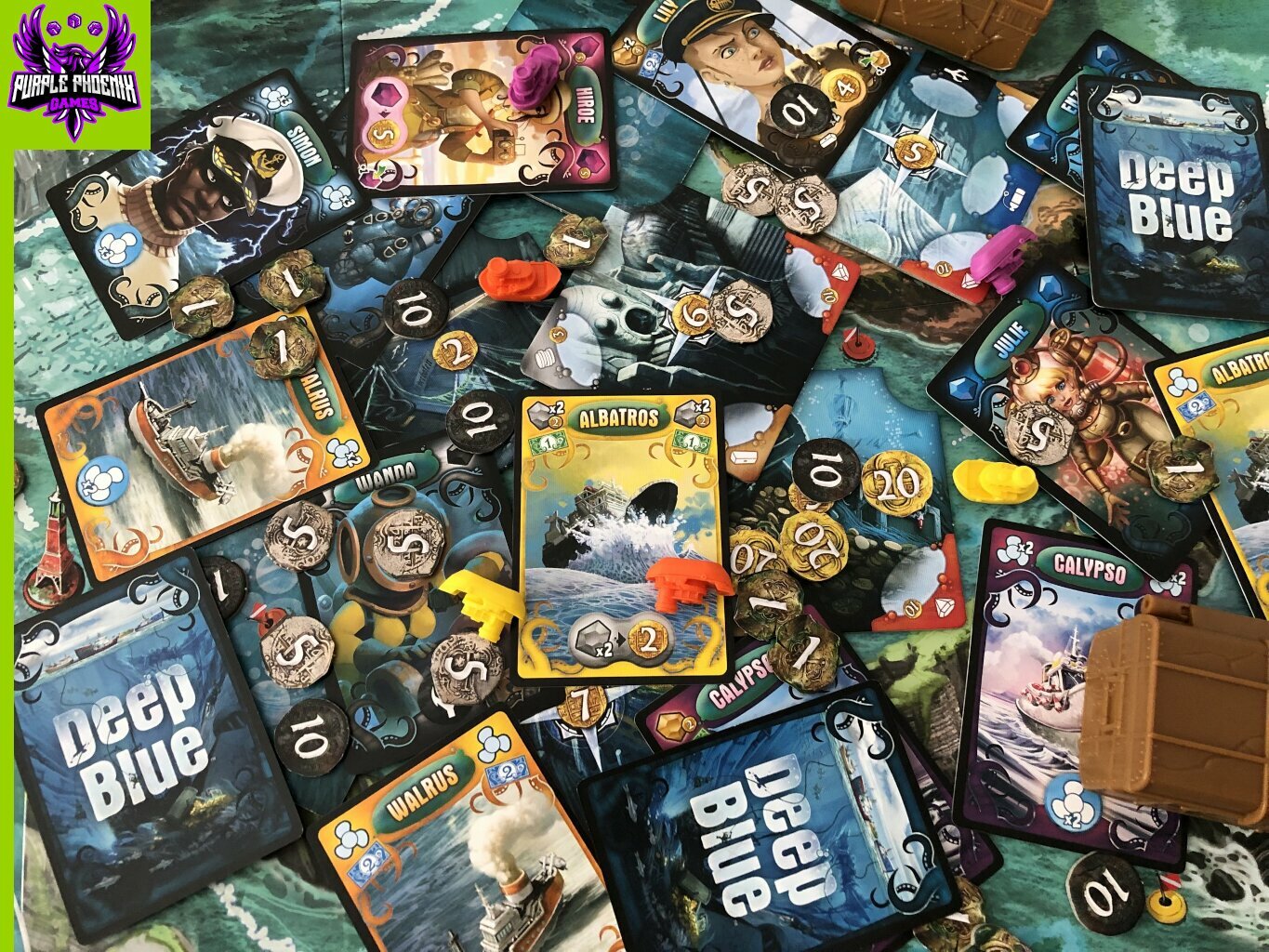
To setup for a game, follow the instructions in the rulebook – there are simply too many to detail here. The basic gist of setup is to create a market of Crew cards, shuffle and randomly distribute Wreck tiles across the board, and create a Gem pool. Each player will receive a player mat and starting cards in their chosen color, as well as 2 ships to be placed on the starting space of the board. Players will also get a treasure chest, in which they will keep their VP throughout the game. Set the Dive Site board, Gem bag, and VP tokens off to the side. Select a starting player, deal out starting tokens accordingly, and the game is ready to begin! Pictured below is the setup for a 3-player game.
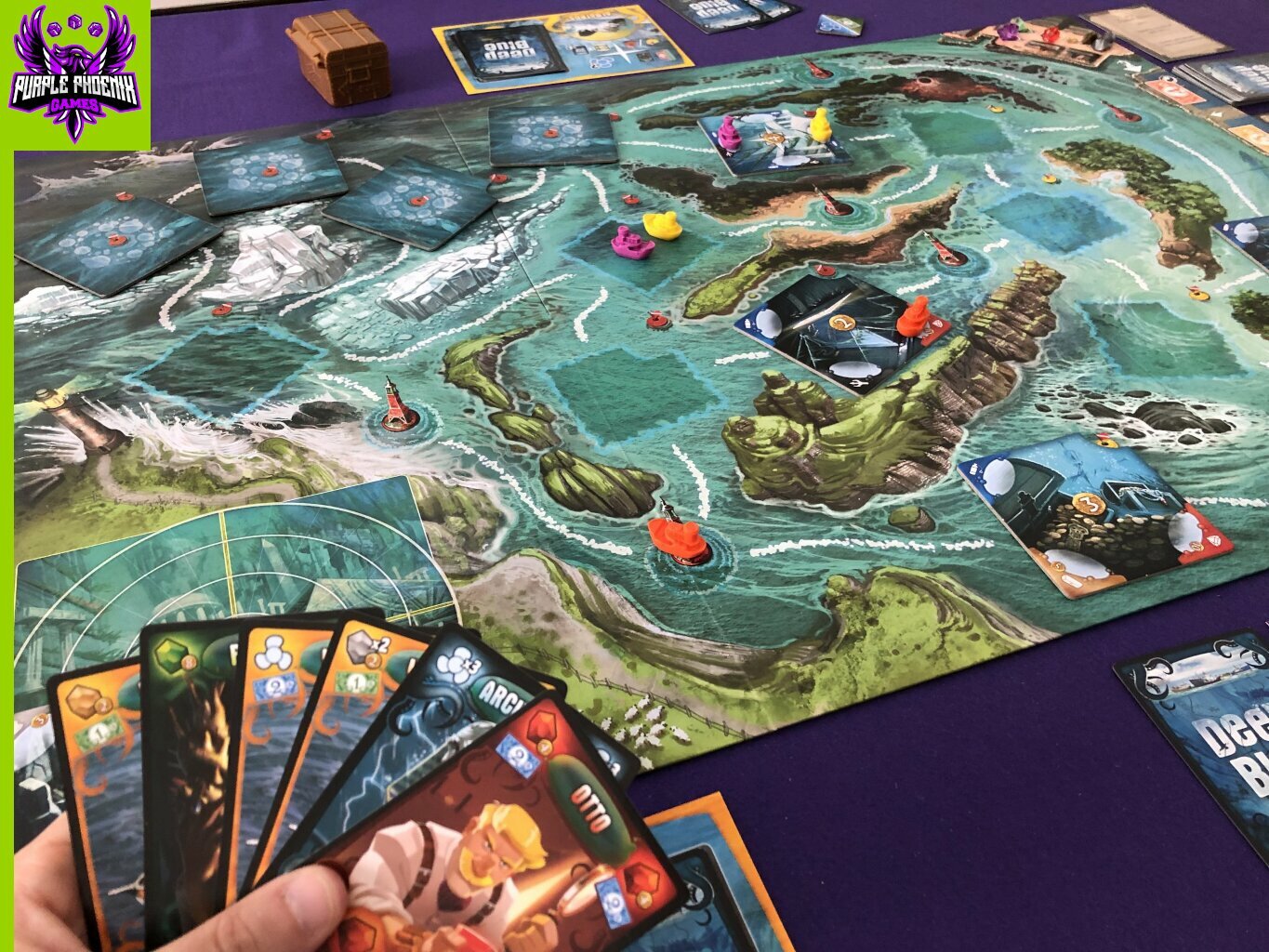
On your turn, you will take one of four possible actions: Recruit a Crew Member, Sail, Rest, or Dive. Throughout the game you will be building your personal deck by Recruiting Crew Members. These new Crew offer unique abilities and scoring powers to be used during Dives. In order to recruit a Crew Member, you must pay the corresponding cost listed by its location in the market. To do so, you will play cards from your hand with $ symbols that equal the required cost. Once you play a card from your hand, it goes facedown onto the Rest area of your player mat. Take the Crew Member you just hired directly into your hand, and move the Market cards down to fill in the empty space, drawing a new card for the final slot. If you choose to Sail, you will play a number of cards from your hand with the Propeller icon. The number of icons dictates how many spaces you may sail. You can use all of your movement on one of your ships, or you can break movement across both ships. If you end a move on a face-up Wreck tile, you will ‘anchor’ your boat to one of the open scouting spots. These scouting spots offer special scoring benefits during the Dive on this tile. If you end movement on a face-down Wreck tile, first you will flip it face-up, and then anchor your boat. When landing on a buoy or an empty dive site, nothing happens.
On any turn, you may instead choose to Rest. To perform this action, you will shuffle all cards that reside on the Rest area of your player mat, and then draw only the 3 topmost cards into your hand. This is the action that allows you to refresh your hand, as you play more cards and your hand starts to dwindle. The final action choice is to Dive. This action is the crux of the game. When you have a boat on a Wreck tile, you may choose to start a Dive. The first step is to declare your Dive – decide which Wreck to Dive if your boats are on different Wreck tiles. Before the Dive begins, any opponents who have boats on adjacent Wreck tiles may move their boats to your Wreck in hopes of also profiting from the Dive. When all eligible boats have been moved to the Wreck, you will then officially begin the Dive. Take the Gem bag and Dive Site board. You will then draw Gems out of the bag, one-by-one, resolving them as necessary. Red, Gold, Silver, Green, and Purple gems are treasures, and can earn you VP. Blue and Black gems are Hazards that must be defended against in order to continue the Dive.
After a Gem is drawn and placed on the Dive Site board, players may choose to play a Crew Member to increase their VP earned. For example, one card allows you to earn 8 VP for a Green gem, instead of 0. To defend against hazards, players may play Crew from their hands who have the ability to negate the hazard, or may use the special ability of their scouting spot on the Wreck tile. If you are unable to defend against a hazard, you are forced to resurface and leave the Dive. The Dive continues in this fashion, until either the active player decides to end the Dive, or when they no longer have the ability to defend against hazards. Any players who still have boats at the Dive Site will collect VP from Crew cards they played, as well as a base amount of VP for the different Gems that were drawn. Once a Dive has been performed at a Wreck, that tile is removed from the game, leaving an empty dive site behind. If players have performed a Dive at one of the 4 Sunken City tiles, it is removed from the board, but placed on its corresponding space in the corner of the board. After all 4 Sunken City tiles have been moved to the corner of the board, the game immediately ends. Players will count up all the VP collected throughout the game, and the player with the highest score is declared the winner!
So how do I feel about Deep Blue overall? I would have to say that it’s fine. Just fine. There are some elements that I really enjoy, but others that kind of frustrate me. What I enjoy – the bits of strategy involved, and the awesome components. What I don’t enjoy – the pacing of the game and the imbalance of actions. To touch on the pros first, this game does require some strategy. You have to decide where to Sail, which Crew to recruit, which Crew to play and when to play them, etc. VP are earned by participating in Dives, so you want to make sure you can be at as many Dives as possible. That means keeping ships close to opponents to profit from any dives they may choose to initiate. Another interesting strategic element is the Rest action. You shuffle your discard pile, but then only draw the 3 topmost cards into your hand. You might not always draw what you were wanting, but you are always allowed to take a Rest action, regardless of how many cards are in your discard. There is no hand limit in this game, so do you rest every other turn to ensure you have almost all cards in your hand? Or do you dwindle your hand down in order to perform other actions instead? It’s all about your strategy, and you never quite know what your opponents are trying to do.
Now for the cons. The pacing of the gameplay feels really slow to me. You are only allowed to perform 1 action per turn, so it seems like the game takes a while to really get going. At first, everyone is going to be wanting to Sail, as all players start in the same starting area of the board. You want to get your ships out there ASAP. But then you run out of cards, so you have to take a turn to Rest and get those cards back. You’re taking a bunch of little turns to accomplish any one bigger thing, and that bogs down the gameplay for me. If you were able to perform 2 actions per turn, that would probably alleviate some of this frustration, as it would allow you to progress more quickly than by taking only a single action. Another aspect I mentioned is the imbalance of actions. The Recruit, Sail, and Rest actions all feel to me like they are on the same level, but the Dive action is different. Which in and of itself isn’t necessarily a bad thing. But the process of the Dive action is vastly different than any of the other actions, to the point that it kind of feels like a different game to me. For half of the game, you’re playing this game of strategy, deck building, and optimizing placement across the board. But for the other half, it turns into a push-your-luck frenzy that seems disjointed from the rest of the game to me. No matter how strategic and careful you are with your actions, it ultimately comes down to the luck of the draw.
To touch on components for a minute – the production quality of this game is awesome. The board, Dive Site board, and VP tokens are nice chunky cardboard. The cards are colorful, have cool artwork, and are sturdy. And the treasure chests are awesome little plastic chests that definitely are holding up well. The Wreck tiles are big and thick, the Gems are cute, and the ships are fun to play with. So overall, this game is made very well.
You can probably tell by now that I have mixed feelings about Deep Blue. There are aspects that I like, but other aspects that negate some of those positive attributes. I was psyched for a cool nautical deck builder where I could really flex my strategy, but got more push-your-luck than I was anticipating. Deep Blue will probably stick around in my collection for the time being. But, like Josh, I will probably find something that gives me the same vibes but done better. It’s a game that I’ll pull out from time to time, but definitely not one that’s going to break into my Top 10. With that said, Purple Phoenix Games gives it a sunken 4 / 6.
Deep Blue is a nautical game for 2-5 players of deck building, hand management, and a bit of push your luck. In it, players take on the roles ship Captains who are racing to collect treasures from undersea wrecks. Players will be hiring Crew members, sailing across the sea, and sending divers down to wrecks to salvage any valuables. The race is on, though, because you are not the only Captain on this treasure hunt… Throughout the game, players will stumble across 4 Wrecks that make up a Sunken City. Once all 4 areas of the Sunken City have been discovered and searched, the game ends. The player who earns the most VP from their collected treasures by the end of the game is declared the winner!
To setup for a game, follow the instructions in the rulebook – there are simply too many to detail here. The basic gist of setup is to create a market of Crew cards, shuffle and randomly distribute Wreck tiles across the board, and create a Gem pool. Each player will receive a player mat and starting cards in their chosen color, as well as 2 ships to be placed on the starting space of the board. Players will also get a treasure chest, in which they will keep their VP throughout the game. Set the Dive Site board, Gem bag, and VP tokens off to the side. Select a starting player, deal out starting tokens accordingly, and the game is ready to begin! Pictured below is the setup for a 3-player game.
On your turn, you will take one of four possible actions: Recruit a Crew Member, Sail, Rest, or Dive. Throughout the game you will be building your personal deck by Recruiting Crew Members. These new Crew offer unique abilities and scoring powers to be used during Dives. In order to recruit a Crew Member, you must pay the corresponding cost listed by its location in the market. To do so, you will play cards from your hand with $ symbols that equal the required cost. Once you play a card from your hand, it goes facedown onto the Rest area of your player mat. Take the Crew Member you just hired directly into your hand, and move the Market cards down to fill in the empty space, drawing a new card for the final slot. If you choose to Sail, you will play a number of cards from your hand with the Propeller icon. The number of icons dictates how many spaces you may sail. You can use all of your movement on one of your ships, or you can break movement across both ships. If you end a move on a face-up Wreck tile, you will ‘anchor’ your boat to one of the open scouting spots. These scouting spots offer special scoring benefits during the Dive on this tile. If you end movement on a face-down Wreck tile, first you will flip it face-up, and then anchor your boat. When landing on a buoy or an empty dive site, nothing happens.
On any turn, you may instead choose to Rest. To perform this action, you will shuffle all cards that reside on the Rest area of your player mat, and then draw only the 3 topmost cards into your hand. This is the action that allows you to refresh your hand, as you play more cards and your hand starts to dwindle. The final action choice is to Dive. This action is the crux of the game. When you have a boat on a Wreck tile, you may choose to start a Dive. The first step is to declare your Dive – decide which Wreck to Dive if your boats are on different Wreck tiles. Before the Dive begins, any opponents who have boats on adjacent Wreck tiles may move their boats to your Wreck in hopes of also profiting from the Dive. When all eligible boats have been moved to the Wreck, you will then officially begin the Dive. Take the Gem bag and Dive Site board. You will then draw Gems out of the bag, one-by-one, resolving them as necessary. Red, Gold, Silver, Green, and Purple gems are treasures, and can earn you VP. Blue and Black gems are Hazards that must be defended against in order to continue the Dive.
After a Gem is drawn and placed on the Dive Site board, players may choose to play a Crew Member to increase their VP earned. For example, one card allows you to earn 8 VP for a Green gem, instead of 0. To defend against hazards, players may play Crew from their hands who have the ability to negate the hazard, or may use the special ability of their scouting spot on the Wreck tile. If you are unable to defend against a hazard, you are forced to resurface and leave the Dive. The Dive continues in this fashion, until either the active player decides to end the Dive, or when they no longer have the ability to defend against hazards. Any players who still have boats at the Dive Site will collect VP from Crew cards they played, as well as a base amount of VP for the different Gems that were drawn. Once a Dive has been performed at a Wreck, that tile is removed from the game, leaving an empty dive site behind. If players have performed a Dive at one of the 4 Sunken City tiles, it is removed from the board, but placed on its corresponding space in the corner of the board. After all 4 Sunken City tiles have been moved to the corner of the board, the game immediately ends. Players will count up all the VP collected throughout the game, and the player with the highest score is declared the winner!
So how do I feel about Deep Blue overall? I would have to say that it’s fine. Just fine. There are some elements that I really enjoy, but others that kind of frustrate me. What I enjoy – the bits of strategy involved, and the awesome components. What I don’t enjoy – the pacing of the game and the imbalance of actions. To touch on the pros first, this game does require some strategy. You have to decide where to Sail, which Crew to recruit, which Crew to play and when to play them, etc. VP are earned by participating in Dives, so you want to make sure you can be at as many Dives as possible. That means keeping ships close to opponents to profit from any dives they may choose to initiate. Another interesting strategic element is the Rest action. You shuffle your discard pile, but then only draw the 3 topmost cards into your hand. You might not always draw what you were wanting, but you are always allowed to take a Rest action, regardless of how many cards are in your discard. There is no hand limit in this game, so do you rest every other turn to ensure you have almost all cards in your hand? Or do you dwindle your hand down in order to perform other actions instead? It’s all about your strategy, and you never quite know what your opponents are trying to do.
Now for the cons. The pacing of the gameplay feels really slow to me. You are only allowed to perform 1 action per turn, so it seems like the game takes a while to really get going. At first, everyone is going to be wanting to Sail, as all players start in the same starting area of the board. You want to get your ships out there ASAP. But then you run out of cards, so you have to take a turn to Rest and get those cards back. You’re taking a bunch of little turns to accomplish any one bigger thing, and that bogs down the gameplay for me. If you were able to perform 2 actions per turn, that would probably alleviate some of this frustration, as it would allow you to progress more quickly than by taking only a single action. Another aspect I mentioned is the imbalance of actions. The Recruit, Sail, and Rest actions all feel to me like they are on the same level, but the Dive action is different. Which in and of itself isn’t necessarily a bad thing. But the process of the Dive action is vastly different than any of the other actions, to the point that it kind of feels like a different game to me. For half of the game, you’re playing this game of strategy, deck building, and optimizing placement across the board. But for the other half, it turns into a push-your-luck frenzy that seems disjointed from the rest of the game to me. No matter how strategic and careful you are with your actions, it ultimately comes down to the luck of the draw.
To touch on components for a minute – the production quality of this game is awesome. The board, Dive Site board, and VP tokens are nice chunky cardboard. The cards are colorful, have cool artwork, and are sturdy. And the treasure chests are awesome little plastic chests that definitely are holding up well. The Wreck tiles are big and thick, the Gems are cute, and the ships are fun to play with. So overall, this game is made very well.
You can probably tell by now that I have mixed feelings about Deep Blue. There are aspects that I like, but other aspects that negate some of those positive attributes. I was psyched for a cool nautical deck builder where I could really flex my strategy, but got more push-your-luck than I was anticipating. Deep Blue will probably stick around in my collection for the time being. But, like Josh, I will probably find something that gives me the same vibes but done better. It’s a game that I’ll pull out from time to time, but definitely not one that’s going to break into my Top 10. With that said, Purple Phoenix Games gives it a sunken 4 / 6.

Lecturio: Med School Study App
Medical and Education
App
Lecturio is the most comprehensive single-point resource for medical school: Get ready to ace your...

Chess-Studio
Games and Entertainment
App
Chess Studio is the first and only application for iPhone and iPad able to completely manage chess...
Purple Phoenix Games (2266 KP) rated Labyrinth in Tabletop Games
Sep 29, 2020
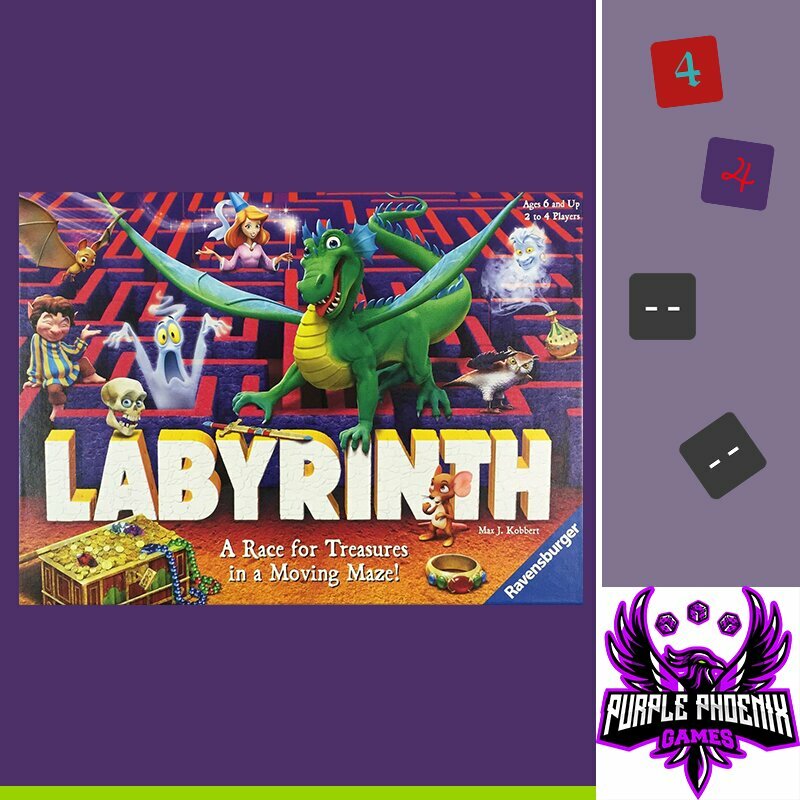
You know what’s super fun? Rediscovering one of your favorite childhood games. What’s even better is if the game itself lives up to your memories from when you were younger. Labyrinth is one of those games for me. My siblings and I played it a lot throughout our childhood, and it’s recently come back into my life. So does it still dazzle me after all of these years? Read on to find out!
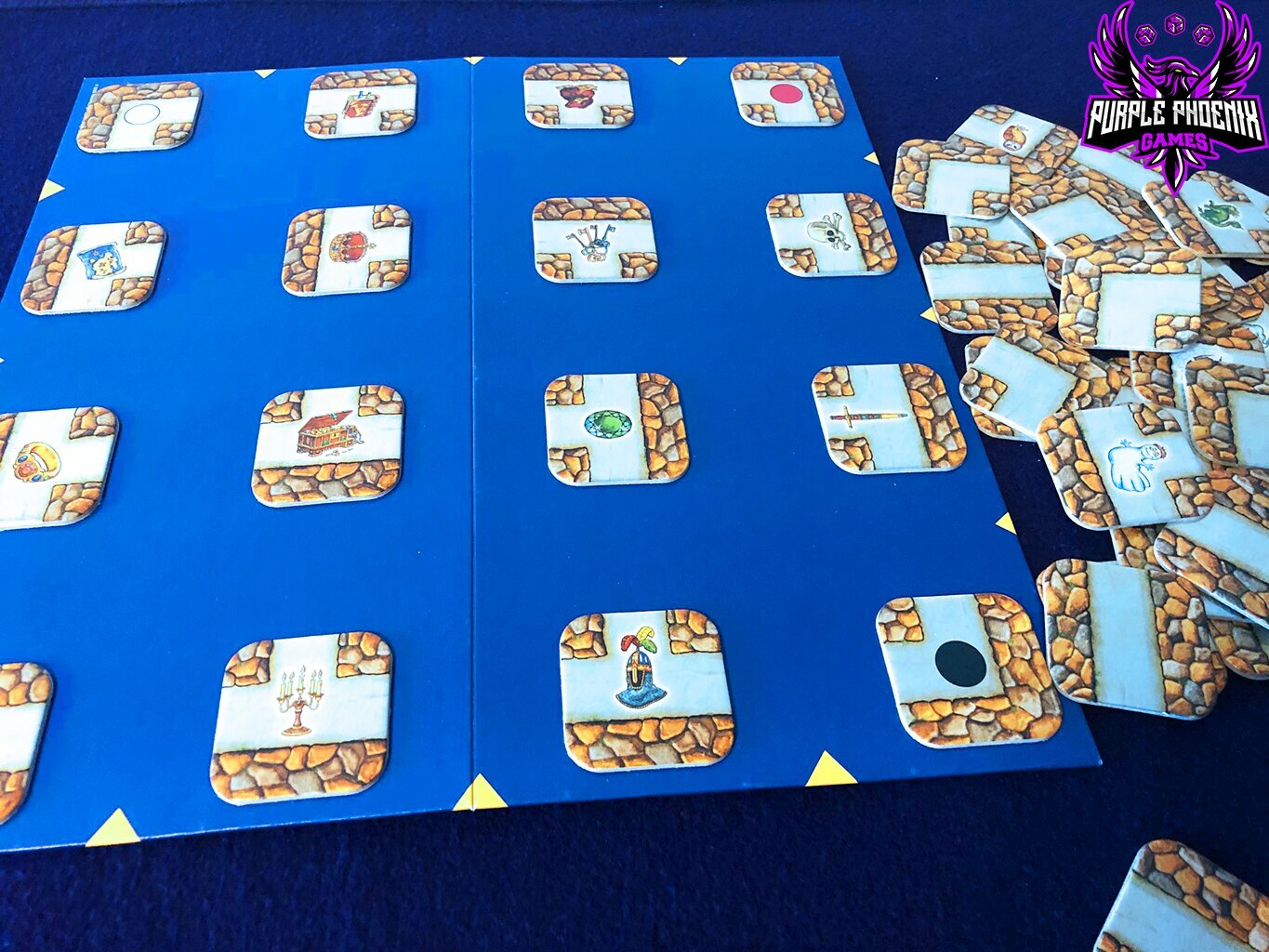
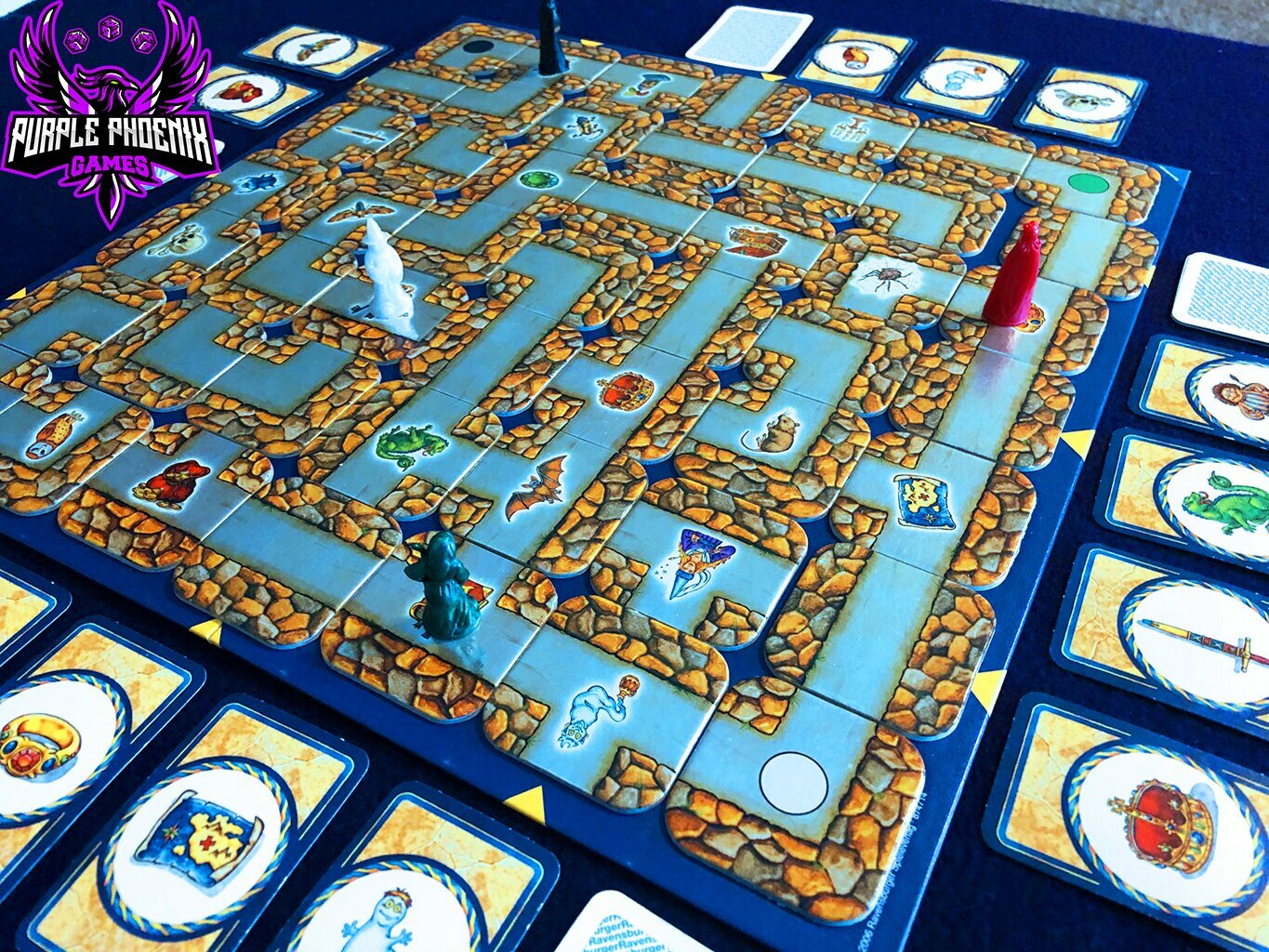
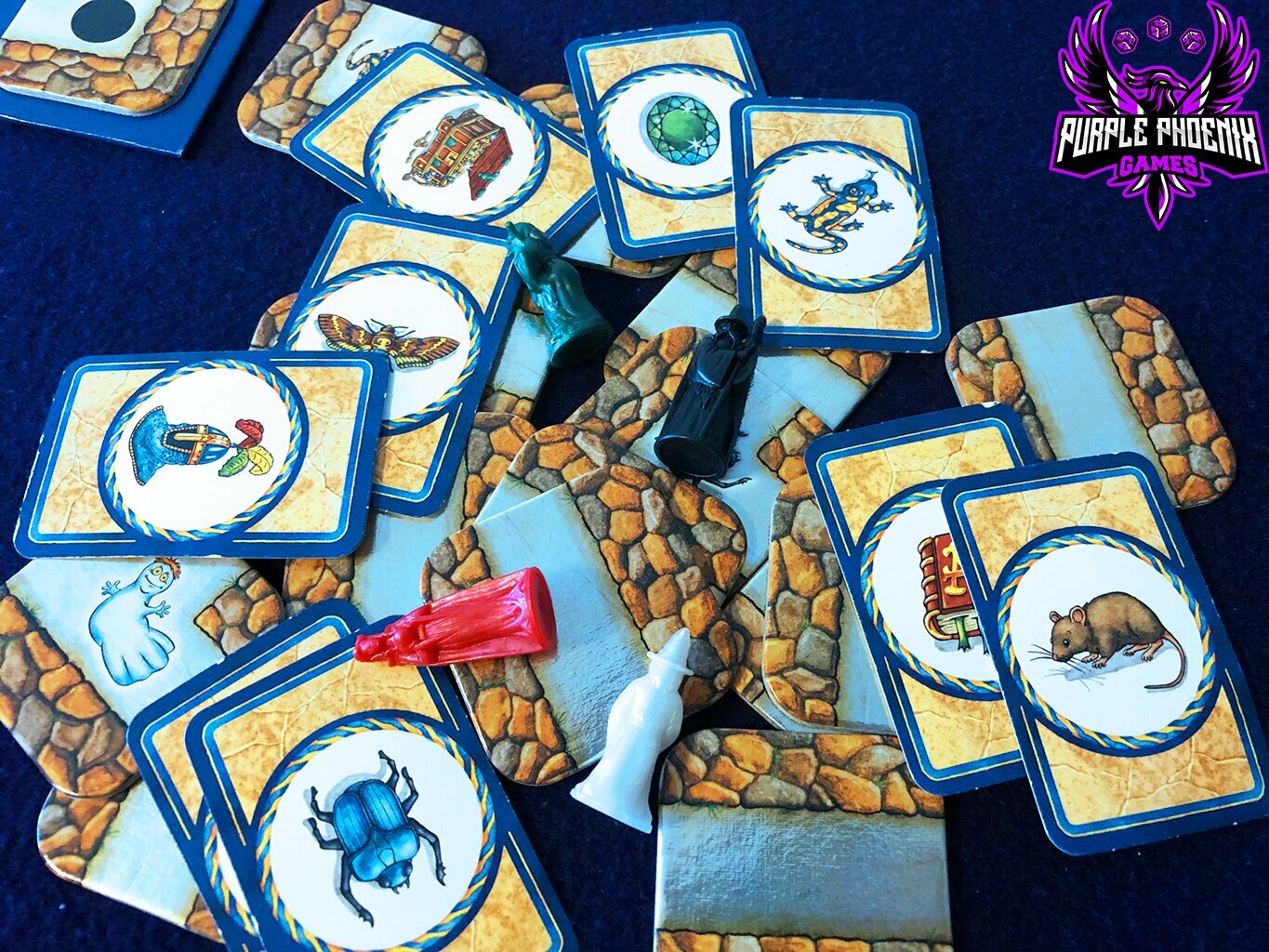
Labyrinth is a game of tile placement and route building with a modular board in which you are trying to navigate the maze to collect various treasures. To setup the game, shuffle the maze tiles and place them randomly on the empty spaces of the board. There will be 1 tile left over. Shuffle the treasure cards and split them evenly between all players. Players may only look at the top card of their stack at a time. On your turn, you are trying to get your pawn to the tile showing the treasure from your card. You do this by shifting the board and creating new pathways through the maze. Take the extra tile, and add it to a row or column, effectively shifting the entire line in one direction. Once you have shifted the maze, move your pawn as far as possible along the open pathway. If you reach your treasure tile, flip over your card. You now look at the next card in your stack, and on your next turn will begin moving towards that tile. If you don’t reach your treasure tile, that is fine. Just try to set yourself up to reach it on your next turn! The game ends once a player has flipped over all of their treasure cards and returned their pawn to its starting position.
I loved Labyrinth as a kid, and I still love it as an adult. The gameplay is pretty engaging, and now that I’m older, I can appreciate the strategy required of the game way more. One of the most fun parts of the game is the act of shifting the tiles. It’s just fun to watch the rows shift, creating new pathways and trapping opponents in dead-end routes. Not just that, but the amount of strategy you need for success is crazy! You have to be thinking several turns in advance, trying to figure out how to shift the randomly set-up maze to your maximum benefit, while also trying to anticipate how your opponents might shift the maze as well. There really is no down-time in Labyrinth, and that keeps it exciting for such a simple game.
The one thing I do not necessarily like about Labyrinth is that you are only allowed to look at your top treasure card at a time. Sometimes you spend several turns getting to a treasure tile, just to look at your next card and realize that you passed through that tile several times on your way here. I guess it would probably make the game easier overall if you could see all of your cards at once and decide your path from there. Not that I necessarily want an easier game, it can just get frustrating sometimes when you have to be traveling back and forth across the board for every single card.
Labyrinth is definitely a game that I will keep in my collection forever. It was a childhood favorite of mine, and I still love to bring it out with my siblings for some good nostalgia coupled with brain-burning strategy. I can’t wait to have children of my own so that I can play this game with them as well. Just because it’s an old game, doesn’t mean that it’s a bad game! Give it a try if you haven’t, because I think you’ll love it. Purple Phoenix Games gives Labyrinth a twisting 8 / 12.
Labyrinth is a game of tile placement and route building with a modular board in which you are trying to navigate the maze to collect various treasures. To setup the game, shuffle the maze tiles and place them randomly on the empty spaces of the board. There will be 1 tile left over. Shuffle the treasure cards and split them evenly between all players. Players may only look at the top card of their stack at a time. On your turn, you are trying to get your pawn to the tile showing the treasure from your card. You do this by shifting the board and creating new pathways through the maze. Take the extra tile, and add it to a row or column, effectively shifting the entire line in one direction. Once you have shifted the maze, move your pawn as far as possible along the open pathway. If you reach your treasure tile, flip over your card. You now look at the next card in your stack, and on your next turn will begin moving towards that tile. If you don’t reach your treasure tile, that is fine. Just try to set yourself up to reach it on your next turn! The game ends once a player has flipped over all of their treasure cards and returned their pawn to its starting position.
I loved Labyrinth as a kid, and I still love it as an adult. The gameplay is pretty engaging, and now that I’m older, I can appreciate the strategy required of the game way more. One of the most fun parts of the game is the act of shifting the tiles. It’s just fun to watch the rows shift, creating new pathways and trapping opponents in dead-end routes. Not just that, but the amount of strategy you need for success is crazy! You have to be thinking several turns in advance, trying to figure out how to shift the randomly set-up maze to your maximum benefit, while also trying to anticipate how your opponents might shift the maze as well. There really is no down-time in Labyrinth, and that keeps it exciting for such a simple game.
The one thing I do not necessarily like about Labyrinth is that you are only allowed to look at your top treasure card at a time. Sometimes you spend several turns getting to a treasure tile, just to look at your next card and realize that you passed through that tile several times on your way here. I guess it would probably make the game easier overall if you could see all of your cards at once and decide your path from there. Not that I necessarily want an easier game, it can just get frustrating sometimes when you have to be traveling back and forth across the board for every single card.
Labyrinth is definitely a game that I will keep in my collection forever. It was a childhood favorite of mine, and I still love to bring it out with my siblings for some good nostalgia coupled with brain-burning strategy. I can’t wait to have children of my own so that I can play this game with them as well. Just because it’s an old game, doesn’t mean that it’s a bad game! Give it a try if you haven’t, because I think you’ll love it. Purple Phoenix Games gives Labyrinth a twisting 8 / 12.
Tavarua
5.0 Rate It
Tabletop Game
Tavarua is a 1-6 player competitive surfing board game. In Tavarua you are a surfer in a surf...
Boardgames SurfingGames 6playerGames
Purple Phoenix Games (2266 KP) rated Abyss in Tabletop Games
Aug 5, 2021


I am not a great swimmer. For several years of my life I would avoid water at all costs. I have since grown to love it, but would still freak out a bit if a crab came towards me. I’m kind of a baby like that. I do so love underwater scenes and the wildlife, so I was bound to enjoy Abyss. Throw in some of the most amazing artwork in all of gaming and you have a hit, right?
Abyss is a push your luck, set collection, hand management, fantasy card drafting game for two to four players. In it players are attempting to gain the most Influence Points to rule the underwater kingdom by recruiting allies and Lords, and controlling locations. The game ends once a player recruits their seventh Lord or if the Lords cards run out before the Court can be refilled.
To setup, lay out the board, shuffle the Exploration cards (starfish backs) and place in the upper left corner. Shuffle the Lord cards (trident backs) and place the deck in the lower left corner. Reveal Lords to each of the spaces drawn to the right of the deck. This is the Court. Shuffle the Monster tokens and place in a messy pile near the board. Next to these place all the Key tokens. Display the Threat Tracker board with the Threat token on the first space. Shuffle the Location tiles into a stack and reveal the first one. Give each player a pearl in a shell cup and the game is ready to begin!
On a player’s turn they will follow the basic structure of Plotting at Court (by spending pearls to reveal more Lords), Taking One Action (by Exploring the Depths, Requesting Support from the Council, or Recruiting a Lord), and Controlling a Location.
Plotting at Court is simply paying pearls to reveal more Lords at Court.
The action choices begin with Exploring the Depths. This is the push your luck portion of the game where players will reveal cards from the top of the Exploration deck one by one, offer the card to their opponents for purchase (payable to the active player in pearls), and then deciding to continue or take into hand. These cards include members of five allied races of underwater species numbered in strength from one to five and monsters. Fighting monsters is an auto-win and the spoils are what is reflected on the Threat Tracker. If players decide to pass, they will move the Threat token down by one level and improve the treasure won when destroying a monster. Any allies that are undrafted will be sorted by family and placed on the appropriate space on the board.
To Request Support from the Council players will take the entire stack from one family on the board. Again, these are made up of the cards that were undrafted from previous Exploring the Depths actions.
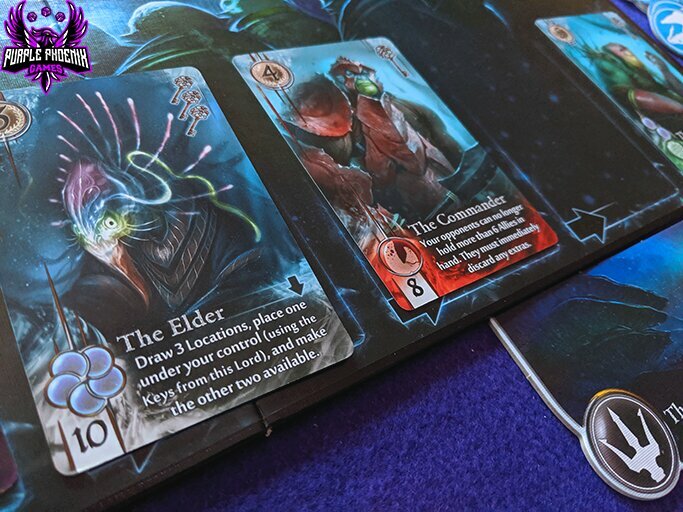
Finally, Recruiting a Lord players will be spending their Exploration cards to combine strength values and family types to appease the Lords they wish to recruit. Players will analyze the strength needed on the bottom left of the Lord card along with the number and color of bubbles above the strength number to determine from which families cards will need to be paid. Lords will have special powers that can be used throughout the game until you use them to Control Locations.
Lords and monster tokens afford players keys, and once players accumulate three keys they MUST Control a Location. To Control a Location players will draft a face-up Location tile or draw one to four tiles and draft one of them. Also, players will sacrifice their Lords (and their special powers) to, well, lord over Locations as super powerful property managers. This is done by covering up the special Lord powers with the Location tiles.
Play continues in this fashion of quick turns until a player recruits their seventh Lord or if the Lords cards run out before the Court can be refilled during a Plot at Court action.
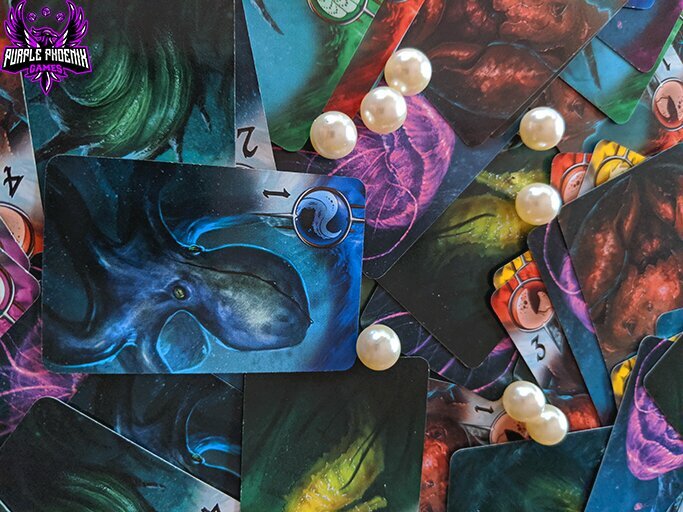
Components. As I mentioned in my open, Abyss boasts some of the most magnificent art ever to grace a board game. The aesthetic coupled with the theme makes for a gorgeous game on the table. The cardboard is all good quality and thick, the cards are good quality as well. The black plastic shells and pearls they hold are so nice to play with and I find myself rolling those pearls as fast as I can within the shells and inevitably spilling them everywhere.
The game play is also quite solid. I like drafting games quite a bit and this delivers a lot of drafting in different locations. You draft Exploration cards and Location tiles to beef up your mini empire. Using the Lords as special power cards but having to cover them up to help control a Location is a clever mechanic and helps with any sort of runaway leader issue. I did not touch on a couple rules because they can be a little confusing to new players (ie the affiliation of allies), but even new gamers can appreciate what Abyss does and how beautifully it accomplishes its task.
I cannot overstate how gorgeous this game is and how much I enjoy being able to pull it off the shelf and set it up to people who have never seen it. I mean, even just the box cover, which is a giant face and no text, is very impressive and helps set the tone for the dark but interesting experiences held within. Purple Phoenix Games gives Abyss a boding 14 / 18. Pick it up, post a picture of which box cover you received, and tag us in the post so we can compare.
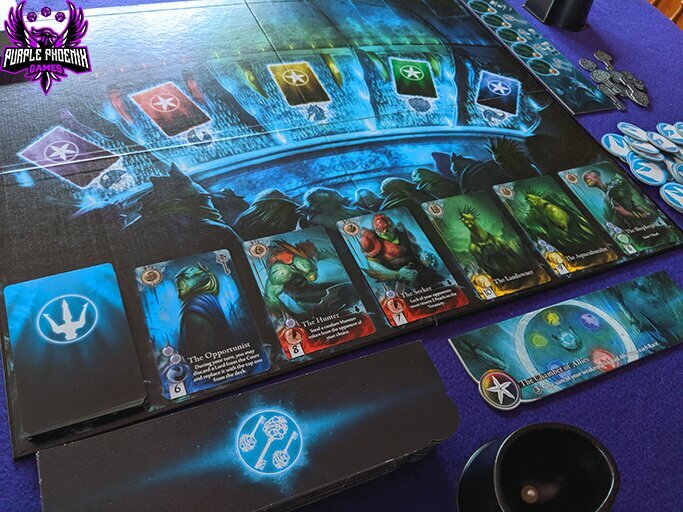
Abyss is a push your luck, set collection, hand management, fantasy card drafting game for two to four players. In it players are attempting to gain the most Influence Points to rule the underwater kingdom by recruiting allies and Lords, and controlling locations. The game ends once a player recruits their seventh Lord or if the Lords cards run out before the Court can be refilled.
To setup, lay out the board, shuffle the Exploration cards (starfish backs) and place in the upper left corner. Shuffle the Lord cards (trident backs) and place the deck in the lower left corner. Reveal Lords to each of the spaces drawn to the right of the deck. This is the Court. Shuffle the Monster tokens and place in a messy pile near the board. Next to these place all the Key tokens. Display the Threat Tracker board with the Threat token on the first space. Shuffle the Location tiles into a stack and reveal the first one. Give each player a pearl in a shell cup and the game is ready to begin!
On a player’s turn they will follow the basic structure of Plotting at Court (by spending pearls to reveal more Lords), Taking One Action (by Exploring the Depths, Requesting Support from the Council, or Recruiting a Lord), and Controlling a Location.
Plotting at Court is simply paying pearls to reveal more Lords at Court.
The action choices begin with Exploring the Depths. This is the push your luck portion of the game where players will reveal cards from the top of the Exploration deck one by one, offer the card to their opponents for purchase (payable to the active player in pearls), and then deciding to continue or take into hand. These cards include members of five allied races of underwater species numbered in strength from one to five and monsters. Fighting monsters is an auto-win and the spoils are what is reflected on the Threat Tracker. If players decide to pass, they will move the Threat token down by one level and improve the treasure won when destroying a monster. Any allies that are undrafted will be sorted by family and placed on the appropriate space on the board.
To Request Support from the Council players will take the entire stack from one family on the board. Again, these are made up of the cards that were undrafted from previous Exploring the Depths actions.
Finally, Recruiting a Lord players will be spending their Exploration cards to combine strength values and family types to appease the Lords they wish to recruit. Players will analyze the strength needed on the bottom left of the Lord card along with the number and color of bubbles above the strength number to determine from which families cards will need to be paid. Lords will have special powers that can be used throughout the game until you use them to Control Locations.
Lords and monster tokens afford players keys, and once players accumulate three keys they MUST Control a Location. To Control a Location players will draft a face-up Location tile or draw one to four tiles and draft one of them. Also, players will sacrifice their Lords (and their special powers) to, well, lord over Locations as super powerful property managers. This is done by covering up the special Lord powers with the Location tiles.
Play continues in this fashion of quick turns until a player recruits their seventh Lord or if the Lords cards run out before the Court can be refilled during a Plot at Court action.
Components. As I mentioned in my open, Abyss boasts some of the most magnificent art ever to grace a board game. The aesthetic coupled with the theme makes for a gorgeous game on the table. The cardboard is all good quality and thick, the cards are good quality as well. The black plastic shells and pearls they hold are so nice to play with and I find myself rolling those pearls as fast as I can within the shells and inevitably spilling them everywhere.
The game play is also quite solid. I like drafting games quite a bit and this delivers a lot of drafting in different locations. You draft Exploration cards and Location tiles to beef up your mini empire. Using the Lords as special power cards but having to cover them up to help control a Location is a clever mechanic and helps with any sort of runaway leader issue. I did not touch on a couple rules because they can be a little confusing to new players (ie the affiliation of allies), but even new gamers can appreciate what Abyss does and how beautifully it accomplishes its task.
I cannot overstate how gorgeous this game is and how much I enjoy being able to pull it off the shelf and set it up to people who have never seen it. I mean, even just the box cover, which is a giant face and no text, is very impressive and helps set the tone for the dark but interesting experiences held within. Purple Phoenix Games gives Abyss a boding 14 / 18. Pick it up, post a picture of which box cover you received, and tag us in the post so we can compare.

Purple Phoenix Games (2266 KP) rated Haven in Tabletop Games
May 1, 2021


Have you ever been a spirit of the forest fighting to keep it from falling into the hands of a greedy nearby city? No? What about the greedy nearby city – ever been one of those? No?? Then you are in luck because Haven is all about pitting the inhabitants of the Forest against the expansion of the nearby City in a fight for the rights to the mysterious Forest. Who will champion the battlefield and further their agendas? Read on to find out!
Haven is a two player area control card game with elements of classic games in an amazingly themed skin. Players will be playing cards jockeying for position to gain Lore from the forest Elementals by winning combats and lore challenges (a la Battle Line and Hanamikoji). These battles are won and forest Elementals influenced to gain control of shrines within the forest. By claiming the majority of shrines in an enclosed area players will be able to place ownership tokens that will assist in scoring at the end of the game. The player with the most points at game’s end will be the winner!
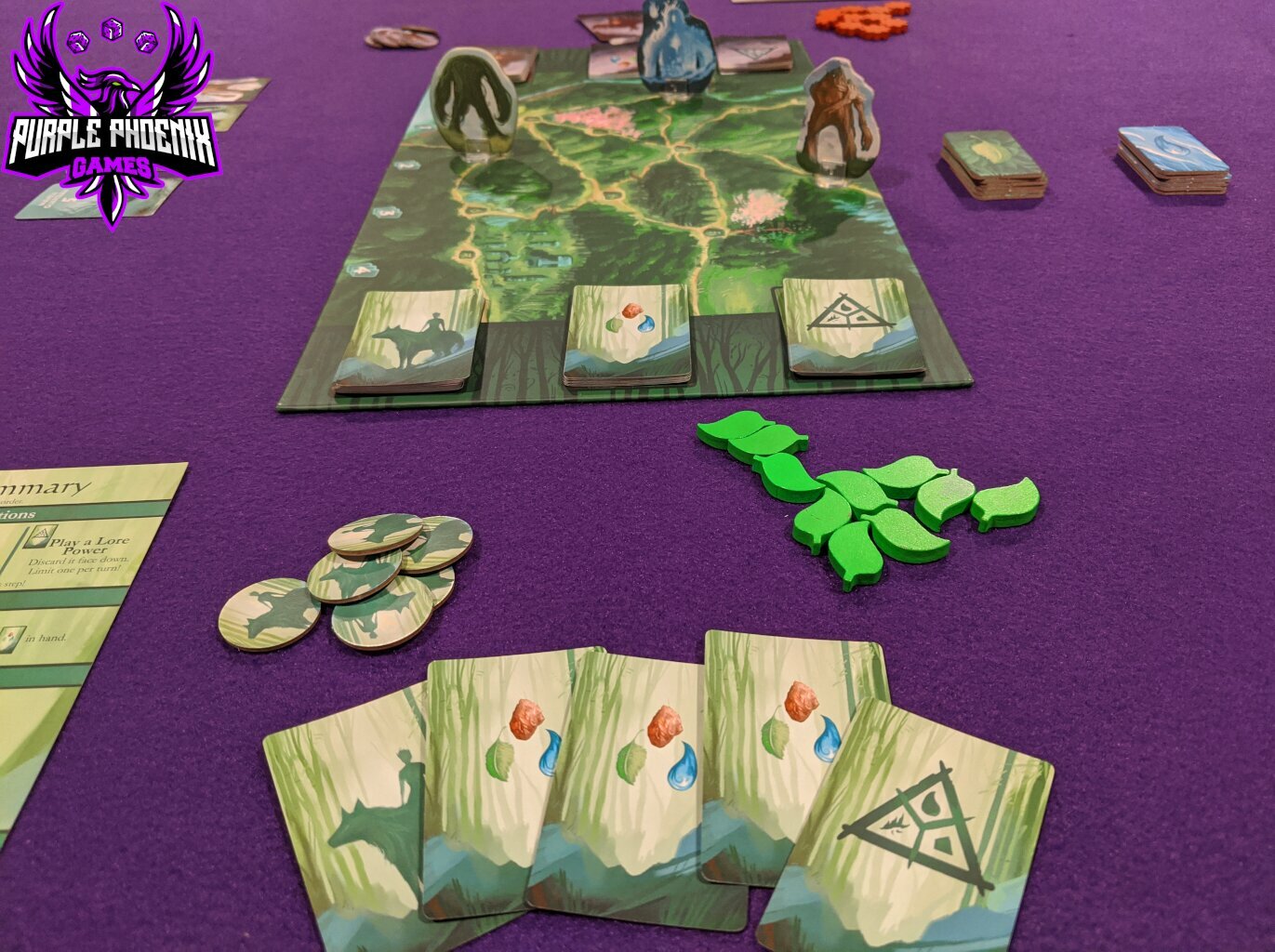
To setup, place the main game board between the players, give each player (Forest and City) their respective components, arrange each player’s starting hand of cards, randomly place forest Elementals per the rule book, and place out Lore Tokens between the players to act as the line. The game may now begin!
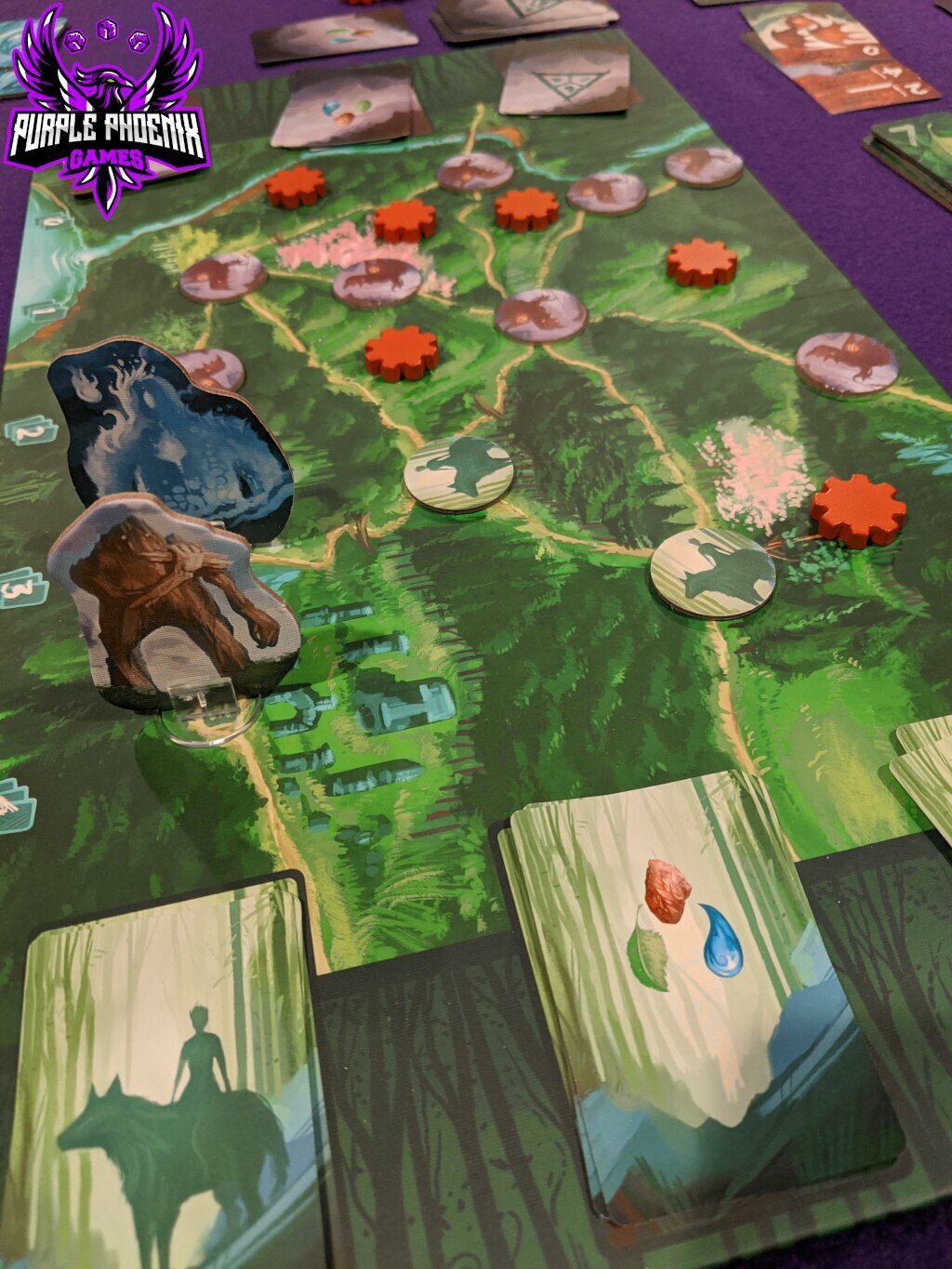
On a turn a player will take two actions to begin. These actions are playing a Lore Power card (once only per turn), placing a Seeker, or removing a Seeker from play. In Haven, players are attempting to claim shrines on the board in order to have majority in a region so they may place their tokens within that area. To achieve this, players will be battling for influence chips and Lore Tokens at the same time. Assigning Seekers to the Lore Tokens with more weapon symbols than the opponent will result in won influence chips to be placed on shrines. Owning the team of Seekers that matches or comes closest to the Lore Token’s number threshold will earn that player the Lore Token to be scored at the end of the game. A team of Seekers whose total numbers surpass the threshold on the Lore Token will bust and be disqualified from winning the Lore Token.
After two actions have been completed, players will draw two cards from any of the three decks in front of them. These are Seekers, Offerings, and Lore Power cards. These draws can be of any combination as long as the player is left with at least one Offering card at the end of their turn.
Once the player’s two cards have been drawn and added to their hand, the player will then add an Offering card to one of the Lore Tokens’ battlefield. For once a battlefield has three or more Offerings upon it, the battle for the influence chips and Lore Tokens will commence.
Elementals will be moving throughout the forest once battles are won to be conquered and pressed for precious Lore. Once an Elemental has no more shrines to visit or if one of the stacks of Lore Tokens ever runs out the game ends and points are tallied to determine if the Forest has been protected by the Forest player or if it falls to the City and its champion.
Components. This game is absolutely gorgeous, as most Ryan Laukat illustrated games are. The art style is recognizably Laukat, but the theme is a little darker than some. The board is nice sized to place between two people, and all cardboard bits are great quality. The Elemental standees are just fine (vs having minis), and all the cards are small and entirely functional. The cogeeples and leafeeples (grr) are nice touches and add a pop of color onto the board once placed. I have no issues with the components at all.
It’s obvious from my score above that I absolutely love Haven. From my very first learning game (I usually play each game solo but multi-handed before introducing to other players) I knew this is my type of game. The out-thinking of your opponents, and the playing Seekers to different Lore Tokens to win areas on the board are just wonderful here. Granted, I’ve never played Battle Line, but I have played Hanamikoji tons, and I prefer the way that mechanic is used in Haven. I have played so many area control games, but I like the movement of the Elementals from shrine to shrine as targets for players to claim on the board. I love that both sides are completely balanced and any one game could award victory to either side. Having agency over the draw piles from which you must draw cards is great. I simply love everything about this game.
It was a complete surprise to me that I would end up falling for this game as I initially picked up from my FLGS clearance rack. It also took me a long time to get it to the table, but once I did it was magic for me. If you and I share similarities in the games we enjoy I implore you to assign your Seekers to track down a copy of Haven. It is perfect for couples or just any two people who enjoy great games. Purple Phoenix Games gives Haven a very well-loved GOLDEN FEATHER AWARD! Let’s show this hidden gem the love it deserves!
Haven is a two player area control card game with elements of classic games in an amazingly themed skin. Players will be playing cards jockeying for position to gain Lore from the forest Elementals by winning combats and lore challenges (a la Battle Line and Hanamikoji). These battles are won and forest Elementals influenced to gain control of shrines within the forest. By claiming the majority of shrines in an enclosed area players will be able to place ownership tokens that will assist in scoring at the end of the game. The player with the most points at game’s end will be the winner!
To setup, place the main game board between the players, give each player (Forest and City) their respective components, arrange each player’s starting hand of cards, randomly place forest Elementals per the rule book, and place out Lore Tokens between the players to act as the line. The game may now begin!
On a turn a player will take two actions to begin. These actions are playing a Lore Power card (once only per turn), placing a Seeker, or removing a Seeker from play. In Haven, players are attempting to claim shrines on the board in order to have majority in a region so they may place their tokens within that area. To achieve this, players will be battling for influence chips and Lore Tokens at the same time. Assigning Seekers to the Lore Tokens with more weapon symbols than the opponent will result in won influence chips to be placed on shrines. Owning the team of Seekers that matches or comes closest to the Lore Token’s number threshold will earn that player the Lore Token to be scored at the end of the game. A team of Seekers whose total numbers surpass the threshold on the Lore Token will bust and be disqualified from winning the Lore Token.
After two actions have been completed, players will draw two cards from any of the three decks in front of them. These are Seekers, Offerings, and Lore Power cards. These draws can be of any combination as long as the player is left with at least one Offering card at the end of their turn.
Once the player’s two cards have been drawn and added to their hand, the player will then add an Offering card to one of the Lore Tokens’ battlefield. For once a battlefield has three or more Offerings upon it, the battle for the influence chips and Lore Tokens will commence.
Elementals will be moving throughout the forest once battles are won to be conquered and pressed for precious Lore. Once an Elemental has no more shrines to visit or if one of the stacks of Lore Tokens ever runs out the game ends and points are tallied to determine if the Forest has been protected by the Forest player or if it falls to the City and its champion.
Components. This game is absolutely gorgeous, as most Ryan Laukat illustrated games are. The art style is recognizably Laukat, but the theme is a little darker than some. The board is nice sized to place between two people, and all cardboard bits are great quality. The Elemental standees are just fine (vs having minis), and all the cards are small and entirely functional. The cogeeples and leafeeples (grr) are nice touches and add a pop of color onto the board once placed. I have no issues with the components at all.
It’s obvious from my score above that I absolutely love Haven. From my very first learning game (I usually play each game solo but multi-handed before introducing to other players) I knew this is my type of game. The out-thinking of your opponents, and the playing Seekers to different Lore Tokens to win areas on the board are just wonderful here. Granted, I’ve never played Battle Line, but I have played Hanamikoji tons, and I prefer the way that mechanic is used in Haven. I have played so many area control games, but I like the movement of the Elementals from shrine to shrine as targets for players to claim on the board. I love that both sides are completely balanced and any one game could award victory to either side. Having agency over the draw piles from which you must draw cards is great. I simply love everything about this game.
It was a complete surprise to me that I would end up falling for this game as I initially picked up from my FLGS clearance rack. It also took me a long time to get it to the table, but once I did it was magic for me. If you and I share similarities in the games we enjoy I implore you to assign your Seekers to track down a copy of Haven. It is perfect for couples or just any two people who enjoy great games. Purple Phoenix Games gives Haven a very well-loved GOLDEN FEATHER AWARD! Let’s show this hidden gem the love it deserves!


Mark @ Carstairs Considers (2650 KP) rated Murder on Moon Trek 1 in Books
May 23, 2018

Murder on a Space Ship
Sylvia Stryker has hacked her way onto Moon Unit 5’s maiden voyage, and she is hoping to keep a low profile. However, within hours of getting on board, she finds a body in the uniform closet. Now she finds herself facing questions not only about whether she should be on the ship but about the murder itself. Setting out to clear her name, she begins to wonder if something much bigger is going on. Can she stop it?
I loved this mystery set in space. It took me a little while to fully feel comfortable in Sylvia’s world, but that was a minor complaint. The mystery starts quickly and the pace is steady until the end. The characters we got to know were strong, and I can’t wait to see them again. The setting really was creative and well done.
I loved this mystery set in space. It took me a little while to fully feel comfortable in Sylvia’s world, but that was a minor complaint. The mystery starts quickly and the pace is steady until the end. The characters we got to know were strong, and I can’t wait to see them again. The setting really was creative and well done.

Sassy Brit (97 KP) rated I Can Grow a Flower in Books
Jun 5, 2019

RHS I Can Grow A Sunflower is endorsed by the Royal Horticultural Society and makes a great starting book for a young gardener with this easy to read, educational guide to growing a sunflower, that comes with free seeds and a sunflower height chart, too!
Sixteen bright board book pages reveal the life cycle of a sunflower, and the excitement of growing a plant from seed. It also has some fun gardening and small critter facts and has fun flaps that open up to reveal hiding creatures!
Winner of the silver award at the Junior Design Awards 2018 – Best Pre-Schooler Book 2-5 Years – this is certainly a book to recommend to parents for children of this age, because not only is it educational, it enables hands-on experience and fun quality time together. It’s a pretty book to gift, that’s also practical and intriguing.
Sixteen bright board book pages reveal the life cycle of a sunflower, and the excitement of growing a plant from seed. It also has some fun gardening and small critter facts and has fun flaps that open up to reveal hiding creatures!
Winner of the silver award at the Junior Design Awards 2018 – Best Pre-Schooler Book 2-5 Years – this is certainly a book to recommend to parents for children of this age, because not only is it educational, it enables hands-on experience and fun quality time together. It’s a pretty book to gift, that’s also practical and intriguing.

The Marinated Meeple (1853 KP) rated 7 Wonders in Tabletop Games
Mar 7, 2018

High Player Count (3 more)
Card Drafting Stratagy
Building your engine
Artwork
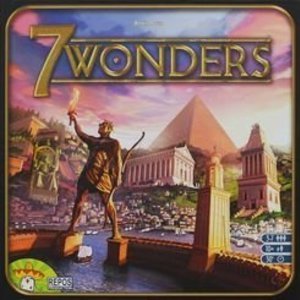
Card Drafting and Civilization building at it's finest, with a large player count which is so hard to find.
love this game, plus it's 2 player version 7 Wonders Duel. it's a really great light to medium weight game about how you choose to build your civilization. You start with a wonder, which gives you a starting power/resource, then you build from there by adding card to your tableau which in turn gives you the ability to buy more things. you can build your military and bully your neighbors, or focus on knowledge, or make sure your civilization is rich with resources and money, and trade with your neighbors... Each thing you do builds up to doing more. Great Game especially showcases what modern games can do and still good for relative beginners to the Board game world.