Search
Search results
Bellum Magica
7.0 Rate It
Tabletop Game
Each player represents an evil lord. Recruit creatures, ranging from simple goblins to terrifying...

Purple Phoenix Games (2266 KP) rated Mitropia in Tabletop Games
Apr 21, 2020
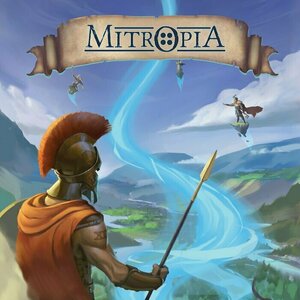

Have you ever had a crush on someone and just wanted to surround them with your presence? Too creepy? Okay, have you ever been at odds with your sworn enemies and learned to settle your differences by transporting yourselves to the plane of the gods to engage in a battle of strategic placement and enveloping in order to determine supremacy? Too specific? Well, the latter is the premise for the game Mitropia.
Mitropia is an area majority game that can end in several fashions. To setup your first game, please use the setup instructions in the rule book to form the playing area. However, the more you play, the more you might like to change it up and try out some wacky board formations. Every player receives a player mat featuring a tribe with different special abilities. They will each also receive the matching colored warrior tokens (and bag if present), cards from the two decks according to the setup in the rules. Each player will place their chieftan (two stacked warrior tokens) on the board. The game is ready to be played!
DISCLAIMER: We were provided a near-retail prototype copy of this game for the purposes of this review. These are preview copy components, and I know the final components will be a little different from these shown (upgrades!). Also, it is not my intention to detail every rule in the game – and the rules will certainly be tweaked from this version and the rules we used to play it. You are invited to download the rulebook from the publisher’s website, back the game through the Kickstarter campaign running April 16 – May 17, 2020, purchase it from your FLGS, or through any retailers stocking it after fulfillment. -T
Game play is relatively simple. Players are attempting to score points by occupying and/or surrounding terrain tiles. Some tiles are worth more points than others depending on tribe abilities and other factors. The game ends once there are no more legal plays, all players have passed, or a chieftan has been captured by an opponent. Points are then tallied and a victor is determined.
On a turn, a player will make a “move,” which is a strange term as the player is actually placing out a warrior token. The placement of the warrior is dependent upon a move pattern card that is showing on the player mat, or one from the player’s hand to be discarded. These move cards show where the warrior can be placed (like Onitama‘s movement cards). Move cards can be combined with special action cards to make interesting warrior placement upon the board. Again, the goal of the game is to encompass as much terrain as possible, and surround your opponents to capture their warrior tokens.
In addition to simply placing out new warriors to claim lands and surround opponents, using terrain types to their fullest is a strategy not to be ignored. Wormholes are teleport locations, and mountains are impassable. Using just these features can wreak havoc on unsuspecting opponents. Mountains can especially be brutal when being used as an obstacle to facilitate surrounding enemies. When you play Mitropia be warned: mind the mountains.
Play continues in turns until a win condition or game end condition has been met. The players tally points to declare a victor, and then setup to play again for the player will definitely want to play another.
Components. Again, this is a near-retail prototype copy, so the components are very close to what will be available and in each box upon a successful Kickstarter campaign. That said, these components are amazing! I told the publisher the day after receiving the game that I was very impressed with what was packed in the box. Now, I haven’t been able to Tetris the components back in the box and have the cover fit flush since I opened it, but what is inside the box truly is wonderful. The player discs are all nicely-painted wood bits. The player mats, cards, and terrain tiles are all great quality. The art on everything is super stellar, and I just love playing with everything! You know the feeling when you’re playing a game that just has that perfect tactile quality? That’s Mitropia. And this copy isn’t even upgraded!
So here are my thoughts on this beast. I have never played Go, and I’m not really sure I want to after having Mitropia in my hands. I probably will play Go sometime, but I can only picture myself wishing I had been playing Mitropia. There is just something about having special abilities and slight differences that really improves my enjoyment. I love being able to see my turns several rounds in advance, but then having to switch tactics because an opponent has thwarted my evil plan at the last moment. I love being able to sit and think about my plays. I do not suffer from analysis paralysis, and this is a caveat I have for the game – do NOT play with AP-prone opponents. There is a lot going on here and so many options on a turn. AP sufferers can just stare at the board frightened of playing the wrong move or deciding whether or not to play a special ability card. However, I think this is a fantastic game with an excellent theme overlaid. If you are looking for a thematic game of Go that looks beautiful, is colorful instead of boring, allows players to have special powers and abilities, card play similar to the award-winning Onitama, then you certainly owe it to yourself to give a look at Mitropia. Please head over to the Kickstarter campaign that ends May 17, 2020 and check it out to learn even more and see what others are saying about it. I will be guarding my copy like you wouldn’t believe.
Mitropia is an area majority game that can end in several fashions. To setup your first game, please use the setup instructions in the rule book to form the playing area. However, the more you play, the more you might like to change it up and try out some wacky board formations. Every player receives a player mat featuring a tribe with different special abilities. They will each also receive the matching colored warrior tokens (and bag if present), cards from the two decks according to the setup in the rules. Each player will place their chieftan (two stacked warrior tokens) on the board. The game is ready to be played!
DISCLAIMER: We were provided a near-retail prototype copy of this game for the purposes of this review. These are preview copy components, and I know the final components will be a little different from these shown (upgrades!). Also, it is not my intention to detail every rule in the game – and the rules will certainly be tweaked from this version and the rules we used to play it. You are invited to download the rulebook from the publisher’s website, back the game through the Kickstarter campaign running April 16 – May 17, 2020, purchase it from your FLGS, or through any retailers stocking it after fulfillment. -T
Game play is relatively simple. Players are attempting to score points by occupying and/or surrounding terrain tiles. Some tiles are worth more points than others depending on tribe abilities and other factors. The game ends once there are no more legal plays, all players have passed, or a chieftan has been captured by an opponent. Points are then tallied and a victor is determined.
On a turn, a player will make a “move,” which is a strange term as the player is actually placing out a warrior token. The placement of the warrior is dependent upon a move pattern card that is showing on the player mat, or one from the player’s hand to be discarded. These move cards show where the warrior can be placed (like Onitama‘s movement cards). Move cards can be combined with special action cards to make interesting warrior placement upon the board. Again, the goal of the game is to encompass as much terrain as possible, and surround your opponents to capture their warrior tokens.
In addition to simply placing out new warriors to claim lands and surround opponents, using terrain types to their fullest is a strategy not to be ignored. Wormholes are teleport locations, and mountains are impassable. Using just these features can wreak havoc on unsuspecting opponents. Mountains can especially be brutal when being used as an obstacle to facilitate surrounding enemies. When you play Mitropia be warned: mind the mountains.
Play continues in turns until a win condition or game end condition has been met. The players tally points to declare a victor, and then setup to play again for the player will definitely want to play another.
Components. Again, this is a near-retail prototype copy, so the components are very close to what will be available and in each box upon a successful Kickstarter campaign. That said, these components are amazing! I told the publisher the day after receiving the game that I was very impressed with what was packed in the box. Now, I haven’t been able to Tetris the components back in the box and have the cover fit flush since I opened it, but what is inside the box truly is wonderful. The player discs are all nicely-painted wood bits. The player mats, cards, and terrain tiles are all great quality. The art on everything is super stellar, and I just love playing with everything! You know the feeling when you’re playing a game that just has that perfect tactile quality? That’s Mitropia. And this copy isn’t even upgraded!
So here are my thoughts on this beast. I have never played Go, and I’m not really sure I want to after having Mitropia in my hands. I probably will play Go sometime, but I can only picture myself wishing I had been playing Mitropia. There is just something about having special abilities and slight differences that really improves my enjoyment. I love being able to see my turns several rounds in advance, but then having to switch tactics because an opponent has thwarted my evil plan at the last moment. I love being able to sit and think about my plays. I do not suffer from analysis paralysis, and this is a caveat I have for the game – do NOT play with AP-prone opponents. There is a lot going on here and so many options on a turn. AP sufferers can just stare at the board frightened of playing the wrong move or deciding whether or not to play a special ability card. However, I think this is a fantastic game with an excellent theme overlaid. If you are looking for a thematic game of Go that looks beautiful, is colorful instead of boring, allows players to have special powers and abilities, card play similar to the award-winning Onitama, then you certainly owe it to yourself to give a look at Mitropia. Please head over to the Kickstarter campaign that ends May 17, 2020 and check it out to learn even more and see what others are saying about it. I will be guarding my copy like you wouldn’t believe.
Tawantinsuyu: The Inca Empire
Tabletop Game
The great Sapa Inca Pachacuti turned to his offspring and ordered them to worship Inti, the Sun God,...
Purple Phoenix Games (2266 KP) rated Unmatched: Cobble & Fog in Tabletop Games
Mar 19, 2021

You know when you read a rulebook and you just know you are going to love the game? This was me whilst reading the rulebook for Unmatched: Cobble & Fog. I will go into more detail why I enjoy the game near the end of my review, but just know, I loved it from the start.
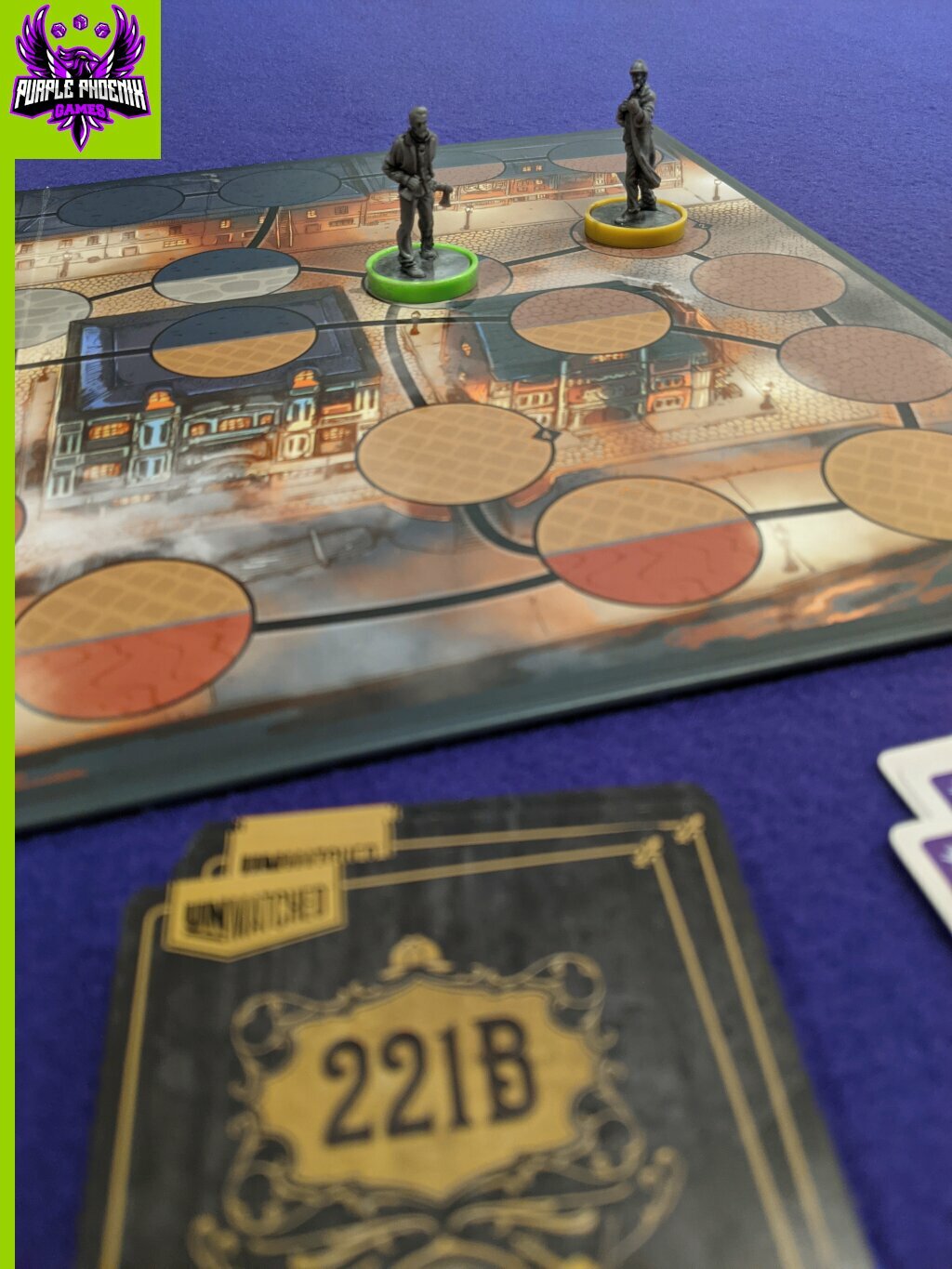
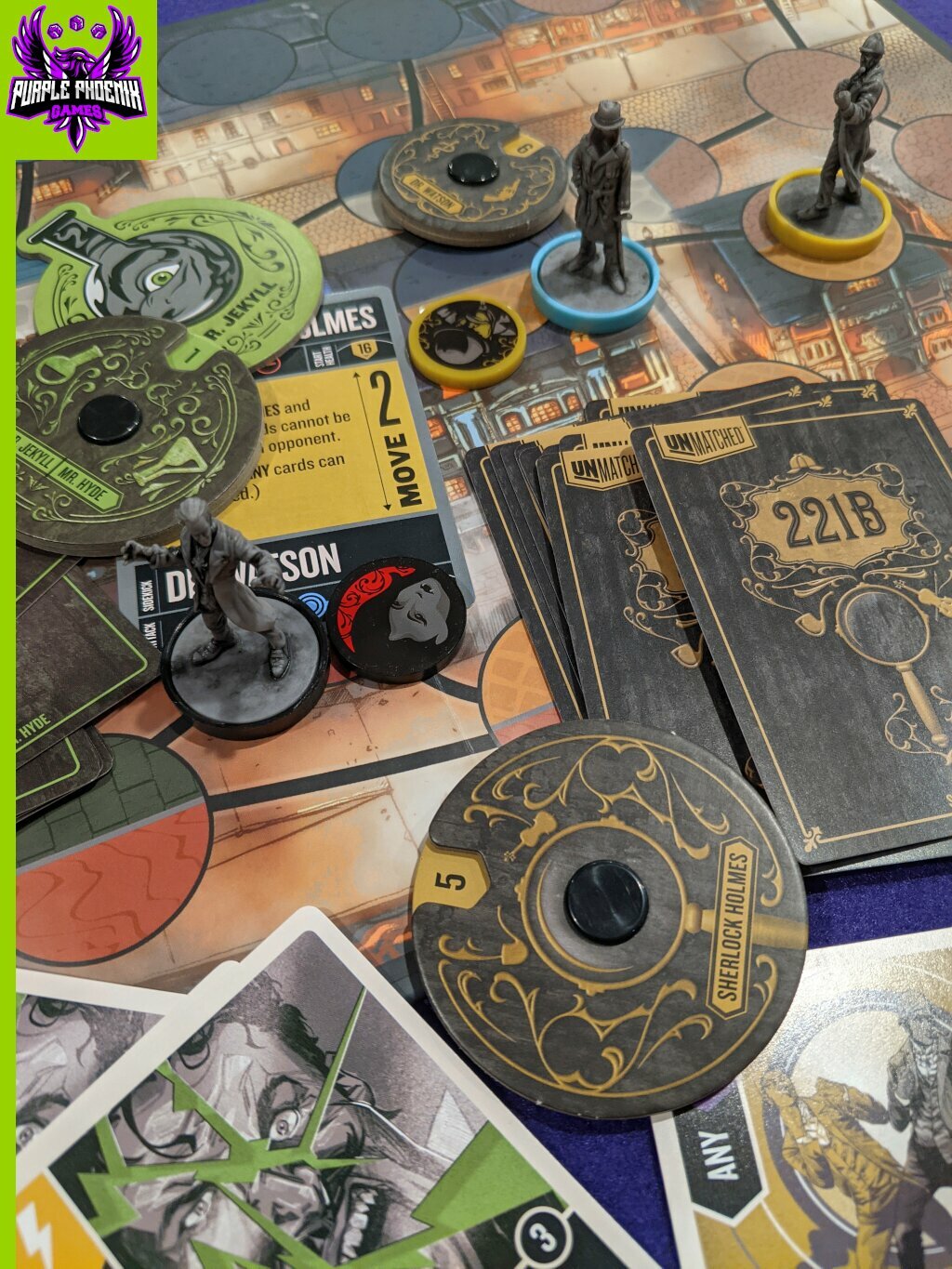
In Unmatched: Cobble & Fog (which I will be calling Unmatched from here) players will be taking on the roles of either Dracula and his Sisters, Sherlock Holmes and Dr. Watson, Invisible Man, or Dr. Jekyll and Mr. Hyde in a battle to the death to claim victory in this, “Who would win in a fight”-style skirmish fighting game. The last hero standing wins, so as one of my favorite characters in literary history says, “The game is afoot.”
DISCLAIMER: Even though this review is for the Cobble & Fog version of Unmatched, the rules are the same throughout the entire Unmatched family of games. I have the original Unmatched: Battle of Legends, Vol. 1 and it plays exactly the same. I prefer the characters in this version, so that’s why I am reviewing it specifically. -T
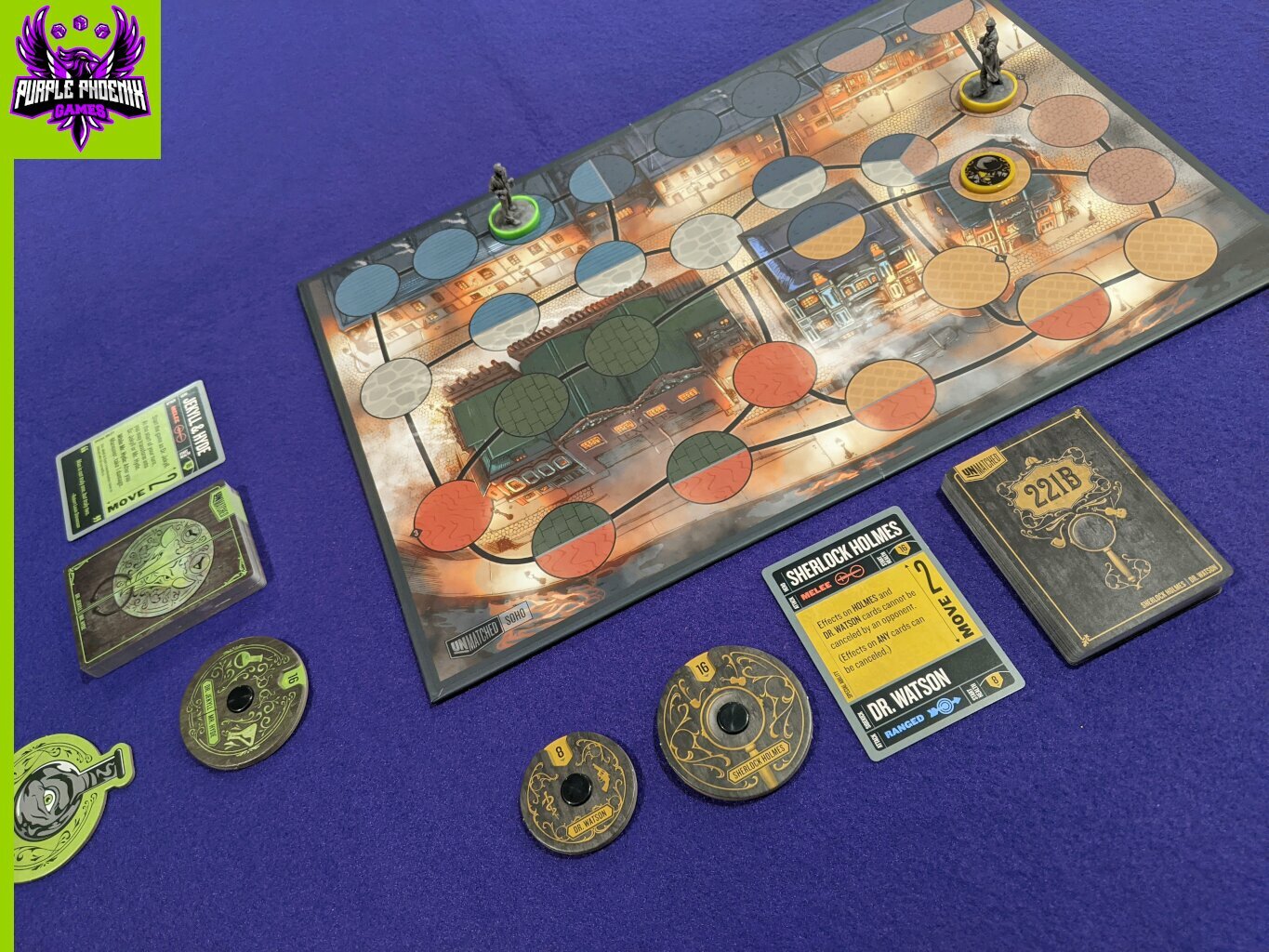
To setup, the players will choose which side of the board they wish to play and set it on the table. Next, players will choose their hero and gather all accoutrements associated with their choice. All heroes come with a deck of 30 action cards, a mini of their figure, a character card, at least one health dial (more if their sidekicks have more than one health point), and some characters will have sidekicks that have tokens, or tokens for other reasons. The youngest player places their mini on the space with the number 1 on the board, and then the rest of the players place theirs on subsequently-numbered spaces. Players shuffle their decks of action cards and draw five cards for their first hand.
On a turn a player may take two actions from the choice of: Maneuver, Scheme, Attack. When a player chooses to Maneuver they will draw a card into their hand, then move the amount of spaces noted on their character card (typically two spaces). These movement values may be boosted by also discarding additional cards for their boost value and adding it to the number of spaces moved.
All action cards will specify which character may use it for attack, defense, or Scheme action. These Scheme cards have a lightning bolt icon on them to indicate that they are played face-up to the table, resolved, and then discarded.
Finally, if a melee-based character is positioned adjacent to an opponent, or if a ranged character is in the same zone as an opponent, they may Attack said opponent. To Attack, the active player declares which opponent will be attacked, and each player involved will choose cards from their hands to use in the battle. The attacking player will need to use attack or versatile (either used for attack or defense) cards to try to inflict damage, while the defending player will need to play defense or versatile cards in defense. The difference of the values printed on the cards will determine which character wins the battle and if health points are to be deducted from the health dial.
Many cards will have action instructions that trigger either immediately during battle or even after the battle concludes. Resolve these actions when appropriate and try to stay on your feet.
Play continues in this fashion of moving around the board to gain cards or using the cards to scheme or attack/defend. The winning player is they who survives at the end and vanquishes all foes on the board.
Components. I love everything about the components in this game. The box is great. The insert is really incredible and well thought out. The cards are great quality and the game features spectacular art all around. The minis are cool and luckily are fitted inside colored bases to remind players which mini is theirs. The sidekick tokens are excellent thick plastic and color-matched to the bases of their hero counterparts. The board is nice and double-sided, and all the rest of the cardboard components are excellent.
It’s no secret here – I absolutely love this game. I have always been a big fan of Sherlock Holmes, and this set also includes other interesting characters to play. Each one is highly unique in style and that’s one of the reasons I am so intrigued by this system. I say system because this is not the only game in the Unmatched family. As of today the Unmatched system boasts all of these as playable characters from different sets: King Arthur, Alice, Medusa, and Sinbad from the “Battle of Legends, Vol 1” set; Robert Muldoon and raptors from the “Jurassic Park, InGen vs Raptors” set; the “Robin Hood vs Bigfoot” set; Bruce Lee; and Buffy, Spike, Willow, and Angel from the “Buffy the Vampire Slayer” set in addition to these here. I know more Jurassic Park sets are on the horizon, and I just cannot wait to see what other sets will be released in time.
Why do I love this game so much when I am not really a fan of moving and dueling games (I’m looking at you Mage Wars)? In these style of games I feel the movement is unnecessary as I just stand and fight. In this system, the only way to draw more cards from your deck is to enact the Maneuver action. There have been several times where I didn’t necessarily want to initiate a battle, but I saw opponents sitting with no cards in their hand. That means no defense cards can be played. Easy chunks of health taken by picking off the stationary few. Unmatched forces players to move around and I love that. Yes, there are opportunities to unleash giant blows or have double-digit health drops in battle, and that’s just delicious. Also there are times during play where mathing out exactly where to place your mini or sidekick is paramount to lay plans of ambush.
I mentioned earlier that I knew right away I would love this one. Opening the cover of the rulebook sold me immediately. As this set utilizes literary characters found in old timey Europe the game utilizes a period art style as well and I’m still fawning over it. Everything clicks for me and I can now understand why so many people were dying (not literally) to get copies of the game Unmatched is based on, Star Wars: Epic Duels. It is extremely fun and each character is interesting and unique. Purple Phoenix Games gives this one a well-earned GOLDEN FEATHER AWARD! If you need a skirmish style game with excellent theme and art, you must grab this post haste. If you and I fall on the same side of the coin with our gaming preferences you NEED to have this in your collection.
I don’t know how many other sets I will be looking to add to my collection at this point, but I cannot tell you how excited I would be to pit Bigfoot against Bruce Lee. Or King Arthur against Dracula. It just feels epic and wonderful. Great job to the team at Restoration Games. This is a huge win for my collection.
In Unmatched: Cobble & Fog (which I will be calling Unmatched from here) players will be taking on the roles of either Dracula and his Sisters, Sherlock Holmes and Dr. Watson, Invisible Man, or Dr. Jekyll and Mr. Hyde in a battle to the death to claim victory in this, “Who would win in a fight”-style skirmish fighting game. The last hero standing wins, so as one of my favorite characters in literary history says, “The game is afoot.”
DISCLAIMER: Even though this review is for the Cobble & Fog version of Unmatched, the rules are the same throughout the entire Unmatched family of games. I have the original Unmatched: Battle of Legends, Vol. 1 and it plays exactly the same. I prefer the characters in this version, so that’s why I am reviewing it specifically. -T
To setup, the players will choose which side of the board they wish to play and set it on the table. Next, players will choose their hero and gather all accoutrements associated with their choice. All heroes come with a deck of 30 action cards, a mini of their figure, a character card, at least one health dial (more if their sidekicks have more than one health point), and some characters will have sidekicks that have tokens, or tokens for other reasons. The youngest player places their mini on the space with the number 1 on the board, and then the rest of the players place theirs on subsequently-numbered spaces. Players shuffle their decks of action cards and draw five cards for their first hand.
On a turn a player may take two actions from the choice of: Maneuver, Scheme, Attack. When a player chooses to Maneuver they will draw a card into their hand, then move the amount of spaces noted on their character card (typically two spaces). These movement values may be boosted by also discarding additional cards for their boost value and adding it to the number of spaces moved.
All action cards will specify which character may use it for attack, defense, or Scheme action. These Scheme cards have a lightning bolt icon on them to indicate that they are played face-up to the table, resolved, and then discarded.
Finally, if a melee-based character is positioned adjacent to an opponent, or if a ranged character is in the same zone as an opponent, they may Attack said opponent. To Attack, the active player declares which opponent will be attacked, and each player involved will choose cards from their hands to use in the battle. The attacking player will need to use attack or versatile (either used for attack or defense) cards to try to inflict damage, while the defending player will need to play defense or versatile cards in defense. The difference of the values printed on the cards will determine which character wins the battle and if health points are to be deducted from the health dial.
Many cards will have action instructions that trigger either immediately during battle or even after the battle concludes. Resolve these actions when appropriate and try to stay on your feet.
Play continues in this fashion of moving around the board to gain cards or using the cards to scheme or attack/defend. The winning player is they who survives at the end and vanquishes all foes on the board.
Components. I love everything about the components in this game. The box is great. The insert is really incredible and well thought out. The cards are great quality and the game features spectacular art all around. The minis are cool and luckily are fitted inside colored bases to remind players which mini is theirs. The sidekick tokens are excellent thick plastic and color-matched to the bases of their hero counterparts. The board is nice and double-sided, and all the rest of the cardboard components are excellent.
It’s no secret here – I absolutely love this game. I have always been a big fan of Sherlock Holmes, and this set also includes other interesting characters to play. Each one is highly unique in style and that’s one of the reasons I am so intrigued by this system. I say system because this is not the only game in the Unmatched family. As of today the Unmatched system boasts all of these as playable characters from different sets: King Arthur, Alice, Medusa, and Sinbad from the “Battle of Legends, Vol 1” set; Robert Muldoon and raptors from the “Jurassic Park, InGen vs Raptors” set; the “Robin Hood vs Bigfoot” set; Bruce Lee; and Buffy, Spike, Willow, and Angel from the “Buffy the Vampire Slayer” set in addition to these here. I know more Jurassic Park sets are on the horizon, and I just cannot wait to see what other sets will be released in time.
Why do I love this game so much when I am not really a fan of moving and dueling games (I’m looking at you Mage Wars)? In these style of games I feel the movement is unnecessary as I just stand and fight. In this system, the only way to draw more cards from your deck is to enact the Maneuver action. There have been several times where I didn’t necessarily want to initiate a battle, but I saw opponents sitting with no cards in their hand. That means no defense cards can be played. Easy chunks of health taken by picking off the stationary few. Unmatched forces players to move around and I love that. Yes, there are opportunities to unleash giant blows or have double-digit health drops in battle, and that’s just delicious. Also there are times during play where mathing out exactly where to place your mini or sidekick is paramount to lay plans of ambush.
I mentioned earlier that I knew right away I would love this one. Opening the cover of the rulebook sold me immediately. As this set utilizes literary characters found in old timey Europe the game utilizes a period art style as well and I’m still fawning over it. Everything clicks for me and I can now understand why so many people were dying (not literally) to get copies of the game Unmatched is based on, Star Wars: Epic Duels. It is extremely fun and each character is interesting and unique. Purple Phoenix Games gives this one a well-earned GOLDEN FEATHER AWARD! If you need a skirmish style game with excellent theme and art, you must grab this post haste. If you and I fall on the same side of the coin with our gaming preferences you NEED to have this in your collection.
I don’t know how many other sets I will be looking to add to my collection at this point, but I cannot tell you how excited I would be to pit Bigfoot against Bruce Lee. Or King Arthur against Dracula. It just feels epic and wonderful. Great job to the team at Restoration Games. This is a huge win for my collection.

Purple Phoenix Games (2266 KP) rated Gizmos in Tabletop Games
Apr 20, 2021
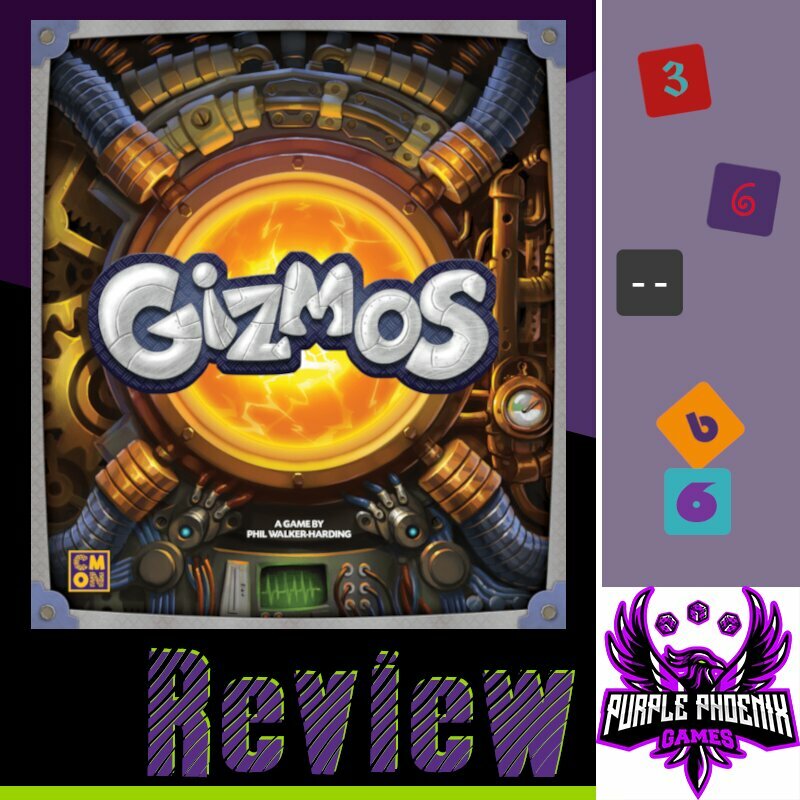
I have absolutely never been very good at science. At least not in school. So when I started reading the rule for Gizmos and found out it was set at a science fair I thought I was doomed. Well, turns out you don’t really need to know anything about science to enjoy this one or be decent at playing. So if you are like me and don’t remember anything besides the Mitochondria is the powerhouse of the cell, then read on about a great game called Gizmos.
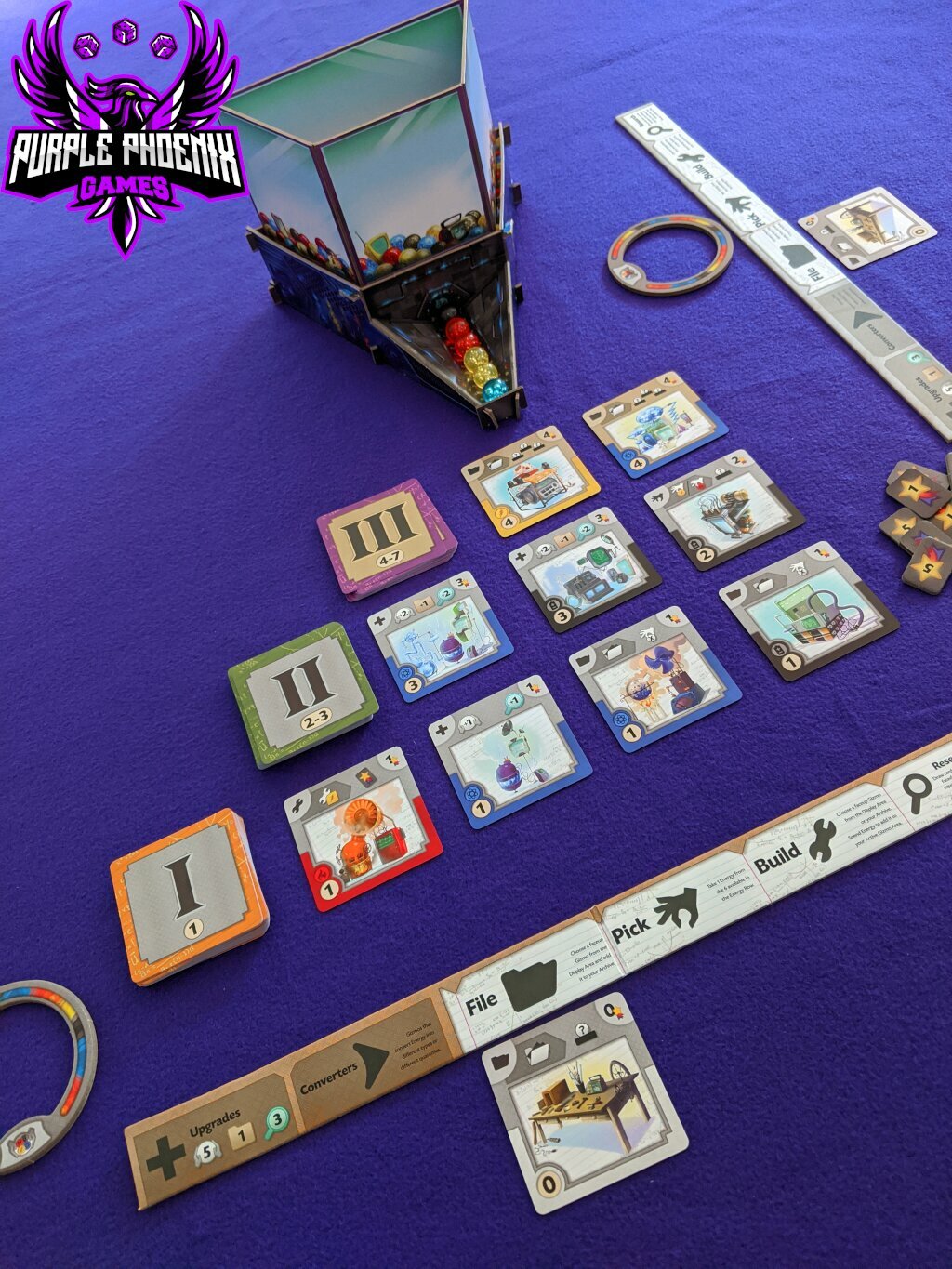
Gizmos is a card drafting, energy collecting, engine building game about, well, building engines. Players will be attempting to draft machine parts from an offer pyramid and build them onto their master jalopy machine using energy marbles in order to chain actions together and maximize their turns. The victorious player is they that claims the most VP from cards and bonus VP tokens at the end of the game.
To setup, assemble the energy dispenser (the marble gumball machine looking component) and place it on the table. Fill it with all the marbles and marvel at the first six that come out into a chute display. Separate and shuffle the card decks by their backs and set out four cards of level I, three cards of level II and two cards of level III. Determine starting player and give them the starting tableau board. Each player will receive a tableau board, an energy ring, and a starting gizmo to be placed under the File section of their board. The game may now begin!
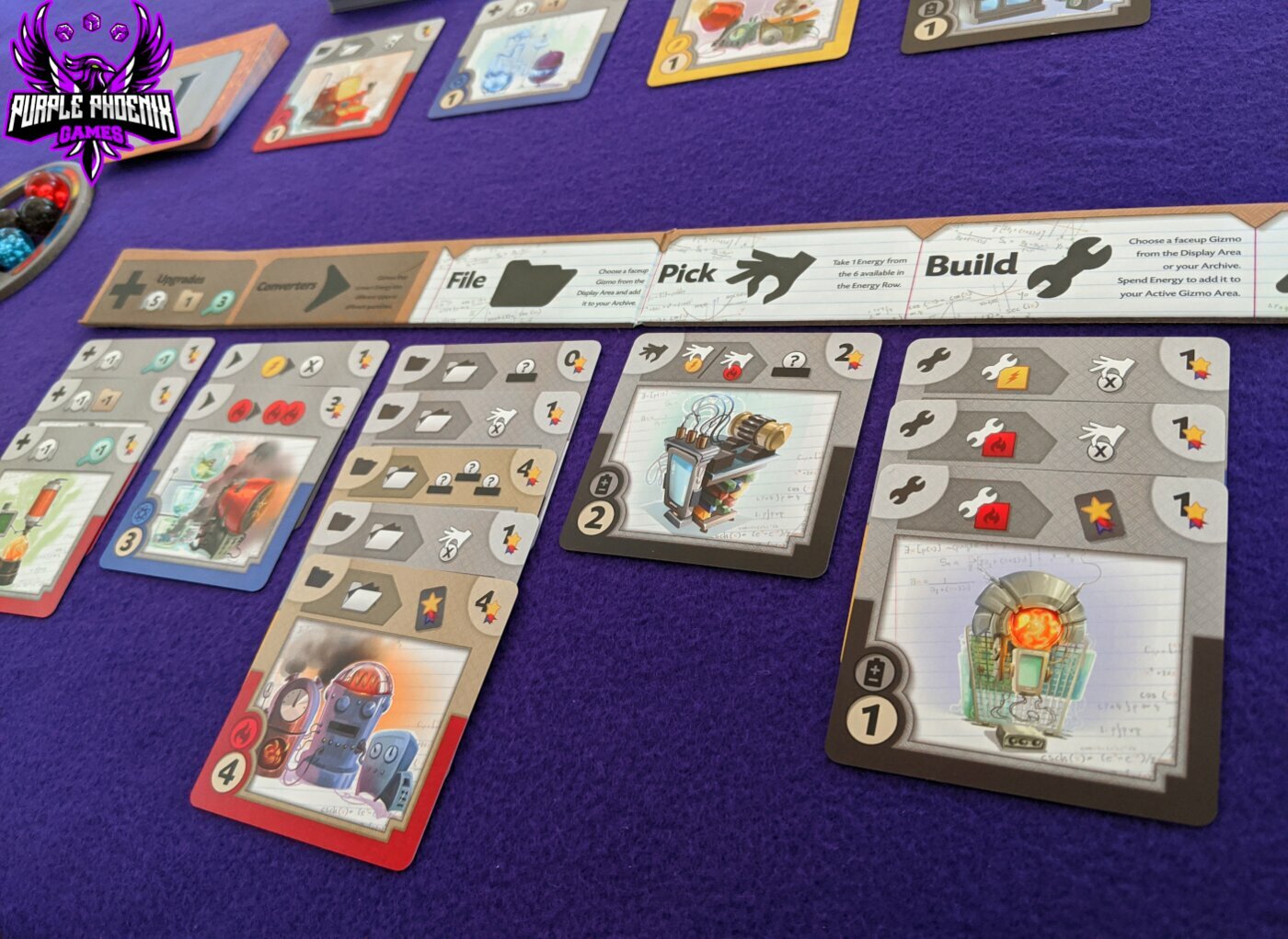
On a player’s turn they will be completing one action from the four actions printed on their player board: File, Pick, Build, and Research. The File action is used when a player chooses a card from the gizmo pyramid (from any level) and places it in their Archive – an imaginary area to the right (or even above I’ve found) their player board. At the beginning of the game players will be able to hold just one gizmo in their Archive, but as they draft and build Upgrades, this number can increase. When choosing the Pick action, the player will simply choose one of the energy marbles from the dispenser chute and place them in their energy ring. Initially rings are only able to hold five marbles, but this also can be increased on future builds. To Build a gizmo into a player’s machine, the player will spend a specific color and number of energy marbles printed on the chosen gizmo card to place the card into their player tableau. These gizmos could possibly be Upgrades, energy Converters, or upgrades to the File, Pick, and Build actions. Pay the energy marble to the dispenser supply. Players will choose to Research when they do not like the gizmos on display in the gizmo pyramid. Researching allows players to draw the top cards from any face-down level deck and choose one to either File or Build.
The game is super simple to this point, but this is where the true strategy and tactics come into play. Though there will always be nine gizmos on display during a player’s turn, the value of these gizmos are in how they are used in the player tableau. Yes each gizmo allows for some benefit, but successful players will be able to utilize these benefits to create chain reactions. When an action is spent to do a thing, gizmos in play in the tableau will sometimes link to the action, or to the placement of a certain type of card, or a certain energy type (color) of gizmo built. It is mastering these chain reactions that creates next-level strategizing and separates the players from the champions. Play continues on in this fashion until a player has built their fourth level III gizmo or their 16th gizmo in total. Count up VP from built gizmos and bonus tokens earned from built gizmos throughout the game to see who wins the science fair (is that what happens at science fairs? People win those, right?)!
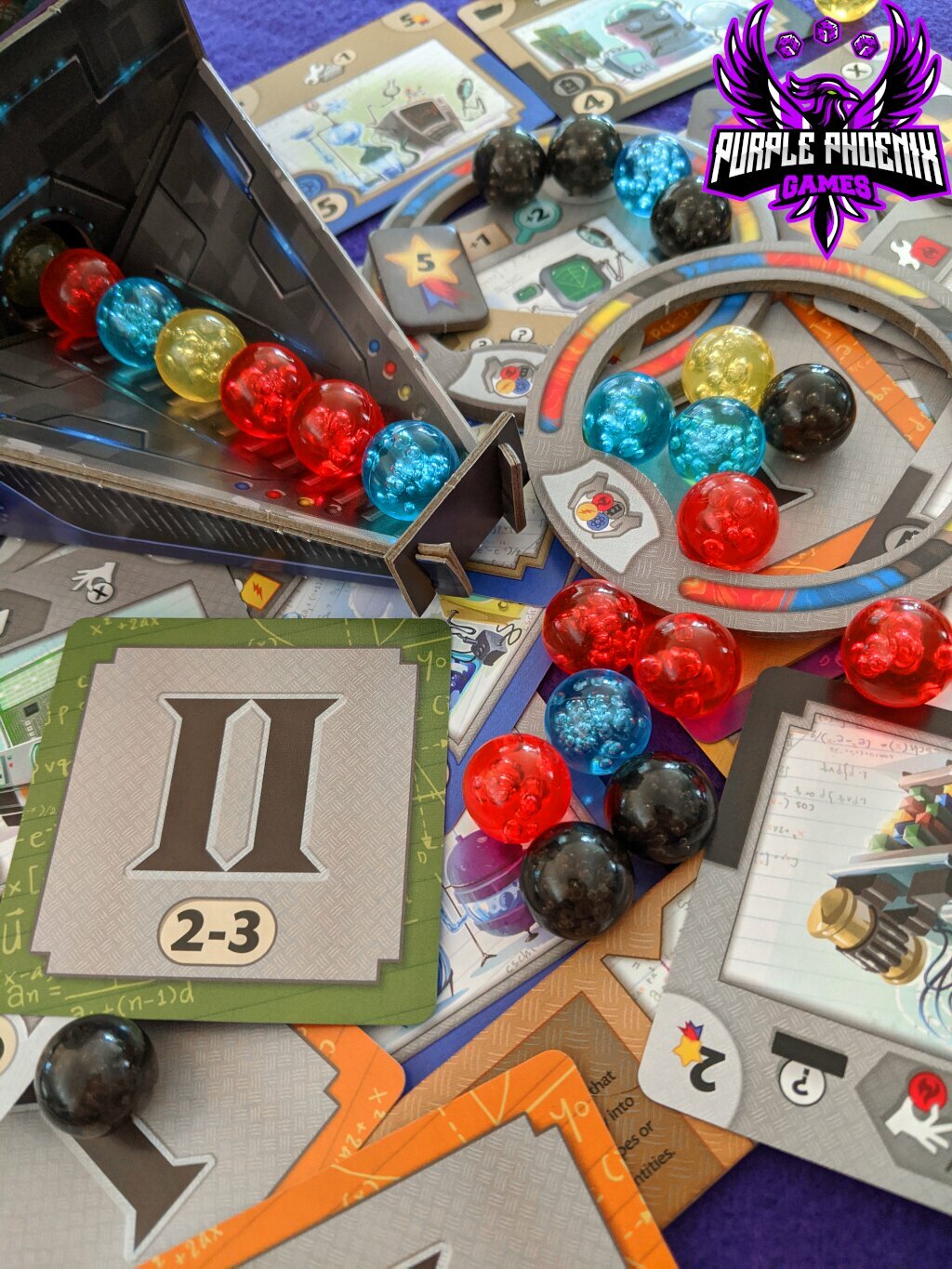
Components. So the gizmo cards are fine, and the cardboard components are fine as well. The marbles are interesting and bubbled plastic (or resin, I told you I’m not great at science) and come in great colors. The true star component here is that energy marble dispenser. It is absolutely brilliant. The game comes with assembly instructions, thankfully, but once it’s built, it’s built forever. It packs neatly back into the box, and the insert is very very well done. The artwork on this is surprisingly secondary to me. In fact, I don’t really remember even looking at much of the artwork on the gizmo cards as I was playing because I concentrate so much more on the effects of the gizmos and trying to figure out my next move to really sit and gawk at the art. The iconography takes a little time to get used to, but once you have seen it in action for a few rounds, you catch on quickly. All in all, a fine set of components, but with the insert and dispenser, now a great set of components.
I adore this game! I love engine builders, and the chain reactions you can create with your gizmos are excellent and can be very powerful. You can try to generate tons of bonus VP from your gizmos, or concentrate on versatile energy marbles using a bunch of Converters, or simply go guns blazing on everything you can afford to try to blitz to 16 gizmos built. Whatever your play style, Gizmos can certainly allow you to play your way while giving you choices upon choices to make each turn.
With all these positives, I had to find a negative, right? Well, ok, yes, but it’s super minor to me here. I don’t really feel like the theme is very immersive. Not once have I felt like I am building a machine in order to win a science fair, but I do feel like I need to maximize my turn every time in order to grab more energy, or to build better Upgrades and Converters so I can grab any gizmo I want and build it right away. So, theme is there, but not at all strong.
Though the theme is just okay, the game play certainly is stellar. This one has everything I like in an engine building game, and has unique and interesting components. Would I like it more if the theme was different. I doubt it. The game play is just so good that the theme and artwork takes a back seat for me, and that’s super weird for me to type. Should you be looking for a great engine building game that looks awesome on the table, has cool components, and allows you to play differently every game, then go find yourself a copy of Gizmos. Purple Phoenix Games gives it an energetic 21 / 24. Now if only my 4-year-old could keep the energy marbles in the chute or the ring and not on the floor…
Gizmos is a card drafting, energy collecting, engine building game about, well, building engines. Players will be attempting to draft machine parts from an offer pyramid and build them onto their master jalopy machine using energy marbles in order to chain actions together and maximize their turns. The victorious player is they that claims the most VP from cards and bonus VP tokens at the end of the game.
To setup, assemble the energy dispenser (the marble gumball machine looking component) and place it on the table. Fill it with all the marbles and marvel at the first six that come out into a chute display. Separate and shuffle the card decks by their backs and set out four cards of level I, three cards of level II and two cards of level III. Determine starting player and give them the starting tableau board. Each player will receive a tableau board, an energy ring, and a starting gizmo to be placed under the File section of their board. The game may now begin!
On a player’s turn they will be completing one action from the four actions printed on their player board: File, Pick, Build, and Research. The File action is used when a player chooses a card from the gizmo pyramid (from any level) and places it in their Archive – an imaginary area to the right (or even above I’ve found) their player board. At the beginning of the game players will be able to hold just one gizmo in their Archive, but as they draft and build Upgrades, this number can increase. When choosing the Pick action, the player will simply choose one of the energy marbles from the dispenser chute and place them in their energy ring. Initially rings are only able to hold five marbles, but this also can be increased on future builds. To Build a gizmo into a player’s machine, the player will spend a specific color and number of energy marbles printed on the chosen gizmo card to place the card into their player tableau. These gizmos could possibly be Upgrades, energy Converters, or upgrades to the File, Pick, and Build actions. Pay the energy marble to the dispenser supply. Players will choose to Research when they do not like the gizmos on display in the gizmo pyramid. Researching allows players to draw the top cards from any face-down level deck and choose one to either File or Build.
The game is super simple to this point, but this is where the true strategy and tactics come into play. Though there will always be nine gizmos on display during a player’s turn, the value of these gizmos are in how they are used in the player tableau. Yes each gizmo allows for some benefit, but successful players will be able to utilize these benefits to create chain reactions. When an action is spent to do a thing, gizmos in play in the tableau will sometimes link to the action, or to the placement of a certain type of card, or a certain energy type (color) of gizmo built. It is mastering these chain reactions that creates next-level strategizing and separates the players from the champions. Play continues on in this fashion until a player has built their fourth level III gizmo or their 16th gizmo in total. Count up VP from built gizmos and bonus tokens earned from built gizmos throughout the game to see who wins the science fair (is that what happens at science fairs? People win those, right?)!
Components. So the gizmo cards are fine, and the cardboard components are fine as well. The marbles are interesting and bubbled plastic (or resin, I told you I’m not great at science) and come in great colors. The true star component here is that energy marble dispenser. It is absolutely brilliant. The game comes with assembly instructions, thankfully, but once it’s built, it’s built forever. It packs neatly back into the box, and the insert is very very well done. The artwork on this is surprisingly secondary to me. In fact, I don’t really remember even looking at much of the artwork on the gizmo cards as I was playing because I concentrate so much more on the effects of the gizmos and trying to figure out my next move to really sit and gawk at the art. The iconography takes a little time to get used to, but once you have seen it in action for a few rounds, you catch on quickly. All in all, a fine set of components, but with the insert and dispenser, now a great set of components.
I adore this game! I love engine builders, and the chain reactions you can create with your gizmos are excellent and can be very powerful. You can try to generate tons of bonus VP from your gizmos, or concentrate on versatile energy marbles using a bunch of Converters, or simply go guns blazing on everything you can afford to try to blitz to 16 gizmos built. Whatever your play style, Gizmos can certainly allow you to play your way while giving you choices upon choices to make each turn.
With all these positives, I had to find a negative, right? Well, ok, yes, but it’s super minor to me here. I don’t really feel like the theme is very immersive. Not once have I felt like I am building a machine in order to win a science fair, but I do feel like I need to maximize my turn every time in order to grab more energy, or to build better Upgrades and Converters so I can grab any gizmo I want and build it right away. So, theme is there, but not at all strong.
Though the theme is just okay, the game play certainly is stellar. This one has everything I like in an engine building game, and has unique and interesting components. Would I like it more if the theme was different. I doubt it. The game play is just so good that the theme and artwork takes a back seat for me, and that’s super weird for me to type. Should you be looking for a great engine building game that looks awesome on the table, has cool components, and allows you to play differently every game, then go find yourself a copy of Gizmos. Purple Phoenix Games gives it an energetic 21 / 24. Now if only my 4-year-old could keep the energy marbles in the chute or the ring and not on the floor…
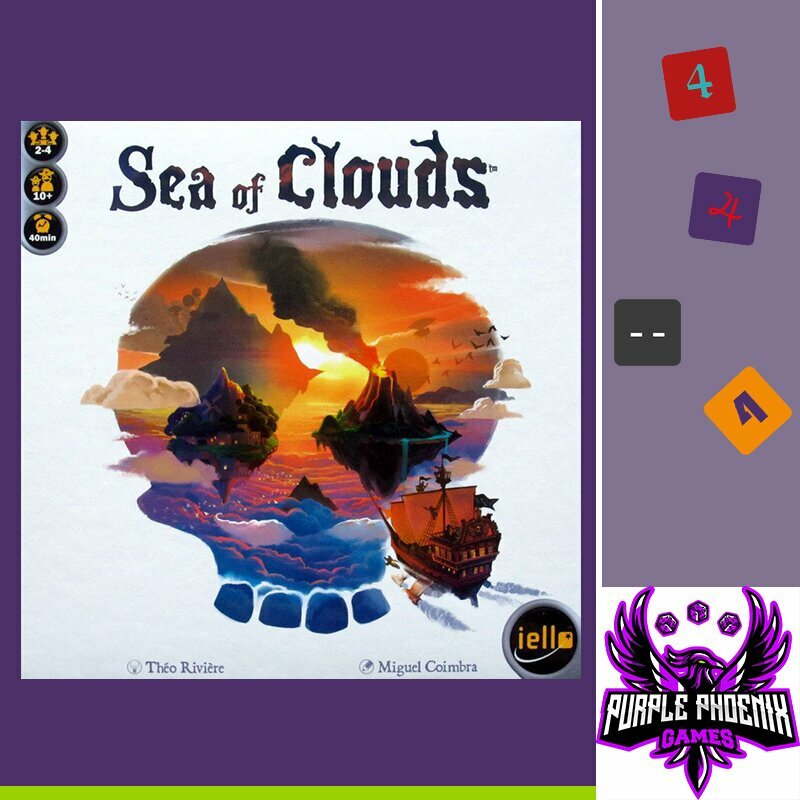
Purple Phoenix Games (2266 KP) rated Sea of Clouds in Tabletop Games
Sep 5, 2019 (Updated Jul 1, 2020)
When it comes to game themes, I think that we at Purple Phoenix Games are pretty good at trying just about anything. That being said, for some reason we keep finding ourselves back at pirates! So how does Sea of Clouds compare to our other pirate-themed games? Is it a good First Mate, or does it need to walk the plank? Keep reading to find out!
In Sea of Clouds, players are Captains of mighty air pirate ships. That’s right – flying pirate ships! Just like the pirate days of yore, your goal is to recruit the best crew, plunder for treasure and relics, and find the best rum along the way. But be careful because your rival pirate Captains have their eyes on the same prize – so make sure you’ve got a way to outsmart them and sail your way to victory!
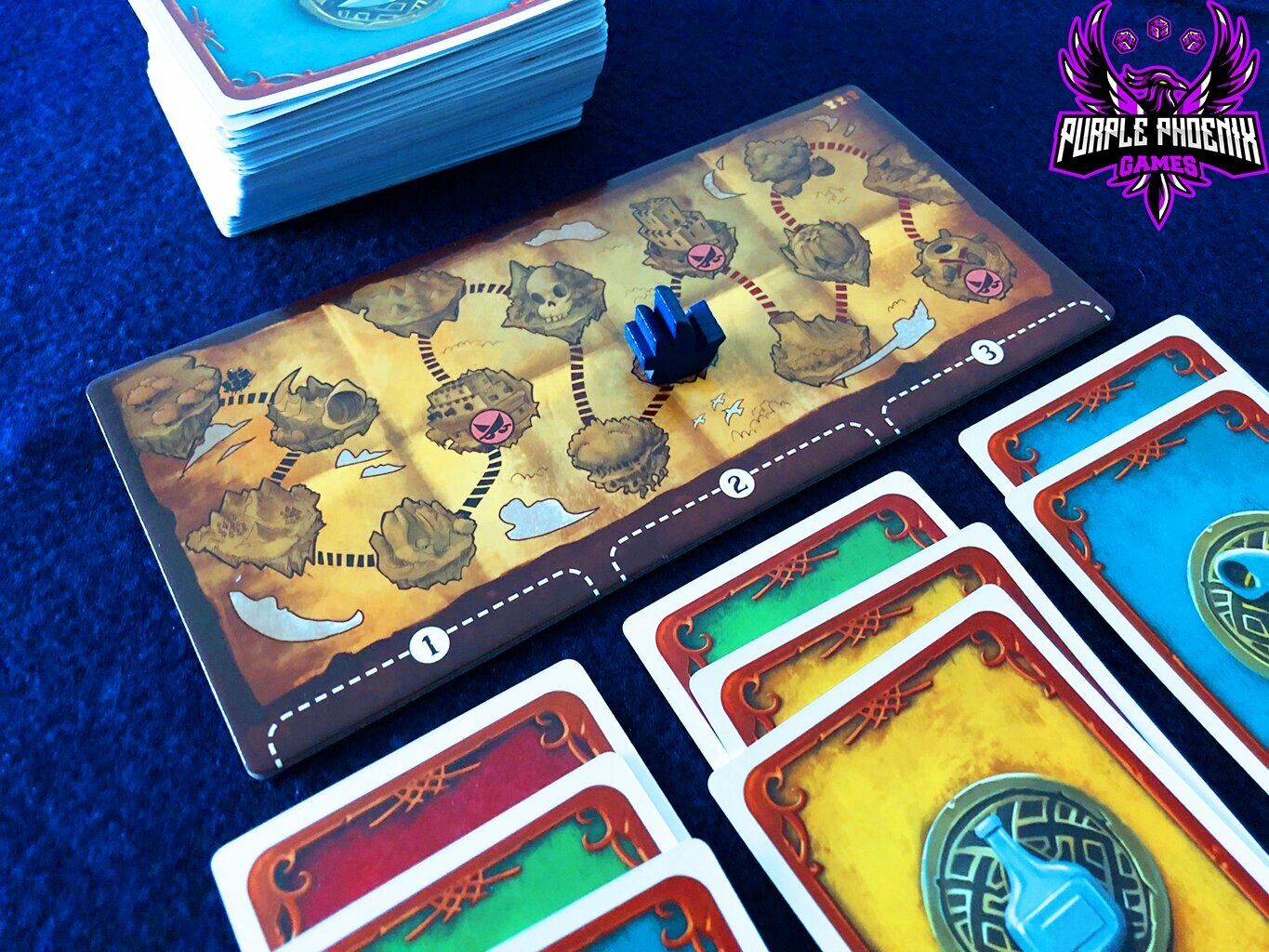
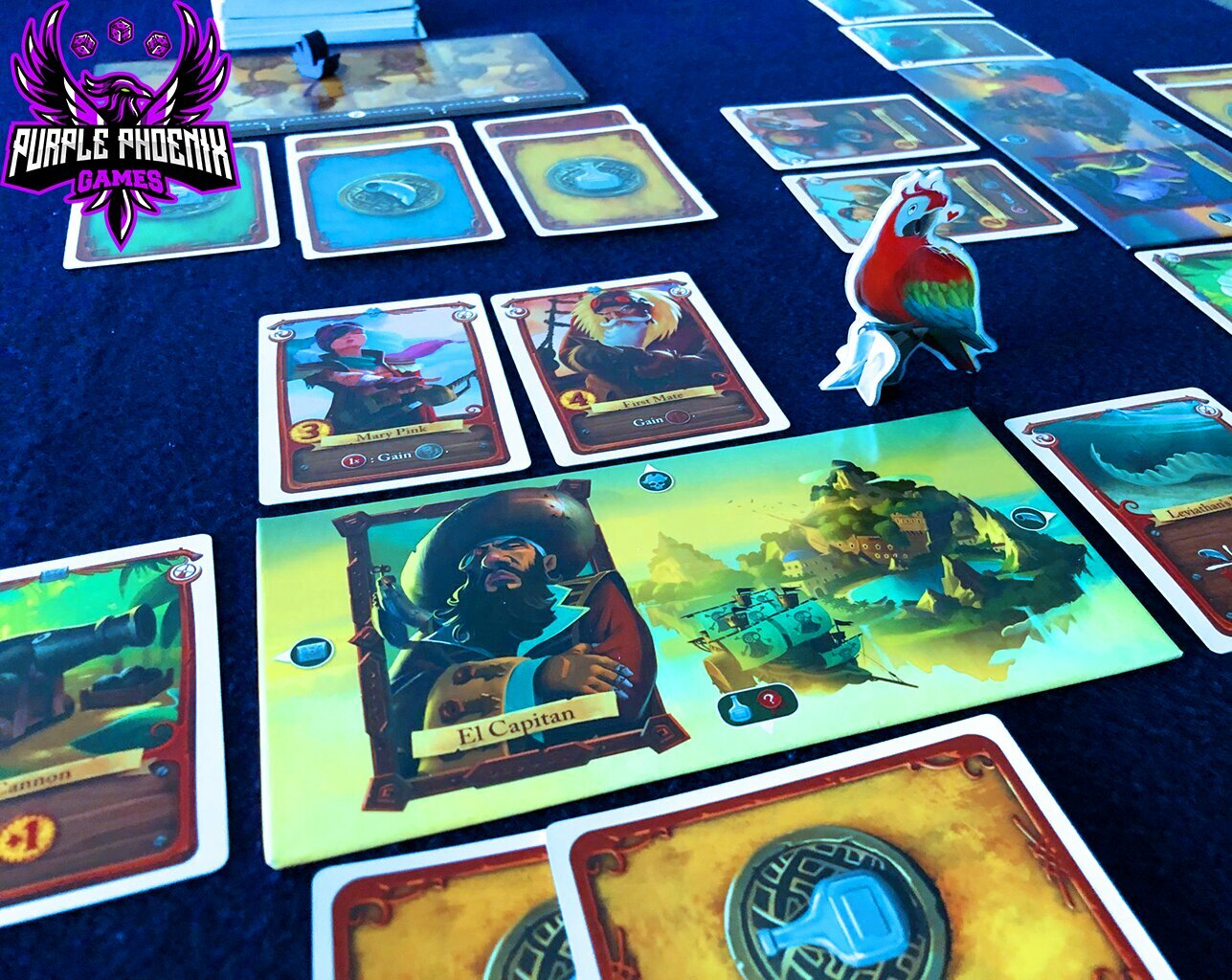
Sea of Clouds is a game of card drafting, set collection, and push your luck in which players are trying to amass the most end-game victory points. Played over a series of rounds, players take turns drafting cards, performing bonus actions, and engaging in combat with their neighboring Captains. To setup, each player takes their chosen Captain board, the central board is placed in the middle of all players, and 1 loot card is placed face-down on each of the 3 loot spaces on the central board. The remaining cards are shuffled and create a draw pile. Now you are ready to play!
Each round consists of divvying up shares of loot between all players. On your turn, you will take the face-down card(s) in the #1 loot spot and look at them secretly. Decide whether you want to take the share, or leave it and look at the next one. If you decide to keep the card(s), add them directly around your Captain board in their corresponding spaces. If you decided to leave the share, add 1 card from the top of the draw pile to that share, and then look secretly at the cards in the #2 loot spot. Proceed in the same manner as before with the cards in the #2 and #3 loot spots, if necessary. If none of the shares catch your fancy, draw 1 card from the top of the draw deck to add to your ship. Play continues to the left, and once everyone has had their turn, move the round marker ahead on the central board, and continue on to the next round in the same fashion. At the end of certain rounds of the game, following the divvying of shares, there will be a boarding/combat turn – players will compare the combat strength of their crew (recruited during the divvying of shares) to that of their neighboring Captains. If your crew’s strength is greater than your neighbor, resolve any rewards/effects on your pirate cards. If your strength is less than your neighbor, you lose the combat and do not collect any rewards. Once all combats have been resolved, everyone discards all their crew cards, and the next round begins. At the end of the game, players count up their victory points, and the player who has amassed the most is the winner!
I’m going to get right to the spoilers and say that I love Sea of Clouds. It has some of my favorite mechanics (set collection and card drafting) and it is easy to teach, learn, and play. Do not let the simplicity of play fool you, however, because strategy is definitely a key to victory. One thing that takes this strategy to the next level for me is that there will be times when all players know what cards are in each share of loot. You’ve got to pay attention to which shares your opponents are taking, and figure out a way to stop them from collecting complete sets, or try to force them to collect a share they may not necessarily want. Also, as shares go unclaimed, they get more cards (and eventually money) added to them, so you have to weigh the risks of collecting a share because of one specific card, even though there may be a ‘bad’ card in that share for you. You always have to be adjusting your strategy based on what cards show up in each share, so there is no idle time for any player in this game.
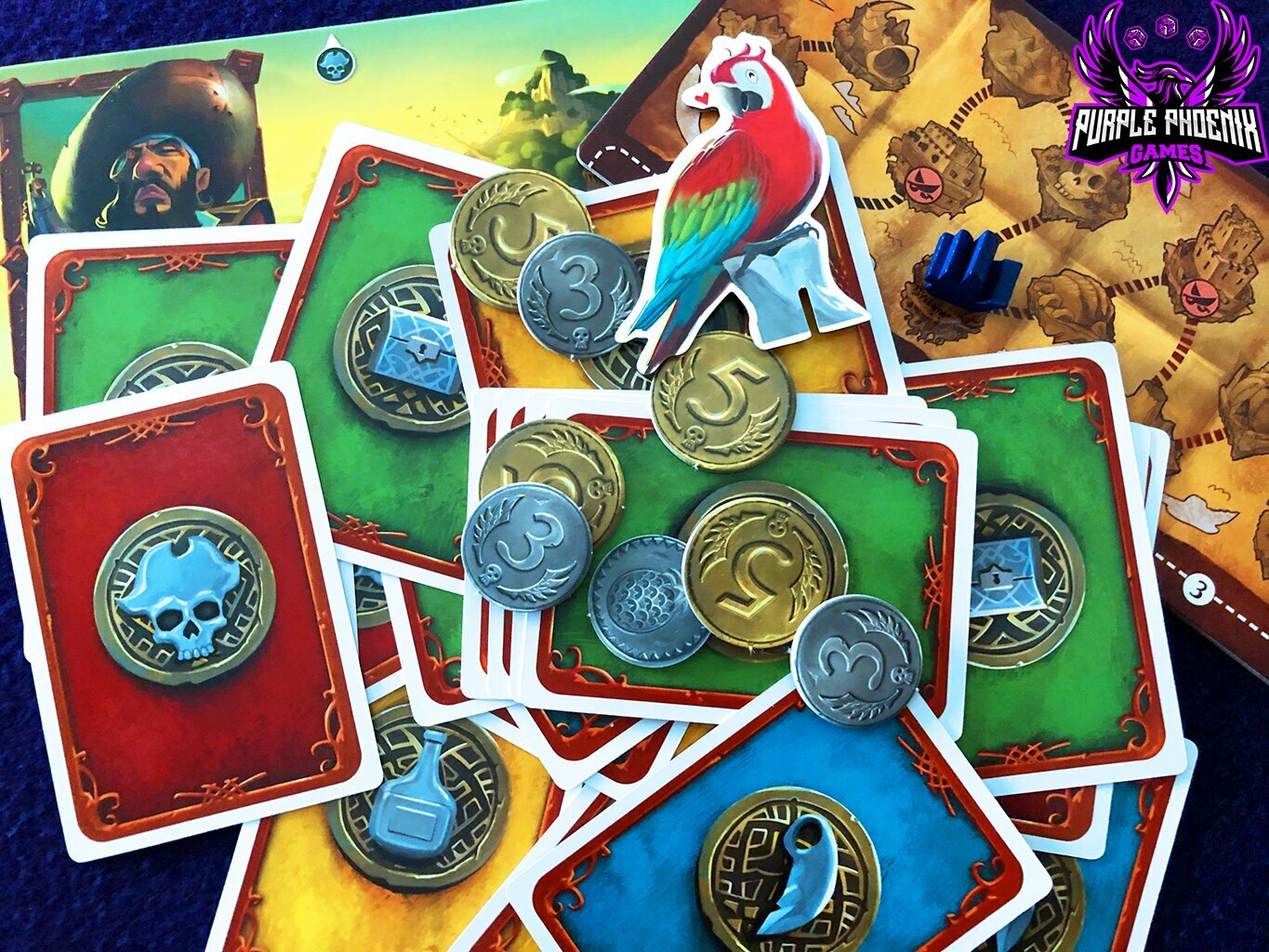
Another neat thing I like about the strategy of this game is that all the cards have backs based on their card type. So all Relic cards have the same back, all Crew cards have the same back, etc. Even though you may not know what is on the other side of the card, you might just take a chance on a share of loot because it has the card types you are trying to get. That’s where the push your luck comes in, because until you look at a share of loot, you aren’t sure if that card is the one you need. Maybe share #1 has a couple cards you could use, but share #2 has a relic card that could be the final one in your set! Are you willing to risk passing up a decent share of loot to see if the next share has what you need? Or maybe the top of the draw deck has the card type you want – would you pass up all 3 shares of loot for one blindly draw card in hopes that it is to your benefit? There is no single ‘right’ way to play, and that is what makes this fun.
The only drawbacks of this game for me are the boarding/combat turns. I like the idea of this player interaction, but it doesn’t always work fairly in my opinion. At the end of each boarding/combat turn, all players discard all of their Crew cards, and you have until the next boarding phase to recruit a new crew. And sometimes, just based on the luck of the draw, you just never get the opportunity to hire anybody. Maybe your opponent takes the share with a Crew member before you get a chance to, or maybe the deck just isn’t evenly shuffled enough to get enough Crew cards out into the playing field. So if you have no Crew, you automatically lose the combat, and that can be detrimental to your strategy – opponents could steal or discard some of your cards, and cause you to lose end-game points. Maybe if there was a draw pile where you could pay a certain amount of gold to hire a Crew member, that would make the game feel a little more fair in the combat department. But ultimately, you’re at the mercy of the luck of the shuffle/draw, and sometimes it just doesn’t balance out.
All in all, I think Sea of Clouds is a great game. It’s a relatively simple game, but one that still requires strategic thought. The push your luck element feels unique in this game because you don’t really lose anything if your luck runs out, you just don’t necessarily get as far as you wanted. The game itself is pretty to look at – the artwork is very well-done and the colors really pop and draw the eye to the cards. This may not be in my Top 10 of favorite games, but it’s one that I will definitely be keeping in my collection. Take a chance on this one if you haven’t so far – it might surprise you. Purple Phoenix Games gives Sea of Clouds a high-flying 12 / 18.
In Sea of Clouds, players are Captains of mighty air pirate ships. That’s right – flying pirate ships! Just like the pirate days of yore, your goal is to recruit the best crew, plunder for treasure and relics, and find the best rum along the way. But be careful because your rival pirate Captains have their eyes on the same prize – so make sure you’ve got a way to outsmart them and sail your way to victory!
Sea of Clouds is a game of card drafting, set collection, and push your luck in which players are trying to amass the most end-game victory points. Played over a series of rounds, players take turns drafting cards, performing bonus actions, and engaging in combat with their neighboring Captains. To setup, each player takes their chosen Captain board, the central board is placed in the middle of all players, and 1 loot card is placed face-down on each of the 3 loot spaces on the central board. The remaining cards are shuffled and create a draw pile. Now you are ready to play!
Each round consists of divvying up shares of loot between all players. On your turn, you will take the face-down card(s) in the #1 loot spot and look at them secretly. Decide whether you want to take the share, or leave it and look at the next one. If you decide to keep the card(s), add them directly around your Captain board in their corresponding spaces. If you decided to leave the share, add 1 card from the top of the draw pile to that share, and then look secretly at the cards in the #2 loot spot. Proceed in the same manner as before with the cards in the #2 and #3 loot spots, if necessary. If none of the shares catch your fancy, draw 1 card from the top of the draw deck to add to your ship. Play continues to the left, and once everyone has had their turn, move the round marker ahead on the central board, and continue on to the next round in the same fashion. At the end of certain rounds of the game, following the divvying of shares, there will be a boarding/combat turn – players will compare the combat strength of their crew (recruited during the divvying of shares) to that of their neighboring Captains. If your crew’s strength is greater than your neighbor, resolve any rewards/effects on your pirate cards. If your strength is less than your neighbor, you lose the combat and do not collect any rewards. Once all combats have been resolved, everyone discards all their crew cards, and the next round begins. At the end of the game, players count up their victory points, and the player who has amassed the most is the winner!
I’m going to get right to the spoilers and say that I love Sea of Clouds. It has some of my favorite mechanics (set collection and card drafting) and it is easy to teach, learn, and play. Do not let the simplicity of play fool you, however, because strategy is definitely a key to victory. One thing that takes this strategy to the next level for me is that there will be times when all players know what cards are in each share of loot. You’ve got to pay attention to which shares your opponents are taking, and figure out a way to stop them from collecting complete sets, or try to force them to collect a share they may not necessarily want. Also, as shares go unclaimed, they get more cards (and eventually money) added to them, so you have to weigh the risks of collecting a share because of one specific card, even though there may be a ‘bad’ card in that share for you. You always have to be adjusting your strategy based on what cards show up in each share, so there is no idle time for any player in this game.
Another neat thing I like about the strategy of this game is that all the cards have backs based on their card type. So all Relic cards have the same back, all Crew cards have the same back, etc. Even though you may not know what is on the other side of the card, you might just take a chance on a share of loot because it has the card types you are trying to get. That’s where the push your luck comes in, because until you look at a share of loot, you aren’t sure if that card is the one you need. Maybe share #1 has a couple cards you could use, but share #2 has a relic card that could be the final one in your set! Are you willing to risk passing up a decent share of loot to see if the next share has what you need? Or maybe the top of the draw deck has the card type you want – would you pass up all 3 shares of loot for one blindly draw card in hopes that it is to your benefit? There is no single ‘right’ way to play, and that is what makes this fun.
The only drawbacks of this game for me are the boarding/combat turns. I like the idea of this player interaction, but it doesn’t always work fairly in my opinion. At the end of each boarding/combat turn, all players discard all of their Crew cards, and you have until the next boarding phase to recruit a new crew. And sometimes, just based on the luck of the draw, you just never get the opportunity to hire anybody. Maybe your opponent takes the share with a Crew member before you get a chance to, or maybe the deck just isn’t evenly shuffled enough to get enough Crew cards out into the playing field. So if you have no Crew, you automatically lose the combat, and that can be detrimental to your strategy – opponents could steal or discard some of your cards, and cause you to lose end-game points. Maybe if there was a draw pile where you could pay a certain amount of gold to hire a Crew member, that would make the game feel a little more fair in the combat department. But ultimately, you’re at the mercy of the luck of the shuffle/draw, and sometimes it just doesn’t balance out.
All in all, I think Sea of Clouds is a great game. It’s a relatively simple game, but one that still requires strategic thought. The push your luck element feels unique in this game because you don’t really lose anything if your luck runs out, you just don’t necessarily get as far as you wanted. The game itself is pretty to look at – the artwork is very well-done and the colors really pop and draw the eye to the cards. This may not be in my Top 10 of favorite games, but it’s one that I will definitely be keeping in my collection. Take a chance on this one if you haven’t so far – it might surprise you. Purple Phoenix Games gives Sea of Clouds a high-flying 12 / 18.
Purple Phoenix Games (2266 KP) rated Evo (second edition) in Tabletop Games
Oct 11, 2019
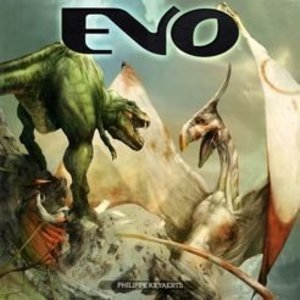
I always get so excited when I start a review because I want to tell you all about these wonderful experiences we have had with different games. I want to let you in on all of our inside jokes that make their way into our every day language. But, alas, I cannot. At least not yet. But my hope is that I will interest you enough to give our favorite games a shot so that you can have these, or similar, great experiences. And Evo is one of our favorite games.
Evo pits its players against one another in a clash to populate an island too small for everyone to enjoy harmoniously. It’s a… Small (dino) World, if you will. By improving your clan’s dinosaurs, survivability, and vigor you may be able to establish the most prosperous clan. At least until the meteor hits and wipes everyone off the face of the island anyway…
DISCLAIMER: We do not intend to cover every single rule included in the rule book, but will describe the overall game flow and major rule set so that our readers may get a sense of how the game plays. For more in depth rules, you may purchase a copy online or from your FLGS. -T
Evo is played over several phases over several turns. Exactly how many turns is unknown because the end game is denoted by a randomized meteor token. To setup Evo shuffle the meteor token into the bottom few climate rotation tokens and set them as a stack face down. These will be the round trackers and also will dictate how the climate may change from round to round. Set the climate wheel on the starting space and within view of the players. Shuffle the event cards and place them face down near the enhancement bid board. Give each player the mat, dinomeeples (yay I got one that makes sense!), and bidding totem of their chosen color. Lay the correct map for the amount of players on the table and have each player place their dinomeeples on the corresponding starting spaces on the map. Give each player their starting money (in VP chips). Determine the starting initiative order and place the totems on the bid board in that order. Set aside the combat die and you are finally ready to play!
The first phase of the game is Climate. (after the first round) A new climate token will be revealed which directs the players to adjust the climate wheel or keep it status quo. The climate wheel determines which spaces on the map will have cold, hot, Death-Valley-type, or safe climates for dinos to live on. This is known information at the beginning of the round so the players can plan out the rest of the round to keep their dinos safe before the culling.
The next phase is bidding on enhancements. Draw from the bag enough tokens for the players to quarrel over and place them randomly on the bid board. In initiative order players will bid on enhancements using their VP chips. When a player is outbid for an item they must place their bid totem on another item. Once all players are winning bids on items they pay the supply for their winnings and add it to their mat in the appropriate slots. These could include items to help a dino survive the cold, increase their attack potential, give their dinos more movement (or walks, as we call them), and other special abilities.
Now that the players are enhanced a bit more, their dinosaurs can move on the map. This may be necessary for some, but not all, depending on how they have enhanced their dino clans. A dino can move as many spaces as feet are shown on the player’s board, or the total movement can be split by multiple dinos. The more feet, the more movement. If, during the movement phase, a dino wishes to enter a space currently inhabited by a rival clan’s dinomeeple a combat will occur. Combat is determined by comparing horns and defenses and the roll of the combat die.
Once movement is over, it’s time for the dinos to get saucy – it’s baby-making time! I mean, it’s reproduction time! That’s not appropriate either. You can create one more dinomeeple to place on the map adjacent to another dino. This is how you may expand your empire of cute dinomeeples.
Once these phases are complete the players will consult the climate wheel to see which of their dinos are safe from elimination. For those dinos that are safe a player will earn 1 VP. Play continues in this fashion until the round that the meteor token is flipped from the stack of climate tokens that typically start a round. As the meteor destroys all dinomeeples on the map players will total their VPs and the winner is the clan leader with the most VP at game’s end.
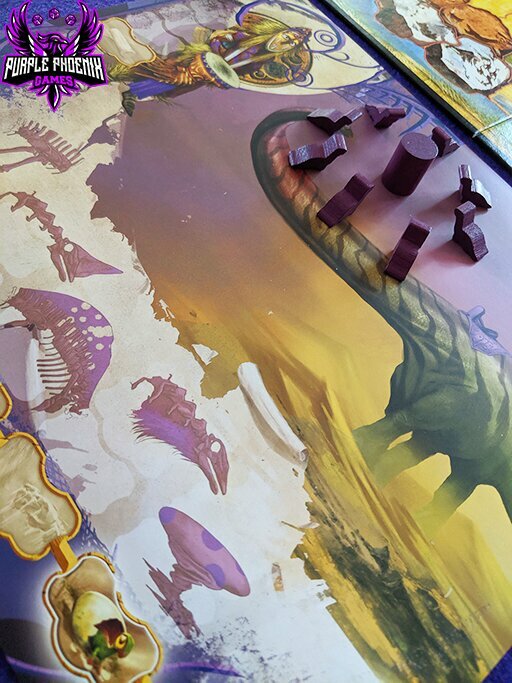
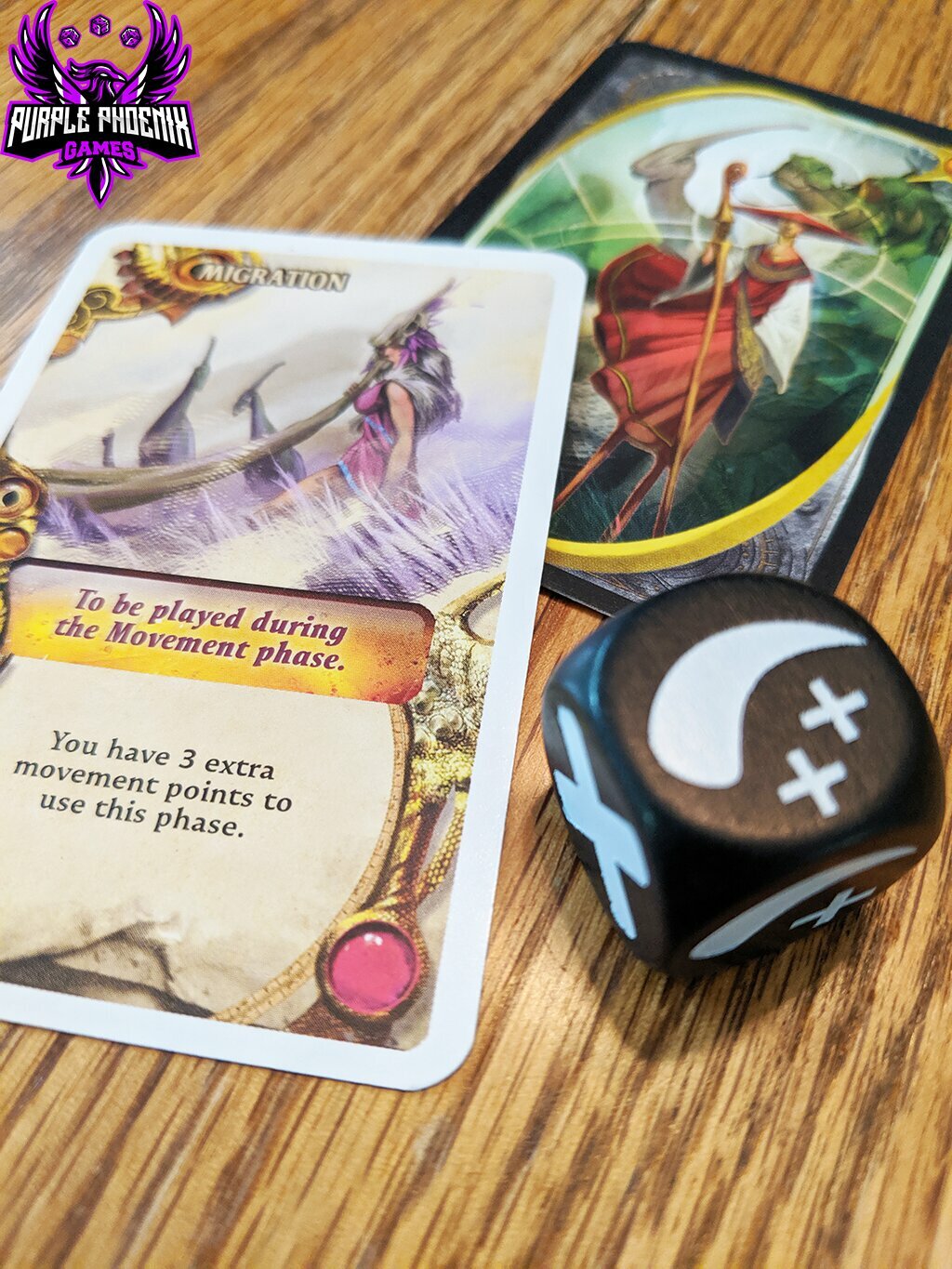
Components. There are a LOT of components in this box. One of the best components in the game is the well-designed box insert. As you unpack the game you can really just setup right out of the box. The maps, bidding board, and climate wheel are normal-style game boards and of good quality. The cards are OK and get the job done. The die is a painted wooden die and it’s fun to roll. The climate tokens, VPs, and enhancement chips are all thick cardboard. The play mats are a matte cardstock (and that’s fine because it just holds your components). The other components are the cloth bag for enhancement draws and those cutie little dinomeeples! Everything is really well-produced and has held up really well for us. My only minor minor complaint is that I wish the dinomeeples were a different shape per color, but everyone having brontosauri is fine with me too. The art. The art is SPECTACULAR on this one. Seriously really great artwork. The cards, the boards, the playmats, the enhancements. Everything looks just amazing.
I kinda already let you know that I love this game. So I am not going to wax poetic here and go into some long analyses of why I love it. It is a more-involved Small World (I hope you caught that shameless reference in the intro) that uses dinosaurs instead of fantasy race/class combos. You know Evo is great when you can compare it to an already-great game from the same designer. I also think you could play Evo and Small World back-to-back and have an enjoyable experience. They are similar, but offer a different experience FOR SURE. I know this one is tough to find nowadays, but please, if you see it for sale in the wild PICK IT UP. It’s a great game that will offer years and years of play for you and your game group. Purple Phoenix Games gives this one a prehistoric 16+ / 18. I say “plus” because I may change it to a 6 in the future. It’s that good.
Evo pits its players against one another in a clash to populate an island too small for everyone to enjoy harmoniously. It’s a… Small (dino) World, if you will. By improving your clan’s dinosaurs, survivability, and vigor you may be able to establish the most prosperous clan. At least until the meteor hits and wipes everyone off the face of the island anyway…
DISCLAIMER: We do not intend to cover every single rule included in the rule book, but will describe the overall game flow and major rule set so that our readers may get a sense of how the game plays. For more in depth rules, you may purchase a copy online or from your FLGS. -T
Evo is played over several phases over several turns. Exactly how many turns is unknown because the end game is denoted by a randomized meteor token. To setup Evo shuffle the meteor token into the bottom few climate rotation tokens and set them as a stack face down. These will be the round trackers and also will dictate how the climate may change from round to round. Set the climate wheel on the starting space and within view of the players. Shuffle the event cards and place them face down near the enhancement bid board. Give each player the mat, dinomeeples (yay I got one that makes sense!), and bidding totem of their chosen color. Lay the correct map for the amount of players on the table and have each player place their dinomeeples on the corresponding starting spaces on the map. Give each player their starting money (in VP chips). Determine the starting initiative order and place the totems on the bid board in that order. Set aside the combat die and you are finally ready to play!
The first phase of the game is Climate. (after the first round) A new climate token will be revealed which directs the players to adjust the climate wheel or keep it status quo. The climate wheel determines which spaces on the map will have cold, hot, Death-Valley-type, or safe climates for dinos to live on. This is known information at the beginning of the round so the players can plan out the rest of the round to keep their dinos safe before the culling.
The next phase is bidding on enhancements. Draw from the bag enough tokens for the players to quarrel over and place them randomly on the bid board. In initiative order players will bid on enhancements using their VP chips. When a player is outbid for an item they must place their bid totem on another item. Once all players are winning bids on items they pay the supply for their winnings and add it to their mat in the appropriate slots. These could include items to help a dino survive the cold, increase their attack potential, give their dinos more movement (or walks, as we call them), and other special abilities.
Now that the players are enhanced a bit more, their dinosaurs can move on the map. This may be necessary for some, but not all, depending on how they have enhanced their dino clans. A dino can move as many spaces as feet are shown on the player’s board, or the total movement can be split by multiple dinos. The more feet, the more movement. If, during the movement phase, a dino wishes to enter a space currently inhabited by a rival clan’s dinomeeple a combat will occur. Combat is determined by comparing horns and defenses and the roll of the combat die.
Once movement is over, it’s time for the dinos to get saucy – it’s baby-making time! I mean, it’s reproduction time! That’s not appropriate either. You can create one more dinomeeple to place on the map adjacent to another dino. This is how you may expand your empire of cute dinomeeples.
Once these phases are complete the players will consult the climate wheel to see which of their dinos are safe from elimination. For those dinos that are safe a player will earn 1 VP. Play continues in this fashion until the round that the meteor token is flipped from the stack of climate tokens that typically start a round. As the meteor destroys all dinomeeples on the map players will total their VPs and the winner is the clan leader with the most VP at game’s end.
Components. There are a LOT of components in this box. One of the best components in the game is the well-designed box insert. As you unpack the game you can really just setup right out of the box. The maps, bidding board, and climate wheel are normal-style game boards and of good quality. The cards are OK and get the job done. The die is a painted wooden die and it’s fun to roll. The climate tokens, VPs, and enhancement chips are all thick cardboard. The play mats are a matte cardstock (and that’s fine because it just holds your components). The other components are the cloth bag for enhancement draws and those cutie little dinomeeples! Everything is really well-produced and has held up really well for us. My only minor minor complaint is that I wish the dinomeeples were a different shape per color, but everyone having brontosauri is fine with me too. The art. The art is SPECTACULAR on this one. Seriously really great artwork. The cards, the boards, the playmats, the enhancements. Everything looks just amazing.
I kinda already let you know that I love this game. So I am not going to wax poetic here and go into some long analyses of why I love it. It is a more-involved Small World (I hope you caught that shameless reference in the intro) that uses dinosaurs instead of fantasy race/class combos. You know Evo is great when you can compare it to an already-great game from the same designer. I also think you could play Evo and Small World back-to-back and have an enjoyable experience. They are similar, but offer a different experience FOR SURE. I know this one is tough to find nowadays, but please, if you see it for sale in the wild PICK IT UP. It’s a great game that will offer years and years of play for you and your game group. Purple Phoenix Games gives this one a prehistoric 16+ / 18. I say “plus” because I may change it to a 6 in the future. It’s that good.
Purple Phoenix Games (2266 KP) rated Holi: Festival of Colors in Tabletop Games
Apr 16, 2022

I absolutely love a beautiful game. Being a gamer, I have seen and played many gorgeous games. However, the first time I set up Holi: Festival of Colors (just Holi from here), both my 5 year old son and my slightly older mother-in-law both commented on how awesome it looked setup on the table. It has been a while since I last was so impressed by the sheer glamour of a game – and I only have the base retail version! I HAVE to get my hands on an upgrade pack or something… Just checked. I’ll have to buy the Deluxe version. Okay, placing order.
Holi is an abstract, area control, card-driven action selection (akin to Onitama) game for two to four players. In it, players are attendees at the Holi Festival and the goal is spread their favorite color onto the plaza and other players in order to increase their joy (earn VP). The winner is the player who is best able to throw their color and score joy, all while enjoying the festival!
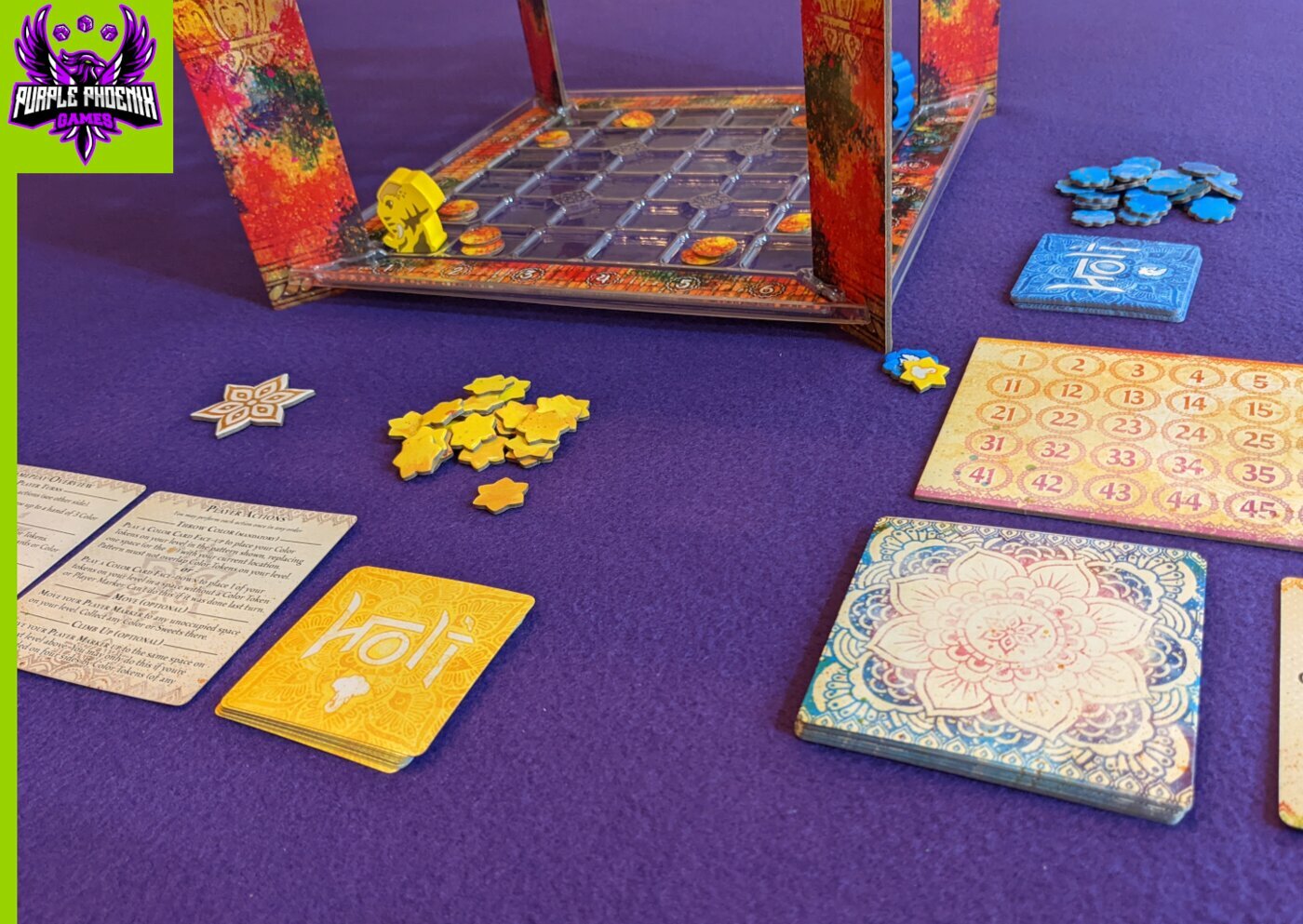
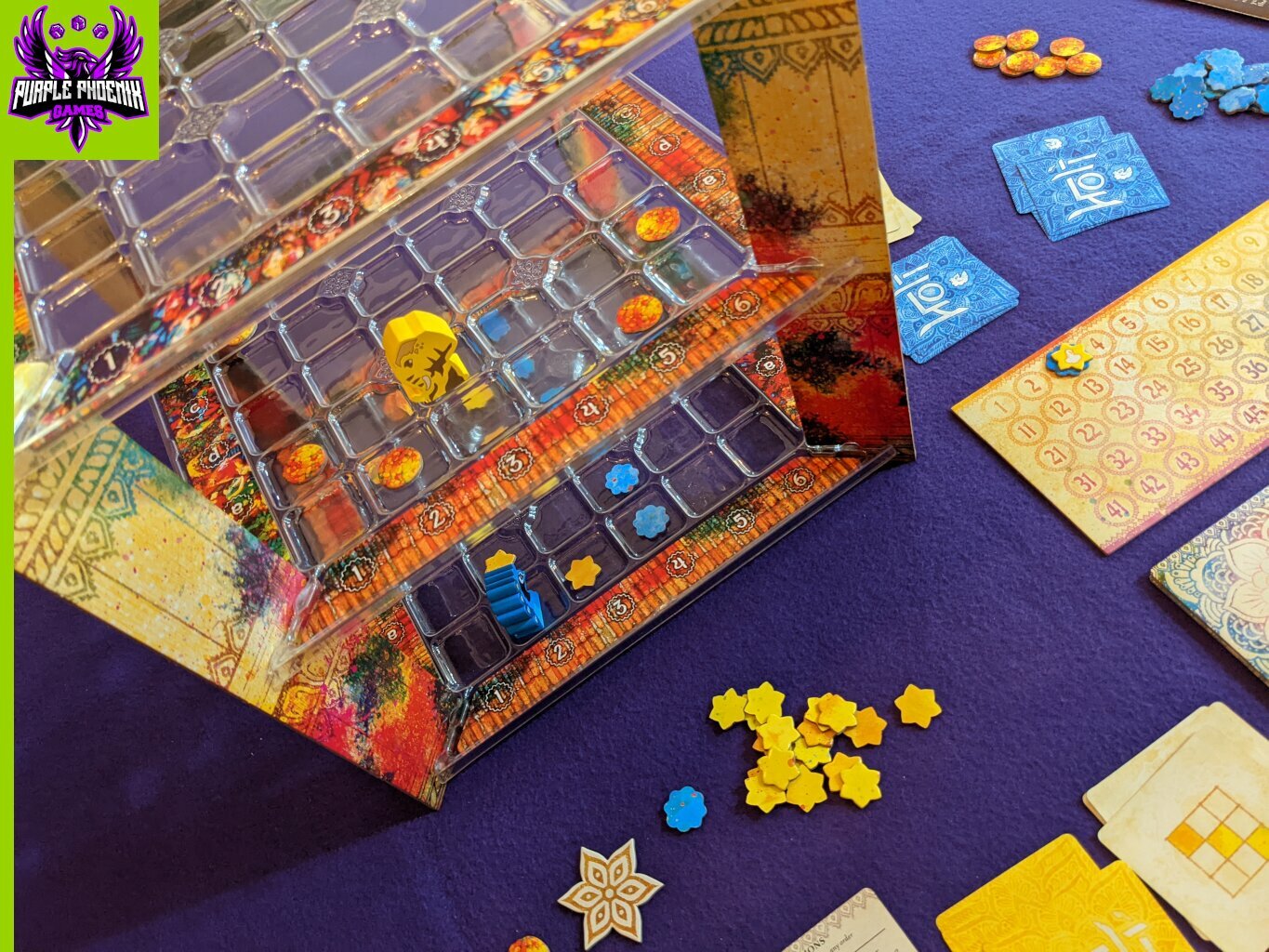
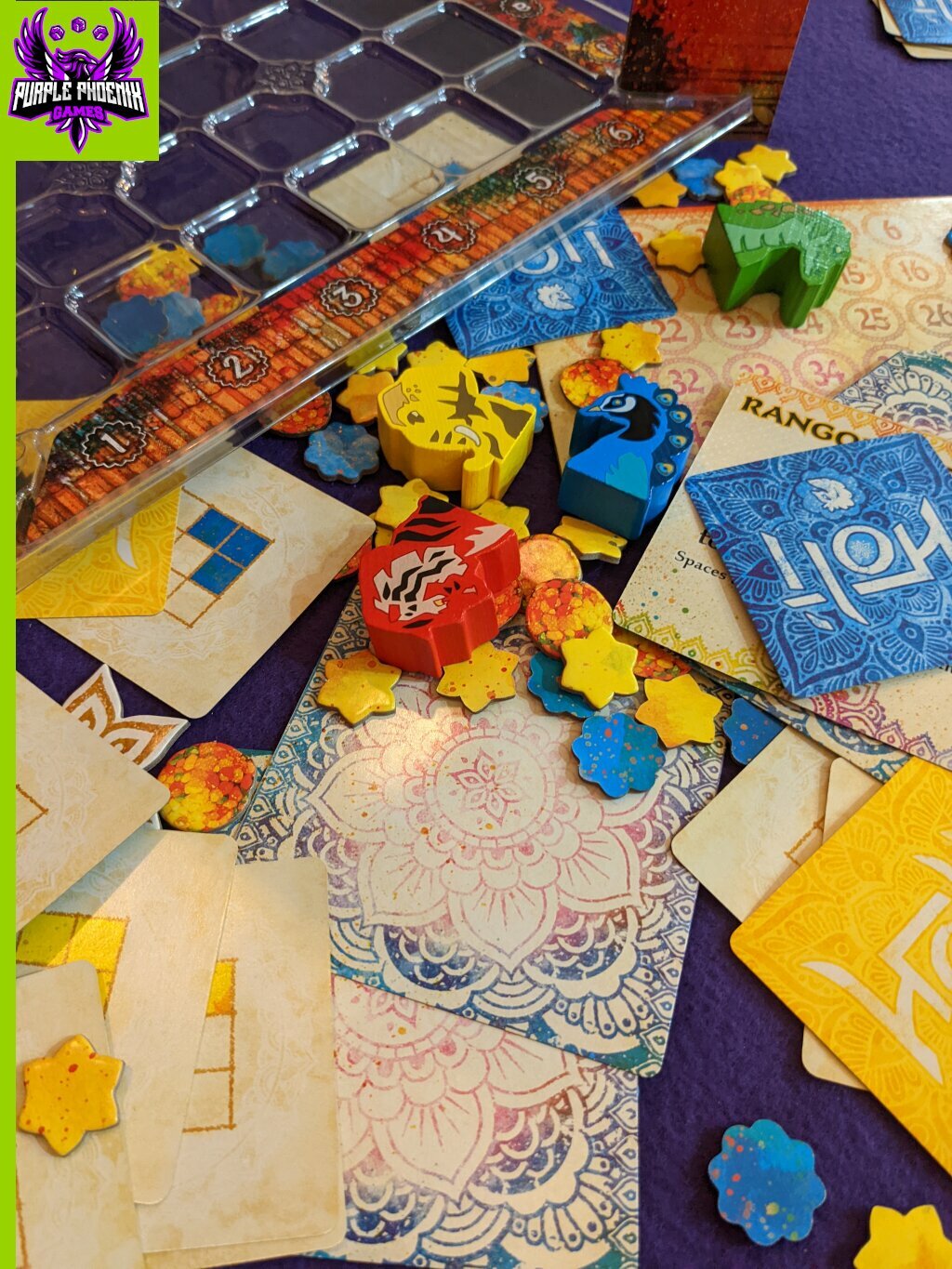
To setup, the game owner will assemble the three-tiered board and place the appropriate sweets tokens on their spaces. The score track and Rivalry cards are set nearby so all can see. Each player receives their color’s player markers (in four delightful animal shapes), color tokens, color cards, and a helper card. The first player receives the cool lotus flower (I think) marker and the game may begin!
Holi is played over a series of turns, and continues until every player has either run out of color tokens or color cards to play. Each turn, players will take one to three actions in any order, with only one action being absolutely mandatory. This is the Throw Color action. In order to Throw Color, the active player will choose a color card from their hand of three cards to play. On these cards are indications of where a player’s marker/piece/animeeple must be located and the spaces near it to throw color tokens on the board. These color cards are reminiscent of those found in Onitama, where players may only move to specific spaces based on card grid iconography. Players will be littering the squares of the play area with their color tokens as well as attempting to hit other players’ animeeples with their color.
Players may also optionally Move at any point during the turn. This is an easy one: players may Move to any space on the current level of the board they are on, except any space inhabited by an opponent’s animeeple. These spaces could already contain sweets tokens, which can be collected by the player, or even color tokens. When a player lands in a space with their own color token, they take it back to their supply to be used again. However, landing on an opponent’s color token causes the active player to also take it into their supply, thus scoring the opponent points at the end of the game.
Finally, a player, if in a space surrounded on four edges by color tokens, may Climb Up to the next higher level. Players on the middle level will score 2 joy (VP) at the end of the game for each color token placed, while tokens on the top level will score 3 joy. Care should be taken when throwing color on the upper levels, because should an empty space reside on the level below where the token has been placed, the token will fall through to the lower level! Therefore, only color tokens will only remain placed on higher levels when another token is blocking its fall below it.
Once all players have played their cards and thrown their color tokens, the game is over and the score is tallied. 1 point is earned for each color token on the bottom level, 2 points for the middle level, and 3 points for tokens on the upper level. Players score 2 more points for each of their color tokens that found their way into opponents’ supplies. Remember those sweets tokens that players were collecting? Players will score 5 points for every player that has less sweets tokens at the end of the game. If playing with the Rivalry cards, points are also scored for any of their special circumstances (ie color tokens scoring 4 instead of 3 on the top level, or hitting opponents with colors score 2 points immediately instead of the normal 1 point, or even 10 bonus points to the player with the most color tokens on the bottom level). The player with the most points at the end of this scoring phase wins the game!
Components. I kind of already made my point about this game being a flat out stunner on the table. I will sing its praises from here to India and then back again. I normally acknowledge the artist(s) on a game once I open it for the first time, but seeing that this is a total Vincent Dutrait masterpiece, I just had to see which other games of his I own. I have made my claims in the past for my favorite board game artists and I had not included Dutrait. No more. This is brilliant and just a wonderful experience throughout. The components are all great, and that multi-layered board? I mean, come on! The intricacies found throughout and within this box are immeasurable, and I will surely be adding the Deluxe version to my collection.
Holi is a game I can pull out with almost any person or group of people and feel confident that it will give an extremely satisfying experience. The rules are relatively simple, and games are very quick. This is not a filler, but runs so smoothly and briskly that one may miscategorize it as such. The options of movement are so unrestricted, and having the ability to craft spatial situations with the cards in your hand to allow only your animeeple to climb up to the next level is just delicious. Speaking of, the sweets tokens, and really ALL of the components, are just so cute and well-illustrated. I really am finding it difficult to point out any flaws in this game. Every time I have played it I have simply had the best time with my opponents. Yeah, there’s some minor take that, but it’s all in good fun, and if you know anything about the actual celebration of Holi, participants relish coming home just covered head to toe in paint, colored water, and other colorful materials. It’s a great theme that shines through, and I look forward to each of my coming plays.
Currently, eight games we have published reviews for have earned the Golden Feather Award. At the time of this writing, I know one other will be joining that list soon, and now Holi will as well. So that is 10 total games over the 495 we have published and are sitting in queue to be published. That said, it is no surprise, I’m sure, that Holi has earned its spot among the best we have played, and I am incredibly relieved that I was able to grab a copy when I did. This will remain a favorite of mine for many years, I know it. If you are like me and appreciate an amazing production value with a comparably wonderful game underneath, then you owe it to yourself to pick up a copy of Holi as soon as you can. Or come play my copy with me. I will always be up for a play.
Holi is an abstract, area control, card-driven action selection (akin to Onitama) game for two to four players. In it, players are attendees at the Holi Festival and the goal is spread their favorite color onto the plaza and other players in order to increase their joy (earn VP). The winner is the player who is best able to throw their color and score joy, all while enjoying the festival!
To setup, the game owner will assemble the three-tiered board and place the appropriate sweets tokens on their spaces. The score track and Rivalry cards are set nearby so all can see. Each player receives their color’s player markers (in four delightful animal shapes), color tokens, color cards, and a helper card. The first player receives the cool lotus flower (I think) marker and the game may begin!
Holi is played over a series of turns, and continues until every player has either run out of color tokens or color cards to play. Each turn, players will take one to three actions in any order, with only one action being absolutely mandatory. This is the Throw Color action. In order to Throw Color, the active player will choose a color card from their hand of three cards to play. On these cards are indications of where a player’s marker/piece/animeeple must be located and the spaces near it to throw color tokens on the board. These color cards are reminiscent of those found in Onitama, where players may only move to specific spaces based on card grid iconography. Players will be littering the squares of the play area with their color tokens as well as attempting to hit other players’ animeeples with their color.
Players may also optionally Move at any point during the turn. This is an easy one: players may Move to any space on the current level of the board they are on, except any space inhabited by an opponent’s animeeple. These spaces could already contain sweets tokens, which can be collected by the player, or even color tokens. When a player lands in a space with their own color token, they take it back to their supply to be used again. However, landing on an opponent’s color token causes the active player to also take it into their supply, thus scoring the opponent points at the end of the game.
Finally, a player, if in a space surrounded on four edges by color tokens, may Climb Up to the next higher level. Players on the middle level will score 2 joy (VP) at the end of the game for each color token placed, while tokens on the top level will score 3 joy. Care should be taken when throwing color on the upper levels, because should an empty space reside on the level below where the token has been placed, the token will fall through to the lower level! Therefore, only color tokens will only remain placed on higher levels when another token is blocking its fall below it.
Once all players have played their cards and thrown their color tokens, the game is over and the score is tallied. 1 point is earned for each color token on the bottom level, 2 points for the middle level, and 3 points for tokens on the upper level. Players score 2 more points for each of their color tokens that found their way into opponents’ supplies. Remember those sweets tokens that players were collecting? Players will score 5 points for every player that has less sweets tokens at the end of the game. If playing with the Rivalry cards, points are also scored for any of their special circumstances (ie color tokens scoring 4 instead of 3 on the top level, or hitting opponents with colors score 2 points immediately instead of the normal 1 point, or even 10 bonus points to the player with the most color tokens on the bottom level). The player with the most points at the end of this scoring phase wins the game!
Components. I kind of already made my point about this game being a flat out stunner on the table. I will sing its praises from here to India and then back again. I normally acknowledge the artist(s) on a game once I open it for the first time, but seeing that this is a total Vincent Dutrait masterpiece, I just had to see which other games of his I own. I have made my claims in the past for my favorite board game artists and I had not included Dutrait. No more. This is brilliant and just a wonderful experience throughout. The components are all great, and that multi-layered board? I mean, come on! The intricacies found throughout and within this box are immeasurable, and I will surely be adding the Deluxe version to my collection.
Holi is a game I can pull out with almost any person or group of people and feel confident that it will give an extremely satisfying experience. The rules are relatively simple, and games are very quick. This is not a filler, but runs so smoothly and briskly that one may miscategorize it as such. The options of movement are so unrestricted, and having the ability to craft spatial situations with the cards in your hand to allow only your animeeple to climb up to the next level is just delicious. Speaking of, the sweets tokens, and really ALL of the components, are just so cute and well-illustrated. I really am finding it difficult to point out any flaws in this game. Every time I have played it I have simply had the best time with my opponents. Yeah, there’s some minor take that, but it’s all in good fun, and if you know anything about the actual celebration of Holi, participants relish coming home just covered head to toe in paint, colored water, and other colorful materials. It’s a great theme that shines through, and I look forward to each of my coming plays.
Currently, eight games we have published reviews for have earned the Golden Feather Award. At the time of this writing, I know one other will be joining that list soon, and now Holi will as well. So that is 10 total games over the 495 we have published and are sitting in queue to be published. That said, it is no surprise, I’m sure, that Holi has earned its spot among the best we have played, and I am incredibly relieved that I was able to grab a copy when I did. This will remain a favorite of mine for many years, I know it. If you are like me and appreciate an amazing production value with a comparably wonderful game underneath, then you owe it to yourself to pick up a copy of Holi as soon as you can. Or come play my copy with me. I will always be up for a play.

Purple Phoenix Games (2266 KP) rated The Bloody Inn in Tabletop Games
Feb 12, 2022


It’s cliche to post a game review like this so near to Halloween, so I will probably hold off on that. However, what a perfect game to go along with the macabre tone of the Halloween season! Get this: you and your family own a motel in a small town where many travelers stop to rest. You are strapped for cash, so what is a logical step in achieving wealth? Of course! Murdering and robbing your customers upon their stays! No? Not a typical business model? Unsustainable? Pfft. You just aren’t robbing the right customers…
The Bloody Inn is a card-drafting, hand management, horror game of recruiting accomplices and having them carry out dastardly deeds to secure the most money at the end of the game. In it, players take on the roles of one of the inn’s staff members and control pawns in their evil schemes in order to swindle and kill for mountains of francs (it’s set in France, pre-Euro).
To setup, place the main board on the table, give each player the components of their color choice, two Peasant cards, a 10 franc (f) check, and a player aid card. The “traveler deck” is assembled and shuffled per the rules, and placed on the Entrance side of the board. Players choose one room to place a key token in their color, and several gray neutral key tokens are placed in other rooms. Unsuspecting travelers will be staying in these rooms each night. Per the rules, the greediest player is given the first player card and the mischief may begin!
The Bloody Inn is played over several rounds, and each round has players completing three phases: Welcome Travelers, Player Actions, and End of Round. Players will Welcome Travelers to signify the start of the round by the first player drawing one card from the deck at a time and choosing in which room they will be placed.
After Travelers have been welcomed and turn in for the evening, the second phase may begin: Player Actions. In turn order players will be able to perform two actions each round. Players may choose from five different actions, and actions can be repeated for the second action of the round. Players may Bribe a Guest by discarding cards from hand equal to the printed value on the target card’s front. Initially all players simply employ the two starter Peasants, so Bribing is only performed on cards that show a value of 0-2. When a player Bribes a guest, they essentially spend cards from hand to recruit the new guest to their employ. These new employees (accomplices) are then available to be used on future actions. One or two Peasants may also be Bribed from the bistro, adding to a player’s hand of usable human resources.
A player may instead choose to Kill a Guest by similarly discarding the appropriate number of accomplices and adding the freshly-slain guest to their tableau, face-down. The card backs feature a coffin with their “rank” (action number) printed on it. Corpses normally cause no issues, but they will need to be buried under an Annex in order to collect the money in their pockets. Players may use an action to Build an Annex by discarding the appropriate number of accomplices and using a card from hand to build and staff the Annex. Annexes can be used for the action printed on the card bottom, and/or as a housing for corpses, with the Corpses being sent to any player’s Annex via the Bury a Corpse action. Discard the requisite number of accomplices to bury a corpse, and avoid suspicion from the Law.
If none of these actions are attractive to the player, or if they simply wish, they may instead Pass and launder money from the village notary. To do this, either reduce the number of francs from the Wealth Track on the main board in order to gain a 10f check, or turn in a check for 10f on the Wealth Track.
Once all players have taken their two actions, the End of Round is performed. Firstly, if any Travelers remain belonging to the Police type (signified by pistol icons on the top of the card), they will conduct an investigation, finding any unburied corpses. Should a corpse be found in this way, the owning player will need to pay 10f for the local undertaker to dispose of the body respectfully. This not only costs the player 10f, but also the amount of money that could have been gained if they had only buried them or dealt with the Police traveler prior. Next, the Travelers who remain all wake up feeling refreshed and leave the inn by being placed in the discard pile. Once the board has been cleared of all Travelers, accomplices must be paid their wages for their help. For each accomplice in hand, the players must pay 1f from the Wealth Track.
Play continues in this fashion until the main Traveler deck has been depleted twice. Then, players add up their francs and the player with the most in francs and checks is the winner, and just the greatest little murderer/robber/briber in all the land!
Components. This game really has a modest amount of components, but they are all similarly great quality. The main board acts as the inn’s room display, the Wealth Track, AND the bistro (where Peasants are discarded, as opposed to being placed in the normal discard pile). I love when components pull double or triple duty. That said, the player aids not only remind the players of the phases and actions from which they may choose, but it also provides the player with a starter Annex that can be used to bury their first corpse! HOW COOL IS THAT?! However, the greatest thing that stands out in regards to the components is the overall look and feel of the game. The character artist for this one is Weberson Santiago, and he has also illustrated games such as the new Quest (the new version of The Resistance: Avalon), Coup, and the new Whirling Witchcraft. I adore his art style, even though I shouldn’t. My typical preference of character art is semi-realism (like that of Kwanchai Moriya), but this style is really unique and perfectly applied to the theme. Great matchup of artist and game here. I do have one silly wish for this game: PLEASE change the player colors. I mean, I am so tired of having the choice between red, blue, green, and yellow. Take a Cue from my good friend Scott Brady and use one of the more interesting color choices. I mean, even to fit in with the theme here a more appropriate palette could include a brown, black, orange, and yellow or something. Be bold!!
I knew right away that this was a great game for me. Yes, the theme is super dark and macabre, which is rare for me to enjoy, but I would only play this with adults anyway so I am unbothered by it. However, the puzzle that lies within this box is one that I thoroughly enjoy solving every round. What I neglected to mention up top is the fact that when actions are taken (Bribing, Killing, Building Annexes, and Burying Corpses) if you happen to have certain card types in hand, then the cost of discards is reduced by the number of cards present. For example, if I were to Bribe a Police card from the rooms in my first action, they have an affinity for killing (messed up, I know) and will thus help me to perform a Kill action on the next turn by reducing the number of accomplices I would need to discard for that action. Side benefit: by taking the Police Travelers off the board, they then will not perform their investigations in the morning.
Another aspect I truly enjoy about The Bloody Inn is that many cards have that dual-purpose mechanic I appreciate. The player aid is also an Annex. Brilliant! Many of the Annex cards can also offer one-time or recurring powers. It’s just so satisfying to grab cards that can combo well with each other in order to fulfill your evil plans. Every card is important, and when they can offer more than one benefit, I am a happy gamer.
I cannot express how happy I am to have decided to purchase this one. I have seen the BGG ratings and rankings, but always thought I wouldn’t like it due to its very adult theme, but boy was I wrong! This is one of the best games I have played recently and I hope to even bling it out a bit, maybe even with new player colors like I suggested earlier. Laura and my wife were able to join me for this one and they agree with me – this one is excellent and definitely worth consideration into anyone’s collection. Purple Phoenix Games gives this one a dastardly 15 / 18. Yeah, it’s perfect for Halloweentime, but also for ANY time. If you are looking for something a little grim and grisly with lighter rules and lots of interesting choices, you need to check out The Bloody Inn. Grab lots of Police cards and go on a killing spree for me!
The Bloody Inn is a card-drafting, hand management, horror game of recruiting accomplices and having them carry out dastardly deeds to secure the most money at the end of the game. In it, players take on the roles of one of the inn’s staff members and control pawns in their evil schemes in order to swindle and kill for mountains of francs (it’s set in France, pre-Euro).
To setup, place the main board on the table, give each player the components of their color choice, two Peasant cards, a 10 franc (f) check, and a player aid card. The “traveler deck” is assembled and shuffled per the rules, and placed on the Entrance side of the board. Players choose one room to place a key token in their color, and several gray neutral key tokens are placed in other rooms. Unsuspecting travelers will be staying in these rooms each night. Per the rules, the greediest player is given the first player card and the mischief may begin!
The Bloody Inn is played over several rounds, and each round has players completing three phases: Welcome Travelers, Player Actions, and End of Round. Players will Welcome Travelers to signify the start of the round by the first player drawing one card from the deck at a time and choosing in which room they will be placed.
After Travelers have been welcomed and turn in for the evening, the second phase may begin: Player Actions. In turn order players will be able to perform two actions each round. Players may choose from five different actions, and actions can be repeated for the second action of the round. Players may Bribe a Guest by discarding cards from hand equal to the printed value on the target card’s front. Initially all players simply employ the two starter Peasants, so Bribing is only performed on cards that show a value of 0-2. When a player Bribes a guest, they essentially spend cards from hand to recruit the new guest to their employ. These new employees (accomplices) are then available to be used on future actions. One or two Peasants may also be Bribed from the bistro, adding to a player’s hand of usable human resources.
A player may instead choose to Kill a Guest by similarly discarding the appropriate number of accomplices and adding the freshly-slain guest to their tableau, face-down. The card backs feature a coffin with their “rank” (action number) printed on it. Corpses normally cause no issues, but they will need to be buried under an Annex in order to collect the money in their pockets. Players may use an action to Build an Annex by discarding the appropriate number of accomplices and using a card from hand to build and staff the Annex. Annexes can be used for the action printed on the card bottom, and/or as a housing for corpses, with the Corpses being sent to any player’s Annex via the Bury a Corpse action. Discard the requisite number of accomplices to bury a corpse, and avoid suspicion from the Law.
If none of these actions are attractive to the player, or if they simply wish, they may instead Pass and launder money from the village notary. To do this, either reduce the number of francs from the Wealth Track on the main board in order to gain a 10f check, or turn in a check for 10f on the Wealth Track.
Once all players have taken their two actions, the End of Round is performed. Firstly, if any Travelers remain belonging to the Police type (signified by pistol icons on the top of the card), they will conduct an investigation, finding any unburied corpses. Should a corpse be found in this way, the owning player will need to pay 10f for the local undertaker to dispose of the body respectfully. This not only costs the player 10f, but also the amount of money that could have been gained if they had only buried them or dealt with the Police traveler prior. Next, the Travelers who remain all wake up feeling refreshed and leave the inn by being placed in the discard pile. Once the board has been cleared of all Travelers, accomplices must be paid their wages for their help. For each accomplice in hand, the players must pay 1f from the Wealth Track.
Play continues in this fashion until the main Traveler deck has been depleted twice. Then, players add up their francs and the player with the most in francs and checks is the winner, and just the greatest little murderer/robber/briber in all the land!
Components. This game really has a modest amount of components, but they are all similarly great quality. The main board acts as the inn’s room display, the Wealth Track, AND the bistro (where Peasants are discarded, as opposed to being placed in the normal discard pile). I love when components pull double or triple duty. That said, the player aids not only remind the players of the phases and actions from which they may choose, but it also provides the player with a starter Annex that can be used to bury their first corpse! HOW COOL IS THAT?! However, the greatest thing that stands out in regards to the components is the overall look and feel of the game. The character artist for this one is Weberson Santiago, and he has also illustrated games such as the new Quest (the new version of The Resistance: Avalon), Coup, and the new Whirling Witchcraft. I adore his art style, even though I shouldn’t. My typical preference of character art is semi-realism (like that of Kwanchai Moriya), but this style is really unique and perfectly applied to the theme. Great matchup of artist and game here. I do have one silly wish for this game: PLEASE change the player colors. I mean, I am so tired of having the choice between red, blue, green, and yellow. Take a Cue from my good friend Scott Brady and use one of the more interesting color choices. I mean, even to fit in with the theme here a more appropriate palette could include a brown, black, orange, and yellow or something. Be bold!!
I knew right away that this was a great game for me. Yes, the theme is super dark and macabre, which is rare for me to enjoy, but I would only play this with adults anyway so I am unbothered by it. However, the puzzle that lies within this box is one that I thoroughly enjoy solving every round. What I neglected to mention up top is the fact that when actions are taken (Bribing, Killing, Building Annexes, and Burying Corpses) if you happen to have certain card types in hand, then the cost of discards is reduced by the number of cards present. For example, if I were to Bribe a Police card from the rooms in my first action, they have an affinity for killing (messed up, I know) and will thus help me to perform a Kill action on the next turn by reducing the number of accomplices I would need to discard for that action. Side benefit: by taking the Police Travelers off the board, they then will not perform their investigations in the morning.
Another aspect I truly enjoy about The Bloody Inn is that many cards have that dual-purpose mechanic I appreciate. The player aid is also an Annex. Brilliant! Many of the Annex cards can also offer one-time or recurring powers. It’s just so satisfying to grab cards that can combo well with each other in order to fulfill your evil plans. Every card is important, and when they can offer more than one benefit, I am a happy gamer.
I cannot express how happy I am to have decided to purchase this one. I have seen the BGG ratings and rankings, but always thought I wouldn’t like it due to its very adult theme, but boy was I wrong! This is one of the best games I have played recently and I hope to even bling it out a bit, maybe even with new player colors like I suggested earlier. Laura and my wife were able to join me for this one and they agree with me – this one is excellent and definitely worth consideration into anyone’s collection. Purple Phoenix Games gives this one a dastardly 15 / 18. Yeah, it’s perfect for Halloweentime, but also for ANY time. If you are looking for something a little grim and grisly with lighter rules and lots of interesting choices, you need to check out The Bloody Inn. Grab lots of Police cards and go on a killing spree for me!
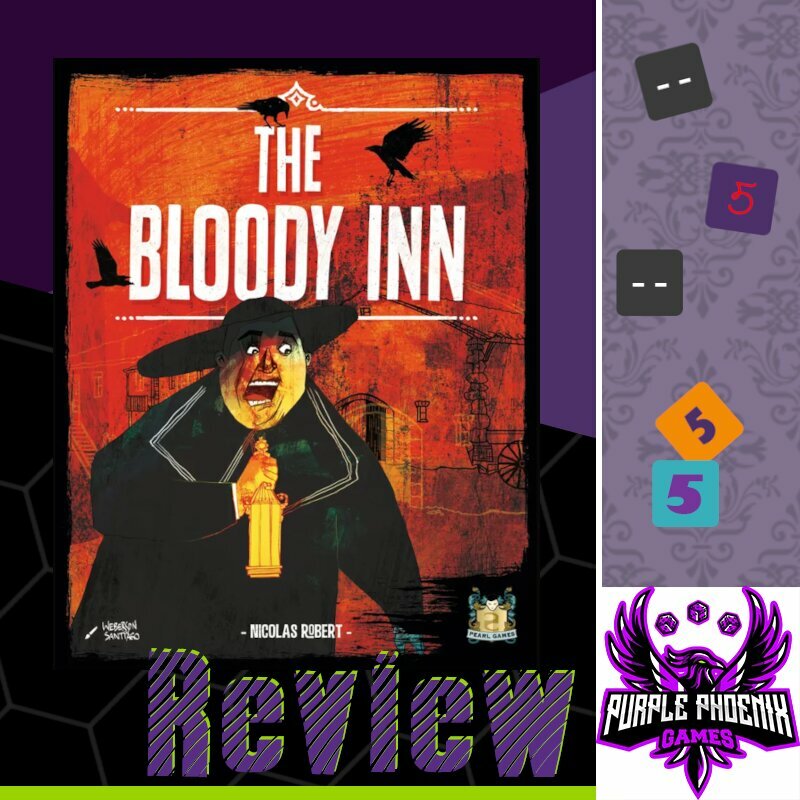
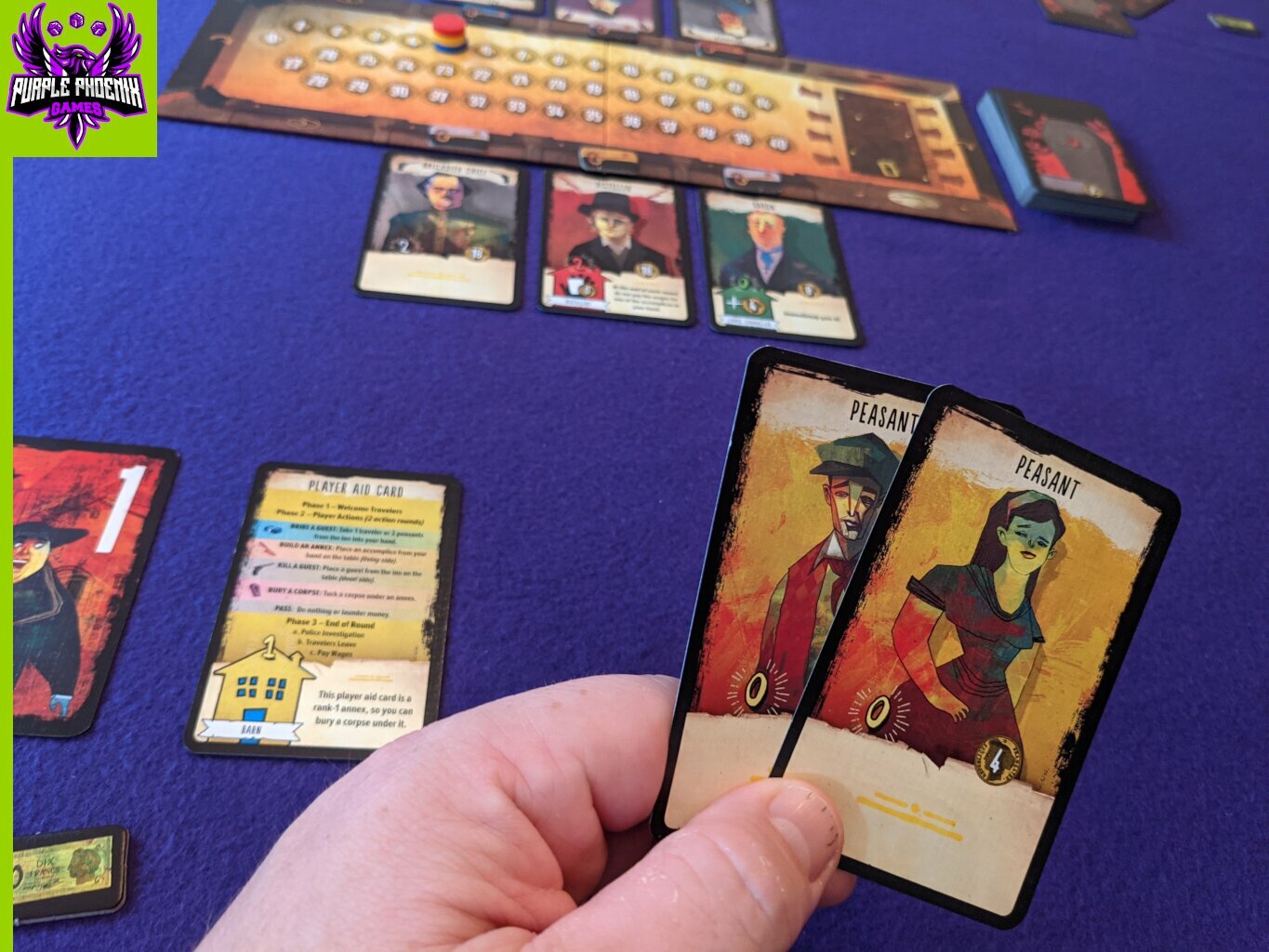
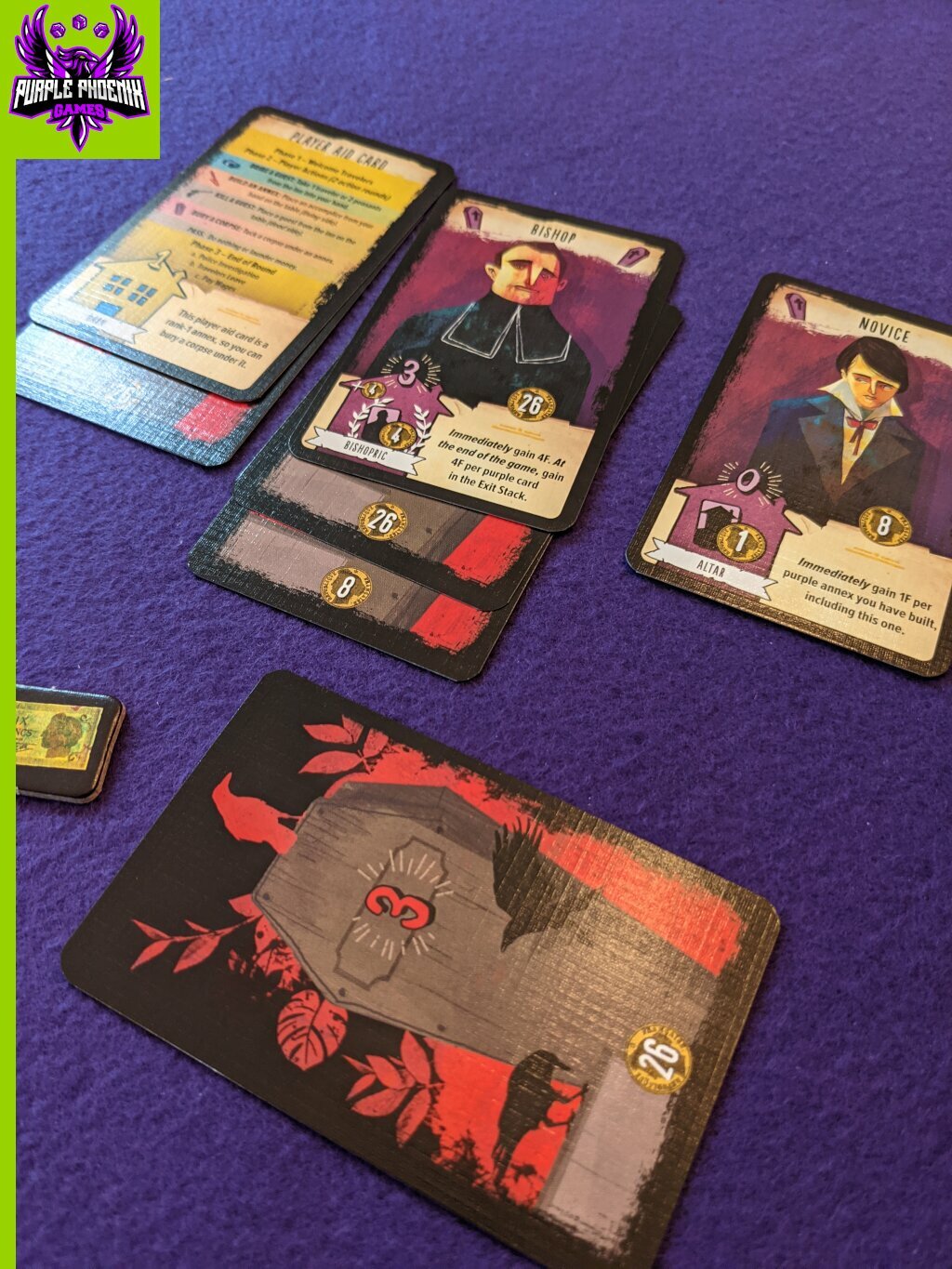
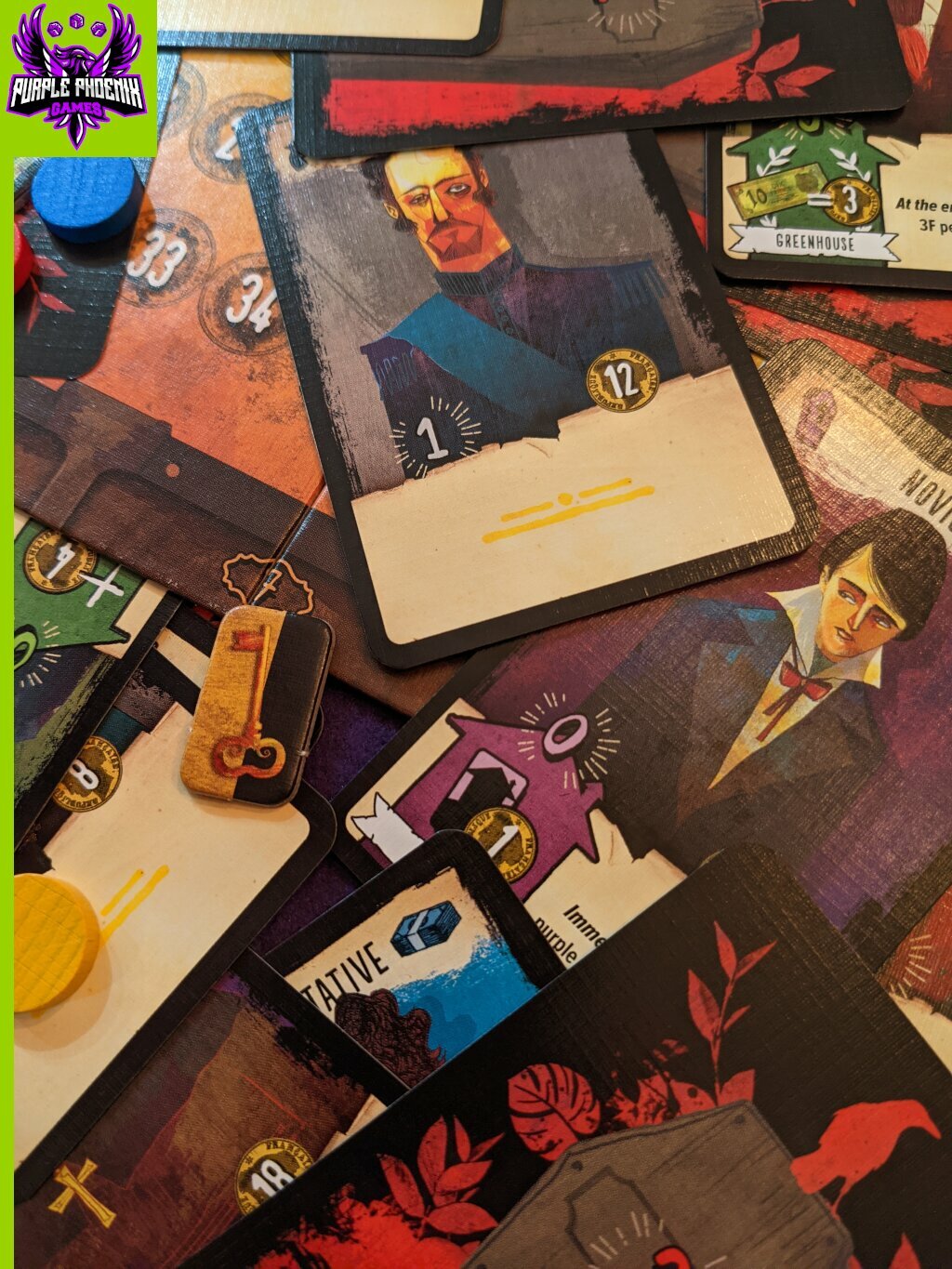
Purple Phoenix Games (2266 KP) rated Destinies in Tabletop Games
Jan 29, 2022
I can recall so many instances of my board game purchases being based on either the designer, artist, or publisher. Surely I am not alone here. Josh will probably always be a Stonemaier Games fanboy. Laura has aligned herself with Daily Magic Games and Button Shy Games. While I am a big fan of the Valeriaverse, I think my current preferences put me on teams Weird Giraffe Games, Blue Orange Games, and Lucky Duck Games. Speaking of the latter, LDG have come through with some seriously excellent hybrid app-driven games that just wow me every single time. I was definitely a hybrid game naysayer when the first Chronicles of Crime came out, but the more I play them, the more I appreciate the accomplishments. Destinies has now come along to me and it has been some time since I have been this jazzed to play a game over and over and over and over.
Destinies is a hybrid app-driven adventure board game for one to three players. In it, players will be choosing their characters and how to play them, along with the path of their individual destinies across several campaign scenarios. When playing multiplayer, the player who completes their destiny first will win. When playing solo (which is also amazing), the player wins when they successfully complete their destiny.
DISCLAIMER: We are using the Kickstarter version of the game. We do have the expansions from the KS campaign, but will not be using those for this review. Also, we do not intend to cover every single rule included in the rule book, but will describe the overall game flow and major rule set so that our readers may get a sense of how the game plays. For more in depth rules, you may purchase a copy from the publisher directly or from your FLGS. -T
Usually I list out the steps to setup a game in this section, but there are so many little items and steps to be taken that I will simply show you, the reader, how a scenario may look once setup. The app will instruct players how to create their character’s stats and which map tiles should be placed out initially. Typically, though, each player will receive a player board, Destiny card (with their character headshot on one side and their Destiny choices on back), two main dice, three effort dice, and one gold coin. Once setup, the app will drive the story along and the players will be rolling dice and making choices in order to win the game or scenario.
Each player will be given their Destiny card with two distinct Destiny paths on the backside. These paths correlate with the current scenario, and the player will be able to choose one of the two given paths to help move their games forward. However, sometimes players will switch their Destiny mid-game due to several factors including successes on previous tasks or current inventory. The only way to win the game is to complete a Destiny, so staying on track is paramount in this open sandbox game – it is incredibly easy to become sidetracked and lose sight of specific tasks to be performed.
Each turn a player may move to a new tile, to previously-explored tiles, or points of interest on specific map tiles. These points of interest could be unique characters to be visited, or more general spaces on the tile represented by tokens. Sometimes visiting a POI (point of interest) will have the player rolling dice to complete tests, initiating trade with the POI NPC, revealing information about their distinct Destiny, or even issuing side quests. Players take their chances by visiting a POI because only one may be visited on a turn. Once a player has moved and visited a POI, their turn is over and the next player’s turn begins.
The most interesting aspect of this game is the experience tracker and results of tests. Player stats are divided between Intelligence, Dexterity, and Power (Strength for my D&D readers). These stats are constantly in flux due to tests and experience, and levels range from 1-12+ on the player board. A player will roll both main dice and any effort dice they wish on each test, and the total result is compared to the discs present on the main player board. One success is counted for each disc’s value equal to or below the rolled result. For example, if the roll is a 6, and the player has a disc on 3 and another on 6 the player counts two successes. Effort dice add values to the rolled result, and one side of these dice depict a star, which counts as one success. Throughout the game players will be moving their skill marker tokens (discs) up and down the tracks. Sometimes this is due to a test being failed or succeeded, but sometimes experience tokens are earned. A player may improve their skill levels by two total values on the tracks for each experience token discarded. Players may choose which tracks, and may maximize their character’s skill or spread out the experience across multiple skills.
Play continues in this fashion of referencing the app for story and plot items, players working toward completing their Destinies, and adventuring across the land rolling tests and improving skills until one player finishes their Destiny and wins the game!
Components. As always, I am going to be honest here by stating I believe that Destinies packs the box with the best components I have seen in a game. The multi-layered insert is perfectly formed and well-thought out, all the cardboard tokens are super-thick, the dice are so fun to handle and roll, the cards and other components feature incredible artwork, and did I mention there’s about a thousand minis in this game? I am reluctant to even call some of these things minis as they are large and in charge for SURE. I have zero complaints or comments on the components present in Destinies. Lucky Duck knocks it out of the park once again. Incredible.
I actually backed this one on Kickstarter just because it comes from Lucky Duck Games. I had played Chronicles of Crime and loved it, and just wanted to try something different but using a similar system. Typically I don’t keep up with the comments and updates to a game I have backed because I enjoy being surprised by the product that arrives at my door. Destinies was certainly a surprise to me, and I have been kicking myself in the butt for not getting it to the table the very first day I received it.
Destinies is my favorite Lucky Duck Games title, and that is saying a ton, as I rave about every game of theirs I have played. I hope you all back me up here, and if you haven’t yet tried this one, I hope you visit your closest friend or board game cafe that owns it. The tutorial scenario is great, and the campaign scenarios have been awesome so far. Okay, yes, when I first played it with Laura, my wife made several comments about it being a 3 hour game, but once that first one is completed, the subsequent plays run much smoother.
What I love so much about this is how indefinitely expandable it is. Most of the components are multi-use (akin to all the character cards in the Chronicles of Crime games), and can be used in campaign after campaign. The drawbacks I see for this, though, is any sort of waning interest in it forcing designers to abandon plans to create more scenarios. Could a new scenario pack be an acceptable expansion versus a large expansion box with oodles of new components and minis? I think so, but I am no designer. Could the Millennium Series treatment be given to Destinies? Absolutely! This system does not need to be played in a medieval fantasy world. It could be molded to almost anything, and that gives me excited shivers over the future of this game.
If you are anything like me and have now embraced the hybrid gaming trend, I highly recommend Destinies. I plan to also review all the expansions in the near future, so do look out for those, but please do yourself a giant favor and pick up Destinies. The excellent storytelling, great components, and just amazing fun helps Purple Phoenix Games give this one a perfectly deserved 12 / 12, and a Golden Feather Award! I can’t stop thinking about it and how I would play it differently next time, and hopefully after I have played through the expansion material I will be able to restart from the very beginning with different characters and choices. It’s a sign of a great game when I can’t stop thinking about it, and I do believe Destinies currently is knocking at the door of my Top 10 Games of All Time. No, it’s there. It’s totally there. TOP 10 BABY!!
Destinies is a hybrid app-driven adventure board game for one to three players. In it, players will be choosing their characters and how to play them, along with the path of their individual destinies across several campaign scenarios. When playing multiplayer, the player who completes their destiny first will win. When playing solo (which is also amazing), the player wins when they successfully complete their destiny.
DISCLAIMER: We are using the Kickstarter version of the game. We do have the expansions from the KS campaign, but will not be using those for this review. Also, we do not intend to cover every single rule included in the rule book, but will describe the overall game flow and major rule set so that our readers may get a sense of how the game plays. For more in depth rules, you may purchase a copy from the publisher directly or from your FLGS. -T
Usually I list out the steps to setup a game in this section, but there are so many little items and steps to be taken that I will simply show you, the reader, how a scenario may look once setup. The app will instruct players how to create their character’s stats and which map tiles should be placed out initially. Typically, though, each player will receive a player board, Destiny card (with their character headshot on one side and their Destiny choices on back), two main dice, three effort dice, and one gold coin. Once setup, the app will drive the story along and the players will be rolling dice and making choices in order to win the game or scenario.
Each player will be given their Destiny card with two distinct Destiny paths on the backside. These paths correlate with the current scenario, and the player will be able to choose one of the two given paths to help move their games forward. However, sometimes players will switch their Destiny mid-game due to several factors including successes on previous tasks or current inventory. The only way to win the game is to complete a Destiny, so staying on track is paramount in this open sandbox game – it is incredibly easy to become sidetracked and lose sight of specific tasks to be performed.
Each turn a player may move to a new tile, to previously-explored tiles, or points of interest on specific map tiles. These points of interest could be unique characters to be visited, or more general spaces on the tile represented by tokens. Sometimes visiting a POI (point of interest) will have the player rolling dice to complete tests, initiating trade with the POI NPC, revealing information about their distinct Destiny, or even issuing side quests. Players take their chances by visiting a POI because only one may be visited on a turn. Once a player has moved and visited a POI, their turn is over and the next player’s turn begins.
The most interesting aspect of this game is the experience tracker and results of tests. Player stats are divided between Intelligence, Dexterity, and Power (Strength for my D&D readers). These stats are constantly in flux due to tests and experience, and levels range from 1-12+ on the player board. A player will roll both main dice and any effort dice they wish on each test, and the total result is compared to the discs present on the main player board. One success is counted for each disc’s value equal to or below the rolled result. For example, if the roll is a 6, and the player has a disc on 3 and another on 6 the player counts two successes. Effort dice add values to the rolled result, and one side of these dice depict a star, which counts as one success. Throughout the game players will be moving their skill marker tokens (discs) up and down the tracks. Sometimes this is due to a test being failed or succeeded, but sometimes experience tokens are earned. A player may improve their skill levels by two total values on the tracks for each experience token discarded. Players may choose which tracks, and may maximize their character’s skill or spread out the experience across multiple skills.
Play continues in this fashion of referencing the app for story and plot items, players working toward completing their Destinies, and adventuring across the land rolling tests and improving skills until one player finishes their Destiny and wins the game!
Components. As always, I am going to be honest here by stating I believe that Destinies packs the box with the best components I have seen in a game. The multi-layered insert is perfectly formed and well-thought out, all the cardboard tokens are super-thick, the dice are so fun to handle and roll, the cards and other components feature incredible artwork, and did I mention there’s about a thousand minis in this game? I am reluctant to even call some of these things minis as they are large and in charge for SURE. I have zero complaints or comments on the components present in Destinies. Lucky Duck knocks it out of the park once again. Incredible.
I actually backed this one on Kickstarter just because it comes from Lucky Duck Games. I had played Chronicles of Crime and loved it, and just wanted to try something different but using a similar system. Typically I don’t keep up with the comments and updates to a game I have backed because I enjoy being surprised by the product that arrives at my door. Destinies was certainly a surprise to me, and I have been kicking myself in the butt for not getting it to the table the very first day I received it.
Destinies is my favorite Lucky Duck Games title, and that is saying a ton, as I rave about every game of theirs I have played. I hope you all back me up here, and if you haven’t yet tried this one, I hope you visit your closest friend or board game cafe that owns it. The tutorial scenario is great, and the campaign scenarios have been awesome so far. Okay, yes, when I first played it with Laura, my wife made several comments about it being a 3 hour game, but once that first one is completed, the subsequent plays run much smoother.
What I love so much about this is how indefinitely expandable it is. Most of the components are multi-use (akin to all the character cards in the Chronicles of Crime games), and can be used in campaign after campaign. The drawbacks I see for this, though, is any sort of waning interest in it forcing designers to abandon plans to create more scenarios. Could a new scenario pack be an acceptable expansion versus a large expansion box with oodles of new components and minis? I think so, but I am no designer. Could the Millennium Series treatment be given to Destinies? Absolutely! This system does not need to be played in a medieval fantasy world. It could be molded to almost anything, and that gives me excited shivers over the future of this game.
If you are anything like me and have now embraced the hybrid gaming trend, I highly recommend Destinies. I plan to also review all the expansions in the near future, so do look out for those, but please do yourself a giant favor and pick up Destinies. The excellent storytelling, great components, and just amazing fun helps Purple Phoenix Games give this one a perfectly deserved 12 / 12, and a Golden Feather Award! I can’t stop thinking about it and how I would play it differently next time, and hopefully after I have played through the expansion material I will be able to restart from the very beginning with different characters and choices. It’s a sign of a great game when I can’t stop thinking about it, and I do believe Destinies currently is knocking at the door of my Top 10 Games of All Time. No, it’s there. It’s totally there. TOP 10 BABY!!