
Search
Search results

Heather Cranmer (2721 KP) created a post
May 20, 2022


Purple Phoenix Games (2266 KP) rated Fray: Champions of the Everyverse in Tabletop Games
Jul 1, 2020


Welcome to the Grand Center – an arena of elite combat. As a Watcher, it is your job to bring forth Champions to fight in the ultimate battle royale of the every-verse. It matters not from what time-period your Champion hails, or what fighting styles they possess – if their realm exists, they are viable candidates. Can your Champions collect valuable loot and knock opponents out of the running? Or will they fail to rise above the Fray? The last team standing wins, so put your Champions to the test and claim glory for yourself!
DISCLAIMER: We were provided a prototype copy of this game for the purposes of this review. These are preview copy components, and I do not know for sure if the final components will be any different from these shown. Also, it is not my intention to detail every rule in the game, as there are just too many. You are invited to download the rulebook, back the game through the pending Kickstarter campaign, purchase it from your FLGS, or through any retailers stocking it after fulfillment. -L
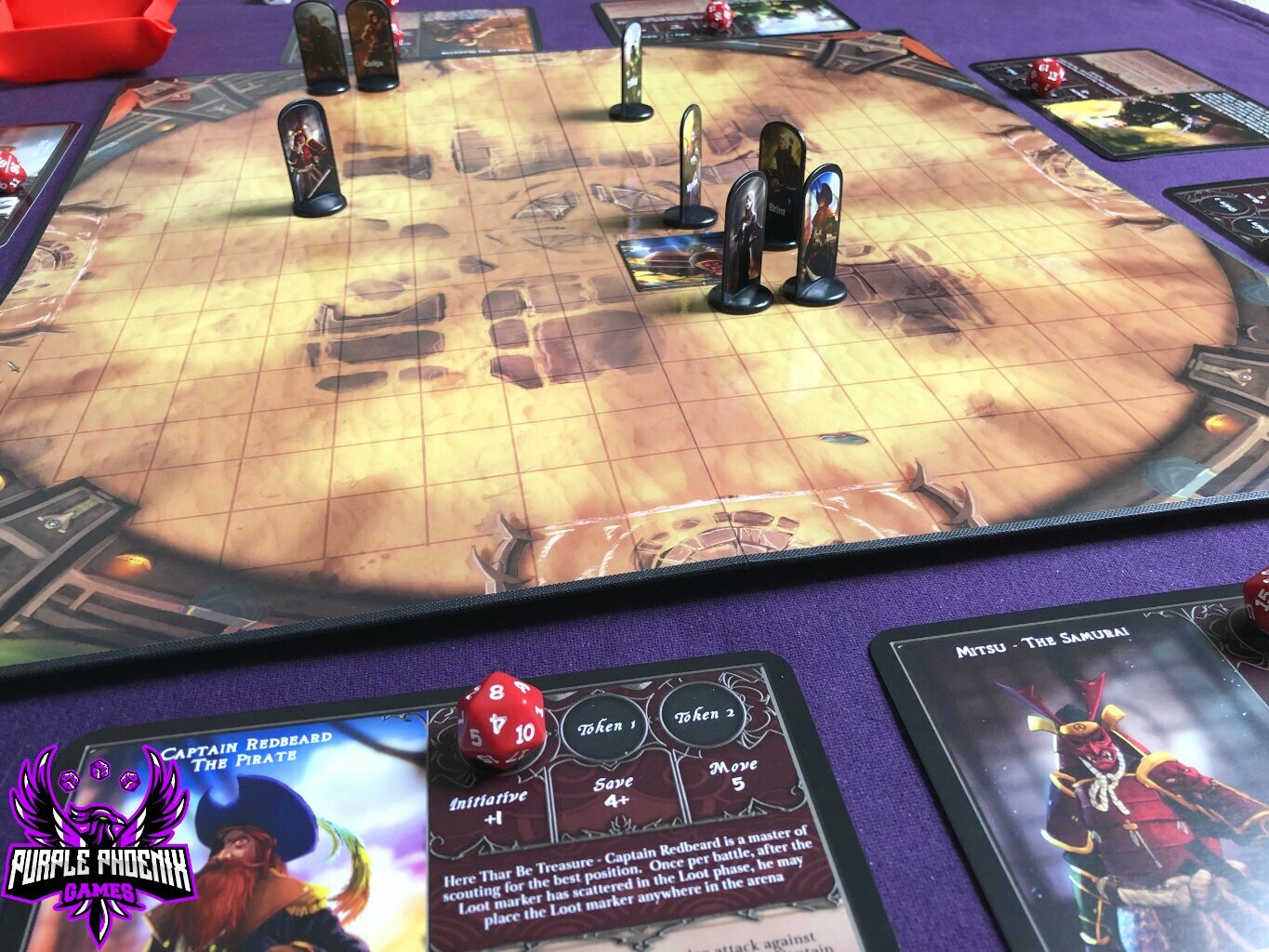
Fray: Champions of the Every-Verse (referred to as just Fray from now on) is a game of dice rolling, grid movement, and fighting in which players are trying to eliminate all opponents and be the last remaining player in the arena. Before setting up to play, you must first determine how many Champions each player will control. Controlling only 1 Champion is considered “Single Mode” and makes for a quicker play-time. Players can control up to 3 Champions in a single game. After determining how many Champions each player will control, set up the game as described in the rulebook. You are now ready to begin!
A game of Fray is divided into a number of rounds, and to begin each round, all players must select one of their Champions to be the round leader, then roll a d6, and add the appropriate Initiative modifier. This determines the turn order for the round – the highest Initiative gets to go first, and so on in descending numerical order. It is important to note that in future rounds when determining Initiative, you may not select the same Champion to lead for consecutive rounds. After Initiative has been determined, player turns begin. On your turn, you will perform 2 Phases: an Item Phase and a Champion Phase. During the Item Phase, you have the opportunity to play as many Item cards from your hand as you wish. Item cards can give you special abilities or buffs for future turns, or can be played as reactions to opponent’s actions, depending on the card.
Once your Item Phase is done, you move to the Champion Phase. To begin your Champion Phase, choose which Champion you are using and roll the 3 Battle Dice. These dice help activate abilities on your turn. The chosen Champion may now move a number of squares as stated on their card. After movement, your Champion can now activate 1 action from the following: Attack, Defend, or Champion Ability. All actions require you to spend a number of resources in order to perform them, so this is where the Battle Dice come into play. Once you have performed your action, resolve abilities as needed (rolling a save against an attack, rolling the damage die, etc.). If, after resolving abilities, you still have unused Battle Dice, you can choose to store up to 2 of them for use on your next turn. You then repeat the entire Champion Phase with your next available Champion. Once you have used all of your Champions, your turn ends.
After all players have had their turns in a round, you move to the Loot Phase. Any player with any Champion within 3 spaces of the Loot Marker on the board gets to draw 1 Loot card. The first player then rolls a d6 and the Scatter die, and moves the Loot Marker appropriately for the next round. The new round is ready to begin, with all players rolling for Initiative once again. During play, if a Champion is reduced to 0 hit points, that Champion leaves the game. The player with the last remaining Champion on the board is the winner!
Ok, I know that seems like a lot, but the gameplay is actually pretty intuitive and streamlined. Here’s how a turn breaks down: play Item cards, roll Battle Dice, move Champion, perform 1 action, resolve, repeat with your other Champions, turn ends. That’s it! After going through the steps with my first Champion, the process just clicked and the gameplay flowed pretty seamlessly. It admittedly seemed pretty daunting at first when I was reading through the rules, but in the actual game, it is easy to pick up.
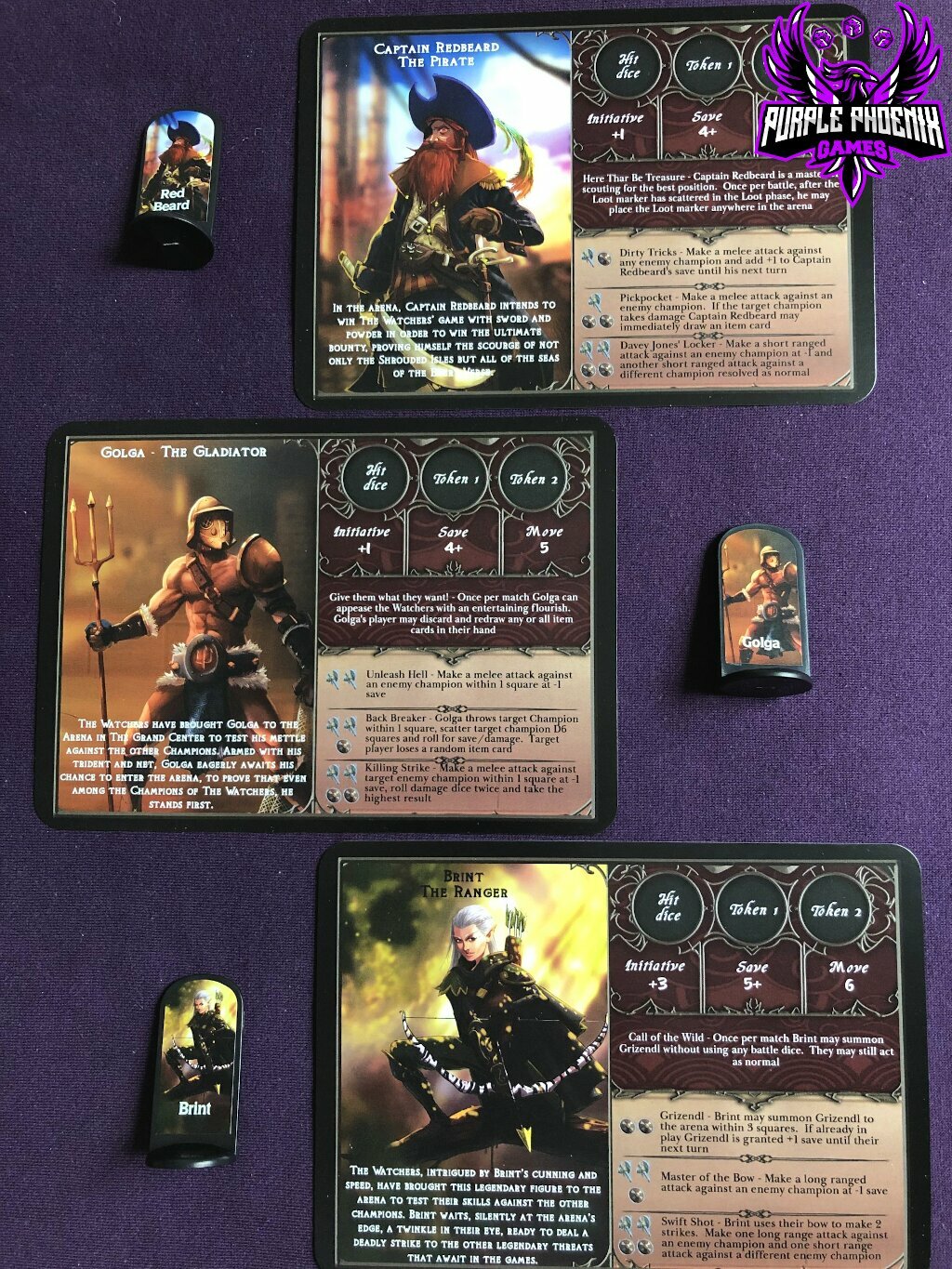
With the purpose of this game being knocking out all your opponents, obviously strategy is a pretty big aspect of the gameplay. All Champions have special abilities, attack combos, and types of attacks. Some Champions are only melee fighters and can interact with opponents 1 square away, others are only short- or long-ranged and must be at a distance to attack, and some have the option to be either melee or ranged. Each Champion requires a bit of a different strategy to be played successfully, and you’ve got to be able to adapt on the fly. That being said, this is a competitive combat game, so some players might not like being pitted directly against opponents and being targeted by others. The other strategic aspect to consider is the location of the Loot Marker on the board. The only way you ever get to draw Item cards is if you are within 3 squares of the Loot Marker at the end of the round. Are you willing to risk combat for a chance to gain an Item card? Or are you content with skirting the battlefield and letting your opponents take each other out? All things to consider when playing Fray.
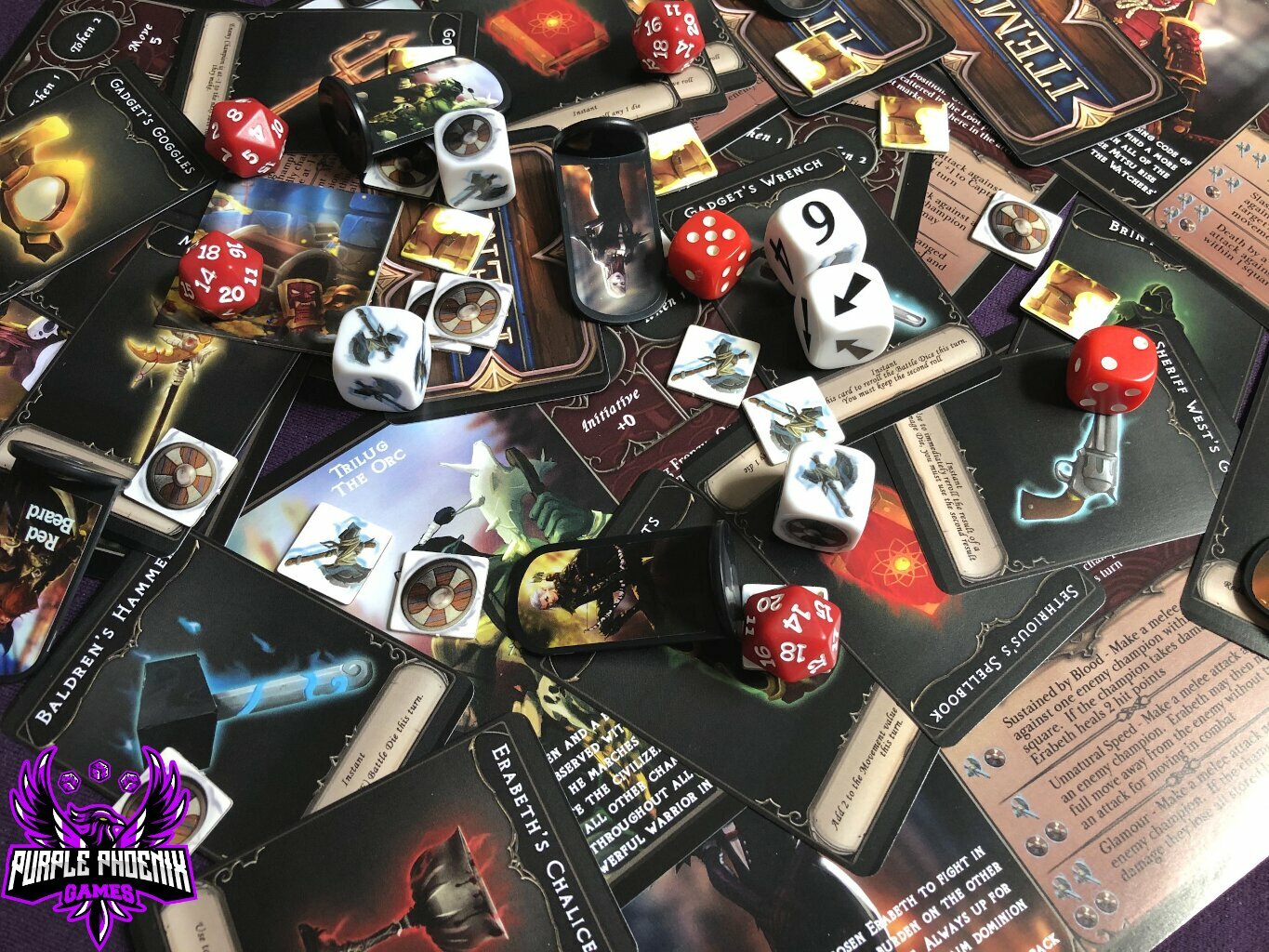
The biggest drawback of Fray for me has to do with some components, or lack thereof. But as I stated earlier, this is only a prototype copy of the game, and I am sure that these things will be addressed in the final production copies! For starters, I’d like to see Turn Order Markers. Since the turn order varies each round based on Initiative, it would be nice to have some numbered markers to help players keep track of the order for the round. Along those lines, maybe a Turn Order Reference card for players could be added as well. The turn steps are generally pretty straightforward, but just having a reminder of the different types of movement, or what resources are required for which actions would be nice. And my final consideration for edits would be to include on each Champion card whether that Champion is a melee, short-ranged, or long-ranged fighter. That breakdown is in the rulebook, but having it on the card would be beneficial as well! Besides those three notes, the components of this prototype copy are phenomenal. The board, cards, and chits are all nice and sturdy. All of the game dice are high quality and easy to read. I know Brain Sandwich Games has plans for sculpted minis for the Champions, but even the simple standees in this copy are easily identifiable and will withstand many plays. The art of the cards is very detailed and awesome to look at. All in all, already a pretty great quality game!
Ultimately, I think Fray is a great game. It may need a little polishing up with some components, but the current gameplay is ready for production. I am not typically someone who enjoys directly competitive games, but Fray was one that I thoroughly loved. It has enough elements of strategy, combat, and luck of the dice rolls that it doesn’t feel targeting or confrontational. I am eager to follow the Kickstarter campaign and see what else Brain Sandwich Games has in store for an already awesome game! I would definitely recommend checking this one out – it’s a unique twist on a standard arena combat game.
DISCLAIMER: We were provided a prototype copy of this game for the purposes of this review. These are preview copy components, and I do not know for sure if the final components will be any different from these shown. Also, it is not my intention to detail every rule in the game, as there are just too many. You are invited to download the rulebook, back the game through the pending Kickstarter campaign, purchase it from your FLGS, or through any retailers stocking it after fulfillment. -L
Fray: Champions of the Every-Verse (referred to as just Fray from now on) is a game of dice rolling, grid movement, and fighting in which players are trying to eliminate all opponents and be the last remaining player in the arena. Before setting up to play, you must first determine how many Champions each player will control. Controlling only 1 Champion is considered “Single Mode” and makes for a quicker play-time. Players can control up to 3 Champions in a single game. After determining how many Champions each player will control, set up the game as described in the rulebook. You are now ready to begin!
A game of Fray is divided into a number of rounds, and to begin each round, all players must select one of their Champions to be the round leader, then roll a d6, and add the appropriate Initiative modifier. This determines the turn order for the round – the highest Initiative gets to go first, and so on in descending numerical order. It is important to note that in future rounds when determining Initiative, you may not select the same Champion to lead for consecutive rounds. After Initiative has been determined, player turns begin. On your turn, you will perform 2 Phases: an Item Phase and a Champion Phase. During the Item Phase, you have the opportunity to play as many Item cards from your hand as you wish. Item cards can give you special abilities or buffs for future turns, or can be played as reactions to opponent’s actions, depending on the card.
Once your Item Phase is done, you move to the Champion Phase. To begin your Champion Phase, choose which Champion you are using and roll the 3 Battle Dice. These dice help activate abilities on your turn. The chosen Champion may now move a number of squares as stated on their card. After movement, your Champion can now activate 1 action from the following: Attack, Defend, or Champion Ability. All actions require you to spend a number of resources in order to perform them, so this is where the Battle Dice come into play. Once you have performed your action, resolve abilities as needed (rolling a save against an attack, rolling the damage die, etc.). If, after resolving abilities, you still have unused Battle Dice, you can choose to store up to 2 of them for use on your next turn. You then repeat the entire Champion Phase with your next available Champion. Once you have used all of your Champions, your turn ends.
After all players have had their turns in a round, you move to the Loot Phase. Any player with any Champion within 3 spaces of the Loot Marker on the board gets to draw 1 Loot card. The first player then rolls a d6 and the Scatter die, and moves the Loot Marker appropriately for the next round. The new round is ready to begin, with all players rolling for Initiative once again. During play, if a Champion is reduced to 0 hit points, that Champion leaves the game. The player with the last remaining Champion on the board is the winner!
Ok, I know that seems like a lot, but the gameplay is actually pretty intuitive and streamlined. Here’s how a turn breaks down: play Item cards, roll Battle Dice, move Champion, perform 1 action, resolve, repeat with your other Champions, turn ends. That’s it! After going through the steps with my first Champion, the process just clicked and the gameplay flowed pretty seamlessly. It admittedly seemed pretty daunting at first when I was reading through the rules, but in the actual game, it is easy to pick up.
With the purpose of this game being knocking out all your opponents, obviously strategy is a pretty big aspect of the gameplay. All Champions have special abilities, attack combos, and types of attacks. Some Champions are only melee fighters and can interact with opponents 1 square away, others are only short- or long-ranged and must be at a distance to attack, and some have the option to be either melee or ranged. Each Champion requires a bit of a different strategy to be played successfully, and you’ve got to be able to adapt on the fly. That being said, this is a competitive combat game, so some players might not like being pitted directly against opponents and being targeted by others. The other strategic aspect to consider is the location of the Loot Marker on the board. The only way you ever get to draw Item cards is if you are within 3 squares of the Loot Marker at the end of the round. Are you willing to risk combat for a chance to gain an Item card? Or are you content with skirting the battlefield and letting your opponents take each other out? All things to consider when playing Fray.
The biggest drawback of Fray for me has to do with some components, or lack thereof. But as I stated earlier, this is only a prototype copy of the game, and I am sure that these things will be addressed in the final production copies! For starters, I’d like to see Turn Order Markers. Since the turn order varies each round based on Initiative, it would be nice to have some numbered markers to help players keep track of the order for the round. Along those lines, maybe a Turn Order Reference card for players could be added as well. The turn steps are generally pretty straightforward, but just having a reminder of the different types of movement, or what resources are required for which actions would be nice. And my final consideration for edits would be to include on each Champion card whether that Champion is a melee, short-ranged, or long-ranged fighter. That breakdown is in the rulebook, but having it on the card would be beneficial as well! Besides those three notes, the components of this prototype copy are phenomenal. The board, cards, and chits are all nice and sturdy. All of the game dice are high quality and easy to read. I know Brain Sandwich Games has plans for sculpted minis for the Champions, but even the simple standees in this copy are easily identifiable and will withstand many plays. The art of the cards is very detailed and awesome to look at. All in all, already a pretty great quality game!
Ultimately, I think Fray is a great game. It may need a little polishing up with some components, but the current gameplay is ready for production. I am not typically someone who enjoys directly competitive games, but Fray was one that I thoroughly loved. It has enough elements of strategy, combat, and luck of the dice rolls that it doesn’t feel targeting or confrontational. I am eager to follow the Kickstarter campaign and see what else Brain Sandwich Games has in store for an already awesome game! I would definitely recommend checking this one out – it’s a unique twist on a standard arena combat game.

Purple Phoenix Games (2266 KP) rated Harry Potter: Death Eaters Rising in Tabletop Games
Dec 3, 2020

Have you read our review of Thanos Rising: Avengers Infinity War? If you have not, please do. I’ll wait. The reason I ask is because this Harry Potter version is a reimplementation of Thanos Rising with a few new twists. Great twists. In fact, I’ll spoil it for you and let you know that I now prefer the Harry Potter version even though I enjoy Marvel-related things in my life much more. But why is it good or better than its predecessor?
Harry Potter: Death Eaters Rising is a game utilizing the Rising system of games (which also includes Batman, Star Wars, and SpongeBob Squarepants as of now) for two to four players. It is a cooperative game where players will take charge of one of the three factions: Dumbledore’s Army, Hogwarts, or Order of the Phoenix in order to defeat Voldemort and his Death Eater cronies. Though Voldemort will be menacing players throughout the game, the players will not be able to attack him directly until about half way through the game. Can you survive long enough to battle the big bad?
DISCLAIMER: We were provided a copy of this game for the purposes of this review. This is a retail copy of the game, so what you see in these photos is exactly what would be received in your box. I do not intend to cover every single rule included in the rulebook, but will describe the overall game flow and major rule set so that our readers may get a sense of how the game plays. For more in depth rules, you may purchase a copy online or from your FLGS. -T
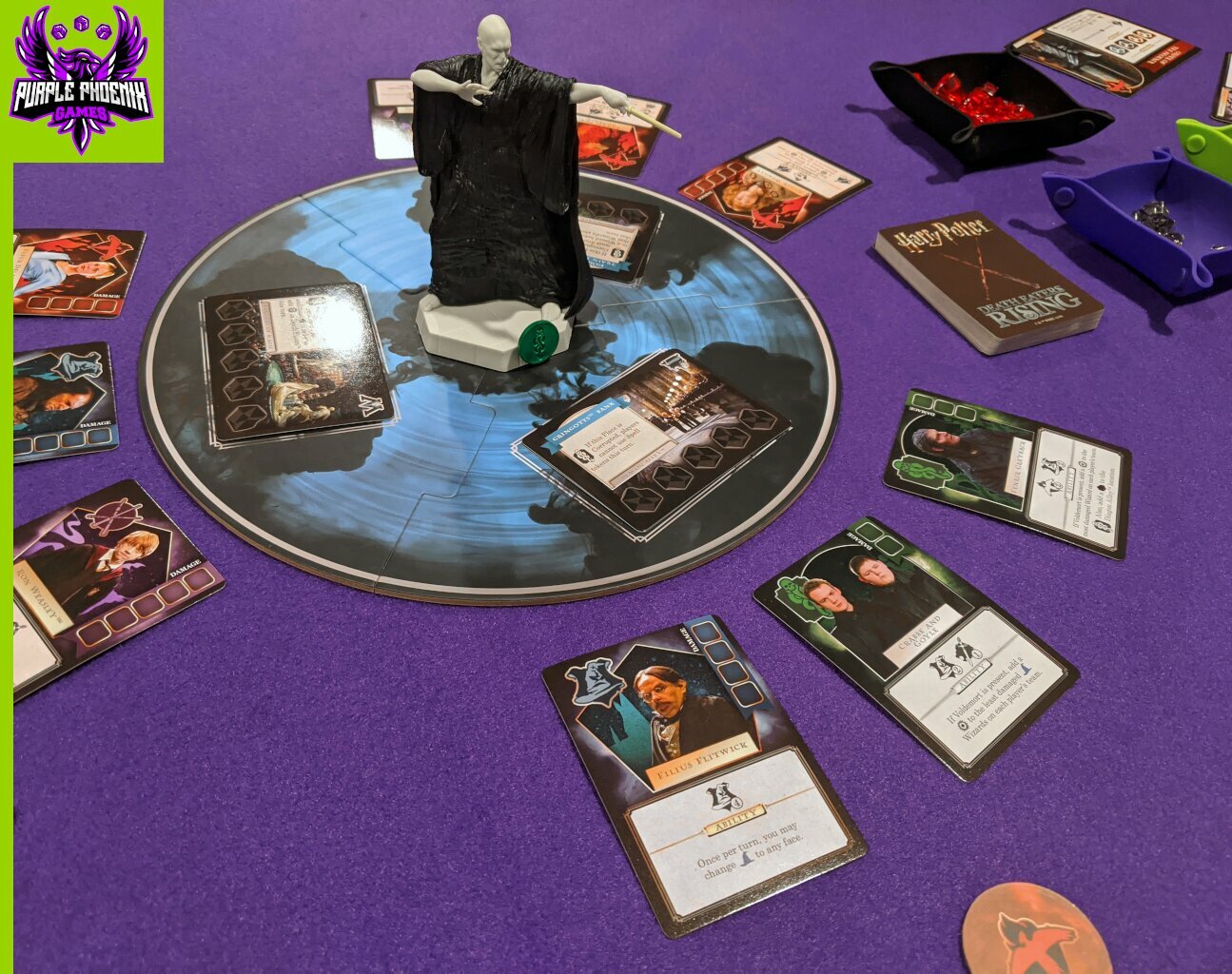
To setup, follow the instructions in the rulebook, but generally the central board will have the large painted Voldemort “mini(?)” and three areas that hold Place cards: Hogwarts, Ministry of Magic, and Diagon Alley. Players will be given one Leader card in their chosen faction (obviously Order of the Phoenix is best) to begin the game. Set aside the damage counters, corruption gem tokens, and Spell tokens in their own piles. Shuffle the main deck of character cards, reveal and place three per Place and then insert the Voldemort card somewhere near half-way into the shuffled deck. The game may now begin.
On a player’s turn they must complete the following steps: 1. Travel to a Location, 2. Roll Voldemort Die and resolve actions, 3. Roll, assign, and resolve Wizard dice, and 4. End Turn. After taking these actions it will be the next player’s turn.
To Travel to a Location, the active player will place their faction-matching Mission token upon one of the Places on the board. This is the Place that the active player may now be able to recruit Wizards from and also attack enemies.
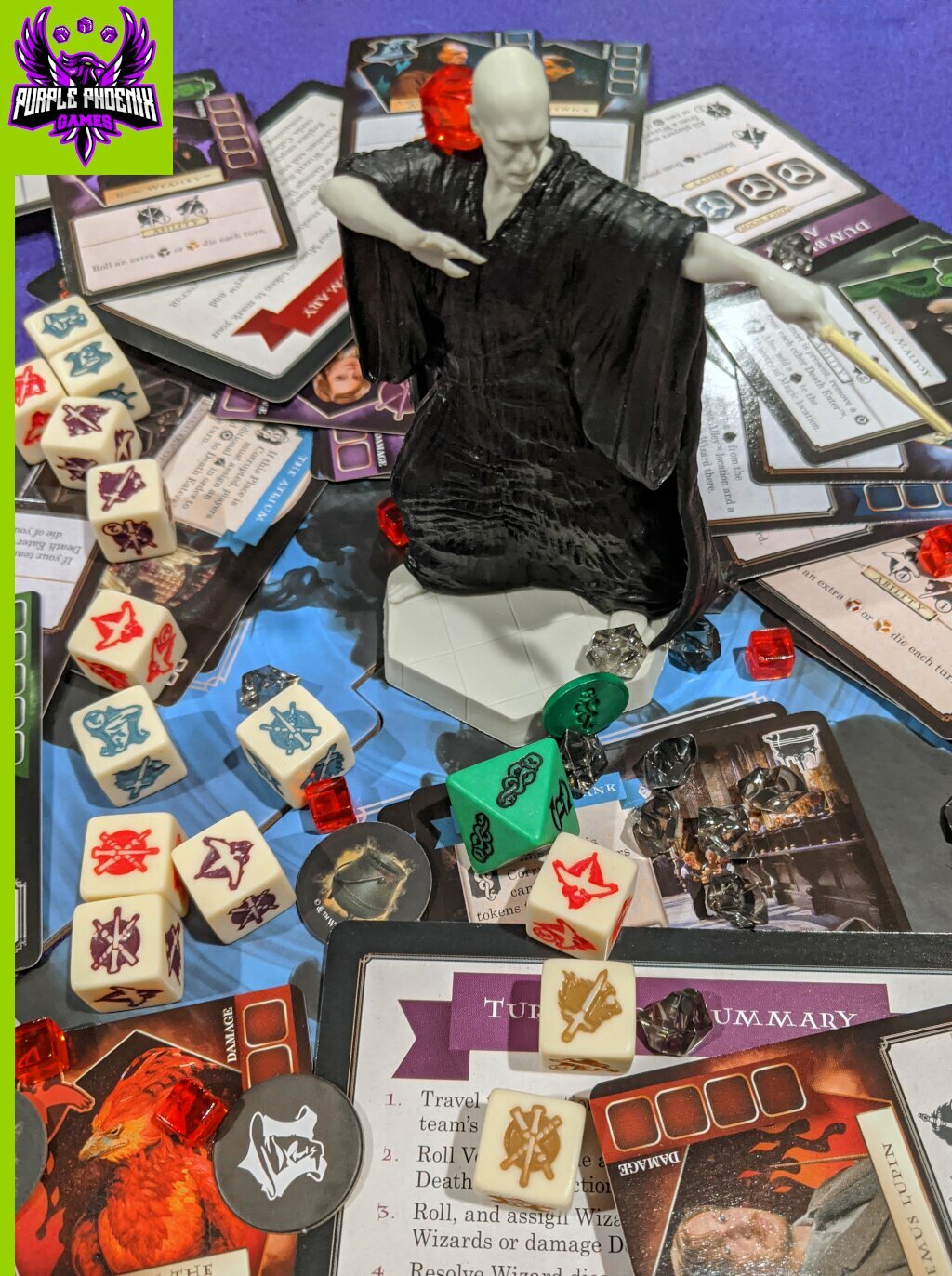
Once at a Location, the active player will Roll Voldemort Die and resolve actions thenceforth. The game affords players a large green Voldemort Die to be rolled. Upon the faces are sides that instruct players to turn the Voldemort mini Left or Right one Place and attack all Wizards there (including all Wizards on a player’s team if Voldemort is now in their Location). Two faces will also show the Dark Mark. When this face is rolled Voldemort does not move, but will attack all Wizards at his current Place (by placing damage counters on the card) as well as activating ALL Death Eater Dark Mark abilities. Not all Death Eaters will have Dark Mark abilities, but when they activate, they can be deadly.
Now that Voldemort has had his fun, the active player will Roll, assign, and resolve Wizard dice. Players will have in front of them faction cards that indicate how many and of which color dice to be rolled on a turn. These dice may be added to or otherwise altered as a result of recruited Wizards’ special abilities as well. Once a player takes the appropriate dice to be rolled, they must roll them and begin assigning faces to Wizards for recruitment, Death Eaters for damage, or other abilities on team cards. Recruiting more Wizards to a player’s team or damaging Death Eaters is how the game progresses because each time a card is recruited or defeated it is removed from the main board and a new card replaces it. As long as at least one die is removed from the player’s pool each time the dice are rolled the player may continue rolling to match symbols needed.
To End Turn, the active player will add any recruited Wizards to their team, discard any defeated Death Eaters, Wizards, or Places, and retrieve their Mission token to be used on the next turn.
Play continues in this fashion of taking turns through the four steps until the Voldemort card is drawn. He then comes into play as an enemy that may be attacked like normal. Players win when they defeat enough Death Eaters and Voldemort, but can lose if the players allow a Place to be completely corrupted (usually by Death Eater card abilities), allowing four Places to be corrupted, if too many Wizards have been defeated per number of players, or any player has all their Wizards defeated from their team.
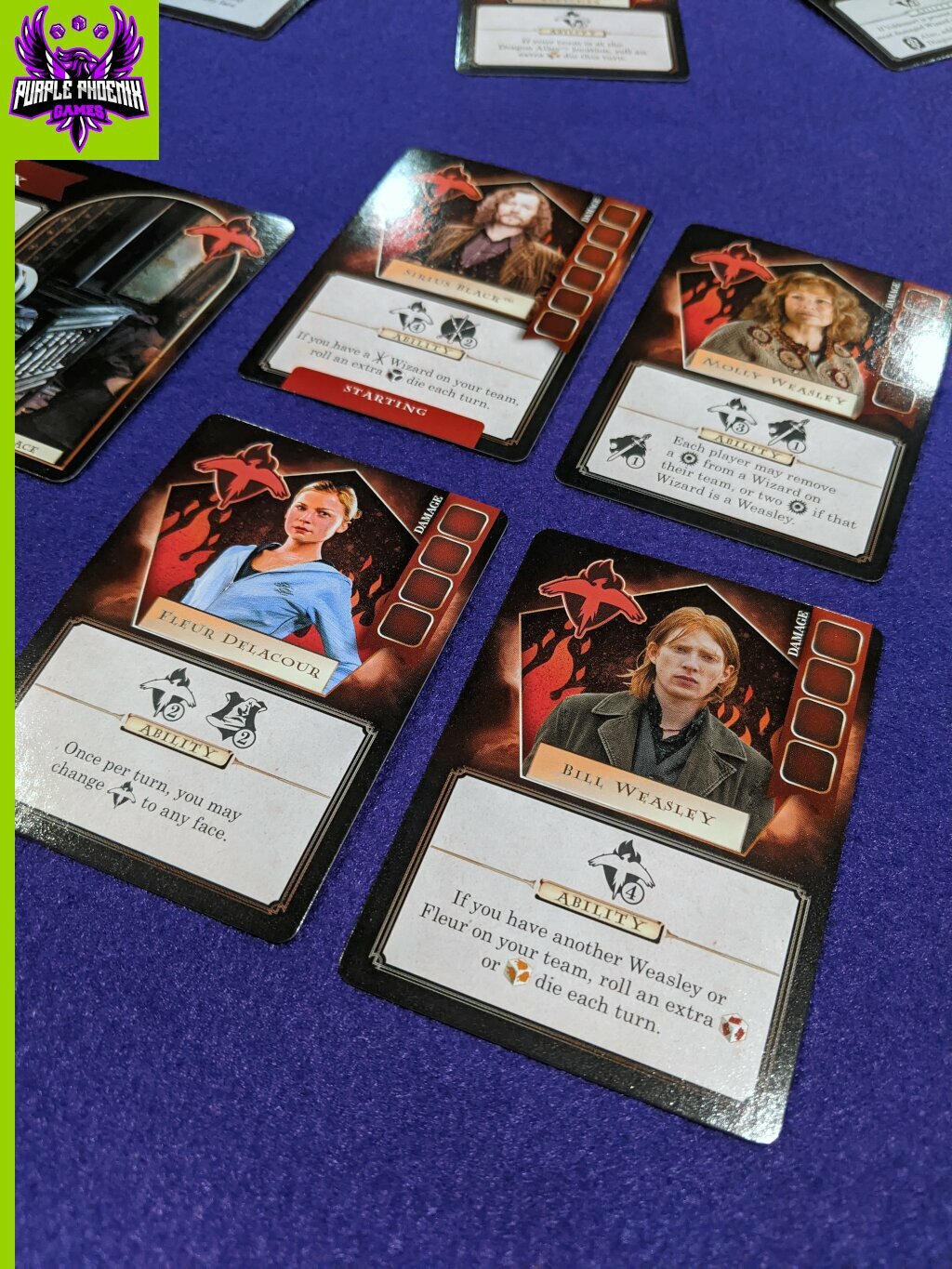
Components. This game includes a lot of components of varying style and materials. The cards are all very glossy (meh) and feature headshots of the characters mostly. The board is three pieces fit together like a pizza and is great. The damage counters are little translucent red cubes, and the corruption gem tokens are also translucent gems but gray in color. The best components in the game are by far the Voldemort, well, statue and all the dice. The Voldemort piece is incredible, and pre-painted. The stance he is taking is formidable and somewhat intimidating when he’s pointing his wand right at you. The dice have been upgraded to a matte finish (as opposed to yucky polished finish) and feature some great inking. The one negative I have to say is also about the dice: I believe that the faces sometimes can be confusing because the icons are more detailed than is necessary. While some would argue that detailed dice are better than merely serviceable dice, I would much rather see a sword on a face and know it’s a sword than to look at a die face and wonder what I am looking at exactly. In any case, that’s my opinion and yours may be different. Let’s still be friends.
So overall this is a big upgrade over the Thanos version of a Rising game for several key reasons. In Thanos I always felt like every turn could lose the game for us, and Thanos seemed to gain the Infinity Stones too quickly for my taste. In this version, you know you have half a deck before you are able to even fight Voldemort, so being able to tackle his minions until then seems more surmountable. The dice have been upgraded, and the Voldemort die is wonderful and easy to read. That was an issue I had with Thanos: his die was hard to read and the colors were not distinct enough. Not a factor in this version at all. I also feel that this version has much more faction-dependency and interplay. What I mean is that an Order of the Phoenix card may require a player to also have a Dumbledore’s Army card on the team in order to unlock access to their special ability. I like that. I like a well-balanced team, though my first game saw me recruit eight Order of the Phoenix cards and one Dumbledore’s Army card. We won, but I felt bad.
So it’s no surprise that I love this game. I find it better and easier to learn/play than the Thanos version. I like the components a whole lot more. I like the interplay between the factions more. I am sad that I prefer Marvel to Harry Potter, but I do not dislike Harry Potter, let it be known. And I do enjoy this version much more. Purple Phoenix Games gives this one a triumphant 10 / 12. My wife and I truly love it and can’t wait to play it again very soon. If you are looking for a good Rising game, I certainly recommend you look at Harry Potter: Death Eaters Rising. It’s a guaranteed hit if you or a loved one is a Harry Potter fan. For sure. It’s brilliant.
Harry Potter: Death Eaters Rising is a game utilizing the Rising system of games (which also includes Batman, Star Wars, and SpongeBob Squarepants as of now) for two to four players. It is a cooperative game where players will take charge of one of the three factions: Dumbledore’s Army, Hogwarts, or Order of the Phoenix in order to defeat Voldemort and his Death Eater cronies. Though Voldemort will be menacing players throughout the game, the players will not be able to attack him directly until about half way through the game. Can you survive long enough to battle the big bad?
DISCLAIMER: We were provided a copy of this game for the purposes of this review. This is a retail copy of the game, so what you see in these photos is exactly what would be received in your box. I do not intend to cover every single rule included in the rulebook, but will describe the overall game flow and major rule set so that our readers may get a sense of how the game plays. For more in depth rules, you may purchase a copy online or from your FLGS. -T
To setup, follow the instructions in the rulebook, but generally the central board will have the large painted Voldemort “mini(?)” and three areas that hold Place cards: Hogwarts, Ministry of Magic, and Diagon Alley. Players will be given one Leader card in their chosen faction (obviously Order of the Phoenix is best) to begin the game. Set aside the damage counters, corruption gem tokens, and Spell tokens in their own piles. Shuffle the main deck of character cards, reveal and place three per Place and then insert the Voldemort card somewhere near half-way into the shuffled deck. The game may now begin.
On a player’s turn they must complete the following steps: 1. Travel to a Location, 2. Roll Voldemort Die and resolve actions, 3. Roll, assign, and resolve Wizard dice, and 4. End Turn. After taking these actions it will be the next player’s turn.
To Travel to a Location, the active player will place their faction-matching Mission token upon one of the Places on the board. This is the Place that the active player may now be able to recruit Wizards from and also attack enemies.
Once at a Location, the active player will Roll Voldemort Die and resolve actions thenceforth. The game affords players a large green Voldemort Die to be rolled. Upon the faces are sides that instruct players to turn the Voldemort mini Left or Right one Place and attack all Wizards there (including all Wizards on a player’s team if Voldemort is now in their Location). Two faces will also show the Dark Mark. When this face is rolled Voldemort does not move, but will attack all Wizards at his current Place (by placing damage counters on the card) as well as activating ALL Death Eater Dark Mark abilities. Not all Death Eaters will have Dark Mark abilities, but when they activate, they can be deadly.
Now that Voldemort has had his fun, the active player will Roll, assign, and resolve Wizard dice. Players will have in front of them faction cards that indicate how many and of which color dice to be rolled on a turn. These dice may be added to or otherwise altered as a result of recruited Wizards’ special abilities as well. Once a player takes the appropriate dice to be rolled, they must roll them and begin assigning faces to Wizards for recruitment, Death Eaters for damage, or other abilities on team cards. Recruiting more Wizards to a player’s team or damaging Death Eaters is how the game progresses because each time a card is recruited or defeated it is removed from the main board and a new card replaces it. As long as at least one die is removed from the player’s pool each time the dice are rolled the player may continue rolling to match symbols needed.
To End Turn, the active player will add any recruited Wizards to their team, discard any defeated Death Eaters, Wizards, or Places, and retrieve their Mission token to be used on the next turn.
Play continues in this fashion of taking turns through the four steps until the Voldemort card is drawn. He then comes into play as an enemy that may be attacked like normal. Players win when they defeat enough Death Eaters and Voldemort, but can lose if the players allow a Place to be completely corrupted (usually by Death Eater card abilities), allowing four Places to be corrupted, if too many Wizards have been defeated per number of players, or any player has all their Wizards defeated from their team.
Components. This game includes a lot of components of varying style and materials. The cards are all very glossy (meh) and feature headshots of the characters mostly. The board is three pieces fit together like a pizza and is great. The damage counters are little translucent red cubes, and the corruption gem tokens are also translucent gems but gray in color. The best components in the game are by far the Voldemort, well, statue and all the dice. The Voldemort piece is incredible, and pre-painted. The stance he is taking is formidable and somewhat intimidating when he’s pointing his wand right at you. The dice have been upgraded to a matte finish (as opposed to yucky polished finish) and feature some great inking. The one negative I have to say is also about the dice: I believe that the faces sometimes can be confusing because the icons are more detailed than is necessary. While some would argue that detailed dice are better than merely serviceable dice, I would much rather see a sword on a face and know it’s a sword than to look at a die face and wonder what I am looking at exactly. In any case, that’s my opinion and yours may be different. Let’s still be friends.
So overall this is a big upgrade over the Thanos version of a Rising game for several key reasons. In Thanos I always felt like every turn could lose the game for us, and Thanos seemed to gain the Infinity Stones too quickly for my taste. In this version, you know you have half a deck before you are able to even fight Voldemort, so being able to tackle his minions until then seems more surmountable. The dice have been upgraded, and the Voldemort die is wonderful and easy to read. That was an issue I had with Thanos: his die was hard to read and the colors were not distinct enough. Not a factor in this version at all. I also feel that this version has much more faction-dependency and interplay. What I mean is that an Order of the Phoenix card may require a player to also have a Dumbledore’s Army card on the team in order to unlock access to their special ability. I like that. I like a well-balanced team, though my first game saw me recruit eight Order of the Phoenix cards and one Dumbledore’s Army card. We won, but I felt bad.
So it’s no surprise that I love this game. I find it better and easier to learn/play than the Thanos version. I like the components a whole lot more. I like the interplay between the factions more. I am sad that I prefer Marvel to Harry Potter, but I do not dislike Harry Potter, let it be known. And I do enjoy this version much more. Purple Phoenix Games gives this one a triumphant 10 / 12. My wife and I truly love it and can’t wait to play it again very soon. If you are looking for a good Rising game, I certainly recommend you look at Harry Potter: Death Eaters Rising. It’s a guaranteed hit if you or a loved one is a Harry Potter fan. For sure. It’s brilliant.

Purple Phoenix Games (2266 KP) rated Azul: Stained Glass of Sintra in Tabletop Games
Oct 15, 2019

Sometimes, finding a game that the entire group loves can be extremely difficult. Such was not the case when Purple Phoenix Games played Azul. We immediately fell in love with it, as you can see by its well-earned Golden Feather Award. So when Azul: Stained Glass of Sintra was released, we knew we had to try it! A reimplementation of a game we all loved – we were so stoked to get it to the table. How does this ‘sequel’ hold up to the OG Azul? Keep reading to find out!
For many years you have worked as a tile layer, creating uniquely beautiful mosaics that adorn walls all around the world. Taking your expert skills, you’ve decided to hone your talent into a new form of mosaic decoration – stained glass windows. Select the most colorful glass combinations to create elaborate and beautiful designs, all while being careful not to waste or break any of your supplies in the process! Years of tile-laying have resulted in a steady hand, but glass is a different story. Does your talent and eye for design transcend materials, or are you better left to your familiar ceramic tiles?
Disclaimer: I do not intend to rehash the entire rulebook in this review. I will briefly go over the turn order, but will leave the specifics for you to discover in the rulebook! – L
Like Azul, Azul: Stained Glass of Sintra is a game of pattern building, set collection, and tile placement. To set up, each player receives a palace board, 8 double-sided pattern strips, and glazier (pawn) in their chosen color. All players need to select the same side, A or B, for their palace boards, but the pattern strips can be placed with either side face-up. Place your glazier above the left-most pattern strip, and you are ready to go! The designated score-keeper sets up the score board – placing each players’ scoring cube on the score track and broken glass track, as well as randomly placing 1 tile of each color on the round tracker. Much like OG Azul, a certain number of factories are in play, each populated with 4 pane tiles. Now the game can begin!
On your turn, you may do one of two things – Advance a pattern, or Move your glazier to the left-most pattern strip. If you choose to advance a pattern, you complete these three steps: Select pane pieces of one color from a factory or the middle of the table, place the pieces on one of your pattern strips, and check to see if the pattern is complete. Easy enough! There are a few placement restrictions to keep in mind, and they are detailed in the rulebook. Moving on, after placing your tiles, if the pattern strip is not yet full, your turn is over and play continues with the next player. If you have successfully filled the entire pattern strip, you get to immediately score that window, and then your turn ends. Specific steps for scoring are found in the rulebook. The other action available to you on your turn is to move your glazier back to the left-most pattern strip. Once you do this, your turn is over. Play continues over six rounds, and the player at the end of the game with the most points is the winner!
So how does Azul: Stained Glass of Sintra hold up? I think it’s a pretty great game. It’s very mechanically and thematically similar to the original Azul, but there is enough of a difference in gameplay that keeps it interesting. It doesn’t just feel like the exact same game to me, even if there are many similarities between the two. There definitely is a good amount of strategy involved, and I think the addition of the glazier (which can sorta restrict your placement options) adds a new level of complexity to the game. Do you dare ‘waste’ a turn to reset your glazier, or do you risk the points and try to complete your current pattern strip?
Another great thing about this game is the variability of it. Each player receives 8 double-sided pattern strips to begin the game. The strips can be placed with whichever face up or down that you want. So no two players will ever have the same setup, just as you will probably never have the same setup yourself between plays. One wrong placement could maybe end up costing you the game! There is no ‘right’ setup, and the fact that everyone’s setup will be different makes the game a little more unique.
Of course, the components are great and the tiles are so much fun to handle. Unlike OG Azul, these tiles are semi-transparent and crystalline, giving them the semblance of actual glass. The pattern strips/palace boards are good, sturdy cardboard, and can definitely withstand the amount of manipulation they see each game. My one qualm is with the score tracker. Instead of moving linearly, the score tracker moves kind of zig-zag-y around the board, and it takes me a minute sometimes to read the points and move my marker quickly because my eyes have to figure out the score line. Yeah, it looks cool, but its just a little inconvenient for me while playing.
Overall, I think Azul: Stained Glass of Sintra is a great ‘sequel’ to Azul. It feels familiar in mechanics and theme, but different enough in overall gameplay that I think it is a good stand-alone reimplementation. And guess what? Another Azul game is in the works! Titled Azul: Summer Pavilion, it is yet another game of tile drafting/placement and set collection. Since I have high praise for Stained Glass of Sintra, I am definitely looking forward to this newest version of Azul, coming soon! Purple Phoenix Games gives Azul: Stained Glass of Sintra, a colorful 9 / 12.
For many years you have worked as a tile layer, creating uniquely beautiful mosaics that adorn walls all around the world. Taking your expert skills, you’ve decided to hone your talent into a new form of mosaic decoration – stained glass windows. Select the most colorful glass combinations to create elaborate and beautiful designs, all while being careful not to waste or break any of your supplies in the process! Years of tile-laying have resulted in a steady hand, but glass is a different story. Does your talent and eye for design transcend materials, or are you better left to your familiar ceramic tiles?
Disclaimer: I do not intend to rehash the entire rulebook in this review. I will briefly go over the turn order, but will leave the specifics for you to discover in the rulebook! – L
Like Azul, Azul: Stained Glass of Sintra is a game of pattern building, set collection, and tile placement. To set up, each player receives a palace board, 8 double-sided pattern strips, and glazier (pawn) in their chosen color. All players need to select the same side, A or B, for their palace boards, but the pattern strips can be placed with either side face-up. Place your glazier above the left-most pattern strip, and you are ready to go! The designated score-keeper sets up the score board – placing each players’ scoring cube on the score track and broken glass track, as well as randomly placing 1 tile of each color on the round tracker. Much like OG Azul, a certain number of factories are in play, each populated with 4 pane tiles. Now the game can begin!
On your turn, you may do one of two things – Advance a pattern, or Move your glazier to the left-most pattern strip. If you choose to advance a pattern, you complete these three steps: Select pane pieces of one color from a factory or the middle of the table, place the pieces on one of your pattern strips, and check to see if the pattern is complete. Easy enough! There are a few placement restrictions to keep in mind, and they are detailed in the rulebook. Moving on, after placing your tiles, if the pattern strip is not yet full, your turn is over and play continues with the next player. If you have successfully filled the entire pattern strip, you get to immediately score that window, and then your turn ends. Specific steps for scoring are found in the rulebook. The other action available to you on your turn is to move your glazier back to the left-most pattern strip. Once you do this, your turn is over. Play continues over six rounds, and the player at the end of the game with the most points is the winner!
So how does Azul: Stained Glass of Sintra hold up? I think it’s a pretty great game. It’s very mechanically and thematically similar to the original Azul, but there is enough of a difference in gameplay that keeps it interesting. It doesn’t just feel like the exact same game to me, even if there are many similarities between the two. There definitely is a good amount of strategy involved, and I think the addition of the glazier (which can sorta restrict your placement options) adds a new level of complexity to the game. Do you dare ‘waste’ a turn to reset your glazier, or do you risk the points and try to complete your current pattern strip?
Another great thing about this game is the variability of it. Each player receives 8 double-sided pattern strips to begin the game. The strips can be placed with whichever face up or down that you want. So no two players will ever have the same setup, just as you will probably never have the same setup yourself between plays. One wrong placement could maybe end up costing you the game! There is no ‘right’ setup, and the fact that everyone’s setup will be different makes the game a little more unique.
Of course, the components are great and the tiles are so much fun to handle. Unlike OG Azul, these tiles are semi-transparent and crystalline, giving them the semblance of actual glass. The pattern strips/palace boards are good, sturdy cardboard, and can definitely withstand the amount of manipulation they see each game. My one qualm is with the score tracker. Instead of moving linearly, the score tracker moves kind of zig-zag-y around the board, and it takes me a minute sometimes to read the points and move my marker quickly because my eyes have to figure out the score line. Yeah, it looks cool, but its just a little inconvenient for me while playing.
Overall, I think Azul: Stained Glass of Sintra is a great ‘sequel’ to Azul. It feels familiar in mechanics and theme, but different enough in overall gameplay that I think it is a good stand-alone reimplementation. And guess what? Another Azul game is in the works! Titled Azul: Summer Pavilion, it is yet another game of tile drafting/placement and set collection. Since I have high praise for Stained Glass of Sintra, I am definitely looking forward to this newest version of Azul, coming soon! Purple Phoenix Games gives Azul: Stained Glass of Sintra, a colorful 9 / 12.
Purple Phoenix Games (2266 KP) rated The Resistance: Avalon in Tabletop Games
Jun 12, 2019
Do you appreciate your friends and your relationships with them? If so, please read no further. Do you want to dissolve your friendships and cause your family members to wonder what went wrong with you and never trust you again? Play The Resistance: Avalon with them.
The Resistance: Avalon (which we always just refer to as simply Avalon) is a game of hidden roles played over several rounds where the “good guys” from King Arthur’s court are pitted against the “bad guys” in Mordred’s thrall. The number of players at the table determines the number of players to be assigned to the good and bad guys squads and the required goals for victory for each team.
To begin, role cards are divvied up and players secretly find out which team they are on for the game. Blue background cards are good guys, red are bad guys. ALERT! Yes, already. I cannot tell you how many times games have been voided because a player was not quite sure what team they were on, so make sure your players know what’s up before continuing. From here a narrator player reads the script in the rulebook to give instructions to players with their eyes closed (a la Mafia or Werewolf). This allows different members of each team to know certain information about their own team or even the opposite team. Players are then instructed to open their eyes simultaneously and thus begins the game of facades.
A player is chosen at random to be the quest giver for now. This person then assigns other players to go on a quest. The “quest” is just a generic quest where it will either succeed or fail. Once the quest giver has made their choices, everyone at the table has a chance to vote to approve the quest team or deny the quest team. Simple majority vote wins. If the team is approved, the quest happens. If the team is denied, the next player in the circle becomes the quest giver and must create a new team of players to go questing.
Once approved, the quest team players are each given two cards: Success and Fail. Secretly, under the table works best, the players make their choices. ALERT! All good guys MUST CHOOSE SUCCESS CARDS so the quest can succeed. Bad guys can choose either one. The questers then pass their cards to an uninvolved player who will then shuffle the cards without looking at them. Once completed, the cards are revealed and thus the success or failure of the quest. If all cards are Success, then the quest was a success and the good guys mark this on the main board. If even just one Fail card appears the quest fails and the bad guys mark it on the main board. This continues until either the good guys win or the bad guys claim victory!
Components. The box is small (akin to the Tiny Epic size boxes). I’m not sure if the game comes with an insert because I won mine from a BGG auction. The cards included in the game are fine, and I sleeved mine because they get held quite a bit. The other miscellaneous tokens are nice and do the job well. This is a game that is less reliant on components, and much more so on game play.
If my intro seemed dark a foreboding, it was completely intentional. Have I witnessed friendships dissolving as a result of this game? Ok not entirely, but there have been some pretty amazing head turns and surprise reveals coupled with slapping and yelling. Not me, mind you, but others. In any case, this game is definitely one to check out if you are a fan of hidden role games and if you want to add tons of tension to your game night. I honestly have no idea why this game (or its older sibling The Resistance if you are more into that theme) isn’t in every game collection. Yes, I know, there are now TONS of hidden role games out there. But this is my favorite of the lot. By far.
We at Purple Phoenix Games are split somehow, giving this one 18 / 24. Obviously it is because Josh is a minion of Mordred and wants our review to fail.
https://purplephoenixgames.wordpress.com/2019/04/24/the-resistance-avalon-review/
The Resistance: Avalon (which we always just refer to as simply Avalon) is a game of hidden roles played over several rounds where the “good guys” from King Arthur’s court are pitted against the “bad guys” in Mordred’s thrall. The number of players at the table determines the number of players to be assigned to the good and bad guys squads and the required goals for victory for each team.
To begin, role cards are divvied up and players secretly find out which team they are on for the game. Blue background cards are good guys, red are bad guys. ALERT! Yes, already. I cannot tell you how many times games have been voided because a player was not quite sure what team they were on, so make sure your players know what’s up before continuing. From here a narrator player reads the script in the rulebook to give instructions to players with their eyes closed (a la Mafia or Werewolf). This allows different members of each team to know certain information about their own team or even the opposite team. Players are then instructed to open their eyes simultaneously and thus begins the game of facades.
A player is chosen at random to be the quest giver for now. This person then assigns other players to go on a quest. The “quest” is just a generic quest where it will either succeed or fail. Once the quest giver has made their choices, everyone at the table has a chance to vote to approve the quest team or deny the quest team. Simple majority vote wins. If the team is approved, the quest happens. If the team is denied, the next player in the circle becomes the quest giver and must create a new team of players to go questing.
Once approved, the quest team players are each given two cards: Success and Fail. Secretly, under the table works best, the players make their choices. ALERT! All good guys MUST CHOOSE SUCCESS CARDS so the quest can succeed. Bad guys can choose either one. The questers then pass their cards to an uninvolved player who will then shuffle the cards without looking at them. Once completed, the cards are revealed and thus the success or failure of the quest. If all cards are Success, then the quest was a success and the good guys mark this on the main board. If even just one Fail card appears the quest fails and the bad guys mark it on the main board. This continues until either the good guys win or the bad guys claim victory!
Components. The box is small (akin to the Tiny Epic size boxes). I’m not sure if the game comes with an insert because I won mine from a BGG auction. The cards included in the game are fine, and I sleeved mine because they get held quite a bit. The other miscellaneous tokens are nice and do the job well. This is a game that is less reliant on components, and much more so on game play.
If my intro seemed dark a foreboding, it was completely intentional. Have I witnessed friendships dissolving as a result of this game? Ok not entirely, but there have been some pretty amazing head turns and surprise reveals coupled with slapping and yelling. Not me, mind you, but others. In any case, this game is definitely one to check out if you are a fan of hidden role games and if you want to add tons of tension to your game night. I honestly have no idea why this game (or its older sibling The Resistance if you are more into that theme) isn’t in every game collection. Yes, I know, there are now TONS of hidden role games out there. But this is my favorite of the lot. By far.
We at Purple Phoenix Games are split somehow, giving this one 18 / 24. Obviously it is because Josh is a minion of Mordred and wants our review to fail.
https://purplephoenixgames.wordpress.com/2019/04/24/the-resistance-avalon-review/

Sophia (Bookwyrming Thoughts) (530 KP) rated Dualed (Dualed, #1) in Books
Jan 23, 2020

As <a href="http://thesocialpotato.maryfaye.net/"; target="_blank" rel="noopener">Faye from The Social Potato</a> puts it, this is about "assassin twins."
For some weird reason, I liked the idea. Come on, <b>thirty days to kill your supposedly "evil" twin before both of you self-detonate? Totally up my alley.</b>
That, however, does not mean I'm secretly a serial killer with a freakishly high IQ and gets a high off from killing people. (However, Lupe is still worried about my future regardless of my feeble protests. I think she's really just worried about the romance department, but I'm not exactly a mind reader despite our six-plus years of friendship.)
Anyways, I'm getting off-topic. <i>Dualed</i> is about assassin twins (I take no credit). In a bit of a contradiction to Faye, who summed this up perfectly, I'll say <i>Dualed</i> stalls. It's either the book stalling or West Grayer is a procrastinator. She's been training for years to kill her Alt (which I suppose are like "evil" twins, but Alts aren't necessarily "evil"), but then she finally gets her assignment.
As expected, it probably feels like a bulldozer has just plowed into you – I know I would be panicking all over the place. I totally understand why <b>West feels like she doesn't have enough training and decides to do something entirely illegal in The Board's eyes – killing someone else's Alt, otherwise known as a striker.</b> (Though in my case I'll probably turn into Hermione. Dye my hair blonde and make it curly than wavy. Claim I'm a Gryffindor and best friends with Harry Potter. Plan religiously and then go after my Alt with my wand crossed with my finger.)
I just felt that West waited until almost the last minute (read: the last couple of days) to go after her Alt. <b>She's going after everyone else's Alt as a striker while her days are counting down down down and when her friend Chord confronts her about it, she just makes an excuse.</b> It's one of those excuses you come up with lamely just to come up with one and when the "interrogator" fires back, you just end up speechless.
(Really it's just screaming "Lies lies lies so let me come up with an excuse in the hopes I won't be questioned further" all over.)
But the book just doesn't feel like it stalls. In fact, it doesn't stall. <b><i>Dualed</i> is very fast-paced, action-packed, and when West 1.0 (the main) meets West 2.0 (the Alt), it'll leave your heart pounding as the two go neck to neck for the chance to survive.</b> (The dark and evil side of me goes: Yeah! Blood and gore! *plays upbeat action music*) In comparison to a lot of dystopians out there, this is actually <b>a refreshingly new idea that'll attract bees to the honey.</b>
(I totally said that. Did it sound weird? My bad.)
So <b>here's my ultimatum: West Grayer is a procrastinator.</b> At the exact same time she starts questioning The Board while taking on striker duties and running away from her Alt. She finally realizes (or maybe Chord just verbally slaps her upside the head and it came through AT LAST) if she wants to live happily ever after as The Board says, she'll have to take the initiative and pounce before her Alt does it to her.
Overall, <i>Dualed</i> wasn't bad to listen to. Alicyn Packard definitely isn't my type of narrator, but I won't complain. I've finally figured out my favorite types of narrators are usually those who do a variety of different voices (one day I'm going to come across a cast and it'll be <span style="text-decoration: line-through;">MIND</span> EAR BLOWING). I give up on commenting on the narration of audiobooks unless it's really good or really bad.
<a href="https://bookwyrmingthoughts.com/audiobook-review-dualed-by-elsie-chapman/"; target="_blank">This review was originally posted on Bookwyrming Thoughts</a>
For some weird reason, I liked the idea. Come on, <b>thirty days to kill your supposedly "evil" twin before both of you self-detonate? Totally up my alley.</b>
That, however, does not mean I'm secretly a serial killer with a freakishly high IQ and gets a high off from killing people. (However, Lupe is still worried about my future regardless of my feeble protests. I think she's really just worried about the romance department, but I'm not exactly a mind reader despite our six-plus years of friendship.)
Anyways, I'm getting off-topic. <i>Dualed</i> is about assassin twins (I take no credit). In a bit of a contradiction to Faye, who summed this up perfectly, I'll say <i>Dualed</i> stalls. It's either the book stalling or West Grayer is a procrastinator. She's been training for years to kill her Alt (which I suppose are like "evil" twins, but Alts aren't necessarily "evil"), but then she finally gets her assignment.
As expected, it probably feels like a bulldozer has just plowed into you – I know I would be panicking all over the place. I totally understand why <b>West feels like she doesn't have enough training and decides to do something entirely illegal in The Board's eyes – killing someone else's Alt, otherwise known as a striker.</b> (Though in my case I'll probably turn into Hermione. Dye my hair blonde and make it curly than wavy. Claim I'm a Gryffindor and best friends with Harry Potter. Plan religiously and then go after my Alt with my wand crossed with my finger.)
I just felt that West waited until almost the last minute (read: the last couple of days) to go after her Alt. <b>She's going after everyone else's Alt as a striker while her days are counting down down down and when her friend Chord confronts her about it, she just makes an excuse.</b> It's one of those excuses you come up with lamely just to come up with one and when the "interrogator" fires back, you just end up speechless.
(Really it's just screaming "Lies lies lies so let me come up with an excuse in the hopes I won't be questioned further" all over.)
But the book just doesn't feel like it stalls. In fact, it doesn't stall. <b><i>Dualed</i> is very fast-paced, action-packed, and when West 1.0 (the main) meets West 2.0 (the Alt), it'll leave your heart pounding as the two go neck to neck for the chance to survive.</b> (The dark and evil side of me goes: Yeah! Blood and gore! *plays upbeat action music*) In comparison to a lot of dystopians out there, this is actually <b>a refreshingly new idea that'll attract bees to the honey.</b>
(I totally said that. Did it sound weird? My bad.)
So <b>here's my ultimatum: West Grayer is a procrastinator.</b> At the exact same time she starts questioning The Board while taking on striker duties and running away from her Alt. She finally realizes (or maybe Chord just verbally slaps her upside the head and it came through AT LAST) if she wants to live happily ever after as The Board says, she'll have to take the initiative and pounce before her Alt does it to her.
Overall, <i>Dualed</i> wasn't bad to listen to. Alicyn Packard definitely isn't my type of narrator, but I won't complain. I've finally figured out my favorite types of narrators are usually those who do a variety of different voices (one day I'm going to come across a cast and it'll be <span style="text-decoration: line-through;">MIND</span> EAR BLOWING). I give up on commenting on the narration of audiobooks unless it's really good or really bad.
<a href="https://bookwyrmingthoughts.com/audiobook-review-dualed-by-elsie-chapman/"; target="_blank">This review was originally posted on Bookwyrming Thoughts</a>

Gareth von Kallenbach (980 KP) rated Lockout (2012) in Movies
Aug 7, 2019
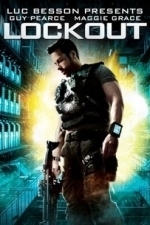

In the later part of the 21st-century the worst criminals the planet has to offer are kept safely away from public in stasis aboard an orbiting prison known as MS: One. Although it is never explained in the film, it does not take a rocket scientist to guess that “MS” stands for Maximum Security and much like the rest of the movie “Lockout”, this is a film that does not aspire to be more than the sum of its heavily borrowed parts.
The film stars Guy Pearce as Snow, a special agent who has been wrongly accused in the killing of a high-ranking operative. Railroaded through the system, Snow is looking at a lengthy sentence.
At the same time, the presidents daughter Emily (Maggie Grace), has visited MS: One on a goodwill tour. One of her special causes is to confirm the truth that long-term stasis has damaging psychological and neurological effects for the prisoners. Since the prison is funded by a deep space research development she definitely sees conflict of interest in how prisoners are being treated.
Things take a turn for the worse when a violent prisoner goes off during his interview and proceeds to release pent-up inmate population and take the crew hostage. The prisoners run amok and for the time being are unaware that they had president’s daughter in their midst. Snow was given an ultimatum that the successful retrieval of the first daughter will help him avoid becoming a future resident of the orbiting prison.
Despite his misgivings, Snow accepts the assignment as he learns that one of his friends is incarcerated on board. This friend holds valuable information that can exonerates Snow from his charges. Once on board the station, Snow must battle mobs of psychopaths as he attempts to locate and rescue Emily.
While one would think this premise would hold plenty of excitement, thrills, and suspense, the film is essentially undone by its inability to sustain any real momentum for any developed and real tension.
While the prisoners do a great job of appearing menacing, torturing and killing the hostages, we really never learn of their true objective. At no time do they really make any serious demands for freedom, material goods, and so on which basically leaves them vulnerable to an all-out attack from the amassing forces around the prison.
One would think they would’ve asked for something as simple as pardons but they seem more interested in glaring threats to the president and the authorities via videoconference, not truly grasping the magnitude of their situation.
Pearce does a good job as the gruff Snow but sadly the script gives him very little to do other than smug one-liners and occasionally shoot the bad guys. Smith does show some spark and personality in her performance but she is given little to do aside from playing the damsel in distress although she doesn infuse the role with some strength and humor.
What really surprised me about the movie was even though it borrowed very heavily from Fortress 1 & 2 as well as an escape from New York, and have surprisingly little new to offer. It was clear that the intention was to create a diehard style film in space but unfortunately it fell relatively flat.
This was a huge surprise to me as one would think that Luc Besson and many of the creative talents that made “Taken” such a thrilling smash would have been able to come up with a better action film.
This is not to say that “Lockout” is a bad film more than it is a disappointment considering the premise, cast, and the potential that it had going for it.
I can certainly overlook plot holes, thinly crafted stock characters, and run-of-the-mill action sequences in my action films as long as they can get me some solid entertainment.
Sadly this is not the case and it plays out more like a direct to DVD release that’s certainly would be extremely welcome us and Netflix are red box rental but for my taste thanks to the lo-res and dated special effects did not warrant a major theatrical release.
The film stars Guy Pearce as Snow, a special agent who has been wrongly accused in the killing of a high-ranking operative. Railroaded through the system, Snow is looking at a lengthy sentence.
At the same time, the presidents daughter Emily (Maggie Grace), has visited MS: One on a goodwill tour. One of her special causes is to confirm the truth that long-term stasis has damaging psychological and neurological effects for the prisoners. Since the prison is funded by a deep space research development she definitely sees conflict of interest in how prisoners are being treated.
Things take a turn for the worse when a violent prisoner goes off during his interview and proceeds to release pent-up inmate population and take the crew hostage. The prisoners run amok and for the time being are unaware that they had president’s daughter in their midst. Snow was given an ultimatum that the successful retrieval of the first daughter will help him avoid becoming a future resident of the orbiting prison.
Despite his misgivings, Snow accepts the assignment as he learns that one of his friends is incarcerated on board. This friend holds valuable information that can exonerates Snow from his charges. Once on board the station, Snow must battle mobs of psychopaths as he attempts to locate and rescue Emily.
While one would think this premise would hold plenty of excitement, thrills, and suspense, the film is essentially undone by its inability to sustain any real momentum for any developed and real tension.
While the prisoners do a great job of appearing menacing, torturing and killing the hostages, we really never learn of their true objective. At no time do they really make any serious demands for freedom, material goods, and so on which basically leaves them vulnerable to an all-out attack from the amassing forces around the prison.
One would think they would’ve asked for something as simple as pardons but they seem more interested in glaring threats to the president and the authorities via videoconference, not truly grasping the magnitude of their situation.
Pearce does a good job as the gruff Snow but sadly the script gives him very little to do other than smug one-liners and occasionally shoot the bad guys. Smith does show some spark and personality in her performance but she is given little to do aside from playing the damsel in distress although she doesn infuse the role with some strength and humor.
What really surprised me about the movie was even though it borrowed very heavily from Fortress 1 & 2 as well as an escape from New York, and have surprisingly little new to offer. It was clear that the intention was to create a diehard style film in space but unfortunately it fell relatively flat.
This was a huge surprise to me as one would think that Luc Besson and many of the creative talents that made “Taken” such a thrilling smash would have been able to come up with a better action film.
This is not to say that “Lockout” is a bad film more than it is a disappointment considering the premise, cast, and the potential that it had going for it.
I can certainly overlook plot holes, thinly crafted stock characters, and run-of-the-mill action sequences in my action films as long as they can get me some solid entertainment.
Sadly this is not the case and it plays out more like a direct to DVD release that’s certainly would be extremely welcome us and Netflix are red box rental but for my taste thanks to the lo-res and dated special effects did not warrant a major theatrical release.
Purple Phoenix Games (2266 KP) rated Elysium in Tabletop Games
Aug 3, 2021
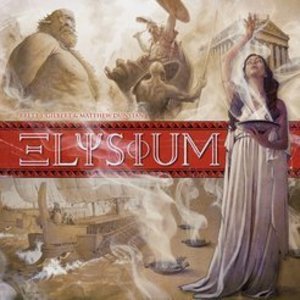
Greek Mythology has ALWAYS been a fascination of mine. I remember rewinding and replaying the original “Clash of the Titans” movie over and over on VHS. It’s super warped today but I still enjoy it now digitally. When I saw Elysium was coming out several years ago I knew I had to take a look at it, and I’m glad I did because it shot up my Top 100 Games of All Time and even spent a while in my Top 10. Not so much anymore, but I still love it. Why, you ask?
Elysium is a set collection card drafting game for two to four players. Each player will be attempting to complete the greatest collection of Legends written and subsequently transferred to their Elysium (Ancient Grecian version of heaven) for Victory Points. Whomever weaves the greatest Legendary tapestry will emerge victorious and really have a story to tell.
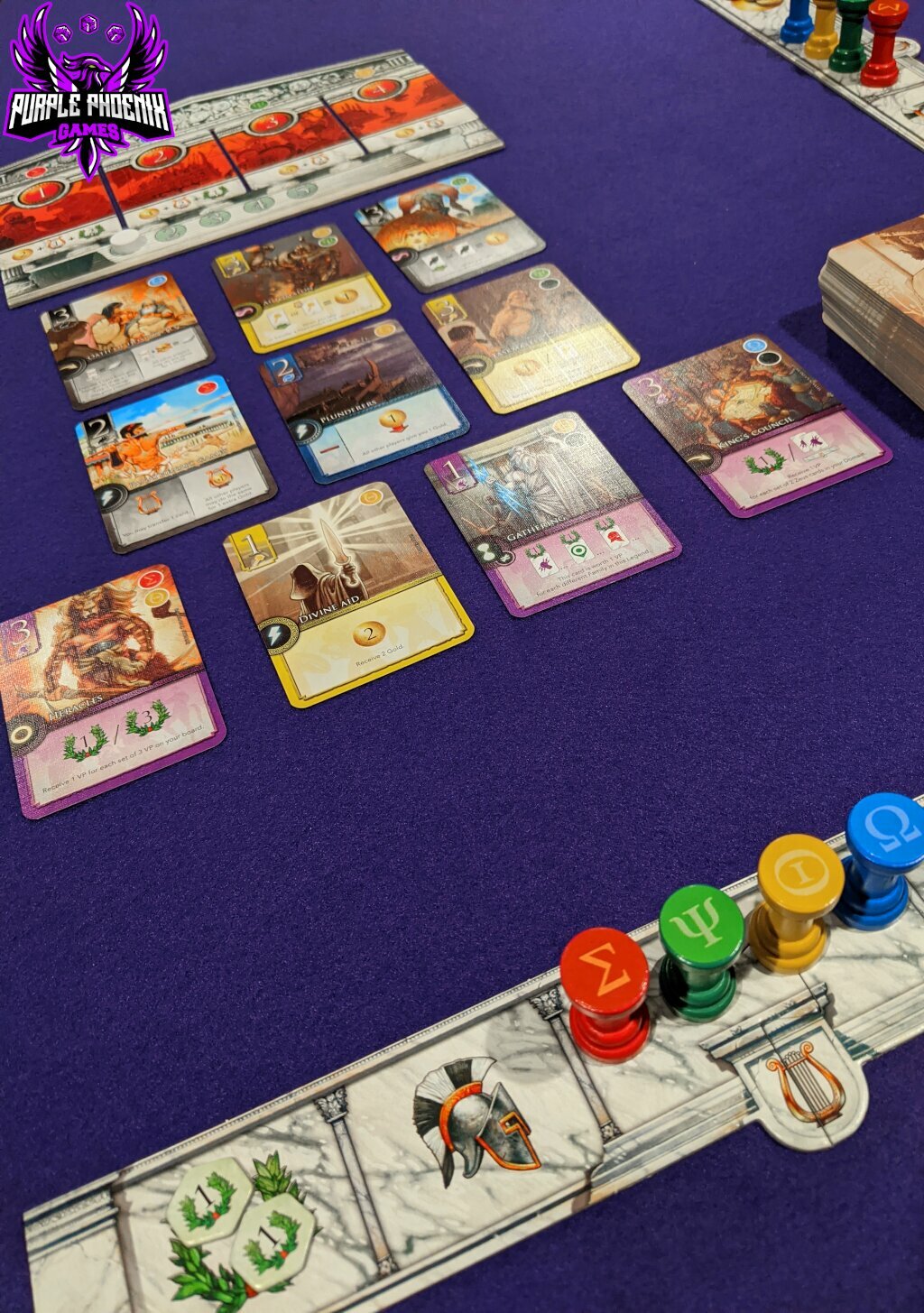
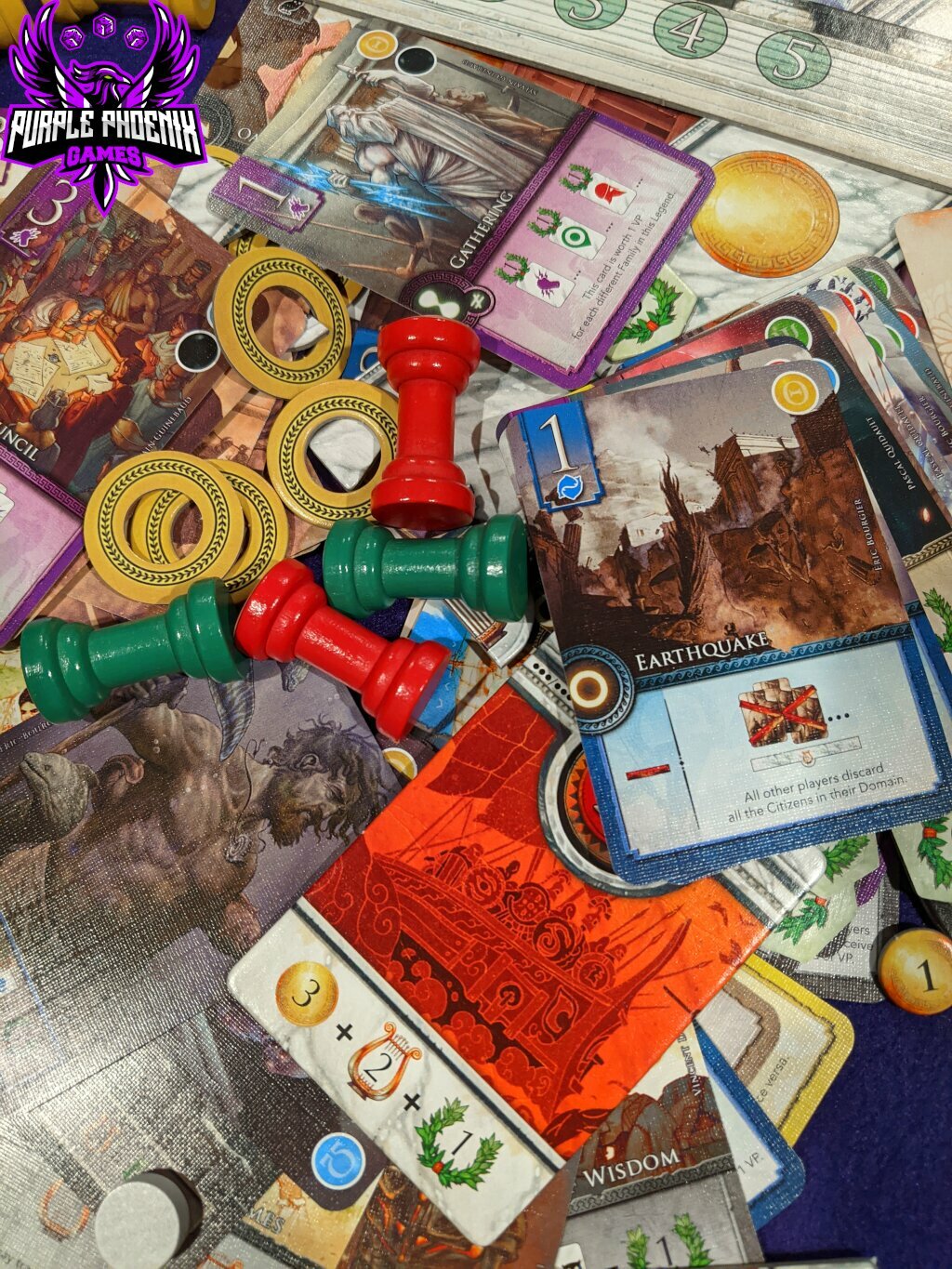
To setup, follow the instructions in the rulebook, but a three player game should look similar to what is pictured above. Players will receive their own player board, starting VP tokens and gold, and a set of columns. Cards from five different Grecian families will be shuffled and displayed in The Agora (middle of the board and the place to draft the cards). Once setup the game may begin.
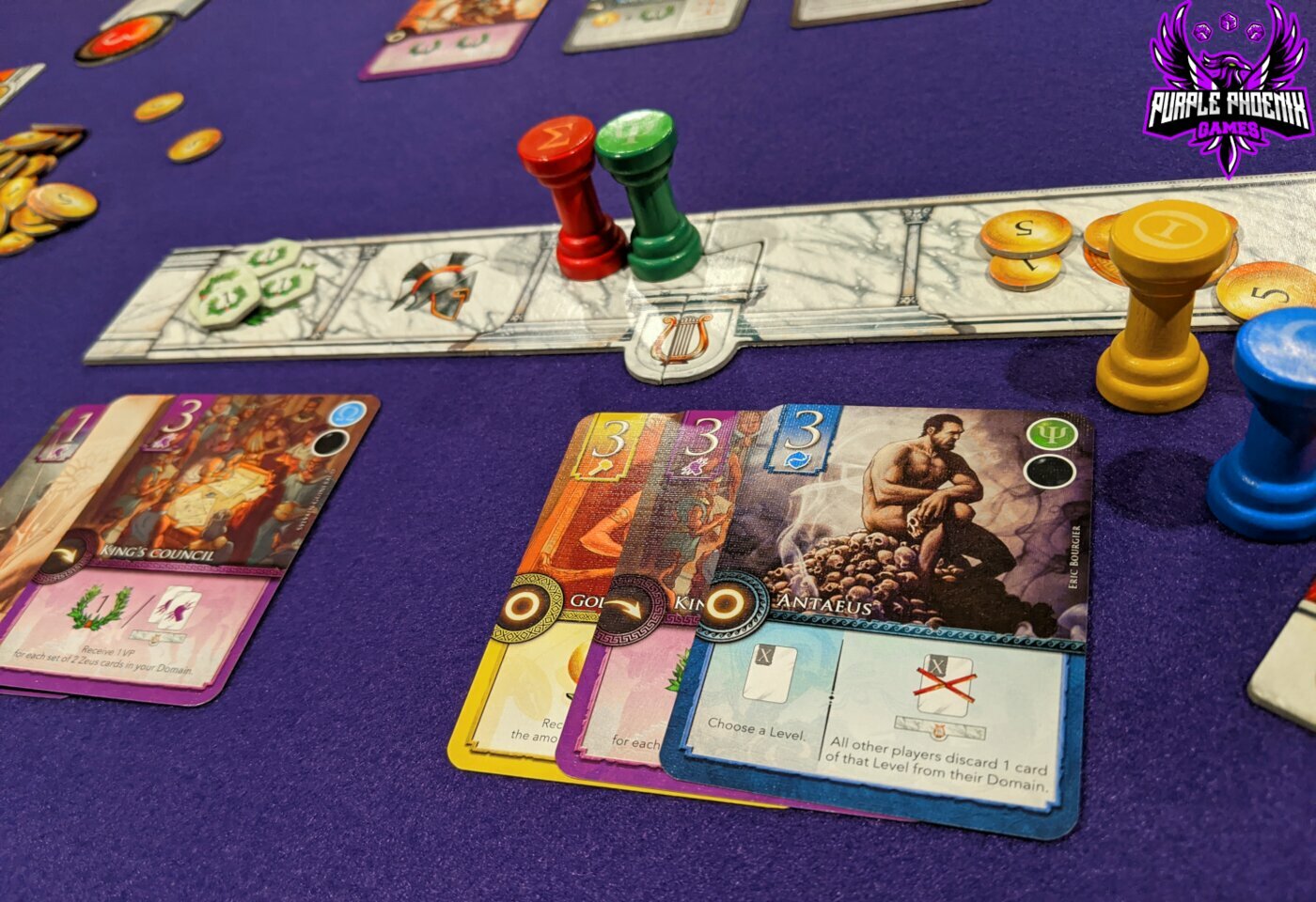
Elysium is played over five Epochs (rounds) and each Epoch is divided into four phases. Phase I is Awakening, which is simply setting up The Agora for the new Epoch by removing all existing cards there and revealing more. Phase II is Actions, where players will be using their columns to draft cards from The Agora (as long as the color of column matches one of the icons on the card) and taking at least one Quest tile (also denotes player order for the next Epoch). Phase III is Writing the Legends, where players will redistribute the player order discs, receive gold and VP per their Quest tile, and transfer any cards from their Domain – active holding area – to their Elysium for VP at game end. Phase IV is End of Epoch, where players will perform basic cleanup tasks to prepare for the next Epoch of play. Play will continue in this fashion until the end of the fifth Epoch and players tally their final VP to determine the greatest Legend-crafter in all the land!
I know this is a VERY brief summary of what is done during the game, but Elysium has many card effects and combos to consider that I just cannot detail here for fear of readers falling asleep or my fingers falling off.
Components. Elysium has simply an incredible aesthetic. The non-card components certainly radiate ancient times and the art on the cards is breathtaking. Every piece is very high quality, which is something I have grown to expect from Space Cowboys games. The columns are fun to hold and move, and as a whole is just visually stunning. I love playing this game and seeing it all out on the table.
Obviously we place our ratings on the very first graphic you see so it is no surprise by the time you read down here, but I love Elysium. Like I mentioned in my open it was in my Top 10 for quite a while, and for very good reasons. First, I love games that simply LOOK good. Is that shallow? Maybe, but it’s what I like. Second, I love the card interplay and combo potential in Elysium. Chaining together cards to build small engines is always fun and provides so much replayability by never really being able to experience every card combo in the box. Finally, it has great components and a theme that speaks to me and my personal interests. It feels like a game that was meant to be played by me specifically. When you find a game like that you have to give it high ratings.
So if you are at all like me and enjoy games with a great theme, excellent art and components, and intriguing replayability, then certainly grab a copy of Elysium. Purple Phoenix Games gives it an Olympus-sized 11 / 12. So many Ancient Greece themed games exist and Elysium is simply one of the best.
Elysium is a set collection card drafting game for two to four players. Each player will be attempting to complete the greatest collection of Legends written and subsequently transferred to their Elysium (Ancient Grecian version of heaven) for Victory Points. Whomever weaves the greatest Legendary tapestry will emerge victorious and really have a story to tell.
To setup, follow the instructions in the rulebook, but a three player game should look similar to what is pictured above. Players will receive their own player board, starting VP tokens and gold, and a set of columns. Cards from five different Grecian families will be shuffled and displayed in The Agora (middle of the board and the place to draft the cards). Once setup the game may begin.
Elysium is played over five Epochs (rounds) and each Epoch is divided into four phases. Phase I is Awakening, which is simply setting up The Agora for the new Epoch by removing all existing cards there and revealing more. Phase II is Actions, where players will be using their columns to draft cards from The Agora (as long as the color of column matches one of the icons on the card) and taking at least one Quest tile (also denotes player order for the next Epoch). Phase III is Writing the Legends, where players will redistribute the player order discs, receive gold and VP per their Quest tile, and transfer any cards from their Domain – active holding area – to their Elysium for VP at game end. Phase IV is End of Epoch, where players will perform basic cleanup tasks to prepare for the next Epoch of play. Play will continue in this fashion until the end of the fifth Epoch and players tally their final VP to determine the greatest Legend-crafter in all the land!
I know this is a VERY brief summary of what is done during the game, but Elysium has many card effects and combos to consider that I just cannot detail here for fear of readers falling asleep or my fingers falling off.
Components. Elysium has simply an incredible aesthetic. The non-card components certainly radiate ancient times and the art on the cards is breathtaking. Every piece is very high quality, which is something I have grown to expect from Space Cowboys games. The columns are fun to hold and move, and as a whole is just visually stunning. I love playing this game and seeing it all out on the table.
Obviously we place our ratings on the very first graphic you see so it is no surprise by the time you read down here, but I love Elysium. Like I mentioned in my open it was in my Top 10 for quite a while, and for very good reasons. First, I love games that simply LOOK good. Is that shallow? Maybe, but it’s what I like. Second, I love the card interplay and combo potential in Elysium. Chaining together cards to build small engines is always fun and provides so much replayability by never really being able to experience every card combo in the box. Finally, it has great components and a theme that speaks to me and my personal interests. It feels like a game that was meant to be played by me specifically. When you find a game like that you have to give it high ratings.
So if you are at all like me and enjoy games with a great theme, excellent art and components, and intriguing replayability, then certainly grab a copy of Elysium. Purple Phoenix Games gives it an Olympus-sized 11 / 12. So many Ancient Greece themed games exist and Elysium is simply one of the best.

Purple Phoenix Games (2266 KP) rated Isla Dorada in Tabletop Games
Jun 24, 2021
I have always wanted to be an explorer. Not that I ever really would: I hate sweating, I need at least daily showers, I’m allergic to all the poison plants, and honestly, walking all that way in boots seems like such a drag. BUT! I will play games about exploring and totally get into the themes and mythos. I love them! How does a 10 year old game about exploring hold up to today’s gaming standards? Read on, weary traveler.
Isla Dorada is a set collection, hand management, bidding, exploration, adventure card and board game from a team of designers including Bruno Faidutti and Alan R. Moon. The players are a cohesive exploration team which has crash landed on an island, and they seek the riches within. To do this, the players will be traveling around the island attempting to satisfy their Destinies and pick up treasures along the way. But not every player wants to go where the others want to go. What to do, what to do…
Follow the setup instructions in the rule book until you have a board with turn tracker discs and the players’ shared totem pawn upon the crash site. Each differently-backed card deck will be shuffled and each player will receive cards drawn from these decks as their starting collection. The youngest player will receive the first player marker and will start the game by placing the totem on a path heading away from the crash site where they would like to go and announce the amount of cards they are willing to bid (even zero cards) in order to convince the party to travel there. The game is now on!
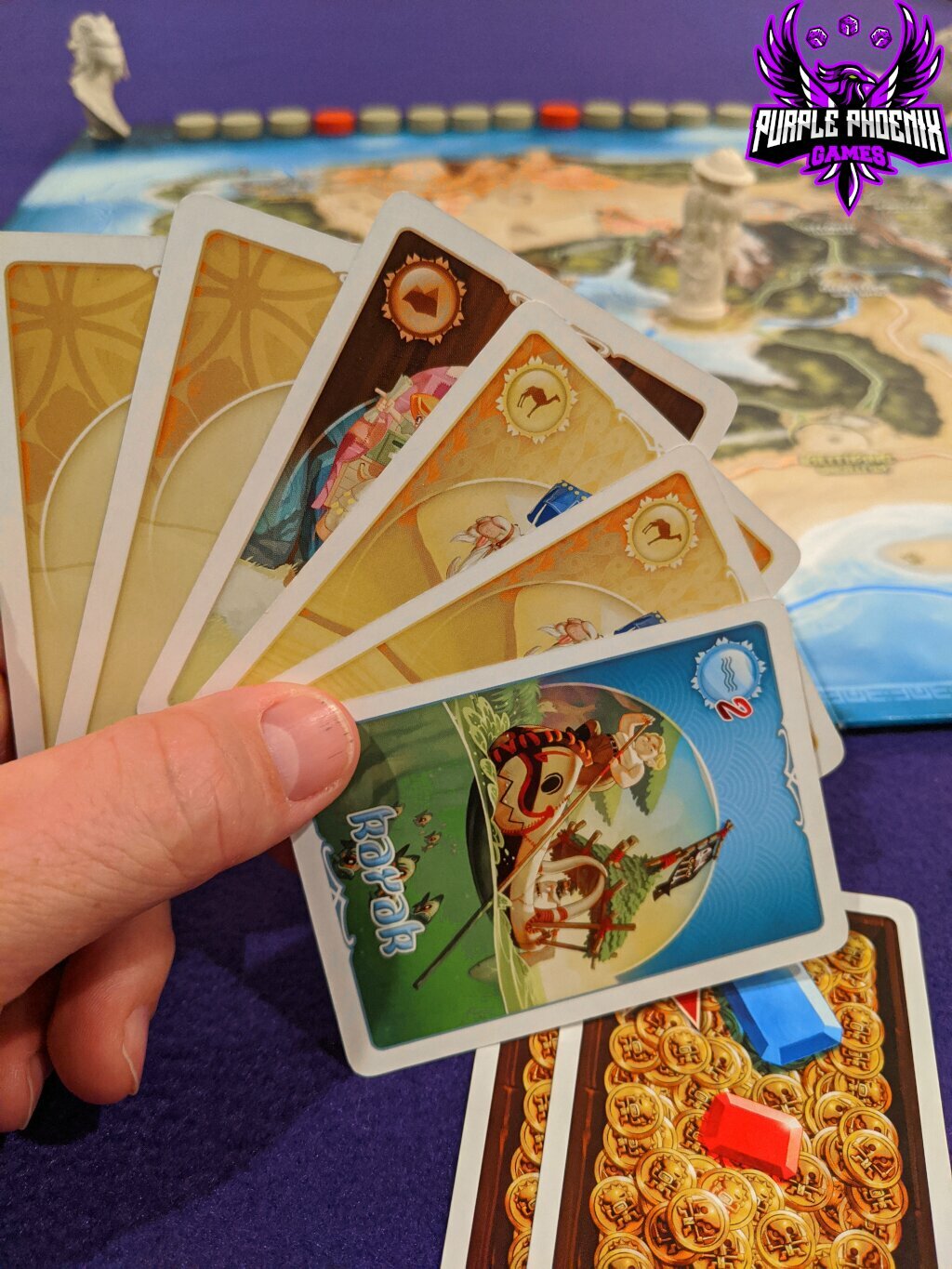
Players will be collecting Adventure cards to be used as currency when bidding on party travel in order to fulfill goals on their personal Destiny cards. When traveling each turn, a turn marker disc will be placed on the location the party has visited in order to track the movements for said Destiny cards, which mostly have lists of areas to be visited. They will also be attempting to avoid certain areas of the island which will trigger their Curse card that awards negative points at the end of the game. During two turns of the game players will be able to draw and choose cards from the Treasure deck that will help award points at game end as well. The winner is the player who best collects a combination of completed Destiny cards, Treasures, money, and considerations for negative points from Curses.
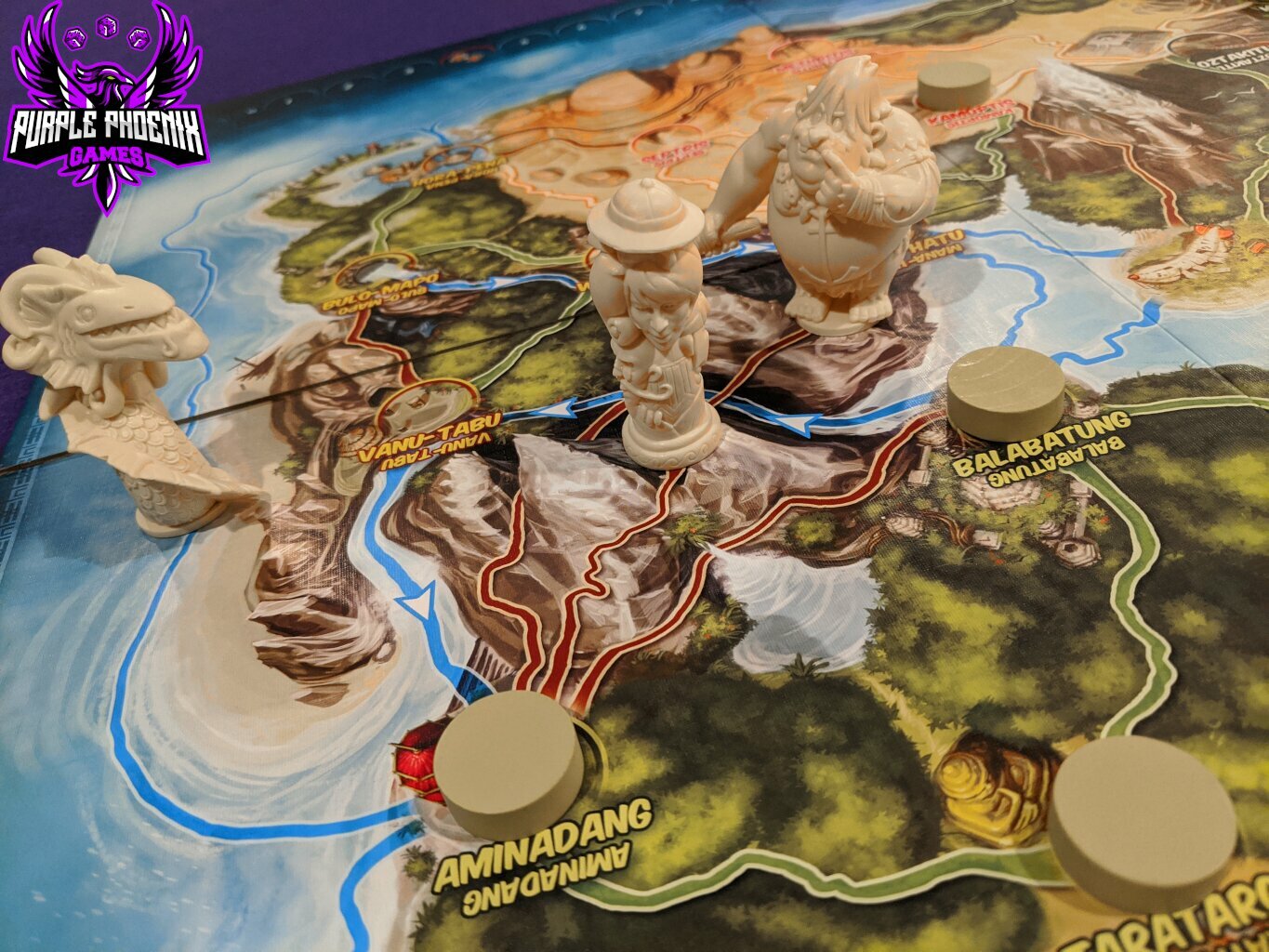
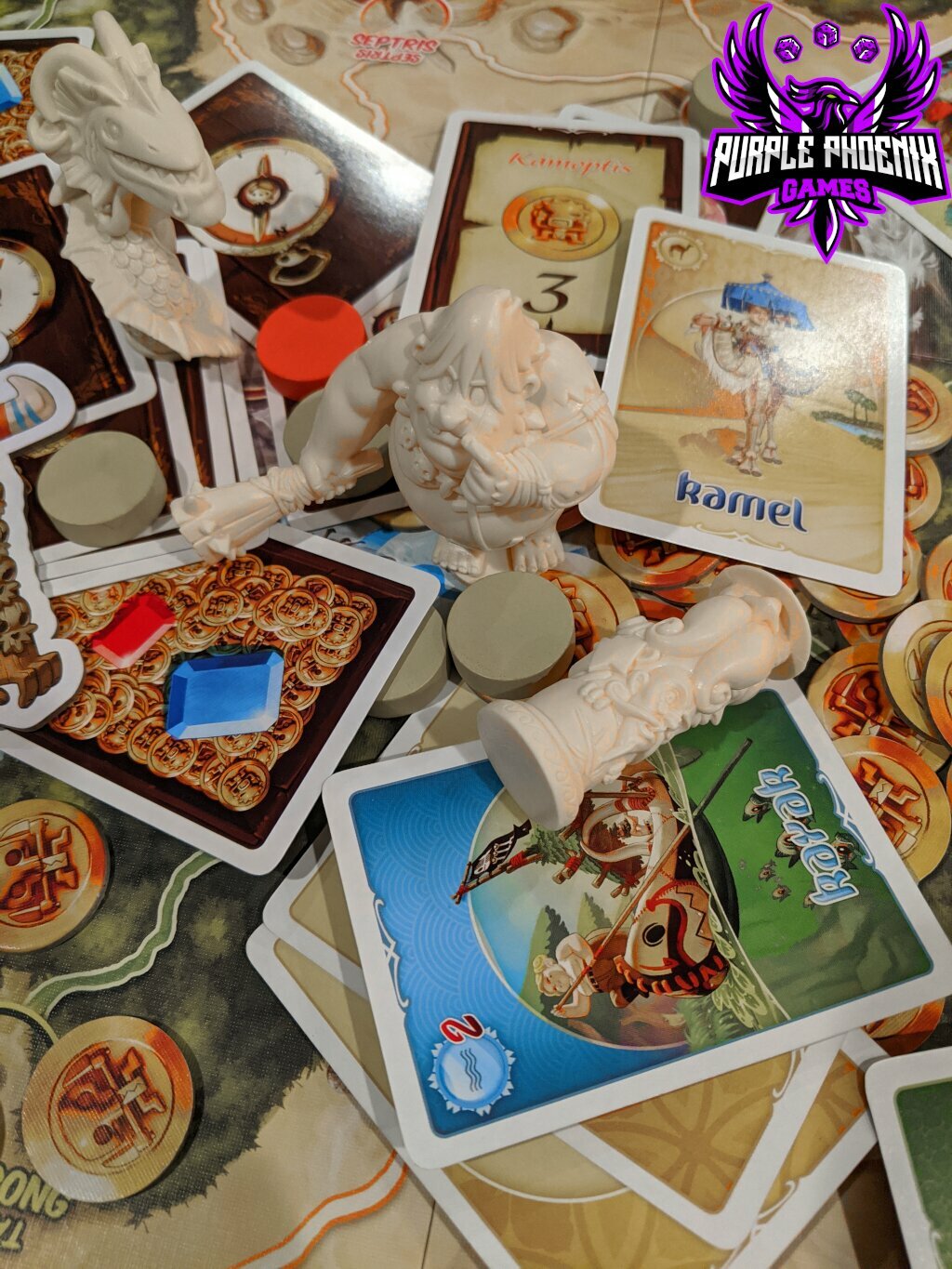
Components. People, Isla Dorada boasts some of the best components in a game we have seen. The totem pawn and Bigfoot/Leviathan pawns are simply amazing. The art throughout the game is mesmerizing and gorgeous. So much attention to little details have gone into this production and the final product is a stunning game that you want to keep playing because the component are just so fabulous.
But the game play? It is awesome with the right game mates. If you can play this with your enthusiastic friends, each turn will be simply exciting and joyous to play. Getting friends and family members to shout at each other their bids to move the party toward Septris instead of Methritis because their Curse card is brutal is downright great entertainment. Watching paths being cut off by the Bigfoot and Leviathan and having people visibly create alternate pathways and tactics can be enjoyable as well.
So do I like this game? Yep! It has beautiful components, is somewhat easy to teach to players of all experience levels, and leaves you satisfied when the game is over. This is not a serial, “play every game night” sort of title, but with the right group and mood, this can be a dynamite experience. If you are looking for a high-energy adventure game with lots of player interaction, set out to find a copy. I do wish you good luck, though, as a copy may be hard to come by. Alas, Purple Phoenix Games gives Isla Dorada a totemic 15 / 18. At least we will always have Kilitiping…
Isla Dorada is a set collection, hand management, bidding, exploration, adventure card and board game from a team of designers including Bruno Faidutti and Alan R. Moon. The players are a cohesive exploration team which has crash landed on an island, and they seek the riches within. To do this, the players will be traveling around the island attempting to satisfy their Destinies and pick up treasures along the way. But not every player wants to go where the others want to go. What to do, what to do…
Follow the setup instructions in the rule book until you have a board with turn tracker discs and the players’ shared totem pawn upon the crash site. Each differently-backed card deck will be shuffled and each player will receive cards drawn from these decks as their starting collection. The youngest player will receive the first player marker and will start the game by placing the totem on a path heading away from the crash site where they would like to go and announce the amount of cards they are willing to bid (even zero cards) in order to convince the party to travel there. The game is now on!
Players will be collecting Adventure cards to be used as currency when bidding on party travel in order to fulfill goals on their personal Destiny cards. When traveling each turn, a turn marker disc will be placed on the location the party has visited in order to track the movements for said Destiny cards, which mostly have lists of areas to be visited. They will also be attempting to avoid certain areas of the island which will trigger their Curse card that awards negative points at the end of the game. During two turns of the game players will be able to draw and choose cards from the Treasure deck that will help award points at game end as well. The winner is the player who best collects a combination of completed Destiny cards, Treasures, money, and considerations for negative points from Curses.
Components. People, Isla Dorada boasts some of the best components in a game we have seen. The totem pawn and Bigfoot/Leviathan pawns are simply amazing. The art throughout the game is mesmerizing and gorgeous. So much attention to little details have gone into this production and the final product is a stunning game that you want to keep playing because the component are just so fabulous.
But the game play? It is awesome with the right game mates. If you can play this with your enthusiastic friends, each turn will be simply exciting and joyous to play. Getting friends and family members to shout at each other their bids to move the party toward Septris instead of Methritis because their Curse card is brutal is downright great entertainment. Watching paths being cut off by the Bigfoot and Leviathan and having people visibly create alternate pathways and tactics can be enjoyable as well.
So do I like this game? Yep! It has beautiful components, is somewhat easy to teach to players of all experience levels, and leaves you satisfied when the game is over. This is not a serial, “play every game night” sort of title, but with the right group and mood, this can be a dynamite experience. If you are looking for a high-energy adventure game with lots of player interaction, set out to find a copy. I do wish you good luck, though, as a copy may be hard to come by. Alas, Purple Phoenix Games gives Isla Dorada a totemic 15 / 18. At least we will always have Kilitiping…

Soul Raiders
7.0 Rate It
Tabletop Game
Tomorrow is the day: you will pledge yourself to the ancestral order of the Soul Raiders, in the...