Purple Phoenix Games (2266 KP) rated Jurassic Parts in Tabletop Games
May 31, 2021
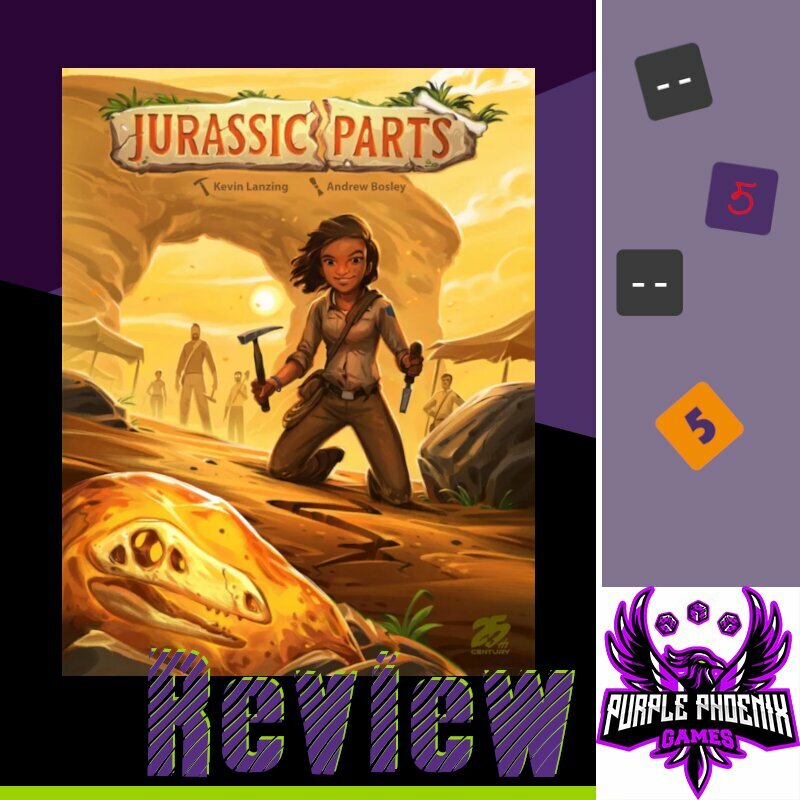
Jurassic Parts is an interesting mix and spins of area control, enclosure, and set collection for two to five players. In it, players are all paleontologists bent on claiming the biggest and best bones from a giant slab of rock containing dozens of dino species. The catch? Each paleontologist is trying to claim the bones for themselves. Sharp wit, good luck, and a bevvy of sharpened chisels spells success and fame for the paleontologist who wins at collecting Jurassic Parts.
DISCLAIMER: We were provided a copy of this game for the purposes of this review. This is a retail copy of the game, so what you see in these photos is exactly what would be received in your box. I do not intend to cover every single rule included in the rulebook, but will describe the overall game flow and major rule set so that our readers may get a sense of how the game plays. For more in depth rules, you may purchase a copy online or from your FLGS. -T
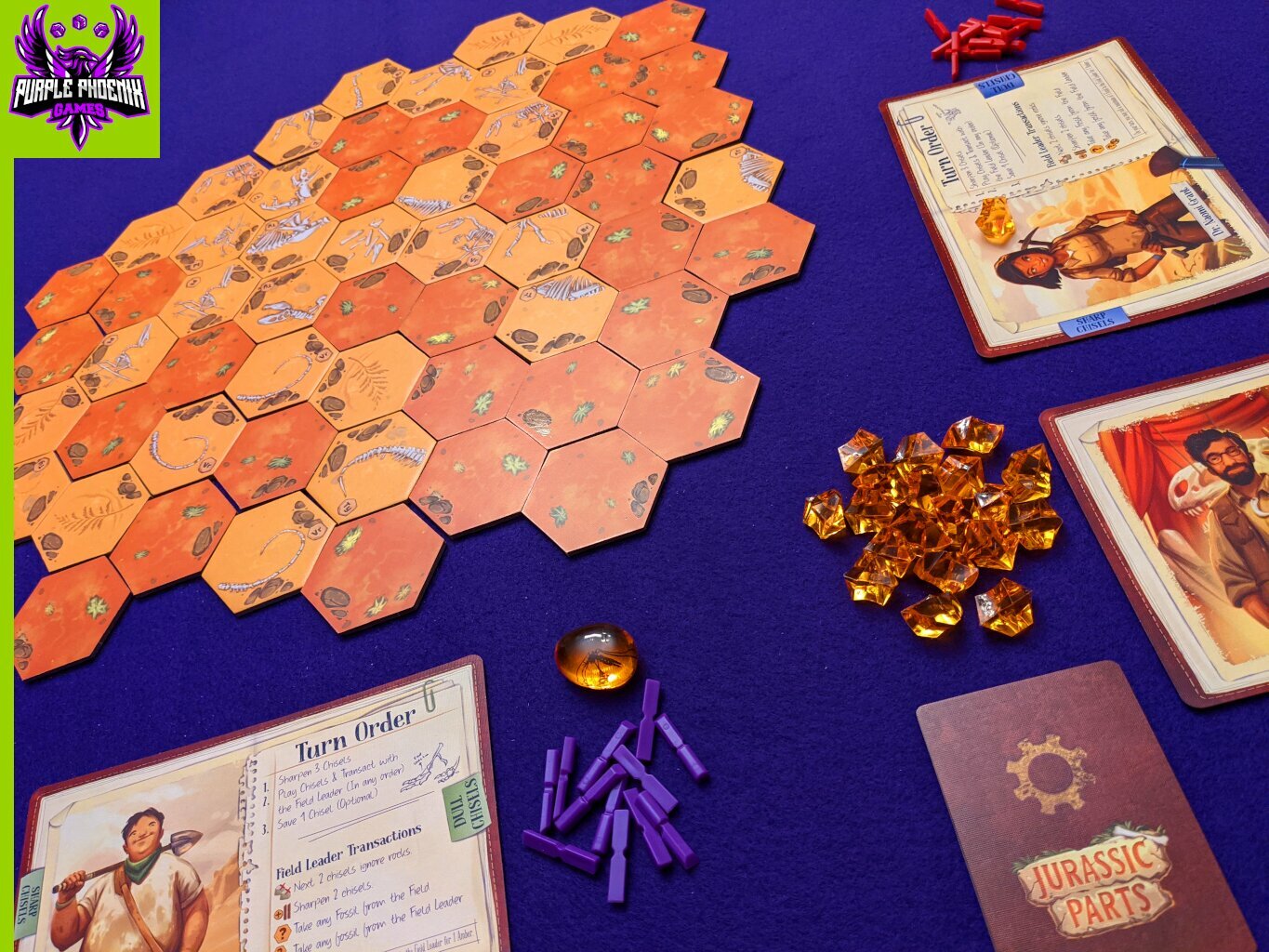
To setup, set aside one of the Pile of Bones (a wild card, of which there are several in the game) and shuffle the rest of the tiles. Split them into two stacks, flip one stack face-down, and build a slab around the Pile of Bones set aside earlier. This creates the slab of rock the players will be splitting. Each player receives their choice of paleontologist character sheet, chisels in their chosen color, and any pre-start resources per the rulebook. The slab is now ready for splitting!
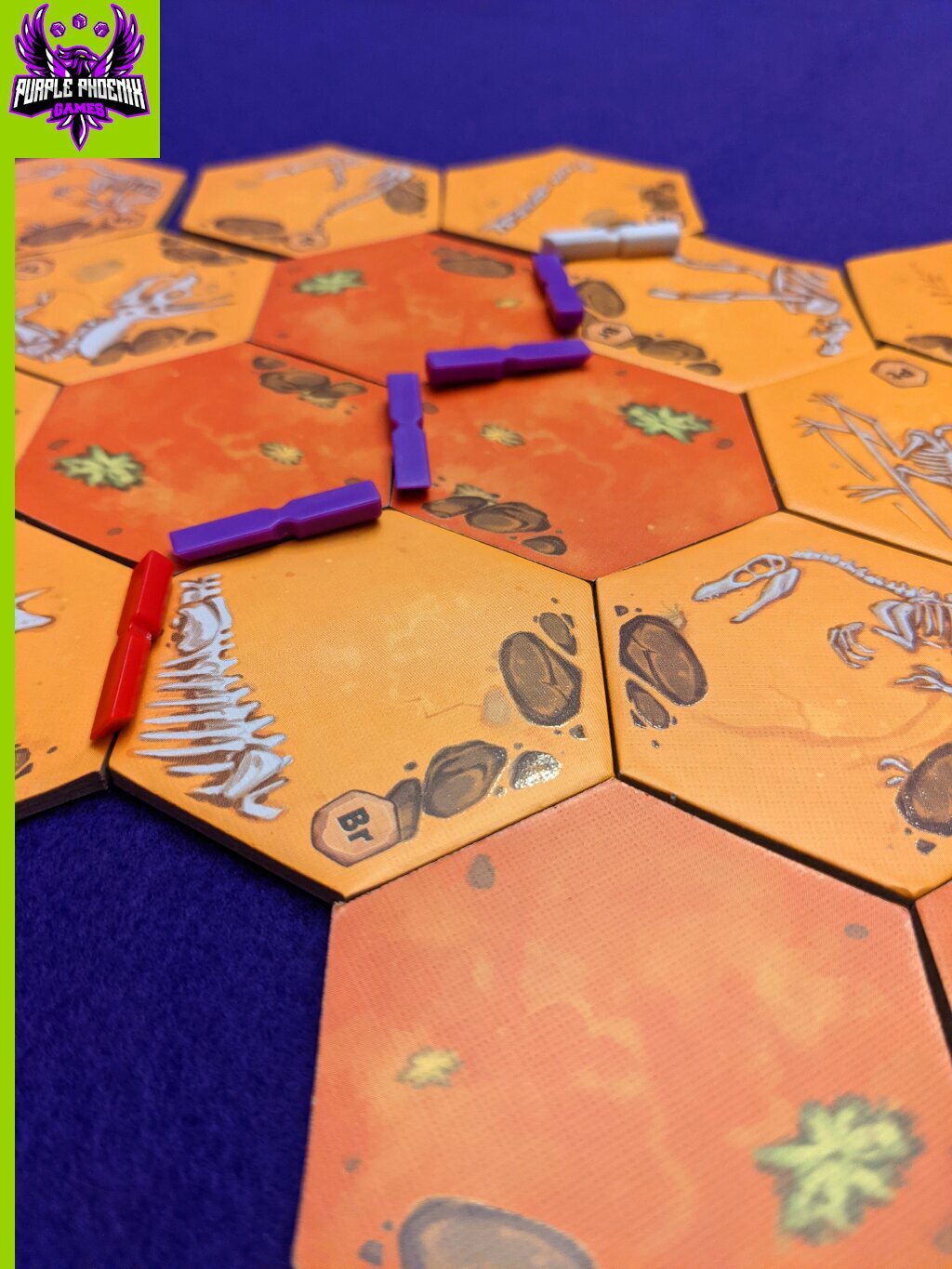
On a turn, the active player will have several options. Firstly, however, the player must sharpen three chisels by moving them from the Dull Chisels are on the right of their sheet to the Sharp Chisels area on the left. Now the player may place their chisels anywhere on the slab, as long as it is on the gap between two tiles. The purpose of this is to create a wonky line of chisels that will break off sections of the slab from the larger chunk. Players will need to beware of rock piles on either side of their preferred placement, as each rock icon on either side of the placement will require an extra chisel to be dulled and discarded. If a chisel placement would cause a line to be completed, a hunk of the slab is separated from the master slab. Players consult with the line of chisels (as shown below) to determine which player has contributed more to the split than the others. This will rank out all contributing players. The player with the most chisels contributed will be able to claim their choice of HALF of the tiles split off, rounded UP (so a player would receive five tiles from a nine-tile split). The next player in contribution order will then have their choice of HALF of the remaining tiles, rounded UP (so the second player would receive two tiles from the previous example, as there would be four left). Subsequent players would then receive HALF of what is left until all tiles have been claimed, or there remains just one tile. This final tile is then given to the Field Leader for his collection.
In addition to this splitting and claiming on a turn, the active player may also make transactions with the Field Leader at any point during their turn. Actions that can be taken while transacting with the Field Leader are selling one tile to him in exchange for an Amber piece, spending Amber to: ignore rocks on the subsequent two chisel placements, sharpen two additional chisels this turn, take any of the leftover fossil tiles from the Field Leader, or take any fossil tile from the slab (as long as it doesn’t create a split). The first action from the Field Leader will cost the player one Amber. Should they wish to enact another action, its cost is two Amber. Subsequent actions on the same turn cost three Amber each.
As you will notice, fossil tiles from the slab will show plant fossils, Pile of Bones (wild), or actual bones belonging to specific dinosaurs. These specific bones will show an alphabetic letter pair icon to denote to which dinosaur it belongs. If, at the end of the game, players are able to assemble the correct type of fossil tiles belonging to specific dinosaurs, they will score many more points than if the dino skeleton were incomplete. For example, at the end of the game, each fossil tile is worth 1VP if from an incomplete skeleton. However, should a player have completed a Velociraptor skeleton, they will receive 4VP for those two tiles. A completed Triceratops scores 7VP, a T-Rex scores 10VP, a Brachiosaurus scores 15VP, and a tiny Pterodactyl scores 1VP for a complete skeleton because it spans only one tile. The Pile of Bones tiles in the game can be used in place of any other fossil tile to complete a skeleton, and Plant tiles score increasingly more points for a larger collection of them.
Play continues in this fashion of sharpening and placing chisels, breaking off sections of the slab and claiming fossil tiles, and utilizing actions at the Field Leader until all slab tiles have been assigned. The player with the most points from complete and incomplete skeletons and plants will be crowned the winner and the greatest paleontologist in the land… until the next playthrough.
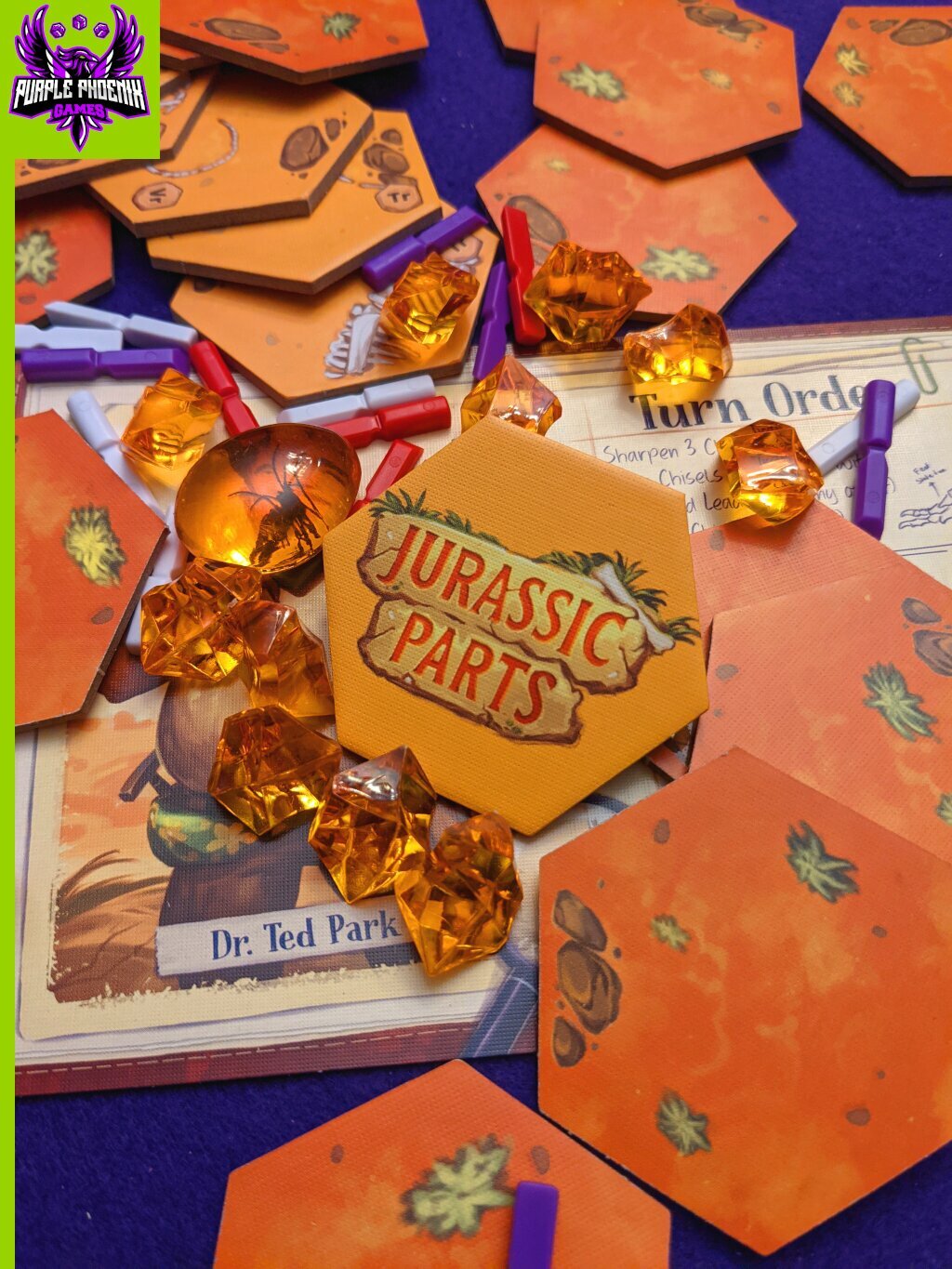
Components. You know how you come to expect certain things from publishers, and can just imagine the quality of the game you are about to receive before seeing it? Such is the case with 25th Century Games. I KNOW that I will be receiving a quality product every time, and this certainly is no exception. The fossil tiles are great and sturdy. The chisels are neatly-designed and multifaceted (which I appreciate, as it would be easy to include tubular chisels and have them rolling around the table everywhere). The amber bits are the typical gemstones you find in Century: Golem Edition, but are the absolute PERFECT color and usage for this game. And did you see that first player marker? It’s a mosquito inside a polished amber stone. I mean, COME ON! How perfect is that? I’m excited just TALKING about the components. I haven’t even touched on art yet, and this is longer than most of my components paragraphs. The art is fabulous. It fits the game and the theme so perfectly – I could not have chosen a better fit myself. Has 25th Century Games set the bar too high for themselves, or will they continue to offer high quality games from here on out? I cannot wait to find out!
So sure, it looks great, but what about the gameplay? Do the art and components merely shield a mediocre game? No. Not at all. Being able to place chisels anywhere you like on the board offers players a freedom that is refreshing, but weighing that against the pressure to contribute to an existing or emerging line of chisels so that you are included in the split is just wonderful. Contemplating turns to sell off fossil tiles in order to earn enough amber to gain more chisels, or bypass rocks, or simply take the perfect tile for your collection offers just enough tacticization (why isn’t that a word…) to warm up the brain without indulging the AP in some players.
This is not at all a heavy game, and it certainly doesn’t need to be. It is just a fun time with friends and family that utilizes interesting twists of mechanics that I enjoy. It feels reminiscent of several games (hints of Through the Desert and a twist on I Split You Choose), but it entirely its own design. Purple Phoenix Games gives this one very rewarding 10 / 12. I generally enjoy most dinosaur-themed games, I understand, but this one sits among the best I have played. If you are looking for something that feels both familiar and fresh, with incredible art and components, you need to grab a copy of Jurassic Parts. There are just so many interesting choices to be made and strategies to attempt. I think I will setup a game right now. Want to come play?
Purple Phoenix Games (2266 KP) rated Ghoulash: The Game of Card Calamity in Tabletop Games
Sep 3, 2019



In Ghoulash: The Game of Card Calamity (which I will shorten to Ghoulash for the purpose of this review – even though there is the OG Ghoulash as well, I think you know what I’m talking about) players are Ghoul hunters. Ghouls are monstrous green blobsters that are coming for you. You fight them by shooting Ghoo, a purply substance, at them to exploit their weak spots and vanquish them. The first Ghoul hunter to reach 10 Victory Points (VPs) will be crowned the winner!
DISCLAIMER: We were provided a prototype copy of this game for the purposes of this review. As this is a preview copy of the game, I do not know if the final rules or components will be similar or different to what we were provided. -T
To setup the game, shuffle the deck and place a 6×3 grid of cards in the middle of the table. This is the “floor” and will be the game board for the duration of the game. When the floor is out of cards (I will explain), set out a new 6×3 grid floor and continue play. Deal each hunter a hand of seven cards and you are ready to play!
Each of the face down cards that comprise the floor are opportunities for encounters. You, as a Ghoul hunter, will enter the floor from any border card. On your turn you may fill your hand up to your current hand limit – which changes based on whether you have taken wounds or not. Next you must move orthogonally onto a space that contains a card or an empty space, but you must move – or take your Action first, THEN move. If you move to a space with a card, you encounter the card. Depending on what type of card is flipped face up you will be taking cards into your hand, following Command instructions, or fighting Ghouls. When you have finished your turn it is the next hunter’s turn.
Should your flipped card reveal an Action or Special card, you simply collect the card into your hand. If the flipped card is an Battle card (which has Ghoo splats – like the ones pictured above on the far right), you must follow the Command instructions at the bottom of the card before collecting to your hand. And if it’s a Ghoul you will begin battle!
Battling Ghouls is mechanically simple, but the overall battle may not be. When you face a Ghoul its card will tell you what the strength of the monster is (the white number). It could have four, five, or six hit points (HPs). To vanquish the Ghoul you will need to play cards whose Ghoo value (splats) is equal to or greater than the Ghoul’s HP amount. From this point the other hunters can intervene in the battle by playing cards whose battle Ghoo tips the scales toward the Ghoul thus making it more difficult to defeat (a la the ganging up mechanic in Munchkin). As only one hunter may affect the battle in this way, it is the player’s cards whose strength is greater that wins the challenge. Now the original combatant must spend more Ghoo cards to overcome the super-buffed Ghoul. Should the hunter prevail they will collect the Ghoul card and display it in front of them to show the table how many VPs they have earned. If the hunter is unsuccessful in the battle, they suffer wounds in the amount of VPs that would have been awarded with a successful battle (the green dots at the bottom of the card). Wounds are reflected by cards in hand, so if a hunter suffers two wounds, their hand limit is now five instead of the original seven. Play continues in this fashion until a hunter has accumulated 10 VPs and earned victory!
Components. Per my disclaimer, the game that was sent to us is a prototype version of the completed game, so components may (and probably will) change or be improved as a result of further development, and/or a successful Kickstarter campaign. That said, I can comment only on the components that were provided to us. The game is a deck of cards in a deck box. The cards themselves are of fine quality. The art upon them is okay. Nothing too stellar, but it gets the job done. I think the art is one thing that can be improved with development. Don’t get me wrong, the art is not at all bad. Perhaps it’s the card layout or graphic design. Something with a bit more punch would be appreciated.
Our thoughts on this one are that it needs some sprucing up a bit. Yes, it is in prototype format currently, and we know that. The card design needs to be updated a bit, but the game itself was also lacking a bit. One of the major concerns we had when playing through it was the card grid of the floor. We did not use any sort of player marker, token, meeple, or anything to mark our locations, and I really think that may have helped. We just had a hard time visualizing where our hunter was in relation to the face-down cards and how many turns it would take us to travel to them. There were several times where we just guessed as to who was actually closer and they were able to encounter the card. I am unsure how to fix that without supplying a grid or some sort of tracker. We should have maybe just played with meeples or dice for position markers. Oh heck I just thought of this: we could have also placed out dice or whatever on an x and y axis to denote where floor cards should be. Ugh. Battles were run somewhat smoothly, even though there were times where I was down to one card because I had suffered so many wounds and I could not get a First-Aid Kit to save my life (literally). The battle challenges did not work with us and we were trying to find a good way to make them happen, but our minds must not have been at their peak. We weren’t quite sure if, like in Munchkin, you could just add one card to your challenge total, or if you had to commit the entire bunch of cards you wish to play. It is not clear in the rules, so we went with our guts.
Overall, this could be a good dungeon crawler type card game. The theme is good, but for us it didn’t quite click…yet. If it sounds like something you would like to have in your collection, check Kickstarter for the campaign (if Ghoulash Games decides to crowd-fund this), contact the publisher directly, or (depending on date you read this) purchase from your FLGS. Oh, and keep the Ghoo Gone away – this time Ghoo is good for your health!
Purple Phoenix Games (2266 KP) rated Evolution in Tabletop Games
Sep 12, 2019


Disclaimer: There are several expansions to this game, but we are not reviewing them at this time. Should we review them in the future we will either update this review or post a link to the new material here. Furthermore, I do not intend to cover every single rule included in the rule book, but will describe the overall game flow and major rule set so that our readers may get a sense of how the game plays. For more in depth rules, you may purchase a copy from the publisher directly or from your FLGS. – B
You start the game in control of one species of animal. One non-descript, traitless species that you will slowly (or maybe quickly) build up to be something bigger and better. You evolve it. (Huh.) You’ll start each round by contributing plant food to the watering hole. Each card in your hand is worth a certain amount of plant food. Once that food is in the watering hole, it’s fair game for anyone to eat. Depending on your strategy, you may want a lot of food in that watering hole, or you may want to starve your opponents out (some cards are even worth negative food!). Once all the food is in the watering hole, it’s time to evolve your critters. The cards in your hand have unique traits on them. To imbue your species with that trait, simply place the card next to your species’ gameboard and voila! You now have horns, or intelligence, or the ability to forage, or many other possibilities. You may also take this opportunity to evolve your creature into a carnivore (more on that later). At this point in the game, you may also discard cards in order to increase the population of your species, or to increase the body size of your cute little guys. This will be important later. You can also discard a card to create a whole new species. There’s no limit to how many species you can have, but there is a limit to the available food, so be wise with the number of species you create.
After everyone has evolved, it’s time to feed! You’ll take turns taking plant food from the watering hole. Yummy! You want to eat enough food to sustain your whole population size (1 piece of food per population). If not, your population size will decrease, meaning your species is dying. If you are unable to sustain the last remaining member of your species, that species will become extinct for eternity. Sad face. But don’t worry. You’ll get a new species for free at the beginning of your next turn. Once everyone is fed and happy, the round is over and you start a new round. The winner of the game goes to whoever has eaten the most food because, just like in real life, the success of your population is based on its ability to sustain itself, which, in this case, means eating the proper amount of food.
It SOUNDS simple, but I haven’t told you about all the curveballs yet. As stated before, you may choose to make your species a carnivore, which means that you will no longer take plant food from the watering hole. In order to eat, you have to attack another species! You can only attack other species who have smaller body sizes than you (I told you body size would be important. It’s your first means of defense against predators!). But some of those smaller species might have evolved some defensive traits, like a hard shell or the ability to burrow underground or to climb trees and taunt their predators from on high. This is the beauty of the game. How well can you evolve your herbivore creature in order to keep it well-fed and also free from predators? If you’re a carnivore, how well can you adapt to your surroundings and your ever-evolving prey before you can no longer feed on them? (I should also mention that you may find yourself in the truly depressing situation where all of your opponents have out-evolved your carnivores and the only other option left to feed them is to attack one of YOUR other species. The rules clearly state that every species MUST feed if able to, so you may have to sacrifice your other friends. VERY sad face.)
Components: Evolution comes in a standard cardboard box containing lots of high-quality trait cards, plant and meat food tokens and a large watering hole token (on which you put the plant food tokens). It also comes with cardboard food screens so you can conceal how much food your little (or maybe not so little) critters have eaten. You’ll get a stack of thick, double-sided species boards for you to keep track of your body size and population. I love that they’re double-sided because it gives you the flexibility to change their orientation (portrait or landscape) to save on table space. Body size and population are tracked using little brown and green cubes, which fit nicely in little holes on your species board. And to top it all off, the first player token is a a very large dinosaur-shaped meeple. Adorbs. The cards do tell you how to use them, but the rulebook has extra clarification for each card in case you need it. The cards are even color-coded so you’ll know if the trait is used for defense or eating, or maybe only usable by carnivores. Everything is very top-notch quality and the artwork is quite beautiful, creating new creatures and using bright, vivid colors. The artwork alone drew me to the box in the first place.
I really love this game. The theme is very on-brand for me, but I also really like that it’ll take a bit of luck (by hopefully drawing usable cards) and a ton of strategy to try to outwit your opponents. It’ll never be played the same way twice. Evolution is so spot-on, in fact, that it’s actually been used in the evolutionary biology department of the University of Oxford, so come on. It’s fun AND educational. I’ve also downloaded and quickly become obsessed with the mobile version, which is available on Google Play, in the App Store and on Steam. As of this writing, there are two expansions available: Flight and Climate, but there’s also a Climate stand-alone game, and an Evolution: The Beginning game, which is suitable for our younger friends. I own the Flight expansion but have yet to play it and I can’t wait to change that! Give this game a go. You’ll be happy you did. In the words of esteemed Dr. Ian Malcolm, “Life, uh, finds a way.” Purple Phoenix Games gives this one a (r)evolutionary 13 / 18.

Modern Jet Air Strike Combat Shooter : Delta Force
Games and Entertainment
App
Your Air fleet was on the routine exercise, when some enemies jets where registered on radars. The...

Backgammon Plus!
Games and Social Networking
App
Played and liked by hundreds of thousands of players on Facebook, Backgammon Plus is now on iPhone! ...
After The Empire
Tabletop Game
After the fall of Rome, Europe fell into the so-called "dark ages." From the chaos, feudalism arose...

ScoreKeeper ScoreBoard
Sports and Games
App
ScoreKeeper ScoreBoard - the Ultimate Scoreboard app! ...
Star Wars: Outer Rim
8.3 Rate It
Tabletop Game
Take to the stars and become a living legend in Star Wars: Outer Rim, a game of bounty hunters,...
2019Games StarWarsGames
Purple Phoenix Games (2266 KP) rated Space Explorers in Tabletop Games
Jan 4, 2021


Space Explorers is a card drafting, set collection game for two to four players. In it players will take on the mantles of unique Human Resources managers… in space! Well, not IN space, but FOR space. By recruiting the best and brightest engineers, testers, scientists, builders, and astronauts players will score points in addition to scoring points for completing projects.
DISCLAIMER: We were provided a copy of this game for the purposes of this review. This is a retail copy of the game, so what you see in these photos is exactly what would be received in your box. I do not intend to cover every single rule included in the rulebook, but will describe the overall game flow and major rule set so that our readers may get a sense of how the game plays. For more in depth rules, you may purchase a copy online or from your FLGS. -T
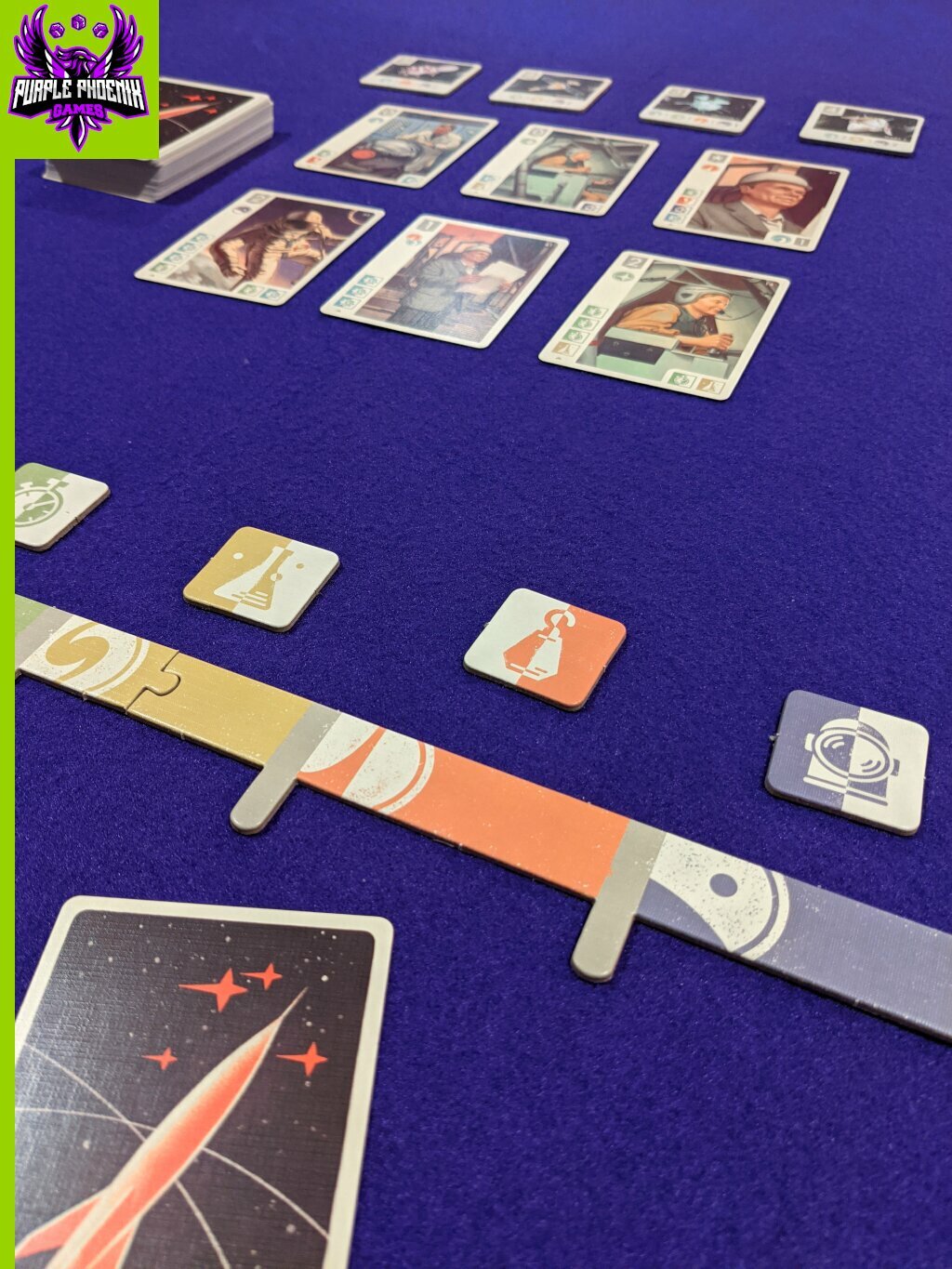
To setup, assemble Hub parts tableau organizer for each player. Shuffle the deck of Specialist cards (engineer, tester, et al) to be recruited and reveal six face up to symbolize the Center. Deal each player one of these Specialist cards to create their starting hand. Randomly choose two plus the number of players Project tiles and lay them on the table to be completed throughout the game. Each player will also receive a reference sheet (VERY handy) and one token of each Research type. Determine the starting player and the space race may now begin!
On a player’s turn they have two choices to make: take a Specialist card from the table into their hand, or recruit a Specialist from either their hand or from the table and place in their personal tableau. After this is completed the player may collect one Project tile if they now control the correct number of Specialists per Project tile.
To take a card into hand, a player simply selects one face-up Specialist card from those on the table and places it in hand. Simple.
To recruit a Specialist the player will need to spend Resources equal to the recruitment cost printed on the Specialist card. Resources may be spent in any combination from actual Resource tokens, Resources provided by recruited Specialists already in the player Hub (tableau), and discarding a Specialist card from hand to the table to give two Resources of any type.
As Specialists are recruited to the players’ Hubs they will then give a discount toward recruiting future Specialists of the same type along with other abilities. For each Specialist in the Hub the player will receive a discount of one Resource icon needed to spend to recruit a Specialist of the same type. For example, if a player already has recruited two Scientists, the next Scientist they recruit will be discounted by two Resources. These Resources are discounted from the bottom-up on the listed recruitment cost, and may even result in Specialists being recruited for free. Similarly, some Specialists have certain abilities printed on their card that allow such actions as recruiting cards for free, or providing Resource icons to be used to recruit, or even providing extra points at game end for a variety of reasons.
Play continues in this fashion of players taking Specialists in hand or recruiting them to their Hub to be used to complete Projects and earn points. The game ends once the last Project has been completed or any one player has recruited their 12th Specialist. Every player will have the same number of turns, after which the winner will be the player with the most points!
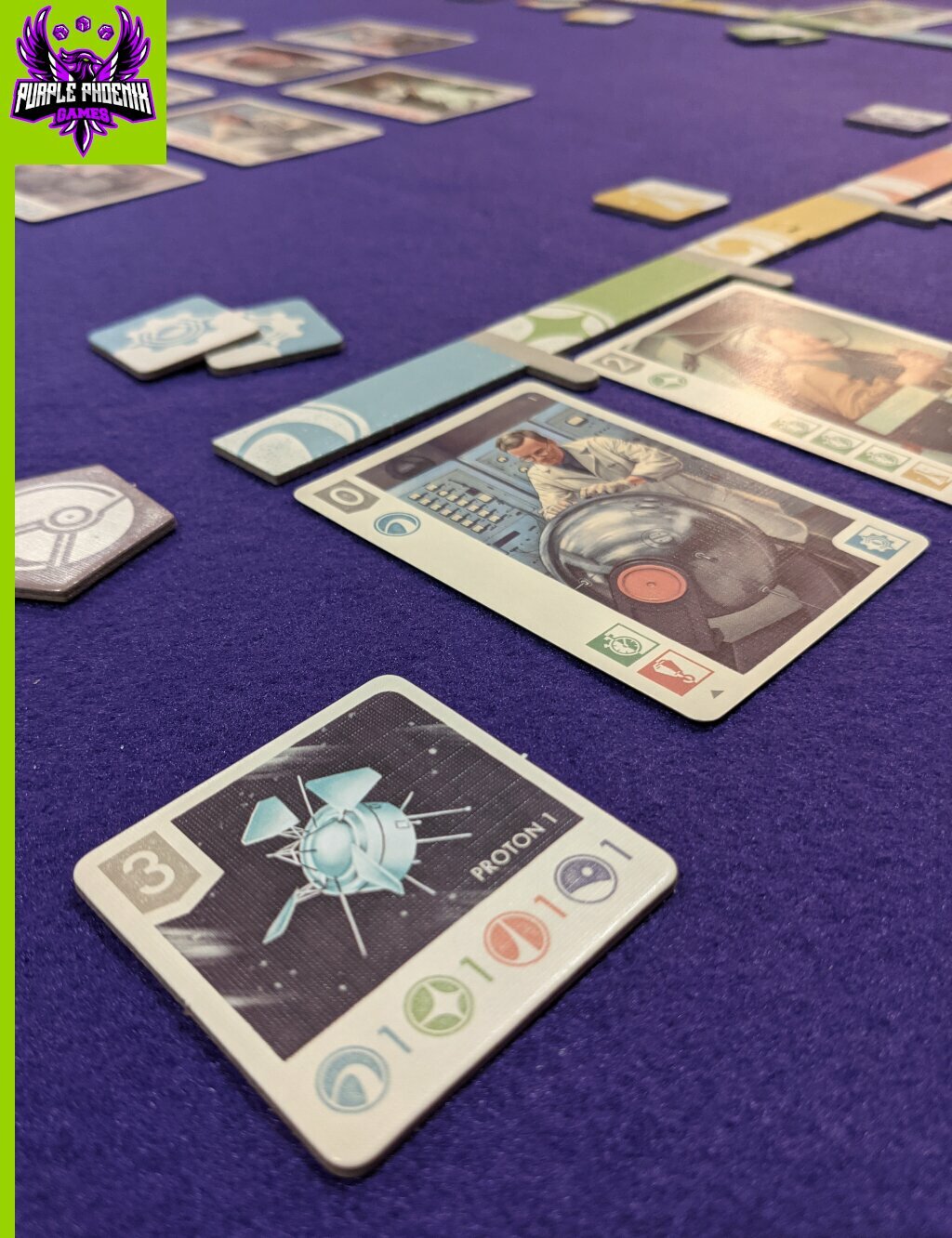
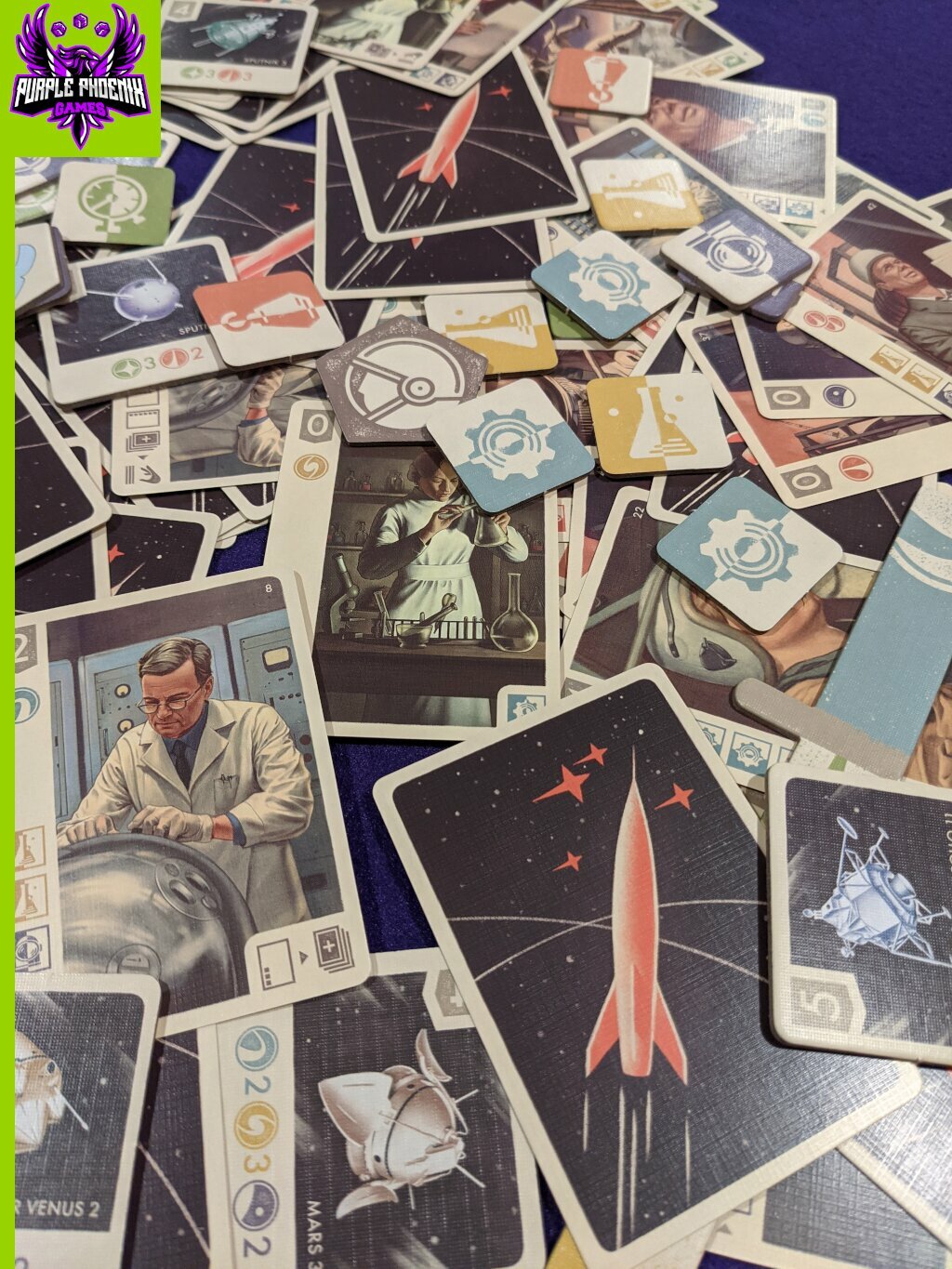
Components. I have a lot to say about the components here. I think that 25th Century Games has absolutely nailed every single component in this box. The Specialist cards are excellent quality: linen finished, great thickness, and they shuffle realllllly well. The Project tiles, Hub parts, and Resource tokens are thick board stock. The reference sheets are good and the rulebook is just perfect. One thing that may be slightly polarizing is the art style. Space Explorers uses imagery similar to what you would find on many things in the 1950s and 1960s in America. That said, I absolutely love the art style and it is reinforced on every component in this game. The icons are slick and stylish, the color scheme is muted without being drab, and everything you play with is meant to help immerse you into the time of the first astronauts. It’s simply amazingly well done.
The gameplay is also quite stellar (Laura will like that one). I know many compare it to Splendor, and that is certainly warranted, but I feel that Space Explorers pulls it off much more fluidly. Yes, Splendor has those weighty chips that everyone likes while Space Explorers has cardboard tokens. But other than that Space Explorers surpasses the other by leaps and bounds. The gameplay is much more intriguing, the theme is way cooler, and I am just overall much more attracted to it.
While gameplay overall is similar, there is quite a number of differences Space Explorers offers. Foremost, when Resource tokens are spent to recruit Specialists, instead of being sent to a communal bank they are passed along to the player on the left. That’s right, you literally give those Resources to your opponent that will be playing next. This small change really increases the need to be aware of what each player’s strategy may be in order to recruit who you need without also helping your rivals. Being able to utilize three different sources of currency in combination to recruit Specialists is also quite nice. Don’t have the right number of tokens? No problem! Check out what your Specialists are providing from their years of experience.
It is really no shock here that I am enamored with Space Explorers. I really didn’t know that I needed a Splendor killer in my collection, but now that I have this I will be holding it tightly and in high regard. Purple Phoenix Games gives this one an out-of-this-world 11 / 12. If you LIKE the aforementioned game that everyone seems to own but don’t LOVE it, then you need to check out Space Explorers. The theme is great, the components are superb, and the gameplay is light and fast. I love it dearly and hope you do too.