
Search



Writing (3 more)
Characters
Inconsistencies
Not a horror book, as marketed
What if a powerful virus was released in the air? What if you had to be tested for it every time you tried to walk into a building? Does this sound a little familiar? What if I told you this scenario was written about back in 2010?
In her novel Feed, writer Mira Grant gives readers this very scenario of an airborne, blood transferred virus; something that seems very familiar in today's environment and day-to-day living- - - just minus the zombies.
Grant started out as an urban fantasy writer known as Seanan McGuire, with her first full-length novel being Rosemary and Rue. She received the 2010 John W. Campbell Award for Best New Writer, as well as many other awards for her work in fiction. There are four books in the Newsflash series (Feed being the first of these).
We meet our main characters, Georgia and Shaun, while they're out in the 'field' filming some zombies for their blog. Shaun is the more careless one, as we witness him poking at zombies with his hockey stick. The two suddenly have to leave when the zombies become a pack. This is where it gets a little strange- - -Georgia explains to the readers that when zombies are in a pack, they become stronger and somehow smarter, but throughout the rest of the book, it's never really explained how this happens.
In this world, blogging and your view count determines your quality of life. Georgia and Shaun have spent years making their blog- - - After the End Times- - - into a popular blog. Every blogger's dream is to be picked to follow the campaign trail of any upcoming politician, and that is exactly what happens to our main characters. Unfortunately, this is when the book turns into a political thriller- - - this happens within the first fifty pages. Zombies end up taking a backseat from here-on-out.
We still get to learn about the virus (Kellis-Amberlee) throughout the book. We're told that any animal that weighs more than 40 pounds is capable of having the virus, and that some people are even born with a dormant-type of the virus inside of them, but this is also never explained in the entire story, at least in book one. Georgia makes it quite clear throughout the novel that she is completely against anyone owning pets that weigh over 40 pounds, but this is due-to her family having lost their younger son to a pet that went viral. This becomes extremely repetitive. Every time that an animal is brought up or seen, Georgia has to retell her stance on owning pets, when once or twice was enough to let the readers know where she stands on the subject.
There are moments of zombie attacks- - - such as after a political rally in a small town where Georgia and her crew are following Senator Ryman on his race to become President, when bodyguards are attacked by a small group of the undead, and Georgia and Shaun become cornered by a few of them- - - these scenes read as if to just keep the zombie trope going, not to actually make the story better. Grant continually repeats herself throughout the book, and because of this, the story didn't have to be as long as it is. Such as with these few zombie attacks, the reader never feels much danger for the characters. And I found that the characters turn out to just not be that likable.
One such character that had potential is Buffy; the backbone of the After the End Times blog. Scenes that were meant to make the reader care for her fell short. Unlike scenes with Georgia and Shaun, including the bond between them, is not felt with Buffy's scenes; she merely seems like a filler character to make certain parts of the story make sense by constantly disappearing and reappearing wherever need be.
Georgia does have an interesting quirk in the book. She harbors the dormant Kellis-Amberlee virus, which has effected her eyes. She can't be in bright lights because they give her blinding headaches, so she wears sunglasses nearly everywhere: " I collapsed onto our bed at the local four-star hotel a little after dawn, my aching eyes already squeezed shut. Shaun was a bit steadier on his feet and he stayed upright long enough to make sure the room's blackout curtains were drawn. "
The technical side of the story - - - the computer world and the electronic usage- - - in Feed is done pretty well. It's like the movie Nightcrawler meets 28 Days Later, but with a lot less zombies. We get to see the seedy underbelly of journalism- - - where bloggers are willing to do anything to get their view count high. Readers also get to witness how life is like living in a world held hostage by a virus - - -something that is very relatable today.
Georgia constantly reminds readers that she doesn't care about other people, and that Shaun is the only person she cares for- - - and, of course, the view count. She continually blames her lack of empathy on their adoptive parents, stating that they only took them in for the their own blog view counts. Oddly after such information, Shaun doesn't seem to be the immature one in the duo.
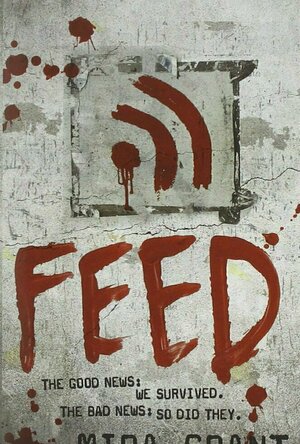
I haven't read the other three books, one which is a republishing of Feed, but from a different point-of-view. This story was disguised as a horror novel, but just ended up being a political thriller with some zombies thrown in for a much wider reading audience. The book skims over what life would be like after a devastating virus takes over, but focuses on what politics would be like. I can't recommend Feed as a horror novel; the tagline is also misleading: " 'The good news: we survived. The bad news: so did they. " Unless Grant was talking about politicians....
I didn't give the story a low rating because it wasn't exactly a horror book, but instead for these reasons: throughout the story, Grant repeats a lot of information that was explained earlier in the book (and only needed to be explained once); she also had inconsistencies throughout, sometimes even in the very next sentence. Adding things that needed to be explained which weren't, and the afterthoughts that broke up the flow of the story, I just couldn't enjoy it. But, if you like political thrillers, then you might like this one. I won't be continuing this series.
In her novel Feed, writer Mira Grant gives readers this very scenario of an airborne, blood transferred virus; something that seems very familiar in today's environment and day-to-day living- - - just minus the zombies.
Grant started out as an urban fantasy writer known as Seanan McGuire, with her first full-length novel being Rosemary and Rue. She received the 2010 John W. Campbell Award for Best New Writer, as well as many other awards for her work in fiction. There are four books in the Newsflash series (Feed being the first of these).
We meet our main characters, Georgia and Shaun, while they're out in the 'field' filming some zombies for their blog. Shaun is the more careless one, as we witness him poking at zombies with his hockey stick. The two suddenly have to leave when the zombies become a pack. This is where it gets a little strange- - -Georgia explains to the readers that when zombies are in a pack, they become stronger and somehow smarter, but throughout the rest of the book, it's never really explained how this happens.
In this world, blogging and your view count determines your quality of life. Georgia and Shaun have spent years making their blog- - - After the End Times- - - into a popular blog. Every blogger's dream is to be picked to follow the campaign trail of any upcoming politician, and that is exactly what happens to our main characters. Unfortunately, this is when the book turns into a political thriller- - - this happens within the first fifty pages. Zombies end up taking a backseat from here-on-out.
We still get to learn about the virus (Kellis-Amberlee) throughout the book. We're told that any animal that weighs more than 40 pounds is capable of having the virus, and that some people are even born with a dormant-type of the virus inside of them, but this is also never explained in the entire story, at least in book one. Georgia makes it quite clear throughout the novel that she is completely against anyone owning pets that weigh over 40 pounds, but this is due-to her family having lost their younger son to a pet that went viral. This becomes extremely repetitive. Every time that an animal is brought up or seen, Georgia has to retell her stance on owning pets, when once or twice was enough to let the readers know where she stands on the subject.
There are moments of zombie attacks- - - such as after a political rally in a small town where Georgia and her crew are following Senator Ryman on his race to become President, when bodyguards are attacked by a small group of the undead, and Georgia and Shaun become cornered by a few of them- - - these scenes read as if to just keep the zombie trope going, not to actually make the story better. Grant continually repeats herself throughout the book, and because of this, the story didn't have to be as long as it is. Such as with these few zombie attacks, the reader never feels much danger for the characters. And I found that the characters turn out to just not be that likable.
One such character that had potential is Buffy; the backbone of the After the End Times blog. Scenes that were meant to make the reader care for her fell short. Unlike scenes with Georgia and Shaun, including the bond between them, is not felt with Buffy's scenes; she merely seems like a filler character to make certain parts of the story make sense by constantly disappearing and reappearing wherever need be.
Georgia does have an interesting quirk in the book. She harbors the dormant Kellis-Amberlee virus, which has effected her eyes. She can't be in bright lights because they give her blinding headaches, so she wears sunglasses nearly everywhere: " I collapsed onto our bed at the local four-star hotel a little after dawn, my aching eyes already squeezed shut. Shaun was a bit steadier on his feet and he stayed upright long enough to make sure the room's blackout curtains were drawn. "
The technical side of the story - - - the computer world and the electronic usage- - - in Feed is done pretty well. It's like the movie Nightcrawler meets 28 Days Later, but with a lot less zombies. We get to see the seedy underbelly of journalism- - - where bloggers are willing to do anything to get their view count high. Readers also get to witness how life is like living in a world held hostage by a virus - - -something that is very relatable today.
Georgia constantly reminds readers that she doesn't care about other people, and that Shaun is the only person she cares for- - - and, of course, the view count. She continually blames her lack of empathy on their adoptive parents, stating that they only took them in for the their own blog view counts. Oddly after such information, Shaun doesn't seem to be the immature one in the duo.
I haven't read the other three books, one which is a republishing of Feed, but from a different point-of-view. This story was disguised as a horror novel, but just ended up being a political thriller with some zombies thrown in for a much wider reading audience. The book skims over what life would be like after a devastating virus takes over, but focuses on what politics would be like. I can't recommend Feed as a horror novel; the tagline is also misleading: " 'The good news: we survived. The bad news: so did they. " Unless Grant was talking about politicians....
I didn't give the story a low rating because it wasn't exactly a horror book, but instead for these reasons: throughout the story, Grant repeats a lot of information that was explained earlier in the book (and only needed to be explained once); she also had inconsistencies throughout, sometimes even in the very next sentence. Adding things that needed to be explained which weren't, and the afterthoughts that broke up the flow of the story, I just couldn't enjoy it. But, if you like political thrillers, then you might like this one. I won't be continuing this series.
Sarah (7800 KP) rated The Haunting of Hill House in TV
Oct 21, 2018


Good but not enough scares or horror
I’ve really struggled rating this show. On the one hand it is a truly fantastic and enthralling character study, but on the other it’s a horror show that has one major flaw; there’s not enough horror.
I’ll start with stating that I’ve never read the book or seen any other films about Hill House (except the 1999 film House on Haunted Hill which I’m pretty sure doesn’t count), so I went into this with a fairly open mind. From a character point of view, this show is truly marvellous. The development and the depth that has gone into each and every member of the Crain family is impressive and choosing to have each episode mainly based around one member of the family was a smart move. Each of these episodes goes into the back story of each character and helps explain how the became who they are, whilst also slowly revealing what happened at Hill House during their childhood. There are some great performances from the cast here, notably Carla Gugino and Michiel Huisman - I’d love to see more of him after this and his turn as Daario Naharis in Game of Thrones. It is this character driven story that kept me watching for the entire series, and also to find out what happened to the family. There was also some very good effects throughout.
The main issue I have with this show is that it’s meant to be a horror show, but for me there just wasn’t enough horror. Don’t get me wrong, there are a few creepy and slightly scary moments but sadly these were few and far between. Whilst I’m glad it didn’t go OTT on the jump scares, it needed a lot more horror. I love scary shows and films, so for me it was a huge disappointment that there wasn’t enough scares and I probably would’ve marked this a lot higher (a 9 maybe?) if they had just thrown a little more horror in.
I’ll start with stating that I’ve never read the book or seen any other films about Hill House (except the 1999 film House on Haunted Hill which I’m pretty sure doesn’t count), so I went into this with a fairly open mind. From a character point of view, this show is truly marvellous. The development and the depth that has gone into each and every member of the Crain family is impressive and choosing to have each episode mainly based around one member of the family was a smart move. Each of these episodes goes into the back story of each character and helps explain how the became who they are, whilst also slowly revealing what happened at Hill House during their childhood. There are some great performances from the cast here, notably Carla Gugino and Michiel Huisman - I’d love to see more of him after this and his turn as Daario Naharis in Game of Thrones. It is this character driven story that kept me watching for the entire series, and also to find out what happened to the family. There was also some very good effects throughout.
The main issue I have with this show is that it’s meant to be a horror show, but for me there just wasn’t enough horror. Don’t get me wrong, there are a few creepy and slightly scary moments but sadly these were few and far between. Whilst I’m glad it didn’t go OTT on the jump scares, it needed a lot more horror. I love scary shows and films, so for me it was a huge disappointment that there wasn’t enough scares and I probably would’ve marked this a lot higher (a 9 maybe?) if they had just thrown a little more horror in.


My rating: 3.5
<i>I won a copy for free through Totally Random Books on Facebook</i>
<i>Crusher</i> is the first installment and debut novel in a young adult thriller series by Irish born author Niall Leonard. Set in present day London it follows Finn Maguire, an illiterate, 17-year old drop out with no GCSEs, after the murder of his stepfather. Being marked as the prime suspect by the police, Finn is determined to discover who the real murdered was, and just as importantly, what their motive was.
As the story unfolds Finn pursues multiples of potential killers. Could it be someone his father knew? As an ex-actor many people knew him. Or was he writing about something someone would rather no become public knowledge? Perhaps London’s biggest gangster, Joseph McGovern, had something to do with it? As Finn gets involved with these people he finds he has put him self in danger of being killed as well.
Leonard writes well and the story is fast paced and engaging however there was an inconsistency in the narrative. Towards the beginning Finn tells the reader “I put in my password and the laptop grunted and groaned… The cops hadn’t asked for my password… Obviously they’d managed to bypass it some how.” However in the following chapter Finn talks about the same laptop: “Eventually the desktop appeared with a tinny fanfare. I’d never bothered with a password… I found it a huge pain in the arse to enter one.” Hmm, that does not quite add up!
Another issue with this novel is that Finn is meant to be an uneducated, ex-drug dealer however he comes across as more of a semi-polite but witty average teenager who is able to take care of himself. The character portrayal becomes slightly more accurate towards the conclusion of the book, but some may find it difficult to picture Finn the way Leonard intended readers to.
Despite these complaints it is a good read. Many young adults would enjoy it.
<i>I won a copy for free through Totally Random Books on Facebook</i>
<i>Crusher</i> is the first installment and debut novel in a young adult thriller series by Irish born author Niall Leonard. Set in present day London it follows Finn Maguire, an illiterate, 17-year old drop out with no GCSEs, after the murder of his stepfather. Being marked as the prime suspect by the police, Finn is determined to discover who the real murdered was, and just as importantly, what their motive was.
As the story unfolds Finn pursues multiples of potential killers. Could it be someone his father knew? As an ex-actor many people knew him. Or was he writing about something someone would rather no become public knowledge? Perhaps London’s biggest gangster, Joseph McGovern, had something to do with it? As Finn gets involved with these people he finds he has put him self in danger of being killed as well.
Leonard writes well and the story is fast paced and engaging however there was an inconsistency in the narrative. Towards the beginning Finn tells the reader “I put in my password and the laptop grunted and groaned… The cops hadn’t asked for my password… Obviously they’d managed to bypass it some how.” However in the following chapter Finn talks about the same laptop: “Eventually the desktop appeared with a tinny fanfare. I’d never bothered with a password… I found it a huge pain in the arse to enter one.” Hmm, that does not quite add up!
Another issue with this novel is that Finn is meant to be an uneducated, ex-drug dealer however he comes across as more of a semi-polite but witty average teenager who is able to take care of himself. The character portrayal becomes slightly more accurate towards the conclusion of the book, but some may find it difficult to picture Finn the way Leonard intended readers to.
Despite these complaints it is a good read. Many young adults would enjoy it.

Mofibo - ebøger & lydbøger
Book and Entertainment
App
Mofibo gives you unlimited access to thousands of books and audio books directly on your iPad and...

English-Russian Travel Phrasebook
Travel and Education
App
For those who are planning to spend a vacation in Russian-speaking countries and want to avoid the...
Chelsea (449 KP) rated The Bachman Books in Books
Sep 6, 2017
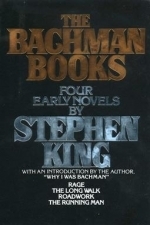
Intro, Why I was Bachman:
WARNING read this LAST! It has spoilers in it, but definitely read it after the books. Very interesting. Why would such a famous author decide to write as someone else and keep it a secret?
Rage:
The infamous story that has been pulled from shelves due to its supposed influence in the Columbine shootings... well, this was a pretty good story. Yes, there's shooting, but it's more about the lives of teenagers. This definitely did not make me want to go shoot up a school.
The Long Walk:
Can you walk at 4mph? Nonstop? For days on end? With no sleep because you are not allowed to go below 4mph? The Long Walk is about a yearly contest where 100 teenage boys VOLUNTEER to walk until there is only one left. Nonstop. If your speed drops below 4mph, you get a warning. If you can keep up the pace for 1 hour then the warning disappears. If you do not speed up after 30 secs, you get another warning. If you collect 3 warnings and slow again you are shot dead. If you are the last walker, you win whatever your heart desires. You are fed and allowed to carry what you think you will need, but you cannot stop. No one is allowed to interfere with a walker's progress, not even spectators. Of course the whole country is watching you, many from along the side of the road just waiting a chance to grab some discarded souvenir. If you have to poop? Yup that could be a souvenir too. Make it quick though so you don't rack up warnings! The guards have no mercy and will shoot you with zero emotion on their face.
This book is brutal. You ARE in the boy's shoes. Why is he there? How do they get SO MANY volunteers EVERY YEAR? So many that they turn away most? This isn't like the hunger games. The boys are not out to kill each other. The situation is just completely bizarre.
The only thing I didn't like about the book was the very end. The end wasn't an "ending" it just kind of lingers.. This wasn't enough of a problem for me to drop the rating though.
Roadwork:
I couldn't get into this one. It is about a man who is upset about needing to leave his home because of a new roadway.
The Running Man:
A slightly creepy and action-packed dystopian future story. A man signs up for a game show whose premise is all too real! Basically, he has to run for his life. Great story.
WARNING read this LAST! It has spoilers in it, but definitely read it after the books. Very interesting. Why would such a famous author decide to write as someone else and keep it a secret?
Rage:
The infamous story that has been pulled from shelves due to its supposed influence in the Columbine shootings... well, this was a pretty good story. Yes, there's shooting, but it's more about the lives of teenagers. This definitely did not make me want to go shoot up a school.
The Long Walk:
Can you walk at 4mph? Nonstop? For days on end? With no sleep because you are not allowed to go below 4mph? The Long Walk is about a yearly contest where 100 teenage boys VOLUNTEER to walk until there is only one left. Nonstop. If your speed drops below 4mph, you get a warning. If you can keep up the pace for 1 hour then the warning disappears. If you do not speed up after 30 secs, you get another warning. If you collect 3 warnings and slow again you are shot dead. If you are the last walker, you win whatever your heart desires. You are fed and allowed to carry what you think you will need, but you cannot stop. No one is allowed to interfere with a walker's progress, not even spectators. Of course the whole country is watching you, many from along the side of the road just waiting a chance to grab some discarded souvenir. If you have to poop? Yup that could be a souvenir too. Make it quick though so you don't rack up warnings! The guards have no mercy and will shoot you with zero emotion on their face.
This book is brutal. You ARE in the boy's shoes. Why is he there? How do they get SO MANY volunteers EVERY YEAR? So many that they turn away most? This isn't like the hunger games. The boys are not out to kill each other. The situation is just completely bizarre.
The only thing I didn't like about the book was the very end. The end wasn't an "ending" it just kind of lingers.. This wasn't enough of a problem for me to drop the rating though.
Roadwork:
I couldn't get into this one. It is about a man who is upset about needing to leave his home because of a new roadway.
The Running Man:
A slightly creepy and action-packed dystopian future story. A man signs up for a game show whose premise is all too real! Basically, he has to run for his life. Great story.

Acanthea Grimscythe (300 KP) rated Fungoid in Books
May 16, 2018

Actual rating: 4.5 Stars
Post-apocalyptic stories are, by far, among my favorites to read, perhaps because it's a hypothetical possibility that could still occur in our future. From zombies to biological warfare, many stories offer a new perspective on the end of the world and William Meikle's Fungoid is no different.
Fungoid takes place in Canada and encompasses a wide range of characters and their interactions with one another and other individuals after the apocalypse falls upon the world in the form of a fungal outbreak, only in this case, the fungal epidemic appears to have a mind of its own as it voraciously consumes humanity. Those who manage to survive are left to fend for themselves as they search for a way to overcome their fates when all odds are against them.
Sometimes, a wide range of characters works. Other times, it doesn't. In this case, it does, when says a lot for Meikle's talent as a writer: his characters are well-developed and each possess their own distinct personalities. None of these characters are perfect: they have their own flaws and faults, and, in the true nature of horror, they aren't all good. The portrayal of a villainous character's decline from normality to the ultimate evil is often skipped over in favor of shining the spotlight on the heroes of a story. Meikle's unfortunate villain is spared no detail, and as a reader I was glad to find myself not only bewildered and frustrated by this character, but also found myself feeling sadness and sympathy for them.
The story is extremely fast paced, leaving little room for breathing as you flip through the pages. Given that the book is actually fairly short, it serves as a perfect read for a rainy afternoon inside. There's no shortage of action which is a necessity in a world where many people simply do not have the time to divulge to reading a thick, slower paced book. Meikle's writing is filled with twists and turns, where his characters are given a plausible route of escape or survival, only to find themselves forced to overcome obstacles that threaten to end their very lives.
Fungoid is a definite, must-read for fans of the horror genre, especially if you're looking for a new way of approaching the end of the world.
I would like to thank DarkFuse, William Meikle, and NetGalley for providing me with an advanced reader's copy in exchange for an honest and unbiased review.
Post-apocalyptic stories are, by far, among my favorites to read, perhaps because it's a hypothetical possibility that could still occur in our future. From zombies to biological warfare, many stories offer a new perspective on the end of the world and William Meikle's Fungoid is no different.
Fungoid takes place in Canada and encompasses a wide range of characters and their interactions with one another and other individuals after the apocalypse falls upon the world in the form of a fungal outbreak, only in this case, the fungal epidemic appears to have a mind of its own as it voraciously consumes humanity. Those who manage to survive are left to fend for themselves as they search for a way to overcome their fates when all odds are against them.
Sometimes, a wide range of characters works. Other times, it doesn't. In this case, it does, when says a lot for Meikle's talent as a writer: his characters are well-developed and each possess their own distinct personalities. None of these characters are perfect: they have their own flaws and faults, and, in the true nature of horror, they aren't all good. The portrayal of a villainous character's decline from normality to the ultimate evil is often skipped over in favor of shining the spotlight on the heroes of a story. Meikle's unfortunate villain is spared no detail, and as a reader I was glad to find myself not only bewildered and frustrated by this character, but also found myself feeling sadness and sympathy for them.
The story is extremely fast paced, leaving little room for breathing as you flip through the pages. Given that the book is actually fairly short, it serves as a perfect read for a rainy afternoon inside. There's no shortage of action which is a necessity in a world where many people simply do not have the time to divulge to reading a thick, slower paced book. Meikle's writing is filled with twists and turns, where his characters are given a plausible route of escape or survival, only to find themselves forced to overcome obstacles that threaten to end their very lives.
Fungoid is a definite, must-read for fans of the horror genre, especially if you're looking for a new way of approaching the end of the world.
I would like to thank DarkFuse, William Meikle, and NetGalley for providing me with an advanced reader's copy in exchange for an honest and unbiased review.

Kristy H (1252 KP) rated Her Sister's Lie in Books
Mar 11, 2019
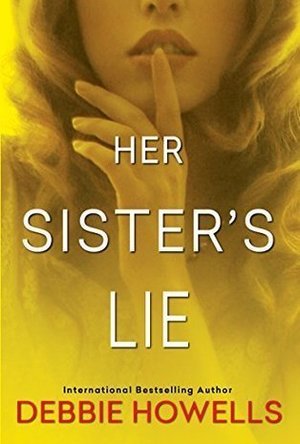
Overall, this one is a mixed bag
Hannah Roscoe hasn't seen or spoken to her sister, Nina, in ten years when she receives the call that Nina is dead. The sisters have no other family, so Hannah is now guardian to her fifteen-year-old nephew, Abe, a sullen and angry boy whom she barely knows. Abe comes to live with Hannah, and soon they learn that the police are investigating Nina's death as suspicious. Simultaneously, Hannah begins experiencing strange, unexplained events that quickly have her questioning both her safety and her sanity. Nina's death seems to be close to exposing secrets she thought were buried forever. Is Hannah safe? And her secretive past?
"I... then stopped myself, pulled by the invisible thread that runs through all of us, that however much we might want to, none of us can ever truly disown. Family."
Well, this was an interesting, albeit frustrating one. I really love Debbie Howells' work and the fascinating stories she weaves. Her characters are always complex and often flawed, and there's no exception here. Hannah is a mess, honestly, and I won't lie, she's not the easiest to like. Truly, there aren't really any likeable characters here. Hannah is an unreliable narrator, which sometimes drives me a bit insane. However, the book does a strong job of making you wonder who to trust or believe and what exactly is going on. I was confused a good portion of the time. The weird, creepy things that happen to Hannah are interesting and crazy, though they sort of stressed me out. (Maybe I get too involved?)
The novel is filled with references of Hannah and Nina sticking to the script and keeping each other's secrets. At first, it's intriguing and you're curious as to what they are hiding. After a while, when Hannah makes yet *another* reference to the script and secrets--without any details being revealed--you sort of want to scream. I get a little frustrated at the lack of any reveal throughout the entire book. Eventually, I basically guessed all the major twists anyway, though I still found them clever.
So, overall, this one is a mixed bag. Unlikable characters, some frustrating plot pieces. Some clever plot twists, though I managed to predict most of them. It's a very quick read, however. My rating may be slightly affected by my overall love of Howells. If you've never read anything by her, I would definitely head to THE BONES OF YOU first.
I received a copy of this novel from the publisher and Netgalley in return for an unbiased review (thank you!).
"I... then stopped myself, pulled by the invisible thread that runs through all of us, that however much we might want to, none of us can ever truly disown. Family."
Well, this was an interesting, albeit frustrating one. I really love Debbie Howells' work and the fascinating stories she weaves. Her characters are always complex and often flawed, and there's no exception here. Hannah is a mess, honestly, and I won't lie, she's not the easiest to like. Truly, there aren't really any likeable characters here. Hannah is an unreliable narrator, which sometimes drives me a bit insane. However, the book does a strong job of making you wonder who to trust or believe and what exactly is going on. I was confused a good portion of the time. The weird, creepy things that happen to Hannah are interesting and crazy, though they sort of stressed me out. (Maybe I get too involved?)
The novel is filled with references of Hannah and Nina sticking to the script and keeping each other's secrets. At first, it's intriguing and you're curious as to what they are hiding. After a while, when Hannah makes yet *another* reference to the script and secrets--without any details being revealed--you sort of want to scream. I get a little frustrated at the lack of any reveal throughout the entire book. Eventually, I basically guessed all the major twists anyway, though I still found them clever.
So, overall, this one is a mixed bag. Unlikable characters, some frustrating plot pieces. Some clever plot twists, though I managed to predict most of them. It's a very quick read, however. My rating may be slightly affected by my overall love of Howells. If you've never read anything by her, I would definitely head to THE BONES OF YOU first.
I received a copy of this novel from the publisher and Netgalley in return for an unbiased review (thank you!).

Dana (24 KP) rated The Winner's Kiss in Books
Mar 23, 2018
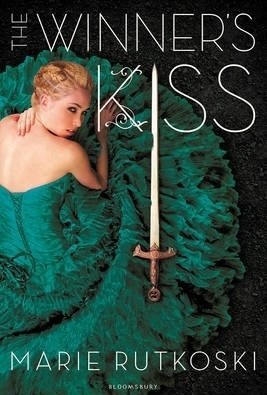
So my rating for this is actually a 3.5 stars instead of a 4 stars, but I rounded up. Oh and there will be spoilers in this review, so you have been warned.
This was an okay ending for the series-it wasn't bad but it wasn't bad either.
The characters got whiny and I only understood some of their motivations for what they did. Kestrel and Arin were very angsty throughout the series, and they did not disappoint in this book either.
I understand Kestrel had to forget herself in the work camp to be able to survive the camp and to become a better person afterwards, but to me, it was kinda pointless. Yes, she gets to start a new relationship with Arin and everyone else, but it seemed like a cover for the story to be able to go on without as many hitches. She was still able to retain some of herself, but most of her memories were gone? That just didn't make much sense to me. With that, how would she remember how to play the games so well if her mind was gone? I'm pretty sure that war strategy doesn't stay with you longer than your core memories, but hey, that's just my opinion. Another convenient thing that came with Kestrel's memory loss was that some of the previous novels' subplots were not touched on because she couldn't remember them. Again, not really my favorite thing in the world when it comes to writing.
Because of these couple of things, I did see quite a few plot holes that were too big for me not to notice.
I liked Arin the tiger. I want a tiger friend because that would be awesome.
I also really liked the clever way Kestrel took down the emperor. That was a brilliant move and I was actually really worried for her when I was reading that part of the book.
Overall, it was paced quite well, it was a very quick read, but there were plot and characterization problems that kept me from absolutely loving it. I am glad that I finished reading this series and that I waited to be able to binge read them all in one summer, but it was also kind of a let down from what I had expected.
If you like books with interesting concepts, lands, and politics, definitely pick this series up because, like I said before, I didn't dislike it! Not by a long shot!
This was an okay ending for the series-it wasn't bad but it wasn't bad either.
The characters got whiny and I only understood some of their motivations for what they did. Kestrel and Arin were very angsty throughout the series, and they did not disappoint in this book either.
I understand Kestrel had to forget herself in the work camp to be able to survive the camp and to become a better person afterwards, but to me, it was kinda pointless. Yes, she gets to start a new relationship with Arin and everyone else, but it seemed like a cover for the story to be able to go on without as many hitches. She was still able to retain some of herself, but most of her memories were gone? That just didn't make much sense to me. With that, how would she remember how to play the games so well if her mind was gone? I'm pretty sure that war strategy doesn't stay with you longer than your core memories, but hey, that's just my opinion. Another convenient thing that came with Kestrel's memory loss was that some of the previous novels' subplots were not touched on because she couldn't remember them. Again, not really my favorite thing in the world when it comes to writing.
Because of these couple of things, I did see quite a few plot holes that were too big for me not to notice.
I liked Arin the tiger. I want a tiger friend because that would be awesome.
I also really liked the clever way Kestrel took down the emperor. That was a brilliant move and I was actually really worried for her when I was reading that part of the book.
Overall, it was paced quite well, it was a very quick read, but there were plot and characterization problems that kept me from absolutely loving it. I am glad that I finished reading this series and that I waited to be able to binge read them all in one summer, but it was also kind of a let down from what I had expected.
If you like books with interesting concepts, lands, and politics, definitely pick this series up because, like I said before, I didn't dislike it! Not by a long shot!