Search

Hadley (567 KP) rated In Cold Blood: A True Account of a Multiple Murder and Its Consequences in Books
Aug 2, 2020



The writing (1 more)
The flow
In the 'Introduction' of Capote's true crime novel In Cold Blood, American writer Bob Colacello states: "Capote was one of the first who dared to elevate journalism to the level of art. In Cold Blood is a work of great discipline and even greater restraint, a tale of fate, as spare and elegiac as a Greek tragedy, as rich in its breadth and depth as the classic French novels of Stendhal and Flaubert. 'We all have our souls and we all have facades,' Truman Capote told his friend Kay Meehan a year or so before he came upon the news that would inspire his masterpiece, 'and then there's something in between that makes us function as people. That's what I have the ability to communicate.' "
The novel, which was published in 1965, is an eyewitness account of Capote's visitation to the scene of the murder as well as meetings with the murderers and townspeople- - - a retelling of the crime and aftermath, mostly from the eyes of those affected, by hundreds of hours of interviews and interrogations. The novel, ultimately, was the end of Capote which led him to alcoholism that took his life in 1984.
Like most small-town murders, a tension between residences is created when a well-known and well-liked family of four is brutally murdered, and everyone begins to point a finger at the other: "But afterward the townspeople, theretofore sufficiently unfearful of each other to seldom trouble to lock their doors, found fantasy re-creating them over and again - - - those somber explosions that stimulated fires of mistrust in the glare of which many old neighbors viewed each other strangely, and as strangers." Fortunately, the KBI (Kansas Bureau of Investigation) didn't allow these accusations to keep them from finding the real killers.
" 'Deep down,' Perry continued, 'way, way rock bottom, I never thought I could do it. A thing like that.' " Perry Smith, one of the murderers, confesses to his cohort and partner-in-crime, Richard Hickock, about murdering the Clutter family. "Presently, he said, 'Know what it is that really bugs me? About that other thing[Clutter murder]? It's just I don't believe it- - - that anyone can get away with a thing like that.' And he suspected that Dick [Richard] didn't, either. For Dick was at least partly inhabited by Perry's mystical-moral apprehensions. Thus: 'Now, just shut up!' "
Capote writes clearly of the impact that Smith's and Hickock's past may have played leading up to the murders, mostly focusing on Smith's traumatic childhood. During the trial portion of the book, a psychologist is brought in to point out how the two murderers may not have been responsible for their actions due-to instances in their past - - - a horrific car crash in Hickock's that left him with a lop-sided face and black-out spells, as well as Smith being physically and emotional abused by his alcoholic mother and father. In exploring these traumas, In Cold Blood leaves the impression that these two men were merely ticking time bombs and that the Clutter family, unfortunately, had to pay for it.
The trauma shared by Hickock and Smith help to shape the two murderers into actual human beings rather than monsters throughout the novel: one scene, where we get to read a letter to Smith from his last living sister, readers get to see how he was perceived by his family members, as his sister goes on to degrade him to the maturity level of a child and that she is above him because of that- - -but she also reveals her jealousy of their father loving him more than he ever loved her (despite the excessive abuse). A close friend of Smith's tells him to be careful writing her anymore because he believes that: 'they can only serve to increase your already dangerous anti-social instincts.'
Part of the narrative, too, is the KBI agent in-charge of the Clutter murder, Alvin Dewey: One day while visiting Holcomb's well-known cafe (Hartman's) where Dewey is told he looks awful from weight loss and fatigue - - - Dewey recalls that he had spent: 'two wearying and wasted days trying to trace that phantom pair, the Mexicans sworn by Paul Helm to have visited Mr. Clutter on the eve of the murders.' And then he gets heckled by a local, who wants to know why he hasn't found the people responsible yet,but Dewey simply smiles and walks away, having put up with numerous people being angry that the murders were taking so long to solve.
But it wasn't footwork that got the pair arrested, it was an old cellmate who had given Hickock the idea that there was $10,000 in a safe at the Clutter farm that came forward: (read this on my blog because I had to cut it out since my review was too long!).
Meanwhile, readers also get to experience Hickock and Smith's troubles as they are on the run after the murders which is done masterfully by Capote. And although one would assume that the killers would stay as far away from Kansas as possible, the two end up back there, only to miraculously get out before the police can catch up with them. The pair decide to head to Florida, where, on December 19, 1959, an entire family was murdered in the exact same way as the Clutters; Hickock and Smith both adamantly denied that they were involved with it - - - and back in 2012- - - Hickock and Smith's bodies were exhumed to compare their DNA with a profile found on one of the victim's clothing: they were not a match. The case remains unsolved til this day.
" Presently he[Smith] came across an inner-page story that won his entire attention. It concerned murder, the slaying of a Florida family, a Mr. and Mrs. Clifford Walker, their four-year-old son, and their two-year-old daughter. Each of the victims, though not bound or gagged, had been shot through the head with a .22 weapon. The crime, clueless and apparently motiveless, had taken place Saturday night, December 19, at the Walker home, on a cattle-raising ranch not far from Tallahassee."
Not soon after the pair leave the Florida beaches, they are arrested on what they believe to be parole violations, but it's clear, when the arresting officers are KBI agents that they had been caught for the Clutter murders. " 'Listen good, Perry. Because Mr. Duntz[KBI agent] is going to tell you where you really were...' Midway in the questioning, after he'd[Smith] begun to notice the number of allusions to a particular November weekend, he'd nerved himself for what he knew was coming, yet when it did, when the big cowboy with the sleepy voice said, 'You were killing the Clutter family' - - - well, he'd damn near died. That's all. "
The confession that follows is the most intense part of the book, given in it's entirety, readers finally get to know what happened to the Clutter family that cold night in November, 1959. Smith reveals that he never had the intention to kill anyone in the home, and that when the safe hadn't been found, he had fully intended to leave, even without Hickock, but what kept him there was Hickock threatening to rape Nancy Clutter. Smith states that he hates people who can't control themselves sexually, and that he didn't allow his partner to touch her at all. He also reveals that he thought about killing Hickock afterwards,stating: " no witnesses."
Capote didn't write 'In Cold Blood' until after Hickock and Smith were executed. The amount of interviews, court room appearances, and even witnessing the executions of both murderers shines through in this novel. But the book has also brought about doubters; a handful of people have since come forward to state that Capote's masterpiece is either 'not the full story' or 'completely wrong.' Just as recent as 2017, a man came forward with a 'manuscript' of a book that Hickock was writing, that contained a different confession on how and why the murders took place- - - Hickock states in this unpublished manuscript that a man by the name 'Roberts' had hired him and Smith to kill the Clutters.
Whether or not you believe that Capote wrote the whole truth or some of the truth, this novel is flawless and beautiful. The writing is poetic and the flow of the story keeps moving, page after page, never stopping long enough to bore the reader. I highly recommend this book as a MUST READ for anyone who loves the True Crime genre.

Purple Phoenix Games (2266 KP) rated Destinies in Tabletop Games
Jan 29, 2022
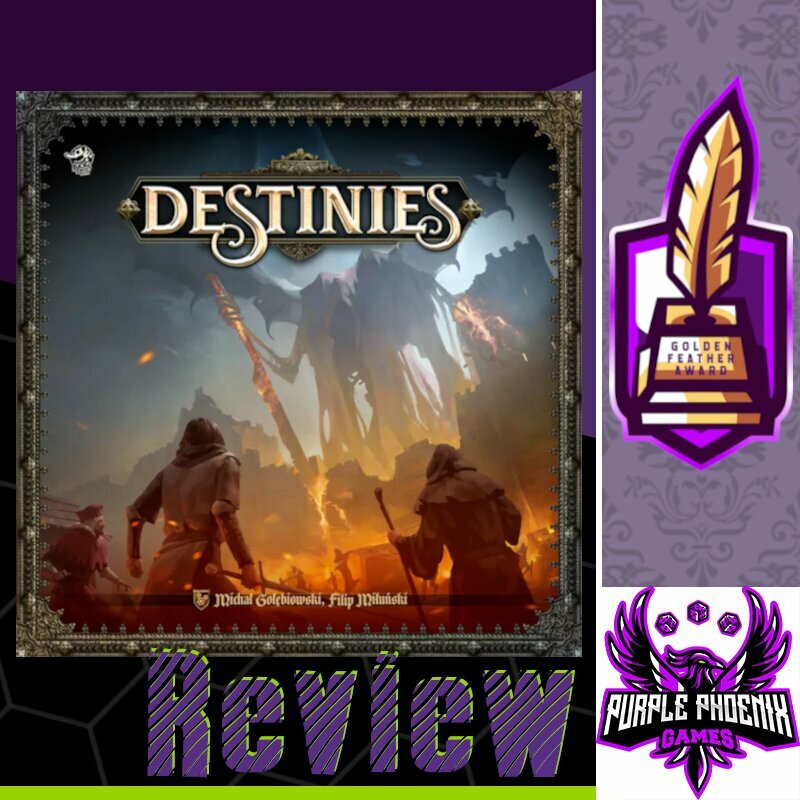
I can recall so many instances of my board game purchases being based on either the designer, artist, or publisher. Surely I am not alone here. Josh will probably always be a Stonemaier Games fanboy. Laura has aligned herself with Daily Magic Games and Button Shy Games. While I am a big fan of the Valeriaverse, I think my current preferences put me on teams Weird Giraffe Games, Blue Orange Games, and Lucky Duck Games. Speaking of the latter, LDG have come through with some seriously excellent hybrid app-driven games that just wow me every single time. I was definitely a hybrid game naysayer when the first Chronicles of Crime came out, but the more I play them, the more I appreciate the accomplishments. Destinies has now come along to me and it has been some time since I have been this jazzed to play a game over and over and over and over.
Destinies is a hybrid app-driven adventure board game for one to three players. In it, players will be choosing their characters and how to play them, along with the path of their individual destinies across several campaign scenarios. When playing multiplayer, the player who completes their destiny first will win. When playing solo (which is also amazing), the player wins when they successfully complete their destiny.
DISCLAIMER: We are using the Kickstarter version of the game. We do have the expansions from the KS campaign, but will not be using those for this review. Also, we do not intend to cover every single rule included in the rule book, but will describe the overall game flow and major rule set so that our readers may get a sense of how the game plays. For more in depth rules, you may purchase a copy from the publisher directly or from your FLGS. -T
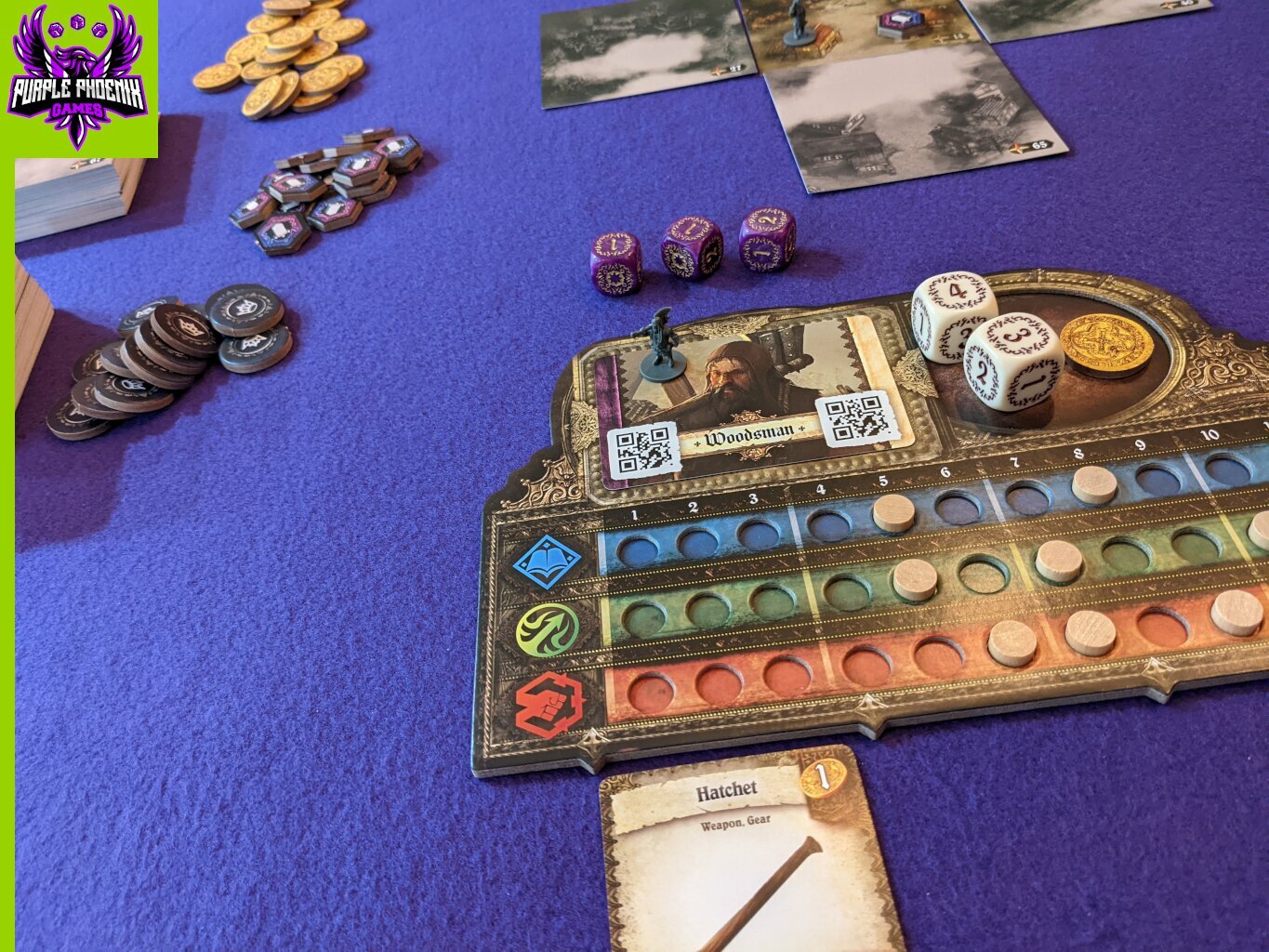
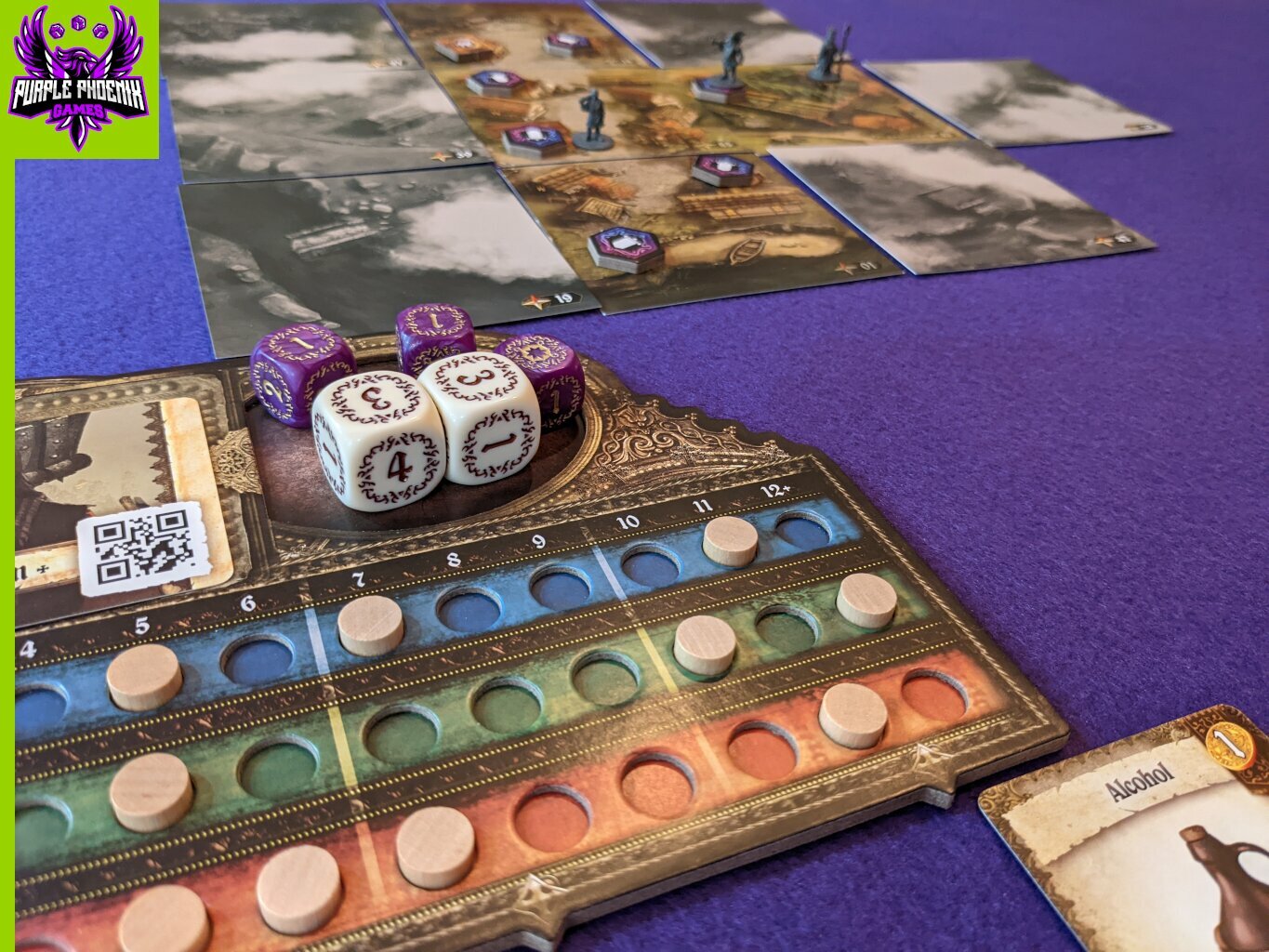
Usually I list out the steps to setup a game in this section, but there are so many little items and steps to be taken that I will simply show you, the reader, how a scenario may look once setup. The app will instruct players how to create their character’s stats and which map tiles should be placed out initially. Typically, though, each player will receive a player board, Destiny card (with their character headshot on one side and their Destiny choices on back), two main dice, three effort dice, and one gold coin. Once setup, the app will drive the story along and the players will be rolling dice and making choices in order to win the game or scenario.
Each player will be given their Destiny card with two distinct Destiny paths on the backside. These paths correlate with the current scenario, and the player will be able to choose one of the two given paths to help move their games forward. However, sometimes players will switch their Destiny mid-game due to several factors including successes on previous tasks or current inventory. The only way to win the game is to complete a Destiny, so staying on track is paramount in this open sandbox game – it is incredibly easy to become sidetracked and lose sight of specific tasks to be performed.
Each turn a player may move to a new tile, to previously-explored tiles, or points of interest on specific map tiles. These points of interest could be unique characters to be visited, or more general spaces on the tile represented by tokens. Sometimes visiting a POI (point of interest) will have the player rolling dice to complete tests, initiating trade with the POI NPC, revealing information about their distinct Destiny, or even issuing side quests. Players take their chances by visiting a POI because only one may be visited on a turn. Once a player has moved and visited a POI, their turn is over and the next player’s turn begins.
The most interesting aspect of this game is the experience tracker and results of tests. Player stats are divided between Intelligence, Dexterity, and Power (Strength for my D&D readers). These stats are constantly in flux due to tests and experience, and levels range from 1-12+ on the player board. A player will roll both main dice and any effort dice they wish on each test, and the total result is compared to the discs present on the main player board. One success is counted for each disc’s value equal to or below the rolled result. For example, if the roll is a 6, and the player has a disc on 3 and another on 6 the player counts two successes. Effort dice add values to the rolled result, and one side of these dice depict a star, which counts as one success. Throughout the game players will be moving their skill marker tokens (discs) up and down the tracks. Sometimes this is due to a test being failed or succeeded, but sometimes experience tokens are earned. A player may improve their skill levels by two total values on the tracks for each experience token discarded. Players may choose which tracks, and may maximize their character’s skill or spread out the experience across multiple skills.
Play continues in this fashion of referencing the app for story and plot items, players working toward completing their Destinies, and adventuring across the land rolling tests and improving skills until one player finishes their Destiny and wins the game!
Components. As always, I am going to be honest here by stating I believe that Destinies packs the box with the best components I have seen in a game. The multi-layered insert is perfectly formed and well-thought out, all the cardboard tokens are super-thick, the dice are so fun to handle and roll, the cards and other components feature incredible artwork, and did I mention there’s about a thousand minis in this game? I am reluctant to even call some of these things minis as they are large and in charge for SURE. I have zero complaints or comments on the components present in Destinies. Lucky Duck knocks it out of the park once again. Incredible.
I actually backed this one on Kickstarter just because it comes from Lucky Duck Games. I had played Chronicles of Crime and loved it, and just wanted to try something different but using a similar system. Typically I don’t keep up with the comments and updates to a game I have backed because I enjoy being surprised by the product that arrives at my door. Destinies was certainly a surprise to me, and I have been kicking myself in the butt for not getting it to the table the very first day I received it.
Destinies is my favorite Lucky Duck Games title, and that is saying a ton, as I rave about every game of theirs I have played. I hope you all back me up here, and if you haven’t yet tried this one, I hope you visit your closest friend or board game cafe that owns it. The tutorial scenario is great, and the campaign scenarios have been awesome so far. Okay, yes, when I first played it with Laura, my wife made several comments about it being a 3 hour game, but once that first one is completed, the subsequent plays run much smoother.
What I love so much about this is how indefinitely expandable it is. Most of the components are multi-use (akin to all the character cards in the Chronicles of Crime games), and can be used in campaign after campaign. The drawbacks I see for this, though, is any sort of waning interest in it forcing designers to abandon plans to create more scenarios. Could a new scenario pack be an acceptable expansion versus a large expansion box with oodles of new components and minis? I think so, but I am no designer. Could the Millennium Series treatment be given to Destinies? Absolutely! This system does not need to be played in a medieval fantasy world. It could be molded to almost anything, and that gives me excited shivers over the future of this game.
If you are anything like me and have now embraced the hybrid gaming trend, I highly recommend Destinies. I plan to also review all the expansions in the near future, so do look out for those, but please do yourself a giant favor and pick up Destinies. The excellent storytelling, great components, and just amazing fun helps Purple Phoenix Games give this one a perfectly deserved 12 / 12, and a Golden Feather Award! I can’t stop thinking about it and how I would play it differently next time, and hopefully after I have played through the expansion material I will be able to restart from the very beginning with different characters and choices. It’s a sign of a great game when I can’t stop thinking about it, and I do believe Destinies currently is knocking at the door of my Top 10 Games of All Time. No, it’s there. It’s totally there. TOP 10 BABY!!