
Search
Search results


Purple Phoenix Games (2266 KP) rated Breakdancing Meeples in Tabletop Games
Oct 18, 2021
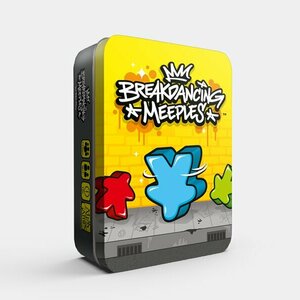

I think that I’ve mentioned in some of my previous reviews that I rarely buy games without first having played and/or researched them beforehand. Enter Breakdancing Meeples. One fine day, I was perusing the fine stock at my FLGS. While I was wandering and debating whether I should buy Reef or 7 Wonders Duel, my gaze fell upon a small tin with some funny artwork – a game titled Breakdancing Meeples. It was a small and fairly inexpensive game, so I figured, why not? I picked it up (along with 7 Wonders Duel this time) and brought it home to my collection. Was my faith misplaced, or does the game deliver on its first impression of simple fun? Keep reading to find out.
Breakdancing Meeples is a real-time game in which players are trying to amass the most Crowd Appeal (VP) by directing their dance crews to perform the baddest and most impressive dance routines of all time. To setup the game, give each player 6 Meeples, 6 cubes, and their starting Routine cards in their chosen color. Shuffle the remaining Routine cards to form a draw pile, open up the Breakdancing Meeples app (or just get a one-minute timer ready) and the dance battle is set to begin!
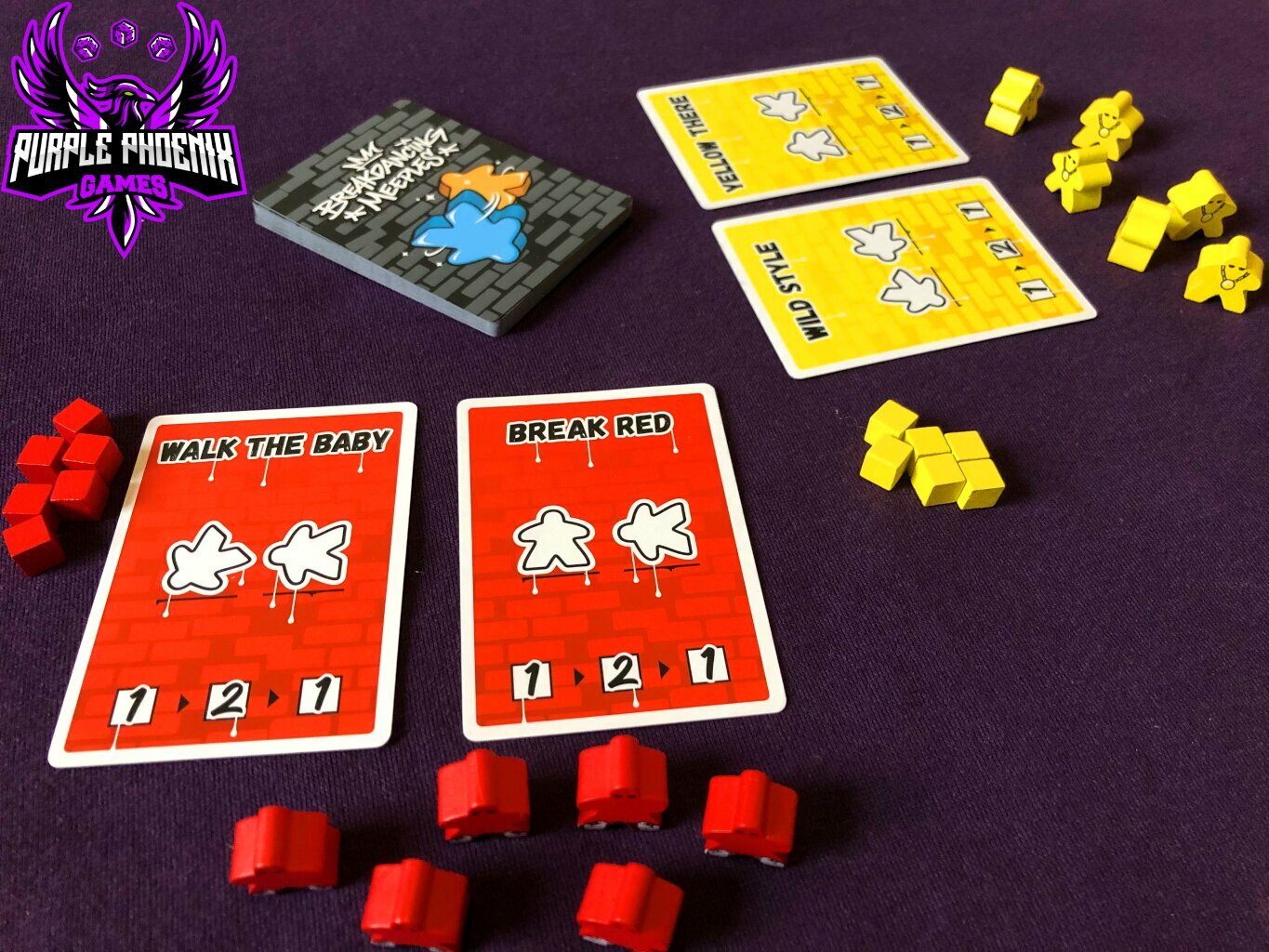
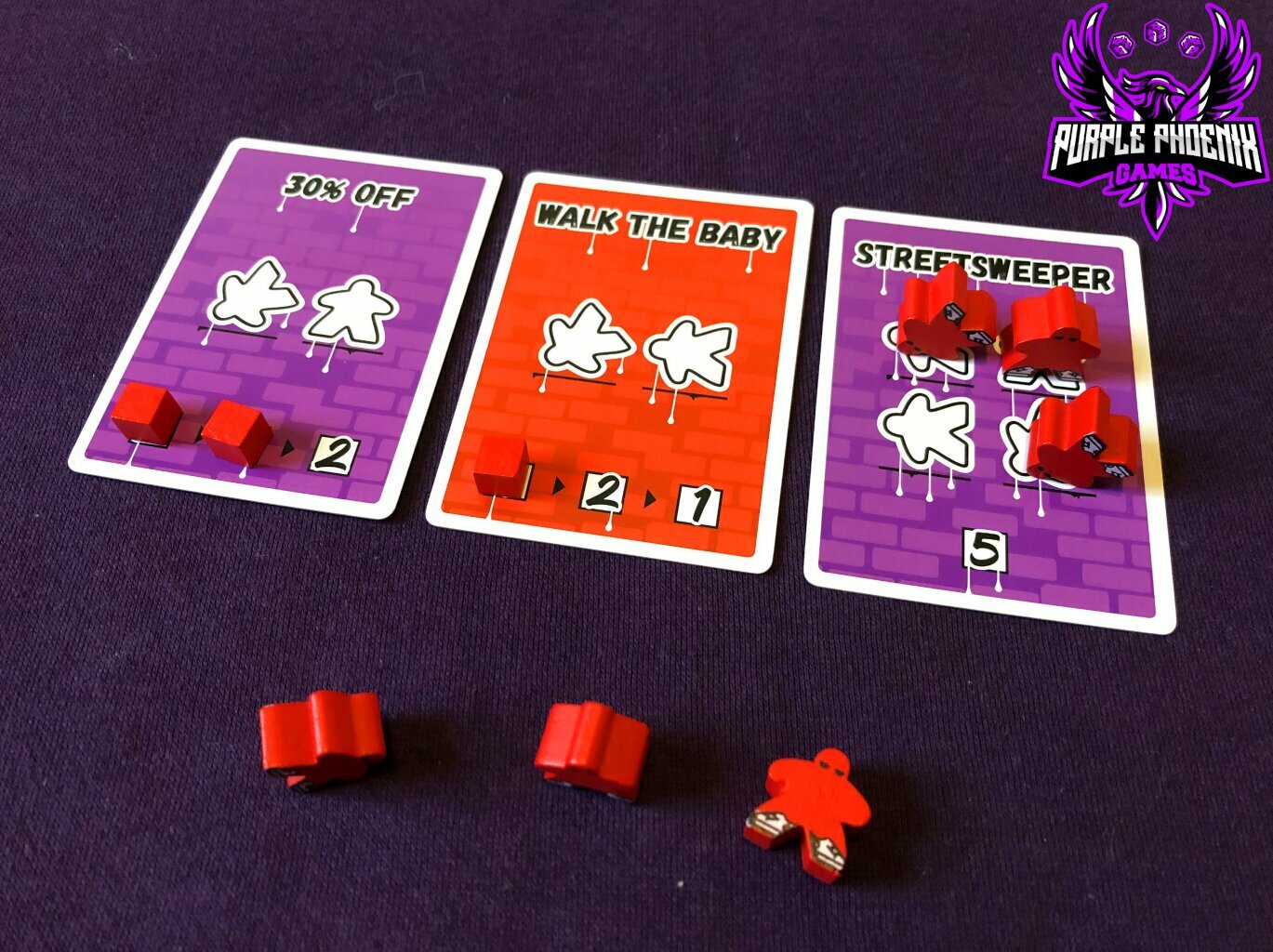
Each round is broken into two phases – Dance Off, and Remix. In the Dance Off, players will have one minute to roll their Meeples (yes, you read that correctly – rolling Meeples) to complete as their crew’s Routines as many times as they can to earn Crowd Appeal. When rolling Meeples, there are 4 stances in which the Meeples can land: Feet, Side, Head, or Back. These positions correspond to stances on your Routine cards. If you roll a Meeple in a stance that matches one on your card, you may place that Meeple on that card, moving you closer to completing that Routine. Once all stances have been filled on a Routine, you earn a Crowd Appeal cube, placing it on the leftmost available square at the bottom of that Routine card. You may then pick up all the Meeples from that card, and they are back in play. It is important to note that once a Meeple has been placed on a Routine, it may not be removed until the Routine is finished! If you are unable, or unwilling, to place a Meeple on a Routine card, you may reroll any unused Meeples. Continue rolling and placing your Meeples in this fashion until the one-minute timer runs out. When time has been called, all players will count up their Crowd Appeal – the points listed at the bottom of their Routine cards that are covered by cubes, signifying a successful rep of that Routine. The Dance Off phase is now over.
Now comes the Remix phase. Reveal as many face-up cards from the Draw deck as there are players plus one. Beginning with the player who has the lowest Crowd Appeal, players will take turns selecting a new Routine card to add to their repertoire for the next round. Players may only ever have 3 Routine cards, so in future rounds, players can choose to discard from their play area in favor of a new card. A new round now begins with another Dance Off, and continues as above until the fourth Dance Off has been completed. Players then tally their total Crowd Appeal, and the player with the highest score is the winner! Dare I say, the Dancing Queen? No? Ok…
With a fun theme and simple gameplay, does Breakdancing Meeples hold up? I would have to say yes. First let’s talk about the simplicity of gameplay. All you have to do is roll Meeples and match stances to cards. It may not sound exciting when stated that way, but add in the one-minute timer and suddenly you’ve got a more engaging and action-based game. Throw the Meeples into the mix (literally, in this game) and their disproportionate limbs and unique silhouettes provide an extra challenge in getting them to roll and land exactly as you want them to.
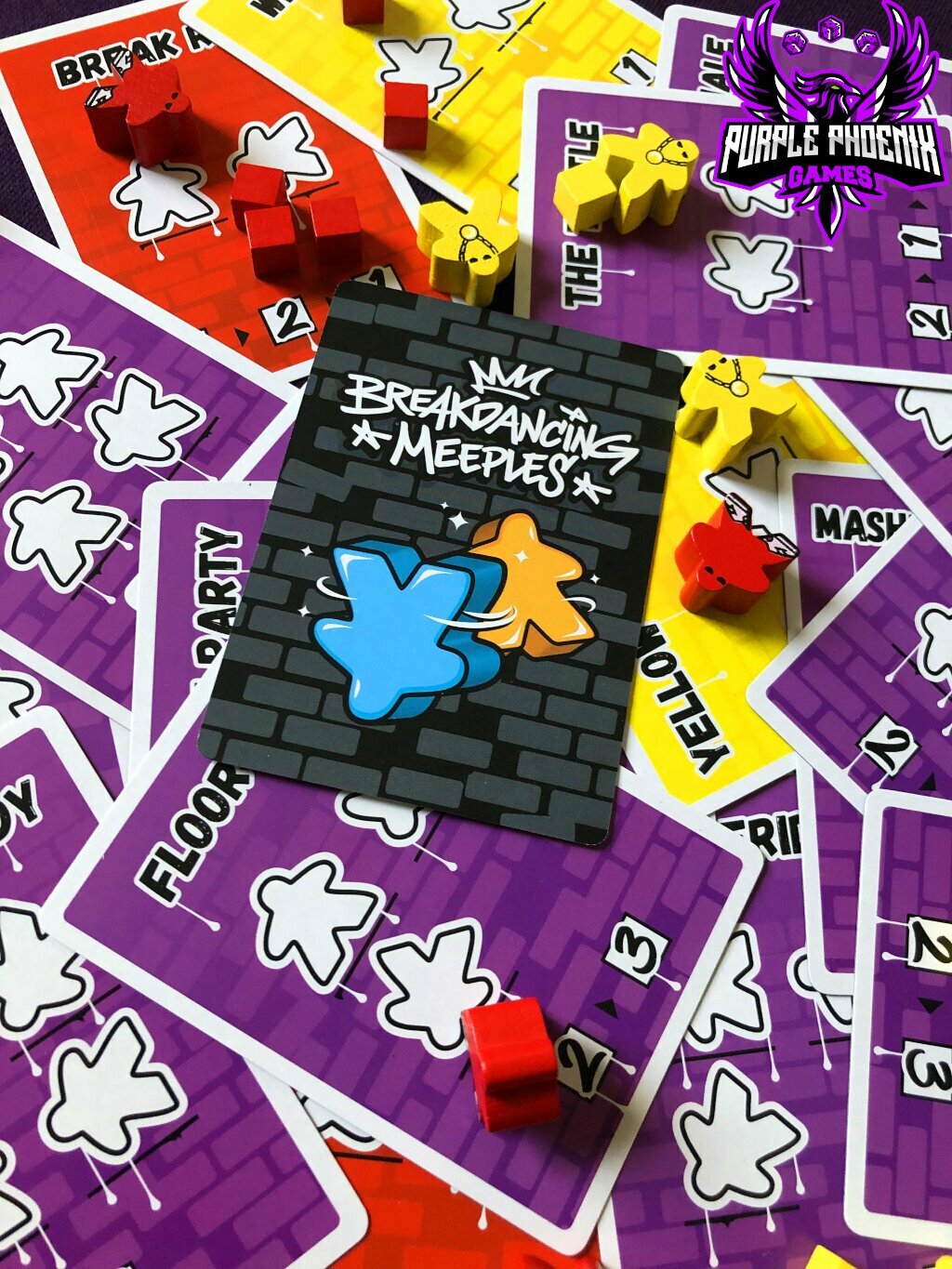
Another neat element of this game is the addition of Rally and Special cards to the Draw deck. Rally cards are purchased (with Crowd Appeal) in the Remix phase, and are then attached to one of your existing Routines. In the next Dance Off, when rolling your Meeples, Rally cards can provide extra Crowd Appeal points once their conditions have been met. These cards may cost some end-game points, but they could earn you much more if the conditions are right. It’s a risk, and adds some suspense to the gameplay. Special cards grant the player a ‘wild’ dancer. If you roll 2 Meeples in the same stance, you may exchange them to a single dancer in your chosen stance. Rally and Special cards can be removed from the game for a more simple gameplay, if playing with younger players for example, but add in an extra twist to the chaos of the real-time limitations.
Is Breakdancing Meeples my favorite game? Nope. But it’s a cute, fun, and fast little game that I can see myself pulling out often as a filler, or even a game to introduce newer gamers to the hobby. It is lighthearted in nature, with a unique theme, and it just is fun to play. I am glad that I bought this game on a whim, and I definitely will be keeping it in my collection. With that said, Purple Phoenix Games gives it a hoppin’ 7 / 12. Check it out, you might be surprised!
Breakdancing Meeples is a real-time game in which players are trying to amass the most Crowd Appeal (VP) by directing their dance crews to perform the baddest and most impressive dance routines of all time. To setup the game, give each player 6 Meeples, 6 cubes, and their starting Routine cards in their chosen color. Shuffle the remaining Routine cards to form a draw pile, open up the Breakdancing Meeples app (or just get a one-minute timer ready) and the dance battle is set to begin!
Each round is broken into two phases – Dance Off, and Remix. In the Dance Off, players will have one minute to roll their Meeples (yes, you read that correctly – rolling Meeples) to complete as their crew’s Routines as many times as they can to earn Crowd Appeal. When rolling Meeples, there are 4 stances in which the Meeples can land: Feet, Side, Head, or Back. These positions correspond to stances on your Routine cards. If you roll a Meeple in a stance that matches one on your card, you may place that Meeple on that card, moving you closer to completing that Routine. Once all stances have been filled on a Routine, you earn a Crowd Appeal cube, placing it on the leftmost available square at the bottom of that Routine card. You may then pick up all the Meeples from that card, and they are back in play. It is important to note that once a Meeple has been placed on a Routine, it may not be removed until the Routine is finished! If you are unable, or unwilling, to place a Meeple on a Routine card, you may reroll any unused Meeples. Continue rolling and placing your Meeples in this fashion until the one-minute timer runs out. When time has been called, all players will count up their Crowd Appeal – the points listed at the bottom of their Routine cards that are covered by cubes, signifying a successful rep of that Routine. The Dance Off phase is now over.
Now comes the Remix phase. Reveal as many face-up cards from the Draw deck as there are players plus one. Beginning with the player who has the lowest Crowd Appeal, players will take turns selecting a new Routine card to add to their repertoire for the next round. Players may only ever have 3 Routine cards, so in future rounds, players can choose to discard from their play area in favor of a new card. A new round now begins with another Dance Off, and continues as above until the fourth Dance Off has been completed. Players then tally their total Crowd Appeal, and the player with the highest score is the winner! Dare I say, the Dancing Queen? No? Ok…
With a fun theme and simple gameplay, does Breakdancing Meeples hold up? I would have to say yes. First let’s talk about the simplicity of gameplay. All you have to do is roll Meeples and match stances to cards. It may not sound exciting when stated that way, but add in the one-minute timer and suddenly you’ve got a more engaging and action-based game. Throw the Meeples into the mix (literally, in this game) and their disproportionate limbs and unique silhouettes provide an extra challenge in getting them to roll and land exactly as you want them to.
Another neat element of this game is the addition of Rally and Special cards to the Draw deck. Rally cards are purchased (with Crowd Appeal) in the Remix phase, and are then attached to one of your existing Routines. In the next Dance Off, when rolling your Meeples, Rally cards can provide extra Crowd Appeal points once their conditions have been met. These cards may cost some end-game points, but they could earn you much more if the conditions are right. It’s a risk, and adds some suspense to the gameplay. Special cards grant the player a ‘wild’ dancer. If you roll 2 Meeples in the same stance, you may exchange them to a single dancer in your chosen stance. Rally and Special cards can be removed from the game for a more simple gameplay, if playing with younger players for example, but add in an extra twist to the chaos of the real-time limitations.
Is Breakdancing Meeples my favorite game? Nope. But it’s a cute, fun, and fast little game that I can see myself pulling out often as a filler, or even a game to introduce newer gamers to the hobby. It is lighthearted in nature, with a unique theme, and it just is fun to play. I am glad that I bought this game on a whim, and I definitely will be keeping it in my collection. With that said, Purple Phoenix Games gives it a hoppin’ 7 / 12. Check it out, you might be surprised!
Purple Phoenix Games (2266 KP) rated Cosmic Run: Express in Tabletop Games
Oct 27, 2021


Components are obviously an integral part of games. Some games are beasts when it comes to components – boasting large numbers of included components to bolster the gameplay. And then you have games that have mastered the art of gameplay utilizing a minimal number of components. Cosmic Run: Express is one of these games, consisting of only 25 cards. But does the gameplay hold up for such a physically small game? Read on to find out!
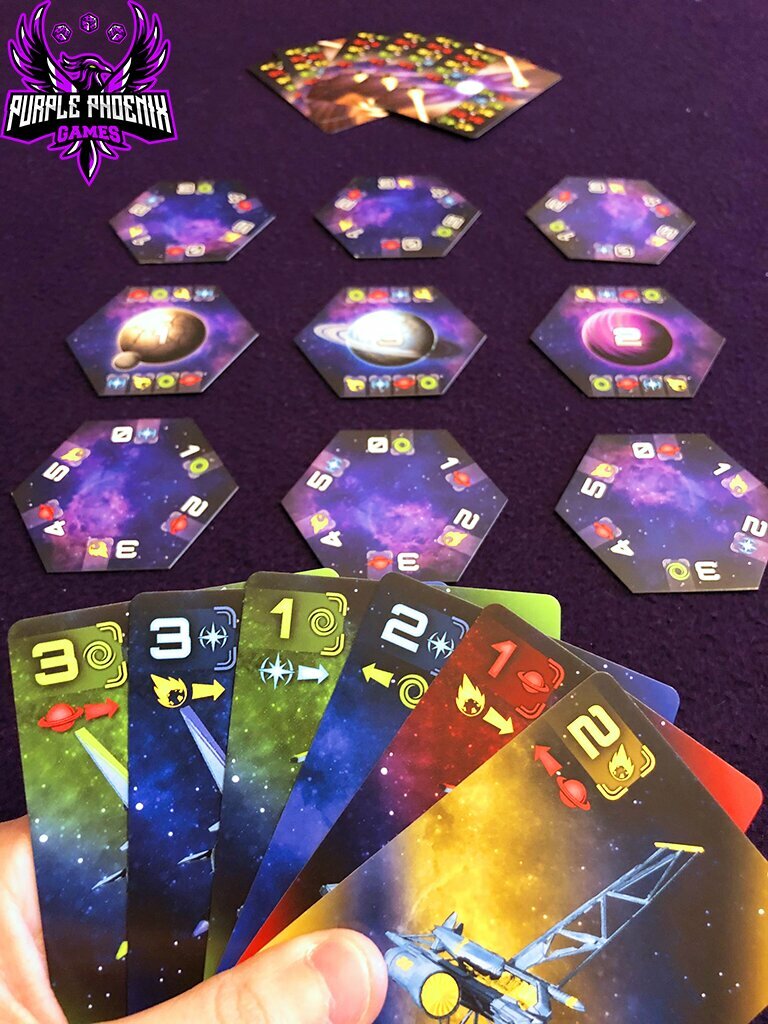
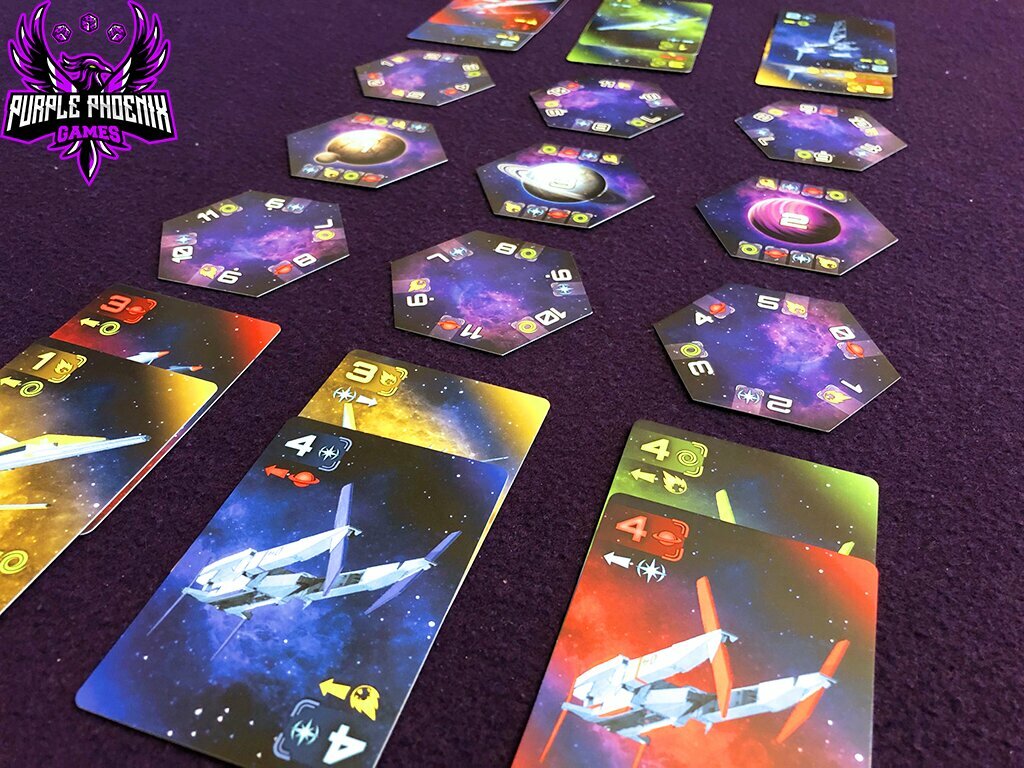
The latest game in Dr. Finn’s Cosmic Run universe, Cosmic Run: Express pits two players against each other, racing to be the first to reach 3 new planets. It is a game of area influence and simultaneous action selection played over a series of rounds in which players are playing cards to the 3 planets to advance their movement trackers the necessary 12 points to reach the planets. To setup the game, place the 3 planet cards in numerical order between the two players. Each player takes a set of 3 movement trackers in their chosen color and places one on their side of each planet card. All of the movement trackers are set to 0 for the start of the game. Players are dealt 6 ship cards, and the game is ready to play!
To begin a round, players look at their hand of 6 cards and choose 2 to pass to their opponent. Taking the new cards into your hand, you can decide to discard 1 card and draw a new card. This is not required, but can be performed by each player in each round. Next, players will simultaneously choose a card from their hand to be played face-up next to any planet, beneath their corresponding movement tracker. You can only play a maximum of 2 cards per planet.. If the color of the card you play at a planet matches the color at the top of your movement tracker, you may immediately move your tracker up by 1. Play continues, simultaneously playing cards, until all 6 cards in hand have been played and each movement tracker has 2 cards next to it.
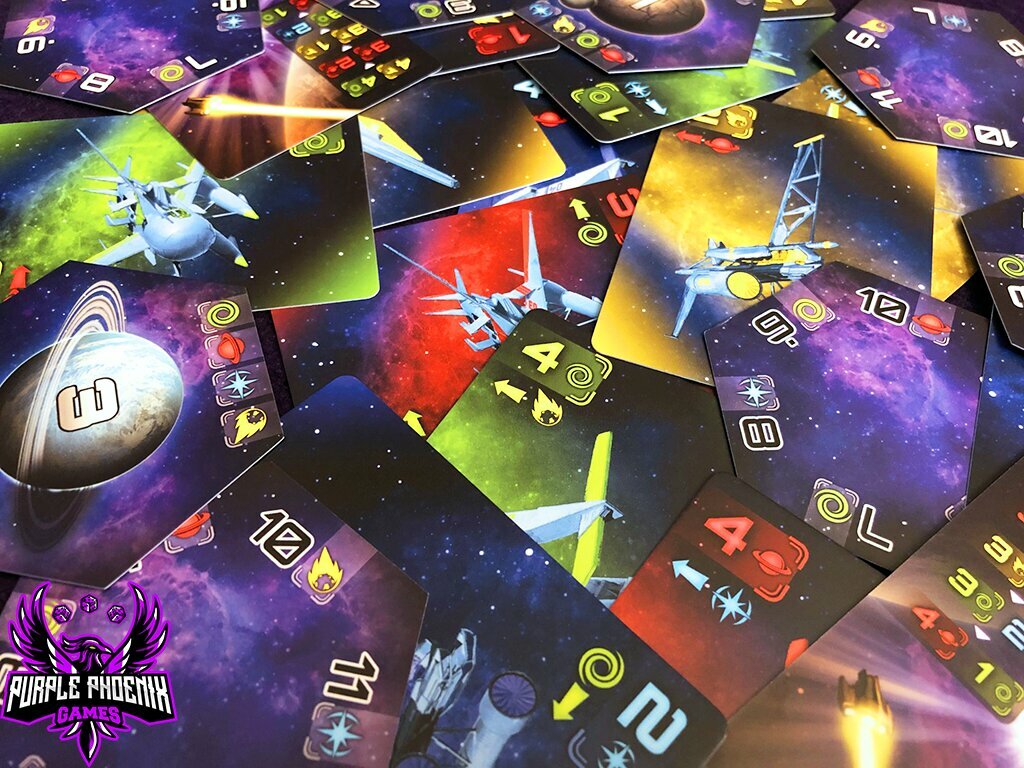
Now we move to the scoring/movement phase. Starting with Planet 1, compare the 2-card hands and determine which player played the best hand. The hierarchy for determining best hand is described in the rules, and that player earns 2 movement points for that planet, and adjusts their tracker accordingly. After scoring best hand, players score arrows. Underneath the number on each card is an arrow pointing either left or right, with a corresponding color. Beginning with the player who did not win best hand, look at the arrows on their 2-card hand, and score movement points if the arrows match any cards in their adjacent planets. Repeat these scoring steps for Planets 2 and 3. If, by the end of scoring, a player has earned 12 movement points and reached all 3 planets, that player is the winner! If not all 3 planets have been reached, collect all the cards, shuffle them, deal 6 to each player, and begin a new round. Rounds continue until one player has reached all 3 planets.
As a fan of the Cosmic Run universe, I was excited when I saw Cosmic Run: Express on Kickstarter. It seemed light, simple, and in the same universe as other games I loved, so I decided to back it. How does it fare? I think it’s great! For starters, I really appreciate that it is a small, portable game that can be played virtually anywhere. Lots of games these days are real table-hogs, and I enjoy the minimalistic approach of this game. Getting into the gameplay – it requires way more strategy than you initially think. There are 3 different ways in which you can score movement points (color matching, best hand, and arrow scoring) and you need to utilize all 3 for success. You are constantly evaluating your hand of cards and trying to determine which placements will yield the most points for you. Maybe you don’t have a color match, but the arrow on that card could make up for that and earn you up to 2 movement points. Another neat strategic point is that you have to pay attention to your opponent as well. The best hand points are a direct head-to-head between players, so not only do you have to maximize your own strategic points with card placement, you have to watch your opponent’s card placements and see if you can get a better hand than they do for a given planet. You are constantly engaged in this game, and that’s what I love about it.
Another great thing about Cosmic Run: Express is that it plays so quickly and effortlessly. Yes, at first there’s a tiny bit of a learning curve to remember the hierarchy for best hand, but after a couple of rounds the game flow is streamlined. It only takes 10-15 minutes to play, so it is easy to play “just one more” when you’re done. It’s light and fast enough to be a great filler between games, but it is also strategic enough to hold its own in a full game night.
So overall, how do we feel about this game? For being a nice and small 2-player game, it packs quite a punch! I was very pleasantly surprised by the amount of engagement and strategy in this game, and it is definitely one that I want to play multiple times in a row. So mission accomplished, Dr. Finn – in this case, less IS more. It’s a great little card game, and I highly recommend giving it a shot if you’re looking for something small but mighty. Purple Phoenix games gives Cosmic Run: Express a stellar 9 / 12.
The latest game in Dr. Finn’s Cosmic Run universe, Cosmic Run: Express pits two players against each other, racing to be the first to reach 3 new planets. It is a game of area influence and simultaneous action selection played over a series of rounds in which players are playing cards to the 3 planets to advance their movement trackers the necessary 12 points to reach the planets. To setup the game, place the 3 planet cards in numerical order between the two players. Each player takes a set of 3 movement trackers in their chosen color and places one on their side of each planet card. All of the movement trackers are set to 0 for the start of the game. Players are dealt 6 ship cards, and the game is ready to play!
To begin a round, players look at their hand of 6 cards and choose 2 to pass to their opponent. Taking the new cards into your hand, you can decide to discard 1 card and draw a new card. This is not required, but can be performed by each player in each round. Next, players will simultaneously choose a card from their hand to be played face-up next to any planet, beneath their corresponding movement tracker. You can only play a maximum of 2 cards per planet.. If the color of the card you play at a planet matches the color at the top of your movement tracker, you may immediately move your tracker up by 1. Play continues, simultaneously playing cards, until all 6 cards in hand have been played and each movement tracker has 2 cards next to it.
Now we move to the scoring/movement phase. Starting with Planet 1, compare the 2-card hands and determine which player played the best hand. The hierarchy for determining best hand is described in the rules, and that player earns 2 movement points for that planet, and adjusts their tracker accordingly. After scoring best hand, players score arrows. Underneath the number on each card is an arrow pointing either left or right, with a corresponding color. Beginning with the player who did not win best hand, look at the arrows on their 2-card hand, and score movement points if the arrows match any cards in their adjacent planets. Repeat these scoring steps for Planets 2 and 3. If, by the end of scoring, a player has earned 12 movement points and reached all 3 planets, that player is the winner! If not all 3 planets have been reached, collect all the cards, shuffle them, deal 6 to each player, and begin a new round. Rounds continue until one player has reached all 3 planets.
As a fan of the Cosmic Run universe, I was excited when I saw Cosmic Run: Express on Kickstarter. It seemed light, simple, and in the same universe as other games I loved, so I decided to back it. How does it fare? I think it’s great! For starters, I really appreciate that it is a small, portable game that can be played virtually anywhere. Lots of games these days are real table-hogs, and I enjoy the minimalistic approach of this game. Getting into the gameplay – it requires way more strategy than you initially think. There are 3 different ways in which you can score movement points (color matching, best hand, and arrow scoring) and you need to utilize all 3 for success. You are constantly evaluating your hand of cards and trying to determine which placements will yield the most points for you. Maybe you don’t have a color match, but the arrow on that card could make up for that and earn you up to 2 movement points. Another neat strategic point is that you have to pay attention to your opponent as well. The best hand points are a direct head-to-head between players, so not only do you have to maximize your own strategic points with card placement, you have to watch your opponent’s card placements and see if you can get a better hand than they do for a given planet. You are constantly engaged in this game, and that’s what I love about it.
Another great thing about Cosmic Run: Express is that it plays so quickly and effortlessly. Yes, at first there’s a tiny bit of a learning curve to remember the hierarchy for best hand, but after a couple of rounds the game flow is streamlined. It only takes 10-15 minutes to play, so it is easy to play “just one more” when you’re done. It’s light and fast enough to be a great filler between games, but it is also strategic enough to hold its own in a full game night.
So overall, how do we feel about this game? For being a nice and small 2-player game, it packs quite a punch! I was very pleasantly surprised by the amount of engagement and strategy in this game, and it is definitely one that I want to play multiple times in a row. So mission accomplished, Dr. Finn – in this case, less IS more. It’s a great little card game, and I highly recommend giving it a shot if you’re looking for something small but mighty. Purple Phoenix games gives Cosmic Run: Express a stellar 9 / 12.
Purple Phoenix Games (2266 KP) rated Boy Band Builder: The Card Game in Tabletop Games
Dec 21, 2021

When researching and requesting games to review and preview, I sometimes need to clarify my stance on certain things. Perhaps my thoughts on climate change, or my interest in European door decorations, or, in this case, my preferences on the era of boy bands past which we recently (and thankfully) have evolved. I was assured that my distaste for the music genre would not negatively influence my enjoyment of this game. After my plays, I must agree.
Boy Band Builder (BBB from here out) is a card drafting and band-building game for two to four players. In it, players are band managers tasked with creating the next big group of talented and attractive boys, with the winner of the game being they who earn the most money from assembling the best band and playing the most lucrative gigs.
DISCLAIMER: We were provided a copy of this game for the purposes of this review. This is a retail copy of the game, so what you see in these photos is exactly what would be received in your box. I do not intend to cover every single rule included in the rulebook, but will describe the overall game flow and major rule set so that our readers may get a sense of how the game plays. For more in depth rules, you may purchase a copy online or from your FLGS. -T
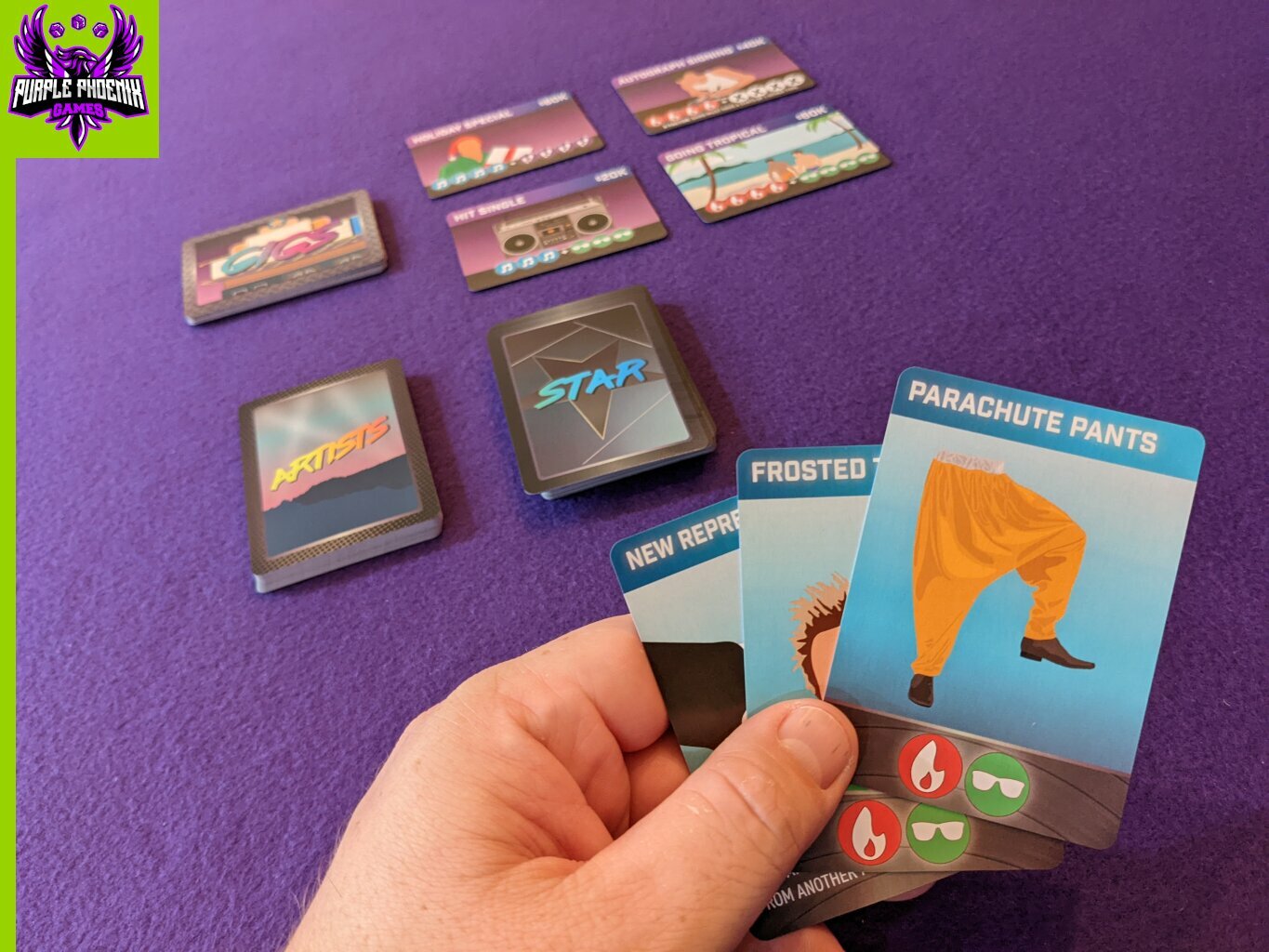
To setup, separate the cards by type and shuffle each stack independently. The Gigs deck is placed on the table with four Gigs displayed from the top of the deck. The Artists and Star decks are placed on the table and each player is dealt three Star cards to start the game. It is now setup and managers are ready to build bands… of boys!
BBB is played over a series of rounds, where each player will take two actions each turn. These actions are Audition, Draw Star Cards, Play a Star Card, and Do a Gig. When a manager Auditions boys for the band, they draw the top three Artist cards, choose one to add to their band, and then discard the rest to the bottom of the deck. The cost to add the boy to the band is shown in the upper right hand corner and represents the number of Star cards to be discarded from hand. Artists are added to band (tableau) and ready to begin rehearsing. At least, I hope they are rehearsing.
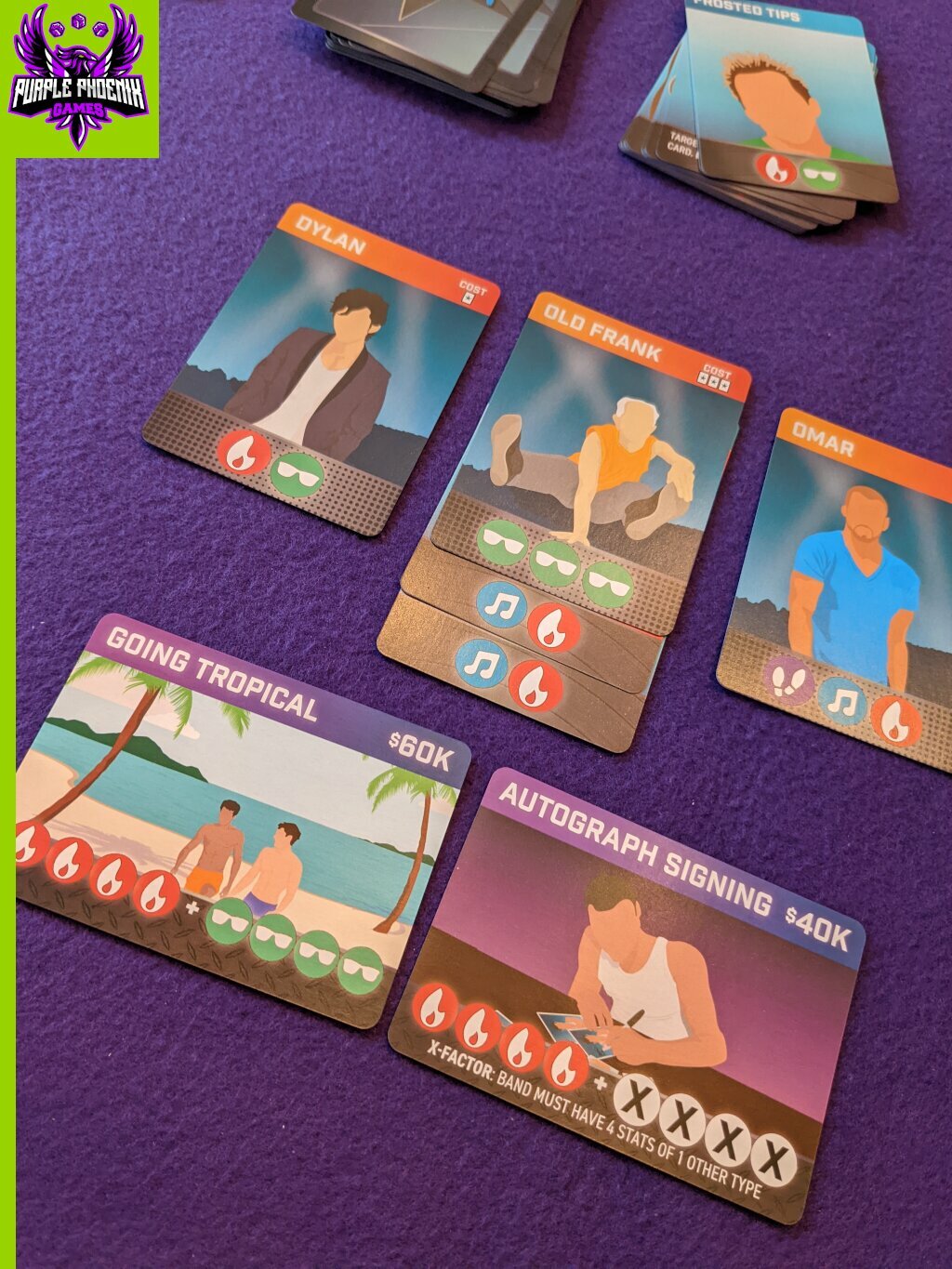
Additionally, the active manager may Draw Star Cards to increase their hand. Simply draw two Star cards from the top of the deck. Alternatively, the manager may choose to Play a Star Card for its stats by slipping the card under a boy to increase his level of Pipes, Moves, Heat, or Cool stats (check out the photo below where I went hard on buffing Old Frank).
Finally, if the boy band members currently possess the appropriate amount of stats, the manager may choose to Do a Gig. They choose one of the face-up Gigs cards, take it to their score pile (assuming they possess the correct type and number of stats), and then do a little dance to celebrate a completed Gig. To signify the end of their turn, the active manager draws a Star card and passes to the next player. The game ends once the appropriate number of Gigs have been completed by a manager, as detailed in the rules per number of players. The manager with the highest total of money earned from Gigs cards is the winner, and receives all the Grammy nominations afforded to them.
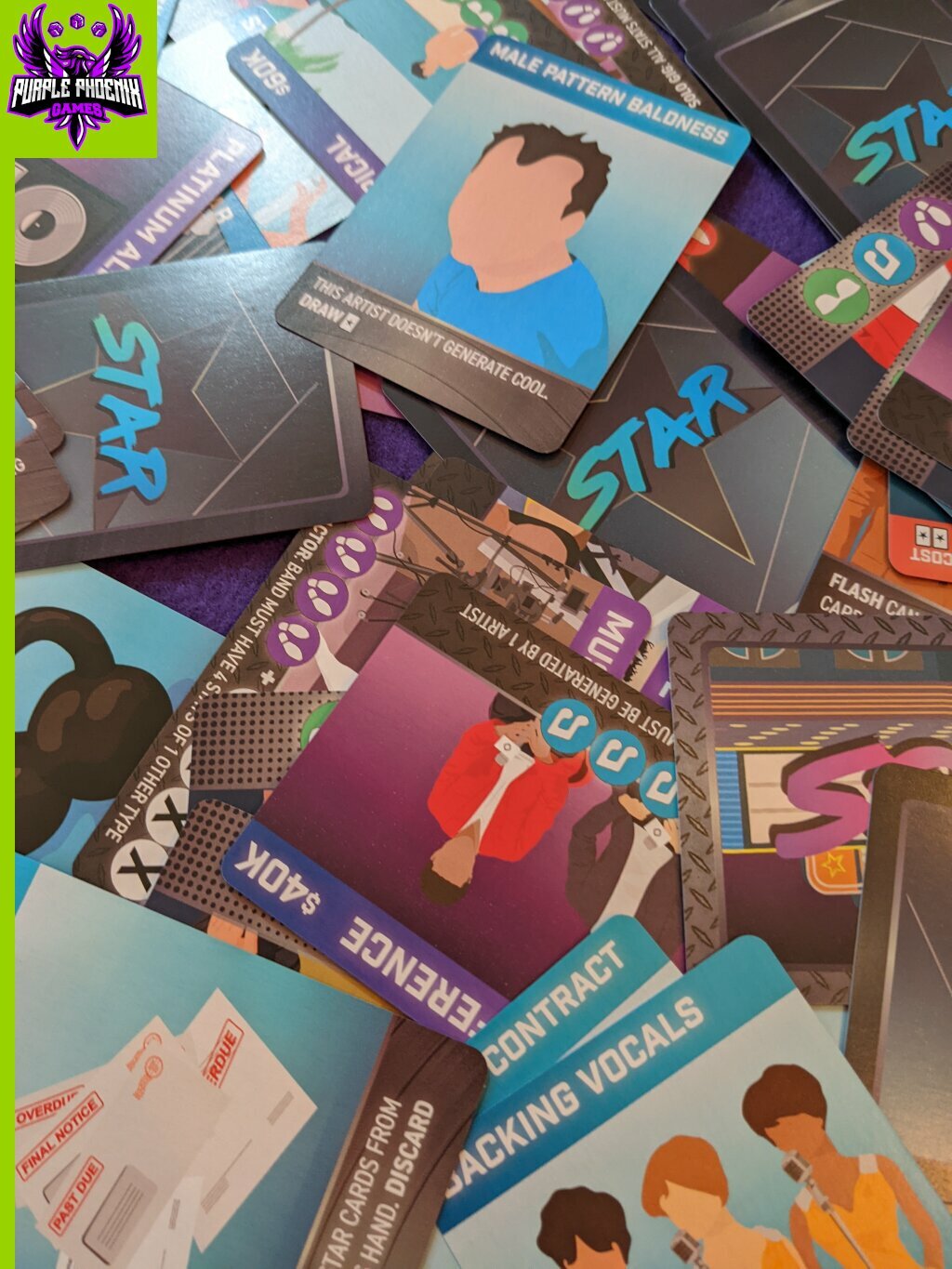
Components. This is a bunch of cards in a tuckbox. The cards are all fine, but the true hero here is the artwork. I cannot express how much I appreciate the decision to keep the art style modern, and the faces blank. I believe it is mostly due to the fact that all of us who were not in boy bands were all a bit jealous of those who were, but I will publicly state that my official opinion is because these boys don’t really need faces. Body language speaks volumes, and the art style reflects that extremely well. Mad props from me on the artwork.
The gameplay here is very intuitive, even though I had a couple questions that were not made clear in the rulebook. You need Star cards in order to buff Boys so they can do Gigs, and making sure that your band has all the right stats to complete the more profitable Gigs. I believe the game lasts an appropriate amount of time; it does NOT overstay its welcome, which is a huge thing for a filler game such as this. I do wish there were more off-the-wall characters like Old Frank and Lil’Hop, and I also wish the Star cards’ backgrounds were a little more interesting to look at, but the game ultimately looks good and plays well too. There are a few extra surprises to be found in the game that I will let our readers discover, including some Take That card that can hinder opponents.
Boy Band Builder can be super quick and competitive, or can be more leisurely and relaxed. This is a great thing for a cute little card game, and though the theme is something with which I am not at all enamored, a love for boy bands is not required to enjoy Boy Band Builder. I can see myself breaking this out with the right people, but I don’t necessarily foresee having this on stand-by for every game night. If you are in the market for a uniquely-themed card game you can chair dance while playing, then check out Boy Band Builder. It can be found on the Amazon store by clicking this link. Enjoy!
Boy Band Builder (BBB from here out) is a card drafting and band-building game for two to four players. In it, players are band managers tasked with creating the next big group of talented and attractive boys, with the winner of the game being they who earn the most money from assembling the best band and playing the most lucrative gigs.
DISCLAIMER: We were provided a copy of this game for the purposes of this review. This is a retail copy of the game, so what you see in these photos is exactly what would be received in your box. I do not intend to cover every single rule included in the rulebook, but will describe the overall game flow and major rule set so that our readers may get a sense of how the game plays. For more in depth rules, you may purchase a copy online or from your FLGS. -T
To setup, separate the cards by type and shuffle each stack independently. The Gigs deck is placed on the table with four Gigs displayed from the top of the deck. The Artists and Star decks are placed on the table and each player is dealt three Star cards to start the game. It is now setup and managers are ready to build bands… of boys!
BBB is played over a series of rounds, where each player will take two actions each turn. These actions are Audition, Draw Star Cards, Play a Star Card, and Do a Gig. When a manager Auditions boys for the band, they draw the top three Artist cards, choose one to add to their band, and then discard the rest to the bottom of the deck. The cost to add the boy to the band is shown in the upper right hand corner and represents the number of Star cards to be discarded from hand. Artists are added to band (tableau) and ready to begin rehearsing. At least, I hope they are rehearsing.
Additionally, the active manager may Draw Star Cards to increase their hand. Simply draw two Star cards from the top of the deck. Alternatively, the manager may choose to Play a Star Card for its stats by slipping the card under a boy to increase his level of Pipes, Moves, Heat, or Cool stats (check out the photo below where I went hard on buffing Old Frank).
Finally, if the boy band members currently possess the appropriate amount of stats, the manager may choose to Do a Gig. They choose one of the face-up Gigs cards, take it to their score pile (assuming they possess the correct type and number of stats), and then do a little dance to celebrate a completed Gig. To signify the end of their turn, the active manager draws a Star card and passes to the next player. The game ends once the appropriate number of Gigs have been completed by a manager, as detailed in the rules per number of players. The manager with the highest total of money earned from Gigs cards is the winner, and receives all the Grammy nominations afforded to them.
Components. This is a bunch of cards in a tuckbox. The cards are all fine, but the true hero here is the artwork. I cannot express how much I appreciate the decision to keep the art style modern, and the faces blank. I believe it is mostly due to the fact that all of us who were not in boy bands were all a bit jealous of those who were, but I will publicly state that my official opinion is because these boys don’t really need faces. Body language speaks volumes, and the art style reflects that extremely well. Mad props from me on the artwork.
The gameplay here is very intuitive, even though I had a couple questions that were not made clear in the rulebook. You need Star cards in order to buff Boys so they can do Gigs, and making sure that your band has all the right stats to complete the more profitable Gigs. I believe the game lasts an appropriate amount of time; it does NOT overstay its welcome, which is a huge thing for a filler game such as this. I do wish there were more off-the-wall characters like Old Frank and Lil’Hop, and I also wish the Star cards’ backgrounds were a little more interesting to look at, but the game ultimately looks good and plays well too. There are a few extra surprises to be found in the game that I will let our readers discover, including some Take That card that can hinder opponents.
Boy Band Builder can be super quick and competitive, or can be more leisurely and relaxed. This is a great thing for a cute little card game, and though the theme is something with which I am not at all enamored, a love for boy bands is not required to enjoy Boy Band Builder. I can see myself breaking this out with the right people, but I don’t necessarily foresee having this on stand-by for every game night. If you are in the market for a uniquely-themed card game you can chair dance while playing, then check out Boy Band Builder. It can be found on the Amazon store by clicking this link. Enjoy!

Griffin (480 KP) rated Exploding Kittens in Tabletop Games
Feb 8, 2019

This game work has something to offer everyone (3 more)
While strategy is not required, it is certainly still an aspect of this game!
Cards are fun and creative
Extremely fast and easy to learn
Card stealing system can pick on certain people (2 more)
Game can feel very unlucky at times
Game feels clunky when playing with just two people
Great game for most people!


Michael Rivera (93 KP) rated Keyforge: Call of the Archons in Tabletop Games
Mar 27, 2019

How can you not love this game
How can you not love this game.
Buy a starter or a bunch and learn each decks strengths and weakness.
With out a doubt a fun game.
You don't have to worry about buying thousands of packs to add cards just the starter or a few starters the choice is yours
Buy a starter or a bunch and learn each decks strengths and weakness.
With out a doubt a fun game.
You don't have to worry about buying thousands of packs to add cards just the starter or a few starters the choice is yours

Mark Lloyd (9 KP) rated The Grimm Forest in Tabletop Games
May 2, 2019

The Grimm Forest is a stunning game for so of the family, and is a great introduction to the hobby for new board gamers as well as an engaging enough experience for established gamers looking for some light fun.
Heartily recommend.
Heartily recommend.


Chelsey Young (29 KP) rated Unstable Unicorns in Tabletop Games
Mar 13, 2018
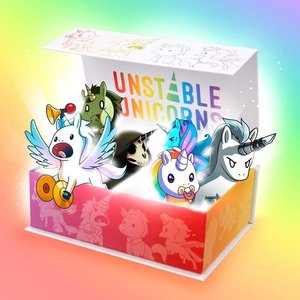
So much fun for playing and beating your friends
This game is probably one of my favorite card building game. The cards are hilarious and unique. The expansions are just as fun. The NSFW expansion is hilarious. My friends and family love playing this and highly recommended it!!!!

James Rudorf (2 KP) rated Exploding Kittens: NSFW Deck in Tabletop Games
Apr 3, 2018
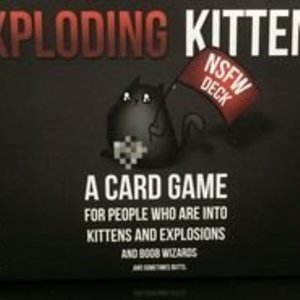
Art work (1 more)
Game time
Quick Fun
Wow this game is a quick 15 minute card game for players up to 6. The art work will make you laugh out loud and you will soon remember some of ur favorite cards. Grab you friends and a drink and start conspiring and sending your friends to their doom by the hands of a exploding kitten.