





Percolation Play ( Leather and Lattes #3)
10.0 Rate It
Book
Publisher Description Kai’s new to bisexuality, new to the area, and new to the scene, but when...

Purple Phoenix Games (2266 KP) rated The Grimm Forest in Tabletop Games
Apr 9, 2021
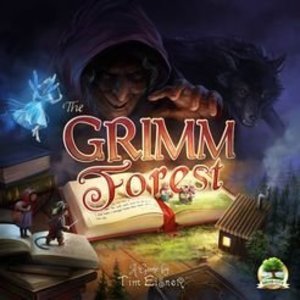
The Grimm Forest is a simultaneous action selection, set collection, take that game for four family members of the infamous Three Little Pigs. As fantasy contractors players are tasked with constructing three houses as sturdy and quickly as they can. However, these contractors will have competition for limited resources, as well as the occasional interference from scary creatures and buddies of opponents. Like the baseball movie says, “If you build it, you will win the contract to build more stuff.” Or something like that.
DISCLAIMER: We were provided a copy of this game for the purposes of this review. This is a retail copy of the game, so what you see in these photos is exactly what would be received in your box. I do not intend to cover every single rule included in the rulebook, but will describe the overall game flow and major rule set so that our readers may get a sense of how the game plays. For more in depth rules, you may purchase a copy online or from your FLGS. -T
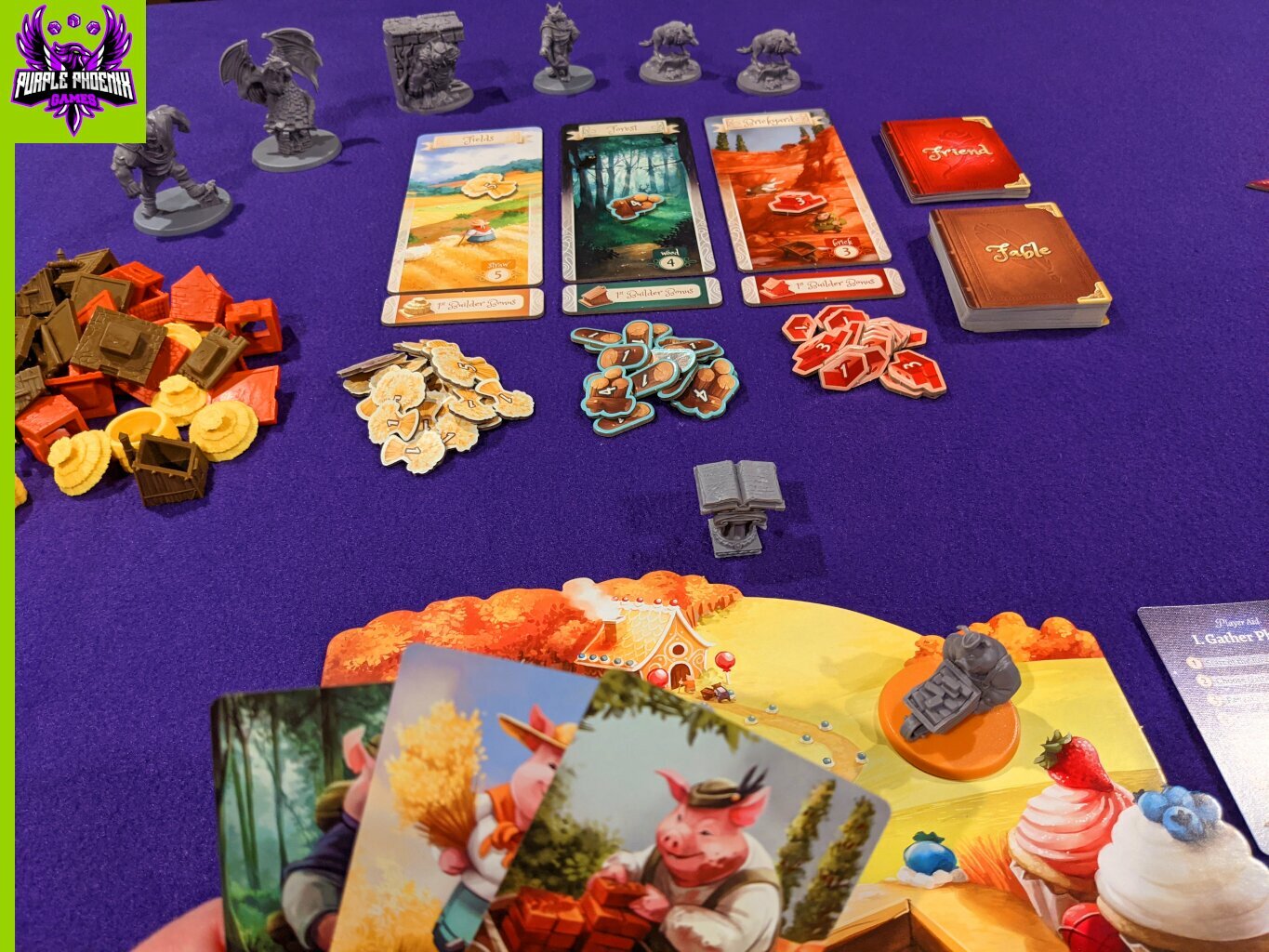
To setup, place the Location boards on the table for the Fields, Forest, and Brickyard (for a three-player game, as below). The First Builder Bonus tokens are placed below the matching Locations as well as the resources that can be harvested. One of each Mega Resource (5 Straw, 4 Wood, 3 Brick) are placed on the matching Location at the beginning of each round. The Friend and Fable decks are shuffled and placed nearby, as are the House sections (Floors, Walls, Roofs – Rooves?), and the Monster minis. Each player chooses a color and collects the Player board, Pig mini, and Gather cards matching that color. The first player is given the Starting Player tome token and the game may now begin!
The Grimm Forest is played over a series of rounds with each pig having a multi-step turn. Initially, however, the pigs will be deciding from which Location they would like to harvest resources by laying the corresponding Gather card from their hand to the table face-down. Once all pigs have laid their card, the Gather cards are flipped and revealed simultaneously. If any pig had chosen to also play one Fable card it would have been revealed and possibly resolved prior to this step. Players will place their Pig mini on the Location board they chose and then harvesting of resources may begin, unless a player has a Fable card that resolves at this point in the turn. If a Pig is alone in a Location they receive all resources currently found there. If Pigs share a Location then the shared minis will share the resources equally, keeping any remaining resources on the Location for the next round. If any player used a Fable card that activates at the end of the Gather phase, it is resolved now.
After the Gather phase, the Pigs will be able to take actions. On their turn, in turn order, each Pig may choose to perform two of the following actions in any order they wish (actions may be repeated except for Friend Special Actions): Draw a Fable card, Gain 1 Resource, Build, Special Actions. Drawing a Fable card is self-explanatory and players will keep their Fable cards secret from the other players. They may choose to play one of these Fable cards during the choosing of Gather cards portion of the beginning phase of a turn. A Pig may instead wish to gain one resource of their choosing and add it to their collection. As mentioned earlier, a Pig may also use their active Friend card’s (which is earned by building a Wall section) Special Action once per turn, should they have collected one earlier.
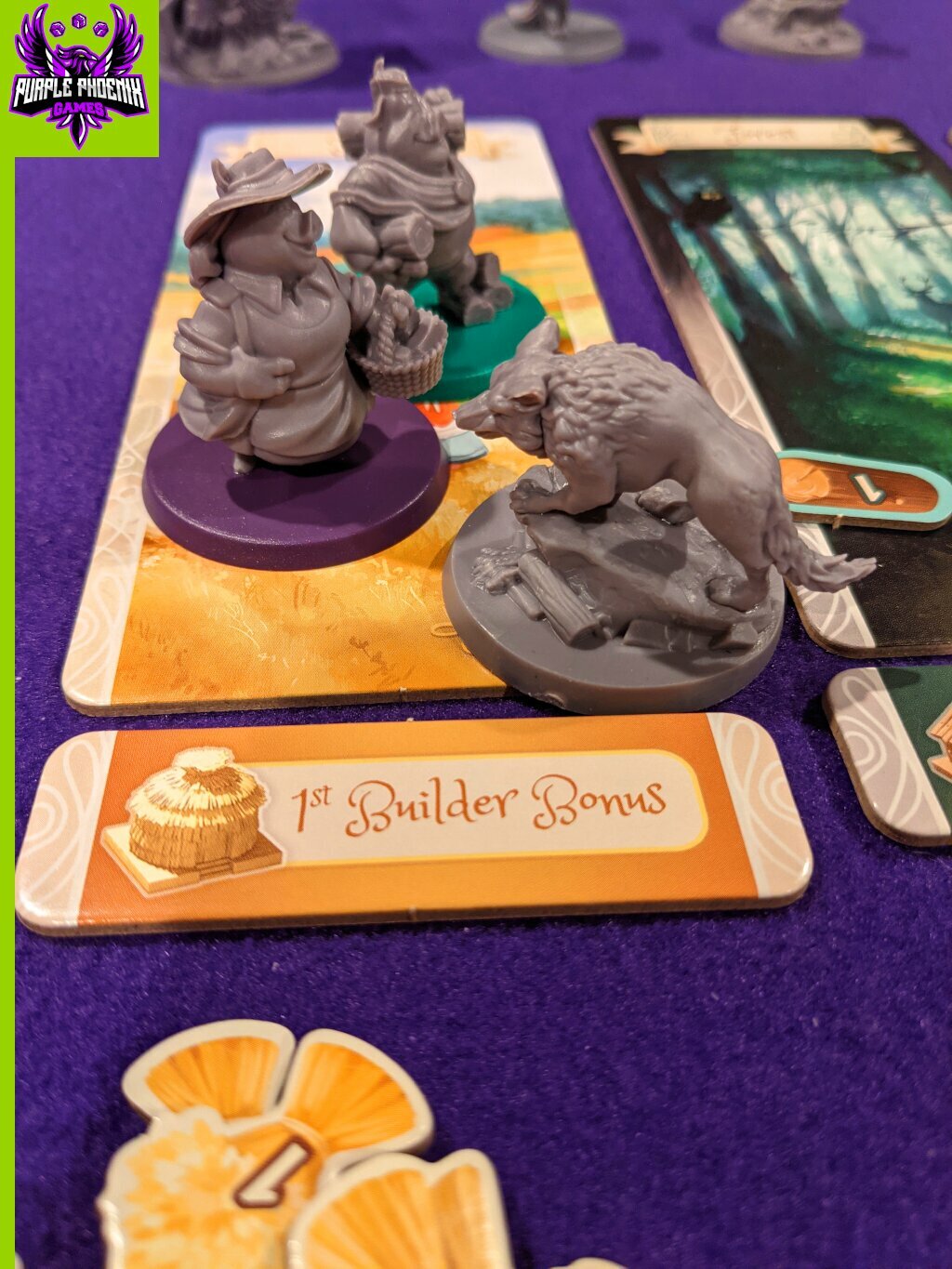
The true hero of The Grimm Forest is the Build action as this is what propels players to victory. Pigs may Build any house type they wish, as long as that type is not currently under construction elsewhere on their board. Also note that houses must be built from the ground up so Floors must be present before Walls can be built and Walls need to be constructed in order to hold up a Roof. Pigs may build these sections of houses by discarding the appropriate number and type of resources they have gathered previously: two resources for a Floor, four resources for Walls, and six resources for a Roof. Once a Pig completes construction of the first house of a type they will grab the matching First Builder Bonus token and reap its rewards.
The game continues in this fashion until one player has built three houses of any type, or multiple players have completed their three houses by the end of the round. Those tied players then check for sturdiness to break their tie: brick houses are sturdier than wood, which are sturdier than straw. The winner is the player with the sturdiest collection of houses, and then all players are invited to share a plate of bacon in celebration of the win (not in the rules, but I added that for… flavor).
Components. This game is chocked full of killer components. I do not oftentimes compliment boxes and inserts, but when a game comes with GameTrayz already, you know that the publisher cared a ton about the game. Everything sets up and tears down so much nicer and quicker with a GameTrayz insert that I wish every game would come with them. Yeah, I know, $$$. Outside of the insert (or inside?) the other components in the game are simply stellar. Everything from the card backs resembling book covers, the incredible plastic house pieces, and amazing minis, just makes this one sing when on the table. The art is done by the incredible Mr. Cuddington, and they are quickly becoming some of my favorite board game artists.
Wait, there are monster minis? But I didn’t talk about that in my overview. Well, yes, that’s correct. These monsters come into play from certain Fable cards, and when they are played it instructs the player to introduce the appropriate monster mini on the playing area. This can be done with such dramatic flair that you truly get a sense of dread that little piggies may feel. If you have seen Stranger Things (not a sponsor) and remember the part when the Demogorgon mini hits the table, then you understand how I introduce my monster minis. These monsters wreak havoc on the players and sometimes deny them resources, and other chaos to mess with pigs.
Overall, I am so enamored with this game. It has nearly everything I love about games. It has amazing theme and art. That is always big with me. The components are super high quality, as all Druid City Games/Skybound Games usually are, and the game is so smooth once it is learned. All phases and turn components work together well, and there are plenty of choices each player makes every round. The game comes with advanced rules and components as well once all players are comfortable with the base game, and I love when games come with that added complexity and difficulty.
I have nothing bad to say about this game at all, which makes me sad, because I can usually find something to improve with every game I play. Okay wait, I just thought of one: I appreciate that the player colors include both orange and purple, but then the others are blue and green. I think the player colors could have come with some different choices as I feel blue, green, and purple are within similar color bands. Maybe pink and aqua would be better choices for my taste? I don’t know, and I am sure research was done to decide on the player colors, but like I said, I needed to find SOMETHING to complain about.
So it is certainly no surprise that I love this game and rated so highly. I doubt it will ever truly break into my Top 10, but I feel it ticks all of my boxes for a great game and a 6 from me. Purple Phoenix Games as a whole gives this one a porky 15 / 18. If you are looking for a great game that is admittedly lighter, but gives great gameplay throughout, features incredible art and components, and offers opportunities for role-play then you definitely need to grab a copy of The Grimm Forest. I will be recommending this to so many gamers in the future, and I will be pushing the floor of the age suggestion on the box once my son decides he wants to learn to read. I think I am going to go try out the Advanced rules now, and remember: don’t eat an apple that a scary person gave you at the door.
Purple Phoenix Games (2266 KP) rated Cubitos in Tabletop Games
Mar 17, 2022

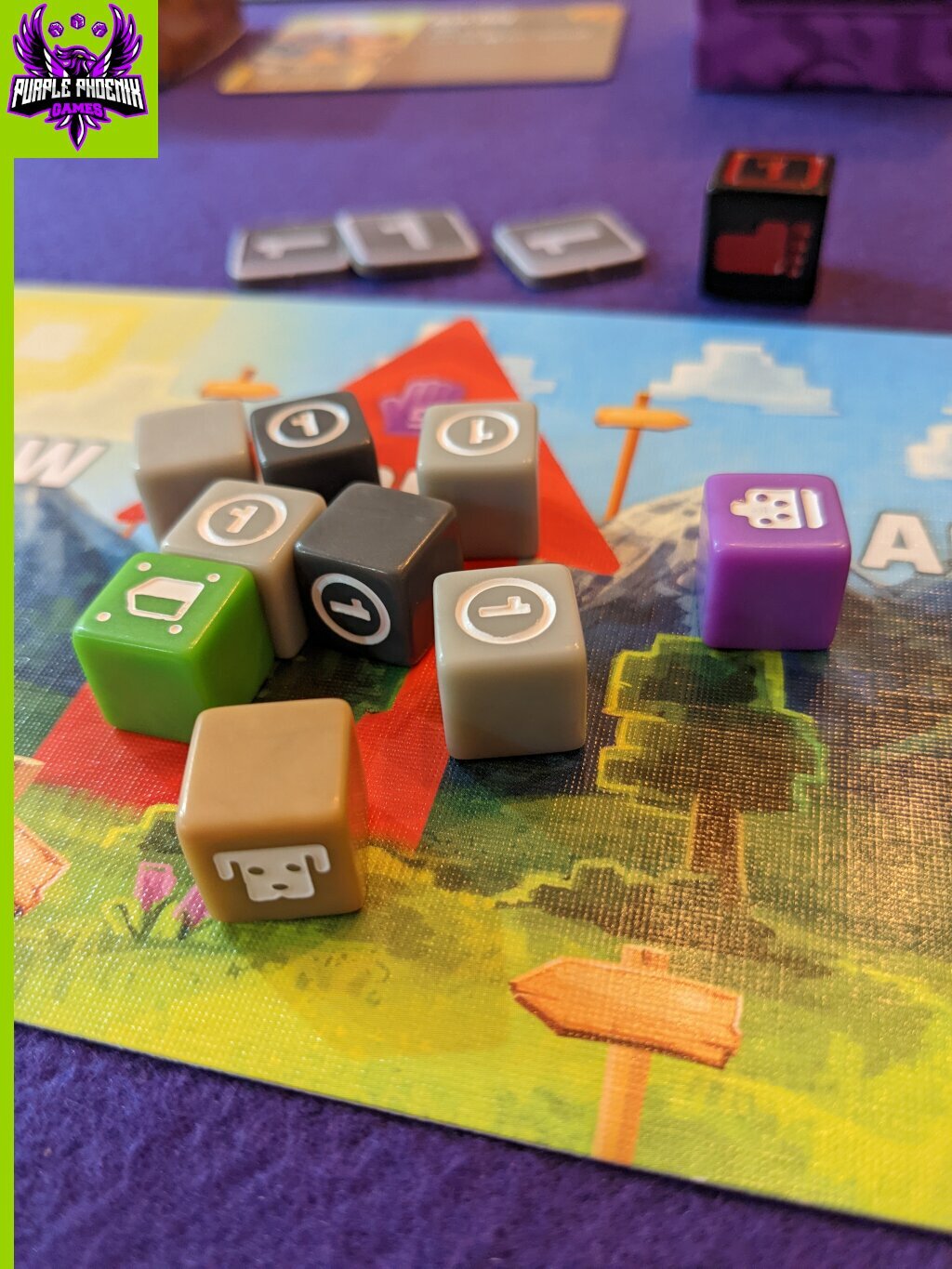
Cubitos is a push-your-luck, dice building, racing game for two to four players. In it, players have runners that will be moving around a crazy race track, and another runner who keeps track of fans (the manager maybe?), and the first player’s runner to cross the finish line will be the winner! Now, managing movement and special abilities is where the game REALLY is, and it all boils down to which special dice are purchased and used, and whether Lady Luck will find favor or not. It’s a wild ride, so prepare your runner and let’s go!
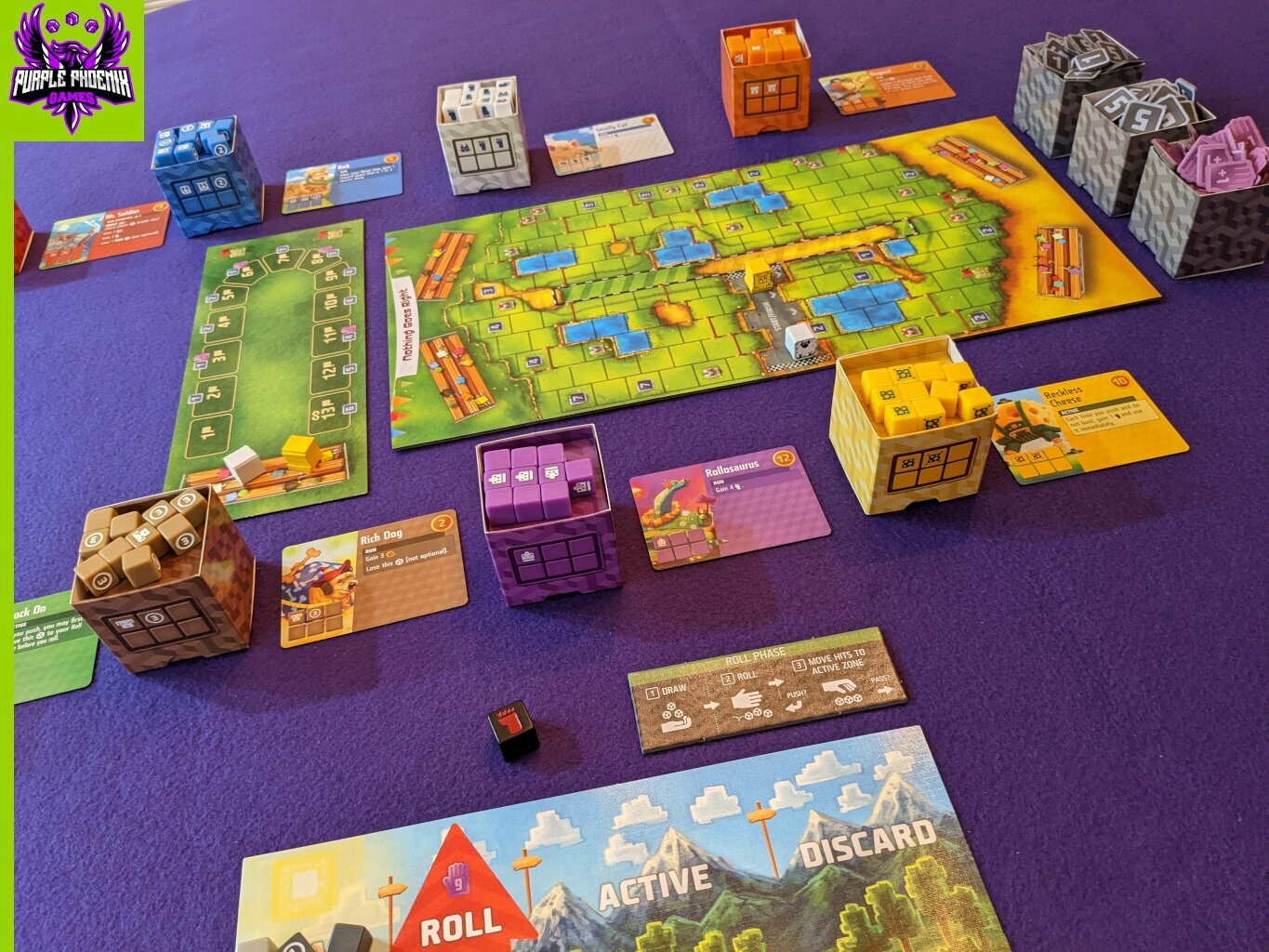
To setup, place out one of the double-sided Racetrack boards, along with the Fan Track board. Runners for each player are placed at the Starting Line on the Racetrack board, and the other on the bleachers of the Fan Track. Each player receives a color-coded Player Board and nine gray starting dice. They receive a Phase Token to keep track of each phase in a round, and the starting player receives the Start Player Die. Each dice box is placed around the boards with the dice on top. All corresponding cards for each die type is placed by the dice box, and the game may now begin!
DISCLAIMER: We have adopted an unofficial variant/house rule that differs from the rules because we find it works better for us. During the phases where all players may play simultaneously we instead just have each player take a turn individually. -T
A turn in Cubitos is divided into two main phases with several sub-phases for each. During the main Roll Phase, players will first Draw dice from their personal Draw Zone (on the Player Board) and place them into the Roll Zone. Initially, players will have a hand size of nine, but that may be adjusted as the game progresses. Once the dice have been drawn the player then Rolls their dice. Every die face showing an icon is counted as a Hit, and every die showing a blank face is considered a Miss. All dice showing Hits are moved to the Active Zone of the board, and the player then decides if they wish to Push (their luck) and re-roll all the Misses in hopes of more Hits, or if they are done rolling. Once a player re-rolls their Misses, if the result is all Misses, the player Busts and must move ALL rolled dice to the Discard Zone on their board. However, players may continue to roll all Misses until they Bust or are content and stop.
The Run Phase then begins with players resolving their red die icons (crossed swords for attacks), and determining their other icons rolled for coins and movement. Feet icons (and certain dice special abilities) provide players with movement along the Racetrack board, and coins provide the player with purchasing power to buy new dice. Once a player’s Runner has landed on a reward spot on the board, the player receives the benefit and moves all dice used this turn to the Discard Zone on the Player board.
Every time a player Busts, or lands on a Fan icon on the Racetrack, the other matching Runner on the Fan Track board will move one spot along the track, and the player receives the benefits of the new space. These benefits are either an increase in hand limit of dice drawn, or more purchasing power in the form of credits. Reward spaces on the board could give players extra dice for free, allow players to remove dice from their collection, or even gain credits to be used at any time. The game continues in this fashion of each player taking their turns until one player crosses the finish line and wins!
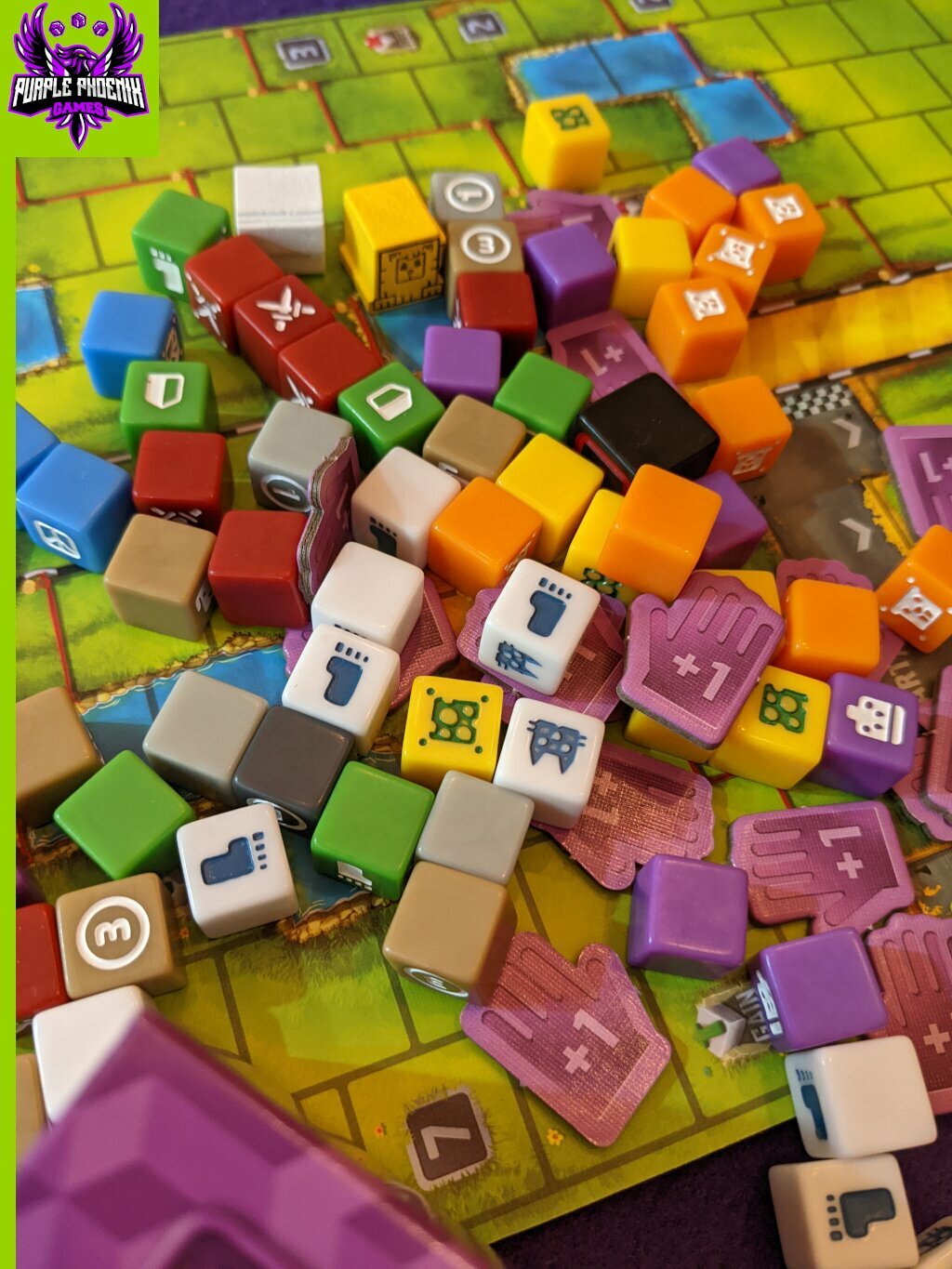
Components. This box is chock full of tasty components that we all just adore. The boards and cards are all good quality and feature some fantastic art, and the custom dice are just so fun to handle. A truly ingenious use of folding arts is used when setting up all the dice boxes. Not only are they used in-game to remind players what icons are on each die face, but they also hold the dice during play, and store the dice in the box. I mean, triple duty dice boxes are where it’s at! Everything is super colorful and just a joy to play with each time. My one quibble is the very offensive block of cheese on the box cover. I am a big Chicago Bears fan, and seeing something so proudly displayed that even remotely resembles an homage to the Packers is such a shame to me. I really hope that wasn’t intentional, but I am also joking. Mostly.
The absolute best part about this game is the selection of action cards associated with each special set of dice. For example, the purple dinosaur dice could be paired with seven different cards, each with different abilities when the icon is rolled. Each color has a seven card deck, from which a card could randomly be used each game. The rulebook also offers 10 suggested combinations of cards, and also invites players to choose their own combos. This reminds me of a similar mechanic I first saw with the Dice Masters system, where each die’s faces could mean something completely different depending on the card associated with it. I loved that mechanic back then, and I do now as well.
I cannot believe I passed on this game for as long as I did. I mean, I like AEG-published games. We have reviewed John D. Clair games positively: Mystic Vale, with Custom Heroes and Space Base coming soon. Was it a subconscious dislike for the dumb cheese man on the cover? I am not too sure, but I am clearly glad to have it now. The cool dice. The interesting theme. The multi-use dice/card components. The fact they included both orange and purple dice. Am I into racing games now? The reasons are plentiful, and I just cannot wait for my next play of Cubitos. Maybe I can get my wife into it and it can be a staple in our rotation.
There are several other little rules that I did not mention here, but all in all I have had a blast every time I play Cubitos. I was certainly correct in wanting to add it to my collection, and having Josh teach Laura and me originally just adds a unique personal touch to the game for me. Creating lasting memories is a big reason I am so into board games in the first place, and I think Cubitos will hold a special place in my heart simply because I was able to play it with my best friends. They agree with me that this is a special game, and Purple Phoenix Games gives this a nonsquare 16 / 18. If you see this at your LFGS I highly recommend you pick up a copy. Don’t wait, like I did, because when you do get around to it, they just may be out of stock. And a suggestion: because the cheeseperson is wearing lederhosen, just refer to them as a great German friend. AND THAT’S IT. Go Bears.
Purple Phoenix Games (2266 KP) rated Space Explorers in Tabletop Games
Jan 4, 2021

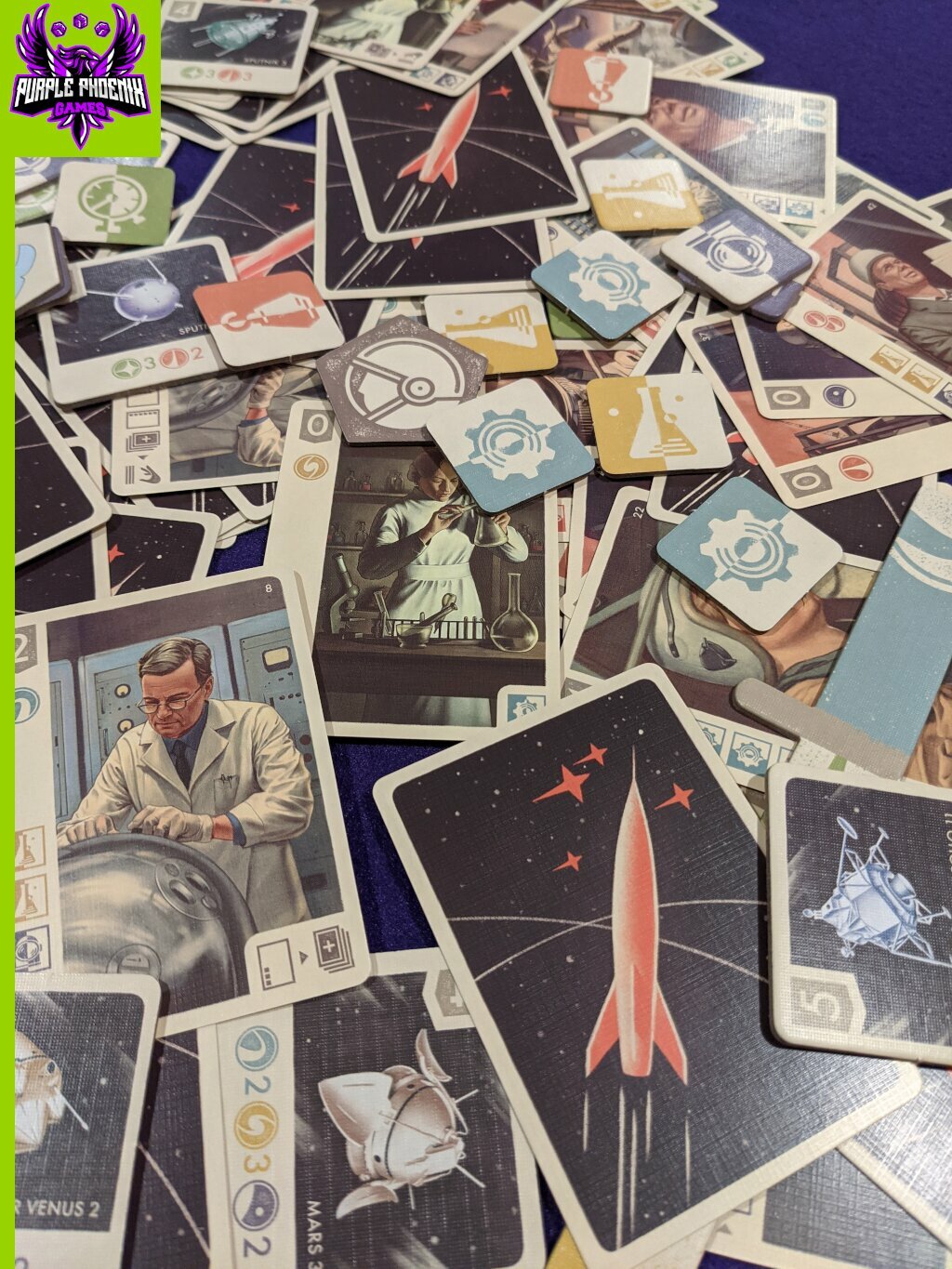
Space Explorers is a card drafting, set collection game for two to four players. In it players will take on the mantles of unique Human Resources managers… in space! Well, not IN space, but FOR space. By recruiting the best and brightest engineers, testers, scientists, builders, and astronauts players will score points in addition to scoring points for completing projects.
DISCLAIMER: We were provided a copy of this game for the purposes of this review. This is a retail copy of the game, so what you see in these photos is exactly what would be received in your box. I do not intend to cover every single rule included in the rulebook, but will describe the overall game flow and major rule set so that our readers may get a sense of how the game plays. For more in depth rules, you may purchase a copy online or from your FLGS. -T
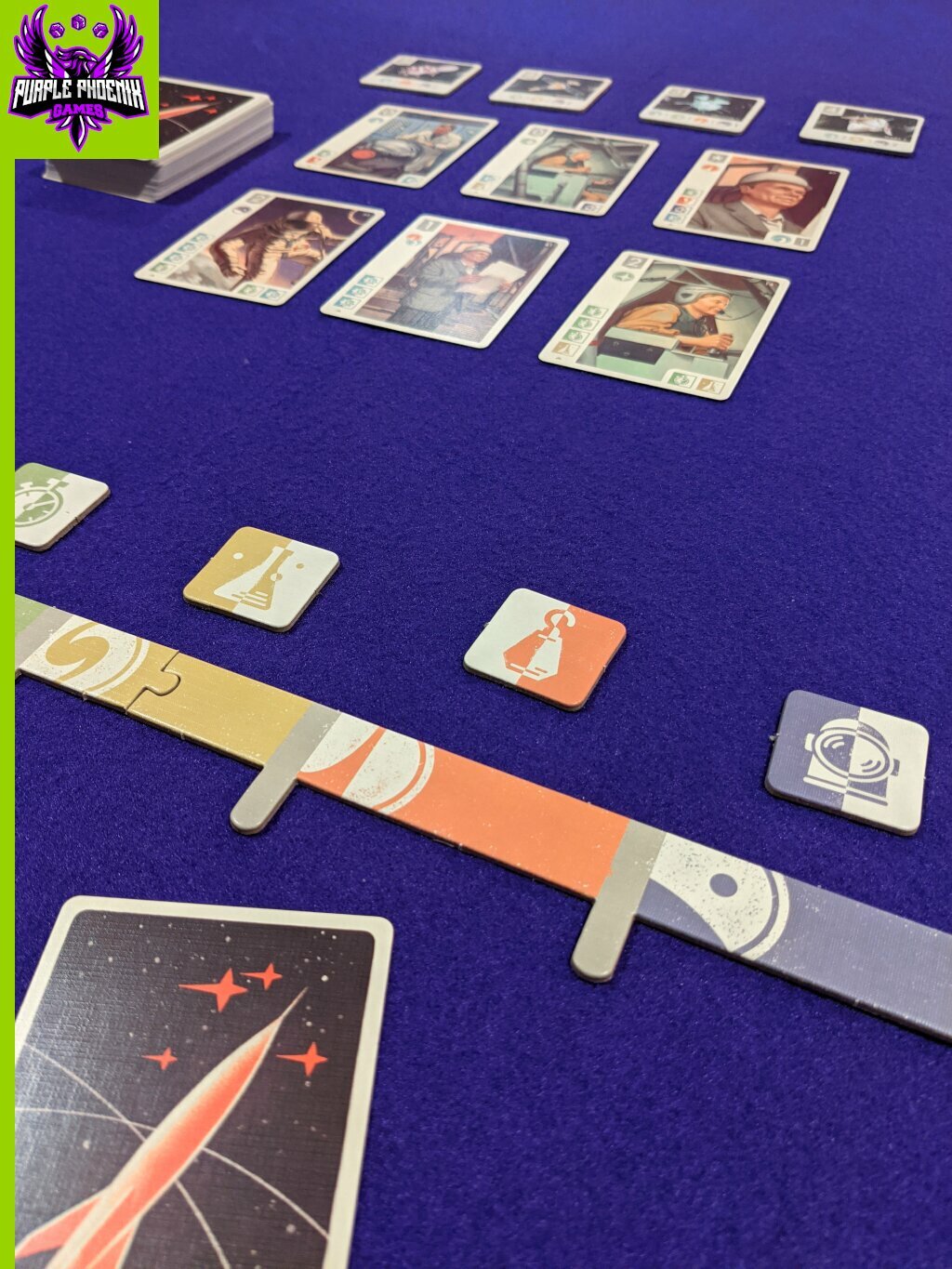
To setup, assemble Hub parts tableau organizer for each player. Shuffle the deck of Specialist cards (engineer, tester, et al) to be recruited and reveal six face up to symbolize the Center. Deal each player one of these Specialist cards to create their starting hand. Randomly choose two plus the number of players Project tiles and lay them on the table to be completed throughout the game. Each player will also receive a reference sheet (VERY handy) and one token of each Research type. Determine the starting player and the space race may now begin!
On a player’s turn they have two choices to make: take a Specialist card from the table into their hand, or recruit a Specialist from either their hand or from the table and place in their personal tableau. After this is completed the player may collect one Project tile if they now control the correct number of Specialists per Project tile.
To take a card into hand, a player simply selects one face-up Specialist card from those on the table and places it in hand. Simple.
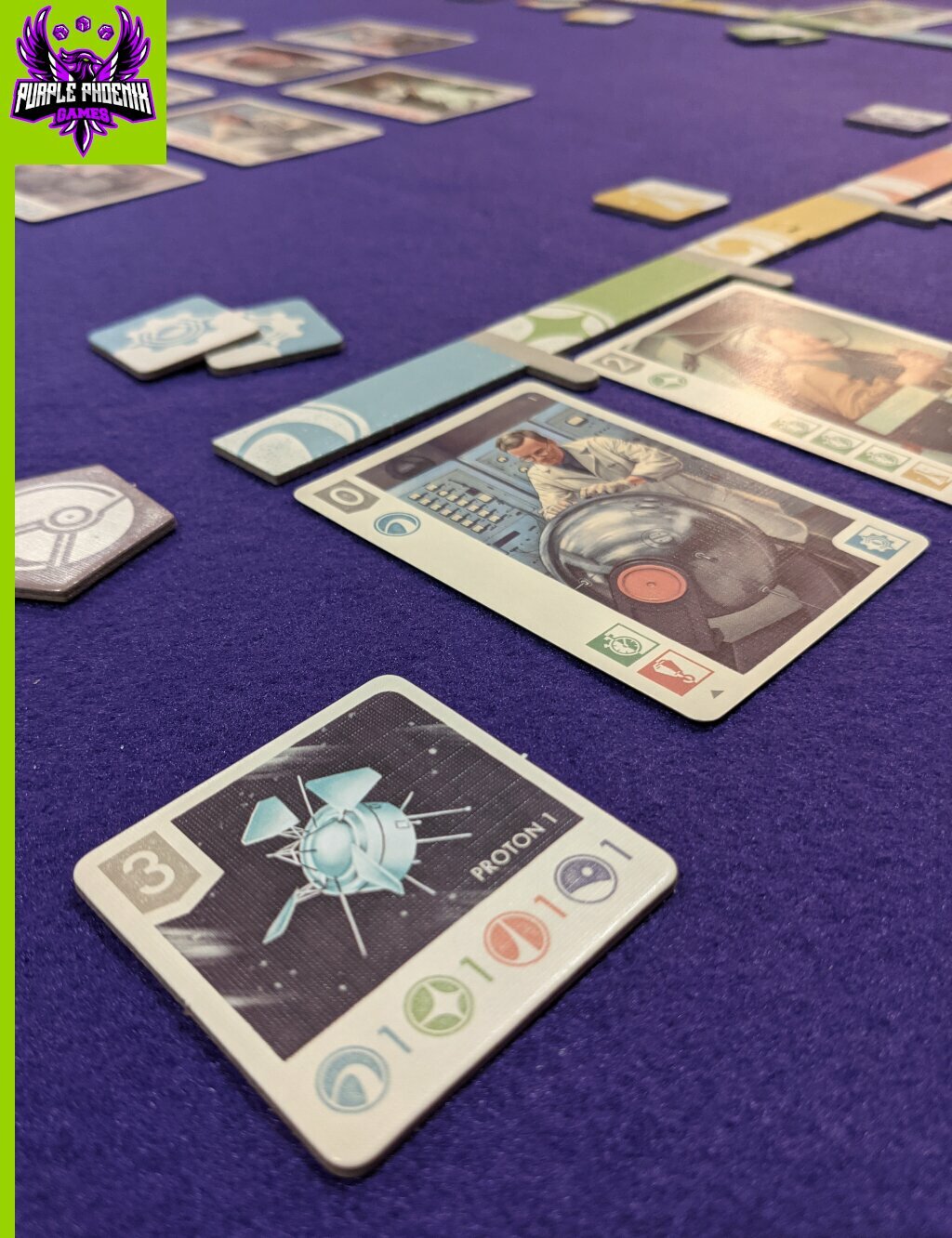
To recruit a Specialist the player will need to spend Resources equal to the recruitment cost printed on the Specialist card. Resources may be spent in any combination from actual Resource tokens, Resources provided by recruited Specialists already in the player Hub (tableau), and discarding a Specialist card from hand to the table to give two Resources of any type.
As Specialists are recruited to the players’ Hubs they will then give a discount toward recruiting future Specialists of the same type along with other abilities. For each Specialist in the Hub the player will receive a discount of one Resource icon needed to spend to recruit a Specialist of the same type. For example, if a player already has recruited two Scientists, the next Scientist they recruit will be discounted by two Resources. These Resources are discounted from the bottom-up on the listed recruitment cost, and may even result in Specialists being recruited for free. Similarly, some Specialists have certain abilities printed on their card that allow such actions as recruiting cards for free, or providing Resource icons to be used to recruit, or even providing extra points at game end for a variety of reasons.
Play continues in this fashion of players taking Specialists in hand or recruiting them to their Hub to be used to complete Projects and earn points. The game ends once the last Project has been completed or any one player has recruited their 12th Specialist. Every player will have the same number of turns, after which the winner will be the player with the most points!
Components. I have a lot to say about the components here. I think that 25th Century Games has absolutely nailed every single component in this box. The Specialist cards are excellent quality: linen finished, great thickness, and they shuffle realllllly well. The Project tiles, Hub parts, and Resource tokens are thick board stock. The reference sheets are good and the rulebook is just perfect. One thing that may be slightly polarizing is the art style. Space Explorers uses imagery similar to what you would find on many things in the 1950s and 1960s in America. That said, I absolutely love the art style and it is reinforced on every component in this game. The icons are slick and stylish, the color scheme is muted without being drab, and everything you play with is meant to help immerse you into the time of the first astronauts. It’s simply amazingly well done.
The gameplay is also quite stellar (Laura will like that one). I know many compare it to Splendor, and that is certainly warranted, but I feel that Space Explorers pulls it off much more fluidly. Yes, Splendor has those weighty chips that everyone likes while Space Explorers has cardboard tokens. But other than that Space Explorers surpasses the other by leaps and bounds. The gameplay is much more intriguing, the theme is way cooler, and I am just overall much more attracted to it.
While gameplay overall is similar, there is quite a number of differences Space Explorers offers. Foremost, when Resource tokens are spent to recruit Specialists, instead of being sent to a communal bank they are passed along to the player on the left. That’s right, you literally give those Resources to your opponent that will be playing next. This small change really increases the need to be aware of what each player’s strategy may be in order to recruit who you need without also helping your rivals. Being able to utilize three different sources of currency in combination to recruit Specialists is also quite nice. Don’t have the right number of tokens? No problem! Check out what your Specialists are providing from their years of experience.
It is really no shock here that I am enamored with Space Explorers. I really didn’t know that I needed a Splendor killer in my collection, but now that I have this I will be holding it tightly and in high regard. Purple Phoenix Games gives this one an out-of-this-world 11 / 12. If you LIKE the aforementioned game that everyone seems to own but don’t LOVE it, then you need to check out Space Explorers. The theme is great, the components are superb, and the gameplay is light and fast. I love it dearly and hope you do too.

Purple Phoenix Games (2266 KP) rated Cindr in Tabletop Games
Oct 29, 2020
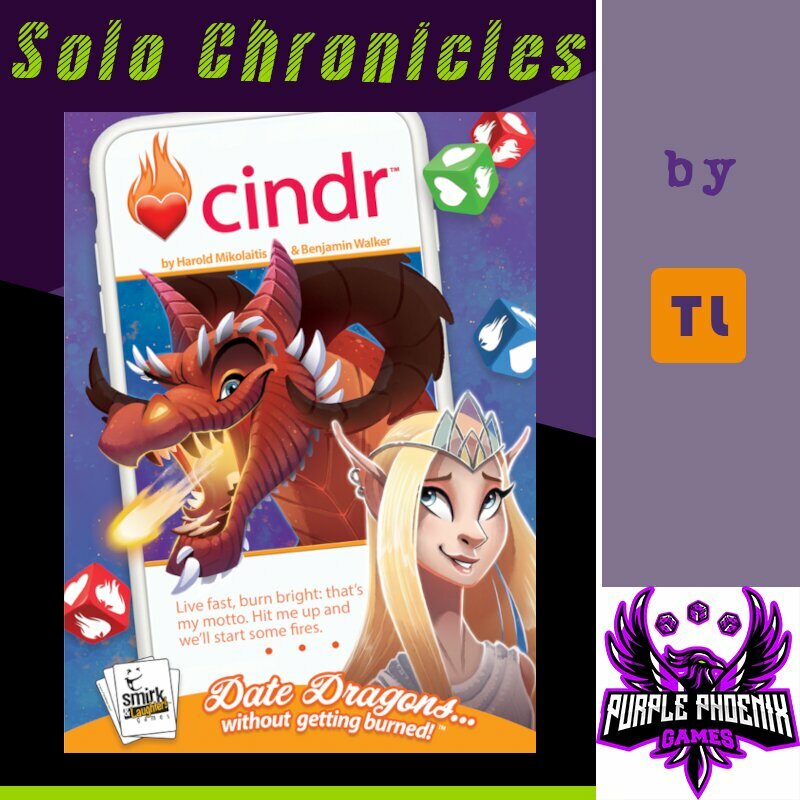
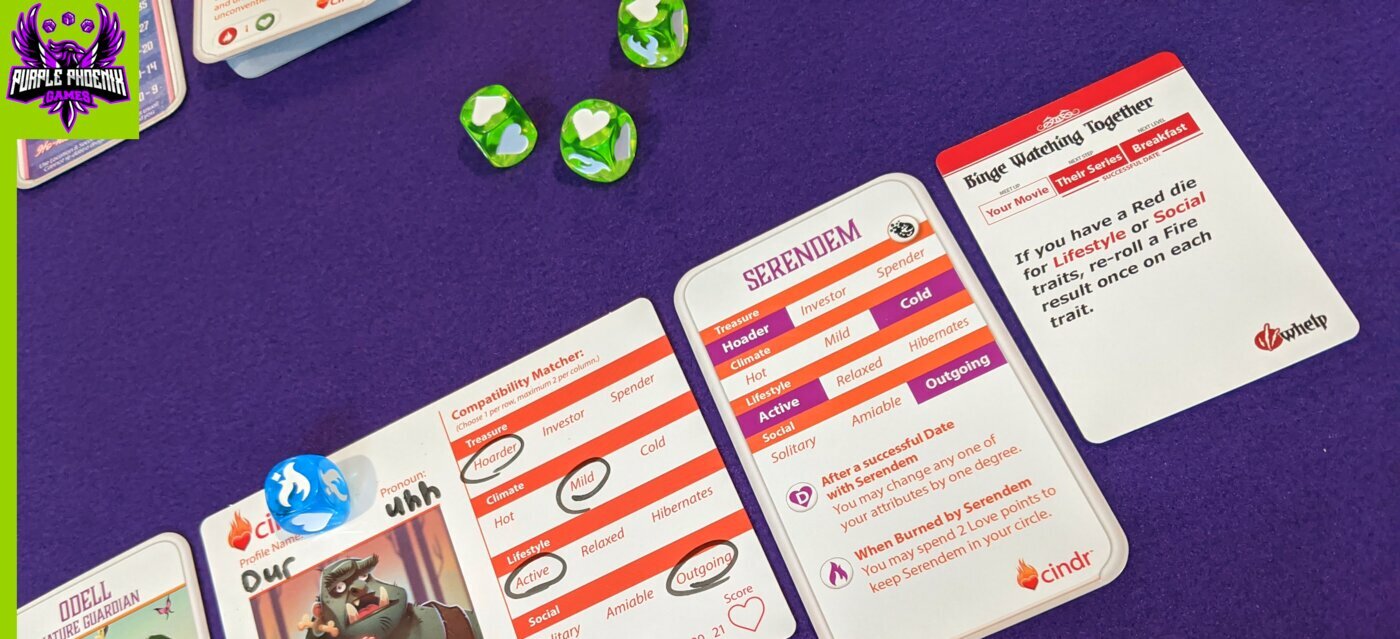
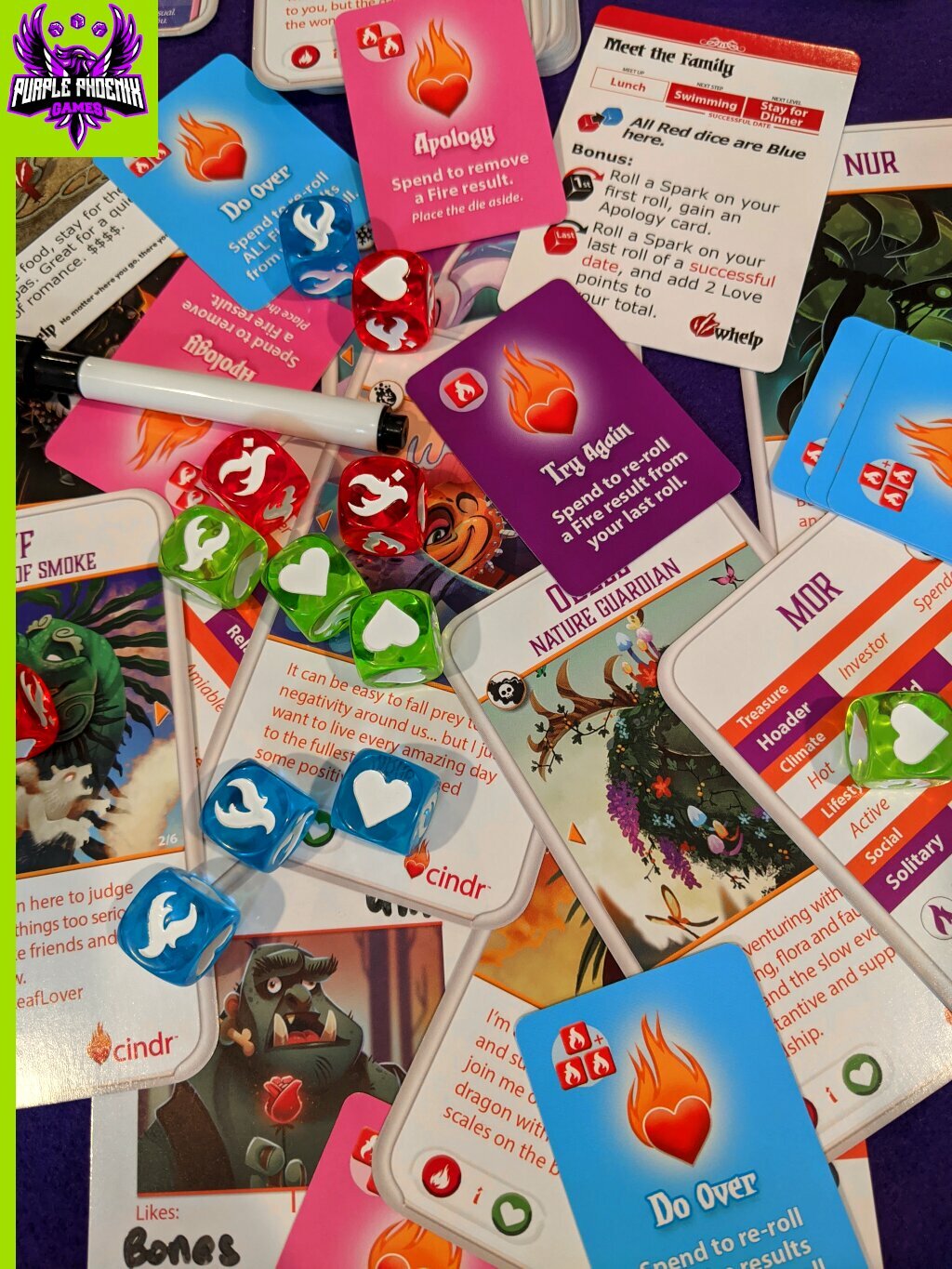
Cindr has players taking on the persona of a lonely fantasy creature looking for dragon love on a dating app. Players will be building their character by making choices and then swiping left or right to attempt going on dates with dragons that may be a great match. Roll the dice well and things may go to the Next Step, or even the Next Level. Roll poorly and your dear dragon date may send you home aflame.
DISCLAIMER: We were provided a copy of this game for the purposes of this review. This is a retail copy of the game, so what you see in these photos is exactly what would be received in your box. I do not intend to cover every single rule included in the rulebook, but will describe the overall game flow and major rule set so that our readers may get a sense of how the game plays. Furthermore I will be covering the game using the Solo rules (which are no different than the multiplayer rules). For more in depth rules, you may purchase a copy online or from your FLGS. -T
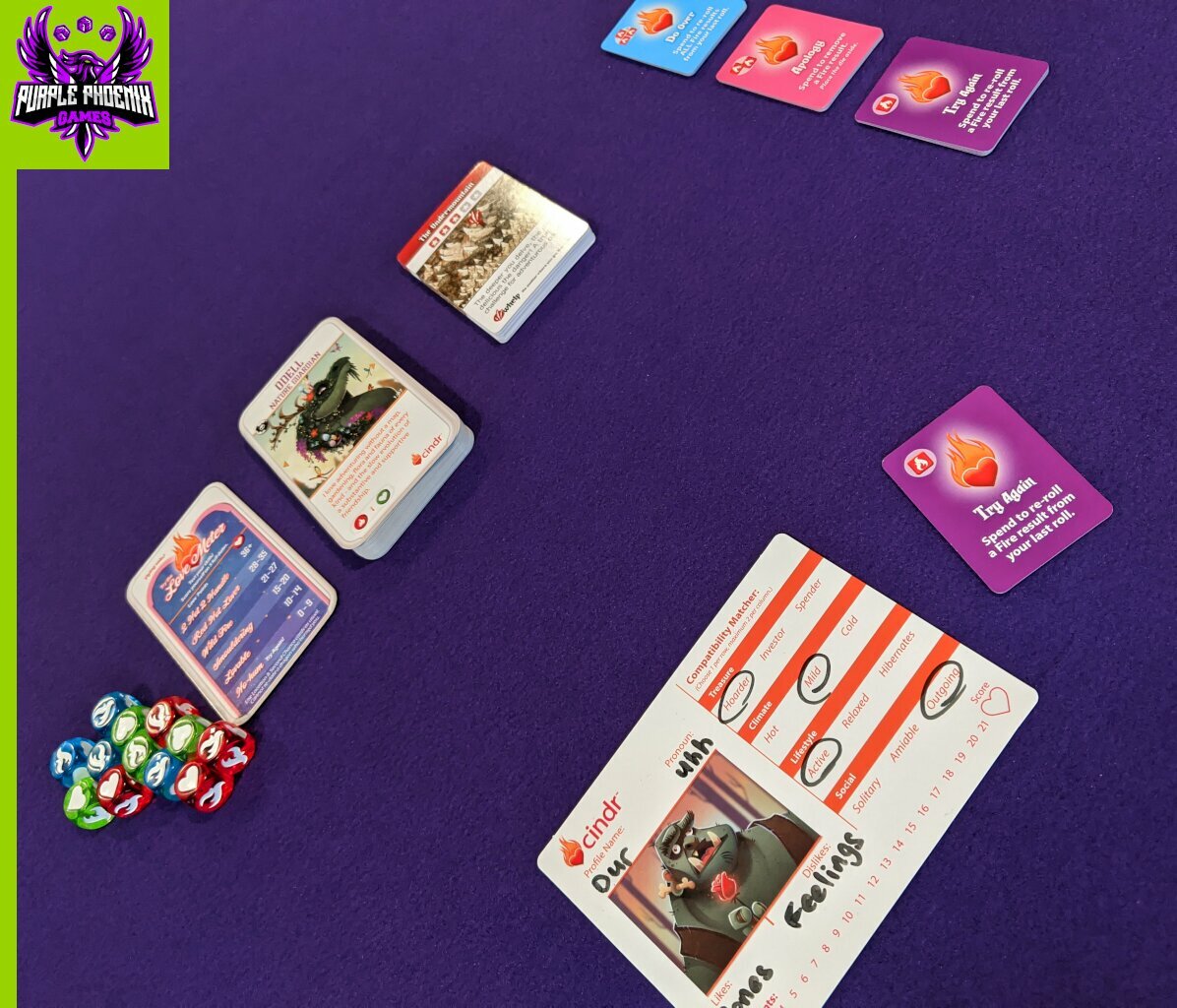
To setup, each player (or just yourself if playing the solo rules as I am) will choose a Character Profile card, filling in the blanks and circling choices to build their new fantasy persona. Each player will take one Try Again card that is useful during game play. Shuffle each Cindr App Dragon Profile and Whelp App Location card deck and place near each other. The dice will be placed near all the cards as well and the game is ready to begin!
On a turn a player will do each of these steps in order: Choose a Dragon to Date, Assemble the Dice Pool, Draw a Location Card, Check Dragon Powers & Location Bonuses, The Date / Roll Dice, Burned by a Dragon, and End of Turn. In the solo game players will be playing long enough to complete five dragon dates.
Choosing a Dragon to Date consists of reading the profile on the top of the deck and deciding whether to date or not. If not, swipe the profile into The Dating Pool below the deck. Players may swipe twice for free, and pay for additional swipes. After a dragon has been chosen, players will Assemble the Dice Pool by flipping the profile card and comparing with the stats they had made for their character at the beginning of the game. For each match players will receive a green die. For each value one space away a blue die, and for two spaces away a red die. Each die color has a different value of faces, but all have hearts and fires. Next the player(s) will Draw a Location Card from the top of the deck, read the front, then flip to the back. The back of the card will list any die up/downgrades and bonuses that may activate at different times during the date. Checking Dragon Powers & Location Bonuses will happen next and are self-explanatory.
Now that a dragon date has been procured and a location chosen, The Date may occur! When on the date, players will roll the four dice up to three times. The first time they are rolled is considered the Meet Up. The Next Step and The Next Level are the second and third rolls respectively. To be considered a full date, players will need to at least roll a second time. It is during The Date that players will be collecting hearts and trying to avoid fires. Three fires and the hearts are lost and the turn over. Players may stop rolling any time they wish and bank the hearts they have won to that point. The hearts then transfer to Love Points that are tracked at the bottom of the Character Profile card.
Should a player roll three flames and have no way to mitigate them, they lose all earned hearts for that round and their turn is over. They were, after all, Burned by a Dragon. The End of Turn is a cleanup phase to setup for the next player (or next round if playing solo). Play continues in this fashion until a player reaches 21+ Love Points in a multiplayer game or after the solo player has gone on five complete dates. Total the points to see who is the winner, or compare against the Love Meter card to see where you stack up.
Components. I’m just going to come out and say it now: I love everything about the components in this game. The dice are excellent and feature GOOD colors (not just boring primary colors). The app cards look like a phone’s screen and that’s brilliant. The Location cards are using a review service named Whelp, and also a stroke of brilliance. The art is amazing, save for the somewhat boring Second Chance cards, and one of the fonts is the same as my favorite game of all time – Valeria: Card Kingdoms, so I am fan for sure.
It’s no use hiding the fact that I am giddy playing this game. Even solo! Yes, I missed out on being able to date dragons from other players’ Dating Pools, but I have access to all the dragons anyway! Being able to adjust your choices during the game as a result of dragon powers or location powers is a neat twist that I wasn’t expecting. Those powers and bonuses are great and can really change the game, and contribute to an already large replayability score from me. It’s just a superb game that I love more and more every time I play it.
Cindr will probably never make my Top 10 Games of All Time, but it will most certainly remain in my Top 100 for years. Again, I wish I had not missed out on the Kickstarter for this one as I am gluttonous for KS stretch goal extras, but I am quite happy with where this game is at retail level. If you are looking for a great game with a hilarious and wonderful theme, plays quickly, and is excellent as a solo game too, then check out Cindr. You will never look at dragon dating sites the same way again. I promise.

Solar Family: Planets for Kids
Education, Games and Stickers
App
**LEARN interesting facts about the PLANETS in the SOLAR SYSTEM with INTERACTIVE STORY and FUN...

Chime Banking
Finance, Lifestyle and Stickers
App
Chime is a new kind of bank account that lets you manage your finances entirely from your...

Paramedic Academy: Flashcards, EKG, EMS Toolkit
Medical and Education
App
Paramedic Academy is a complete training guide for EMT-Paramedic level EMS personnel. This is an...