
Search
Search results

Purple Phoenix Games (2266 KP) rated Viceroy in Tabletop Games
Jun 12, 2019
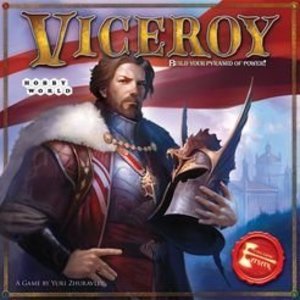


One of the best parts of the board gaming experience is finding a fun group of people with whom to play! Sometimes, though, coordinating a game night is easier said than done. We all must occasionally forego the group experience and face the world as the Lonely Only. But fear not! The world of solo-play is a vast and exciting realm! What follows is a chronicle of my journey into the solo-playing world – notes on gameplay, mechanics, rules, difficulty, and overall experience with solo variations of commonly multiplayer games! I hope this will provide some insight as you continue to grow your collection, or explore your already owned games!
Power. That’s what everyone wants, isn’t it? Well, at least it is in Viceroy! As an inhabitant of the world of Laar, you are fighting to become the ultimate ruler. Recruit allies who provide strategic advantages and enact laws that solidify your claim for power. Do you have what it takes to build and maintain a powerful kingdom, or will your attempts fall short?
DISCLAIMER: There is an expansion to this game, but we are not reviewing it at this time. Should we review it in the future we will either update this review or post a link to the new material here. -T
Viceroy, a game of card drafting and tile placement, is played over 12 turns in which players build a pyramid with their cards – paying to place each card and collecting rewards based upon which level of the pyramid a card is placed. Each turn is divided into two phases: Auction and Development. During the Auction Phase, players bid gemstones to buy a card from the auction line. Once every player has either collected 1 card from auction or passed, play moves to the Development Phase. During the Development Phase, players can either play a card into their pyramid, pass, or discard a card and take 2 gemstones from the reserve. To play a Law card into your pyramid, you place it for free. To play a Character card into your pyramid, you have to pay for it with gems. The cost is dependent upon which level of the pyramid the card is to be placed. You must pay for the level the card will sit on, as well as pay the cost for every level beneath it. For example, to add a card to the third level of the pyramid, you must pay the cost for the 3rd level, AND 2nd level, AND 1st level. The rewards gained from adding a card to the pyramid, however, are taken only for the level on which the card sits. In the earlier example, you would only get the reward for the third level alone, since that is the level on which the card sits. The Development Phase is played over 3 rounds, so a player could play up to 3 cards into their pyramid during 1 Development Phase. After the 3 rounds are up, the next turn begins again in the Auction Phase. When all cards are gone from the Auction Deck, the game ends. Players count up all of their Power Points, and the player with the highest Power value wins!
The only change in Viceroy between a group and solo game is during the Auction Phase. Obviously, if you are playing solo, there is nobody to bid against for cards. How that is alleviated is that you still bid your gemstone as normal, and you randomly draw an unused gemstone from the box as an AI bid. If the colors match, you lose your gem and go on to the next auction. If the colors do not match, you collect your choice card, and the card the AI would have collected gets discarded. If the AI color does not match an available card, you just discard one of the remaining cards. This mimics group play in the sense that you might not always get the card you want from auction! The Development Phase is played as normal. At the end of the game, count points as normal and try to beat your own high score.
Viceroy is a neat game. Every card has so many options that there is no one single strategy that is a sure-win every time. Maybe one game I’ll go for Magic tokens. And maybe the next I’ll try to go for raw Power Point tokens. The possibilities really are endless, and that keeps this game fresh for me. I don’t feel like I’m just going through the motions because every card will act differently depending on where it is played. Strategy really is everything here. On the flip-side of that, however, is that sometimes the options can be a little overwhelming. With so many possibilities for each card, it can get hard for me to decide on what strategy I really want to use. It should also be noted that a card can only be played onto a level if it can sit on exactly 2 cards on the level beneath it. So sometimes I buy a card to play on a certain level only to get to the Development Phase and realize I don’t have a legal place to which I can play it. So do I sacrifice other cards/gemstones to build a slot for this one card, or do I play it to a different level and change my strategy a bit? There’s a little bit of a learning curve, but the more I play, the better I get (or at least, the better I think I get).
Another grievance with Viceroy is that I find myself running out of cards in my hand a lot. The only opportunity to draw cards is if you play a card into your pyramid that allows you to do so. And since I’m usually focused on other strategic routes, I don’t use those cards for those purposes. So then I play all of the cards in my hand (leaving me empty-handed), get 1 card at the next auction, play it, and am again left with no cards in my hand. To fix this issue, I wish one of the actions you could take during the Development Phase was to draw 1 card. I’m not sure if other people have this issue, or if it’s just me, but it’s a problem I run into almost every game.
Overall, I think Viceroy is a good game. It’s unique in the sense that there are so many possibilities that you’ll probably never play the same game twice, even if you decide to play by the same strategy. The mechanics and gameplay are cool too – it’s fun to watch your pyramid literally grow in front of you as the game progresses. This game takes a little more focus and thought than you might think, so it’s not one I’d necessarily just pull out for some light fun. I think Viceroy is as exciting as a solo game as it is as a group game since there really aren’t any differences between the two settings. If you like Viceroy, give it a try solo! If you’ve never played Viceroy, try it either solo or in a group – it’s the same game after all!
https://purplephoenixgames.wordpress.com/2019/04/18/solo-chronicles-viceroy/
Power. That’s what everyone wants, isn’t it? Well, at least it is in Viceroy! As an inhabitant of the world of Laar, you are fighting to become the ultimate ruler. Recruit allies who provide strategic advantages and enact laws that solidify your claim for power. Do you have what it takes to build and maintain a powerful kingdom, or will your attempts fall short?
DISCLAIMER: There is an expansion to this game, but we are not reviewing it at this time. Should we review it in the future we will either update this review or post a link to the new material here. -T
Viceroy, a game of card drafting and tile placement, is played over 12 turns in which players build a pyramid with their cards – paying to place each card and collecting rewards based upon which level of the pyramid a card is placed. Each turn is divided into two phases: Auction and Development. During the Auction Phase, players bid gemstones to buy a card from the auction line. Once every player has either collected 1 card from auction or passed, play moves to the Development Phase. During the Development Phase, players can either play a card into their pyramid, pass, or discard a card and take 2 gemstones from the reserve. To play a Law card into your pyramid, you place it for free. To play a Character card into your pyramid, you have to pay for it with gems. The cost is dependent upon which level of the pyramid the card is to be placed. You must pay for the level the card will sit on, as well as pay the cost for every level beneath it. For example, to add a card to the third level of the pyramid, you must pay the cost for the 3rd level, AND 2nd level, AND 1st level. The rewards gained from adding a card to the pyramid, however, are taken only for the level on which the card sits. In the earlier example, you would only get the reward for the third level alone, since that is the level on which the card sits. The Development Phase is played over 3 rounds, so a player could play up to 3 cards into their pyramid during 1 Development Phase. After the 3 rounds are up, the next turn begins again in the Auction Phase. When all cards are gone from the Auction Deck, the game ends. Players count up all of their Power Points, and the player with the highest Power value wins!
The only change in Viceroy between a group and solo game is during the Auction Phase. Obviously, if you are playing solo, there is nobody to bid against for cards. How that is alleviated is that you still bid your gemstone as normal, and you randomly draw an unused gemstone from the box as an AI bid. If the colors match, you lose your gem and go on to the next auction. If the colors do not match, you collect your choice card, and the card the AI would have collected gets discarded. If the AI color does not match an available card, you just discard one of the remaining cards. This mimics group play in the sense that you might not always get the card you want from auction! The Development Phase is played as normal. At the end of the game, count points as normal and try to beat your own high score.
Viceroy is a neat game. Every card has so many options that there is no one single strategy that is a sure-win every time. Maybe one game I’ll go for Magic tokens. And maybe the next I’ll try to go for raw Power Point tokens. The possibilities really are endless, and that keeps this game fresh for me. I don’t feel like I’m just going through the motions because every card will act differently depending on where it is played. Strategy really is everything here. On the flip-side of that, however, is that sometimes the options can be a little overwhelming. With so many possibilities for each card, it can get hard for me to decide on what strategy I really want to use. It should also be noted that a card can only be played onto a level if it can sit on exactly 2 cards on the level beneath it. So sometimes I buy a card to play on a certain level only to get to the Development Phase and realize I don’t have a legal place to which I can play it. So do I sacrifice other cards/gemstones to build a slot for this one card, or do I play it to a different level and change my strategy a bit? There’s a little bit of a learning curve, but the more I play, the better I get (or at least, the better I think I get).
Another grievance with Viceroy is that I find myself running out of cards in my hand a lot. The only opportunity to draw cards is if you play a card into your pyramid that allows you to do so. And since I’m usually focused on other strategic routes, I don’t use those cards for those purposes. So then I play all of the cards in my hand (leaving me empty-handed), get 1 card at the next auction, play it, and am again left with no cards in my hand. To fix this issue, I wish one of the actions you could take during the Development Phase was to draw 1 card. I’m not sure if other people have this issue, or if it’s just me, but it’s a problem I run into almost every game.
Overall, I think Viceroy is a good game. It’s unique in the sense that there are so many possibilities that you’ll probably never play the same game twice, even if you decide to play by the same strategy. The mechanics and gameplay are cool too – it’s fun to watch your pyramid literally grow in front of you as the game progresses. This game takes a little more focus and thought than you might think, so it’s not one I’d necessarily just pull out for some light fun. I think Viceroy is as exciting as a solo game as it is as a group game since there really aren’t any differences between the two settings. If you like Viceroy, give it a try solo! If you’ve never played Viceroy, try it either solo or in a group – it’s the same game after all!
https://purplephoenixgames.wordpress.com/2019/04/18/solo-chronicles-viceroy/

Chris Sawin (602 KP) rated Batman Begins (2005) in Movies
Jun 18, 2019

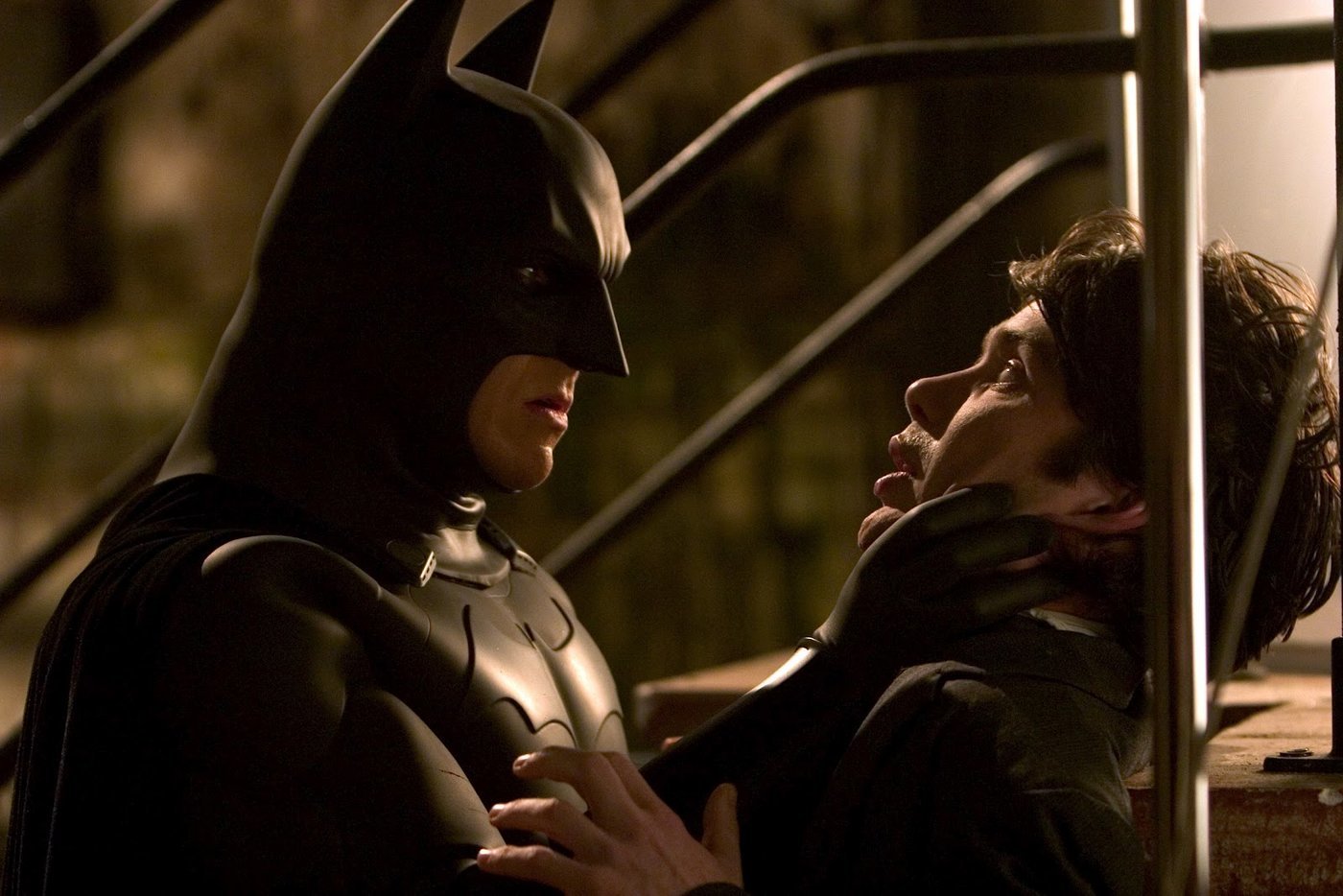
Before Ben Affleck, but after Adam West, Michael Keaton, Kevin Conroy, Val Kilmer, and George Clooney, Christian Bale was Batman for at least two of the best Batman films out there. With a screenplay by director Christopher Nolan and his brother Jonathan and a story by David S. Goyer, Batman Begins is an origin story. Gotham City is dying since criminals like Carmine Falcone (Tom Wilkinson) are able to get away with murder since, “he keeps the bad people rich and the good people scared,” as Rachel Dawes (Katie Holmes) puts it. Bruce Wayne (Christian Bale) trains with Henri Ducard (Liam Neeson), the right hand of Ra’s Al Ghul (Ken Watanabe), and The League of Shadows.
But The League of Shadows has a skewed view of justice since they believe that more serious crimes should be punishable by death (usually by their hand) while Bruce believes in compassion and the right to a fair trial before passing judgment. Leaving The League of Shadows in shambles, Bruce makes his way back to Gotham after a seven year absence. In Bruce’s own words, “As a man, I’m flesh and blood. I can be ignored. I can be destroyed. But as a symbol I can be incorruptible. I can be everlasting.” This is the story of Batman’s uprising; how a young Bruce Wayne conquered his fear of bats and the death of his parents to become the ominous and fearsome dark knight.
Even when you look back at what Christopher Nolan accomplished in his Dark Knight Trilogy, Batman Begins still holds its own and should be considered one of the best Batman films to date. Before Batman v Superman took the dark and gritty aspects of serious superhero films too far, Batman Begins was the first Batman film since Tim Burton’s Batman to favor a more serious tone in comparison to the campiness that overloads the likes of Batman Forever and Batman & Robin. Christopher Nolan always had the intention of keeping Batman grounded in realism and that concept reflected in its incredibly well-written storyline. Batman Begins is a lot like the Year One comic book storyline with Bruce Wayne returning to Gotham City after training in martial arts and being gone for several years, the inclusion of Carmine Falcone, a blossoming relationship between Batman and Jim Gordon, and The Joker tease on the rooftop even ends the story in similar fashion.
The realistic quality Christopher Nolan was aiming for also translates into the dialogue as nothing seems forced or out of place and everything seems to take place in consistent and reasonable fashion. Aside from Christian Bale, the rest of the cast is far more impressive than it had any right to be with the likes of Michael Caine, Morgan Freeman, Gary Oldman, Cillian Murphy, and Rutger Hauer. Caine adds a level of tenderness to the Alfred character we haven’t really seen before while Cillian Murphy is brilliantly sinister as Jonathan Crane/Scarecrow. Thanks to frequent Christopher Nolan collaborator, director of photography Wally Pfister, Batman Begins is beautifully shot. Colors are always bright and vibrant outside of the Batcave as the dark visuals of the film seem to slowly swallow their colorful surroundings piece by piece.
The inclusion of Liam Neeson in the film is an interesting one for statistical purposes. Prior to Taken, Neeson was known for taking on roles where his character died; Star Wars: Episode I – The Phantom Menace, Gangs of New York, Kingdom of Heaven, and The Chronicles of Narnia: The Lion, The Witch, and The Wardrobe are all prime examples. Neeson’s character Ducard is also the main ingredient in the surprise Nolan often includes in the finale of his films. Neeson has this calm demeanor about him as Ducard that portrays just how in control he is of the training he’s passing onto Bruce. The cast to Batman films are usually packed with stars that are relevant to the time it’s released, but Batman Begins can boast that its supporting cast is just as strong as the leads in the film.
The reasoning behind Christian Bale’s Batman voice is legitimate and you certainly understand why it’s utilized, but the awkward transition between normal voice and rough and raspy vigilante takes some getting used to since you immediately think of the ridiculousness in The Lego Batman Movie or the handful of Deadpool 2 jokes whenever he’s Batman now. Katie Holmes is dull dishwater as an actress. She is the least memorable of the entire cast and is basically that person at a party that everyone knows that’s there but they don’t say anything to anybody before leaving when no one is looking. Maggie Gyllenhaal is able to add some depth with the Rachel Dawes character in The Dark Knight, but it’s as if you can still hear the sound of the Dawson’s Creek theme song echoing in your head whenever Gyllenhaal is on-screen; Katie Holmes is like a huge fart that is still smelt after she’s gone in the sequel she’s not even a part of. There was an overwhelming amount of complaints in the online community regarding how ugly Batman’s new Batmobile, The Tumblr, is in the film. While the vehicle is ugly, at least that ugliness is maintained throughout Nolan’s entire trilogy. Batman likes ugly things in this universe, but at least they’re functional and serve their purpose.
Even with how most individuals feel about The Dark Knight, Batman Begins is still an incredible superhero film that is more than capable as a standalone feature as well as the jumpstart to a new set of Batman films. Christopher Nolan practically reinvented the Batman franchise to a certain extent starting with this film. Depending on how you feel about Ben Affleck’s Batman, Christian Bale was the last satisfying Batman.
Batman Begins feels more like a crime film first and a superhero film second where Batman is an unstoppable force of nature. Stripping the film of its origin retelling, one would think this is what Todd McFarlane is going for with his new Spawn film only to an R-rated extent; a superhero that flourishes in the darkness and has a reputation as this spiritual incarnation of vengeance. Christopher Nolan made something special with his Batman films and it feels like Batman Begins is often overlooked due to the reputation of The Dark Knight. While that perspective isn’t necessarily wrong, fans should at least appreciate Batman Begins in a similar light if not a slightly brighter one.
Batman Begins is currently available to stream for $2.99 on Amazon Prime, YouTube, Vudu, and Google Play and for $3.99 on iTunes. The film is available for a variety of formats on Amazon including 4K/Blu-ray ($24.49), DVD ($9.43), and Multi-Format Blu-ray ($11.49). The Blu-ray is currently $5.22 (5% off its normal $5.50 price) in brand new condition and $3.42 pre-owned on eBay with free shipping on both. You can also get the film as part of a three-disc DVD trilogy pack with The Dark Knight and The Dark Knight Rises or as The Dark Knight Trilogy box set on DVD or Blu-ray. Both options are available on both Amazon and eBay (DVD set is running $11.97 on eBay and $19.72 on Amazon while The Dark Knight Trilogy is available in a variety of formats (regular, ultimate, and special editions) on both sites between $12 and $18.99 unless you want the $69.99 ultimate set.
But The League of Shadows has a skewed view of justice since they believe that more serious crimes should be punishable by death (usually by their hand) while Bruce believes in compassion and the right to a fair trial before passing judgment. Leaving The League of Shadows in shambles, Bruce makes his way back to Gotham after a seven year absence. In Bruce’s own words, “As a man, I’m flesh and blood. I can be ignored. I can be destroyed. But as a symbol I can be incorruptible. I can be everlasting.” This is the story of Batman’s uprising; how a young Bruce Wayne conquered his fear of bats and the death of his parents to become the ominous and fearsome dark knight.
Even when you look back at what Christopher Nolan accomplished in his Dark Knight Trilogy, Batman Begins still holds its own and should be considered one of the best Batman films to date. Before Batman v Superman took the dark and gritty aspects of serious superhero films too far, Batman Begins was the first Batman film since Tim Burton’s Batman to favor a more serious tone in comparison to the campiness that overloads the likes of Batman Forever and Batman & Robin. Christopher Nolan always had the intention of keeping Batman grounded in realism and that concept reflected in its incredibly well-written storyline. Batman Begins is a lot like the Year One comic book storyline with Bruce Wayne returning to Gotham City after training in martial arts and being gone for several years, the inclusion of Carmine Falcone, a blossoming relationship between Batman and Jim Gordon, and The Joker tease on the rooftop even ends the story in similar fashion.
The realistic quality Christopher Nolan was aiming for also translates into the dialogue as nothing seems forced or out of place and everything seems to take place in consistent and reasonable fashion. Aside from Christian Bale, the rest of the cast is far more impressive than it had any right to be with the likes of Michael Caine, Morgan Freeman, Gary Oldman, Cillian Murphy, and Rutger Hauer. Caine adds a level of tenderness to the Alfred character we haven’t really seen before while Cillian Murphy is brilliantly sinister as Jonathan Crane/Scarecrow. Thanks to frequent Christopher Nolan collaborator, director of photography Wally Pfister, Batman Begins is beautifully shot. Colors are always bright and vibrant outside of the Batcave as the dark visuals of the film seem to slowly swallow their colorful surroundings piece by piece.
The inclusion of Liam Neeson in the film is an interesting one for statistical purposes. Prior to Taken, Neeson was known for taking on roles where his character died; Star Wars: Episode I – The Phantom Menace, Gangs of New York, Kingdom of Heaven, and The Chronicles of Narnia: The Lion, The Witch, and The Wardrobe are all prime examples. Neeson’s character Ducard is also the main ingredient in the surprise Nolan often includes in the finale of his films. Neeson has this calm demeanor about him as Ducard that portrays just how in control he is of the training he’s passing onto Bruce. The cast to Batman films are usually packed with stars that are relevant to the time it’s released, but Batman Begins can boast that its supporting cast is just as strong as the leads in the film.
The reasoning behind Christian Bale’s Batman voice is legitimate and you certainly understand why it’s utilized, but the awkward transition between normal voice and rough and raspy vigilante takes some getting used to since you immediately think of the ridiculousness in The Lego Batman Movie or the handful of Deadpool 2 jokes whenever he’s Batman now. Katie Holmes is dull dishwater as an actress. She is the least memorable of the entire cast and is basically that person at a party that everyone knows that’s there but they don’t say anything to anybody before leaving when no one is looking. Maggie Gyllenhaal is able to add some depth with the Rachel Dawes character in The Dark Knight, but it’s as if you can still hear the sound of the Dawson’s Creek theme song echoing in your head whenever Gyllenhaal is on-screen; Katie Holmes is like a huge fart that is still smelt after she’s gone in the sequel she’s not even a part of. There was an overwhelming amount of complaints in the online community regarding how ugly Batman’s new Batmobile, The Tumblr, is in the film. While the vehicle is ugly, at least that ugliness is maintained throughout Nolan’s entire trilogy. Batman likes ugly things in this universe, but at least they’re functional and serve their purpose.
Even with how most individuals feel about The Dark Knight, Batman Begins is still an incredible superhero film that is more than capable as a standalone feature as well as the jumpstart to a new set of Batman films. Christopher Nolan practically reinvented the Batman franchise to a certain extent starting with this film. Depending on how you feel about Ben Affleck’s Batman, Christian Bale was the last satisfying Batman.
Batman Begins feels more like a crime film first and a superhero film second where Batman is an unstoppable force of nature. Stripping the film of its origin retelling, one would think this is what Todd McFarlane is going for with his new Spawn film only to an R-rated extent; a superhero that flourishes in the darkness and has a reputation as this spiritual incarnation of vengeance. Christopher Nolan made something special with his Batman films and it feels like Batman Begins is often overlooked due to the reputation of The Dark Knight. While that perspective isn’t necessarily wrong, fans should at least appreciate Batman Begins in a similar light if not a slightly brighter one.
Batman Begins is currently available to stream for $2.99 on Amazon Prime, YouTube, Vudu, and Google Play and for $3.99 on iTunes. The film is available for a variety of formats on Amazon including 4K/Blu-ray ($24.49), DVD ($9.43), and Multi-Format Blu-ray ($11.49). The Blu-ray is currently $5.22 (5% off its normal $5.50 price) in brand new condition and $3.42 pre-owned on eBay with free shipping on both. You can also get the film as part of a three-disc DVD trilogy pack with The Dark Knight and The Dark Knight Rises or as The Dark Knight Trilogy box set on DVD or Blu-ray. Both options are available on both Amazon and eBay (DVD set is running $11.97 on eBay and $19.72 on Amazon while The Dark Knight Trilogy is available in a variety of formats (regular, ultimate, and special editions) on both sites between $12 and $18.99 unless you want the $69.99 ultimate set.


Purple Phoenix Games (2266 KP) rated Tranquility in Tabletop Games
Oct 21, 2021
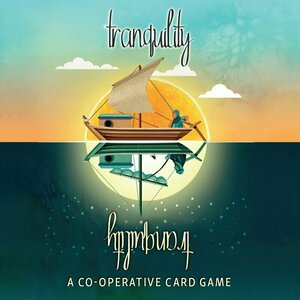
Are you a boat person? As in, do you enjoy lounging on a boat, floating to nowhere in particular, just enjoying the day? Or are you a thrill-seeking water-skiier or tuber that enjoys shredding the waves and nearly drowning? Perhaps you are neither. I am definitely in the first category. I would rather just toot around a lake in a boat, maybe throw out a fishing pole, and just enjoy being out on the water with little care for what may be happening in the world around me. So when I heard that Lucky Duck Games was planning on publishing Tranquility I just had to jump at the opportunity to get it on my table. And I was definitely impressed.
Tranquility is a cooperative hand management, tile placement card game for one to five players. In it players will be attempting to create a sea of islands around which they sail their boat towards infinite paradise. They will accomplish this by laying numbered cards from their hand in numerical order before any of the players run out of chances to play a card. Oh, and there’s also no talking during the game. That’s kind of a big deal.
DISCLAIMER: We were provided a copy of this game for the purposes of this review. This is a retail copy of the game, so what you see in these photos is exactly what would be received in your box. I do not intend to cover every single rule included in the rulebook, but will describe the overall game flow and major rule set so that our readers may get a sense of how the game plays. For more in depth rules, you may purchase a copy online or from your FLGS. -T
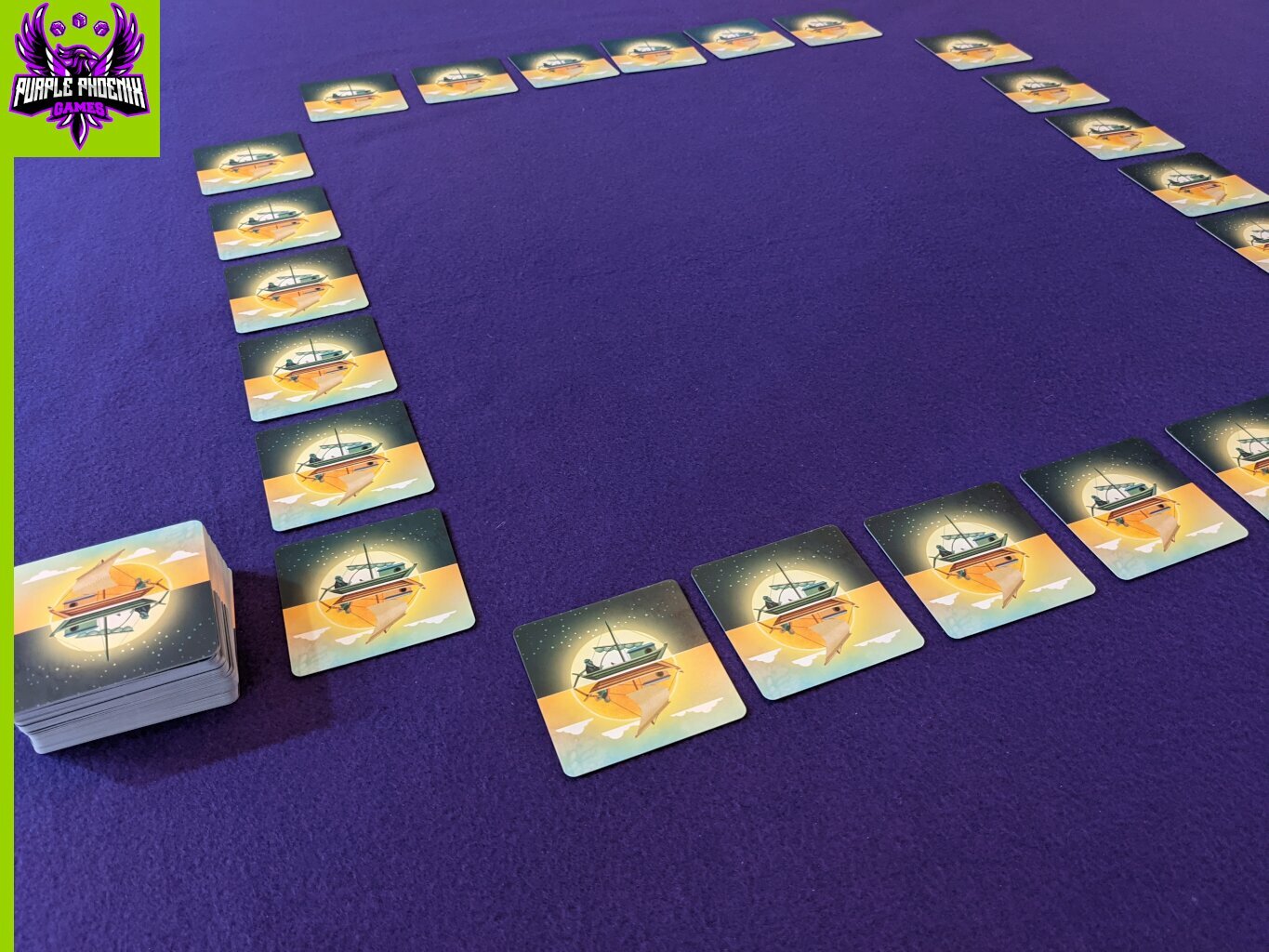
To setup the standard game, place all the border cards around a 6×6 grid, as in the photo below. Shuffle the appropriate number of Start and Finish cards into the deck of Island cards and place that beside the grid. Draw a hand of five cards and the game may begin. Setup is similar to the multiplayer setup, with a few changes. Once the hand of cards has been drawn, the game may begin! It is the solo player’s goal to build the sea of island cards, and place the Start and Finish cards before they run out of cards to be legally played.
The game is played over many turns. Each turn players will be either playing a card from hand or discarding two cards. When a player plays a card from hand to the grid, they may place it anywhere they wish within the grid. The goal is to have each card placed numerically in order beginning from the lower left of the grid in a zig-zag pattern left to right, then ascending to the next highest level. In other words, the play area would be ordered numerically as English-speaking people read, but from the bottom up instead of the top down – like a reverse typewriter.
When a card is played, the player may choose to place it in its own area, or immediately next to another card already in play. If the new card is placed adjacent to an existing card, the player must discard cards equal to the difference between the values of the two adjacent cards. For example, if a 12 is placed next to a 14, then the player would need to discard two cards after placement. If a card is placed that is already in direct numerical order, no discards are needed. Again, a card at the right-hand edge of a row is adjacent to the card on the next row higher on the left-hand edge, and this is the most difficult aspect of the game to grasp for new players.
Should a player instead wish to discard two cards for their turn, they do so to their discard pile. After each action (playing a card or discarding two cards) the player will draw back up to their hand of five cards.
Eventually, the player will happen across the Start and Finish cards. In the solo game, when a Start card is placed (outside the grid, but in amongst the border cards in the lower left-hand corner), the player will need to draw eight cards from the draw deck, keep four, and discard the remaining eight. This eats up cards from the draw pile and draws the game closer to the end. When the grid is completed and all the numbered cards are in numerical order, the player may then play the Finish card to end the game. If all cards are properly placed the player wins! If not, they must try again. Probably immediately, because it is that kind of game.
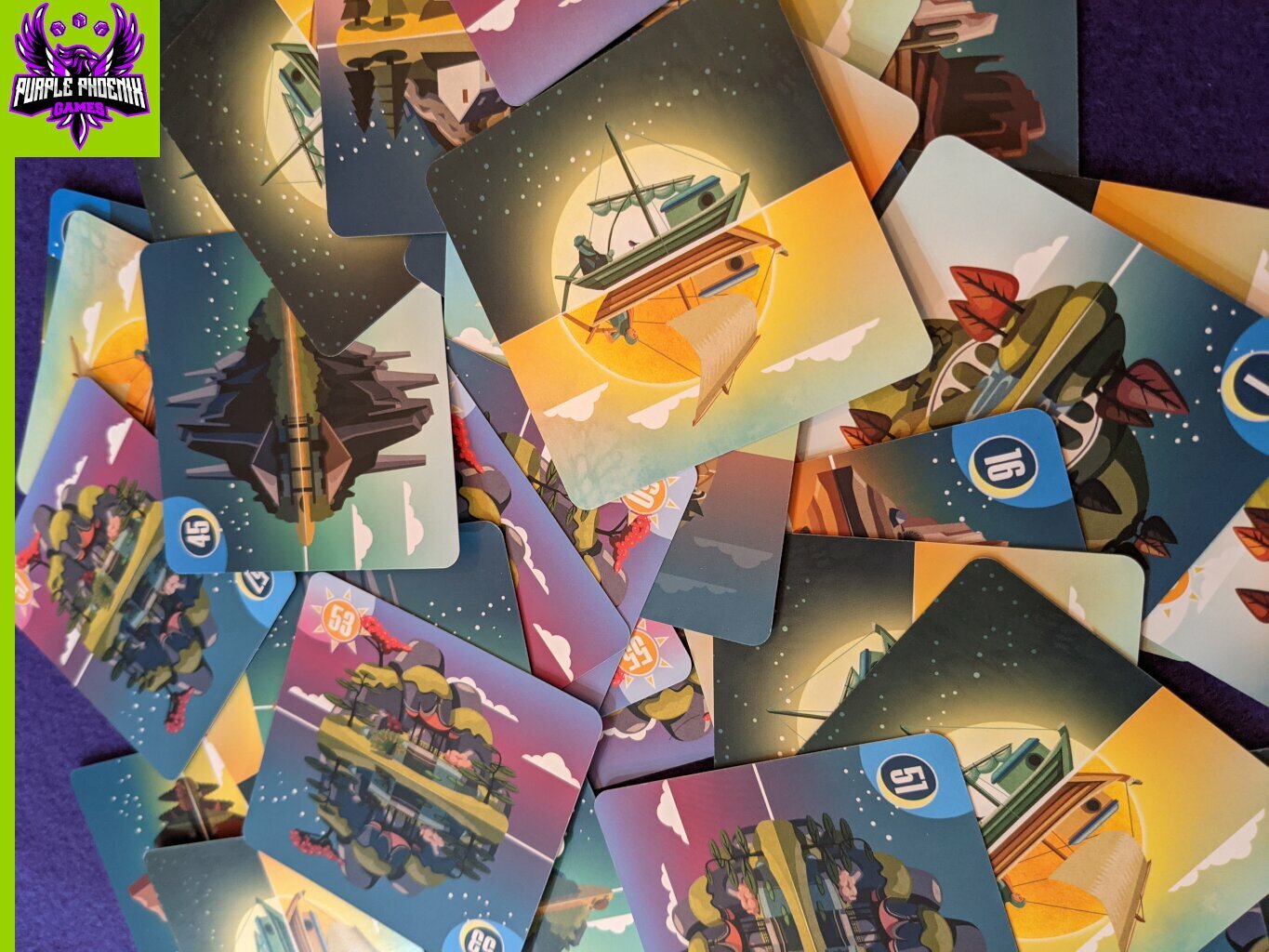
Components. This game is a bunch of square cards in a cubic box. Now, while that doesn’t sound super exciting, the art on the cards certainly make up for the lack of component diversity. Each card is matte finished, which I prefer for cards with great art on them. And oh man, that art is something wonderful! I have always been a fan of Tristam Rossin’s art, and it is on full display here. The cards are, well, I guess I cannot find the correct word because they aren’t double-sided, but split on the horizontal, with a daytime scene on the “top” and a nighttime scene on the “bottom” (or vice-versa, however you feel). I have nothing but praise for the components here.
The gameplay is familiar in feel, but definitely a little different and a whole lot of fun. Fans of The Mind will find this familiar in that the game is structured around silent players building a grid/stack of numerically appropriate cards until the win condition is met. However, I have not been able to play The Mind solo, and Tranquility comes with solo rules in the box. So that’s a win in my book.
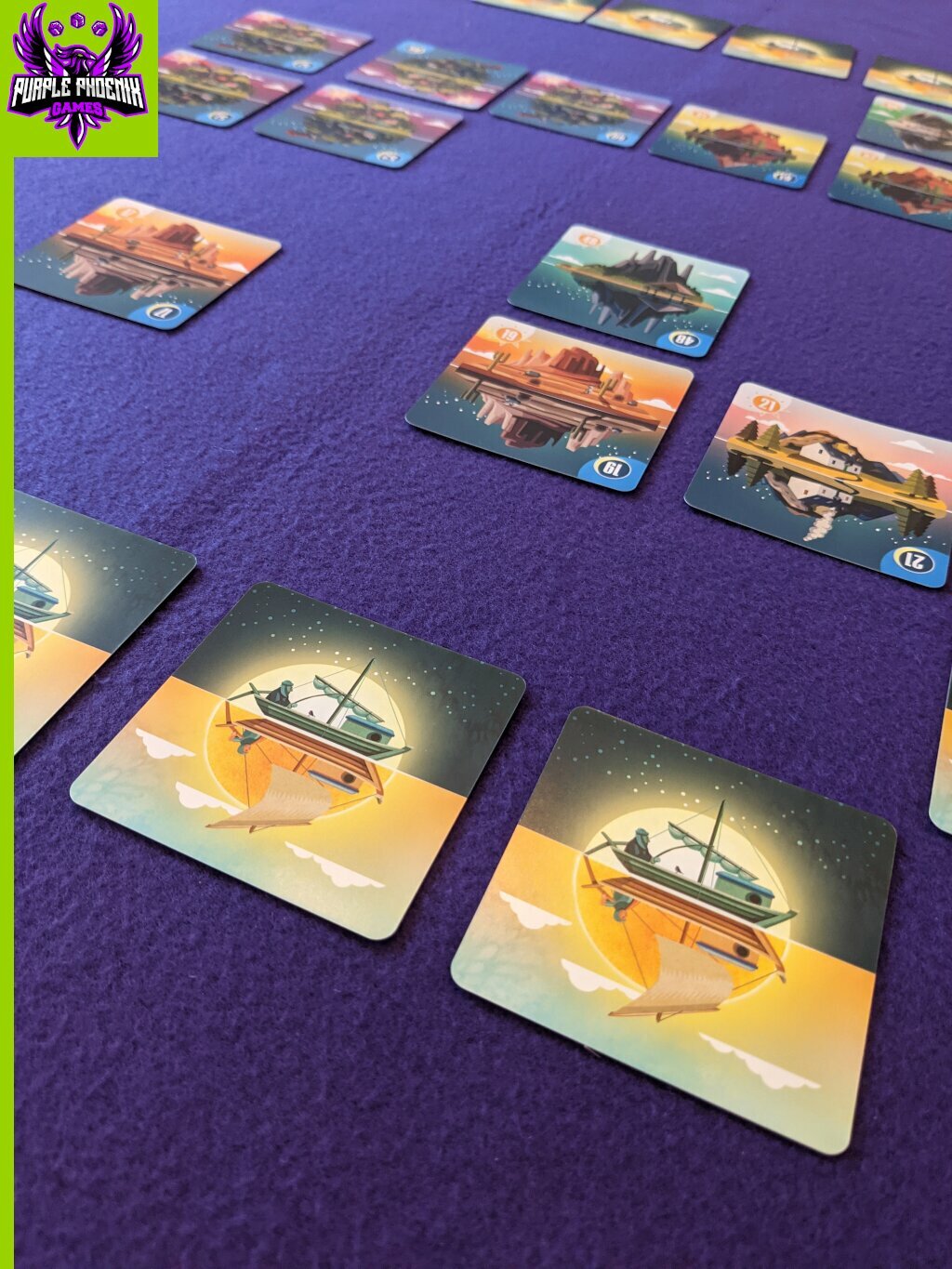
Now, Tranquility solo is no cakewalk. No, there are no other players to make crazy decisions to throw off any tactics planned, but you most certainly can misjudge where to place a card, and then be married to its position as you try to fill in all the appropriate cards around it. I learned that all too early when I decided my first game that I should try to divide the grid into equal sections and approximate where a 48 should go. Well, I’ll tell you now that a 48 has absolutely no business being a row above a 19 (check the photo above if you don’t believe me). Silly choices like this make for an afternoon of pondering optimal placements when unboxing your next play, and that brings a smile to my face. Any time I think about a game the next day or several days later and it entices me to play again with a different strategy, I feel is the mark of a great game.
I have yet to play this with a group (damn COVID), but I know the people I play with are going to love this one. And, honestly, I am going to love the peace and quiet as the game plays out, so I can think about my turn and then think about a different possibility once someone ruins my plans. But I tell you what, even as a solo game, this one is great. I am quite happy to keep this as a pure solo experience, but I do want to try it once with others. We do not typically give out ratings for Solo Chronicles reviews, but this one would be pretty high, I’m telling you now. Okay, I have to go get the boat ready and pack my cooler. Enjoy Tranquility!
Tranquility is a cooperative hand management, tile placement card game for one to five players. In it players will be attempting to create a sea of islands around which they sail their boat towards infinite paradise. They will accomplish this by laying numbered cards from their hand in numerical order before any of the players run out of chances to play a card. Oh, and there’s also no talking during the game. That’s kind of a big deal.
DISCLAIMER: We were provided a copy of this game for the purposes of this review. This is a retail copy of the game, so what you see in these photos is exactly what would be received in your box. I do not intend to cover every single rule included in the rulebook, but will describe the overall game flow and major rule set so that our readers may get a sense of how the game plays. For more in depth rules, you may purchase a copy online or from your FLGS. -T
To setup the standard game, place all the border cards around a 6×6 grid, as in the photo below. Shuffle the appropriate number of Start and Finish cards into the deck of Island cards and place that beside the grid. Draw a hand of five cards and the game may begin. Setup is similar to the multiplayer setup, with a few changes. Once the hand of cards has been drawn, the game may begin! It is the solo player’s goal to build the sea of island cards, and place the Start and Finish cards before they run out of cards to be legally played.
The game is played over many turns. Each turn players will be either playing a card from hand or discarding two cards. When a player plays a card from hand to the grid, they may place it anywhere they wish within the grid. The goal is to have each card placed numerically in order beginning from the lower left of the grid in a zig-zag pattern left to right, then ascending to the next highest level. In other words, the play area would be ordered numerically as English-speaking people read, but from the bottom up instead of the top down – like a reverse typewriter.
When a card is played, the player may choose to place it in its own area, or immediately next to another card already in play. If the new card is placed adjacent to an existing card, the player must discard cards equal to the difference between the values of the two adjacent cards. For example, if a 12 is placed next to a 14, then the player would need to discard two cards after placement. If a card is placed that is already in direct numerical order, no discards are needed. Again, a card at the right-hand edge of a row is adjacent to the card on the next row higher on the left-hand edge, and this is the most difficult aspect of the game to grasp for new players.
Should a player instead wish to discard two cards for their turn, they do so to their discard pile. After each action (playing a card or discarding two cards) the player will draw back up to their hand of five cards.
Eventually, the player will happen across the Start and Finish cards. In the solo game, when a Start card is placed (outside the grid, but in amongst the border cards in the lower left-hand corner), the player will need to draw eight cards from the draw deck, keep four, and discard the remaining eight. This eats up cards from the draw pile and draws the game closer to the end. When the grid is completed and all the numbered cards are in numerical order, the player may then play the Finish card to end the game. If all cards are properly placed the player wins! If not, they must try again. Probably immediately, because it is that kind of game.
Components. This game is a bunch of square cards in a cubic box. Now, while that doesn’t sound super exciting, the art on the cards certainly make up for the lack of component diversity. Each card is matte finished, which I prefer for cards with great art on them. And oh man, that art is something wonderful! I have always been a fan of Tristam Rossin’s art, and it is on full display here. The cards are, well, I guess I cannot find the correct word because they aren’t double-sided, but split on the horizontal, with a daytime scene on the “top” and a nighttime scene on the “bottom” (or vice-versa, however you feel). I have nothing but praise for the components here.
The gameplay is familiar in feel, but definitely a little different and a whole lot of fun. Fans of The Mind will find this familiar in that the game is structured around silent players building a grid/stack of numerically appropriate cards until the win condition is met. However, I have not been able to play The Mind solo, and Tranquility comes with solo rules in the box. So that’s a win in my book.
Now, Tranquility solo is no cakewalk. No, there are no other players to make crazy decisions to throw off any tactics planned, but you most certainly can misjudge where to place a card, and then be married to its position as you try to fill in all the appropriate cards around it. I learned that all too early when I decided my first game that I should try to divide the grid into equal sections and approximate where a 48 should go. Well, I’ll tell you now that a 48 has absolutely no business being a row above a 19 (check the photo above if you don’t believe me). Silly choices like this make for an afternoon of pondering optimal placements when unboxing your next play, and that brings a smile to my face. Any time I think about a game the next day or several days later and it entices me to play again with a different strategy, I feel is the mark of a great game.
I have yet to play this with a group (damn COVID), but I know the people I play with are going to love this one. And, honestly, I am going to love the peace and quiet as the game plays out, so I can think about my turn and then think about a different possibility once someone ruins my plans. But I tell you what, even as a solo game, this one is great. I am quite happy to keep this as a pure solo experience, but I do want to try it once with others. We do not typically give out ratings for Solo Chronicles reviews, but this one would be pretty high, I’m telling you now. Okay, I have to go get the boat ready and pack my cooler. Enjoy Tranquility!
Purple Phoenix Games (2266 KP) rated Divinus in Tabletop Games
Aug 10, 2021
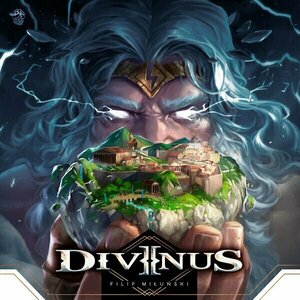
Bragi. Hercules. Percy Jackson. All excellent examples of successful demigods. As you well know, demigods are offspring of a god and a mortal. Of all the things I have conjured in my lifetime to answer the old, “What do you want to be when you grow up?” question, I never really answered, “a demigod.” Well, that’s because I KNOW my parents and have a hard time believing I could be a son of a god or goddess. Unless it was some weird NPCs (novel series by Drew Hayes) universe with Grumble as my patron/parent. In any case, my new dream of becoming the greatest demigod alive must be played out in today’s preview: Divinus.
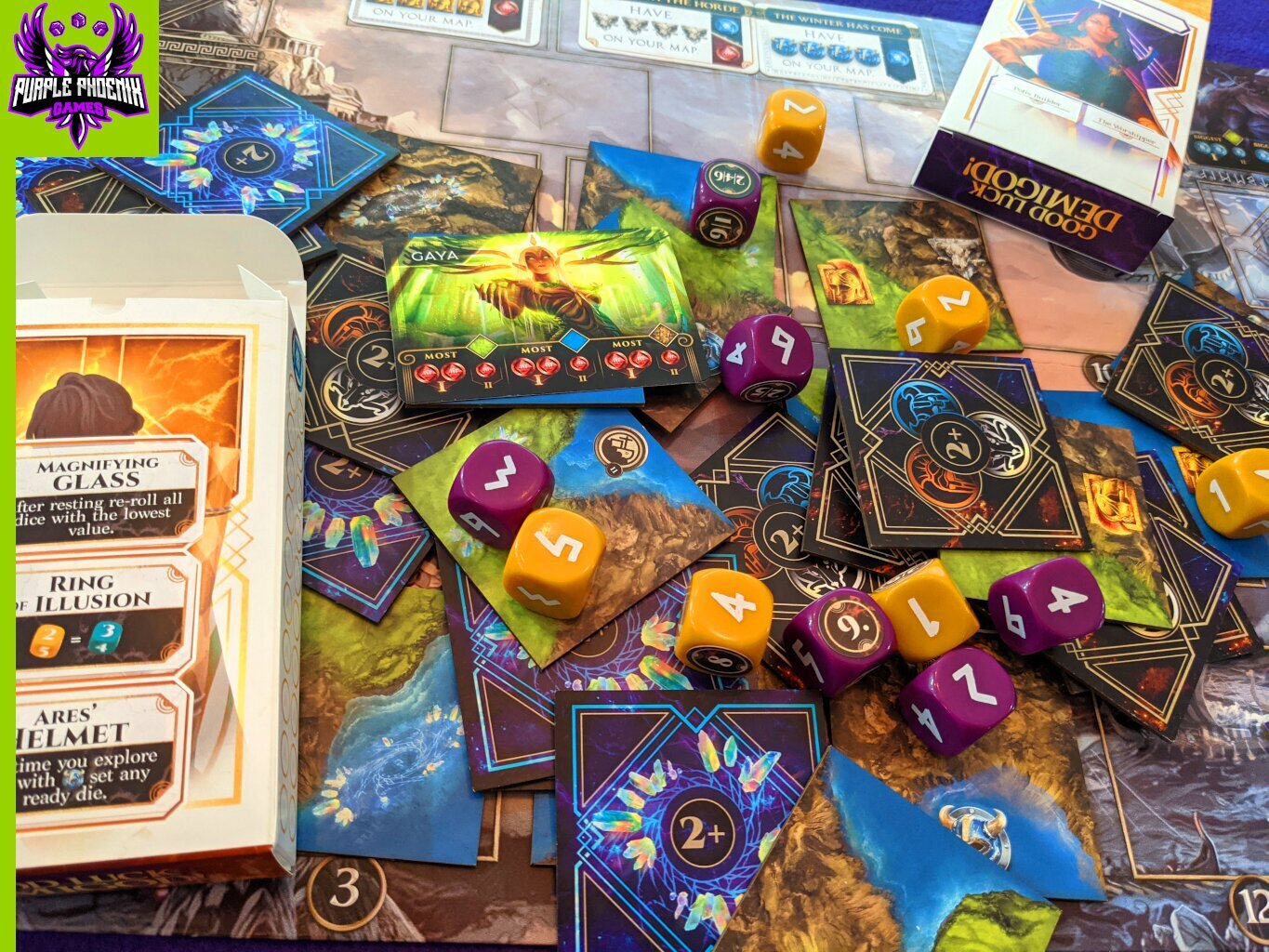
Divinus is a competitive tile placement, campaign, drafting, dice game in which players assume the roles of upcoming demigods fighting over the one last spot at the table. By appeasing the gods of the warring ancient Roman and Norse cultures players will earn their place among them. This game uses some interesting hybrid app-driven story mechanics along with legacy-style component alterations to create this world that is constantly under refurbishment and ripe for the claiming of the future Divinus.
DISCLAIMER: We were provided a prototype copy of this game for the purposes of this review. These are preview copy components, and I do not know for sure if the final components will be any different from these shown. Also, it is not my intention to detail every rule in the game, as there are just too many. You are invited to download the rulebook, back the game through the Gamefound campaign, or through any retailers stocking it after fulfillment. -T
To setup, place the main board on the table, sort out the Map tiles by player count, and populate the board per the rulebook. Each player chooses their Demigod box and takes all components contained within. As Divinus is intended to be played either as a scenario session or its Eternal Mode, which is infinitely replayable using the board and components already altered by previously-played scenarios, open the chosen Scenario Box to be played and allow the app to instruct on how to setup with these components. All players roll their dice and place them in the “ready” pile to be used on their first turn. The first player takes the token (a black meeple in the prototype version) and the game is ready to be played!
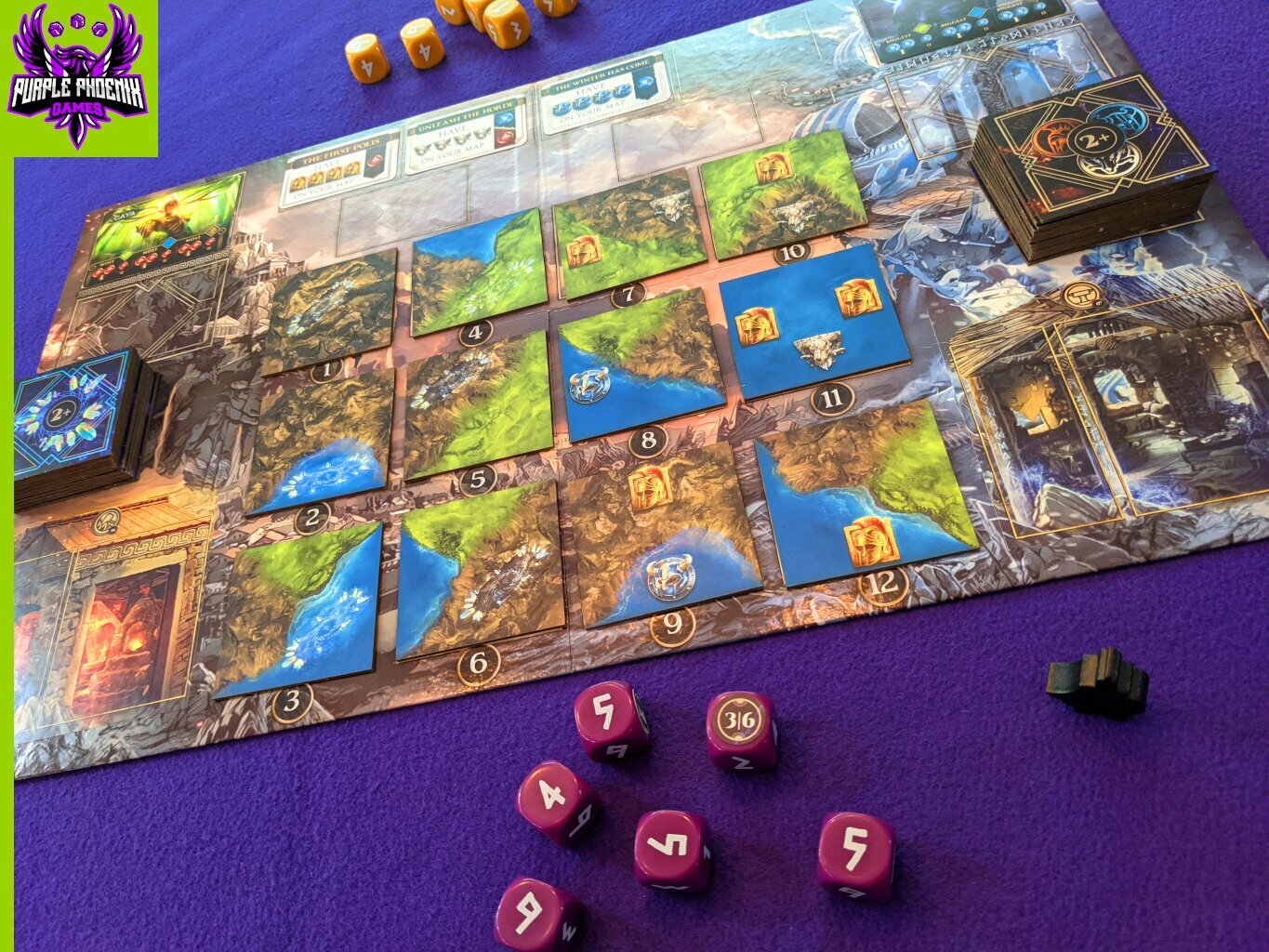
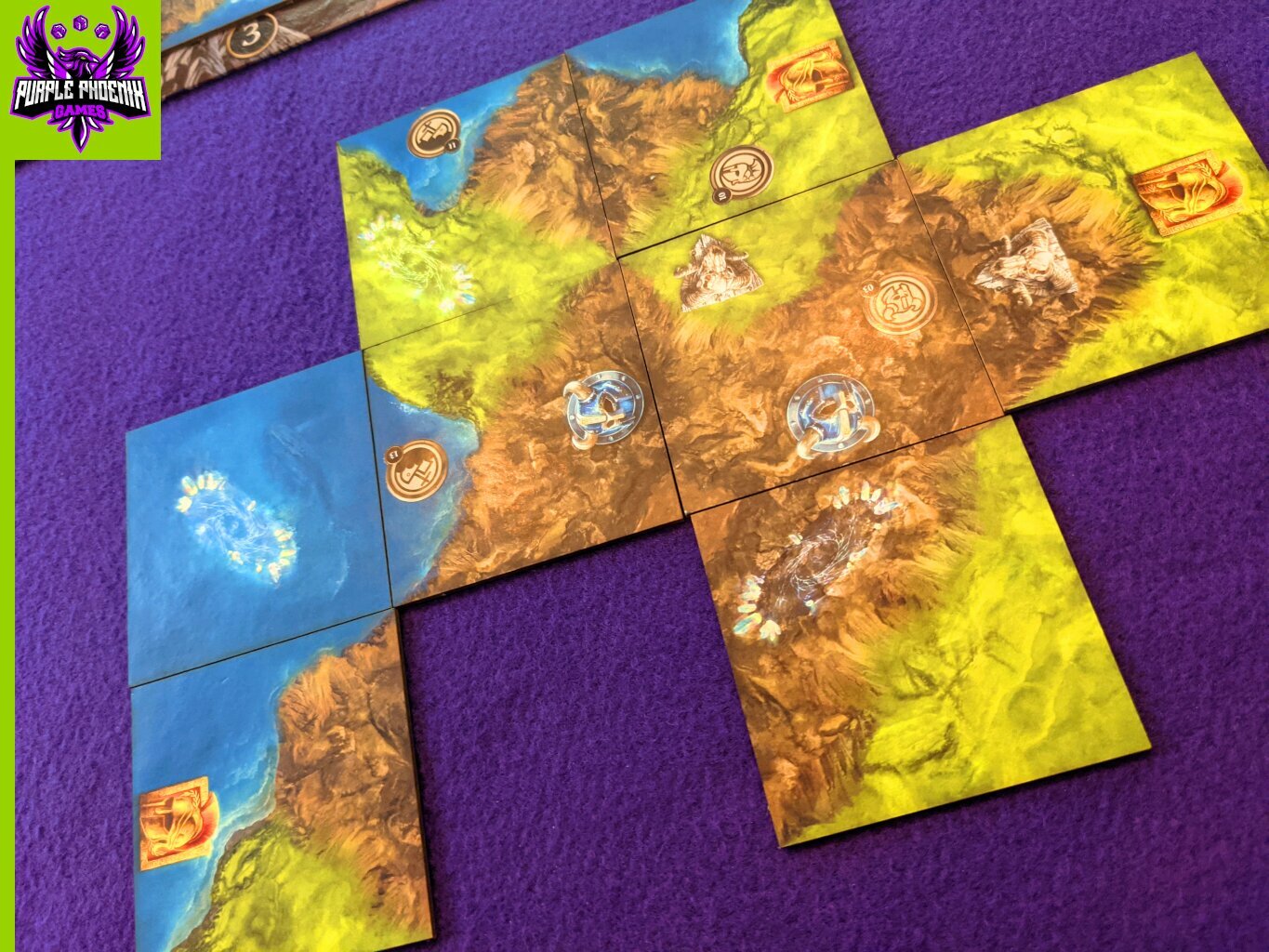
Divinus is played in turns starting with the first player and continuing around the table until one player places their final Map tile signaling the end of the game. On a turn, players will have a choice of using an Explore action or a Rest action. More actions may be available in future scenarios, but for the prototype scenarios, these are the two available choices. During an Explore action, the active player will choose any number of their rolled dice in order to create a mathematical equation that matches with one of the Map tiles on the main board. These spaces range from 1-12 in value, so an appropriate dice combination could be 5 + 4 – 1 = 8 in order to claim the Map tile on the 8 spot. Any number of dice can be used to claim tiles, and once a tile is claimed, it must be placed within the player’s personal play area map. In order to add these tiles, the edges will need to match up by terrain type with tiles already presently in play (see below), or may also be placed atop an existing tile. Map tiles may or may not contain symbols for factions, locations, and also Sacred Places. These will all be used in scenarios for different purposes.
Once a player decides they do not wish to (or cannot) take more Explore actions, they must Rest. To Rest, the active player reclaims all spent (and unspent ready) dice and rerolls them for the next turn, replacing empty spaces on the board with new Map tiles.
Play continues in this fashion of Exploring and Resting until one player places their 16th tile, thus completing their 4×4 personal map. Players will consult the app for scoring instructions and the winner will be announced. Should the players wish to play another scenario (or many, as we would have liked), they simply use the same Demigods and open a new Scenario Box. Inside these boxes are different gods to appease, new quests to fulfill (more on these later), and stickers to be applied to game components to improve their usefulness.
Components. Again, this is a prototype version of the game, and it includes two introductory scenarios, a bunch of sticker sheets, and a developmental app. That said, I really enjoyed my plays of the scenarios and they felt like great first steps to lure me into what I just know is going to be somewhat of a lifestyle game (assuming more and more expansions are in the plans). The sticker sheets are all fine, and as I understand it, the stickers that are placed on the Map tiles will have non-removable glue, but the stickers placed on the dice faces will have removable glue. As I am not a glue expert, I can’t really vouch for either. The app is somewhat similar to those that are used in the Chronicles of Crime series, but Divinus promises to deliver an app that can scan the components WITHOUT the use of QR codes. For those gamers who think the QRs are an eye-sore, then Divinus is taking a promising first step for you! I haven’t even touched on the artwork yet, and that’s usually my favorite aspect of a game’s components. The visual style and art on Divinus really make the game pop on the table, and just draw you into the lore and setting. I love it!
So while initially Divinus is a simple roll-and-draft game of building a 4×4 grid akin to Kingdomino, the addition and usage of the Quests and, later, the Charge Actions, morph this into something quite a bit meatier. Each Scenario Box (at least in this version) contains two god cards (that affect how the end of the scenario is scored) and some Quest cards (that are side-quests players can follow to earn some extra VP and other goodies). I imagine as the game progresses through Scenario Boxes that Quests will get more difficult and the god cards more interesting as well.
All in all Divinus has roped me in, and I am very much looking forward to all the other great things that Lucky Duck Games has planned for it. I can foresee soooooo many expansions being built on this excellent chassis, and I am very eager to finish the entire legacy aspect in order to play through the Eternal Mode a bunch of times. Can I divulge a little dirty secret of mine here? I have never before played any type of legacy board game, and if this is what they are like, then I will be breaking out my copy of Betrayal Legacy way sooner than I originally planned.
I believe that the theming here is great, the gameplay is relatively simple to grasp, and the hybrid app-driven story really adds to the entire experience. If you are someone who, like me, has yet to delve into legacy-style games where the components are constantly changing due to choices made at the table, and you have a penchant for dice games with a splash of ACTUAL math skills used, I urge you to take a look at backing Divinus on Gamefound ASAP. With just the initial two scenarios included, I am already addicted to the game and cannot wait to sink my teeth into more scenarios and more crucial decisions that will alter the landscape of my copy of the game. I know that as of the publish date of this preview, the campaign is already about 1000% funded and so many stretch goals have already been unlocked. It is a great time to hop on board and grab a big ol’ chunk of goodies for this one. You may have a preference for Roman or Norse mythology before playing, but be warned: your loyalties may change as a result of playing Divinus… or maybe you will learn to accept both at the harmonious center of activity in your own little section of the world.
Divinus is a competitive tile placement, campaign, drafting, dice game in which players assume the roles of upcoming demigods fighting over the one last spot at the table. By appeasing the gods of the warring ancient Roman and Norse cultures players will earn their place among them. This game uses some interesting hybrid app-driven story mechanics along with legacy-style component alterations to create this world that is constantly under refurbishment and ripe for the claiming of the future Divinus.
DISCLAIMER: We were provided a prototype copy of this game for the purposes of this review. These are preview copy components, and I do not know for sure if the final components will be any different from these shown. Also, it is not my intention to detail every rule in the game, as there are just too many. You are invited to download the rulebook, back the game through the Gamefound campaign, or through any retailers stocking it after fulfillment. -T
To setup, place the main board on the table, sort out the Map tiles by player count, and populate the board per the rulebook. Each player chooses their Demigod box and takes all components contained within. As Divinus is intended to be played either as a scenario session or its Eternal Mode, which is infinitely replayable using the board and components already altered by previously-played scenarios, open the chosen Scenario Box to be played and allow the app to instruct on how to setup with these components. All players roll their dice and place them in the “ready” pile to be used on their first turn. The first player takes the token (a black meeple in the prototype version) and the game is ready to be played!
Divinus is played in turns starting with the first player and continuing around the table until one player places their final Map tile signaling the end of the game. On a turn, players will have a choice of using an Explore action or a Rest action. More actions may be available in future scenarios, but for the prototype scenarios, these are the two available choices. During an Explore action, the active player will choose any number of their rolled dice in order to create a mathematical equation that matches with one of the Map tiles on the main board. These spaces range from 1-12 in value, so an appropriate dice combination could be 5 + 4 – 1 = 8 in order to claim the Map tile on the 8 spot. Any number of dice can be used to claim tiles, and once a tile is claimed, it must be placed within the player’s personal play area map. In order to add these tiles, the edges will need to match up by terrain type with tiles already presently in play (see below), or may also be placed atop an existing tile. Map tiles may or may not contain symbols for factions, locations, and also Sacred Places. These will all be used in scenarios for different purposes.
Once a player decides they do not wish to (or cannot) take more Explore actions, they must Rest. To Rest, the active player reclaims all spent (and unspent ready) dice and rerolls them for the next turn, replacing empty spaces on the board with new Map tiles.
Play continues in this fashion of Exploring and Resting until one player places their 16th tile, thus completing their 4×4 personal map. Players will consult the app for scoring instructions and the winner will be announced. Should the players wish to play another scenario (or many, as we would have liked), they simply use the same Demigods and open a new Scenario Box. Inside these boxes are different gods to appease, new quests to fulfill (more on these later), and stickers to be applied to game components to improve their usefulness.
Components. Again, this is a prototype version of the game, and it includes two introductory scenarios, a bunch of sticker sheets, and a developmental app. That said, I really enjoyed my plays of the scenarios and they felt like great first steps to lure me into what I just know is going to be somewhat of a lifestyle game (assuming more and more expansions are in the plans). The sticker sheets are all fine, and as I understand it, the stickers that are placed on the Map tiles will have non-removable glue, but the stickers placed on the dice faces will have removable glue. As I am not a glue expert, I can’t really vouch for either. The app is somewhat similar to those that are used in the Chronicles of Crime series, but Divinus promises to deliver an app that can scan the components WITHOUT the use of QR codes. For those gamers who think the QRs are an eye-sore, then Divinus is taking a promising first step for you! I haven’t even touched on the artwork yet, and that’s usually my favorite aspect of a game’s components. The visual style and art on Divinus really make the game pop on the table, and just draw you into the lore and setting. I love it!
So while initially Divinus is a simple roll-and-draft game of building a 4×4 grid akin to Kingdomino, the addition and usage of the Quests and, later, the Charge Actions, morph this into something quite a bit meatier. Each Scenario Box (at least in this version) contains two god cards (that affect how the end of the scenario is scored) and some Quest cards (that are side-quests players can follow to earn some extra VP and other goodies). I imagine as the game progresses through Scenario Boxes that Quests will get more difficult and the god cards more interesting as well.
All in all Divinus has roped me in, and I am very much looking forward to all the other great things that Lucky Duck Games has planned for it. I can foresee soooooo many expansions being built on this excellent chassis, and I am very eager to finish the entire legacy aspect in order to play through the Eternal Mode a bunch of times. Can I divulge a little dirty secret of mine here? I have never before played any type of legacy board game, and if this is what they are like, then I will be breaking out my copy of Betrayal Legacy way sooner than I originally planned.
I believe that the theming here is great, the gameplay is relatively simple to grasp, and the hybrid app-driven story really adds to the entire experience. If you are someone who, like me, has yet to delve into legacy-style games where the components are constantly changing due to choices made at the table, and you have a penchant for dice games with a splash of ACTUAL math skills used, I urge you to take a look at backing Divinus on Gamefound ASAP. With just the initial two scenarios included, I am already addicted to the game and cannot wait to sink my teeth into more scenarios and more crucial decisions that will alter the landscape of my copy of the game. I know that as of the publish date of this preview, the campaign is already about 1000% funded and so many stretch goals have already been unlocked. It is a great time to hop on board and grab a big ol’ chunk of goodies for this one. You may have a preference for Roman or Norse mythology before playing, but be warned: your loyalties may change as a result of playing Divinus… or maybe you will learn to accept both at the harmonious center of activity in your own little section of the world.
Purple Phoenix Games (2266 KP) rated Mutants in Tabletop Games
Mar 11, 2022
Boy, we have some crazy ideas when it comes to what the world will look like in the future. Flying cars? Probably. Robot house butlers? Maybe. Mutant fighters that can be formed immediately and placed into battle seconds after “birth?” Now, that’s a stretch. But, embrace the stretch here, because Mutants is all about it.
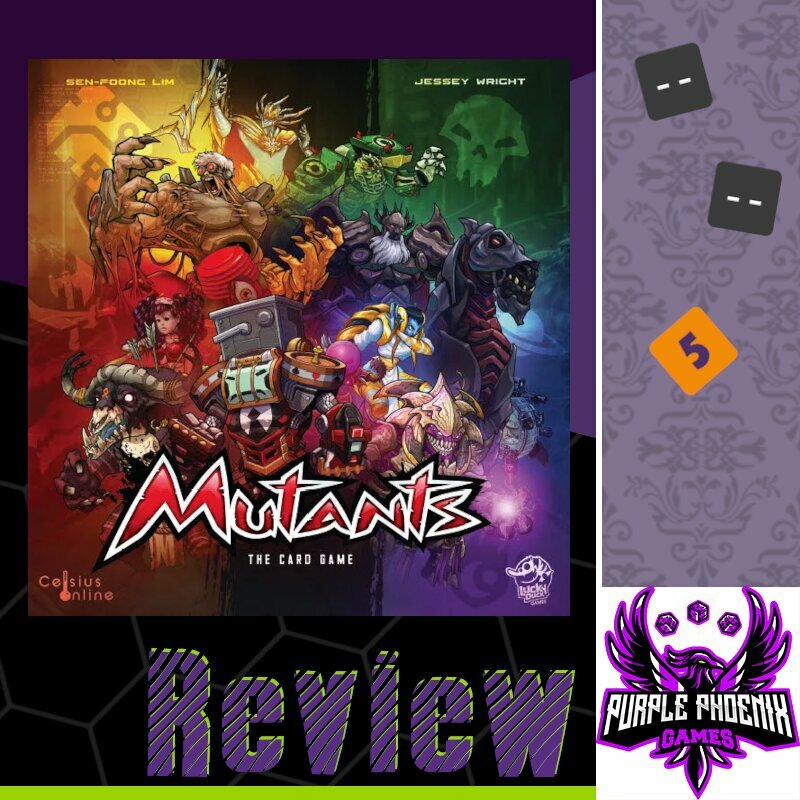
Mutants is a crazy-themed deck building, hand management, fighting, card game for one to four players. Usually in this instance I would put together a Solo Chronicles review, but I wanted to first get the multiplayer rules down and then delve into solo. In any case, this game pits players against each other in a royal rumble where controlling mutants to fight one another most effectively and efficiently will earn the player riches galore. Come check out the world of Mutants.
To setup, well, there are many steps. The biggest and perhaps most confusing step is creating the decks of mutants that will be used by players throughout the game. I will recommend you follow the rulebook for drafting your team, or simply use one of the provided pre-constructed team suggestions. Otherwise, place the main board on the table, along with the power and scoring tokens for each player. Players choose their player board according to color chosen, take their starting deck, and divide their Advanced Mutant deck into three piles, with the top card flipped face-up. Players draw a hand of six Basic Mutant cards (one of each type initially) and the battle may begin!
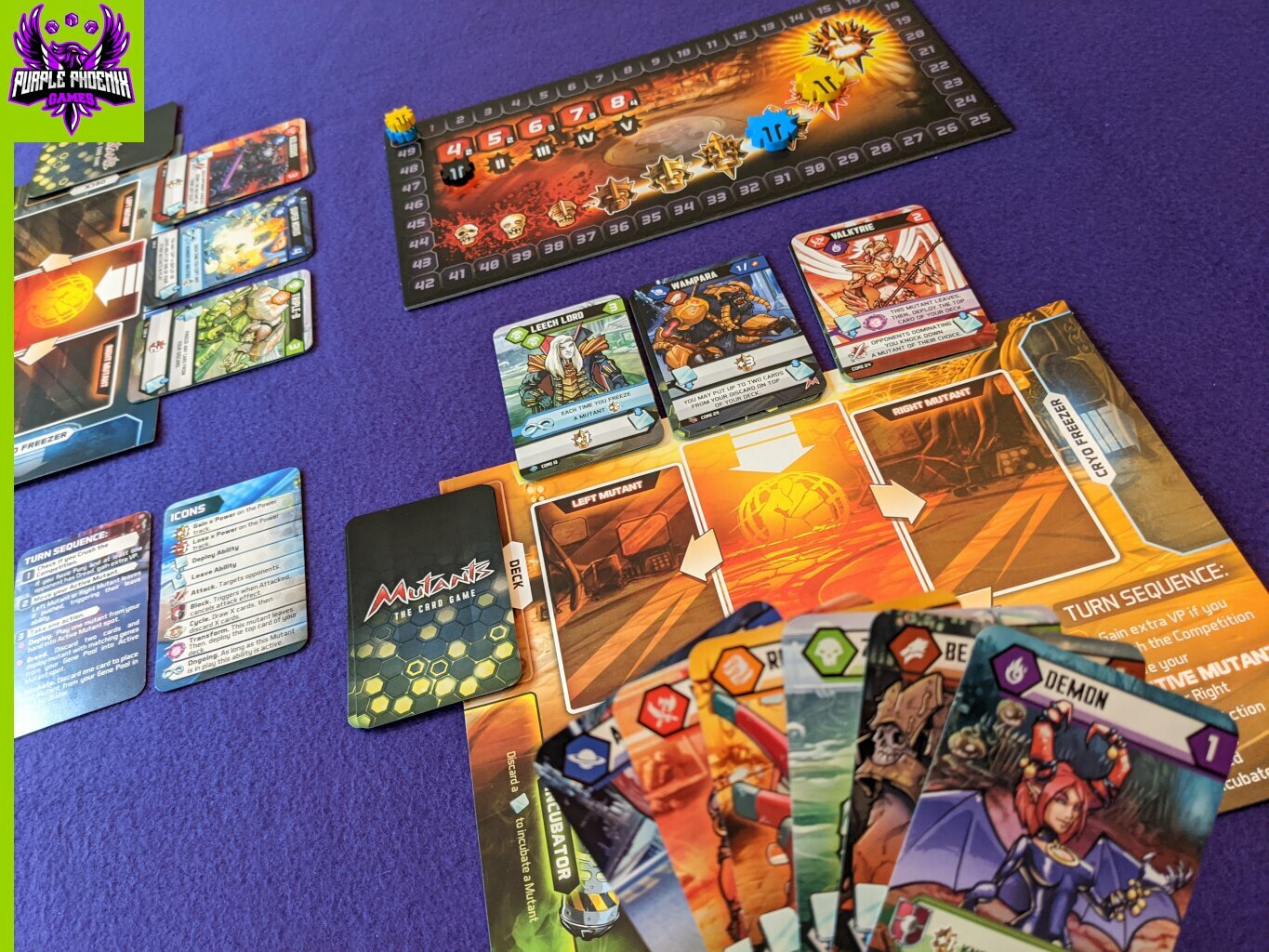
Mutants is played over five rounds, tracked on the main board. Each round encompasses three phases: Crush the Competition, Move Active Mutant, and Take Action. As the game progresses, the power tokens for players will be moving up and down the Power Track. If, at the start of the current player’s turn, an opponent’s power token is located in one of the last three Power Track spaces (named the Dread Zone), and the current player’s token is on the Fury Space (furthest along the Track), then the current player will score immediate bonus points by Crushing the Competition.
The first turn will not utilize the Move Active Mutant phase, but on subsequent phases, this will need to be resolved. A player’s board consists of three main slots: Left Mutant, Active Mutant, and Right Mutant. Mutants may only enter the Active Mutant slot in the middle, so if a Mutant is currently placed in that slot, it will need to be moved either to the Left or Right slot, at the player’s discretion. Should all slots be filled, one of the Mutants will need to be moved off the board to make room for the new one. Once this happens, the Mutant’s Leave Ability (at the bottom of the Mutant’s card) will activate. This could give the player more Power, some Attacking abilities, or other unique abilities. Once a card leaves their slot and applies their Leave Ability, it is placed in the Discard space at the bottom of the player board.
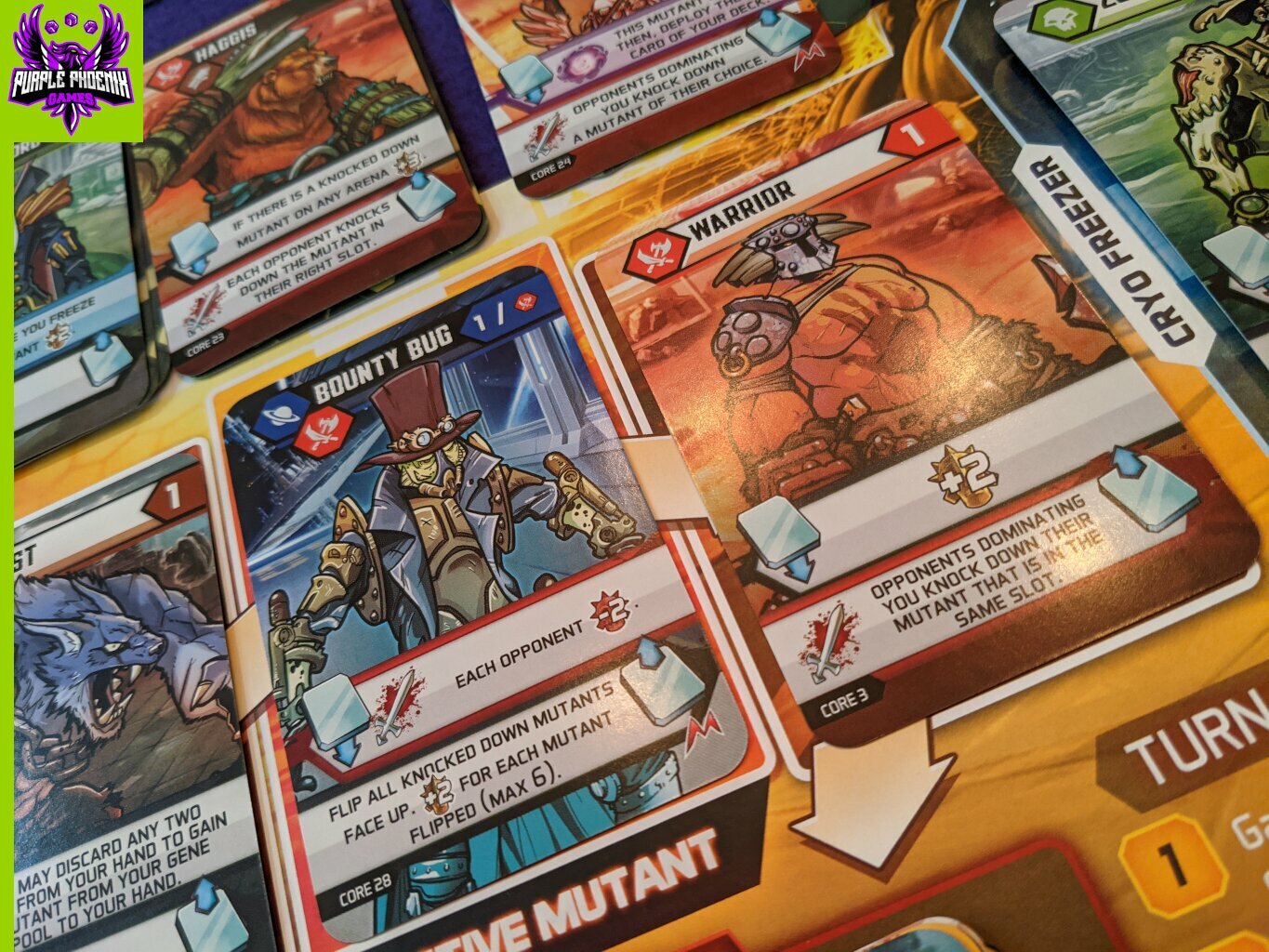
Now that the Active Mutant slot is available, the current player may choose from one of the Take Action choices: Deploy Mutant, Breed, or Incubate. To Deploy Mutant, simply play a card from hand to the Active Mutant slot, activating the Deploy Ability once placed. These Deploy Abilities could range from cycling (draw a card from the deck and discard a card from the hand), gaining Power, or even reactionary abilities. Breeding Mutants requires the player to discard two cards from hand whose type icons match those of one of the face-up Advanced Mutant cards atop the player board. Discarding these cards allows the Advanced Mutant to enter play on the Active Mutant slot. Finally, the player may instead choose to Incubate an Advanced Mutant from one on offer by discarding one card (and it does NOT need to match icons) and placing the chosen Advanced Mutant on the Incubator slot on the left side of the board. These incubated Advanced Mutants will be placed atop the draw deck at the end of the round, so it will be drawn during the next round.
If at any time a player needs to draw a card from their draw deck and there are no cards remaining, they will first choose a card from their Discards to Freeze, by placing it in the appropriate Cryo Freezer on the right side of the player board. Frozen cards will be scored at game end, and can really boost a final score.
At the end of the round players will perform a few more tasks and setup for the next round. First, the Power Tokens are scored according to which is in first place along the Track and so on, using the red and black VP numbers printed on the main board. The round marker is advanced one level, and each Mutant in Incubation is moved to the players’ draw decks. Players then draw a new hand of six cards, and Power Tokens are reset according to the previous round’s placement, in reverse order. The player whose Power Token is now furthest behind will be the starting player for the next round.
Play continues in this fashion of moving Mutants around, taking actions, and jockeying for supremacy along the Power Track until the end of the fifth round. At that time, the final VPs are awarded for the Power Track placement, and all cards in the Cryo Freezer are tallied. The player with the most VP at the end of the game is the winner of Mutants!
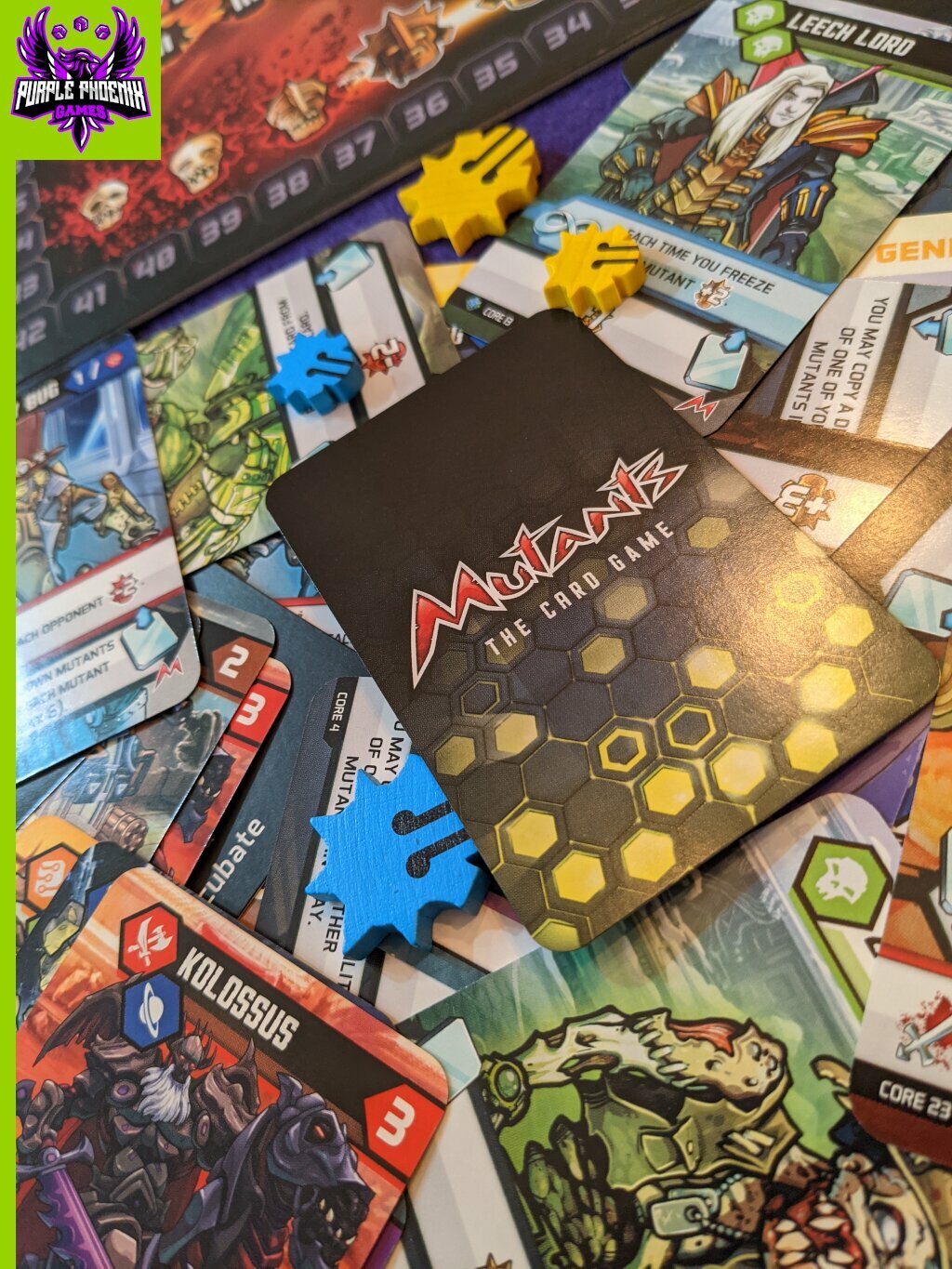
Components. Okay, I have some thoughts here, and more than just, “oh hey, they are nice.” The game comes with a bevvy of cards, some wooden tokens, and a couple “boards.” I used quotations because only the main board is an actual board. The player boards are slick cardstock and, while functional, feel a little cheap. The cards themselves are all super great and the artwork is appropriate and quite excellent. I have a couple issues with some other components, however. The Power and Score Tokens are the only wooden components in the box and I just do not understand them. They look like Sauron/Spartan helmets, or someone who is crying because they just shoved a fork into the power outlet. Now, there are four of each type in different colors, and though the colors aren’t the primary colors we have grown to accept for our player colors, they have swapped out the green for purple, and I think the game is colorful enough to include more exciting colors. So I’m not a fan of the Power and Score Tokens. Similarly, I don’t really understand the insert that comes with the game. I see that it is setup to hold TONS of cards, and maybe there were/are plans for many many expansions, but the base game can be housed in two of the 14 total card slots provided. Also, I have no idea what is going on in the middle of the insert, but I also don’t own any of the expansions yet, so hopefully those molded spots are actually meant to hold something. Everything else, though, is great!
For me, art and components are very high on my list of items that affect how much I enjoy a game. Now, I can live with the wonky Power and Score Tokens, and I suppose I don’t mind carrying around a giant box of cards, when the game could ALMOST fit inside a box the size of Bohnanza or Point Salad or the like. That said, I have definitely enjoyed my plays of Mutants. The rulebook is a little daunting at first, mostly because the theme is unique and the game style is similarly different to me. Once the game gets into the thick of it, though, strategy and tactics take over so strongly. Each card is carefully considered for its usability as either a card to be played or discarded for varying effects. I love that about this game.
This is certainly more than a “deck builder,” even though deck building and hand management are at the forefront of the mechanics here. You aren’t necessarily building your deck and cycling through it quickly enough for me to consider this a true deck builder alone, but using each card for different purposes certainly increases the replayability with Mutants. When is the best time to freeze a card versus keeping it in the deck for its abilities? Do I move off the Left Mutant or keep it around for another turn? Why did I pick these Advanced Mutants during the draft, when I have crappy supporting cards? Every play of Mutants has been a wonderful challenge of maximizing my deck and choosing just the right opponents to attack with my monstrous creations. Purple Phoenix Games gives this one a horrifically delightful 5 / 6. I hate having to bling out my games, but I think I will probably try to find replacements for the Power and Score Tokens (though maybe a little spray paint will help?), and look into grabbing one or all of the expansions so that I may be able to fill up that confusing insert. I look forward to my next games of this, and to getting the word out on this little gem I finally tried.
Mutants is a crazy-themed deck building, hand management, fighting, card game for one to four players. Usually in this instance I would put together a Solo Chronicles review, but I wanted to first get the multiplayer rules down and then delve into solo. In any case, this game pits players against each other in a royal rumble where controlling mutants to fight one another most effectively and efficiently will earn the player riches galore. Come check out the world of Mutants.
To setup, well, there are many steps. The biggest and perhaps most confusing step is creating the decks of mutants that will be used by players throughout the game. I will recommend you follow the rulebook for drafting your team, or simply use one of the provided pre-constructed team suggestions. Otherwise, place the main board on the table, along with the power and scoring tokens for each player. Players choose their player board according to color chosen, take their starting deck, and divide their Advanced Mutant deck into three piles, with the top card flipped face-up. Players draw a hand of six Basic Mutant cards (one of each type initially) and the battle may begin!
Mutants is played over five rounds, tracked on the main board. Each round encompasses three phases: Crush the Competition, Move Active Mutant, and Take Action. As the game progresses, the power tokens for players will be moving up and down the Power Track. If, at the start of the current player’s turn, an opponent’s power token is located in one of the last three Power Track spaces (named the Dread Zone), and the current player’s token is on the Fury Space (furthest along the Track), then the current player will score immediate bonus points by Crushing the Competition.
The first turn will not utilize the Move Active Mutant phase, but on subsequent phases, this will need to be resolved. A player’s board consists of three main slots: Left Mutant, Active Mutant, and Right Mutant. Mutants may only enter the Active Mutant slot in the middle, so if a Mutant is currently placed in that slot, it will need to be moved either to the Left or Right slot, at the player’s discretion. Should all slots be filled, one of the Mutants will need to be moved off the board to make room for the new one. Once this happens, the Mutant’s Leave Ability (at the bottom of the Mutant’s card) will activate. This could give the player more Power, some Attacking abilities, or other unique abilities. Once a card leaves their slot and applies their Leave Ability, it is placed in the Discard space at the bottom of the player board.
Now that the Active Mutant slot is available, the current player may choose from one of the Take Action choices: Deploy Mutant, Breed, or Incubate. To Deploy Mutant, simply play a card from hand to the Active Mutant slot, activating the Deploy Ability once placed. These Deploy Abilities could range from cycling (draw a card from the deck and discard a card from the hand), gaining Power, or even reactionary abilities. Breeding Mutants requires the player to discard two cards from hand whose type icons match those of one of the face-up Advanced Mutant cards atop the player board. Discarding these cards allows the Advanced Mutant to enter play on the Active Mutant slot. Finally, the player may instead choose to Incubate an Advanced Mutant from one on offer by discarding one card (and it does NOT need to match icons) and placing the chosen Advanced Mutant on the Incubator slot on the left side of the board. These incubated Advanced Mutants will be placed atop the draw deck at the end of the round, so it will be drawn during the next round.
If at any time a player needs to draw a card from their draw deck and there are no cards remaining, they will first choose a card from their Discards to Freeze, by placing it in the appropriate Cryo Freezer on the right side of the player board. Frozen cards will be scored at game end, and can really boost a final score.
At the end of the round players will perform a few more tasks and setup for the next round. First, the Power Tokens are scored according to which is in first place along the Track and so on, using the red and black VP numbers printed on the main board. The round marker is advanced one level, and each Mutant in Incubation is moved to the players’ draw decks. Players then draw a new hand of six cards, and Power Tokens are reset according to the previous round’s placement, in reverse order. The player whose Power Token is now furthest behind will be the starting player for the next round.
Play continues in this fashion of moving Mutants around, taking actions, and jockeying for supremacy along the Power Track until the end of the fifth round. At that time, the final VPs are awarded for the Power Track placement, and all cards in the Cryo Freezer are tallied. The player with the most VP at the end of the game is the winner of Mutants!
Components. Okay, I have some thoughts here, and more than just, “oh hey, they are nice.” The game comes with a bevvy of cards, some wooden tokens, and a couple “boards.” I used quotations because only the main board is an actual board. The player boards are slick cardstock and, while functional, feel a little cheap. The cards themselves are all super great and the artwork is appropriate and quite excellent. I have a couple issues with some other components, however. The Power and Score Tokens are the only wooden components in the box and I just do not understand them. They look like Sauron/Spartan helmets, or someone who is crying because they just shoved a fork into the power outlet. Now, there are four of each type in different colors, and though the colors aren’t the primary colors we have grown to accept for our player colors, they have swapped out the green for purple, and I think the game is colorful enough to include more exciting colors. So I’m not a fan of the Power and Score Tokens. Similarly, I don’t really understand the insert that comes with the game. I see that it is setup to hold TONS of cards, and maybe there were/are plans for many many expansions, but the base game can be housed in two of the 14 total card slots provided. Also, I have no idea what is going on in the middle of the insert, but I also don’t own any of the expansions yet, so hopefully those molded spots are actually meant to hold something. Everything else, though, is great!
For me, art and components are very high on my list of items that affect how much I enjoy a game. Now, I can live with the wonky Power and Score Tokens, and I suppose I don’t mind carrying around a giant box of cards, when the game could ALMOST fit inside a box the size of Bohnanza or Point Salad or the like. That said, I have definitely enjoyed my plays of Mutants. The rulebook is a little daunting at first, mostly because the theme is unique and the game style is similarly different to me. Once the game gets into the thick of it, though, strategy and tactics take over so strongly. Each card is carefully considered for its usability as either a card to be played or discarded for varying effects. I love that about this game.
This is certainly more than a “deck builder,” even though deck building and hand management are at the forefront of the mechanics here. You aren’t necessarily building your deck and cycling through it quickly enough for me to consider this a true deck builder alone, but using each card for different purposes certainly increases the replayability with Mutants. When is the best time to freeze a card versus keeping it in the deck for its abilities? Do I move off the Left Mutant or keep it around for another turn? Why did I pick these Advanced Mutants during the draft, when I have crappy supporting cards? Every play of Mutants has been a wonderful challenge of maximizing my deck and choosing just the right opponents to attack with my monstrous creations. Purple Phoenix Games gives this one a horrifically delightful 5 / 6. I hate having to bling out my games, but I think I will probably try to find replacements for the Power and Score Tokens (though maybe a little spray paint will help?), and look into grabbing one or all of the expansions so that I may be able to fill up that confusing insert. I look forward to my next games of this, and to getting the word out on this little gem I finally tried.

Annie Chanse (15 KP) rated Shadows & Dreams in Books
Dec 19, 2017
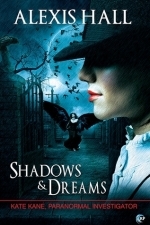


Review** spoiler alert ** *Warning: contains spoilers, bad words, and quite a long rant*
To be honest, I was very disappointed in this book. It had a great premise, which meant it had the potential to be a really good story, but the writing style of the author just completely ruined this book for me.
The basic idea behind the story is that Kate Kane, a paranormal PI, sets off on a case to find the brother of a woman she slept with once, and during this investigation, she runs into ALL MANNER OF TROUBLE. There are vampires and werewolves and ex-girlfriends around every corner, just lurking and waiting to pounce on Miss Kane. It's a very busy and involved story, and if it had been better written, I would have easily given it four stars at least, but there was just TOO much about this book -- style-wise -- that drove me insane.
For instance:
1. The plot, itself, is actually fairly well thought out and developed and is nowhere NEAR as cheesy as it sounds when you hear, "Vampires fighting werewolves," -- which, let's be honest, these days is so trite and overdone that it is scoffed at on a regular basis. However, there IS a good story in this novel. But the way Hall writes the not-cheesy story is so cheesy that it makes you THINK the story is cheesy. A lot of cheese, huh? A little confusing? Well then, let me give you an example.
Page 7-8: "Truth be told it was a little bit awkward, but my social weirdness threshold has gone way up since my girlfriend tried to murder my ex-girlfriend because her ex-girlfriend tried to murder her."
Okay... a bit ridiculous, especially seven/eight pages in, but I can roll with it. However, at the bottom of page eight:
Kane asks, "Who saw him last?"
Her assistant -- who is actually a statue brought to life and gifted to Kate by a group of rats who are apparently all seeing and all knowing God-types -- says, "I don't know. [...] Probably somebody at the hospital."
Kane asks, "Which one?"
And the assistant replies with this fantastic line: "The Whittington. He broke his leg changing a light bulb. Because he was standing on a swivel chair because he's an idiot."
Okay, I concede that maybe this line is supposed to sound ridiculous and funny, so I can even let that one slide. But then, three pages later, Hall completely turns me off to the book with this:
"Well, fuck. I was about to be hired by a woman I'd very nearly slept with to find her missing brother who was working for the woman who'd left me for a tech startup at the tech startup she left me for."
Wh-wh-what?! Are you kidding me? Could that sentence BE anymore convoluted or that plot-point any more ridiculously stereotypical?
And what is truly awful is that the story itself REALLY WASN'T THAT BAD. I mean, the writing was awful, which, overall, meant that the novel was -- in my opinion, of course -- bad, but the way the story progressed WAS interesting. It was nowhere near as bad as these 'recaps' by the main character make it sound, but the problem is that Hall throws in these inner-monologues for Kane ALL throughout the book, and they are terrible! Which, in turn, decreases the value of the entire story.
Another example falls right on the heels of the page 11 jewel.
Page 14: "I really really hoped this wasn't going to be another zombie plague. There'd been an outbreak when I'd taken Eve up to Lake Windermere for our third anniversary, and we'd spent the whole weekend under siege in the hotel, making molotovs from the minibar and clubbing re-animated tourists to death with souvenir walking sticks."
Really? Zombies now? On top of the vampires, witches, and werewolves? Can we POSSIBLY fit anymore para into this normal?
Enough with that.
Now on to point number 2. The girl on girl sex scenes in this book between sexy, snarky PI and her vampire girlfriend, the Prince (yes, Prince) of Cups, should be hot, right? No. They are forced, fake, and ridiculous. Halfway through the first one, I thought, "Jesus. This isn't lesbian sex. This is lesbian sex if it was written by a man who WISHES he could see some lesbian sex." That was the point at which I decided to look up more info on Alexis Hall, and I found out that he is, in fact, a man, which at least explains the sex scenes.
#3. Speaking of sex scenes, Hall also has this really irritating -- and distracting -- habit of throwing in random, explicitly sexual thoughts at TOTALLY inappropriate times. Right in the middle of the most stressful situations -- being locked up, about to be killed, thrown in prison/on trial -- Kate Kane begins inner-monologuing with herself about how much she'd like to fuck whatever female happens to be standing in front of her. RIDICULOUS! And annoying. Hated it.
4. One of the MOST annoying things about this book, however, was that it was in DESPERATE need of a SERIOUS case of editing. All throughout the book there were glaring errors that any first year college student should have caught while reading. I'm willing to discount SOME of these "errors" as simply being lost in translation, as the book is written with a British tone, and I am very much American. However, SOME of these errors simply CANNOT be due to anything other than careless editing.
For instance, page 113: "It's main distinguishing feature, right, was that was it was blue."
WAS that WAS it WAS blue? What does that even mean? Oh, yes, it means that no one bothered editing this beast before printing.
Page 141: "Piercing the heart will paralyse, but it won't kill, and anything will do, it doesn't have to wood."
Okay, so maybe the "paralyse" is simply British, but surely the "doesn't have to wood" bit needs a "be" in there somewhere, right?
Page 157: "Have we have achieved case closed, Miss Kane?"
Yes, yes have we have.
There are several -- SEVERAL -- more examples of these type errors, but I'm not about to point them all out. If you read the book, I'm sure you'll easily catch them on your own.
5. Another thing that drove me NUTS was the repetition. The awful thing is I'm fairly certain that Hall used these repetitious lines PURPOSELY to create some kind of effect -- humor, maybe? Whatever the desired result, it failed to do anything other than annoy me.
For instance, page 163: "'Hi. So. Look.' I tried to find a way to express the fact I had some good news and some bad news that wasn't I've got some good news and some bad news. 'I've got some good news and some bad news.'"
...blink... ...falls over...
Page 177: "All the more reason to tell them. [...] If they know that we know that she has returned, then they will not be tempted to conspire against us out of the false belief that we do not know. Of course, they may already know, but at present, we have no way to know what they know. If we tell them, we will know what they know, and all we will not know is how long they have known it."
Oh. Jumping. Jesus. On. A. Pogo. Stick. Please tell me you aren't serious.
And there was this one thing that repeated over and over again throughout the book. The first time, it was actually pretty clever. The second time, even, was okay. But by the time I'd read it nine times -- yes, NINE TIMES, no exaggeration whatsoever -- I was ready to never EVER read anything like it ever again.
This particular phrase was something Kate Kane internalized or muttered aloud to herself each time she decided to do something stupid OR she felt her life was in danger. The basic format went something like this:
"Here lies Kate Kane, died peacefully in her sleep aged 94. Beloved daughter."
The "Here lies Kate Kane" part remained constant, as did the "Beloved daughter." It was only the middle part that changed, for instance, "Here lies Kate Kate. Should have minded her own business. Beloved daughter." Or perhaps, "Here lies Kate Kane. She made a difference to dozens. Beloved daughter."
This continued NINE TIMES. It is not cute, funny, or clever after about the second time, definitely after the third. BUT NINE TIMES?! Come on!
And finally, my last complaint.
6. Several of the items, scenes, quotes, etc. in this book seemed waaaaaaaaaay too close to things from other books for my taste. Perhaps it is simply a coincidence and the author did not intentionally siphon plot points and details from other authors -- except, of course, when he obviously did in his quotations, such as his use of "Not all those who wander are lost" and "As old as my tongue, a little bit older than my teeth" which are DIRECTLY taken from other books, but I'm hoping those were intentional and not attempted-to-get-away-with-it plagiarism.
But there are several things in this novel that could have been taken from Jim Butcher's "Dresden Files", Lewis' "Narnia" chronicles, and Tolkien's "Lord of the Rings" series. I'm hoping, however, that they weren't, but they were very, very similar.
All in all, I'm disappointed to say that I was not a fan of this book at all, and I will most likely not be reading anymore Kate Kane books.
To be honest, I was very disappointed in this book. It had a great premise, which meant it had the potential to be a really good story, but the writing style of the author just completely ruined this book for me.
The basic idea behind the story is that Kate Kane, a paranormal PI, sets off on a case to find the brother of a woman she slept with once, and during this investigation, she runs into ALL MANNER OF TROUBLE. There are vampires and werewolves and ex-girlfriends around every corner, just lurking and waiting to pounce on Miss Kane. It's a very busy and involved story, and if it had been better written, I would have easily given it four stars at least, but there was just TOO much about this book -- style-wise -- that drove me insane.
For instance:
1. The plot, itself, is actually fairly well thought out and developed and is nowhere NEAR as cheesy as it sounds when you hear, "Vampires fighting werewolves," -- which, let's be honest, these days is so trite and overdone that it is scoffed at on a regular basis. However, there IS a good story in this novel. But the way Hall writes the not-cheesy story is so cheesy that it makes you THINK the story is cheesy. A lot of cheese, huh? A little confusing? Well then, let me give you an example.
Page 7-8: "Truth be told it was a little bit awkward, but my social weirdness threshold has gone way up since my girlfriend tried to murder my ex-girlfriend because her ex-girlfriend tried to murder her."
Okay... a bit ridiculous, especially seven/eight pages in, but I can roll with it. However, at the bottom of page eight:
Kane asks, "Who saw him last?"
Her assistant -- who is actually a statue brought to life and gifted to Kate by a group of rats who are apparently all seeing and all knowing God-types -- says, "I don't know. [...] Probably somebody at the hospital."
Kane asks, "Which one?"
And the assistant replies with this fantastic line: "The Whittington. He broke his leg changing a light bulb. Because he was standing on a swivel chair because he's an idiot."
Okay, I concede that maybe this line is supposed to sound ridiculous and funny, so I can even let that one slide. But then, three pages later, Hall completely turns me off to the book with this:
"Well, fuck. I was about to be hired by a woman I'd very nearly slept with to find her missing brother who was working for the woman who'd left me for a tech startup at the tech startup she left me for."
Wh-wh-what?! Are you kidding me? Could that sentence BE anymore convoluted or that plot-point any more ridiculously stereotypical?
And what is truly awful is that the story itself REALLY WASN'T THAT BAD. I mean, the writing was awful, which, overall, meant that the novel was -- in my opinion, of course -- bad, but the way the story progressed WAS interesting. It was nowhere near as bad as these 'recaps' by the main character make it sound, but the problem is that Hall throws in these inner-monologues for Kane ALL throughout the book, and they are terrible! Which, in turn, decreases the value of the entire story.
Another example falls right on the heels of the page 11 jewel.
Page 14: "I really really hoped this wasn't going to be another zombie plague. There'd been an outbreak when I'd taken Eve up to Lake Windermere for our third anniversary, and we'd spent the whole weekend under siege in the hotel, making molotovs from the minibar and clubbing re-animated tourists to death with souvenir walking sticks."
Really? Zombies now? On top of the vampires, witches, and werewolves? Can we POSSIBLY fit anymore para into this normal?
Enough with that.
Now on to point number 2. The girl on girl sex scenes in this book between sexy, snarky PI and her vampire girlfriend, the Prince (yes, Prince) of Cups, should be hot, right? No. They are forced, fake, and ridiculous. Halfway through the first one, I thought, "Jesus. This isn't lesbian sex. This is lesbian sex if it was written by a man who WISHES he could see some lesbian sex." That was the point at which I decided to look up more info on Alexis Hall, and I found out that he is, in fact, a man, which at least explains the sex scenes.
#3. Speaking of sex scenes, Hall also has this really irritating -- and distracting -- habit of throwing in random, explicitly sexual thoughts at TOTALLY inappropriate times. Right in the middle of the most stressful situations -- being locked up, about to be killed, thrown in prison/on trial -- Kate Kane begins inner-monologuing with herself about how much she'd like to fuck whatever female happens to be standing in front of her. RIDICULOUS! And annoying. Hated it.
4. One of the MOST annoying things about this book, however, was that it was in DESPERATE need of a SERIOUS case of editing. All throughout the book there were glaring errors that any first year college student should have caught while reading. I'm willing to discount SOME of these "errors" as simply being lost in translation, as the book is written with a British tone, and I am very much American. However, SOME of these errors simply CANNOT be due to anything other than careless editing.
For instance, page 113: "It's main distinguishing feature, right, was that was it was blue."
WAS that WAS it WAS blue? What does that even mean? Oh, yes, it means that no one bothered editing this beast before printing.
Page 141: "Piercing the heart will paralyse, but it won't kill, and anything will do, it doesn't have to wood."
Okay, so maybe the "paralyse" is simply British, but surely the "doesn't have to wood" bit needs a "be" in there somewhere, right?
Page 157: "Have we have achieved case closed, Miss Kane?"
Yes, yes have we have.
There are several -- SEVERAL -- more examples of these type errors, but I'm not about to point them all out. If you read the book, I'm sure you'll easily catch them on your own.
5. Another thing that drove me NUTS was the repetition. The awful thing is I'm fairly certain that Hall used these repetitious lines PURPOSELY to create some kind of effect -- humor, maybe? Whatever the desired result, it failed to do anything other than annoy me.
For instance, page 163: "'Hi. So. Look.' I tried to find a way to express the fact I had some good news and some bad news that wasn't I've got some good news and some bad news. 'I've got some good news and some bad news.'"
...blink... ...falls over...
Page 177: "All the more reason to tell them. [...] If they know that we know that she has returned, then they will not be tempted to conspire against us out of the false belief that we do not know. Of course, they may already know, but at present, we have no way to know what they know. If we tell them, we will know what they know, and all we will not know is how long they have known it."
Oh. Jumping. Jesus. On. A. Pogo. Stick. Please tell me you aren't serious.
And there was this one thing that repeated over and over again throughout the book. The first time, it was actually pretty clever. The second time, even, was okay. But by the time I'd read it nine times -- yes, NINE TIMES, no exaggeration whatsoever -- I was ready to never EVER read anything like it ever again.
This particular phrase was something Kate Kane internalized or muttered aloud to herself each time she decided to do something stupid OR she felt her life was in danger. The basic format went something like this:
"Here lies Kate Kane, died peacefully in her sleep aged 94. Beloved daughter."
The "Here lies Kate Kane" part remained constant, as did the "Beloved daughter." It was only the middle part that changed, for instance, "Here lies Kate Kate. Should have minded her own business. Beloved daughter." Or perhaps, "Here lies Kate Kane. She made a difference to dozens. Beloved daughter."
This continued NINE TIMES. It is not cute, funny, or clever after about the second time, definitely after the third. BUT NINE TIMES?! Come on!
And finally, my last complaint.
6. Several of the items, scenes, quotes, etc. in this book seemed waaaaaaaaaay too close to things from other books for my taste. Perhaps it is simply a coincidence and the author did not intentionally siphon plot points and details from other authors -- except, of course, when he obviously did in his quotations, such as his use of "Not all those who wander are lost" and "As old as my tongue, a little bit older than my teeth" which are DIRECTLY taken from other books, but I'm hoping those were intentional and not attempted-to-get-away-with-it plagiarism.
But there are several things in this novel that could have been taken from Jim Butcher's "Dresden Files", Lewis' "Narnia" chronicles, and Tolkien's "Lord of the Rings" series. I'm hoping, however, that they weren't, but they were very, very similar.
All in all, I'm disappointed to say that I was not a fan of this book at all, and I will most likely not be reading anymore Kate Kane books.