Search

Search only in certain items:

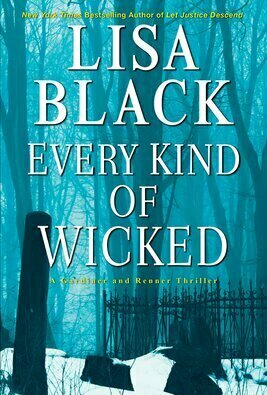
Every Kind of Wicked (Gardiner and Renner #6)
Lisa Black | 2020 | Mystery
7
7.0 (1 Ratings)
Book Rating
I was provided with a complimentary copy of this book so I could give an honest review. The opinions are entirely my own, and any quotes are taken from the ARC and may be different in the final published copy.

Every Kind of Wicked by Lisa Black is the 6th book in her Gardiner and Renner series. I have not read any of the earlier books so, to give a fair review., I read the 1st book, That Darkness. While some novels allow you to pick up in the middle of the series, having a basic understanding of the main characters helped reading Every Kind of Wicked. I will include a description of them below this review.

Maggie Gardiner and Jack Renner investigate a murder which occurred where they first met, in the Erie Street Cemetery. She is having difficulty dealing with the events of the last eight months, and Rick, her ex-husband, is suspicious of Jack. Rick wants to investigate Jack and his past.

Black's Gardiner and Renner are an interesting duo. If you have not read any of the Gardiner and Renner series, think Bones meets Dexter. They allow people to believe they are dating to throw off any suspicions they have of Jack. The event which brought them together continues to pull them closer.

Once I knew who the characters were, I enjoyed the book. I will continue reading the series and start Black's Theresa MacLean series.

This 200-word review was published on Philomathinphila.com on 8/25/20.


Here is what you need to know to get the most out of Lisa Black's Gardiner and Renner series before reading book #6.

Maggie Gardiner forensic investigator for the Cleveland Police Department and she is good at it. She works alongside the homicide detectives, including Rick, her ex-husband, and Jack Renner. Maggie and Jack met eight months prior while working a case involving a Jane Doe discovered in the local cemetery.

Jack has a mission. He needs to find the women he is hunting, and has been hunting, through several states.

Maggie follows all of the clues which keep pointing to one person - Jack. After confronting Jack, Maggie needs to decide if it is moral to kill someone that has harmed others and that will do harm again. She agrees to give Jack time to leave so as not to arouse suspicions that the serial killings stopped when he left Cleveland.

At some point after the first book, That Darkness, but before the 6th book, Every Kind of Wicked, Rick becomes suspicious of Jack. He is determined to show Maggie the kind of man Jack is.

  
    SweetRing Pro

    SweetRing Pro

    Social Networking and Entertainment

    (0 Ratings) Rate It

    App

    SweetRing is the premier dating app platform for those dedicated to finding their perfect match and...

Heard It in a Love Song
Tracey Garvis Graves | 2021 | Contemporary, Fiction & Poetry, Romance
6
6.0 (1 Ratings)
Book Rating
Layla is recently divorced after a ten-year marriage to a man who never truly appreciated her and subjected her to constant financial and emotional stress. Once a lead singer in a rock band, Layla is now an elementary music teacher struggling to find her place in the world. One thing that brightens her day is her interactions with Josh, the father of one of her students. A single father, Josh was married to his high school sweetheart, Kimmy, for nearly twenty years. He too is trying to find his way now that he's single. Both wary about getting back into the dating grind, Layla and Josh decide to be "friends with potential." But with all their baggage, are they destined for heartbreak?

"And she wasn't lonely, not really. Layla had been lonely for years while she was married, and she'd take being alone over lonely any day."

I didn't dislike this book, but it wasn't the sweeping romance I was hoping for. This one redefined slow burner, as Josh and Layla sloowly made their way toward one another. Most of this is the format--told from both Layla and Josh's point of view, each chapter breaks off to delve into how that particular's character's marriage fell apart. So we may get a few moments of them in the present and then--boom--it quickly flashes back to Josh and Kimmy in high school or Layla and her ex-husband, Liam, meeting when Layla is singing in her band. Each piece is just a snippet, slowly parsed out per chapter and building up to the end of the marriage, so both the past and the present is a build-up. I admire the style, but wow... everything takes time. A lot of time! It made the story feel quite plodding at times.

And, I just couldn't quite find the spark between Layla and Josh. Individually, they were great people, and I liked and rooted for their characters to move on from their past relationships. Together, I just didn't feel that they had "it"--that special something that really makes you want a particular couple to succeed. I certainly desired for each to find themselves again, but I didn't necessarily need it to be with one another. I did, however, have great fondness for Norton, the older dog Josh adopts, and whom Layla often dog-sits. So there you go.

This isn't a bad book, and I know lots of people who enjoyed it. It received a 3-star rating from me, which is *not* a poor rating. It just wasn't what I was hoping for, and I had wanted more passion. But if you enjoy a character-driven read, especially one that really delves into the characters' pasts, you'll find a lot to love here. (Also the cover is simply gorgeous.)
  
The Naked Future
The Naked Future
Patrick Tucker | 2018 | Computing & IT, Contemporary, Philosophy, Psychology & Social Sciences
8
8.0 (1 Ratings)
Book Rating
Book Review by Cari Mayhew. Rating 7.5/10

This is a book about how the digital footprint we leave behind us can be used to make predictions about our future in all aspects of our lives. But are we seeing the coming to being of a dystopian science fiction, or are we tapping into a new superpower?

Every app on every device we use leaves a digital trail about us, and this has implications in the fields of medicine and the spread of infections, education and learning, and crime prediction, through to movie preference and dating.

The book predominantly examines the value to society in general but also looks at the benefits to the individual. Of course, these benefits come at a cost to our privacy, which the book also briefly addresses. Each chapter is centered on its own topic. I will mention each but in the interests of brevity won’t go into detail on each topic.

Chapter 1 begins by describing how certain apps can be extremely useful warning providers, but by the end of the chapter, we are looking at how your smartphone apps can be used to locate you, even when your GPS is turned off and you’re not geo-tagging posts or tweets. With modern statistical models and enough data points, it’s possible to predict where you will be down to the hour and within a square block one and a half years from now. Turning off your GPS doesn't actually make you less predictable, it just makes your predictability level harder to detect - your future remains naked.

Similarly, in Chapter 2 which examines deliberate self-tracking, Tucker notes that Fitbit users who are confused or ignorant of the device’s privacy settings are inadvertently sharing the data details of their sexual activity.

This seems like frightening stuff, but then the conversation turns to more benevolent uses of such technology. Chapter 3, by way of an imagined story, examines how such technology can be used to predict the spread of dangerous infections, including the identification of new strains of virus as new mutations occur.

Chapter 4 looks at the use of such technology in weather forecasting, and how it’s been used to make way for insurance against the effects of the weather for affected businesses. Chapter 5 explores how movie/book choice and ratings can be used to predict what makes a good movie/book.

We go back to the frightening stuff in Chapter 6. Here Tucker talks about how the smartphone has become the ultimate shopping accessory. Knowing what habitual time an individual wants a coffee, cig, or beer, is ideal for online advertisers, who will be able to send you a voucher/coupon or a mere suggestion right there on the spot. There could also be surveillance systems examining what you pick up and consider buying but don't put into basket /trolley. Tucker goes on to describe how data brokers such as Acxiom have begun selling on to advertisers access to not only your data to also to your future decisions.

Chapter 7 looks at education and learning, and makes the following good points: “What telemetric education offers is the chance for all students to raise their hands and be heard, without fear of confirming some unflattering, broadly held perception about their social group.” And “Imagine for a moment the power of knowing beforehand how well you would perform on a test but how disempowered you would feel if that same future was naked to your competition, or to your future potential employers.”

I like the title of chapter 8 “When Your Phone Says You’re In Love”. Here Tucker tells how online dating sites have become a living social science lab. Again here your personal details can be sold on. In the future, you could be rating your actual get-togethers on the app. Already invented is a “sociometer” which detects unconscious biological signals which show what role you’re taking in a conversation, and can then produce predictions on how the rest of the conversation will go.

Chapters 9 and 10 look at predictions in the where, when and who of acts of crime. He discusses where it has worked so far. But on this Tucker says “Predictive policing in the wrong hands looks less like a boon to public safety and more like a totalitarian hammer.”

The book concludes with Chapter 11, titled “The World That Anticipates Your Every Move”. Here one interviewee said as “Privacy is a blip on the radar of history.” Indeed the chapter ends with an obituary to privacy, where Tucker says “we will feel increasingly powerless against the tide of transparency rendering this planet in a new form as surely as the movement of glaciers carved our canyons and valleys.”

I’ve highlighted here the more worrisome aspects of the topics, but it’s important to note that Tucker does aim to offer a prescription for the situation, though it’s spread out in occasional paragraphs here and there rather than as a useful reference at the end. That said I found the actionable advice was rather brief and unoriginal.

Tucker presents a fair and balanced view of this important and highly relevant topic of our times, and the book is clearly well-researched. Some chapters show a little humor which was fun, but although the book is aimed at the layman, I often felt like I was reading a science textbook. The book is a real eye-opener, especially if it’s something you hadn’t given much thought to. The overall message of the book is clear: our data is already out there, but it’s ours first and foremost, and we can be savvy and use it to our advantage.
  
40x40

Lee (2222 KP) rated Get Out (2017) in Movies

Jul 26, 2017  
Get Out (2017)
Get Out (2017)
2017 | Horror, Thriller
Slow, brilliant build up. Hugely satisfying ending (0 more)
The trailer spoils most of it (0 more)
Amazingly, I managed to head into Get Out having not even seen the trailer. It had been appearing more and more frequently on my news feeds recently, usually accompanied by a lot of positive buzz, and usually featuring an image of lead character Chris, wide eyed and terrified, with a tear running down his cheek (note that I’ve continued this trend with my review!). Described as a racial satire/horror it just didn’t really feature high on my watch list, but I booked a ticket to go see it, wanting to see what all the buzz was about. I’m kind of glad that I went in relatively blind as to what to expect though, as I was absolutely blown away by it.

Daniel Kaluuya plays Chris, a young black man dating a white girl called Rose (Allison Williams). He’s preparing to go and meet her parents for the first time but he’s a bit unsure as to what they’re going to think about him, despite Rose assuring him that he’s got nothing to worry about. When they arrive at the huge house out in the country, her parents really are fine with Chris. And they take every opportunity during their conversations to be positive about race and to assure Chris that they’re fine with him too, to the point where Chris (and us) begin to feel a little bit uneasy. This unease isn’t helped by the fact that there are two black servants in the house, neither of whom have very much to say and both acting very strangely. At night, the housekeeper wanders quietly around the house while the groundsman sprints around outside in the dark!

Paranoia and tension continues when a large group of family friends arrives for a party and they all seem very keen to get to know Chris and bond with him. One of the guests even has a black ‘companion’ who is also acting strangely. Despite the assurances from all, things definitely are not OK…

Of the little I read about Get Out beforehand, one of the reviews that stuck with me most described it a little bit like From Dusk Til Dawn in the way that everything suddenly all goes to shit in a hugely enjoyable and unexpected twist. There are definitely no vampires or anything similar in this movie, but I felt that it was a pretty good comparison. The movie spends a long time putting you on the edge of your seat, building up the tension, providing plenty of food for thought on modern day racism and adding the odd bit of welcome comedy relief from Chris’ friend on the end of the phone trying to support him. It’s all hugely enjoyable and even though you can guess pretty early on what’s going on, it’s all still hugely satisfying when the truth finally is revealed and the violence and action take over.
  
HT
How to Survive Your Freshman Year
6
6.0 (1 Ratings)
Book Rating
Rating: 3.75

How To Survive Your Freshman Year contains a truckload of information: at nearly 400 pages and contributions from tons of college students all over the world, it’s not exactly a fast read. How To Survive Your Freshman Year is like an encyclopedia of tips and tricks for Freshman on every topic you can think of, and probably some you didn’t think of.

Twenty chapters and an appendix full of useful information, This book is a great tool for upper class High-schoolers and college Freshman—and even parents—who have questions and concerns, or are just curious and looking for information, or just don’t know what to expect.

I would, however, use with caution. How To Survive Your Freshman Year gathers advice from everyone—Jews, Christians, Atheists, Homosexuals, etc. so there are contradictory pieces of advice, sometimes right next to each other. The thing about this book is you have to know yourself pretty well in order to use it. You have to decide which pieces of advice are suitable for you, which follow your beliefs, and which you should pretend you never heard. The book does post this disclaimer inside it:

Warning: This Guide contains differing opinions. Hundreds of Heads will not always agree. Advice taken in combinations may cause unwanted side effects. Use your Head when selecting advice.

I think this is a reasonable disclaimer, as it’s very true that there are some very opposite viewpoints in here.

Also, some of the information in here is common sense—then again, it may be common to me but not to someone else because of the way I was raised—and those pieces of advice are just taking up space on a page.

And then there was, in my opinion, also a lot of really dumb advice: like sleep with people, it’s ok to goof off your first term, college is about having fun, bring a fake ID. (note these are not direct quotes, they are summaries of various reoccurring pieces of advice.)

All in all, however, the book is beneficial and worth the buy, especially to brand new college students. I don’t attend a university yet, I attend a community college. I’ve found that a lot of the information and advice I have already gone through and experienced, but there were some other helpful things on topics I’ve yet to encounter, such as large lectures and dorms and vacations/study abroad and a few other things.

Content/Recommendation: There is some colorful language used to prove points in some quotes. There is a chapter on dating and sex. But, the age recommendation is to highschool and Freshman college students and parents, so it’s age appropriate. There is also some mention of religions and beliefs, and the word God is changed to G-d, probably to keep from offending some people.
  
Isla and the Happily Ever After (Anna and the French Kiss, #3)
Stephanie Perkins | 2014 | Contemporary, Romance, Young Adult (YA)
8
6.8 (5 Ratings)
Book Rating
In the third novel of the sries, we return to enchanting Paris. Isla, who we were introduced to in the fist novel now takes centre stage. Familiar characters like John and Rashmi's younger sister Sanjita join her. We didn't know much about the artistic Josh beyond his love of snogging and frequent altercations with his girlfriend Rashmi. I am pleased to be able to watch his character develop.

The banter, or lack thereof, between Isla and Josh just makes you smile. They're both endearingly awkward and adorable together. When they go to the comic book store and Josh finds out Kurt isn't her boyfriend, the interaction is very authentic. You can almost feel his dismay turn to confusion and then happy relief.

Despite the fact that Isla has had a crush on Josh for three years, its nice to see that it doesn't come between her and her best friend, Kurt. (Well, most of the time.) Loyalty is very impotant and she won't let anyone treat him badly. Her only other relationship ended because the boy she was dating couldn't get along with Kurt. She's not the best at confronting people and speaking up, but she never lets people take advantage of her best friend or mistreat him. That person will no longer be a part of her life.

Unlike Anna, when I read about Isla and Josh they feel like the shy, exhuberant high schoolers that they are. They experience the awkwardness of first live and the misunderstandings or insecurities that come with not being entirely confortable in a relationship yet. Falling so hard and so fast, but faced with the crippling fear that the rug is going to be pulle out from under you. Isla and Josh experience it all.

Just as I hoped, the Olympics brought the gang back to Paris - plus their new additions. The inseperable Anna and St. Clair, Meredith, lovebirds Lola and Cricket, and Josh. They claim they're back for the Olympics, but something even more important and magical happens. A proposal, in Paris, on the famed bronze marker. It was a return to the city where Anna and Etienne found their other halves and officially began their happily every after. It was a simple, yet touching scene.

I'm glad we find out how Calliope does in the Olympics, although there is very little detail given. I think her story would lend itself well to a novella. But, I'll be happy with what we were given even if that does not happen.

Despite all of the struggles and heartbreak, insecurities and mistakes - Isla and Josh still find their own happily ever after. The story and sweet and heart-warming. J'adore mon <s>petit chou</s>... mon livre - I fell in love with the series "the good parts and the ugly parts" and I hope you do as well.