
Search
Search results

Purple Phoenix Games (2266 KP) rated Doctor Who: Time of the Daleks in Tabletop Games
Sep 2, 2021


I cannot tell you what a big fan of Doctor Who I am. I have one sticker on my car, and it’s a DW TARDIS right there in the upper left. They say you’ll never forget your first Doctor, and I only started watching several years into the reboot, but started with 9. And then 10 stole my heart. 11 was also quite amazing and I always reference people who have never seen the show to please please please watch, “Vincent and the Doctor.” If you watch that episode and are not moved to tears by the sheer beauty of the story being told, you absolutely have no soul. And if after watching that episode you are not an immediately-converted Whovian, then it was never meant to be. So why then is my rating on this game so lackluster if I love the IP so?
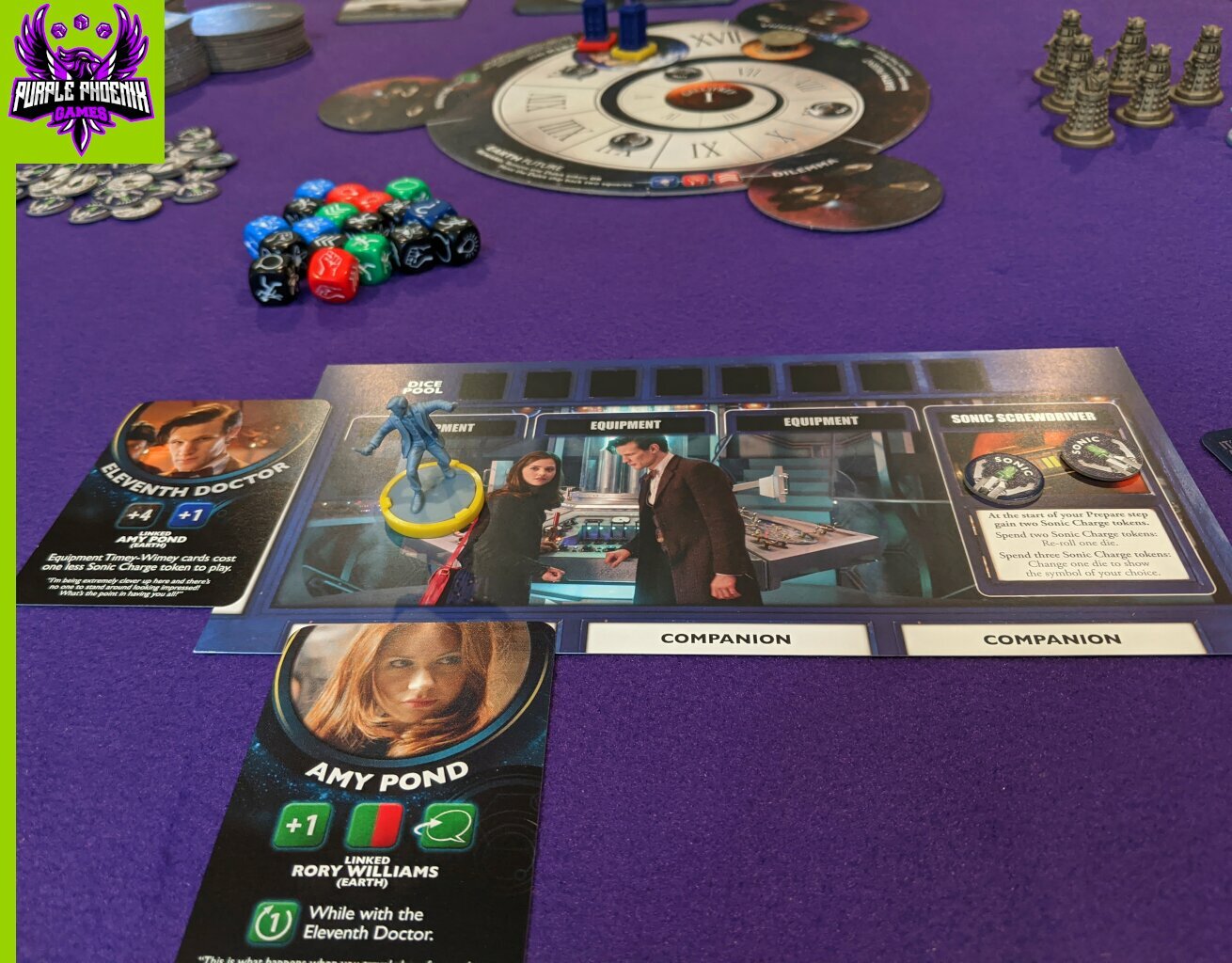
Doctor Who: Time of the Daleks (which I will carefully refer to as DW from here on out though I would never abbreviate to Dr.) is an adventure dice racing game, even though the only official tag is dice. In it, players take on the roles of different Doctor regenerations and will travel through time and space collecting companions, Timey-Wimey cards, and Sonic Charges in order to manipulate dice rolls to defeat Dilemmas and Time Anomalies that pop up at the absolute worst times.
To setup, follow the rulebook instructions – there are just too many components to detail here. The game takes up quite a bit of table space, so do make sure to use your largest table.
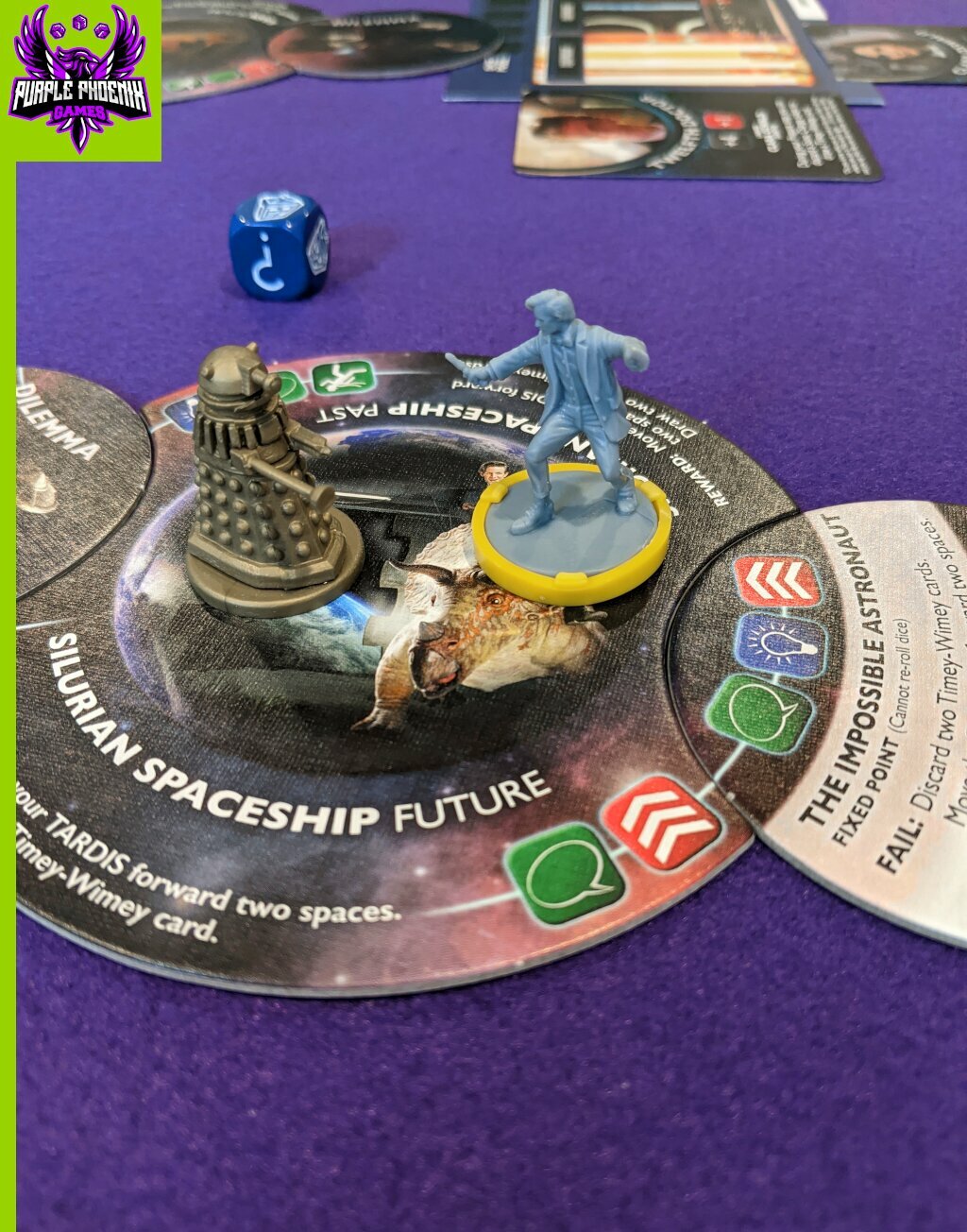
On a player’s turn they will be adding Sonic Charges, shuffling up companions, and rolling the TARDIS die to determine travel. Once at a location, the Doctor (and subsequent harem) can Adventure by assessing the challenge of dice results printed on the Location board plus the Dilemma disc combined. It is these icons that must be rolled (and possibly manipulated) in order to have a successful adventure. If successful, typically this involves a reward of moving the TARDIS pawn on the main Web of Time board closer to Gallifrey, in addition to other rewards. Failure on an adventure will typically result in the Dalek ship being moved further from Skaro and closer to Gallifrey.
Once the Doctors have had their turn, the Daleks will take a turn. Immediately move the Dalek ship one space on the Web of Time track towards Gallifrey, and if they have reached Gallifrey before any Doctor, or on the same turn as a Doctor, the Daleks win and the Doctors all lose. If not, play continues in this fashion until one of those win conditions are met, along with a couple more loss conditions I will leave you to discover.
This is a very pared-down synopsis of the rules, and I have intentionally left out several rules so as not to bog down my paraphrasing with minutia. Take this into consideration when determining if this is the game for you.
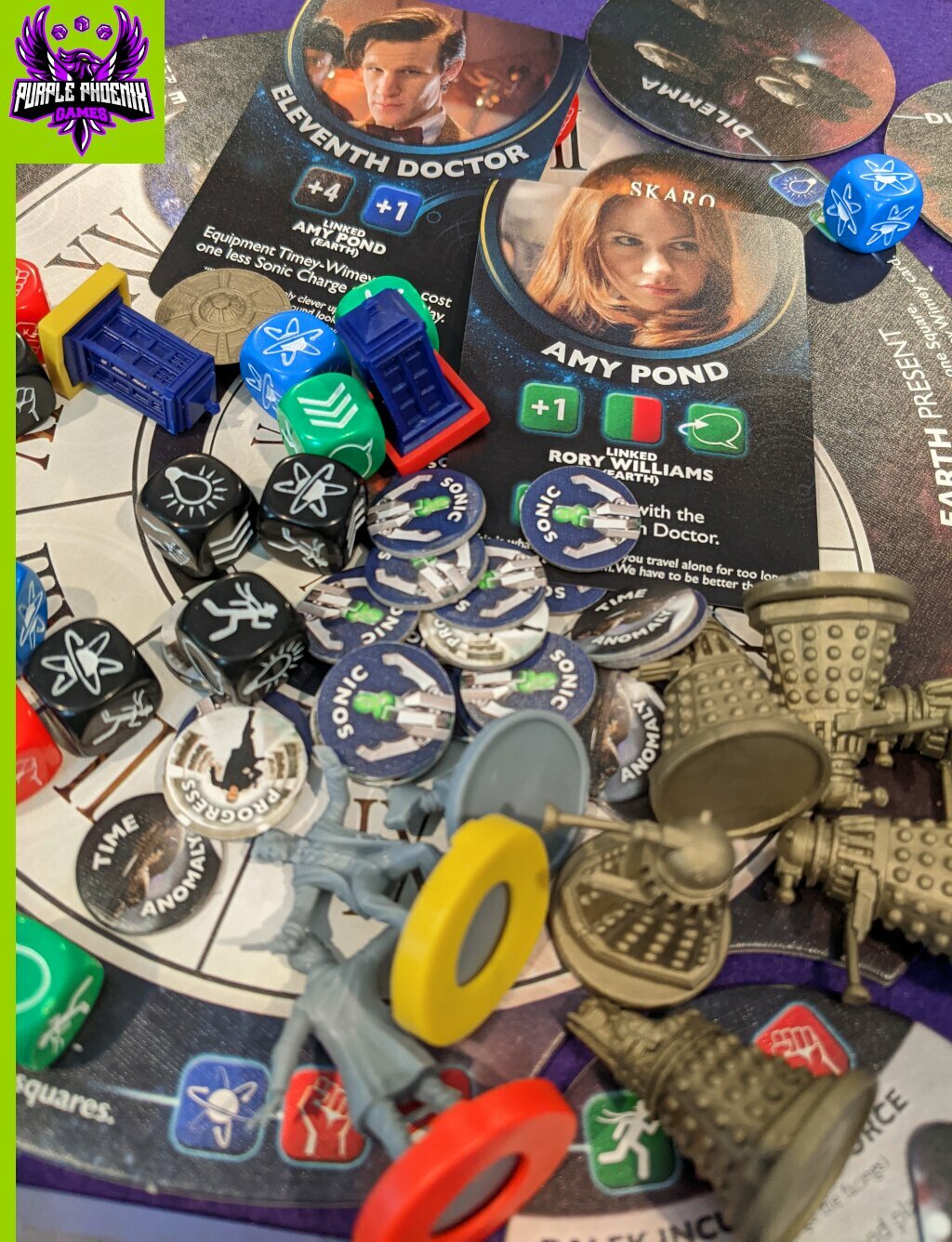
Components. All in all the components in DW are absolutely stellar! All the cardboard is thick and features great art and screencaps (which is a polarizing subject that I simply don’t mind). The dice are great quality, though I wish they had chosen a different color for the blue dice so that the TARDIS die would be the only blue in the box. The minis are great, and have interchangeable bases because throughout the game the Doctors may have to regenerate, thus switching to a different Doctor mid-game (awesome mechanic for this IP by the way).
Let me tell you why I like this DW game and why I do not. Firstly, the game is just too hard for me. Maybe it’s how I roll the dice, but I feel I am almost never in possession of enough resources to be able to reroll or manually manipulate my dice results enough to have the requisite amount of successful adventures. Some challenges require the Doctor to roll six dice, but then there are restrictions in play that drop a Doctor’s dice pool down to six, thus creating a you-must-roll-EXACTLY-what-you-need-to-win scenario that is tough to swallow for a dice game. Also, this next part is completely personal opinion, I wish that 10 was included in the starter box. I got my 11, and I appreciate that, but I feel like 10 is the most widely-popular Doctor in the franchise, or at least in New Who, so the ball was dropped here. I know I can purchase 10 in an expansion pack with 5 (and kudos to whomever made THAT combination), but I want him NOW.
Time travel games are so difficult to pull off, and with Doctor Who you HAVE to consider that time travel will play a very important part in gameplay. I believe this title handles it well, and even allows for multiple Doctors to work together (let’s not talk about time paradoxes for now). That is great and allows for excellent cooperative play, so I applaud the designer for that. I also enjoy the different abilities given by each different regeneration as well as what the companions each bring to the table. Perhaps a companion will add certain colors of dice to the Dice Pool, or allow the Doctor to switch out some of his generic dice for stronger and more specific dice, or simply allow rerolls of certain colors of dice. I dig that a lot. And seeing my precious companions in the game matched up to their Doctors fills me with a sense of nostalgia that I just do not feel in other games.
While this has been the subject of much deliberation on my part, I will be keeping my copy of the game, and will most definitely be adding 5 and 10 to the mix. I really want to like this game more than I do, and maybe having 10 in my arsenal is enough to do it, though I have my doubts. I love the Doctor Who IP and love dice games. I think this is a good game overall, and will continue to explore it with other gamers. Something will click, I’m sure of it. Purple Phoenix Games gives this one wibbly-wobbly 8 / 12. If you need a difficult dice game in your collection and also love the Doctors, pick up a copy. But also do yourself a favor and grab a copy of any expansion that includes your favorite Doctor – you will thank me later. Spoilers, sweetie, that’s coming in tomorrow’s post.
Doctor Who: Time of the Daleks (which I will carefully refer to as DW from here on out though I would never abbreviate to Dr.) is an adventure dice racing game, even though the only official tag is dice. In it, players take on the roles of different Doctor regenerations and will travel through time and space collecting companions, Timey-Wimey cards, and Sonic Charges in order to manipulate dice rolls to defeat Dilemmas and Time Anomalies that pop up at the absolute worst times.
To setup, follow the rulebook instructions – there are just too many components to detail here. The game takes up quite a bit of table space, so do make sure to use your largest table.
On a player’s turn they will be adding Sonic Charges, shuffling up companions, and rolling the TARDIS die to determine travel. Once at a location, the Doctor (and subsequent harem) can Adventure by assessing the challenge of dice results printed on the Location board plus the Dilemma disc combined. It is these icons that must be rolled (and possibly manipulated) in order to have a successful adventure. If successful, typically this involves a reward of moving the TARDIS pawn on the main Web of Time board closer to Gallifrey, in addition to other rewards. Failure on an adventure will typically result in the Dalek ship being moved further from Skaro and closer to Gallifrey.
Once the Doctors have had their turn, the Daleks will take a turn. Immediately move the Dalek ship one space on the Web of Time track towards Gallifrey, and if they have reached Gallifrey before any Doctor, or on the same turn as a Doctor, the Daleks win and the Doctors all lose. If not, play continues in this fashion until one of those win conditions are met, along with a couple more loss conditions I will leave you to discover.
This is a very pared-down synopsis of the rules, and I have intentionally left out several rules so as not to bog down my paraphrasing with minutia. Take this into consideration when determining if this is the game for you.
Components. All in all the components in DW are absolutely stellar! All the cardboard is thick and features great art and screencaps (which is a polarizing subject that I simply don’t mind). The dice are great quality, though I wish they had chosen a different color for the blue dice so that the TARDIS die would be the only blue in the box. The minis are great, and have interchangeable bases because throughout the game the Doctors may have to regenerate, thus switching to a different Doctor mid-game (awesome mechanic for this IP by the way).
Let me tell you why I like this DW game and why I do not. Firstly, the game is just too hard for me. Maybe it’s how I roll the dice, but I feel I am almost never in possession of enough resources to be able to reroll or manually manipulate my dice results enough to have the requisite amount of successful adventures. Some challenges require the Doctor to roll six dice, but then there are restrictions in play that drop a Doctor’s dice pool down to six, thus creating a you-must-roll-EXACTLY-what-you-need-to-win scenario that is tough to swallow for a dice game. Also, this next part is completely personal opinion, I wish that 10 was included in the starter box. I got my 11, and I appreciate that, but I feel like 10 is the most widely-popular Doctor in the franchise, or at least in New Who, so the ball was dropped here. I know I can purchase 10 in an expansion pack with 5 (and kudos to whomever made THAT combination), but I want him NOW.
Time travel games are so difficult to pull off, and with Doctor Who you HAVE to consider that time travel will play a very important part in gameplay. I believe this title handles it well, and even allows for multiple Doctors to work together (let’s not talk about time paradoxes for now). That is great and allows for excellent cooperative play, so I applaud the designer for that. I also enjoy the different abilities given by each different regeneration as well as what the companions each bring to the table. Perhaps a companion will add certain colors of dice to the Dice Pool, or allow the Doctor to switch out some of his generic dice for stronger and more specific dice, or simply allow rerolls of certain colors of dice. I dig that a lot. And seeing my precious companions in the game matched up to their Doctors fills me with a sense of nostalgia that I just do not feel in other games.
While this has been the subject of much deliberation on my part, I will be keeping my copy of the game, and will most definitely be adding 5 and 10 to the mix. I really want to like this game more than I do, and maybe having 10 in my arsenal is enough to do it, though I have my doubts. I love the Doctor Who IP and love dice games. I think this is a good game overall, and will continue to explore it with other gamers. Something will click, I’m sure of it. Purple Phoenix Games gives this one wibbly-wobbly 8 / 12. If you need a difficult dice game in your collection and also love the Doctors, pick up a copy. But also do yourself a favor and grab a copy of any expansion that includes your favorite Doctor – you will thank me later. Spoilers, sweetie, that’s coming in tomorrow’s post.


Chris Sawin (602 KP) rated Doctor Strange in the Multiverse of Madness (2022) in Movies
May 4, 2022
The noticeable Sam Raimi elements. (2 more)
The film is great when it's able to showcase horror.
The second end credits sequence is amazing.
The film is incredibly formulaic outside of its horror elements. (2 more)
You don't really care about any of the new characters.
No one is going to get that first end credits sequence.
Sam Raimi Finally Brings Horror to the MCU
Even with all of the universe jumping and Sam Raimi being able to add his filmmaking trademarks, Doctor Strange in the Multiverse of Madness is a bit too formulaic for its own good. Doctor Strange (Benedict Cumberbatch) has been having dreams of a different version of himself dying while seeking a mythical book known as The Book of Ashanti. In his dream, Strange encounters America Chavez (Xochitl Gomez), a young girl with the uncontrollable power of universe jumping.
But then Strange meets America in his universe and learns that dreams are actually us seeing different versions of ourselves in different universes. Still blinded by the events in WandaVision, Scarlet Witch (Elizabeth Olsen) intends to capture America and utilize her universe jumping ability to reunite with the children she created with magic.
Doctor Strange in the Multiverse of Madness relies on what feels like a simplistic storyline to drive what is essentially the MCU’s first horror film. Strange really only seems driven to protect America because he dreamed about her and Wanda Maximoff has only turned evil because there’s suddenly this very thin line between being a mother and becoming a monster. Most of the film feels like a typical MCU film featuring the standard humor and wisecracking you’ve come to expect from superhero films along with the fate of the world (and possibly every other) probably being at stake.
The most refreshing moments of Doctor Strange in the Multiverse of Madness are the moments that you can tell Raimi had a hand in writing, directing, or having some sort of input in some capacity. This is Raimi’s first directorial gig since 2013’s Oz: The Great and Powerful and it becomes quite obvious that audiences have missed his work. The Shuma Gorath sequence (renamed Gargantos for trademark purposes) is outstanding. Doctor Strange, Wong, and America battling a giant one eyed octopus is something so awesome that it kind of writes itself. Not only is it the film’s first big action sequence, but you can see a lot of Doctor Octopus and Spider-Man 2 influences as Gargantos destroys skyscrapers and gets his tentacles chopped off. The slicing of the bus as it’s thrown at Doctor Strange and America is also legitimately one of the coolest moments of the film.
There is a ton of homage to Evil Dead and Drag Me to Hell buried within the film. The final 20 minutes are overflowing with concepts seemingly pulled from classic Sam Raimi films. Doctor Strange in the Multiverse of Madness revolves around a book of the damned not unlike the Necronomicon. There are at least two major eyeball gags and a ridiculous amount of burning candles in the film. Like most Sam Raimi films, there’s an emphasis on corniness. His sense of humor has always been on the corny side and the heartfelt moments always seem to be milked and over exaggerated ever so slightly. All of these elements are in Doctor Strange in the Multiverse of Madness and they are the moments that make the film feel more unique in comparison to the other 28 films in the MCU.
Strange saves America from Scarlet Witch by knocking her and himself into her own star shaped portal that sees them both falling through multiple universes. It’s a gloriously disorienting sequence, but it’s also incredibly similar to not only what we saw in the first Doctor Strange film but also a lot like the 700 space jumps in Guardians of the Galaxy Vol. 2. This film is meant to open the door even further when it comes to the cosmic side of the MCU and now the horror side of it as well. Doctor Strange in the Multiverse of Madness is not Spider-Man: No Way Home. There are not a ton of nostalgic cameos sprinkled throughout the film. There’s one sequence that combines fan speculation and other universes, but there aren’t a lot of hidden cameos like the internet speculated.
What is perhaps most interesting about this superhero sequel is that Stephen Strange is still learning to be more humble. His only play during Infinity War that ended up costing so many their lives for five long years is still weighing heavily on his mind. He also still loves Christine (Rachel McAdams) despite the fact that she’s moved on and struggles with whether he’s now happy or not. Throughout the film he’s constantly compared to the Doctor Strange of that universe and yet the film goes out of its way to show that this Doctor Strange is different. He will break the rules if he has to, but he will only do so when it’s the only option.
With so many universes and alternate versions of himself, it was naturally only a matter of time before Doctor Strange would have to fight himself. The musical note war Strange has with the Darkhold obsessed version of himself in the collapsed universe in the second half of the film does some really intriguing stuff with musical notes that essentially borrows visuals from the Chuck Jones directed animated short, “High Note,” from 1960 as well as the battle or reactionary element found in video games such as Dance Dance Revolution and Guitar Hero. It’s an unusual fight that seems to be inspired solely by Strange bumping into a piano during the magical brawl.
Doctor Strange in the Multiverse of Madness is dark, silly, and fan pleasing. The film is at is most bewitching when Sam Raimi can let his horror roots be showcased. It will satisfy horror and superhero film fans alike, but would have and could have been even better if Raimi was allowed to dive even further into the horror genre. Be sure to stay after the credits, as well. There are two after credits sequences with the final one being so absurdly on the nose for Sam Raimi that it may be the most entertaining part of the film.
But then Strange meets America in his universe and learns that dreams are actually us seeing different versions of ourselves in different universes. Still blinded by the events in WandaVision, Scarlet Witch (Elizabeth Olsen) intends to capture America and utilize her universe jumping ability to reunite with the children she created with magic.
Doctor Strange in the Multiverse of Madness relies on what feels like a simplistic storyline to drive what is essentially the MCU’s first horror film. Strange really only seems driven to protect America because he dreamed about her and Wanda Maximoff has only turned evil because there’s suddenly this very thin line between being a mother and becoming a monster. Most of the film feels like a typical MCU film featuring the standard humor and wisecracking you’ve come to expect from superhero films along with the fate of the world (and possibly every other) probably being at stake.
The most refreshing moments of Doctor Strange in the Multiverse of Madness are the moments that you can tell Raimi had a hand in writing, directing, or having some sort of input in some capacity. This is Raimi’s first directorial gig since 2013’s Oz: The Great and Powerful and it becomes quite obvious that audiences have missed his work. The Shuma Gorath sequence (renamed Gargantos for trademark purposes) is outstanding. Doctor Strange, Wong, and America battling a giant one eyed octopus is something so awesome that it kind of writes itself. Not only is it the film’s first big action sequence, but you can see a lot of Doctor Octopus and Spider-Man 2 influences as Gargantos destroys skyscrapers and gets his tentacles chopped off. The slicing of the bus as it’s thrown at Doctor Strange and America is also legitimately one of the coolest moments of the film.
There is a ton of homage to Evil Dead and Drag Me to Hell buried within the film. The final 20 minutes are overflowing with concepts seemingly pulled from classic Sam Raimi films. Doctor Strange in the Multiverse of Madness revolves around a book of the damned not unlike the Necronomicon. There are at least two major eyeball gags and a ridiculous amount of burning candles in the film. Like most Sam Raimi films, there’s an emphasis on corniness. His sense of humor has always been on the corny side and the heartfelt moments always seem to be milked and over exaggerated ever so slightly. All of these elements are in Doctor Strange in the Multiverse of Madness and they are the moments that make the film feel more unique in comparison to the other 28 films in the MCU.
Strange saves America from Scarlet Witch by knocking her and himself into her own star shaped portal that sees them both falling through multiple universes. It’s a gloriously disorienting sequence, but it’s also incredibly similar to not only what we saw in the first Doctor Strange film but also a lot like the 700 space jumps in Guardians of the Galaxy Vol. 2. This film is meant to open the door even further when it comes to the cosmic side of the MCU and now the horror side of it as well. Doctor Strange in the Multiverse of Madness is not Spider-Man: No Way Home. There are not a ton of nostalgic cameos sprinkled throughout the film. There’s one sequence that combines fan speculation and other universes, but there aren’t a lot of hidden cameos like the internet speculated.
What is perhaps most interesting about this superhero sequel is that Stephen Strange is still learning to be more humble. His only play during Infinity War that ended up costing so many their lives for five long years is still weighing heavily on his mind. He also still loves Christine (Rachel McAdams) despite the fact that she’s moved on and struggles with whether he’s now happy or not. Throughout the film he’s constantly compared to the Doctor Strange of that universe and yet the film goes out of its way to show that this Doctor Strange is different. He will break the rules if he has to, but he will only do so when it’s the only option.
With so many universes and alternate versions of himself, it was naturally only a matter of time before Doctor Strange would have to fight himself. The musical note war Strange has with the Darkhold obsessed version of himself in the collapsed universe in the second half of the film does some really intriguing stuff with musical notes that essentially borrows visuals from the Chuck Jones directed animated short, “High Note,” from 1960 as well as the battle or reactionary element found in video games such as Dance Dance Revolution and Guitar Hero. It’s an unusual fight that seems to be inspired solely by Strange bumping into a piano during the magical brawl.
Doctor Strange in the Multiverse of Madness is dark, silly, and fan pleasing. The film is at is most bewitching when Sam Raimi can let his horror roots be showcased. It will satisfy horror and superhero film fans alike, but would have and could have been even better if Raimi was allowed to dive even further into the horror genre. Be sure to stay after the credits, as well. There are two after credits sequences with the final one being so absurdly on the nose for Sam Raimi that it may be the most entertaining part of the film.

Shaun Collins (3 KP) rated Doctor Who: I.D. and Urgent Calls in Books
Jan 12, 2018


Another exceptional Big Finish tale with the Sixth Doctor. I.D. plays out over three parts as opposed to the normal four and really benefits from the shortened run time, as it forces the truncated story to be tighter, faster paced and less stuffed. Urgent Calls is a fun one-parter. For more on these, check out our reviews at www.travelingthevortex.com
Shaun Collins (3 KP) rated Lethbridge-Stewart: Mind of Stone (#10) in Books
Jan 12, 2018
Yet another excellent entry into the Lethbridge-Stewart series that features a slow, but deliberate build to a breakneck climax. With a James Bond feel, it makes a great capstone to this particular season of books, all of which have been solid. Can't recommend these enough for Doctor Who fans, or fans of sci-fi in general. For a full review, visit www.travelingthevortex.com.
Shaun Collins (3 KP) rated Doctor Who: The Twelfth Doctor Volume 4 - The School of Death in Books
Jan 12, 2018

Another enjoyable entry into the Titan Comics Doctor Who line, featuring the return of the Sea Devils in a major four part arc, and a stand alone fourth wall breaking romp that was so much fun to read. Robbie Morrison is doing a great job capturing the 12th Doctor's voice. Here's to more! For a more detailed review, visit www.travelingthevortex.com.

Suswatibasu (1703 KP) rated The Motorcycle Diaries (2004) in Movies
Aug 9, 2017

A historically beautiful film
This film should be seen in its historical context, how Che Guevara became the man that he was. A young Guevara decided to travel across the country in his bike, after becoming a doctor, and understanding the problems that locals in the rural areas faced. It's subtle, poignant and rather beautiful. Gael Garcia Bernal is wonderful.

Sonofdel (6291 KP) rated Tu Hijo (Your Son) (2018) in Movies
Apr 5, 2019

A dark Spanish Movie
Contains spoilers, click to show
A dark compelling Spanish film centred around a doctor called Jaime whose son is beaten and left for dead outside a nightclub. Wanting to find out who and why he takes it upon himself to play detective and ultimately starts a chain of events that lead to his downfall.

Andy K (10826 KP) created a poll
Oct 23, 2019


Kevin Phillipson (10072 KP) rated Doctor Who - Series 12 (New Season 12) in TV
Feb 25, 2020


Jodie Whittaker (4 more)
Bradley Walsh
Cybermen
Master
Haunting of villa donatti
Almost finished season 12 definitely an improvement on the previous season Jodie is getting better at playing the doctor. Nice to see the Cybermen back with a new looj and the return of the master with a new look face. Overall better season than last but not perfect

The Rowing Lesson
Book
Pregnant with her first child, Betsy Klein is summoned from her home in the US to her father's...