Search
Search results

Kirk Bage (1775 KP) rated The Mandalorian in TV
Jan 22, 2021 (Updated Jan 22, 2021)
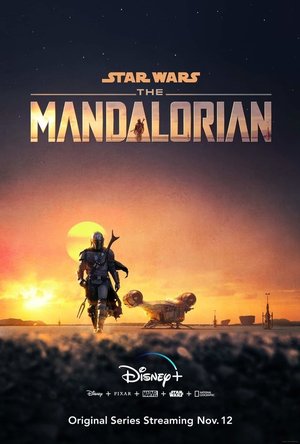


Being a child of Star Wars, born in ’73, whose first memory of a cinema was A New Hope in ’77, of course the entire franchise is still close to my heart. I am no superfan, however. I do not need to remember every name of every character, or know the obscure names of planets to enjoy it. I remember that deeply competitive nature back in the playground – how important it was to prove Star Wars was yours by knowing more than any other kid! Fortunately I managed to let that go shortly after The Return of the Jedi. Ok, maybe 1995.
The Mandalorian is definitely for all Star Wars fans, but it is mostly for the kids that never grew up and need those details of “the canonical Star Wars” universe in their lives. And there are plenty of them. It is a geek’s wet dream! With chat rooms and fan sites going wild in debate and argument over the smallest of Easter eggs and hints to connections across the medium. As if this is a lost historical document that sheds light on the truth of many characters and events, that until now were shrouded in darkness and speculation only.
I find that phenomenon weird and a little creepy, but I do appreciate where it comes from. For me, I am merely glad it isn’t crap. It is nice to be in the Star Wars universe without holding your face in your hands for shame of lazy storytelling and moments that shit on the spirit of the original trilogy. The first thing that pleased me about The Mandolorian is how close it is in feel to the old school trilogy. In fact it surprised me, because, despite the very modern effects and full budget of Disney behind it, it feels very old fashioned, like a TV show from around 1986, maybe. And I wonder how they have achieved that every time I watch it. It has an intangible magic about it.
In fact, the feel of the show as a whole is often a little cheap, shockingly – the posters and toys and all associated media is as glossy and crisp as all money can afford, creating an image of the show that isn’t actually what the show is. In reality it is a cross between old spaghetti westerns, with The Mandalorian cast as The Man With No Name, and episodes of The A-Team or Knightrider. I kinda like it; very nostalgic, and a smart move by Jon Favreau and the other show-runners. It appeals to middle aged audiences and new alike, because it is a knowing hybrid of all things cool and nerdy!
Design-wise, the look of The Mandalorian himself is perfect fan bait and very cool. The music goes a long way to drawing you in – Ludwig Göransson, known for his work on Black Panther and Tenet, has hit on a career defining theme that blends Clint Eastwood and Star Wars in perfect harmony. I can’t imagine the show working half as well without that theme music! The spaceships and detail of every alien and weapon and costume is meticulous (if at times a little wobbly or cheap looking), and the wider feel of background and tertiary characters is pretty damn good.
But, let’s face it… The Mandalorian is the success it has been predominantly for one reason. I could give him his real name, but if you haven’t finished it yet that would count as a huge spoiler, so I will refer to him as The Child. The temptation to use the phrase Baby Yoda is hard to resist, and has been a cultural phenomenon that only comes along once or twice in a decade, but on this I agree with the fans: it is inaccurate and misleading. The Child is fine. It’ll do until you learn his true moniker.
In season one, where the build up of story, character and mystery is superb, we see very little of The Child at first. But we cannot take our eyes off him for every second he is on screen. The whole concept is so beyond cute and incredibly strong as a hook for a Star Wars story it is almost impossible not to squeal out loud at everything he does. Who is he? Why is he? What is he capable of? How will he fit in to the longterm idea for the story? So exciting, and total genius to keep everyone watching.
It isn’t all about The Child on his own though. It is about the unlikely symbiotic bond, like father and son, that develops between the tiny, vulnerable and childlike focal point, and the increasingly confident and loyal antihero, who will stop at nothing to protect his ward, as he struggles to find his own place in the universe. After a very short time, we care more about this relationship than 90% of all romances in all of TV history.
Through danger, mayhem and a touch of comedy, we grow to adore the two of them together, and can’t bear to think of them being apart. Some trick when you realise The Child is as much a mini-muppet style prosthetic as it is added CGI for expression and detail. Perhaps another callback to our 80s sensibilities, when we accepted ETs and Gremlins and all of the residents of Mos Eisley’s cantina as real without hesitation. It doesn’t have to look real, is the point, as long as it fits the story, is cool and is fun! Which The Child totally is – for entertainment value they have got the tone of the show so right.
What doesn’t hold up that strongly to critical scrutiny though is quite a lot of the scripts, the repetitive nature of the context of many episodes and missions the duo find themselves on, the mismatch quality of the guest directors abilities, and quite a lot of the dodgy acting by supporting characters. It’s as if at some production meeting at one early point they all said, look it’s Star Wars, we make the aliens and the spaceships and the weapons look good and we can’t fail… plus we have The Child and Boba Fett’s (yes, I know) armour, we can’t fail!
The basic storyline is enough to hook it on, just about, it is the detail that sometimes feels weak and lazy. But don’t worry, any minute something cool to look at and a big fight will happen, so we’re all good! I’m sure Pedro Pascal (the actor under the armour) can’t believe his luck! He is one of the biggest stars in TV all of a sudden, for basically doing a fairly monotone voice-over performance of some seriously dodgy dialogue. That is the magic of Star Wars.
So, I came to season one late, having no access at that time to Disney plus. In fact, I watched all of season one in a day the day before the launch of season two, so the switch to a new episode to look forward to suited me well. It gave me something to look forward to on a Friday between Halloween and Christmas. Trouble was that, although still having fun with the exploits of The Kid, I was starting to weary of the plotlines, and put my viewing on hold after S2E4 in favour of the far superior scripting of His Dark Materials on BBC.
I must have needed the hiatus, because when I came back to mop it up and finish season two a few days ago I realised that I had in fact missed it. It also helped that episode 5 onwards is when the season gets really good again. Rosario Dawson as Ashoka Tano (known well by fans of The Clone Wars) was a truly great addition that the show much needed by that point.
I had no trouble after that in bingeing to the end. You could feel a climax and a revelation coming, and although the character of Moff Gideon (Giancarlo Esposito) crumbled disappointly away into nothing much, the last 15 minutes of the final episode had me slack jawed in fan wonderment. I felt 9 years old again, and I loved it! I had been amazingly lucky not to stumble upon spoilers, I guess. Amazing ending, and all faults forgiven for that unforgettable moment and feel. Wonderful stuff!
To say any more, again, is to spoil. So, let’s just talk about it privately, or, you know, in about a year when season 3 is over and it is old news. Hmmm, season 3…? I wonder where they will take that now…? Actually, properly exciting, in a back in the playground kind of way.
The Mandalorian is definitely for all Star Wars fans, but it is mostly for the kids that never grew up and need those details of “the canonical Star Wars” universe in their lives. And there are plenty of them. It is a geek’s wet dream! With chat rooms and fan sites going wild in debate and argument over the smallest of Easter eggs and hints to connections across the medium. As if this is a lost historical document that sheds light on the truth of many characters and events, that until now were shrouded in darkness and speculation only.
I find that phenomenon weird and a little creepy, but I do appreciate where it comes from. For me, I am merely glad it isn’t crap. It is nice to be in the Star Wars universe without holding your face in your hands for shame of lazy storytelling and moments that shit on the spirit of the original trilogy. The first thing that pleased me about The Mandolorian is how close it is in feel to the old school trilogy. In fact it surprised me, because, despite the very modern effects and full budget of Disney behind it, it feels very old fashioned, like a TV show from around 1986, maybe. And I wonder how they have achieved that every time I watch it. It has an intangible magic about it.
In fact, the feel of the show as a whole is often a little cheap, shockingly – the posters and toys and all associated media is as glossy and crisp as all money can afford, creating an image of the show that isn’t actually what the show is. In reality it is a cross between old spaghetti westerns, with The Mandalorian cast as The Man With No Name, and episodes of The A-Team or Knightrider. I kinda like it; very nostalgic, and a smart move by Jon Favreau and the other show-runners. It appeals to middle aged audiences and new alike, because it is a knowing hybrid of all things cool and nerdy!
Design-wise, the look of The Mandalorian himself is perfect fan bait and very cool. The music goes a long way to drawing you in – Ludwig Göransson, known for his work on Black Panther and Tenet, has hit on a career defining theme that blends Clint Eastwood and Star Wars in perfect harmony. I can’t imagine the show working half as well without that theme music! The spaceships and detail of every alien and weapon and costume is meticulous (if at times a little wobbly or cheap looking), and the wider feel of background and tertiary characters is pretty damn good.
But, let’s face it… The Mandalorian is the success it has been predominantly for one reason. I could give him his real name, but if you haven’t finished it yet that would count as a huge spoiler, so I will refer to him as The Child. The temptation to use the phrase Baby Yoda is hard to resist, and has been a cultural phenomenon that only comes along once or twice in a decade, but on this I agree with the fans: it is inaccurate and misleading. The Child is fine. It’ll do until you learn his true moniker.
In season one, where the build up of story, character and mystery is superb, we see very little of The Child at first. But we cannot take our eyes off him for every second he is on screen. The whole concept is so beyond cute and incredibly strong as a hook for a Star Wars story it is almost impossible not to squeal out loud at everything he does. Who is he? Why is he? What is he capable of? How will he fit in to the longterm idea for the story? So exciting, and total genius to keep everyone watching.
It isn’t all about The Child on his own though. It is about the unlikely symbiotic bond, like father and son, that develops between the tiny, vulnerable and childlike focal point, and the increasingly confident and loyal antihero, who will stop at nothing to protect his ward, as he struggles to find his own place in the universe. After a very short time, we care more about this relationship than 90% of all romances in all of TV history.
Through danger, mayhem and a touch of comedy, we grow to adore the two of them together, and can’t bear to think of them being apart. Some trick when you realise The Child is as much a mini-muppet style prosthetic as it is added CGI for expression and detail. Perhaps another callback to our 80s sensibilities, when we accepted ETs and Gremlins and all of the residents of Mos Eisley’s cantina as real without hesitation. It doesn’t have to look real, is the point, as long as it fits the story, is cool and is fun! Which The Child totally is – for entertainment value they have got the tone of the show so right.
What doesn’t hold up that strongly to critical scrutiny though is quite a lot of the scripts, the repetitive nature of the context of many episodes and missions the duo find themselves on, the mismatch quality of the guest directors abilities, and quite a lot of the dodgy acting by supporting characters. It’s as if at some production meeting at one early point they all said, look it’s Star Wars, we make the aliens and the spaceships and the weapons look good and we can’t fail… plus we have The Child and Boba Fett’s (yes, I know) armour, we can’t fail!
The basic storyline is enough to hook it on, just about, it is the detail that sometimes feels weak and lazy. But don’t worry, any minute something cool to look at and a big fight will happen, so we’re all good! I’m sure Pedro Pascal (the actor under the armour) can’t believe his luck! He is one of the biggest stars in TV all of a sudden, for basically doing a fairly monotone voice-over performance of some seriously dodgy dialogue. That is the magic of Star Wars.
So, I came to season one late, having no access at that time to Disney plus. In fact, I watched all of season one in a day the day before the launch of season two, so the switch to a new episode to look forward to suited me well. It gave me something to look forward to on a Friday between Halloween and Christmas. Trouble was that, although still having fun with the exploits of The Kid, I was starting to weary of the plotlines, and put my viewing on hold after S2E4 in favour of the far superior scripting of His Dark Materials on BBC.
I must have needed the hiatus, because when I came back to mop it up and finish season two a few days ago I realised that I had in fact missed it. It also helped that episode 5 onwards is when the season gets really good again. Rosario Dawson as Ashoka Tano (known well by fans of The Clone Wars) was a truly great addition that the show much needed by that point.
I had no trouble after that in bingeing to the end. You could feel a climax and a revelation coming, and although the character of Moff Gideon (Giancarlo Esposito) crumbled disappointly away into nothing much, the last 15 minutes of the final episode had me slack jawed in fan wonderment. I felt 9 years old again, and I loved it! I had been amazingly lucky not to stumble upon spoilers, I guess. Amazing ending, and all faults forgiven for that unforgettable moment and feel. Wonderful stuff!
To say any more, again, is to spoil. So, let’s just talk about it privately, or, you know, in about a year when season 3 is over and it is old news. Hmmm, season 3…? I wonder where they will take that now…? Actually, properly exciting, in a back in the playground kind of way.

Matthew Krueger (10051 KP) rated Horrified: Universal Monsters Strategy Board Game in Tabletop Games
Jul 31, 2020 (Updated Aug 1, 2020)
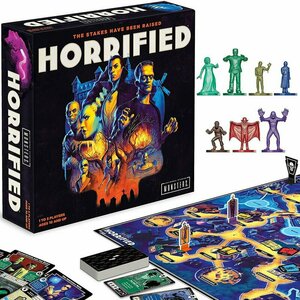

The Universal Monsters (3 more)
The Strategy
Replay Value
Think Ten Steps Ahead
The Excellent Universal Monsters Board Game
When I heard about Horrorified, i wanted to buy it right away. A board game that has the universal monsters and it revolves around them, i really wanted to buy it. Cause i love the universal monsters. My favorite being The Invisible Man and Dracula. So lets talk more about it.
The Gameplay:
Horrified is a cooperative game in which all the players win or lose together. The players win if they defeat all of the Monsters they are playing against. In order to defeat a Monster, you must first complete a task.
Each Monster's task and subsequent defeat is unique:
Creature from the Black Lagoon: Find the Creature's hidden lair, then drive the Creature away.
Dracula: Smash Dracula's four coffins, then overcome Dracula.
Frankenstein and the Bride: Teach Frankenstein and the Bride what it means to be human so they can live peacefully.
The Invisible Man: Supply evidence to the police of the Invisible Man's existence, then trap him.
The Mummy: Break the Mummy's curse, then return him to his tomb.
The Wolf Man: Discover the cure for lycanthropy, then administer it to the Wolf Man.
The players lose immediately if one of the following occurs:
Terror: Each time a Hero or Villager is defeated, the Terror Level will increase. If the Terror Level reaches its maximum, indicated by the skull, the Monsters have overrun the village and the players lose.
Out Of Time: Each turn, you will draw a card from the Monster deck. If you need to draw a Monster card but the deck is empty, you have taken too long to defeat the Monsters and the players lose.
Each turn has two phases, performed in this order:
Hero Phase: Take as many actions as indicated on your Badge. In addition, any player may play any number of Perk cards.
Monster Phase: Draw one Monster card from the top of the Monster deck and resolve all three parts of the card. After completing both phases, play proceeds clockwise, starting with the next player's Hero Phase.
Hero Phase: Actions: Take up to the number of actions indicated on your Badge. You may choose to take fewer. Actions may be taken multiple times and in any order. The possible actions are:
Move: Move your Hero along a lit path to an adjacent space. You cannot move to water spaces and can only cross the river using one of the two bridge spaces. In addition, you may take any number of Villagers in your Hero's space with you when you move.
Guide: Move one Villager from your Hero's space to an adjacent space, or move one Villager from an adjacent space to your Hero's space. Villagers also cannot move to water spaces, and Monsters do not affect their movement.
Special Action: Some Heroes have a special action, as indicated on their Badge. Just like other actions, special actions count as one of the total number of actions for your turn and can be taken multiple times.
Pick Up: Take any number of Items from your Hero's space. Keep all your Items in front of you, next to your Badge.
Share: All Heroes in the same space as your Hero may freely give or take any number of Items from each other.
Advance: At a specific location, use one of your Items to advance a Monster's task.
Defeat: In a Monster's space, use your Items to defeat that Monster.
Monster Phase:
Draw a card from the top of the Monster deck and resolve the three parts of the card, from top to bottom. After resolving the entire Monster card, put it in a discard pile face up.
1. Items: Draw the number of Items listed at the top of the card, if any, from the Item bag. Place each Item at the location indicated on the Item.
If you need to draw an Item when the Item bag is empty, place all the Items from the discard pile into the bag, mix them up, and continue drawing.
2. Event: Each Event either involves one of the Monsters or the Villagers.
The card's color, as well as the symbol above the Event's name, indicates who the Event is about. Gray cards are about the Villagers. Colored cards are about a specific Monster.
If the Event Monster is not in your game, completely ignore the Event and continue with the Monster Strike. Otherwise, read the Event out loud and do what it says.
3. Monster Strike: Certain Monsters move and attack, as indicated by the symbols at the bottom of the card. In order from left to right, move and attack with the first Monster before proceeding to the next Monster.
If an indicated Monster is not in your game, ignore that symbol. If the Frenzy symbol is shown, the Monster with the Frenzy Marker moves and attacks. This could result in the same Monster moving and attacking twice in one turn.
Move the Monster the number of spaces indicated on the card towards the closest person (Hero or Villager). As soon as the Monster is in a space with a person, they stop moving. If the Monster started in a space with a person, they don't move at all.
Attack one person in the Monster's space by rolling the number of attack dice indicated. If there are no people in the Monster's space, the Monster does not attack-do not roll dice. If there are multiple people in that space, the Monster will attack a Hero rather than a Villager.
If there are still multiple people the Monster could attack, the current player chooses one to attack before rolling.
Perk Cards: Each player starts the game with a Perk card, and more Perk cards can be earned by getting Villagers to their safe locations. Keep all your Perk cards face up in front of you. It's a good idea to discuss your Perk cards, and when to play them, with the other players.
Perks may be played on any player's turn, but only during the Hero Phase. When you play a Perk card, do what the card says, and then put it in a discard pile face up. Playing a Perk card does not take an action.
Items: Items are important for advancing tasks and defeating Monsters, as well as defending yourself from the Monsters' attacks. Each Item has a color, indicating its type, and a strength, which is the number at the top. Each Item also has a location, which indicates where the Item is placed when it is drawn from the Item bag.
Hit by a Monster:
Heroes: To ignore being hit by a Monster's attack, a Hero may discard one Item for each Hit symbol rolled. If the Hero does not have enough Items, or does not wish to discard any Items, they are defeated. One hit defeats a Hero.
When a Hero is defeated, increase the Terror Level by moving the Terror Marker one space and remove that Hero from the board.
At the start of that player's next turn, they place their Hero at the Hospital and take their turn as normal, including their full number of actions. A defeated Hero does not lose any Items or Perk cards.
Villagers: A Villager does not have any Items and is therefore defeated immediately when hit. When a Villager is defeated, increase the Terror Level by moving the Terror Marker one space and remove that Villager from the board.
End of the Game: The game can end in one of three ways:
Heroes Triumph: If you defeat all the Monsters, the game immediately ends and the players have won! You've saved the village from a horrific fate, and perhaps even the Monsters themselves.
Terror!: If the Terror Level reaches its maximum, indicated by the skull, the game immediately ends and the players have lost. Everyone, including the Heroes, are too horrified to continue. You abandon the village to the Monsters.
Out Of Time: If you need to draw a card when the Monster deck is empty, the game immediately ends and the players have lost. You've taken too long to save the village. The Villagers have fled and you aren't able to continue.
Solo Play: The Villagers are more fearful if there is only one Hero trying to save the village. Begin the game with the Terror Marker on the "3" of the Terror Level Track.
All the rules remain the same. However, do not play as the Courier-that Hero's Special Action cannot be taken in a solo game. Also the Perk cards "Special Delivery" and "Conduct An Investigation" cannot be used.
Either remove these cards before playing, or when drawn, immediately discard and draw a new Perk card to replace it.
Its a fantasic excellent strategy game based around the universal monsters. I love it so much its such a fun game. If you want to learn more go to BoardGameGeek, Dice Tower Review or One Stop Co-Op Shop.
The Gameplay:
Horrified is a cooperative game in which all the players win or lose together. The players win if they defeat all of the Monsters they are playing against. In order to defeat a Monster, you must first complete a task.
Each Monster's task and subsequent defeat is unique:
Creature from the Black Lagoon: Find the Creature's hidden lair, then drive the Creature away.
Dracula: Smash Dracula's four coffins, then overcome Dracula.
Frankenstein and the Bride: Teach Frankenstein and the Bride what it means to be human so they can live peacefully.
The Invisible Man: Supply evidence to the police of the Invisible Man's existence, then trap him.
The Mummy: Break the Mummy's curse, then return him to his tomb.
The Wolf Man: Discover the cure for lycanthropy, then administer it to the Wolf Man.
The players lose immediately if one of the following occurs:
Terror: Each time a Hero or Villager is defeated, the Terror Level will increase. If the Terror Level reaches its maximum, indicated by the skull, the Monsters have overrun the village and the players lose.
Out Of Time: Each turn, you will draw a card from the Monster deck. If you need to draw a Monster card but the deck is empty, you have taken too long to defeat the Monsters and the players lose.
Each turn has two phases, performed in this order:
Hero Phase: Take as many actions as indicated on your Badge. In addition, any player may play any number of Perk cards.
Monster Phase: Draw one Monster card from the top of the Monster deck and resolve all three parts of the card. After completing both phases, play proceeds clockwise, starting with the next player's Hero Phase.
Hero Phase: Actions: Take up to the number of actions indicated on your Badge. You may choose to take fewer. Actions may be taken multiple times and in any order. The possible actions are:
Move: Move your Hero along a lit path to an adjacent space. You cannot move to water spaces and can only cross the river using one of the two bridge spaces. In addition, you may take any number of Villagers in your Hero's space with you when you move.
Guide: Move one Villager from your Hero's space to an adjacent space, or move one Villager from an adjacent space to your Hero's space. Villagers also cannot move to water spaces, and Monsters do not affect their movement.
Special Action: Some Heroes have a special action, as indicated on their Badge. Just like other actions, special actions count as one of the total number of actions for your turn and can be taken multiple times.
Pick Up: Take any number of Items from your Hero's space. Keep all your Items in front of you, next to your Badge.
Share: All Heroes in the same space as your Hero may freely give or take any number of Items from each other.
Advance: At a specific location, use one of your Items to advance a Monster's task.
Defeat: In a Monster's space, use your Items to defeat that Monster.
Monster Phase:
Draw a card from the top of the Monster deck and resolve the three parts of the card, from top to bottom. After resolving the entire Monster card, put it in a discard pile face up.
1. Items: Draw the number of Items listed at the top of the card, if any, from the Item bag. Place each Item at the location indicated on the Item.
If you need to draw an Item when the Item bag is empty, place all the Items from the discard pile into the bag, mix them up, and continue drawing.
2. Event: Each Event either involves one of the Monsters or the Villagers.
The card's color, as well as the symbol above the Event's name, indicates who the Event is about. Gray cards are about the Villagers. Colored cards are about a specific Monster.
If the Event Monster is not in your game, completely ignore the Event and continue with the Monster Strike. Otherwise, read the Event out loud and do what it says.
3. Monster Strike: Certain Monsters move and attack, as indicated by the symbols at the bottom of the card. In order from left to right, move and attack with the first Monster before proceeding to the next Monster.
If an indicated Monster is not in your game, ignore that symbol. If the Frenzy symbol is shown, the Monster with the Frenzy Marker moves and attacks. This could result in the same Monster moving and attacking twice in one turn.
Move the Monster the number of spaces indicated on the card towards the closest person (Hero or Villager). As soon as the Monster is in a space with a person, they stop moving. If the Monster started in a space with a person, they don't move at all.
Attack one person in the Monster's space by rolling the number of attack dice indicated. If there are no people in the Monster's space, the Monster does not attack-do not roll dice. If there are multiple people in that space, the Monster will attack a Hero rather than a Villager.
If there are still multiple people the Monster could attack, the current player chooses one to attack before rolling.
Perk Cards: Each player starts the game with a Perk card, and more Perk cards can be earned by getting Villagers to their safe locations. Keep all your Perk cards face up in front of you. It's a good idea to discuss your Perk cards, and when to play them, with the other players.
Perks may be played on any player's turn, but only during the Hero Phase. When you play a Perk card, do what the card says, and then put it in a discard pile face up. Playing a Perk card does not take an action.
Items: Items are important for advancing tasks and defeating Monsters, as well as defending yourself from the Monsters' attacks. Each Item has a color, indicating its type, and a strength, which is the number at the top. Each Item also has a location, which indicates where the Item is placed when it is drawn from the Item bag.
Hit by a Monster:
Heroes: To ignore being hit by a Monster's attack, a Hero may discard one Item for each Hit symbol rolled. If the Hero does not have enough Items, or does not wish to discard any Items, they are defeated. One hit defeats a Hero.
When a Hero is defeated, increase the Terror Level by moving the Terror Marker one space and remove that Hero from the board.
At the start of that player's next turn, they place their Hero at the Hospital and take their turn as normal, including their full number of actions. A defeated Hero does not lose any Items or Perk cards.
Villagers: A Villager does not have any Items and is therefore defeated immediately when hit. When a Villager is defeated, increase the Terror Level by moving the Terror Marker one space and remove that Villager from the board.
End of the Game: The game can end in one of three ways:
Heroes Triumph: If you defeat all the Monsters, the game immediately ends and the players have won! You've saved the village from a horrific fate, and perhaps even the Monsters themselves.
Terror!: If the Terror Level reaches its maximum, indicated by the skull, the game immediately ends and the players have lost. Everyone, including the Heroes, are too horrified to continue. You abandon the village to the Monsters.
Out Of Time: If you need to draw a card when the Monster deck is empty, the game immediately ends and the players have lost. You've taken too long to save the village. The Villagers have fled and you aren't able to continue.
Solo Play: The Villagers are more fearful if there is only one Hero trying to save the village. Begin the game with the Terror Marker on the "3" of the Terror Level Track.
All the rules remain the same. However, do not play as the Courier-that Hero's Special Action cannot be taken in a solo game. Also the Perk cards "Special Delivery" and "Conduct An Investigation" cannot be used.
Either remove these cards before playing, or when drawn, immediately discard and draw a new Perk card to replace it.
Its a fantasic excellent strategy game based around the universal monsters. I love it so much its such a fun game. If you want to learn more go to BoardGameGeek, Dice Tower Review or One Stop Co-Op Shop.

Purple Phoenix Games (2266 KP) rated On the Rocks in Tabletop Games
Sep 7, 2021

I have to come clean right at the top of this one. I have not really tried a whole lot of different cocktails in my life. I have been mostly a beer kind of guy. Not that I am opposed to cocktails at all – in fact, I have really enjoyed most of the drinks I have tried. That said, I wish I was more hip so I would know all the drink lingo and really know why someone would want their concoction shaken and not stirred. So, I went into this one thinking I would learn the secret finally. But I didn’t. I did have a good time playing it though.
“On the Rocks is a marble drafting, cocktail recipe fulfillment game for 1-4 players. It is NOT a drinking game.” – straight from the game’s BGG page. So what does that mean? Well, this one is a variation of the “I cut, you choose” style game, but HEAVILY themed around bartending and enhanced with additional fun mechanics. The winner is the player who amasses the most amount of money by the end of their shift.
DISCLAIMER: We were provided a copy of this game for the purposes of this review. This is a retail copy of the game, so what you see in these photos is exactly what would be received in your box. I do not intend to cover every single rule included in the rulebook, but will describe the overall game flow and major rule set so that our readers may get a sense of how the game plays. For more in depth rules, you may purchase a copy online or from your FLGS. -T
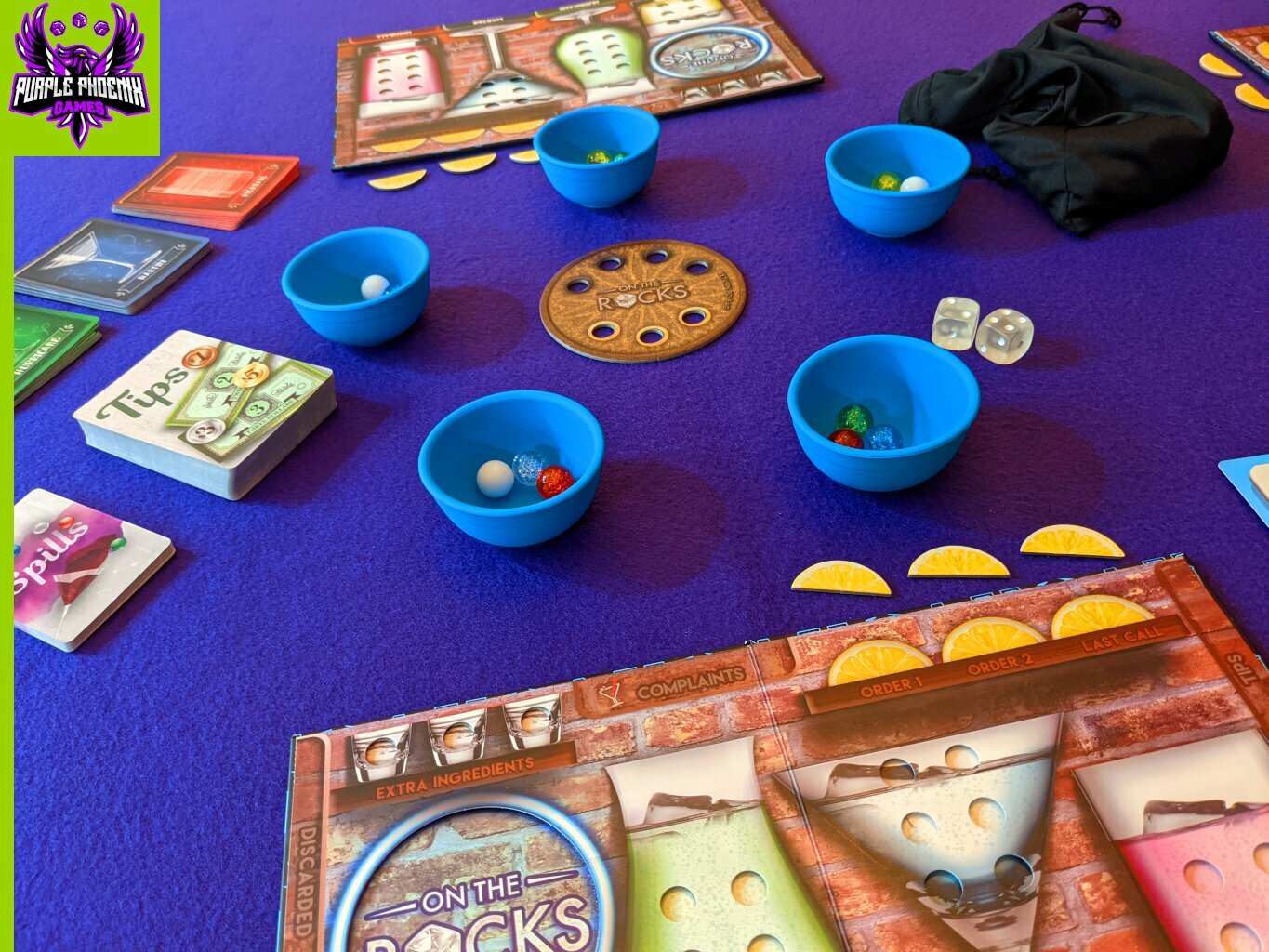
To setup, consult the rulebook, as there are many steps. However, once setup, the game should look similar to the photo below. Choose the starting player and the mixology competition can begin!
On the Rocks is played over several rounds with each player completing specific steps. The first step is optional, and is Tip Cards. Players will accumulate Tip Cards throughout the game, and each one features a special ability that may be used at this time. The next step may also be optional, depending on if the active player had received a Complaint card previously. Complaints must be completed on this step and is pretty much a wrench thrown in the plans by competitors.
Once these (possibly) optional steps have been completed the active player then takes the 2d6 and Rolls them. This number determines how many ingredient marbles are to be pulled from the bag and added into play. For the cost of one ingredient marble, the active player may manipulate the rolled dice by flipping it to its opposite face. Next, the player will Draft the number of marbles from the bag they rolled in the previous step. From these drafted marbles the player will Mix them into the blue Jigger Bowls in the middle of the table one at a time, a la Mancala (oh that’s fun to say: A LA MANCALA!). Then the player will Select & Place a jigger of marbles from the table onto their player board. Placing the corresponding marbles onto the drinks is how recipes can be completed. If any ingredients were selected from the jigger but not placed, the player must then place the ingredients into the Extra Ingredients shot glasses on the top portion of the player board, to Save for later use.
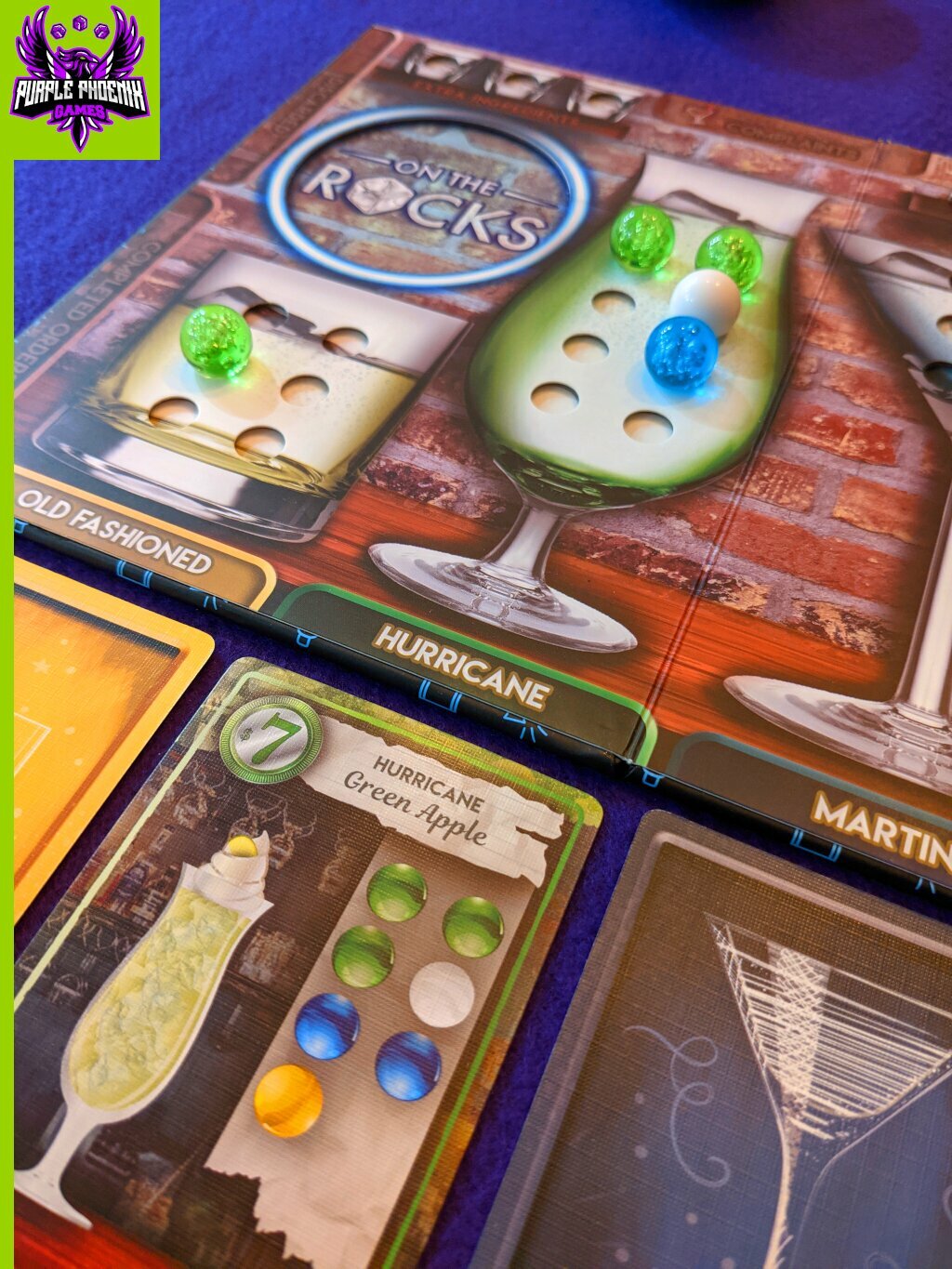
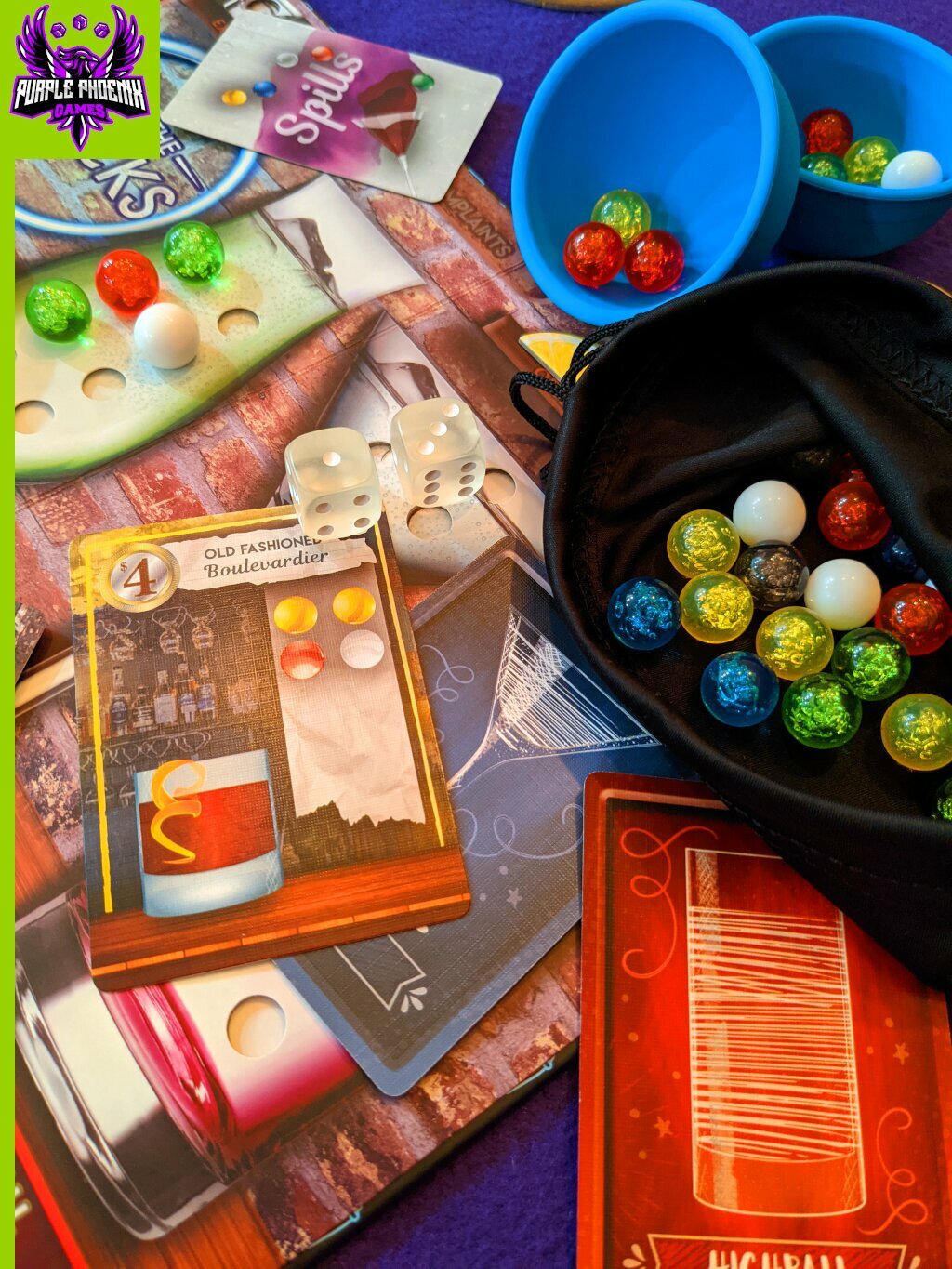
When the ingredient marbles have been placed and saved, the player must then complete the Resolve step. Several ingredient marbles are “Premium” or “Spill” marbles. Premium marbles (golden) allow the player to select ANY two ingredients from the draw bag and the Premium marble is then discarded to the coaster in the middle of the table. The black Spill marble forces the active player to draw a Spill card from the deck and complete its action. It also during the Resolve step that the player may complete a recipe card by discarding the drink’s ingredients to the bag and flipping its recipe card face-down. If the entire order (all of the face-up recipe cards) is completed, the active player’s round ends and they notate this by placing one of the three lemon tokens on their player board. Some round end cleanup is performed, like drawing another set of 3 or 4 drink recipes for an order, and the player’s turn is over.
Once a player has completed their third order of drinks, they must indicate “Last Call” to the other players at the table. This informs the other players that they have one last turn to earn any extra money before the game ends. When the game has been finished, final scoring is performed and the winner is they who earned the most money throughout the night. The other players must immediately fix the winner a drink, or buy the winner a shot. Okay, those aren’t in the rulebook, but merely suggestions for the revised second edition…
Components. For those that follow our reviews, you know I am a sucker for games with great components, and this one definitely delivers for me. The aesthetics and art style are just perfect, the double-layer boards are always lovely, and the rubber jiggers are excellent. I cannot see anything that can be improved in terms of components, and I completely expected that because this was published by Pentree Games and 25th Century Games (one of my favorite publishers in the business). The game looks and feels deluxe, which is VERY satisfying.
I think that the Pittre duo of Michael and Christina really knocked it out of the park with this one. Wait, this is their first game design?? And it’s incredible? Okay okay, I’ll be keeping my eye on you two. On the Rocks is a light game with excellent table presence and some difficult choices presented. Now, the choices may be TOOOOOO difficult for some gamers, especially our AP-prone players. Carefully planning out each ingredient’s distribution into the jigger bowls can send them into a frenzy, so I have advised to choose one or two bowls they wish to buff and concentrate on hitting those with the marbles they want, and just randomly place the other ingredients. I know that is a big ask, but this game is supposed to take 45-90 minutes, not 45-90 hours. My other gripe about the game is the color-dependence of the ingredient marbles. I am sorry to all my colorblind friends out there, but I am unable to see how you might keep a possible 12 different marbles straight in your heads while simultaneously remembering the state of marbles in each jigger bowl. I hope I am completely wrong, as I do not suffer from colorblindness, and please do let me know if this is still playable for those gamers.
These gripes aside, everything else about the game is fabulous. I love being able to manipulate my dice rolls (yes, with a cost) to have ultimate control of the number of marbles pulled from the bag. That bag, however, takes control away immediately unless I draft a bunch of clear (wild) or golden marbles to affect my final placements. I also adore struggling to choose which recipes to concentrate on first, and weighing the possibilities of completing the higher value recipes, or blitzing the smaller ones first.
Oh, and the Spills cards? They can be real pains in the booty. These effectively give the active player the ability to completely botch another players’ plans by discarding their ingredient marbles from their player board. Not enough player interaction? How about negative Tip cards, which are earned by completing a recipe, that impede a competitor’s progress by making them complete the Tip card before being able to move on with their plans, or by limiting their marble selection to two instead of the entire bowl? Yeah, this has player interaction for sure.
Again, I like a good drink now and then, just as much as the next person. However, I have never been a bartender, and I do not plan on ever becoming one. I could not ever imagine having to compete with other bartenders for tip money either, especially if it is as brutally cutthroat as On the Rocks portrays it to be. I will, however, play a game where all that “fun” is diluted to dice, cards, and marbles. I was looking through my collection recently and noticed have embarrassingly few games with an adult beverage theme. If you are like me and require more games depicting fun with alcohol, then I strongly urge you to check out On the Rocks. I feel like I can finally graduate from Fuzzy Navels and Stone Sours just by playing this game and really upping my liquor acumen. Purple Phoenix Games gives this one a delicious 5 / 6. It seems readily available for consumption, but please do not try to go drink for drink with this game. It’s not designed to be a drinking game… or is it?
“On the Rocks is a marble drafting, cocktail recipe fulfillment game for 1-4 players. It is NOT a drinking game.” – straight from the game’s BGG page. So what does that mean? Well, this one is a variation of the “I cut, you choose” style game, but HEAVILY themed around bartending and enhanced with additional fun mechanics. The winner is the player who amasses the most amount of money by the end of their shift.
DISCLAIMER: We were provided a copy of this game for the purposes of this review. This is a retail copy of the game, so what you see in these photos is exactly what would be received in your box. I do not intend to cover every single rule included in the rulebook, but will describe the overall game flow and major rule set so that our readers may get a sense of how the game plays. For more in depth rules, you may purchase a copy online or from your FLGS. -T
To setup, consult the rulebook, as there are many steps. However, once setup, the game should look similar to the photo below. Choose the starting player and the mixology competition can begin!
On the Rocks is played over several rounds with each player completing specific steps. The first step is optional, and is Tip Cards. Players will accumulate Tip Cards throughout the game, and each one features a special ability that may be used at this time. The next step may also be optional, depending on if the active player had received a Complaint card previously. Complaints must be completed on this step and is pretty much a wrench thrown in the plans by competitors.
Once these (possibly) optional steps have been completed the active player then takes the 2d6 and Rolls them. This number determines how many ingredient marbles are to be pulled from the bag and added into play. For the cost of one ingredient marble, the active player may manipulate the rolled dice by flipping it to its opposite face. Next, the player will Draft the number of marbles from the bag they rolled in the previous step. From these drafted marbles the player will Mix them into the blue Jigger Bowls in the middle of the table one at a time, a la Mancala (oh that’s fun to say: A LA MANCALA!). Then the player will Select & Place a jigger of marbles from the table onto their player board. Placing the corresponding marbles onto the drinks is how recipes can be completed. If any ingredients were selected from the jigger but not placed, the player must then place the ingredients into the Extra Ingredients shot glasses on the top portion of the player board, to Save for later use.
When the ingredient marbles have been placed and saved, the player must then complete the Resolve step. Several ingredient marbles are “Premium” or “Spill” marbles. Premium marbles (golden) allow the player to select ANY two ingredients from the draw bag and the Premium marble is then discarded to the coaster in the middle of the table. The black Spill marble forces the active player to draw a Spill card from the deck and complete its action. It also during the Resolve step that the player may complete a recipe card by discarding the drink’s ingredients to the bag and flipping its recipe card face-down. If the entire order (all of the face-up recipe cards) is completed, the active player’s round ends and they notate this by placing one of the three lemon tokens on their player board. Some round end cleanup is performed, like drawing another set of 3 or 4 drink recipes for an order, and the player’s turn is over.
Once a player has completed their third order of drinks, they must indicate “Last Call” to the other players at the table. This informs the other players that they have one last turn to earn any extra money before the game ends. When the game has been finished, final scoring is performed and the winner is they who earned the most money throughout the night. The other players must immediately fix the winner a drink, or buy the winner a shot. Okay, those aren’t in the rulebook, but merely suggestions for the revised second edition…
Components. For those that follow our reviews, you know I am a sucker for games with great components, and this one definitely delivers for me. The aesthetics and art style are just perfect, the double-layer boards are always lovely, and the rubber jiggers are excellent. I cannot see anything that can be improved in terms of components, and I completely expected that because this was published by Pentree Games and 25th Century Games (one of my favorite publishers in the business). The game looks and feels deluxe, which is VERY satisfying.
I think that the Pittre duo of Michael and Christina really knocked it out of the park with this one. Wait, this is their first game design?? And it’s incredible? Okay okay, I’ll be keeping my eye on you two. On the Rocks is a light game with excellent table presence and some difficult choices presented. Now, the choices may be TOOOOOO difficult for some gamers, especially our AP-prone players. Carefully planning out each ingredient’s distribution into the jigger bowls can send them into a frenzy, so I have advised to choose one or two bowls they wish to buff and concentrate on hitting those with the marbles they want, and just randomly place the other ingredients. I know that is a big ask, but this game is supposed to take 45-90 minutes, not 45-90 hours. My other gripe about the game is the color-dependence of the ingredient marbles. I am sorry to all my colorblind friends out there, but I am unable to see how you might keep a possible 12 different marbles straight in your heads while simultaneously remembering the state of marbles in each jigger bowl. I hope I am completely wrong, as I do not suffer from colorblindness, and please do let me know if this is still playable for those gamers.
These gripes aside, everything else about the game is fabulous. I love being able to manipulate my dice rolls (yes, with a cost) to have ultimate control of the number of marbles pulled from the bag. That bag, however, takes control away immediately unless I draft a bunch of clear (wild) or golden marbles to affect my final placements. I also adore struggling to choose which recipes to concentrate on first, and weighing the possibilities of completing the higher value recipes, or blitzing the smaller ones first.
Oh, and the Spills cards? They can be real pains in the booty. These effectively give the active player the ability to completely botch another players’ plans by discarding their ingredient marbles from their player board. Not enough player interaction? How about negative Tip cards, which are earned by completing a recipe, that impede a competitor’s progress by making them complete the Tip card before being able to move on with their plans, or by limiting their marble selection to two instead of the entire bowl? Yeah, this has player interaction for sure.
Again, I like a good drink now and then, just as much as the next person. However, I have never been a bartender, and I do not plan on ever becoming one. I could not ever imagine having to compete with other bartenders for tip money either, especially if it is as brutally cutthroat as On the Rocks portrays it to be. I will, however, play a game where all that “fun” is diluted to dice, cards, and marbles. I was looking through my collection recently and noticed have embarrassingly few games with an adult beverage theme. If you are like me and require more games depicting fun with alcohol, then I strongly urge you to check out On the Rocks. I feel like I can finally graduate from Fuzzy Navels and Stone Sours just by playing this game and really upping my liquor acumen. Purple Phoenix Games gives this one a delicious 5 / 6. It seems readily available for consumption, but please do not try to go drink for drink with this game. It’s not designed to be a drinking game… or is it?

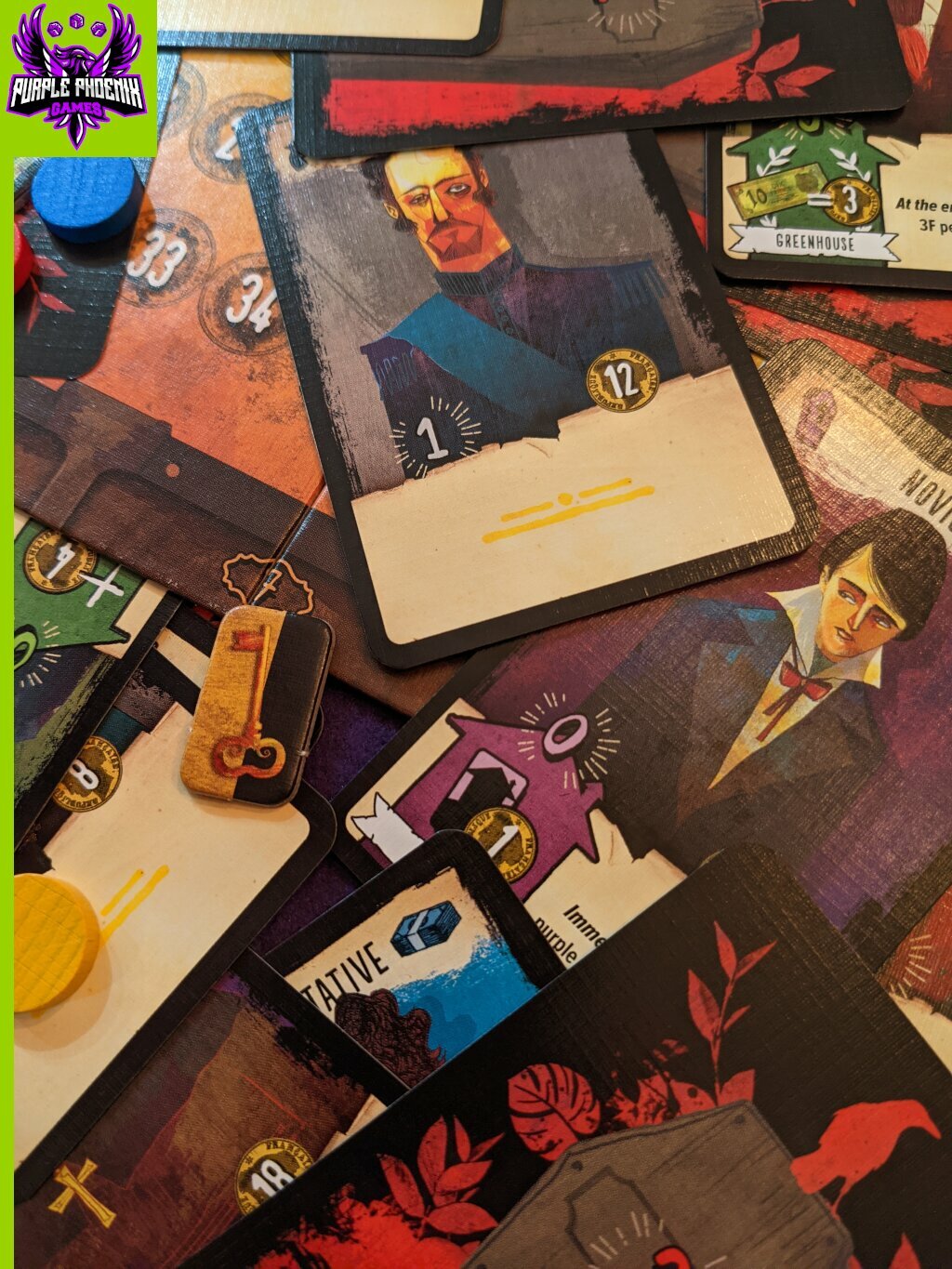
Purple Phoenix Games (2266 KP) rated The Bloody Inn in Tabletop Games
Feb 12, 2022
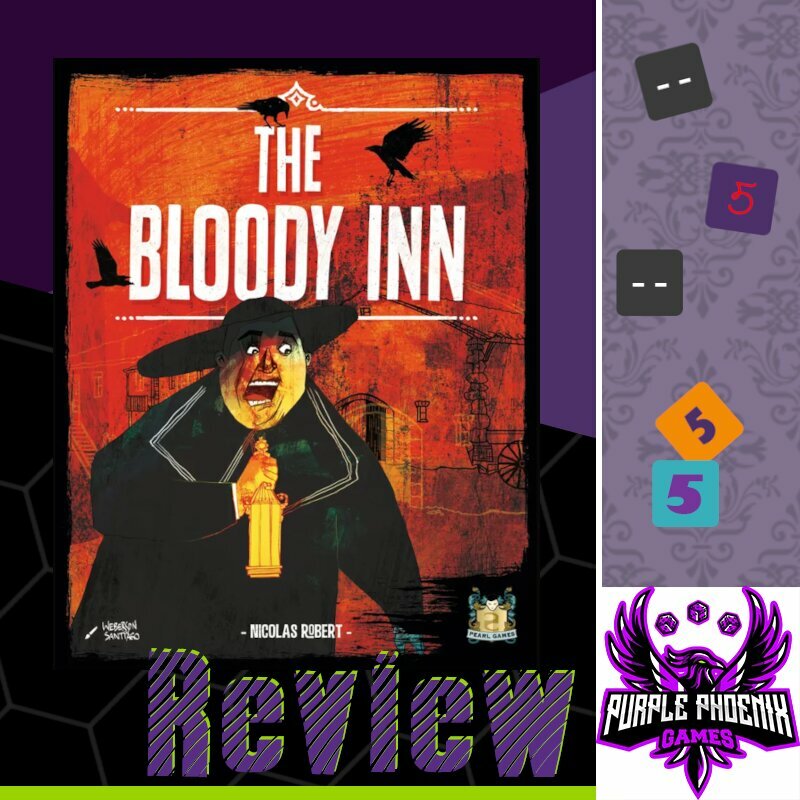
It’s cliche to post a game review like this so near to Halloween, so I will probably hold off on that. However, what a perfect game to go along with the macabre tone of the Halloween season! Get this: you and your family own a motel in a small town where many travelers stop to rest. You are strapped for cash, so what is a logical step in achieving wealth? Of course! Murdering and robbing your customers upon their stays! No? Not a typical business model? Unsustainable? Pfft. You just aren’t robbing the right customers…
The Bloody Inn is a card-drafting, hand management, horror game of recruiting accomplices and having them carry out dastardly deeds to secure the most money at the end of the game. In it, players take on the roles of one of the inn’s staff members and control pawns in their evil schemes in order to swindle and kill for mountains of francs (it’s set in France, pre-Euro).
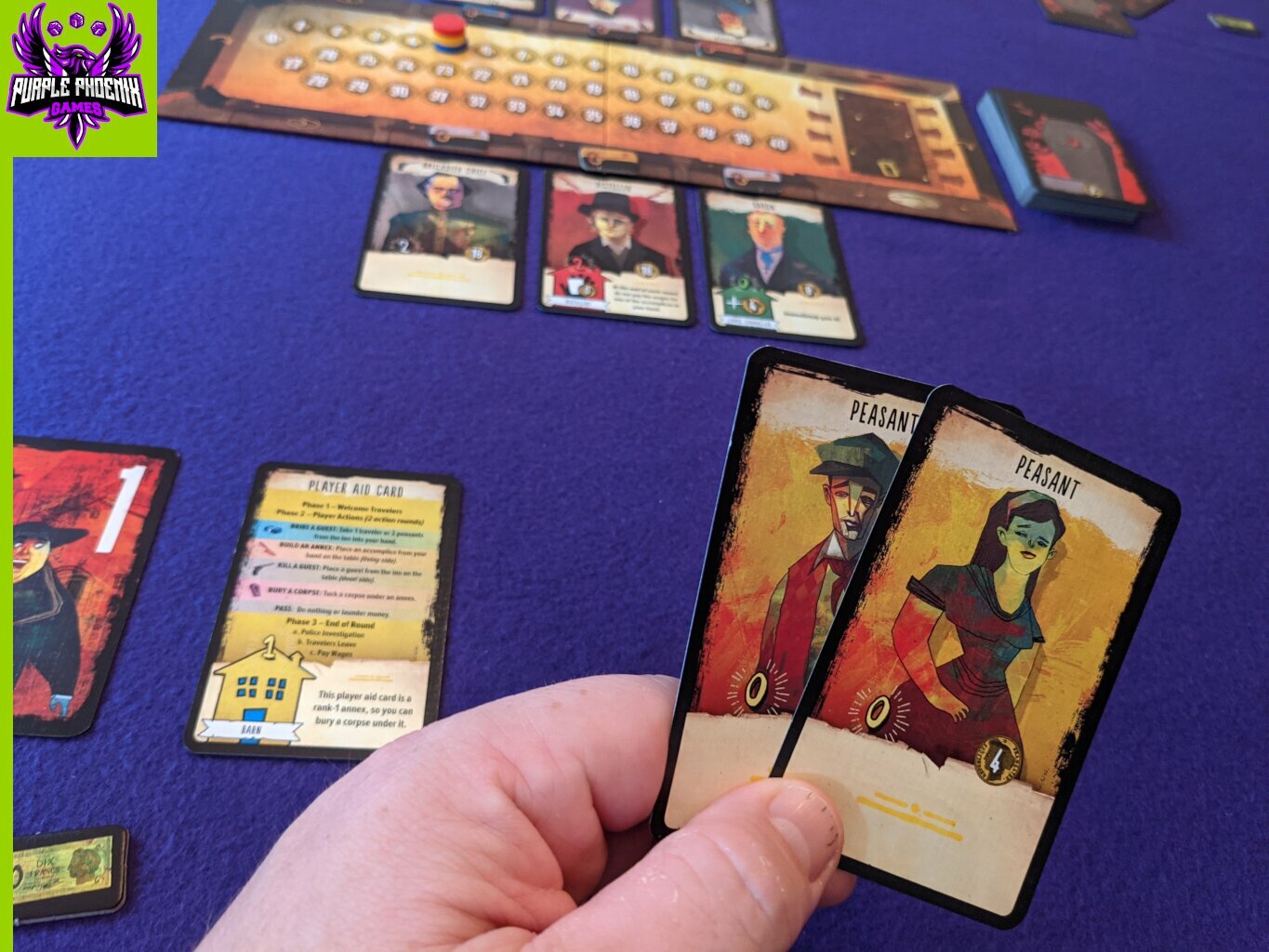
To setup, place the main board on the table, give each player the components of their color choice, two Peasant cards, a 10 franc (f) check, and a player aid card. The “traveler deck” is assembled and shuffled per the rules, and placed on the Entrance side of the board. Players choose one room to place a key token in their color, and several gray neutral key tokens are placed in other rooms. Unsuspecting travelers will be staying in these rooms each night. Per the rules, the greediest player is given the first player card and the mischief may begin!
The Bloody Inn is played over several rounds, and each round has players completing three phases: Welcome Travelers, Player Actions, and End of Round. Players will Welcome Travelers to signify the start of the round by the first player drawing one card from the deck at a time and choosing in which room they will be placed.
After Travelers have been welcomed and turn in for the evening, the second phase may begin: Player Actions. In turn order players will be able to perform two actions each round. Players may choose from five different actions, and actions can be repeated for the second action of the round. Players may Bribe a Guest by discarding cards from hand equal to the printed value on the target card’s front. Initially all players simply employ the two starter Peasants, so Bribing is only performed on cards that show a value of 0-2. When a player Bribes a guest, they essentially spend cards from hand to recruit the new guest to their employ. These new employees (accomplices) are then available to be used on future actions. One or two Peasants may also be Bribed from the bistro, adding to a player’s hand of usable human resources.
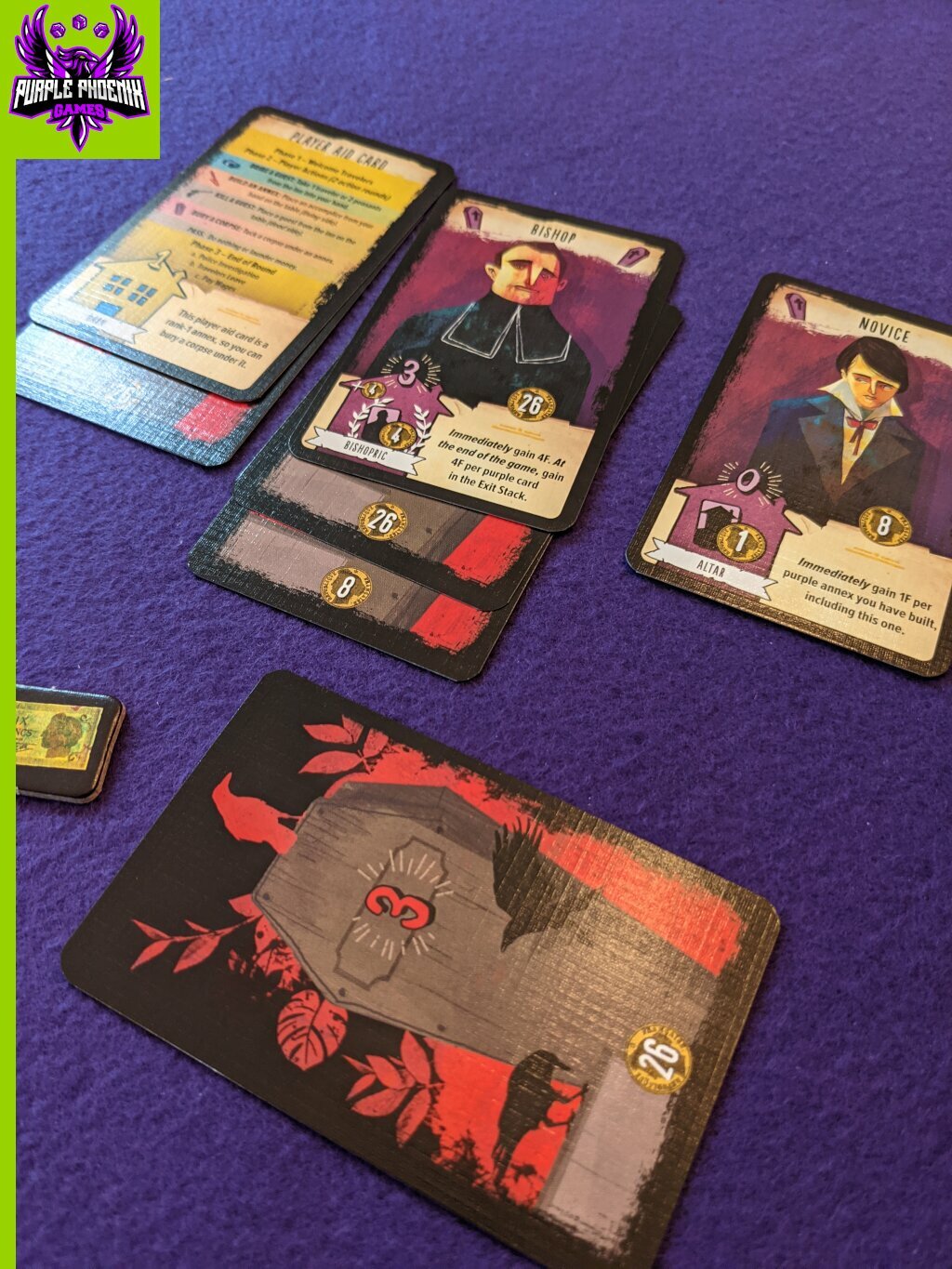
A player may instead choose to Kill a Guest by similarly discarding the appropriate number of accomplices and adding the freshly-slain guest to their tableau, face-down. The card backs feature a coffin with their “rank” (action number) printed on it. Corpses normally cause no issues, but they will need to be buried under an Annex in order to collect the money in their pockets. Players may use an action to Build an Annex by discarding the appropriate number of accomplices and using a card from hand to build and staff the Annex. Annexes can be used for the action printed on the card bottom, and/or as a housing for corpses, with the Corpses being sent to any player’s Annex via the Bury a Corpse action. Discard the requisite number of accomplices to bury a corpse, and avoid suspicion from the Law.
If none of these actions are attractive to the player, or if they simply wish, they may instead Pass and launder money from the village notary. To do this, either reduce the number of francs from the Wealth Track on the main board in order to gain a 10f check, or turn in a check for 10f on the Wealth Track.
Once all players have taken their two actions, the End of Round is performed. Firstly, if any Travelers remain belonging to the Police type (signified by pistol icons on the top of the card), they will conduct an investigation, finding any unburied corpses. Should a corpse be found in this way, the owning player will need to pay 10f for the local undertaker to dispose of the body respectfully. This not only costs the player 10f, but also the amount of money that could have been gained if they had only buried them or dealt with the Police traveler prior. Next, the Travelers who remain all wake up feeling refreshed and leave the inn by being placed in the discard pile. Once the board has been cleared of all Travelers, accomplices must be paid their wages for their help. For each accomplice in hand, the players must pay 1f from the Wealth Track.
Play continues in this fashion until the main Traveler deck has been depleted twice. Then, players add up their francs and the player with the most in francs and checks is the winner, and just the greatest little murderer/robber/briber in all the land!
Components. This game really has a modest amount of components, but they are all similarly great quality. The main board acts as the inn’s room display, the Wealth Track, AND the bistro (where Peasants are discarded, as opposed to being placed in the normal discard pile). I love when components pull double or triple duty. That said, the player aids not only remind the players of the phases and actions from which they may choose, but it also provides the player with a starter Annex that can be used to bury their first corpse! HOW COOL IS THAT?! However, the greatest thing that stands out in regards to the components is the overall look and feel of the game. The character artist for this one is Weberson Santiago, and he has also illustrated games such as the new Quest (the new version of The Resistance: Avalon), Coup, and the new Whirling Witchcraft. I adore his art style, even though I shouldn’t. My typical preference of character art is semi-realism (like that of Kwanchai Moriya), but this style is really unique and perfectly applied to the theme. Great matchup of artist and game here. I do have one silly wish for this game: PLEASE change the player colors. I mean, I am so tired of having the choice between red, blue, green, and yellow. Take a Cue from my good friend Scott Brady and use one of the more interesting color choices. I mean, even to fit in with the theme here a more appropriate palette could include a brown, black, orange, and yellow or something. Be bold!!
I knew right away that this was a great game for me. Yes, the theme is super dark and macabre, which is rare for me to enjoy, but I would only play this with adults anyway so I am unbothered by it. However, the puzzle that lies within this box is one that I thoroughly enjoy solving every round. What I neglected to mention up top is the fact that when actions are taken (Bribing, Killing, Building Annexes, and Burying Corpses) if you happen to have certain card types in hand, then the cost of discards is reduced by the number of cards present. For example, if I were to Bribe a Police card from the rooms in my first action, they have an affinity for killing (messed up, I know) and will thus help me to perform a Kill action on the next turn by reducing the number of accomplices I would need to discard for that action. Side benefit: by taking the Police Travelers off the board, they then will not perform their investigations in the morning.
Another aspect I truly enjoy about The Bloody Inn is that many cards have that dual-purpose mechanic I appreciate. The player aid is also an Annex. Brilliant! Many of the Annex cards can also offer one-time or recurring powers. It’s just so satisfying to grab cards that can combo well with each other in order to fulfill your evil plans. Every card is important, and when they can offer more than one benefit, I am a happy gamer.
I cannot express how happy I am to have decided to purchase this one. I have seen the BGG ratings and rankings, but always thought I wouldn’t like it due to its very adult theme, but boy was I wrong! This is one of the best games I have played recently and I hope to even bling it out a bit, maybe even with new player colors like I suggested earlier. Laura and my wife were able to join me for this one and they agree with me – this one is excellent and definitely worth consideration into anyone’s collection. Purple Phoenix Games gives this one a dastardly 15 / 18. Yeah, it’s perfect for Halloweentime, but also for ANY time. If you are looking for something a little grim and grisly with lighter rules and lots of interesting choices, you need to check out The Bloody Inn. Grab lots of Police cards and go on a killing spree for me!
The Bloody Inn is a card-drafting, hand management, horror game of recruiting accomplices and having them carry out dastardly deeds to secure the most money at the end of the game. In it, players take on the roles of one of the inn’s staff members and control pawns in their evil schemes in order to swindle and kill for mountains of francs (it’s set in France, pre-Euro).
To setup, place the main board on the table, give each player the components of their color choice, two Peasant cards, a 10 franc (f) check, and a player aid card. The “traveler deck” is assembled and shuffled per the rules, and placed on the Entrance side of the board. Players choose one room to place a key token in their color, and several gray neutral key tokens are placed in other rooms. Unsuspecting travelers will be staying in these rooms each night. Per the rules, the greediest player is given the first player card and the mischief may begin!
The Bloody Inn is played over several rounds, and each round has players completing three phases: Welcome Travelers, Player Actions, and End of Round. Players will Welcome Travelers to signify the start of the round by the first player drawing one card from the deck at a time and choosing in which room they will be placed.
After Travelers have been welcomed and turn in for the evening, the second phase may begin: Player Actions. In turn order players will be able to perform two actions each round. Players may choose from five different actions, and actions can be repeated for the second action of the round. Players may Bribe a Guest by discarding cards from hand equal to the printed value on the target card’s front. Initially all players simply employ the two starter Peasants, so Bribing is only performed on cards that show a value of 0-2. When a player Bribes a guest, they essentially spend cards from hand to recruit the new guest to their employ. These new employees (accomplices) are then available to be used on future actions. One or two Peasants may also be Bribed from the bistro, adding to a player’s hand of usable human resources.
A player may instead choose to Kill a Guest by similarly discarding the appropriate number of accomplices and adding the freshly-slain guest to their tableau, face-down. The card backs feature a coffin with their “rank” (action number) printed on it. Corpses normally cause no issues, but they will need to be buried under an Annex in order to collect the money in their pockets. Players may use an action to Build an Annex by discarding the appropriate number of accomplices and using a card from hand to build and staff the Annex. Annexes can be used for the action printed on the card bottom, and/or as a housing for corpses, with the Corpses being sent to any player’s Annex via the Bury a Corpse action. Discard the requisite number of accomplices to bury a corpse, and avoid suspicion from the Law.
If none of these actions are attractive to the player, or if they simply wish, they may instead Pass and launder money from the village notary. To do this, either reduce the number of francs from the Wealth Track on the main board in order to gain a 10f check, or turn in a check for 10f on the Wealth Track.
Once all players have taken their two actions, the End of Round is performed. Firstly, if any Travelers remain belonging to the Police type (signified by pistol icons on the top of the card), they will conduct an investigation, finding any unburied corpses. Should a corpse be found in this way, the owning player will need to pay 10f for the local undertaker to dispose of the body respectfully. This not only costs the player 10f, but also the amount of money that could have been gained if they had only buried them or dealt with the Police traveler prior. Next, the Travelers who remain all wake up feeling refreshed and leave the inn by being placed in the discard pile. Once the board has been cleared of all Travelers, accomplices must be paid their wages for their help. For each accomplice in hand, the players must pay 1f from the Wealth Track.
Play continues in this fashion until the main Traveler deck has been depleted twice. Then, players add up their francs and the player with the most in francs and checks is the winner, and just the greatest little murderer/robber/briber in all the land!
Components. This game really has a modest amount of components, but they are all similarly great quality. The main board acts as the inn’s room display, the Wealth Track, AND the bistro (where Peasants are discarded, as opposed to being placed in the normal discard pile). I love when components pull double or triple duty. That said, the player aids not only remind the players of the phases and actions from which they may choose, but it also provides the player with a starter Annex that can be used to bury their first corpse! HOW COOL IS THAT?! However, the greatest thing that stands out in regards to the components is the overall look and feel of the game. The character artist for this one is Weberson Santiago, and he has also illustrated games such as the new Quest (the new version of The Resistance: Avalon), Coup, and the new Whirling Witchcraft. I adore his art style, even though I shouldn’t. My typical preference of character art is semi-realism (like that of Kwanchai Moriya), but this style is really unique and perfectly applied to the theme. Great matchup of artist and game here. I do have one silly wish for this game: PLEASE change the player colors. I mean, I am so tired of having the choice between red, blue, green, and yellow. Take a Cue from my good friend Scott Brady and use one of the more interesting color choices. I mean, even to fit in with the theme here a more appropriate palette could include a brown, black, orange, and yellow or something. Be bold!!
I knew right away that this was a great game for me. Yes, the theme is super dark and macabre, which is rare for me to enjoy, but I would only play this with adults anyway so I am unbothered by it. However, the puzzle that lies within this box is one that I thoroughly enjoy solving every round. What I neglected to mention up top is the fact that when actions are taken (Bribing, Killing, Building Annexes, and Burying Corpses) if you happen to have certain card types in hand, then the cost of discards is reduced by the number of cards present. For example, if I were to Bribe a Police card from the rooms in my first action, they have an affinity for killing (messed up, I know) and will thus help me to perform a Kill action on the next turn by reducing the number of accomplices I would need to discard for that action. Side benefit: by taking the Police Travelers off the board, they then will not perform their investigations in the morning.
Another aspect I truly enjoy about The Bloody Inn is that many cards have that dual-purpose mechanic I appreciate. The player aid is also an Annex. Brilliant! Many of the Annex cards can also offer one-time or recurring powers. It’s just so satisfying to grab cards that can combo well with each other in order to fulfill your evil plans. Every card is important, and when they can offer more than one benefit, I am a happy gamer.
I cannot express how happy I am to have decided to purchase this one. I have seen the BGG ratings and rankings, but always thought I wouldn’t like it due to its very adult theme, but boy was I wrong! This is one of the best games I have played recently and I hope to even bling it out a bit, maybe even with new player colors like I suggested earlier. Laura and my wife were able to join me for this one and they agree with me – this one is excellent and definitely worth consideration into anyone’s collection. Purple Phoenix Games gives this one a dastardly 15 / 18. Yeah, it’s perfect for Halloweentime, but also for ANY time. If you are looking for something a little grim and grisly with lighter rules and lots of interesting choices, you need to check out The Bloody Inn. Grab lots of Police cards and go on a killing spree for me!

Paul Kellett (118 KP) rated Descent: Journeys in the Dark (Second Edition) in Tabletop Games
May 4, 2019
Plenty of expansions (1 more)
Decent quality miniatures
App can be buggy (1 more)
One side can snowball after a couple of wins
Descent: Journeys In The Dark has been around a long time now, starting as a huge dungeon crawler and morphing into a tactical skirmish / objective-based campaign game. It is supposed to be played with 2-5 players with 1 player being the "Overlord", controlling all the monsters and playing nasty cards on the other players playing the group of heroes (at least 2 heroes required). The game is a fun dice-chucker with a decent amount of strategy and on the whole, well balanced.
With a couple of big-box and half a dozen small-box expansions, not to mention the various hero & monster packs, there is a ton of stuff available and if you own everything, you will be able to choose from 72 heroes with 22 different class decks; fight against 45 different monster types, and encounter around 15 lieutenants over a total of 182 different scenarios. That's plenty to keep you quiet for a while.
So many cards...
Descent: An Overview In The Dark
Descent is a scenario-based game where you work through a tree of different missions, choosing the next one based on whether the heroes or the Overlord worn the last. Each scenario will have specific objectives - anything from stealing an item and reaching the exit to interrogating prisoners and defeating a fearsome Lieutenant of the Overlord. Some of the monsters to be encountered are specified in the scenario text with other free groups able to be chosen from traits specific to that scenario. This gives some variety meaning you will never face exactly the same monsters if you replay the scenarios.
The good players choose a hero from the stack of basic skill types - Fighter, Healer, Scout or Mage and then choose from one of the many class decks for each type so the Fighter could be a Knight or a Berzerker, the Mage a Necromancer and the Healer a Bard, etc. These decks give each hero their skills and form their general strategy.
Meanwhile, the Overlord player chooses one of two Basic decks of cards that will form the base of his defence against the heroes. One deck is more about springing traps while the other has more things to enhance monster attacks. After choosing the basic deck, the Overlord can choose a specialist deck. These can be used to fine tune the Overlord's strategy and at first, only one card is available, the others will be purchased with experience points after each scenario. Finally, if the relevant expansion packs are available, the Overlord can choose a Lieutenant deck which adds further depth to his strategy and also offers the chance to bring a powerful figure into play later in the campaign.
Solo? How So? Redjak has the answer.
With all that going on, it sounds like a fairly daunting if not impossible task to play a solo game of Descent but a fan going by the name of Redjak created two card-driven AI decks - Redjak's Automated Monster Variant (RAMV) and Redjak's Automated Overlord Variant (RAOV). These decks both allow a player, or group of players to play the game as a fully co-operative experience with the cards replacing the Overlord player.
I will say that it is preferable if you have a grasp of the basic rules before jumping into these variants as there can be a lot going on if you are trying to learn the game and the solo rules at the same time. It's probably best to only choose two heroes at first as playing four heroes is more involved but ultimately more rewarding.
These variants are available to download and print out and are also available from the Printer Studio website if you search, although if you are not in the US, then shipping gets expensive.
RAMV
The Monster AI deck is the simpler of the two AI's, being just concerned with the monster actions and leaving out all the Overlord's cards. I haven't played much with this variant but the rules are fairly straightforward. You will set up 4 decks - an Event deck, a Dark Influence deck, a Conditions deck and a Monster deck.
After choosing a scenario to play, you draw cards from the Monster deck, finding ones with icons matching those of the current scenario. This keeps things random and you will always have different things to fight. The selected monster groups will then be placed in "Teams" underneath a row of team cards that will give them their activation order. Finally you will place the encounter objective card for the current scenario. This will give you specific things for each monster group to focus on in terms of stopping you from winning.
You will take your turn alternating hero and monster groups, drawing cards at various points when the monsters should react to attacks, certain scenario triggers ond other in-game events.
It is a fairly simple system but it works really well, giving a solid, straightforward dungeon crawl feel of exploring a map and fighting monsters while trying to complete your quest. Definitely a good starting point and good if you want a 'quick' dungeon crawl.
RAOV
This is the meat, the full experience. Although daunting at first, if you are familiar with the game rules (and have possibly played RAMV a bit), then it will make sense once you get stuck in.
RAOV differs over RAMV in only having one deck, but the rule book is more in depth describing how everything gets played.
You set up as normal, decide on what decks the Overlord will be playing with, draw his starting hand of cards placing them face up on the table. (This variant uses D10 dice anytime you have to make selections)
and take all your heroes actions. If at any point one of your actions would trigger an Overlord card, then that card is played and discarded. Having an open hand means that there are fewer surprises and the Overlord cant be as evil as a human player would be, but it is still tricky and knowing what cards might trigger forces you to think about your strategy in a different way.
Once the heroes have all activated, then the Overlord take its turn, playing any cards that would trigger at the start of the turn. Then, you flip over the top card of the AI deck and activate the first monster group. These cards have a primary target, shown by the corresponding hero symbol and several secondary targets. This gives the monster a focus for its actions. The main text of the card is a list of actions and essentially you work down the list doing whatever actions you are able. Each monster that activates will draw a new card and follow it's orders.
That in a nutshell is it. The Overlord's cards will trigger at the first available opportunity and the monsters will follow a list of options. Once you get used to it, it flows really well and doesn't feel too fiddly at all.
An Open Dungeon
As well as the two AI variants, Redjak also created Delven Deep - a deck of cards each displaying a different map tile that you can use to play a completely randomly generated dungeon crawl. I have yet to try this out, but it is another option if you don't fancy playing through a scripted scenario and just want to explore a random map, killing things.
For The Digital Generation
Fantasy Flight Games have also released an official, free companion app on Android, Steam and IOS that will take control of the Overlord player. This app comes with, I think 2 campaigns - a short training story and a larger, full campaign. Other campaigns a random dungeon generator are available to purchase in the app. None of the printed scenarios are playable using this app and it doesn't use any of the overlord cards, plot decks, event cards or encounter cards.
I will say that I am not a fan of apps for board games and it was actually this app in particular that soured me on the whole idea. Many people really enjoy this app and it has breathed a new lease of life into the game, but unfortunately on my first playthrough, it decided to crash near to the end of a campaign and I essentially lost 6 hours of gaming. I would have had to start all over again from the beginning. That was not a fun experience and put me off completely.
The app borrows heavily from Redjak's work, giving you a list of options to work through when activating the monsters, and various other triggers. Unlike the printed scenarios, all the maps in the digital stories are hidden until you explore them, so you never know what you will encounter. Also, there is a hidden timer in the program that means if you take too long exploring, fighting or whatever, then the game will start throwing nastier and nastier events at you. This makes the game much more of a race than its cardboard cousin and ramps up the difficulty at a fast pace making you feel like you never have enough time to do what you want.
In My opinion, RAOV is the best way to play Descent solo. It uses absolutely everything in the box and gives the most realistic feeling of playing the complete game.
With a couple of big-box and half a dozen small-box expansions, not to mention the various hero & monster packs, there is a ton of stuff available and if you own everything, you will be able to choose from 72 heroes with 22 different class decks; fight against 45 different monster types, and encounter around 15 lieutenants over a total of 182 different scenarios. That's plenty to keep you quiet for a while.
So many cards...
Descent: An Overview In The Dark
Descent is a scenario-based game where you work through a tree of different missions, choosing the next one based on whether the heroes or the Overlord worn the last. Each scenario will have specific objectives - anything from stealing an item and reaching the exit to interrogating prisoners and defeating a fearsome Lieutenant of the Overlord. Some of the monsters to be encountered are specified in the scenario text with other free groups able to be chosen from traits specific to that scenario. This gives some variety meaning you will never face exactly the same monsters if you replay the scenarios.
The good players choose a hero from the stack of basic skill types - Fighter, Healer, Scout or Mage and then choose from one of the many class decks for each type so the Fighter could be a Knight or a Berzerker, the Mage a Necromancer and the Healer a Bard, etc. These decks give each hero their skills and form their general strategy.
Meanwhile, the Overlord player chooses one of two Basic decks of cards that will form the base of his defence against the heroes. One deck is more about springing traps while the other has more things to enhance monster attacks. After choosing the basic deck, the Overlord can choose a specialist deck. These can be used to fine tune the Overlord's strategy and at first, only one card is available, the others will be purchased with experience points after each scenario. Finally, if the relevant expansion packs are available, the Overlord can choose a Lieutenant deck which adds further depth to his strategy and also offers the chance to bring a powerful figure into play later in the campaign.
Solo? How So? Redjak has the answer.
With all that going on, it sounds like a fairly daunting if not impossible task to play a solo game of Descent but a fan going by the name of Redjak created two card-driven AI decks - Redjak's Automated Monster Variant (RAMV) and Redjak's Automated Overlord Variant (RAOV). These decks both allow a player, or group of players to play the game as a fully co-operative experience with the cards replacing the Overlord player.
I will say that it is preferable if you have a grasp of the basic rules before jumping into these variants as there can be a lot going on if you are trying to learn the game and the solo rules at the same time. It's probably best to only choose two heroes at first as playing four heroes is more involved but ultimately more rewarding.
These variants are available to download and print out and are also available from the Printer Studio website if you search, although if you are not in the US, then shipping gets expensive.
RAMV
The Monster AI deck is the simpler of the two AI's, being just concerned with the monster actions and leaving out all the Overlord's cards. I haven't played much with this variant but the rules are fairly straightforward. You will set up 4 decks - an Event deck, a Dark Influence deck, a Conditions deck and a Monster deck.
After choosing a scenario to play, you draw cards from the Monster deck, finding ones with icons matching those of the current scenario. This keeps things random and you will always have different things to fight. The selected monster groups will then be placed in "Teams" underneath a row of team cards that will give them their activation order. Finally you will place the encounter objective card for the current scenario. This will give you specific things for each monster group to focus on in terms of stopping you from winning.
You will take your turn alternating hero and monster groups, drawing cards at various points when the monsters should react to attacks, certain scenario triggers ond other in-game events.
It is a fairly simple system but it works really well, giving a solid, straightforward dungeon crawl feel of exploring a map and fighting monsters while trying to complete your quest. Definitely a good starting point and good if you want a 'quick' dungeon crawl.
RAOV
This is the meat, the full experience. Although daunting at first, if you are familiar with the game rules (and have possibly played RAMV a bit), then it will make sense once you get stuck in.
RAOV differs over RAMV in only having one deck, but the rule book is more in depth describing how everything gets played.
You set up as normal, decide on what decks the Overlord will be playing with, draw his starting hand of cards placing them face up on the table. (This variant uses D10 dice anytime you have to make selections)
and take all your heroes actions. If at any point one of your actions would trigger an Overlord card, then that card is played and discarded. Having an open hand means that there are fewer surprises and the Overlord cant be as evil as a human player would be, but it is still tricky and knowing what cards might trigger forces you to think about your strategy in a different way.
Once the heroes have all activated, then the Overlord take its turn, playing any cards that would trigger at the start of the turn. Then, you flip over the top card of the AI deck and activate the first monster group. These cards have a primary target, shown by the corresponding hero symbol and several secondary targets. This gives the monster a focus for its actions. The main text of the card is a list of actions and essentially you work down the list doing whatever actions you are able. Each monster that activates will draw a new card and follow it's orders.
That in a nutshell is it. The Overlord's cards will trigger at the first available opportunity and the monsters will follow a list of options. Once you get used to it, it flows really well and doesn't feel too fiddly at all.
An Open Dungeon
As well as the two AI variants, Redjak also created Delven Deep - a deck of cards each displaying a different map tile that you can use to play a completely randomly generated dungeon crawl. I have yet to try this out, but it is another option if you don't fancy playing through a scripted scenario and just want to explore a random map, killing things.
For The Digital Generation
Fantasy Flight Games have also released an official, free companion app on Android, Steam and IOS that will take control of the Overlord player. This app comes with, I think 2 campaigns - a short training story and a larger, full campaign. Other campaigns a random dungeon generator are available to purchase in the app. None of the printed scenarios are playable using this app and it doesn't use any of the overlord cards, plot decks, event cards or encounter cards.
I will say that I am not a fan of apps for board games and it was actually this app in particular that soured me on the whole idea. Many people really enjoy this app and it has breathed a new lease of life into the game, but unfortunately on my first playthrough, it decided to crash near to the end of a campaign and I essentially lost 6 hours of gaming. I would have had to start all over again from the beginning. That was not a fun experience and put me off completely.
The app borrows heavily from Redjak's work, giving you a list of options to work through when activating the monsters, and various other triggers. Unlike the printed scenarios, all the maps in the digital stories are hidden until you explore them, so you never know what you will encounter. Also, there is a hidden timer in the program that means if you take too long exploring, fighting or whatever, then the game will start throwing nastier and nastier events at you. This makes the game much more of a race than its cardboard cousin and ramps up the difficulty at a fast pace making you feel like you never have enough time to do what you want.
In My opinion, RAOV is the best way to play Descent solo. It uses absolutely everything in the box and gives the most realistic feeling of playing the complete game.
Purple Phoenix Games (2266 KP) rated The Grimm Forest in Tabletop Games
Apr 9, 2021
I am so psyched to be reviewing another board game based on fairytale lore. The Brothers Grimm material is such an enchanting (eh? eh?) theme and games can be taken in so many wonderful directions. Though I have never actually read any of the Grimm’s Fairy Tales (I know, I know), I have seen most of the movies based on the stories. I also know that the source material happens to be way darker than what Disney puts out, so when I heard we would be receiving The Grimm Forest to review, and not having really researched it much beforehand, I had a feeling it would be darker fare. But how dark does it go? Let’s find out.
The Grimm Forest is a simultaneous action selection, set collection, take that game for four family members of the infamous Three Little Pigs. As fantasy contractors players are tasked with constructing three houses as sturdy and quickly as they can. However, these contractors will have competition for limited resources, as well as the occasional interference from scary creatures and buddies of opponents. Like the baseball movie says, “If you build it, you will win the contract to build more stuff.” Or something like that.
DISCLAIMER: We were provided a copy of this game for the purposes of this review. This is a retail copy of the game, so what you see in these photos is exactly what would be received in your box. I do not intend to cover every single rule included in the rulebook, but will describe the overall game flow and major rule set so that our readers may get a sense of how the game plays. For more in depth rules, you may purchase a copy online or from your FLGS. -T
To setup, place the Location boards on the table for the Fields, Forest, and Brickyard (for a three-player game, as below). The First Builder Bonus tokens are placed below the matching Locations as well as the resources that can be harvested. One of each Mega Resource (5 Straw, 4 Wood, 3 Brick) are placed on the matching Location at the beginning of each round. The Friend and Fable decks are shuffled and placed nearby, as are the House sections (Floors, Walls, Roofs – Rooves?), and the Monster minis. Each player chooses a color and collects the Player board, Pig mini, and Gather cards matching that color. The first player is given the Starting Player tome token and the game may now begin!
The Grimm Forest is played over a series of rounds with each pig having a multi-step turn. Initially, however, the pigs will be deciding from which Location they would like to harvest resources by laying the corresponding Gather card from their hand to the table face-down. Once all pigs have laid their card, the Gather cards are flipped and revealed simultaneously. If any pig had chosen to also play one Fable card it would have been revealed and possibly resolved prior to this step. Players will place their Pig mini on the Location board they chose and then harvesting of resources may begin, unless a player has a Fable card that resolves at this point in the turn. If a Pig is alone in a Location they receive all resources currently found there. If Pigs share a Location then the shared minis will share the resources equally, keeping any remaining resources on the Location for the next round. If any player used a Fable card that activates at the end of the Gather phase, it is resolved now.
After the Gather phase, the Pigs will be able to take actions. On their turn, in turn order, each Pig may choose to perform two of the following actions in any order they wish (actions may be repeated except for Friend Special Actions): Draw a Fable card, Gain 1 Resource, Build, Special Actions. Drawing a Fable card is self-explanatory and players will keep their Fable cards secret from the other players. They may choose to play one of these Fable cards during the choosing of Gather cards portion of the beginning phase of a turn. A Pig may instead wish to gain one resource of their choosing and add it to their collection. As mentioned earlier, a Pig may also use their active Friend card’s (which is earned by building a Wall section) Special Action once per turn, should they have collected one earlier.
The true hero of The Grimm Forest is the Build action as this is what propels players to victory. Pigs may Build any house type they wish, as long as that type is not currently under construction elsewhere on their board. Also note that houses must be built from the ground up so Floors must be present before Walls can be built and Walls need to be constructed in order to hold up a Roof. Pigs may build these sections of houses by discarding the appropriate number and type of resources they have gathered previously: two resources for a Floor, four resources for Walls, and six resources for a Roof. Once a Pig completes construction of the first house of a type they will grab the matching First Builder Bonus token and reap its rewards.
The game continues in this fashion until one player has built three houses of any type, or multiple players have completed their three houses by the end of the round. Those tied players then check for sturdiness to break their tie: brick houses are sturdier than wood, which are sturdier than straw. The winner is the player with the sturdiest collection of houses, and then all players are invited to share a plate of bacon in celebration of the win (not in the rules, but I added that for… flavor).
Components. This game is chocked full of killer components. I do not oftentimes compliment boxes and inserts, but when a game comes with GameTrayz already, you know that the publisher cared a ton about the game. Everything sets up and tears down so much nicer and quicker with a GameTrayz insert that I wish every game would come with them. Yeah, I know, $$$. Outside of the insert (or inside?) the other components in the game are simply stellar. Everything from the card backs resembling book covers, the incredible plastic house pieces, and amazing minis, just makes this one sing when on the table. The art is done by the incredible Mr. Cuddington, and they are quickly becoming some of my favorite board game artists.
Wait, there are monster minis? But I didn’t talk about that in my overview. Well, yes, that’s correct. These monsters come into play from certain Fable cards, and when they are played it instructs the player to introduce the appropriate monster mini on the playing area. This can be done with such dramatic flair that you truly get a sense of dread that little piggies may feel. If you have seen Stranger Things (not a sponsor) and remember the part when the Demogorgon mini hits the table, then you understand how I introduce my monster minis. These monsters wreak havoc on the players and sometimes deny them resources, and other chaos to mess with pigs.
Overall, I am so enamored with this game. It has nearly everything I love about games. It has amazing theme and art. That is always big with me. The components are super high quality, as all Druid City Games/Skybound Games usually are, and the game is so smooth once it is learned. All phases and turn components work together well, and there are plenty of choices each player makes every round. The game comes with advanced rules and components as well once all players are comfortable with the base game, and I love when games come with that added complexity and difficulty.
I have nothing bad to say about this game at all, which makes me sad, because I can usually find something to improve with every game I play. Okay wait, I just thought of one: I appreciate that the player colors include both orange and purple, but then the others are blue and green. I think the player colors could have come with some different choices as I feel blue, green, and purple are within similar color bands. Maybe pink and aqua would be better choices for my taste? I don’t know, and I am sure research was done to decide on the player colors, but like I said, I needed to find SOMETHING to complain about.
So it is certainly no surprise that I love this game and rated so highly. I doubt it will ever truly break into my Top 10, but I feel it ticks all of my boxes for a great game and a 6 from me. Purple Phoenix Games as a whole gives this one a porky 15 / 18. If you are looking for a great game that is admittedly lighter, but gives great gameplay throughout, features incredible art and components, and offers opportunities for role-play then you definitely need to grab a copy of The Grimm Forest. I will be recommending this to so many gamers in the future, and I will be pushing the floor of the age suggestion on the box once my son decides he wants to learn to read. I think I am going to go try out the Advanced rules now, and remember: don’t eat an apple that a scary person gave you at the door.
The Grimm Forest is a simultaneous action selection, set collection, take that game for four family members of the infamous Three Little Pigs. As fantasy contractors players are tasked with constructing three houses as sturdy and quickly as they can. However, these contractors will have competition for limited resources, as well as the occasional interference from scary creatures and buddies of opponents. Like the baseball movie says, “If you build it, you will win the contract to build more stuff.” Or something like that.
DISCLAIMER: We were provided a copy of this game for the purposes of this review. This is a retail copy of the game, so what you see in these photos is exactly what would be received in your box. I do not intend to cover every single rule included in the rulebook, but will describe the overall game flow and major rule set so that our readers may get a sense of how the game plays. For more in depth rules, you may purchase a copy online or from your FLGS. -T
To setup, place the Location boards on the table for the Fields, Forest, and Brickyard (for a three-player game, as below). The First Builder Bonus tokens are placed below the matching Locations as well as the resources that can be harvested. One of each Mega Resource (5 Straw, 4 Wood, 3 Brick) are placed on the matching Location at the beginning of each round. The Friend and Fable decks are shuffled and placed nearby, as are the House sections (Floors, Walls, Roofs – Rooves?), and the Monster minis. Each player chooses a color and collects the Player board, Pig mini, and Gather cards matching that color. The first player is given the Starting Player tome token and the game may now begin!
The Grimm Forest is played over a series of rounds with each pig having a multi-step turn. Initially, however, the pigs will be deciding from which Location they would like to harvest resources by laying the corresponding Gather card from their hand to the table face-down. Once all pigs have laid their card, the Gather cards are flipped and revealed simultaneously. If any pig had chosen to also play one Fable card it would have been revealed and possibly resolved prior to this step. Players will place their Pig mini on the Location board they chose and then harvesting of resources may begin, unless a player has a Fable card that resolves at this point in the turn. If a Pig is alone in a Location they receive all resources currently found there. If Pigs share a Location then the shared minis will share the resources equally, keeping any remaining resources on the Location for the next round. If any player used a Fable card that activates at the end of the Gather phase, it is resolved now.
After the Gather phase, the Pigs will be able to take actions. On their turn, in turn order, each Pig may choose to perform two of the following actions in any order they wish (actions may be repeated except for Friend Special Actions): Draw a Fable card, Gain 1 Resource, Build, Special Actions. Drawing a Fable card is self-explanatory and players will keep their Fable cards secret from the other players. They may choose to play one of these Fable cards during the choosing of Gather cards portion of the beginning phase of a turn. A Pig may instead wish to gain one resource of their choosing and add it to their collection. As mentioned earlier, a Pig may also use their active Friend card’s (which is earned by building a Wall section) Special Action once per turn, should they have collected one earlier.
The true hero of The Grimm Forest is the Build action as this is what propels players to victory. Pigs may Build any house type they wish, as long as that type is not currently under construction elsewhere on their board. Also note that houses must be built from the ground up so Floors must be present before Walls can be built and Walls need to be constructed in order to hold up a Roof. Pigs may build these sections of houses by discarding the appropriate number and type of resources they have gathered previously: two resources for a Floor, four resources for Walls, and six resources for a Roof. Once a Pig completes construction of the first house of a type they will grab the matching First Builder Bonus token and reap its rewards.
The game continues in this fashion until one player has built three houses of any type, or multiple players have completed their three houses by the end of the round. Those tied players then check for sturdiness to break their tie: brick houses are sturdier than wood, which are sturdier than straw. The winner is the player with the sturdiest collection of houses, and then all players are invited to share a plate of bacon in celebration of the win (not in the rules, but I added that for… flavor).
Components. This game is chocked full of killer components. I do not oftentimes compliment boxes and inserts, but when a game comes with GameTrayz already, you know that the publisher cared a ton about the game. Everything sets up and tears down so much nicer and quicker with a GameTrayz insert that I wish every game would come with them. Yeah, I know, $$$. Outside of the insert (or inside?) the other components in the game are simply stellar. Everything from the card backs resembling book covers, the incredible plastic house pieces, and amazing minis, just makes this one sing when on the table. The art is done by the incredible Mr. Cuddington, and they are quickly becoming some of my favorite board game artists.
Wait, there are monster minis? But I didn’t talk about that in my overview. Well, yes, that’s correct. These monsters come into play from certain Fable cards, and when they are played it instructs the player to introduce the appropriate monster mini on the playing area. This can be done with such dramatic flair that you truly get a sense of dread that little piggies may feel. If you have seen Stranger Things (not a sponsor) and remember the part when the Demogorgon mini hits the table, then you understand how I introduce my monster minis. These monsters wreak havoc on the players and sometimes deny them resources, and other chaos to mess with pigs.
Overall, I am so enamored with this game. It has nearly everything I love about games. It has amazing theme and art. That is always big with me. The components are super high quality, as all Druid City Games/Skybound Games usually are, and the game is so smooth once it is learned. All phases and turn components work together well, and there are plenty of choices each player makes every round. The game comes with advanced rules and components as well once all players are comfortable with the base game, and I love when games come with that added complexity and difficulty.
I have nothing bad to say about this game at all, which makes me sad, because I can usually find something to improve with every game I play. Okay wait, I just thought of one: I appreciate that the player colors include both orange and purple, but then the others are blue and green. I think the player colors could have come with some different choices as I feel blue, green, and purple are within similar color bands. Maybe pink and aqua would be better choices for my taste? I don’t know, and I am sure research was done to decide on the player colors, but like I said, I needed to find SOMETHING to complain about.
So it is certainly no surprise that I love this game and rated so highly. I doubt it will ever truly break into my Top 10, but I feel it ticks all of my boxes for a great game and a 6 from me. Purple Phoenix Games as a whole gives this one a porky 15 / 18. If you are looking for a great game that is admittedly lighter, but gives great gameplay throughout, features incredible art and components, and offers opportunities for role-play then you definitely need to grab a copy of The Grimm Forest. I will be recommending this to so many gamers in the future, and I will be pushing the floor of the age suggestion on the box once my son decides he wants to learn to read. I think I am going to go try out the Advanced rules now, and remember: don’t eat an apple that a scary person gave you at the door.
Purple Phoenix Games (2266 KP) rated Illumination in Tabletop Games
Oct 5, 2021
Ancient Medieval books. We all love ’em, right? Full of bright beautiful pictures of angels fighting demons, knights fighting dragons, dogs fighting squirrels(?), and monks fighting armed bunnies?? Hey, what’s going on here? Okay, I have played enough Alf Seegert games to know that everything comes with a hint of quirk, but now I need to pore through my non-existent collection of old tomes to find instances of monks warding off sword-brandishing rabbits. Ohhhhh, maybe this is about children’s books! Man, times were weird back in the day.
Illumination is a game about two monks who are tasked with illuminating the pages of manuscripts with drawings in the hopes of becoming the next head of the Scriptorium: The Scriptmaster, one might say. However, one of the monks gets a little itch and begins to draw irreverent subjects, like demons, dragons, and such. Which monk will earn the made-up-by-me title of Scriptmaster? Guess you will have to play to find out.
DISCLAIMER: We were provided a copy of this game for the purposes of this review. This is a retail copy of the game, so what you see in these photos is exactly what would be received in your box. I do not intend to cover every single rule included in the rulebook, but will describe the overall game flow and major rule set so that our readers may get a sense of how the game plays. For more in depth rules, you may purchase a copy online or from your FLGS. -T
As with many games that are well endowed with components, setup can be a bit of a task. The game will be focused around a few main areas. First, the three manuscript pages are placed on the table in any orientation, with the purple wild Drollery tiles placed on one text box on each page. The Monastery mat is placed nearby as well, with the Abbot pawn randomly placed on a blank station. This pawn will be moved around the map during play to determine which rituals may be performed at any one time. Each player will have their own player mat, upon which will be placed their starting gold (1 for the Reverent player and 5 for the Irreverent player), as well as their starting nine Illumination tiles. The rules mention separating all the Illumination tiles into stacks of three, choosing three of these stacks to flip over and place on the play mat without altering the order. This is very important to keep the tiles in their randomized order. The remainder of the tiles are to be placed nearby in stacks of three. Each player is dealt one starting Scriptorium card and a random Crusade card that will offer bonuses at the end of the game. Once all setup, the game may begin with the Reverent player’s turn.
On a turn, the active player will choose from their mat one row or column of three tiles to be played. They take the three tiles and place them upon one of the three book pages on the table, in the margins. From there the player can choose any tile from the margin to place onto the page in any order they wish, upon any quill icon they choose (except for coin tiles – those simply grant two coins immediately). If the tile is placed on a quill of a matching color to that of the tile, the player will immediately collect one coin and place it on the player mat. If the tile is placed on a quill and orthogonally touches a tile of the matching color, the player then collects a Ritual token of the same color. These Ritual tokens are used in sets of three, four, or five in order to earn VP for end of game scoring. Each purple Drollery tile is wild for the purpose of placement and Ritual token collection. Each tile placed will collect its earnings immediately, and any coins earned may be spent immediately as well.
A player may use coins for several purposes throughout the game: move a tile from the margin of one book to the margin of a different book, move the Abbot one space along the track for Ritual purposes, or to draw a Scriptorium card. The other resources are Ritual tokens, and may be spent during the turn as well. In order to spend these, the Abbot must be on the matching location on the Monastery board, and the player may spend three, four, or five matching tokens to perform the Ritual. They discard the tokens, place one of their cubes upon the appropriate icon on the Monastery mat for VP at game end.
At any time during the turn Scriptorium cards may be played. These are very special cards that allow the player to complete certain actions that break the normal rules. This could be a free movement of the Abbot, or switching places of two tiles on the player mat, or even banishing one of the opponent’s tiles to another book entirely.
Why mention the battles in the intro if they are not part of the game? They are. Once opposing foes are placed orthogonally from each other, and all involved tiles are completely enclosed by other tiles or board obstacles, a Bounded Battle will begin. Battles are simple to resolve as it requires players to count the number of combatants on both sides and whichever side has more forces wins the battle. The winner places their cube on the appropriate battle card near the Monastery mat, and the loser gains coins equal to the number of their tiles lost to battle. Tiles that are lost are simply flipped to its opposite side.
Play continues in this fashion of players choosing and placing tiles, drawing and using Scriptorium cards, performing Rituals, and resolving Bounded Battles until both players pass their turn. The game is then over and VP counted in all their places around the play area. The player with the most points becomes the next Scriptmaster Flex and is able to enhance or defile as many manuscripts as they like!
Components. This game has a lot of components, but they are mostly cardboard tiles, cardstock cards and mats, and wooden cubes. The quality is all very fine, as to be expected with Eagle-Gryphon games. The art, for me, is the biggest drawback of the game. I UNDERSTAND why it looks the way it does – in trying to stick with a Medieval manuscript theme some decision were made on the style. It just doesn’t vibe with me. I took a look at the new edition of The Road to Canterbury, by the same designer and publisher, and loved the look of it. I REALIZE that the tiles are supposed to be not only reminiscent of the art style of that time period, but also imaginations of monks and their doodles, but it’s just not for me. I do like the looks of everything else except the art on the tiles, and when that’s the majority of the components I am looking at, I sigh a little. I am absolutely no artist, and I can acknowledge that the art presented is very good and in line with the theme. Oh well.
The game play is very solid, and I do like it quite a bit. Everything makes a lot of sense as to why you are doing the actions, and the most difficult thing to comprehend the first time through is the Bounded Battles. You see, battles don’t immediately happen when you pit one foe against another. In fact, all tiles engaged need to be surrounded by other tiles or battleground obstacles before battle can begin. This allows both sides to add more tiles to help sway the balance of power, and can get a little confusing for some players. Not ME, of course, but SOME players (ok it was totally me the first time through). I am thankful that resolving the battles are pretty simple, and winning battles gives the victor a cool five points.
Other aspects I really enjoy are the Scriptorium cards and the Rituals. Again, the Scriptorium cards can be drawn for two coins during the game and can provide excellent rule-breaking choices to the players. Any time a game has cards that bend the rules, I generally am a fan. The Rituals are merely tokens that are collected and then turned in for points. This doesn’t necessarily sound that interesting until I reveal that a player board only has space for seven items: Ritual tokens AND coins included. So a player may be stacking up coins, and not have space for Ritual tokens or vice versa. Hard choices need to be made sometimes, but to help with that Ritual tokens can also be used like a coin, but not the other way around. So there is no buying Ritual tokens. Having that restriction of seven items on hand is a really nice touch, and makes each turn important.
So all in all I enjoyed my plays of Illumination. I have yet to try the solo version that is included, but I will soon. I feel that of the two Medieval series games I have played I prefer The Road to Canterbury, but I do like the different feel of Illumination. Having a solo mode is also very attractive to me because my wife and I do not always have matching schedules where we can game together. I like Illumination for the actual gameplay, but the art is a turn-off for me. Purple Phoenix Games gives this one an irreverent 4 / 6. If you are looking for something a little different that features some interesting game play, tons of choices, yet is restrictive as well, take a look at Illumination. Try not to complete too many wine and candle rituals though. Those two things don’t mix very well in my experience.
Illumination is a game about two monks who are tasked with illuminating the pages of manuscripts with drawings in the hopes of becoming the next head of the Scriptorium: The Scriptmaster, one might say. However, one of the monks gets a little itch and begins to draw irreverent subjects, like demons, dragons, and such. Which monk will earn the made-up-by-me title of Scriptmaster? Guess you will have to play to find out.
DISCLAIMER: We were provided a copy of this game for the purposes of this review. This is a retail copy of the game, so what you see in these photos is exactly what would be received in your box. I do not intend to cover every single rule included in the rulebook, but will describe the overall game flow and major rule set so that our readers may get a sense of how the game plays. For more in depth rules, you may purchase a copy online or from your FLGS. -T
As with many games that are well endowed with components, setup can be a bit of a task. The game will be focused around a few main areas. First, the three manuscript pages are placed on the table in any orientation, with the purple wild Drollery tiles placed on one text box on each page. The Monastery mat is placed nearby as well, with the Abbot pawn randomly placed on a blank station. This pawn will be moved around the map during play to determine which rituals may be performed at any one time. Each player will have their own player mat, upon which will be placed their starting gold (1 for the Reverent player and 5 for the Irreverent player), as well as their starting nine Illumination tiles. The rules mention separating all the Illumination tiles into stacks of three, choosing three of these stacks to flip over and place on the play mat without altering the order. This is very important to keep the tiles in their randomized order. The remainder of the tiles are to be placed nearby in stacks of three. Each player is dealt one starting Scriptorium card and a random Crusade card that will offer bonuses at the end of the game. Once all setup, the game may begin with the Reverent player’s turn.
On a turn, the active player will choose from their mat one row or column of three tiles to be played. They take the three tiles and place them upon one of the three book pages on the table, in the margins. From there the player can choose any tile from the margin to place onto the page in any order they wish, upon any quill icon they choose (except for coin tiles – those simply grant two coins immediately). If the tile is placed on a quill of a matching color to that of the tile, the player will immediately collect one coin and place it on the player mat. If the tile is placed on a quill and orthogonally touches a tile of the matching color, the player then collects a Ritual token of the same color. These Ritual tokens are used in sets of three, four, or five in order to earn VP for end of game scoring. Each purple Drollery tile is wild for the purpose of placement and Ritual token collection. Each tile placed will collect its earnings immediately, and any coins earned may be spent immediately as well.
A player may use coins for several purposes throughout the game: move a tile from the margin of one book to the margin of a different book, move the Abbot one space along the track for Ritual purposes, or to draw a Scriptorium card. The other resources are Ritual tokens, and may be spent during the turn as well. In order to spend these, the Abbot must be on the matching location on the Monastery board, and the player may spend three, four, or five matching tokens to perform the Ritual. They discard the tokens, place one of their cubes upon the appropriate icon on the Monastery mat for VP at game end.
At any time during the turn Scriptorium cards may be played. These are very special cards that allow the player to complete certain actions that break the normal rules. This could be a free movement of the Abbot, or switching places of two tiles on the player mat, or even banishing one of the opponent’s tiles to another book entirely.
Why mention the battles in the intro if they are not part of the game? They are. Once opposing foes are placed orthogonally from each other, and all involved tiles are completely enclosed by other tiles or board obstacles, a Bounded Battle will begin. Battles are simple to resolve as it requires players to count the number of combatants on both sides and whichever side has more forces wins the battle. The winner places their cube on the appropriate battle card near the Monastery mat, and the loser gains coins equal to the number of their tiles lost to battle. Tiles that are lost are simply flipped to its opposite side.
Play continues in this fashion of players choosing and placing tiles, drawing and using Scriptorium cards, performing Rituals, and resolving Bounded Battles until both players pass their turn. The game is then over and VP counted in all their places around the play area. The player with the most points becomes the next Scriptmaster Flex and is able to enhance or defile as many manuscripts as they like!
Components. This game has a lot of components, but they are mostly cardboard tiles, cardstock cards and mats, and wooden cubes. The quality is all very fine, as to be expected with Eagle-Gryphon games. The art, for me, is the biggest drawback of the game. I UNDERSTAND why it looks the way it does – in trying to stick with a Medieval manuscript theme some decision were made on the style. It just doesn’t vibe with me. I took a look at the new edition of The Road to Canterbury, by the same designer and publisher, and loved the look of it. I REALIZE that the tiles are supposed to be not only reminiscent of the art style of that time period, but also imaginations of monks and their doodles, but it’s just not for me. I do like the looks of everything else except the art on the tiles, and when that’s the majority of the components I am looking at, I sigh a little. I am absolutely no artist, and I can acknowledge that the art presented is very good and in line with the theme. Oh well.
The game play is very solid, and I do like it quite a bit. Everything makes a lot of sense as to why you are doing the actions, and the most difficult thing to comprehend the first time through is the Bounded Battles. You see, battles don’t immediately happen when you pit one foe against another. In fact, all tiles engaged need to be surrounded by other tiles or battleground obstacles before battle can begin. This allows both sides to add more tiles to help sway the balance of power, and can get a little confusing for some players. Not ME, of course, but SOME players (ok it was totally me the first time through). I am thankful that resolving the battles are pretty simple, and winning battles gives the victor a cool five points.
Other aspects I really enjoy are the Scriptorium cards and the Rituals. Again, the Scriptorium cards can be drawn for two coins during the game and can provide excellent rule-breaking choices to the players. Any time a game has cards that bend the rules, I generally am a fan. The Rituals are merely tokens that are collected and then turned in for points. This doesn’t necessarily sound that interesting until I reveal that a player board only has space for seven items: Ritual tokens AND coins included. So a player may be stacking up coins, and not have space for Ritual tokens or vice versa. Hard choices need to be made sometimes, but to help with that Ritual tokens can also be used like a coin, but not the other way around. So there is no buying Ritual tokens. Having that restriction of seven items on hand is a really nice touch, and makes each turn important.
So all in all I enjoyed my plays of Illumination. I have yet to try the solo version that is included, but I will soon. I feel that of the two Medieval series games I have played I prefer The Road to Canterbury, but I do like the different feel of Illumination. Having a solo mode is also very attractive to me because my wife and I do not always have matching schedules where we can game together. I like Illumination for the actual gameplay, but the art is a turn-off for me. Purple Phoenix Games gives this one an irreverent 4 / 6. If you are looking for something a little different that features some interesting game play, tons of choices, yet is restrictive as well, take a look at Illumination. Try not to complete too many wine and candle rituals though. Those two things don’t mix very well in my experience.
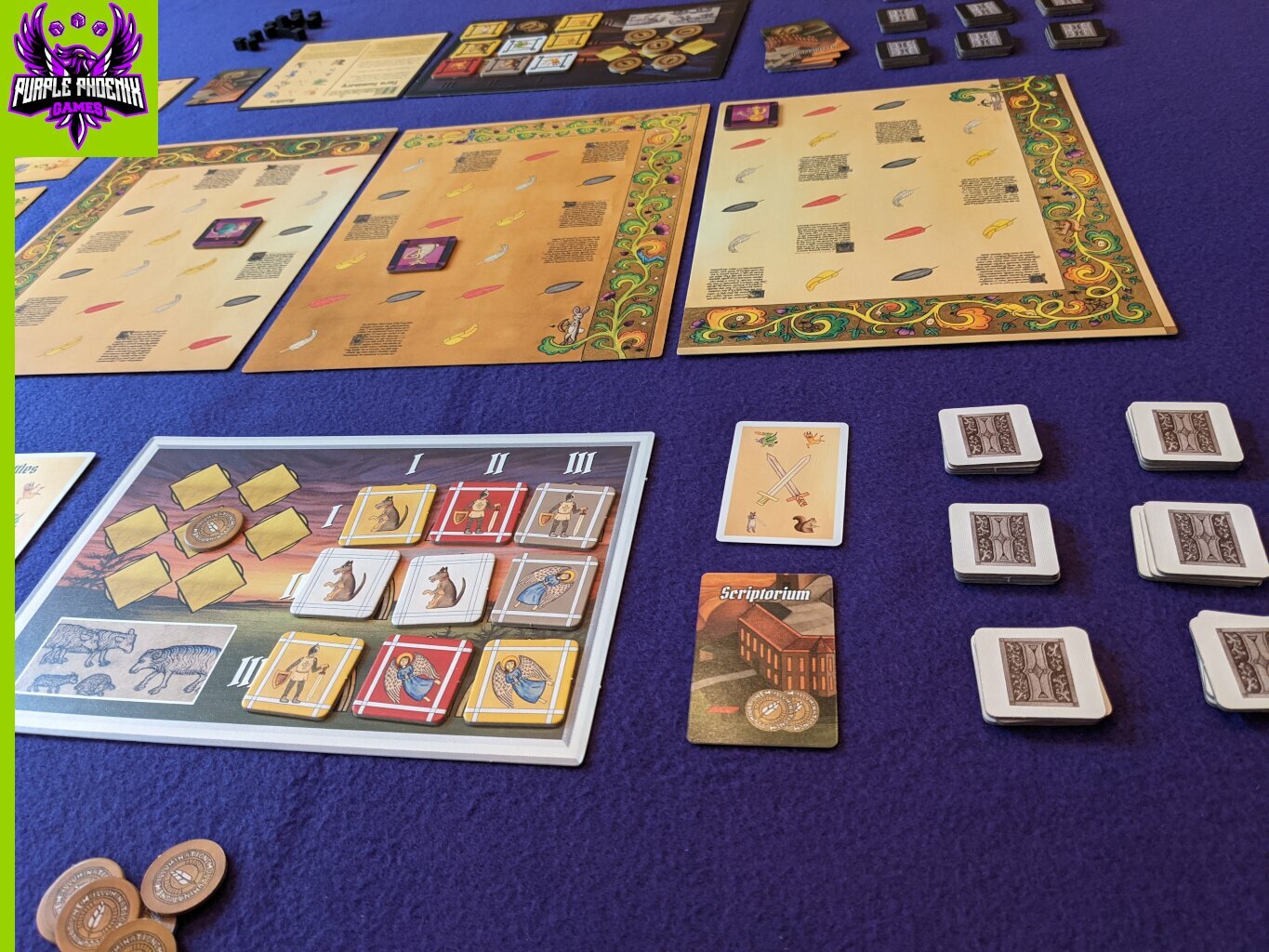
Purple Phoenix Games (2266 KP) rated The Road to Canterbury in Tabletop Games
Oct 4, 2021
I am not a sinless man. In fact, it’s been years since I’ve been to confession, and at this point I’m afraid I would be there for hours just spilling the beans. I know many pious people, but alas, I am not one. However, I do appreciate those that attempt to live that holy life. It takes a lot of guts and a lot of hard work. I guess I’m a little slothy when it comes to that, personally. Anyway, I know of the Seven Deadly Sins, Cardinal Sins, Capital Vices, or whatever you’d like to call them. In fact, I really like the movie Seven – I think it’s great! That said, let’s find out just “what’s in the box?”
The Road To Canterbury is a game of medieval hand management and area influence. In it players are false pardoners stalking the road to the city of Canterbury as pilgrims make their way there from London. As their companies run across these pardoners, they are offered the chance to purchase pardons – salvation and forgiveness for their sins. However, these pardoners are also keen to help the pilgrims along the path of sin, thus making their faux pardons worth even more money! The pardoner who ends the game with the most money will win along The Road to Canterbury.
DISCLAIMER: We were provided a copy of the Impoverished Pilgrim Edition (2nd edition) game for the purposes of this review. This is a retail copy of the game, so what you see in these photos is exactly what would be received in your box. I do not intend to cover every single rule included in the rulebook, but will describe the overall game flow and major rule set so that our readers may get a sense of how the game plays. For more in depth rules, you may purchase a copy online or from your FLGS. -T
To setup, follow the rulebook, as there are many components to track. The main areas are the Circle of Sin mat that holds the Parson pawn, the decks area that hold the various decks of cards from which players will be drawing, and each player’s personal area where players will hide their earnings and hand of cards behind the privacy screen. Once all is setup somewhat correctly, it should look similar to the photo below. Warning: When I set this up and took the photo, I neglected to realize the red company and the map tiles were translated to the wrong spaces, so just switch those.
The Road to Canterbury is a game of rounds, and each round players will be taking similar steps: Play One Card, Redraw, Perform a Reckoning of Sin. Players will have access to three different types of cards that can be played during the Play One Card phase: Sin cards (five of which are dealt at setup), Pardon cards, and Relic cards. During this phase, the active player can play a Sin card to one of the active Pilgrims to tempt them towards committing that sin. The first time the player adds a Sin card to a Pilgrim, they place one of their corruption cubes on the matching sin on the Circle of Sin. Alternatively, they may play a powerful Relic card that offers adjustments to the rules, or has some interesting results. When a player feels that enough Sin cards of a specific type have been played on a Pilgrim, they may opt to play a matching Pardon card in order to gain precious coin to their pockets. Each Pardon card essentially pardons ALL the sins of that type on the Pilgrim, and the player then collects coins exponentially for a larger total of matching Sin cards on that Pilgrim. If the Parson is currently sitting on the matching sin, the pardoner receives extra coin for it being an especially egregious sin in the eyes of the church. Each time the Pilgrim is pardoned, the pardoner places one of their corruption cubes upon the Pilgrim.
After the active player has played their card, they must Redraw their hand back to five cards, choosing to draw from the Sin, Pardon, or Relic offerings. Some Sin cards may be drawn that are Death Approaches cards. When these surface, they are immediately attached to the Pilgrim whose color matches that of the drawn card’s border color. This essentially eats up a slot on the Pilgrim that could be used for a Sin card to be pardoned.
Once the player has redrawn cards to their hand they must next Perform a Reckoning of Sin. The active player assesses each active Pilgrim to see if they have seven or more cards attached to them. If so, that Pilgrim will perish from the “deadly” sins. Whichever player has placed the most number of corruption cubes upon the Pilgrim is considered present at time of death and will receive credit for the sending to the heavens. They move one of the cubes upon the Pilgrim to the first space on the map tile, earning bonus points and a Last Rites token. Last Rites may be performed immediately to take another turn, or may be held until the end of the game for a 3 VP bonus per token. The most interesting aspect of a Pilgrim dying is the fact that their card now becomes a permanent placeholder underneath their company’s colored banner. So the next Pilgrim to enter play for that company will need only six additional cards to kick the bucket, and so on.
Play continues in this fashion of players taking turns through their three phases. The game ends when all the spaces on the map tile are filled with cubes. Bonus points are counted, coins are added, and the player with the most money/highest score is the winner! The best temptress and pardoner this side of Yorkshire!
Components. I have no experience with the first edition of The Road to Canterbury, so unfortunately I cannot compare and contrast components. However, I have seen many photos and even checked out a review video or two. What I can say about components is that this edition has refreshed the look of nearly everything, and so much for the better. Instead of boring plain cards, there’s just a little more decoration. Not so much to be invasive or distracting, but very tasteful. The component quality throughout is quite stellar. There’s a lot of cardboard in this box, and it all looks and feels great. I do quite like the art style, even though it’s all medievall-y and too artsy for my normal preference. All in all a great quality box of game.
So like I said, I have no experience with this game prior to receiving it and playing through it now. It certainly doesn’t feel like a 10-year-old game, nor does it really feel like many of the Alf Seegert games I have played in the past. Neither of these points are bad at all, just some thoughts I had.
It should be obvious by my ratings graphic that I dig this game a lot. I have nothing like it in my collection, and I am super excited to really bring this out with different types of gamers to see how it fares (once the COVID is no longer an issue, of course). I see this being a hit with my family, who enjoys a lot of take that style games. I see this being a hit with my more thinky gamer friends, because there are just so many juicy choices to be had every turn. I can see this even being a hit with my more gateway friends, because it isn’t terribly heavy, has some humor in it, and I can see the prospect of sowing sin and killing off innocent Pilgrims being attractive to some of my more morbid friends.
For me, I love the ability to take every turn and make important decisions. I try to make every turn meaningful to my agenda, but tactical with what may be at my disposal at the time. When should I play this Relic? Why is named something ridiculous? Should I wait a while longer to pardon this sin, or should I pile on another and then pardon next turn? Ooh, but what if my opponent has the same Pardon card. Am I truly happy that this poor Wife of Bath is about to kick it? GAAHHHHH!
Now it’s no secret that I am a big fan of Dr. Seegert’s games, as I have previously reviewed Fantastiqa and Haven with very high ratings. So, I was not at all surprised that I would love this one as well. It offers so many great choices, looks great on the table, fills a unique void that was present in my collection, and can be played with various types of gamers, even though it is designed for two or three players total. Purple Phoenix Games gives this one an unapologetic 5 / 6. I don’t think it will break into my Top 10, but I certainly won’t rule it out quite yet. More plays with different types of gamers may change my mind on that statement, and I eagerly await my plateful of crow. So if you are like me in your gaming preferences, check out this version of The Road to Canterbury. Let me know how often you tend to grab Relics too, because I feel like I need to utilize them more, but it is so hard to pass up a Sin or Pardon. I Lust after them so very badly.
The Road To Canterbury is a game of medieval hand management and area influence. In it players are false pardoners stalking the road to the city of Canterbury as pilgrims make their way there from London. As their companies run across these pardoners, they are offered the chance to purchase pardons – salvation and forgiveness for their sins. However, these pardoners are also keen to help the pilgrims along the path of sin, thus making their faux pardons worth even more money! The pardoner who ends the game with the most money will win along The Road to Canterbury.
DISCLAIMER: We were provided a copy of the Impoverished Pilgrim Edition (2nd edition) game for the purposes of this review. This is a retail copy of the game, so what you see in these photos is exactly what would be received in your box. I do not intend to cover every single rule included in the rulebook, but will describe the overall game flow and major rule set so that our readers may get a sense of how the game plays. For more in depth rules, you may purchase a copy online or from your FLGS. -T
To setup, follow the rulebook, as there are many components to track. The main areas are the Circle of Sin mat that holds the Parson pawn, the decks area that hold the various decks of cards from which players will be drawing, and each player’s personal area where players will hide their earnings and hand of cards behind the privacy screen. Once all is setup somewhat correctly, it should look similar to the photo below. Warning: When I set this up and took the photo, I neglected to realize the red company and the map tiles were translated to the wrong spaces, so just switch those.
The Road to Canterbury is a game of rounds, and each round players will be taking similar steps: Play One Card, Redraw, Perform a Reckoning of Sin. Players will have access to three different types of cards that can be played during the Play One Card phase: Sin cards (five of which are dealt at setup), Pardon cards, and Relic cards. During this phase, the active player can play a Sin card to one of the active Pilgrims to tempt them towards committing that sin. The first time the player adds a Sin card to a Pilgrim, they place one of their corruption cubes on the matching sin on the Circle of Sin. Alternatively, they may play a powerful Relic card that offers adjustments to the rules, or has some interesting results. When a player feels that enough Sin cards of a specific type have been played on a Pilgrim, they may opt to play a matching Pardon card in order to gain precious coin to their pockets. Each Pardon card essentially pardons ALL the sins of that type on the Pilgrim, and the player then collects coins exponentially for a larger total of matching Sin cards on that Pilgrim. If the Parson is currently sitting on the matching sin, the pardoner receives extra coin for it being an especially egregious sin in the eyes of the church. Each time the Pilgrim is pardoned, the pardoner places one of their corruption cubes upon the Pilgrim.
After the active player has played their card, they must Redraw their hand back to five cards, choosing to draw from the Sin, Pardon, or Relic offerings. Some Sin cards may be drawn that are Death Approaches cards. When these surface, they are immediately attached to the Pilgrim whose color matches that of the drawn card’s border color. This essentially eats up a slot on the Pilgrim that could be used for a Sin card to be pardoned.
Once the player has redrawn cards to their hand they must next Perform a Reckoning of Sin. The active player assesses each active Pilgrim to see if they have seven or more cards attached to them. If so, that Pilgrim will perish from the “deadly” sins. Whichever player has placed the most number of corruption cubes upon the Pilgrim is considered present at time of death and will receive credit for the sending to the heavens. They move one of the cubes upon the Pilgrim to the first space on the map tile, earning bonus points and a Last Rites token. Last Rites may be performed immediately to take another turn, or may be held until the end of the game for a 3 VP bonus per token. The most interesting aspect of a Pilgrim dying is the fact that their card now becomes a permanent placeholder underneath their company’s colored banner. So the next Pilgrim to enter play for that company will need only six additional cards to kick the bucket, and so on.
Play continues in this fashion of players taking turns through their three phases. The game ends when all the spaces on the map tile are filled with cubes. Bonus points are counted, coins are added, and the player with the most money/highest score is the winner! The best temptress and pardoner this side of Yorkshire!
Components. I have no experience with the first edition of The Road to Canterbury, so unfortunately I cannot compare and contrast components. However, I have seen many photos and even checked out a review video or two. What I can say about components is that this edition has refreshed the look of nearly everything, and so much for the better. Instead of boring plain cards, there’s just a little more decoration. Not so much to be invasive or distracting, but very tasteful. The component quality throughout is quite stellar. There’s a lot of cardboard in this box, and it all looks and feels great. I do quite like the art style, even though it’s all medievall-y and too artsy for my normal preference. All in all a great quality box of game.
So like I said, I have no experience with this game prior to receiving it and playing through it now. It certainly doesn’t feel like a 10-year-old game, nor does it really feel like many of the Alf Seegert games I have played in the past. Neither of these points are bad at all, just some thoughts I had.
It should be obvious by my ratings graphic that I dig this game a lot. I have nothing like it in my collection, and I am super excited to really bring this out with different types of gamers to see how it fares (once the COVID is no longer an issue, of course). I see this being a hit with my family, who enjoys a lot of take that style games. I see this being a hit with my more thinky gamer friends, because there are just so many juicy choices to be had every turn. I can see this even being a hit with my more gateway friends, because it isn’t terribly heavy, has some humor in it, and I can see the prospect of sowing sin and killing off innocent Pilgrims being attractive to some of my more morbid friends.
For me, I love the ability to take every turn and make important decisions. I try to make every turn meaningful to my agenda, but tactical with what may be at my disposal at the time. When should I play this Relic? Why is named something ridiculous? Should I wait a while longer to pardon this sin, or should I pile on another and then pardon next turn? Ooh, but what if my opponent has the same Pardon card. Am I truly happy that this poor Wife of Bath is about to kick it? GAAHHHHH!
Now it’s no secret that I am a big fan of Dr. Seegert’s games, as I have previously reviewed Fantastiqa and Haven with very high ratings. So, I was not at all surprised that I would love this one as well. It offers so many great choices, looks great on the table, fills a unique void that was present in my collection, and can be played with various types of gamers, even though it is designed for two or three players total. Purple Phoenix Games gives this one an unapologetic 5 / 6. I don’t think it will break into my Top 10, but I certainly won’t rule it out quite yet. More plays with different types of gamers may change my mind on that statement, and I eagerly await my plateful of crow. So if you are like me in your gaming preferences, check out this version of The Road to Canterbury. Let me know how often you tend to grab Relics too, because I feel like I need to utilize them more, but it is so hard to pass up a Sin or Pardon. I Lust after them so very badly.
Purple Phoenix Games (2266 KP) rated Deep Blue in Tabletop Games
Mar 17, 2022
A couple of months ago, Travis was in town, so he and I went over to Josh’s place to get a day of gaming in. It was an awesome time to play together, and to get to experience some new games for each of us. While we were there, we got to talking about some of the games in Josh’s collection, and he pulled out Deep Blue. He’d had it for a while, but had since gotten another game that he felt did the same things but better. So he asked if either of us wanted to take it off his hands. I said sure, as I’d never played the game before. Now that it’s a part of my collection, is it going to stay there? Or will my feelings mirror Josh’s with regards to the gameplay?
Deep Blue is a nautical game for 2-5 players of deck building, hand management, and a bit of push your luck. In it, players take on the roles ship Captains who are racing to collect treasures from undersea wrecks. Players will be hiring Crew members, sailing across the sea, and sending divers down to wrecks to salvage any valuables. The race is on, though, because you are not the only Captain on this treasure hunt… Throughout the game, players will stumble across 4 Wrecks that make up a Sunken City. Once all 4 areas of the Sunken City have been discovered and searched, the game ends. The player who earns the most VP from their collected treasures by the end of the game is declared the winner!
To setup for a game, follow the instructions in the rulebook – there are simply too many to detail here. The basic gist of setup is to create a market of Crew cards, shuffle and randomly distribute Wreck tiles across the board, and create a Gem pool. Each player will receive a player mat and starting cards in their chosen color, as well as 2 ships to be placed on the starting space of the board. Players will also get a treasure chest, in which they will keep their VP throughout the game. Set the Dive Site board, Gem bag, and VP tokens off to the side. Select a starting player, deal out starting tokens accordingly, and the game is ready to begin! Pictured below is the setup for a 3-player game.
On your turn, you will take one of four possible actions: Recruit a Crew Member, Sail, Rest, or Dive. Throughout the game you will be building your personal deck by Recruiting Crew Members. These new Crew offer unique abilities and scoring powers to be used during Dives. In order to recruit a Crew Member, you must pay the corresponding cost listed by its location in the market. To do so, you will play cards from your hand with $ symbols that equal the required cost. Once you play a card from your hand, it goes facedown onto the Rest area of your player mat. Take the Crew Member you just hired directly into your hand, and move the Market cards down to fill in the empty space, drawing a new card for the final slot. If you choose to Sail, you will play a number of cards from your hand with the Propeller icon. The number of icons dictates how many spaces you may sail. You can use all of your movement on one of your ships, or you can break movement across both ships. If you end a move on a face-up Wreck tile, you will ‘anchor’ your boat to one of the open scouting spots. These scouting spots offer special scoring benefits during the Dive on this tile. If you end movement on a face-down Wreck tile, first you will flip it face-up, and then anchor your boat. When landing on a buoy or an empty dive site, nothing happens.
On any turn, you may instead choose to Rest. To perform this action, you will shuffle all cards that reside on the Rest area of your player mat, and then draw only the 3 topmost cards into your hand. This is the action that allows you to refresh your hand, as you play more cards and your hand starts to dwindle. The final action choice is to Dive. This action is the crux of the game. When you have a boat on a Wreck tile, you may choose to start a Dive. The first step is to declare your Dive – decide which Wreck to Dive if your boats are on different Wreck tiles. Before the Dive begins, any opponents who have boats on adjacent Wreck tiles may move their boats to your Wreck in hopes of also profiting from the Dive. When all eligible boats have been moved to the Wreck, you will then officially begin the Dive. Take the Gem bag and Dive Site board. You will then draw Gems out of the bag, one-by-one, resolving them as necessary. Red, Gold, Silver, Green, and Purple gems are treasures, and can earn you VP. Blue and Black gems are Hazards that must be defended against in order to continue the Dive.
After a Gem is drawn and placed on the Dive Site board, players may choose to play a Crew Member to increase their VP earned. For example, one card allows you to earn 8 VP for a Green gem, instead of 0. To defend against hazards, players may play Crew from their hands who have the ability to negate the hazard, or may use the special ability of their scouting spot on the Wreck tile. If you are unable to defend against a hazard, you are forced to resurface and leave the Dive. The Dive continues in this fashion, until either the active player decides to end the Dive, or when they no longer have the ability to defend against hazards. Any players who still have boats at the Dive Site will collect VP from Crew cards they played, as well as a base amount of VP for the different Gems that were drawn. Once a Dive has been performed at a Wreck, that tile is removed from the game, leaving an empty dive site behind. If players have performed a Dive at one of the 4 Sunken City tiles, it is removed from the board, but placed on its corresponding space in the corner of the board. After all 4 Sunken City tiles have been moved to the corner of the board, the game immediately ends. Players will count up all the VP collected throughout the game, and the player with the highest score is declared the winner!
So how do I feel about Deep Blue overall? I would have to say that it’s fine. Just fine. There are some elements that I really enjoy, but others that kind of frustrate me. What I enjoy – the bits of strategy involved, and the awesome components. What I don’t enjoy – the pacing of the game and the imbalance of actions. To touch on the pros first, this game does require some strategy. You have to decide where to Sail, which Crew to recruit, which Crew to play and when to play them, etc. VP are earned by participating in Dives, so you want to make sure you can be at as many Dives as possible. That means keeping ships close to opponents to profit from any dives they may choose to initiate. Another interesting strategic element is the Rest action. You shuffle your discard pile, but then only draw the 3 topmost cards into your hand. You might not always draw what you were wanting, but you are always allowed to take a Rest action, regardless of how many cards are in your discard. There is no hand limit in this game, so do you rest every other turn to ensure you have almost all cards in your hand? Or do you dwindle your hand down in order to perform other actions instead? It’s all about your strategy, and you never quite know what your opponents are trying to do.
Now for the cons. The pacing of the gameplay feels really slow to me. You are only allowed to perform 1 action per turn, so it seems like the game takes a while to really get going. At first, everyone is going to be wanting to Sail, as all players start in the same starting area of the board. You want to get your ships out there ASAP. But then you run out of cards, so you have to take a turn to Rest and get those cards back. You’re taking a bunch of little turns to accomplish any one bigger thing, and that bogs down the gameplay for me. If you were able to perform 2 actions per turn, that would probably alleviate some of this frustration, as it would allow you to progress more quickly than by taking only a single action. Another aspect I mentioned is the imbalance of actions. The Recruit, Sail, and Rest actions all feel to me like they are on the same level, but the Dive action is different. Which in and of itself isn’t necessarily a bad thing. But the process of the Dive action is vastly different than any of the other actions, to the point that it kind of feels like a different game to me. For half of the game, you’re playing this game of strategy, deck building, and optimizing placement across the board. But for the other half, it turns into a push-your-luck frenzy that seems disjointed from the rest of the game to me. No matter how strategic and careful you are with your actions, it ultimately comes down to the luck of the draw.
To touch on components for a minute – the production quality of this game is awesome. The board, Dive Site board, and VP tokens are nice chunky cardboard. The cards are colorful, have cool artwork, and are sturdy. And the treasure chests are awesome little plastic chests that definitely are holding up well. The Wreck tiles are big and thick, the Gems are cute, and the ships are fun to play with. So overall, this game is made very well.
You can probably tell by now that I have mixed feelings about Deep Blue. There are aspects that I like, but other aspects that negate some of those positive attributes. I was psyched for a cool nautical deck builder where I could really flex my strategy, but got more push-your-luck than I was anticipating. Deep Blue will probably stick around in my collection for the time being. But, like Josh, I will probably find something that gives me the same vibes but done better. It’s a game that I’ll pull out from time to time, but definitely not one that’s going to break into my Top 10. With that said, Purple Phoenix Games gives it a sunken 4 / 6.
Deep Blue is a nautical game for 2-5 players of deck building, hand management, and a bit of push your luck. In it, players take on the roles ship Captains who are racing to collect treasures from undersea wrecks. Players will be hiring Crew members, sailing across the sea, and sending divers down to wrecks to salvage any valuables. The race is on, though, because you are not the only Captain on this treasure hunt… Throughout the game, players will stumble across 4 Wrecks that make up a Sunken City. Once all 4 areas of the Sunken City have been discovered and searched, the game ends. The player who earns the most VP from their collected treasures by the end of the game is declared the winner!
To setup for a game, follow the instructions in the rulebook – there are simply too many to detail here. The basic gist of setup is to create a market of Crew cards, shuffle and randomly distribute Wreck tiles across the board, and create a Gem pool. Each player will receive a player mat and starting cards in their chosen color, as well as 2 ships to be placed on the starting space of the board. Players will also get a treasure chest, in which they will keep their VP throughout the game. Set the Dive Site board, Gem bag, and VP tokens off to the side. Select a starting player, deal out starting tokens accordingly, and the game is ready to begin! Pictured below is the setup for a 3-player game.
On your turn, you will take one of four possible actions: Recruit a Crew Member, Sail, Rest, or Dive. Throughout the game you will be building your personal deck by Recruiting Crew Members. These new Crew offer unique abilities and scoring powers to be used during Dives. In order to recruit a Crew Member, you must pay the corresponding cost listed by its location in the market. To do so, you will play cards from your hand with $ symbols that equal the required cost. Once you play a card from your hand, it goes facedown onto the Rest area of your player mat. Take the Crew Member you just hired directly into your hand, and move the Market cards down to fill in the empty space, drawing a new card for the final slot. If you choose to Sail, you will play a number of cards from your hand with the Propeller icon. The number of icons dictates how many spaces you may sail. You can use all of your movement on one of your ships, or you can break movement across both ships. If you end a move on a face-up Wreck tile, you will ‘anchor’ your boat to one of the open scouting spots. These scouting spots offer special scoring benefits during the Dive on this tile. If you end movement on a face-down Wreck tile, first you will flip it face-up, and then anchor your boat. When landing on a buoy or an empty dive site, nothing happens.
On any turn, you may instead choose to Rest. To perform this action, you will shuffle all cards that reside on the Rest area of your player mat, and then draw only the 3 topmost cards into your hand. This is the action that allows you to refresh your hand, as you play more cards and your hand starts to dwindle. The final action choice is to Dive. This action is the crux of the game. When you have a boat on a Wreck tile, you may choose to start a Dive. The first step is to declare your Dive – decide which Wreck to Dive if your boats are on different Wreck tiles. Before the Dive begins, any opponents who have boats on adjacent Wreck tiles may move their boats to your Wreck in hopes of also profiting from the Dive. When all eligible boats have been moved to the Wreck, you will then officially begin the Dive. Take the Gem bag and Dive Site board. You will then draw Gems out of the bag, one-by-one, resolving them as necessary. Red, Gold, Silver, Green, and Purple gems are treasures, and can earn you VP. Blue and Black gems are Hazards that must be defended against in order to continue the Dive.
After a Gem is drawn and placed on the Dive Site board, players may choose to play a Crew Member to increase their VP earned. For example, one card allows you to earn 8 VP for a Green gem, instead of 0. To defend against hazards, players may play Crew from their hands who have the ability to negate the hazard, or may use the special ability of their scouting spot on the Wreck tile. If you are unable to defend against a hazard, you are forced to resurface and leave the Dive. The Dive continues in this fashion, until either the active player decides to end the Dive, or when they no longer have the ability to defend against hazards. Any players who still have boats at the Dive Site will collect VP from Crew cards they played, as well as a base amount of VP for the different Gems that were drawn. Once a Dive has been performed at a Wreck, that tile is removed from the game, leaving an empty dive site behind. If players have performed a Dive at one of the 4 Sunken City tiles, it is removed from the board, but placed on its corresponding space in the corner of the board. After all 4 Sunken City tiles have been moved to the corner of the board, the game immediately ends. Players will count up all the VP collected throughout the game, and the player with the highest score is declared the winner!
So how do I feel about Deep Blue overall? I would have to say that it’s fine. Just fine. There are some elements that I really enjoy, but others that kind of frustrate me. What I enjoy – the bits of strategy involved, and the awesome components. What I don’t enjoy – the pacing of the game and the imbalance of actions. To touch on the pros first, this game does require some strategy. You have to decide where to Sail, which Crew to recruit, which Crew to play and when to play them, etc. VP are earned by participating in Dives, so you want to make sure you can be at as many Dives as possible. That means keeping ships close to opponents to profit from any dives they may choose to initiate. Another interesting strategic element is the Rest action. You shuffle your discard pile, but then only draw the 3 topmost cards into your hand. You might not always draw what you were wanting, but you are always allowed to take a Rest action, regardless of how many cards are in your discard. There is no hand limit in this game, so do you rest every other turn to ensure you have almost all cards in your hand? Or do you dwindle your hand down in order to perform other actions instead? It’s all about your strategy, and you never quite know what your opponents are trying to do.
Now for the cons. The pacing of the gameplay feels really slow to me. You are only allowed to perform 1 action per turn, so it seems like the game takes a while to really get going. At first, everyone is going to be wanting to Sail, as all players start in the same starting area of the board. You want to get your ships out there ASAP. But then you run out of cards, so you have to take a turn to Rest and get those cards back. You’re taking a bunch of little turns to accomplish any one bigger thing, and that bogs down the gameplay for me. If you were able to perform 2 actions per turn, that would probably alleviate some of this frustration, as it would allow you to progress more quickly than by taking only a single action. Another aspect I mentioned is the imbalance of actions. The Recruit, Sail, and Rest actions all feel to me like they are on the same level, but the Dive action is different. Which in and of itself isn’t necessarily a bad thing. But the process of the Dive action is vastly different than any of the other actions, to the point that it kind of feels like a different game to me. For half of the game, you’re playing this game of strategy, deck building, and optimizing placement across the board. But for the other half, it turns into a push-your-luck frenzy that seems disjointed from the rest of the game to me. No matter how strategic and careful you are with your actions, it ultimately comes down to the luck of the draw.
To touch on components for a minute – the production quality of this game is awesome. The board, Dive Site board, and VP tokens are nice chunky cardboard. The cards are colorful, have cool artwork, and are sturdy. And the treasure chests are awesome little plastic chests that definitely are holding up well. The Wreck tiles are big and thick, the Gems are cute, and the ships are fun to play with. So overall, this game is made very well.
You can probably tell by now that I have mixed feelings about Deep Blue. There are aspects that I like, but other aspects that negate some of those positive attributes. I was psyched for a cool nautical deck builder where I could really flex my strategy, but got more push-your-luck than I was anticipating. Deep Blue will probably stick around in my collection for the time being. But, like Josh, I will probably find something that gives me the same vibes but done better. It’s a game that I’ll pull out from time to time, but definitely not one that’s going to break into my Top 10. With that said, Purple Phoenix Games gives it a sunken 4 / 6.