

Global Teams: How the Best Teams Achieve High Performance
Book
Working for a matrix international organisation, with its ensuing diverse global teams, based in a...

A Little Thing Called Life: On Loving Elvis Presley, Bruce Jenner, and Songs in Between
Book
Award-winning songwriter Linda Thompson breaks her silence, sharing the extraordinary story of her...

Purple Phoenix Games (2266 KP) rated Lagoon: Land of Druids in Tabletop Games
Jun 12, 2019
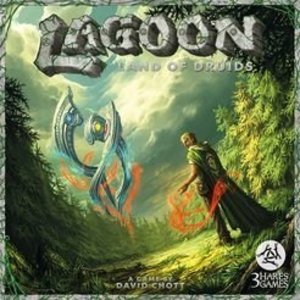


Lagoon is a land of harmony and balance. Or at least it WAS until the rise of humanity. The three spiritual energies that once existed in a perfect equilibrium are now fighting for dominance and control over the destiny of Lagoon. Each energy has amassed a following of druids who are working to ensure that their chosen energy is victorious! Which energy will you choose to serve, and will your choice be the correct one in the end? There’s only one way to find out!
Lagoon: Land of the Druids is a game of tile placement and exploration. You are the leader of a circle of druids, and they will do your bidding throughout the game. On your turn, you will take any/all of these five actions: Move, Summon (add one of your reserve druids to the play area), Explore (add a new site tile to the table), Invoke (use a Site Action), or Unravel (remove a site tile from play). You can perform as many of these actions as you want, as long as you have the appropriate resources to spend. Each tile in the game is double-sided, and each side has a unique action/ability associated with it. Strategy is everything – which tile side should you choose to bring into play, and how can you best use the available abilities to benefit your chosen energy? You also have to keep an eye on your opponents because they might be trying to undermine your plans to help their energy achieve success! The game ends when all tiles have been explored, and then players count up points dependent upon which energy was ultimately dominant. The player with the most points is the winner!
As a solo game, Lagoon plays similarly to the multi-player game. Instead of competing against other humans, you are playing against an AI opponent (fondly referred to as “AJ” in the rulebook). On its turn, alternating with yours, the AI executes three steps – Explore, Unravel, and Invoke (perform an action dependent on which druids the AI currently has in play). Each of those steps is explained in more detail in the rulebook. The game ends as in a normal group game, and the player (either you or the AI) with the highest score wins.
The first thing I should mention are the solo rules themselves – they are very wordy and contain lots of ambiguity. It took me a couple of read-throughs before I felt comfortable trying to play, and even now I still keep the solo rules easily accessible when I do play. With so many moving elements in this game, clear and concise rules are necessary for an unencumbered game.
When I say there are a lot of moving elements, I mean it. At any point, you could have up to 5 druids in play, with access to up to 5 unique site powers to invoke in addition to the basic actions you can take on your turn. And on top of that, your druids are spiritually connected, so a druid on one site can use the power of a different site as long as you have a druid there as well. There are also lots of opportunities to combo powers this way, and unless you’re 100% focused, you could lose track of what you already did or forget to pay for an action. And in a solo game, you’re not only tracking this for yourself, you also have to make sure you’re executing the AI turns correctly. There’s just a lot going on and it can be easy to accidentally skip a step.
The thing I dislike most about playing Lagoon solo is that I have to make decisions for the AI. When placing tiles on AI turns, I get to choose which side to play. When the AI unravels a site, I get to choose which site to remove. It’s hard to play this game honestly because I can just choose whatever will benefit ME the most, and not necessarily act in the AI’s best interest. Obviously, a human opponent would do whatever they want for themselves, but in a solo game I am in control of my opponent. The rulebook does offer ways to alleviate this, but I either honestly forget to refer back to the rules for certain situations, or I just choose to ignore the suggestions. I know, I know, that sounds like a personal problem. And I guess it is. I just don’t like the responsibility of having to play two competing sides because it is hard to stay honest. Since this game is so dependent on strategy and personal decisions, there is no good way for an AI opponent to be successful.
Lagoon: Land of the Druids is a complex game that requires more strategy than you think. That being said, I don’t like to play it solo. Each turn offers lots of opportunities, but so many options can be overwhelming. Having to make decisions for the AI is not enjoyable for me because I am aware that I do not always make the best decision for the AI – it’s just hard for me to consciously make decisions detrimental to my game. The idea of this game is neat, but the execution of the solo rules (from their editing to their actual gameplay) just doesn’t work well for me. Give it a try solo if you want, but you’re not really missing a lot if you don’t.
https://purplephoenixgames.wordpress.com/2019/03/11/solo-chronicles-lagoon-land-of-the-druids/

AccuWeather - Superior Accuracy
Weather and Travel
App
Stay connected to the latest in weather forecasting with AccuWeather – Weather for Life. This...

A Tigers Destiny (Tiger Protectors #3)
7.0 Rate It
Book
He's one beast of a bodyguard... Kel Cunningham is the only white tiger shifter in the world....

Gareth von Kallenbach (980 KP) rated Gods Of Egypt (2016) in Movies
Aug 6, 2019
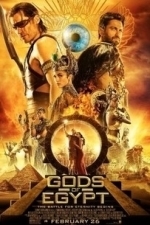
The trailers for this film set high expectations, promising a story of the mythical, god-like beings that come from Egyptian lore. But they also raised questions: would the story keep in tune with common mythos, or branch out into a whole new realm?
With Game of Thrones star Nikolaj Coster-Waldau taking the lead, along with 300’s Gerard Butler, the film starts off in a beautiful, ancient Egypt, ruled over by Osiris and his Queen. Horus, Osiris’s son (Coster- Waldau), is ready to assume the crown, but Set (Butler), brother to Osiris, has other plans. He feels scorned for having to live in the desert, and decides it is his time to rule all of Egypt. He murders Osiris, but leaves Horus alive, taking his eyes instead of his life.
Enter a thief, who wants to rescue his beloved from the clutches of Set’s architect (Rufus Sewell). The love of his life somehow talks him into rallying a dejected Horus to fight Set.
All the gods of Egypt are represented in some form or fashion, even if in minor capacity.
The gods have the ability to morph into larger, more powerful beings. They are nigh invincible, but still age, and die. They pray to Ra, god of the sun and grandfather to Horus.
This two-hour movie is filled to the brim with star-power, and superb acting. The special effects are a sight to behold, and they instill a sense of wonderment. The adventure is grand indeed, and will certainly leave you entertained.
That said, the script is sub-par. There are moments where emotional lines could be delivered, but aren’t. This is not from lack of trying on the part of the actors; the writers simply failed to find the proper words. In these moments, there was laughter from the audience at my viewing — during scenes clearly not meant for humor. This is the precarious knife-edge the movie walks between greatness and campy.
I’ve read several articles about how moviegoers are upset at the very Caucasian-looking cast. I shared this sentiment, to a certain degree. It seemed odd that a movie about a specific time and place in history made little effort to be ethnically accurate.
In the end, I let it go. The movie’s lore turned out to be so far from a real-world tie in that it no longer mattered. It was clear this was some sort of alternate universe; one of the major plot holes is a lack of connection to planet Earth.
If you can divorce yourself from some of these elements, you can really enjoy the film for what it is.
My screener companion said he didn’t care for the graphics, because they were obviously fake. I experienced this movie using animated films as my frame of reference, and that made it easier to watch. It is also clearly a High Fantasy film.
In summary: great acting is the glue that holds this film together. Without that talent, it wouldn’t stand up. It is, however, worth seeing if you love fantasy films. You will be entertained, for sure.
3.5 out 5 stars

Daniel Boyd (1066 KP) rated Sgt. Pepper's Lonely Hearts Club Band by The Beatles in Music
Nov 2, 2017



Even when the album is over the Beatles are still innovating by including a creepy loop within the groove of the album, implemented to give listeners a fright as they only expect to hear silence after the climax of ‘A Day In The Life.’ After a few moments of peace, a high pitched frequency is heard followed by a peculiar mix of abstract sounds all at once. Even after all this time, after the ridiculously high number of times that I’ve listened to the record and although I know to expect the sound before it happens, it’s still chilling to this day. This was the first time that a band intentionally included hidden sounds on an album, making listeners sit through a few seconds of silence to hear it. People claim that this album is overrated, but there is a reason that it is held in such high regard and whether you think this album deserves its legendary status or not, it is impossible to debate the fact that it is probably the most important album ever recorded. Everything from the album artwork to the music and the lyrics is still extremely relevant and important, even in this current digital age of music.

Kristy H (1252 KP) rated The Guest Room in Books
Feb 13, 2018

This was an interesting book with a somewhat fascinating premise. It brings up a lot of questions about morality. What role does our society play when it comes to bachelors parties -- and what is the expectation of those attending? And the spouses and fiancees on the other side? What do we tell ourselves about the origin of the "talent" that appears at such functions? Bohjalian attempts to explore these questions through Richard's story - which unfolds from Richard's perspective, that of his wife, Kristin, and one of the hired girls, Alexandra. It becomes almost a bit of a thriller - as we piece together bits before the party, the aftermath, and also learn what led up to the girls' fateful decision.
A bit of the book lags in the beginning, but it picks up quickly and becomes quite compelling. One would think Richard would be the main character, but for me, the story revolved around Alexandra. Her tale is the most thought-provoking and insightful. At points, the novel is simply heart-breaking. Richard's sections are often irritating and frustrating, as you can only have so much sympathy for the man at points. Kristin is a good go-between - the innocent bystander blindsided by what occurred in her home when she was not there.
Overall, the book weaves the story nicely around its characters. Little details give a nuanced perspective that authors less experienced than Bohjalian may lack (he's also one of the few authors that has me hitting the dictionary from time to time to look up words). There was a time when I really felt my rating for this could range from 2 - 4 stars. It received a bump for the ending, which just felt fitting, and for Alexandra, who was a lovely protagonist and written in such a quiet way that doesn't come along very often. In the end, this felt more than a "life in suburbia gone terribly wrong" story - it was cold and heartless, yet heart-breaking and compassionate. A worthwhile read, for sure.
(Note: I received an ARC from Netgalley in return for an unbiased review.)


AutoRap by Smule
Music and Entertainment
App
Say something. AutoRap turns your speech into rap. Choose from 100+ beats from artists like Drake,...