
Search
Search results

Hazel (1853 KP) rated Timmy Failure: The Cat Stole My Pants in Books
Dec 17, 2018



<i>I received this book for free through Goodreads First Reads.</i>
For fans of <i>Diary of a Wimpy Kid</i> (Kinney, 2004) is a juvenile series by American author, Stephan Pastis, about a young boy who believes he is the world’s greatest detective. A series that is continually growing, the sixth <i>Timmy Failure </i>story is now available for fans and new readers. Subtitled <i>The Cat Stole My Pants</i>, Timmy Failure embarks on an adventure of mystery and crime solving whilst getting himself into all sorts of mischief.
Emulating both real and fictional detectives, Timmy has established his own agency, Failure, Inc., of which he is the sole employee after the flight of his (imaginary) ex-business partner, Total the polar bear, who is currently seeking political asylum in Cuba. Unfortunately, Timmy has been forced to join his mother and Doorman Dave on their honeymoon in Key West, Florida, along with Doorman Dave’s nephew, Emilio.
“Crime doesn’t take a holiday. Neither does greatness.” Determined to continue solving crimes, Timmy hires Emilio as an unpaid intern and sets off searching for crimes, greatly over exaggerating every little piece of “evidence” he finds. However, it soon appears that someone is out to get Timmy and he, along with Emilio, is determined to find out whom.
Timmy is a melodramatic, unconventional child with a large ego and is constantly getting told off. From annoying adults to having his pants stolen by a polydactyl cat – or so he claims – there is no end to the hilarious situations he causes.
The cat that stole Timmy’s pants only makes a brief appearance in the book, therefore the subtitle is more to attract the attention of young readers with its silliness rather than be suggestive of a certain storyline.
Despite his grand claims, Timmy is not a very good detective and a lot of his unsolved crimes have been invented by his overactive imagination. This adds to the humour because, although he seems like an intelligent child, his ideas are completely silly.
Adorned with childish drawings and diagrams, Timmy Failure narrates the story from his subjective point of view, inflating his successes and blaming any failure on poor Emilio. No one takes Timmy seriously, which is something many of the target readers may appreciate, although they should also understand how futile Timmy’s attempts are at being a detective.
The storyline is not particularly clear until the final chapters of the book. Up until that moment, the book is full of disastrous, imaginary detective endeavours that prove Timmy to be nothing more than an annoying, inventive boy.
Some of the language may be above children’s reading capabilities, however, the humour is directly on their level. Whereas an adult may not find the idea of a cat stealing someone’s pants amusing, a child would find that hysterical.
There is no reason to read the <i>Timmy Failure</i> books in order, so if you, like me, read book six first, there is no problem. The stories are particularly aimed at young boys and will hopefully encourage the demographic to start reading more. Whilst it may not be a great feat of literature, it is a good enough introduction to the world of books.
For fans of <i>Diary of a Wimpy Kid</i> (Kinney, 2004) is a juvenile series by American author, Stephan Pastis, about a young boy who believes he is the world’s greatest detective. A series that is continually growing, the sixth <i>Timmy Failure </i>story is now available for fans and new readers. Subtitled <i>The Cat Stole My Pants</i>, Timmy Failure embarks on an adventure of mystery and crime solving whilst getting himself into all sorts of mischief.
Emulating both real and fictional detectives, Timmy has established his own agency, Failure, Inc., of which he is the sole employee after the flight of his (imaginary) ex-business partner, Total the polar bear, who is currently seeking political asylum in Cuba. Unfortunately, Timmy has been forced to join his mother and Doorman Dave on their honeymoon in Key West, Florida, along with Doorman Dave’s nephew, Emilio.
“Crime doesn’t take a holiday. Neither does greatness.” Determined to continue solving crimes, Timmy hires Emilio as an unpaid intern and sets off searching for crimes, greatly over exaggerating every little piece of “evidence” he finds. However, it soon appears that someone is out to get Timmy and he, along with Emilio, is determined to find out whom.
Timmy is a melodramatic, unconventional child with a large ego and is constantly getting told off. From annoying adults to having his pants stolen by a polydactyl cat – or so he claims – there is no end to the hilarious situations he causes.
The cat that stole Timmy’s pants only makes a brief appearance in the book, therefore the subtitle is more to attract the attention of young readers with its silliness rather than be suggestive of a certain storyline.
Despite his grand claims, Timmy is not a very good detective and a lot of his unsolved crimes have been invented by his overactive imagination. This adds to the humour because, although he seems like an intelligent child, his ideas are completely silly.
Adorned with childish drawings and diagrams, Timmy Failure narrates the story from his subjective point of view, inflating his successes and blaming any failure on poor Emilio. No one takes Timmy seriously, which is something many of the target readers may appreciate, although they should also understand how futile Timmy’s attempts are at being a detective.
The storyline is not particularly clear until the final chapters of the book. Up until that moment, the book is full of disastrous, imaginary detective endeavours that prove Timmy to be nothing more than an annoying, inventive boy.
Some of the language may be above children’s reading capabilities, however, the humour is directly on their level. Whereas an adult may not find the idea of a cat stealing someone’s pants amusing, a child would find that hysterical.
There is no reason to read the <i>Timmy Failure</i> books in order, so if you, like me, read book six first, there is no problem. The stories are particularly aimed at young boys and will hopefully encourage the demographic to start reading more. Whilst it may not be a great feat of literature, it is a good enough introduction to the world of books.

LOUISE HAY AFFIRMATION MEDITATIONS: ESSENTIAL AFFIRMATIONS FOR HEALTH, LOVE, SUCCESS & SELF-ESTEEM
Lifestyle and Health & Fitness
App
Unleash your full potential for love, health, success and self-esteem with this revolutionary new...

Purple Phoenix Games (2266 KP) rated Divinus in Tabletop Games
Aug 10, 2021
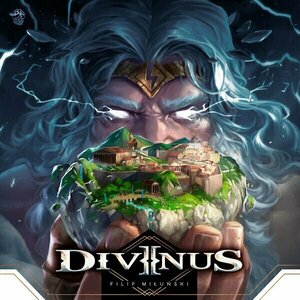

Bragi. Hercules. Percy Jackson. All excellent examples of successful demigods. As you well know, demigods are offspring of a god and a mortal. Of all the things I have conjured in my lifetime to answer the old, “What do you want to be when you grow up?” question, I never really answered, “a demigod.” Well, that’s because I KNOW my parents and have a hard time believing I could be a son of a god or goddess. Unless it was some weird NPCs (novel series by Drew Hayes) universe with Grumble as my patron/parent. In any case, my new dream of becoming the greatest demigod alive must be played out in today’s preview: Divinus.
Divinus is a competitive tile placement, campaign, drafting, dice game in which players assume the roles of upcoming demigods fighting over the one last spot at the table. By appeasing the gods of the warring ancient Roman and Norse cultures players will earn their place among them. This game uses some interesting hybrid app-driven story mechanics along with legacy-style component alterations to create this world that is constantly under refurbishment and ripe for the claiming of the future Divinus.
DISCLAIMER: We were provided a prototype copy of this game for the purposes of this review. These are preview copy components, and I do not know for sure if the final components will be any different from these shown. Also, it is not my intention to detail every rule in the game, as there are just too many. You are invited to download the rulebook, back the game through the Gamefound campaign, or through any retailers stocking it after fulfillment. -T
To setup, place the main board on the table, sort out the Map tiles by player count, and populate the board per the rulebook. Each player chooses their Demigod box and takes all components contained within. As Divinus is intended to be played either as a scenario session or its Eternal Mode, which is infinitely replayable using the board and components already altered by previously-played scenarios, open the chosen Scenario Box to be played and allow the app to instruct on how to setup with these components. All players roll their dice and place them in the “ready” pile to be used on their first turn. The first player takes the token (a black meeple in the prototype version) and the game is ready to be played!
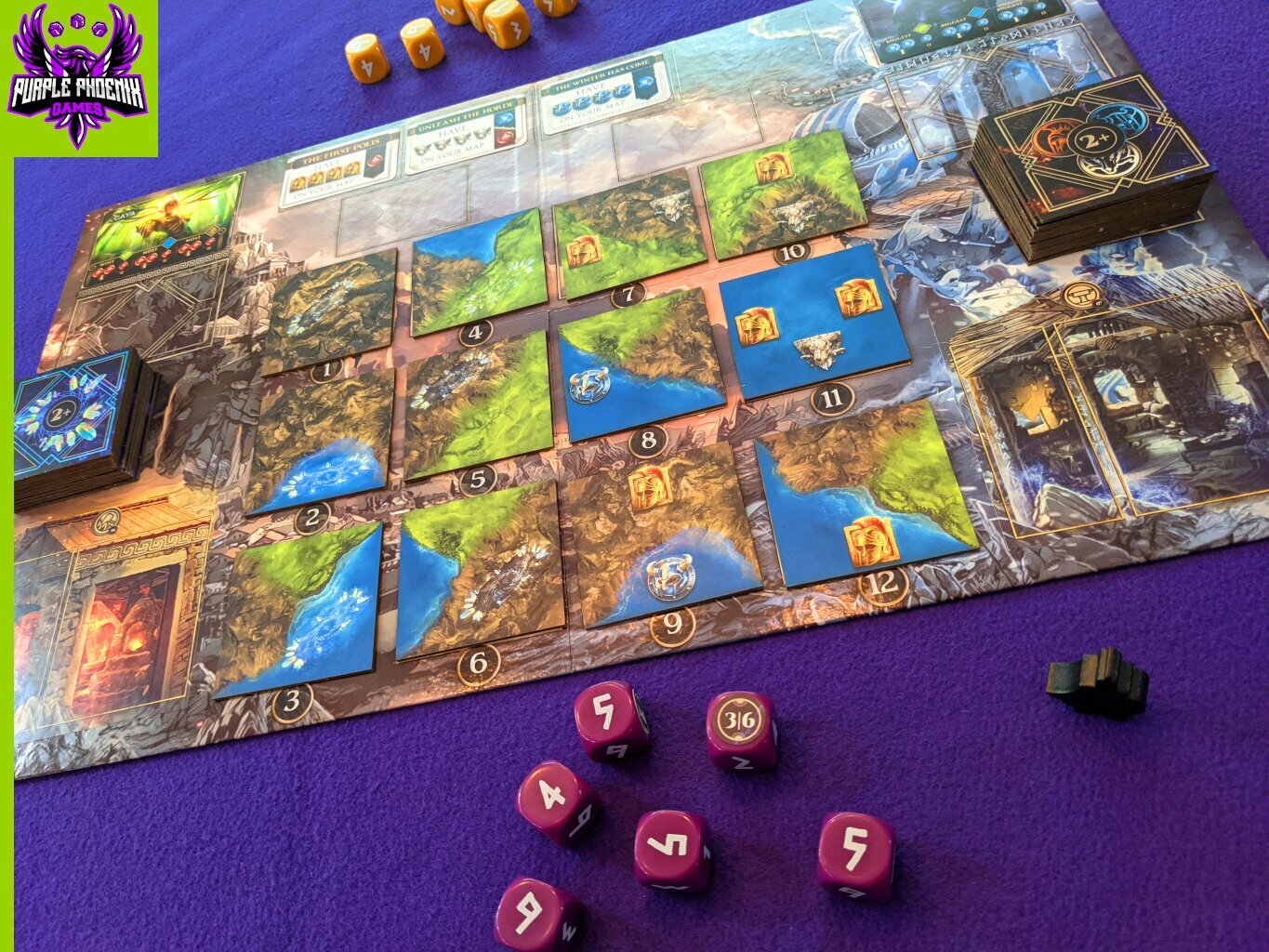
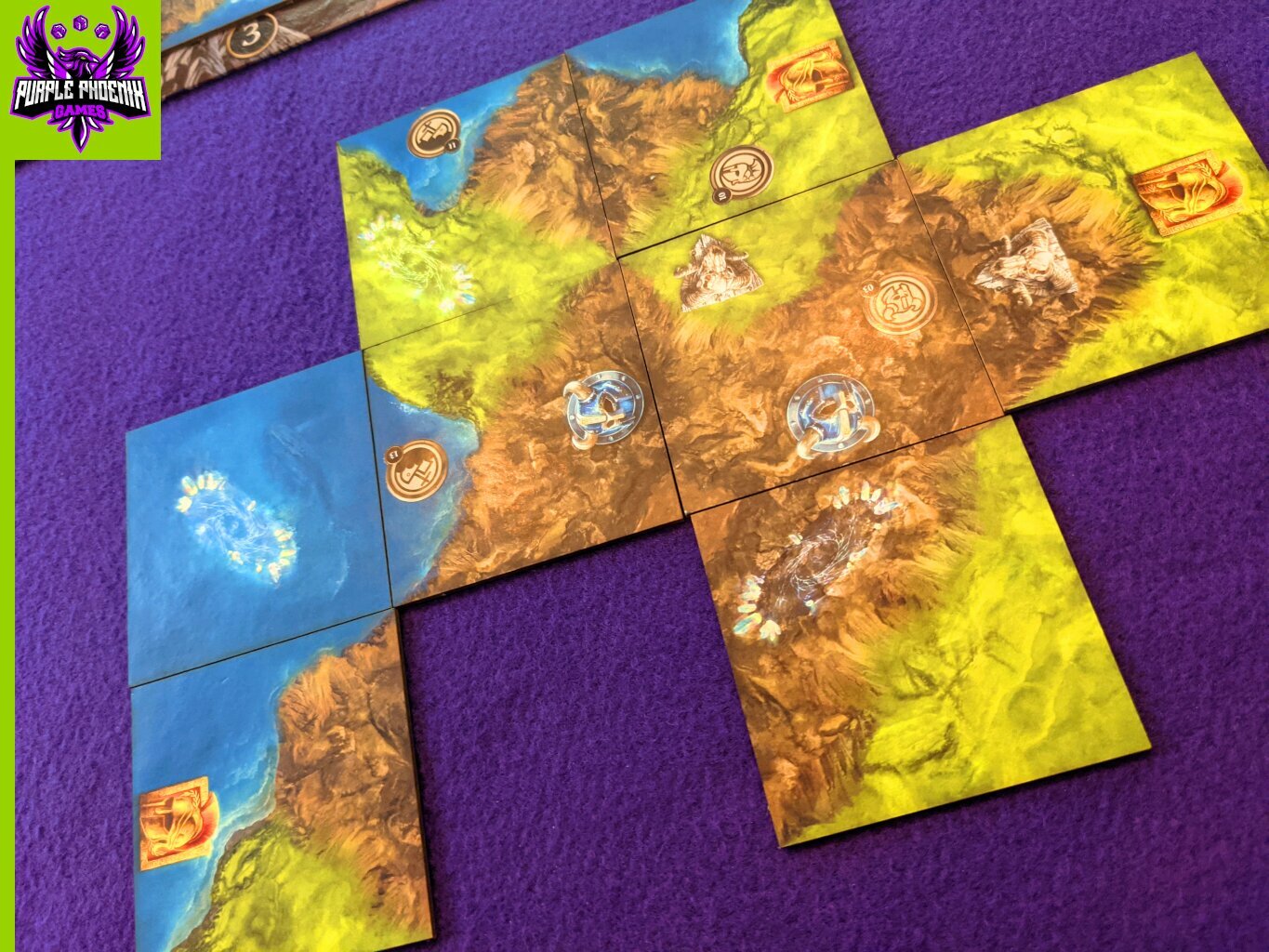
Divinus is played in turns starting with the first player and continuing around the table until one player places their final Map tile signaling the end of the game. On a turn, players will have a choice of using an Explore action or a Rest action. More actions may be available in future scenarios, but for the prototype scenarios, these are the two available choices. During an Explore action, the active player will choose any number of their rolled dice in order to create a mathematical equation that matches with one of the Map tiles on the main board. These spaces range from 1-12 in value, so an appropriate dice combination could be 5 + 4 – 1 = 8 in order to claim the Map tile on the 8 spot. Any number of dice can be used to claim tiles, and once a tile is claimed, it must be placed within the player’s personal play area map. In order to add these tiles, the edges will need to match up by terrain type with tiles already presently in play (see below), or may also be placed atop an existing tile. Map tiles may or may not contain symbols for factions, locations, and also Sacred Places. These will all be used in scenarios for different purposes.
Once a player decides they do not wish to (or cannot) take more Explore actions, they must Rest. To Rest, the active player reclaims all spent (and unspent ready) dice and rerolls them for the next turn, replacing empty spaces on the board with new Map tiles.
Play continues in this fashion of Exploring and Resting until one player places their 16th tile, thus completing their 4×4 personal map. Players will consult the app for scoring instructions and the winner will be announced. Should the players wish to play another scenario (or many, as we would have liked), they simply use the same Demigods and open a new Scenario Box. Inside these boxes are different gods to appease, new quests to fulfill (more on these later), and stickers to be applied to game components to improve their usefulness.
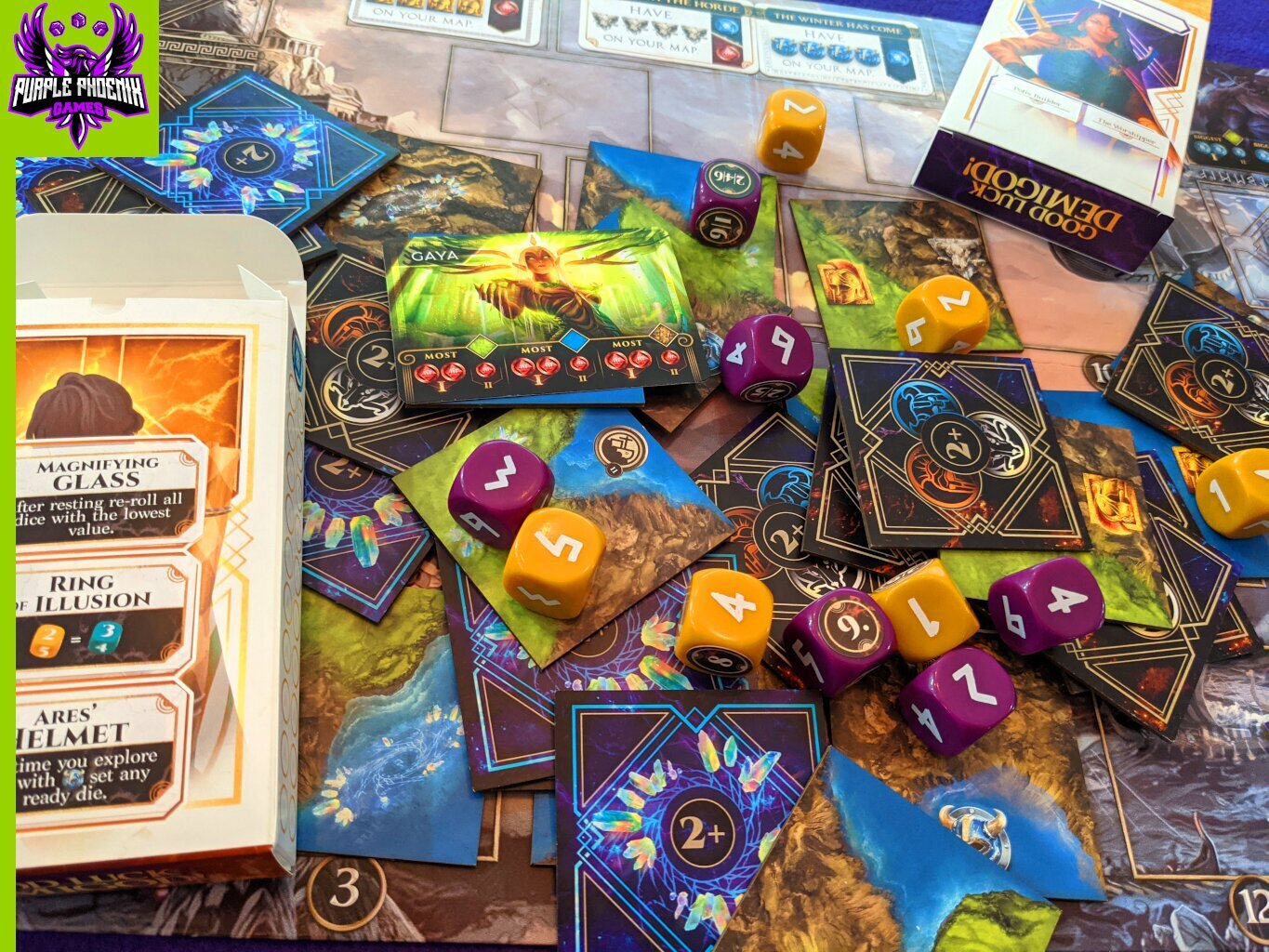
Components. Again, this is a prototype version of the game, and it includes two introductory scenarios, a bunch of sticker sheets, and a developmental app. That said, I really enjoyed my plays of the scenarios and they felt like great first steps to lure me into what I just know is going to be somewhat of a lifestyle game (assuming more and more expansions are in the plans). The sticker sheets are all fine, and as I understand it, the stickers that are placed on the Map tiles will have non-removable glue, but the stickers placed on the dice faces will have removable glue. As I am not a glue expert, I can’t really vouch for either. The app is somewhat similar to those that are used in the Chronicles of Crime series, but Divinus promises to deliver an app that can scan the components WITHOUT the use of QR codes. For those gamers who think the QRs are an eye-sore, then Divinus is taking a promising first step for you! I haven’t even touched on the artwork yet, and that’s usually my favorite aspect of a game’s components. The visual style and art on Divinus really make the game pop on the table, and just draw you into the lore and setting. I love it!
So while initially Divinus is a simple roll-and-draft game of building a 4×4 grid akin to Kingdomino, the addition and usage of the Quests and, later, the Charge Actions, morph this into something quite a bit meatier. Each Scenario Box (at least in this version) contains two god cards (that affect how the end of the scenario is scored) and some Quest cards (that are side-quests players can follow to earn some extra VP and other goodies). I imagine as the game progresses through Scenario Boxes that Quests will get more difficult and the god cards more interesting as well.
All in all Divinus has roped me in, and I am very much looking forward to all the other great things that Lucky Duck Games has planned for it. I can foresee soooooo many expansions being built on this excellent chassis, and I am very eager to finish the entire legacy aspect in order to play through the Eternal Mode a bunch of times. Can I divulge a little dirty secret of mine here? I have never before played any type of legacy board game, and if this is what they are like, then I will be breaking out my copy of Betrayal Legacy way sooner than I originally planned.
I believe that the theming here is great, the gameplay is relatively simple to grasp, and the hybrid app-driven story really adds to the entire experience. If you are someone who, like me, has yet to delve into legacy-style games where the components are constantly changing due to choices made at the table, and you have a penchant for dice games with a splash of ACTUAL math skills used, I urge you to take a look at backing Divinus on Gamefound ASAP. With just the initial two scenarios included, I am already addicted to the game and cannot wait to sink my teeth into more scenarios and more crucial decisions that will alter the landscape of my copy of the game. I know that as of the publish date of this preview, the campaign is already about 1000% funded and so many stretch goals have already been unlocked. It is a great time to hop on board and grab a big ol’ chunk of goodies for this one. You may have a preference for Roman or Norse mythology before playing, but be warned: your loyalties may change as a result of playing Divinus… or maybe you will learn to accept both at the harmonious center of activity in your own little section of the world.
Divinus is a competitive tile placement, campaign, drafting, dice game in which players assume the roles of upcoming demigods fighting over the one last spot at the table. By appeasing the gods of the warring ancient Roman and Norse cultures players will earn their place among them. This game uses some interesting hybrid app-driven story mechanics along with legacy-style component alterations to create this world that is constantly under refurbishment and ripe for the claiming of the future Divinus.
DISCLAIMER: We were provided a prototype copy of this game for the purposes of this review. These are preview copy components, and I do not know for sure if the final components will be any different from these shown. Also, it is not my intention to detail every rule in the game, as there are just too many. You are invited to download the rulebook, back the game through the Gamefound campaign, or through any retailers stocking it after fulfillment. -T
To setup, place the main board on the table, sort out the Map tiles by player count, and populate the board per the rulebook. Each player chooses their Demigod box and takes all components contained within. As Divinus is intended to be played either as a scenario session or its Eternal Mode, which is infinitely replayable using the board and components already altered by previously-played scenarios, open the chosen Scenario Box to be played and allow the app to instruct on how to setup with these components. All players roll their dice and place them in the “ready” pile to be used on their first turn. The first player takes the token (a black meeple in the prototype version) and the game is ready to be played!
Divinus is played in turns starting with the first player and continuing around the table until one player places their final Map tile signaling the end of the game. On a turn, players will have a choice of using an Explore action or a Rest action. More actions may be available in future scenarios, but for the prototype scenarios, these are the two available choices. During an Explore action, the active player will choose any number of their rolled dice in order to create a mathematical equation that matches with one of the Map tiles on the main board. These spaces range from 1-12 in value, so an appropriate dice combination could be 5 + 4 – 1 = 8 in order to claim the Map tile on the 8 spot. Any number of dice can be used to claim tiles, and once a tile is claimed, it must be placed within the player’s personal play area map. In order to add these tiles, the edges will need to match up by terrain type with tiles already presently in play (see below), or may also be placed atop an existing tile. Map tiles may or may not contain symbols for factions, locations, and also Sacred Places. These will all be used in scenarios for different purposes.
Once a player decides they do not wish to (or cannot) take more Explore actions, they must Rest. To Rest, the active player reclaims all spent (and unspent ready) dice and rerolls them for the next turn, replacing empty spaces on the board with new Map tiles.
Play continues in this fashion of Exploring and Resting until one player places their 16th tile, thus completing their 4×4 personal map. Players will consult the app for scoring instructions and the winner will be announced. Should the players wish to play another scenario (or many, as we would have liked), they simply use the same Demigods and open a new Scenario Box. Inside these boxes are different gods to appease, new quests to fulfill (more on these later), and stickers to be applied to game components to improve their usefulness.
Components. Again, this is a prototype version of the game, and it includes two introductory scenarios, a bunch of sticker sheets, and a developmental app. That said, I really enjoyed my plays of the scenarios and they felt like great first steps to lure me into what I just know is going to be somewhat of a lifestyle game (assuming more and more expansions are in the plans). The sticker sheets are all fine, and as I understand it, the stickers that are placed on the Map tiles will have non-removable glue, but the stickers placed on the dice faces will have removable glue. As I am not a glue expert, I can’t really vouch for either. The app is somewhat similar to those that are used in the Chronicles of Crime series, but Divinus promises to deliver an app that can scan the components WITHOUT the use of QR codes. For those gamers who think the QRs are an eye-sore, then Divinus is taking a promising first step for you! I haven’t even touched on the artwork yet, and that’s usually my favorite aspect of a game’s components. The visual style and art on Divinus really make the game pop on the table, and just draw you into the lore and setting. I love it!
So while initially Divinus is a simple roll-and-draft game of building a 4×4 grid akin to Kingdomino, the addition and usage of the Quests and, later, the Charge Actions, morph this into something quite a bit meatier. Each Scenario Box (at least in this version) contains two god cards (that affect how the end of the scenario is scored) and some Quest cards (that are side-quests players can follow to earn some extra VP and other goodies). I imagine as the game progresses through Scenario Boxes that Quests will get more difficult and the god cards more interesting as well.
All in all Divinus has roped me in, and I am very much looking forward to all the other great things that Lucky Duck Games has planned for it. I can foresee soooooo many expansions being built on this excellent chassis, and I am very eager to finish the entire legacy aspect in order to play through the Eternal Mode a bunch of times. Can I divulge a little dirty secret of mine here? I have never before played any type of legacy board game, and if this is what they are like, then I will be breaking out my copy of Betrayal Legacy way sooner than I originally planned.
I believe that the theming here is great, the gameplay is relatively simple to grasp, and the hybrid app-driven story really adds to the entire experience. If you are someone who, like me, has yet to delve into legacy-style games where the components are constantly changing due to choices made at the table, and you have a penchant for dice games with a splash of ACTUAL math skills used, I urge you to take a look at backing Divinus on Gamefound ASAP. With just the initial two scenarios included, I am already addicted to the game and cannot wait to sink my teeth into more scenarios and more crucial decisions that will alter the landscape of my copy of the game. I know that as of the publish date of this preview, the campaign is already about 1000% funded and so many stretch goals have already been unlocked. It is a great time to hop on board and grab a big ol’ chunk of goodies for this one. You may have a preference for Roman or Norse mythology before playing, but be warned: your loyalties may change as a result of playing Divinus… or maybe you will learn to accept both at the harmonious center of activity in your own little section of the world.


Darren (1599 KP) rated Villain (1971) in Movies
Jul 25, 2019


Story: Villain starts as we see how gangster Vic Dakin (Burton) controls London, he has people that will grass on him to the cops with Inspector Bob Matthews (Davenport) trying to bring down the criminal.
Vic continues to use his business connections to stay ahead of the police, with Wolfe Lissner (McShane) being the latest person the inspectors are turning to try and give up Vic’s secrets.
Thoughts on Villain
Characters – Vic Dakin runs London with his criminal activities, he is feared by most people and if you cross him, you will get hurt if not killed. He has become over confident that he can get away with anything, making him one of the prime targets for everyone involved in law. Wolf Lissner works for Vic, he is one of the youngster members of the crew and the one that the police are trying to use to turn on him, even if he the one person that Vic will always turn to. Bob Matthews is the inspector that has been trying to bring down Vic for years, he has risen up the ranks, got the people in the gang, but never been able to get the conviction. Gerald Draycott is the politician that is being blackmailed to keep the business under wraps for Vic.
Performances – We do have two big names in his film, first Richard Burton that doesn’t get to show the skill he could bring to a film, while a younger Ian McShane shows us that he could be set for a career in this sidekick gangster role. The rest of the cast are doing all they need to without being in anyway stand out through the film.
Story – The story follows a gangster that has the power over London, the police have been hunting him for years, but he always finds a way to get out of trouble. This time they get closer than ever before and could finally take down one of the biggest gangsters in London. When it comes to the gangster genre, we don’t really ever get much different when it comes to where the story goes, this one is based loosely on the Kray brother, but for some reason only one of the twins. It does feel like we have seen everything before, we don’t get drawn into support either side of the battle and end up feeling like it is just another gangster film.
Crime – The crime world we enter shows us just where the criminals operate and just where the police will need to turn to, in any hope of bringing him down.
Settings – The film is mostly set in London which see just how the criminals operate, where they can get away from crime.
Scene of the Movie – The opening scene as we see just how Vic can operate.
That Moment That Annoyed Me – The final shot.
Final Thoughts – This is a typical British gangster film that starts with an intense opening, only to become a drag as the film unfolds.
Overall: British Gangster 101.
Vic continues to use his business connections to stay ahead of the police, with Wolfe Lissner (McShane) being the latest person the inspectors are turning to try and give up Vic’s secrets.
Thoughts on Villain
Characters – Vic Dakin runs London with his criminal activities, he is feared by most people and if you cross him, you will get hurt if not killed. He has become over confident that he can get away with anything, making him one of the prime targets for everyone involved in law. Wolf Lissner works for Vic, he is one of the youngster members of the crew and the one that the police are trying to use to turn on him, even if he the one person that Vic will always turn to. Bob Matthews is the inspector that has been trying to bring down Vic for years, he has risen up the ranks, got the people in the gang, but never been able to get the conviction. Gerald Draycott is the politician that is being blackmailed to keep the business under wraps for Vic.
Performances – We do have two big names in his film, first Richard Burton that doesn’t get to show the skill he could bring to a film, while a younger Ian McShane shows us that he could be set for a career in this sidekick gangster role. The rest of the cast are doing all they need to without being in anyway stand out through the film.
Story – The story follows a gangster that has the power over London, the police have been hunting him for years, but he always finds a way to get out of trouble. This time they get closer than ever before and could finally take down one of the biggest gangsters in London. When it comes to the gangster genre, we don’t really ever get much different when it comes to where the story goes, this one is based loosely on the Kray brother, but for some reason only one of the twins. It does feel like we have seen everything before, we don’t get drawn into support either side of the battle and end up feeling like it is just another gangster film.
Crime – The crime world we enter shows us just where the criminals operate and just where the police will need to turn to, in any hope of bringing him down.
Settings – The film is mostly set in London which see just how the criminals operate, where they can get away from crime.
Scene of the Movie – The opening scene as we see just how Vic can operate.
That Moment That Annoyed Me – The final shot.
Final Thoughts – This is a typical British gangster film that starts with an intense opening, only to become a drag as the film unfolds.
Overall: British Gangster 101.



Ok this was steamy and dreamy. The author did this couple justice in bringing them together with her word magic. We continue one month later after the First Sight. Beth is back at work and moving forward with her business as a designer. When out of nowhere Adam Blaire finds her and presents her with a deal she doesn’t want to turn down.
Okay I enjoyed this couple in the prequel but they had me falling deeper in this book. Beth doesn’t do emotions she doesn’t want or need the baggage. But with the way Adam is digging his way under her skin she might not have a choice. But when Adam gives her ultimatums and leaves her at the door she walks away. Can they find their way back to each other or will their beginning be their end?
Man I’ve read some steamy books in my life but this one is at the top. Adam is just wow. He has stamina out of this world. The way he loves her and gives himself to her. Dream come true. Beth just does it without knowing she’s doing it. Gives him her all without fully knowing she did it.
If you're reading this review before buying this book you're wasting precious reading time. You could’ve already been in love with this author like me.
Okay I enjoyed this couple in the prequel but they had me falling deeper in this book. Beth doesn’t do emotions she doesn’t want or need the baggage. But with the way Adam is digging his way under her skin she might not have a choice. But when Adam gives her ultimatums and leaves her at the door she walks away. Can they find their way back to each other or will their beginning be their end?
Man I’ve read some steamy books in my life but this one is at the top. Adam is just wow. He has stamina out of this world. The way he loves her and gives himself to her. Dream come true. Beth just does it without knowing she’s doing it. Gives him her all without fully knowing she did it.
If you're reading this review before buying this book you're wasting precious reading time. You could’ve already been in love with this author like me.

Leanne Crabtree (480 KP) rated Miss Me Not in Books
Sep 3, 2019


Note: This has been on my Kindle for years--literally! I've decided every so often when there's not a book I've bought that I'm just dying to read that I'll start reading my backlog of books from the earliest bought. This was #1 - from 2013. I'm not doing bad, I only have one more book from 2013 before I start the ones from 2014. Yay!
*-*-*-*-*
This covers some rather dark topics like suicide and physical abuse. On the first page we learn of a student's suicide and Madison's feelings about it. And then the fact that she has a sort of suicide pact with her only friend. It's quite a punch to the gut that these 17 year olds feel so low due to family situations that they want to end things.
Madison had a very unconventional childhood with parents who took no notice of her at all and in an effort to gain any sort of attention from them she acted out in the past until the unthinkable happened when she was just 13. I understand how stuff like that can warp you when it happens at such a young age.
Then a ray of light appears in the form of Dean--all round good guy. He's been asked to tutor her so she doesn't flunk a class. He's determined to be her friend after watching her for years and seeing her "fade into the background" behaviour. Things progress from friendship into romance over time and we get a rather sweet romance between Dean and Madison. He's very protective of her.
Of course, things don't always go the way you want and someone close to Madison commits suicide throwing her back into the darkness of grief. Luckily, she now has a strong support system in place with Dean and his family and they manage to keep her grounded.
I thought it ended a little abruptly but it was a sweet young adult romance that covered some hard hitting topics.
Another note: Suicide does seem to be a big issue in teenagers around the world and this book does a good job of highlighting it. It doesn't seem fair to me for teens to be that low that they take their own lives. They've barely started living and they ready to die already? That's not right. I've had a few good cries while reading this.
*-*-*-*-*
This covers some rather dark topics like suicide and physical abuse. On the first page we learn of a student's suicide and Madison's feelings about it. And then the fact that she has a sort of suicide pact with her only friend. It's quite a punch to the gut that these 17 year olds feel so low due to family situations that they want to end things.
Madison had a very unconventional childhood with parents who took no notice of her at all and in an effort to gain any sort of attention from them she acted out in the past until the unthinkable happened when she was just 13. I understand how stuff like that can warp you when it happens at such a young age.
Then a ray of light appears in the form of Dean--all round good guy. He's been asked to tutor her so she doesn't flunk a class. He's determined to be her friend after watching her for years and seeing her "fade into the background" behaviour. Things progress from friendship into romance over time and we get a rather sweet romance between Dean and Madison. He's very protective of her.
Of course, things don't always go the way you want and someone close to Madison commits suicide throwing her back into the darkness of grief. Luckily, she now has a strong support system in place with Dean and his family and they manage to keep her grounded.
I thought it ended a little abruptly but it was a sweet young adult romance that covered some hard hitting topics.
Another note: Suicide does seem to be a big issue in teenagers around the world and this book does a good job of highlighting it. It doesn't seem fair to me for teens to be that low that they take their own lives. They've barely started living and they ready to die already? That's not right. I've had a few good cries while reading this.

Sophia (Bookwyrming Thoughts) (530 KP) rated Avalon Rising (Metal & Lace, #2) in Books
Jan 23, 2020
<b><i>I received this book for free from Publisher in exchange for an honest review. This does not affect my opinion of the book or the content of my review.</i></b>
Compared to <i><a href="https://bookwyrmingthoughts.com/arc-review-camelot-burning-by-kathryn-rose/"; target="_blank" rel="noopener">Camelot Burning</a>,</i> the sequel definitely surpassed most, if not all, of my expectations.
I found <i>Avalon Rising</i> to be a lot more enjoyable than its predecessor. There aren't as many technical terms this time around, as Vivienne seems to be more focused on the mission the Lady of the Lake left for her near the end of the first book and helping Camelot's remaining refugees rebuild after the war with Morgan Le Fay. Soon, Vivienne finds out that some of the knights, including her brother and Marcus, have been missing for several weeks on their quest to find the Holy Grail and Avalon. She also finds out that Jerusalem, where the alchemist Azur resides, is attacked by the Black Knight and his men. Wanting to offer her help, Vivienne decides to leave earlier than what the Lady of the Lake originally planned, finding out that in doing so, she may have placed Marcus's life in danger.
The second <i>Metal & Lace</i> novel is a lot more adventurous than the first one - Vivienne teams up with the castle blacksmith to find the missing knights, which is eventually intercepted by Merlin (who tends to be more of an obstacle this time around rather than actually helping Vivienne). They are then sent to free the Fisher King in the Perilous Lands, which actually results in several fantastic tests/trials for Vivienne to try and prove her worth to free the Fisher King and reveal the coordinates to Avalon. The trials that Vivienne goes through in <i>Avalon Rising</i> to find the knights and to reveal Avalon's coordinates almost felt like a female version of Percy Jackson in a medieval-esque world.
Vivienne also underwent a few changes as a character. She seems more temperamental, but is definitely extremely determined to accomplish what she wants to accomplish. A fantastic quality in a heroine, since Vivienne probably would have spent her time running away from pursuers who also want the coordinates to Avalon rather than doing something extremely interesting (like trying to resist using magic despite the pull).
<i>Avalon Rising</i> was a fantastic companion to <i>Camelot Burning</i> - I definitely look forward to reading the next book with the major cliffhanger Kathryn Rose leaves us with. Might I ask to review-nap this until the next book come out?
<a href="https://bookwyrmingthoughts.com/arc-review-avalon-rising-by-kathryn-rose/"; target="_blank">This review was originally posted on Bookwyrming Thoughts</a>
Compared to <i><a href="https://bookwyrmingthoughts.com/arc-review-camelot-burning-by-kathryn-rose/"; target="_blank" rel="noopener">Camelot Burning</a>,</i> the sequel definitely surpassed most, if not all, of my expectations.
I found <i>Avalon Rising</i> to be a lot more enjoyable than its predecessor. There aren't as many technical terms this time around, as Vivienne seems to be more focused on the mission the Lady of the Lake left for her near the end of the first book and helping Camelot's remaining refugees rebuild after the war with Morgan Le Fay. Soon, Vivienne finds out that some of the knights, including her brother and Marcus, have been missing for several weeks on their quest to find the Holy Grail and Avalon. She also finds out that Jerusalem, where the alchemist Azur resides, is attacked by the Black Knight and his men. Wanting to offer her help, Vivienne decides to leave earlier than what the Lady of the Lake originally planned, finding out that in doing so, she may have placed Marcus's life in danger.
The second <i>Metal & Lace</i> novel is a lot more adventurous than the first one - Vivienne teams up with the castle blacksmith to find the missing knights, which is eventually intercepted by Merlin (who tends to be more of an obstacle this time around rather than actually helping Vivienne). They are then sent to free the Fisher King in the Perilous Lands, which actually results in several fantastic tests/trials for Vivienne to try and prove her worth to free the Fisher King and reveal the coordinates to Avalon. The trials that Vivienne goes through in <i>Avalon Rising</i> to find the knights and to reveal Avalon's coordinates almost felt like a female version of Percy Jackson in a medieval-esque world.
Vivienne also underwent a few changes as a character. She seems more temperamental, but is definitely extremely determined to accomplish what she wants to accomplish. A fantastic quality in a heroine, since Vivienne probably would have spent her time running away from pursuers who also want the coordinates to Avalon rather than doing something extremely interesting (like trying to resist using magic despite the pull).
<i>Avalon Rising</i> was a fantastic companion to <i>Camelot Burning</i> - I definitely look forward to reading the next book with the major cliffhanger Kathryn Rose leaves us with. Might I ask to review-nap this until the next book come out?
<a href="https://bookwyrmingthoughts.com/arc-review-avalon-rising-by-kathryn-rose/"; target="_blank">This review was originally posted on Bookwyrming Thoughts</a>

Cynthia Armistead (17 KP) rated This Case Is Gonna Kill Me (Linnet Ellery, #1) in Books
Mar 1, 2018
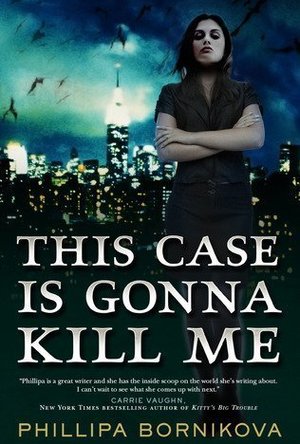
This book was an unexpected delight. Lawyers? Meh. Even lawyers with paranormal spice.
But Linnet Ellery is no ordinary lawyer, even for a young lawyer in a White Fang law firm. She has no end of backbone and smarts, not to mention luck - or should I say Luck? Because fortune swirls around her like nobody else, making her a nexus of events and a little too conspicuous for her very discreet employers.
That's not to say that she doesn't make her share of mistakes - that wouldn't be any fun, now would it? She survives and learns from them, then helps others avoid the same.
Living in a world of vampires, werewolves, and Alfar (elves) might be intimidating to most humans, especially when those beings (Powers) are essentially in charge. Linnet doesn't let them intimidate her. She uses her contacts and plays to her strengths, winning more and more significant battles every time she goes to bat.
Bornikova sets things up very nicely for a sequel, and I am personally hungry to read more. I strongly suggest this book to anyone who enjoys paranormals, urban fantasy, or simply good, humorous fiction with a dollop of suspense and a strong heroine.
But Linnet Ellery is no ordinary lawyer, even for a young lawyer in a White Fang law firm. She has no end of backbone and smarts, not to mention luck - or should I say Luck? Because fortune swirls around her like nobody else, making her a nexus of events and a little too conspicuous for her very discreet employers.
That's not to say that she doesn't make her share of mistakes - that wouldn't be any fun, now would it? She survives and learns from them, then helps others avoid the same.
Living in a world of vampires, werewolves, and Alfar (elves) might be intimidating to most humans, especially when those beings (Powers) are essentially in charge. Linnet doesn't let them intimidate her. She uses her contacts and plays to her strengths, winning more and more significant battles every time she goes to bat.
Bornikova sets things up very nicely for a sequel, and I am personally hungry to read more. I strongly suggest this book to anyone who enjoys paranormals, urban fantasy, or simply good, humorous fiction with a dollop of suspense and a strong heroine.

Movie Metropolis (309 KP) rated The Fate of the Furious (2017) in Movies
Jun 11, 2019

Spectacularly Dumb
With box office takings of over $1.5billion, it was obvious that Universal Pictures would never let Furious 7 be the end of a multi-billion dollar franchise, no matter what many fans truly wanted.
The previous instalment was also, surprisingly, warmly received by critics who were impressed with how sensitively the naturally bombastic series handled the death of lead star Paul Walker. Two years on, the crew are back with Fast and Furious 8; does it do enough to keep the franchise on a high?
Now that Dom (Vin Diesel) and Letty (Michelle Rodriguez) are on their honeymoon, Brian and Mia have retired from the game, and the rest of the crew have been exonerated, the plucky team of globetrotters has found a normal life of sorts. But when a mysterious woman (Charlize Theron) seduces Dom back into a world of crime that he can’t seem to escape from, the rest of the gang will face things that will test them like never before.
Newcomer to the franchise, director F. Gary Gray (Law Abiding Citizen, The Italian Job) manages to craft what is perhaps the most ridiculous entry in the series to date, plagued with tonal imbalances and plot holes so big you could fit the QE2 into them with ease. But you know what? It’s probably the most fun you’ll have in the cinema all year.
The cast are all reunited, barring Paul Walker’s Brian and those publicised rifts between Vin Diesel and Dwayne Johnson are nowhere to be seen as everyone on screen appears to be having the time of their lives. New recruit Charlize Theron adds a level of class to proceedings as steely supervillain, Cipher. She’s a cracking addition to the series and her acting prowess oozes from every pore, despite the often clunky dialogue.
Of course, successful predecessors command bigger budgets for their follow-ups and Furious 8 is no exception. $250million was spent on creating this film and it shows. It’s a feast for the eyes with explosions, shiny cars, stunning locations and breath-taking special effects. The result is frankly exceptional. From Cuba to NYC and from Berlin to Russia (actually filmed in Iceland), the vistas are nicely filmed and beautifully executed.
The action sequences are also choreographed very well, but from a franchise built on these foundations, I’d expect nothing less. In particular, a street chase through New York City is edge of your seat stuff as literally hundreds of vehicles worm their way through its congested streets.
Negatives? Well, the story is awkward despite some decent twists, the aforementioned plot holes cause a few headaches for a series that prides itself on continuity and some of the comedic elements are poorly placed, but in this eighth outing, much of that can be forgiven. After all, what other franchise could survive eight films and still prove as exciting as its first?
Overall, Fast and Furious 8 is unashamedly ridiculous but who cares? With exceptional special effects and a great new adversary in Charlize Theron, the series once again manages to surpass expectation. Each film tries its best to outdo its predecessor and before long, we’ll no doubt be heading to Mars with the gang. I’m up for that. Are you?
https://moviemetropolis.net/2017/04/13/spectacularly-dumb-fast-furious-8-review/
The previous instalment was also, surprisingly, warmly received by critics who were impressed with how sensitively the naturally bombastic series handled the death of lead star Paul Walker. Two years on, the crew are back with Fast and Furious 8; does it do enough to keep the franchise on a high?
Now that Dom (Vin Diesel) and Letty (Michelle Rodriguez) are on their honeymoon, Brian and Mia have retired from the game, and the rest of the crew have been exonerated, the plucky team of globetrotters has found a normal life of sorts. But when a mysterious woman (Charlize Theron) seduces Dom back into a world of crime that he can’t seem to escape from, the rest of the gang will face things that will test them like never before.
Newcomer to the franchise, director F. Gary Gray (Law Abiding Citizen, The Italian Job) manages to craft what is perhaps the most ridiculous entry in the series to date, plagued with tonal imbalances and plot holes so big you could fit the QE2 into them with ease. But you know what? It’s probably the most fun you’ll have in the cinema all year.
The cast are all reunited, barring Paul Walker’s Brian and those publicised rifts between Vin Diesel and Dwayne Johnson are nowhere to be seen as everyone on screen appears to be having the time of their lives. New recruit Charlize Theron adds a level of class to proceedings as steely supervillain, Cipher. She’s a cracking addition to the series and her acting prowess oozes from every pore, despite the often clunky dialogue.
Of course, successful predecessors command bigger budgets for their follow-ups and Furious 8 is no exception. $250million was spent on creating this film and it shows. It’s a feast for the eyes with explosions, shiny cars, stunning locations and breath-taking special effects. The result is frankly exceptional. From Cuba to NYC and from Berlin to Russia (actually filmed in Iceland), the vistas are nicely filmed and beautifully executed.
The action sequences are also choreographed very well, but from a franchise built on these foundations, I’d expect nothing less. In particular, a street chase through New York City is edge of your seat stuff as literally hundreds of vehicles worm their way through its congested streets.
Negatives? Well, the story is awkward despite some decent twists, the aforementioned plot holes cause a few headaches for a series that prides itself on continuity and some of the comedic elements are poorly placed, but in this eighth outing, much of that can be forgiven. After all, what other franchise could survive eight films and still prove as exciting as its first?
Overall, Fast and Furious 8 is unashamedly ridiculous but who cares? With exceptional special effects and a great new adversary in Charlize Theron, the series once again manages to surpass expectation. Each film tries its best to outdo its predecessor and before long, we’ll no doubt be heading to Mars with the gang. I’m up for that. Are you?
https://moviemetropolis.net/2017/04/13/spectacularly-dumb-fast-furious-8-review/

Glass Road
Games
App
Glass Road is the official digital version of Uwe Rosenberg's Glass Road board game. STORY: The...