
Search
Search results

Purple Phoenix Games (2266 KP) rated Terrible Candidates in Tabletop Games
Aug 28, 2020


2020 is a year that will definitely go down in the history books for many reasons. Amidst a global pandemic, a growing civil rights movement, and a hurricane-like storm that ravaged the state of Iowa on August 10th, we ALSO find ourselves in an election year. As if things couldn’t get any crazier, right? Get in the campaigning mood by checking out Terrible Candidates, and remember to get out and vote on November 3rd, America!
Disclaimer: We were provided a copy of Terrible Candidates for the purposes of this review. The components pictured are finalized and are what come in a production copy of the game. I do not intend to rehash the entire rulebook, but rather provide an overview of the rules and general gameplay. -L
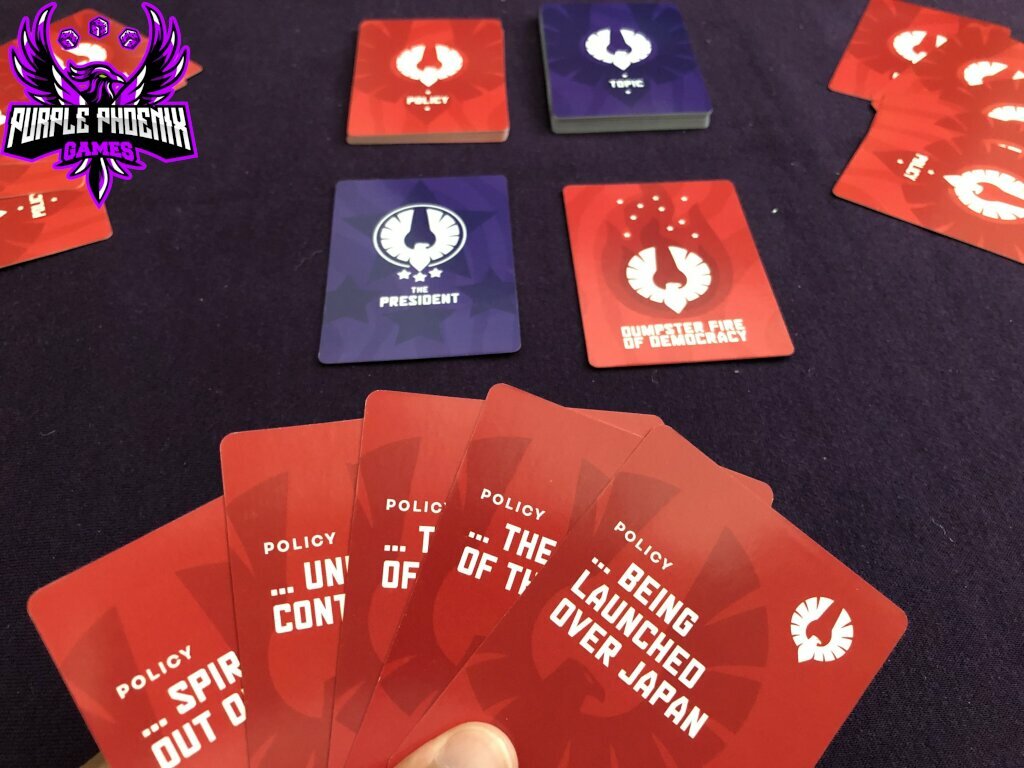
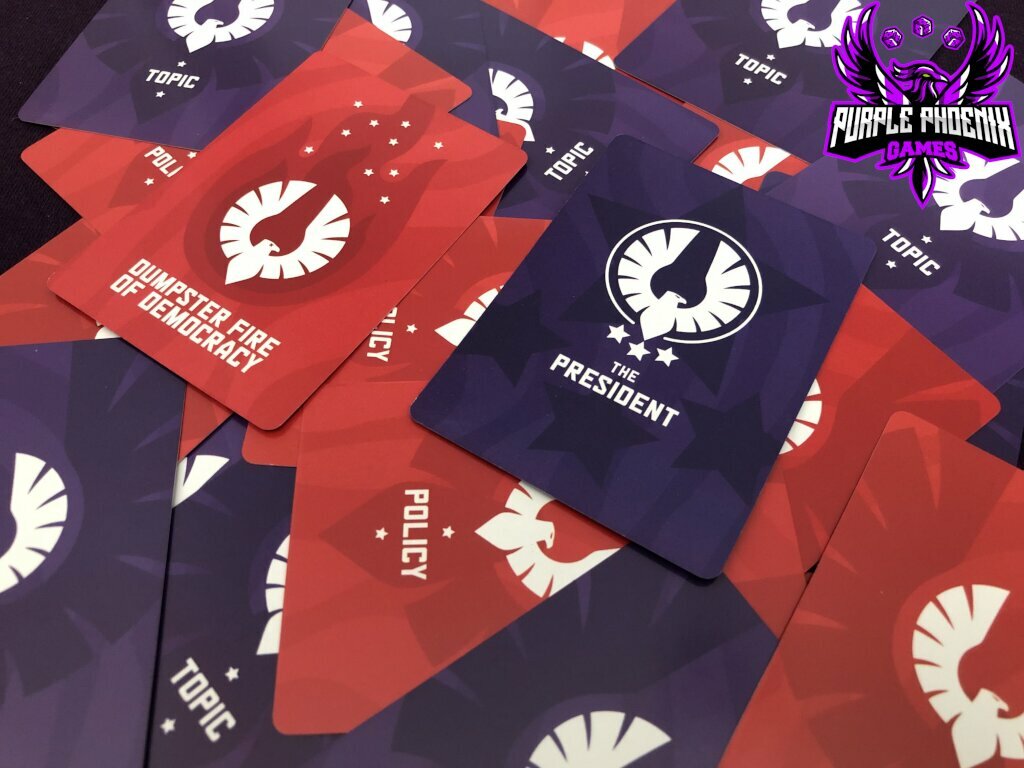
Terrible Candidates is a party game in which all players, candidates vying for the Presidency, participate in a series of public debates. At the end of the game, the player who has won the most debates is declared the new President! Setup is simple: Deal 5 Policy cards to each player, place the remaining Policy and Topic cards in the center of the table, place the Dumpster Fire of Democracy card within reach of all players to indicate the discard pile, and keep the President card off to the side.
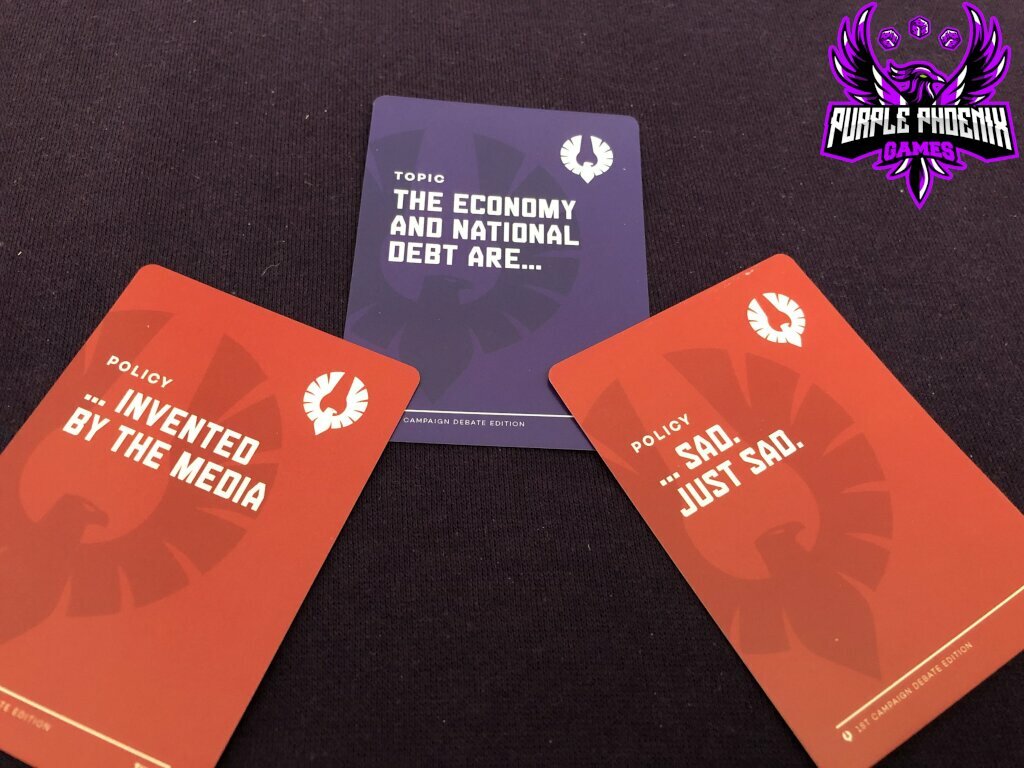
The gameplay itself is just as simple! Select a pair of neighboring players to be the first debate Candidates. A Topic card is revealed, and the 2 Candidates select a Policy card from their hand to play in this debate. Once the Policy cards are selected, each Candidate gets 30 seconds to explain/debate their selected response to the Topic, providing as many talking points, facts (true or alternative) and other general jargon or nonsense to convince the Media (the non-Candidates for this turn) to vote for them. When both Candidates have made their debates, each member of the Media is allowed to ask one question, providing an extra chance for political shenanigans or hilarity. Once all questions have been asked, the Media votes on which Candidate they believe was the best of the pair, and that winning Candidate keeps the Topic card as their point. The game moves on to the next debate, rotating one person around the group to get a new pair of Candidates – one Candidate from the previous debate, and a new competitor. Play progresses in this manner until all players have participated in 2 debates, thus ending the round. Any players who have no Topic cards (meaning they didn’t win either of their debates in the round) is knocked out of the game, and the next round commences with the remaining players. The second round follows the steps of the first, and when all players have debated twice, the game ends. The player with the most Topic cards is declared the winner and becomes President!
I know that this game might seem like a lot, but it’s honestly not complicated. Each round works as follows: Debate, Question, Vote, and repeat until all players have done 2 debates. If there is one thing that is a must for a party game, it’s a simple set of rules and gameplay to maximize playing time, and Terrible Candidates has adhered to that policy (See what I did there?). The overall atmosphere of the game is reminiscent of CAH, but with a twist. In CAH, all players submit a card and one player is the ultimate judge for the turn, thus allowing players to cater to the personality/sense of humor of that one person. Terrible Candidates is a group effort, meaning that you have to get a majority of the votes in your favor to win the debate. Instead of focusing on one person, you have to be quick-witted and clever enough to find ways to influence all other players. That makes it feel like a more engaging game overall, since all players are involved in every step of the turn.
Obviously, this game has some political implications, but the gameplay can be whatever your group wants it to be. Playing with a group of highly political friends? Maybe it will turn into some intelligent debates and conversations throughout the night. Playing with the fam at a reunion or get-together? Go crazy, make up hilarious stories, and just have a good time. It all depends on your gaming group, and it can be whatever kind of game you want it to be – serious or silly. A caveat with this, as with CAH-esque games, is knowing your group and the kind of humor that is acceptable. Just make sure that however you decide to play, everyone involved is comfortable and having fun!
All in all, I think that Terrible Candidates is a fun and funny little game for everyone involved. As a Candidate, you put your improv skills to the test as you make ridiculous claims or present decent ideas in your 30-second time limit. As a member of the Media, you also get in on a little improv, coming up with a question to ask the Candidates, and then casting your vote for the most convincing side. This game can be so unpredictable, and that’s what helps keep it fresh, entertaining, and funny. Whether you are politically active or not, this game can result in some great times and good conversations among the group. If you’re up for it, take a chance and cast your vote for Terrible Candidates!
Disclaimer: We were provided a copy of Terrible Candidates for the purposes of this review. The components pictured are finalized and are what come in a production copy of the game. I do not intend to rehash the entire rulebook, but rather provide an overview of the rules and general gameplay. -L
Terrible Candidates is a party game in which all players, candidates vying for the Presidency, participate in a series of public debates. At the end of the game, the player who has won the most debates is declared the new President! Setup is simple: Deal 5 Policy cards to each player, place the remaining Policy and Topic cards in the center of the table, place the Dumpster Fire of Democracy card within reach of all players to indicate the discard pile, and keep the President card off to the side.
The gameplay itself is just as simple! Select a pair of neighboring players to be the first debate Candidates. A Topic card is revealed, and the 2 Candidates select a Policy card from their hand to play in this debate. Once the Policy cards are selected, each Candidate gets 30 seconds to explain/debate their selected response to the Topic, providing as many talking points, facts (true or alternative) and other general jargon or nonsense to convince the Media (the non-Candidates for this turn) to vote for them. When both Candidates have made their debates, each member of the Media is allowed to ask one question, providing an extra chance for political shenanigans or hilarity. Once all questions have been asked, the Media votes on which Candidate they believe was the best of the pair, and that winning Candidate keeps the Topic card as their point. The game moves on to the next debate, rotating one person around the group to get a new pair of Candidates – one Candidate from the previous debate, and a new competitor. Play progresses in this manner until all players have participated in 2 debates, thus ending the round. Any players who have no Topic cards (meaning they didn’t win either of their debates in the round) is knocked out of the game, and the next round commences with the remaining players. The second round follows the steps of the first, and when all players have debated twice, the game ends. The player with the most Topic cards is declared the winner and becomes President!
I know that this game might seem like a lot, but it’s honestly not complicated. Each round works as follows: Debate, Question, Vote, and repeat until all players have done 2 debates. If there is one thing that is a must for a party game, it’s a simple set of rules and gameplay to maximize playing time, and Terrible Candidates has adhered to that policy (See what I did there?). The overall atmosphere of the game is reminiscent of CAH, but with a twist. In CAH, all players submit a card and one player is the ultimate judge for the turn, thus allowing players to cater to the personality/sense of humor of that one person. Terrible Candidates is a group effort, meaning that you have to get a majority of the votes in your favor to win the debate. Instead of focusing on one person, you have to be quick-witted and clever enough to find ways to influence all other players. That makes it feel like a more engaging game overall, since all players are involved in every step of the turn.
Obviously, this game has some political implications, but the gameplay can be whatever your group wants it to be. Playing with a group of highly political friends? Maybe it will turn into some intelligent debates and conversations throughout the night. Playing with the fam at a reunion or get-together? Go crazy, make up hilarious stories, and just have a good time. It all depends on your gaming group, and it can be whatever kind of game you want it to be – serious or silly. A caveat with this, as with CAH-esque games, is knowing your group and the kind of humor that is acceptable. Just make sure that however you decide to play, everyone involved is comfortable and having fun!
All in all, I think that Terrible Candidates is a fun and funny little game for everyone involved. As a Candidate, you put your improv skills to the test as you make ridiculous claims or present decent ideas in your 30-second time limit. As a member of the Media, you also get in on a little improv, coming up with a question to ask the Candidates, and then casting your vote for the most convincing side. This game can be so unpredictable, and that’s what helps keep it fresh, entertaining, and funny. Whether you are politically active or not, this game can result in some great times and good conversations among the group. If you’re up for it, take a chance and cast your vote for Terrible Candidates!


KalJ95 (25 KP) rated Final Fantasy VII Remake in Video Games
Jun 10, 2020 (Updated Jun 10, 2020)


Combat Is Fluid, Weighty And Satisfying. (2 more)
The Protagonists Are Well Thought Out.
I Can't Wait For The Next Part.
Side missions Are Tedious And Boring (2 more)
The Middle Is A Slog To Go Through,
Parts Of The Story Needed Removing
A Classic Reborn.
I understand the impact FFVII has had on both video game narratives, and storytelling itself. It remains a staple mark on video games, and as such is held so highly amongst developers as the standard of how great a narrative can be, and its hard to argue. I haven't even played the original 1997 release, but I know the story beats and main moments. Its an incredible journey, with fascinating characters, rolled into moments of twists and turns. Once a remake was announced, it obviously was met with massive anticipation, and worrying doubt. Could you possibly pull off a remake of classic and make fans old and new fall in love all over again?
The answer is a yes, but only just. I played FFVIIR as a brand new player, knowing nothing of the characters or story of what happens in Midgar, and began being completely enthralled. The opening is a chapter of fast edged combat and moral dilemmas of actions taken by our heroes. Its explosive, bursting with huge set pieces and cheesy dialogue. I loved every moment, and this was only the tutorial. The implications ride high throughout the whole experience when you see the environment change around you, and questions begin to arise from NPC’s, and yourself. Is their really any good guys amongst this world of soldiers, eco-terrorists and corrupt authority figures?
From then the game takes different directions, and things become problematic, specifically once you fade from the Avalanche crew.
Although the story still remains as engaging to a certain point, the experience takes a wayward nosedive. Side missions are introduced, and while you don't have to complete them, you feel the need to once characters start asking you to. This becomes a major issue because they are all so boring and stiff. The characters you talk to are all robotic, the dialogue seems overdramatised, and the reward itself just isn't worth it. The main aspect of buying a game for me is for immersion, and consistently I was being pulled from the experience because of lacklustre moments, and this is the same for most of the game. As I said, the opening to the story is a perfect way to begin your stay in Midgar, but once you drift away from the Avalanche crew, the story becomes stale. The game feels more like a twenty five hour experience rather than thirty five, and cutting certain sections would boost the story significantly. I understand wanting to add more and retain the great moments from the original, but sometimes cutting the fat can also be a good thing.
While moments in the original game could last around one hour, FFVIIR stretches it further to gain more insight into side characters and exploration. Don’t get wrong, it works in certain areas, for example Wall Market and Sector 7 as a whole are fantastic places to spend hours in, which I did. They burst with details that provide back story to their presence only thought about by the player. The slums are cramped, lifeless in colour, and shows the class divide within Midgar’s people.
However, in these moments they are only boosted further by the best feature of the game; Combat.
The combat is sublime, crunchy and weighty, and requires excellent skill the more you progress. Each of the protagonists has unique fighting styles, and customisation with materials gives you even more edge over your opponents. Fighting your standard monsters and creatures becomes a breeze once you know their weaknesses, but Boss fights are where the real challenge happens. Boss fights are the highlight of the entire game, especially the likes of a Giant House and the Final confrontation, and encapsulate the work and progression within the characters you play as. At first, I just wanted to play as Cloud, but knowing each characters skills, then switching between them to fight, and help other members of your party, becomes a juggling act thats so damn good. Speaking of which, our Heroes. At first, I thought I was dealing with generic anime characters who all boast the same attributes, and how wrong I was. Cloud is defensive, standoffish and blunt, who's primarily in the job for the money. Cloud is suffering, from what I can gather, with amnesia, and as the game’s questions begin to reveal the answers, he sets aside the hard edged exterior he carries with him, and opens up to warm to this band of wacky eco-terrorists. Even with this just being the first part of however many they are planning to release, Cloud is so interesting to me, a nut you want to crack and see what is inside, and his past becomes the focal point of the finale. He has become one of my favourite characters in a video game.
FFVIIR is a conundrum I only further want to figure out. Its both an incredible video game, but also bogged down with clear issues, which I personally feel either didn’t need to be in the game, or could of spent more time being fleshed out. Would I recommend it? Absolutely. Its a game I feel everyone should play, for gorgeous spectacle and mesmerising vision. I can’t wait for the second part.
The answer is a yes, but only just. I played FFVIIR as a brand new player, knowing nothing of the characters or story of what happens in Midgar, and began being completely enthralled. The opening is a chapter of fast edged combat and moral dilemmas of actions taken by our heroes. Its explosive, bursting with huge set pieces and cheesy dialogue. I loved every moment, and this was only the tutorial. The implications ride high throughout the whole experience when you see the environment change around you, and questions begin to arise from NPC’s, and yourself. Is their really any good guys amongst this world of soldiers, eco-terrorists and corrupt authority figures?
From then the game takes different directions, and things become problematic, specifically once you fade from the Avalanche crew.
Although the story still remains as engaging to a certain point, the experience takes a wayward nosedive. Side missions are introduced, and while you don't have to complete them, you feel the need to once characters start asking you to. This becomes a major issue because they are all so boring and stiff. The characters you talk to are all robotic, the dialogue seems overdramatised, and the reward itself just isn't worth it. The main aspect of buying a game for me is for immersion, and consistently I was being pulled from the experience because of lacklustre moments, and this is the same for most of the game. As I said, the opening to the story is a perfect way to begin your stay in Midgar, but once you drift away from the Avalanche crew, the story becomes stale. The game feels more like a twenty five hour experience rather than thirty five, and cutting certain sections would boost the story significantly. I understand wanting to add more and retain the great moments from the original, but sometimes cutting the fat can also be a good thing.
While moments in the original game could last around one hour, FFVIIR stretches it further to gain more insight into side characters and exploration. Don’t get wrong, it works in certain areas, for example Wall Market and Sector 7 as a whole are fantastic places to spend hours in, which I did. They burst with details that provide back story to their presence only thought about by the player. The slums are cramped, lifeless in colour, and shows the class divide within Midgar’s people.
However, in these moments they are only boosted further by the best feature of the game; Combat.
The combat is sublime, crunchy and weighty, and requires excellent skill the more you progress. Each of the protagonists has unique fighting styles, and customisation with materials gives you even more edge over your opponents. Fighting your standard monsters and creatures becomes a breeze once you know their weaknesses, but Boss fights are where the real challenge happens. Boss fights are the highlight of the entire game, especially the likes of a Giant House and the Final confrontation, and encapsulate the work and progression within the characters you play as. At first, I just wanted to play as Cloud, but knowing each characters skills, then switching between them to fight, and help other members of your party, becomes a juggling act thats so damn good. Speaking of which, our Heroes. At first, I thought I was dealing with generic anime characters who all boast the same attributes, and how wrong I was. Cloud is defensive, standoffish and blunt, who's primarily in the job for the money. Cloud is suffering, from what I can gather, with amnesia, and as the game’s questions begin to reveal the answers, he sets aside the hard edged exterior he carries with him, and opens up to warm to this band of wacky eco-terrorists. Even with this just being the first part of however many they are planning to release, Cloud is so interesting to me, a nut you want to crack and see what is inside, and his past becomes the focal point of the finale. He has become one of my favourite characters in a video game.
FFVIIR is a conundrum I only further want to figure out. Its both an incredible video game, but also bogged down with clear issues, which I personally feel either didn’t need to be in the game, or could of spent more time being fleshed out. Would I recommend it? Absolutely. Its a game I feel everyone should play, for gorgeous spectacle and mesmerising vision. I can’t wait for the second part.

Gareth von Kallenbach (980 KP) rated The Batman (2022) in Movies
Feb 28, 2022
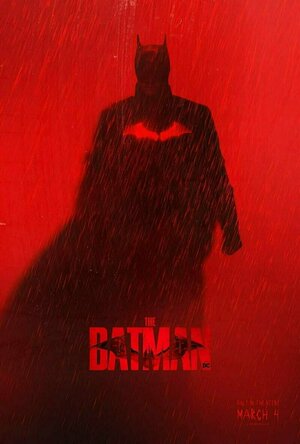
In 1989 Michael Keaton was seen as a very controversial choice to wear the Cowl of Batman but soon proved his doubters wrong by turning “Batman” and its subsequent sequel “Batman Returns” into massive Box Office success before leaving the cape behind.
While four other actors have taken up the cinematic version of the character in the subsequent years, Keaton has remained for many the Gold Standard with Christian Bale likely being his biggest rival.
When Robert Pattinson was named as the new Batman, there was interest but concern as an actor who is largely known for playing Edward in the “Twilight” films seemed to be an odd choice. However, I would say that anyone who has seen some of his recent work including his performance in “The Lighthouse” would be playing him a disservice by saying he was not up to the part.
In “The Batman”, audiences are given a darker and more broken Bruce Wayne, an Emo recluse who is far from the Socialite he has been portrayed as for decades and a very sullen and withdrawn individual who does not exude charm or grace and even shows issues making eye-contact.
When the Mayor of Gotham is killed shortly before the election by a mysterious individual known as “The Riddler” (Paul Dano), the vigilante known as “The Batman” is called in to help the police by Lt. James Gordon (Jeffrey Wright). Gordon has been working with Batman for some time but it is clear that his association with him has not won him any favors with his fellow officers, many of which openly question his use and involvement in the crime scenes.
Further complicating matters are clues left at the various crime locales that are addressed to The Batman and cause many to believe that he may be working with the very killer they are attempting to stop.
As the investigation unfolds, the seedy side of Gotham City comes to light in the form of a missing girl who was photographed with the married Mayor and may well be the key to the investigation. Her disappearance leads her friend Selina Kyle (Zoe Kravitz), to take on her Catwoman persona and delve deep into an underworld that features deadly individuals ranging from Carmine Falcone (John Turturro), and The Penguin (Colin Farrell), amongst others as she and the Batman conduct their own investigations that at times overlap and further complicate matters.
As the body count rises and Batman races to find the true method behind the madness of The Riddler, the tone becomes darker and more sinister in a deadly race against time.
The film eschews the usual abundance of action sequences and glossy special effects which are common for Comic Book related films and instead gives audiences a slow-burning murder mystery that holds your attention from start to finish over its three-hour run time.
The dark and foreboding tone of the film is brought home by the haunting and sharp piano keys of the film’s theme that permeates the film and punches home that this is a film clearly aimed at a more adult audience.
Pattinson does a great job showing the deeply broken individual that is behind the mask and that Batman is the only form of escape or therapy that Bruce Wayne has due to his insistence on saving a city that many argue cannot be saved. He has strained his relationship at times with Alfred (Andy Serkis), caused damage to the financial stability and reputation of the family company in his quest for vengeance and justice, and has become a bitter and broken recluse in doing so. In many ways, it could be argued that his only socialization with others is as The Batman and his single-minded obsession is chilling to watch.
Pattinson also handles the action sequences well as the film spaces them out to put the emphasis more on the man than the gadgets as they are kept to a minimum even during a thrilling chase with the new version of The Batmobile.
The strong supporting cast works well with the film and Paul Dano gives a very compelling and disturbing version of his character which makes the film even darker and more engrossing.
Director Matt Reeves has crafted a dark and foreboding tone and visual style as a good portion of the film takes place in the darkness and his screenplay is not afraid to take chances by putting the emphasis on the characters and their flaws versus an abundance of action and effects.
I found this version of the character and interpretation more engrossing than prior versions of the film as the bold move to do a slow-burning and dark murder mystery versus an effect-laden action film reminded me of some of the better Batman stories such as Batman: The Killing Joke or Batman: The Long Halloween.
The film is not going to be for everyone, especially younger viewers and some may take issue with the casting choices, but their performances shine and as such, “The Batman” was a very engaging and unforgettable tale that for me serves as one of the best adaptations of the character ever.
4 stars out of 5
While four other actors have taken up the cinematic version of the character in the subsequent years, Keaton has remained for many the Gold Standard with Christian Bale likely being his biggest rival.
When Robert Pattinson was named as the new Batman, there was interest but concern as an actor who is largely known for playing Edward in the “Twilight” films seemed to be an odd choice. However, I would say that anyone who has seen some of his recent work including his performance in “The Lighthouse” would be playing him a disservice by saying he was not up to the part.
In “The Batman”, audiences are given a darker and more broken Bruce Wayne, an Emo recluse who is far from the Socialite he has been portrayed as for decades and a very sullen and withdrawn individual who does not exude charm or grace and even shows issues making eye-contact.
When the Mayor of Gotham is killed shortly before the election by a mysterious individual known as “The Riddler” (Paul Dano), the vigilante known as “The Batman” is called in to help the police by Lt. James Gordon (Jeffrey Wright). Gordon has been working with Batman for some time but it is clear that his association with him has not won him any favors with his fellow officers, many of which openly question his use and involvement in the crime scenes.
Further complicating matters are clues left at the various crime locales that are addressed to The Batman and cause many to believe that he may be working with the very killer they are attempting to stop.
As the investigation unfolds, the seedy side of Gotham City comes to light in the form of a missing girl who was photographed with the married Mayor and may well be the key to the investigation. Her disappearance leads her friend Selina Kyle (Zoe Kravitz), to take on her Catwoman persona and delve deep into an underworld that features deadly individuals ranging from Carmine Falcone (John Turturro), and The Penguin (Colin Farrell), amongst others as she and the Batman conduct their own investigations that at times overlap and further complicate matters.
As the body count rises and Batman races to find the true method behind the madness of The Riddler, the tone becomes darker and more sinister in a deadly race against time.
The film eschews the usual abundance of action sequences and glossy special effects which are common for Comic Book related films and instead gives audiences a slow-burning murder mystery that holds your attention from start to finish over its three-hour run time.
The dark and foreboding tone of the film is brought home by the haunting and sharp piano keys of the film’s theme that permeates the film and punches home that this is a film clearly aimed at a more adult audience.
Pattinson does a great job showing the deeply broken individual that is behind the mask and that Batman is the only form of escape or therapy that Bruce Wayne has due to his insistence on saving a city that many argue cannot be saved. He has strained his relationship at times with Alfred (Andy Serkis), caused damage to the financial stability and reputation of the family company in his quest for vengeance and justice, and has become a bitter and broken recluse in doing so. In many ways, it could be argued that his only socialization with others is as The Batman and his single-minded obsession is chilling to watch.
Pattinson also handles the action sequences well as the film spaces them out to put the emphasis more on the man than the gadgets as they are kept to a minimum even during a thrilling chase with the new version of The Batmobile.
The strong supporting cast works well with the film and Paul Dano gives a very compelling and disturbing version of his character which makes the film even darker and more engrossing.
Director Matt Reeves has crafted a dark and foreboding tone and visual style as a good portion of the film takes place in the darkness and his screenplay is not afraid to take chances by putting the emphasis on the characters and their flaws versus an abundance of action and effects.
I found this version of the character and interpretation more engrossing than prior versions of the film as the bold move to do a slow-burning and dark murder mystery versus an effect-laden action film reminded me of some of the better Batman stories such as Batman: The Killing Joke or Batman: The Long Halloween.
The film is not going to be for everyone, especially younger viewers and some may take issue with the casting choices, but their performances shine and as such, “The Batman” was a very engaging and unforgettable tale that for me serves as one of the best adaptations of the character ever.
4 stars out of 5
Purple Phoenix Games (2266 KP) rated Orchard: A 9 Card Solitaire Game in Tabletop Games
Mar 1, 2022
I love playing games with other people. Absolutely LOVE it. However, I also love playing games solo as well. When a game comes along that is specifically designed for solo play only, I tend to like them more than multiplayer games that include a solo mode. Also included here are cooperative games where the solo player just quarterbacks multiple players. But a game that is designed for solo play and even includes it in its title? I cannot recall many games I have played like this. But how is this one?
Orchard: A 9 Card Solitaire Game (simply Orchard from here on out) is a solo game where the player is attempting to harvest the most fruit from trees that are bred for high yield. As there are no players to play against, the player will instead compare their ending score with a table in the rulebook. Will the player’s game result in a “Pal-tree” score or will they score enough to be considered “Almost imposs-apple!”?
To setup, place the dice and Rotten Fruiteeple on the table. Shuffle the 18 cards, deal two decks of nine cards (two games worth), and choose a deck to play. Flip the first card over to start the orchard, shuffle the remaining cards and draw two into hand. The game is now setup and ready to begin!
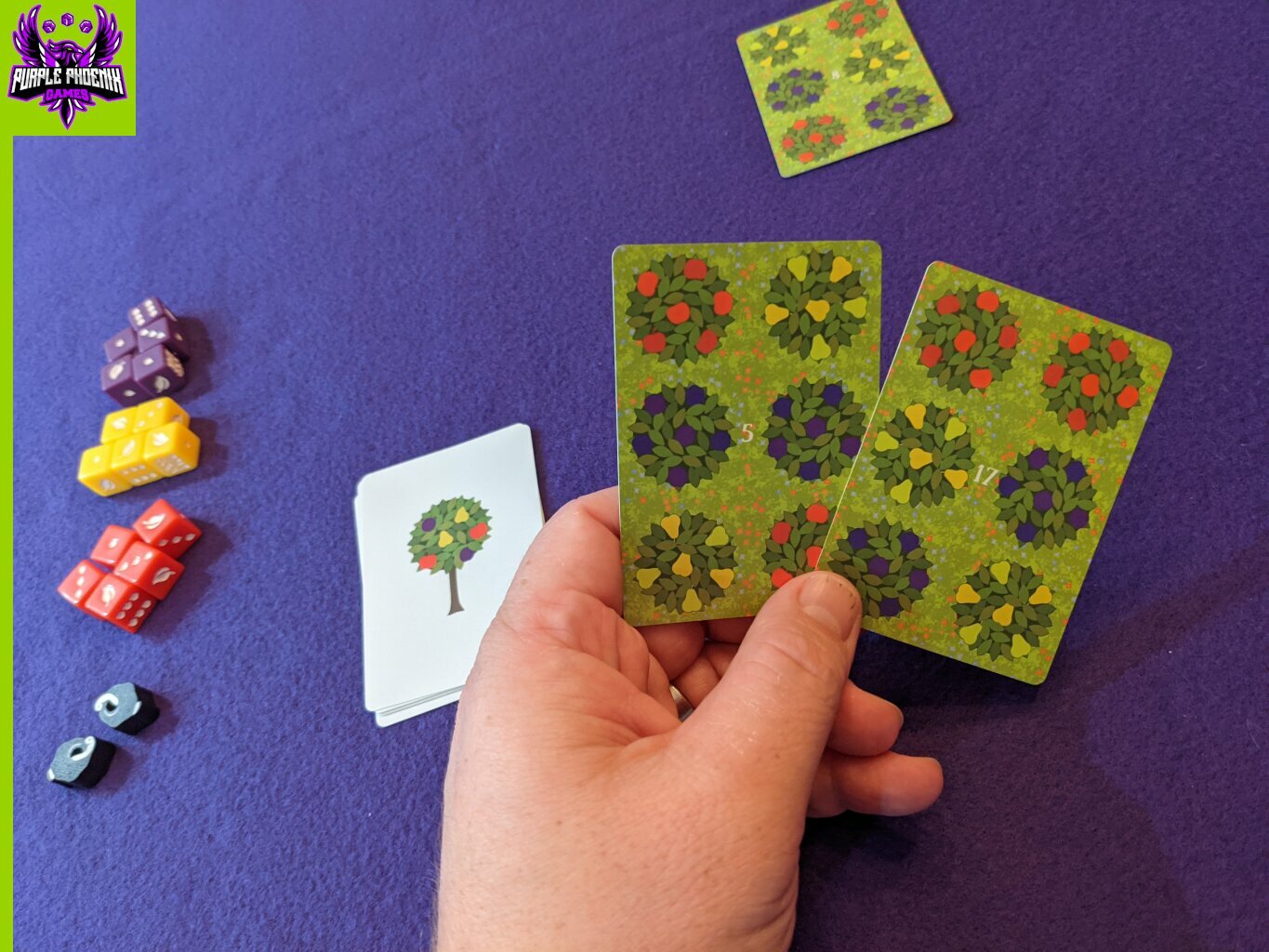
Turns in Orchard could not be simpler: Play a Card, Place Dice, Draw a Card. From the two-card hand, choose one to be placed in the orchard with one very important rule: the newly-placed card must overlap another card in the orchard by overlapping matching tree types. So, a card can only be placed if the apple tree overlaps an apple tree, etc. More than one icon may overlap the existing card, but each icon must match types below it.
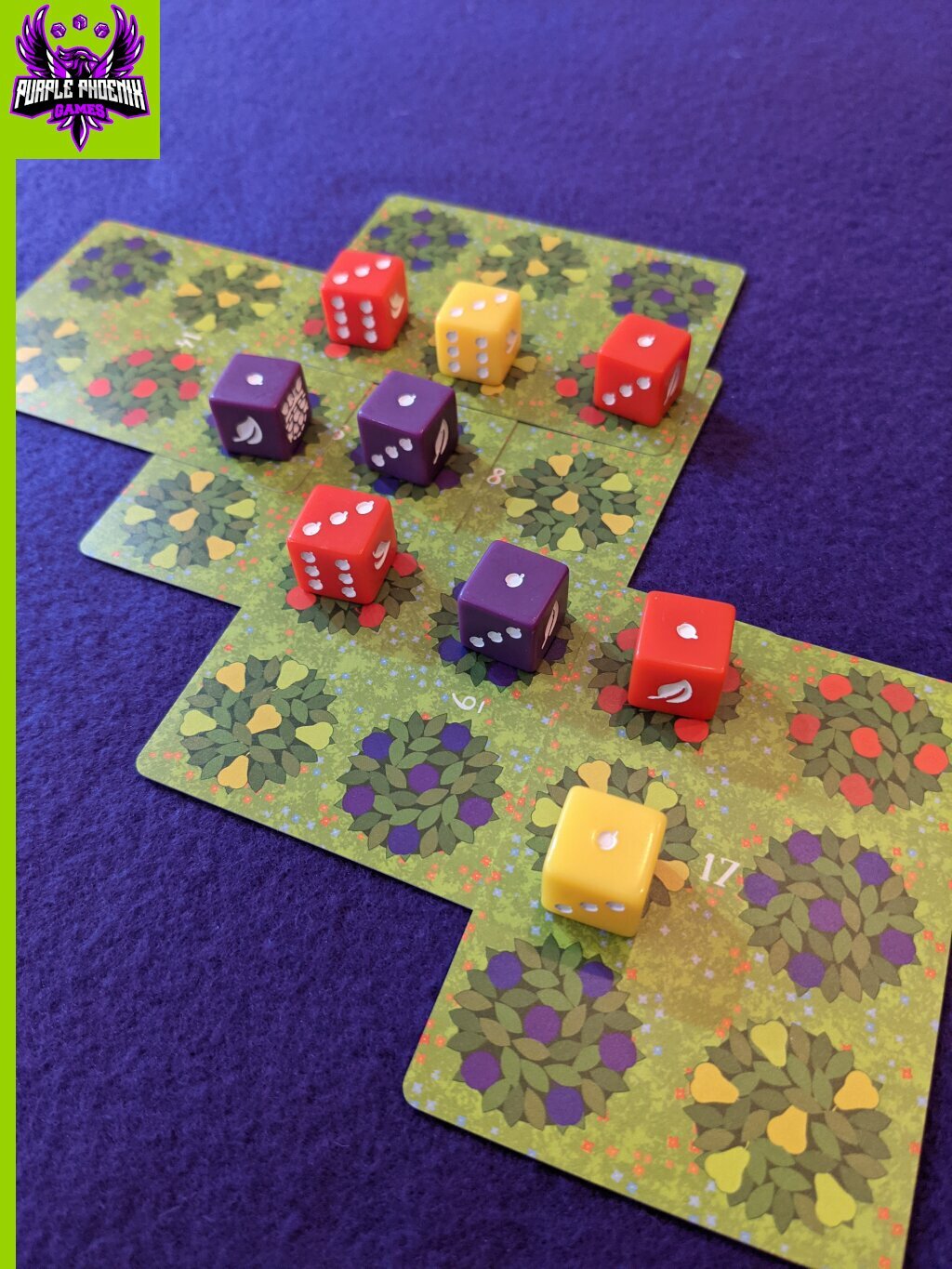
Once the new card has been placed, for each icon overlapped, a die matching the fruit type is placed on the icon. If this is the first time the tree has been overlapped, the die face is placed with value 1 showing. However, the die will increase in value each subsequent time it is overlapped (total die values of 1, 3, 6, 10). Therefore, when a card has been overlapped four times on the same icon, the maximum number of points has been reached for that icon. Should a player wish instead to forego any die placement and be unable (or unwilling) to place a card correctly, they may place any card, overlap an icon, and then add a Rotten Fruiteeple atop the mismatched icon. This spoils the fruit for the remainder of the game, so no further dice may be placed upon it, and also reduces the final score by three VP at game end for each token placed.
Finally, when the card and die have been placed, the player draws another card into their hand. When the final card has been played, or no further legal placements can be made, the game ends and the player totals up the dice values to arrive at their final score.
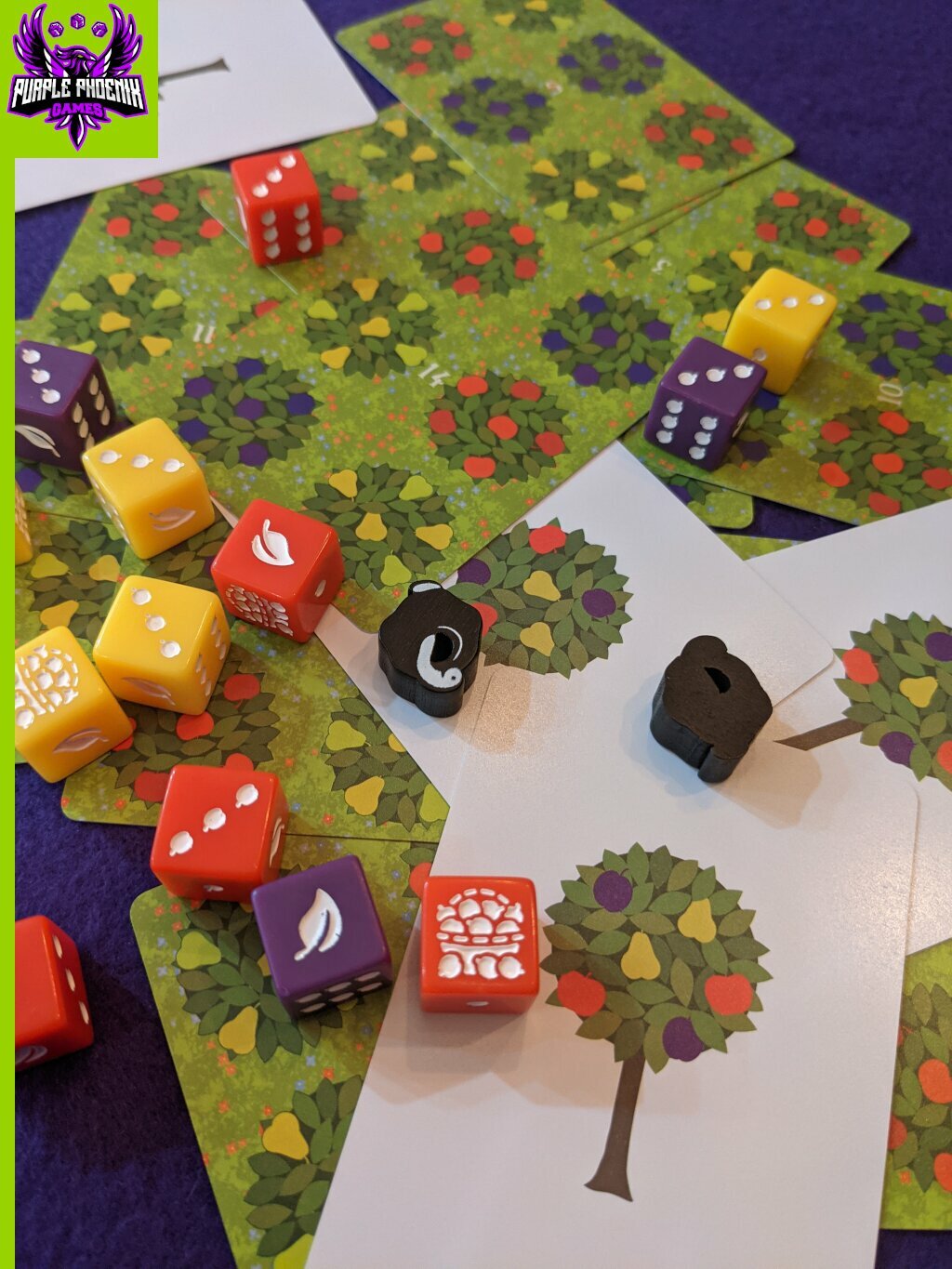
Components. This game is 18 cards of good quality, a bunch of custom dice, and two Rotten Fruit meeples. Everything is good quality and size, and it fits into a really cool sliding deck-box. The art, for me, is fine. The colors match fruits from the real world, and the dice match those color well enough too. I feel like different fruit choices could have been made to increase accessibility for our color-blind gamer friends. The plums and apples are both small and round (with an ever-so-slight different shape on the apple). I don’t know what other fruits would have been more appropriate – I’m not a botanist. Similarly, the dice are custom made with the pips looking like a plum or apple, and two sides of the dice showing a leaf icon. Perhaps in the interest of differentiation, instead of the leaves, the different dice colors could instead show the matching fruit style (if only the plum and apple looked differently enough). So instead of leaves, the red dice could show apples, the yellow dice could show pears, and the purple dice could show, I don’t know, eggplants? I am not color-blind, so these do not affect me, but it is something I have taken to commenting on as I review more and more games.
All in all, Orchard is a really good little game of overlapping and puzzling out next moves. The games are super-quick and engaging, and I always want to improve my score each time I play. When a game forces me to play again and again I feel it is a sign of a good game. I have plans to keep this one in its own special place where I can just grab it and go, instead of being dwarfed by my collection of much larger game boxes. If you are like me and pine for good solo play, then perhaps you should check out Orchard: A 9 Card Solitaire Game. The rules are light, game play is simple and fast, and it keeps drawing me in every time I look at the box.
Also let me know your highest score because I apparently am trash at this game, even though I really enjoy playing it. Have you scored in the top tier? Those must be some delicious fruits.
Orchard: A 9 Card Solitaire Game (simply Orchard from here on out) is a solo game where the player is attempting to harvest the most fruit from trees that are bred for high yield. As there are no players to play against, the player will instead compare their ending score with a table in the rulebook. Will the player’s game result in a “Pal-tree” score or will they score enough to be considered “Almost imposs-apple!”?
To setup, place the dice and Rotten Fruiteeple on the table. Shuffle the 18 cards, deal two decks of nine cards (two games worth), and choose a deck to play. Flip the first card over to start the orchard, shuffle the remaining cards and draw two into hand. The game is now setup and ready to begin!
Turns in Orchard could not be simpler: Play a Card, Place Dice, Draw a Card. From the two-card hand, choose one to be placed in the orchard with one very important rule: the newly-placed card must overlap another card in the orchard by overlapping matching tree types. So, a card can only be placed if the apple tree overlaps an apple tree, etc. More than one icon may overlap the existing card, but each icon must match types below it.
Once the new card has been placed, for each icon overlapped, a die matching the fruit type is placed on the icon. If this is the first time the tree has been overlapped, the die face is placed with value 1 showing. However, the die will increase in value each subsequent time it is overlapped (total die values of 1, 3, 6, 10). Therefore, when a card has been overlapped four times on the same icon, the maximum number of points has been reached for that icon. Should a player wish instead to forego any die placement and be unable (or unwilling) to place a card correctly, they may place any card, overlap an icon, and then add a Rotten Fruiteeple atop the mismatched icon. This spoils the fruit for the remainder of the game, so no further dice may be placed upon it, and also reduces the final score by three VP at game end for each token placed.
Finally, when the card and die have been placed, the player draws another card into their hand. When the final card has been played, or no further legal placements can be made, the game ends and the player totals up the dice values to arrive at their final score.
Components. This game is 18 cards of good quality, a bunch of custom dice, and two Rotten Fruit meeples. Everything is good quality and size, and it fits into a really cool sliding deck-box. The art, for me, is fine. The colors match fruits from the real world, and the dice match those color well enough too. I feel like different fruit choices could have been made to increase accessibility for our color-blind gamer friends. The plums and apples are both small and round (with an ever-so-slight different shape on the apple). I don’t know what other fruits would have been more appropriate – I’m not a botanist. Similarly, the dice are custom made with the pips looking like a plum or apple, and two sides of the dice showing a leaf icon. Perhaps in the interest of differentiation, instead of the leaves, the different dice colors could instead show the matching fruit style (if only the plum and apple looked differently enough). So instead of leaves, the red dice could show apples, the yellow dice could show pears, and the purple dice could show, I don’t know, eggplants? I am not color-blind, so these do not affect me, but it is something I have taken to commenting on as I review more and more games.
All in all, Orchard is a really good little game of overlapping and puzzling out next moves. The games are super-quick and engaging, and I always want to improve my score each time I play. When a game forces me to play again and again I feel it is a sign of a good game. I have plans to keep this one in its own special place where I can just grab it and go, instead of being dwarfed by my collection of much larger game boxes. If you are like me and pine for good solo play, then perhaps you should check out Orchard: A 9 Card Solitaire Game. The rules are light, game play is simple and fast, and it keeps drawing me in every time I look at the box.
Also let me know your highest score because I apparently am trash at this game, even though I really enjoy playing it. Have you scored in the top tier? Those must be some delicious fruits.
Purple Phoenix Games (2266 KP) rated TEN in Tabletop Games
Nov 28, 2021

When it comes to game mechanics, set collection is my JAM. Auction/bidding and push your luck, not so much….. So when Alderac Entertainment Group brought TEN into my life, I was a bit wary at first. A game of collecting sequences/sets of numbers? Awesome!! Add in bidding for Wildcards or pushing your luck to not Bust each turn? A bit too risky, at least for my gaming tastes. After having had the opportunity to play TEN, were my initial feelings misplaced? Spoiler: Yes. For me, TEN was a prime example of “Don’t judge a game by its mechanics.” Keep reading to find out why.
Disclaimer: We were provided with a copy of TEN for the purposes of this review. This is a final production copy, so what you see pictured is what you would receive in a retail copy of the game. -L
TEN is a push-your-luck game of set collection and auction/bidding in which players are trying to amass the most points by the end of the game. Points are earned by collecting sets of numeric sequences in the 4 colors of the game: Blue, Green, Pink, and Orange. Played over a series of turns, players will be drawing/collecting cards from the tableau, buying cards from the Market, or Busting if they push their luck a bit too far. To setup for a game, assemble the deck of cards as dictated by the player count and set it in the play area. Each player gets 5 Currency tokens with which to start the game, and are all dealt a random reference card. The player who was dealt the reference card with the Starting Player symbol will begin the game. Before getting into the actual gameplay, I want to mention the different card types, as to provide a better understanding when reading this review. In each of the 4 colors, there are card values numbered 1-9, with more copies of the lower numbers and fewer of the higher numbers. There are also Wildcards that can be used to represent any #/color, depending on the card. Some cards in the deck are Currency cards and show a value of 1-5 Currency. Should you choose to take these from the tableau, you collect that amount of Currency to be used for auctions or buying cards in later turns.
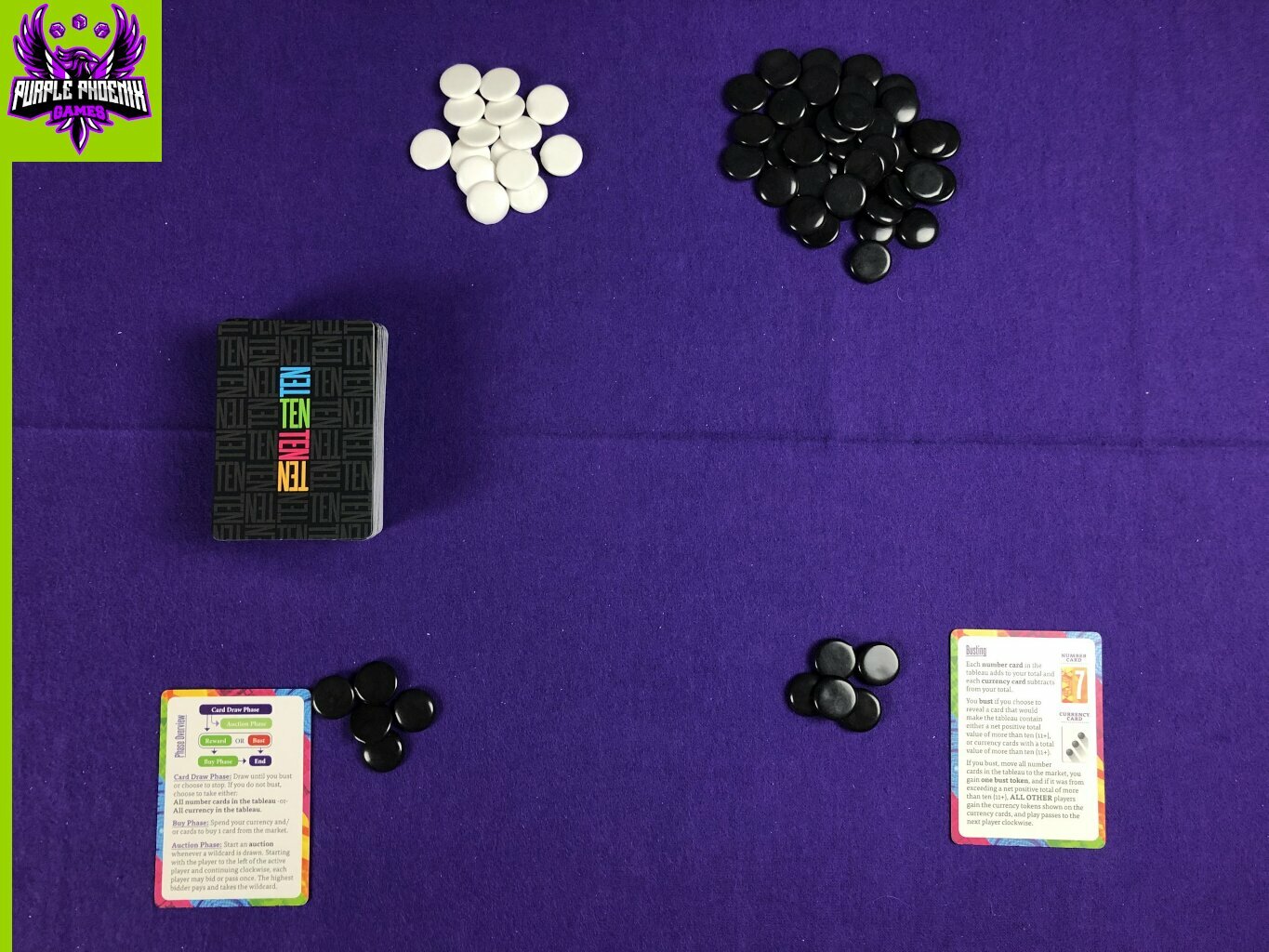
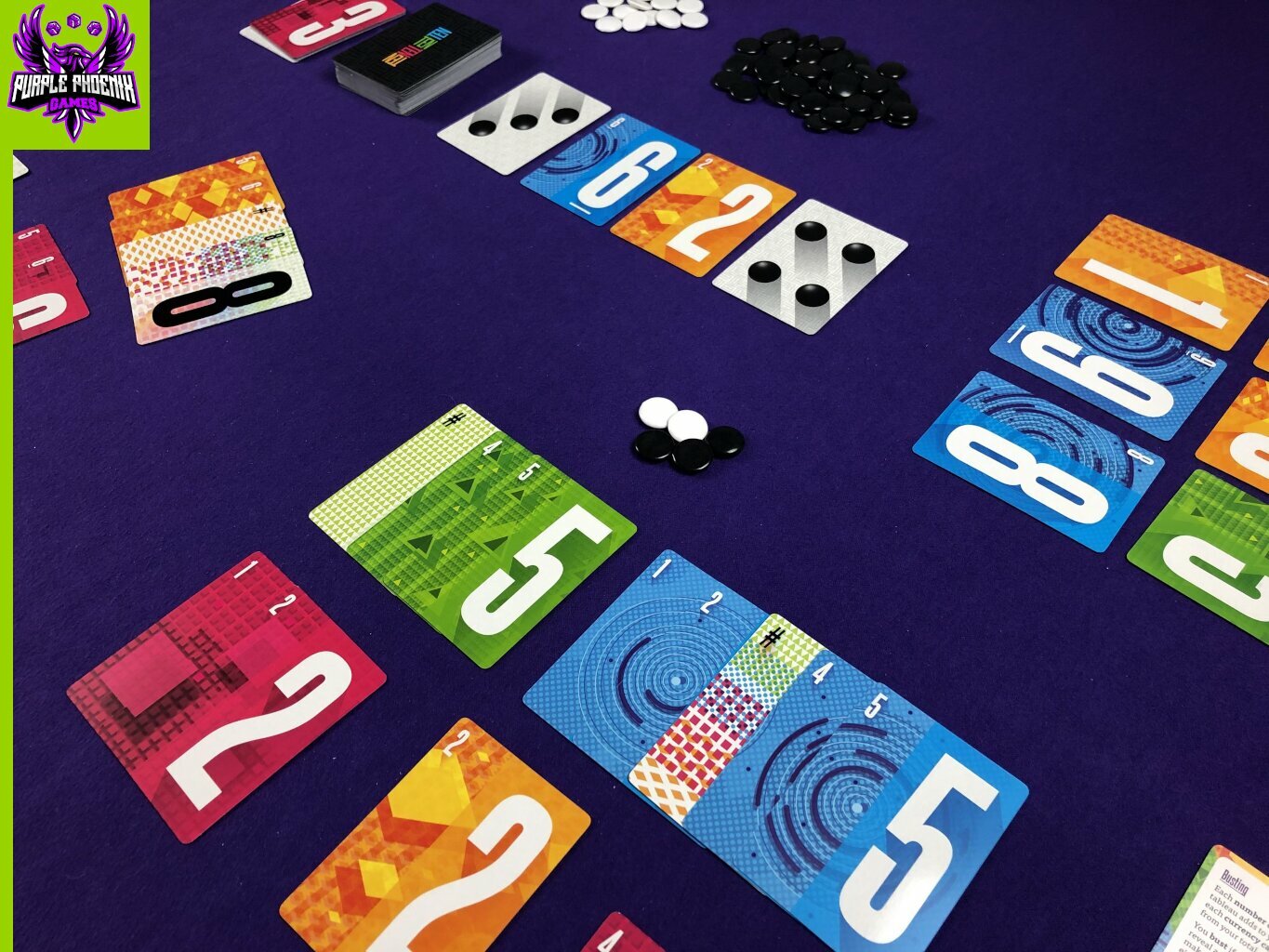
On your turn, you will perform a series of actions, the first of which is Draw a Card. You will draw a card from the top of the deck and place it in the tableau. If the card is a # card or a Currency card, you will then decide if you wish to continue drawing cards. If you do, draw the next card, and so on, until either you decide to stop or you Bust (more on this in a bit). As long as you do not Bust, you can decide when to stop drawing cards to the tableau. You may then take one of the following rewards: take all the # cards to your play area, or take Currency tokens (equal to the amount shown on the Currency cards in the tableau). When you take the # cards, they go into your play area and all other players will collect Currency tokens. You then have the opportunity to Buy a card from the Market (by paying the numeric value of the card) and add it to your play area. If you instead choose to collect Currency, you will take Currency equal to the total value of Currency in the tableau, and all other players receive nothing from your turn. All # cards are moved to the Market, and your turn ends. In the picture below, if I choose to take the # cards, I would take the Orange 2 and Blue 6 to my play area, and all other players would collect 7 Currency. Conversely, I could choose to take 7 Currency, and the # cards are added to the Market (on the right-hand side of the picture).
So how does Busting work? The tableau may never have a value of more than 10. Every # card you draw adds to your total value, and any Currency card drawn subtracts from the total. If you were to draw a # card that would give you a total value of more than 10, you Bust! OR if you ever have Currency cards that total more than 10, you Bust as well. So there’s a bit of math involved, with addition and subtraction, but you have to make sure you never get more than 10! For example, in the picture below, the net total value of the tableau is 1. (8 from # cards, -7 from Currency cards) If I were to draw a Currency card of 4-5, I would Bust, because that totals more than 10. In this pictured instance, any # card I draw would not make me Bust, as the highest total would only be a 10, given the current cards in play. If you ever push your luck too far and end up Busting, all # cards in the tableau are moved to the Market, and you gain a Bust token (worth 3 Currency). If you Busted with # cards, then all other players will collect Currency tokens, but if you Bust with Currency cards, nobody receives anything. After resolving a Bust, your turn ends and the game continues to the next player.
If, on your turn, you ever draw a Wildcard, your turn pauses and the Wildcard is auctioned. Each player will have one chance to either bid (increasing the bid from the previous) or pass. Whomever wins the auction must pay their bid, and they collect the Wildcard to their play area. Once the auction has been resolved, your turn continues as normal. It is possible to have multiple auctions on your turn – it all depends on the cards. The game continues in this fashion, players taking turns drawing cards, collecting cards/Currency, buying from the Market, bidding in auctions, etc., until the draw deck has been depleted. The active player finishes their turn as normal, but may not draw any more cards. Points are then tallied. All players will arrange their cards to create consecutive sequences of numbers in the 4 different colors. You receive 1 point per card in your longest sequence of each color. If you have a complete set of numbers 1-9 in a color, you get a bonus point. Players count up all their points, and the player with the highest value is the winner!
That kind of seems like a lot, but I promise it’s actually pretty intuitive when you get playing. Also, huge shoutout to AEG for providing such a well-done reference card – it includes a little flowchart to help you with how the turns flow. The gameplay itself is essentially pretty straightforward. You draw a card, and then react based on what it is. Bust? Collect a Bust token and your turn ends. No Bust? Decide if you want to keep drawing. Done pushing your luck? Collect either the # cards or Currency. Try to make sequential runs of numbers in the different colors – the more cards you get in sequence, the more points you’ll get at the end of the game. The thing that elevates TEN beyond a simple push-your-luck game to me is that it requires more strategy than just luck. You can see what cards are available in the Market – is there something you need to buy? You can see everyone else’s playing area – do they need any of the numbers you just revealed? You know how much Currency every player has – do you bid high on this Wildcard because your neighbor can’t outbid you? There is so much more than just luck in this game, and that is what takes it to the next level for me. I know that Travis has reviewed No, Thanks! in the past, and I would say that this gives me similar vibes, but way better in my opinion.
When it comes to playing games, I am generally not a huge risk-taker. I like making logical choices based on known information and end-game strategy. But something about this game just gets me. I think one element that makes me love this game is the different types of cards – # cards and Currency cards. When you’re pushing your luck and drawing cards, there’s an added element of excitement, because the two different types of cards affect the net total differently. It doesn’t all positively add to the net total, which makes me more likely to keep drawing in hopes that things will cancel out and I can maximize the turn. If everything all added together, and you just couldn’t get more than 10, I would probably only ever draw 2 cards per turn, max., just to make sure I didn’t Bust. But the fact that Currency cards subtract from the net total encourages players to keep pushing their luck, and either earning a big payoff or a big Bust. This game is exciting, engaging, and entertaining to play, and that makes it fun!
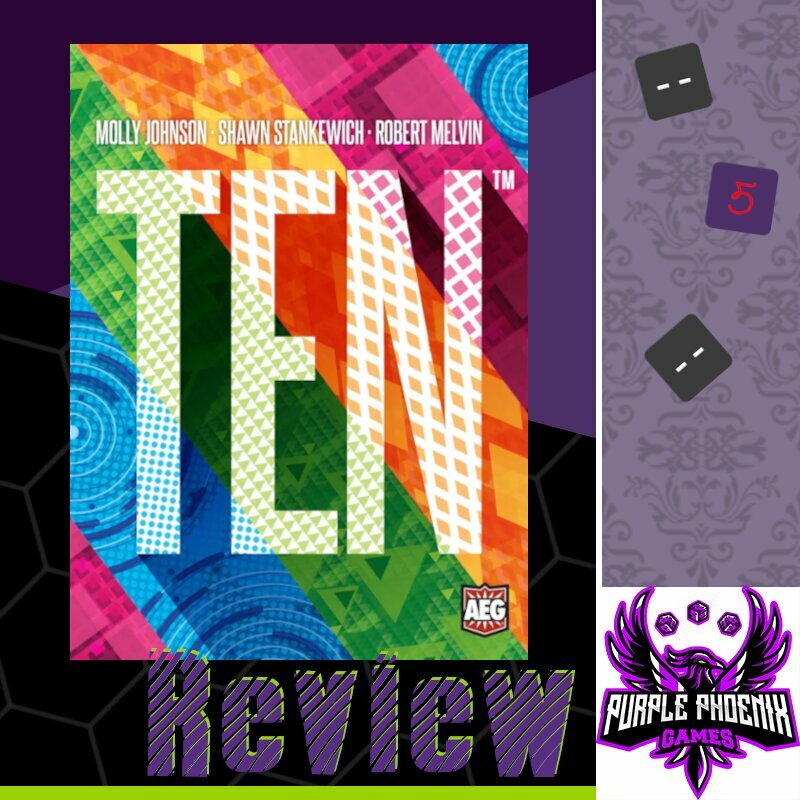
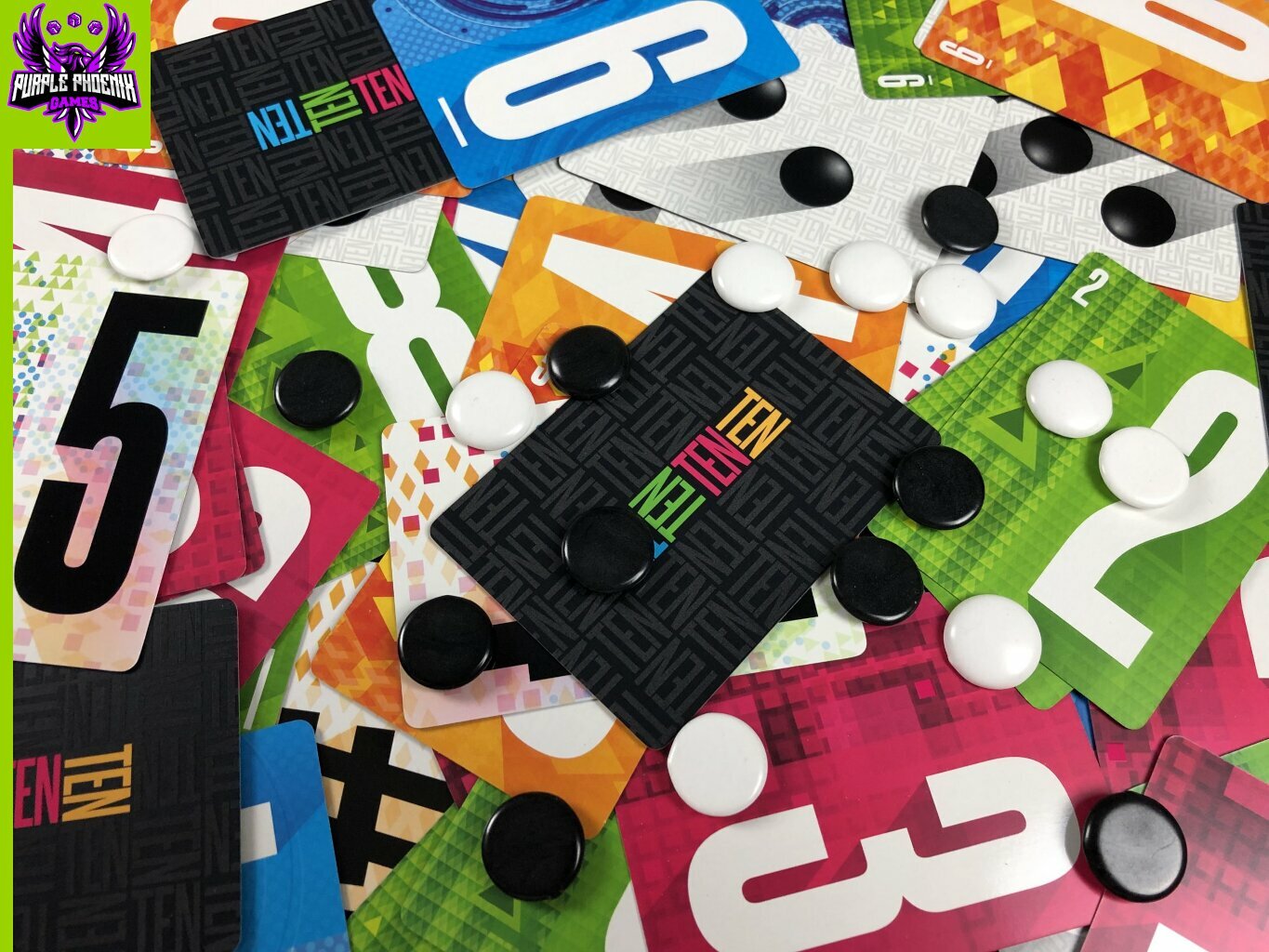
To touch on components, AEG always hits it out of the park – and TEN is no exception. The game is mostly just a bunch of cards, and some white/black Currency tokens. The tokens themselves are nice plastic, and are smooth and chunky in hand. The cards are thick and sturdy, and hold up to shuffling pretty well. The colors of the game are bright and vibrant, and they are very clear to differentiate between. It’s a nice pop of color on the table, and that adds to the overall enjoyment of the game. Each of the 4 colors, and the Wildcards for that matter, have a unique background design – which can help our colorblind friends who may not necessarily be able to differentiate between the colors. Just an added plus to help the gamers tell what cards belong to what colors! The game box is equally as colorful, and is eye-catching on the shelf. All in all, I’d say AEG gets a 10 for their production quality here. (Get it?)
I spoke earlier about judging a game by its mechanics, and how TEN really challenged me on that. I was expecting a game that I would like, but would be kind of just ok overall for me. What I got is a game that is highly strategic, yet also unpredictable at times. I am definitely a planner when it comes to strategy, but the unpredictability of this game is light, fun, and engaging for all players at all times. It just is fun to play. This is a game that I see staying in my collection for a long time, and hopefully getting to the table quite often when I need a quick filler that isn’t so light that it’s mindless, but not heavy enough that it’s a brain-burner. If you’re in the market for a fun little game that challenges all players, I would definitely recommend checking out TEN. Purple Phoenix Games rates our games on a scale of 1-6 (not 10 unfortunately in this case), and we give this one a solid 5 / 6.
Disclaimer: We were provided with a copy of TEN for the purposes of this review. This is a final production copy, so what you see pictured is what you would receive in a retail copy of the game. -L
TEN is a push-your-luck game of set collection and auction/bidding in which players are trying to amass the most points by the end of the game. Points are earned by collecting sets of numeric sequences in the 4 colors of the game: Blue, Green, Pink, and Orange. Played over a series of turns, players will be drawing/collecting cards from the tableau, buying cards from the Market, or Busting if they push their luck a bit too far. To setup for a game, assemble the deck of cards as dictated by the player count and set it in the play area. Each player gets 5 Currency tokens with which to start the game, and are all dealt a random reference card. The player who was dealt the reference card with the Starting Player symbol will begin the game. Before getting into the actual gameplay, I want to mention the different card types, as to provide a better understanding when reading this review. In each of the 4 colors, there are card values numbered 1-9, with more copies of the lower numbers and fewer of the higher numbers. There are also Wildcards that can be used to represent any #/color, depending on the card. Some cards in the deck are Currency cards and show a value of 1-5 Currency. Should you choose to take these from the tableau, you collect that amount of Currency to be used for auctions or buying cards in later turns.
On your turn, you will perform a series of actions, the first of which is Draw a Card. You will draw a card from the top of the deck and place it in the tableau. If the card is a # card or a Currency card, you will then decide if you wish to continue drawing cards. If you do, draw the next card, and so on, until either you decide to stop or you Bust (more on this in a bit). As long as you do not Bust, you can decide when to stop drawing cards to the tableau. You may then take one of the following rewards: take all the # cards to your play area, or take Currency tokens (equal to the amount shown on the Currency cards in the tableau). When you take the # cards, they go into your play area and all other players will collect Currency tokens. You then have the opportunity to Buy a card from the Market (by paying the numeric value of the card) and add it to your play area. If you instead choose to collect Currency, you will take Currency equal to the total value of Currency in the tableau, and all other players receive nothing from your turn. All # cards are moved to the Market, and your turn ends. In the picture below, if I choose to take the # cards, I would take the Orange 2 and Blue 6 to my play area, and all other players would collect 7 Currency. Conversely, I could choose to take 7 Currency, and the # cards are added to the Market (on the right-hand side of the picture).
So how does Busting work? The tableau may never have a value of more than 10. Every # card you draw adds to your total value, and any Currency card drawn subtracts from the total. If you were to draw a # card that would give you a total value of more than 10, you Bust! OR if you ever have Currency cards that total more than 10, you Bust as well. So there’s a bit of math involved, with addition and subtraction, but you have to make sure you never get more than 10! For example, in the picture below, the net total value of the tableau is 1. (8 from # cards, -7 from Currency cards) If I were to draw a Currency card of 4-5, I would Bust, because that totals more than 10. In this pictured instance, any # card I draw would not make me Bust, as the highest total would only be a 10, given the current cards in play. If you ever push your luck too far and end up Busting, all # cards in the tableau are moved to the Market, and you gain a Bust token (worth 3 Currency). If you Busted with # cards, then all other players will collect Currency tokens, but if you Bust with Currency cards, nobody receives anything. After resolving a Bust, your turn ends and the game continues to the next player.
If, on your turn, you ever draw a Wildcard, your turn pauses and the Wildcard is auctioned. Each player will have one chance to either bid (increasing the bid from the previous) or pass. Whomever wins the auction must pay their bid, and they collect the Wildcard to their play area. Once the auction has been resolved, your turn continues as normal. It is possible to have multiple auctions on your turn – it all depends on the cards. The game continues in this fashion, players taking turns drawing cards, collecting cards/Currency, buying from the Market, bidding in auctions, etc., until the draw deck has been depleted. The active player finishes their turn as normal, but may not draw any more cards. Points are then tallied. All players will arrange their cards to create consecutive sequences of numbers in the 4 different colors. You receive 1 point per card in your longest sequence of each color. If you have a complete set of numbers 1-9 in a color, you get a bonus point. Players count up all their points, and the player with the highest value is the winner!
That kind of seems like a lot, but I promise it’s actually pretty intuitive when you get playing. Also, huge shoutout to AEG for providing such a well-done reference card – it includes a little flowchart to help you with how the turns flow. The gameplay itself is essentially pretty straightforward. You draw a card, and then react based on what it is. Bust? Collect a Bust token and your turn ends. No Bust? Decide if you want to keep drawing. Done pushing your luck? Collect either the # cards or Currency. Try to make sequential runs of numbers in the different colors – the more cards you get in sequence, the more points you’ll get at the end of the game. The thing that elevates TEN beyond a simple push-your-luck game to me is that it requires more strategy than just luck. You can see what cards are available in the Market – is there something you need to buy? You can see everyone else’s playing area – do they need any of the numbers you just revealed? You know how much Currency every player has – do you bid high on this Wildcard because your neighbor can’t outbid you? There is so much more than just luck in this game, and that is what takes it to the next level for me. I know that Travis has reviewed No, Thanks! in the past, and I would say that this gives me similar vibes, but way better in my opinion.
When it comes to playing games, I am generally not a huge risk-taker. I like making logical choices based on known information and end-game strategy. But something about this game just gets me. I think one element that makes me love this game is the different types of cards – # cards and Currency cards. When you’re pushing your luck and drawing cards, there’s an added element of excitement, because the two different types of cards affect the net total differently. It doesn’t all positively add to the net total, which makes me more likely to keep drawing in hopes that things will cancel out and I can maximize the turn. If everything all added together, and you just couldn’t get more than 10, I would probably only ever draw 2 cards per turn, max., just to make sure I didn’t Bust. But the fact that Currency cards subtract from the net total encourages players to keep pushing their luck, and either earning a big payoff or a big Bust. This game is exciting, engaging, and entertaining to play, and that makes it fun!
To touch on components, AEG always hits it out of the park – and TEN is no exception. The game is mostly just a bunch of cards, and some white/black Currency tokens. The tokens themselves are nice plastic, and are smooth and chunky in hand. The cards are thick and sturdy, and hold up to shuffling pretty well. The colors of the game are bright and vibrant, and they are very clear to differentiate between. It’s a nice pop of color on the table, and that adds to the overall enjoyment of the game. Each of the 4 colors, and the Wildcards for that matter, have a unique background design – which can help our colorblind friends who may not necessarily be able to differentiate between the colors. Just an added plus to help the gamers tell what cards belong to what colors! The game box is equally as colorful, and is eye-catching on the shelf. All in all, I’d say AEG gets a 10 for their production quality here. (Get it?)
I spoke earlier about judging a game by its mechanics, and how TEN really challenged me on that. I was expecting a game that I would like, but would be kind of just ok overall for me. What I got is a game that is highly strategic, yet also unpredictable at times. I am definitely a planner when it comes to strategy, but the unpredictability of this game is light, fun, and engaging for all players at all times. It just is fun to play. This is a game that I see staying in my collection for a long time, and hopefully getting to the table quite often when I need a quick filler that isn’t so light that it’s mindless, but not heavy enough that it’s a brain-burner. If you’re in the market for a fun little game that challenges all players, I would definitely recommend checking out TEN. Purple Phoenix Games rates our games on a scale of 1-6 (not 10 unfortunately in this case), and we give this one a solid 5 / 6.

okletmereviewit (4 KP) rated Kubo and the Two Strings (2016) in Movies
May 11, 2018

A great film for any family night
Contains spoilers, click to show
Kubo and the two strings is a heart warming, coming of age movie, for the whole family. Adults, you will appericate the story line and the plight that Kubo undergoes. Kids will love the animation and the characters. From the moment that the movie started, I fought back the tears. You see a mother and baby in the middle of the ocean one moment and the next, you see them ship wrecked on a beach. You skip forward a few years to when Kubo is about the age of ten. He is now a caregiver for his mother who you come to understand as mentally ill, with something like alzheimer's or dementia. Daily young Kubo goes into the neighboring village and tells fantastic stories of a Samurai Knight, and how he battles the evil Moon King and his army, all while playing his Sangen (a Japanese Guitar) and creating Origami creatures for the story. But as the bells ring for night to come forth, Kubo runs home.
It seems that his mother only "comes to life" when its night time. And then shortly there after returns to a catatonic state. One day while in the village an old beggar woman who befriended him tells him a story of how she speaks with her dead husband at night during a certain ritual. Kubo, who is confused and longing to know anything about his father who was said to be the greatest Samurai, goes to the ancestral resting place and tries to summon his father.
Time gets away from him and night befalls rather quickly. Soon two masked spectral spirits appear, and tell him that they are his aunts. Kubo is then told the reason he is missing an eye is due to his grandfather who only wanted to have his other eye so that he could join them in the heavens. Kubo begins running back to the village. The two spirits attack and destroy the village. When they are almost upon him, his mother shows up and uses the last of her magics to activate a totem and to create wings to whisk him away to safety, far away from his blood thirsty aunts. Kubo then wakes up in a vast frozen waste land with a monkey looking after him. The monkey begins to address Kubo, telling him that they need to go on this quest to find a magical suite of armor that his father once wore. So Kubo and Monkey set off on a quest. Kubo is awaken by the monkey, saying that the origami papers that he carried in his pack, were flying around and that in his sleep he created an origami Samurai. The same Samurai from his stories. This little paper guardian, shows them the way to the armor's pieces, which consist of a sword, a breast plate, and a helmet. Along the way they come across a Beetle who was once a Samurai who was cursed to live the rest of his life as a beetle. After that the unlikely foursome come across a cave that has the sword in it. But much like Kubos life, it was not an easy task to retrieve it as it awakened a tall skeleton warrior, which they had to defeat. They then come to a large body of water, which Kubo uses his magic and his Samgen to create a boat made out of leaves. Monkey exclaims to him how his power is growing. As they set sail, the little paper Samurai point out that the breast plate is at the bottom of the water. Kubo remembering a story that his mother told him, of eyes that show you what you want to see most, lived at the bottom of the water. Beetle offers to dive in and look for the breast plate as "beetles can hold their breaths for a really long time under water, and are great swimmers." After quite some time passes Kubo dives in after Beetle and the breast plate. Monkey is then attacked by one of the evil aunts. While Kubo is under the water he finds the breast plate, and the eyes. They show him that the Monkey is actually his mother in the form of a spirit totem (MIND BLOWN)...Becoming dazzled by the eyes, he begins to drowned. Beetle swoops in and begins shooting the eyes and rescues Kubo. During this time Monkey is battling one of the aunts and defeats her. Kubo and the gang then continue their quest to find the helmet, which is back at his fathers fort. Once back at the fort one of the aunts reveals to Kubo and to Monkey that Beetle is actually Kubos father. So Kubo now armed with this new knowledge is able to defeat his aunt, but not after losing both his parents again. Kubo then uses his magic, to fly back to his village to adorn the helmet to complete his suite of armor. He then has to battle his grandfather The Moon King. At which point The Moon King transforms into a giant centipede like demon. Kubo uses his wits, and magic, to defeat his grandfather and makes him mortal. In his mortal state he loses his memories, and the village people tell him how he was a just and honest man, and how he was kind. The story ends on an upswing.
Over all the movie was really good. I love how engaging it was, and all the attention to detail they provided in it since it was a stop motion claymation. I highly recommend this for any family night.
It seems that his mother only "comes to life" when its night time. And then shortly there after returns to a catatonic state. One day while in the village an old beggar woman who befriended him tells him a story of how she speaks with her dead husband at night during a certain ritual. Kubo, who is confused and longing to know anything about his father who was said to be the greatest Samurai, goes to the ancestral resting place and tries to summon his father.
Time gets away from him and night befalls rather quickly. Soon two masked spectral spirits appear, and tell him that they are his aunts. Kubo is then told the reason he is missing an eye is due to his grandfather who only wanted to have his other eye so that he could join them in the heavens. Kubo begins running back to the village. The two spirits attack and destroy the village. When they are almost upon him, his mother shows up and uses the last of her magics to activate a totem and to create wings to whisk him away to safety, far away from his blood thirsty aunts. Kubo then wakes up in a vast frozen waste land with a monkey looking after him. The monkey begins to address Kubo, telling him that they need to go on this quest to find a magical suite of armor that his father once wore. So Kubo and Monkey set off on a quest. Kubo is awaken by the monkey, saying that the origami papers that he carried in his pack, were flying around and that in his sleep he created an origami Samurai. The same Samurai from his stories. This little paper guardian, shows them the way to the armor's pieces, which consist of a sword, a breast plate, and a helmet. Along the way they come across a Beetle who was once a Samurai who was cursed to live the rest of his life as a beetle. After that the unlikely foursome come across a cave that has the sword in it. But much like Kubos life, it was not an easy task to retrieve it as it awakened a tall skeleton warrior, which they had to defeat. They then come to a large body of water, which Kubo uses his magic and his Samgen to create a boat made out of leaves. Monkey exclaims to him how his power is growing. As they set sail, the little paper Samurai point out that the breast plate is at the bottom of the water. Kubo remembering a story that his mother told him, of eyes that show you what you want to see most, lived at the bottom of the water. Beetle offers to dive in and look for the breast plate as "beetles can hold their breaths for a really long time under water, and are great swimmers." After quite some time passes Kubo dives in after Beetle and the breast plate. Monkey is then attacked by one of the evil aunts. While Kubo is under the water he finds the breast plate, and the eyes. They show him that the Monkey is actually his mother in the form of a spirit totem (MIND BLOWN)...Becoming dazzled by the eyes, he begins to drowned. Beetle swoops in and begins shooting the eyes and rescues Kubo. During this time Monkey is battling one of the aunts and defeats her. Kubo and the gang then continue their quest to find the helmet, which is back at his fathers fort. Once back at the fort one of the aunts reveals to Kubo and to Monkey that Beetle is actually Kubos father. So Kubo now armed with this new knowledge is able to defeat his aunt, but not after losing both his parents again. Kubo then uses his magic, to fly back to his village to adorn the helmet to complete his suite of armor. He then has to battle his grandfather The Moon King. At which point The Moon King transforms into a giant centipede like demon. Kubo uses his wits, and magic, to defeat his grandfather and makes him mortal. In his mortal state he loses his memories, and the village people tell him how he was a just and honest man, and how he was kind. The story ends on an upswing.
Over all the movie was really good. I love how engaging it was, and all the attention to detail they provided in it since it was a stop motion claymation. I highly recommend this for any family night.
Purple Phoenix Games (2266 KP) rated Dinosaur Island in Tabletop Games
Jun 12, 2019
One of the best parts of the board gaming experience is finding a fun group of people with whom to play! Sometimes, though, coordinating a game night is easier said than done. We all must occasionally forego the group experience and face the world as the Lonely Only. But fear not! The world of solo-play is a vast and exciting realm! What follows is a chronicle of my journey into the solo-playing world – notes on gameplay, mechanics, rules, difficulty, and overall experience with solo variations of commonly multiplayer games! I hope this will provide some insight as you continue to grow your collection, or explore your already owned games!
In Dinosaur Island, you have successfully created a theme park of the Jurassic variety (see what I did there?), and are now tasked with managing and supervising the day-to-day operations. Think “Zoo Tycoon” on steroids. You have to collect new DNA, upgrade your facilities, build new attractions, hire specialists, oversee your workers, and create new dinosaurs to populate your park! Make sure you manage your resources wisely for maximum benefit, and keep a close eye on the security of your park to ensure the safety of your guests! The goal is to create and maintain the most successful dinosaur park!
DISCLAIMER: An expansion exists for Dinosaur Island, and I do own it, but I have yet to incorporate it into my games. Once I get some experience with the expansion, I will either amend this review or address it in a separate post! -L
Let me first begin this review by saying that there is A LOT going on in this game. Seriously, a lot. And it can be pretty overwhelming at first. But one thing I cannot praise enough about Dinosaur Island is its rulebook. It’s kind of hefty, but it is so detailed and clear (with numerous examples) that I understood how to play the game on my first read-through. And sometimes with games that have so many moving elements, total understanding from the get-go can be rare, for me especially. The excellent rulebook makes a seemingly daunting game not so scary. I always keep the rulebook on hand when I play (just to be safe!), but once I got the hang of all of the steps, I don’t really need to refer back to it anymore!
As a solo game, Dinosaur Island plays very similarly as it does in group play with a few minor differences. For one, no regular Objective cards are used – instead you use a set of specified Solo Objective cards. Next, to simulate player interaction during the Research and Market Phases, the solo player draws a card from an AI deck and eliminates the options/discards the resources listed on the card – this mimics group play in the sense that turn order changes every round and you do not always get your first pick during these phases. The remaining 2 Phases (Worker and Park) occur simultaneously and involve no player interaction, so those are played as normal. One final difference between group and solo play is that the solo player can choose to play without Plot Twist cards. A solo game is played over the course of 7 total rounds, and the overall goal of the game remains the same – amass the most Victory Points.
The trickiest part of playing Dinosaur Island solo, for me, has to do with the Solo Objectives. You have 7 Solo Objectives to be completed throughout the game, and they reward Victory Points based on the round in which they were completed – finishing objectives in earlier rounds yields a higher number of points. If you are unable to complete any objective in a given round, you must discard one (of your choice) at the end of that round. The hard thing is that depending on which objectives are currently in play, it can be difficult to complete one each round to earn those points. Some things take time (and a couple of rounds) to be able to complete – like “Reach a threat level of 15.” If you have multiple long-term objectives in play, they can really limit the number of points you can earn from them. A nice mix of objectives (both short-term and long-term) can help balance out the game a little more, but it’s ultimately a luck of the draw.
One positive thing I can say about the objectives, though, is that they really force you to come up with a multi-faceted strategy. Depending on which objectives are in play, you have to decide on a logical strategy and order in which to complete them for maximum points. You can’t just focus on one objective – you also need to be setting yourself up to complete future objectives. I never feel like I’m just going through the motions because I always need to be thinking ahead to my future rounds.
The thing I really like about Dinosaur Island as a solo game is that it is still extremely engaging. I’m not a huge fan of “Beat your own personal best” solo games, but this one keeps me so involved that I don’t mind the fact that there’s no real ‘winner.’ Since a group game doesn’t involve that much player interaction anyway, Dinosaur Island doesn’t really even necessarily feel like a solo game. Every play requires a different strategy, and that makes it feel like a new game every time. If you enjoy Dinosaur Island in a group setting, give it a try as a solo game. There’s really not much of a gameplay difference, and I think you’ll enjoy it just as much!
https://purplephoenixgames.wordpress.com/2019/05/21/solo-chronicles-dinosaur-island/
In Dinosaur Island, you have successfully created a theme park of the Jurassic variety (see what I did there?), and are now tasked with managing and supervising the day-to-day operations. Think “Zoo Tycoon” on steroids. You have to collect new DNA, upgrade your facilities, build new attractions, hire specialists, oversee your workers, and create new dinosaurs to populate your park! Make sure you manage your resources wisely for maximum benefit, and keep a close eye on the security of your park to ensure the safety of your guests! The goal is to create and maintain the most successful dinosaur park!
DISCLAIMER: An expansion exists for Dinosaur Island, and I do own it, but I have yet to incorporate it into my games. Once I get some experience with the expansion, I will either amend this review or address it in a separate post! -L
Let me first begin this review by saying that there is A LOT going on in this game. Seriously, a lot. And it can be pretty overwhelming at first. But one thing I cannot praise enough about Dinosaur Island is its rulebook. It’s kind of hefty, but it is so detailed and clear (with numerous examples) that I understood how to play the game on my first read-through. And sometimes with games that have so many moving elements, total understanding from the get-go can be rare, for me especially. The excellent rulebook makes a seemingly daunting game not so scary. I always keep the rulebook on hand when I play (just to be safe!), but once I got the hang of all of the steps, I don’t really need to refer back to it anymore!
As a solo game, Dinosaur Island plays very similarly as it does in group play with a few minor differences. For one, no regular Objective cards are used – instead you use a set of specified Solo Objective cards. Next, to simulate player interaction during the Research and Market Phases, the solo player draws a card from an AI deck and eliminates the options/discards the resources listed on the card – this mimics group play in the sense that turn order changes every round and you do not always get your first pick during these phases. The remaining 2 Phases (Worker and Park) occur simultaneously and involve no player interaction, so those are played as normal. One final difference between group and solo play is that the solo player can choose to play without Plot Twist cards. A solo game is played over the course of 7 total rounds, and the overall goal of the game remains the same – amass the most Victory Points.
The trickiest part of playing Dinosaur Island solo, for me, has to do with the Solo Objectives. You have 7 Solo Objectives to be completed throughout the game, and they reward Victory Points based on the round in which they were completed – finishing objectives in earlier rounds yields a higher number of points. If you are unable to complete any objective in a given round, you must discard one (of your choice) at the end of that round. The hard thing is that depending on which objectives are currently in play, it can be difficult to complete one each round to earn those points. Some things take time (and a couple of rounds) to be able to complete – like “Reach a threat level of 15.” If you have multiple long-term objectives in play, they can really limit the number of points you can earn from them. A nice mix of objectives (both short-term and long-term) can help balance out the game a little more, but it’s ultimately a luck of the draw.
One positive thing I can say about the objectives, though, is that they really force you to come up with a multi-faceted strategy. Depending on which objectives are in play, you have to decide on a logical strategy and order in which to complete them for maximum points. You can’t just focus on one objective – you also need to be setting yourself up to complete future objectives. I never feel like I’m just going through the motions because I always need to be thinking ahead to my future rounds.
The thing I really like about Dinosaur Island as a solo game is that it is still extremely engaging. I’m not a huge fan of “Beat your own personal best” solo games, but this one keeps me so involved that I don’t mind the fact that there’s no real ‘winner.’ Since a group game doesn’t involve that much player interaction anyway, Dinosaur Island doesn’t really even necessarily feel like a solo game. Every play requires a different strategy, and that makes it feel like a new game every time. If you enjoy Dinosaur Island in a group setting, give it a try as a solo game. There’s really not much of a gameplay difference, and I think you’ll enjoy it just as much!
https://purplephoenixgames.wordpress.com/2019/05/21/solo-chronicles-dinosaur-island/
Gareth von Kallenbach (980 KP) rated Call of Duty: Ghosts - Onslaught in Video Games
Jun 19, 2019
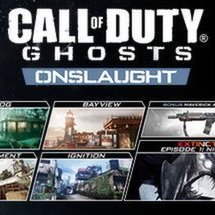
Call of Duty: Ghosts gets a much needed update with the release of Onslaught, the first of four planned DLC packs for the game.
The new content requires the full version of Ghosts to play and offers up a plethora of content including four new maps, a dual mode weapon, and a new episode of the alien invasion game, Extinction.
For me Ghosts was filled with frustration on the multiplay side as I found many maps were too large and encouraged camping, which as anyone who has been spawn killed numerous times in a row will tell you, leads quickly to frustration.
First off the new Maverick Assault rifle offers power and a high rate of fire for up close and personal combat. For those wanting to do their dirty work from afar, there is also a sniper rifle customization that will give fans of sniper action plenty of options.
The new maps are some of the most fun I have had in Ghosts and for me, were more enjoyable than many of the maps that shipped with the game as they allow for multiple styles of gameplay.
Bayview
Is a whimsical and fun map set in a California Coastal town. It is great for close quarters and run and gun gamers like myself, but has plenty of tactical spots for those that like ranged attacks. The great thing about the map is that it is lots of fun to play.
Running through gift shops, restaurants, the aquarium, and other tourists locales made this a very fun and engaging map. The action is intense and you can even take a ride on the trolley car that roams the boardwalk. One inspired gamer but his Sentry Gun on the car and watched as it road up and down the map picking off enemies that dared get near the tram.
I loved seeing the naval units off on the horizon in a pitched battle which made me think of the action in Modern Warfare 3.
Containment
This is a battle in an abandoned Mexican village after a truck has crashed and spilled nuclear material. The combat is on two levels on two sides of the town with a No Man’s Land in the middle in the guise of a partially destroyed bridge.
From a bar, a church, and the streets, the action is intense in both ranged and close-quarter combat and the map offers plenty of charm and diversity.
Some like to snipe from the windows while others like myself like to sneak their way across and battle in the blasted out bars and shops of the town.
Ignition
Set in an abandoned launch facility I had to dodge firing rockets, sniper fire, and all manner of nooks and hiding spaces for enemy units to attack me from. This is a large map that is spread out but there are some great areas for players to get results with a little planning.
The map has long corridors that provide plenty of options to snipers but also numerous options in which to flank and attack. There is even a plane fuselage for players to travel through as well as plenty of multilevel and cover laden office buildings and labs.
The rockets will randomly fire and setting off either of the two engines will result in some great things happening to the enemy units and with careful planning, players can blast away while they run for cover.
Fog
This is a creepy and quirky map that is set in a swamp like area complete with caves, fog, shacks, and uneven terrain. At first I did not like it as although nice to look at, it seemed to encourage camping and sniping. My thoughts on the map changed the next time through thanks to the run and gun style of play that was going on. Suddenly I heard the familiar music from “Halloween”, and Michael Myers himself appeared and dispatched me and several of my team with an axe.
Several shots and grenades did not slow Myers down at all so I learned it is best to stay away from him or simply accept multiple deaths while he is on the map, unless you can get several shots off while he is busy dispatching others.
If a player completes a certain Field Order, they become Myers and the music will let everyone know to prepare.
For fans of Extinction, there is a new episode called Nightfall which introduces two new alien threats as well as a new weapon and challenges for players to survive as it is a highly enjoyable adventure. This content actually builds on the whole experience and to me seemed like a vital and necessary part rather than a simple bonus map.
I can honestly say that this is the most fun I have had with any of the DLC for Call of Duty as while I have enjoyed maps in the past, I have not had a collection where I enjoyed playing all the maps as much as I have this one and what is a bigger surprise to me is how much it has restored the fun and enjoyment that was missing in Ghosts for me as for the first time since Black Ops 2, I am eager to get back to the fight and level up my character.
While hit counts, play balance, and hackers still hamper the game, the review is for the new content and not the game as a whole and as such, Onslaught delivers in a big way.
Activision recently announced that the second DLC pack named Devastation will appear on the Xbox Consoles in April with the PS 3 and PC versions to follow.
http://sknr.net/2014/03/09/call-of-duty-onslaught/
The new content requires the full version of Ghosts to play and offers up a plethora of content including four new maps, a dual mode weapon, and a new episode of the alien invasion game, Extinction.
For me Ghosts was filled with frustration on the multiplay side as I found many maps were too large and encouraged camping, which as anyone who has been spawn killed numerous times in a row will tell you, leads quickly to frustration.
First off the new Maverick Assault rifle offers power and a high rate of fire for up close and personal combat. For those wanting to do their dirty work from afar, there is also a sniper rifle customization that will give fans of sniper action plenty of options.
The new maps are some of the most fun I have had in Ghosts and for me, were more enjoyable than many of the maps that shipped with the game as they allow for multiple styles of gameplay.
Bayview
Is a whimsical and fun map set in a California Coastal town. It is great for close quarters and run and gun gamers like myself, but has plenty of tactical spots for those that like ranged attacks. The great thing about the map is that it is lots of fun to play.
Running through gift shops, restaurants, the aquarium, and other tourists locales made this a very fun and engaging map. The action is intense and you can even take a ride on the trolley car that roams the boardwalk. One inspired gamer but his Sentry Gun on the car and watched as it road up and down the map picking off enemies that dared get near the tram.
I loved seeing the naval units off on the horizon in a pitched battle which made me think of the action in Modern Warfare 3.
Containment
This is a battle in an abandoned Mexican village after a truck has crashed and spilled nuclear material. The combat is on two levels on two sides of the town with a No Man’s Land in the middle in the guise of a partially destroyed bridge.
From a bar, a church, and the streets, the action is intense in both ranged and close-quarter combat and the map offers plenty of charm and diversity.
Some like to snipe from the windows while others like myself like to sneak their way across and battle in the blasted out bars and shops of the town.
Ignition
Set in an abandoned launch facility I had to dodge firing rockets, sniper fire, and all manner of nooks and hiding spaces for enemy units to attack me from. This is a large map that is spread out but there are some great areas for players to get results with a little planning.
The map has long corridors that provide plenty of options to snipers but also numerous options in which to flank and attack. There is even a plane fuselage for players to travel through as well as plenty of multilevel and cover laden office buildings and labs.
The rockets will randomly fire and setting off either of the two engines will result in some great things happening to the enemy units and with careful planning, players can blast away while they run for cover.
Fog
This is a creepy and quirky map that is set in a swamp like area complete with caves, fog, shacks, and uneven terrain. At first I did not like it as although nice to look at, it seemed to encourage camping and sniping. My thoughts on the map changed the next time through thanks to the run and gun style of play that was going on. Suddenly I heard the familiar music from “Halloween”, and Michael Myers himself appeared and dispatched me and several of my team with an axe.
Several shots and grenades did not slow Myers down at all so I learned it is best to stay away from him or simply accept multiple deaths while he is on the map, unless you can get several shots off while he is busy dispatching others.
If a player completes a certain Field Order, they become Myers and the music will let everyone know to prepare.
For fans of Extinction, there is a new episode called Nightfall which introduces two new alien threats as well as a new weapon and challenges for players to survive as it is a highly enjoyable adventure. This content actually builds on the whole experience and to me seemed like a vital and necessary part rather than a simple bonus map.
I can honestly say that this is the most fun I have had with any of the DLC for Call of Duty as while I have enjoyed maps in the past, I have not had a collection where I enjoyed playing all the maps as much as I have this one and what is a bigger surprise to me is how much it has restored the fun and enjoyment that was missing in Ghosts for me as for the first time since Black Ops 2, I am eager to get back to the fight and level up my character.
While hit counts, play balance, and hackers still hamper the game, the review is for the new content and not the game as a whole and as such, Onslaught delivers in a big way.
Activision recently announced that the second DLC pack named Devastation will appear on the Xbox Consoles in April with the PS 3 and PC versions to follow.
http://sknr.net/2014/03/09/call-of-duty-onslaught/
Gareth von Kallenbach (980 KP) rated Mission: Impossible III (2006) in Movies
Aug 14, 2019

The summer movie season of 2006 is underway with the release of Mission Impossible 3 which once again stars Tome Cruise as agent Ethan Hunt. The film opens with a tense interrogation scene with an icily cold Philip Seymour Hoffman threatening to shoot a woman unless Ethan reveals the location of something called “The Rabbits Foot”.
The film then goes back in time where Ethan is busy entertaining at a party for his pending marriage where it is learned that he has put his days in the field behind him to be a training instructor as well as his pending marriage to Julia (Michelle Monaghan).
No sooner does the party get info full swing when Ethan is summed to a meeting by a phone call. During the meeting he is given a secret message and learns that one of his prize pupils, Lindsey (Keri Russell), has been captured by a known arms dealer named Owen Davian (Hoffman).
Normal policy is should an agent be captured, they are disavowed and on their own, but for this case, an exception is made and a plan is put into place to retrieve Lindsey. Despite his misgivings, Ethan is drawn back into the fray and joins the rescue team in Berlin.
What at first seems to be a text book rescue takes an unexpected twist and lands Ethan and his team afoul of the company director Brassel (Lawrence Fishburne). This sets the stage for a future operation to obtain Davian at the Vatican as it is hoped they can learn to whom he intends to deliver an item known as “The Rabbits Foot” and exactly what it is.
While things at first seem to go as planned, before long, Ethan and his team must deal with forces outside of their mission plan and are soon caught up in a situation that has grown larger than anyone could have predicted, and with dire consequences.
Sadly, despite the good setup, the film goes very wrong and very fast. One issue that arises is a plot so filled with holes and complications it makes even the most hackneyed summer movie plot seem like a Shakespearean wannabe in comparison. The film goes from one scenario to another with all sorts of new complications many of which are never fully explained, or worse yet left hanging.
Characters act a certain way only to change pace in the film without any explanation. One such scenario involves a character who helps Ethan only to later be revealed as a bad guy, yet the how, where, and why of their actions are never explained, as is one of the key plot devices that drives the film.
While I am willing to expect a certain amount of non-sequitors for a summer movie, the number that M.I. 3” tosses out is ludicrous.
Another glaring issue with the film is the action sequences. Yes, there are a few well planned sequences such as a helicopter chase and a daring battle on a bridge, but they all seem surprisingly flat and lack any real tension or drama. They just simply unfold without fully engaging the viewer.
Another issue is that Director J.J. Abrams uses very close camera angles for some of the action sequences which when combined with the shaky camera style, results in sequences that are very hard to watch due to the frantic motion. I am all for realism, but when I cannot fully understand what is going on as the camera is bouncing all over the scene, then this is a problem.
The final frustration I had with the film falls solely with Cruise himself. Yes I can separate all of the recent off camera exploits that have been well documented the past year, but what I do have an issue with is how unfit Cruise seems for the part. The man is a very good performer with a long history of box office success. Yet, his diminutive size does not make me believe him as an action star. It is hard to believe that he is capable of doing such daring acts of strength as well as dispatching all manner of imposing bad guys. In a very underwhelming finale, Hoffman seemed much more suited as a character of menace as his look and the way he carried himself was one of power. With Cruise, I kept seeing a person trying to make me believe his character was tough guy, and I simply was not buying it. The same was also true for his relationship with Julia. The utter lack of chemistry between them and the awkward and stiff love scenes did nothing to make me believe that this is a person whom Ethan is willing to risk everything for.
Hoffman fresh off his Oscar win for “Capote” does the best he can with what is at best a stock character but he like the supporting Ving Rhames are not given much to work with.
The locales of the film are amazing but sadly they alone cannot carry the film. During the approximately Two Hour and 10 minute run time, there were about 40 minutes of real entertainment for me and much of this came at the start of the film.
While it is better than the last film in the series, the issues I documented above really hamper what could have been, and should have been not only the best film in the series, but is instead another hollow Summer Film that looks flashy, just as long as you do not remove the bumper sticker to see all the dents underneath.
The film then goes back in time where Ethan is busy entertaining at a party for his pending marriage where it is learned that he has put his days in the field behind him to be a training instructor as well as his pending marriage to Julia (Michelle Monaghan).
No sooner does the party get info full swing when Ethan is summed to a meeting by a phone call. During the meeting he is given a secret message and learns that one of his prize pupils, Lindsey (Keri Russell), has been captured by a known arms dealer named Owen Davian (Hoffman).
Normal policy is should an agent be captured, they are disavowed and on their own, but for this case, an exception is made and a plan is put into place to retrieve Lindsey. Despite his misgivings, Ethan is drawn back into the fray and joins the rescue team in Berlin.
What at first seems to be a text book rescue takes an unexpected twist and lands Ethan and his team afoul of the company director Brassel (Lawrence Fishburne). This sets the stage for a future operation to obtain Davian at the Vatican as it is hoped they can learn to whom he intends to deliver an item known as “The Rabbits Foot” and exactly what it is.
While things at first seem to go as planned, before long, Ethan and his team must deal with forces outside of their mission plan and are soon caught up in a situation that has grown larger than anyone could have predicted, and with dire consequences.
Sadly, despite the good setup, the film goes very wrong and very fast. One issue that arises is a plot so filled with holes and complications it makes even the most hackneyed summer movie plot seem like a Shakespearean wannabe in comparison. The film goes from one scenario to another with all sorts of new complications many of which are never fully explained, or worse yet left hanging.
Characters act a certain way only to change pace in the film without any explanation. One such scenario involves a character who helps Ethan only to later be revealed as a bad guy, yet the how, where, and why of their actions are never explained, as is one of the key plot devices that drives the film.
While I am willing to expect a certain amount of non-sequitors for a summer movie, the number that M.I. 3” tosses out is ludicrous.
Another glaring issue with the film is the action sequences. Yes, there are a few well planned sequences such as a helicopter chase and a daring battle on a bridge, but they all seem surprisingly flat and lack any real tension or drama. They just simply unfold without fully engaging the viewer.
Another issue is that Director J.J. Abrams uses very close camera angles for some of the action sequences which when combined with the shaky camera style, results in sequences that are very hard to watch due to the frantic motion. I am all for realism, but when I cannot fully understand what is going on as the camera is bouncing all over the scene, then this is a problem.
The final frustration I had with the film falls solely with Cruise himself. Yes I can separate all of the recent off camera exploits that have been well documented the past year, but what I do have an issue with is how unfit Cruise seems for the part. The man is a very good performer with a long history of box office success. Yet, his diminutive size does not make me believe him as an action star. It is hard to believe that he is capable of doing such daring acts of strength as well as dispatching all manner of imposing bad guys. In a very underwhelming finale, Hoffman seemed much more suited as a character of menace as his look and the way he carried himself was one of power. With Cruise, I kept seeing a person trying to make me believe his character was tough guy, and I simply was not buying it. The same was also true for his relationship with Julia. The utter lack of chemistry between them and the awkward and stiff love scenes did nothing to make me believe that this is a person whom Ethan is willing to risk everything for.
Hoffman fresh off his Oscar win for “Capote” does the best he can with what is at best a stock character but he like the supporting Ving Rhames are not given much to work with.
The locales of the film are amazing but sadly they alone cannot carry the film. During the approximately Two Hour and 10 minute run time, there were about 40 minutes of real entertainment for me and much of this came at the start of the film.
While it is better than the last film in the series, the issues I documented above really hamper what could have been, and should have been not only the best film in the series, but is instead another hollow Summer Film that looks flashy, just as long as you do not remove the bumper sticker to see all the dents underneath.
Gareth von Kallenbach (980 KP) rated Cloverfield (2008) in Movies
Aug 14, 2019
Shrouded in mystery and riding a wave of fan hype, “Cloverfield” has at last arrived in theaters and delivers the goods. The film is produced by J.J. Abrams who is the mastermind behind “LOST”, “Alias”, “Mission Impossible 3”, and the next “Star Trek Film”. With a pedigree like this, it is clear that Abrams has a clear understanding of what fans want in their action/fantasy and he supplies it in droves.
The film cleverly tells the story through footage from a video camera that has been recovered in what used to be Central Park. The audience informed of this in the opening scenes when a series of coded missives against a Government warning indicates that this footage is now classified.
The footage in the camera is footage of a group of friends preparing a surprise party for their friend Rob (Michael Stahl-David), who is about to go to Japan as part of his new job as a V.P. of his company. The fact that such a young man has raised to such a prestigious position shows that Rob is clearly a motivated young man with a future, and based on the large turnout at his party, a very popular one at that.
Through footage that has been recorded over and pops up occasionally in the film, we learn that Rob and his friend Beth (Odette Yustman) had a recent physical relationship that has caused issues between them due to Rob’s pending departure for Japan. This becomes heated at the party, as amongst the throngs of well wishers, Rob and Beth have a fight that ends with Beth leaving and Rob verbally lashing out at her.
As his brother Jason (Mike Vogel), and best friend Hud (T.J. Miller), try to console Rob, the party is wracked by a sever jolt, that startles everyone in attendance. Thinking it is an earthquake, the guests are informed via television that there has been a platform overturned in the harbor, and before the guests know what hit them, there is an explosion followed by the head of the Statue of Liberty hurling through the streets.
Horrified by the noise and destruction about them, many of the guests as well as the local populace seek to exit the city, and make their way toward bridges out of Manhattan. Things go from bad to worse, and Rob, Hud, Jason, and their friends soon find themselves trapped.
Wracked by guilt over his conversation with Beth, Rob is surprised when she calls him saying that she is injured and trapped, which forces Rob to make a decision, as he and his friends, race back towards the carnage, in an effort to save Beth instead of seeking the safety before them.
Thus the stage is set for one of the more entertaining films of this genre in recent memory. The film moves along briskly, as with a running time of an hour and ten minutes, never becomes dull or overstays its welcome.
The action is intense as Rob and his friends are faced with a world gone mad, as what was once thought to be a terrorist attack goes madly astray when they see a giant creature wrecking havoc on Manhattan despite the best efforts of the military.
The intense action combined with the constant unknown as well as the suspense of the situation helps place the audience into the shoes of the characters, who unlike most genre films, come across as very real characters, despite little attention to their histories. This works very well, as we know what we need to about them as they are clearly close friends who when faced in an amazing situation, support and listen to each other without turning on one another.
Some may question the lack of answers in the film as many of the who, what, when, and why’s of the situation are not clearly explained, but the film works this in, as the audience learns and sees, only what the group of ordinary people see as they flee the streets. Since they are not high ranking military or government types, they are not given the answer, nor do they become fixated on finding them, as they are simply trying to survive.
Since the film is shot from a video camera, there are many scenes that are very herky-jerky, and some people exiting our screener mentioned that they were a bit dizzy from all of the motion. While it was at times difficult, it was also very realistic, and added to the immersion process, as you at times truly felt like you were right at Rob’s side with his friends. I did have to question how the camera, which was on constantly during the ordeal, never lost charge or needed to have the battery replaced, but in fantasy, suspension of belief is often a key criteria to propel the plot.
Much has been speculated as to the creature that is key to the plot of the film as very fan sites have run wild with speculation and claims to have the inside story. While I will not ruin the surprise, I will say that it turns out to be highly effective and engaging, and only adds to the mystery and horror of the situation. Once again, Abrams and company are to be applauded for taking an old formula of a creature on the loose in a large city, and making it fresh and invigorating.
“Cloverfield” is a solid and highly entertaining film, that would stand up with any of the past summer blockbusters and was a very welcome and refreshing way to kick off the 08 movie year, and a nice change from the comedies and dramas that usually dominate theaters this time of year.
The film cleverly tells the story through footage from a video camera that has been recovered in what used to be Central Park. The audience informed of this in the opening scenes when a series of coded missives against a Government warning indicates that this footage is now classified.
The footage in the camera is footage of a group of friends preparing a surprise party for their friend Rob (Michael Stahl-David), who is about to go to Japan as part of his new job as a V.P. of his company. The fact that such a young man has raised to such a prestigious position shows that Rob is clearly a motivated young man with a future, and based on the large turnout at his party, a very popular one at that.
Through footage that has been recorded over and pops up occasionally in the film, we learn that Rob and his friend Beth (Odette Yustman) had a recent physical relationship that has caused issues between them due to Rob’s pending departure for Japan. This becomes heated at the party, as amongst the throngs of well wishers, Rob and Beth have a fight that ends with Beth leaving and Rob verbally lashing out at her.
As his brother Jason (Mike Vogel), and best friend Hud (T.J. Miller), try to console Rob, the party is wracked by a sever jolt, that startles everyone in attendance. Thinking it is an earthquake, the guests are informed via television that there has been a platform overturned in the harbor, and before the guests know what hit them, there is an explosion followed by the head of the Statue of Liberty hurling through the streets.
Horrified by the noise and destruction about them, many of the guests as well as the local populace seek to exit the city, and make their way toward bridges out of Manhattan. Things go from bad to worse, and Rob, Hud, Jason, and their friends soon find themselves trapped.
Wracked by guilt over his conversation with Beth, Rob is surprised when she calls him saying that she is injured and trapped, which forces Rob to make a decision, as he and his friends, race back towards the carnage, in an effort to save Beth instead of seeking the safety before them.
Thus the stage is set for one of the more entertaining films of this genre in recent memory. The film moves along briskly, as with a running time of an hour and ten minutes, never becomes dull or overstays its welcome.
The action is intense as Rob and his friends are faced with a world gone mad, as what was once thought to be a terrorist attack goes madly astray when they see a giant creature wrecking havoc on Manhattan despite the best efforts of the military.
The intense action combined with the constant unknown as well as the suspense of the situation helps place the audience into the shoes of the characters, who unlike most genre films, come across as very real characters, despite little attention to their histories. This works very well, as we know what we need to about them as they are clearly close friends who when faced in an amazing situation, support and listen to each other without turning on one another.
Some may question the lack of answers in the film as many of the who, what, when, and why’s of the situation are not clearly explained, but the film works this in, as the audience learns and sees, only what the group of ordinary people see as they flee the streets. Since they are not high ranking military or government types, they are not given the answer, nor do they become fixated on finding them, as they are simply trying to survive.
Since the film is shot from a video camera, there are many scenes that are very herky-jerky, and some people exiting our screener mentioned that they were a bit dizzy from all of the motion. While it was at times difficult, it was also very realistic, and added to the immersion process, as you at times truly felt like you were right at Rob’s side with his friends. I did have to question how the camera, which was on constantly during the ordeal, never lost charge or needed to have the battery replaced, but in fantasy, suspension of belief is often a key criteria to propel the plot.
Much has been speculated as to the creature that is key to the plot of the film as very fan sites have run wild with speculation and claims to have the inside story. While I will not ruin the surprise, I will say that it turns out to be highly effective and engaging, and only adds to the mystery and horror of the situation. Once again, Abrams and company are to be applauded for taking an old formula of a creature on the loose in a large city, and making it fresh and invigorating.
“Cloverfield” is a solid and highly entertaining film, that would stand up with any of the past summer blockbusters and was a very welcome and refreshing way to kick off the 08 movie year, and a nice change from the comedies and dramas that usually dominate theaters this time of year.